German Migration to America: Johan Martin MOSER 1693-c.1743 Part One
This is the story of one of my many German ancestors. If he isn’t one of your ancestors this may not be of interest to you on it’s face. But if you have German ancestors who immigrated in the first half of the 18th century, there may be some things that you will want to add to your own story. Like many of the migrants from Europe to America they were heavily influenced by the stories of those who had made the trek and lived to write about it.
Although I had put together a genealogy in 2015 when you shift from writing a genealogy to writing a story—many new things come to light. Please take note that a Genealogy is not the same as a biography or family history. The latter gives more historical context and deeper research brings to life a much richer story. First off, we must note that there was no country of Germany during this period it was composed of duchies, independent states, or kingdoms. It was generally believed that God pre-ordained your station in life, so there was no possibility of upward mobility. The nobles protected, the clergy prayed, and the peasants worked. The reforms that Martin Luther brought led to the deep divisions between Catholics and Protestants. Do not underestimate the power of religion in a peasant’s daily life and as a means of upward mobility and its influence on immigration.
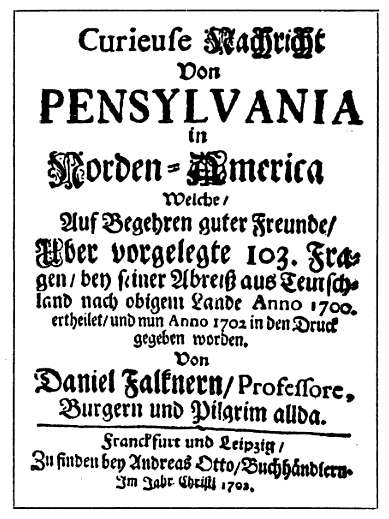
by Daniel Falckner 1703
When Johan Martin MOSER was just a year old he was living on a farm in Grossulrichshausen, Bavaria, Germany, Daniel FALCKNER, a professor and son of a Lutheran minister [also named Daniel FALCKNER] arrived in Philadelphia the 23rd of June 1694. He returned to Europe in 1698 where his book Accurate Tidings from Pennsylvania was published. He wrote for potential immigrants about what they might find in America via a series of 103 Questions.
The questions are incredibly insightful and here are a few:
- 1 How to contrive a voyage to America.
- 7 What is to be observed concerning ship and seasickness.
- 9 What is to be observed upon arrival in Virginia or Pennsylvania.
- 14 Regarding the fertility of the country.
- 17 Of the savages, their nations, numbers and languages.
- 32 How is it supposed that the savages came to America and in particular the different nations.
- 53 Whether all kinds of artisans cannot find subsistence there, and which in particular.
- 63 What kind of animals are there, both domestic and wild?
- 68 How to develop the country and bring about its proper uses and advantages.
- 86 To whom must one first report upon his arrival to America?
- 102 What manner of names do the savages have?
The answers to each question very between a paragraph and a page or so. They are full of piety and amusing reflections in the context of the time. Here is the first sentence in answer to Question 7: “Sea-sickness mostly affects people of bilious disposition and such as are inclined to vertigo and fear.” Question 63 begins: “With some exceptions, just the same as with us here. Among the exceptions is the jackass, which would be very useful there.” These books gave very practical advice and information and were to have a profound impact on the immigration of Germans and particularly Lutherans to Pennsylvania. I highly recommend perusing it.
GROSSULRICHSHAUSEN

Meanwhile in the hamlet of Grossulrichshausen, then in Mittlefranken [Middle Franconia] now Bavaria, Johan Martin MOSER was the seventh child, and 4th son, born to Adam MOSER and his wife Maria STRÖBEL. At the time of his birth Martin’s eldest brother, Adam, had already died. After Adam all the sons were named first Johan and a middle name which was generally the name by which they were known, so for sake of clarity I will refer to Johan Martin as Martin. His father, Adam MOSER, was a peasant farmer and shoemaker by trade. The family had recently moved from Altengrueth to Grossulrichshausen and the closest parish was Wörnitz, hardly a mile away. [Gross = large; Ulrich is likely the name of the farm or family and Hausen the Residence or House] This is a lovely rural setting with just a small cluster of farm buildings and houses. The field in the photo above was full of beautiful wildflowers when we visited.
When Martin was just two years old his mother died, the 15th of January 1695, leaving his father with six children. By May his father had remarried to Elisabetha WOLLINGER. To this marriage another five children were born between 1696 and 1707. Tragedy struck again in January of 1714 when his step-mother Elisabetha died. By this time Martin had just turned 21 and may not have been living on the farm. Later that year his father married for the third time to Apollonia GELLINGER the 6th of November 1714. At the time of this marriage Adam had ten children but some had already married. Apollonia was to give Adam 3 more children but only one survived more than a month. In total Adam sired 16 children by 3 wives over a period of 45 years!
WÖRNITZ
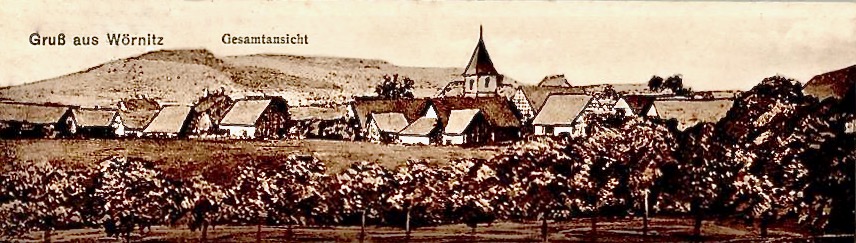
The Village of Wörnitz lies next to the river of the same name. The River Wörnitz begins at Schillingsfurst, 6 miles north of Wörnitz and then heads south 55 miles to Donauwörth where it meets the Danube River. There was a St. Martin’s chapel in Wörnitz as early as 741 and a chapel in 1392 which was later made into a fortified church. The oldest parts of the existing church are the choir room and bell tower which dates to 1519. From 1520 services held here were in the protestant rite [Lutheran]. During the Thirty Years War (1618-1648) the whole of the town burned except for the church, the rectory and the schoolhouse. Note at this early date that there was a schoolhouse! Martin Luther had been a proponent of early education. So David Falckner’s book may have been available at the schoolhouse where Martin was an educated.


Besides life on the farm much of Martin’s early life would have been centered around the church. It was here that he, Johan Martin MOSER, was baptized the 10th of January, 1693, perhaps named for the patron of the church St Martin or Martin Luther for whom Lutherans are named. Martin Luther was never canonized as his calls for reform got him excommunicated from the Catholic Church. Whereas, St. Martin of Tours died the 8th of November in 397 and his feast is celebrated as St. Martin’s day in Germany. It marks the end of the harvest season and the start of winter and the “reveling season.” St. Martin of Tours is known for his mercy, kindness and helping those most in need. Martin was the first of Adam’s children to be baptized here at St. Martins.


The Church was updated in 1709 when Martin was sixteen. The interior of the church was lengthened, widened and the height was raised perhaps to accommodate a growing population. The stones for the renovation came from a high defensive wall that was said to cast too much shadow on the church. New Baroque windows were installed on the north side, where the south gothic windows remained [as pictured above]. I can imagine the young Martin gazing at the sky and watching the Linden leaves dancing in the breeze.
WÖRNITZ LINDEN TREE
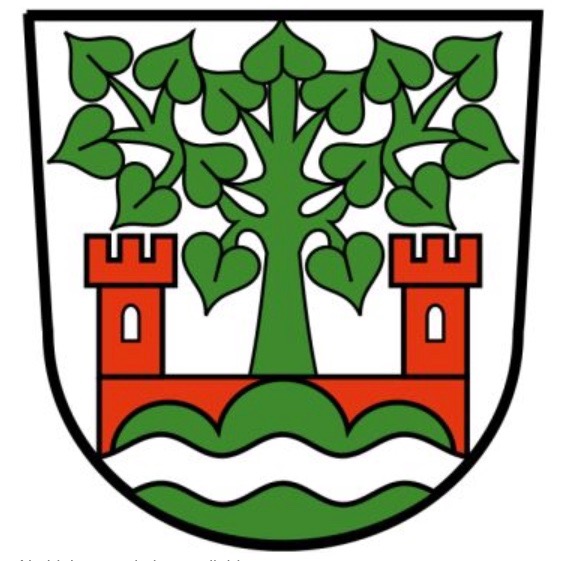
“[The] Linden will connect you to your roots, ancestry, your place of being.”
Andre Cullen
I simply must take a moment to tell you more about the center of life in Wörnitz. It is so important to the village that it appears on their Coat of Arms. To the west of St Martins church is a large Linden tree [Tilia cordata] and its history is worth repeating. The original Linden tree was planted the 10th of March 1653 in part to commemorate the end of the thirty years war. Six months later Adam MOSER was born and baptized in Weißenkirchberg about 6 miles to the east of Wörnitz. When Adam settled in Grossulrichshausen probably about 1692 the linden tree was nearly 40 years old. The original tree lived to be 308 years old!
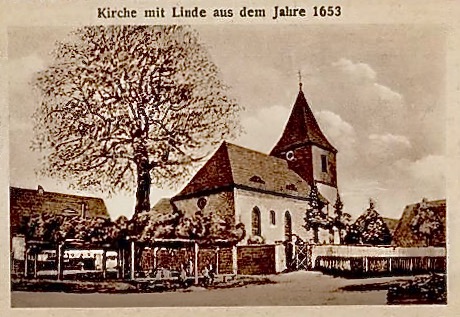
On the first of June 1961 lightening struck the tree. An offshoot of the tree was planted the 30th of April 1962. When I stood there in May of 2018 this replacement tree was 46 years old. [click on photos for more detail]


Today this tree is huge and spreading. As you can see there is seating around the perimeter of the canopy. In Celtic and Germanic culture the motherly goddess, Freyja, is associated with love, fidelity, friendship, peace, justice, altruism, fertility and prosperity and the Linden tree. It was also believed to ward of evil spirits including lightening strikes. Perhaps we can say the tree sacrificed itself for that of the church. Later the Linden tree was associated with Mary the mother of Jesus. Linden Trees are found in central locations in many German Villages. Townspeople would assemble beneath the Linden tree to celebrate, dance or hold important meetings. Under the Linden tree it was believed that one could only speak the truth. This is where lovers pledged their love, disagreements were settled and important occasions marked. In some places there were dance floors erected under the Linden Tree. Can’t you just imagine Martin chasing his siblings around the tree? His older sisters Anna Maria and Eva both married here in 1705, was young Martin a witness to their courtship under the tree? You can imagine the villagers congregating after Baptisms. Marriage and funerals as well as after weekly worship.

The sweet smell of Linden blossoms perfumed the air on the day I was there and they are a rich source of nectar for bees. Linden honey is said to be good for fevers and colds and for lowering blood pressure. Did Martin or his father keep bees on the farm? Or did they buy honey from a apiary in the village?

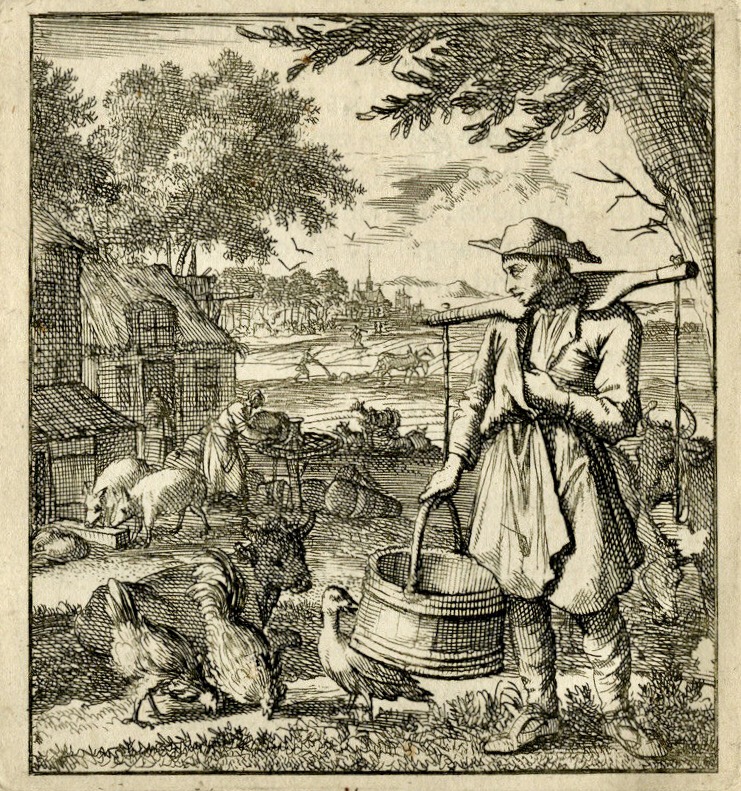
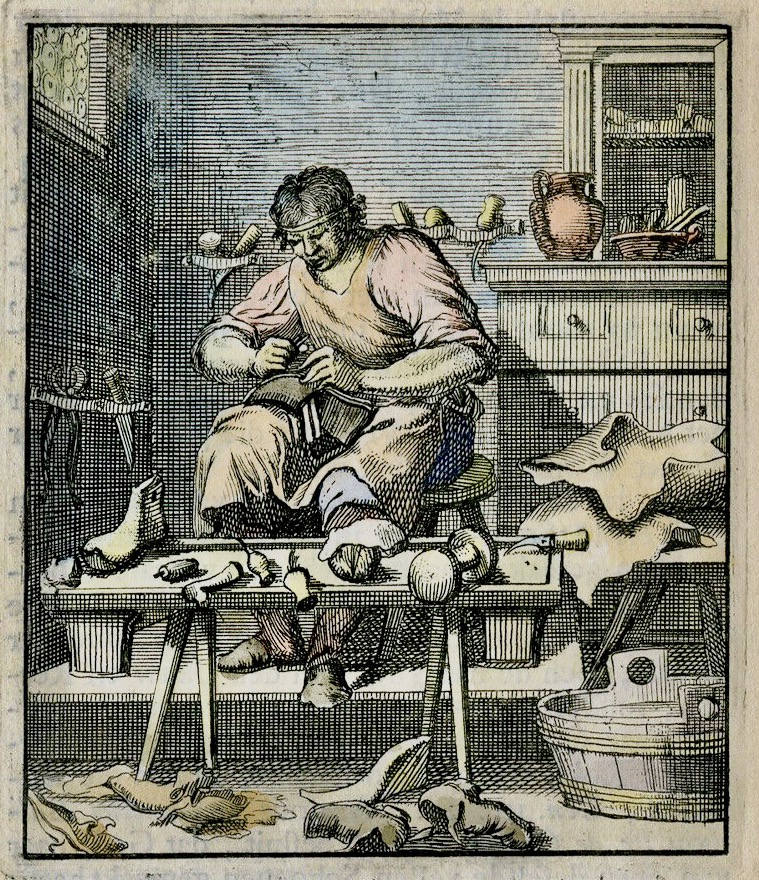
c. 1730 titled “As long as it lasts”
SHOEMAKER
We can only construe a life from the scant circumstances in the historical record. What we do know is that Martin MOSER grew up on the farm of his birth in Grossulrichshausen and that he was baptized at St Martin’s Wörnitz. During his time in Grossulrichshausen He must have apprenticed with his father who was a shoemaker as when he marries he is listed as a shoemaker. This early print of a shoemaker would not have changed much in 150 years. It was a valuable trade that did not require many tools. The shoemaker was an integral part of the community for whether you were a farmer, clergy or a nobleman everyone needed shoes.
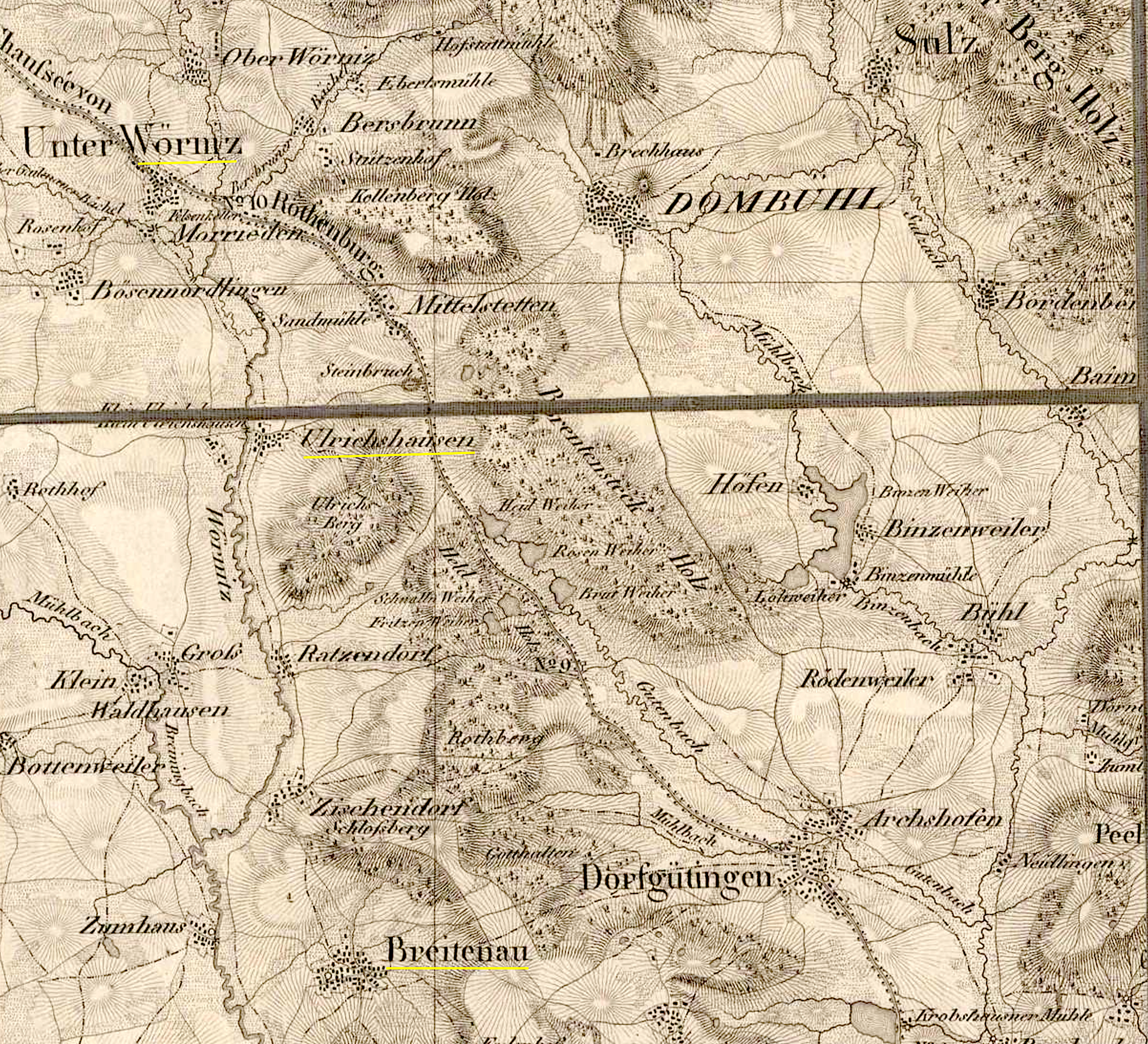
We can infer that the village of Wörnitz needed but one shoemaker and sometime between 1713-1716 Martin relocates to Breitenau about 4.5 miles south of Wörnitz and even less from Grossulrichshausen [shown on the map above]. We will take up our next chapter in Breitenau and why Martin would trade a seemingly idyllic life in Germany for the wilds of America.
I hope this gives you a some ideas to search for the context of your German immigrant’s life.
Special thanks to the the Gerling family and my friend Denise for making the trip I took possible.
Kelly Wheaton ©2024 – All Rights Reserved
 Wheaton Wood
Pingback: German Migration to America: Johan Martin MOSER 1693-c.1743 Part Two | Wheaton Wood
Pingback: German German Migration to America: Johan Martin MOSER 1693-c.1743 Part Four | Wheaton Wood
Pingback: THE MOSERS IN BAVARIA: Wißenkirchberg, Hetzweiler, Kloster Sulz, Altengrueth | Wheaton Wood