BAVARIAN Hans MOSER c1623-1696 was from Austria, not Switzerland
Please excuse my rant. You can’t do proper genealogy without historical context. You shouldn’t go connecting people to your tree willy-nilly without evidence. A few years back my friend Paul Chiddwicks had a blog post Are you a Genealogist or Family Historian? As I go about teaching genealogy and writing about family history I would say I am both. However, major problems arise should you not brush up on geography and history. We all make mistakes but sadly—one mistake long ago proliferates like a cancer.

Remember my Blog post Mind the Gap? This is another cautionary tale. Boat loads of trees have a Hans MOSER bc 1621-3 as the son of Andreas Johann Wilhelm MOSER born on 12 October 1603, in Rothenbach, Bern, Switzerland nor is it Hanß Reichardt Moser born the son of Johann Wilhelm MOSER 6 Apr 1621 Schwäbisch Hall, Baden-Württemberg. There is not a shred of proof of either of these and the historical record says Hans was from Lower Austria. More on that shortly. So lets face some facts, shall we? Let’s start with the SURNAME
SURNAME MOSER

Whether German, Austrian or Swiss it is generally agreed that the surname MOSER comes from “Moos” meaning a marsh, moor, or bog and “er” the person coming from such a place. So in this case MOSERs are “the people of the marsh” as was coined by Charles Recker over fifty years ago. A moor or marsh is generally peaty and dominated by grasses and sedges, often near the bench or lowland of a river. Although it may have a negative connotation today, these were rich, fertile farmlands. As a habitational name it may have been adopted by widely scattered individuals.
As a coincidental side note, when Johan ‘Martin’ MOSER settles in Pennsylvania it is at New Hanover near the Swamp River, Montgomery County and he is a member of the Lutheran “Swamp Church.”
As a habitational name there is no relationship to be inferred by sharing the surname MOSER. Widely scattered unrelated people may have taken up the name at different times. The largest concentration (rounded) of MOSERs today and the rank of surname within the country:
- America 40,000; 1,071th most popular surname
- Germany 36,000; 194th
- Austria 26,000; 9th
- Switzerland 19,000; 17th
Today Hans is the 8th most popular forename in Germany and 75th in Lower Austria. Hans is a derivation of Johan or Johannes which both remain popular. So the idea that you can simply take a name like Hans MOSER and connect it to a random individual born around 1623 is absurd. But this looks to be what has happened. Even without other evidence to the contrary it just doesn’t make sense. First the forenames Andreas, Wilhelm or Reichardt are not found in our Bavarian MOSER families.
To write the proper story of your ancestors one must know the context in which they lived. Between 1618 and 1648 the Thirty Years’ War was one of the longest and most destructive wars in European history. An estimated 4.5 to 8 million soldiers and civilians died directly from the war, or from disease and famine. Switzerland enjoyed relative stability because they remained neutral during the war, whereas Germany was decimated. So the idea that a Swiss MOSER suddenly decides to travel 310 miles to a decimated area of Germany doesn’t make much sense.
HANS MOSER’S ARRIVAL IN GERMANY
The following is the single most important bit of evidence as to the time of Hans MOSER’s arrival in Bavaria and his place of origin as given to me by Gary MOSIER from the Accounts of the jurisdiction of Colmberg and Leuterhausen STA Nüremberg, RA Colmberg 316, Item 117 sheet 94:
Hanss MOSER, Hetzweiler, 1653 Hans MOSER peasant farmer from Unterösterrich for the acquisition of Leonhardt FINISTERER’s peasant property at Hetzweiler, owes the purchase price of 20 Guilders, that he has promised to settle in annual installments of 4 Guilders, payable at Candelmas. [Important Feast day known as the beginning of the “farmer’s year” in Germany and often when accounts were settled.]
The year of immigration is likely 1652. Hetzweiler is contiguous with Wießenkirchberg and Brunst. On the map below Altengrueth is spelled Altengruet. Leonhardt FINISTERER’s farm was called the GUTH Farm. There was a Martin GUTH from GroßGerungs, Austria who lived in Ansbach-Eyb, Bavaria about 13 miles east of Hetzweiler. And there were FINISTERERs in Wießenkirchberg as early as 1557. In 1631 FINISTERERS lived at Hetzweiler and were associated with Weihrsmühle. A Johann Leohard FINISTERER died at Gutenhard in 1652 and an educated guess is that Hans MOSER took over the small farm in the area of Weihrsmuhle or Gutenhart before later settling less than a mile away at Altengruth. Today there is a Gut Weihrsmuhle and perhaps that was originally the “GUTH” estate or farm or at Gutenhart.

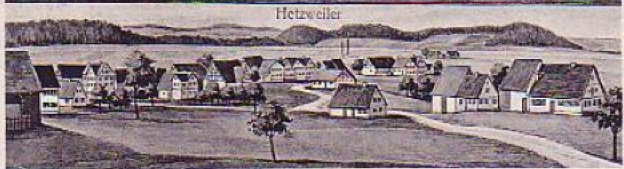
Tax Roll of Hetzweiler 1646-1654: Account of the district of Brunst at Colmberg and Leuterhausen STA Nüremberg, RA Colmberg 225/5 1, Item 27 [First person listed is taxable owner in 1646 second is taxable owner in 1654]:
- Hanns HOFFMAN
- Hans KRAUS at Guth Farm Now (1654) Valentine RUCKER. Valenetine’s first child was born in 1652 at Brunst; subsequent children at Hetzweiler. He died 1676 at the age of 50 (b.c 1626)
- Georg SHARVOGEL at Hof Farm: Now (1654) Matthias HOCHLEITHER. First child and subsequent born 1654 Hetzweiler
- Leonard LÖDTER at Hof Farm: Now (1654) Matthias and Hanns STEINER ?
- Leonhardt KRAUS at Hof Farm: Now (1654) Paul DAUBER (DAUBINGER) first children born Hetzweiler 1659; he died 1688 age 74 (bc1618) He md 2nd Maria KAPFER of GroßGerungs Lower Austria
- Wolff HAUFF at Guth Farm: Now (1654) Wolff (Wolfgang) GÄRTTNER (GÄRTNER) First child born Hetzweiler 1654; Brunst 1659. He died Eckartsweiler 1668 at age 74 (bc 1594) He married Margaret WACKER 1655 Wife of Martin LÖSCHEL his father from Griesbach Lower Austria
- HANS FINSTERER [FINNISTERERs in Weiẞenkirchberg as early as 1557] at Halboff Farm now (1654) Hanns HAFFNER (HÄFFNER) Lower Austria his widow md 2nd Thomas SOLZENDALLER from Griesbach
- Hanns FUNCKH (FUCHS?) at Guth Farm: Now (1654) Hans KÖRBAN (KÖRBER) [family in Hetzweiler since 1565]
- Leonhardt FINSTERER at Guth Farm: Now (1654) Hanns MOSER Lower Austria
Now let’s take a look at why Hans MOSER and perhaps the DAUBINGER, GÄRTNER and KÖRBER families immigrated from Niederösterreich, aka Lower Austria to the Weiẞenkirchberg area.
Niederösterreich: Lower Austria
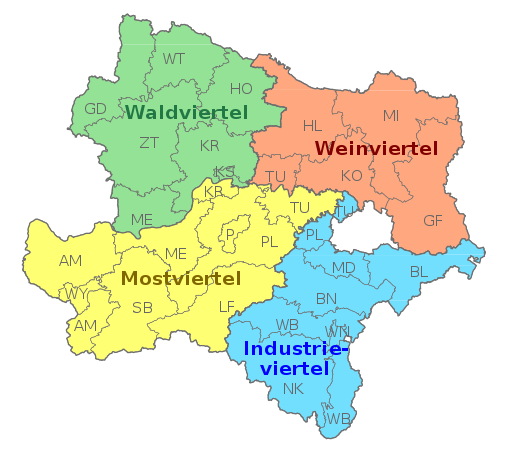
Niederösterreich aka Lower Austria is the northwestern-most of the nine states of Austria. It is further divided into four quarters known as Viertel. The most likely origin of our Hans is in Waldviertel, or translated the Forest Quarter. The Waldviertel is bounded on the south by the Danube River and on the north it borders the Bohemian part of Czech Republic. The Austrians and Bavarians share a common ancestry. They have a common political affiliation with the old Duchy of Bavaria, shared traditions, Bavarian dialect, art, folk style and clothing. Historically the Bavarians are said to be descendants of the ancient Marcomanni, a Germanic tribe.
When Martin Luther in 1517, then a Catholic monk, listed 95 criticisms of the Catholic Church, Protestantism began to spread throughout Austria. Excesses within the church were part of the problem.
“A report by the papal legate Commendone on a visit to the Wilhering monastery in 1569 sheds light on the state of the Catholic Church in Austria: The Eucharist was not kept, the last rites were not recognized, there were no silent masses, Lutheran books like the Bible translation was found, the abbot Matthäus Schweitzer, who was only twenty-seven years old, interpreted the holy scriptures according to his own opinion like the Lutherans, the convent leaned strongly towards Lutheranism in matters of faith, although remnants of Catholic life were still present, etc.” Osterreichische Exulanten in Franken und Schwaben, Georg Russam 1989 p 36
By the turn of the century the majority of the population of Austria was Protestant. For example: Arbesbach in 1530 was less than 10% Catholic. Rappotenstein in 1643 was less than 5%. In 1596 when Ferdinand II came to power [the representative of the Habsburgs and the Holy Roman Empire] things changed drastically for the Protestants. In the year 1600 Lutherans were forbidden to baptize. By 1620 Lutheran nobles were charged with rebellion and their estates were confiscated. By 1628 the Proestestants were forced to convert or emigrate. Most peasants had no options, so they no longer practiced their faith openly. The Emperor set up a commission who scoured the country looking for Protestants. They confiscated and burned their Lutheran bibles, books and records. They took their children for conversion to Catholicism and generally spreading terror among the people. Many still refused to become Catholic. They were to become the Exulanten or Exiles.
EXULANTEN: The Exiles
During the Thirty Years War [1618 to 1648], starvation warfare and disease decimated Europe. The War was primarily a religious conflict between Roman Catholics and Protestants that eventually included most of Europe taking up sides. As with most religious conflicts there were political agendas and territorial disputes. Adding to the losses were typhus and plague along with famine. Areas of Germany and Bohemia suffered the highest losses. The population of Germany had been reduced by 40 percent or more in the rural areas, and 33 percent in the cities. The Protestant who were forced out of Catholic Austria had one silver lining to all the dark clouds. They had a place that needed them. They came to Franconia to farm the fields as this was a Protestant area of Germany which had been deeply depopulated.
“The monastery office of St. Gumbertus (Ansbach) [Ansbach is the district where Wießenkirchberg is located] reported in November 1634: Of the 421 estates and farms belonging to the monastery in the wide area around Ansbach, only 123 are left; Of the remaining 298, the residents died or ran away.” Georg Russam 1989 p114
In 1652 the last remaining Lutheran refugees from all over Austria gathered in the counties which were situated in the state of Lower Austria. Each was interrogated individually between 1652-1654 by the Imperial Commission for the Re-Reformation. In the final report of that commission, the “Verzeichnis der Neubekehrten im Waldviertel Codex Vindobonesis 7757” each of those interrogated is mentioned by name. Arranged and published by Georg Kuhr and Gerhard Bauer 1992.
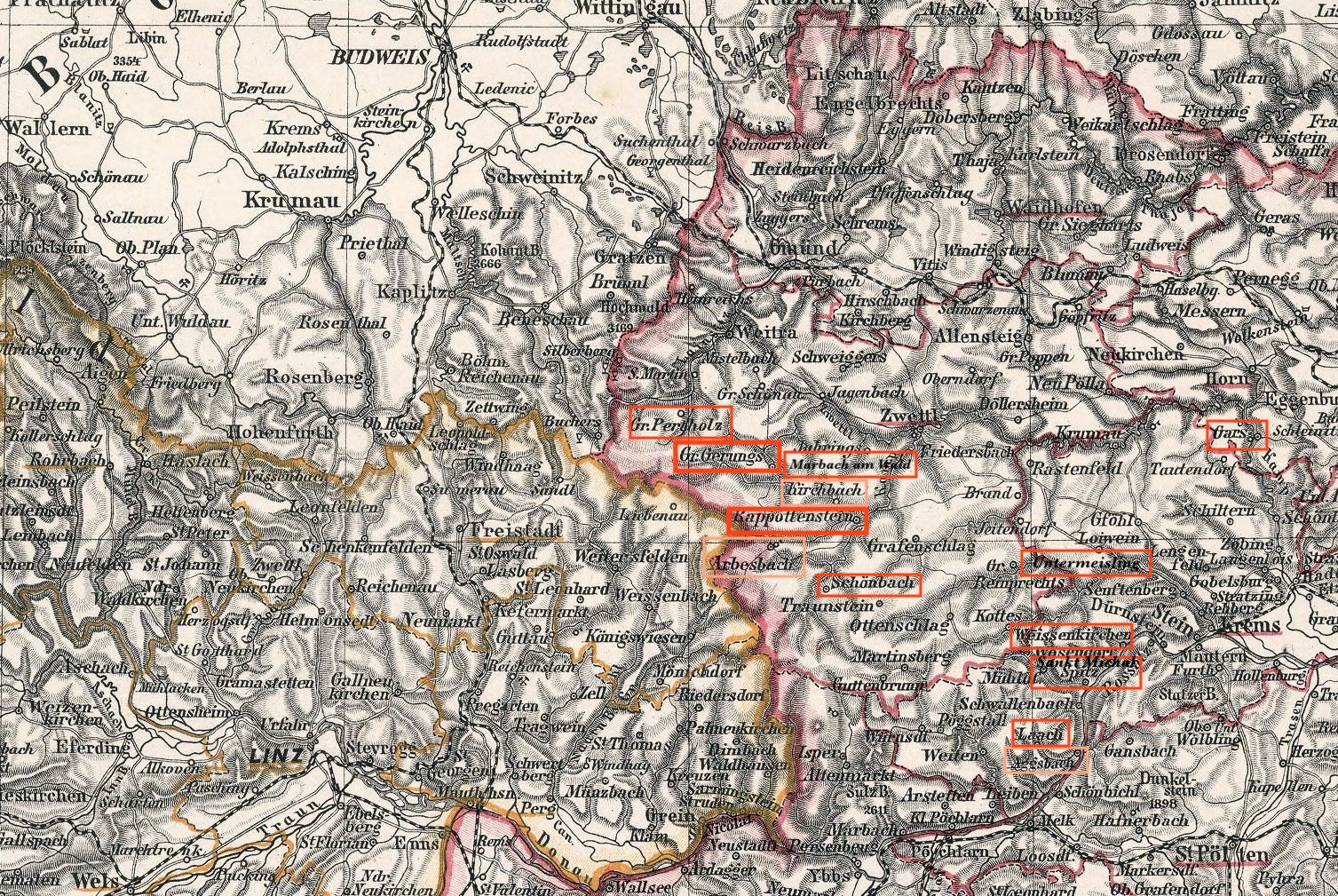
There were 22,000 Lutheran’s interrogated in 1652-1654. Of those in ”Lower Austria” there was a total of 72 MOSERs, mainlyin two areas. The first around the villages near Rappottenstein [Castle pictured at beginning of blog post] and the other alone the Danube near Spitz. 28 lived near Rappottenstein. It is likely that is where we find our Hans MOSER. Although to be fair it is only 25 miles from Rappotenstein to Sankt Michael near Spitz. Of those MOSERS there are 12 Johann [ Hanns ] MOSERs as follows [ Number Parish in Austria (distance from) total MOSERS from parish]:
- 3 in Rappottenstein (+1 Phillip, 1 Georg, 1 Abraham MOSER) 5 total
- 1 in Großgerungs (8 miles from Rappottenstein)
- 1 in Schönbach (6 miles from Rappottenstein)
- 1 in Sankt Michael (+1 Simon MOSER; 1 mile from Spitz)
- 2 in Weißenkirchen (+2 Georg, 1 Maria; 3 miles from Spitz)
- 2 in Maria Laach (+1 Barhtholomaus; 1 Georg, 1 Barabara, 1 Rebecca, 1 Rosina MOSER; 7 miles from Spitz) 7 total
- 1 in Untermelisling (+1 Sebald, 1 Töchter; 12 Miles from Spitz) 3 total
- 1 in Gars am Kamp (+1 Barbara; 31 miles from Spitz) 2 total
Additionally Hans had 3 sons that may be common forenames in his family: Hans Adam, Johan Philip and Hans Michael. In the lists those forenames appear with MOSER as follows:
- Philip MOSER 1 Rappottenstein
- Michael MOSER 1 Kirchbach (2 miles from Rappottenstein)
- Michael MOSER 2 in Marbach am Wald (3 miles from Rappottenstein)
- Michael MOSER 1 Arbesbach (7 Miles from Rappottenstein)
- Adam MOSER 1 Großpertholz (15 miles from Rappottenstein)
- Philip MOSER 1 Aggsbach (6 miles from Spitz)
Speaking of forenames these percentages of forenames come from Eberhard Krauß Exulanten aus dem westlichen Waldviertal in Franken 1997 pg 68 and that from “The Directory of New Converts in the Waldviertal.” Note the forename Adam or Philip does not make the list of the top 12. And of course Hans and Maria are the most common forenames . Rank Male and Female.
- 1. Hans 16.8% Maria 17%
- 2. Georg 10.2%. Barbara 9.7%
- 3. Matthias 7.8% Catharina 9.0%
- 4. Michael 5.4% Anna 8.2%
- 5. Thomas 4.9% Elisabeth 6.0%
- 6. Paul 4.5% Susanna 5.9%
- 7. Andres 3.8% Eva 4.9%
- 8. Martin 3.7%. Margaretha 4.7%
- 9. Simon 3,7% Magdalena 4.1%
- 10. Wolff 3.4% Rosina 4.1%
- 11. Jacob 3.05% Ursula 4.1%
- 12. Stephan 2.7% Regina 3.1%
Since we do not know for sure which Johannes MOSER is ours we look to friends and family. Of the above Villages in Austria only the following have other immigrants to the area of Weißenkirchberg, Bavaria Germany. Town from: SURNAMES
- Großgerungs : BINDER, BÜCHLER, EBERTS, EINFAULT, FESEL, HÖBEL, RECHBERGER, ROGNER, ROSENECKER, SCHMITZ, SINDEL,STEINLEIDNER, WITTEBSCHLAGER, WIZELBAUER, ZANZINGER, ZIMMERER
- Rappottenstein: EINFAULT, FISCHER, HEIDECKER, MAURER, SINDEL, STEINLEIDNER
- Arbesbach: AUER, FRAGNER, HABERECKER, HÖLLRIEGEL, KERSCHBAUM
- Großperholz: AUER, HITZGER
- Marbach am Wald: MAURER
- Griesbach * not above (Between Arbesbach & Großgerungs): DANZER, ORNTNER (who settle in Altengrueth)
Information on families from the books:
- Frederich Krauß Exulanten im Evang-Luth Dekant Feuctwangen 1999 and
- Eberhard Krauß Exulanten aus dem westlichen Waldviertal in Franken 1997

Hans MOSER “most likely” came from the area of Rappottenstein or Großgerungs if we play by the numbers. Rappottenstein is the village near the Rappottenstein Castle which was built in the late 12th century by Rapoto von KUENERING. It was one of many castles he built to protect his familiy’s lands. The castle was adjacent an ancient trade route. Großgerungs is a much larger and had a larger number of immigrants to Weißenkirchberg. However the towns are only 8 miles apart. So it would not be surprising if all the MOSERS in this area were related. You will note that in the list above that the same surnames appear in more than one village. It is not surprising that soem MOSERS stayed and converted to Catholicism. In Georg KUHRr’s article Östrreichische Exhulanten: Gründe der Auswanderung. Orte dew Zuwanderung und Bedeutung für Franken nach dem Dreiigjähringen Kreig 1987 he writes “especially in the western part [of Waldviertal] near Arbesbach , Rappottenstein and to the north Groß-Gerungs and Langschlag [about 4 miles west of Großpertholz] … over 90% of the residents remained with their Protestant faith. The Evangelicals had the support from Protestant rulers such as Wilhelm V. LANDAU of Rappottenstein, Achatius HACKLEBERGER V. Höhenberg at Arbesbach or den HERREN v RÄWEN in Marbach am Wald.”

The Adam MOSER in Großpertholz is intriguing since it is the name of Hans’ oldest son, Adam, and Adam names his oldest son. It is the only Adam among the 72 MOSERs listed as exiles. I hope those reading this find the evidence compelling that Hans MOSER was not from Switzerland. Of the 22,000 exiles at least 3,500 went from the Waldviertal to Franken [the specific part of Bavaria].
So our Hans MOSER was about thirty when and his wife Maria traveled out of Austria in 1653 and were welcomed into the community of Protestants celebrating at St. Wenzeslaus at Weißenkirchberg, in Bavaria, Germany. In 1627 alone Weißenkirchberg lost 257 people to the plague. At the end of the thirty years war only 22 households remained. Most of Mittelfranken was Protestant with small enclaves of Catholicism Kloster Sulz. Lutheran clergy and landowners welcomed the newcomers from Austria, as farmers were needed to grow food and tend the land and more parishioners were good for the local churches. A couple of relevant quotes from the article by Georg KUHR. As we learn some of these families already had a relationship with Weißenkirchberg.
“Interesting observations about the parish of Weißenkirchberg in Leuerhausen where Waldviertel farmers, after the sale of their cattle, brought out of Lower Austria, in Ansbach, attended service and the Lord’s Supper at Weßenkirchberg the Evang. The Rogner, Binder, Löschel, Zansinger, Nefischer, Einault farmers were attracted between 1637-1640. From 1642-1650 friends from the old homeland came in groups of 8-12 people at a time. We find about 150 people from Aresbach, Griersbach, Rappottenstein, who came after the counter-reformation.”
“In 1643 large numbers of cattle herders from Aresbeck, Rappottenstein, Wiesenfeld, Griesbach, Rohrof, Lembach and other areas of the Waldviertel sold their cattle in the area just outside Lower Austria and used the opportunity to commune in Weißenkirchberg [Franconia] according to the Lutheran manner. The same occurred again the next year and along with the cattle herders, others joined them including a sixty year old widow from Arlesbach that had not been able to commune as a Lutheran for several years. Some of them decided not to return home and resettled there.”
Immigration from the Austria to Franconia began about 1598 and lasted until about 1668. The highest numbers came in 1632 or later. They walked on foot traveling the well worn oxen path from Arbesbach in the Waldviertal, south to Grein on the Danube River then following the Danube north into Germany and on to Franconia. After the Thirty Years War cattle farmers from the Waldviertal found a welcome market for their cattle in Franconia, with good prices. As people began to emigrate they followed the path of those before them. By 1652 large numbers were immigrating. Through this period the records of the Weißenkirchberg church shows that about 41% of the marriages were of exulanten. These Lutheran areas of Germany became sanctuaries for the Austrian immigrants. As mentioned previously they shared the same language and customs as there new homeland. The exiles are credited with rebuilding areas ravaged by the war and revitalizing the Lutheran church in Franconia.
In the next Blog post we will explore the MOSERs life in Weißenkirchberg.
Kelly Wheaton @ 2024 – All Rights Reserved
 Wheaton Wood
I’ve had the same issue with my husband’s Johannes Whitmer (1752-1828, KY) from Barbelroth, Germany. I proved his origins there and published an article about my research. There are hundreds of trees online which show his parents to be – incorrectly – Michael Whitmer and Barbara, from Lancaster County, PA. They even show John born in Lancaster County. I did an experiment years ago and contacted all the owners of those trees who accepted messages. I provided them with a copy of my article. A few thanked me and about 13 trees were updated. One guy told me I was absolutely wrong and when I told him I would love to have proof of the father-son connection in PA so I could correct my records, he refused to provide any. It’s been years now and most of the trees are still wrong. I decided long ago that it’s hopeless and just go my way with my research.
Linda very frustrating but we keep trying. I noted one of the original perpetrators took down her webpages with the erroneous information. Part of the purpose of this post is so others will have all the correct information and a starting off place should they want to pursue the connections deeper. Not much in the way of Lutheran records in Austria—all destroyed…
Pingback: THE MOSERS IN BAVARIA: Wißenkirchberg, Hetzweiler, Kloster Sulz, Altengrueth | Wheaton Wood
Pingback: German Immigrants to Pennsylvania: Pioneer Georg “Frederick” MOSER (1722-1800) | Wheaton Wood
Pingback: Write What You Know: Research What You Don’t & Beware of Artificial Intelligence Generated Answers. | Wheaton Wood
Thanks for the information showing that Hans MOSER was from Austria, not Switzerland. My wife and I both have ancestry in Germany and Switzerland, and often see erroneous parentage posted due to the same or similar names in a different location. My wife is the MOSER descendant. Her ancestor was the immigrant Leonhard, son of Adam MOSER and Elisabetha WOLLINGER.
James it took Gary Mosier many years to find the proper parentage of Leonhardt. Hoping this post slowly supercedes the erroneous ones.
Just a small circumstantial data point that would point towards Austrian exile’s…my grandfather (William Moser) was essentially disowned by his family a Tobias (?) Moser (PA) clan for marring a Catholic (Mary Brophy) as this was considered very disrespectful given that the Moser’s were persecuted by Catholics pre-immigration. All this is oral history without primary documentation but I appreciate the thorough series of blog posts you have put together.
Religion has been a source of conflict and power for millennia. Rather sad.
Pingback: Fleshing out the Story: Context Matters | Wheaton Wood
I saw several family trees stating Hans Moser came from Switzerland, and that the name was originally spelled Mossiman. However, after seeing Gary Mosier’s website I came to the conclusion that his information was correct. I know a lady who came from Lower Austria and she told me that Moser is a common name there, and her family physician was named Dr. Moser. Also, some people might be interested in knowing that actor Clark Gable is descended from Hans Martin Moser, and actor/singer Burl Ives is descended from Leonhardt Moser.
Thank you for this. Sorry for the delay in replying. I didn’t know that about Clark Gable. Yes many MOSERS in Austria. Very common name there.
Pingback: Friday’s Family History Finds | Empty Branches on the Family Tree