German Immigrants to North Carolina: Pioneer Georg “Frederick” MOSER (1722-1800) Part Two
TROUBLE IN ORANGE COUNTY

While we read in the last post that settlers were lured to North Carolina with advertisements of inexpensive land and no taxes, the speculators had other ideas. The settlers came, cleared the land and made improvements: cabins, fences, pastures and fruit orchards. They raised rye, barley, oats, hemp and flax as well as herbs and vegetables. They raised livestock such as hogs, sheep, fowl, cattle and horses. They supplemented their diet with game they could hunt and often sold pelts for extra income.
These were settlers in a 60 mile wide area of land that the King had granted Lord GRANVILLE but then in 1737 Henry Eustace MCCULOCH, through proxies, received a deed for 1.2 million acres. The problem was that some of the lands overlapped and there was no clear title. The lands that Frederick MOSER and his fellow settlers in Orange County fell into MCCLOUGH track 11. It was a twelve and a half mile square rotated to appear as a diamond shape. It encompassed much of what was then Orange County but is now Alamance and Guilford counties. When GRANVILLE died in January of 1763 the matter of clear titles had not been settled and there was nothing to keep the unscrupulous from backdating contracts or worse.
Henry MCCULOCH, when he turned over the unsold lands in the GRANVILLE Tract , listed all that his father had sold. The earliest was dated 20 Sep 1757, to George CLAPP. The last 7 were sold to himself between April and June of 1763. The following are of note:
- 21. Anthony MOSER, 220 acres, 8 Sep, 1762 [first cousin to Frederick]
- 57. Malachy ISLEY, 200 acres, 14 Sep 1762 [brother of Ludowick Isley]
- 58. Ludowick ISLEY, 257 acres, 14 Sep 1762
- 77. Martin LOY, 251 acres 17 May 1763, he built a mill on Rock Creek
- 85. Frederick MOSER, 225 acres, 24 May 1763
- 93. Ludowick ALBRIGHT, 258 acres, 1 June 1763
MCCULOCH made his money by trying to sell the land back to the same farmers who had toiled to improve it. These were families that paid for land patents that did not materialize or were claimed to have been handled improperly. It was the work of the settlers who gave the land its value that now MCCULOCH wanted to sell back to them. The German farmers in the Piedmont settled near streams or rivers where they could successfully farm. As they cleared more land they increased the size of their farms. They lived in one room log cabins perhaps with a loft. Later cabins may have been made of stone or clad with wood siding.
“The trouble began to arise between GRANVILLE’s agents and the early settlers. It was said that the title to their land was not good… [Agents] contrived by villainous means to extort money from those who had already paid for their lands. One of them being a lawyer, pretended to find a fault or defect in the other’s patent, which had been signed simply ‘ GRANVILLE’ by his attorneys, saying that it ought to have been by ”the right honorable earl GRANVILLE, by his attorneys,’ etc. GRANVILLE lived too far away to set the matter right. So patents were to be taken out a second time. They doubled the fee and contrived a device which they fixed to a warrant of survey, without authority, for which they charged six dollars.” STOCKFORD pg 49
MCCULOCH cannily made alliances with government officials and even cut them in on the action. The FROHOCK brothers: John, Thomas and William took up positions as commissioners, clerks and land surveyors. Thomas FROHOCK was the son-in-law of Henry McCULLOCH’s cousin, Alexander MCCULLOCH. One final member of the extortion ring was Edmund FANNING who positioned himself as assemblyman for Orange county as well as public registrar for Hillsborough and a militia officer. So the fix was in.
It wasn’t just the German settlers who had been lured or who were caught up in the scheme. Many Scots, Irish, Swiss were early settlers who now realized they were being taken advantage of. And it wasn’t just land transactions it was also fees for marriage licenses and other legal matters that were set beyond the settlers ability to pay. From Walter WHITAKER’s Centennial History of Alamance County 1849-1949 no copyright.
Henry MCCULOCH required settlers to pay twice the price, interest and an agreement not to fight him in court. Either way MCCULOCH made out like a bandit. He appointed Edmund FANNING and John and Thomas FROHOCK to collect debts, fees and monies or claim the settlers forfeited lands. Money was scarce and many settlers would have had no way to pay in the 1760’s and 1770’s.
“In the year 1766, Governor TRYON, escorted by 100 troops and servants, led a 17-day expedition into western North Carolina to run a boundary between the colony and the Cherokee nation. The trip cost taxpayers 15,000 pounds sterling — $75,000. In November of the same year the General Assembly ratified a proposal to tax the colonists 20,000 pounds to build a new palace for the Governor at New Bern. Such government extended into Orange County also. The county clerk charged 15 pounds — $75 — for a marriage license. Tax collectors frequently took a farmer’s horse from the plow to satisfy exorbitant taxes.” WHITAKER pg 47
The Governor of North Carolina, William TYRON and his council ordered the 17th of April 1765 that MCCULOCH “desist from any Steps in Law to dispossess these People,” meaning the farmers of their property. Matters reached a head on the 7th of May also in 1765 when MCCULOCH and his surveyors including John FROHOCK were badly beaten while attempting to survey lands belonging to a widow of the ALEXANDER clan.
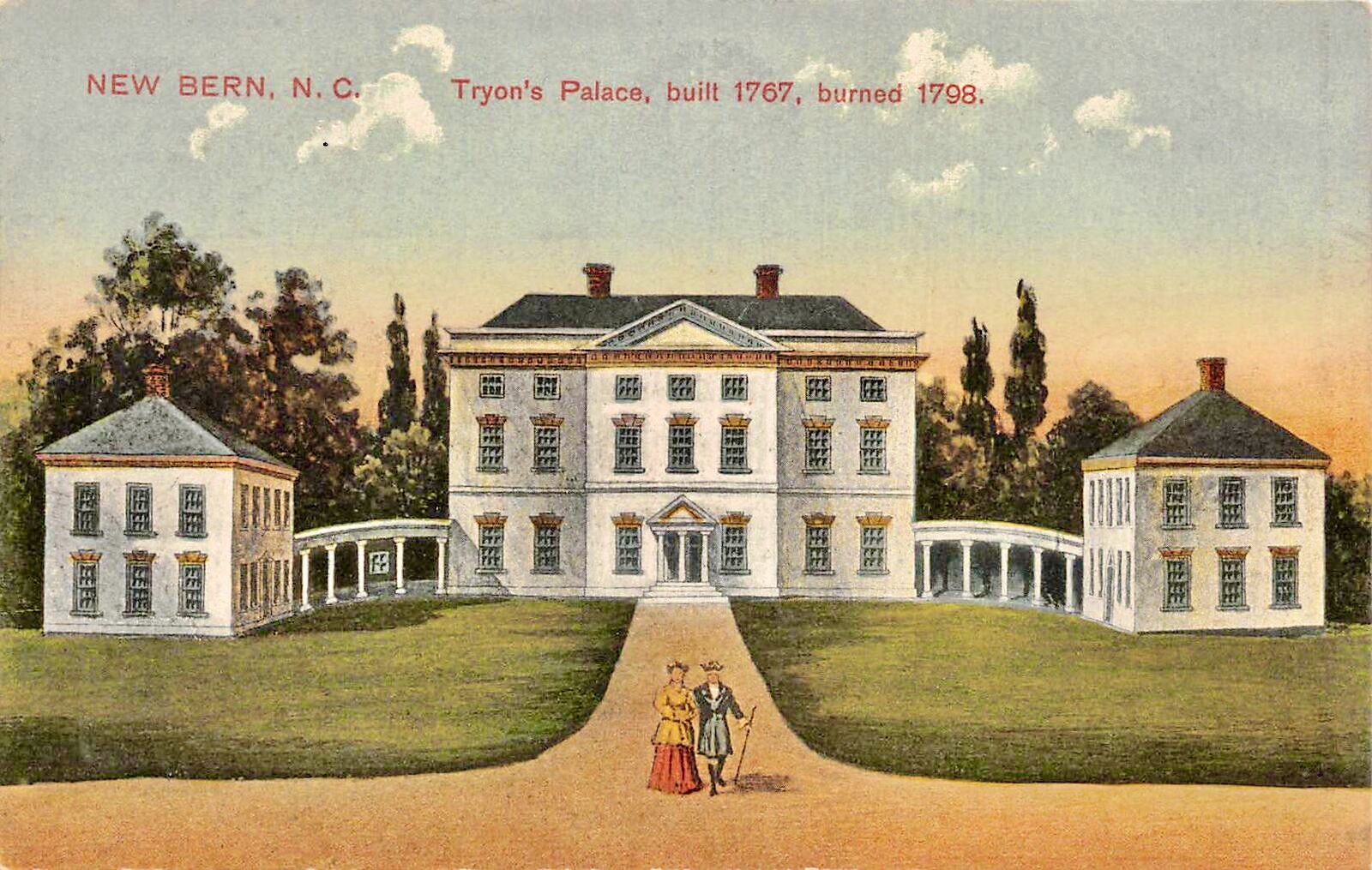
The gentry were getting rich, the taxpayers were getting squeezed by new taxes to pay for Governor TRYON’s Palace built in 1767 and viewed with great distaste by the poor farmers of the area.
“On October 10, 1766, a number of men entered a session of Inferior Court at Hillsborough and requested the clerk to read a petition written by Herman HUSBAND [Prominent Quaker and outspoken representative of the farmers]. The petition called for a meeting of county officials and citizens “judiciously to inquire whether the free men of this county labor under any power of abuse . , . and in particular to examine into the public tax and inform themselves of every particular thereof, by what laws and for what use it is laid…
Husband, however, worded his “advertisement” in vague terms, and the court complied with his proposal and set a meeting for October 10 at MADDOCK’s Mill, two or three miles west of Hillsborough, “a suitable place where there is no liquor.” On the appointed day the hopeful planters left their unharvested crops and rode to the mill. After waiting several hours they sent a millboy into Hillsborough to see why no officials had appeared, and late in the afternoon a lone horseman arrived at the mill. Colonel Edmund FANNING and Thomas LLOYD, the Orange County delegates to the General Assembly, had intended to come, said the rider — but Colonel FANNING noticed the word “judiciously” in HUSBAND’s petition. Since the men gathered at MADDOCK’s Mill had no judicial authority, it seemed obvious that they were insurrectionists, and the delegates refused to meet with them. Unsuccessful and dissatisfied, the farmers broke up their meeting and returned to their homes. Their grievances, however, had become stronger.During the following spring further action developed.” WHITAKER pg 47-48
Adam MOSER, Frederick’s nephew was among the signers of a Regulator petition to Governor TRYON seeking relief from excess fees.
THE REGULATORS
The Regulator movement was born out of necessity. From the book the The Regulators of North Carolina (1765-1771) by John Spencer BASSETT
Another very prominent grievance [of the Regulators] was the dishonesty of the sheriffs, who failed to pay into the hands of the public treasury the money they had collected. The public accounts were most inefficiently kept. There was a prevalent opinion among all classes that there was fraud just here. In 1767 Governor TRYON declared it as his opinion that “the sheriffs have embezzled more than one-half of the public money ordered to be raised and collected by them.” BASSETT Pg 152
Extortionate fees was perhaps the greatest grievance of all. Nearly all the officers were paid in fees. The people of the back counties complained heavily of their officers, and in support of their complaint the Orange County Regulators produced affidavits sufficient to satisfy the most skeptical that they were right. As soon as counties were organized on the frontier sheriffs, clerks, registers, and lawyers swooped down upon the defenseless inhabitants like wolves. BASSETT Pg 153
“On March 22, 1767, several hundred Orange County citizens met at Sandy Creek to discuss the situation. The courthouse ring refused to deal with them; the governor would not answer their petitions; it was time for action. Finally they agreed to organize. Things proceeded slowly but by 1770 things were getting heated “When Judge Richard HENDERSON opened the fall term of court for Orange County on September 24, 1770, the Regulators were present in great force…Hardly was the session underway before a mysterious letter written by James Hunter appeared accusing Husband of promoting the Orange County riots. As a result Husband was dismissed from the Assembly and placed under arrest in the New Bern jail. A grand jury found him not guilty, and again he was released. ” WHITAKER pg 54-56
Note the date above September 24, 1770. Note the name Edmund FANNING. [See his portrait above] So back in February of 2016 I randomly decided to do a search on Ebay for “writ” & “MOSER” and bingo I hit genealogical gold! For sale was a document dated 1770 titled “Orange County NC Writ for Frederick MOSLER Owing Henry MCCULLOCH 46 pounds.” It cost me $11! It was actually for Frederick MOSER written MOSUR.

This original document is signed by Thomas FROHOCK. He was appointed the clerk of Superior court : “Whereas Thomas FROHOCK hath Received an Appointment from the Honourable Martin Howard Esquire Chief Justice of the province aforesaid dated the Fifteenth day of December 1768 thereby constituting and Appointing him the said Thomas FROHOCK Clerk of the Superior Court for the District of Salisbury“
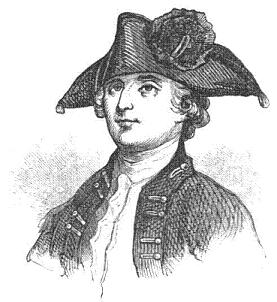
And on the reverse it is signed by E. [Edmund] FANNING. Interestingly the first date Sept 1769 is crossed out and the March date of 1770 is substituted. I looked through the Superior Court records and did not find the corresponding case. I did find Martin HOWARD Esq Chief Justice at Salisbury present on September 6th 1770 but not on September 5th. it is not clear to me that these cases were ever heard in court. The German settlers were at a decided disadvantage as many were not fluent in English. The date of the original land transaction as it appears in MCCULOCH’s records is May 24th 1763 and on the above document from May 25th 1763 so I believe this is his original purchase. Here is the Transcription:
“North Carolina
George the third by the grace of God King Etc.
To the sheriff of Orange County Greeting Whereas In a Judgement in Reasoned Lobby in Our Superior Court of Justice held for the district of Salisbury at the court House in Salisbury by Henry Eustace MCCULLOCH against Frederick MOSIER for the Sum of Forty Six pounds Proviso and Intent from 25 day of May 1763 we find for his Debt also the sum of Four pounds three shillings and four pence for his cost by him about his such Expended .__ .___
You the said Sheriff Z?lumo On the Writ of Feri Facias to you District executed on S..dry. And Motion of the Plantiffe Attorney it was so by our hand ordered that a writ of Vandickson? v Expon? Issue whereby the said goods may be sold to answer the Judgement and Costs aforesaid. We remmand you therefore that Expon? The said goods to Sale according to Law and the money arising therefrom you are to return to Our Supt Superior Court of Justice to be held for the district aforesaid at the Court House Afsd on the Fifth day of March Sep —— Next When and then to Render onto the said Henry Eustace MCCULOOCH his debt and costs aforesaid. Witness Martin Howard Esquire Chief Justice of Our said Province at Salisbury the Fifth day of
SeptemberMarch in this viiiix Year of Our– Reign AD17691770Thomas FROHOCK”
Even more interesting perhaps is the second sheet that shows the charges. They include Entering and Docketing action and order rule and order thereon and serving papers; Entering Each Attorney on the Docket 7d, Entering Plaintiff and defendants Appearance and Testimony Defendant and Default et cetera in the amount of Ł8.16s.9d in interest and fees. In 1770 pounds this would be equivalent to: 2 horses, 3 cows, 39 Sheep, 11 stone of wheat and 183 hours of skilled labor. Or $2,000 in today’s dollars. This is what was meant by Exorbitant fees.

So we have first hand evidence of the actions that lead to the revolt of the farmers and the formation of the Regulators. And we can place Frederick MOSER in the thick of it. In “A sketch of the life and character of the Rev. David Caldwell, D. D by Eli Washington CARUTHERS in 1842 pg 114 he writes “It was said that he [Thomas FROHOCK] charged $15 for a marriage license; and the consequence was that some of the inhabitants on the head waters of the Yadkin took a short cut. They took each other for better or for worse ; and considered themselves as married without any further ceremony.”
“The General Assembly was reaching adjournment in late January, 1771, when word reached Governor TRYON that a large force of Regulators had gathered at Cross Creek (now Fayetteville), intent on burning the governor’s new palace. Once more, however, the Regulators dispersed when they learned of Husband’s freedom. Once more bloodshed was narrowly averted. The fuse was burning shorter now. Thousands had joined the Regulators. Many of them were law-abiding people who abhorred mob violence and who had no part in the disreputable rioting. Yet they and their forefathers had fought oppression for centuries. They had come to a new land with a new dream — the dream that here there was justice for all. For this dream they were willing to fight and to die.” WHITAKER pg 56

THE BATTLE OF ALAMANCE

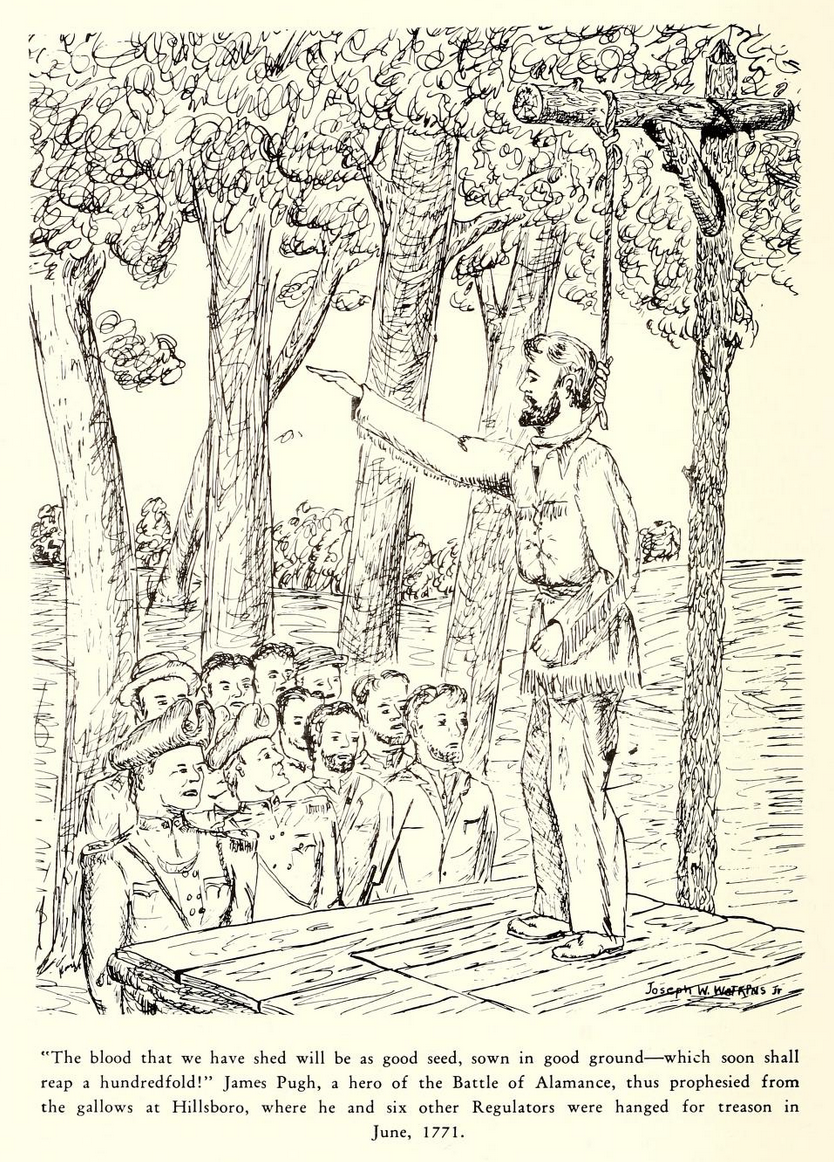
Things finally came to a head on May 14, 1771, Governor TRYON and his militia were camped on the banks of Great Alamance Creek, with a force of 2,000 troops. They marched about 10 miles, likely crossing the lands of Frederick MOSER until they reached where the Regulators were gathered, about 2.5 miles west of Frederick’s farm. About 6,000 men, mostly farmer, came in hopes of making a statement. Instead Governor TRYON on May 16th came prepared to put down any rebellion. The Regulators were mostly unarmed and unorganized. In the end 9 members of the militia were killed and 61 were wounded. 10-15 members of the Regulators were killed and between 100 and 150 were wounded in what is known as the Battle of Alamance. Governor Tryon took 15 prisoners, 6 of whom were hanged at the Hillsborough Courthouse. Some believe this was the opening battle of the Revolution. Others believe it was simply a peasant’s revolt. It certainly was an important event in what led up to the Revolution. At the time the citizen’s were seeking relief from their government rather than over throwing it. The effect of this insurrection on breeding the impetus to seek revolution cannot be underestimated.
“On May 16, 1771 Governor TRYON met about two thousand Regulators on the plains of Alamance. Then was the first blood shed for freedom on American soil ; that was the first open resistance against the oppression of King George’s rule. The battle of Alamance, N. C, and not the battle of Lexington, Mass., was the beginning of the Revolutionary war. It was a fight against the primal cause of the war for American Independence.” STOCKARD pg 11
” The blood that we have shed will be as good seed, sown in good ground—which soon shall reap a hundredfold.”
James Pugh, A Regulator at the gallows
A contemporary article in the Pennsylvania looks on the Battle at Alamance with scorn for the Regulators. This is the opening paragraph:

The following document from the North Carolina is a proclamation by Governor TRYON dated the day after the Battle of Alamance, giving amnesty to those Regulators who will take an oath of allegiance.


“Though some took the test oath becoming loyal to King George, some took it and remained neutral; more took it refraining themselves from fighting, but making up for it in helping others, as did old Mr. MOSER, on the Great Alamance, who encouraged his six or seven sons to be ” Whigs of the Revolution.” Some of the Regulators who had sworn to TRYON took Dr. CALDWELL’s advice and considered their oath a broken contract.” STOCKARD pg 75
We get a slightly different version in this account from the Church Records of Reverend D.I. Offman, Lutheran Minister from Part 19 MOSER Family Records 1974:
“Tradition says that when Gov TRYON took the oath of allegiance of those who participated in the battle of Alamance, Mr. MOSER was of that number. His sons were not old enough [Jacob the oldest was about 19] to be in the battle consequently the oath was not administered to them. When [the Rev.] War broke out the boys sided with the patriots, but the old man kept his oath. Someone reported to the authorities that he was aiding and abetting the American cause. Soldiers were sent to arrest him. When he saw them he ran into his house and escaped out the back side into a thicket. The soldiers not knowing this when they could not find him fired the house to be sure of his death. After they left he came from his hiding place and said, that politically he was dead, and he assisted the American cause ever after.” OFFMAN
Like the rest of the colonies the years from 1775 onward through the Revolutionary War were tumultuous. The Orange County Militia was founded the 9th of September 1775 and its last skirmish occurred at Deep River 11th of February 1782. Close by, the Battle of Hillsborough occurred the 12th of September 1781. The patriots under Governor Thomas BURKE lost 15 killed, 20 wounded and 2000 captured by the Loyalists under Colonel David FANNING, who had but 1 soldier injured. So the back-country of Orange County remained an unsafe place. Based on the above two quotes it would appear that while Fredrick tried to thread the needle he like so many others, eventually had to choose a side. How he and his sons helped in the war effort for the patriots remains a mystery. Whether supplying horses, food or a place to hide the two quotes suggest they were involved.
In early 1781, General Charles CORNWALLIS occupied Hillsborough re-imposing loyalist control of Orange County. Before long, CORNWALLIS and his army moved out, and as he left the Loyalists knew that the Revolutionaries would take back control. From “Early Settlers in the North Carolina Piedmont on Land Sold by Henry McCulloh within Granville’s District, 1749-1763” by John Scott DAVENPORT’s (NCGenSoc Journal), #4, 1978
RECORDS BURIED!!! Loyalist James MUNRO, later stated in an affidavit that “when Lord Cornwallis gave sudden and unexpected orders for the movement of the army from Hillsborough,” he decided to seize, “the Records of the County with intention to hold them, in order to strengthen the influence of government until the contest should be decided.” “I had all the records above mentioned privately buried underground in the woods along with my own bonds, books, and most valuable papers, with strict directions not to touch them until I should return; consequently they were suffered to remain in that situation so long, that when they were taken up, many of the books were found quite destroyed, and almost all my own papers rendered entirely useless.” Of the several deed books which Munro buried, only one was salvaged, a book that was at that time known as Orange County Deed Book B and has since been renumbered Orange County Deed Book 1. Though there were thousands of real estate transactions in Orange County between its formation in 1752 and this incident in 1781, only a small fraction remain well documented in Orange County Deed Book 1.” DAVENPORT
After the War the North Carolina General Assembly from 1776 through the 1780s passed the Confiscation Acts to confiscate the property of Loyalists. Part punishment but also to gain control and obtain income for the state. The confiscated real estate netted North Carolina about £600,000. It may be in this way that Frederick MOSER reacquired his lands or gained clear title to them.
In our next post we will examine where exactly Frederick lived and the closing chapters of his life.
Kelly Wheaton ©2024 - All rights Reserved.
 Wheaton Wood