Estate Planning for Family Historians & Genealogists

Ashes to ashes, dust to dust. Should all your work go into the circular file? None of us are immortal but the least we can do is create a plan for our research, books and heirlooms to go somewhere. No guarantees but the time to find a landing place for your legacy is now. I don’t recommend putting this in your will, generally speaking, but I do advise putting it in a letter or directive to your executor(s).
In general terms we need to find a place for:
- Family heirlooms
- Family photos and documents
- Genealogy or Family History related Books
- Your research
The most likely place is not going to be that all those things travel to their new custodians together. You need to think about breaking up the collection so that it goes to people, organizations or archives that will be good custodians and who want your collection. So let’s take these one at a time.
Family Heirlooms
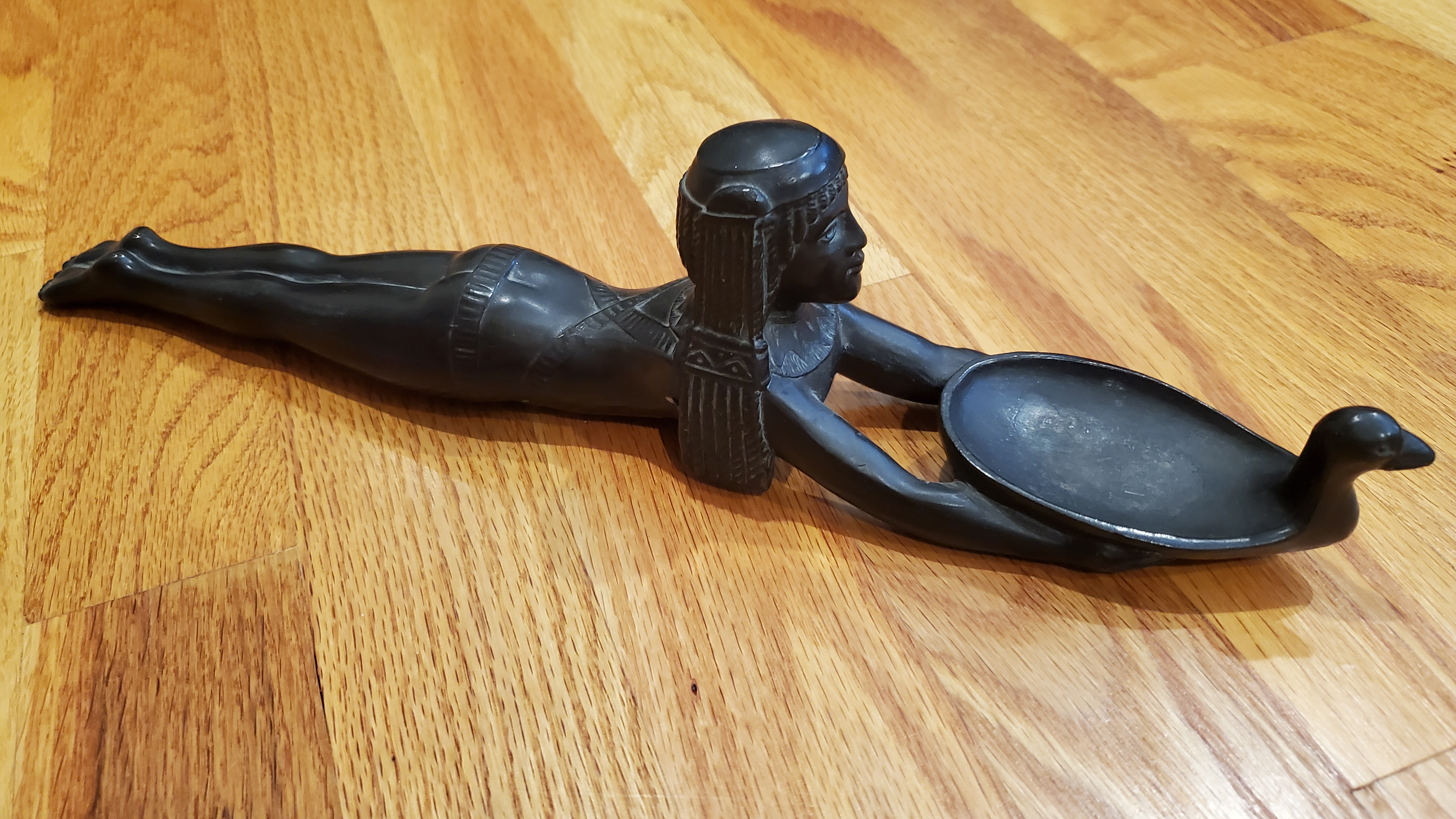
One man’s junk is another man’s treasure.
Make a list of things that have historical or personal significance. It could be your great grandfather’s military uniform, a coin collection or grandmother’s tatting shuttles. If you can spare the time, take a photo and put that together with the story of where the item came from and what its significance is. Use a spreadsheet or chart to list items. [Example below] As your list grows you might want to break down into categories like Art work, jewelry or specific collections.
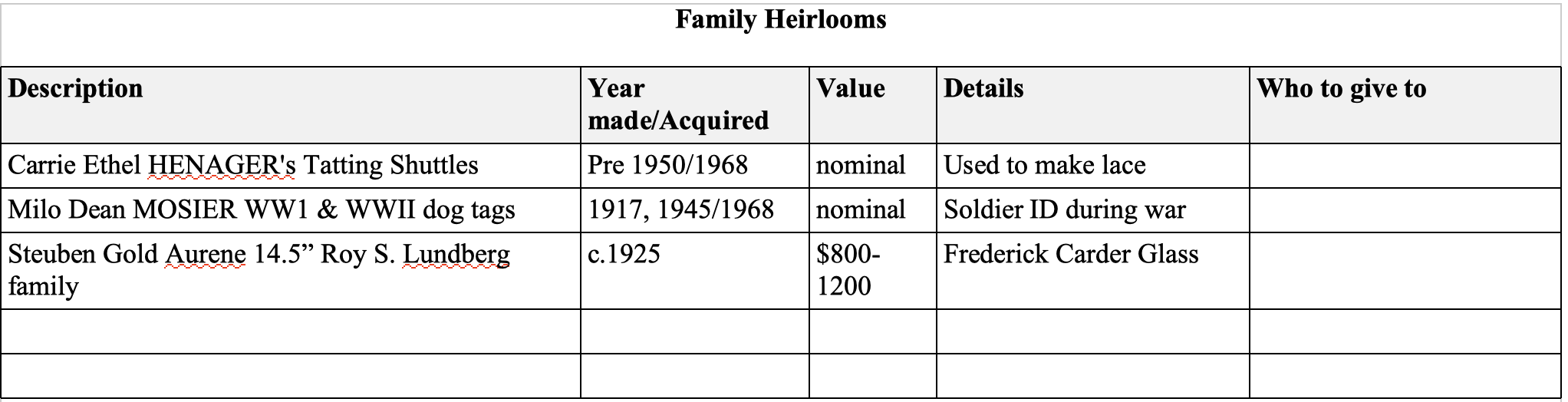
Next, ask family members or friends what they might be interested in. If the person who wants it is someone you want to bequeath it to, then put their name in your chart. If no one is interested consider what organization(s) might want it. If it is of great historical value look you may want to donate to a specific organization.
For instance in my list above the Steuben Aurene Pan might be of interest to the Corning Glass Museum and one can contact them via a specific page about donations. So on the chart above you might want to put in a link to this site. So each item may need a specific suggestion that you will need to research. While the Corning Glass Museum is 3,000 miles away in New York—I could check with organizations much closer like the Oakland Museum which has two ways to give: White Elephant sale and to their collection. The important thing is to identify and contact possible places so your heir won’t have to. Maybe you have an extensive collection of 19th century lace. Do a google search and you’ll find there is a Lace Museum in Fremont California and they have a donation page. Or maybe you have a collection of Cut Paper. Did you know that the Philip Dressler Center for the Arts, in Somerset, Pennsylvania has a The National Museum of the Guild of American Papercutters. How about American Military memorabilia? How about the American G. I. Museum donations
Family Photos and Papers, Genealogy Books, Your Research
If you have followed me—you’ll know that your collection of old photos, tin types and papers should be in archival pages and filed in your family specific family binder or file. So rather than dumping a bunch of photos on your family these will already be organized with the family history to which they belong. This will make it easier to decide what goes where. Some general places:
- Family members related to a particular family: Nephew Peter has an interest in his Great great Grandfather an aviator in WWI, Granddaughter Alicia is interested in the French side of the family and so on.
- Family or specific Surname organizations: Sheldon Genealogy or Griswold Family Association Do I general search online and contact the organization directly
- Location specific organizations or libraries: Rehoboth (MA) Antiquarian Society, Dutchess County New York Genealogy Society etc. If your material is related to that locale.
- Immigrant related organizations [based on county of origin]: Swenson Swedish Immigration Research Center, German American Heritage Foundation, Swiss American Historical Society, Danish American Arichive & Library, etc If your materials are related to immigrant families from another country
- Local or regional genealogy or historical societies or libraries: If your books or materials are relevant o a specific area.
- Regional or National Archives or libraries: These can be like the New England Historical and Genealogical Society or specific to a state California Genealogical Library or government related like Sutro Library which is a branch of the California State Library which houses Adolph Sutro (1830–1898)’s collection of historical and genealogy books. State and district archives are possibilities.
I highly recommend reading this article from the Society of American Archives which will give you guidance on what kinds of things archives are interested in. Such as “Although a repository cannot accept everything that you offer (whether because of staff and space constraints or because the materials are not within the collecting mission of the particular institution), it welcomes the chance to review material; if it is not appropriate for one repository, there may be another one to which it could be referred.“
If you have a lifetime of work then you may want to prioritize what is most important. If you have been following me any amount of time you’ll know that it isn’t all those family group sheets and charts that are the most important—its the stories. So part of your task is to prioritize putting in writing the things you know, that no body else does. One important way to do that is to start with stuff and family heirlooms and write the stories about the items. If you do they may suddenly become more interesting to your heirs.
You may also wish to add onto the Heirloom chart above a brief description of part of your genealogy collection and list the website or email address for possible archives that might be interested.
MAJOR GENEALOGY REPOSITORIES
Click on bolded items for more information
Gifts to the Library of Congress Largest collection in the world. Check to see if they already have what you are offering. Contact them to see if they are interested.
Allen County Public Library Genealogy Collection will accept loose genealogy materials and books. Please contact them for details. General contact ask@acpl.info
How do I donate to Family Search Library? What they accept: Family histories, Local and county histories, Autobiographies and biographies containing genealogical material, Indexes to records in book format.
How to donate to New England Historical and Genealogical Society (not just interested in New England).
Newberry Library in Chicago. This page link has contact info for specific genealogy related materials.
National Archives and Records Administration Donations here are by specific area such as still pictures or often related to a specific library like Presidential library. “We may accept offers of donations when the documentary materials involved are closely related to federal records already in our custody. When documentary materials don’t have a close federal connection, we direct potential donors to other appropriate archival facilities.”
SPECIFIC COLLECTIONS

Your objective is to connect the things of value with the institutions or organizations that would appreciate and care for them. For instance my cousin donated my grandmothers college materials from her years at the Michigan Agricultural College, now Michigan State University, to their archives where the items can now be viewed online in their digital collection. This can include yearbooks, programs, uniforms etc. I still have her diploma. This is going to take a bit of time, but it also means that your work will live on.
Hard Truths
Not everything we have accumulated has value to any one else. That’s okay. However I think we owe it to history to seek out a repository for those that we can find homes for. Some things are valuable to archivists that many people would throw away. This list from the Society of American Archivists article above is particularly useful.
- Letters/email
- Memoirs/reminiscences
- Diaries/blogs
- Scrapbooks/photo albums
- Professional papers
- Genealogical information
- Speeches/lectures
- Articles/essays
- Subject files
- Legal documents
- Minutes/reports
- Brochures and fliers
- Awards/certificates
- Photographs (with subjects and locations identified)
- Films/videos/audio tapes (including identifying information)
- Websites
This is an overwhelming task, so if you aren’t ready to get cracking right away—perhaps make a commitment to catalog an object each week. Maybe take its picture and put together a brief description. You aren’t limited to one item but even if you do one a week you’ll have 50 things described and maybe identified a person or place for it to go, which for most of us is better than where we are right now. Depending on how close you think the grim reaper is to visiting you—it may be time to donate or distribute some items right away. Your executor will thank you.
There are lots of little hints but one I began (and completed) a few years ago is putting a very small removable Color coding label in each of my books (not just genealogy ones). There are 5 colors: Pink, yellow, orange & green [Avery 6721] Green are for books that have value or should be saved—(over $25) I place a copy of its value in the front. Orange labels are for genealogy books to be donated, if the family does not want them. Yellow are for them to evaluate, that may be of specific interest. And pink are donate to a Free library or charity shop. It doesn’t take that much time to do and I know my heirs will appreciate it some day. A similar strategy could go for heirlooms and physical objects.
Country of Origin or Religious Archives with Donation Information—
This is a list to get you started. If what you are looking for is not here try using the search terms <religious affiliation> Archives or <Country or Ethnicity> American Archives. Please note many groups are regional so you may wish to look at the Archdiocese of Boston rather than a national Catholic organization. Many regions that have significant populations from a specific country will have regional archives. In all cases I suggest that you contact them directly to see if they are interested in what you have to donate.
- American- Canadian Genealogical Society
- American Hungarian Foundation
- American Jewish Archives
- Baptist Historical Collections at Baylor University
- Chinese Historical Society of America
- Danish American Archive & Library
- Finnish American Heritage Center
- Hispanic Museum and Library
- Irish American Archives Society
- Italian American Heritage Foundation
- Japanese American Museum
- German American Heritage Foundation
- Norwegian American Historical Association
- Pacific Lutheran Archives
- Swenson Swedish Immigration Research Center
- Swiss American Historical Society
- Welsh American Museum
Please note that if you have a specific collection of specialized objects there is likely a museum that would be interested such as The National Museum of Toys / Miniatures . If you don’t want your collection to go to the dumpster best to do a bit of research and find a home for it now. Have fun and good luck. If you have suggested additions to my list please leave them in the comments and I will add. I Have tried to give the page on which donation directions are listed rather than an individual address as those can change over time.
Kelly Wheaton ©2024 – All Rights Reserved
 Wheaton Wood
Very thorough article on this important topic, Wheaton, and much appreciated!
Thank you. Glad to be of help.