We Can’t Write What We Don’t Know: A Journey from the Fjords of Norway to the Shores of New York Mid 19th Century
If you decide you want to write about an ancestor be prepared to go down many gopher holes you never dreamed of visiting. Almost every time I decide to dig deeper into an ancestor’s story I end up researching things I never knew anything about. My last blog post Deep Diving: Water Wheels and Papermaking in 19th Century Sweden is a perfect example. Please note that the chronology below is based on what was discovered and how that informed my research. So it jumps backward and forward as is typical of the research process.
INTRODUCTION

When I set out to trace the journey of Asloûg Eilefsdotter from Vinje, Telemark, Norway to America I had no idea what to expect. As we learned in Locating Immigration Records Asloûg traveled with a group of twenty-two from her parish and there were four families. As yet I cannot confirm any close familial relationships with anyone that she traveled with, but many may have been distantly related and certainly would have worshipped together. A drawing of Vinje Church as it would have appeared when Asloûg left. What would leaving the land of your birth and that of your ancestors for a far away shore evoke? I imagine Asloûg departed with both trepidation and excitement. I know I would have…

DREAMS of EMIGRATION
It has taken me awhile to ascertain the most likely scenario for the families taking leave for America. Most historians suggest that they were leaving for opportunity whether it be a wider choice for a spouse and/or the hope of a more prosperous life. I like to think the seeds of Asloûg’s escape may have been planted when she was fourteen. In the Fall of 1843, Knud Svalestson, a native of Vinje, returned from Muskego, Wisconsin to Vinje. I can imagine villagers sitting in rapt attention listening to his stories of America. In addition we have the book mentioned in the Locating Immigration Records post published in 1838 giving any future emigre background on what to expect in America. [These are often to be found in other languages, not just Norwegian] Here is the introduction from the True Account of a Norwegian in America:
“Good Countrymen,
Fine and Craftsman!
I have now been eight months in America, and during this time have had occasion to experience much, about which I tried in vain to obtain information before I left Norway. I felt at this point how uncomfortable it is for those who would like to go to America, that they must miss a reliable and fairly detailed account of the country; I also experienced how great people’s ignorance is, and what false and unreasonable rumors were believed to be the full truth. — in the present little writing it has therefore been my endeavor to answer every question, which I even vomited, to clarify every point about which I felt that people were in ignorance, and to refute the false rumors that have come to my ears, partly before my departure from Norway, partly after my arrival here. – – I would like , dear Reader! that you must not find any Post, about which you wanted Information, overlooked or incompletely processed!
Illinois, the 13th of February 1838.
Ole Rynning“
I loved that he noted “Two things are a plague on the ocean [crossing], namely sickness and boredom.”
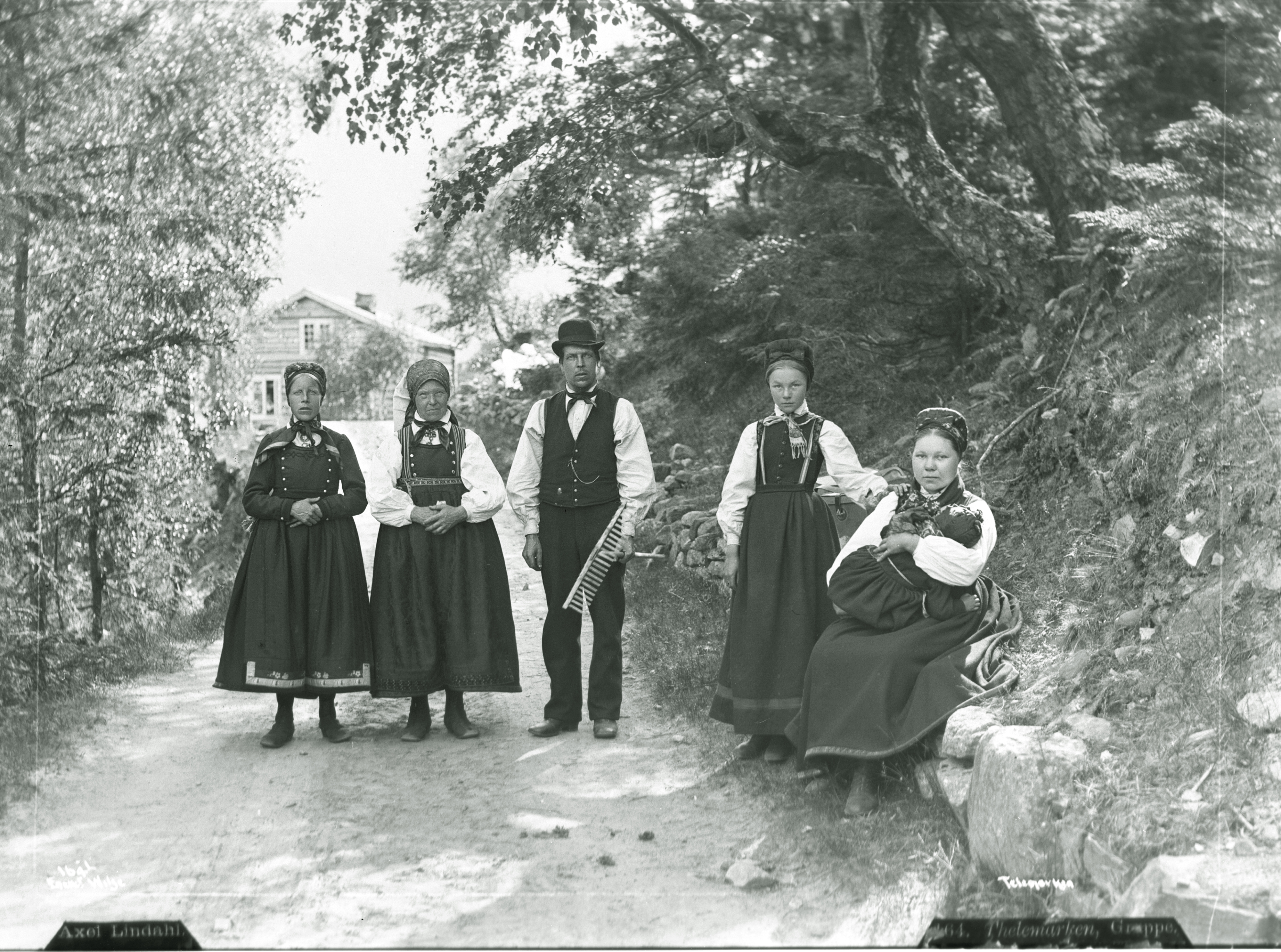
Perhaps most influential were letters from those in America sent home to Vinje telling tales of their adopted land. It seems most of her fellow passengers were headed to Wisconsin or Iowa. Why she was headed for Chicago I do not know. However, I suspect that she had secured a job there. In looking through the 1850 census of Chicago for those born in Norway the vast majority were young women employed in the households of English speaking families as servants. As I view Asloûg as a practical women– this makes sense to me—that she would have a job awaiting her. Although the photo below is from some years later it provides food my imagination of a family group in Telemark.
In 1853 Printed at Thorv. A. Hansen’s printing house this poem written by a Norwegian who stayed behind while his countrymen left for the promise of America, a few excerpts:
“A Farewell Ode to Emigrants on Their Journey to America“
1.
You are going away to maybe never again
See Norway, your homeland behold.
O that all that you here bitterly must manage without,
you in that distant safe harbor will get tenfold back.
In America’s valleys abounding with flowers,
where the earth does not mock the sweat of its grower,
on your journey there we pray that God
will look down upon your wandering with blessings!
 5.
When you in a better home country stand,
don’t forget your friends in the cold North,
that will never on your coast land;
but trudge heavily on Norway’s barren soil.
Send them a letter, a penny with a picture of freedom
so they with affection can stare at it,
on the ideal they can imagine,
in helmet and armor joyfully standing strong.
 10.
Thanks for your good company here! Do know from me
my wishes and warm prayers to God
hopefully not in vain I am raising
for your wellbeing: O for the young strong sprouts
of Norwegian stock in America to progress
to the delight and luck of father and mother
and all good! Salvation you will enjoy
when you one day leave this earth!
It seems to me even those left behind were invested in a good outcome for the emigrants.
VINJE TO SKIEN
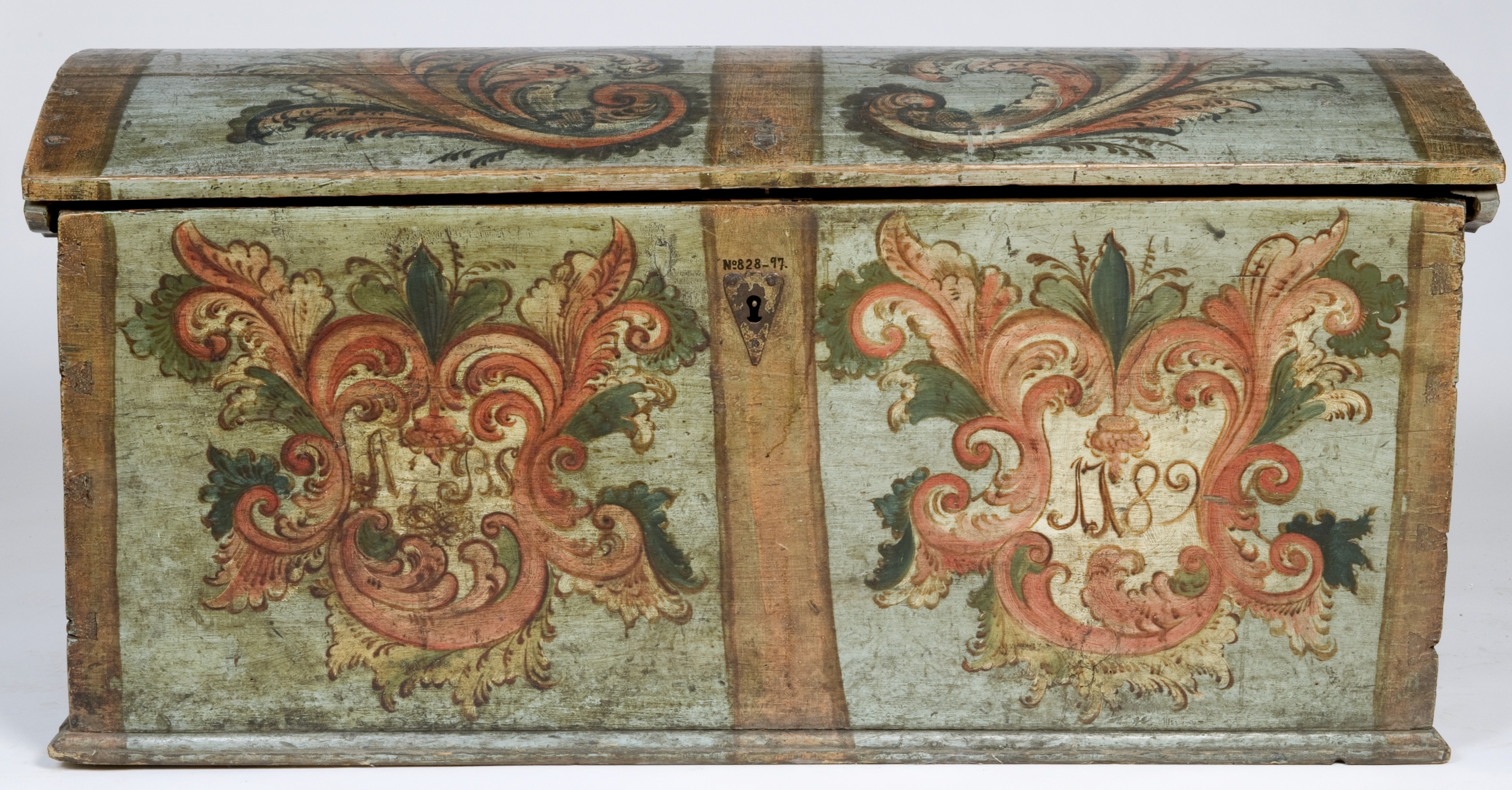
courtesy Norsk Folkmuseum
Imagine getting into a row boat such as this one below and waving goodbye to your parents and siblings–especially to your youngest sister, Sigrid, who was 16 and likely not wanting to be left behind. All of your belongings are packed in a trunk. Many of these trunks were actually dowry chests that were made for young women to store their belongings in preparation for marriage. At the time of Asloûg’s emigration she was 25 years old, a bit past prime time for marriage. The trunk would carry her dreams for the future and memories of her past. There would be objects of Norwegian identity whether traditional clothing, a bible or book from home. Additional clothes—bedding, a cooking pot, utensils, items for your daily toilet: soap, comb, brush and hair ribbons, sewing items, perhaps knitting or embroidery items to keep one busy on the two month journey to America.
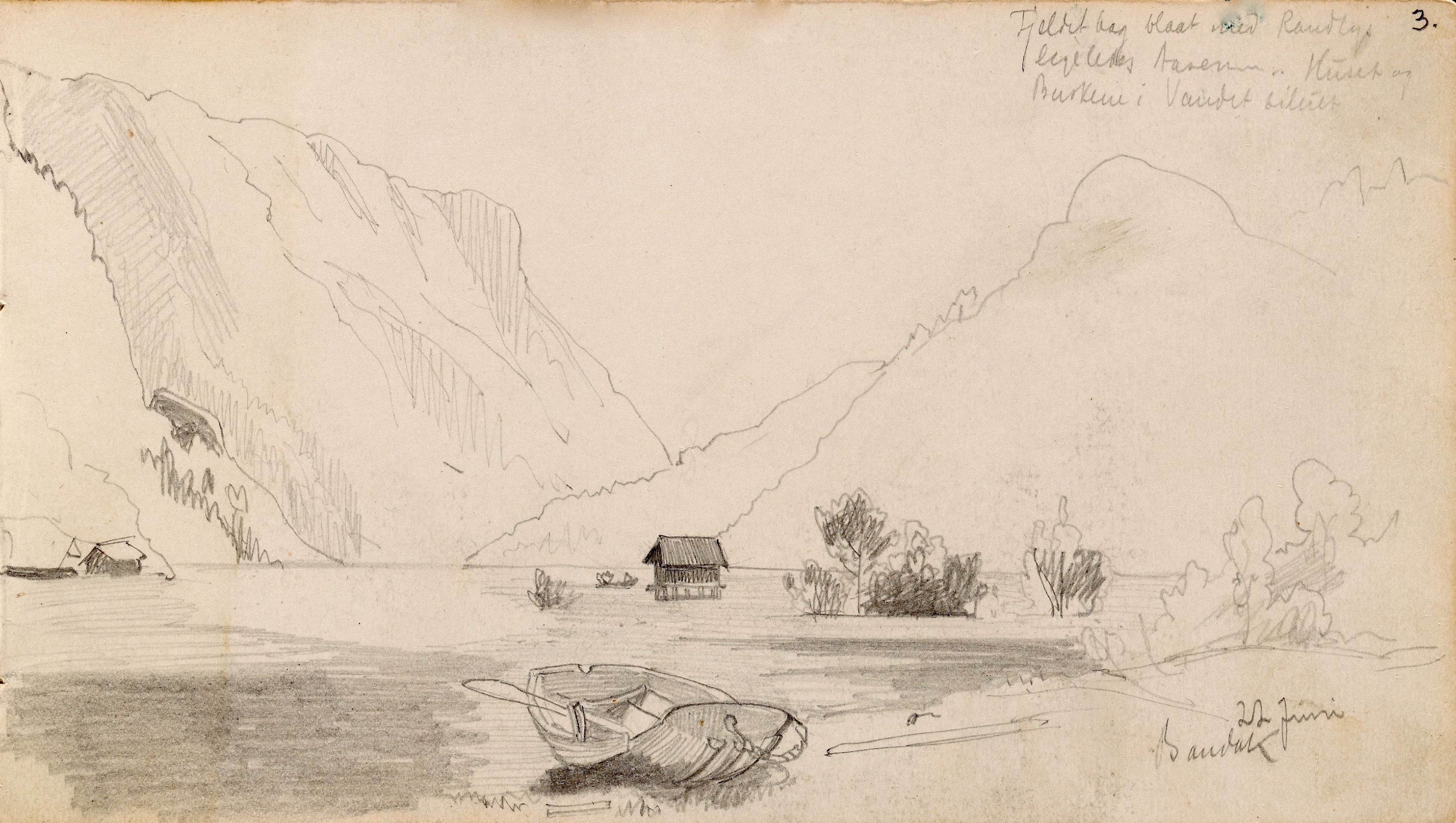
by Elief Peterssen 1873
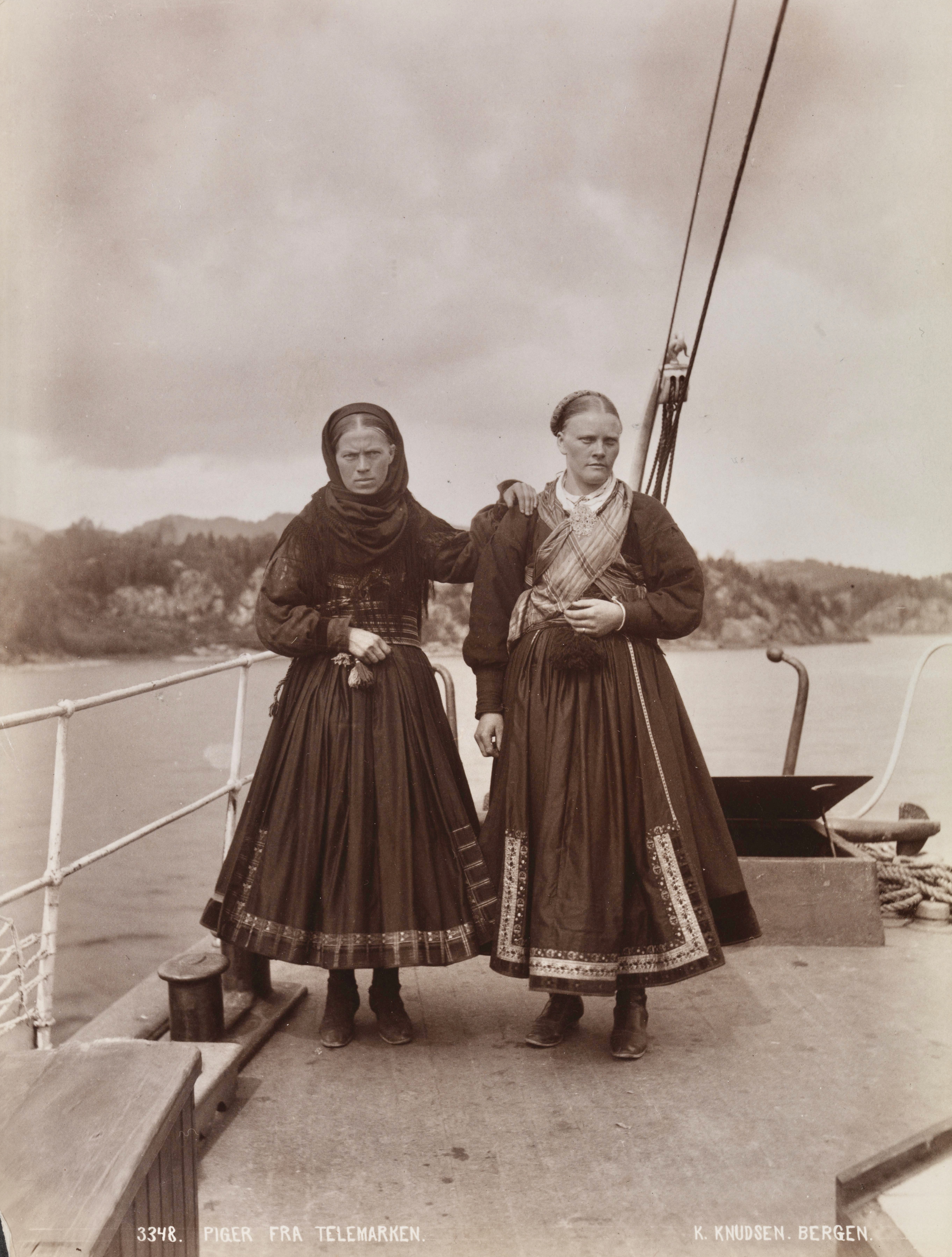
I love this photo of two girls from Telemarken from 1864. It is 12 years after Asloûg immigrated but it shows the traditional costumes and they are aboard a ship perhaps like one Asloûg may have taken across the fjords. The journey from Vinje to Kragerø was not an easy one, but easier by boat than by foot. More on that in a bit.
RESEARCHING IN NORWEGIAN LANGUAGE NEWSPAPERS PUBLISHED IN NORWAY
Just because you do not speak or read Norwegian or another language does not mean you should not look through their archives. The Norwegian Newspapers are available here for free. As I discussed in my Blog post on Google Translate you can have anything translated for you. Since I knew the ship that Asloûg traveled on was the ‘Colon,’ it is simple to search. This yielded a number of advertisements. This one from February suggests that there was a organized effort to secure enough passengers by March for the ‘Colon.’ So between the time they may have heard and their commitment to go was not a particularly long one. I did read of agents traveling into the interior of Norway looking for passengers.

The Correspondent Skein, Norway
11 Feb 1852
This later ad reads: “The brig ‘Alerth’, led by Capt Disen, and the ship ‘Colon,’ led by Capt Hassel, whose vessels, which the past 3 years have been sailing to America, will leave this spring with passengers for New York, if a sufficient number sign up for it before the month of March.”
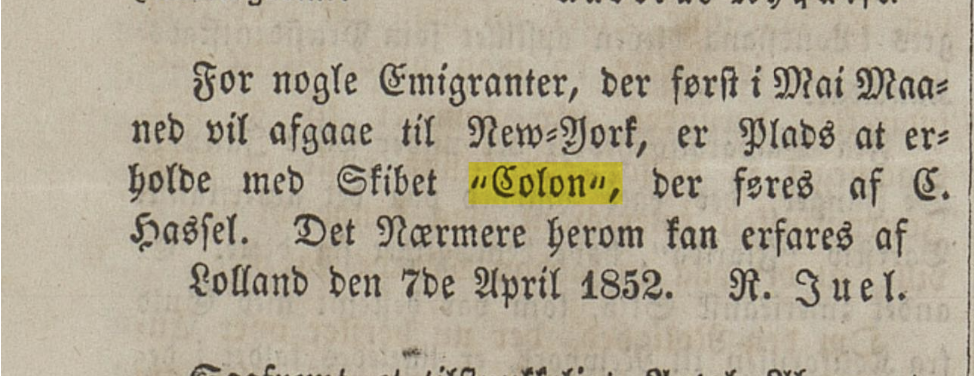
This was followed in April with this ad that suggests there was still room on board. “For some emigrants, who will leave for New York first in the month of May, there is room to be had with the ship ‘Colon’, which is led by C. Hassel. More details about this were learned from Lolland on 7th April 1852. R. Juel.”
But I hit the jackpot with this one. This is a rough transcription of an article that appeared in Morgenbladet newspaper Oslo, Norway Thursday June 3 1852:

“Kragero, the 28th of May. Yesterday morning the ship “Colon”, Mastered by Capt. Chr. Hassel, here from the city [of Kragerø] to New York with 146 emigrants. Most notably coming from Bratsberg upper Telemark . The majority were healthy and wealthy people in their prime, reportedly quite prosperous. Most of them left, full of courage, some were afraid of ‘abandoning [Norway] and jumping overseas’; but this individual was confident, because ‘Colon’ is a new well regarded Ship, just like Capt. Hassel is known as a capable shipmaster and also a conscientious man, who on arrival in New York does not fail to assist them with advice and guidance. The interior on board was very appropriate and won the passengers’ complete satisfaction. It is not a happy sign to see the dearest of the people seeking escape in a distant country, which, according to their statements, year by year here becomes more difficult to bear, even among those whose claims are the most wretched and who are used to the lands windswept and harsh nature. But we hope that a bright future is reserved for Telemark; that much improved communication will awaken the farmers inertia and sluggishness, for the spirit of business and enterprise, which in the past had been well respected, and which first brought about real development. A call for new branches of business and the opening of a large district resources, which until now had only been stopped at the ground of the people’s slumbering industrial enterprises.”
Now how often do you get a first hand account of a ship’s sailing? I know that of the 146 passengers only 19 were well off enough to travel first class in their own cabins. The rest traveled in steerage which literally means between decks. Overall they must have presented themselves well. There are very few illustrations from this time period to give one an idea of what steerage was like. Since this was a ship that was only two years old and “won the passengers’ complete satisfaction” perhaps it was a bit better than is illustrated here. Although we do not have the exact dimensions, the dept of the ship was typically 28-29 feet so with the cargo hold full of luggage and exports. the between the decks area needed to house 127 passengers. Since passengers had to eat, sleep and spend much of their time here it is no wonder so many ships ended up with illness. Luckily there was no cholera aboard and only one infant died.

SKEIN
The article mentions Bratsberg as where they came from so back to the Norwegian Archives and I found the map below for Bratsberg, which it turns out is the area that encompases the parishes from which the emigrants came. The original advertisement was in the Skein paper and it got me thinking how did they get to Kragerø and it appears they went via Skien. Here is a map with my suggested route. They would have traveled mainly by row boat or sailing ship using the waterways and fjords as highways and avoiding the need for much wagon or foot travel. Each passenger would have had a trunk packed with clothing, personal items and cookery for preparing food aboard ship. We can estimate the time of travel based on the leaving of the Laurentz Agundsson family who are recorded on the leaving registers on 21 April and their known arrival in Skein. More on that in a minute.

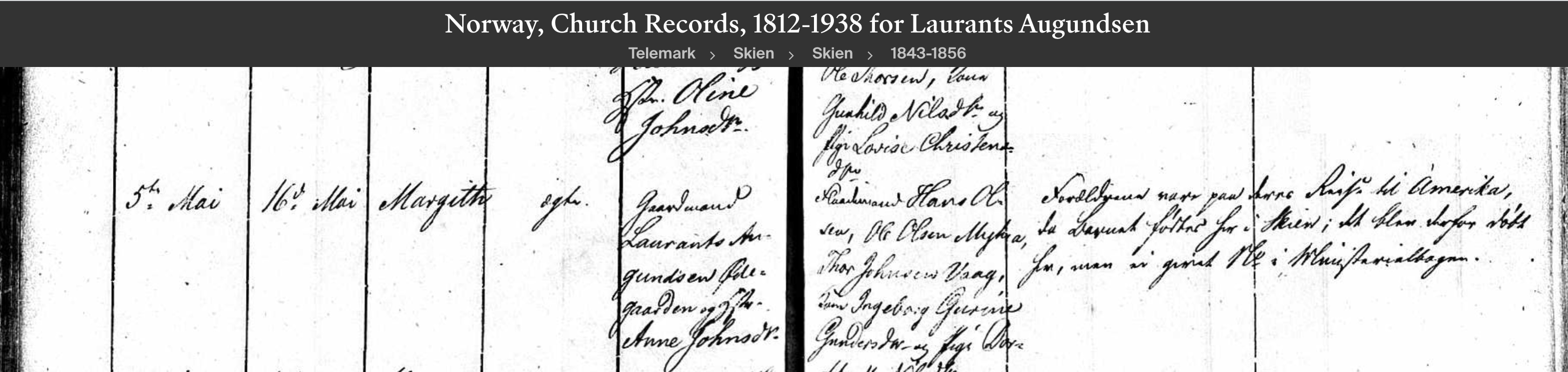
Finding the article in the Skien paper was a clue so I decided to see if I could find anything in the Clerical Household Records or comings and goings, but that came up empty. But I hit a bit of a jackpot with the birth/death records for Skien. So this family from Vinje left according to Vinje Church records on the 11st of April. They arrived by the 5th of May when their daughter, Margith, was born. Sadly she died on the 16th of May , just ten days before they would board the Ship ‘Colon’ for America. The notation on the right reads “The parents were on their journey to America, when the child was born here in Skien. It was then baptized here, but not given a number in the church record [Ministerialbogen– The persons did not belong to the parish, and that is why the child was not given a number.]”. Since those that were staying in Skien on their way to America were also not a part of the parish they are not recorded either.
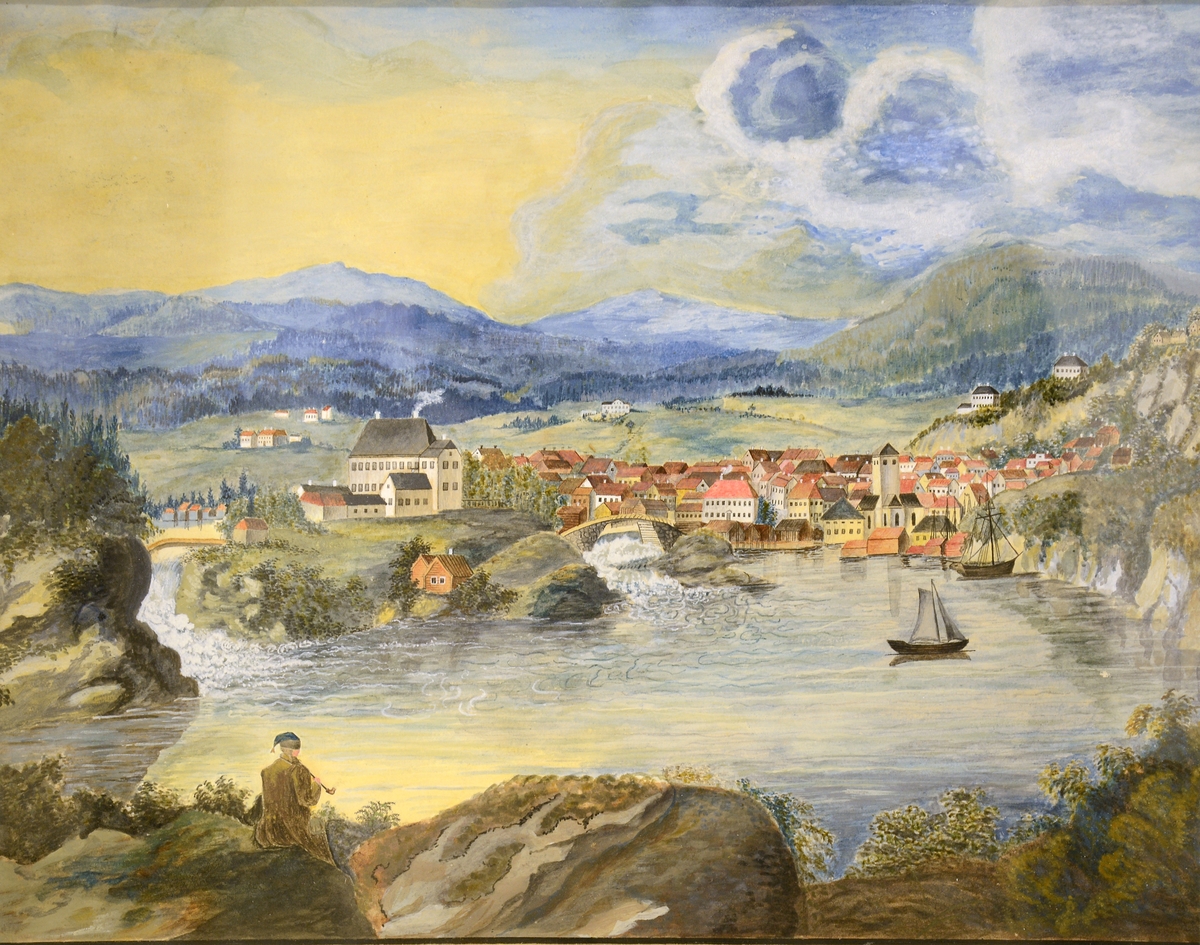
Skien was a primary port in the area and a more direct route from upper Telemark. Kragerø would have involved more land travel and portage. Kragerø was also a less populated area so the party from upper Telemark may have traveled to Skien thinking they would find more lodging there. This painting from 1822 is quite idyllic. But belies the sad death recorded above.
Skien’s claim to fame is as the birthplace of the playwright Henrik Ibsen, born March 20, 1828, Skien and died May 23, 1906, Kristiania [now Oslo]). Skien was known for its seafaring, timber and exports. Its was one of Norway’s three largest cities between the 16th and 19th centuries. In 1846 the population was recorded as 3,677.
KRAGERØ to NEW YORK
Kragerø in the 19th century was one of Norway’s largest port cities and definitely a hub of ship building and seafaring. It later became known as a vacation spot and was a favorite of the Norwegian Edvard Munch whose painting the “Scream” is universally known.

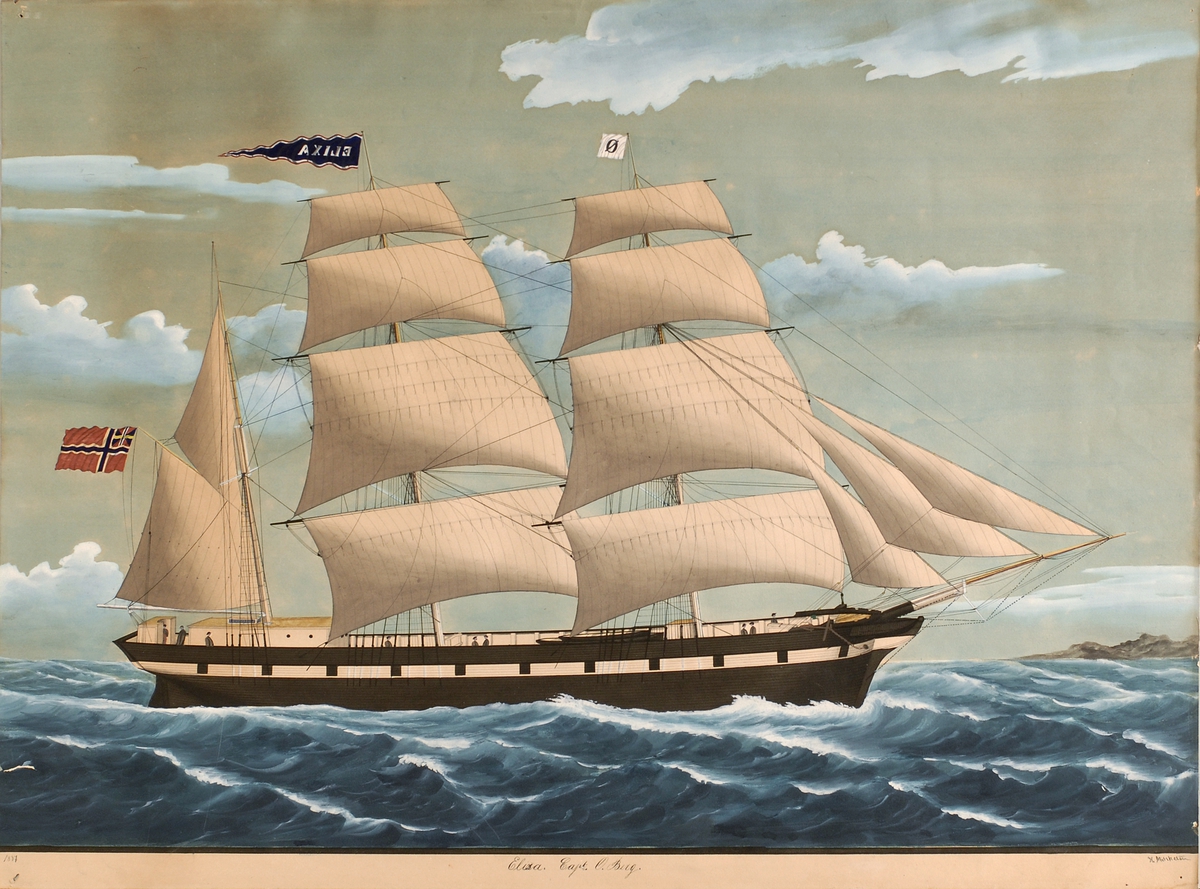
The Ship Colon’s Captain was a Kragerø native born 24 July 1834 and the son of a ship’s Captain Ludvig Andreas Hassel. His ship the ‘Colon’ was built in Kragerø and launched in April of 1850. Its maiden voyage was to New York with 152 passengers. From there the ship traveled to Havana, Brazil, Amsterdam, Odessa and Constantinople. So by the time Asloûg boarded the Kragerø in 1852 the ‘Colon’ and her Captain had proved their seaworthiness. Although no pictures of the ‘Colon’ are known the Bark ‘Eliza’ built a couple years later would have been similar. I note that the paintings present a rather romanticized version. Compare with the photo below it of an Emigrant Ship from Bergen from 1860. I think it gives a more realitic view

I cannot exit our discussion of the ship ‘Colon’ without mentioning its sailing back to Larvik [about 33 miles to the northeast by sea] from Kragerø. The ship traveled back via Canada and Hull, England with only a crew of six, as seven of the crew jumped ship in New York! Of those that remained all but the chief and under steerman, were young men and boys. After that there are no more records of the ‘Colon’ [whether she was sold and renamed we do not know.]
A TWO MONTH CROSSING
It is very hard to imagine spending two months at sea on a ship traveling steerage. The Diary of Elisabeth Koren 1853-1855 translated by David T Nelson gives us some insight. Although the author was of a wealthier class and traveled first class, and a year after Asloûg’s journey it does give us a good feel for things. Two differences were in Asloûg’s favor; the time of year she left and the weather. The Colon left 28th of May 1862 whereas Elisabeth Koren began traveling 26th September. So Asloûg traveled at a better time of year. In 1852 the first hurricane hit the Atlantic was 19th of August a month after Asloûghad safely arrived. There were two hurricanes during Elisabeth Koren’s passage. When seas are relatively calm steerage passengers could spend much of their time above deck in the fresh air. This would have been better for all aspects of their health. From Elisabeth’s descriptions of the steerage passengers we do learn that they spread out their rugs on deck and made their toilet. the men played chess and smoked their pipes and she mentions the nasty smell of tobacco. I would gather the women would knit or sew or perhaps read if they weren’t looking after children.
Weather records that I have located for 1852 [in Newspapers in Europe and the US] show the weather was dry and balmy in May-July [after a very wet winter and early spring]. It heated up towards the end of July and into the fall, Europe entered a drought. So as long as winds for sailing were favorable, it looks as though Asloûg’s crossing would have been a favorable one of calm seas and decent temperatures.
ARRIVAL in NEW YORK

After two months at sea imagine spying land and entering the port of New York. I can imagine her awe at the scene above. However it was also sweltering as Asloûg arrived in the midst of a heat wave. I imagine her steaming in the heavy wool clothing of Telemark.

All passenger ships entering into New York Harbor in 1852 were stopped to await a health inspector who went by boat to each arriving ship. Those with infectious disease, including ships’ crew that were ill, were removed from the ships and taken to the Staten Island facility for quarantine. [It was not until August of 1855 that Castle Garden Hospital and Immigration Center was operational.] Those who were well were transported ashore via boat. Then commenced the issue of getting lodging and arranging train passage [ if not already arranged. ] If Asloûg had. a job awaiting her in Chicago, perhaps she had help making he arrangements.
This article appears in Norwegian newspaper, Christiana Osten, 5 March 1851 “License Passage Bureau of Immigration” which lends a note of caution to passengers arriving in New York from Norway or Sweden:
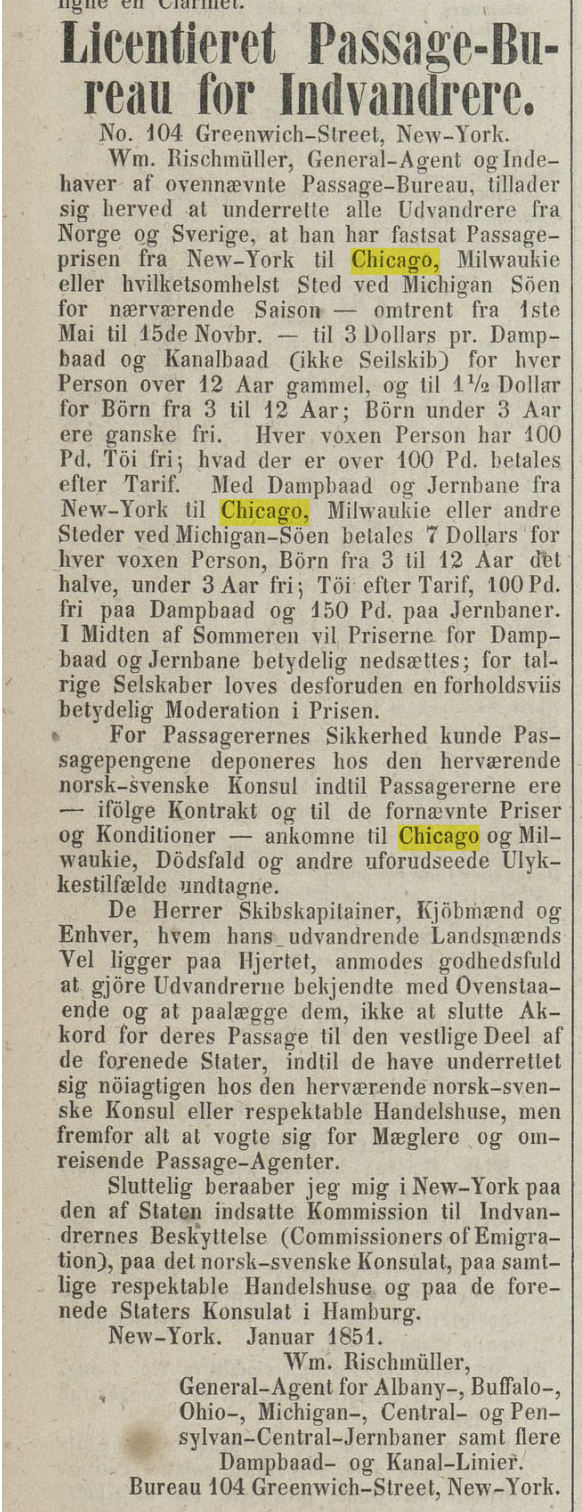
“No. 104 Greenwich-Street, New-York. Wm. Rischmüller, General-Agent and Indehaver of the above-mentioned Passage-Bureau, hereby takes the liberty of informing all Emigrants from Norway and Sweden, that he has fixed the Passage price from New-York to Chicago, Milwaukie or any Place on the Lake of Michigan for the present Season approximately from 1 May to 15 November.to 3 Dollars per Steam boat and canal band (not sailing ship) for each person over 12 years old… By steam train and railway from New-York to Chicago, Milwaukee or other places on Lake Michigan, 7 dollars is paid for a live adult person… In the middle of the summer, the prices for steamboats and trains will be significantly reduced; for numerous Companies, a proportionately significant Moderation in the Price is also promised. For Passengers’ Safety, the Passage money can be deposited with the present Norwegian-Swedish Consul until the Passengers are in accordance with the Contract and at the aforementioned Prices and Conditions arrived at Chicago and Milwaukee, Death and other unforeseen accidents excepted.
The Gentlemen Ship Captains, Merchants and Anyone, who has the welfare of his emigrant countrymen at heart, is graciously requested to acquaint the emigrants with the above and to oblige them, not to enter into an agreement for their passage to the western part of the United States, until they have notified, consulted with the present Norwegian-Swedish Consul or respectable Trading Houses, but above all to beware of Brokers and traveling Passage Agents. Finally, I appeal in New York to the Commissioners of Emigration appointed by the state, to the Norwegian-Swedish Consulate, to all respectable trading houses, and to the United States Consulate in Hamburg.“
The new country was fraught with hazards. It was not easy for non-English speakers to locate the right train and schedule. I do not know whether Asloûg traveled alone or with a group to Chicago. When she was finally boarded a train headed in the right direction there she would be among a mix of passengers of different classes and nationalities. Among them traveled newsboys selling apples, cookies, newspapers, books and magazines. What a culture shock to go from a small village in a Norwegian fjord across an ocean and now chugging on a steam train across the prairies and woodlands of New York! If only we could hear her stories.


The next part of the story was covered in How they Met.
RESOURCES
1850 Federal Census for Chicago
Newberry Library Digital Collections Chicago
The Diary of Elisabeth Koren 1853-1855 translated and Edited by David T. Nelson c1955
Kelly Wheaton ©2023 – All RIghts Reserved


Fascinating. I can only imagine the shock of the summer temperatures in NY upon her arrival considering the heavy wool garments she might (must?) have been wearing.
My thoughts precisely!