Family Heirlooms: Egyptian Cosmetic Spoon
This is an example of starting to write about a particular object and ending up with much more than you bargained for. All the memories of a beloved place come streaming back. So no matter the writing—let it take you where it wants to go.
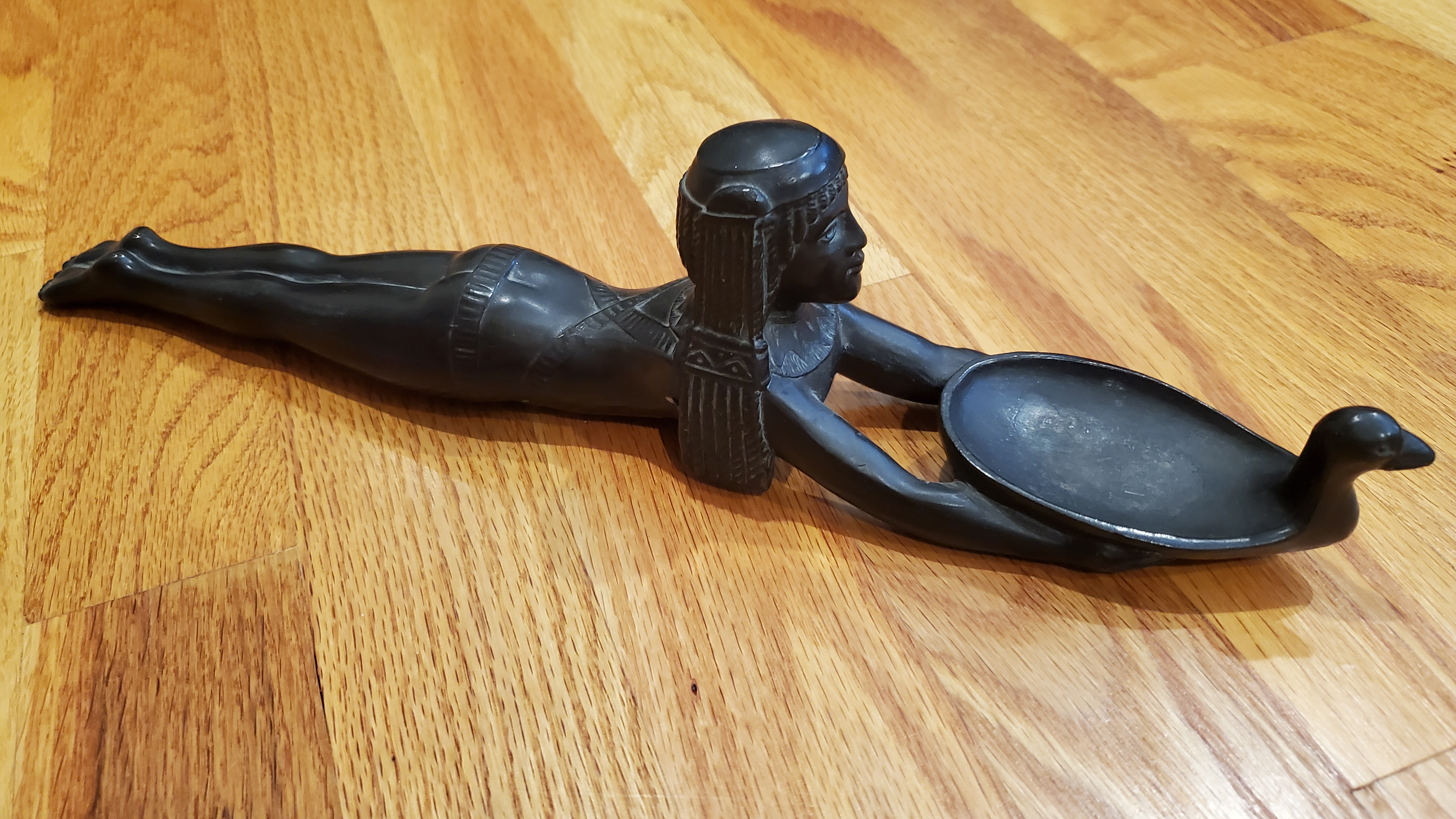
This figure sat on the coffee table of my grandparents house and I never knew the provenance of it. I never was quite sure whether it was American Indian or Egyptian in style. My grandparents did not have much in the way of toys at their house, so I sometimes played with the black princess. The toy box, stored in their pantry, which we used to drag out into the kitchen, held old wood spools and wood rings that looked like donuts. The box had a pierced metal, vented top and sides and a lovely latching mechanism on top. Reminded me a bit of an old icebox. Thinking about that box I wonder whether it previously held pigeons as mentioned in my great grandmother Lulu’s diary. When we write we are bound to remember. We are encouraged to wonder. There was also a small assortment of red plastic Hills Brothers coffee scoops in the toy box. And even though washed, they still smelled like coffee. So the wood pigeon carrier perhaps, repurposed as toy box. It had a mix of wood odors and coffee. It’s not just the fragrance of things past, it is the tactical remembering you feel in your fingertips or notes echoing in your ears.

The black princess was not really a toy. She was heavy, weighing in at two pounds—so not exactly a barbie doll! She was proportioned more like a girl than a mature woman –so that gave her a leg up on Barbie in my book. She was utilitarian as she would gladly hold nuts, collected flowers or petals from the garden or my favorite specially selected pea pebbles from my grandparent’s pea gravel paths and driveway. The black princess didn’t talk much and she was like Barbie, completely inflexible, but she was more amenable to my story telling. She made me wonder about her. And she looked like a swimmer and so we had that in common.
When my grandparents died in 1968 I never knew where the black princess ended up. I would sometimes think of her and always wonder where she was. Then one day I was talking to my cousin and it turns out she had the black princess and as she had no specific memories of it—so she lovingly sent it to me. It’s one of those objects that can instantaneously transport me back to the 1960’s in my grandparents living room on Cedar Street. Compared to my parent’s living room it seemed large. It was filled with the most glorious light filtering in from opposite sides of the room. There were two sofas: one a dark gray horse hair and another that was in a cream and gold brocade. The cream and gold brocade being the newer more modern one that had a good view of the console television. The black princess sat on the coffee table of the horse hair sofa and she had a good view of the brick fireplace and the windows with their lace curtains. I preferred her kingdom to the modern one that the family generally occupied. There was one table between the two kingdoms and that held my grandfather’s well loved upright Royal typewriter. I can smell the typewriter ribbon just thinking about it.

Once I possessed the black princess, I set out to find out more about her and each time came up empty. Then in one of those inspirational moments I took a photo and posted it on Mastodon [Free social media platform]. And sure enough Mastodon did not let me down. Thanks to @ThreeDollarBill and @CyperBunk. I learned my black princess was indeed Egyptian. And she is a “cosmetic spoon.” Who knew?

Wikipedia has a photo of a Cosmetic spoon from the Louvre: “Cosmetic Spoon: Young Girl Swimming is a late Eighteenth Dynasty ancient Egyptian carving by an unknown artist. Completed sometime between 1400 BC–1300 BC, it currently resides in the Louvre, Paris. These spoons are also referred to as “toilet spoons”. It is believed that cosmetic spoons were used to throw myrrh onto fires as offerings to gods or to the dead.” The spoons are associated with the Egyption Goddess, Nwt [Nut], Goddess of the night sky. As such she ruled over the stars and the universe. She was said to draw the dead into the night sky where she would enfold and protect them. She was also the protector of Ra, the sun god. The spoon may have been a vessel for cosmetic paints or aromatic oils however, egyptologists still argue over her purpose. In my version of the mythology she is mother gathering the souls of the dead to swim them to the heavens.
My cosmetic spoon obviously, is a replica. No matter its value is not to be measured in dollars. ASOR: The American Society of Overseas Research has a picture of an identical piece on their webpage here from the author’s collection. Save that his is Bronze: “Victorian swimming girl spoon ca. 1890.” It looks to me as that they were cast from the same mold. Whether this was from the 1915 Panama–Pacific International Exposition as I suspect or something earlier, I do not know. If it is, who bought it? My grandmother Carrie, was still in Washington State so my guess is either my great-grandmother Lulu or her son, my grandfather, Milo. I guess it may have been Lulu and this was something he kept of hers as a keepsake. Or perhaps Lulu’s mother, Millie, had bought it when she was visiting. She writes about her visit to the Panama–Pacific International Exposition here.

My black princess is my feminist icon of connection between the living and the dead. The Zulu and Ndebele people of southern Africa believed the stars are the eyes of dead ancestors, keeping watch on the living from above. That pleases me. By the way the duck is a symbol of renewal and fertility…the law of conservation says all matter is conserved. The same amount of matter exists before and after the change [death] —nothing is created or destroyed.
Update: In an email exchange with Peter Lacovara the author mentioned in the ASOR article the spoons estimated date of production was 1870’s-1880’s. When the Suez Canal was opened in 1869 there was a resurgence of Egyptian style known as the Egyptian Revival Style that persisted into the 1920’s. That makes it even harder to pinpoint who owned it. If only I could power-up the time machine…
Please see my post on writing about heirlooms.
Kelly Wheaton © 2023 – All Rights Reserved
 Wheaton Wood
Wonderful memories re this fascinating “girl with spoon”. And yes, one item stimulates so many connections. My immediate response – When my Grandpa died in 1962, I had asked for one of his pipes – he had 4 on a special pipe rack. Don’t know what happened to any of them, likely discarded. But I can smell the Erinmore flake tobacco, just thinking of Grandpa sitting in his chair by a window, holding his pipe and taking a few puffs. Sigh.
Very interesting post on how one memory connects to more.
Oh I am with you on being able to smell that pipe tobacco even without the pipe. Thanks for sharing.
Did you access Antiques Roadshow to inquire about your Egyptian spoon because you have a paid subscription?
I thought about it but once I had a response from Mastodon—it was easy to find more information. I don’t think she is super valuable—except to me.
Loved this post. My grandma kept a coffee can full of miscellaneous tiny toys like little plastic soldiers and trinkets on top of the piano. I was able to keep a miniature chamber pot stamped “the smallest” which Dad said came from my great great Aunt Rose. Good memories.