THE MOSERS IN BAVARIA: Wißenkirchberg, Hetzweiler, Kloster Sulz, Altengrueth
If you haven’t read the previous blog post BAVARIAN Hans MOSER c1623-1696 was from Austria, not Switzerland you should read it first. When last we met Hans MOSER he was part of a mass migration of “exulanten” or exiles having been expelled from Catholic Austria and resettling in a Lutheran part of Mittlfranken or Middle Franconia in Bavaria, Germany [Please note in Germany it is often written Bayern].
BACKGROUND

It is about 12 miles from Ansbach to Weißenkirchberg
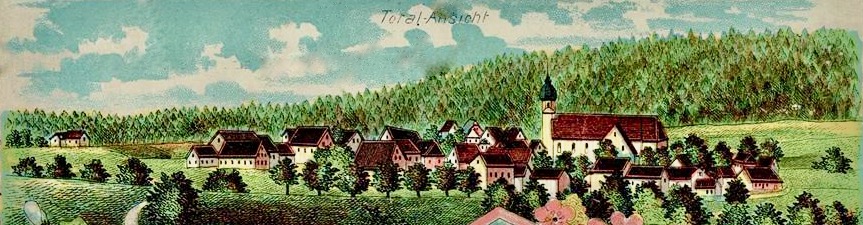
This map was drawn just a few years before Hans and Maria MOSER arrived in Franconia. It shows the area of Weißkirchberg still as forest. Towards the end of the Thirty Years War Brunst and Weißenkirchberg had 22 households. In 1642 the Properties in the Principality of Ansbach are:
- Kloster Sulz: 2 properties
- Brunst (taxes to the parish of Weißenkirchberg): 9 properties one a tavern; plus taxes to church 3 properties
- Weißenkirchberg: 3 properties one with an inn and tavern; the office of Schillingsfürst 2 farms, 2 properties one with a blacksmith shop

Hans and Maria MOSER were part of a large exodus coming out of the Waldviertal. Based on their ages at their deaths Hans is estimated to have been born about 1623 and Maria about 1630 so their marriage may have occurred between 1650 and 1653. It is not recorded in Weißenkirchberg so it is assumed they were married in Austria of elsewhere on their trek to Weißenkirchberg. It is likely that they knew where they were headed and perhaps even had friends or family already established in the area. The landscape would not seem altogether different from where they had come from. Rolling hills, verdant valleys and pockets of heavy forest. Since all the early Protestant church records in Austria were destroyed during the persecution we will likely not be able to reach further back unless it is through DNA. [Haplogroup I: M221> Z189> L801> Z165> CTS6433> S2364> S2361> Z171>CTS8584>Z185>BY165960>BY181213]

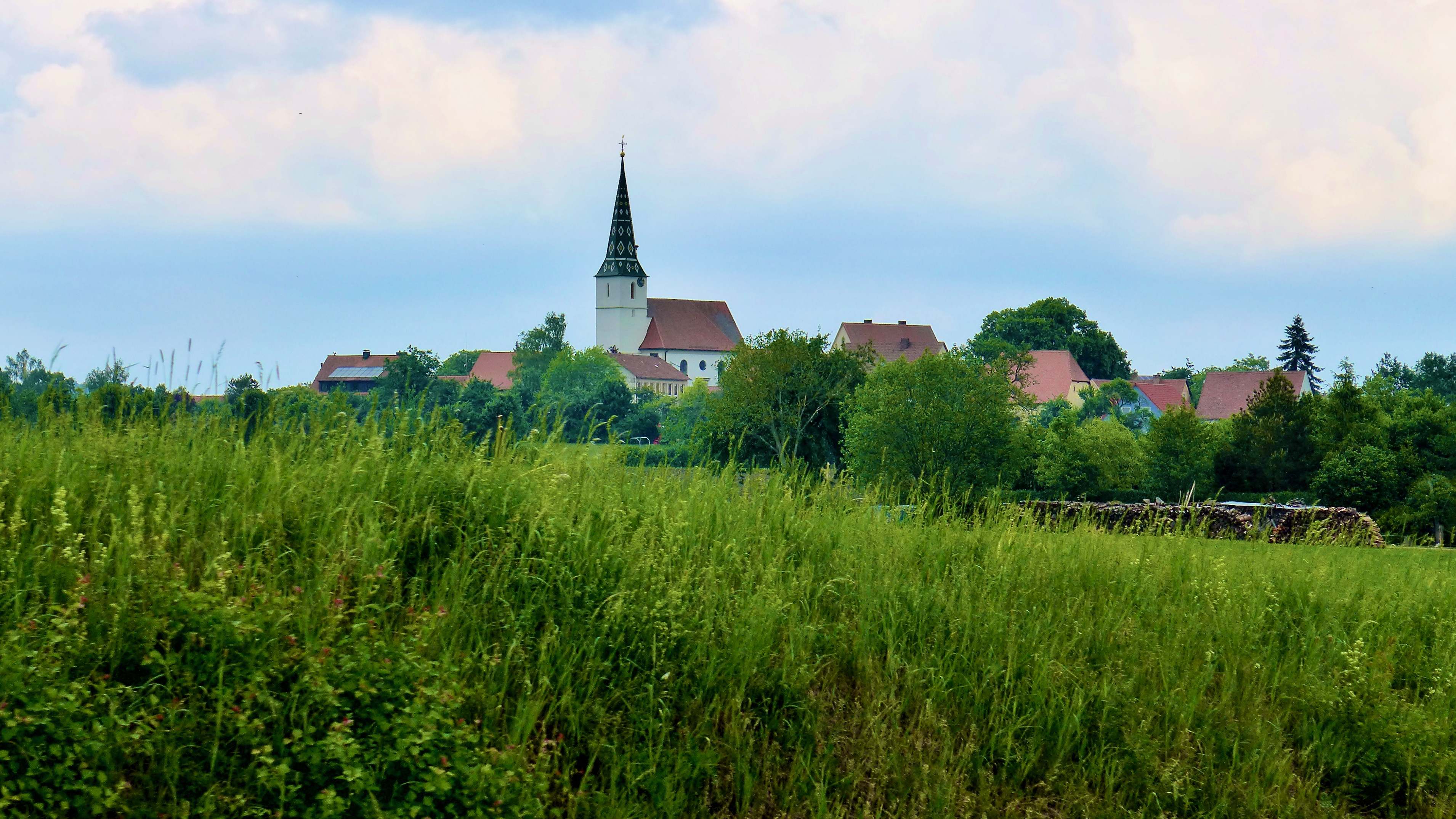
St. Wenzeslaus church in Weißenkirchberg is first mentioned in the historical record in 1333 but was heavily damaged during the Thirty Years War. One would guess the new arrivals would lend a hand in rebuilding it. The tower still holds two old bells; the smaller one from 1521 and the other from 1575. The photo below is immediately adjacent the church and might give a better idea of what things looked like back when the MOSER’s arrived: stone walls tile roofs and simple wood framed windows.

This is a view of the church today with the beautiful tiled steeple.

The day I visited the MOSER villages we drove through the forest that lies between Kloster Sulz and the hamlets of Weißenkirchberg, Brunst and Heitzweiler. As one exits the forest the church tower of St. Wenzeslaus is visible rising above the farmland as seen in Photo above. The smaller bell is rung each day at 3 PM as a reminder of a nun from the nearby Kloster Sulz monastery. It is said she was lost in the forest and found her way out by following the chiming of the bell at St. Wenzeslaus church. Unfortunately we arrived at 3:08 PM just missing the ringing of the bell.

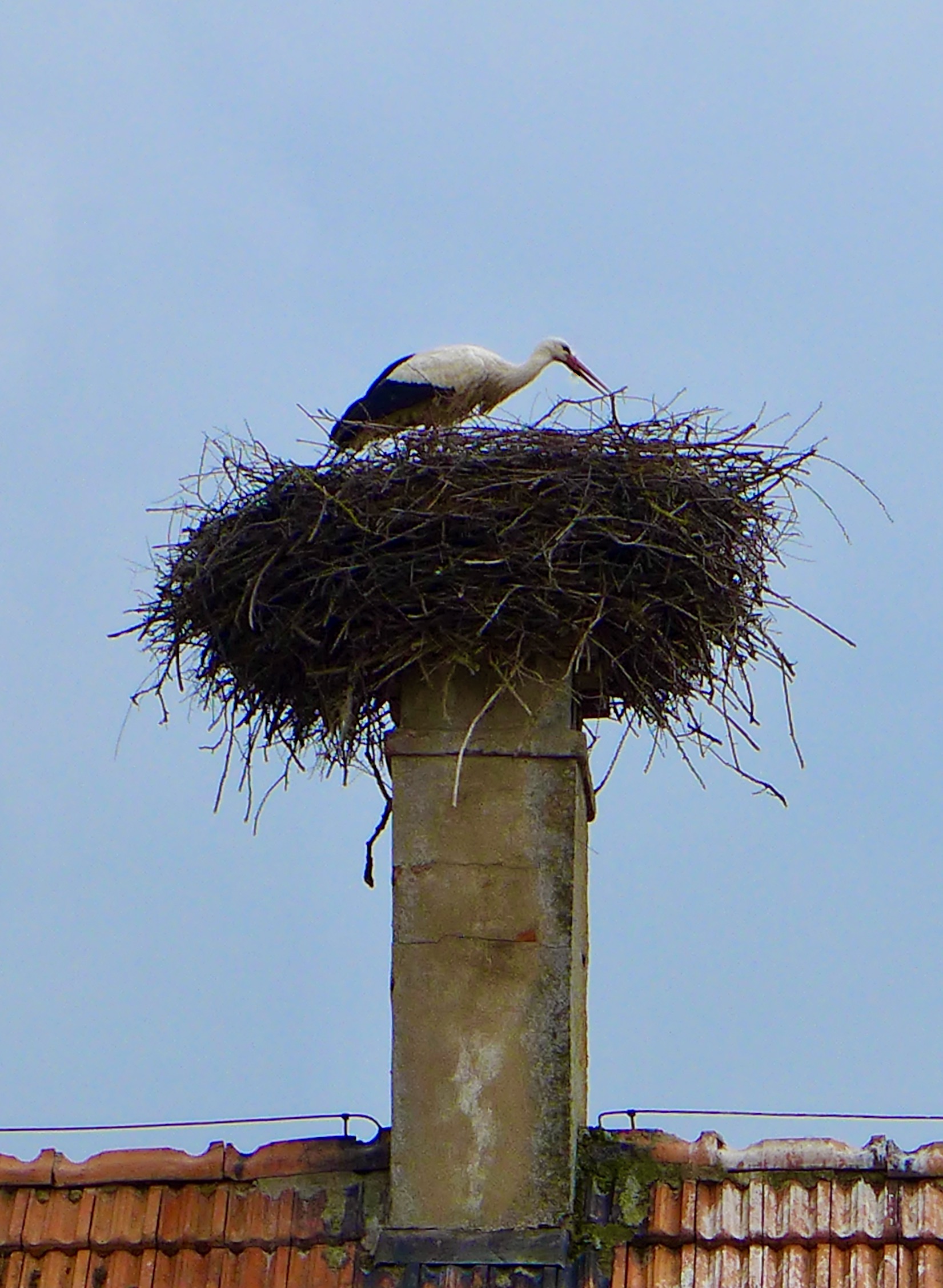
In Weißenkirchberg adjacent the church of St. Wenzeslaus, on the chimney of a nearby house a mother stork was being kept very busy feeding her young . In Germany the stork is a sign of fidelity, longevity, prosperity, protection, luck, and motherhood. And then the rumbling began as waves of thunder roared across the valley—it was so loud it felt as if our arrival was being announced.
HANS & MARIA MOSER IN BAVARIA
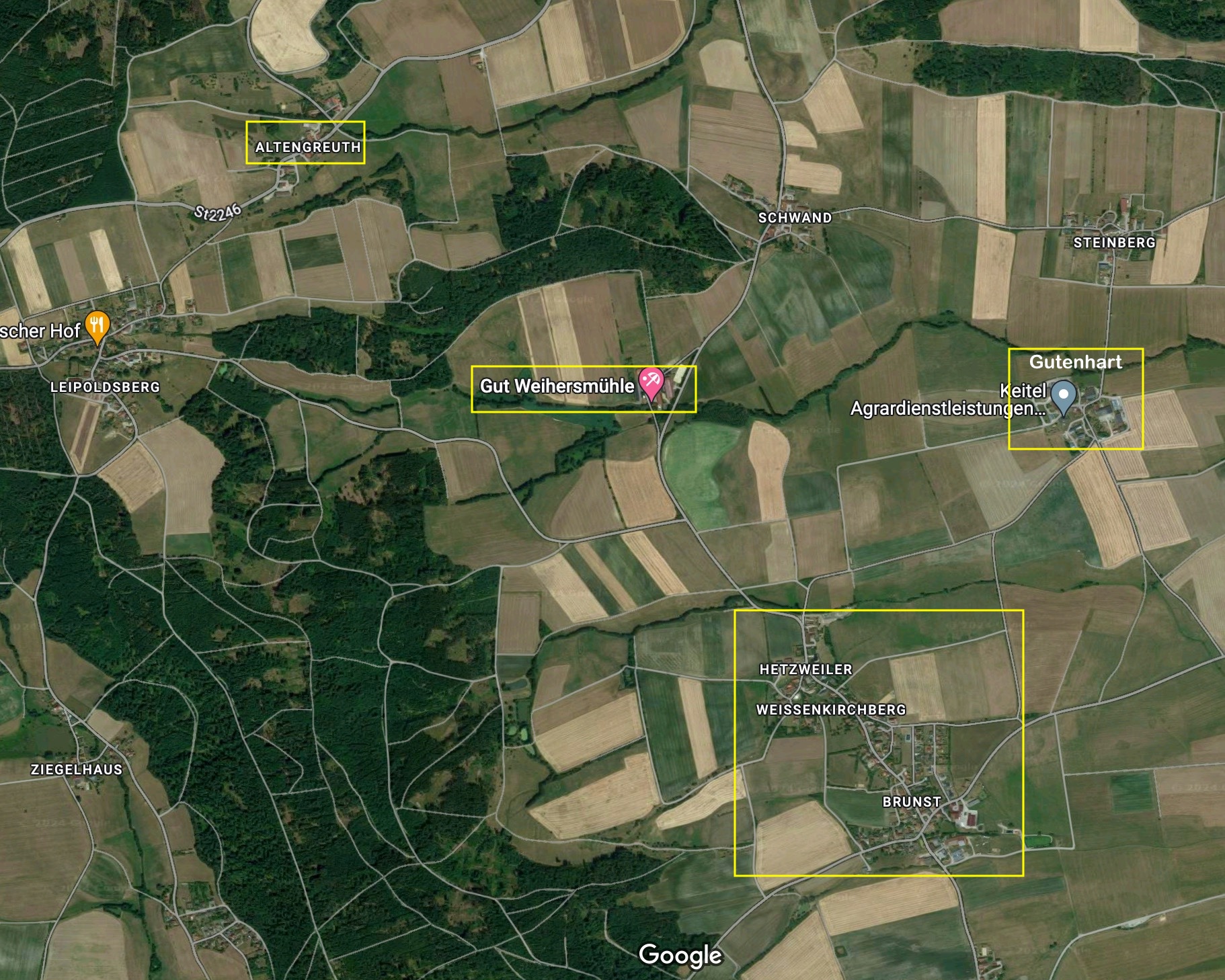
The first record we have of Hans MOSER is a Tax record. This establishes that Hans was settled at Hetzweiler in 1653. You can see that Hetzweiler and Weißenkirchberg today are just a cluster of houses with the church in Weißenkirchberg. Accounts of the jurisdiction of Colmberg and Leuterhausen STA Nüremberg, RA Colmberg 316, Item 117 sheet 94:
Hanss MOSER, Hetzweiler, 1653 Hans MOSER peasant farmer from Unterösterrich for the acquisition of Leonhardt FINISTERER’s peasant property at Hetzweiler, owes the purchase price of 20 Guilders, that he has promised to settle in annual installments of 4 Guilders, payable at Candelmas. [Important Feast day known as the beginning of the “farmer’s year” in Germany and often when accounts were settled.]
Then we have the tax exemption for the jurisdiction of Colmberg and Leuterhausen STA Nüremberg Hetzweiler 316 Item 27 Sheet 140 1653:
For the first year Hans MOSER is exempted from the annual Candelmas-tax for the acquisition of Leonhardt FINISTERER’s little property at Hetzweiler. He is exempted from 2.37 Guilders. He is exempt for three years which ends in 1656 so to begin tax in 1657
Then we have the Tax Roll of Hetzweiler 1646-1654: Account of the district of Brunst at Colmberg and Leuterhausen STA Nüremberg, RA Colmberg 225/5 1, Item 27:
“Leonhardt FINSTERER at Guth Farm (1646) : Now Hanns MOSER Lower Austria (1654)”
As I explored in the last post the Guth farm may have been in the area of Gutenhart and/or Gut Weihrsmüle. One of the fields visible on the above map was undoubtedly farmed by Hans MOSER 370 years ago. Then what little we know is recorded at Wenzeslaus church. First is the baptism of Hans Adam MOSER the 14th of September. He was born at Hetzweiler. The list of Hans and Maria MOSER’s children:
- i. HANS ADAM MOSER Born 14 Sep 1653 in Hetzweiler, Mittelfranken, Bavaria, Germany. He married Maria Stroebel. He is my 7th great grandfather. More about him later.
- ii. HANS PHILIP MOSER Born 30 April 1656 in Hetzweiler, Bavaria, Germany. m. ROSINA MITTLEMEYER . He was a farmer and married Rosina MITTLEMAYER, 4 June 1689 in Eckartsweiler He died 21 May 1727, Eckartsweiler, Bavaria. His death record says he died of a stroke. With this interesting side note. “For many years he was suffering from melancholy, and pretending being a prophet claiming that with his death the entire world will come to an end. After his death he was buried to earth, however, the world is still extant to date.“
- iii.JOHANN MICHAEL MOSER Born 19 Aug 1658 in Hetzweiler, Bavaria, Germany; married EVA MITTLEMEYER 13 May 1683 in Weissenkirchberg, Bavaria, Germany. He died 5 Feb 1716/17 Brunst, Bavaria, Germany.
Of note is the godparent of both, Hans Philip and Johan Michael MOSER was Hans HEFFNER [HAFFNER]. Like Hans MOSER, in 1654, Hans HEFFNER [HÄFFNER] occupied a farm previously belonging to Hans FINSTERER . Hanns HEFFNER was also an Exulanten of Lower Austria and like Hans MOSER we do not know where he was from precisely. We do know HEFFNER‘s widow married 2nd Thomas SOLZENDALLER from Griesbach, Lower Austria. Again all likely from the area around Rappottenstein. Two of the MOSER brothers married sisters both daughters of Hans MITTLEMEYER. The younger son, Johann Michael MOSER married at 25 years of age and had ten children. His older brother, Hans Philip MOSER married at 33 and had six children.
Sometime between 1659 and 1686 Hans and Maria MOSER moved to Altengrueth. Altengrueth is a hamlet about 1.5 miles northwest of Hetzweiler. [See the above aerial map] Today there are 6 farms in Altengrueth. We know of four families that lived at Altengrueth from the later part of the 1600’s MOSER, SINDEL, ORTNER and DANZER. The DANZERs and ORTNERs came from Griesbach and the SINDELs from Rappottenstein and GroßGerungs. The distance from Griesbach to GroßGerungs is 4 miles, and to Rappottenstein 7 miles. We also know there was a Hans MOSER at GroßGerungs and 3 at Rappotenstein. A very strong possibility is that one of them was our Hans MOSER.
Maria and Hans would have been alive to see their son Johan Adam married at St Wenzeslaus church the 26th of January 1675. The first four of Adam’s children were born at Altengrueth, probably on the same farm where Hans and Maria lived and likely Maria would have attended their births. In 1683 Hans Michael [3rd son] was married. In 1686
“On 30th of July, between 6 and 7 o’clock in the morning, there died Maria, wife of Hans Moser, subject to Rothenburg in Altengreuth, after a long illness of tumor in the 56th year of her life. She was buried to earth with sermon on the 31st.”
Hans lived another ten years. His 3 sons had 16 children among them by the time of his death. In 1696:
“On the 26th of September, between 4 and 5 o’clock. In the morning, Hans Moser, widower in Altengreuth, died of feverish sickness, and was buried with a sermon on the 27th of the same month. Age: 73 years”
Hans and Maria’s son, Philip MOSER, removed to Eckartsweiler when he married Rosina MITTLEMEYER who was from Eckartsweiler which is less than a mile south of Weißenkirchberg. Their first three children were born in Altengrueth and then Eckartsweiler. Hans and Maria’s son, Michael MOSER, lived in Brunst and the first six of his children were born in Altengrueth. Hans and Maria’s son, Johan Adams first child was born in Hetzweiler but the following six were born in Altengrueth. So it appears the family was tight knit and most of the early grandchildren were born on their grandparents farm in Altengrueth. It makes me think that grandma Maria was a good midwife!
Eldest son, Johan Adam MOSER marries Maria STRÖBEL, daughter of Han STRÖBEL 26 Jan 1675 in Brunst. She was born at Kloster Sulz in 1652. We know that the Johan Adam MOSER family moved to Grossulrichausen between March of 1690 and January of 1693 when Johan Martin MOSER was baptized at St Martins church in Wörnitz.
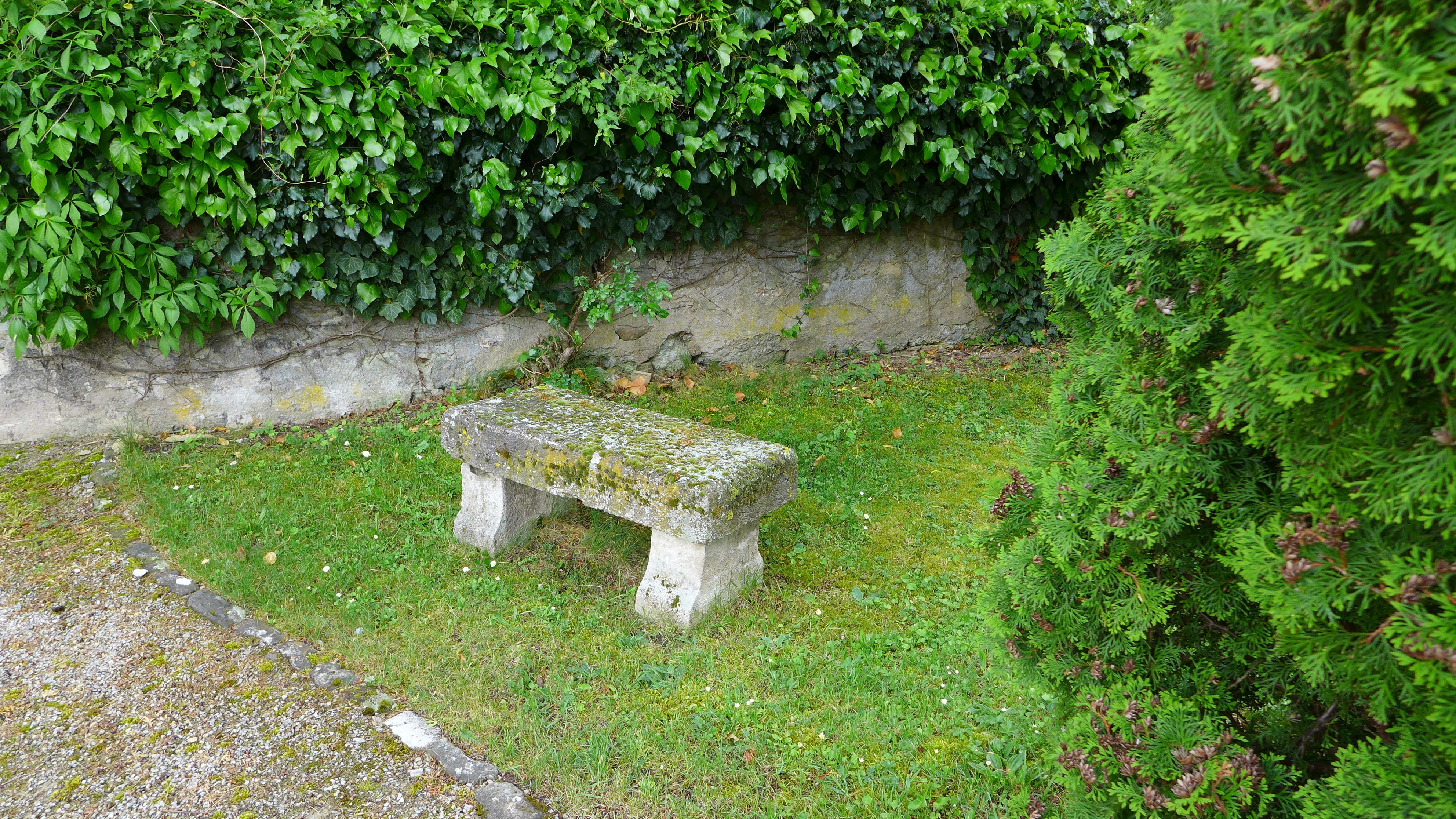
If you have an opportunity to visit St Wenszlaus church in Weißenkirchberg have a sit, perhpas upon a stone that a MOSER previously sat upon.
I have not researched much on the MOSERs who may have stayed in the Weißenkirchberg. Of the grandsons of Hans and Maria MOSER, it appears that only their son Hans Philip MOSER (1656-1727) had a son that stayed in the area. That would be Johan Michael MOSER born 10th April 1695. He was a tailor in Eckartsweiler and he had sons Johan Michael 1726 and Johann Sebastian 1730. And there appears to be great -grandsons born in the latter half of the 17th century. The last entry for a MOSER in Weißenkirchberg is the marriage of John Leonhard son of Johan Sebastian in 1800. So that ends our tale of MOSERS in Weißenkirchberg. My part of the story is continued in the previously posted stories of Johan Martin MOSER of Großulrichausen, Wörnitz and Breitenau Bavaria and New Hanover, Pennsylvania:
- Three Brothers Story Retold: Johan Martin MOSER
- German Immigration Part One: Johan Martin MOSER
- German Immigration Part Two: Johan Martin MOSER
- German Immigration Part Three : Johan Martin MOSER
- German Immigration Part Four : Johan Martin MOSER
Future posts may involve some unconnected MOSERs in the Weißenkirchberg area. And the continuation of my particular branch with Frederick MOSER of Breitenau, New Hanover and Orange County [now Alamance] North Carolina. I hope you find these stories inspirational in searching your own.
Kelly Wheaton ©2024 – All Rights Reserved
 Wheaton Wood
One side booted out by Catholics and the other by Protestants. Explains why we had a Cameron Catholic Nun and Moser Protestant Missionaries of recent generations.
My Maclean and Cameron family was booted from Mull (sailing port) because the Protestants didn’t want Catholics. After landing in Nova Scotia, they built a home, but soon were informed by neighbors that it would be a better for them (safer) to move quickly to the Catholic side of Nova Scotia which they did. Devout great great grandma raised a son John Cameron who became Bishop of Nova Scotia at St. Ninians Cathedral and encouraged higher education for women at Xavier College.
So much bad in the name of religion….
Quite lovely to connect these dots and especially th
Pingback: German Immigrants to Pennsylvania: Pioneer Georg “Frederick” MOSER (1722-1800) | Wheaton Wood