Write What You Know: Research What You Don’t & Beware of Artificial Intelligence Generated Answers.
If you are a follower you know I encourage you to turn your family trees into stories. But sometimes it is hard to know how to do that. Well you start with what you know about an ancestor or family. That is where tools like Family Group Sheets, Individual Research Checklists and Timelines come in handy. These are ways to organize information that you know and see what is missing. If you use Ancestry or a similar online program you will be familiar with a view that shows a timeline on the left side, like this one in Ancestry’s Facts view:

So you are placing the individual “Frederick” within the context of time and family. If you switch on Ancestry to the Life Story view it starts shifting you into a narrative format as shown below
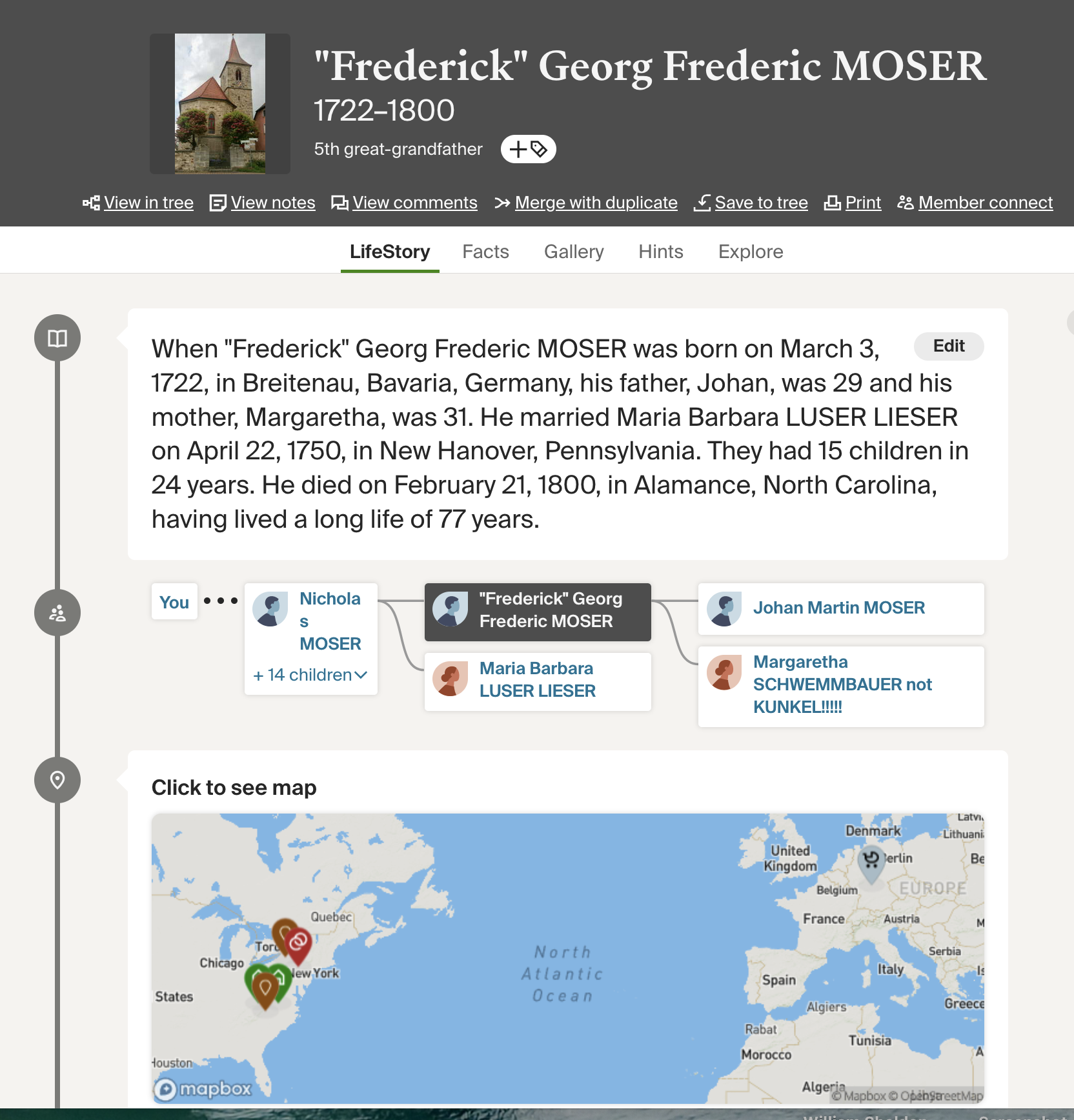
You will notice they insert maps and make observations about the family. There may be short articles on historical events.
CAUTION
But now there is a new twist you can have Ancestry AI suggest a question and give you an answer via Artificial Intelligence. The problem is in the first question I tried the answer was partly, VERY WRONG. This is in BETA but it troubles me. The Question was “What was Breitenau, Bavaria, Germany like when Frederick Georg was born?” Below is the answer as reported by ancestry AI.

Generally speaking this a correct, but one horribly wrong statement made me distrust it wholesale. The wrong statement shifts a fundamental part of understanding Frederick MOSER and his parents. This is the patently false statement “Religion played a significant role in the lives of the people in Breitenau. The village had a Catholic church, which served as the spiritual center of the community. The villagers attended mass regularly and participated in religious ceremonies and processions.” There was no Catholic Church in Breitenau. It is in a predominately Protestant area of Bavaria and the church was Lutheran then, as it is today. This is a very small village and it has ONLY one church. Furthermore both Frederick’s parents were descendants of Austrian exulanten. These were protestants who fled Catholic Austria during the early 17th century, for protestant areas of Germany. Do not rely on Artificial intelligence or those nice little historical details to write your stories for you. The only way to do it properly is to do your own research.
HOW TO RESEARCH an ANCESTOR’S STORY
And what does that mean? It means to familiarize your self with the geography, the maps, and local history of the place your ancestors lived. The WHAT, WHERE and WHY of your ancestors story.
- What was the area known for?
- Were there wars between indigenous people and immigrants?
- Were there divisions between religious or ethnic groups?
- Were there wars or economic divisions that occurred before or during your ancestors lifetime?
- Who lived nearby?
- Why did they move here and not somewhere else?
HISTORIES
Immerse yourself in where they lived. It’s wonderful if you have the opportunity to visit, but in the absence of that search for time appropriate maps. Or at least as close to the time frame in question. If you can drive down the road in Google Street View. Look around. What do you see? Do a search for a county or regional history. My favorite way to do that is to do a search for: “Archive the History of [the name of the county or region].” So a search would yield something like this:
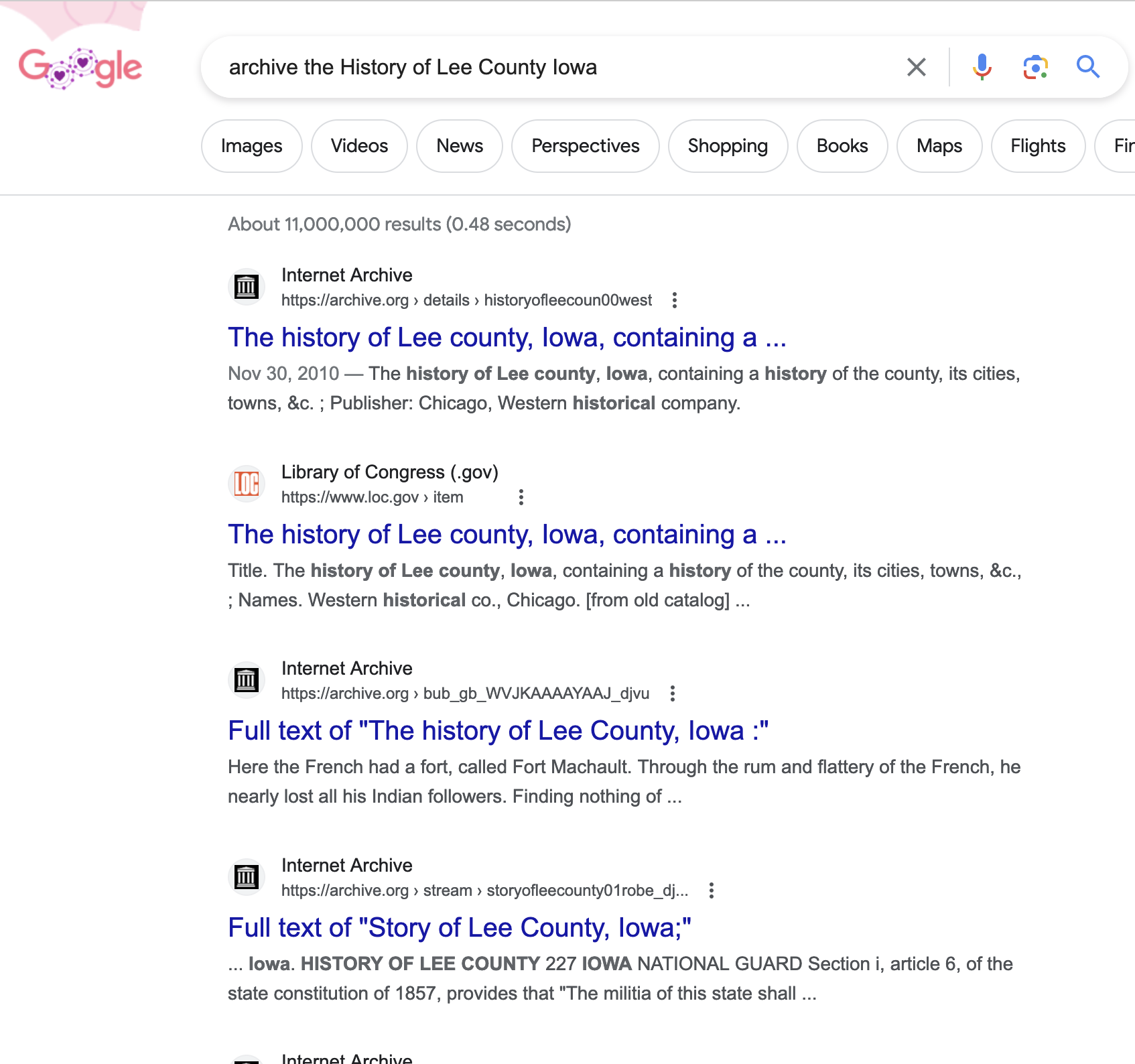
This immediately gets you able to read Histories of Lee County Iowa that are out of copyright. I can search for ancestors but I can also look for details about population, agriculture, churches, military service, history etc. Because this brings up history that is uncopyrighted I can freely quote descriptions of life and the areas my ancestors lived. Sometimes it will even have delightful stories about your ancestors, like the one I wrote about in Ice Cream Melons & Foxes.
MAPS
Second I like to research maps. Perhaps my favorite map resource is David Rumsey Map Collection. There are many great features but two favorites are the Georeferencing or overlaying of current and historical maps. And a NEW feature is: Search by Text-on-Maps! Have a look at what a search for Alamance looks like. Each one of those images will take you to a map with the word Alamance in it.

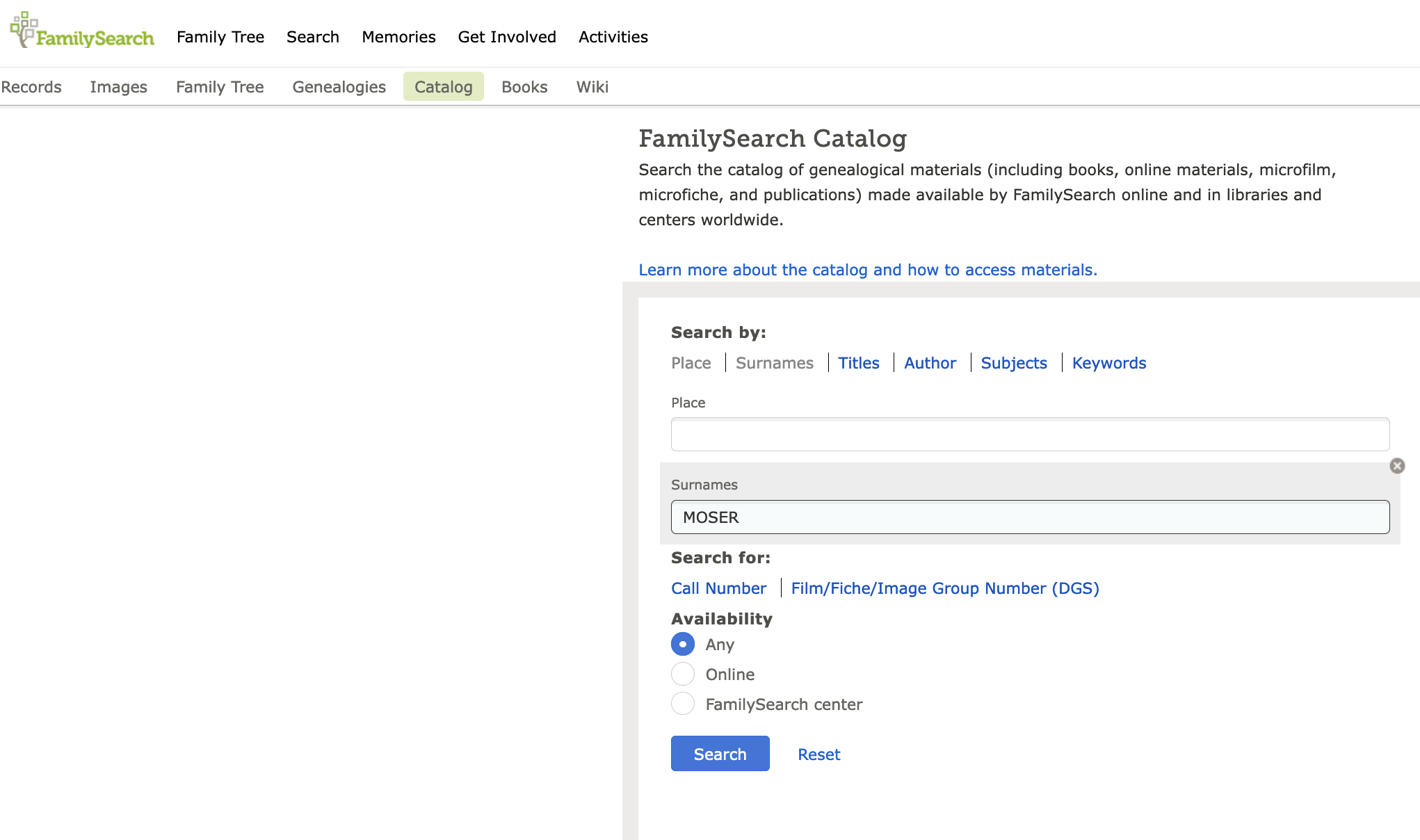
So first we looked at some background history and then maps. What next? The sky can be the limit but here are a few places I tend to check. I especially like Family Search for looking for an existing genealogy that may cover your ancestors. So here I have clicked on Catalog then on Surnames and Entered the surname “MOSER” This will yield hundreds of published and unpublished manuscripts that contain the MOSER family.
GENEALOGIES
Which brings us to your “Friends and Family” searches. Even if you can’t find something about your family you might find something about their neighbors. So go back to your Census records and take a closer look. Was your family living in a Jewish neighborhood? Or were most of the people in the area Irish? Who did your ancestor marry? Who were her/his in-laws? Who did their children marry? The names you come up with can be clues to finding out more about your ancestor. You can go back and search for them as above.
NEWSPAPERS
Now depending on how deep you want to go—you may wish to explore newspapers to see what was going on in your ancestors lifetime. If you are lucky maybe you’ll find a mention or an obituary. But pay attention to other things that were being reported on locally. Was there a series of droughts? A drop in cotton prices or maybe labor riots. All this familiarity withe what was going on during your ancestors lifetime will inform what you write about and how you understand their challenges. I have a civil war ancestor who was legally charged with taking care of his “slow” brother under and agreement with his father.
ARCHIVES
Another great sources of information is Regional or institutional archives. Examples might include:
- Religious denominational archives
- College or University Archives (often repositories of individual papers)
- Historical or genealogical Archives
- State Archives
- Regional Archives
- National Archives
What you might find can range from letters, vital records, deeds, maps, diaries or even court cases. And REMEMBER the diary, letter etc does not have to mention your ancestor to be relevant to your understanding of what your ancestor went through. Sometimes its a simple tidbit or snippet of information that makes the difference.
So assuming you have followed my suggestions above–what’s next? Go back over all the records you have and see what you overlooked— before you knew all the information you have gathered. Was there some information on a death certificate that now makes sense. An obvious one is a death from a work related exposure. Like an accident on the railroad or dying of black lung because your ancestor was a coal miner. Look at birth order, the number of children, deaths in the family, remarriage etc. Did grandparents live in the household? Did relatives settle nearby? Was your ancestor’s immigration preceded by a friend or family member? When you can answer these questions, then you are ready to write your ancestor’s story.
At the end of the day, how you tell the story will make us care about your ancestor or not. Your job is to tell enough of the story with just enough detail to make us care, without boring your audience and bogging the story down with extraneous details that will cause your intended audience to stop reading. You are not writing the history of blankity-blank region. You are writing about how that history influenced your ancestor’s life. That said whatever you do, however well or poorly written something is, it is always better than nothing, IF it is well researched. But if it is AI generated nonsense it is worse than nothing at all—because it is just glorified fiction. You have to do enough of your own research to know what is true and what is not. AI has its uses like in being able to take places in maps and deliver them to your computer screen. But the lack of conscience and integrity that AI has in compiling stories must be met with a very healthy dose of skepticism.
Kelly Wheaton ©2024 – All rights Reserved
 Wheaton Wood
Great reminder! I too wrote about Ancestry’s BETA AI feature as well, quite awhile back, and I agree with being extra careful with it. 😉
Pingback: OUR LEGACY: Leaving Breadcrumbs | Wheaton Wood
Fantastic advice…I love, love, love maps and newspapers! And fully agree about relying on the AI generated information, both at Ancestry and elsewhere…
Thank you Teresa!
Pingback: Friday’s Family History Finds | Empty Branches on the Family Tree