LONDON Day Two, Part One: Temple
Temple: from the Latin templum meaning an ‘open or consecrated space’.
I had an itinerary and a plan, but that was based on traveling with someone who had not been to London before. Upon getting back last night and finding my feet and back complaining more loudly than expected I decided to revamp my plans and downsize my expectations. This was my view of the patio while eating breakfast.
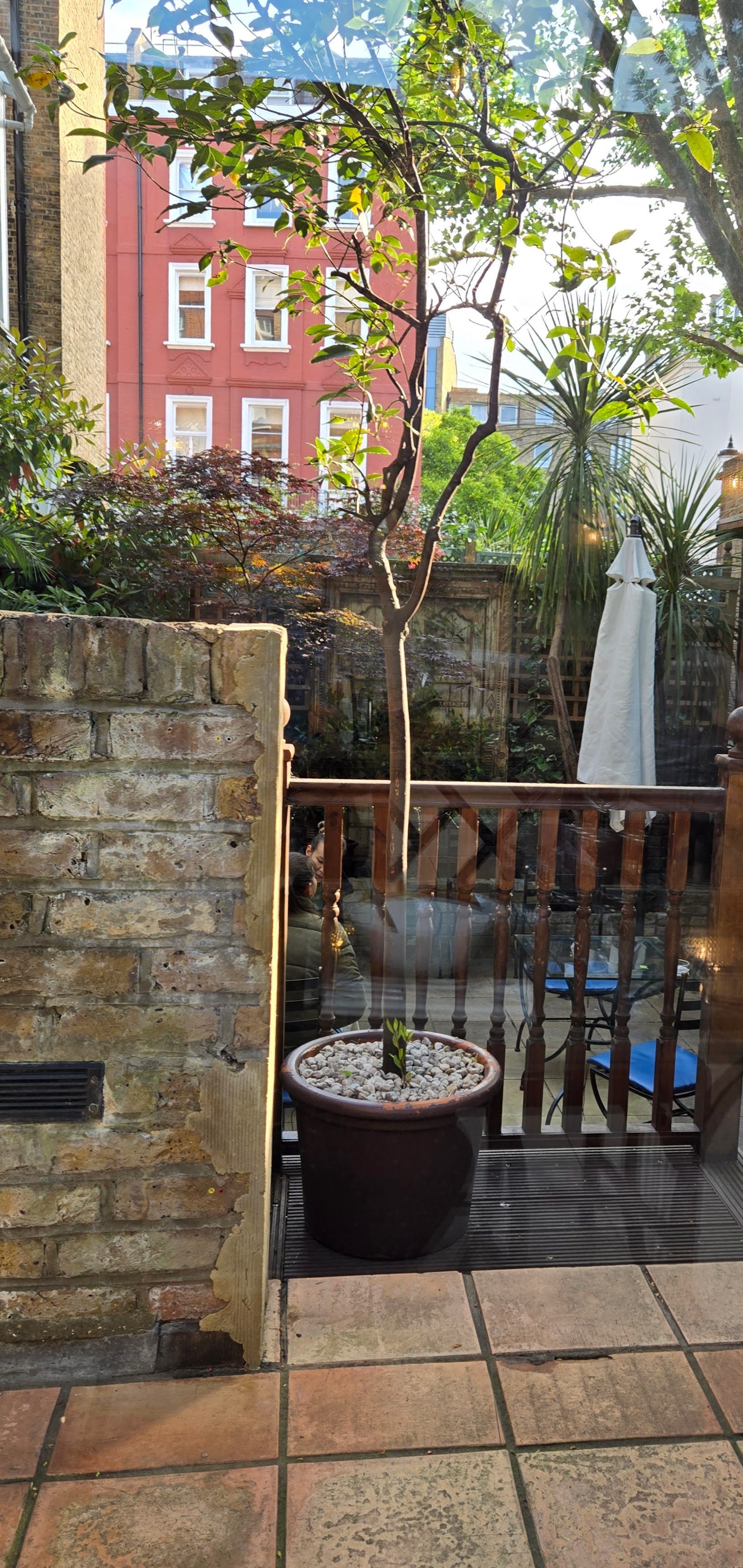
I did not “have to” go or be anywhere. I reduced my goal to traveling to the Temple District. The Temple District is the main legal area in London and home to the Royal Courts of Justice, London’s 4 Inns of the Court, with their adjacent gardens and the Temple Church, built in 1185 by the military order of the Knights Templar. I like to travel with a plan, but not necessarily stick to it, leaving openings for serendipity.
After breakfast I made my way to the Earl’s Court Underground Station and looked to catch the District Line to Temple Station. On exiting Temple Station I happened upon a Women’s art installation beside the River Thames with a fanciful pumpkin carriage with Chain, and a cupcake with the London Eye in the distance.
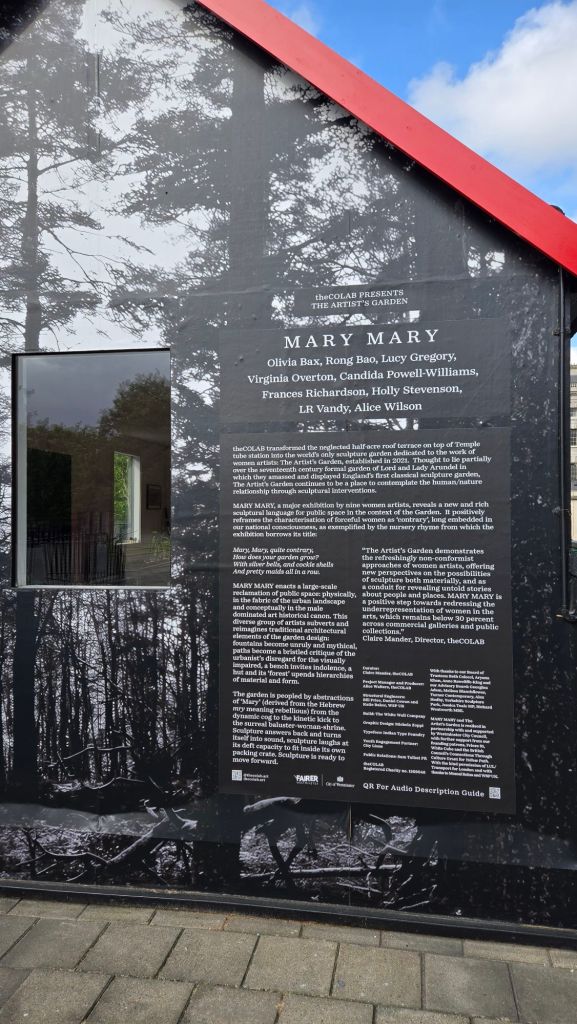
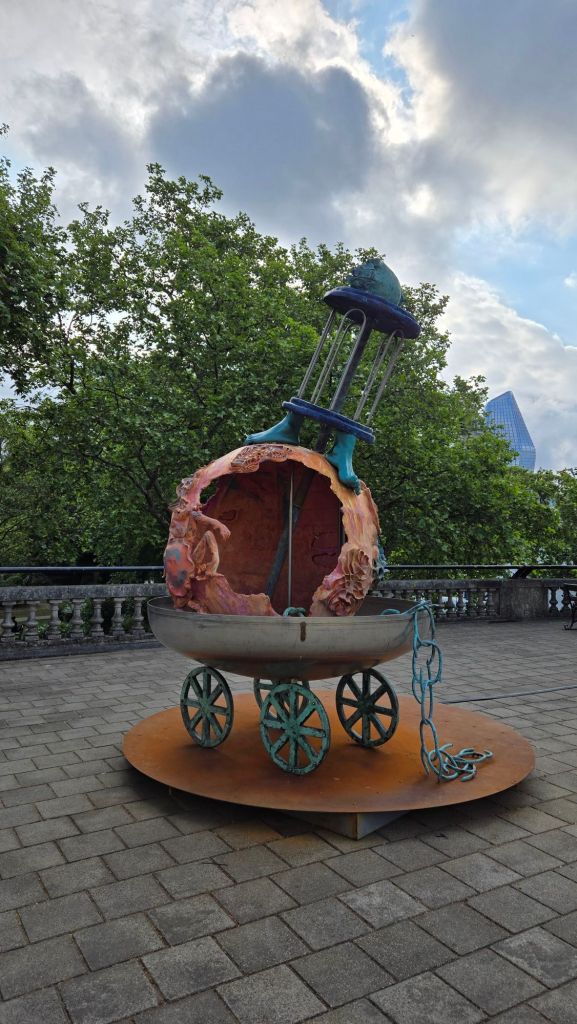
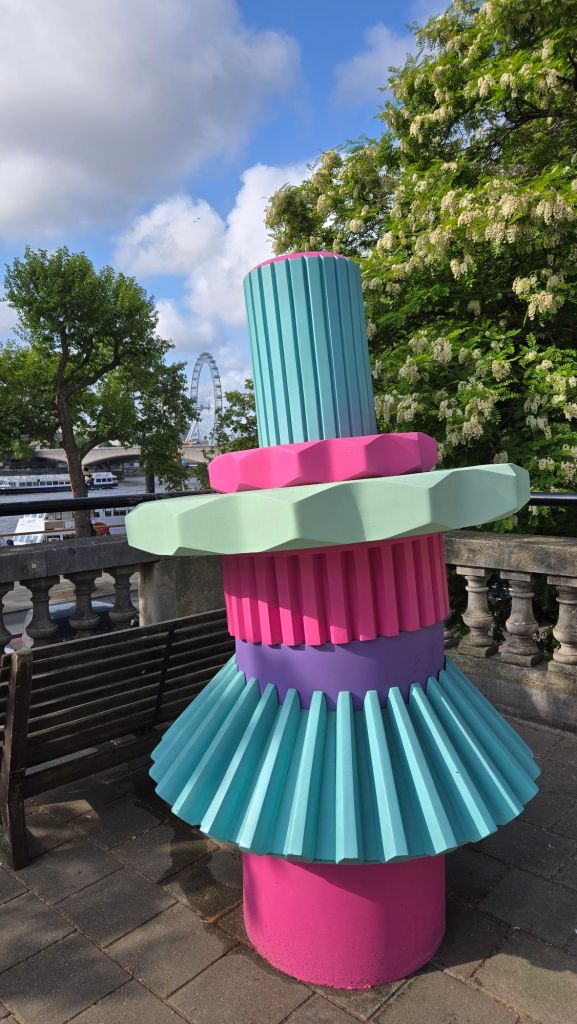
I had visited the remains of the White Friars Monastery on Carmelite Street [see map below] on a previous visit to London. The Temple district is loosely bounded by the River Thames to the south, Surrey Street to the west, the Strand and Fleet Street to the north, and Carmelite Street and Whitefriars to the east.

I became more interested in the Temple area when reading Nancy Maude Peters, “Was Shakespeare a Hydden Man? An Elizabethean Jigsaw Puzzle” This book builds a case for the author of Shakespeare’s works being Ralph SHELDON rather than William SHAKESPEARE. The same Ralph who was responsible for the SHELDON tapestries I saw at the Albert & Victoria Museum yesterday. Her book is available on Amazon and is well researched, albeit controversial. Interestingly, Ralph SHELDON is not among the 88 listed on Wikipedia’s Shakespeare Authorship Candidates list and she builds a better case than most of them. My interest in Ralph has to do with my working theory that my grandmother SHELDON’s line is connected to the SHELDON’s of Warwickshire of which Ralph SHELDON was a prominent member. Ralph SHELDON was admitted to the Middle Temple to study law 12th of November 1556 and had chambers there through May of 1560. About this same time Ralph’s sister Katherine SHELDON married Edmund PLOWDEN. Edmund was Treasurer of the Middle Temple and oversaw its design and construction in the 1560’s. The Middle Temple hosted the first recorded performance of Shakespeare’s play “Twelfth Night” in the hall on 2 February 1602. It is also of note that William Shakespeare set the scene for “Henry VI.” Pt. I. Act 2, sc. iv. at the beginning addressing the Wars of the Roses in the Temple Garden:
Warwick: “And here I prophesy: this brawl today,
Grown to this faction in the Temple garden,
Shall send, between the Red Rose and the White,
A thousand souls to death and deadly night.” SHAKESPEARE
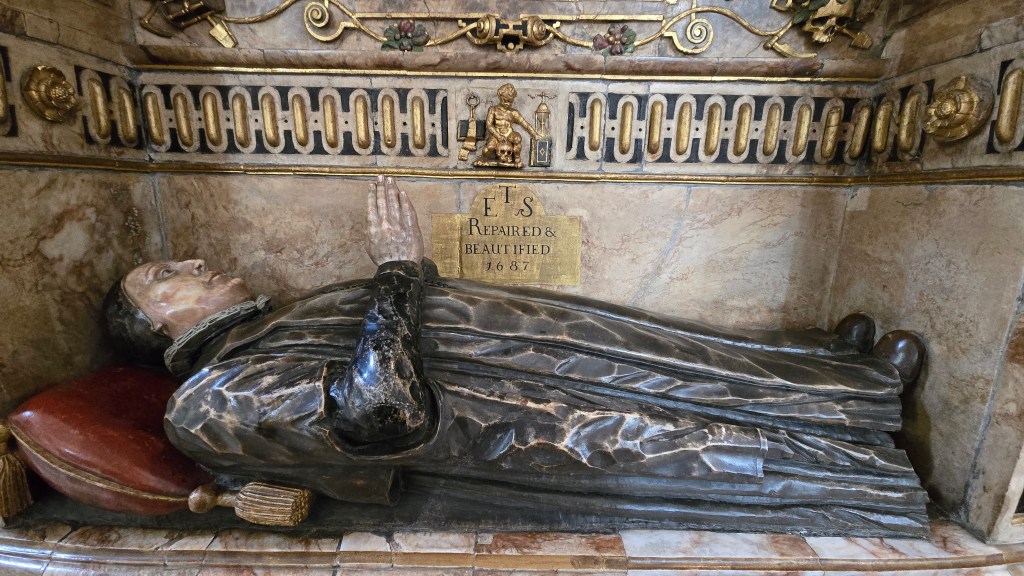
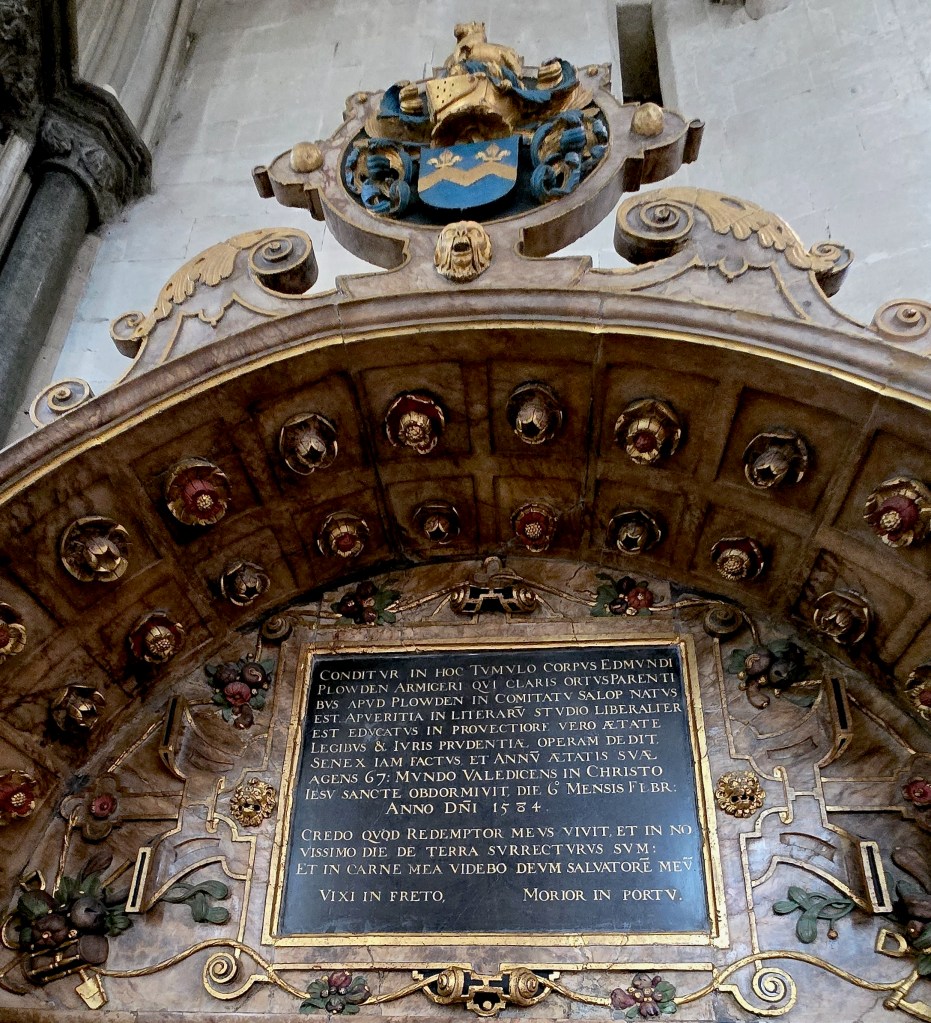
Much of the Middle Temple was destroyed in a fire in January 1679, which caused more damage to the Inn, than the Great Fire of London in 1666. Peters goes into great detail about Edmund’s published law tracts and their influence on a number of Shakespeare’s plays. So there were several reasons for spending my first full day in London visiting the Temple District. Edmund PLOWDEN is interred at the Temple Church [below is his memorial and effigy]. I had not remembered this, but when I read his name I knew it was familiar so I took a couple of photos, even though I had forgotten his connection. But I jump ahead of myself.
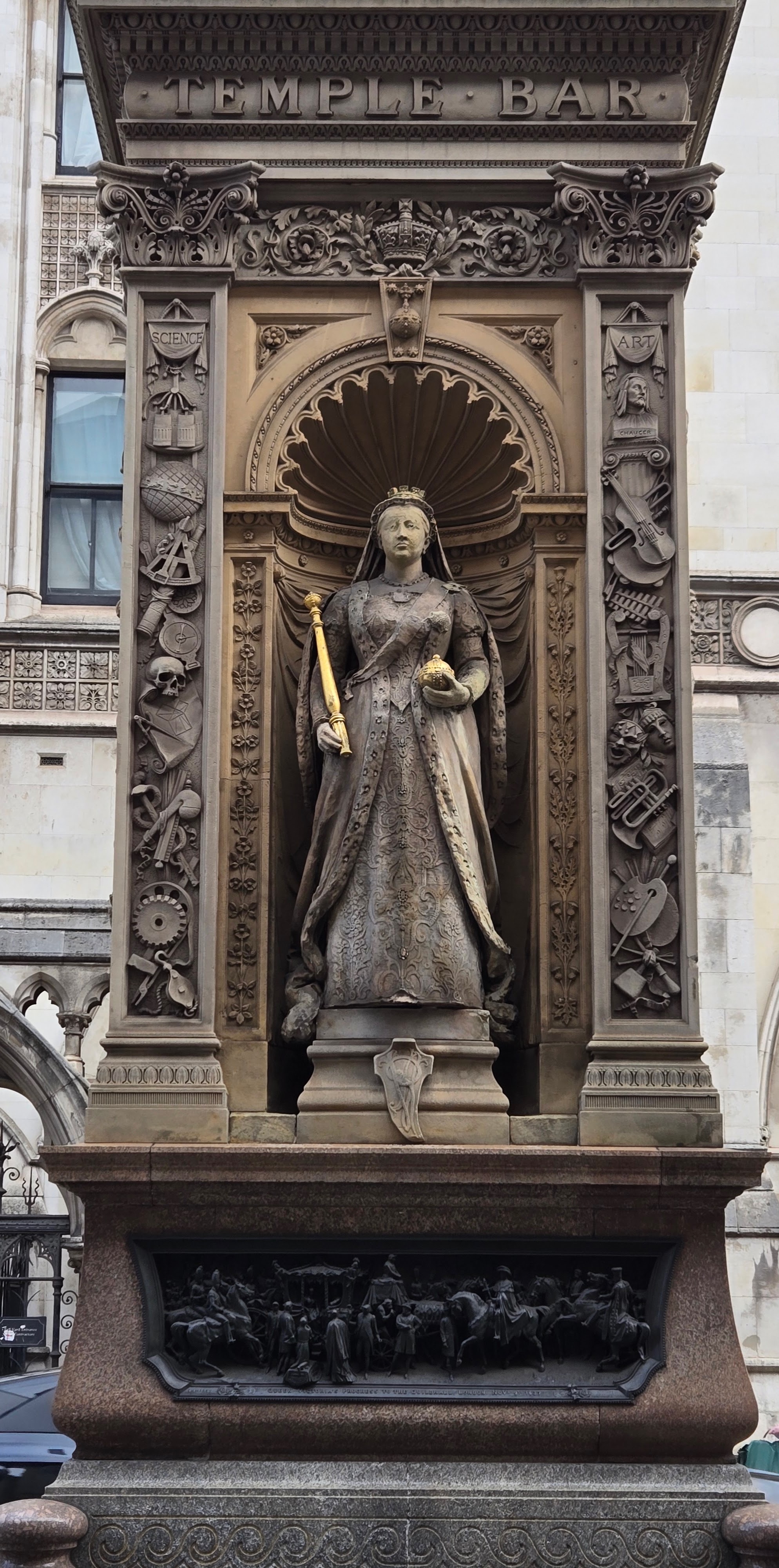
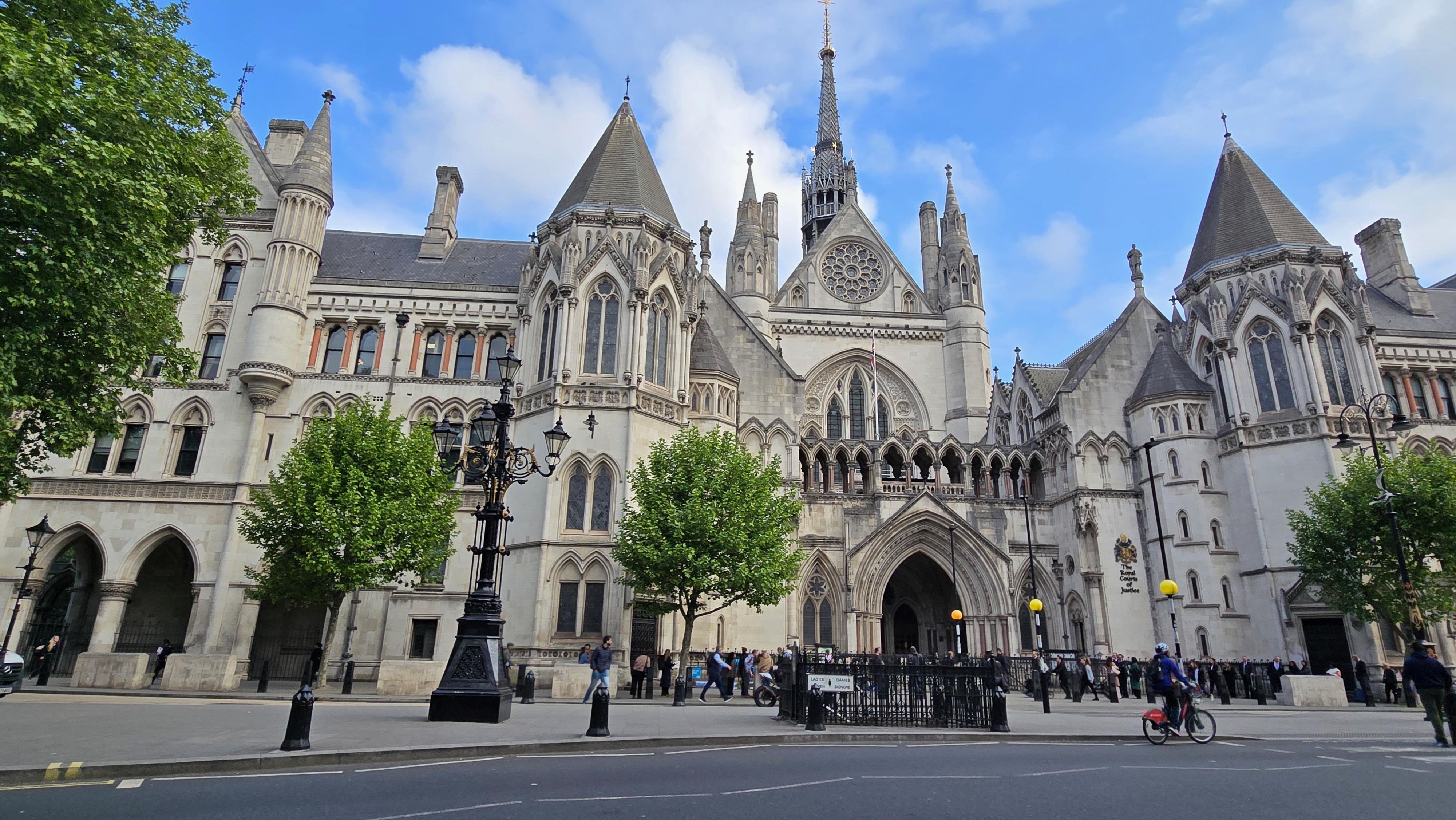
As I was at the Temple church more than a hour before it opened, I made my way up from the Thames to the Royal Courts of Justice on the Strand. This building dates to the 1870s and were opened by Queen Victoria in 1882. A statue honors her nearby. The Royal Courts of Justice, commonly called the Law Courts, house the High Court and Court of Appeal for England and Wales.


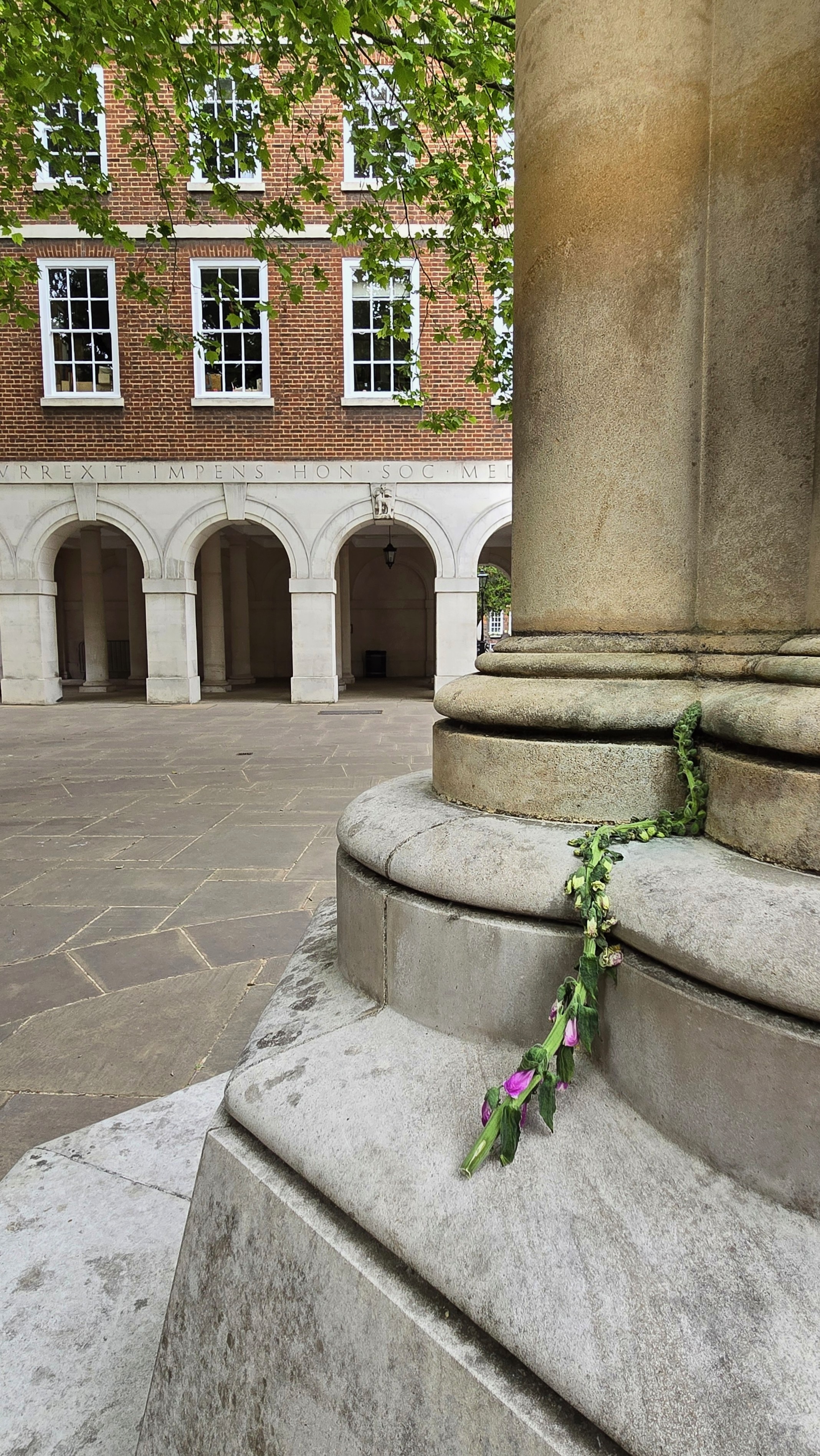
Then I wandered back to the Temple Church and still had about an hour so I wandered around the Temple buildings visiting their gardens as I went. The courtyard outside of the Temple Church is that of the Inner Temple and has this lovely statue to the Knights Templar. Someone had laid a single foxglove stalk at its base and I loved the way it hugged the statue. To whomever left it there thank you! It made me smile.

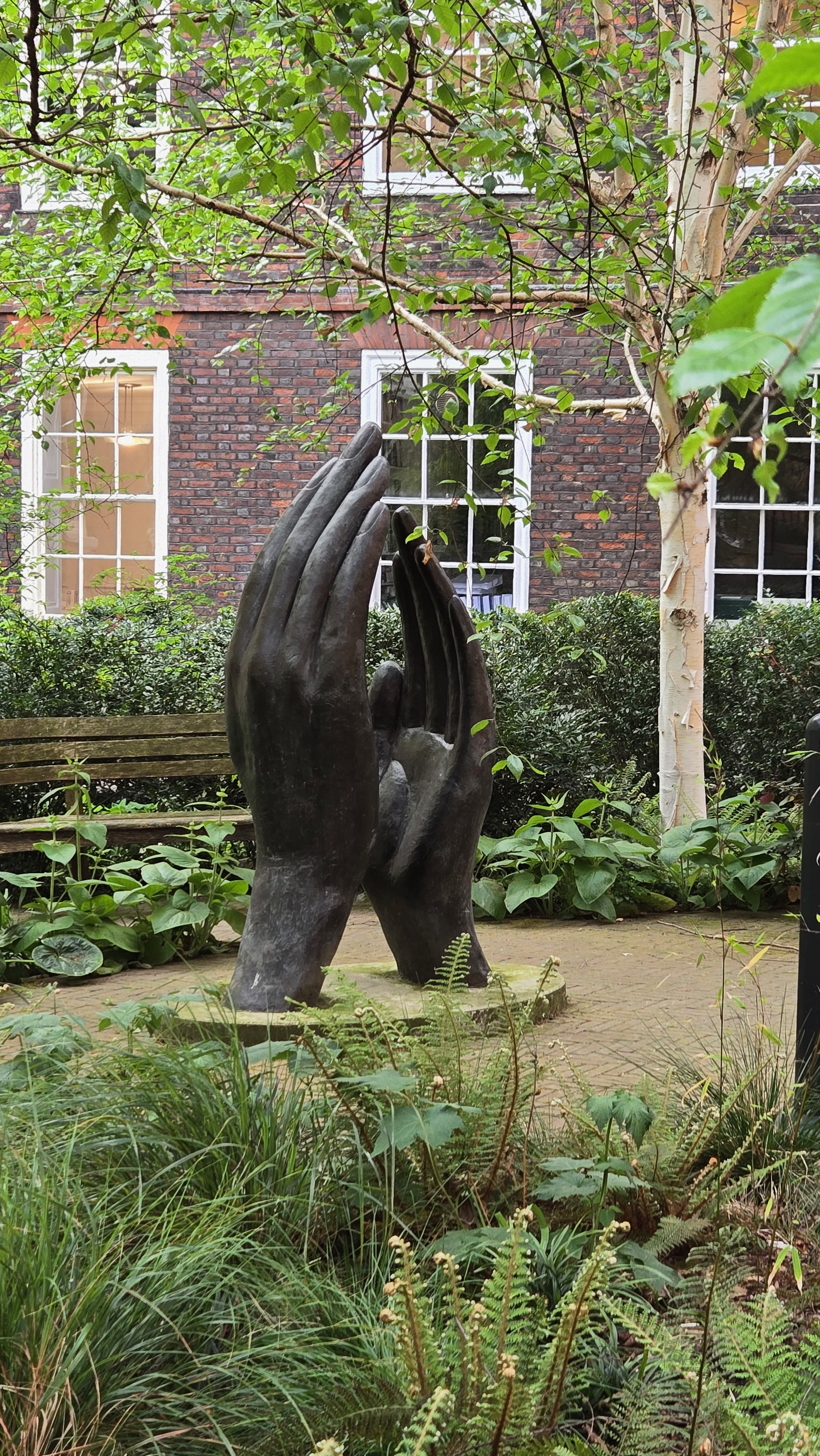
The first garden I discovered was that of Hare Court. This garden was envisioned by the Inner Temple’s Head Gardener, Andrea Brusendorf. Her vision was quite successful. I spent some time exploring this garden and enjoying the benches here and viewing the sculpture ‘Justice’ by Tanya Russell. Viewed from different angles giving very different impressions.

My next garden was that of Pump Court which is more of a courtyard than a garden. In each court building is a list of occupants. Note the Pump in the foreground.


ELM COURT GARDEN
My Next Garden was Elm Court Garden. It was this garden that stole my heart. This was originally part of Fig Tree Court which is memorialized here. [As with all my photos click on them to see the whole photo.] As the plaque denotes it was destroyed in the great fire of 1666 and then rebuilt in 1679 and then destroyed in 1940. It is now part of Elm court. The official listing for the buttery Listed entry #100206 In this case the term come from the French but and was not a place to store butter but rather a place of storage in general.
“The Inner Temple Hall Buttery [is] located 53m south of Temple Church.
It is the under croft and service end of a 14th century hall. Domestic under crofts of the medieval period could comprise three or more vaulted bays depending upon the wealth of the owner. They were constructed of stone, fireproof and used for the storage of provisions or items of special value. Although under crofts are sometimes referred to as cellars, they were not necessarily built entirely below ground level. Despite alterations and additions, Inner Temple Hall Buttery survives well. It is a rare example of a surviving 14th century secular building in Greater London. The building retains some significant 14th and 15th century architectural features and will contain archaeological information relating to the use and history of the site.”
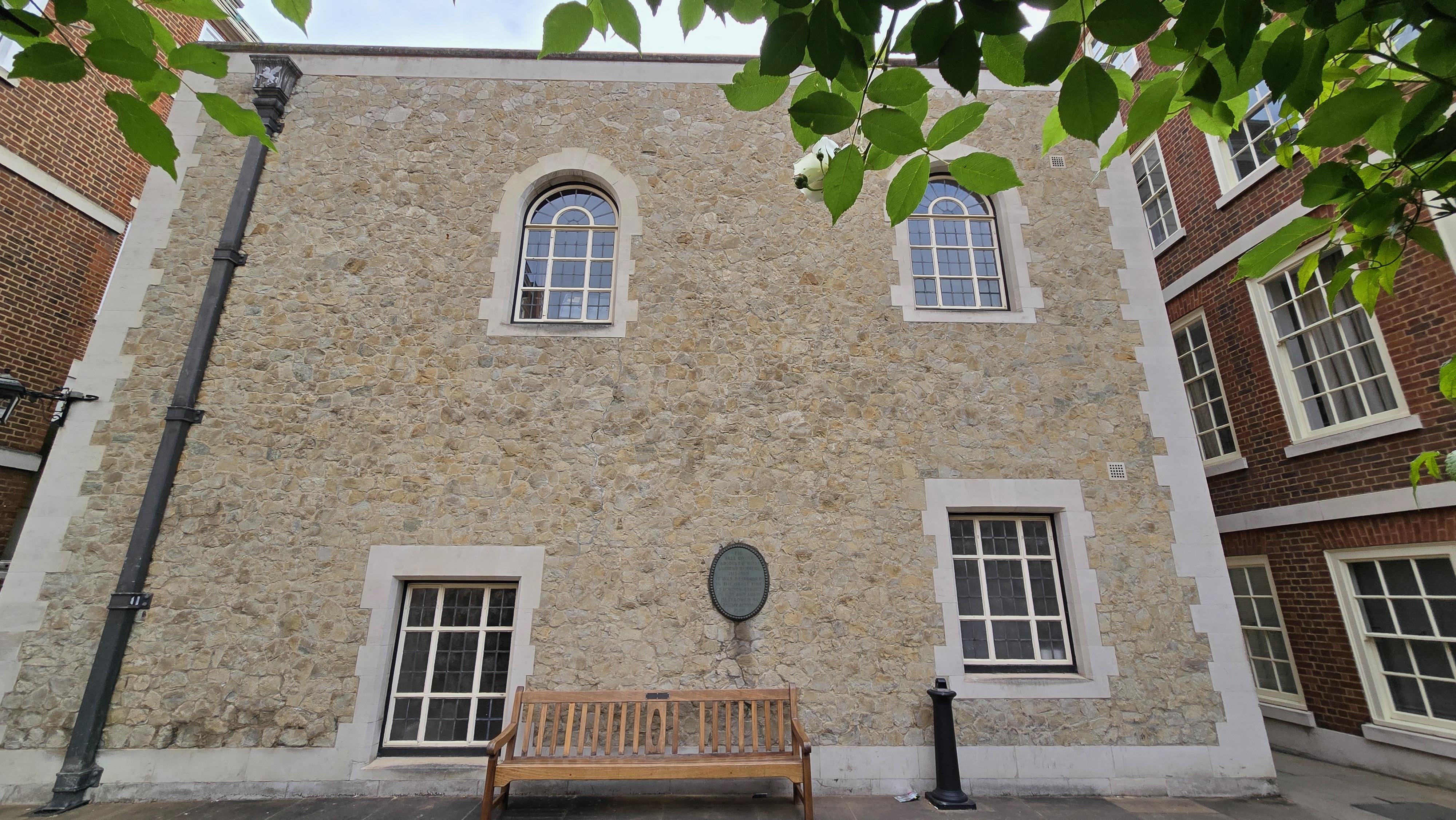

The Buttery forms the (slightly north) eastern boundary of Elm Court. The brick buildings as the stand today are from the rebuilding after WWII except for this wall of the Buttery. To the West is the Lamb Building and to the North and south Elm Court Buildings. This charming space that I fell in love with was originally part of the Middle Temple!!! The same temple where Ralph SHELDON and Edmund PLOWDEN belonged.


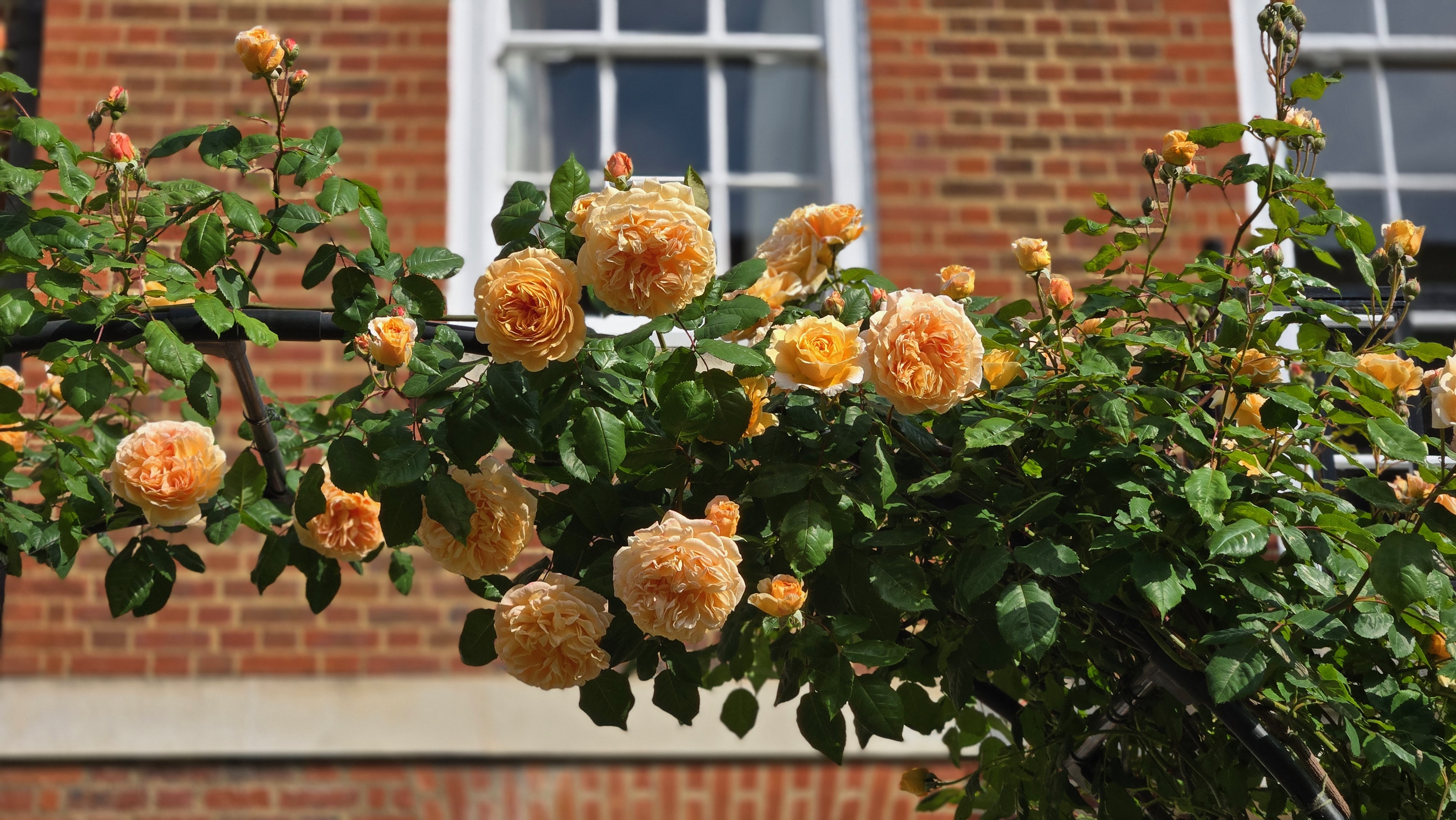
Since Gardening is a passion I want you to read about this garden designer Master Kate Jenrick the Middle Temple’s Master Gardener. “For planting inspiration, Kate looks to the dynamic duo of Christopher Lloyd and Beth Chatto,” both favorites of mine. But let me tell you what I noticed in this garden. There is an incredible attention to detail and the planting of color echoes. Color echoes are plants that share some of the same colors. Look at the photos above do you see how the color of the benches is echoed in the climbing rose and in the brick below. Look closely at the photos below and you will see colors repeated. I think this might be the David Austin Rose “Crown Princess Margareta.”

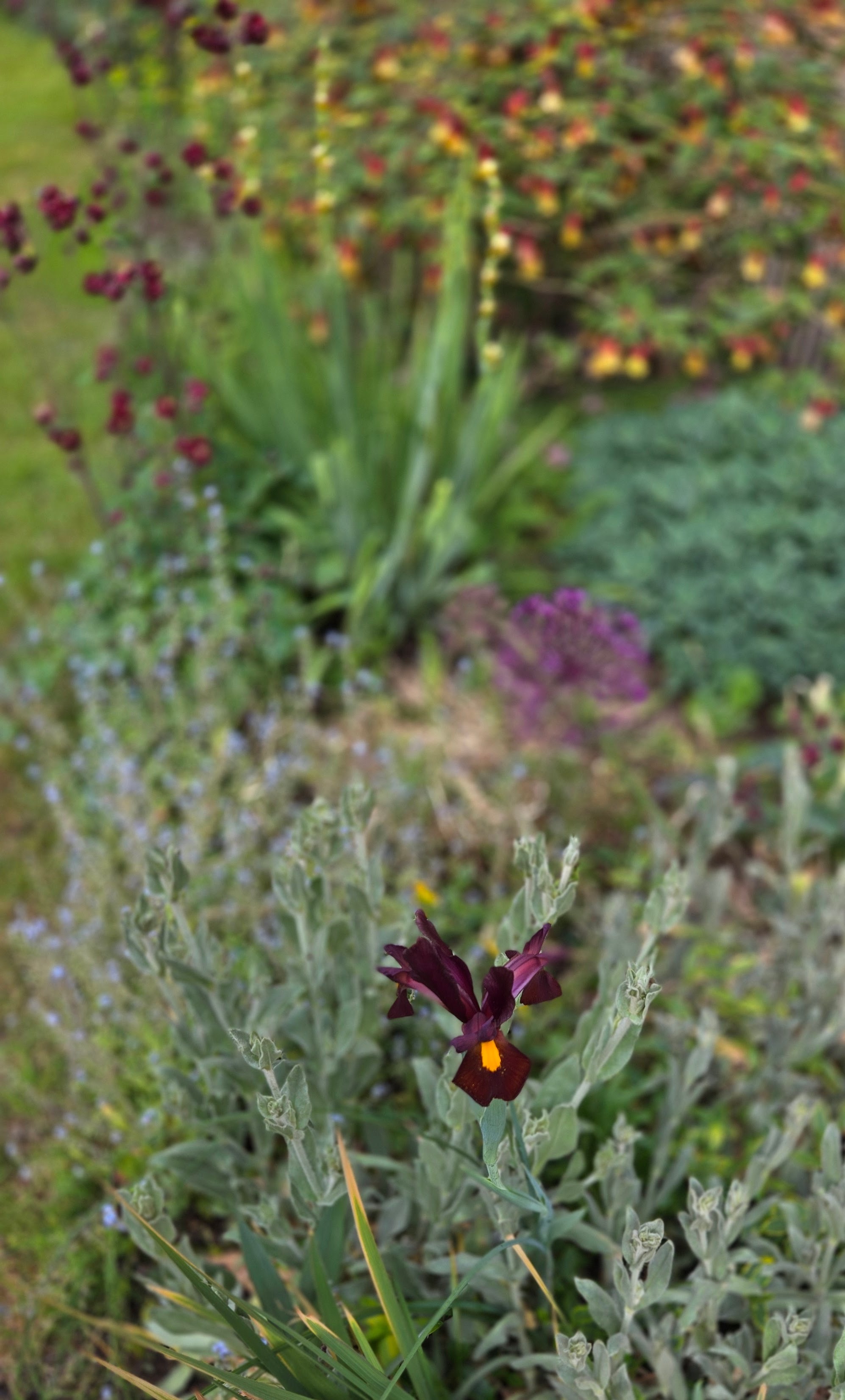
I love the inscription on the bench which reads “IN MEMORY OF TAHERA LADAK 1962 – 2014. SHE WAS A BRAVE ADVOCATE FOR FAMILIES FACING INJUSTICE.” And the Armillary sphere reads:
◆ Make Time Save Time ◆ While Time Lasts ◆ Time is No Time
◆ When Time Has Past ◆

I came back to this garden several times. Such was its impact on me.
MIDDLE TEMPLE GARDENS
However, Master Kate Jenrick is also in charge of the garden that nearly took my breath away. I was coming down the steps onto the Garden court of the Middle Temple Garden and stopped in my tracks. Wisteria dripping off the balustrades and banksea roses climbing the brick walls of Middle Court. A man, the only other soul there saw my admiration and said, “Stunning isn’t it?”
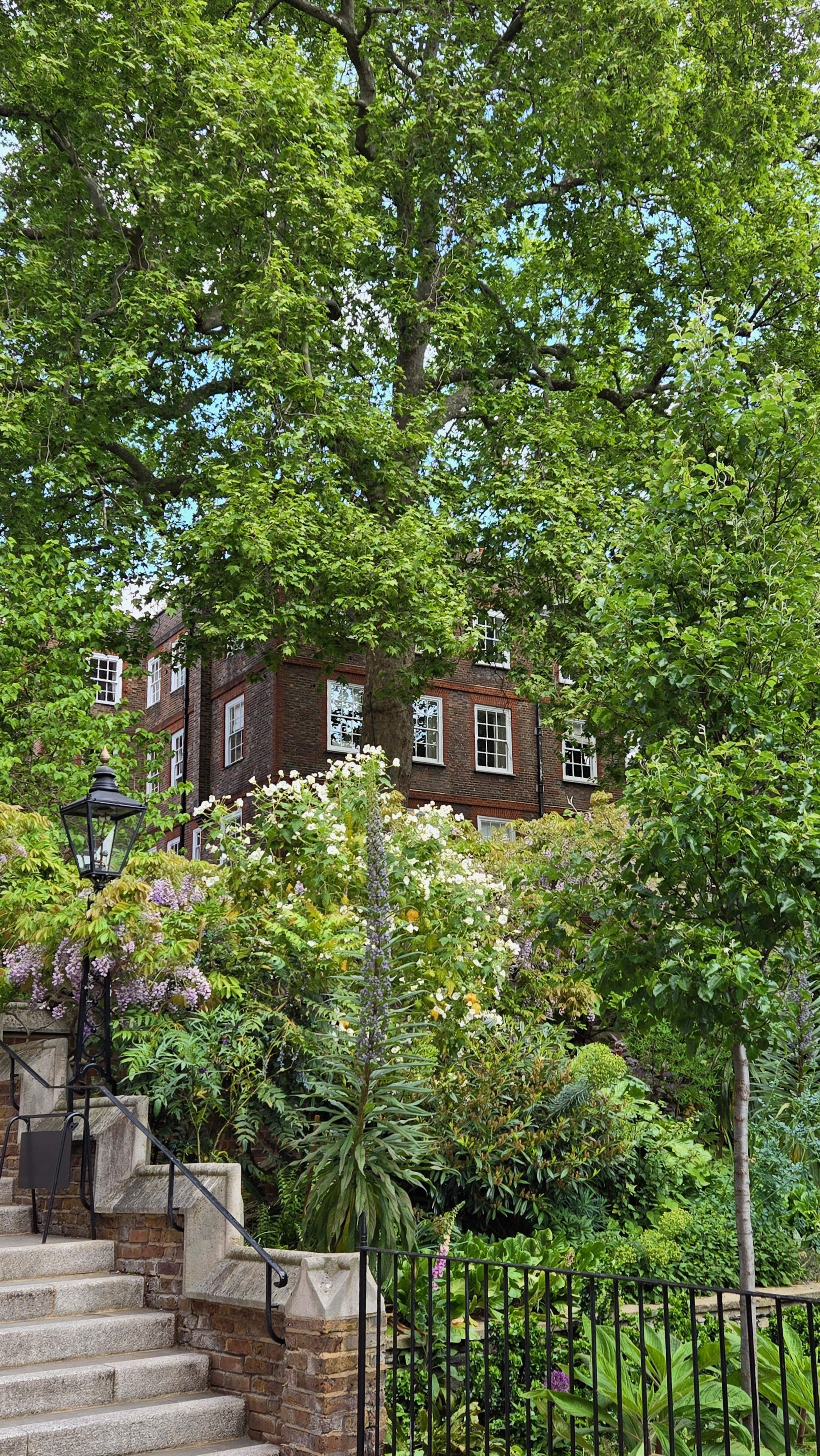


That was the start of a remarkable twenty minute conversation that ranged from gardens to American politics to who would be the next Pope. He said he worked with people not two blocks away who have never seen these gardens. It turned out he was a barrister with the Court of Appeals [photos earlier in this post]. And he was a gay, Catholic who had dreamt the night before about our American President, with whom he admitted he was mildly obsessed. [Who isn’t concerned for democracy in the world?] I did not get his name but a kindred spirit he was and I thank hi for taking the time to engage with me. I will forever remember him.
A few more photos of the Middle Temple and gardens. This arch of the Middle Temple


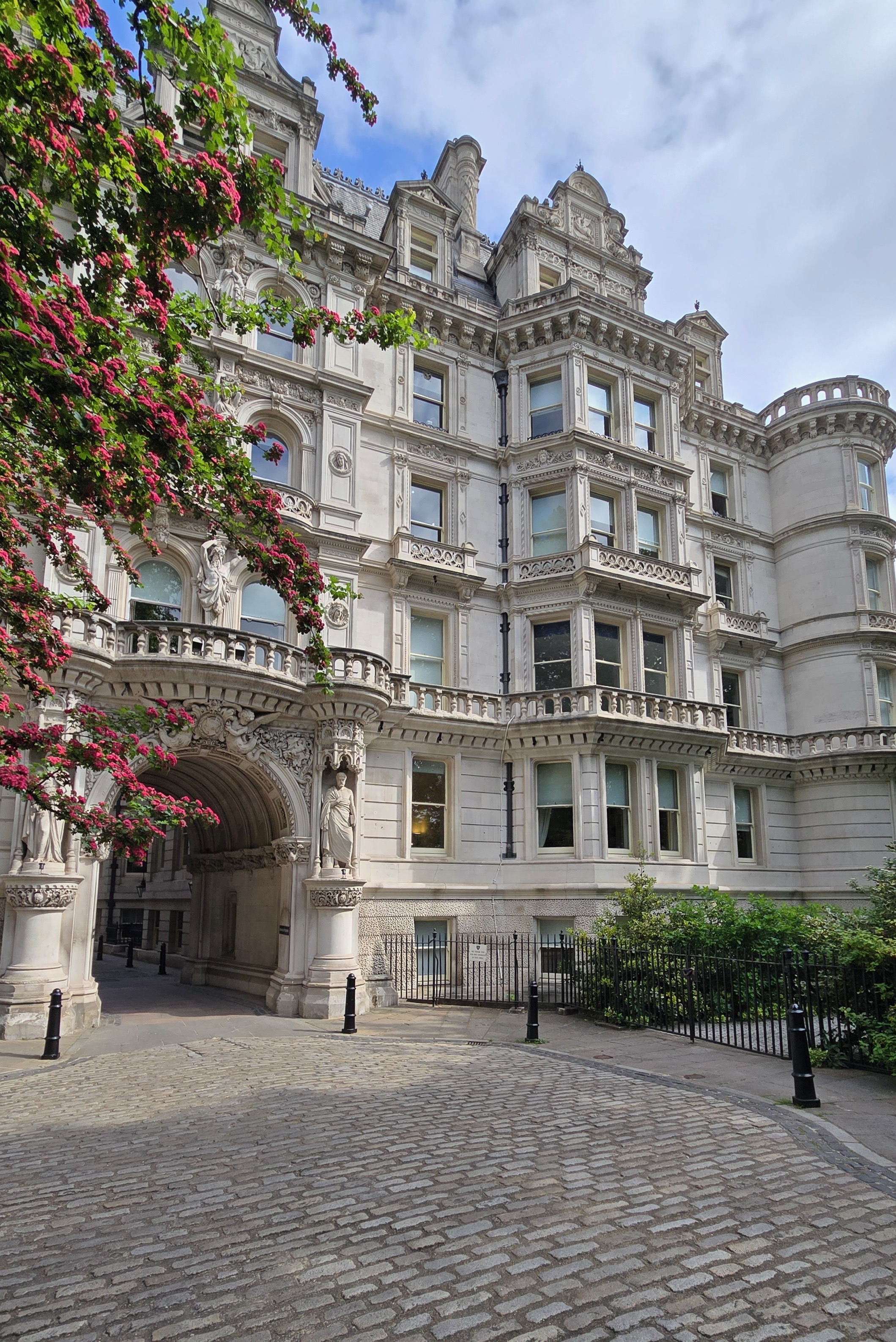

INNER TEMPLE GARDEN
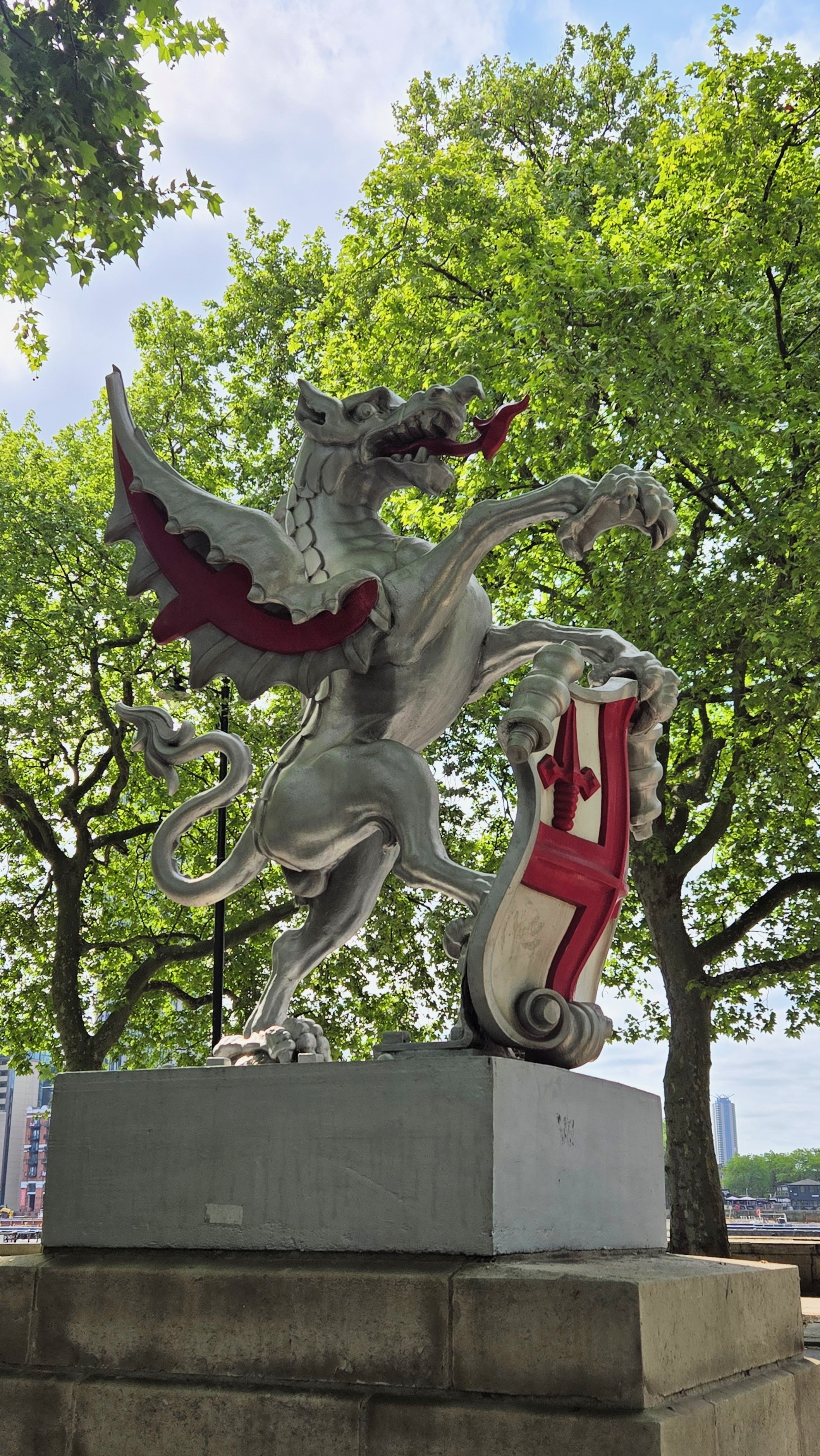
I had planned to come back for the opening of the Inner Temple Garden but it wasn’t until 12:30 PM and I felt my garden fix was satiated. I did take this one of the Inner Temple from outside, as well as the familiar Dragon along the Thames.

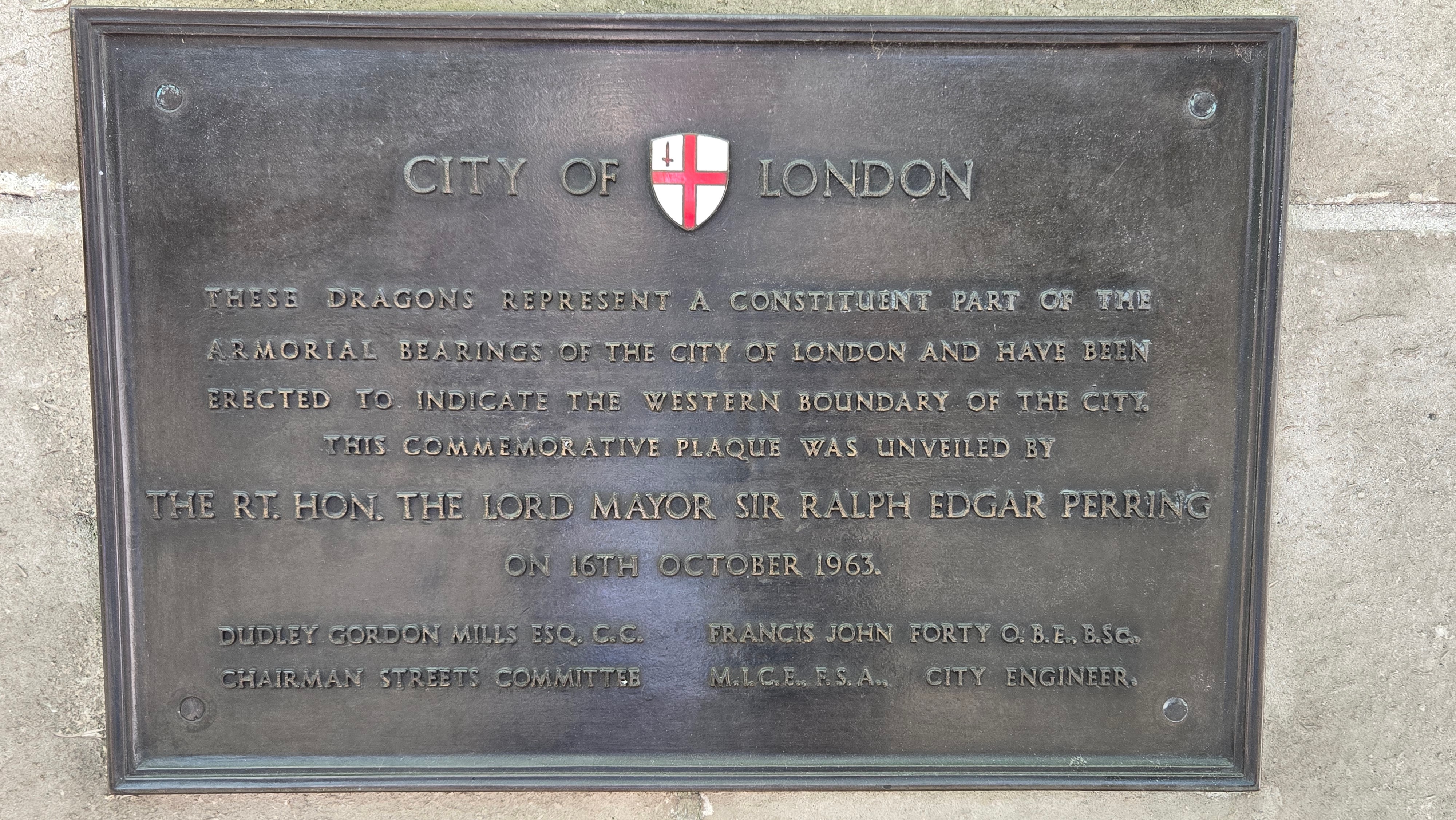
Now it was time to make it back to Temple church and of course another walk through of Elm Court.
TEMPLE CHURCH
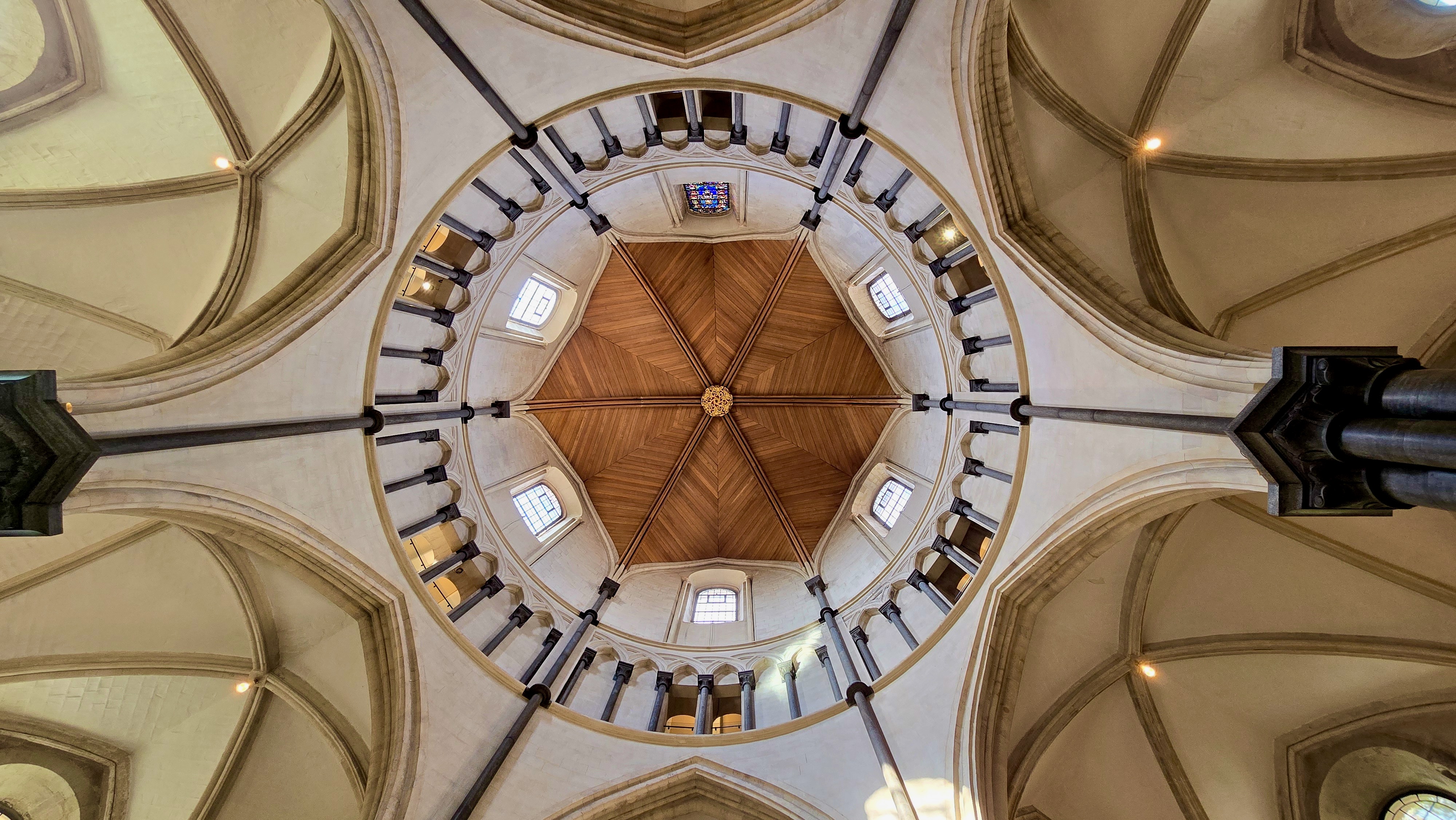
By the time I made it back to the Temple Church it was open and there were maybe a dozen people exploring it. Please google the church to find out more. This particular photo I took by laying on my back in the middle of the rotunda and shooting straight up [or the best that I could].
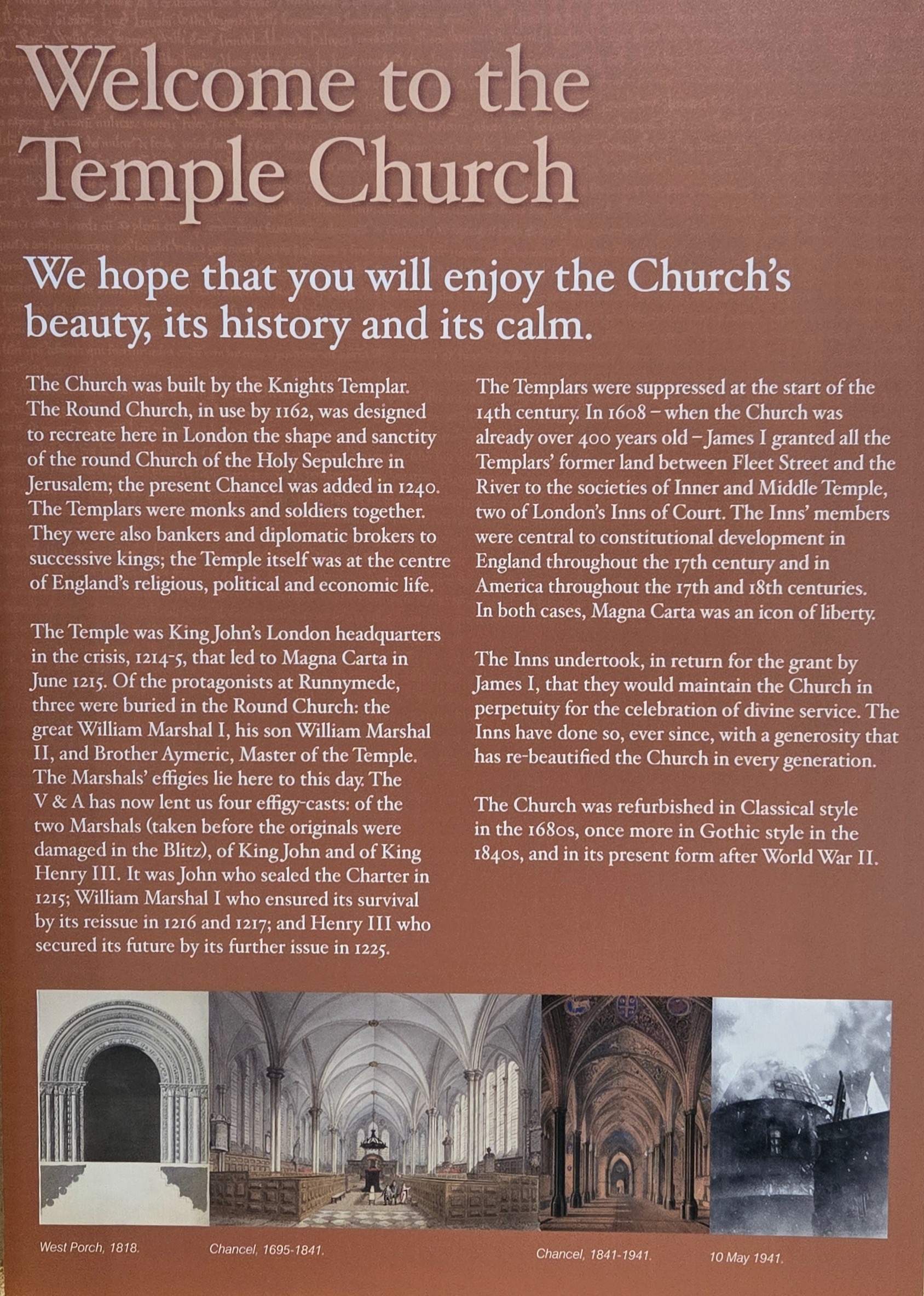
Some good information from the panels within the church.

There were several Americans here as I was visiting and I suspect it is a draw, particularly now as our United States Bill of Rights are under attack. Our Bill of rights takes some of its ideas from the Magna Carta which came to fruition in 1215 under the Reign of King John. A copy of his effigy is on loan here from the Victoria & Albert Museum. [Original is in Worcester Cathedral].
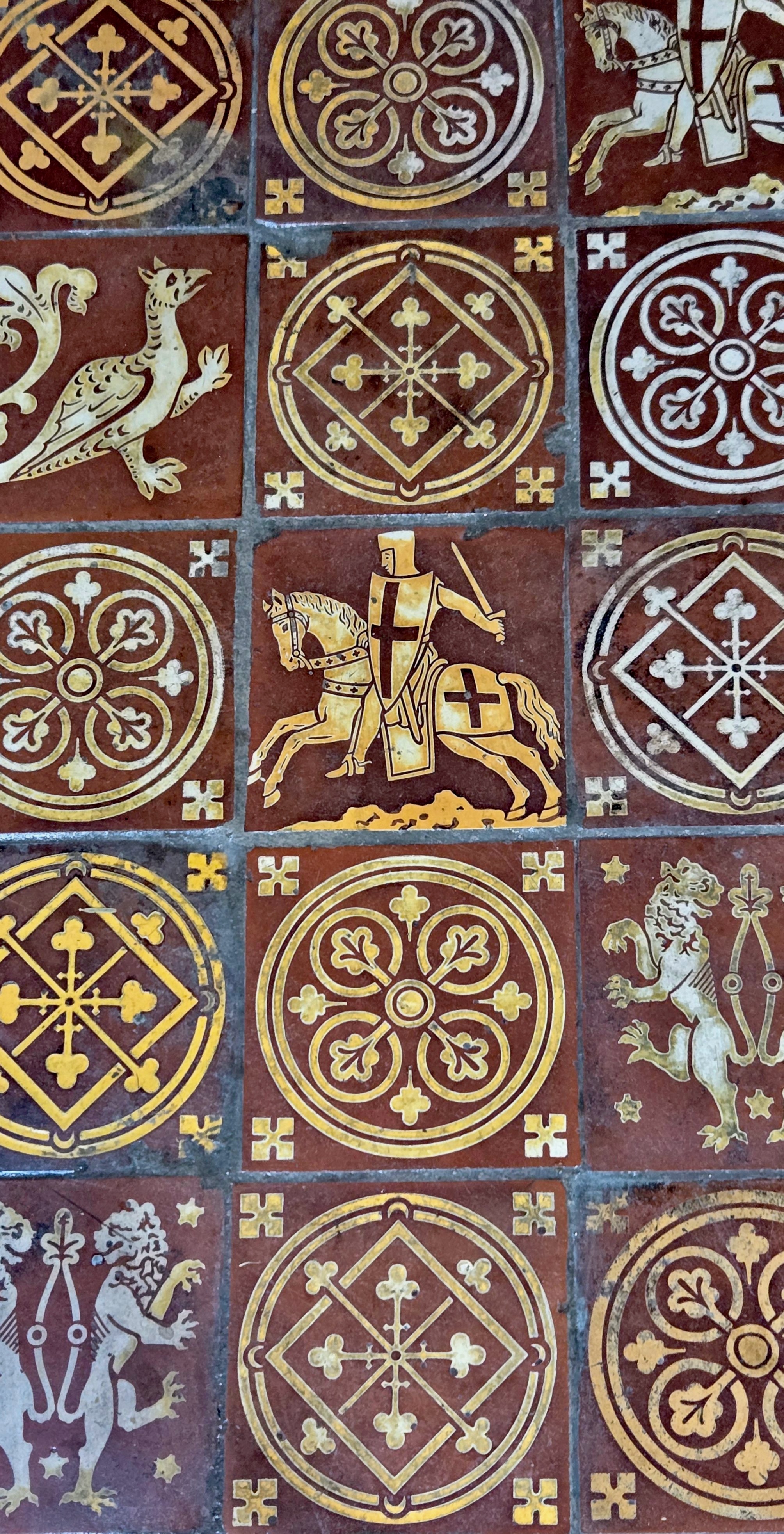
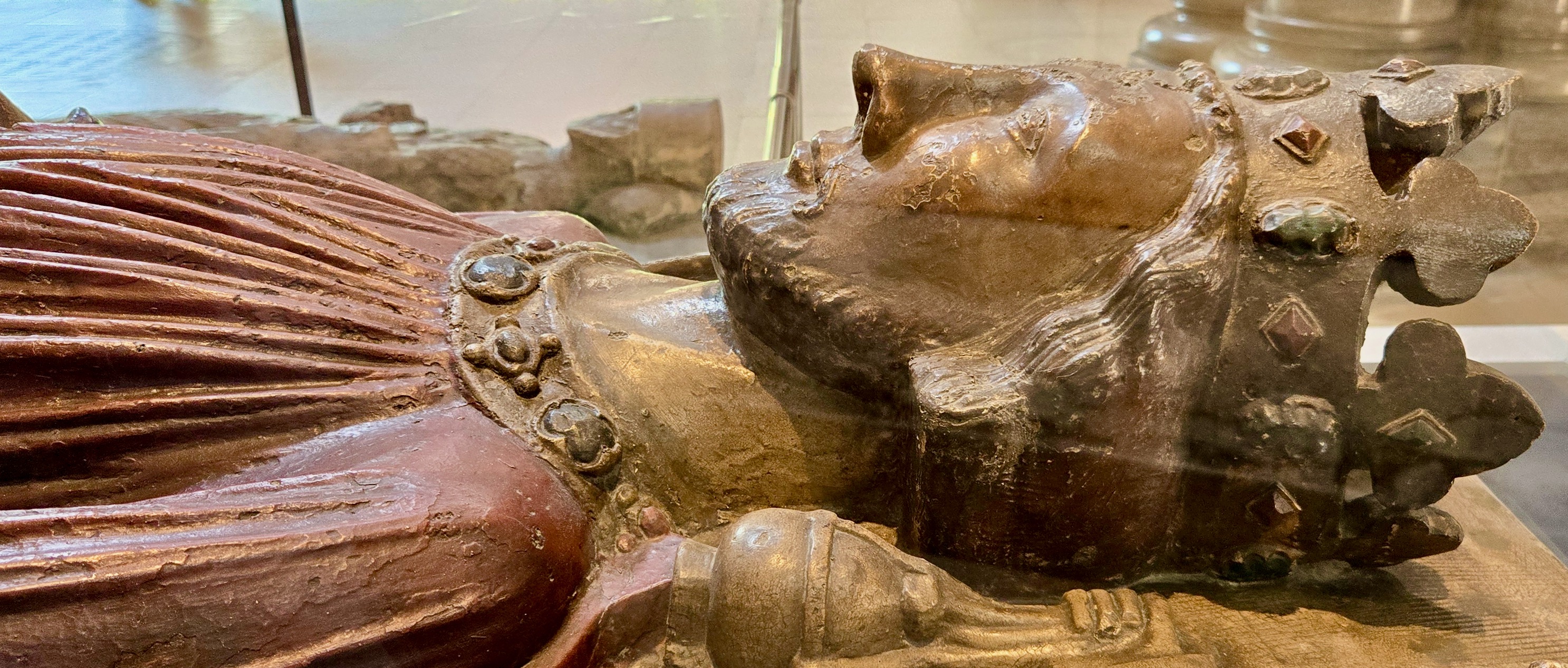


This church remains a Catholic church and its chancel dome was fashioned in 1162 as a replica of that in Jerusalem of the Church of the Holy Sepulchre. The priest gave us a blessing of PEACE while were there.
Outside the Temple church.


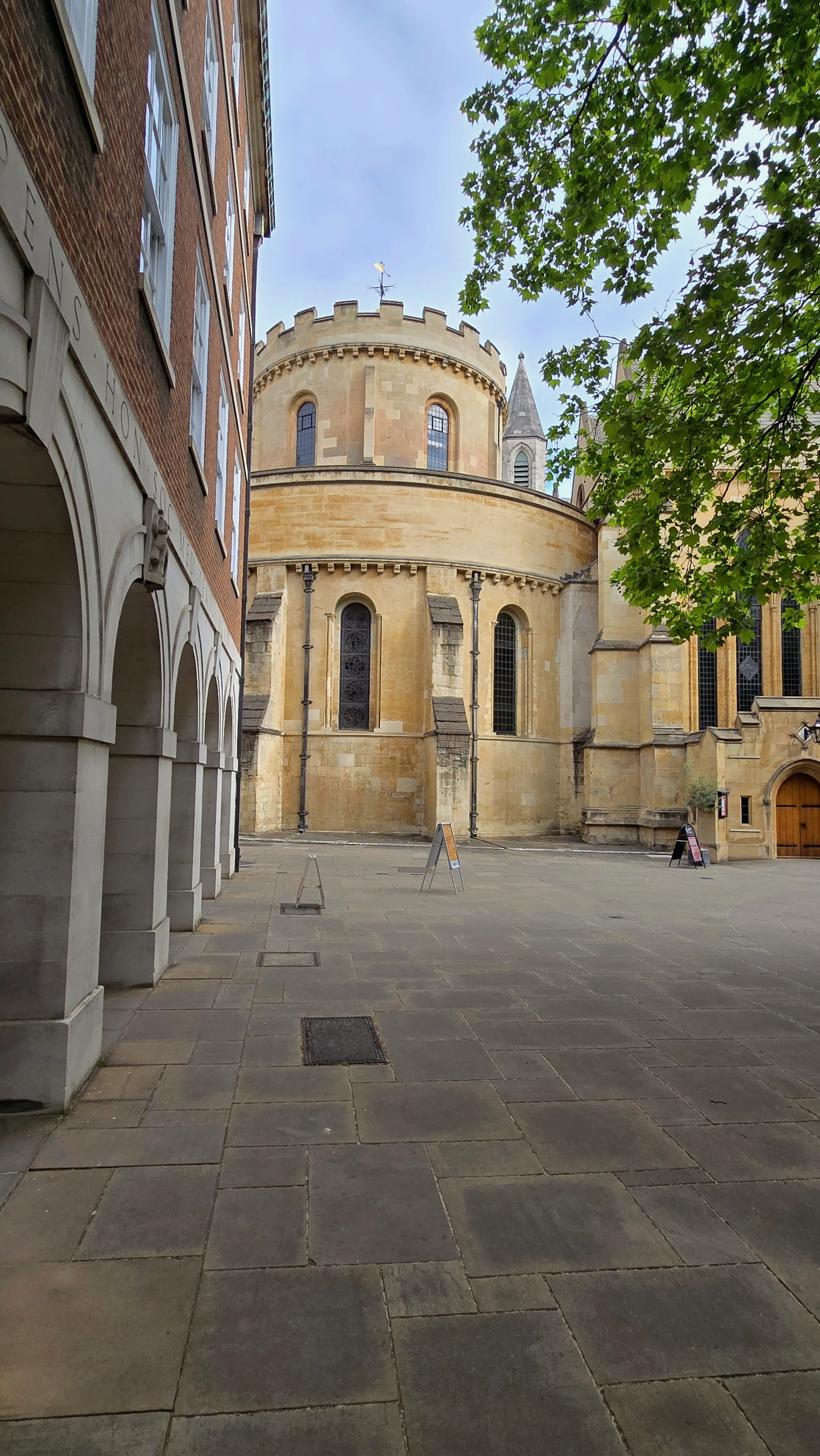
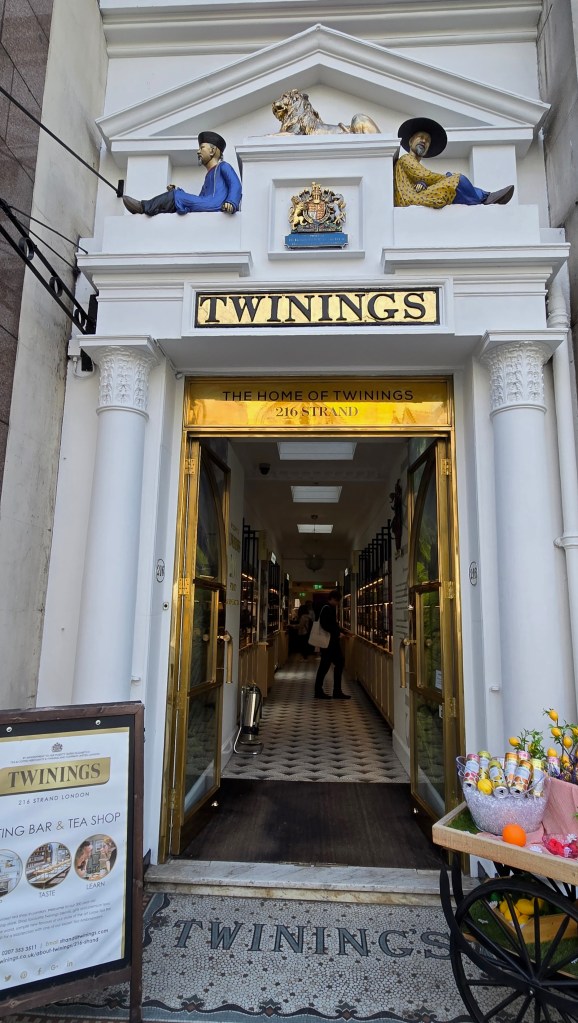
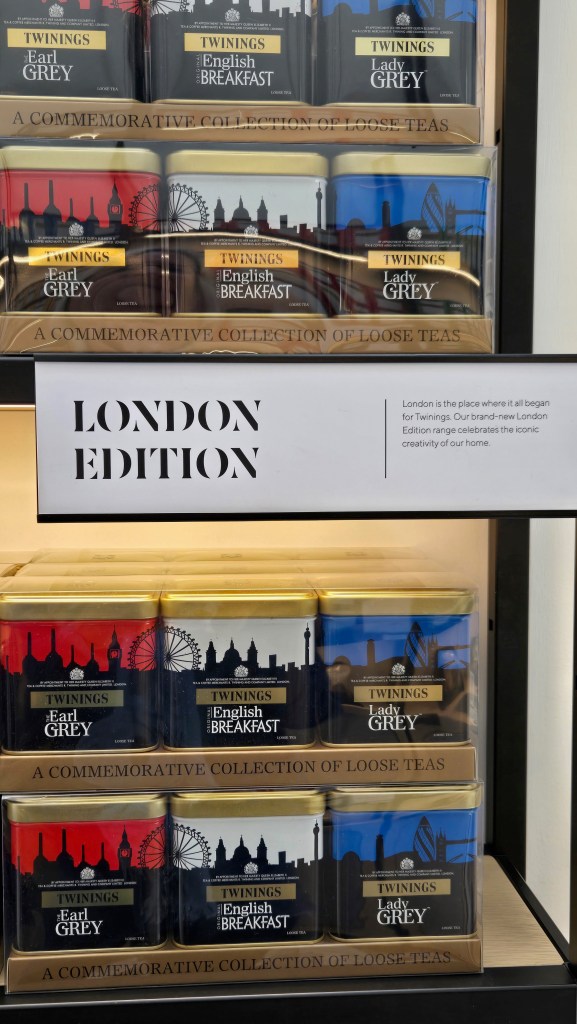
I had my lunch on the porch of Temple church before making my way back up to the Strand. Where I just happened upon a Twinging store and was able to fulfill a request from my friend, Denise’s daughter. Although I had thought we could get the same Earl Grey in the United States I was informed that this particular blend of Earl Grey was only found in London.
LINCOLN’s COURT GARDENS
Next I made my way to Lincoln’s Court on my way to the Chancery Lane Underground Station.
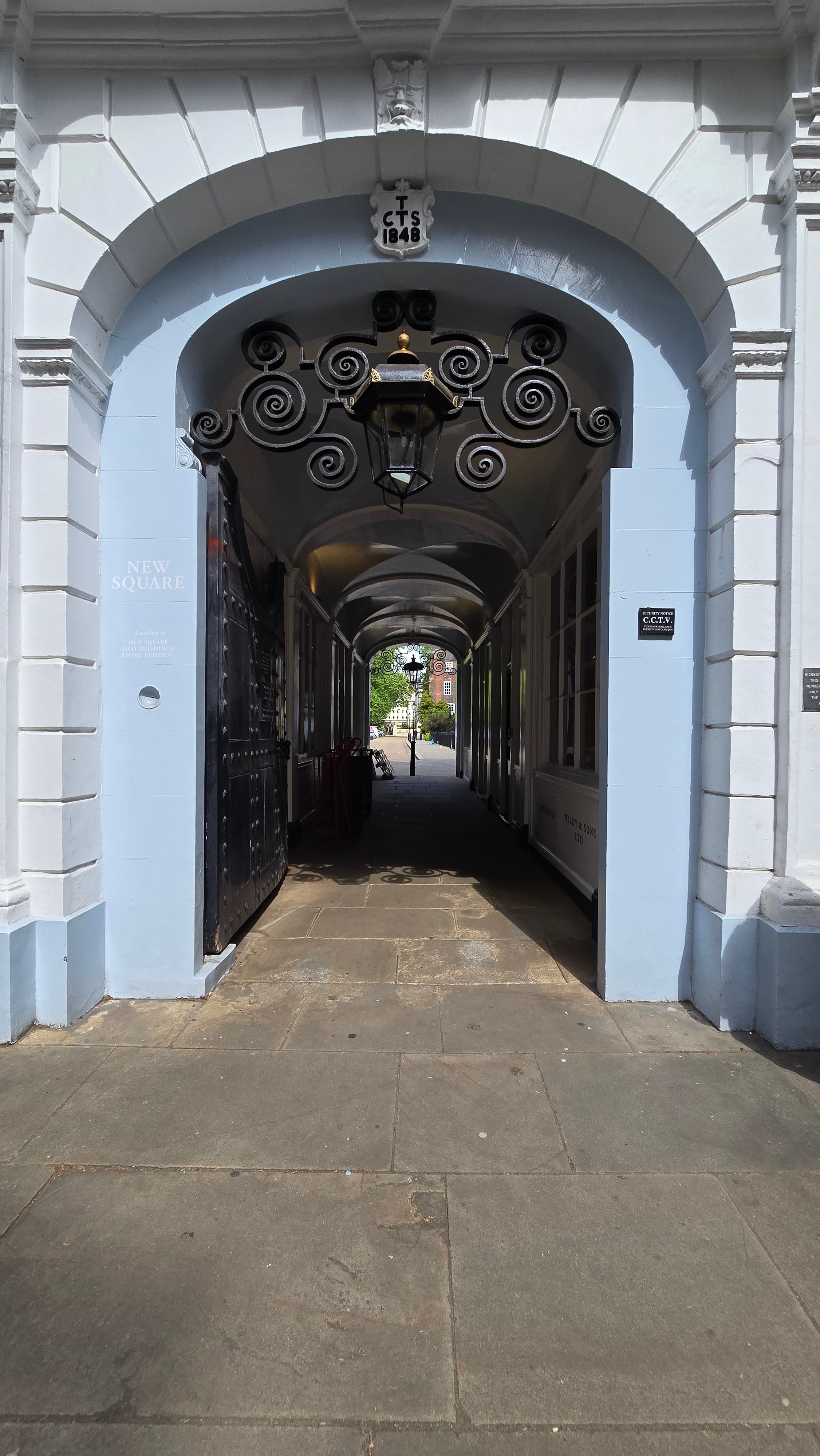
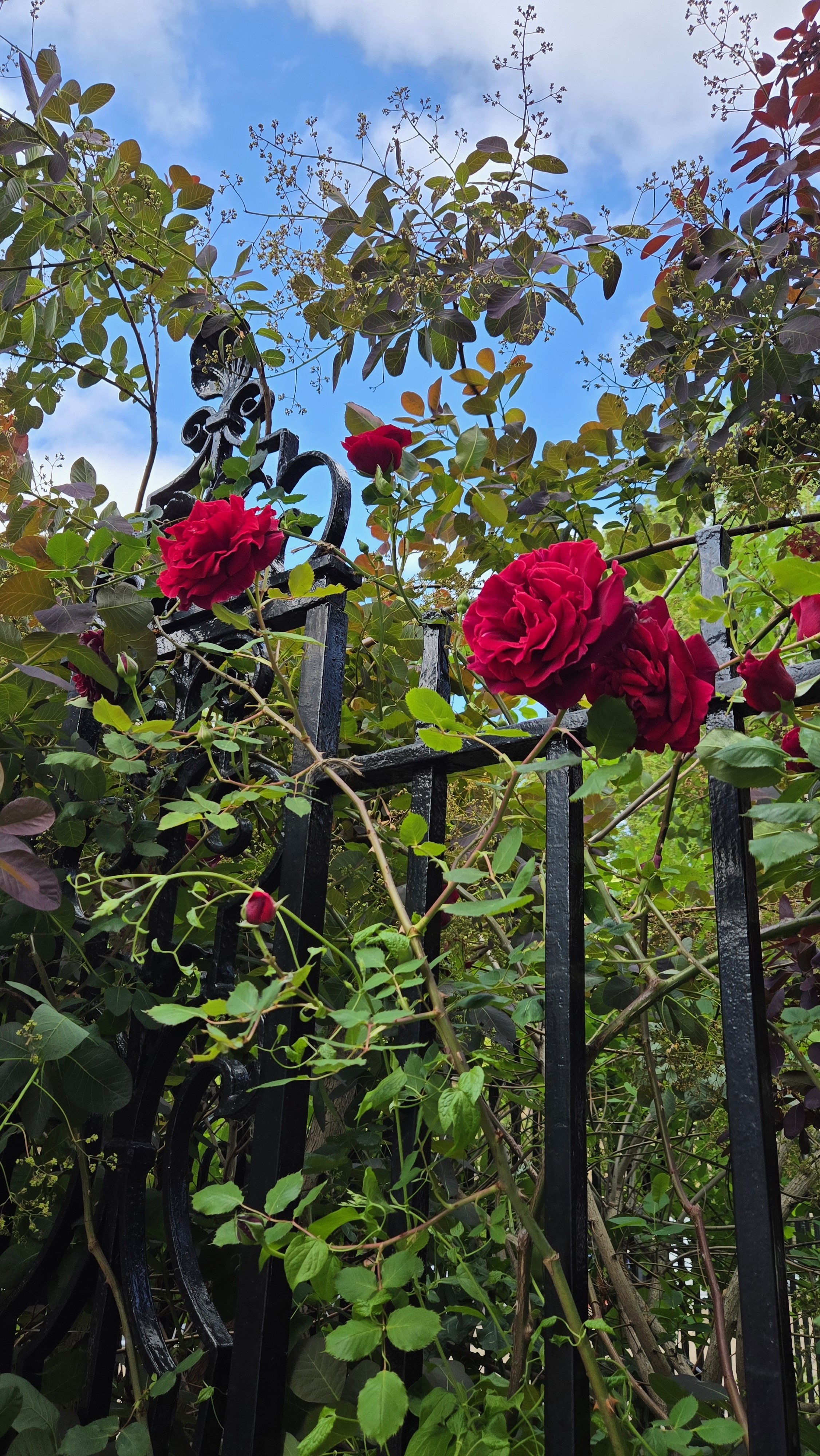
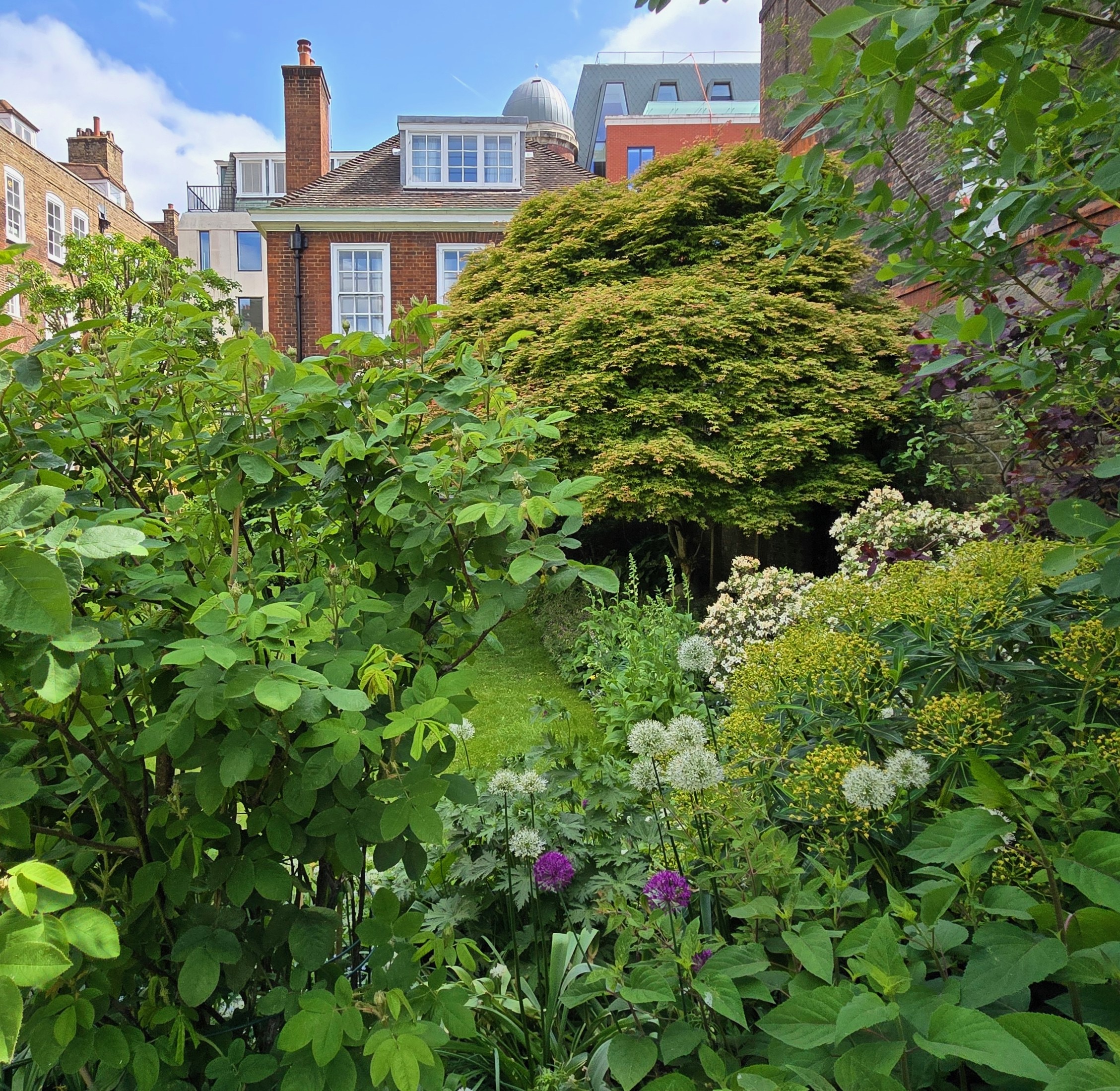


And then a couple of things happened. I knew that today, May 8th, was the 80th Anniversary of VE Day or Victory in Europe, commemorating the end of WWII for Europe. Celebrations were everywhere. These presented themselves. And note the building called “The Last Judgement.” So in an impulsive decision I decided to head over to Westminster. I had been to Trafalgar Square during the BREXIT Vote….how busy could it be?


In my next post I will reflect on the Celebrations for VE Day. It was a bit ironic to know that my father, uncle and grandfather were at this time 80 years ago stationed in the Pacific Theatre. My father and grandfather on Tinian Island, where the Enola Gay and Bockscar would leave from to drop their deadly cargo. My father would be among the first troops to occupy Nagasakai in September 1945. So the War in Europe ended in May, but for my family it did not end for another 6 months.
Kelly Wheaton © 2025 – All Rights Reserved
 Wheaton Wood