LONDON Day One: Part 2 The Fukishima Garden
Posted on May 31, 2025 1 Comment
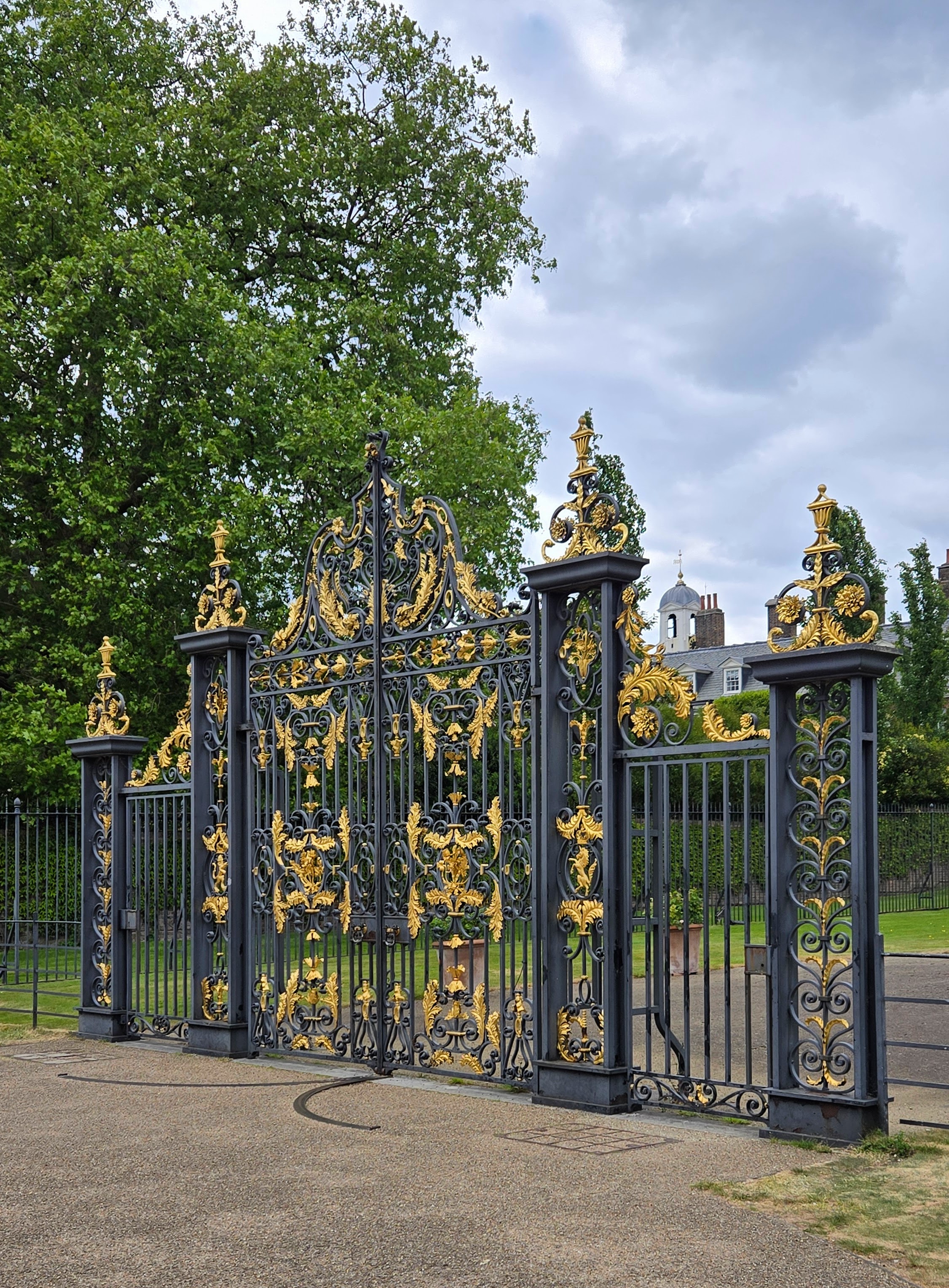
Well its been some three plus weeks since I started my travelogue and I am back to putting it down on paper. As I finished up at The Victoria and Albert Museum and traveled via the Kensington Park Flower Walk and passing the modest (compared to her husband) memorial to Queen Victoria I skirted the edge of Kensington Palace. Where I took a photo through the fence. And admired the gate.

Walking through some very posh neighborhoods to Holland Park, I stopped at a lovely upscale market, Bayley & Sage, where I picked up a fancy salad for an evening picnic at the so called Kyoto Garden, correctly called the Fukishima Garden. I had originally scheduled the garden on arrival in London, but then I read how it is a very busy destination, especially for proposals and engagement photos, so I put this at the end of my day instead. Unlike reasonable people who use their phone for walking directions I had several google maps I had printed out in advance, perhaps out of a fear of technology leaving me high and dry, if it failed… And to be honest I am a lover of maps, aka a cartophile. There’s something about studying a map that imprints the image and helps my sense of direction. Occasionally when my internal compass goes awry, its like losing my equilibrium. I have to keep spinning the map in my head until it is aligned with reality. As if a map is as real, as what it is supposed to represent. Some of you will know what I mean.
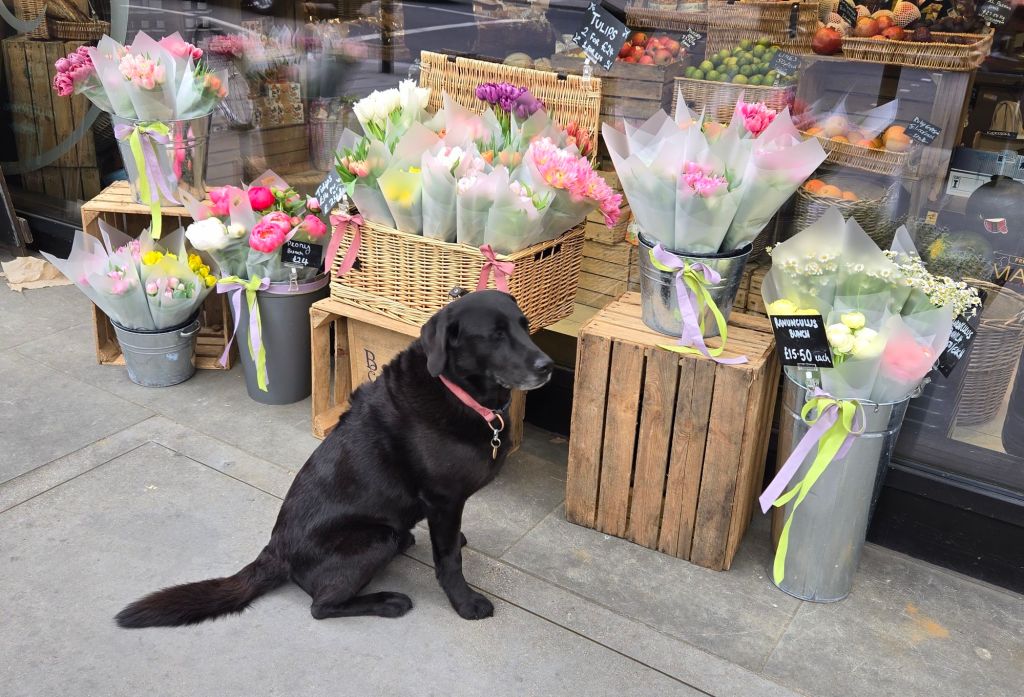
Why this garden? It isn’t as if I hadn’t seen Japanese Gardens before, but something made me want to see this one. Maybe it was because it seemed out of place.Growing up, I was very familiar with the Japanese Tea Garden in Golden Gate Park and I have my own pseudo Japanese style garden in my front garden. Perhaps a beacon of serenity in an otherwise bustling city? Perhaps the use of Azaleas, Rhododendrons, water and stone, all things I love. On my way I passed this sweet dog waiting oh so patiently amidst the flowers. It reminded me of my son’s dog Booker…long ago…in a galaxy far away…when you travel there are always touch stones.
I had not made it to all that I had planned today, but I had made it to the Japanese garden. My feet and back hurt but I was in London and felt surprisingly at home in spite of exploring areas I had not been to before. I had walked and traveled a long way in a relatively short time. I was alone in a large city, which I had done before but this time it hadn’t been planned that way.

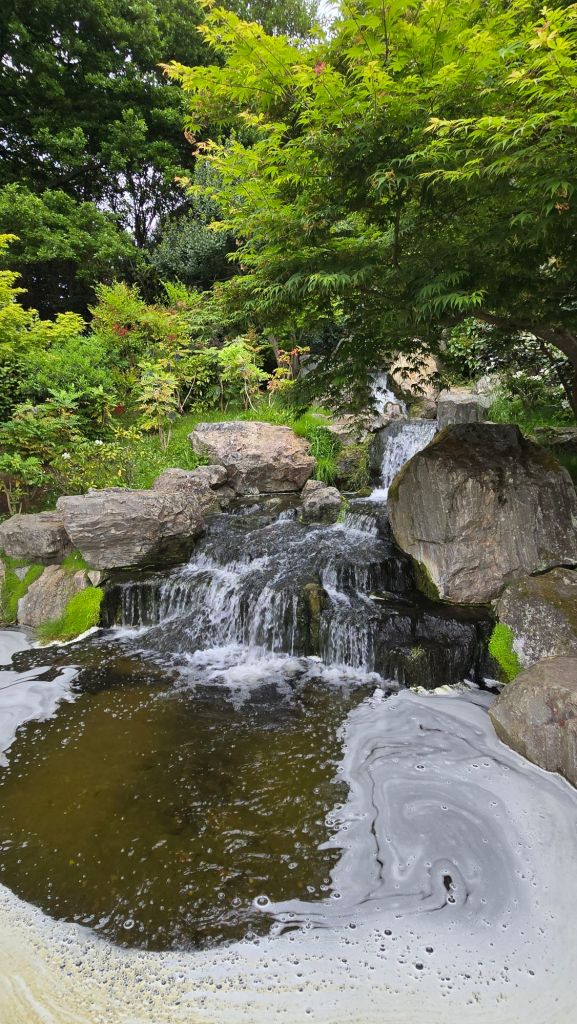
The plaque at the entrance to the garden. I was surprised that the garden was so young, less than 8 years old. My own home garden is 35! Motomiya is a city of about 30,000, about 10 miles south of Fukishima in Japan. Following the 2011 Great East Japan Earthquake and Tsunami, the Royal Borough of Kensington and Chelsea, in collaboration with Motomiya City, built the Fukushima Garden in Holland Park, London, as a symbol of unity and solidarity. Surprisingly the Japanese sister city to San Francisco, Osaka severed ties after 60 years in 2018 after a private group of citizens erected a statue in San Francisco memorializing the “Comfort Women” who were forced to work in Brothels from the early 1930s until Japan’s defeat in 1945. My home town does not have a sister city in Japan, but I do like these connections, between countries especially when they don’t become politicized.
I will let the pictures speak for themselves.


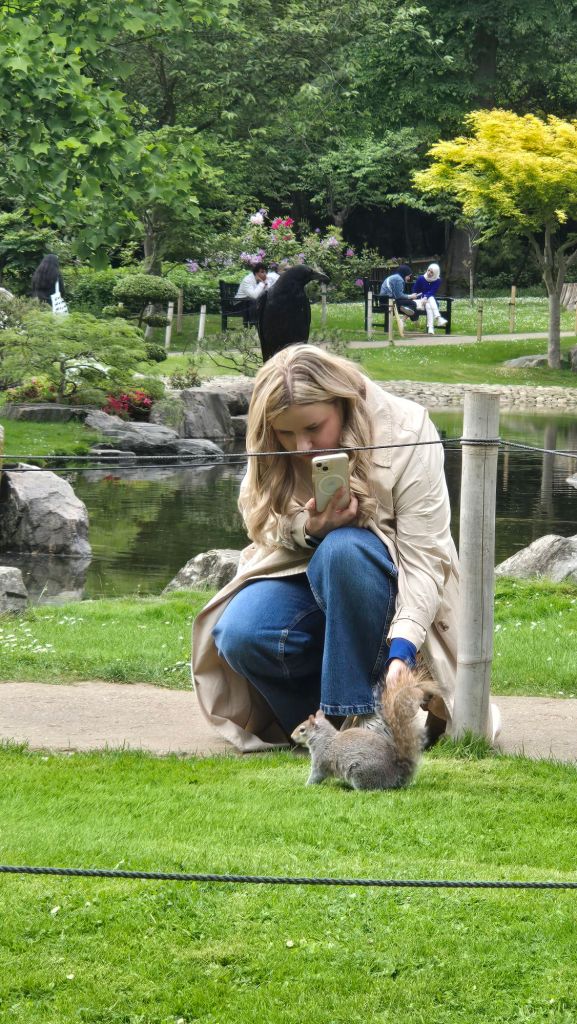
The last photo amused me as while the woman is stooping to feed and photograph the squirrels, she is unknowingly overseen by a crow, perched on a post right behind her, ready to swoop in. Parks are interesting places where people and nature interact, often in amusing ways.

I walked back to my home base for the next 3 nights at 20 Nevern Square in Earl’s Court. A neighborhood of Georgian Homes only a short walk from the Earl’s Court Tube station. I was happy with this as a quiet location to return to each night.

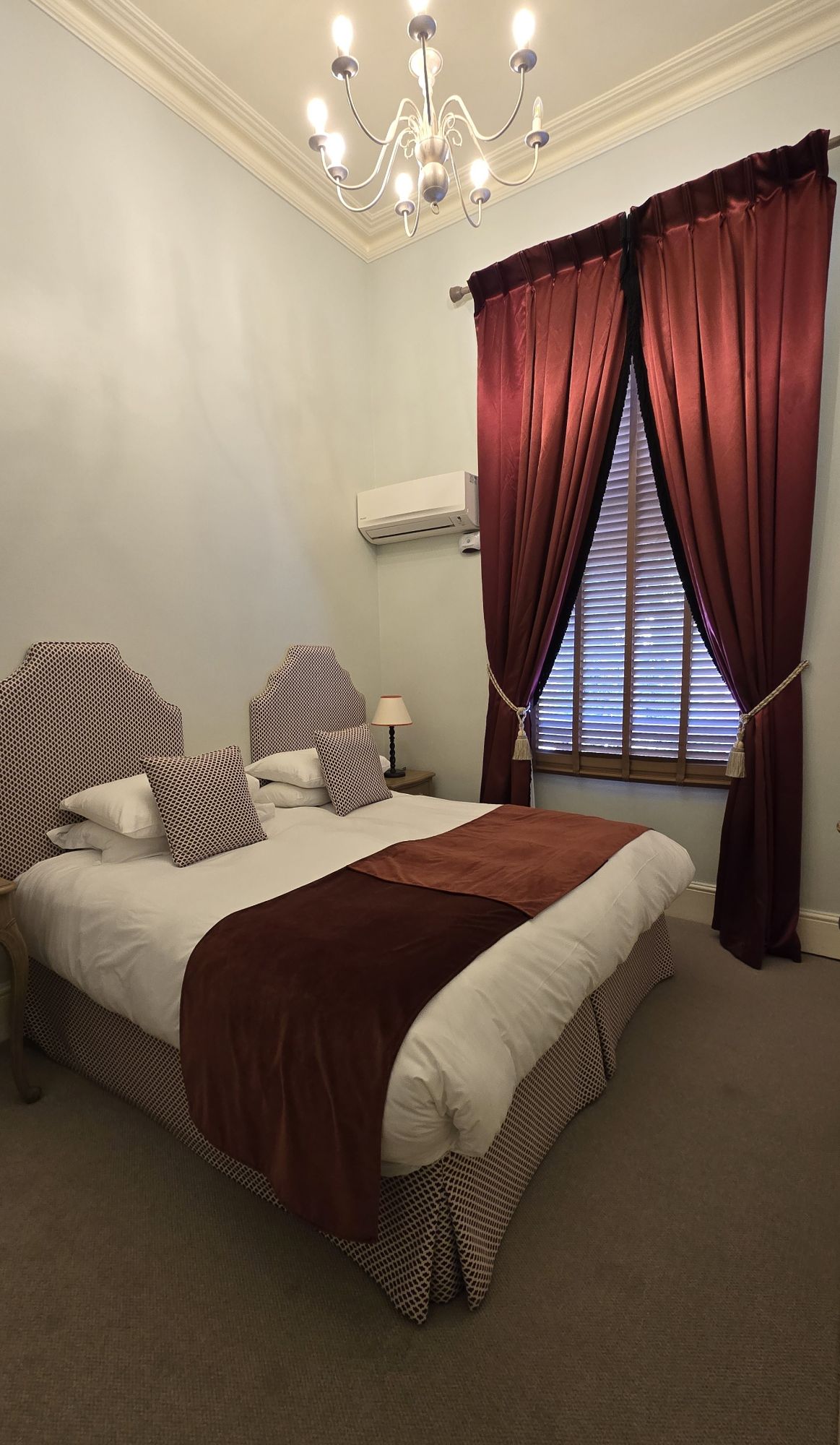

And thus ends the first day in London.
Previous posts on this trip:
- Arrival In London
- Traveling for Genealogy : Expectation vs Reality
Kelly Wheaton © 2025 – All Rights Reserved
TRAVELING FOR GENEALOGY: Expectation vs Reality
Posted on May 30, 2025 3 Comments
Back in December I wrote Traveling for Genealogy: Virtual and In person in which I note all the things I have experienced in planning for a genealogy related trip. Because the trip I was taking in May was NOT ostensibly for genealogy and I was not to have any control over dates, times etc, I went with a “whatever happens, happens attitude.” I did not want to encourage expectations which were not possible to full-fill. I did not reach out in advance to places I might have occasion to visit, simply because I wasn’t even sure of I would have the opportunity to visit them.
As I have recounted this trip was partly to allow my friend Denise to visit Canterbury where her direct ancestor Robert CUSHMAN lived and was instrumental in organizing the sailing of the Mayflower. As luck had it Denise was not able to go, but I was able to wander around Canterbury the evening we arrived and the next morning and find all of the places I had mapped out in advance related to Robert CUSHMAN.
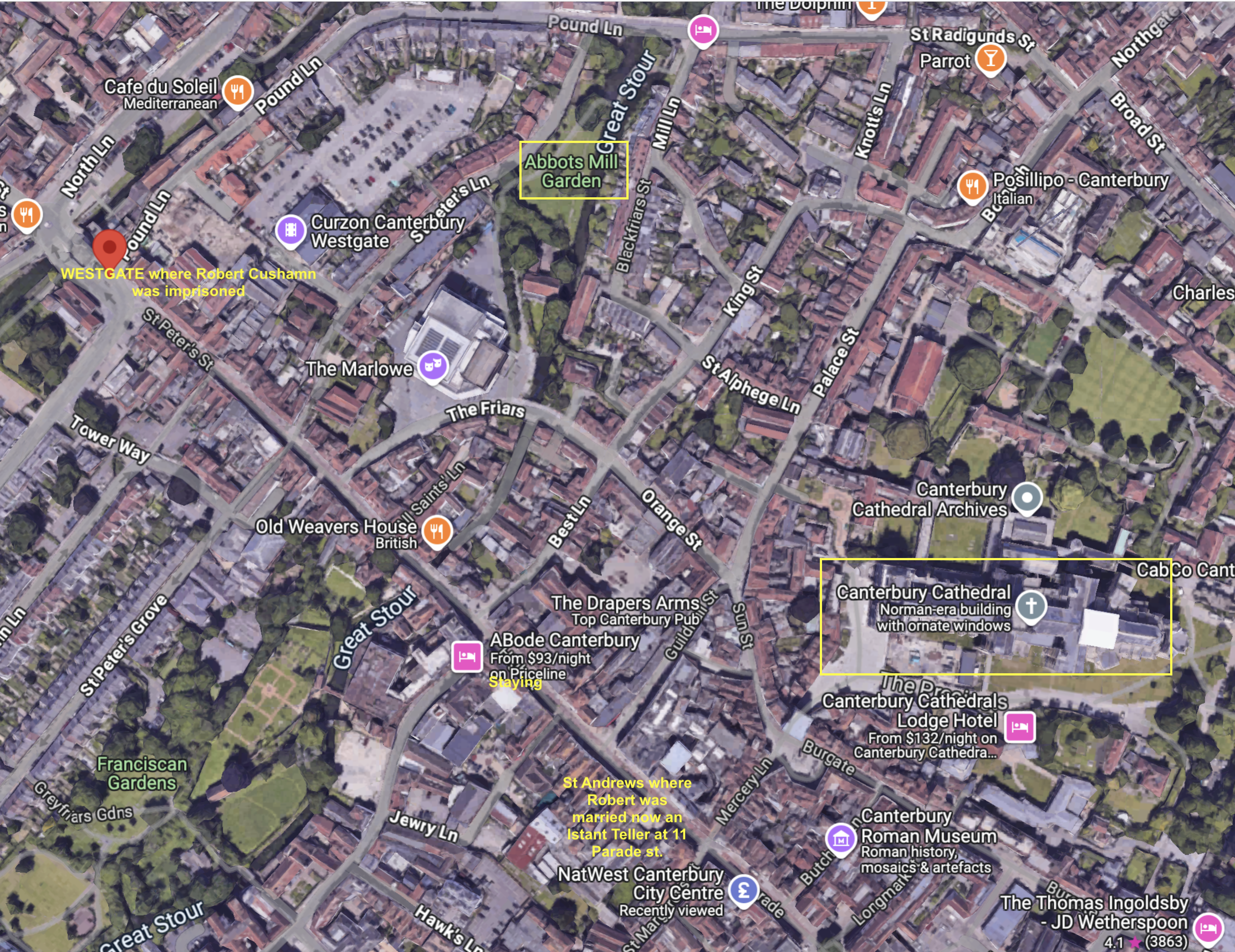
So in this case I was quite successful. [I will take up the CUSHMAN story in another Blog post.]
The other possible opportunities were to happen upon leaving Leed’s Castle on our way south to Tenterden. I had asked our tour guide, Ben SIMS and driver, Tony GILBERT, if it might be possible to exit Leeds Castle via Chegworth Road that led to Ulcombe Road, then turns into Tilden Road, rather than taking the B2163. The advantage of going with a tour company like Blue Roads /Back Roads Touring is that it is at their discretion to accommodate such requests. They checked it out via Google Maps and agreed. I had shown them a couple of screen shots of what I was looking for as well as my blog post about the TILDENs.

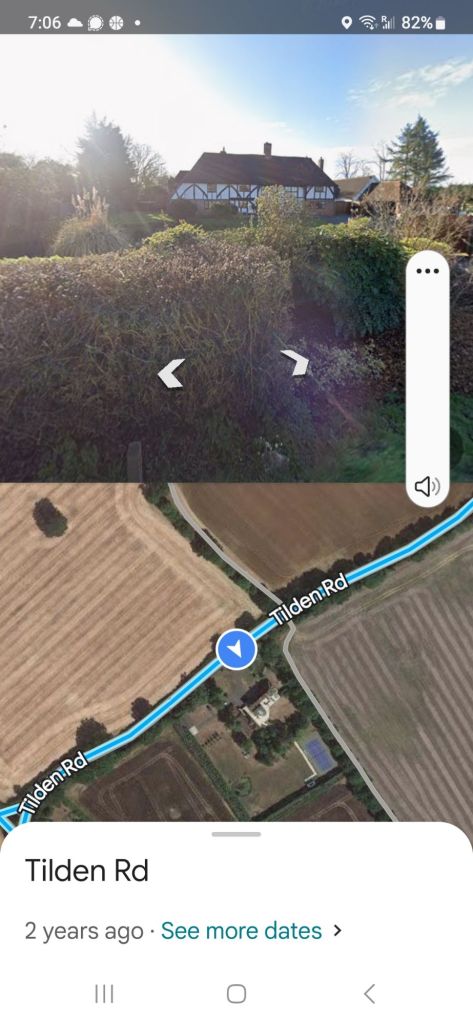
Now this was a true English country lane, replete with hedgerows and our ride was an 18 passenger Mercedes Coach. However, with an experienced driver it was easily managed. Giving true meaning to back roads touring as we did go off the beaten track. Here’s a view from the coach. Thank you Ben and Tony and my tour group for allowing me this opportunity.

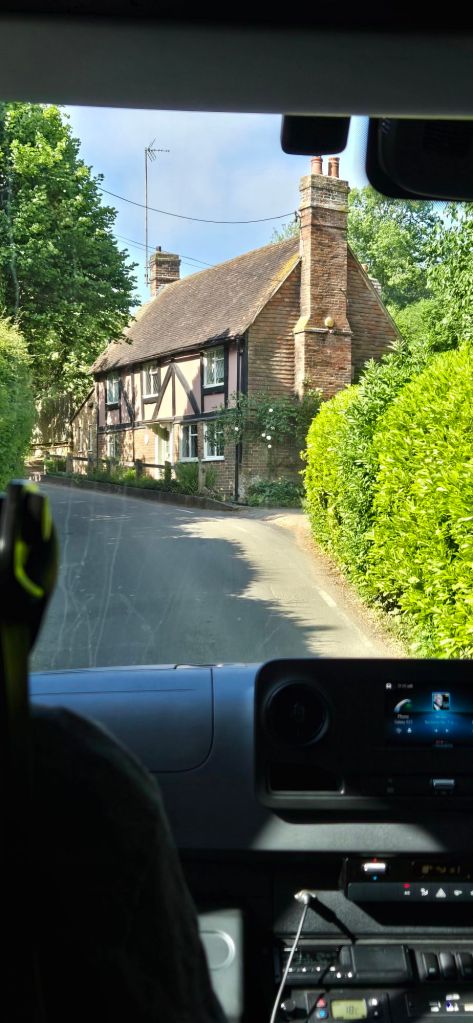
It maybe added an extra 10-15 minutes to our journey but this was the reward. Seeing the Old half timber frame 15th- 16th century TILDEN Houses first hand.

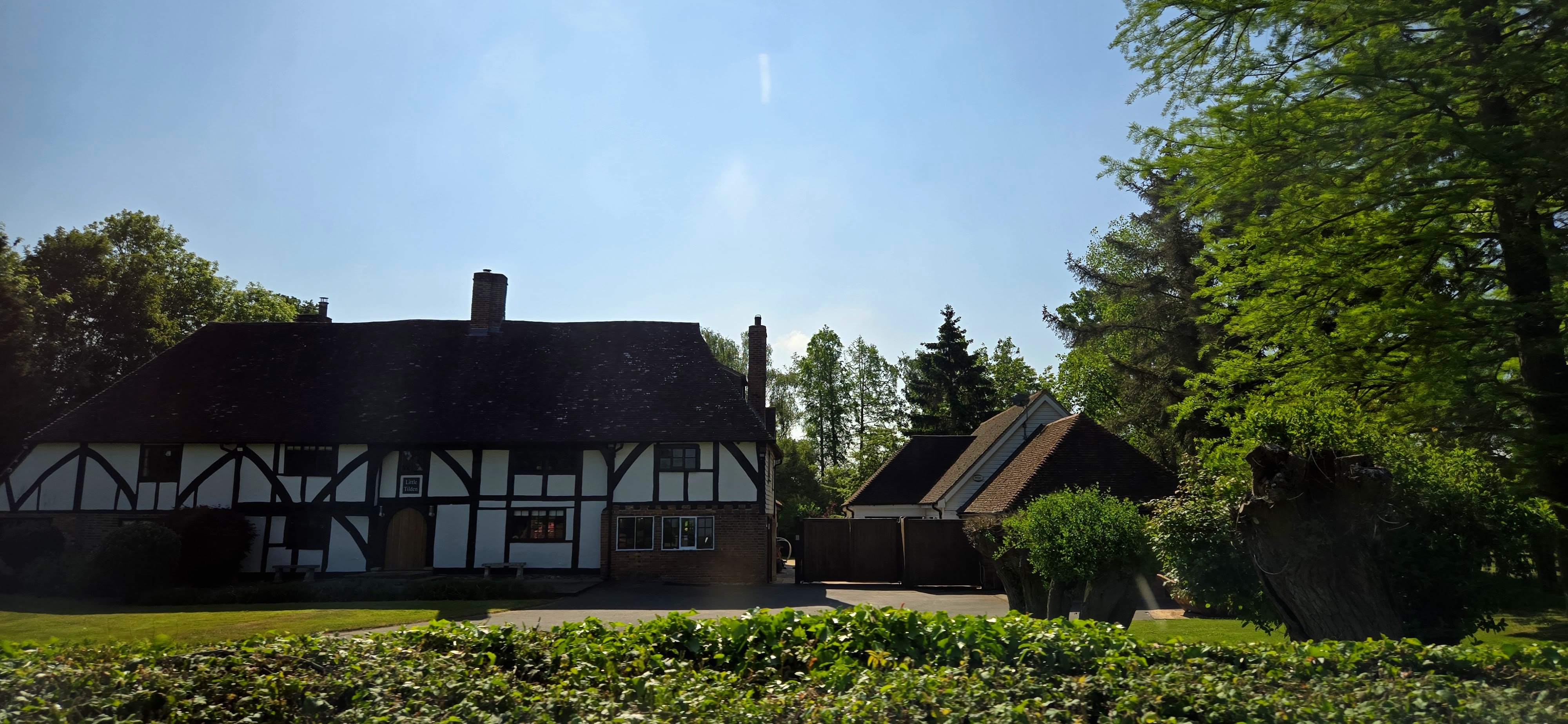
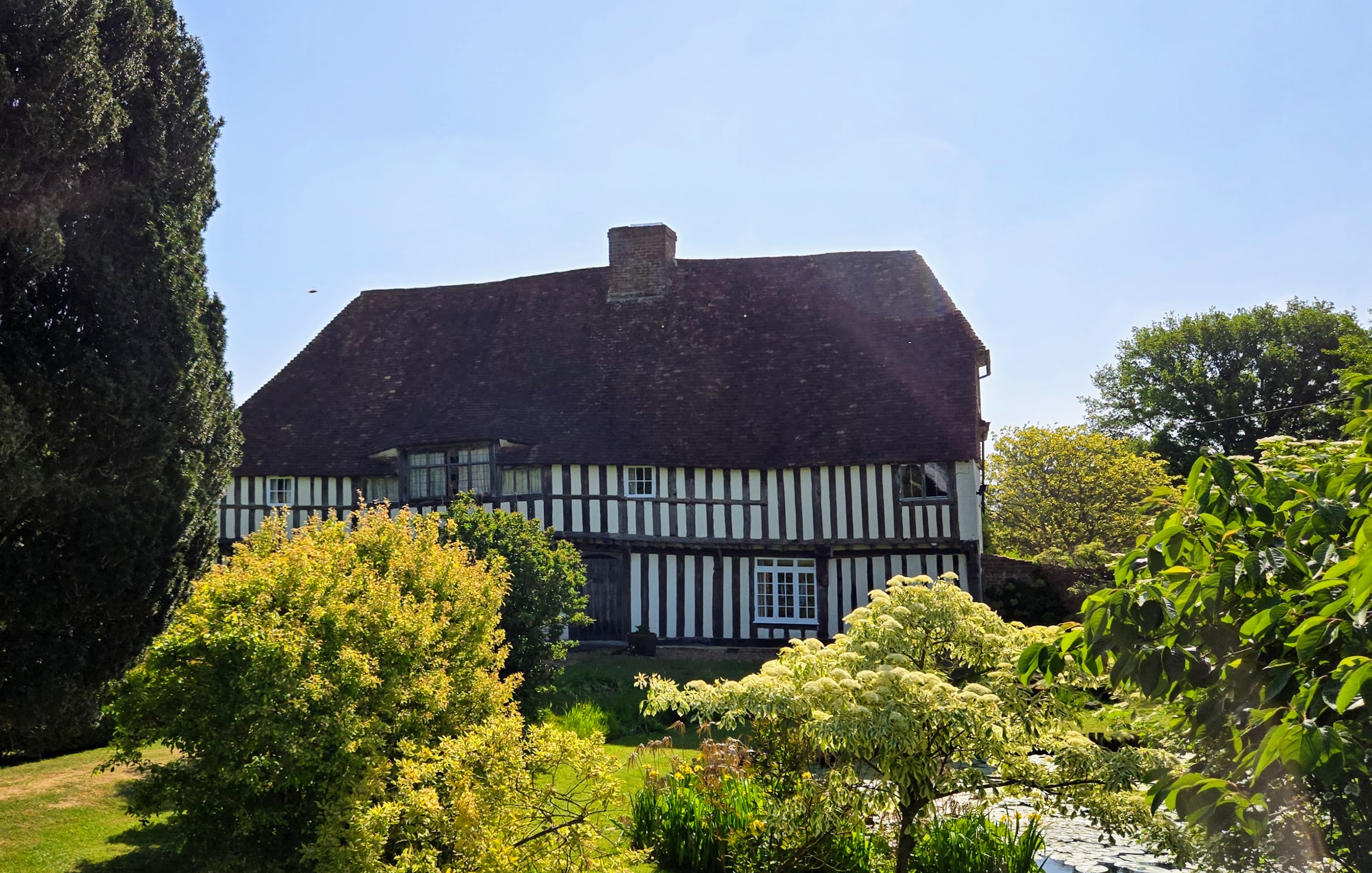
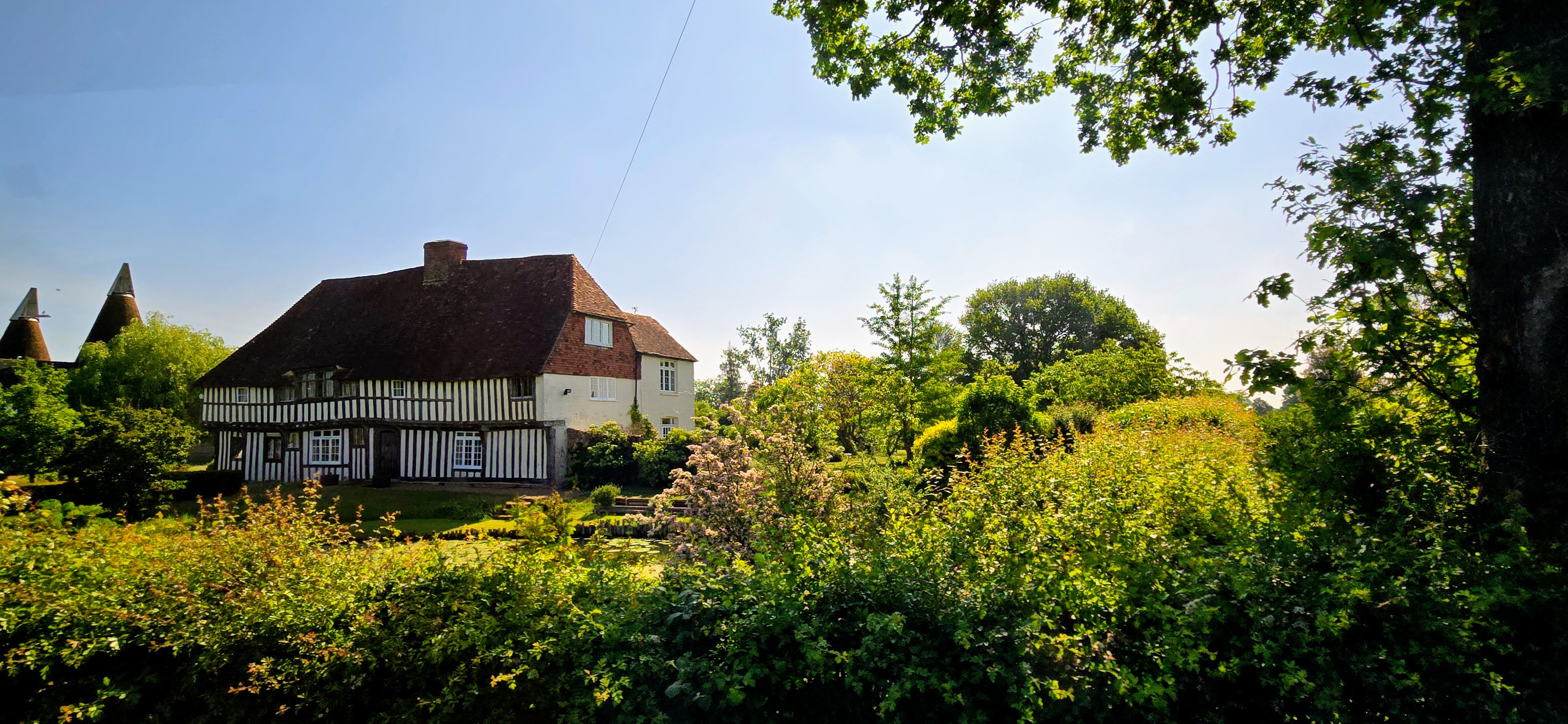
We made our way to the town of Tenterden and the spire of St Mildred’s Church could be seen from quite a distance, as seen in this old postcard looking north from Six Fields Lane.
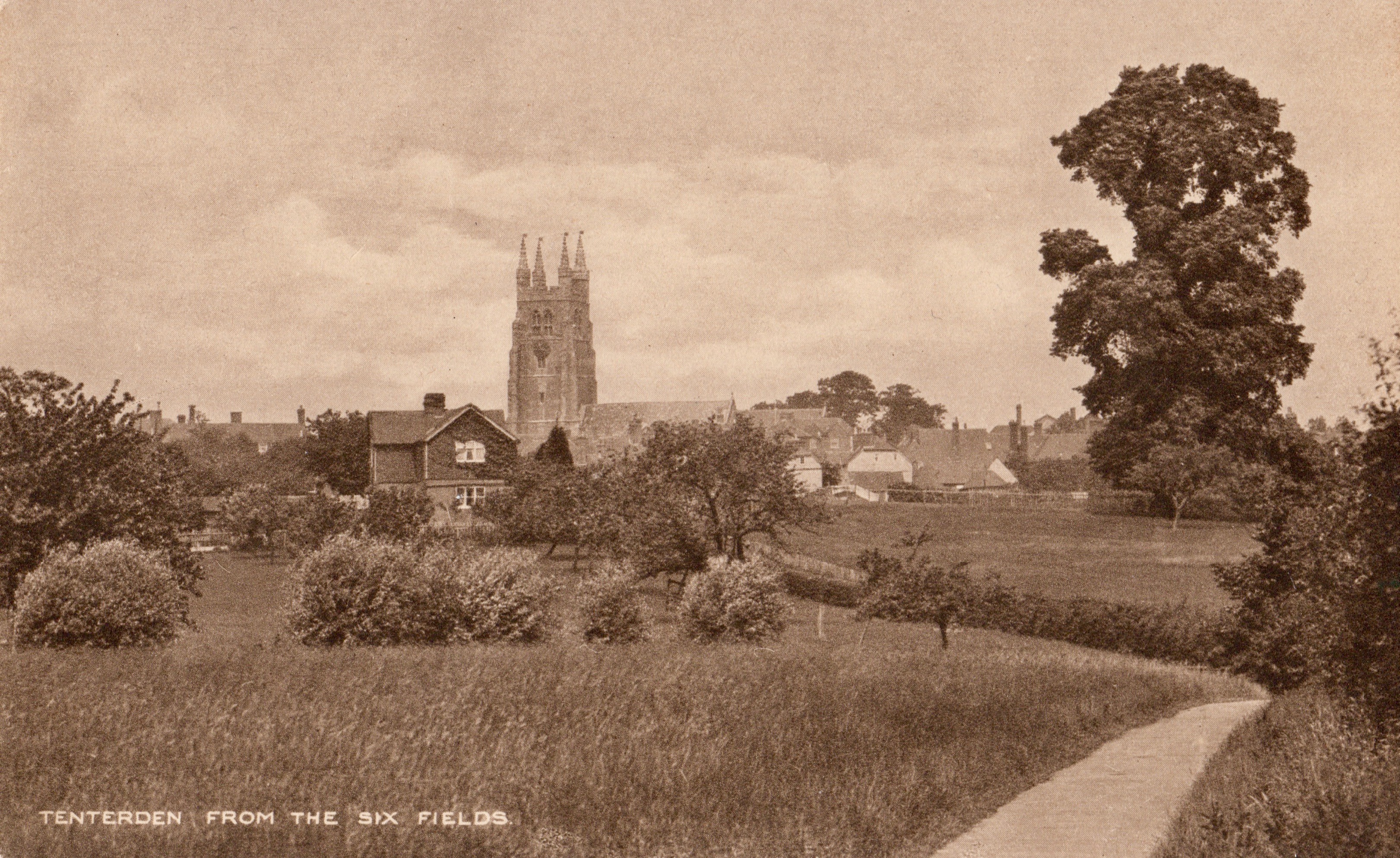
The 15th century tower was built from funds from the wealthy citizens (wool merchants?) of Tenterden and is constructed of local Bethersden marble. It stands at 200 feet above sea level and is itself 125 feet high. The coast of France can be seen from the top of the tower on a clear day. The tower is visible to ships in the Channel and previously had a beacon at its top. Local tradition has it that it was lit during the arrival of the Spanish Armada and perhaps to guide ships to Tenterden when it was one of the “limbs” (additions) of the original Cinque Ports. The Cinque Ports, prounouced “sink” were a confederation of originally five ports, during the reign of Edward the Confessor (1042–1066). These ports were granted the local profits and certain autonomous privileges in exchange for providing ships and protection. They are mentioned in the Magna Carta of 1297. [More on the Magna Carta when I post about my visit to Temple Church in London.]
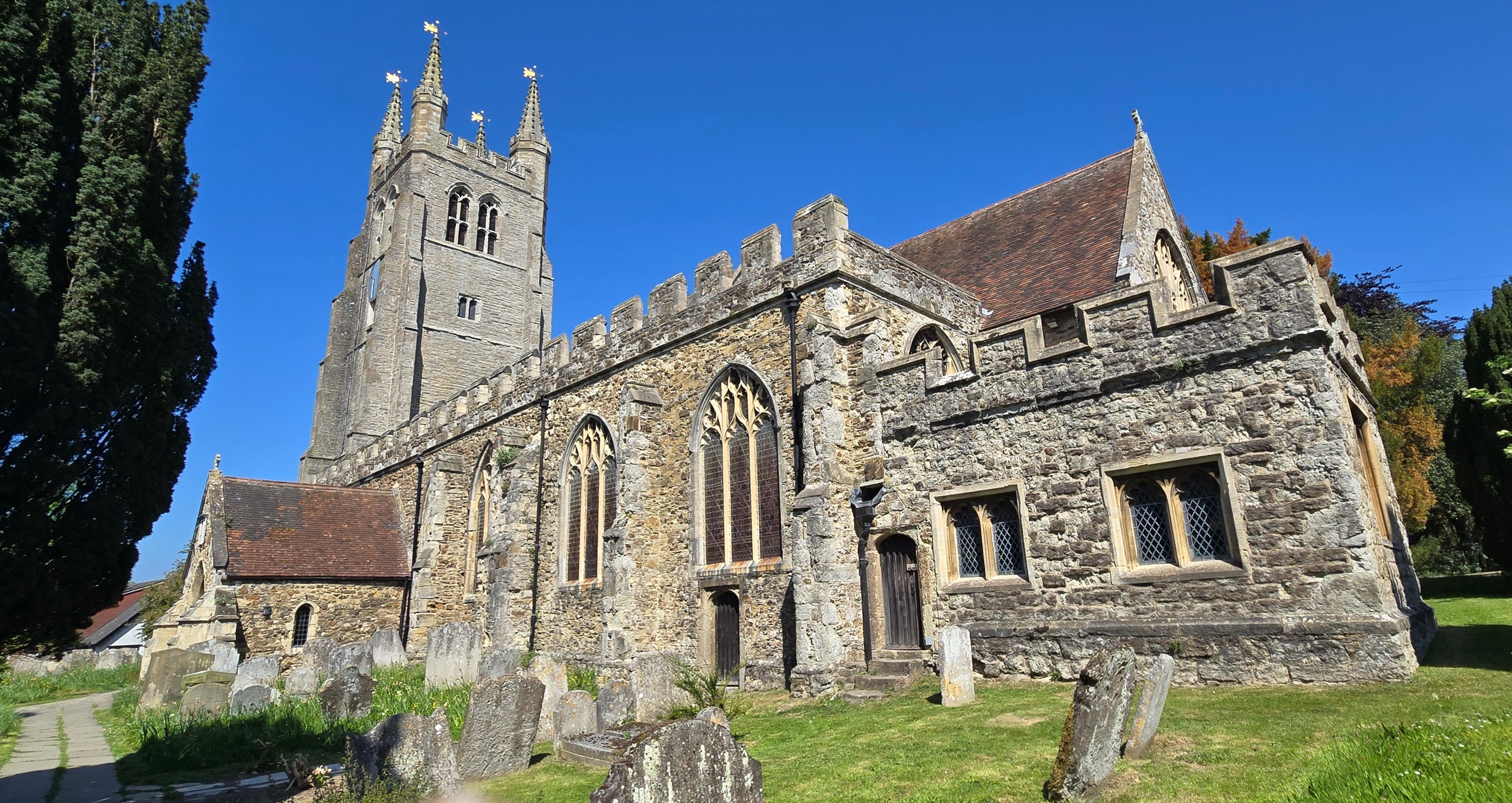
We proceeded into town of Tenterden and parked in the car park on Station Road and St Mildred’s was a short walk away. Here are my first close-up views of St Mildred.
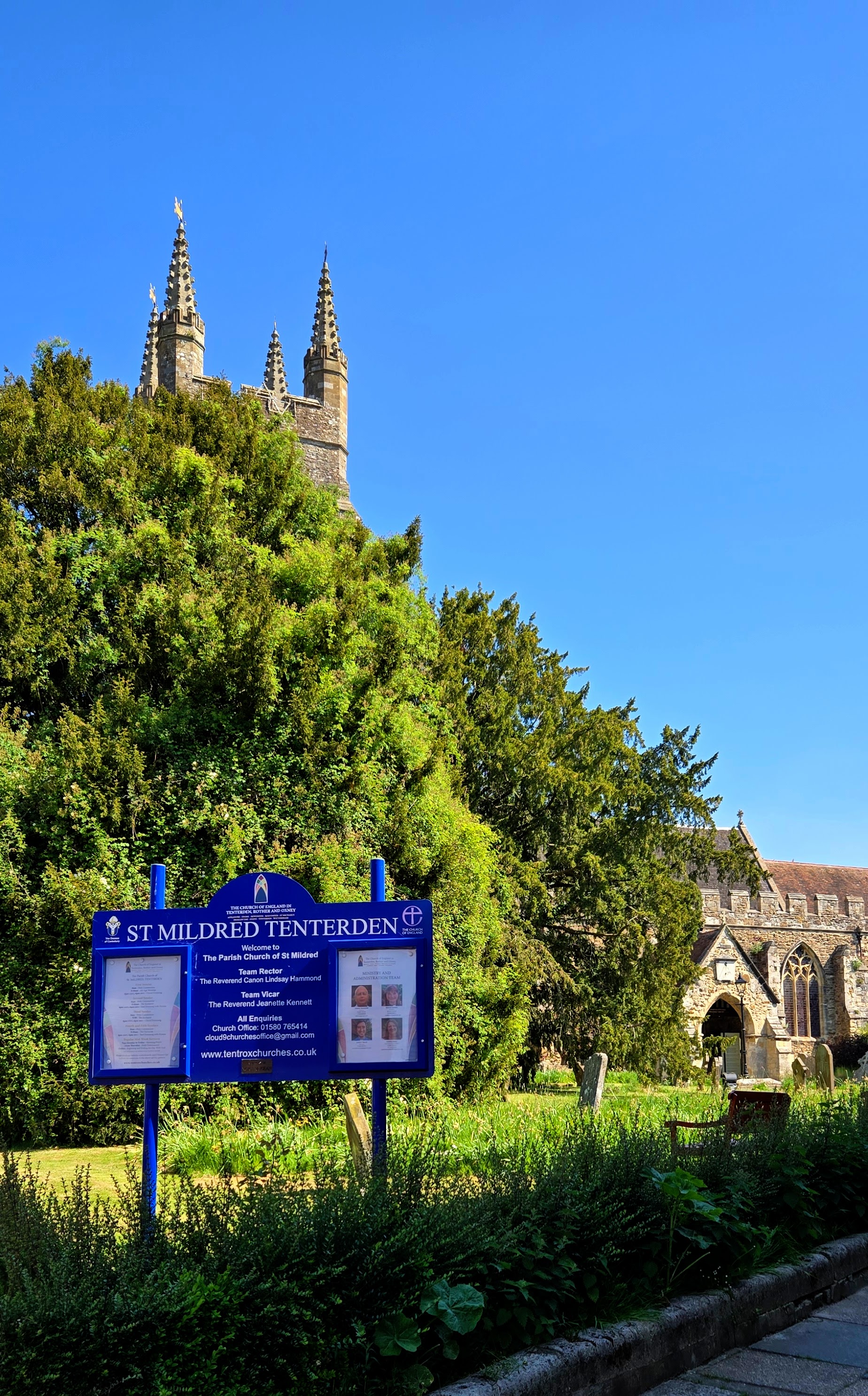

Upon reaching the front door I was met with this, “St. Mildred’s Church is temporarily closed. This is because work is taking place which will improve the building for both the church and the community of Tenterden…” I laughed out loud. This was not the first time this had happened to me when visiting an old church in England.

So I wandered around the building to see if there was another opening. And of course there was, and this one had some young workmen there and I asked permission to have a look see, since I had come all the way from America and they kindly obliged. Having done the other part of my research, I knew this church had a unique 15th century barrel vaulted ceiling with hand carved bosses. Even though, said ceiling it is not even mentioned in the write-up about it in England’s Thousand Best Churches. Tenterden church is dedicated to St Mildred and this dedication is an uncommon one in england with only a handful of ST Mildred chrches. St Mildred was a very pious and revered lady who became Abbess of the Abbey at Minster on the island of Thanet, Kent. She died the 13th of July 734 and was originally buried in her beloved abbey on Thanet. Her relics were later transferred to a shrine at St Augustine’s Abbey at Canterbury, which was one of the most important monasteries in medieval England. St Augustine’s was plundered under Henry VIII’s “Suppression of the Monasteries.” More can be read about St Mildred here. What happened to her remains I have not ascertained. St Mildred was the great-great-granddaughter of the King of Kent, Ethelbert. The one thing you find is historical connections everywhere in England. And of course a slightly more personal connection was my grandmother was named Helen “Mildred” an uncommon name on my mother’s side or anywhere in my tree. There is no record of why she was given the middle name Mildred. My TILDEN connection is on my father’s side through Judith TILDEN who married William PABODIE the 27th of June 1693 at Little Compton, Newport, Rhode Island. Judith’s mother in Law was Elizabeth ALDEN born 31st of MAY 1624 at Plymouth, Massachusetts. She was the daughter of Mayflower voyagers: John ALDEN and Priscilla MULLINS.
Looking at the outside doors of the tower, into the Nave and up at the barrel vaulted ceiling. I looked for the baptismal font but could not find it ( the workman did not know where it was either although I looked under canvases and tarps.) However, as I gazed up at the ceiling I thought of my ancestors Stephen TILDEN baptized here in 1629, my 9th great grandfather back to his grandfather Thomas born in 1551 and married here in 1576 to Alice BIGGE. The ceiling reminded me of a ships hull or the woodworking on an ornate chest and I speculated that some of the ship builders who were active just south of Tenterden at the hamlet of Small Hythe had been responsible for its construction. Small Hythe stood on a branch of the Rother estuary and was a busy shipbuilding port in the 15th century. The Rother estuary led out to Rye Harbor. Small Hythe silted up and ceased as a shipbuilding place.


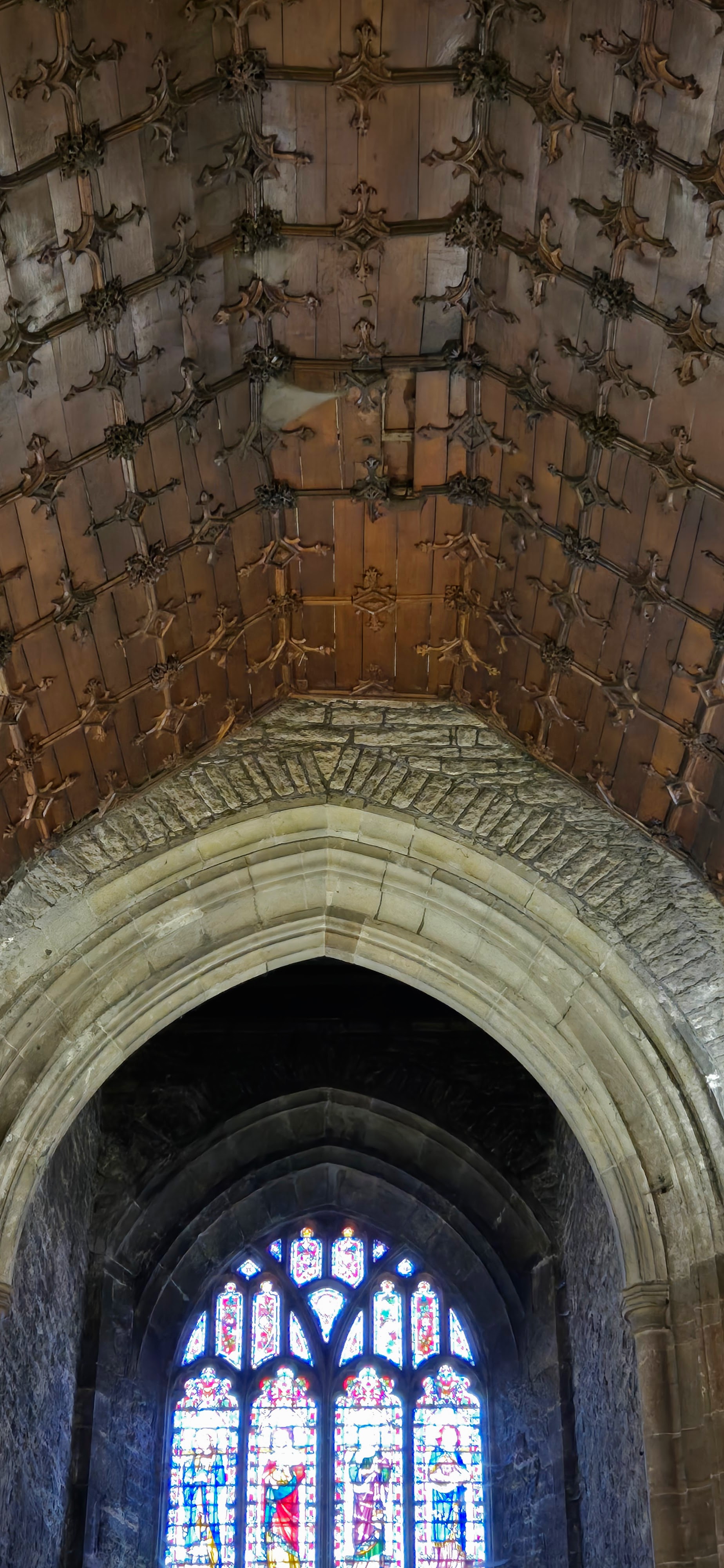
Above are assorted views inside. Outside I saw one old monument to a BIGGE (Stephan TILDEN married Alice BIGGE), but did not have time to explore at length. English Daisies appearing through cracks at front of St Mildred’s. The old tombs of a BIGGE, the sundial above the porch, long view of St Mildreds, a mermaid rose which was a surprise [The Mermaid Rose is a hybrid climber bred in 1906 by English horticulturist William Paul and son. Parentage is Rosa bracteata x unnamed tea. William Paul (1822–1905) was an English horticulturalist and writer, known for his book “The Rose Garden.” Not to mention we were to spend the night at the Mermaid Inn at Rye] and a final view of the tower.





Then a quick dash down the lane to the Tenterden Town Hall where I hoped to pop in for a look at the plaque listing the mayors of Tenterden which included my immigrant , Stephen TILDEN. But in what I considered an absurd sense of humor of the gods this is what I found. The Town Hall was also undergoing renovation ” We make Plans, god laughs”. [It took me 3rd trips to London to see the Elizabeth Tower where it was not shrouded in scaffolding and cloth. Known to most as Big Ben—The bell inside the tower, known as the Great Bell, is the one that is actually named “Big Ben”.]

A broader view of the Town Hall. No entrance at all.

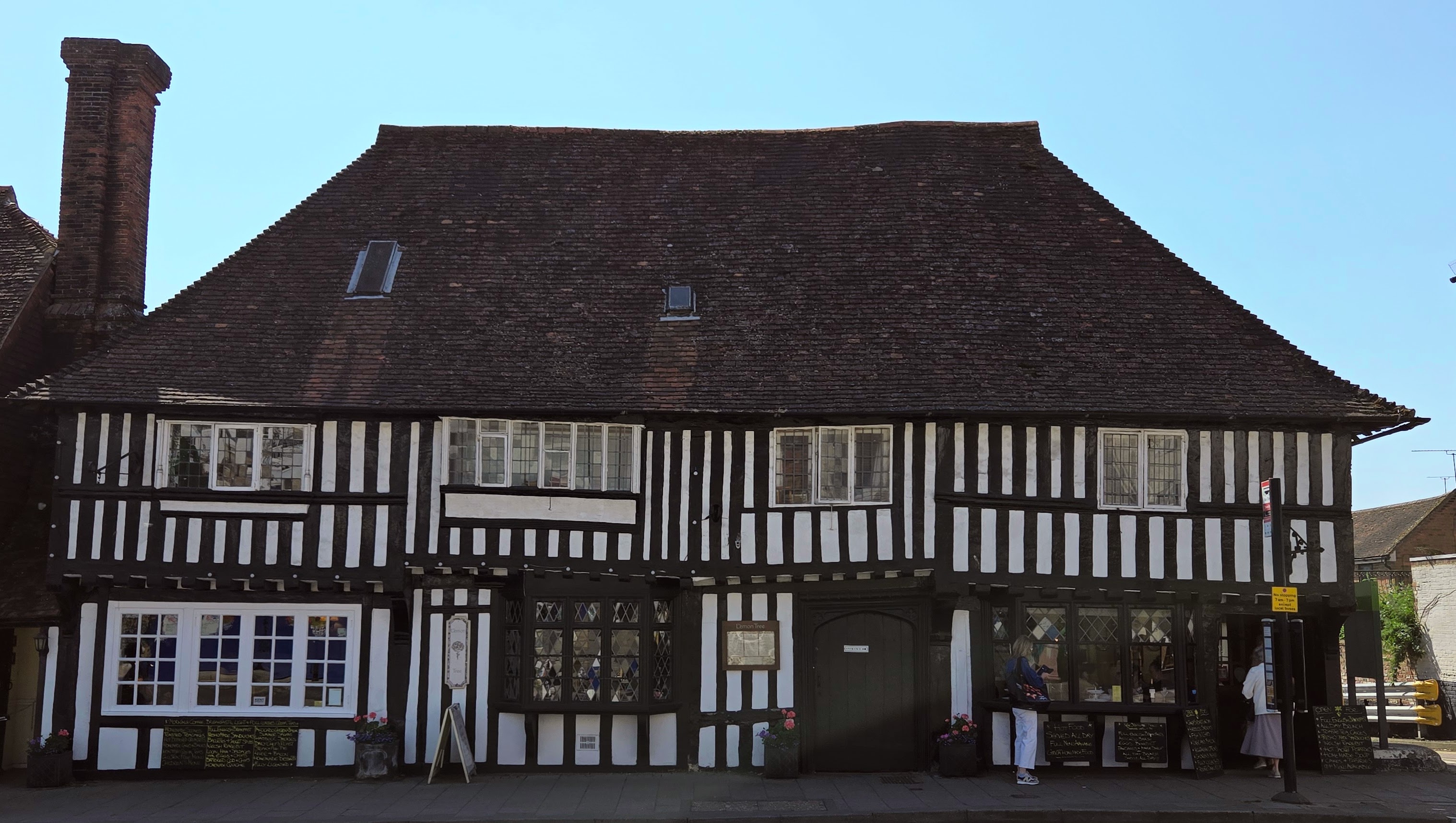
Across the street was the Lemon Tree Pub. Housed in the 14th century “Wealden Hall House” building, reportedly visited by King Henry VIII. So giving me an idea of what things might have looked like back at the time the TILDENs lived here. Obviously the Town Hall has been updated and modernized over time.
And finally on the way back to the car park I threw a coin in the Tenterden Wishing Well which benefits the Savannah Trust. It was previously the The Brewery Well on Coombe Lane dug in 1893 and originally powered by a wind pump now re-envisioned as a wishing well. My wish is that if I make it back to Tenterden the renovations are complete. Anyone happening upon this who may have photos of the plaque or the baptismal font willing to share drop me a line.
Thus the adventures of traveling for genealogy. Sometimes what you don’t have access to—becomes as much the story, as what you do. And cast your eyes about—no telling what you might find. Finding a familiar rose was certainly a surprise. And the ceiling was still as visible as ever.
Kelly Wheaton ©2025 – All Rights Reserved
LONDON Day One: Arrival
Posted on May 10, 2025 5 Comments
Wednesday May 7th
Deplaning at Heathrow was not at all as expected. The reason for the long delay became evident when finally reaching the door. There was no mechanized causeway. What greeted me was two flights of stairs with a landing at half point. Now ordinarily this would not seem that daunting however carrying my 20 pound bag while clutching the handrail was not welcome. The extra weight on my 70 year old knees caused them to groan in disapproval. I was shocked that this was not announced before exiting and there were no offers by crew to help. For once I wanted to look older and more unfit. I have deplaned via stairs before, but not one so far off the ground. A new experience indeed. Nod to the Outlander scene where Claire and Frank are deplanning in New York City. I know that my photo makes the steps look flat but I assure you this was steeper than it looks.

Well that was just the start of my misadventures. “Chin up buttercup!”
Once on the tarmac we were shuttled into buses which took us through the bowels of Heathrow airport including a section signed “Extremely Dangerous Traffic Area.” Having survived that serapentine travel and made it quickly through the automated customs (all done biometricly without human contact) and then successfully navigating to the correct area to catch the train to London. Stopped off to top of my Oyster Card only to be told the green District Line was experiencing “Extreme Delays.” So back up to where I came from to take the Piccadly line going East and then transfer backtracking going west to make it to my destination at Earl’s Court.

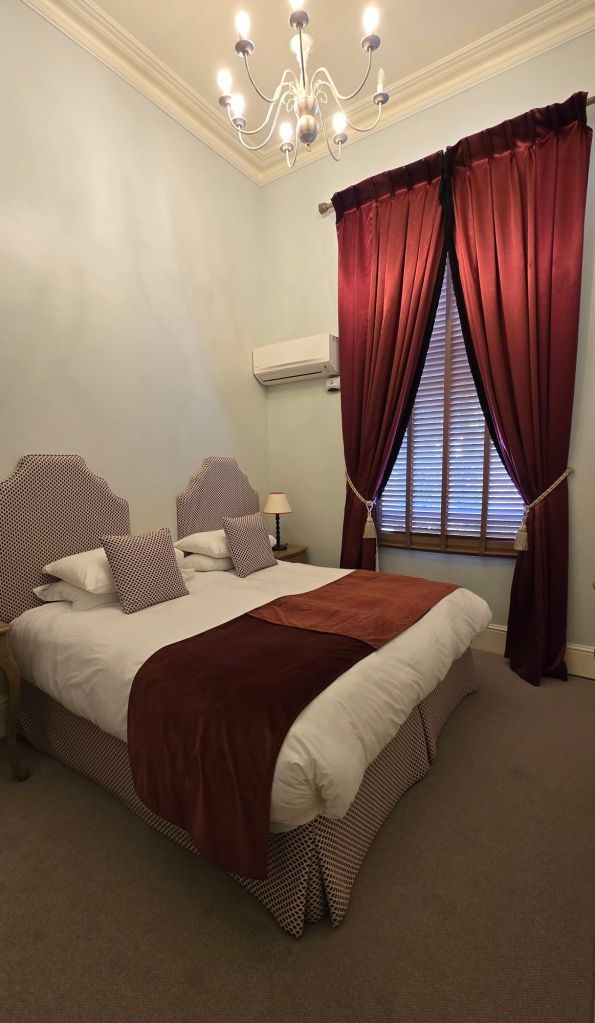
Two hours later than expected I arrived at my final destination for the next 3 nights. 20 Nevern Place. The staff remade the twins into a queen and let me check in early. Yay!

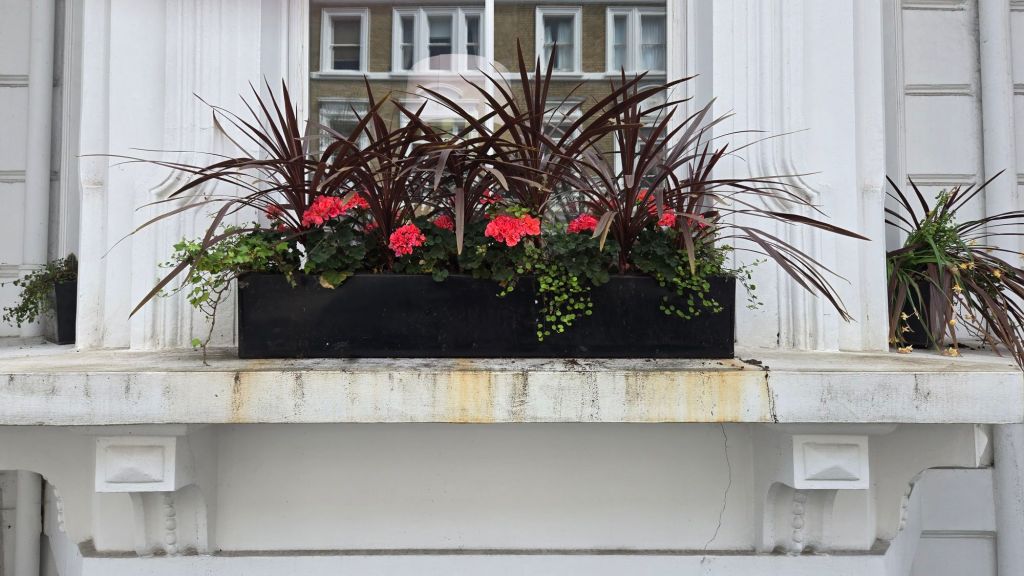


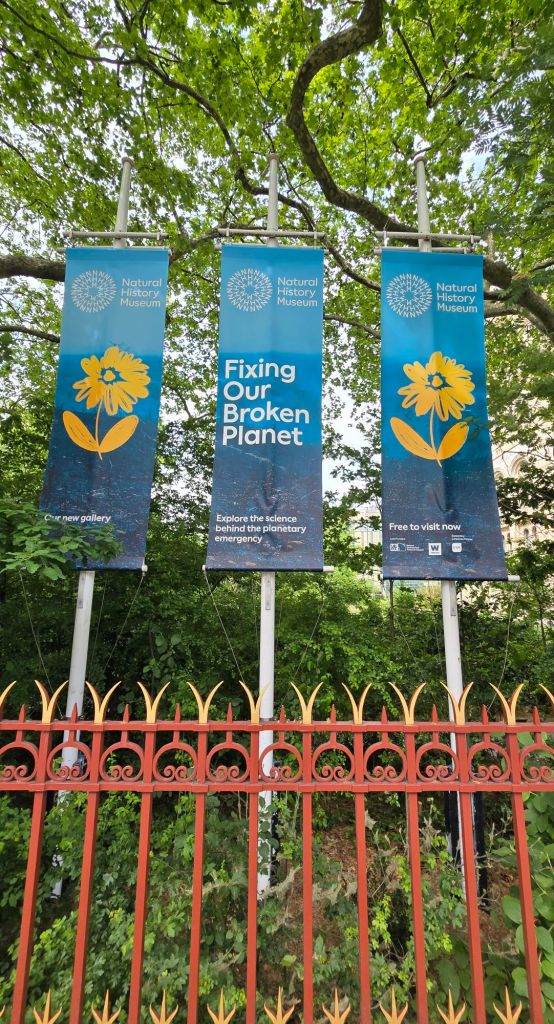
Off on foot to the Victoria & Albert Museum. By the time I got to The Natural History Museum I could feel the day’s travel hitting me. Rather than pop in I just strode right by. However I did love the title of this exhibit.
And also spotted this delightful pair of old phone booths.

On to the Victoria & Albert where I wanted to view more of the SHELDON tapestries having seen the largest intact one in Warwick and an exhibit of others at the Oxford Bodliean Library.


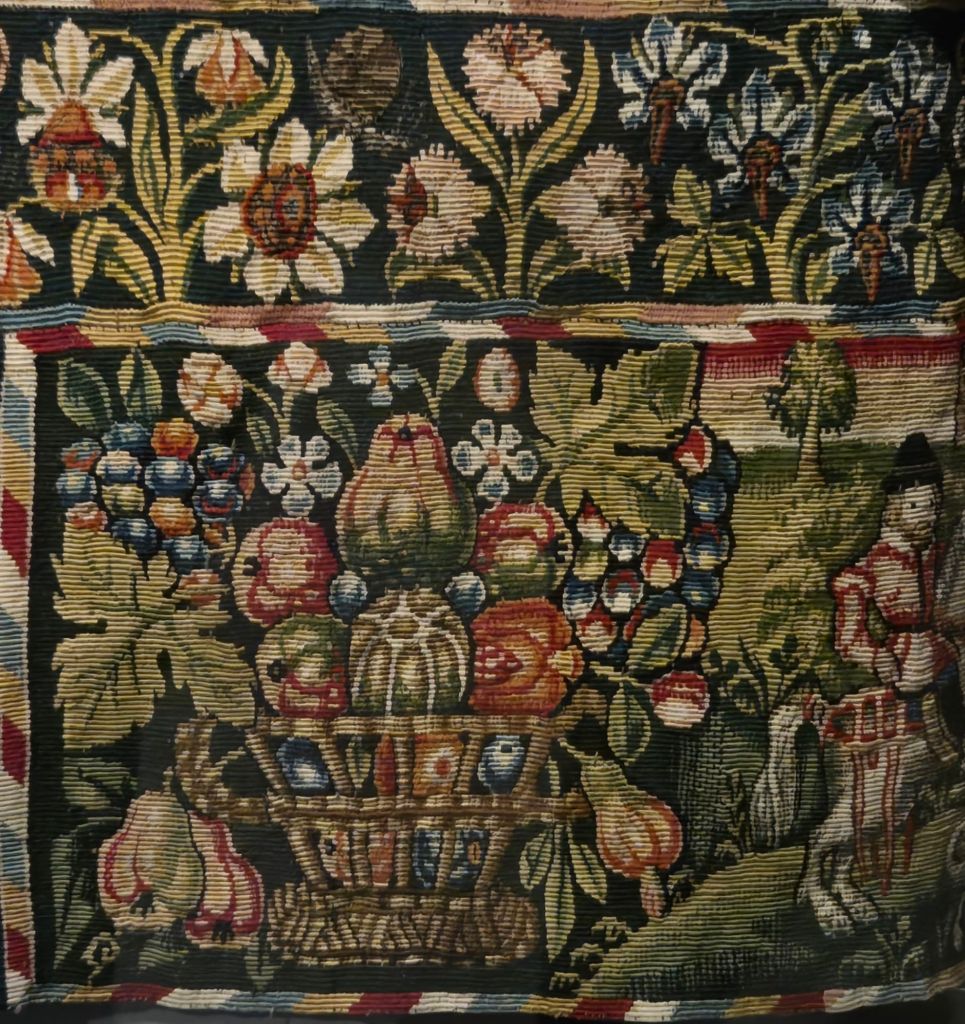
The museum is a gem of life and joy set in an inspiring architecture. As I had planned to eat in the Cafe there and did so I marvelked at its beauty in a city of beautiful things. Not to be missed.
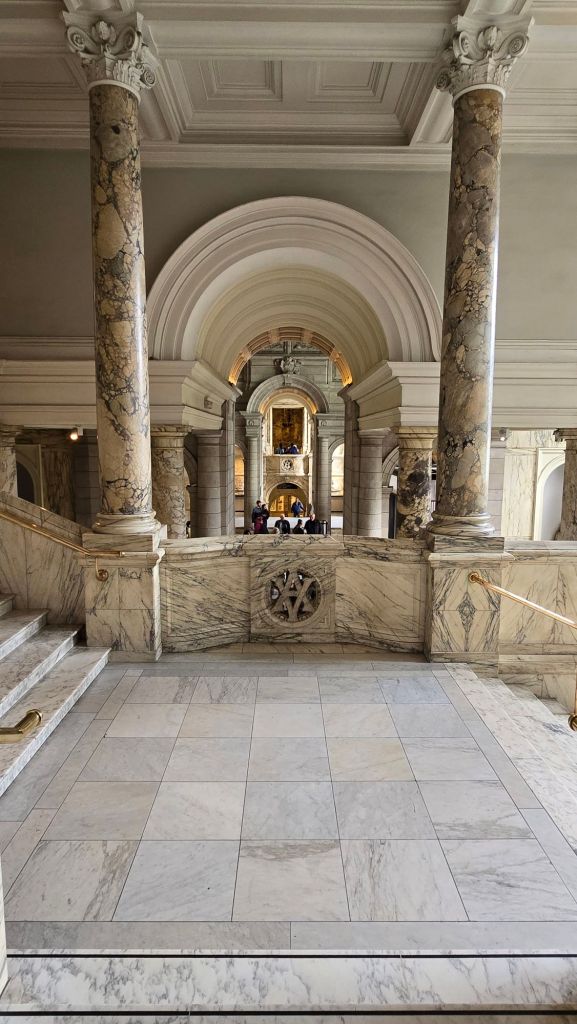

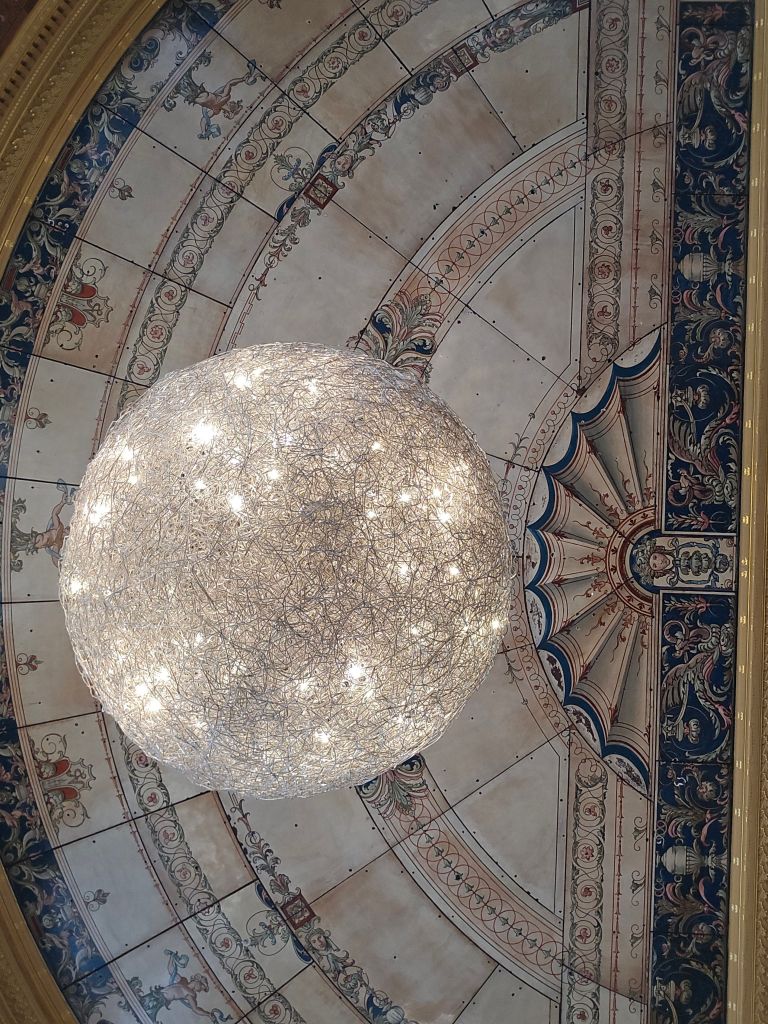
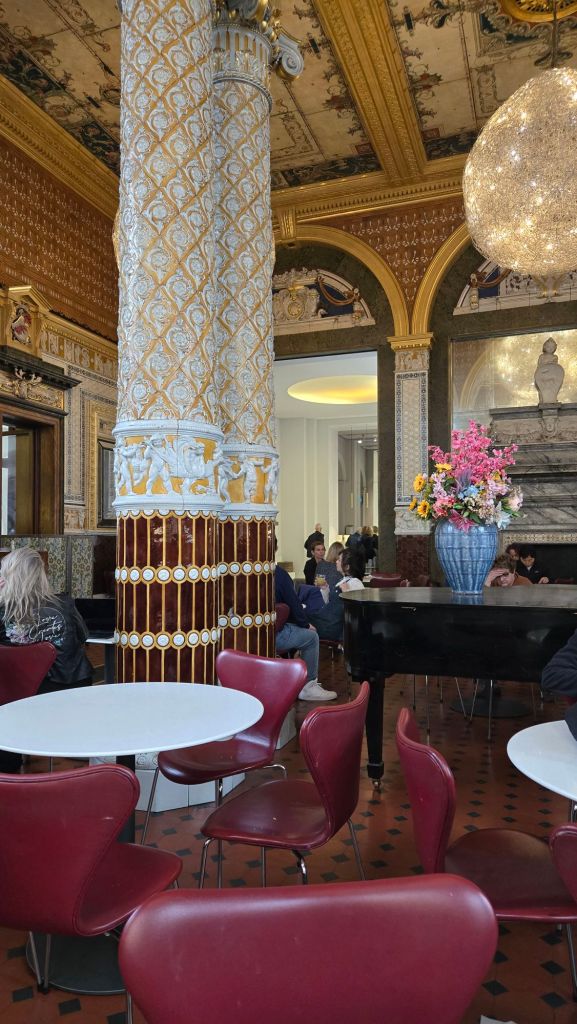


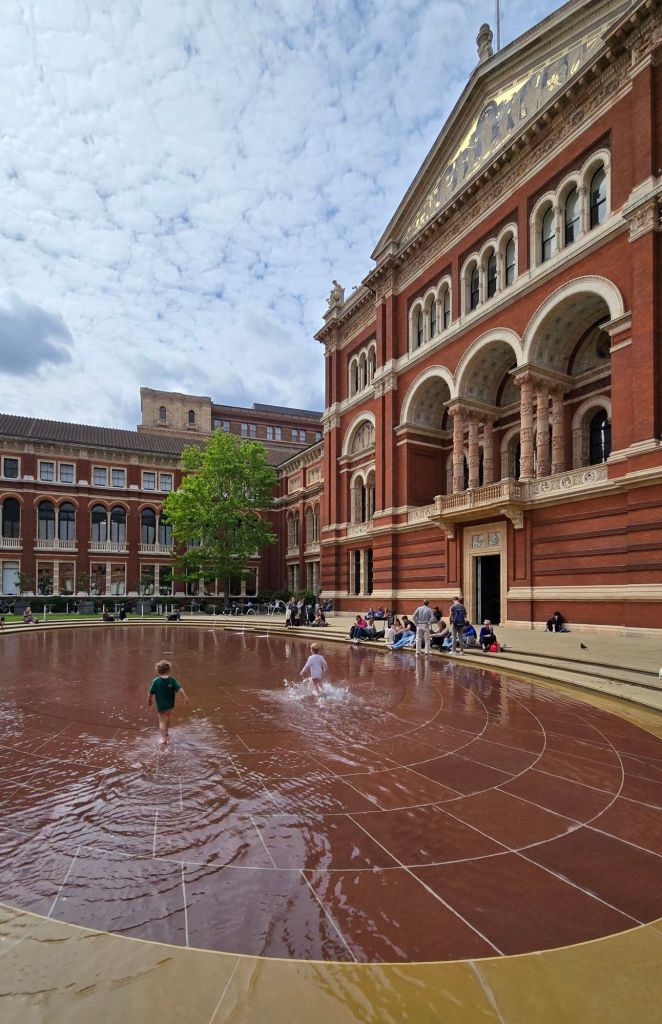
And the courtyard is just as lovely. Caught two youngsters playing in the water which delighted me.
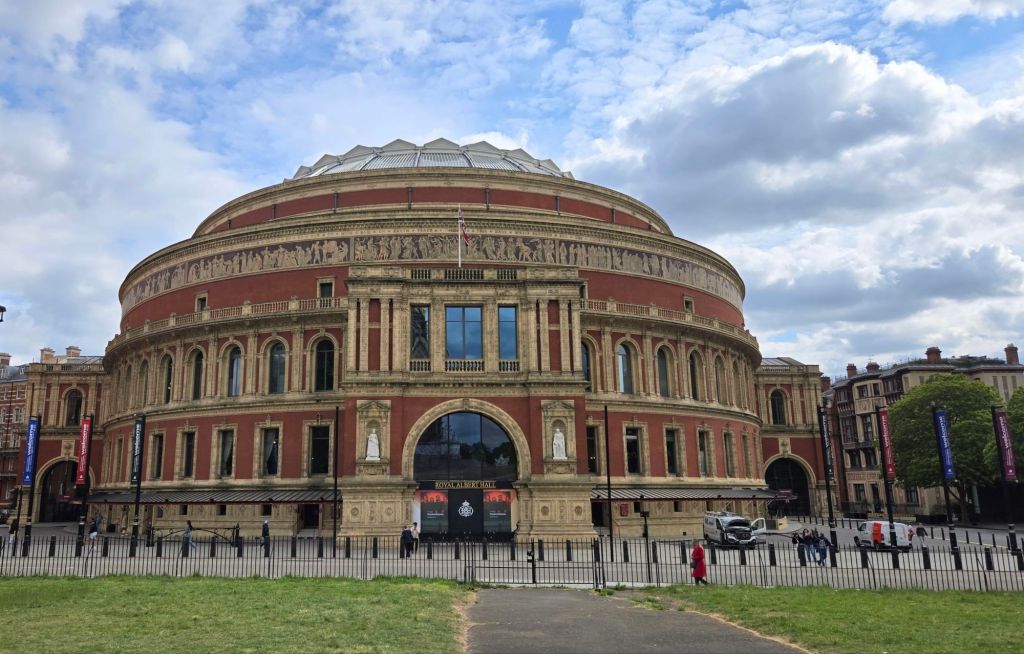
Finally Albert Hall.

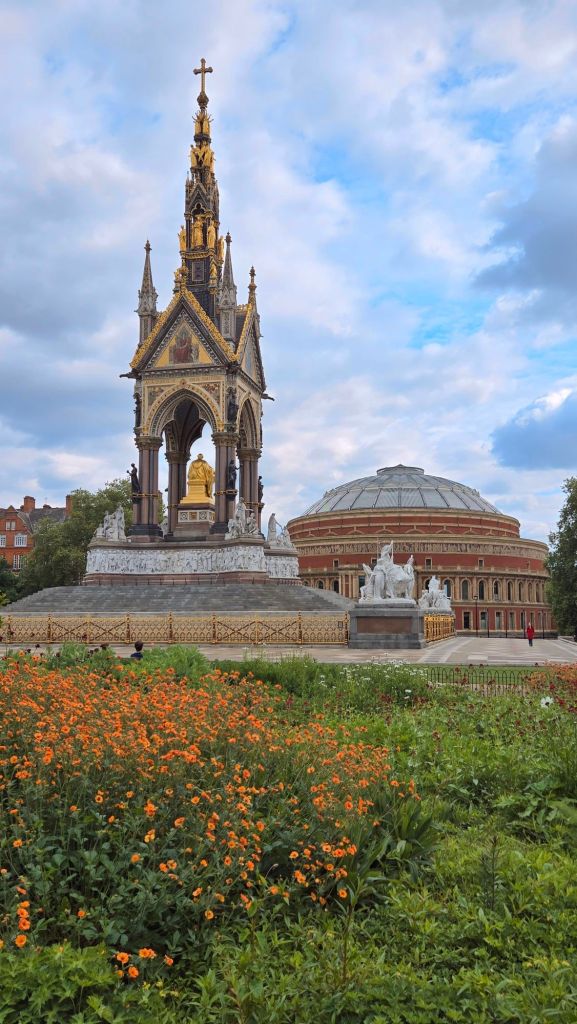
I thought of the BBC series Victoria and Albert. It may be a romanticized view but it was a golden age in England. Intricate and opulent but not heavy or morose. Interesting juxtaposition of monuments. The first Victoria’s Tribute to her husband and the second a memorial after her death.


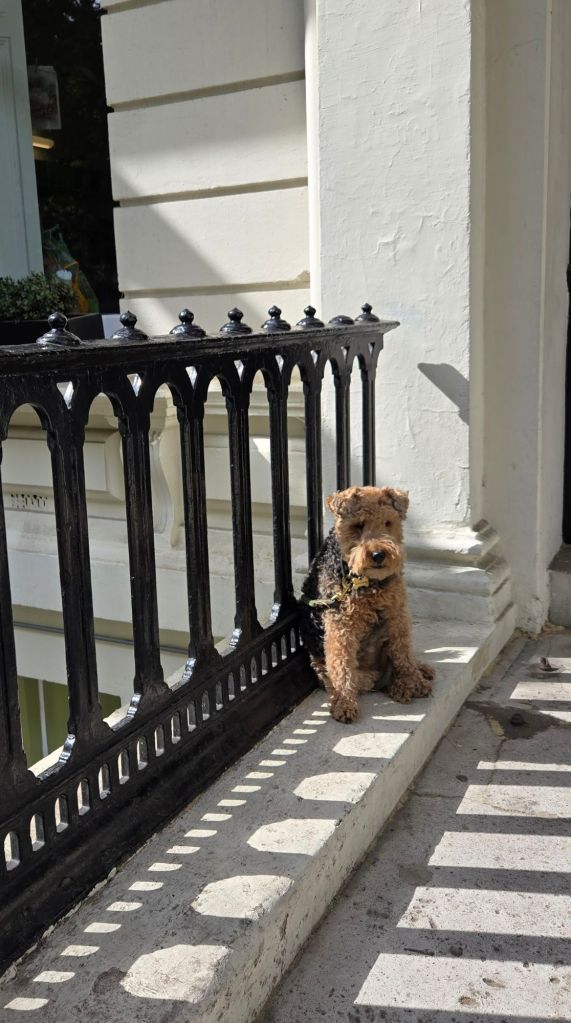
As often happens as one wanders about there are delightful moments like these two faithful servants exhibiting patience. I used to say “the English love their gardens, their tea their Queen and their dogs, not necessarily in that order.”
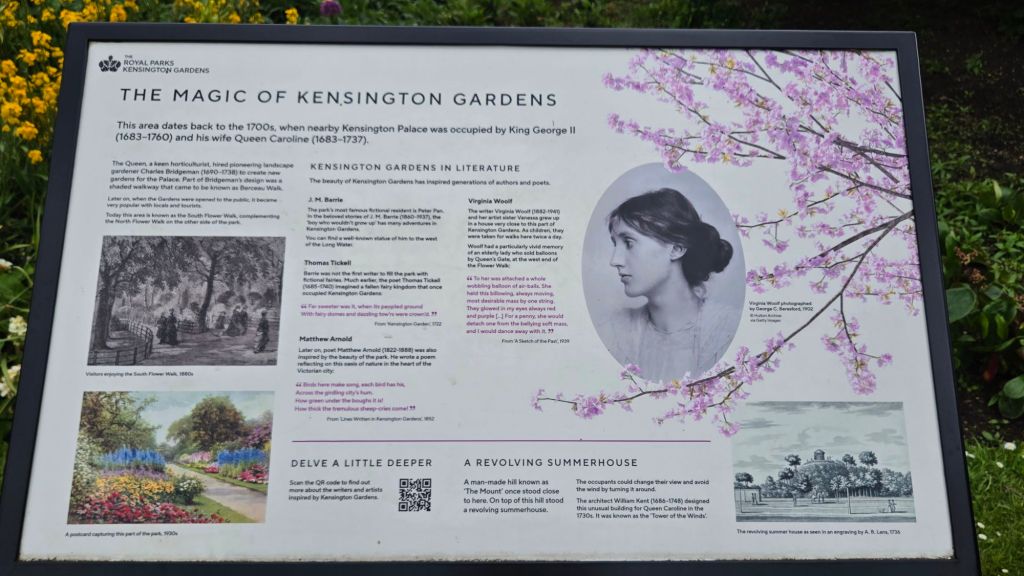
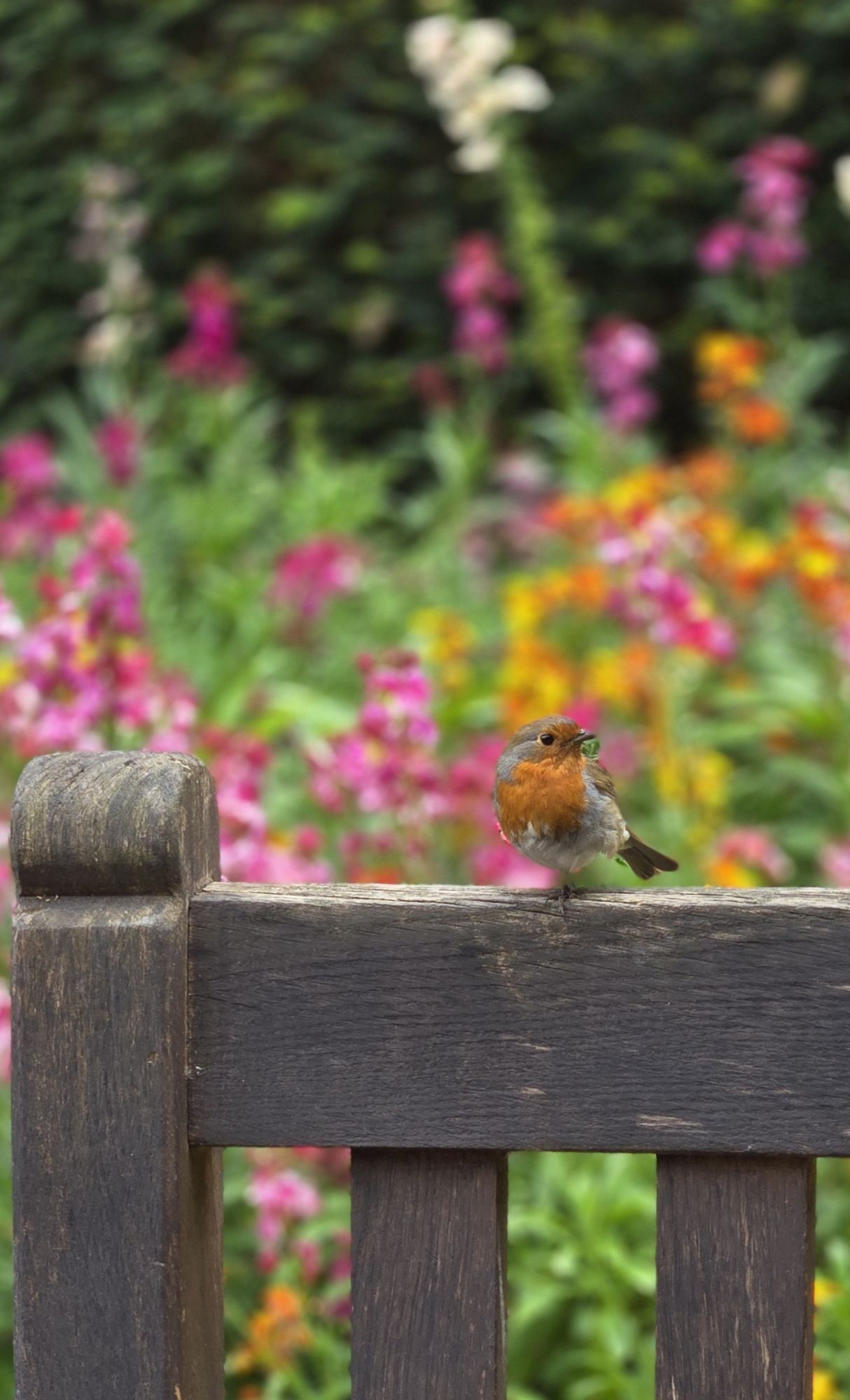
Rather than walk to the Diana monument I happened upon “The Flower Walk” which turned out to be magical. Greeted by very friendly squirrels and a robin greeter posed perfectly for photos in front of a matching bed of wallflowers. Three green parrots squalked loudly. Drawing my eyes overhead, as they flew off. They reminded me of San Francisco’s parrots of Telegraph Hill. Guessing they were once domestic gone wild and looking them up they are known as Ring-necked parakeets native to Africa.
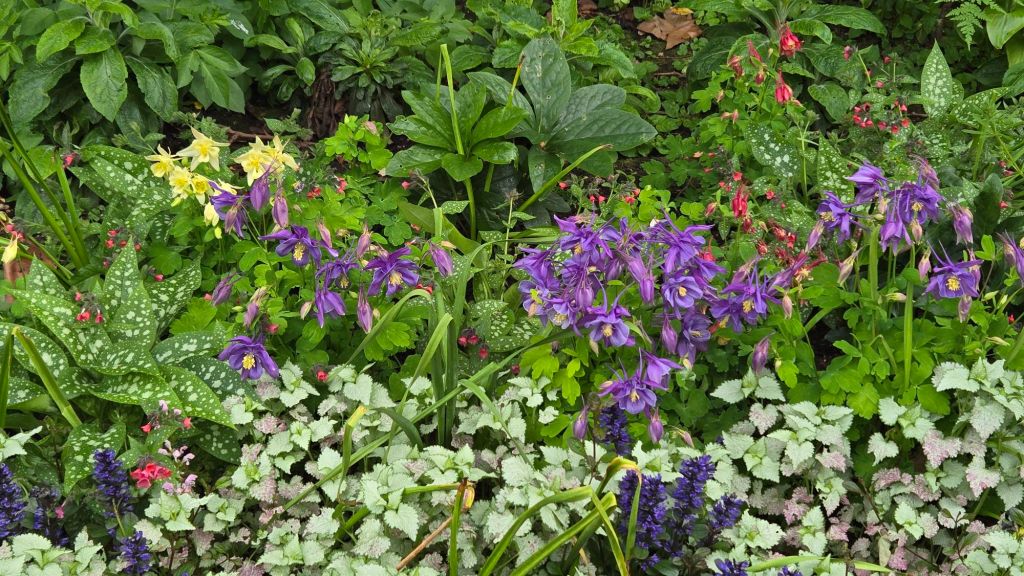
The trees and flower display were stunning in this quarter of a mile walk.



The day was not yet done. But that will wait for a new post as I fall farther and farther behind. Perhaps it was a good thing that I was delayed in arriving as I jammed so much into this first day. As you will note, this diary is both in words and photos.
More to come.
Kelly Wheaton © 2025 – All Rights Reserved.
Recording one’s own History: Off to London
Posted on May 9, 2025 Leave a Comment
This is a travel diary meant to record my trip. I have an old letter from my great aunt about her travels to Europe, along with the diary of my great grandmother so apologies to those who are looking strictly for genealogy.
Tuesday May 6th, 2025
Woke at 3 AM PST. That was appropriate as I had been going to bed early and waking early to prepare for my trip to England. Trying to trick my body into jumping ahead 8 hours. Fairly succesful at this as the jet lag exhaustion was front ended, by the time I landed about 10:30 AM London time I felt quite refreshed.
This was supposed to be my travel mate’s first trip to England. I lost track of how many times I have been. When my son was getting his doctorate at University of Southampton I began coming and had kept it up after his return to the states 5 years later. That was twenty years ago when my first trip was to meet my first grandchild.
As an avid gardener, genealogist and history buff England has many magnets pulling me towards her. I do feel quite at home here, for a foreigner. And over the twenty years I have learned the English language from the English. “Well done. Right you are, ” said the British reservationist on my first trip.
I have had some trepidation upon setting out solo, as my travel companion and friend from kindergarten, who was to travel with me took ill. I have traveled alone before, but always meeting up with some family or friends for at least part of the journey. So part of the trip was familiar, but I was also to have the experience of traveling alone as a 70 year old woman.
As usual I had begun my planning nearly a year ahead and researching minute details of places to go and things to see. I never do EVERYTHING on my Itinerary but instead it gives me a buffet of things to choose from.
Last minute brisk walk and watering of my garden and was ready ahead of schedule. Driving to the airport is 1-2 hours plus 3 hoyrs early for International flight. Target was 11 AM. I was ready by 10 so off we went. Over the years I travel with just a carry-on and a pursue. (Still manage to pack more than I need!)
Arrived at the airport about 4 hours ahead of schedule only to tack on another 20 minutes for a flight delay.
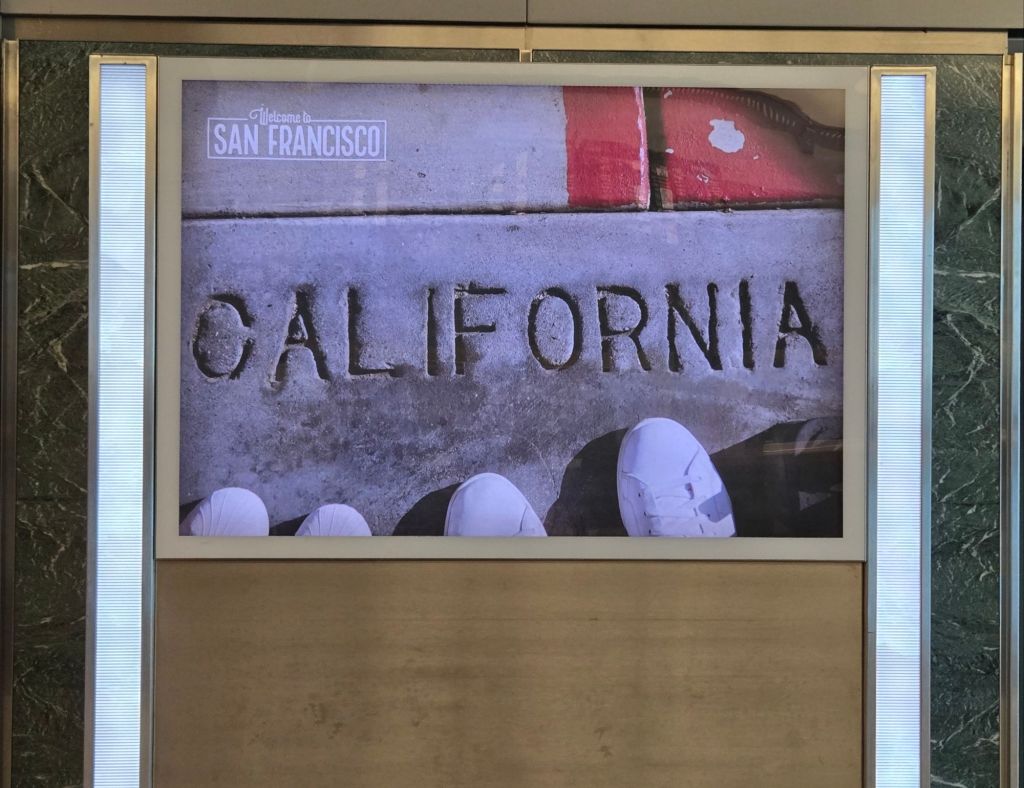
Flew through security and arrived at gate just after the previous departure. So had the area largely to myself. Plenty of available USB ports to keep my phone juiced. The lounge was one of those downstairs and this was the art to which I faced.

Boarding was quick and well organized with Virgin using two doors to admit passengers (Priority and normal). Didn’t need to check ticket or passport as they check you in via biometrics. The UK began with that many years ago. The plane was fairly full in First Class and Business Class. We had paid $37 extra for priority seats: one window and one aisle. So as it worked out I had the whole row to sleep on!

Awoke about 7:30 AM local time and had an opportunity to watch a movie, “Across the River and Into the Trees” which seemed apropriate.
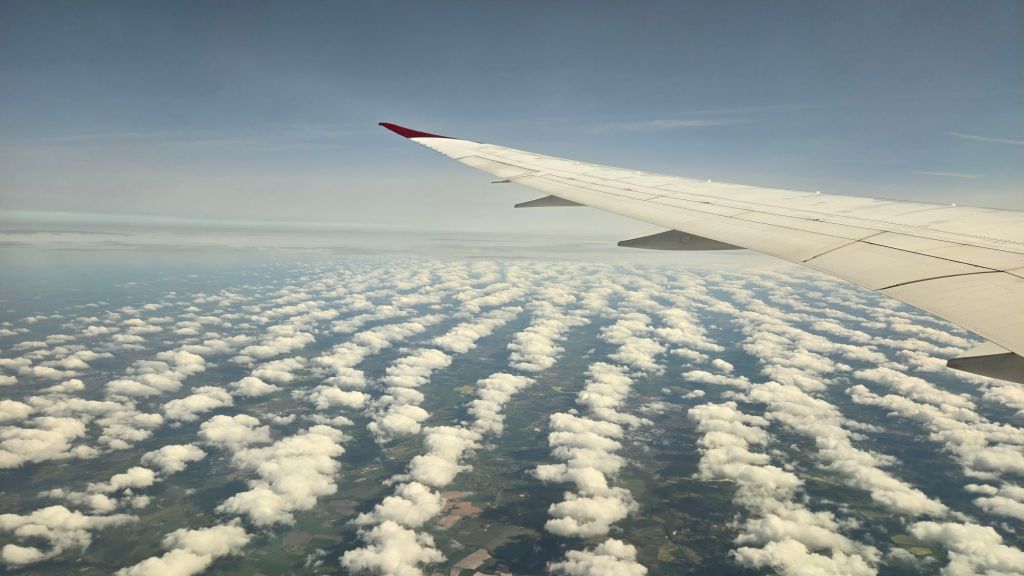
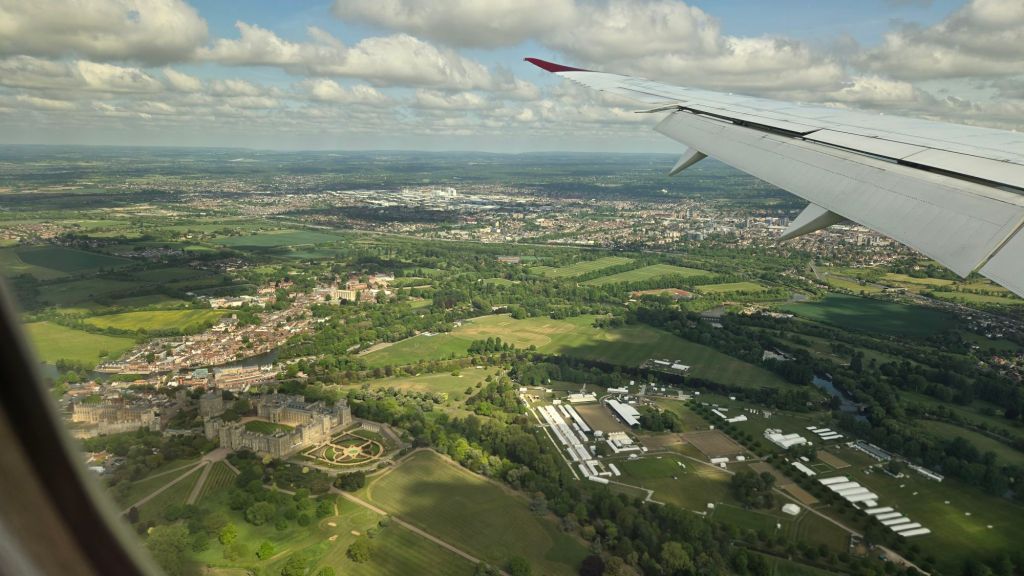
I had expected an overcast day so was delighted with some sunshine. To my delight I caught a glimpse of Windsor Castle lit by the morning sun as we were coming into Heathrow Airport.
To be continued…
Kelly Wheaton copyright All Rights Reserved
Fleshing out the Story: Context Matters
Posted on January 26, 2025 1 Comment

How do we go from avid genealogist to storyteller? How do we bring a single ancestor back to life? How do we take a set of facts, essential the bones of our ancestors life, and tell their story as a three dimensional ancestor that you want others to know more about?
Research of course! There’s lots to be gleaned from what you already have. Whoever the ancestor you chose, they arrived into this world of two parents who have stories of their own. For our purposes we will only tell parts of the parents story that enhances the ancestor’s story. We will select and imaginary ancestor Rebecka. Let’s say Rebecka spelled with a “K” was the daughter of a coal miner in Pennsylvania. That will be quite a different story than Rebecka born to an aristocratic plantation owner in Virginia. Context matters. [See my earlier post: Reformed Genealogists: Turning Trees into Stories.]
We also need to look at the time frame and what was happening when Rebecka was born. Did she live during the American Revolution, or Civil War. Did she have brothers or a father who fought in a war? Did her mother survive many childbirths or died giving birth to Rebecka? How did she get her name? How many siblings did she have? Was there a step parent? What was her birth order? The last of 6 girls. The oldest child and the rest sons? How do these things affect her life? Did she marry young, typical or late in life? Did she have an occupation, go to school or perhaps University? Did her family move often? Why? [For more on this topic see Katherine Scott Sturdevant’s “Bringing you Family History to Life through social history.]
1) At this point you may wish to write a list of questions you would like to ask or answer about Rebecka.
The next thing, is to find material based in the time frame and place she lived. Look for diaries, historical novels, histories, letters anything you can find that will put you “in the mood” to think about Rebecka.
2) You can do a google search or find an archive that would be relevant and do some scratching around. You can do a library search for a place and see what pops up.
Once you feel familiar with the place and era you can do some digging. Things you might want to include in your story.

- Maps
- Letters
- Photos
- Illustrations
You can find these through Google searches or on Ebay or from your own collection. You might search for postcards of a place. Etching of a place or occupation. If you are publishing your piece you should look for “out of copyright material” that you can use freely. As of 2025:
©
- Works from 1929 and sound recordings from 1924 are now open to all in the U.S.
- For works created after 1978, copyright lasts for the author’s life plus 70 years.
- Even with copyright extensions, the maximum copyright term in the US, for works published before 1978, is 95 years from publication.
I recently told my class: a few well told stories of your ancestors have a much better chance of survival than thousands of names, dates and places in your family tree. Stories have more life in them, and are likely to be the gift that keeps on giving. Of course, it is impossible to write stories of all your ancestors. So concentrate on the ones that speak to you. It could be because you know part of a family legend about them or something piques your interest.
Examples of Ancestor stories on my blog Wheatonwood.com/blog for reference.
- My Woman Warrior Pioneer Mother: Catherine Adeline STEWART MURPHY MOSIER a self assignment on one ancestor
- Revolutionary War Details in Ancestor’s Pension Files: Peter P Hall Fleshing out a Revolutionary War ancestor
- Hans Moser c1623-1696 was from Austria not Switzerland The farthest back ancestor of the MOSER family
- A Soprano’s Aria Introduction: Chapter 1. The introductory Chapter for my great grandmother’s diary transcription.
- A Tale of Two Soldiers My two Civil War ancestors compared
- Deep Diving: Water Wheels and Paper Making in 19th Century Sweden My Lundberg family in Sweden and Why they were always moving
How far you go with your story is up to you. A few paragraphs or a story with several chapters. Whatever you write is going to tell not only your ancestors story—but a bit about you, and what you cared about. If you are looking for inspiration try one of the Family History Writing blog Posts. Remember this is supposed to be an adventure, not a chore. Have fun! Happy digging.
Kelly Wheaton © 2025 – All Rights Reserved
TILDEN’s of Kent, England
Posted on January 2, 2025 5 Comments
In my last blog post Traveling for Genealogy I chronicled my research into the TILDEN family of Benenden, Kent. I decided to do a deeper dive and as usual found some interesting connections. One of the places we are to stay and visit is Leeds Castle. So let’s dive in to a bit of ancient history.
LEEDS CASTLE

From about the year 857, Leeds Castle, near Broomfield, Maidstone, Kent, was a Saxon castle built of wood on 2 islands, in the middle of the River Len. It was owned by the Saxon chief, Led or Leed, and was known as the Manor of Esledes. After the Norman Conquest of 1066, it was rebuilt in stone in 1119 by Robert de Crevecoeur as a Norman Castle. Robert de Crevecouer was the son of Hamo de Creveqouer. Leeds Castle descended through the de Crevecoeur family until the 1260s. In 1278, the castle was bought by King Edward I’s Queen, Eleanor of Castile [Both interred at Westminster Abbey]. The Norman Leed’s Castle was held by Odo Bishop of Bayeux, who was the half brother of WILLIAM I, aka William the Conqueror. All roads lead to William the Conqueror!
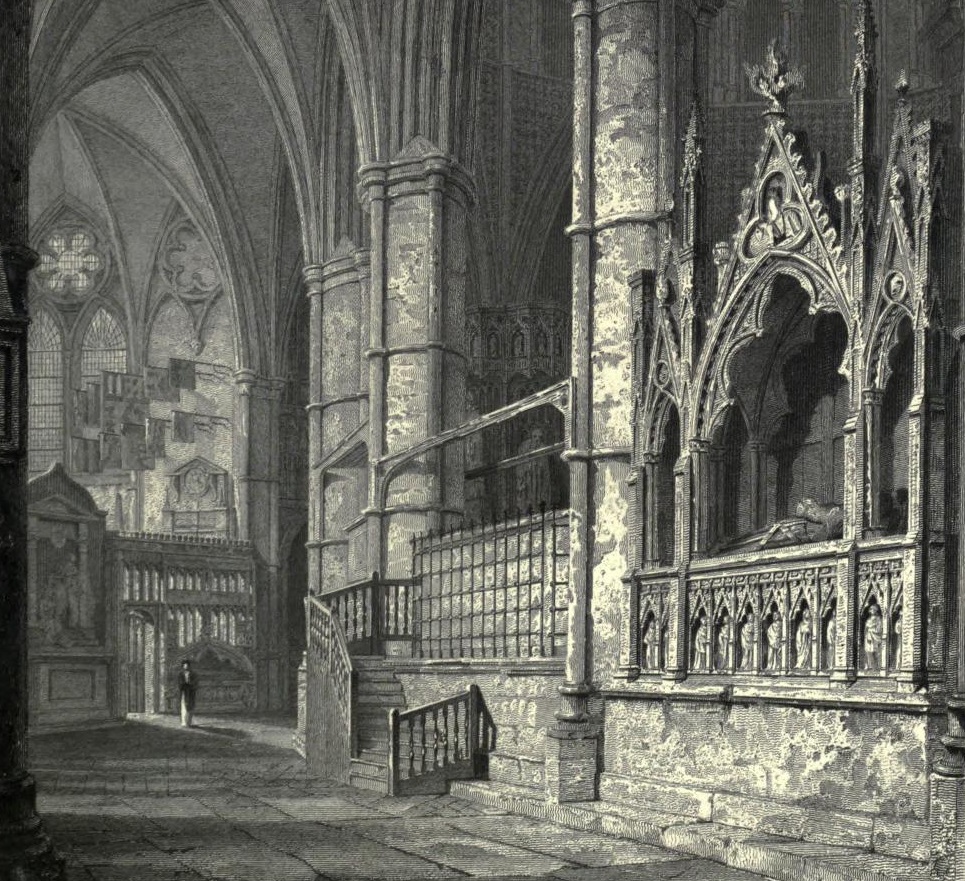

It is the assumption of John Tilden in his 1968 manuscript “The Tilden Family: our English Ancestors 1235-1635” that the TILDENs were originally from East Sutton or Hollingbourne which lay about 4 miles apart, with Leeds Castle in between. The earliest record he found is of a Henr’ de TILDENN who was born about 1235 and died after 1311. Henry appears as a witness in 1293, in a legal controversy between EDWARD I of England, and the Pryor of the Hospital of St. John, of Sutton de la Hone [Sutton-at-Hone], Kent, England [ Placita de Quo Warranto , pages 352-353]. Also Henry TILDEN appears as a witness in a controversy between said EDWARD I and Adam MARTEL, of the Manor of East Sutton, County Kent, [Placita de Quo Warranto , pages 358-359]. At that time he is mentioned as of East Sutton or Holyngbourne, County Kent. East Sutton would make sense. However I have discovered an earlier record, a grant from Nicholas of TILDEN (‘Teldenne’), son of Ordmeus de Hethezeherst to Hamo de Crevecquer, son of Robert de Crevequer . I cannot find Ordmeus as a given name so this may be a mistaken transcription. Perhaps Ordmær, Ordmer? meaning “famous-spear.”
Grant From : Nicholas of Tilden (‘Teldenne’), son of Ordmeus de Hethezeherst To: Hamo de Crevecquer, son of Robert de Crevequer. An annual payment of 18¼d, payable by Vincent de herdesfeld, Michael de hethezeherst and Martin de hethezeherst. Payable as specified for 4 acres of land called ‘hopeland’, lying in ‘hethezeherst’ [possibly in or near Marden], 4 acres of land called ‘hope’, lying in ‘hethezeherst’ and the capital messuage of Martin de hethezeherst. For an annual payament of ½d, payable at the court of Bockingfold (‘Bokingefold’). Dated 42HenIII, no month. Witnesses: Henry of Cheveney [in Marden]; Michael de helherst; John de Sipherst [Sheephurst], brother of Giles; Giles de Sipherst, brother of John; William Salomun; Hugh the clerk; Gilbert de bades’elle; Nicholas de Tetesden, brother of Ralph; Ralph de Tetesden [Teterden?], brother of Nicholas; William the clerk.
Dated 28 Oct 1257 – 27 Oct 1258.
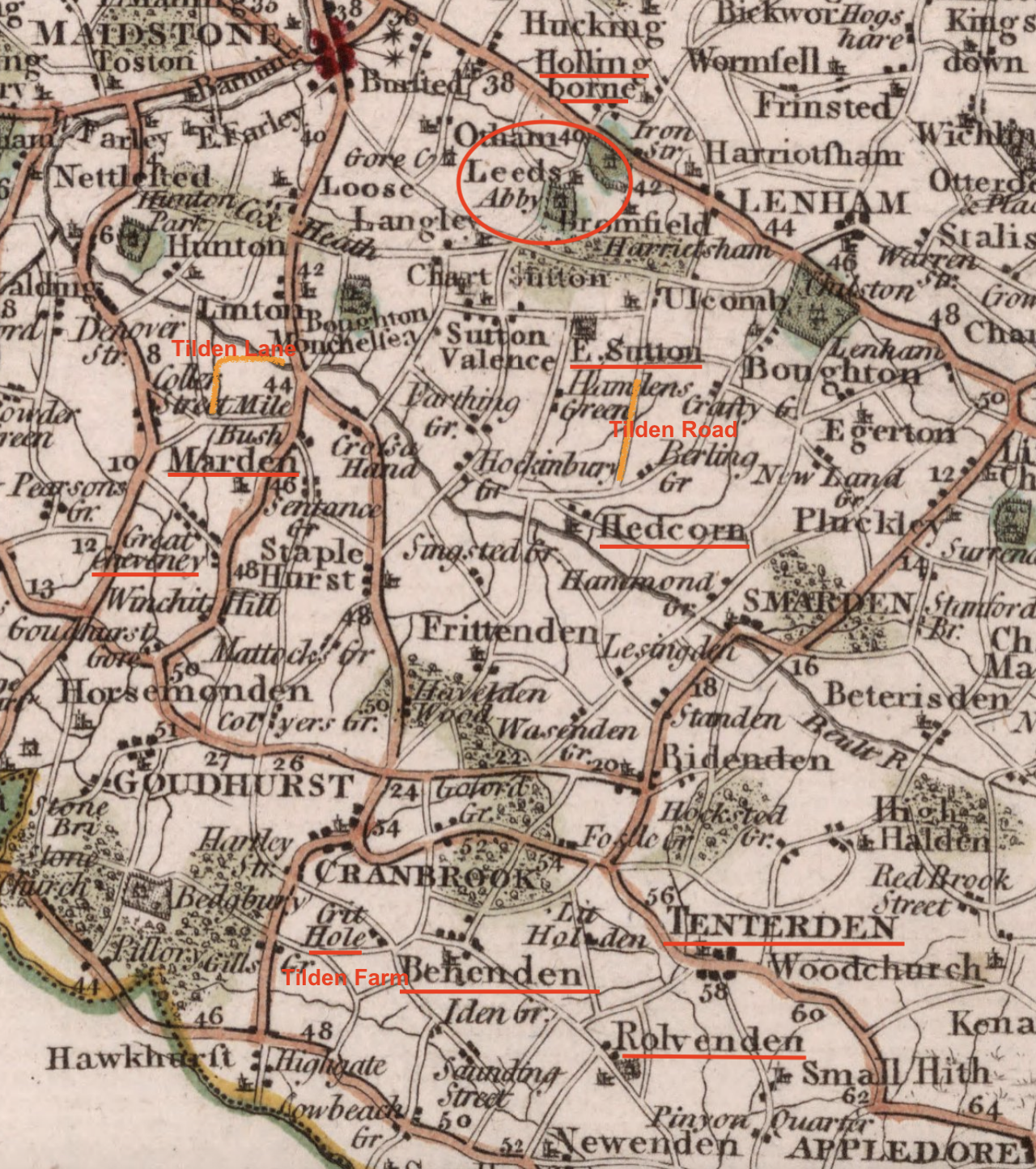
My best guess is Hethezherst is Heather Hurst or Heather Hill, very possibly on the lands that are now adjacent Tilden Lane. At the terminus of Tilden Lane if you were to go straight East, crossing Stilbridge Lane, you would run right into a hummock or hill. Here you will find a present day Hertsfield [as in Vincent de Herdsfeld] and a Hurst Green. So my best guess would put Hethezeherst where Tilden Lane in north Marden.
The original Hamo Crevequer aka de Crevequer was born about in Calvados, Normandy, France and his son Robert Crevequer founded the priory and stronghold of Leeds in Kent. Further grants establish a bit more certainty of the proximity of the people mentioned in the deed above. In this case the court was held at Bockingfold. Bockinfold is south of Marden and about 5.6 miles from the TILDEN estates. The other names are from properties in the parish of Marden, so fairly safe to assume in the vicinity.
SURNAME TILDEN
The surname TILDEN is a habitational name that is literally “from Tila’s pasture.” The name Tila means heritage, fortune, or wealth. Another possibility is from the word “Till” as in “to cultivate.” Kent manor houses had dens or pig pastures often distant from a manor’s arable holdings. Kent Wealden Weal meaning well-being or wealth and pig pastures. Manors may have had several dens which were an important part of the local economy. Each fall, pigs were driven by the swineherds to the manorial dens, where they were fattened foraging on, fungi, nuts, roots beetles, etc, before being butchered in November or December. Many place names arise from these dens, such as Tenterden, Tilden, Beneden etc.
TILDEN PLACES
Early places in Kent, England, are: Great and Little TILDEN in Marden, TILDEN in Headcorn and TILEDN Farm in Benenden. I have marked Leeds Castle, Hollingbourne and East Sutton, as well as two Roads named Tilden and the location of TILDEN Farm in Benenden on Water Lane. We will take up the TILDEN Listed buildings in Kent, from the suspected oldest to more recent. It is bit of a tossup which is the oldest. Because the oldest standing might not be the same as the oldest named TILDEN. The map below has Leeds Castle circled, places mentioned in the deed underlined and the location of the 2 TILDEN Road and Lanes in orange, which are about 6 miles apart as the crow flies. It would not be surprising if two of the early TILDENs settled in the area. Below we take up each TILDEN place. Please note that all 3 of these places fell under the ownership of Bishop Odo of Bayeux who also owned Leed’s Castle. From Leed’s castle to TILDEN Farm near Benenden is about 13 miles as the crow flies
MARDEN

Marden does not appear in the Domesday book. The name Maere dene or Maera dene, derives from “forest clearing for horses.” There was a church, probably built of timber, in Marden by 1085, which is mentioned in the Domesday Monachorum of Canturbury. EDWARD I gave the village of Marden to his mother, Queen Eleanor of Provence in the 13th century, and she was granted the right to hold a weekly market and an annual fair. Edward III in 1336 invited continental cloth weavers to England. Below is perhaps our earliest TILDEN place contender. It is the earliest deed for a place TILDEN:
Grant, in free, pure and perpetual alms From: Margery of Pattenden [in Marden], widow of Samson of Pattenden To: ‘Dominus’ Hamo de Crevequer 4 acres of land in Murzie [in Marden] which Godholte?, her mother, gave her, lying with the land of Richard? la farne? to south, the street which leads to Tilden [in Marden] to north, … Hamo’s land to west. For an annual payment of a root of ginger? For this Hamo has also paid 40s as a gersum fine. Dated 41 Henry III, no month. Witnesses: Henry of Cheveney [in Marden]; …de Heherst; John de Sipherst; Giles, brother of John de Sipherst; … Solmon; Hugh the clerk (partially damaged)
28 Oct 1256 – 27 Oct 1257
It is followed by a deed in 31 July 1303 which mentions Henry TILDEN and his three sons: Walter, Henry and John TILDEN. This is probably the same Henry TILDEN in the earlier records cited by John Tilden in his manuscript. It would likely be on the same property as we find the Great TILDEN Farmhouse at a later date.
A LEASE from: William of Borden, prior of Leeds Priory To: Stephen of Reed, of Marden parish 3 pieces of land lying in Marden parish on the denns of ‘Hyedenne’ and Reed, which land Stephen held at farm of William’s predecessors. For the term of Stephen’s life. For an annual payment of 5s, payable as specified. Right of distraint if payment in arrears. Priory’s part of indenture. Witnesses: Henry of Tilden; Walter, son of Henry of Tilden; Henry, son of Henry of Tilden; John, son of Henry of Tilden; Adam de Hertesfeld’; Walter Finch; Richard of Reed [in Marden]; John Kyr Endorsed with description in early 14th cent hands. 31 July 1303 [Document damaged.]
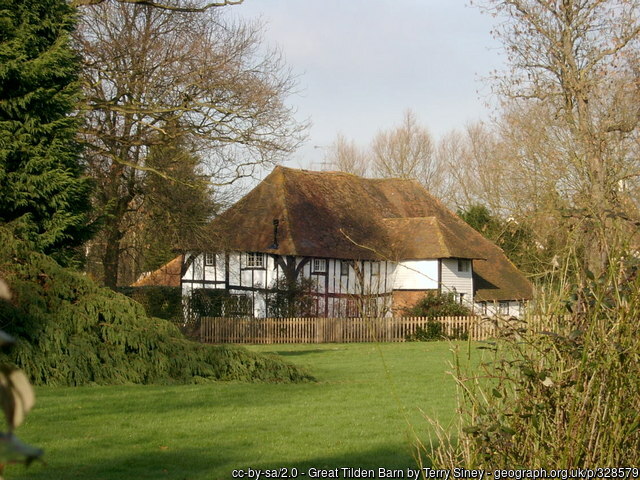
GREAT TILDEN FARMHOUSE TQ 74 NW TILDEN LANE (north side), MARDEN Farmhouse. C15 or early C16, and late C16 or early C17, C18 and mid C19. Left wing red brick in Flemish bond. Ground floor of central section red brick in stretcher bond, first floor pebbledashed, with applied studding. Listing NGR: TQ7486247664
In 1452 there is a lawsuit that refers to a tenement called Tylden, in Marden, Kent . Between 1454 Sept 1-1455 Aug 31 there is a deed with the Grantor: William Brook. Recipient: Thomas Elys, the younger, William Tyldenne, Robert Mayhewe, John Tyldenne and John Lynche.
BENENDEN
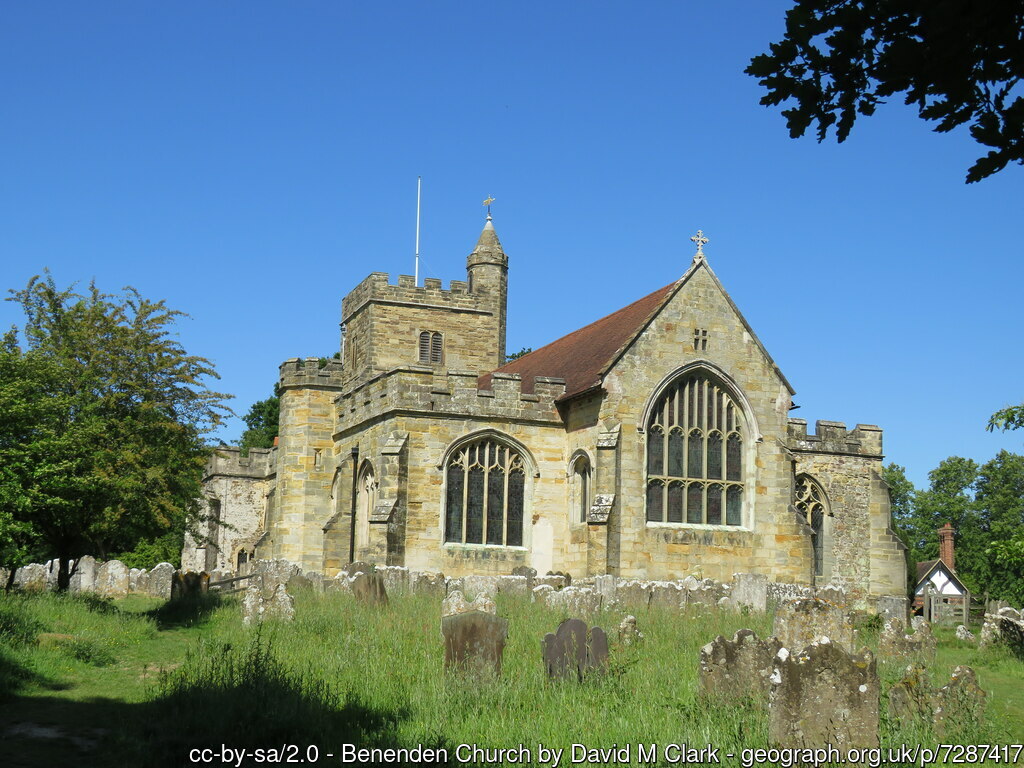
This appears to be the second oldest place named TILDEN. The Domesday Book of Benindene was one of only four places in the Weald of Kent to have a church. 4 villagers. 9 smallholders; 2 ploughlands. 1 lord’s plough teams. 2 men’s plough teams; Woodland 5 swine render. 1 church. Annual value to lord: 2 pounds 10 shillings in 1086; 2 pounds when acquired by the 1086 owner; 2 pounds in 1066. Tenant-in-chief in 1086: Bishop Odo of Bayeux. From the 14th century places such as Benenden became of industrial importance. The Wealden ironmasters continued what the Romans had done; and the other major industry, cloth-making, also helped to make the village prosperous.
“Clothiers were the entrepreneurs at the heart of the cloth trade which became England’s leading industry in the late Middle Ages. No other industry created more employment or generated more wealth. As many as 1 in 7 of the country’s workforce were probably making cloth and 1 in 4 households were involved in spinning.”
Working in the Middle Ages: The Medieval Clothier. John S. Lee
The earliest record of TELDEN [TILDEN] in Beneden is dated 24 Dec 1418 , a Grant by Thomas Goldyng [Golding] of Benenden, Kent, to Thomas Morleyn and Beatrice his wife, of Benenden, of a messuage and 14 pieces of land, meadow and wood, upon the denes of Backtilt and Maplesden in Benenden, Kent, 32 acres. Witnesses: Robert Stace, James Telden, Thomas Wylard, John Bygge, Richard Moore, Stephan Heanden, William Dokelynden, and many others. Grantor: William Brook. Recipient: Thomas Elys, the younger, William Tyldenne, Robert Mayhewe, John Tyldenne and John Lynche. Place or Subject: Maidstone. County: [Kent]. Date: 33 Hen VI 1454 Sept 1-1455 Aug 31. The TILDENs and BYGGE [Bigge] become clothiers in Benenden and surrounds.
TILDEN FARM, WATER LANE, HAWKHURST [BENENDEN] TQ 73 SE (east side) House. C16. timber framed and tile hung, with part exposed small panel frame to right return and English bond brick base with plain tiled roof. Listing NGR: TQ7760431961
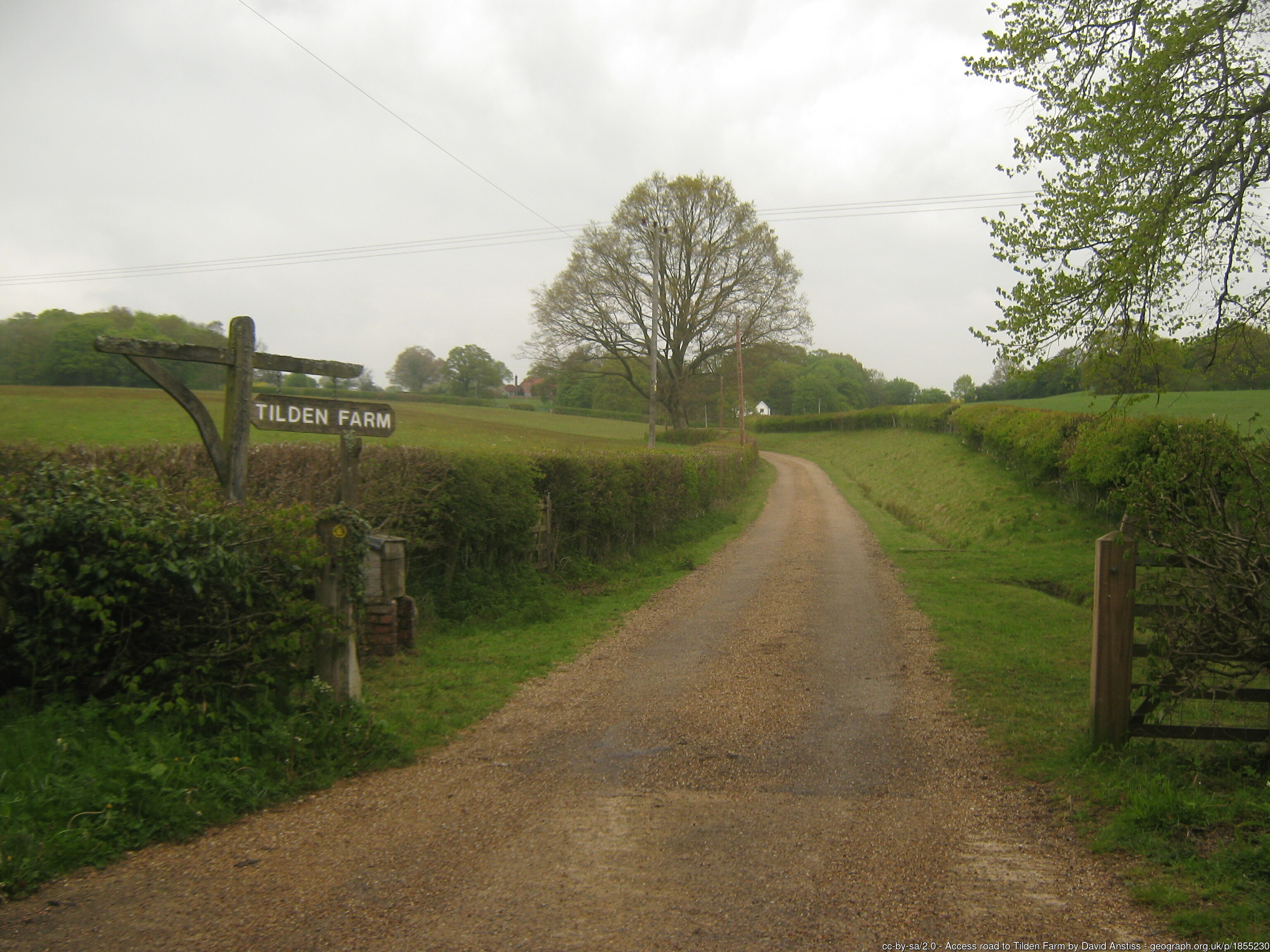
EAST SUTTON / HEADCORN

In the Domesday book the closest listed place to Headcorn is [East] SUTTON which had 15 villagers. 9 smallholders. 10 slaves; 8 ploughlands; 2 lord’s plough teams; 4 men’s plough teams; 8 acres Meadow. 50 acre Woodland swine render. 1 church. Annual value to lord: 12 pounds in 1086; 10 pounds when acquired by the 1086 owner; 10 pounds in 1066. Tenant-in-chief in 1086: Bishop Odo of Bayeux who also held Leed’s Castle. Curiously I can find no record referring to TILDEN people or places near Headcorn in the 12-16 centuries, so it is unclear when the road and buildings adopted their name.

TILDEN, HEADCORN ULCOMBE ROAD TQ 84 NW (East side) Farmhouse. C15 or early C16, with C16 alterations. Timber framed with plaster infilling. Listing NGR: TQ8361145374

LITTLE TILDEN HEADCORN ULCOMBE ROAD TQ 84 NW (East side) Farmhouse. [On the map the Tilden Road from East Sutton to Headcorn] Mid C15 or earlier, with C19 or C20 addition. Timber framed with plaster infilling. Ground floor of right end bay underbuilt in red and grey brick, ground floor of added left bay red brick in stretcher bond. Plain tile roof. Wealden Hall Houses were timber framed farmhouses built by wealthy Yeoman farmers from the late 1300’s to the mid 1500’s Listing NGR: TQ8371645591
SUMMARY
So summing it up we have the surname TILDEN [or its variants] appearing in the mid 13 century [1258-59] near Marden, Kent and by 1452 we have a place referred to in a deed as Tylden, Marden, Kent. In 1418 the surname appears on a deed in Benenden. Best guess is it was adopted from a dene of a Saxon named Til in the area that is now TILDEN Lane in north Marden. From there it spread as a surname to Benenden and other areas of Kent and eventually across the ocean via Nathaniel TILDEN to Scituate, Massachusetts. I cannot fail to mention two other TILDENs. First is TILDEN Park in the San Francisco Bay Area, a very special place of my childhood named in honor of Charles Lee TILDEN. I believe he traces back to Nathaniel TILDEN of Tenterden. And another place we shall visit on our upcoming trip is Chartwell, home of Sir Winston Churchill. It was designed by Philip TILDEN, architect, who I have traced back to a William TYLDEN born about 1585 and died in 1669 Rainham, Kent. And most likely tracing back to the same Marden roots.
Corrections, suggestions and comments are welcome.
Kelly Wheaton ©2025 – All Rights Reserved
TRAVELING for GENEALOGY: Virtual & In Person
Posted on December 8, 2024 7 Comments
There are many types of travel and just as many of interest to Genealogists. For the purposes of this blog post I am concentrating on travel to the homeland of an ancestor or ancestors for the purpose of experiencing something of their time upon this earth. Remember our principal reason to do genealogy, besides the fun (or frustration of it), is to be able to tell the stories of our ancestors. I do not advocate the collection of names dates and places. Your job, sometimes a MISSION IMPOSSIBLE, is to recreate the past and tell your ancestors stories, to the best of your ability. There’s nothing like getting to stand in the place they lived, to help you tell the story with more authenticity and enthusiasm. If you are reading this and age, health or finances prevent you from traveling, there is still a lot you can do virtually and it is an important part of the travel planning process. So do not lose heart.
PLANNING: Avoiding Pitfalls
“By failing to prepare, you are preparing to fail.” — Benjamin Franklin
A successful trip is most often months or years in the planning. Yes, you can grab your carry-on at a moment’s notice and have a good trip, but it can also be an unmitigated disaster. Some examples of what happens without planning:
- The archive you wanted to visit is closed on Tuesdays.
- The courthouse is being renovated and the documents you wished to peruse are in storage.
- The Church documents you wished to review are now in the Nat’l church archives and not available locally.
- The Historical or Genealogical Society won’t be open during your visit.
- You have a map but cannot locate the Family Cemetery but you’ve seen it on Find a Grave.
- It’s a lot farther from point A to point B than you thought. You are running out of time.
All of the above could have been avoided through proper planning. I mention them because it tells you something about the planning process. You want to research all places ahead of time. Even a phone call, email or visit to the announcements page of their website can save you a lot of grief.
GOALS & PURPOSE

You really can’t begin your planning if you have not defined your purpose. And unless you will have weeks or months in the place you are traveling to, you really want to focus on what’s most important during your visit. As time goes on more and more records are available on line. You don’t want to waste time on things you can do from home. Often what’s most important, will be photos you want to take of headstones, homes churches, or documents related to your ancestors life. Sometimes it will be the opportunity to peruse original records. And if you are lucky you may have the opportunity to meet relatives. So you will want to compile as much information as you can ahead of time. Then organize that information so you can take it with you. You aren’t going to be lugging binders around and even if files are digitized there are times when having something printed is helpful. You will want to develop a list of places you want to visit and what you want to look at once there.
In the case of my trip to Germany in May of 2018, I had about 1/2 day to visit the 3 parish churches that my MOSER family had lived from about 1620, until their immigration to America in 1728. A very kind relative of my friend Denise, offered to drive us to each of them and he even made arrangements with the minister in the one church which is generally closed. I was able to visit the hamlet where the family farm was located although it was not clear which exact one. The landscapes of a place helps to set the context of the story. It is about 1.3 miles on foot from the cluster of farms in Ulrichshausen to St Martin’s Church, in Wörnitz. So on this trip my goal was to visit the churches and take photographs so that I could put together their story. The story can be found in the multipart Blog posts of MOSERS from Germany to Pennsylvania.


TRIP PLANNING: An Example
I am going to use an upcoming trip I am taking in May, as an example. Half the trip I will be in London where I can go anywhere public transport and my own two feet will take me, and the other part is a small group tour of Kent. This will be with my best friend from kindergarten, Denise, mentioned above. It is her first trip to England and it was her desire to go to Canterbury where her ancestor Robert CUSHMAN (sometimes spelled Couchemen or Coachmen) was instrumental in planning the voyage of the Mayflower (although he did not sail with the original passengers). So that is part of the reason for Kent. Another is Sissinghurst Castle Gardens which have been on my bucket list for decades. And Hever Castle, the White Cliffs of Dover etc. Mind you this was not planned as a “Genealogy Trip” but that is no deterrent as you will see. Note: I am using this rather than a larger trip so I can concentrate on specifics. If your trip is strictly for genealogy this would be repeated many times for each place you re visiting.
So in this case any Genealogy will be not the focus of the trip, but the icing on the cake, if it happens. So the very first thing I do when I am going somewhere is to check and see if I might have any ancestors from the area. This is true whether I am traveling in the United States or abroad.
This is where I find having a genealogy Program like Family Tree Maker quite helpful. I go to the PLACES tab, in this case I am looking for ancestors who lived in Kent, England. On the left are all locations for which I have family entries and on the far right are the individuals. Those SURNAMES in capitals are direct line ancestors. In this case it shows the surnames BIGGE, HINCKLEY, HUCKSTEP, and TILDEN. As a child a favorite park was Tilden Park in the hills above Berkeley so that name immediately attracts my attention. Tilden Park was named after Charles Lee TILDEN 1857 – 1950, probably a distant cousin. So far I have his line back to a William TYLDEN bc 1585 who died in Rainham, Kent in 1669.
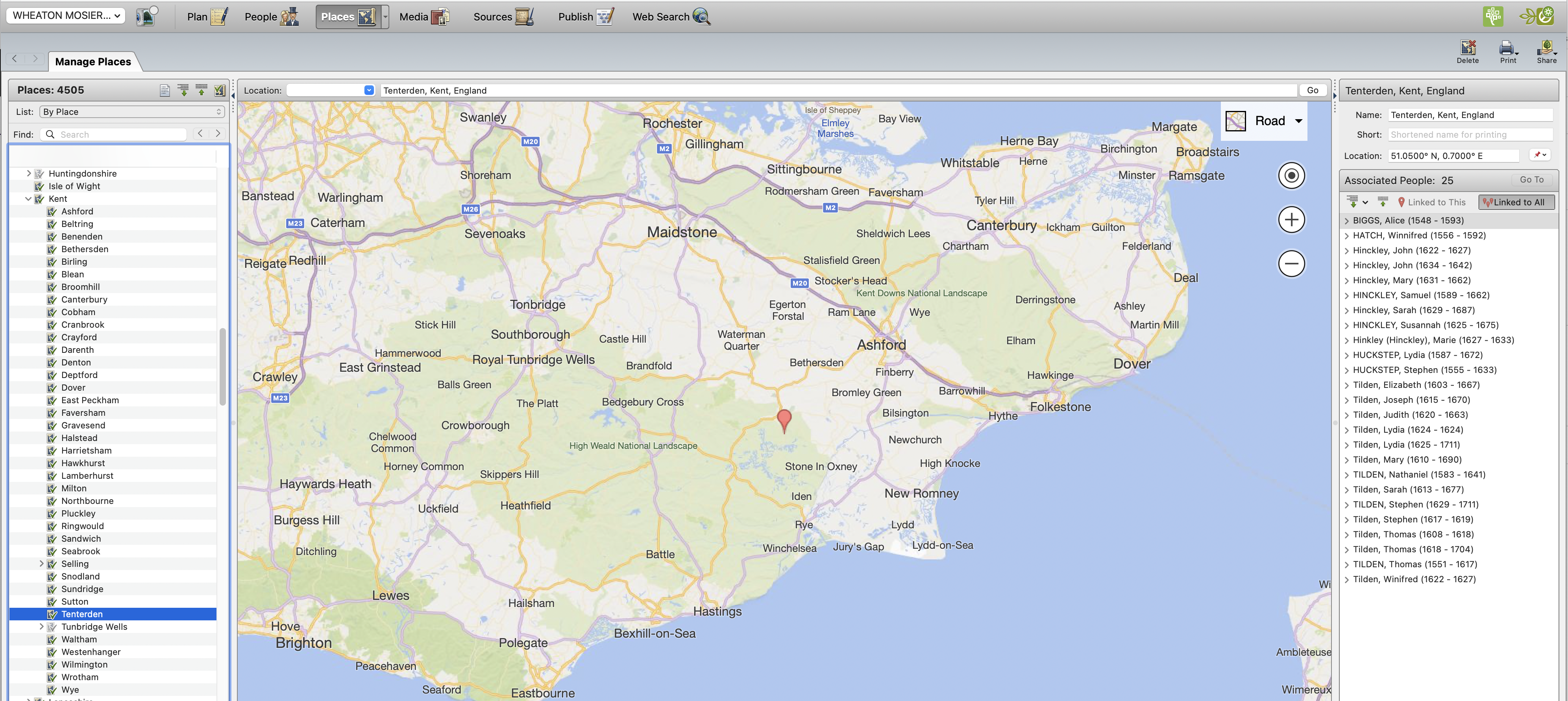
So then I click on each and start to organize the events that took place in Tenterden. So we have my 11th Great Grandmother Alice BIGGE bc 1548 at nearby Benenden, who marries at the St Mildred’s Church, Tenterden to Thomas TILDEN 10th March 1576. She dies there the 13th of May 1593. Furthermore their son my 10th Great Grandfather, Nathaniel TILDEN was born and baptized in Tenterden 28th of July 1583. He served as mayor of Teneterden and Justice of the Peace and is listed at the Townhall. He immigrated on the ‘Hercules’ in 1634-5 with his wife Lydia, and their seven children and with seven servants. He was an elder of the first church in Scituate and among Scituate’s wealthiest residents. He died in 1641 and is buried in the Men of Kent Cemetery. Furthermore his son, Stephen TILDEN , my 9th Great Grandfather was also baptized in Tenterden. Since the itinerary of the tour includes a visit to Tenterden, so with a little luck I will have time to pop into St Mildred’s Church and the Townhall.
Of course I compile a list. This list includes the TILDENS I mentioned and a CUSHMAN of my friend. So organizing your ancestors and making a cheat sheet like this really helps. Note the first column is for the place then the date of event the name the events that occurred there and the relationship to me.

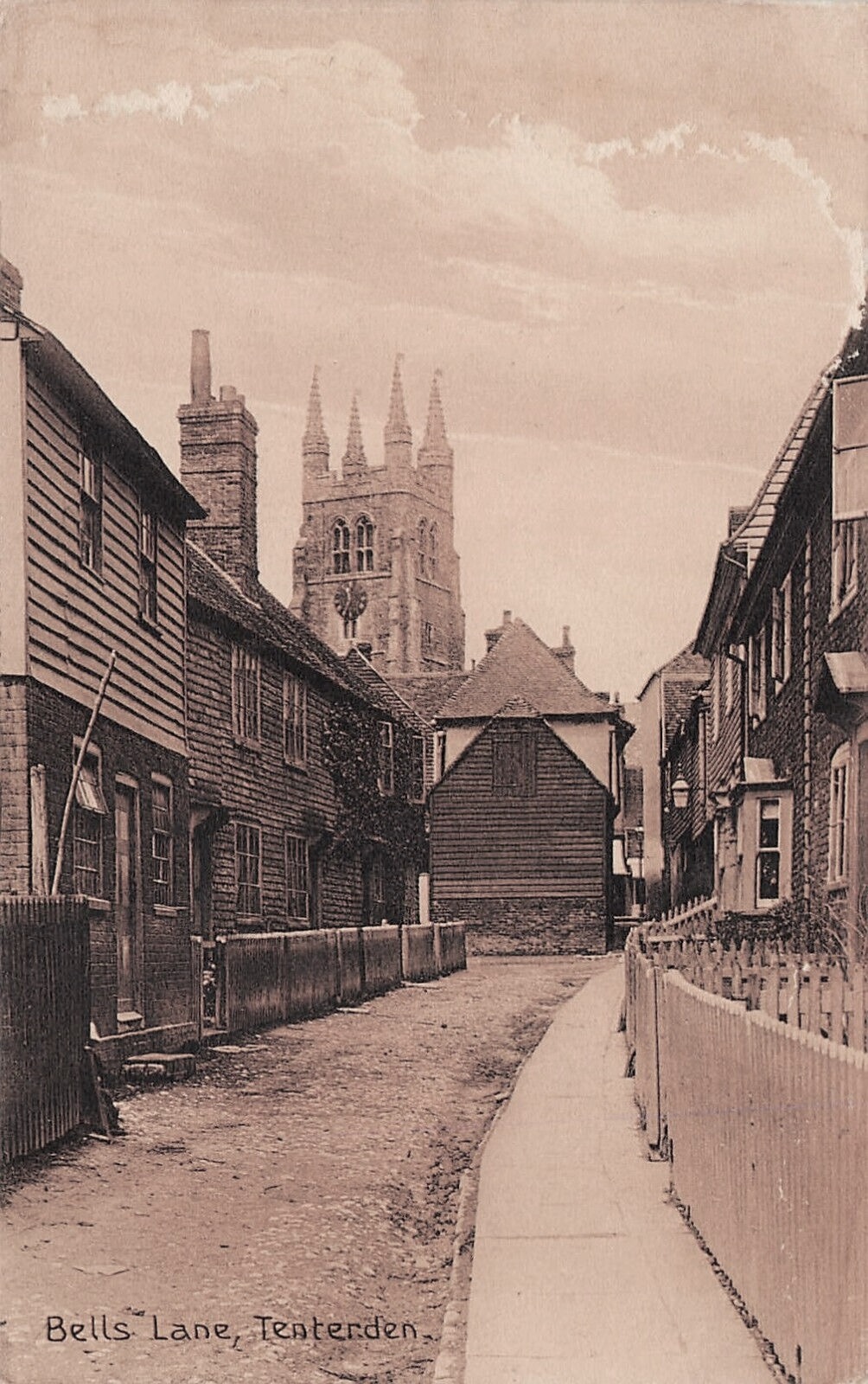
Then this is the time to do more research and there’s even a Wikipedia page on the TYLDEN family. How far you decide to research the family of interest is up to you. But a cursory glance on Ebay turns up some lovely postcards of St Mildred’s Church in Tenterden. (click on images to see full view)

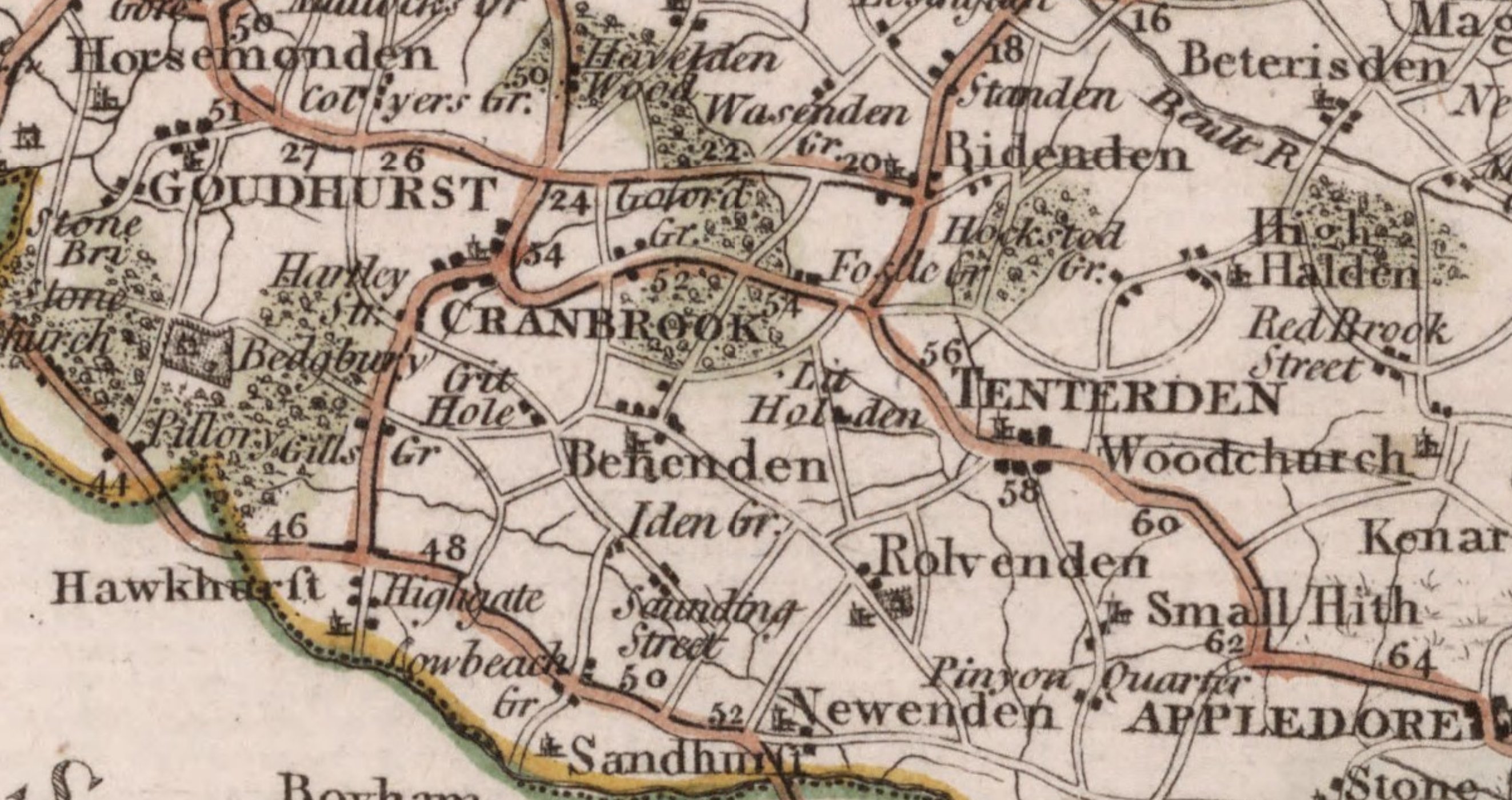
Then a look at an old 1787 John Cary Map from the David Rumsey Collection. This is part of a map of Kent showing Tenterden and nearby Benenden and Rolvenden.
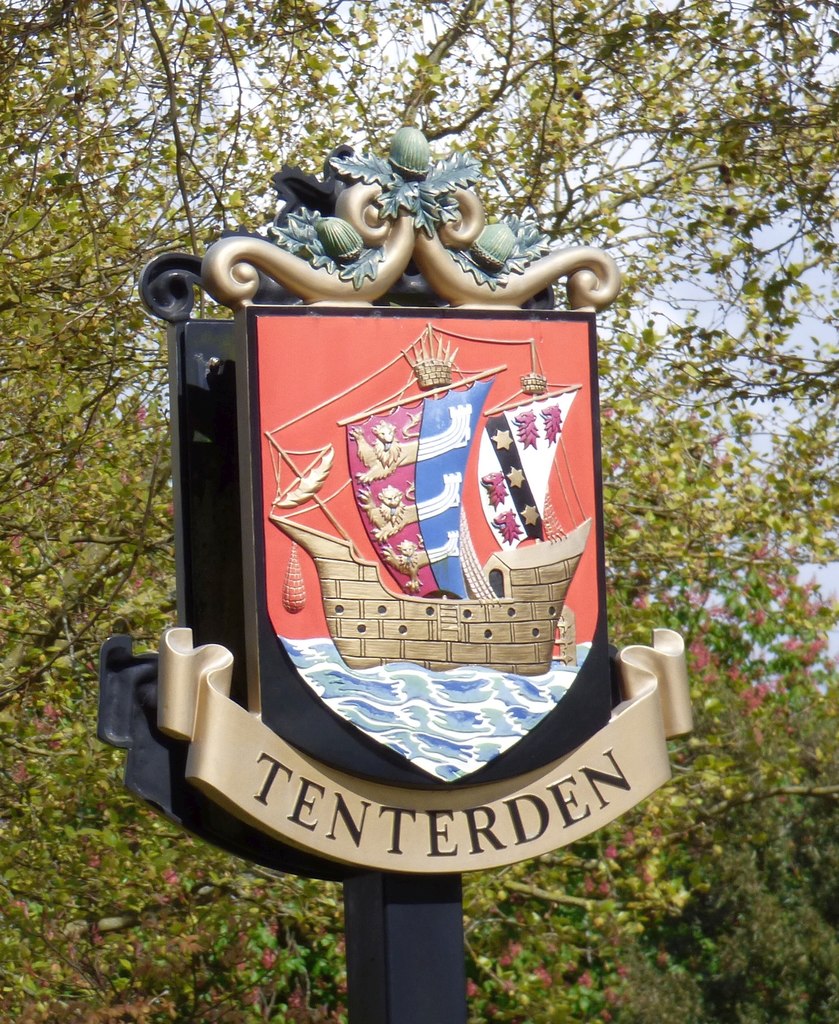
Then if you are looking at places in the UK I like to hop over to GEOGRAPH and see what photos are available. This lovely photo by Gerald England of the town coat of arms. I hope you are starting to see that long before you step one foot outside your door. There’s a lot to find.
On GEOGRAPH I found photos of High Street, of St Mildred’s Church inside and out and all the surrounding area. These photos maybe used for personal use with proper citation. They can help to orient you and suggest things you’ll want to see. So here is a photo of the ceiling of St Mildred’s Church. The roof of St Mildred’s Church, Tenterden. It says The aisled nave dates from the 14th century. The carved wagon roof probably dates from the 15th century, possibly earlier. I won’t want to miss this!

So a lot of the research and pre-planning is what I would do for any line I am researching. And that is what is meant by Virtual travel. You can spend days, weeks and months digging deep into your ancestors surroundings, documents, maps etc.
Now I turn to a book I very much recommend if you like old churches and have ancestry in England. Published in 1999 and usually copies are available on Ebay. I go to the chapter on Kent to see if St Mildred’s Tenterden might be listed. And it is with 3 nice paragraphs of information. [Hint: Always bring a a bit of cash when visiting churches as they often have a guide for purchase. Usually well worth the price, and hard to get anywhere else.] These will often date things like the baptismal font or altar or various important features. If you are telling the story of your ancestors life, you don’t want to claim they were baptized in 1583 when the font is really from the 17th century.

“Tenterden church gets a poor write-up from church guides. Yet its mighty 15th century tower is worthy of any in the Cotswolds. “
Simon Jenkins
One of the many reasons I love old churches, are in many cases, they may be the only thing left standing from when your ancestors lived there. The pews, the baptismal font maybe the very same ones your ancestors knew. So churches rank at the top of my list in Genealogy related travel places to visit, aside from records repositories. Churches were often the hub of community life. They often hold a wealth of information and although many churches have gone through many restorations many have original features.
So for each of the places I anticipate I may be able to visit I compile a list of events of ancestors and bring an abbreviated Genealogy with me. Please note that unlike New England, most gravestones in the UK or in Mainland Europe, are no longer extant or legible for ancestors buried before 1700. In many places in Scandinavia the graves of the recently departed replace the graves of those who die centuries ago. The exception is if your ancestors were interned inside the church. You will want to research this BEFORE you visit. If you are visiting large graveyards or cemeteries you will want to contact a local historical or genealogical society for finding aids or sometimes Find a Grave can be helpful.
THE SURPRISE
So I spent quite a few days researching the TILDEN family and the CUSHMANs and then things got interesting. Remember Nathaniel TILDENs is my 10th Great Grandfather and Robert CUSHMAN is Denise’s 9th Great Grandfather. Robert was born February 9th, 1577 in Rolvenden. Nathaniel TILDEN born at Tenterden 28th of July 1583 Scroll back up to the map. Rolvenden is a mere 3 miles from Tenterden. And it get’s better. The Rolvenden History Group has a Mayflower Project. This leads to many resources one an article from NEGHS that I had given to Denise. From that article:
“Robert Cushman served as the chief agent of the Pilgrims and
worked on their behalf in London from 1619 until his death
from an unknown cause in 1625. He was born in Rolvenden,
Kent, in 1577/8, son of Thomas and Elynour (Hubbarde)
“Cutchman” [Cushman] and lived his early life in Canterbury,
Kent. In 1606 he married Sara Reader, a daughter of Paul
Reader, of Lenham, Kent. Their only surviving child, Thomas
Cushman, was born in Canterbury in 1607/8.”American Ancestors Spring 2017:
Pilgrim Robert Cushman by Robert C. Cushman
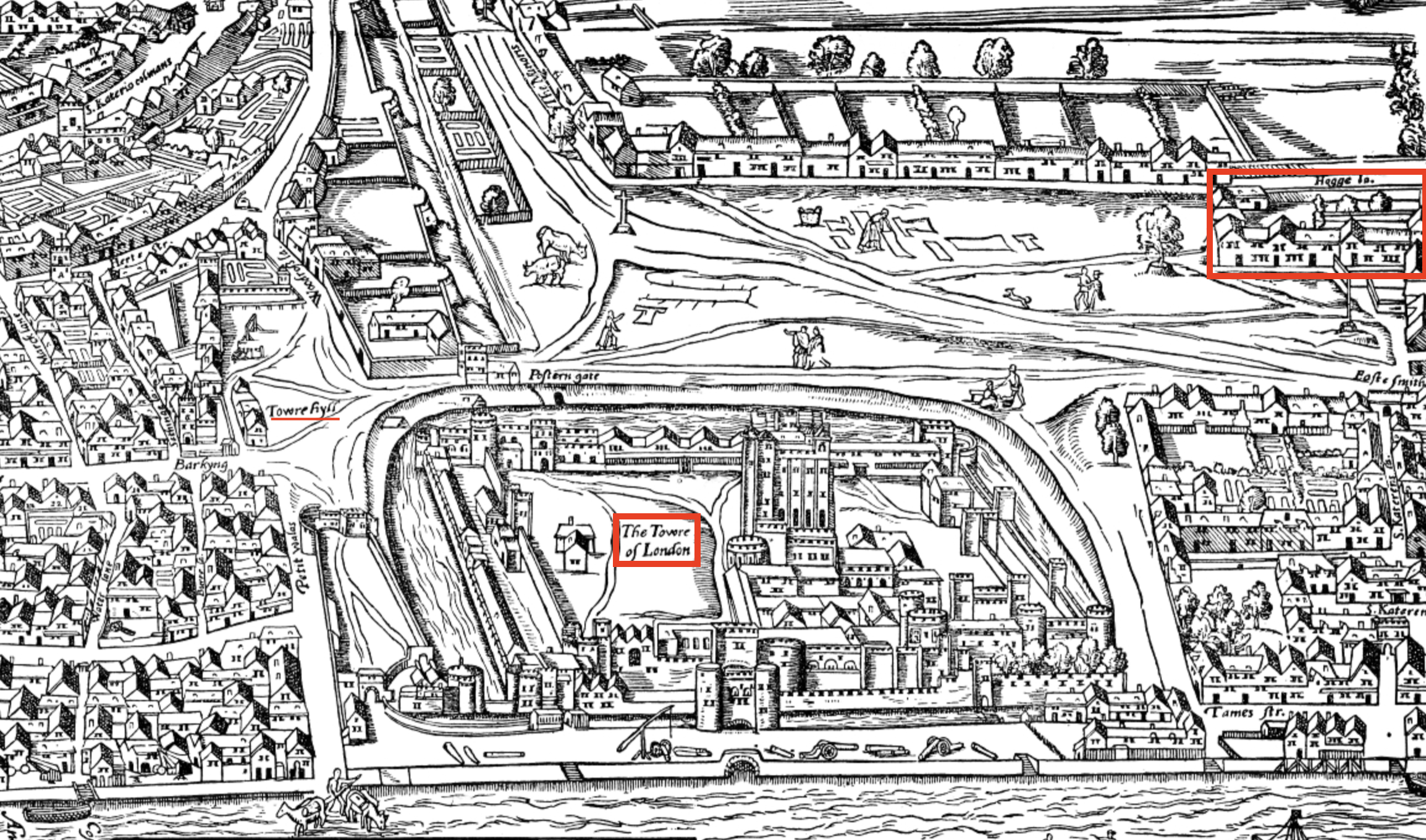
In a 1619 letter from Robert CUSHMAN to William BRADFORD, of Plymouth Plantation, Cushman is writing a book whilst living in London. Although arranging for the ‘Mayflower’ and ‘Speedwell’ he abandons traveling when the ‘Speedwell’ was not seaworthy and he was ill during the sailing of the ‘Mayflower.’ Robert CUSHMAN arrives in America in 1621, a year later than the Mayflower, with his son Thomas, on the ‘Fortune.’ He gave the first sermon preached in America on December 6, 1621, on “Sin and Danger of Self-Love”. Robert returns to England on the Fortune on December 13, 1621. The vessel is captured by the French and Robert is take to France and released two weeks later, where he acts as a financial agent for the Pilgrims. A 1624 deposition record gave an address of “Rosemary Lane, London.” This is now called Royal Mint Street and was earlier called Hog Lane, or Hoggestrete very near to the Tower of London (Coincidentally, very near to where we are staying in London). The “Agas Map of London 1561” shows exactly where this was. We are staying about where the two Cows are depicted toward the middle of the map. Hogge Lane is on the far right and the Tower of London, Middle bottom towards the Thames River. I delight in finding local connections in my travels. Also note just below the cows, is the still extant Roman Wall remains from when London was called Londinium. This wall was built between 190 and 225CE by the Romans.
In 1622 Nathaniel TILDEN is mayor of Tenterden. He is succeeded by his cousin John TILDEN in in 1623-4. Nathaniel TILDEN is ‘Jurat ‘ of Tenterden (Justice of the Peace) in 1624, 1625, 1627, and 1629 [L. Vernon Briggs, History and Genealogy of the Briggs Family, 1254-1937, 1938, Three volume]. Robert CUSHMAN dies 6th of May 1625 in Beneden, Kent while visiting relatives said to be the EVERDENs. It is said he dies of the plague. In this year an estimated 70,000 people died of the plague in England . So the year Robert CUSHMAN dies in Beneden, Nathaniel is Justice of the Peace just 5 miles away in Tenterden.
Now we must take a slight detour. Robert CUSHMAN’s father was Thomas Henry CUSHMAN who married Elinor HUBBARDE 18 Jul 1568 in Rolvenden. Thomas Henry dies 14 February 1586 at Rolvenden. Then Elinor marries second at St Alphege, Canterbury to Emmauel EVERDEN, he dies 3 December 1589. [Remember above Robert CUSHMAN is visiting the EVERDENs in Beneden when he dies.] His mother, Elinor, married for the third time 6 November 1593 to Thomas TILDEN at Teneterden. Thomas TILDEN is the father of my Nathaniel TILDEN!!! So Robert CUSHMAN and Nathaniel TILDEN were step brothers. Elinor dies 22 July 1601. Thomas TILDEN marries a third time to Alyce BOURNE. He dies in Wye in 1617. When his son, Nathaniel TILDEN immigrates to America on the ‘Hercules’ in 1634 leaving from Sandwich, Kent, England with master, John Witherley. Also on board are members of the HATCH and HINCKLEY families. Nathaniel brings his wife and 7 children AND 7 servants. Among them is a Sara COUCHMAN (CUSHMAN) who it is speculated, may be Robert CUSHMAN’s daughter. This would make sense as once her mother and father and grandparents are gone she may have been taken in by her father’s stepbrother, Nathaniel (step uncle). So my childhood friend and I share common ancestors John HOWLAND and Elizabeth ALDEN of the Mayflower and a surprise step brother relationship! This not only illustrates how you do research to a place you plan to visit. It also brings up surprising connections.
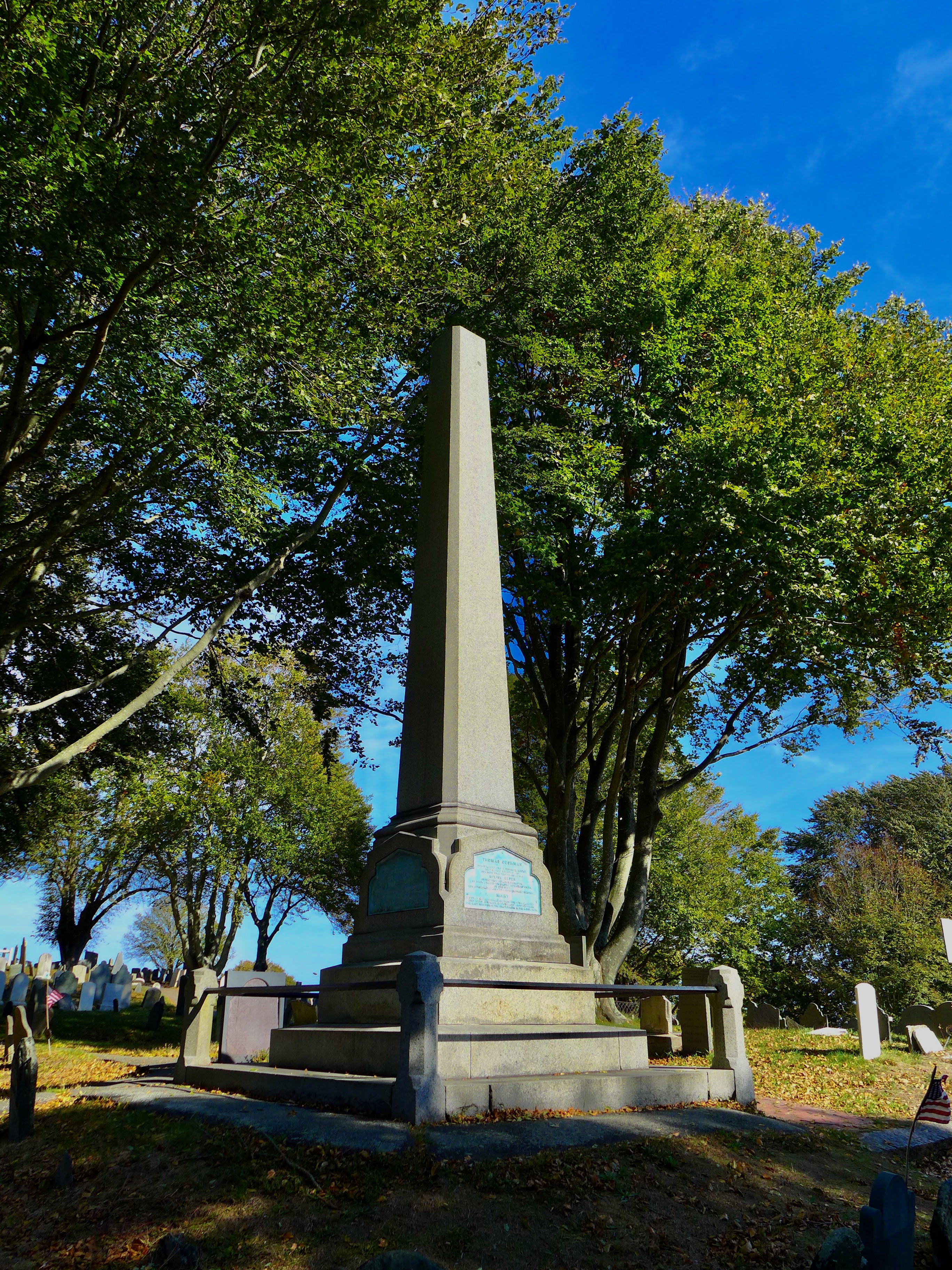
There is a large monument to Robert CUSHMAN in Plymouth, MA however he is buried in Benenden, Kent ENGLAND.
Another couple of surprises on the trip. We will be visiting Chartwell which was a hunting lodge that King Henry VIII visited when courting his future wife Anne Boleyn. But what caught my eye is his architect was Philip TILDEN (1887-1956) son of William Augustus TILDEN born 15 August 1842. I have traced him back to a Matthew TILDEN bc 1615 of Northfleet, Kent so I think part of the same clan!
GENEALOGY FOCUSED TRAVEL
There are many things to keep in mind if the sole focus of your travel is genealogy. You will want to first make a list on ancestors by place and date. Then you want to sketch out a possible itinerary. Then you want to research, research, research. You will want to include exact locations, hours and special needs. Check for hours, whether you must make arrangements in advance and who you may want to meet with :
- Churches, cemeteries, graveyards.
- Historical, Genealogy or Special interest groups. Can you arrange to have records pulled in advance.
- Archives, University libraries and other document repositories. Same as above.
- Courthouses, Town Hall offices and other Government Offices.
- Historic Houses, farms or estates. Are they open to the public? Can you contact the owners or trustees to arrange a visit?
The time frame you are interested in can matter a lot. For instance many local history societies abroad are focused in the last couple of hundred years, whereas your interest may be more distant. Denise and I had a lovely visit with the minister of a village outside of Heildelburg: Dossenheim where my RIEMENSBERGER (now RAMSBURG or REMSBURG) emigrated from in 1748 to Maryland.
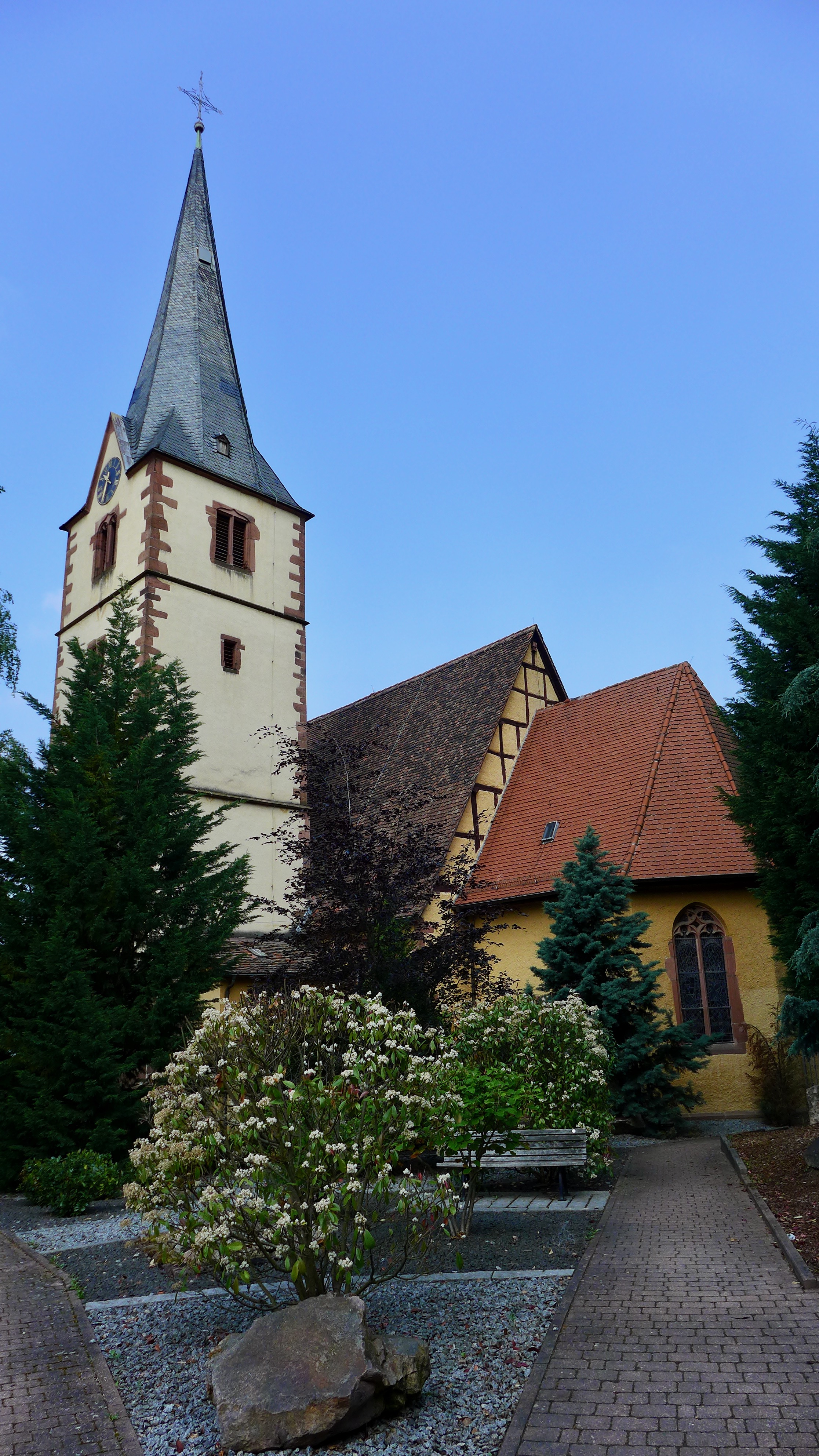

There is no limit to what you can achieve from the comfort of your home or by reaching out and making arrangements to visit places across the county or abroad. Careful planning is key.
SPECIAL HINTS
- Do bring small thank you gifts for people you will meet with. Remember you are an ambassador of sorts.
- Do research the history of a place, not just that of your ancestor. Context matters.
- Do look at old maps and Gazetteers . Names of places often change, as in my example above.
- Don’t just rely on a website, contact the archive or church directly.
- Don’t hesitate to go into a bakery, post office or library and ask for help. Ask if there is anyone who knows whether there are any “MCFADDENS’s” still living there.
- Change your perspective. Take Photos not just of things directly related to your ancestors. Take broad views of the cemetery, not just gravestones. Look up! Lie on the ground. Record the smells or sounds.
- Look for the oldest buildings in a place you will be visiting.
- Listen to your intuition. Take photos even if you don’t know exactly why you are taking them.
- Ask for help.
- Don’t forget to ask about large maps or Family Trees that may not be filed where you would easily find them.
FOLLOW-UP: On Current Trip Planning to Kent

So to give you an idea of the level of detail you may want to pursue. The following map shows places of interest in Canterbury including those related to Robert CUSHMAN. I like to print out or screen shot these on my phone. You’ll note they are all in easy walking distance of our hotel, no more than a couple of blocks. We will be visiting the Cathedral and Chapter House. It shows the location of the church where he was married, now an Instant Teller of Nat West. Bank and where he was briefly imprisoned at Westgate, which has Museum and rumored the best views of the city [£4 Adults, £3 Student/Concession]. And in case you don’t know concession is for Seniors! Also note that the Westgate gardens are lovely and the Gatehouse is lovely at night. beautiful at night. Which reminds me night photographs are often stunning, especially in cities. Here’s one of the steeple of Holy Trinity Church, William Shakespeare’s final resting place, at Stratford on Avon, taken on our way to a talk there. I didn’t know that Westgate was lit at night so I make a mental checklist to try to get a picture. Also Canterbury Cathedral at night is likely to be lovely and Evensong is at 5:30 Mon-Sun. One of my favorite experiences was a happy accident when we arrived at Beoley St Leonard’s Church as the services were beginning so we stayed. Another was at St Martin in the Fields, London where they were practicing for an evening concert of Vivaldi’s the Four Seasons.
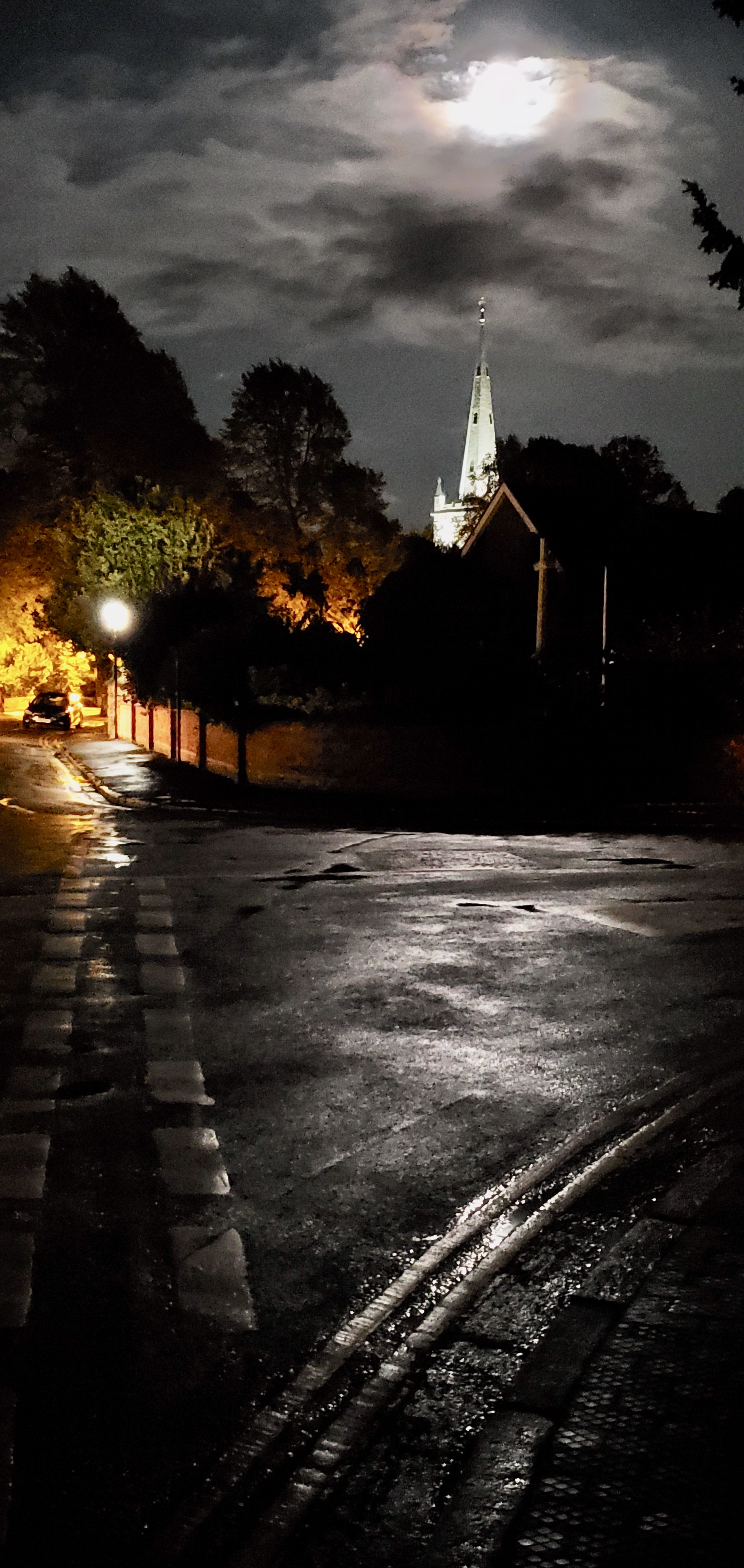
Always be open to serendipity! It leads to unusual and unique experiences.
RESOURCES
BOOKS
- Journeys Home: Inspiring Stories, Plus Tips and Strategies to Find Your Family History by Andrew McCarthy
- Travel Back to Your Polish Roots by Donna B Gawell
- Family History Trippin’ – A Guide to Planning a Genealogy Research Trip by Thomas MacAntee ebook
- Callie and Natalie’s Dutch Family History by Darlene Miller
- Visiting Your Ancestral Town by Carolyn Schott
- Researching Your Irish Ancestors at Home and Abroad by David R. Elliott
VIDEOS
- Family History Roundtable: Traveling for Your Research NEGHS
- Planning a Trip to Ancestral Homelands. NEGHS
Kelly Wheaton ©2024 – All Rights Reserved
NEWSPAPER RESOURCES FOR GENEALOGISTS
Posted on December 7, 2024 4 Comments
Note: this will also be posted as a static Page under the RESOURCES TAB to make it easy to find.
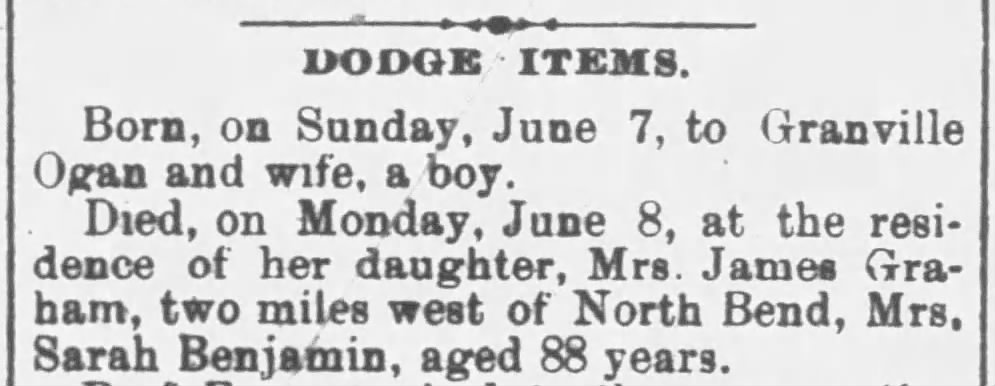
If you haven’t availed yourself of Newspapers to fill in tidbits of you ancestors lives you could be in for a real treat. Everything from recitals to accidents to winning prizes in the County Fair. This is an announcement of the death of my 3rd great grandmother Sarah Milton RUTAN BENJAMIN MOSIER 8 Jun 1891 Near, North Bend, Dodge, Nebraska, USA.
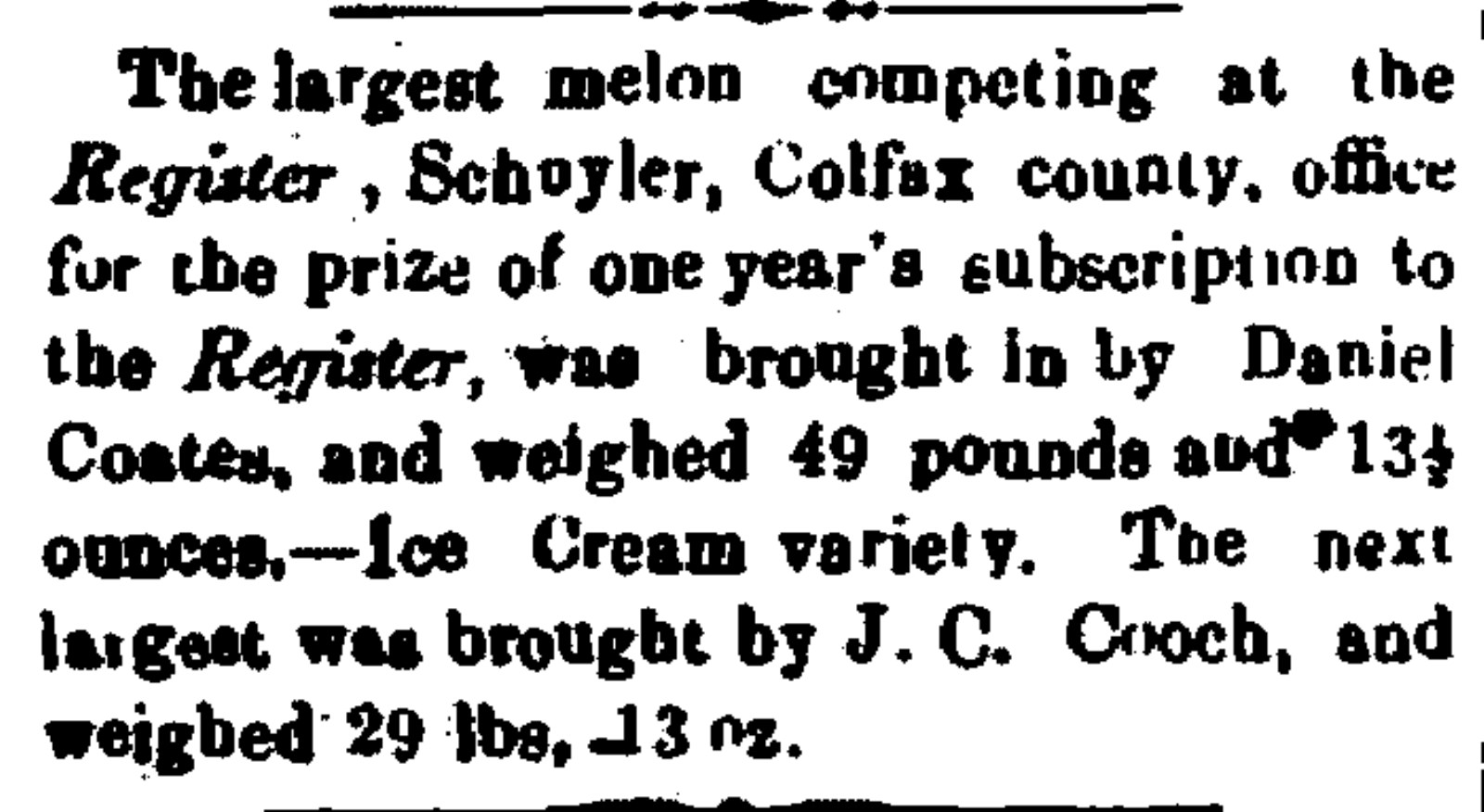
Or here is another of my 3rd great grandparents in this case Daniel Coates, whose prize winning Ice cream melon weighing in at 49 pounds and 13 1/2 ounces, appeared in the Daily Nebraska Press October 13 1875
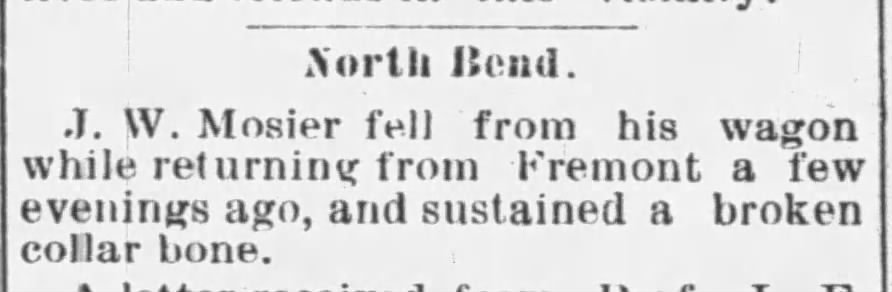
Or my 2nd great grandfather takes a tumble:
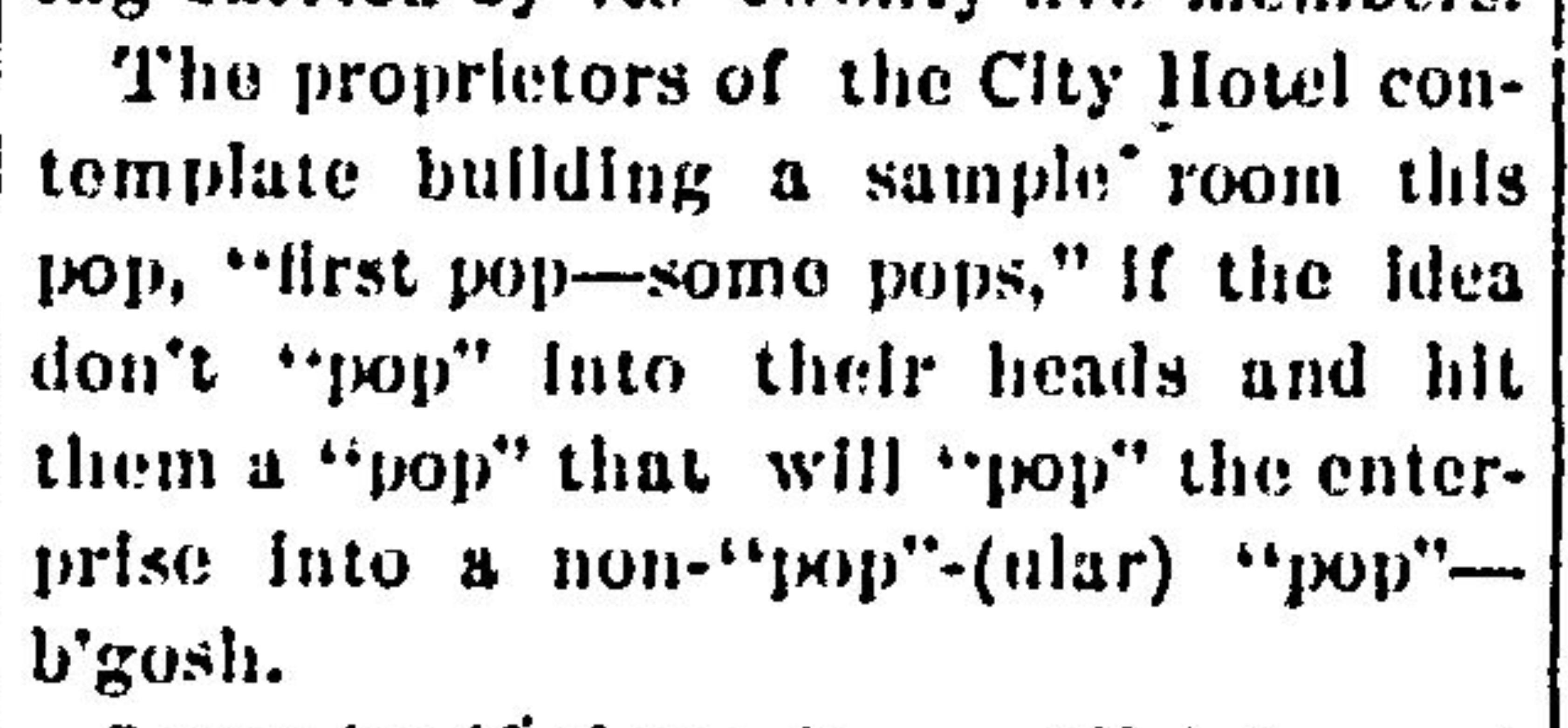
And finally my 2nd great Grandmother Catherine Adeline STEWART MURPHY MOSIER the proprietress of the City Hotel in North Bend, Nebraska.
In addition to articles about your ancestors, or mentions in passing, newspaper articles can tell stories about what was happening locally during their lifetimes. Articles about plagues, famines, wars and local happenings are rich with local detail.
The biggest sources are usually available through subscriptions. Many offer a free trial period and by the month or longer subscriptions.
HOW TO SEARCH
This is much art as science. To find a collection, not listed: try Search Terms: __________ digital newspaper archive. So if you are looking for Military Newspapers try “Military Digital Newspaper Archive” that will yield this library of Congress page https://guides.loc.gov/stars-and-stripes-us-military-newspapers/digital-resources
Here are some actual some hints to searching within a collection:
- All variations of a name may be used. Including nicknames, Mrs —-, Granny —-, Initials ie: CJ Jones
- Be careful on restricting your search to places you know your ancestor lived.
- Use quotations marks “James L. PADEN” to restrict your search. Try alternatives “J. L. PADEN”, “James PADEN” and in this case I knew his nickname “Louie PADEN”
- Be careful with time frames for your search. Maybe your ancestor died in 1875. But is mentioned 25 years later in the obituary of his daughter.
- Unusual surnames help. Locales help.
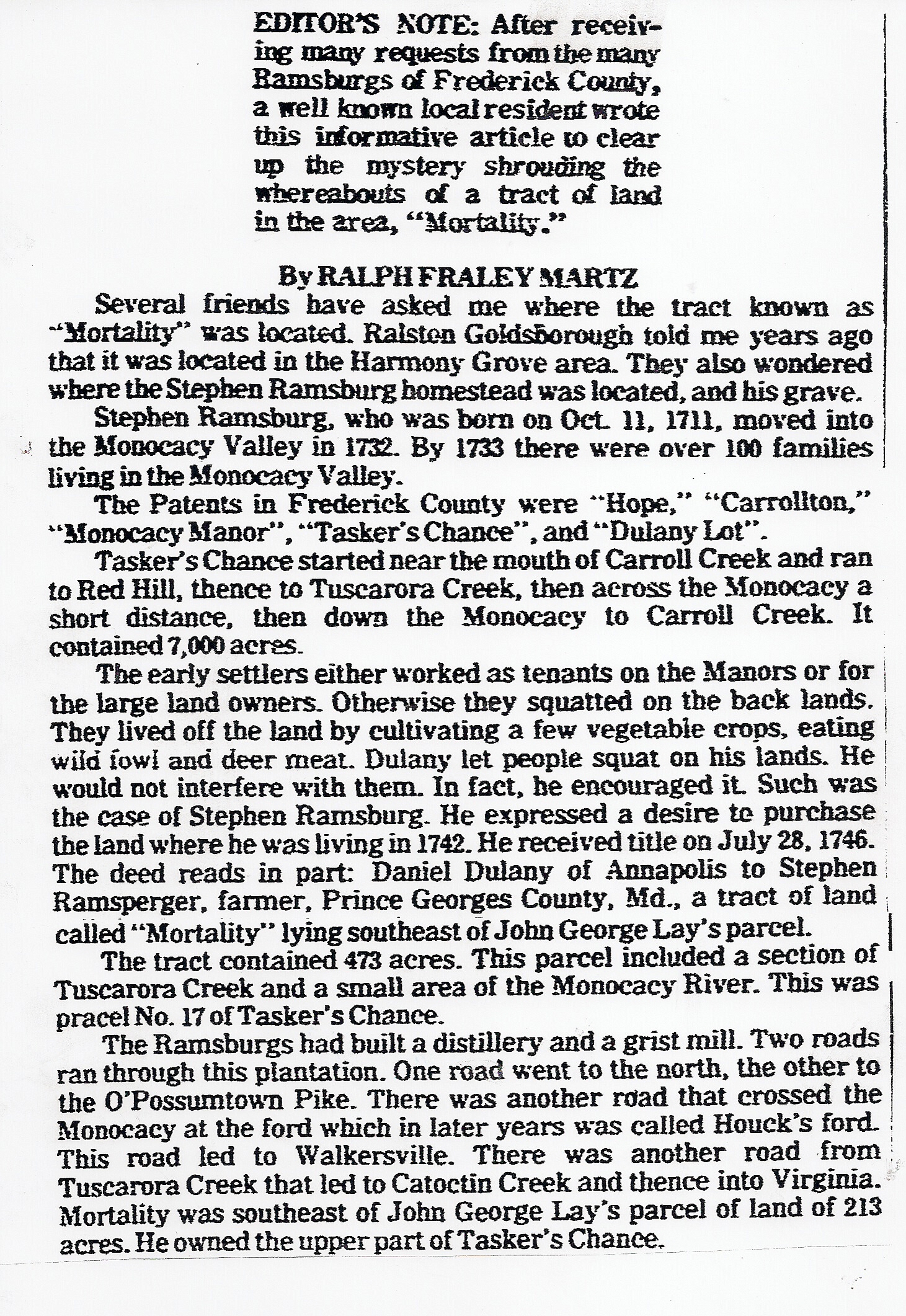
- But you want to try every different combination. I found wonderful fairly recent articles on my ancestors, like Stephen RAMSBURG, because he is mentioned in the history of a tract of Land in Maryland. SO just because your ancestor lived a hundred years ago or more he still may be mentioned more recently.
SUBSCRIPTIONS $$$$
- Newspapers.com: (can be included in an Ancestry Subscription)
- Newspaper Archive
- British Newspapers via Find My Past
- OldNews.com from MyHeritage.
FREE
Some of the larger National sites
- Library of Congress: Chronicling America : Select, representative newspapers across the US
- Purdue University Free Newspapers by State : lists of links by state
- Fulton County NY Free archives: 105 Old Newspaper pages from US & Canada
- Community History Archive
- Digital Archives of the Green Free Library
- The Ancestor Hunt : Lists many links by state and country
- Historical Indigenous and Native American Newspapers Online
- Historic U.S. Newspaper Pages Now Available from Advantage Archives
- Free Online Obituary and Obituary Index Collection Links from the U.S.
SELECTED STATE NEWSPAPER LINKS
More are available in the links above. This is to give you an idea. You can also search collections in major universities in States or communities that you might be interested.
- Alabama Civil War & Reconstruction Newspapers
- California Digital Newspaper Collection
- Massachusetts Historic Newspapers
- Michigan Newspaper Archives
- Minnesota Digital Newspapers
- Nebraska Digital Newspaper Collection
- New York Historic Newspapers
- Ohio Memory Collection
- Pennsylvania Historic Newspaper Archive
- Historic Oregon Digital Newspapers
- Texas Newspaper Collection
- Utah Digital Newspapers
- Virginia Newspapers
WORLD
- Trove – over 23.8 million pages from Australia
- Canada Online Historical Newspaper Links
- Europe Free Online Historical Newspapers
- German Newspaper Collection (From Germany):
- Swedish Digitized Newspapers: freely-available-for-all in Swedish
- Swedish Language papers in US
- Norwegian Digitized Library includes Newspapers
SPECIFIC SUBJECT
- Historical Indigenous and Native American Newspapers Online
- Historical African American Newspapers Online
- The Catholic News Archive
- US Military Newspapers
- Historical Japanese Internment Camp Newspapers Online
- Historical American Farming Newspapers Online
- Historical American Labor and Union Newspapers Online
- American Railroading Periodicals from the Library of Congress
The same general principals can be used for searching magazines and other periodicals.
Kelly Wheaton © 2024 All Rights Reserved
AMERICAN MILITARY RESOURCES for Genealogists
Posted on November 2, 2024 1 Comment
Please note that much of this information was put together by Veronica Walsh-Uribina for a class I host. I have added books and videos and commentary. Thank you Veronica for giving me permission to post along with some notes and resources of my own.
COLLECTING POSSIBILITIES
I like to start with this chart from Ancestry from a 2014 Blog post to identify possible ancestors who may have served.

Then you look at your family tree to identify all your direct ancestors that may have served. Compile the list with everything you know from your tree. My Working version looks like this:
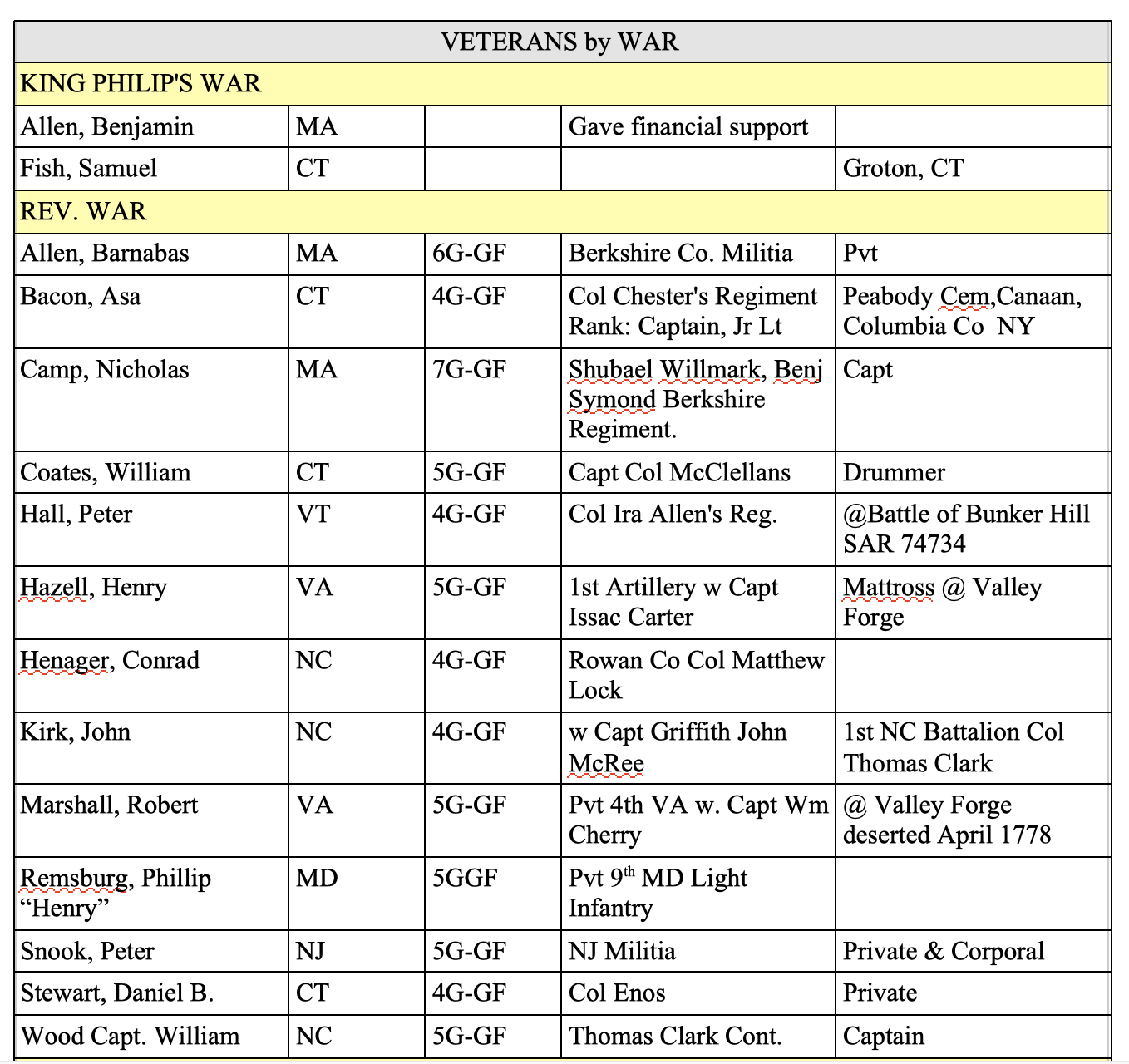
So once you have assembled your list you can start your actual research. This is Veronica’s handy chart with Hyperlinks. Hover over the Bolded or underlined titles to make the hyper links appear and click.
RESOURCES
AMERICAN MILITARY RESEARCH RESOURCES BY WAR
| WAR | DAR/SAR | FamilySearch WIKI * | Fold3 | LOC | NARA | NPS |
| Indian Wars | X | X | X | X | ||
| Revolution | X | X | X | X | ||
| War of 1812 | X | X | X | |||
| Mexican War | X | X | X | X | ||
| Civil War | X | X | X | X | ||
| Spanish-American | X | X | X | |||
| Philippine Insurrection | X | X | ||||
| WWI | X | X | X | |||
| WWII | X | X | X | |||
| Korean | X | X | X | |||
| Vietnam | X | X | X |
Abbreviation Guide + Links for above
WEB LINKS
- DAR/SAR Daughters of the Revolution – Sons of the American Revolution – Free to search
- FamilySearch WIKI Free
- Fold3 Military Records site for a fee
- LOC Library of Congress
- NARA National Archives
- NPS National Park Service
YOUTUBE VIDEOS
- YOUTUBE VIDEOS for all wars from the National Archives
- Discovering Our Veterans – Finding Military Service Details Crista Cowan Ancestry
Veronica highly recommends the Family Search Wiki as a good place to start. I usually begin with Ancestry [subscription] or FamilySearch [FREE] to find out as much as I can about who may have served. Once you are on the Family Search Wiki page you can enter the word military in the search bar to see the incredible list of wiki pages with Military information. If you know exactly what you are looking for enter say Military War of 1812 [also provided in links below]. This will give you many results for perusal or you can further refine your search. This is particularly good for general, historical information, unit histories and links for further research.
HINT: If you scroll to the very bottom you will find some templates for Download. Please note that your ultimate goal is to put together your veteran’s military Narrative. I have listed some of my blog posts for inspiration.
RESOURCES BY WAR
INDIAN WARS: Colonial Period 1609–1774
—-King Philip’s War, 1675-1676
WEB LINKS
BOOKS
- Soldiers in King Philip’s War [Internet Archive read online]
- Our Beloved Kin: A New History of King Philip’s War by Lisa Brooks from a Native American perspective
- King Philip’s War: The History and Forgotten Leagacy by Eric Schultz & Michael J Tougias
—-Queen Anne’s War 1702 to 1713
WEB LINKS
BOOKS
—-French and Indian War, 1754-1763
WEB LINKS
BOOKS
- The French-Indian War 1754-1760 by Daniel Marston
- The War That Made America: A Short History of the French and Indian War by Fred Anderson
- George Washington in the French & Indian War (History & Guide) by Scott Patchan
REVOLUTIONARY WAR: 1775-1783
WEB LINKS
- NARA. National Archives Free
- Fold3 Military Records site for a fee
- Family Search Wiki Free
- DAR Daughter’s of the American Revolution Free to search database
- SAR Son’s of the American Revolution
- LOC Library of Congress original document Collection
- LOC Map Collection for Revolutionary War Maps
- A compilation from the archives United States Revolutionary War Compiled Service Records, 1775-1783
- Connecticut Men in the Revolution
- Revolutionary War in Deleware in 3 vols
- Soldiers of the American Revolution – Maine
- Massachusetts soldiers and sailors of the Revolutionary War
- Rolls of the soldiers in the Revolutionary War New Hampshire
- Official register of the officers and men of New Jersey in the Revolutionary War
- New York in the Revolution as colony and state; these records were discovered, arranged, and classified in 1895, 1897, and 1898
- North Carolina Archives Revolutionary War
- Pennsylvania in the war of the revolution, battalions and line. 1775-1783
- Parker’s Guide to the Revolutionary War in South Carolina
- The state of Vermont: Rolls of the soldiers in the Revolutionary War, 1775 to 1783
- Virginia Militia in the Revolutionary War : McAllister’s data
BOOKS: too many, so a couple of favorites with more emphasis on personal stories
- Washington’s Spies: The Story of America’s First Spy Ring. Alexander Rose
- The Revolutionary: Samuel Adams by Stacy Schiff
- The People’s War: Original Voices of the American Revolution by Noel Rae
- Dear Abigail: The Intimate Lives and Revolutionary Ideas of Abigail Adams and her Two Remarkable Sisters by Diane Jacobs [Great for a more female centered viewpoint]
VIDEOS
- Basic Military Records at the National Archives: Revolutionary War to 1917
- Tracing Revolutionary War Soldiers at the State Archives
WAR of 1812: 1812-1815
WEB LINKS
- NARA
- Fold3 Military Records site for a fee
- United States in the War of 1812 Family Search
BOOKS
- 1812: The War That Forged a Nation by Walter R Borneman
MEXICAN AMERICAN WAR: 1846-1848
WEB LINKS
- NARA
- Fold 3 Military Records site for a fee
- Family Search Wiki
- NPS
BOOKS
- The Training Ground: Grant, Lee, Sherman, and Davis in the Mexican War, 1846-1848 by MArtin Dugard
- The Last Campaign: Sherman, Geronimo and the War for America by H.W. Brands
CIVIL WAR: 1861-1865
WEB LINKS
- NARA
- Fold 3 General Military Records site for a fee
- Fold 3: Union Military Records site for a fee
- Fold 3: Confederate Military Records site for a fee
- Family Search Wiki
- National Park Service – soldier look up
- 12 Stunning Civil War Facts from Ancestry Blog
- National Archives Cartographic Research Room: Civil War
BOOKS— so, so many
- Untold Civil War, The: Exploring the Human Side of War by James Robertson
- Eyewitness to the Civil War: The Complete History from Secession to Reconstruction by Steve Hyslop
- When the Smoke Cleared at Gettysburg: The Tragic Aftermath of the Bloodiest Battle of the Civil War by George Sheldon
VIDEOS
- I have a Civil War Veteran Now What? Allen County Public Library
- How to Find Your Civil War Roots on Ancestry.com Ancestry
- Genealogy: Researching Ancestors Who Served in the U.S. Civil War Boston Public Library
SPANISH AMERICAN WAR 1898
WEB LINKS
- NARA
- Fold 3 Military Records site for a fee
- Family Search Wiki
BOOKS
- The Spanish War: An American Epic 1898 by G.J.A. O’Toole
PHILIPPINE INSURRECTION 1899-1902
WEB LINKS
- NARA – note on same page as Spanish-American war
- Family Search Wiki
BOOKS
- Bound by War: How the United States and the Philippines Built America’s First Pacific Century by Philip Capozzola
WORLD WAR I
WEB LINKS
- NARA
- Fold 3 Military Records site for a fee
- Family Search Wiki
BOOKS too many search by location/ topic
VIDEOS
- Library and Archives Workshop: Finding World War I Ancestors
- Researching Your World War I Ancestors Alabama Department of Archives & History
WORLD WAR II
WEB LINKS
- NARA
- Fold 3 Military Records site for a fee
- Family Search Wiki
- WWII Memorial Registry
- Military Resources: Women in the Military
- US ARMY CENTER OF MILITARY HISTORY – The Army Nurse Corps
- National Archives WWII Records in the Cartographic Branch
BOOKS too many search by location/ topic ie Normandy, Tarawa, Letters etc.
YOU TUBE VIDEOS
- Discover Your Veteran’s WWII Story Allen County Public Library
KOREAN WAR
WEB LINKS
- NARA
- Fold 3
- Family Search Wiki
- Blog post on Korean War Draft Cards from Ancestry Blog
BOOKS
- Valleys of Death: A Memoir of the Korean War by Bill Richardson
- The Coldest War: A Memoir of Korea by James Bradley
YOUTUBE VIDEO
- Discovering Your Korean War Veteran by James Tanner BYU LIbrary
VIETNAM WAR 1964-1972
WEB LINKS
Miscellaneous
WEB LINKS
- History Hub (Archives)
- Veterans Military Discharge Document List
- National Cemetery Administration (Headstone/Grave Markers)
- Veterans Legacy Memorial – for Soldiers buried in VA National Cemetery’s
TEMPLATES [from Veronica]
BLOG POSTS For INSPIRATION
Please note that the reason for doing the research is to bring your ancestor back to life. Research is just the first part. The writing of the story is the second.
- A Tale of Two Soldiers Civil War
- Revolutionary War Details in Ancestor’s Pension Files: Peter P Hall
- Resurrecting the Dead Part Two: Bringing them to Life “Peter P HALL”
- Fact or Fiction? A Revolutionary War soldier talked to a boy, who became a Civil War soldier
Feel free to send a favorite resource I have missed. This will be a blog post and also a page found under the Resources Tab.
Kelly Wheaton © 2024 All Rights Reserved
Estate Planning for Family Historians & Genealogists
Posted on August 2, 2024 2 Comments

Ashes to ashes, dust to dust. Should all your work go into the circular file? None of us are immortal but the least we can do is create a plan for our research, books and heirlooms to go somewhere. No guarantees but the time to find a landing place for your legacy is now. I don’t recommend putting this in your will, generally speaking, but I do advise putting it in a letter or directive to your executor(s).
In general terms we need to find a place for:
- Family heirlooms
- Family photos and documents
- Genealogy or Family History related Books
- Your research
The most likely place is not going to be that all those things travel to their new custodians together. You need to think about breaking up the collection so that it goes to people, organizations or archives that will be good custodians and who want your collection. So let’s take these one at a time.
Family Heirlooms
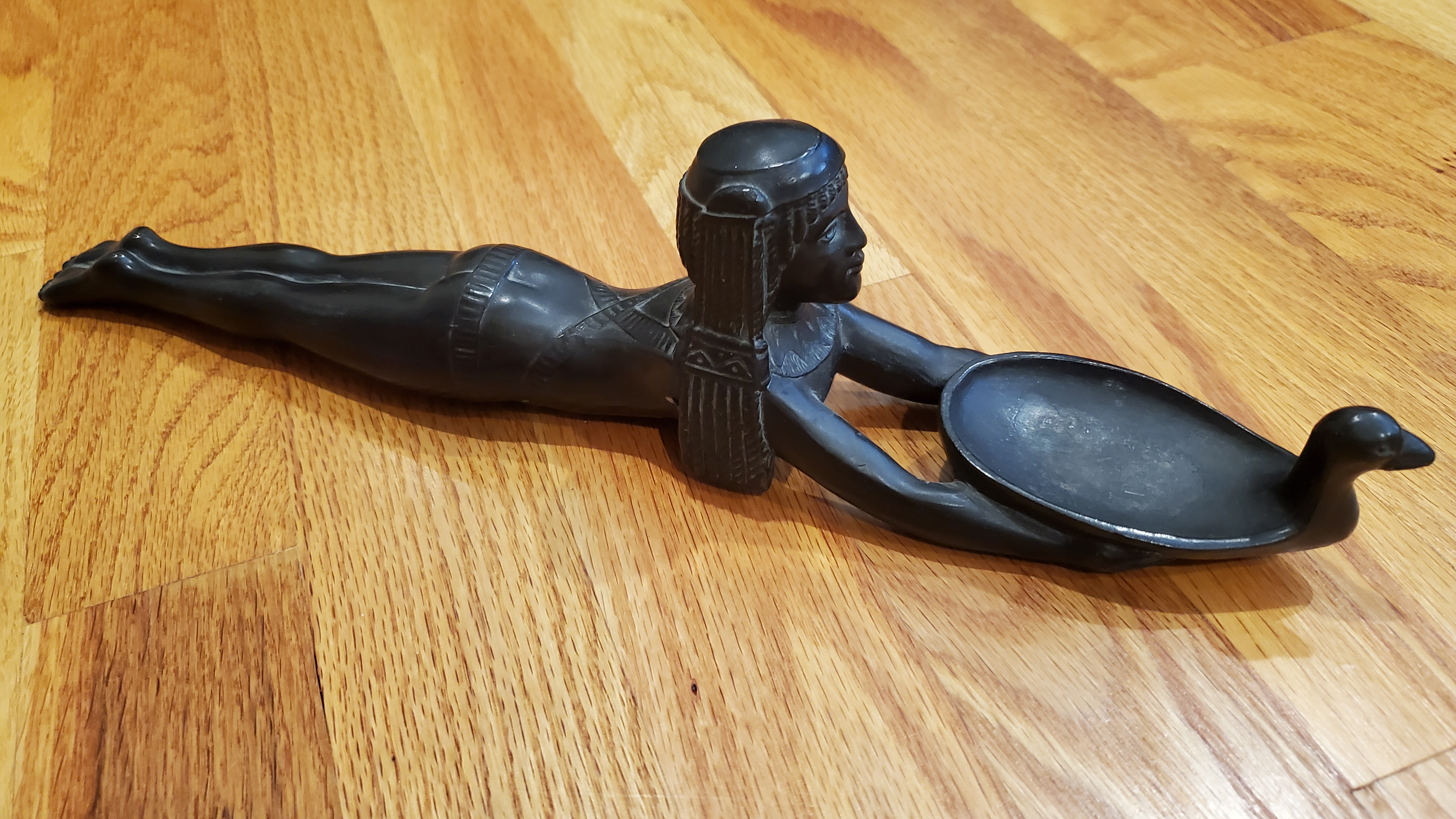
One man’s junk is another man’s treasure.
Make a list of things that have historical or personal significance. It could be your great grandfather’s military uniform, a coin collection or grandmother’s tatting shuttles. If you can spare the time, take a photo and put that together with the story of where the item came from and what its significance is. Use a spreadsheet or chart to list items. [Example below] As your list grows you might want to break down into categories like Art work, jewelry or specific collections.
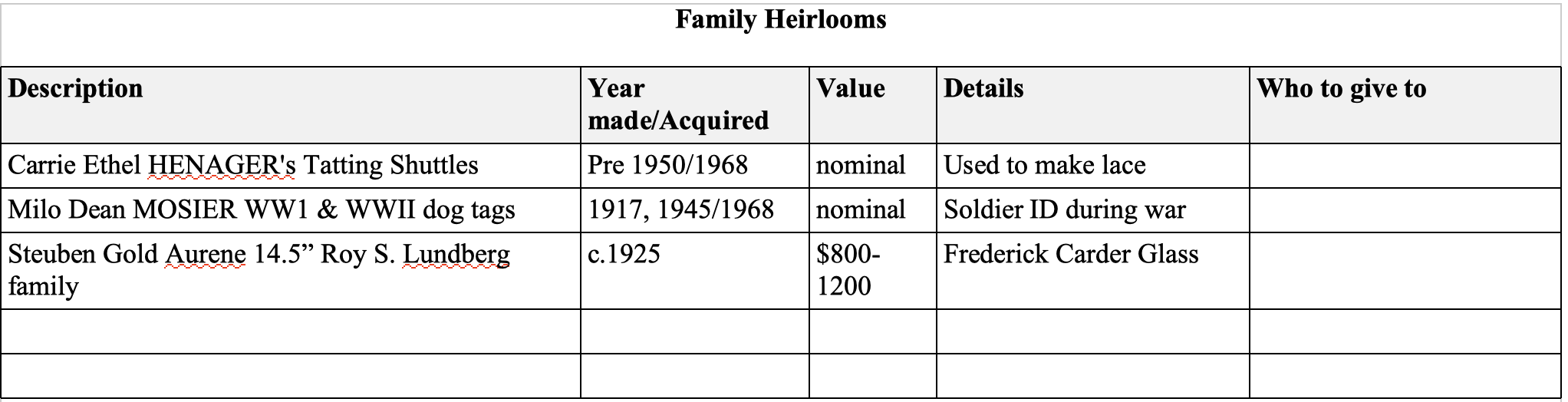
Next, ask family members or friends what they might be interested in. If the person who wants it is someone you want to bequeath it to, then put their name in your chart. If no one is interested consider what organization(s) might want it. If it is of great historical value look you may want to donate to a specific organization.
For instance in my list above the Steuben Aurene Pan might be of interest to the Corning Glass Museum and one can contact them via a specific page about donations. So on the chart above you might want to put in a link to this site. So each item may need a specific suggestion that you will need to research. While the Corning Glass Museum is 3,000 miles away in New York—I could check with organizations much closer like the Oakland Museum which has two ways to give: White Elephant sale and to their collection. The important thing is to identify and contact possible places so your heir won’t have to. Maybe you have an extensive collection of 19th century lace. Do a google search and you’ll find there is a Lace Museum in Fremont California and they have a donation page. Or maybe you have a collection of Cut Paper. Did you know that the Philip Dressler Center for the Arts, in Somerset, Pennsylvania has a The National Museum of the Guild of American Papercutters. How about American Military memorabilia? How about the American G. I. Museum donations
Family Photos and Papers, Genealogy Books, Your Research
If you have followed me—you’ll know that your collection of old photos, tin types and papers should be in archival pages and filed in your family specific family binder or file. So rather than dumping a bunch of photos on your family these will already be organized with the family history to which they belong. This will make it easier to decide what goes where. Some general places:
- Family members related to a particular family: Nephew Peter has an interest in his Great great Grandfather an aviator in WWI, Granddaughter Alicia is interested in the French side of the family and so on.
- Family or specific Surname organizations: Sheldon Genealogy or Griswold Family Association Do I general search online and contact the organization directly
- Location specific organizations or libraries: Rehoboth (MA) Antiquarian Society, Dutchess County New York Genealogy Society etc. If your material is related to that locale.
- Immigrant related organizations [based on county of origin]: Swenson Swedish Immigration Research Center, German American Heritage Foundation, Swiss American Historical Society, Danish American Arichive & Library, etc If your materials are related to immigrant families from another country
- Local or regional genealogy or historical societies or libraries: If your books or materials are relevant o a specific area.
- Regional or National Archives or libraries: These can be like the New England Historical and Genealogical Society or specific to a state California Genealogical Library or government related like Sutro Library which is a branch of the California State Library which houses Adolph Sutro (1830–1898)’s collection of historical and genealogy books. State and district archives are possibilities.
I highly recommend reading this article from the Society of American Archives which will give you guidance on what kinds of things archives are interested in. Such as “Although a repository cannot accept everything that you offer (whether because of staff and space constraints or because the materials are not within the collecting mission of the particular institution), it welcomes the chance to review material; if it is not appropriate for one repository, there may be another one to which it could be referred.“
If you have a lifetime of work then you may want to prioritize what is most important. If you have been following me any amount of time you’ll know that it isn’t all those family group sheets and charts that are the most important—its the stories. So part of your task is to prioritize putting in writing the things you know, that no body else does. One important way to do that is to start with stuff and family heirlooms and write the stories about the items. If you do they may suddenly become more interesting to your heirs.
You may also wish to add onto the Heirloom chart above a brief description of part of your genealogy collection and list the website or email address for possible archives that might be interested.
MAJOR GENEALOGY REPOSITORIES
Click on bolded items for more information
Gifts to the Library of Congress Largest collection in the world. Check to see if they already have what you are offering. Contact them to see if they are interested.
Allen County Public Library Genealogy Collection will accept loose genealogy materials and books. Please contact them for details. General contact ask@acpl.info
How do I donate to Family Search Library? What they accept: Family histories, Local and county histories, Autobiographies and biographies containing genealogical material, Indexes to records in book format.
How to donate to New England Historical and Genealogical Society (not just interested in New England).
Newberry Library in Chicago. This page link has contact info for specific genealogy related materials.
National Archives and Records Administration Donations here are by specific area such as still pictures or often related to a specific library like Presidential library. “We may accept offers of donations when the documentary materials involved are closely related to federal records already in our custody. When documentary materials don’t have a close federal connection, we direct potential donors to other appropriate archival facilities.”
SPECIFIC COLLECTIONS

Your objective is to connect the things of value with the institutions or organizations that would appreciate and care for them. For instance my cousin donated my grandmothers college materials from her years at the Michigan Agricultural College, now Michigan State University, to their archives where the items can now be viewed online in their digital collection. This can include yearbooks, programs, uniforms etc. I still have her diploma. This is going to take a bit of time, but it also means that your work will live on.
Hard Truths
Not everything we have accumulated has value to any one else. That’s okay. However I think we owe it to history to seek out a repository for those that we can find homes for. Some things are valuable to archivists that many people would throw away. This list from the Society of American Archivists article above is particularly useful.
- Letters/email
- Memoirs/reminiscences
- Diaries/blogs
- Scrapbooks/photo albums
- Professional papers
- Genealogical information
- Speeches/lectures
- Articles/essays
- Subject files
- Legal documents
- Minutes/reports
- Brochures and fliers
- Awards/certificates
- Photographs (with subjects and locations identified)
- Films/videos/audio tapes (including identifying information)
- Websites
This is an overwhelming task, so if you aren’t ready to get cracking right away—perhaps make a commitment to catalog an object each week. Maybe take its picture and put together a brief description. You aren’t limited to one item but even if you do one a week you’ll have 50 things described and maybe identified a person or place for it to go, which for most of us is better than where we are right now. Depending on how close you think the grim reaper is to visiting you—it may be time to donate or distribute some items right away. Your executor will thank you.
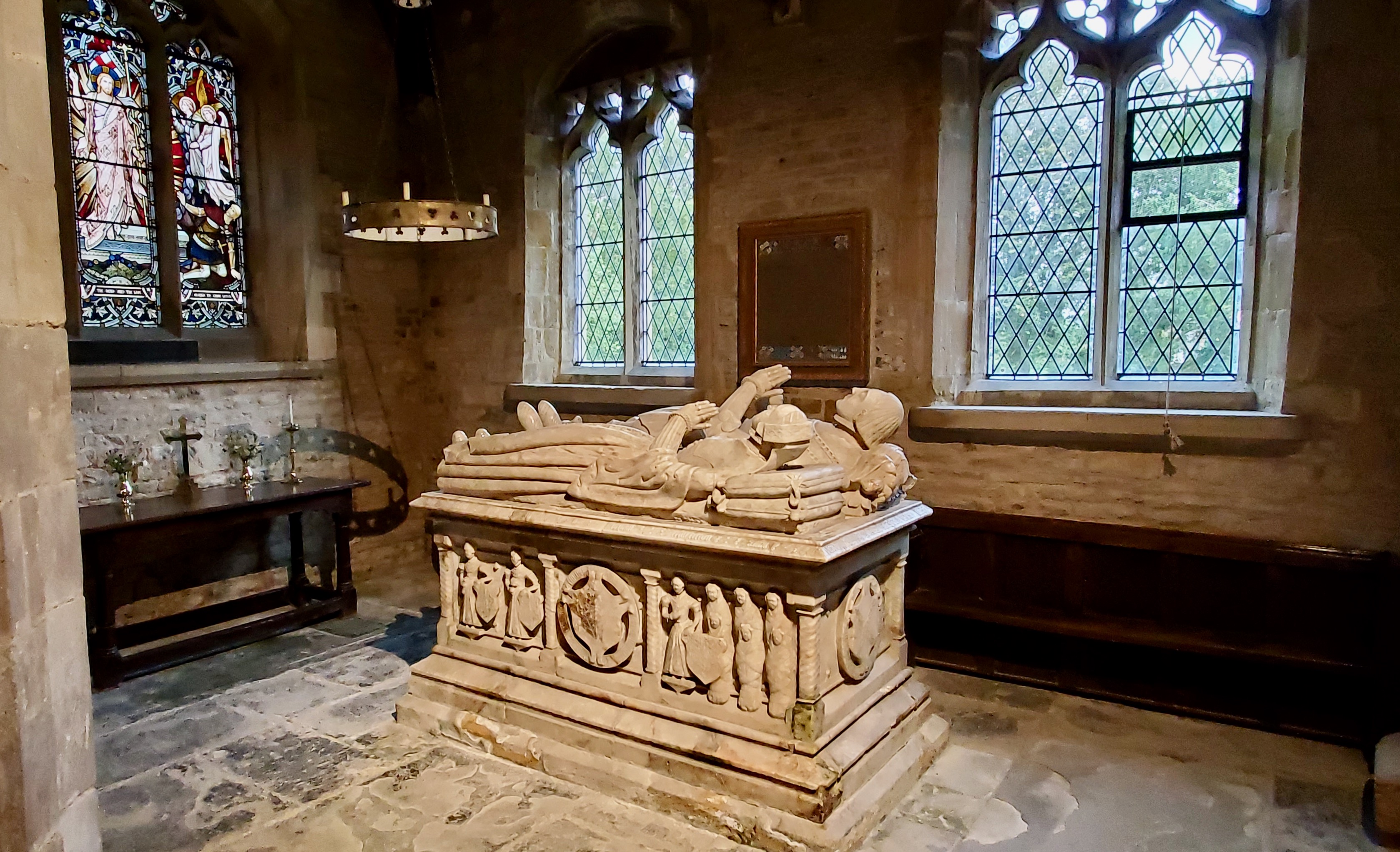
There are lots of little hints but one I began (and completed) a few years ago is putting a very small removable Color coding label in each of my books (not just genealogy ones). There are 5 colors: Pink, yellow, orange & green [Avery 6721] Green are for books that have value or should be saved—(over $25) I place a copy of its value in the front. Orange labels are for genealogy books to be donated, if the family does not want them. Yellow are for them to evaluate, that may be of specific interest. And pink are donate to a Free library or charity shop. It doesn’t take that much time to do and I know my heirs will appreciate it some day. A similar strategy could go for heirlooms and physical objects.
Country of Origin or Religious Archives with Donation Information—
This is a list to get you started. If what you are looking for is not here try using the search terms <religious affiliation> Archives or <Country or Ethnicity> American Archives. Please note many groups are regional so you may wish to look at the Archdiocese of Boston rather than a national Catholic organization. Many regions that have significant populations from a specific country will have regional archives. In all cases I suggest that you contact them directly to see if they are interested in what you have to donate.
- American- Canadian Genealogical Society
- American Hungarian Foundation
- American Jewish Archives
- Baptist Historical Collections at Baylor University
- Chinese Historical Society of America
- Danish American Archive & Library
- Finnish American Heritage Center
- Hispanic Museum and Library
- Irish American Archives Society
- Italian American Heritage Foundation
- Japanese American Museum
- German American Heritage Foundation
- Norwegian American Historical Association
- Pacific Lutheran Archives
- Swenson Swedish Immigration Research Center
- Swiss American Historical Society
- Welsh American Museum
Please note that if you have a specific collection of specialized objects there is likely a museum that would be interested such as The National Museum of Toys / Miniatures . If you don’t want your collection to go to the dumpster best to do a bit of research and find a home for it now. Have fun and good luck. If you have suggested additions to my list please leave them in the comments and I will add. I Have tried to give the page on which donation directions are listed rather than an individual address as those can change over time.
Kelly Wheaton ©2024 – All Rights Reserved
 Wheaton Wood