Family Tree Charting Services
Posted on September 1, 2026 2 Comments
From time to time I get asked where to go for printing large or complex family trees. I make no endorsement of these companies but offer these up for what its worth. Most resident Family Tree programs have Chart Making capability but for larger than legal sized charts these may be helpful. Also check Ancestry, My Heritage and others for resident tree printing.
Charting Companion Software for doing your own
If you know of any others drop me a line.
Kelly Wheaton ©2026 All Rights Reserved
What was it Like? Where to find Diaries and Letters
Posted on September 1, 2026 Leave a Comment
As a follow-up to my post They Came to America: The Immigrant Experience I thought I would put together websites that may be helpful in finding diaries that share experiences with your ancestor. Off the top, any large archive like the National Archives or major Library or University is a good place to start. You must break down your ancestor into a list of categories: time lived, place lived, nationality, occupation, war or conflict.
LARGE REPOSITORIES
- Digital Public Libraries of America (DPLA): Search multiple institutions at once for digitized materials.
- ArchiveGrid & SNAC: Find catalog records for manuscript collections across many repositories.
- FamilySearch: Good for genealogy, linking records to specific collections.
- The Great Diary Project in the UK
- NIOD Netherlands Institute for War Holocaust and Genocide: diaries
- A Diary Archive in Amsterdam Offers a Trove of Untold Stories: Jewish holocaust
- American Diary Project
- Historical Archives of the European Union: Video showing how to use
CIVIL WAR DIARIES
- Virginia Tech Collection both Union & Confederate
- Civil War Digital
- Penn State Collection
- Auburn University
- University of Michigan
- Waiting for Orders: The Civil War Diary of Micajah A. Thomas
- The Civil War Diary of John A. Blair
- Two Southern Women Writers: the Civil War Journals of Emily Jane Liles Harris and Mary Boykin Chesnut
- The Journal of Elizabeth Maxwell Alsop Wynne, 1862-1878
- What Sorrows and What Joys: The Civil War Diaries of Cloe Tyler Whittle, 1861-1866
- A diary kept on the battlefield in the year of 1863 John A. Holtzman
- Village Life in America 1852-1972 as told in the diary of a school-girl Caroline Cowls Richards
EARLY NEW ENGLAND
- A voyage into New England begun in 1623. and ended in 1624
- Abigail Adams Diary of her Return Voyage to America, 30 March–1 May 1788 (Pres John Adams wife)
- Logbook of the Stanton (Ship) of Fairhaven, Mass., mastered by John Church, keeper unknown, on voyage from 1833 May 1–1836 March 12
- New-Englands plantation, with the sea journal and other writings
- Journal of Richard Mather. 1635. Bristol, England to New England
- The Diary of Anna Green Winslow : A Boston School Girl of 1771
- An account of two voyages to New-England : made during the years 1638, 1663
Use Specific Search Terms:
- Keyword:
surname + diary,location + personal narrative,family records,letters,manuscripts. - Subject Headings: Use terms like “Diaries,” “Travelers’ writings,” “Women’s diaries,” or specific historical periods, ie.: 18th century”
Have fun! This can lead you down many a gopher hole.
Kelly Wheaton ©2026 All Rights Reserved
Spinning a Scottish Yarn: The Reverend David Dickson Part Four Edinburgh
Posted on September 1, 2026 Leave a Comment
EDINBURGH
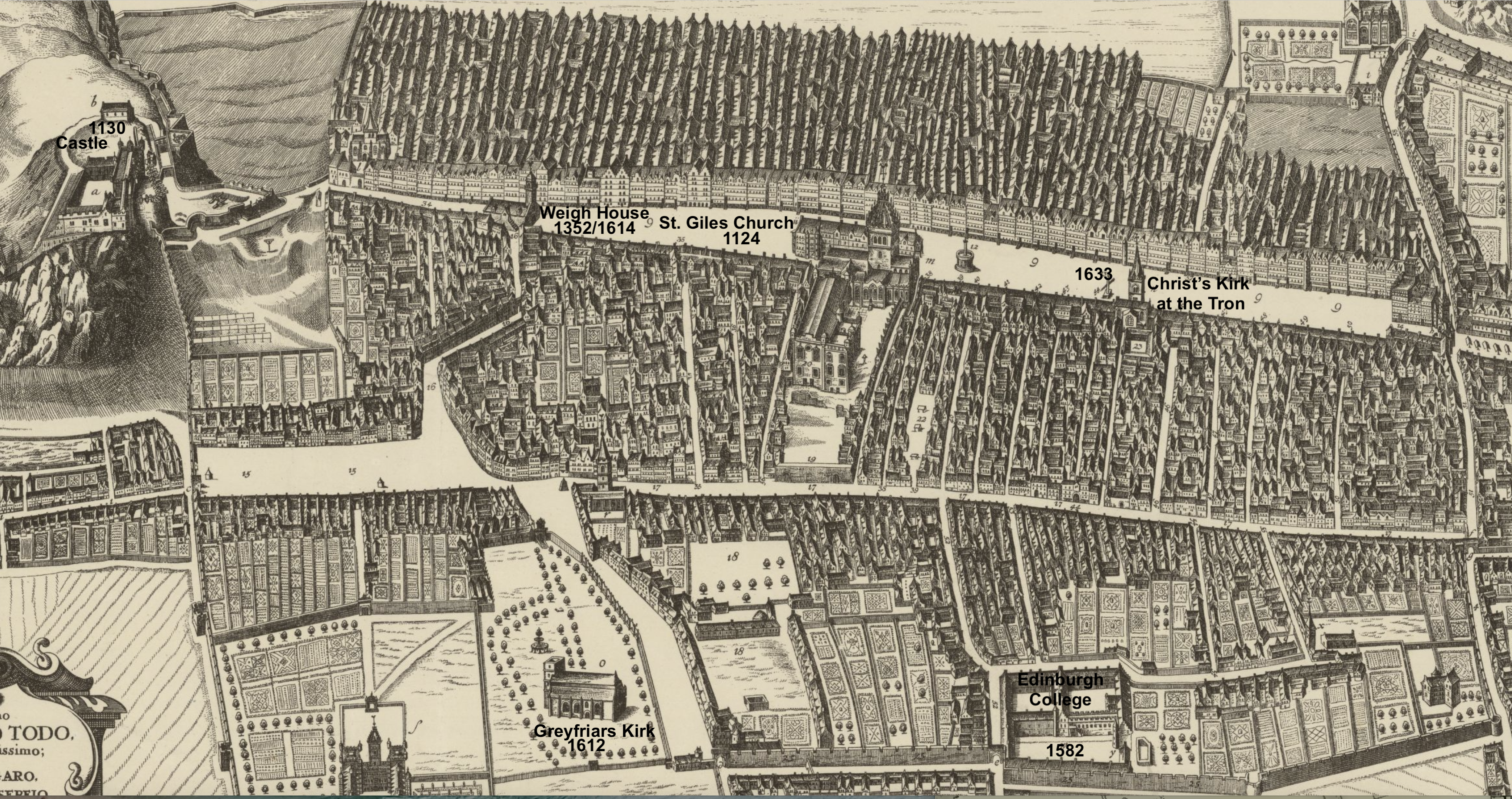
After spending a decade in Glasgow, on the 12th April 1650 David Dickson was appointed to a charge at St Giles Cathedral (second charge) by the Town Council and to serve as a professor of Divinity at the University of Edinburgh. At the latter he succeeded Samuel RUTHERFORD. DICKSON left Glasgow University and its High Kirk for the University of Edinburgh and the High Kirk St Giles. While St Giles’ was not officially a cathedral for most of the 17th century (only during brief periods of Episcopacy), it served as the main church (High Kirk) where Dickson ministered. Mr. David DICKSON, was declared a professor of Divinity at the College of Edinburgh on the 8th of April 1650. He served as Burgess of Edinburgh that same year. The University of Edinburgh was founded in 1582 on the site now occupied by the Old College. Before 1582 it had been the precincts of St Mary’s Kirk, and the Kirk o’ Fields [see map] , and part of the medieval burial ground. Most of the footings of the 17th and 18th century university buildings were uncovered, including the fully-paved courtyard of the 1617 Common Hall when excavations were done in 2005 by Simpson & Brown. The existing “Old College Campus” was built between 1789-1827 so at the time DICKSON would have been there it would have been the original campus . DICKSON most likely lived at the Edinburgh Townhouse of James SKENE of Curryhill. It was purchases by SKENE in December of 1639 to serve as the residence for its professor of Divinity, It was located behind the High School at Kirk o’ Field [see below]. He was Moderator of the Assembly 21st July 1652.
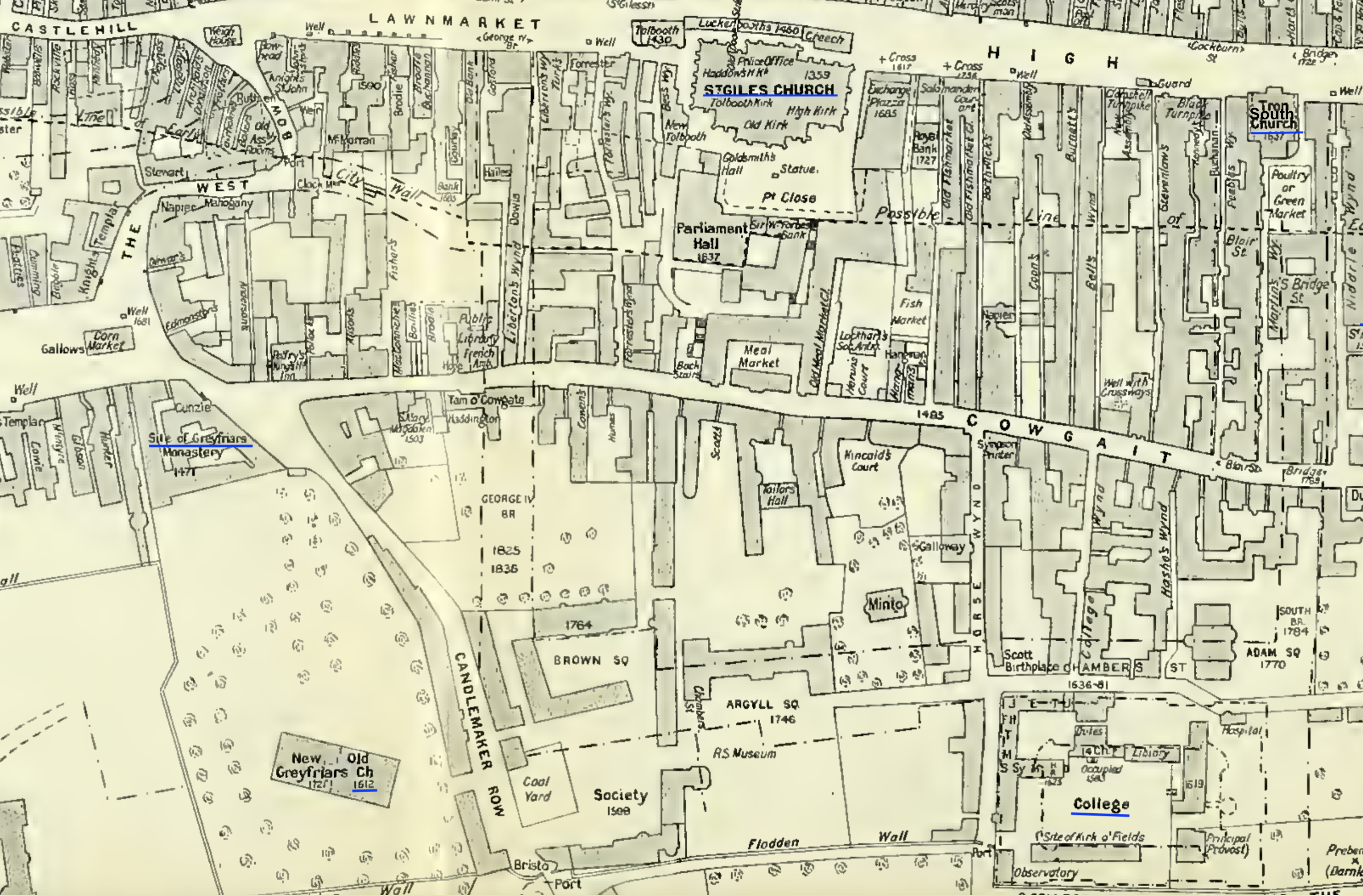
This was not the first time DICKSON was in Edinburgh. The Greyfriars Kirk is historically significant as the site where the National Covenant was signed by citizens in March 1638.

David DICKSON was a key leader in the Scottish Reformation, signed the National Covenant in 1638, and served as chaplain to the Covenanter army, playing a crucial role in defending the Church of Scotland against royal interference. He attended a private 1637 meeting against bishops, and helped suspend the service book, and visited Aberdeen to promote the Covenant. He served as moderator of the General Assembly in 1639 and was a chaplain in the army of the Covenanters under Alexander Leslie which encamped at Dunse Law in June 1639.
FRIENDS OF DAVID DICKSON
One thing I noticed early on in my research is how many of David DICKSON’s books are dedicated to prominent individuals. The relationship of these individuals to David DICKSON and each other are of note. For instance the Earl of Eglington, Alexander MONTGOMERIE, was an early supporter of DICKSON, his estate being just outside Irvine. Alexander’s daughter, Anna MONTGOMERIE, married Mr. John DICKSON, fiar of Busbie, the son of David DICKSON. They had a son David, and a daughter Margaret. The former, in 1653, received a bond for 3000 merks Scots as his mother’s tocher, from her brother Sir Robert MONTGOMERIE, younger, then of Skelmorlie. John DICKSON died in August 1653, [Before his father David DICKSON] as appears from his testament, which was confirmed by the Commissary of Glasgow on 22nd May 1655, to Anna MONTGOMERIE his relict as follows:
At Glasgow, the saxtein [16] day of August 1653, I, Mr. John Dicksone, fiar of Busbie, having rychteousnes and eternall life setled to me in Jesus Chryst by the covenant of grace, do make my testament and latter will concerning things temporall as follows : — In the first, I noniina.t Mr. James Robertone of Bedlay, Mr. David Dicksone, my father, and Mr. Alexander Dicksone, my broyther, or any of thame tutoris to my children, David and Margaret Dicksones. As also, I nominat my youngest broyther Andrew Dicksone, tutor to my said children, &c. Item, I nominat David and Margaret Dicksons, my children, executoris and intromittoris, with my guids and geir, &e. Item, I ordane my father and freinds to deall with Sir Archibald JOHNSTONE of Waristone and his lady, for bringing the commowneing begune betuixt me and thame to some gud conclusione, anent quhat in law or conscience sould be refoundit to my fatherles children of the sowme of sevin thowsand merks and annuelrents thairof, advanced be me to thame at my entrie to the plaice quhilk I had in exchequer, &c. And lastlie, I humblie recommend my wyffe and children to the grace and blissit protectione of God ; and under him to the care and protection of the very noble lords, Archibald Marquis of Argyle, Archibald Lord Lore, and Lord Neill Campbell his sones, and to the kindness and caire of Sir Robert MONTGOMERIE, elder of Skelmurlie, and Sir Robert MONTGOMERIE younger, his son. In witnes quhair of, I have written and subscryvit thir presents with my awin hand, &c, befoir thir witness, Mr. Robert BAILLIE, professor of divinity in Glasgow, and Mr. Andrew RRONERTONE, sone to Mr. James ROBERTONE of Bedlay, etc
Anna MONTGOMERIE married, secondly, before 6th April 1656, William CUNINGHAME (1627-1676), brother to Alexander CUNINGHAME (1626-1690) of Craigends.
- Sir Archibald JOHNSTON of Warriston (1611-1663) Scottish Judge and Statesman. Named in John DICKSON’s will [David DiCKSON’s son]. A prominent Covenanter. Hanged at Mercat Cross 22 July 1663 [See Diary of Sir Archibald JOHNSTON of Wariston]
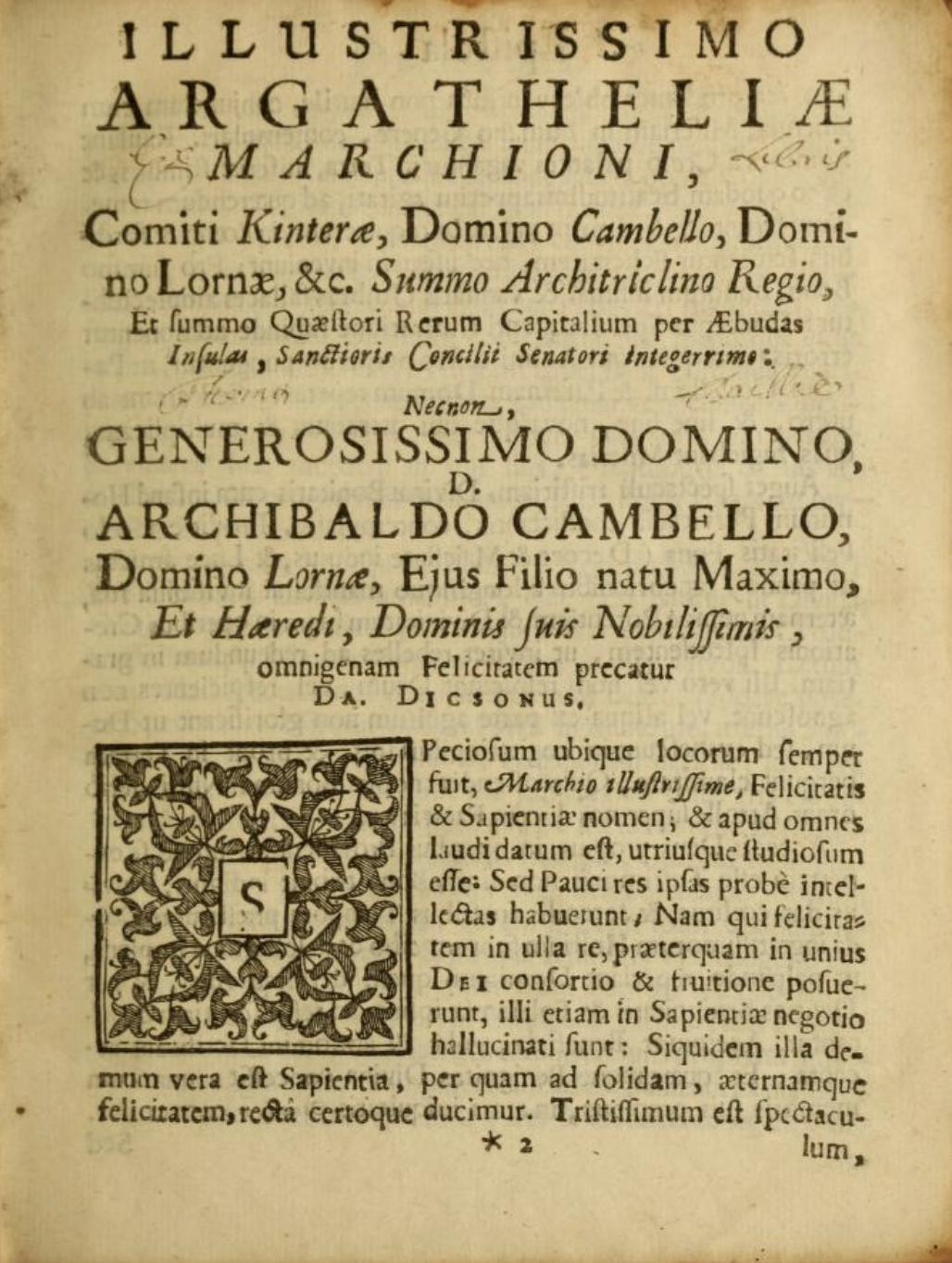
- Archibald CAMPBELL, 1st Marquess of Argyll (March 1607 – 27 May 1661) of Inveraray Castle where David and his wife spent 2 years. In 1646 DICKSON dedicates a book to him and his eldest son, Archibald CAMPBELL 9th Earl of Argyll. David Dickson spends time with the senior, Archibald CAMPBELL, the night before his execution with the Maiden [Scots version of a guillotine], at Mercat Cross 27 May 1661. His son Archibald CAMPBELL (1629–1685) was also executed by the Maiden, 20 years later, 30 June 1685 at Edinburgh. And both their heads were impaled at the top of the Tollbooth.
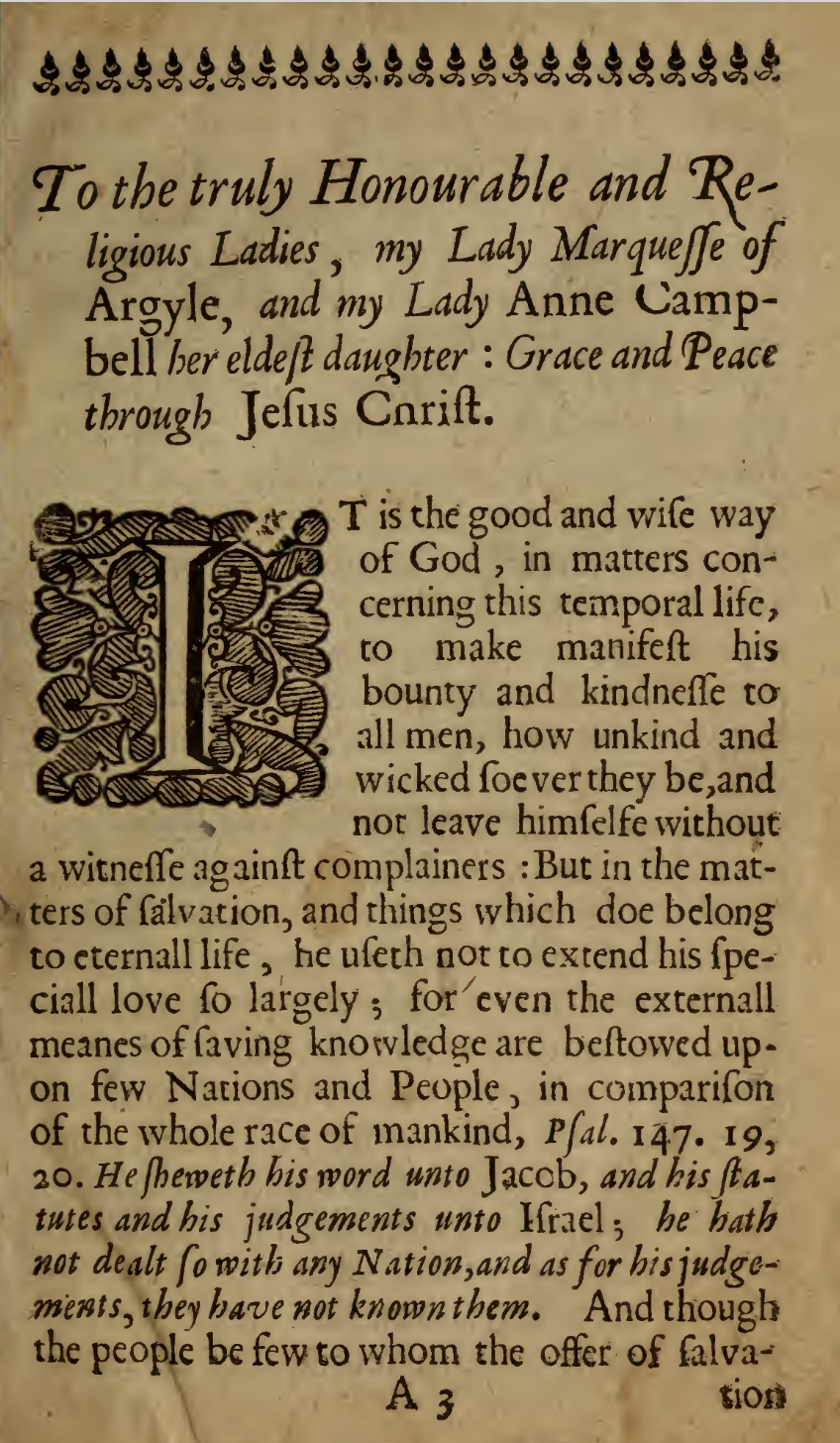
- Lady Marquesse of Argyll, Margaret DOUGLAS (1610–1678) (married to Archibald CAMPBELL, 1st Marquess of Argyll above) Book of Psalms dedicated to: her and her eldest daughter, Lady Anne CAMPBELL .
- 6th Earl of Cassilis John KENNEDY (c1602-4 Apr 1668) DICKSON dedicated a book to him in 1655
- Lady Janet Kerr, widow of William CUNNIGHAME, 8th Earl of Glencairn, [she is the mother of William Cunningham, 9th Earl of Glencairn who is made Lord High Chancellor of Scotland for life. William the 9th’s marriage to Margaret MONTGOMERIE, daughter of Alexander, 6th Earl of Eglinton, ended the CUNNINGHAM-MONTGOMERY feud which began in 1586 after Hugh MONTGOMERIE, 4th Earl of Eglinton, is murdered by James CUNNINGHAM, 7th Earl of Glencairn]
- Robert BAILLIE (30 Apr 1602-July 1662) Followed in DICKSON’s footsteps. Graduated in 1620 from Univ. Of Glasgow. Also tutored the son of the Earl of Eglinton, and was ordained to the pastorate of Kilwinning (adjacent Irvine), in 1631. In 1661, he was made principal of the University of Glasgow and he died in August, 1662. DICKSON died in December of the same year.
- John LIVINGSTONE (21 June 1603-9 August 1672) Went to Ireland and America was present at the signing of the Covenant in 1638 in Edinburgh. Eventually banished from Scotland and lived out his years in exile in Rotterdam.
- Alexander MONTGOMERIE, 6th Earl of Eglington, (1588 – 7 January 1661) longstanding friend of DICKSON. He supported the Covenanters. In 1651 he was betrayed to Oliver Cromwell and detained in Edinburgh Castle, but set free at Berwick.
- Lady Anne CUNNIGHAME, Dowager of Glencairn (1 Jan 1586-16 Apr 1647) fourth daughter of James CUNINGHAME, 7th Earl of Glencairn and Margaret, daughter of Sir Colin CAMPBELL of Glenorchy. She led a mixed-sex cavalry troop during the “Battle” of Berwick on 5 June 1639.
LADY MARGARET DOUGLAS, MARCHIONESS OF ARGYLL [ wife of Archibald CAMPBELL] : “As an instance of this, it may be mentioned that the well-known Mr. David Dickson, with his wife and children, resided two years in their family, at Inveraray; during which time Dickson and Mr. Gordon, the minister of the parish, divided the services of the Sabbath between them, the former preaching in the forenoon, and the latter in the afternoon…” [“Ladies of the Covenant” pg 84 1650-1655 Alexander GORDON was minister at Inveraray.] Archibald Campbell, 1st Marquess of Argyll (1607 – 1661) was a Scottish nobleman, politician, and peer. He was the husband of Lady Margaret Douglas of Argyll He was the de facto head of Scotland’s government during most of the conflict of the 1640s and 1650s. It is said that some of DICKSON’s later work was built upon some sermons preached by DICKSON at Inveraray when he was a guest at Inveraray Castle, home of Archibald CAMPBELL. [A descendant of the 2nd Earl of Argyll my 11th great grandfather].
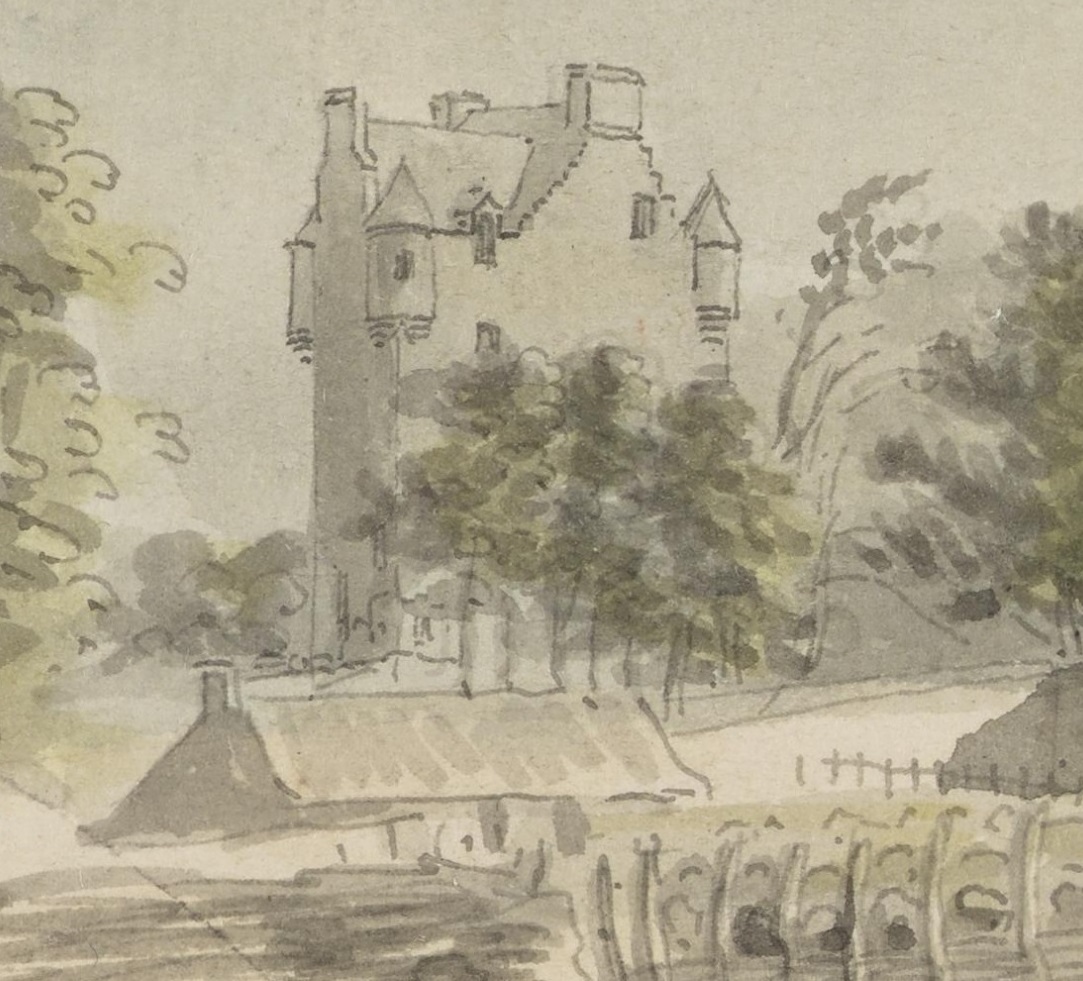
Letter from Baillies FOR MR. DAVID DICKSON, AT INVERARAY. MARCH 5TH [1651.] [Baillies Vol 3 pg 131] Places DICKSON at Inveraray Castle.
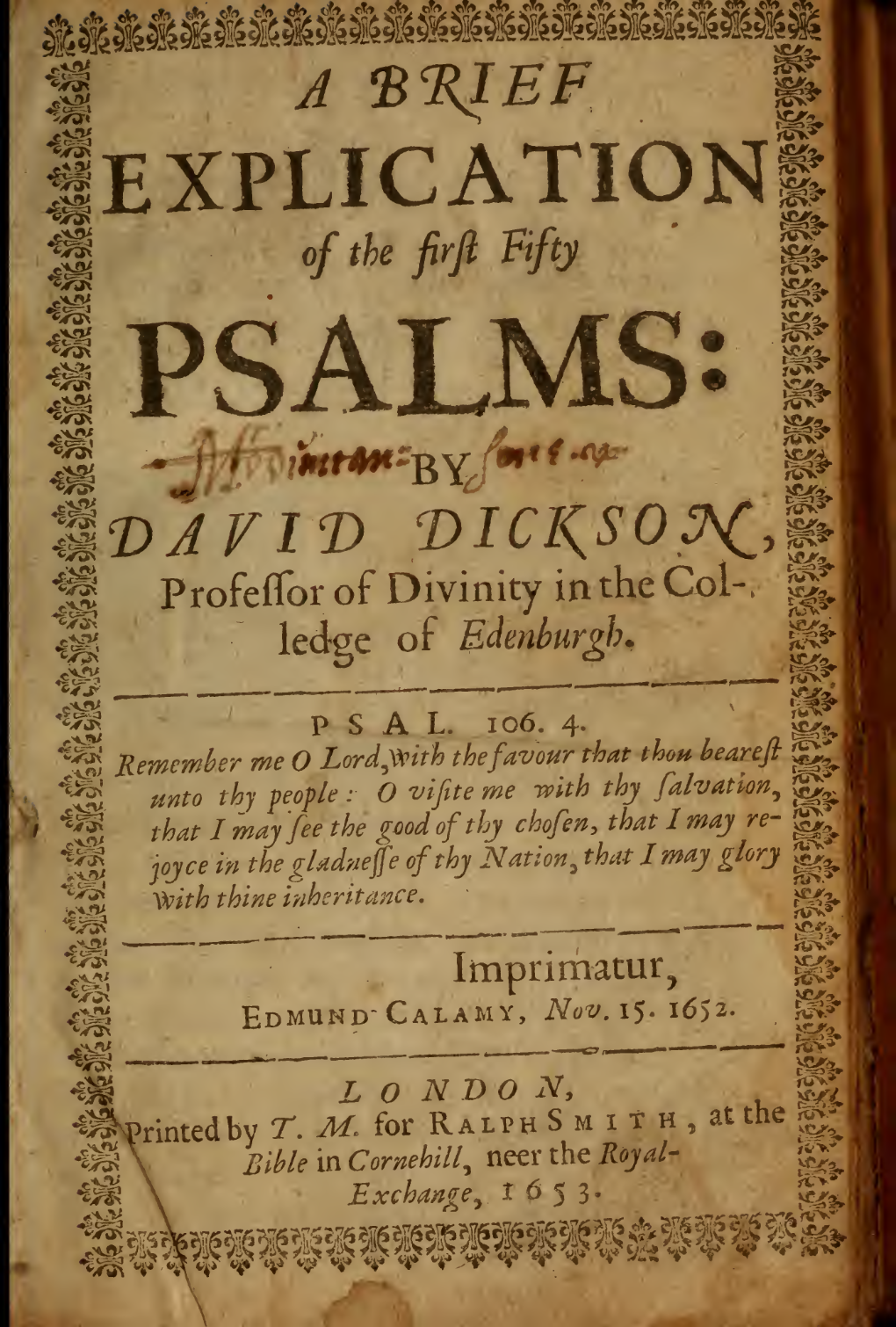
We can see a bit of the relationship in the Dedication to “A Brief Explication of the First Fifty Psalms by DICKSON: ” To the truly Honourable and Religious Ladies, my Marquesse of Argyle, and my Lady Anne Campbell her eldest daughter: Grace and Peace through Jesus Christ.” Most likely this was in thanks for their hospitality.
A bit more of the relationship of David with the gentry can been found in his son John’s will [he predeceased his father].
“At Glasgow, the saxtein [16] day of August 1653, I, Mr. John Dicksone, fiar of Busbie, having rychteousnes and eternall life setled to me in Jesus Chryst by the covenant of grace, do make my testament and latter will concerning things temporall as follows : — In the first, I nominate Mr. James Robertone of Bedlay, Mr. David Dicksone, my father, and Mr. Alexander Dicksone, my broyther, or any of thame tutoris to my children, David and Margaret Dicksones. As also, I nominat my youngest broyther Andrew Dicksone, tutor to my said children, &c. Item, I nominat David and Margaret Dicksons, my children, executoris and intromittoris, with my guids and geir, &e. Item, I ordane my father and freinds to deall with Sir Archibald Johnestone of Waristone and his lady, for bringing the commowneing begune betuixt me and thame to some gud conclusione, anent quhat in law or conscience sould be refoundit to my fatherles children of the sowme of sevin thowsand merks and annuelrents thairof, advanced be me to thame at my entrie to the plaice quhilk I had in exchequer, &c. And lastlie, I humblie recommend my wyffe and children to the grace and blissit protectione of God ; and under him to the care and protection of the very noble lords, Archibald Marquis of Argyle, Archibald Lord Lome, and Lord Neill Campbell his sones, and to the kindness and caire of Sir Robert Montgomerie, elder of Skelmurlie, and Sir Robert Montgomerie younger, his son. In witnes quhairof, I have written and subscryvit thir presents with my awin hand, &c, befoir thir witness, Mr. Robert Baillie, professor of divinity in Glasgow, and Mr. Andrew Robertone, sone to Mr. James Robertone of Bedlay, &c.”
Back-tack and other papers concerning a mortgage by Sir David CUNNIGHAM of Robertland to Mr David DICKSON, professor of divinity in College of Edinburgh and Margaret ROBERTON, his spouse, of lands of Fulschaw in parish of Stewarton and sheriffdom of Ayr. [GD172/2483]
BRIEF LIST of LETTERS
National Library of Scotland CH1/5/4 Wodrow Folio Manuscripts. vol. 25 & 26. These help to place DICKSON and his whereabouts.
- 33. Letter signed by David DICKSON, H. BIRSBANE, George YOUNG to Robert DOUGLAS, minister of Edinburgh, suggesting an overture. Falkirk 2 April 1646. [Printed `Letters and Journals’, II, 513.]
- 59 Letter signed by John DRYSDAIL, Gilbert RAMSAY, W. RICHHARDSONE, David GEMMILL, Fergus ALEXANDER, Andrew STUARTT and J. GREY, members of presbytery of Bangor in Ireland to Mr. Robert DOUGLESSE, minister of Edinburgh, and Mr. David DICKSONE, minister of Glasgow, asking that Sir James MONTGOMERIE be looked upon with compassion, `if it shall please the Lord to continew him in the detestation of this his late backslyding from the Covenant’. Bangor in Irland, 27 Sept. 1649.
- 110 Letter from David DICKSONE, [minister of St. Giles, Edinburgh, second charge,] to Robert DOUGLACE 26 April 1651
- 3. Letter signed by Mr. Jo. ? Allade, Mr. MUNRO, Mr. Duncan ROS and Mr. James MACKENSIE, to Mr. David DICKSON and Mr. Robert DOUGLAS, ministers at Edinburghe, their brethren, warning them against Mr. Hew ANDERSONE, a man of suspected principle. (? Caithness c. 1654).
- 4. Letter from [Sir] John CLOTWORTHY (later 1st Viscount Massereene) to Mr. David DICKSON and other ministers of Edinburgh, announcing his intention of visiting Lord Broghill at Edinburgh. (4 Feb. 1655.)
- 5. Letter signed George MONCK to David DICKSON and Robert DOUGLAS, excusing himself from intermeddling with church business (probably about the sheriff’s summons for their praying for the King). Dalkeith, 21 Aug. 1655.
- 9. Letter from presbytery (? of Skye), signed by moderator and Mr. Archibald MACQUIEN, clerk, [minister of Snizort,] to Mr. Robert DOUGLAS and Mr. David Dickson, asking for a warrant so that boys chosen by presbytery for college may be accepted by provincial synod. Snizort 14 Aug. 1656. In dorso: invitation to funeral of James MAXWELL of Moristoune, 11 Nov. 1720.
- 14 Letter from Mr. William DOWGLAS and others to Mr. David Dicksone and others, Aberdeen, 16 April 1656
- 22. Letter from P. GILLESPIE to Mr. David Dicksone and Mr. Robert DOUGLAS, regretting breach in church of Scotland. (2) July 1657. [Printed `Letters and Journals’, III, 577-8.]
- 26. Letter from James DURHAME to Mr. David Dicksone and others. 18 Feb. 1658.
- 28. Letter from Lord BROGHILL to Mr. David Dickson and Mr. Robert DOUGLAS, in answer to no.25 supra. Maidenhead, 3 May 1658.
- 40. Letter from George MONCK, to Mr. David Dickson and Mr. Robert DOUGLAS, asking them to come and discuss a fast. Dalkeith, 26 April 1659.
- 94. Draft letter from Messrs. DICKSON, Douglas and HUTCHESON to Mr. SHARP, asserting their innocence, Edinburgh, 17 March 1660.
- 102. Draft letters, (i) from Messrs. Douglas, DICKSON and HUTCHESON to King, (ii) from Messrs. DOUGLAS and HUTCHESON to Earl of Rothes, (iii) from Messrs. Douglas and HUTCHISON to Earls of Craufurd Lindsay and Lauderdaill, and (iv) from Mr. DOUGLAS to Mr. James SHARP. Edinburgh, 10 May 1660.
- 103. Draft address from Messrs. Douglas, DICKSON, James HAMILTON, John SMITH and HUTCHESON to King, expressing satisfaction with comfortable revolution of affairs making way for king’s re-establishment. Edinburgh, 8 May 1660.
- 113. Letter from presbytery of Chirnside to David DICKSONE and Robert DOUGLAS, new minister of Chirnside. n.d.
THE DEATH OF THE MARQUESS OF ARGYLL, ARCHIBALD CAMPBELL
“In prison, Argyll had acquired that ecstasy of faith which makes the martyr defiant and serene. He held discourse with the ministers, DOUGLAS, HUTCHISON, DICKSON ; and he settled his earthly affairs with precision. But gentle LEIGHTON, busy with a Latin eulogy of Middleton, did not trouble to cross the Cowgate to bid farewell to Argyll and GUTHRIE. How different David DICKSON! He was Argyll’s bedfellow on the night before his execution.” [Covenanter’s Hist pg 86]
On Monday 27th May [1661], “as Argyll was leaving for execution, he called forth GUTHRIE for a parting embrace, during which GUTHRIE happily said : ‘ My Lord, God hath been with you. He is with you, and God will be with you ; and such is my respect for your Lordship, that if I were not under sentence of death myself, I could cheerfully die for your Lordship.’ He walked down to the scaffold at the Cross on High Street. Standing beside The Maiden [Guillotine] …His [Argyll] final audible prayer was for the King, Government, and Council. He knelt, laying his neck on the block, and the loaded blade sheared off his head. Friends bore his body to the Magdalen Chapel in the Cowgate, to await transportation, first to Lothian’s vault at Newbattle, thence to the mausoleum at Kilmun ; the hangman fixed the head on the Tolbooth top. [His head was taken down on 8th June 1664, 3 years later!] [Covenant’s Hist pg 87]
“The night before his death [Archibald CAMPBELL, Marquess of Argyll] Mr David Dickson was his bed-fellow ; and ll that time betwixt his sentence and his death, tho’ he was commonly called timorous, his friends hade more adoe to restrain his desires after his last hour, then to strengthen his courrage. Before he went to death he dined with his friends cheerfully, and after dinner went to secret prayer, then returned to his friends, telling them, now the Lord hade sealled his charter, and said to him. Son, be of good cheer, thy sins are forgiven ; and so, accompanied with divers noblemen and gentlemen, he went to the scaffold.” Kirkton’s History of the Church of Scotland by Rev James Kirkton pg 103
LAST YEARS
DICKSON lived in the Canongate a burgh just outside the city walls. It remained free from the overcrowding and strict guild taxes of central Edinburgh. It was residential suburb for the Scottish nobility and a hub of early local commerce. In 1660 David DICKSON was ejected from professorship in Edinburgh, for refusing to take oath of supremacy. 1661 after the execution of his friend Archibald CAMPBELL, the Marquess of Argyll. In August his friend Robert BAILLIE died. In October of 1662 DICKSON was officially removed from the Kirk and his professorship. He died in December of the same year.
1662 “This summer also saw Principal Robert Baillie declining to his grave, and confessing, ‘I tell you, my heart is broken with grief.'” Died August 1862. [Covenanter’s Hist 152]
“In October [1662], David Dickson, now an octogenarian, was removed from his professorship of divinity and charge in Edinburgh, where he had distinguished himself as the champion of the public Resolutions, a hymnologist, and a cultured commentator.” [Covenanter’s Hist pg 157]
“Accordingly in December 1662, he fell extremely weak. Mr. John Livingstoun now suffering for the same Cause with him, and under a Sentence of Banishment for refusing the foresaid Oath, came to visit Mr. DICKSON on his Death-bed. They had been intimate Friends near 50 Years, and now rejoiced together as Fellow Confessors. When Mr. LIVINGSTOUN asked the Professor how he found himfelf ; his Answer was, ” I have taken all my good Deeds and all my bad Deeds -and cast them through each other in in a Heap before the Lord ; and fled from both ; and betaken myfelf to the Lord Jefus Chrift ; and in him I have sweet Peace.” Mr. Dickson’s youngest Son gave my Informer, a worthy Minister yet alive, this Account of his Father’s Death. Having been very weak and low for some Days, he called ail his Family together,and spoke in particular to each of them, and when he had gone through them all, he pronounced the Words of the Apostolic Blessing, 2 Cor. xiii. 14. with much Gravity and Solemnity ; and then put up his Hand and closed his own Eyes, and without any struggle or Apparent Pain, immediately expired in the Arms of his Son, my Brother’s Informer. [Truth xix-xx]
It is written in many places that David DICKSONE died in Edinburgh and was buried in Canongate Churchyard on 31 December 1662 [OPR Burial Index 685/3 200 214] But this is WRONG Canongate Cemetery was not used until 1668. The original Entry for Canongate deaths reads: 31 Dec 1662 Master David Dicksone of Busbie, minister of ye gospel and professor of Divinitie mad[e] buryal at ye Gray friars.
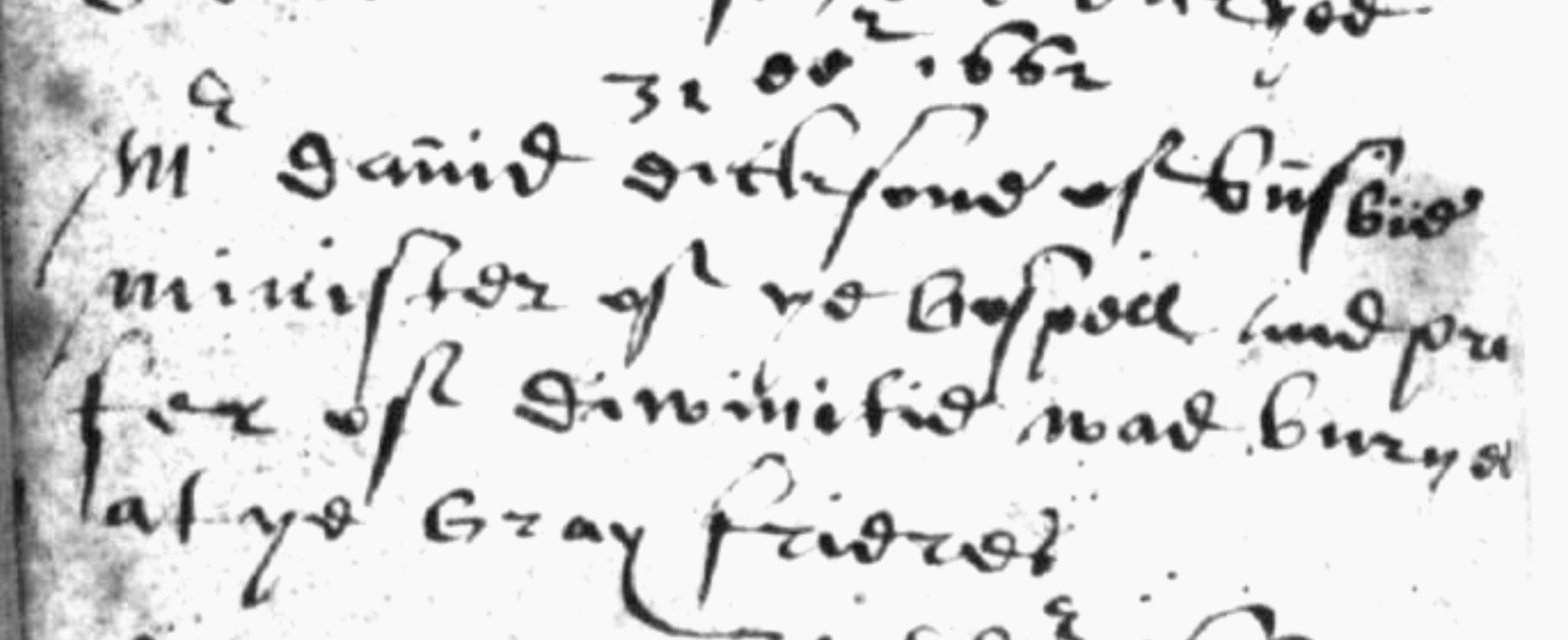
It is fitting in a many ways that David Dickson would be interred here. This is the same kirk yard in which the Covenanters met and he signed that first Covenant. [See above]
LIST OF PUBLICATIONS BY DAVID DICKSON
- 1630 ‘A Treatise on the Promises‘
- 1635 ‘Explanation of the Epistle to the Hebrews‘ Subtitled Preacher of God’s Word at Irvine
- 1643 ‘Directory for Public Worship‘ with Alexander HENDERSON and David CALDERWOOD
- 1646 ‘Expositio analytica omnium Apostolicarum Epistolarum‘ dedicated to Archibald CAMPBELL, 1st Marquess of Argyll (March 1607 – 27 May 1661) and his eldest son Archibald CAMPBELL 9th Earl of Argyll (26 February 1629 – 30 June 1685)
- 1650 ‘The Sum of Saving Knowledge‘ with James DURHAM
- 1651 ‘A Brief Exposition of the Gospel according to Matthew ‘ dedicated to the 1st Earl of Loudon, John CAMPBELL (1598 – March 1662) He was elected elder for the Burgh of Irvine in the general assembly, which met at Glasgow in November 1638 (during the plague)
- 1653 ‘Explanation of the First Fifty Psalms‘ dedicated to To the truly Honourable and relligious Ladies , my Lady Marquesse of Argyll, Margaret DOUGLAS (married to Archibald CAMPBELL, 1st Marquess of Argyll) , and my Lady Anne CAMPBELL her eldest daughter.
- 1655 ‘Explication upon the Last Fifty Psalms‘ dedicated to the 6th Earl of Cassilis John KENNEDY
- 1655 ‘A Brief Explication of the Psalms from L to C‘
- 1656 ‘Therapeutica Sacra, seu de curandis Casibus Conscientiae circa Regenerationem per Foederum Divinorum applicationem‘ Dedicated to The Countess Dowager of Glencairn, Lady Janet Kerr, widow of William CUNNIGHAME
- 1659 ‘Praelectiones in Confessionem Fidei‘
- “The Christian Sacrifice” and “O Mother dear, Jerusalem poems
- 1684 ‘Truth’s Victory over Error‘ published in the translator’s name and later corrected
A Poem of Dickson’s from “Reminiscences of Scottish Life and Character” (1861)
Sight through a Glass, and Face to Face
I Love the windows of thy grace,
thro’ which my Lord is seen,
I long to meet my Saviour’s face,
without a glass between.
Oh! that the happy hour were come,
to change my faith to sight:
I shall behold my Lord at home
in a diviner light.
Haste my beloved, and remove
these interposing days;
Then shall my passions all be love,
and all my pow’rs be praise.
On my trip to Scotland next month, I shall visit a few of the places associated with my 9th great-grandfather David DICKSON. The posts may be updated at that time.
Kelly Wheaton ©2026 All Rights Reserved
Spinning a Scottish Yarn: The Reverend David Dickson Part Three The Covenant & Glasgow
Posted on June 28, 2026 Leave a Comment
The following excerpts provide a timeline of DICKSON’s activities from 1638 to about 1650. They are pieced together from various sources. Roughly covering his last years at Irvine through his tenure at Glasgow University. There are many excerpts from correspondence between David DICKSON and Robert BAILLIE. Just looking at the places he traveled to gives you an idea of how busy he was in securing the Covenanters vision.
THE COVENANT
In 1638 the Lords Loudon and Rothes and the minister David DICKSON sent letters summoning noblemen, lairds and others to Edinburgh to support the Presbyterians—believing Christ is the sole head of the church—and not the King. The organizers were afterward known as Covenanters. David DICKSON was a signer of the Covenant at Greyfriars Church on the 28th February 1638 in Edinburgh. Upwards of 60,000 people had gathered in the city for the event. The covenant opposed Charles I’s Anglican (Laudian) Prayer Book of 1637, which he had imposed on all churches in Scotland. In August 1638 David DICKSON preached in a sermon that obedience to a ruler was neither Mandatory or necessary since it was “Better to Obey God than man.” [ Truth’s Victory Over Error David Dickson ]
“By far the most interesting of the original copies (or, as WARISTON would have called them, principal copies) of the National Covenant still known to exist, is the one in Edinburgh Municipal Museum. The extreme measurements are : across the top, 3 feet 10| inches, and from top to bottom 3 feet 7 inches. On the front there are about thirteen hundred and fifty signatures and initials, all autograph. Among them are many of the leading nobles, including Montrose, Rothes, Cassilis, and Loudon ; and such prominent ministers as Harry ROLLOCK, Edinburgh ; David DICKSON, Irvine ; and Alexander Henderson, Leuchars… It has long been supposed that this was the copy which was first signed in the Greyfriars’ Church, and, as was believed, in the churchyard. On the back of the document, however, are the words : ” At the South Kirk of Edinburgh the threttein, twentie, and xxvii dayis of Marche, 1638.” … The question remains. Which church was then known as the South Kirk of Edinburgh ? A communion cup of Old Grey friars, bearing the date 1633, is inscribed : ” For the chvrch of the svth vest [southwest] parich of Edinbvrghe ” (Burns’ Old Scottish Communion Plate, pp. 222, 223)…nineteen hundred of which are autograph signatures, and about nine hundred have been written by notaries. [From PROCEEDINGS OF THE SOCIETY, FEBRUARY 10, 1908. “BANDS” OR COVENANTS IN SCOTLAND, WITH A LIST OF EXTANT
COPIES OF THE SCOTTISH COVENANTS. BY THE REV. JAMES KING HEWISON, M.A., D.D., F.S.A. Scot pg 172-73]
A bit more detail in the Covenantors, vol. i.,’ p. 264. Of. Act. Parl. Scot., llth June 1640, v. 292-8.1638 Covenant in the Museum of the Corporation of Edinburgh. This magnificent parchment is par excellence the Covenant of 1638. It is preserved and framed between two sheets of glass. The skin, probably that of a deer, is the largest engrossed with the Covenant, and measures 43 inches long and 46 inches broad. Both sides are fully occupied with the names, initials, and marks of subscribers, 3250 in all—1350 on one side and 1900 on the other. The skin shows two cuts and one large hole. It was ” written be James Davie, Schoolmaister in Edinburghe.” Immediately below the terms of the Covenant, but in smaller script and clearer ink, appears the following addendum (of 30th August 1639) embodying the Determination of Glasgow Assembly (Peterkin, Records, 208 ; Scottish Hist, and Life, 1902, p. 98). Then follow these names in order : Montrose, Rothes, Eglinton, Cassillis, Lothian, Boyd, Forrester, Wemyss, Yester, Sinclare, Elcho, Lindesay, Cranstoune, Loudoun, Johnstoun, Balmerino, Flemyng, Lyone, and others of the nobility. Then follow the leading lairds and members of “BANDS” OR COVENANTS IN SCOTLAND. Parliament: S[ir] H[ew] Campbell, …” Mr Andro Cant” made a clear subscription, as did David DICKSON, minister in Irvine, Harie Rollok, minister in Edinburgh, many dames, doctors, advocates, ministers, magistrates ; and illiterates made marks or penned huge initial letters. Notaries signed on behalf of many others. A notarial attestation, “At the South Kirk of Edinburgh the threttein, tweritie, and xxvii dayis of March 1638,” indicates that this deed was subscribed before the 1638 Glasgow Assembly. [History of the Old Greyfriars church Edinburgh by William Moisr BRYGE with Chapter on the Subscribing of the Nat’l Covenant by D. Hay FLEMING 1912] Pg 85]
In Carol A Williams Doctoral dissertation at Calvin Theological Seminary in 2005 titled : the Decree of Redemption is in Effect a Covenant: David DIckson and the Covenant of Redemption Ms Williams credits David Dickson (1583-1662) to be the first to precisely formulate the doctrine that becomes the basis of the Covenant. “This dissertation examines the works of one of the under-investigated seventeenth-century theologians whose work illustrates development of the doctrine of the pactum salutis [the covenant of Salvation] . Despite the prominence of David DICKSON (1583-1662) in the history of the Scottish church and his contributions to the trajectory of federal theology, his work has not been adequately explored. Although discussion of the three covenants can be found in print before DICKSON, he appears to be the first to precisely formulate the doctrine in the context that became accepted as orthodoxy.”
The following are excerpts for The Letters and Journals of DICKSON’s friend Robert BAILLIE. There are many references in this volume of Letters and Journals to David DICKSON, some under the name David DICK.
From The letters and journals of Robert Baillie … M.DC.XXXVII.-M.DC.LXII we learn: in a letter to
To MR. WILLIAM SPANG. dated Feb. 27, [1638.] “From the 24th of July to the 10th of August, the posts rann thick betwixt the Court and the Counsell, which satt every other day, to finde means for peaceable introduction of the Service. There wanted not good will in the Magistrates and Ministers of Edinburgh, for to do his Majestie service, as ye may see in the minutes of the Counsell yet all was delayed to the 20th of August ; at which tyme the source Supplications which by the diligence of one man, D.D. [David DICKSON then Minister of Irvine] upon very small, or no hope of successe, was procured from Glasgow, Irwine, Aire, Fyfe, were presented, and that favourable letter which ye have before, was written by the Counsell to the King ; to the which come down that sharp reply, the 20th of September, which ye heard likewise.” [pg 32]
DICKSON “was sent to Aberdeen, with Mistrs. HENDESON and CANT, by the Covenanters, to persuade that City and Country to join in renewing the Land’s Covenant with the Lord. This brought him to bear a great Part in the Debates with the learned Doctors FORBES, BARRON, SIBBALD, etc. [Truth xvi] David DICKSON and Alexander HENDERSON took a road trip which is described in the above booklet printed in 1638 in Aberdeen and mentions stops in Aberdeen, Alford, Deer and Turiff where DICKSON had been exiled for a time [in 1622]. They were clearly securing signers and supporters of the National Covenant

“To the Christian Reader. That you may know our Proceedings, how we are , brought upon the Stage, and contrarie to out expectations, arc pre put in Print. Coming to Aberdeen, on Friday, in the afternoon, we received the Demands of Our Reverend Brethren that night late and, for the greater expedition, without delay, we returned our summarie Answers Sunday at night. On the LORDS Day following, we desired to express our selves to the People in presence of the Ministrie, but the Pulpits and Kirkes were altogether refused, and therefore in the most convenient place we could have ful dio[open air] , and at such houres as were vacant from the ordinarie exerciscs of publick Wordhip, we delivered our Message in the audience of many. After our last Sermon, towards Evening, wee found that our labour was not in vaine in the LORD: for diverse persons, of speciaall note, both for place and wisdome , with willing heart , and great readinesse of minde, did publicklie put their hands to the Covenant. Having the weeke following seene some parts of the Countrey, (where besides the Presbyteries Alforde and Deare [Old Deer Parish] , who had subscribed before, the Moderator, and diverse of the Presbyterie of Aberdene , the Presbyterie and people of Turreff , after they were satisfied in some scruples , did also subscribe ) wee returned the next Saturday to Aberdene, where finding that some others had subscribed that weeke , wee resolved to Preach upon the morne. That night wee receaved a Replye, unto which before our returne home, we have made an Answere. All these we desire may be unpartially considered : and if it shall please the LOTD, that any light should come from our labour unto thy minde, let it be ascribed not unto us, (who neither had time nor helpe for such a taske) but to the brightnesse of the Trueth, and Cause itself, and to the Father of Lights: to whom bee all Glorie.” The Answeres of some brethren of the Ministerie : to the replyes of the ministers and professours of divinitie in Aberdeene, concerning the late Covenent by Alexander HENDERSON and David DICKSON printed
1638 Monday, 3d of December, we keeped our eleventh Session. The first action was the appointment of preachers for that week… At the entriy Mr. D. Dick[son] made a long harangue of Arminianisem. I admired the witt of the man, and his dextrous expression : he refuted all these errors in a new way of his own, as some years agoe he had conceaved it in a number of sermons on the new covenant. “I was not called upon that day, so I was glad that my task was forgot ; yet at night I studied the article of free will, which before I had no tyme to confider. Mr. David‘s discourse was much, as all his things, extemporall ; so he could give no double of it, and his labor went away with his speech” [Baillie pg 150]
Monday, the 17th of December 1638 ” to have established a Professor of Divinitie among them, for now they had meanes enough for one ; Rutherfurd was named…they and we both intended Mr. D. DICKSONE : yet other great affaires hes taken all their tyme, and thir thoughts are cast by till our estate be settled.” [Baillie pg 172]
To MR. DAVID DICKSON. REVEREND AND BELOVED BROTHER, 21st of July, 1639. In a very long letter Baillie writes “If God bless yow in these endeavours, I will take yow for a blessed and happie instrument to our Church.” Baillie 178]
From David DICKSON to Baillies 1639 . “It was written in answer to this Letter as followes : As for these Overtures, whereof yow and I have been speaking, it is in my heart to indeavour them to the uttermost of my power ; and I hope in God to fee them effectuate. This is from your loveing Brother, DAVID DICKSON.” [Baillies 180]
March 30th, 1640. FOR MR. D. DIKSOUN, PROFESSOR IN GLASGOW. “REVEREND AND BELOVED BROTHER, I long much to understand how all things frames with yow in your new charge(6) ; there is no reason, that at first everie thing would be according to the mind of your friends. If that Towne and Colledge were so disposed alreadie, as to give the lyke of yow fo heartie and kind welcome as they aught, what would you have done there ? Was it not your onlie er[r]and to be God’s instrument among them, by your labours, to gett that dispoition of theirs amend ed, which this long whyle hes been to the land so offend the ; to gett the grace of God, and heartie love to those who mindit pietie, planted in their heart ? Shall we be so unreasonable as to look for those things in them at the first moment, without any of your labour, which we wish may be wrought in them, by all the paines yow can take in your whole life ?” [Baillie 244-45]
While David DICKSON was traveling about the country he still remained assigned to his post in Irvine. The National Covenant pledged those who swore to it to defend the true religion against innovations, such as those that had recently been introduced, that were interpreted by the Reformers, as against their understanding of the Bible. These disagreements led to the Wars of the Three Kingdoms. In England, Scotland and Ireland, which were still separate countries,a series of conflicts fought between 1639 and 1653 began. King Charles I wanted all under his dominion. In June 1639 under Alexander LESLIE, and the Scots Army of Covenanters encamped at Dunse Law, a 700-foot-high hill located in the Scottish Borders. DICKSON acted as chaplain of the Ayrshire regiment, commanded by the 1st Earl of Loudoun, John CAMPBELL, and later at the general assembly which, after the pacification, met at Edinburgh in August of the same year where he was chosen moderator.
GLASGOW

On the 27th Feb. 1640, Mr. David Dickson’s entered his office as Professor and Doctor of Theology. Returning to the school that had educated him must been a bittersweet homecoming, leaving his Irvine parish where he had ministered for over twenty years. The Moderators had undertaken to provide him with a certain salary and dwelling-house. Official residential chambers were built directly into the inner courtyards of the University and stone quadrangles of the old college. As seen below.

In the 17th century ‘Episcopalians’ were governed by bishops, usually appointed by the monarch; ‘Presbyterians’ were ruled by Elders of the church. The Elders were nominated by their congregations. Presbyterians had more local control, whereas the Church of Scotland was ruled by the monarch. Champions of either faction were the subject of vigorous debate. Between 1639 to 1640 the “Bishops’ Wars” began when Charles I marched to confront his Covenanter opponents in Scotland. The 6th Earl of Eglington [Alexander MONTGOMERIE], and members of his family were among those who took part in the “Bishops’ War” in the North of England on the side of the Covenanters.
Excerpts below are from the Letters and Journals of Robert BAILLIE. BAILLIE and DICKSON shared many similarities. [I have mostly left the original spelling] BAILLIE was born 1602 in Saltmarket, Glasgow, the eldest son of James BAILLIE, also a merchant and burgess of Glasgow, like DICKSON’s father. Although younger, he somewhat followed in DICKSON’s footsteps. He was licensed by Archbishop James LAW and became a regent of Philosophy in the University, and tutor to the son of Alexander MONTGOMERIE, 6th Earl of Eglinton, a good friend of DICKSON from the Irvine area. He was ordained to Kilwinning on 25 May 1631 and admitted burgess of Glasgow 6 July 1631. In 1642 he was made Professor of Divinity at the University of Glasgow, holding the chair jointly with David DICKSON.
From Baillie’s letter to To MR. WILLIAM SPANG, AFTER ABERDEEN ASSEMBLIE. [September 1640.] “When we came to the committee, all fyve acts was read[ Perth Articles]… I sett myself to perswade that his draught might be accepted, for truelie it had nothing that was contraverted : It confided of three articles ; — the Second, ” That read prayer was not unlawful!, ” Mr. D. DICK[SON] did inlarge, That it should be lawfull to read prayers, both in private and publick.” [Baillie Vol 1 pg 253]
“Act of ratificatioun of the Professor of Theologie in the University of Glasgow,” in favour of Mr. David Dicksoune,” was passed by Parliament, Sept. 11, 1641, (Acts Parl. vol. v, p. 938.)
In 1642 the Glasgow University Archive retains a manuscript [GB 248 GUA 35377] which includes an account for David Dickson for plastering, glazing, locks and keys.
This Letter in David DICKSONe’s hand I record in full. It is advice to the younger man, BAILLIE, on how to negotiate the present difficulties and challenges. :
“To MR. ROBERT BAILLIE. REVEREND AND BELOVED BROTHER, I KNOW you have your own miscontentments in the place where you are, which I foresaw and told you of before, and you have used your own way in refusing apparentlie God’s calling elsewhere ; and namelie to Glasgow, in such a way as none could but yield unto you, except they would have resolved extreamlie to crosse and grieve you ; if you doe so still, it is in vain for any man, hot for your enemies, to move any thing for your transportation. Yow know the estate of the Colledge for the present, and all our parts : yow remember also that yow have made this a main exception against the taking on a profession in the Colledge, that yow doubted whether yow might be able and fitt to discharge your self as became, whereof we and such as know yow, makes no doubt. Now the matter is so contrived in God’s providence, as I fee not how you can refuse the call, as yow will particularlie see by the bearer. Therefore my advyce to yow as to a friend is this, that yow professe to your brethren openlie, and to all your friends, that seeing the Colledge of Glasgow, which hes such interest in yow, doe call unto yow to under take a profession, which as you dare not altogether refuse, so till yow take tryall how yow may be worthie of the trust put upon yow, yow cannot so deep ingadge into as to be fad for ever : If the Colledge will be content with what yow can doe convenientlie for a year or two, whill yow are upon a course of sitting your studies for that service, then yow will yield unto them, and cannot refuse, having so fair an offer of being free, if yow find not yourself after such a tyme able and willing to be tyed dureing life unto them. If thus yow doe, I say it is weell ; your brethren and your paroche shall find yow allwayess the same ; the sentence of the Generall Assemblie is dulie respected, and yours credit is provyded for, for the present, and for tyme to come, whatsoever hand yow shall turn yourself to, after two years serving the profession as yow may. But if this course seem not good in your eyes, I should be glad to hear your reasons, face to face ; that either ye might make me of your mind, or I you of my mind, and both might rest ; for till now, doe what I could, I was never able to find a lyklie ground to goe upon to bring you hither, since the Generall Assemblie gave then’ sentence. What comfort you may, God willing, expert in our fellowship, I will not speak much of it, wishing rather reallie to be friendlie than largelie to undertake. The Lord direct you, and I rest. Your loving Brother, March 28th, 1642. DAVID DICKSONE. [Baillie Vol 2 pg 13-14]
And this entreaty a couple of months later from DICKSON.
To MR. ROBERT BAILLIE. REVEREND AND BELOVED BROTHER, BECAUSE the chock of tyme is now, when either yow must resolve this obedience of the sentence of the Synod, ere we resolve in our dayes to quite thoughts of you ; therefore, for my exoneration, I have resolved to speak home to you. Remember, that you was the first motion-maker of my coming to the Colledge, and the chief instrument of bringing it about, and that you used for arguments, such as I lay now to your doore back againe : the good of the publick, in the weell of the seminarie ; the comparison of both preaching in the kirk and teaching in the schooles, with the worth of preaching, etc ; the obligation to the Colledge of Glasgow, and to the West-countrie, for whose use chieflie it doth serve ; and others lyke. I pray you, (partialitie laid aside,) think upon how oft you have been called upon, to say no more, in. God’s providence, which is not lightlie to be looked upon? How manie Assemblies your name hes been tossed into ? How news went at Aberdeen, that you should have been fanged? for that Universitie ? And how impossible it is to keep your appellation undisscussed, except you judge Glasgow, town and presbytrie, so sensless as to quyte the sentence of the Synod with shame and skaith both ? How foolish a proposition it will be thought to be, to make ane motion of an act of never transportation of you ; and that everie wife hearer will judge it as much as if the proponers would say to the Assemblie, Settle this man in some Universitie, for there will be no rest till it be done ; and either doe it now, or else bind your own hands, never to medle with him hereafter, how usefull soever he may seem. Therefore, doe not mock yourself and others also ; either testifie your refpect to this Colledge now in tyme, or be allured to be disposed of otherwayes than either your Presbytrie or we would. If you will not delay to put this matter to a poynt, blow mist in your own eyes as yow will, you are gone [lost] to that West-countrie, as any reasonable man may see. I will seek to submitt my self to God’s will, which, within two or three dayes after this, in my expectation, will be revealed. He that refuses a calling, and he that intrudes in a calling, is [alike] blame worthy before God. I have said, and God doe as he pleases. I rest, Your loving Brother, May 15th 1642. DAVID DICKSONE. [Letters Vol 2 pg 21]
In a very long letter BAILLIES brings DICKSON Up to date. [1642]
To which Baillie replied [in part ]
REVEREND AND BELOVED BROTHER, I CANNOT but acknowledge, with thanks, your love and respects to me in all these your continued cares and pains for me. I professe your reasons and your affectionat importunitie vexes me… By God’s grace, a little after my Communion, I shall be a little peremptor ; before I cannot, for I refolve to conferre with the men I named. Wonder not at this my resolution, the matter is verie weightie ; I am weak and simple, and have powerfull attractives on both hands : but I hope the goodnefs of God, which hes ever been to me verie great, will guide this matter to all our satisfactions. I rest, Your verie loving and much obliedged Brother, Kilwinning, May l7th 1642. R. BAILLIE. [Letters Vol 2 pg 22-23]
FOR MR. DICKSON. REVEREND AND DEAR [BROTHER,] The Lord is yet going on here after his wonted way : he gives us no more outward ground of hope than is compassed with just reasons of feare, and tryes us with no more matter of fear than he setts about with evident grounds of hope…As all former disasters, so this, I hope, shall doe us good. Yesterday was a gracious day of prayer. Manchester has used all dilligence to draw down his forces ; and we trust is so strong, that Prince Rupert shall make small use of his great advantage at Newark. Though HOPTON and Sir Jacob ASHLEY be strong at Winchester, yet BALFOUR and WALLER is lying foreannent, with more resolute forces. The Parliament is much wakened. Essex at last is going to the field, with ten thousand good men : it was no wayes his fault but he had been recruited long agoe ; have with Oxford. The Admirall is making out, with fortie good ships. I hope to-day or tomorrow we mail present (as on Monday it was appointed) in the Aslemblie our modell of a Presbyteriall Ordination presentlie to be put in practice. After a thick darkness God will fend light. [Letters Vol 2 pg 155]
Letter FOR MR. W. SPANG, July 26th 1643. “1643 At the day June 22d, was a most frequent meeting, never a Parliament so great ; all the Barrones and Burghs, without exception of one, were for the common weell. The bavard Lords came with great backs, and none greater than Carnwath ; hot at once Fyfe[ Fife] and the West gentlemen came in so thick, that the backs of the others were overshaddowed and vanished. There was a great meeting of the Ministrie ; all went one way ; our reply to the King’s Answer was printed ; we were put on a remonstrance of the Church and Kingdome’s dangers. Mr. David DICKSON and I had resolved at home to be verie quiet in this meeting, and so we were ; we thought the necessitie of putting our countrey in a posture for armes great, and our assisting of the Parliament of England also neccessare against that partie, whom, we doubted not, intended our overthrow no lesse than theirs.” [Baillie Vol 2 pg 75]
To MR. WILLIAM SPANG, September 22d 1643. August 1st. “Being advisedments by my Lord Waristoun to be in town some tyme before the Synod, for advisements, Mr. David DICK[SON] and I came in on Tuesday August 1 ; where some few of us meeting in Waristoun’s chamber, advysed whom to have on committee for bills, reports, and other things.” [Baillie Vol 2 pg 83]
“1643 Sunday the sixth, Mr. David DICK preached well, as allwayes, in the New Church, before noone, but little of the present affaires; for as yet men knew not what to say, the English Commissioners not yet being come.” [Baillie Vol 2 pg 88]
The National Records of Scotland record Letter from Mr David DICKSON, professor of divinity at Glasgow, to Alexander, 6th Earl of Eglinton; rejoices at latter’s return from the army, 29th of July 1644. [GD3/5/345]
To RIGHT REVEREND [BAILLIE] , TAKING to consideration the postur of effairs as now they ar, and the insolenc of this wicked enemie, quho is now sturing, for incuraging of our pairtie, and waikening of the hands of the enemie, wee have beine thinking that it wald be most conducable for their ends, that so suin as the declaration again 11 thair wicked band beis emitted, sum abill and honest gentilmen and ministers shall deill with thes of ther shyr, and obtein, thatsthe shyr being conveined, declair this wicked remonstranc to be destructiv to our Solemne League and Covenant, and so to religioun and libertie, and thervpon ty them lelss one to another, that they will, to the vttermoft of thair indevours, oppose this combination of the enemie, and adher to the declaration emitted against the samin by Kirk and Stait [State] . This motioun wee have thouht good to communicat with you, that if yee find it convenient, it may, by you, tak farther lyf in thes bounds ; and withall wee intreat that fo fuin as yee can have the convenience of a beirer, wee may vnderftand that wee think fitt to be don heirin, for if yee allow of it, wee resolve throuh God’s help, activlie to bestur our selfs in our bounds for furtherance of the famin. Wee ar vpon Tuysday next to cum to be at Hammiltoun, the place where our Synod meits, at that tyme at fartheft wee expeft the declaration, and your judgment concerning this overtur. Thus commending yow to the grace of God, wee remain, Your affectionat Brethern, Falkirk, 2d Apr 1644. DAVID DICKSON. H. BIRSBANE. GEO. YOING [Letters Vol 2 pg 513]
To MR. DAVID DICKSONE : APRIL 29TH 1644. REVEREND AND DEAR BROTHER, YOURS, in the beginning of Aprile, we receaved yeternight. Your letters and memorie, believe it, is very sweet to all here. I hope before this you have received many of mine since the 18th of February…Yow have in my wife’s letter a paper for forraigne news…I am glad of what yow writt to Mr. Henderson of your ending the Epistles [A volume by DICKSON, entitled, ” Expositio Analytica Omnium Apostolicarum Epistolarum,” was printed at Glasgow, 1645] by all means go on with diligence in that work. I remaine in my old opinion of the great use may be of it, and of your fitness for it above any man I yet heare of: who flights it, understands it not. I yet look for a blessing on our labours ; so much the more of the sharp oppositions Satan has made hitherto to our intentions. I hope the moft of the ftorme is fallen out, that the weather shall shortlie be faire. Let me know, I pray yow, how all goes. The Lord be with yow. Your Brother, Aprile 29th [1644.] R. BAYLIE. [Letters Vol 2 pg 171-173]
FOR MR. D. D[ICKSON.] JULY 23 [1644.] REVEREND AND DEAR BROTHER, NOT knowing where you were from Aprile till the time of your son’s [John] coming hither, I directed my letters to Mr. Robert. You have in my publick letter and papers the outside of our affaires ; but the infide of the thoughts of many here is this. Our difficulties in all our affaires, both of Church and State, are great and many, as they have ever been, from the beginning till this day ; yet the Lord hes carried us through hitherto…The viclorie at Yorke, fo farr as we are informed, appears to us more and
more miraculous. We cannot praise God enough for it. It was exceeding great, and exceeding feafonable, if all the truth were known. By the assistance of your prayers, we truft to obtain from God a happie conclusion of the whole work in his due time. All our companie are, praised be God, in good health. [Letters Vol 2 pg 211-214]
FOR MR. D. D[ICKSON]. SEPTEMBER 16th 1644. REVEREND AND DEAR BROTHER, How affaires goe here you may see in my publick letters and printed papers : but beside all these, yow may know more. At this time we are put to live by faith ; for fo farr as we can reach with the eye of our sence, there is one of the thickest clouds above us that we have feen since the beginning of our affaires. Beside your troubles in Scotland, which we feare are very great, and the small hopes of carying Newcastle in haste, we walk here very heavily. We can gett money for nothing : very vast soumes are mispended…The Chancellor is here in a very needfull time. Blessed be God, all our company is in health and cheerful! ; trusting God, and resolving to doe our duty with all the care and prudence God will enable us, be the fuccefs what it may, as truely we are hopefull it mail be very good. These things to you, Mr. Robert, and Mr. George. I rest, your Brother, September 16th 1644. R BAYLIE. [Letters Vol 2 pg 229-231]
FOR MR, DAVID DICKSON. JANUARY 31st 1646. REVEREND AND DEAR BROTHER, WITHIN these ten or twelve dayes I wrote to you at great length how all affaires here went. Though I can adde little now, yet ane express going from us, I could not but write salutations. The King sends thick messages for a personall treatie. The Parliament answers as they may in their way ; so at this time they have three of the King’s to answer together : what the matter will produce, we know not yet…Our hearts are oft overburdened ; albeit on Monday the matter of tolleration went better with us than we expected, yet we are so deceaved, that we will say nothing yet. We proceed but slowlie in the Confession of Faith. This must be ended before the Catechise be resumed. The Parliament will have a Court of civill Commissioners erected in every church, on pretence to make report to the Houses in every new case of scandall, but reallie to keep down the power of the Presbyteries forever, and hold up the head of Sectaries. It’s our present work to gett that crushed, and I hope we have done some good in this. Our hearts aikes for griefe and fear for that poor land. The calamities on you, and the greater danger, seems yet to us to be above our head. The Lord arise ere we perish, so I refs, Your Brother, R. BAYLIE. London, January 31ft (Saturday) 1646. [PS] Will that fool Johnstone never take any course for your books ? My service to your wife and sonnes. The King’s designe on our armie here, if it was reall, we hope we have tymouflie prevented it. Sinclare seems to be scarce a good man. We are on vindication of ourfelfes from scurvie aspersions, to the shame of the foolsh contryvers. [Letters pg 347-349]
FOR SCOTLAND. To MR. DICKSON. MARCH I7TH 1646. SINCE my lad, this day fortnight, all the account I can give of our affaires here is this. In the Aflemblie we are fallen on a faftiious propofition, that hes keeped us diverse dayes, and will do fo diverse more, coming upon the article of the church and the church-notes to oppofe the Eraztian heresie, which in this land is very strong, especiallie among the lawyers, unhappie members of this Parliament…The King will not in a fortnight know whither to go. Never man did him worse service than Montrose, and all thefe men who have weakened and divided Scotland : I believe the King feels that folly, among other errors, which now he cannot remeed. A few days will clear many things of Church and State that for the time are in great darkness. London, March 17th 1646. POSTSCRIPT…If my Lady Argyle be with you, remember my heartie affections to her, and to my Lord, and all his : for all that is come, he is my choice of all the Noblemen I know : The Lord be with him, and aflift him. Remember me to all friends. So I rest, Your Brother. 31st March 1646 [Letters pg 360-362]
FOR MR. DICKSON. AUGUST 18th 1646. IN the Assemblie we are returned to the Confession of Faith, and are drawing towards the end of it. The Catechise is almost all past through the Committee. If these were done, lyklie the Assemblie may adjourne, that the members thereof may go downe to their severall shyres, to assist the erecting of sessions, presbyteries, and synods. They have gone on in London, and chosen many very gracious and able elders. [The tumult across Europe has put the fighting against the Presbyterian Army less profitable and there is lots of bargaining to be had.] [Letters pg 390-392]
FOR MR. DICKSON. 22nd SEPTEMBER 1646. REVEREND AND DEAR BROTHER, IT’S lyke tomorrow James Gray may agree with some stationers to sell your books as they may best [Expositio Analytical] : We purpose to sett in a half-meet, in the be-ginning, the order of the House of Lords, and the Elogia, that we three and some other divines here has and mall write upon it If the Lord send us peace, I wish God may give yow time and srength to goe on with the whole work : It will be exceeding profitable ; and because it will not be posslble to bring it into a manuell, as yow first intended it, I think yow need not hamper yourself into too great a shortness, but take a little more libertie ; for it will be the more pleasant both to yourself and your hearers...We have ended the Confession of Faith for the matter, and have perfected the most half of it, nyneteen chapters ; the other seventeen, I hope, in ten or twelve days will be perfected, and so all be sent up to the Houses…If that choyse fall wrong, Scotland is in hazard to be ruined. It’s lyke yow may fee the Marquess of Argyle shortlie : The Lord help him out of his trouble ; his enemies are many, and friends for any purpofe bot few : yet God is not dead. My service to Margaret, and Mr. John, and all the rest. I rest, Your Brother, London, 22d September 1646. R. BAYLIE. [Letters pg 397-398]
While David DICKSON was serving as a captain in the covenanting army during the civil war he overheard James DURHAM exhorting his soldiers concerning their souls. Recognizing his ministerial gifts DICKSON told him, “Go home, Sir, for you seem to be called to another work than this!” About 1645 DURHAM entered the University of Glasgow and studied divinity under DICKSON “There the holy and learned Mr. DURHAM passed his trials, and was earnestly recommended by the Professor [DICKSON] to the Presbytery and Magistrates of Glasgow, and in a little Time ordained Manlier to that City. Great was the Friendship and Familiarity between these two eminent Lights of this Church there ; and among other effects of their familiar Conversation, which still turned upon profitable Subjects and Designs, we have, the “Sum of Saving Knowledge,” which hath been so often printed with our Confession of Faith and Catechisms.” [The Bullwark Jan-Mar 2010: The Authors of ‘The Sum of Saving Knowledge’ Matthew Vogan pg 18.] James DURHAM graduated M.A. Glasgow, 1 May 1647 in record time Durham such was his outstanding acumen. He was ordained to Blackfriars in Glasgow. He was licensed for the ministry by the Presbytery of Irvine 18 May 1647. In 1650 he was appointed professor of divinity at Glasgow University. But before he was settled in that office the general assembly decided that he should attend as chaplain to the king. DURHAM died 25 June 1658 of Tuberculosis.
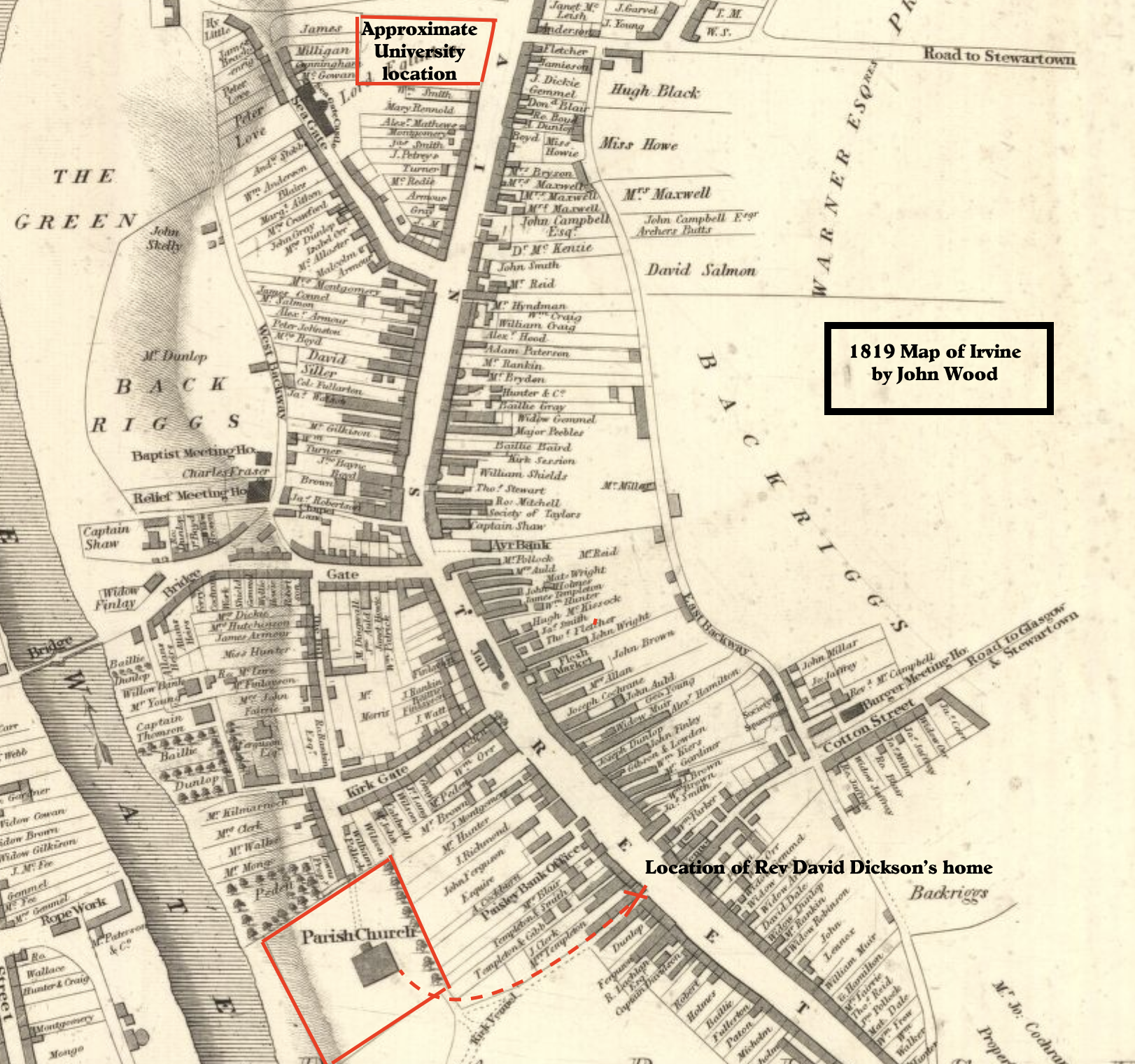
As fate would have it six years later, in 1647 the plague was raging in Glasgow. The Masters and Students of the University removed to Irvine upon Mr. DICKSON‘s Motion. Prior to the 1647 relocation, the Irvine Burgh Council had actively supported the University and besides David DICKSON, many prominent University leaders, such as John STRANG (1584–1654) had served in Irvine. The university’s operations were said to have been located in a Malt Barn behind the Elephant Inn off Eglington Street bounded by Seagate. Note it is labeled in the 1819 map by John Wood as Lord Eglinton’s property. So it makes perfect sense that when the University left Glasgow in 1647 Alexander, 6th Earl of Eglington would lend his property in Irvine.

According to a document titled “Typed Copy of the Faculty of the College of Glasgow” [GB 248 GUA 34628] at Irvine dated April-October 1647 we know the University operated there for at least 6 months— About this Time, Mr. DICKSON had a great share in the printed pamphlets upon the unhappy debates betwixt the Resolutioners and Protestors. He was in his Opinion for the public Resolutions, and most of the Papers upon that Side were written by him.”
I am unable to find what DICKSON was up to in 1648-1649. His correspondence with BAILLIE is strangely silent. This however was during the second English Civil War. A faction of the Covenanters known as the “Engagers” formed an alliance with King Charles I . In January of 1649 King Charles 1 was executed and Charles II took the throne. Another more radical branch of the Covenanters The Kirk party was led by the Marquess of Argyll and backed Charles II.
It was during 1650 he wrote ‘The Sum of Saving Knowledge‘ with James DURHAM. The conversations took place in the afternoons bteween the two as they walked in the Craigs area of Glasgow, now known as the Necropolis. It is said to have been dictated by both men to another minister, Patrick SIMSON (George GILLESPIE’s cousin). In 1650 DICKSON was transferred to the Chair of Divinity at Edinburgh. We will continue the final chapter in 1650.
Brief outline from above when not otherwise in Glasgow:
- Feb 1638 Edinburgh: Greyfriars signing of Covenant
- Mar? 1638 on road to Aberdeen, Alford, Deer, Turiff to urge signers to the Covenant
- Dec 1638-1644 Glasgow
- Apr 1644 Falkirk
- Mar 1646 Inverary–with Marchioness of Argyll
- Apr-Oct 1647 Irvine
- 1648-1650 Glasgow
Kelly Wheaton ©2026 All Rights Reserved
Spinning a Scottish Yarn: The Reverend David Dickson Part Two Irvine
Posted on June 22, 2026 1 Comment
In part one we visited David DICKSON’s early life in Glasgow. The next part of the story Begins in Irvine where David DICKSON was a minister for 23 years. Be forewarned it took an unexpected twist. I am grateful to Ian DICKSON (no relation) and Billy KERR for allowing me to quote from their work and research. They have filled in pertinent details of David’s tenure in Irvine, Ayrshire, Scotland.
Mostly when we write about the past there’s a tendency to burnish the rough edges. Going back to 600 BCE we are admonished “De mortuis nil nisi bonum” Of the dead, say nothing but good. The idea being that the deceased are not here to defend themselves. As a family historian we must look at all aspects and come to our own conclusions. We cannot do that if we only report the good, as that falsifies history or only the bad as if taken out of context.
IRVINE
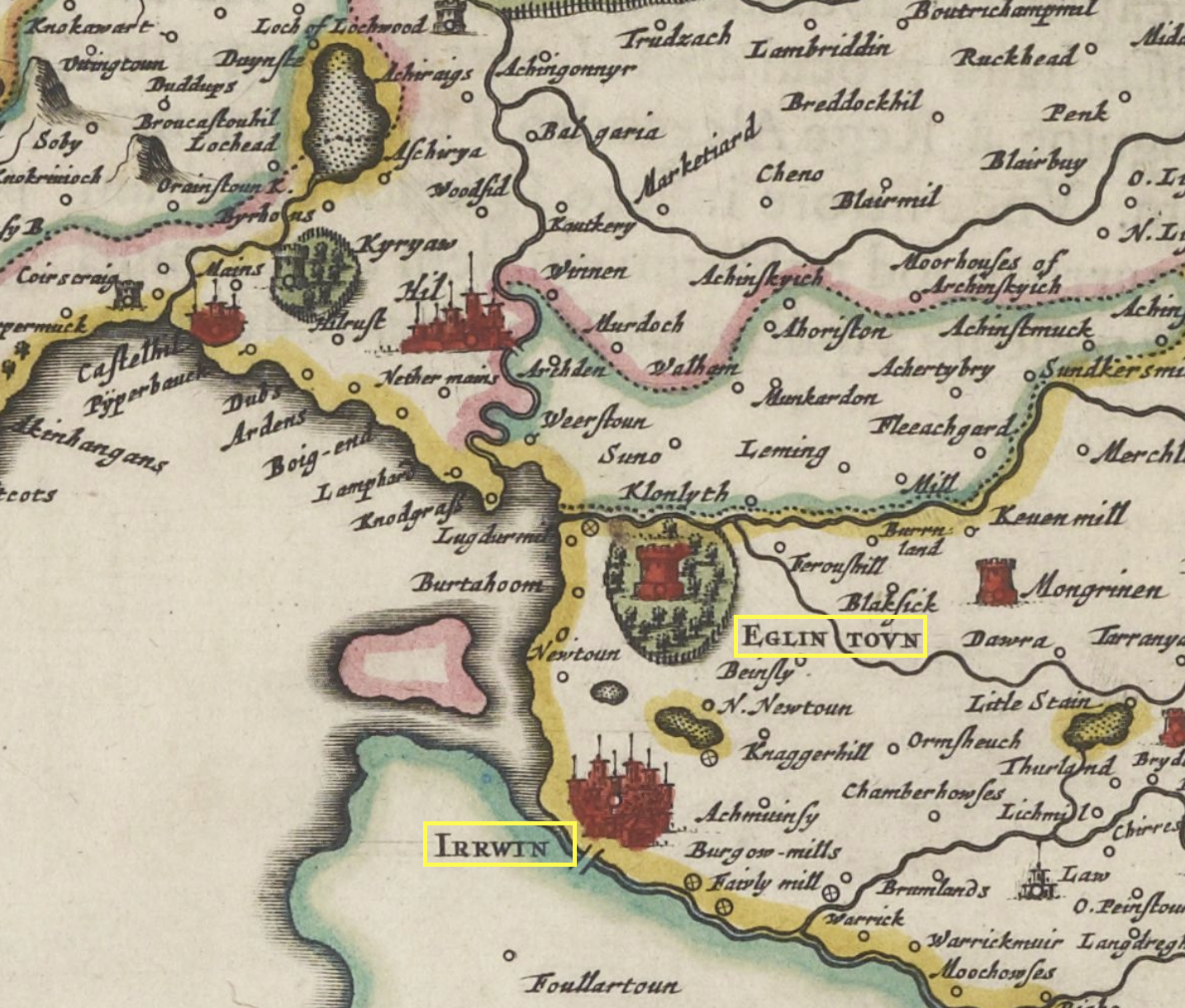
Irvine is one of Scotland’s oldest royal burghs, chartered by King Robert the Bruce in 1308, and formerly the capital of the Cunninghame district. The Map above is a part of Cunninghame. Irvine is described as a busy seaport situated on a rising sandy ridge on the north bank of the River Irvine. Eglintovn on the map is the seat of MONTOGOMERIE’s of Eglinton.
Before I go further I must talk a coincidence. My friend Sissy and I are distant cousins on the Isaac SHELDON line. Well it turns out she is going on a last minute trip to Scotland in July 2026 and we were comparing notes. It turns out her ancestor and mine were both ministers of the Parish Church at Irvine, Ayrshire, Scotland. This is a list of Irvine’s first 15 ministers. Mine was Rev David DICKSON the sixth and hers was Charles BANNATYNE, the fifteenth.
1 1562 – John Lynd
2 1567 – Robert Hamilton
3 1570 – John Young
4 1584 – William Strang
5 1589 – Alexander Scrimgeour
6 1618 – David Dickson
7 1642 – Hew Mackaile
8 1650 – Alexander Nisbet
9 1662 – John Grant
10 1669 – George Hutchison
11 1676 – John Stirling
12 1684 – William Hamilton
13 1688 – Patrick Warner
14 1709 – William McKnight
15 1751 – Charles Bannatyne
After his marriage 23 Sept, 1617, David DICKSON was ordained a Minister 31st March 1618 and appointed to the Town of Irvine. The Parish Church of St Mary the Virgin often shortened to St Mary’s was demolished in 1772 to make way for what is now called the Irvine Old parish Church. St Mary’s was originally a small chapel that belonged to the monks of nearby Kilwinning Monastery. After the downfall of the Abbey under the dissolution of the monasteries, in 1603 the Patronage of the Church of Irvine, passed to Hugh MONTGOMERIE, 5th Earl of Eglinton. The Lord of the Manor exercised his right until the ministry of Dr. Sommerville whose service began in 1863.
A stone carved with the date 1506 and the initials “MQ” (thought to commemorate a visit by Margaret Tudor, Queen of Scots) survives from the old chapel and it is built into the west wall of the current church. From The Irvine Burns Club quoted with permission: “Early mention of St. Mary’s Church occurs in the agreement between the Burgesses of Irvine and Brice the Earl of Eglintoun in 1205. It was built “small and rude of freestone ashlar” and was cruciform in shape, lit by narrow lancet windows turned with two arches. The oak panelling exhibited in Irvine Burns Club is a relic of this early Church. The carving is a fine example in the style of the Flemish Guild and the inscription, in Greek, reads: “Blessed are they who hear the word of God and keep it. “
“The Rev. David DICKSON lived in a manse located at the corner of the High Street and Kirk Vennel (a Barbershop is now there) in Irvine which had a large Hall that he used for gatherings.” Again from the The Irvine Burns Club with permission Ex-Provost John Paterson, writing c.1892 (handwritten notes, p.62), of David DICKSON’s house: “it was an antique plain two storey house, and projected about ten feet further out into the High St than its successor …The Manse presented a Gable end to the High St with a door & small windows facing down the street. The Garden runs parallel with the Vennel, and a built up door is still to be seen in the Wall, which would open into the passage leading to the small Gate into the Kirkyard, but which is now included in the Burial Ground.” (McJannet, p.146, mentions all the kirkyard-adjoining gardens as having gates, as a practice accepted in Irvine, but dissuaded in some other parishes.)” From Billy KERR’s article on David DICKSON: “Interestingly, the birthplace of Irvine’s ‘great awakening’ occurred just across the road from the Porthead Tavern outside the premises of Lennons the barber at the Kirk Vennel/ High Street corner, which was then David Dickson’s manse. At the right gable of the barber’s shop is an ancient close (still seen today) which led to a footpath that ran parallel along Kirk Vennel to exit at Dickson’s Gate in the kirkyard wall. Under this very lintel ‘The Apostle of the Covenant’ would have stooped on countless occasions on his way to and from the parish church. In recent years Dickson’s Gate was been under threat due to encroaching nearby trees and the old wall being allowed to fall into a state of disrepair, however Kirk yard custodians redeemed the situation when they did an excellent job in restoring this historic symbol of a humble man who God once used so powerfully.“
From “On p. 59, Paterson notes: “From 1630, DICKSON’s Manse at Irvine was said to be a refuge for many of the ousted Ministers both from Scotland & Ireland from which latter country especially they were pursued with relentless cruelty by the Bishops. Situated within the Port of the Burgh where a guard was kept night and day by the Burghers & having the goodwill of the Magistrates of Irvine as well as of the Bailie of CUNNINGHAME, The Earl of Eglinton, David Dickson was placed in a vantage ground to defy the Bishops & even Royalty itself that but few of the Clergy of the time enjoyed. The Guard at the Towns Port had only to give the alarm and a thousand strong arms & willing hearts would have surrounded the old Manse to defend the Minister.” So as a refuge for fellow minsters it appears DICKSON did good.
WITCH TRIALS IN IRVINE 1618
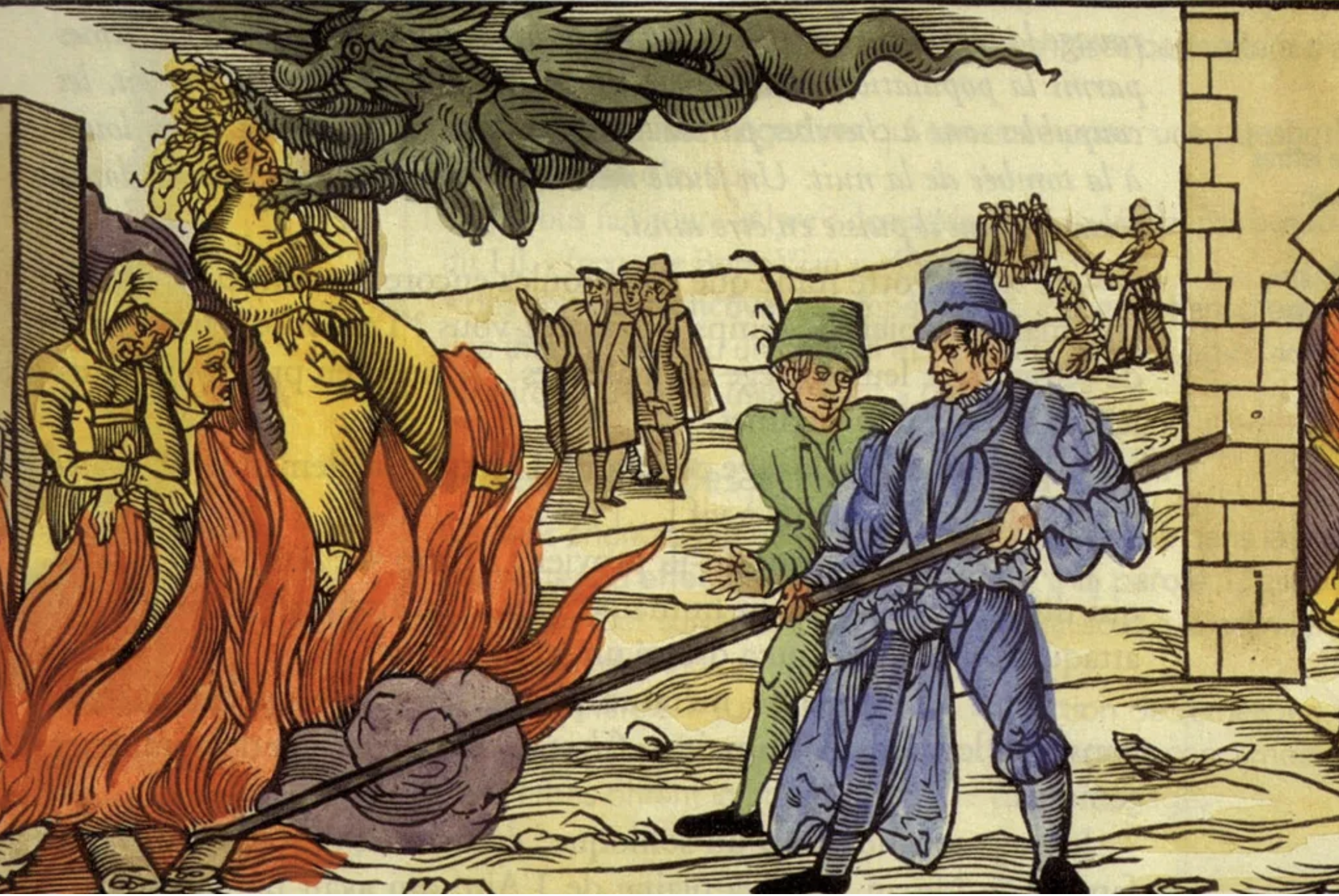
In the same year that David DICKSON is appointed as minister to Irvine a disturbing witch trial was held there. In Sir Walter SCOTT’s book Letters on Demonology and Witchcraft about 1830. In it he recounts the distressing account of Margaret BARCLAY and 3 others accused of witchcraft in 1618 at Irvine. It is ten pages long and he took the material from their original sources [Click on the title to read directly]. I will quote from Billy KERR’s account of “JOHN PEEBLES PROVOST/ MAGISTRATE OF IRVINE” for a succinct account :
WARNING not for the squeamish
In the year 1618 an appalling miscarriage of justice took place in Irvine which Sir Walter Scott described in his Letters on Demonology and Witchcraft as “the most detailed specimen I have met with of a Scottish trial for witchcraft, illustrating in particular, how poor wretches, abandoned, as they conceived, by God and the world, deprived of all human sympathy, and exposed to personal tortures of an acute description, became disposed to throw away their lives that were rendered bitter to them by a voluntary confession of guilt, rather than struggle hopelessly against so many evils.” [Scott pg 264]
“This heart-rending occurrence recorded for posterity as The Trial of Margaret Barclay resulted in the agonized deaths of, Isobel INCH an elderly woman, vagrant John STEWART, beautiful young mother Margaret BARCLAY and Isabel CRAWFORD who was in the full bloom of youth. They were accused of being involved in a satanic plot that was widely believed to have caused the Irvine vessel ‘The Gift of God‘ to be wrecked of the coast of Cornwall, causing most of the local crew, including Provost Andrew TRAN to perish. A Justice Court comprising of magistrates and ministers was commissioned to conduct legal proceedings, one of whom was former Provost John PEEBLES.“
“Isobel INCH was the first of the coven to perish as a result of the brutal treatment meted out to her by her accusers. She endured several days of pitiless interrogation before succumbing and promising to make a formal confession the next day. That same night in desperation she flung herself down from the kirk belfry where she had been imprisoned. Although critically ill from her fall, she was still pressed to admit her part in the demonic scheme. She died from her injuries five days later maintaining her innocence to the last minute of her life.“
“John STEWART, an itinerant juggler, likewise resorted to desperate measures to relieve his sufferings. Incarcerated in the tollbooth, he was so securely fettered that he pleaded with the Rev David Dickson who attended him during the trial, that “I am so strictly guarded that it lies not in my power to get my hand to take off my bonnet, nor to get bread to my mouth.” Later, being left unattended with his shackles loosened, he seized the moment and committed suicide by strangling himself with a piece of hemp used to tie his bonnet.“
“Margaret BARCLAY was a spirited, high tempered, young woman, who steadfastly denied all the “divilish practices” made against her. The most incriminating evidence the Justice Court had against her was that she carried a piece of rowan tree and a colour thread, to make, as she said her cow to give milk when it failed. To overcome her resolve the inquiry proposed a method of ‘gentle torture’ as this would take into account her age and sex. This tender torment consisted of placing Margaret’s legs in the stocks and loading her bare shins with iron bars until she acknowledged her guilt, the weights were removed only when she promised the inquisition that she would tell them what they wanted to hear. On her last day in court she implored ‘All I have confessed was in agony of torture, and before God, all I have spoken is false and untrue.’ After sentence was passed she was immediately taken to a place of execution outside the old burgh boundary known as Springfield, just about where Malcolm Gardens is today. Having made many expressions of religion and repentance, this poor soul met the fate of most convicted witches in Scotland by being strangled at the stake, then having her body burned to ashes.“
“Three innocent lives lost by barely credible allegations, the magistrates sought a fourth. After the Rev David DICKSON failed with earnest prayers to open the ‘obdurate and closed heart”’of Isobel CRAWFORD; she also was introduced to the “gentle torture”. It is recorded that Isobel endured her torment with unbelievable firmness, suffering in silence, with above thirty stone of iron laid on her legs. Only when the bars were moved to other parts of her legs she relented with cries of ‘ak af, tak af, and I sall tell all’ After her confession she then experienced the same cruel end Margaret BARCLAY suffered. However, at her judicial killing, she absolutely rejected the consolations of religion, and raged at the great injustice by constantly interrupting the minister in his prayers and totally refusing to pardon the executioner, as was the custom. Fastened to the stake, this blameless girl died a bewildered raving maniac.
Three mentions of David DICKSON from Sir Walter Scott’s text: “My Lord and Earl of Eglintoune (who dwells within the space of one mile to the said burgh) having come to the said burgh at the earnest request of the said justices, or giving to them of his lordship’s countenance, concurrence and assistance…And upon that same day of the assize, about half an hour before the downsitting of the Justice Court, Mr. David DICKSON, minister at Irvine, and Mr. George DUNBAR, minister of Air, having gone to him [John STEWART] to exhort him to call on his God for mercy for his bygone wicked and evil life, and that God would of his infinite mercy loose him out of the bonds of the devil, whom he had served these many years bygone, he acquiesced in their prayer and godly exhortation…” [Scott 259]
[At the trial of Margaret BARCLAY] “… my Lord of Eglintoune, the said four justices, and the said Mr. David DICKSON, minister of the burgh, Mr. George DUNBAR, minister of Ayr, and Mr. Mitchell WALLACE, minister of Kilmarnock, and Mr. John CUNNINGHAME, minister of Dairy, and Hugh KENNEDY, provost of Ayr…” [Scott 261]
“Isobel CRAWFORD, inculpated by Margaret BARCLAY’s confession. A new commission was granted for her trial, and after the assistant minister of Irvine, Mr. David DICKSON, had made earnest prayers to God for opening her obdurate and closed heart, she was subjected to the torture of iron bars laid upon her bare shins, her feet being in the stocks, as in the case of Margaret BARCLAY. [Scott 263]
RECKONING
I was a few weeks into researching David DICKSON’s life when Billy KERR brought me back to reality, by introducing me to DICKSON’s participation in the famous Witch Trial in Irvine. Billy’s paraphrasing of the historian’s challenge to “never judge a man by your time, but by his” is good advice. On the one hand a well respected, compassionate theologian and minister. On the other DICKSON exemplifies the religious hysteria that led to accusations of witchcraft of approximately 4000 people in Scotland during the period from 1563-1736 and the execution of roughly 2500. This rate was 5 times higher than the rate of Europe overall. Perhaps this can be explained by widespread Celtic beliefs in folk magic, fairies, changelings and the healing arts as practiced by wise women. Both clergy and their parishioners were primed to believe in witches.
It is particularly noteworthy that the online and printed biographies of David DICKSON leave out this part of DICKSON’s life. Is this to paint a more sympathetic character and not to shock our modern sensibilities? I dare say it lays bare the contradiction of religious extremism. Tragic events must be accounted for, and not unlike Aztec or Hawaiian rituals of human sacrifice that we now consider barbaric, they strike to the core of the human need for explanation or even appeasement of their gods. In many cases an unholy union between church and state that essentially keeps people in their place and punishes those least able to defend themselves that dared to stray beyond established norms.
Whether reading about the Salem Witch trials in America or this one in Irvine, Scotland, it seems that accusing someone of witchcraft was often a way to rid yourself of inconvenient , or quarrelsome people, or hated enemies and/or misguided attempts to explain away tragedy or illness. In the case above this was a tragedy, in search of someone to blame. There had already been an ongoing quarrel between the wives of two brothers Archibald DEIN and his brother John DEIN. Archibald was the Burgess of Irvine and his wife was the accused Margaret BARCLAY and his brother John DEIN’ s bark [ship], ironically named, ‘The Gift of God’ was to sail for France, and Andrew TRAIN, or TRAN, provost of the burgh of Irvine, who was an owner of the vessel, went with him to superintend the commercial part of the voyage. John DEIN and Andrew TRAN perished and only two sailors survived. John DEIN’s wife, Janet LYAL, now a widow finds an opportunity for revenge. The whole sordid tale is based on tainted testimony. At the time the accused were not afforded legal representation at their trials—which were a mockery at best. Lest we think we have completely moved on—scapegoating is still in practice today, although no longer under the guise of witchcraft.
To add some more historical context, the Scottish Witchcraft Act of 1563 made the practice of witchcraft, sorcery, and necromancy, as well as consulting with witches, capital offenses punishable by death. In 1590 King James VI [later James I of England] deeply feared witchcraft, and famously blamed witches for the storms that nearly sank his ship while he was returning from Denmark. He authored a treatise titled Daemonologie in 1597. It was not until Great Britain, in the Witchcraft Act of 1735 revoked all previous Witchcraft Acts and ruled that witchcraft was not a crime. And on Woman’s Day 2022 Scotland’s First Minister Nicola Sturgeon addressed an apology “Some will ask why this generation should say sorry for something that happened centuries ago,” “But it might actually be more pertinent to ask why it has taken so long.” Sturgeon called the accusation, conviction, vilification and execution of those under the Witchcraft Act 1563 an “egregious historic injustice“. She extended a “formal, posthumous apology” on behalf of the Scottish government.
The Kirk of Scotland and its evangelical Presbyterian factions were almost entirely responsible for the 17th-century witch trials in Scotland. The times brought overly zealous Protestants keen to enforce their version of morality. Catholics after the Reformation had been marginalized and persecuted, playing virtually no role in witch hunts. The Scottish Reformation led by John Knox established Calvinism as the state religion. The pursuit of witchcraft became highly systematized including Kirk Sessions, local parish disciplinary committees, and were often led by Presbyterian ministers and elders, who investigated immoral or ungodly behavior. They gathered evidence against suspected witches. Presbyterians believed they had a direct covenant with God and viewed witchcraft not just as a crime, but as a threat from the Devil himself, that in turn might bring down the wrath of God in the form of all manner of evil. So it was not a simple matter in the established Ptresbyterian orthodoxy.
To be fair, to begin your ministry, as DICKSON did, and be thrust into a witch trial —made for a trial for DICKSON himself– “these are the times that try men’s souls“. Did these scenes, even if he believed he was correct in trying to save their souls, did they haunt him from time to time? It makes we wonder how this may have affected him going forward. Whether the compassion that he seemed to display was influenced by these events. It appears DICKSON was sincere in his prayers for these unfortunate souls, however misguided we know those prayers to be now.
“If we look back into history for the character of present sects in Christianity, we shall find few that have not in their turns been persecutors, and complainers of persecution. The primitive Christians thought persecution extremely wrong in the Pagans, but practised it on one another. The first Protestants of the Church of England, blamed persecution in the Roman church, but practised it against the Puritans: these found it wrong in the Bishops, but fell into the same practice themselves both here and in New England.”
Benjamin FRANKLIN Letter to the London Packet, 3 June 1772
Or as Jesus said at the Sermon on the Mount. “Judge not, lest ye be judged.” But judge, we do…and too often in the name of a religion or God who would not recognize the mayhem we have created in his/her name.
IRVINE Continued
In 1620 DICKSON was named in a leet of seven [list of candidates] to be a minister in Edinburgh, but since he was suspected of nonconformity his nomination was not promoted. The birth of his children is roughly as follows John 1620, Margaret 1622 , James 1624, David 1626, Alexander 1628, Robert 1630 and Andrew 1632, Archibald 1634 [listed as youngest son in deed dated 15 July 1659 Rh/28/137]. All assumed to have been born in Irvine. Billy KERR has supplied me with an old Photo of a grave of Alexander COCHRANE and his wife Margaret DICKSON recorded on this memorial she is said to be the daughter of David Dickson. “Sadly the stone no longer exists, probably dumped into the nearby river by gravediggers, as they were once prone to do.” It reads “her lys the corps of the truly peious Alexander COCHRANE merchant ? husband to Margaret DICKSON who departed thus life the 11 of Apreie 1688 His age 76 When thou art herd thou ? as with ? prayse God to thee?” This would make him born about 1612 and not unlikely somewhat older than his wife—so Margaret, very likely a daughter of David.
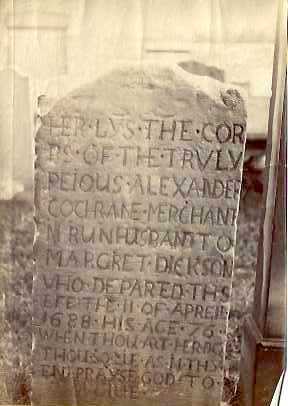
January 29, 1622 David DICKSON was summoned to appear before the High Commission, by Janus LAW, Archbishhop of Glasgow. He was summoned because he was outspoken in condemning the Five Articles of Perth. King James in 1618 aimed to align the Church of Scotland with that of England by a set of controversial liturgical rules. DICKSON appeared, and gave a paper declining the jurisdiction of the Court. He was sentenced to deprivation of his ministry at Irvine, and ordained to proceed to Turriff, in Aberdeenshire, within twenty days. He continued preaching almost daily until his time was up and was then was about to commence his journey to the North.
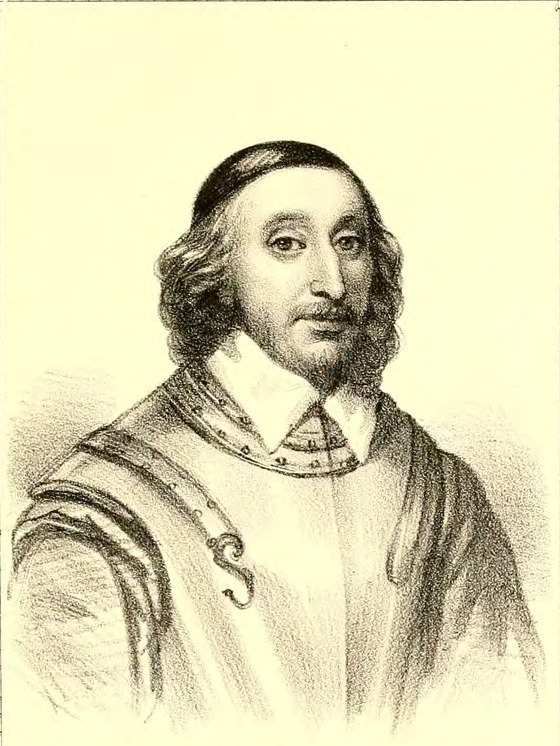
At the request of the Alexander MONTGOMERIE, 6th Earl of Eglintoun, he was permitted to remain in Ayrshire, where for about two months he preached weekly in the hall and courtyard of Eglintoun Castle to large congregations of his parishioners. He was then ordered by the Archbishop of Glasgow to set out for the Turiff which he did. The 25th of April 1622 Instrument recorded narrating that Mr David DICKSON, minister at Irvine, entered himself in free ward in town of Turriff [GD172/2476] it is said DICKSON stated “The will of the Lord be done; though ye cast me off, the Lord will take me up. Send me whither you will. I hope my Master will go with me; and as he has been with me heretofore, he will be with me still, as being his own weak servant.”
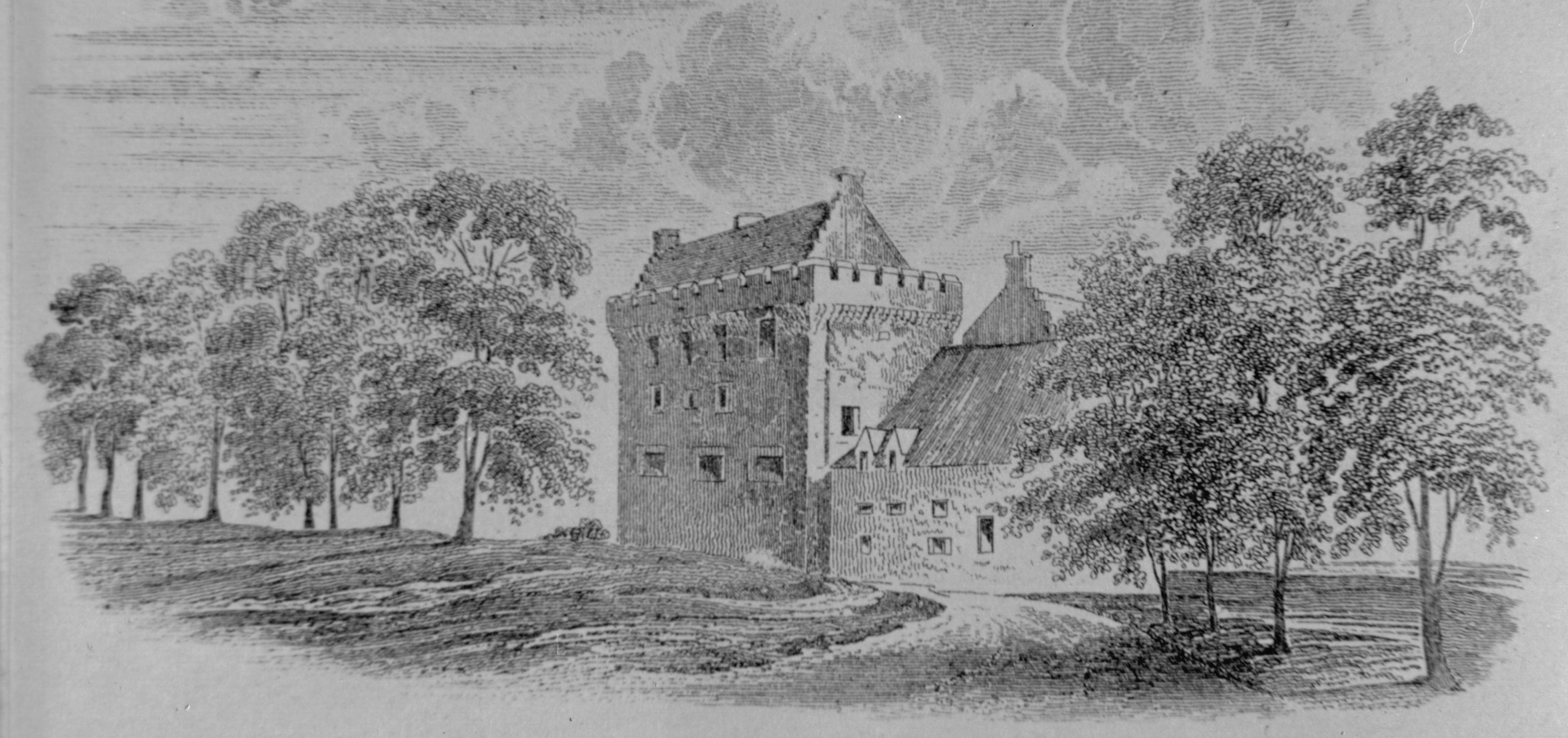
This is the same Lord Eglinton who hosted David DICKSON’s services in 1622 . The Eglinton Estate and Castle were home to the MONTGOMERIEs of Eglinton, who were the Earls there for nearly 800 years and among the most powerful families in Scotland. Alexander MONTGOMERIE, 6th Earl of Eglington (1588 – 1661) would have been a contemporary of David DIXON. Alexander was a staunch Presbyterian, chiefly owing to the influence of David DICKSON during his time as minister of Irvine. Alexander was one of the commissioners at parliament in 1621 who voted against the five articles of Perth as did David DICKSON. After DICKSON was deprived of his ministry at Irvine for publicly protesting against the five articles, the Earl obtained for him freedom to come to Eglinton and visit his family at Irvine. The Records of Scotland record a Letter dated 24th of March 1623 to Mr David DICKSON, minister at Irvine from Alexander, Earl of Eglinton regarding the writer’s efforts to persuade the bishop to allow DICKSON to return to his parish. [GD172/279]. The Earl and others eventually being successful, DICKSON was permitted to return to Irvine in July 1623. On his arrival at Eglinton, the Earl arranged that he should preach in the hall of the castle, and afterwards in the close, when the multitudes who thronged to hear him became too great for the hall.
A most interesting book “The Ladies of the Covenant: Memoirs of Distinguished Scottish Female Characters Embracing the Period of the Covenant and the Persecution” by James ANDERSON 1862 Some mentions of Davis DICKSON:
LADY ANNE CUNNINGHAM, MARCHIONESS OF HAMILTON. “The bishops had procured all the dissatisfied ministers to be discharged the town, so divers of them, upon the last day of the Parliament, went out to Sheens [Kirk o’ Shotts 16 miles east of Glasgow] , near Edinburgh, where in a friend’s house they spent the day in fasting and prayer, expecting the event, of which they were as then uncertain. After the aged ministers had prayed in the morning with great straitening, at length a messenger from the city, with many tears, assured them all was concluded contrary to their request. This brought them all into a fit of heaviness, till a godly lady there present, desired Mr. David DICKSON, being at that time present, might be employed to pray, and though he was at that time but a young man, and not very considerable for his character, yet was he so wonderfully assisted, and enlarged for the space of two hours, that he made bold to prophesy, that from that discouraging day and forward, the work of the gospel should both prosper and flourish in Scotland, notwithstanding all the laws made to the prejudice of it.” Kirkton has not recorded the name of the lady who suggested that Dickson should be employed in prayer ; but Livingstone, who narrates the same incident in his Memorable Characteristics, informs us that Lady Culross told him she was the person by whom the suggestion was made.” [Ladies of the Covenant pg 36 about 1620] Lady Anne CUNNINGHAM’s daughter was married to Hugh MONTGOMERIE 6th Earl of Eglinton.
LILIAS DUNBAR, MRS. CAMPBELL [Lilias Dunbar was the only daughter of Mr.DUNBAR of Boggs, by his wife, Christian CAMPBELL, daughter to Sir John CAMPBELL, fifth knight of Calder]: “During the persecution, the adherents of Presbytery, though most numerous in the south and west of Scotland, were scattered more or less numerously over the northern counties. Even so far north as Morayshire, and in some of the neighbouring shires, not a few of them were to be found. The gospel had been preached in these remote parts, with considerable success, by Mr. Robert BRUCE, Mr. David DICKSON, and other ministers who had been banished thither by James Vl or by the high commission court, for their opposition to the introduction of prelacy, and the fruits of the instructions of these eminent men remained even to the persecuting times.” [Ladies pg 292 before 1625]
As above, DICKSON returned to his parish in Irvine in July 1623. From all accounts he was a very popular and persuasive Minsiter. “At Irvine, Mr. Dickson’s Ministry was singularly countenanced of God. Multitudes were convinced and converted ; and few that lived in his Day were more honored to be Instruments of Conversion than he.” [Wodrow pg xiii] People came from far and wide to ear him preach and many settled in Irvine. “Mr. Dickson had his Week Day Sermons upon the Mondays, the Market-Days then at Irvine. Upon the Sabbath Evenings, many persons under Soul Distress, used to resort to his House after Sermon, when usually he spent an Hour or two in answering their Cases, and directing and comforting those who where cast down, in all which he had an extraordinary Talent ; indeed he had the Tongue of the Learned, and knew how to speak a word in Season to the weary Soul. In a large Hall he had in his House at Irvine, there would have been, as I am informed by old Christians, several Scores of serious Christians waiting for him, when he came from the Church.” [Wodrow pg xiv] ” On 23rd of Nov 1624 the College of Glasgow and David Dickson, presenter of Glasgow and others of the parsonage and vicarage of Kilbride and Torrance were party to an Agreement. [GB248 GUA 20788]
STEWARTON SICKNESS
This is a wonderful telling of the “Stewarton Sickness” from Billy KERR: “This sacred phenomenon received its name from ‘The daft people of Stewarton’ as they were mockingly called who traveled to Irvine to hear the parish minister [DICKSON] preach. The Stewarton minister at the time William CASTLELAW encouraged his congregation to journey to the Townhead to attend the Monday morning market which was always preceded by a talk from the Irvine minister. From those weekday sermons this particular out-letting of the Holy Spirit began, quickly spreading from house to house for miles around and then sweeping further a field across Ayrshire. Within a few weeks thousands of people were flocking from all over Scotland to listen to David Dickson preach. The ‘Stewarton Sickness’ lasted lasted five years (1625-1630) and its impact would be felt for generations to come. It is said that David Dickson’s style of delivering a sermon was not that of the usual revivalist who normally relies on a loud voice and thumping the bible to work up hysteria, but was very cultured in tone and learned in application, appealing to many.“
About the Year 1632, some of Presbyterian Scots Ministers: Mr. Robert Blair, Mr. John Livingstoun, etc. settled amongst the Scots in the North of Ireland. Then in 1637, Robert Blair and John Livingston, were driven by the bishops from their charges in Ireland. They were given shelter by DICKSON. He was again cited before the High Commission Court, however no charges were brought against him. He was active in many serious debates. So we can say by this time David DICKSON was having no problem defying those in authority.
REDEMPTION
Having brought us low with the accounting of David DICKSON in his early years as a minister, perhaps it is well to offer a more sympathetic story recounted by Billy KERR: “an account of David Dickson that reflects the influence he had on people he met, even his enemies such as a highwayman he encountered, the story goes: ‘Traveling on horseback to Edinburgh he was stopped and robbed by a young man who stole a considerable amount of money from the minister. He said to the man “This is a very bad way of making a living you are following. Take my advice, take my money from me, go trade with it and leave this woeful course of yours.” Many years later when the Rev Dickson was Professor at Edinburgh University a hogshead of the finest wine arrived at his residence, not knowing who sent the wine he set it aside. [A hogshead of wine typically holds about 230-300 liters or 300 – 400 bottles of wine.] A few days later a wealthy merchant arrived at the house of the professor and was treated with the greatest respect and given a glass of ale. When the merchant asked if there was any wine in the house it was explained to him that a hogshead of wine arrived a few days ago but no one knew who it was from. The merchant said that he had sent it and asked the professor if he remembered a young man robbing him of his purse, the professor replied that he remembered it vividly; the merchant said that he was that young man and that he had come to repay the money he had stolen plus interest.“
“We pardon to the extant that we love“
Victor Hugo
To be continued.
Kelly Wheaton ©2026 All Rights Reserved.
Spinning a Scottish Yarn: The Reverend David Dickson Part One Beginnings in Glasgow and Busby
Posted on June 20, 2026 2 Comments

Storaidhnean farsaig: in Scots Gaelic storaidhnean is a story or tale and farsaig : wide, extensive or broad. Roughly translated an expansive tale. This may turn out to be Storaidhnean farsaig.
INTRODUCTION
As I often do when getting ready for a trip I try my hand at researching my own families that may intersect with the places I am to visit. I have done this many times. A search on my website will find many examples. It starts with someone that catches my eye or strikes my fancy and then take on a life of its own. This is a long and twisted tale—so it will be tackled in parts
My upcoming trip to Scotland in October I will be based in Edinburgh, Stirling and Cromarty (near Inverness). My Scots ancestry is not recent with many of my families coming in the early 1700’s and mostly via Ireland. I have at least 3 STEWART lines, DICKSON, KENNEDY, ROBERTON, HAMILTON, ROBINSON, PADEN, WILLIAMSON, CAMPBELL and many others. My great grandmother was a PADEN and that is a line that I have used DNA when the paper trail dried up. I have written about one of my STEWART lines that goes dry in Ireland before my immigrant Alexander STEWART who likely was born in Antrim, Northern Ireland about 1675, immigrates to America in 1719. He settled in Voluntown, New London, Connecticut and died there 20 July 1742. Finding the proper Alexander STEWART is like a needle in a haystack. Although through DNA we have confirmed the family legend that he was of the Royal STEWART line.
Like so much in genealogy when you can’t find your specific individual follow their religion. The first known Scots Irish immigration from Northern Ireland to Boston, Massachusetts is in August of 1718, followed by thousand of others in the next decade. These were Scots who originally fled religious persecution of Presbyterians during the reign of James VI by the Church of Scotland. They chiefly immigrated to Ulster, Ireland from Scotland starting about 1610. The first Presbyterian minister, Rev George Dunbar served in 1627. The creation of the first presbytery in Ulster in 1642 was by chaplains of a Scottish Covenanter army which had arrived to protect the mostly Protestant British (Scottish and English) settlers in Ulster. It is one of the oldest in Northern Ireland having been established by members of the Scottish Kirk who came during the Plantation of Ulster. The First Presbyterian Church of Ballymena, Kirkinriola, Antrim, Northern Ireland was in 1666.
My Alexander STEWART’s father was a likely descendant of those original Presbyterians and he is listed as Presbyterian in Connecticut. He marries in Ireland Margaret DIXON, she born about 1677 at Ballymena. Her father was Robert DICKSON born at Irvine, Ayrshire, Scotland about 1630, son of the famous Covenanter, the Rev. David DICKSON, and her mother was Priscilla KENNEDY daughter of Hugh (Hew) KENNEDY.
And at this point I am having a bit of deja vu. As in my search for my Alexander PADEN’s origins, one invariable comes into contact with Alexander PEDEN 1626 – 1686, also known as “Prophet PEDEN.” He was one of the leading figures in the Covenanter movement in Scotland as was David DICKSON. PEDAN was born at Auchincloich Farm near Sorn, Ayrshire, about 1626. He was a student at the University of Glasgow from 1643 to 1648. David DICKSON was appointed Professor of Divinity in Glasgow in 1641 and served there about ten years. So don’t you just love those coincedences?
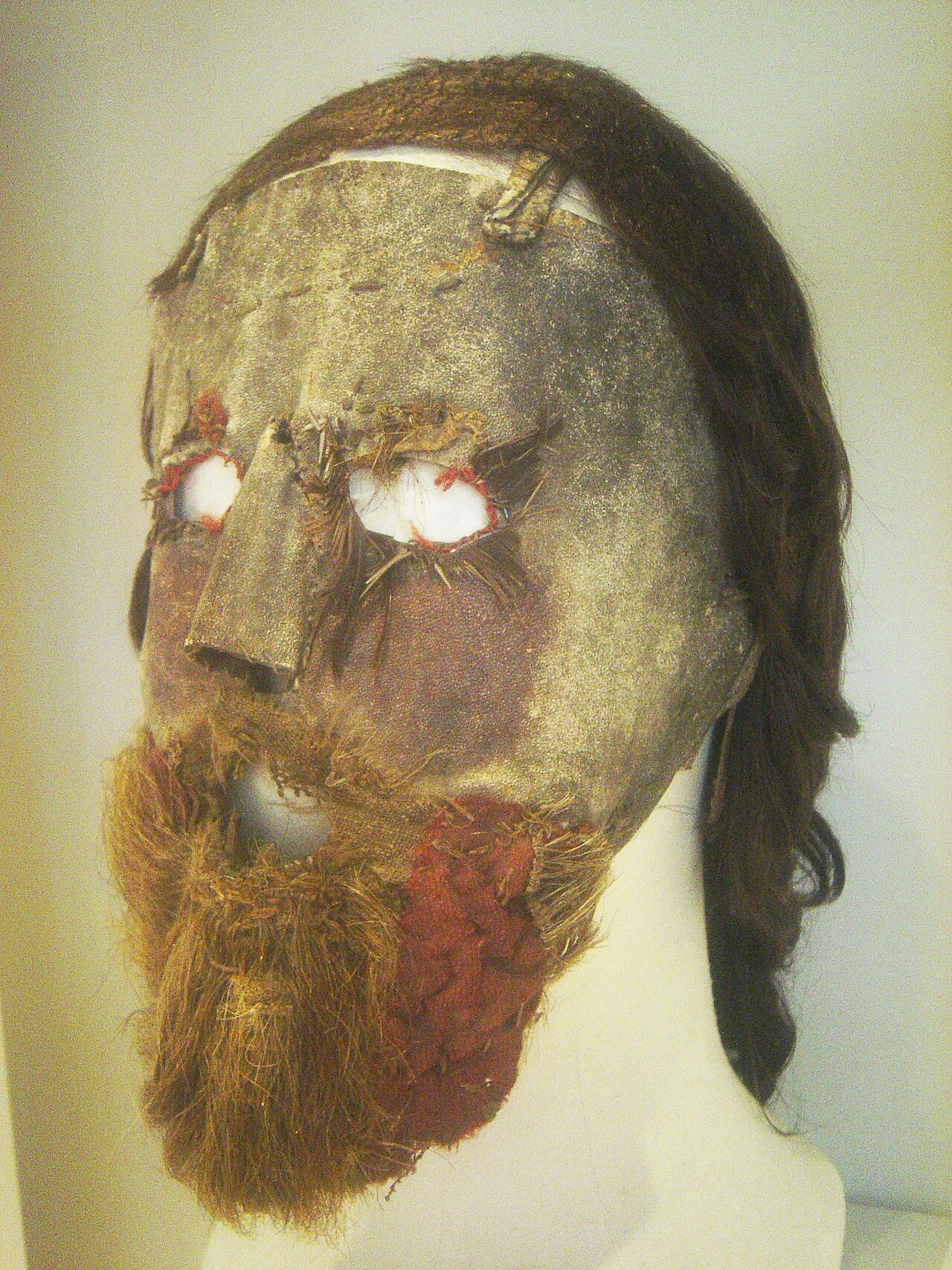
As it turns out the YDNA for the famous Alexander PEDEN line, is not the same as that of my Alexander PADEN. My Alexander is the son of John PADEN b 20 Dec 1767 Coleraine, Londonderry, Northern Ireland who immigrates to Maryland. Since PADEN is a Nickname for Little Patrick and the DNA connections are with MCKEE, MAXWELL, NOBLE, LOWERY and other surnames and mostly in Ireland that remains a brick wall. However the children of a PADEN and a STEWART of mine line marry and I think that connection is a hint.
DAVID DICKSON
In the absence of many clues I decide to follow the DIXON / DICKSON line as it seemed to provide more material. The Rev David Dickson (c. 1583–1662) is my 9th great grandfather. He was a minster, a professor of theology, a writer and a poet. Reaching back hundreds of years, for many of our ancestors we can barely get a glimpse. We are luck with David DICKSON because we can read his own words and those of his contemporaries. The personal biography contained in his book “Truth’s Victory over Error, or, the true principles of the Christian religion“, originally translated by George SINCLAIR and misattributed to him. Later it was published in David DICKSON’s name with the Rev. Robert WODROW (1679-1734) giving a short account of the Reverend DICKSON’s life. It is that account that I am using in part as the basis to track his life along with as many contemporary resources as I can fit in. My purpose is to get a feel for the man and the places he may have been rather than the typical genealogy of names, dates and places. Nor am I looking to him as theologian or Presbyterian scholar but, rather a curious descendant.
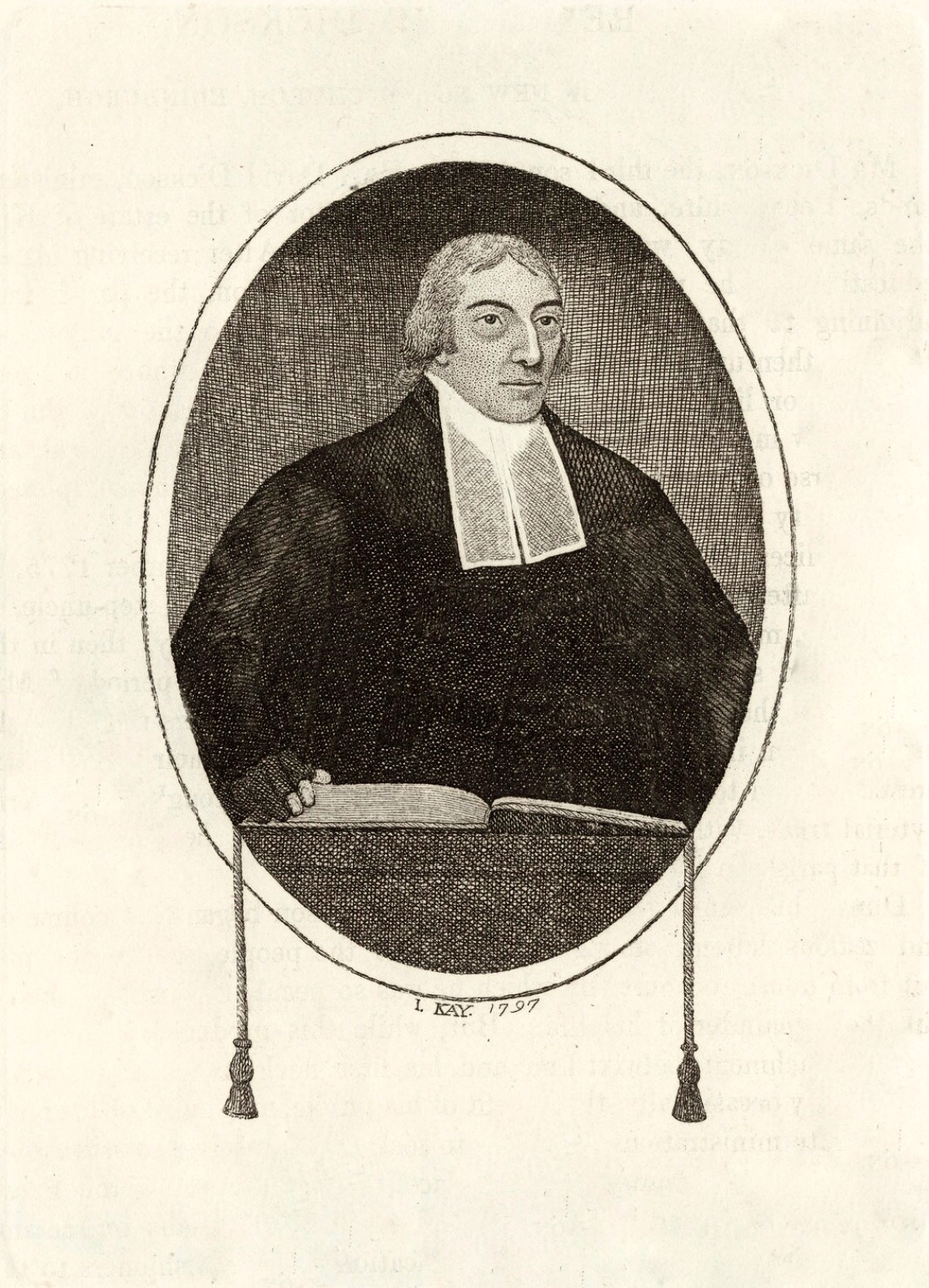
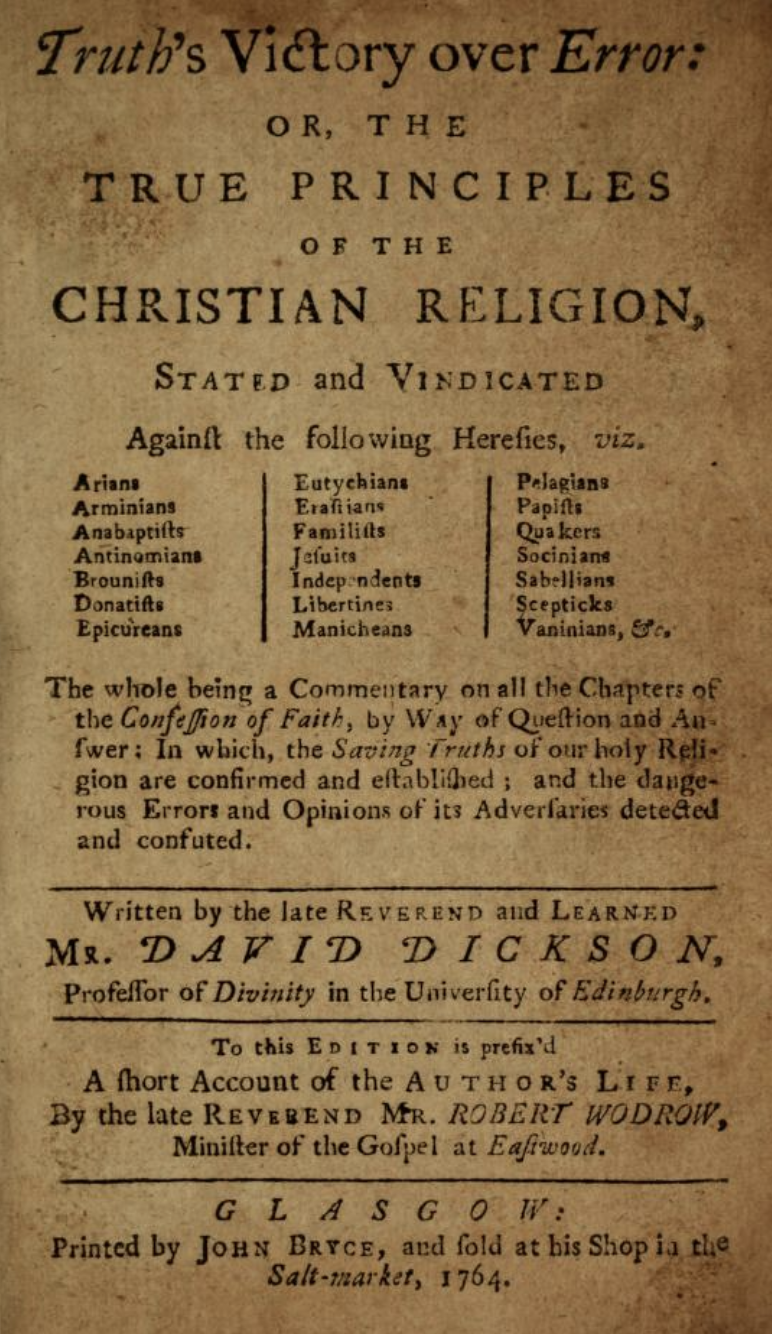

GLASGOW
According to Scott Hew’s Fasti ecclesiae scoticanae; the succession of ministers in the Church of Scotland from the reformation 1915: “DAVID DICKSON of Busby, born Glasgow 1583, son of John DICK/SON, a wealthy merchant of the Trongate, was at first intended for the mercantile profession, but afterwards studied for the Church. After becoming M.A. of Glasgow, he was appointed Regent of Philosophy in the University, and on 31st March 1618 was ordained minister of Irvine...”
This is not quite as colorful or as informative as “the Short Account of his life” from Truth’s Victory cited above.: “Mr. David DICK, or DICKSON, was the only Son of John Dick or DICKSON, Merchant in Glasgow, whose Father was an old Feuar (land owner), and possessor of some Lands in the Barony of Fintry, and Parish of Saint Ninians, called the Kirk of the Muir. His Parents were Religious Persons, of considerable Substance, and many Years married before they had this Child, and he was the only one ever they had, as I am informed. As he was a Samuel asked of the Lord, for he was early devoted to him and-the Ministry; yet afterwards the Vow was forgot, till Providence, by a Rod and fore Sickness on their Son, brought their Sins to Remembrance; and then he was put to resume his Studies which he had left, and at the University of Glasgow he made very great Progress in them.” [Truth’s Victory xi-xii]
So doing some digging on “Kirk of the Muir,” I find Post Reformation Minister of St Ninians Old Parish Church 1567-1587 was Patrick GILLEPSIE, Minister of St Ninians, Larbert, Donypace, Kippane, Kirk o’ Muir and Gargunnock. So it appears that the parish contained within it these churches. Stirling names website states: “The Kirk on the Muir in the Carron Valley, is one of the most overlooked wee gems in Stirling and is rife with a deep history. The site of a chapel dedicated to St Mary in the 15th century, probably in connection with John de Graham’s Castle and marked on maps in the 17th and 18th centuries it was demolished by the 1850s, when it became just a cemetery and the site of what may be Scotland’s smallest school, measuring 7.5m long and 4m wide!” The small graveyard remains but the Carron River was dammed forming the Carron Valley Reservoir about 1939. Below is the Ordnance Survey map from 1878. Whether his father just owned land there or lived there is not known.
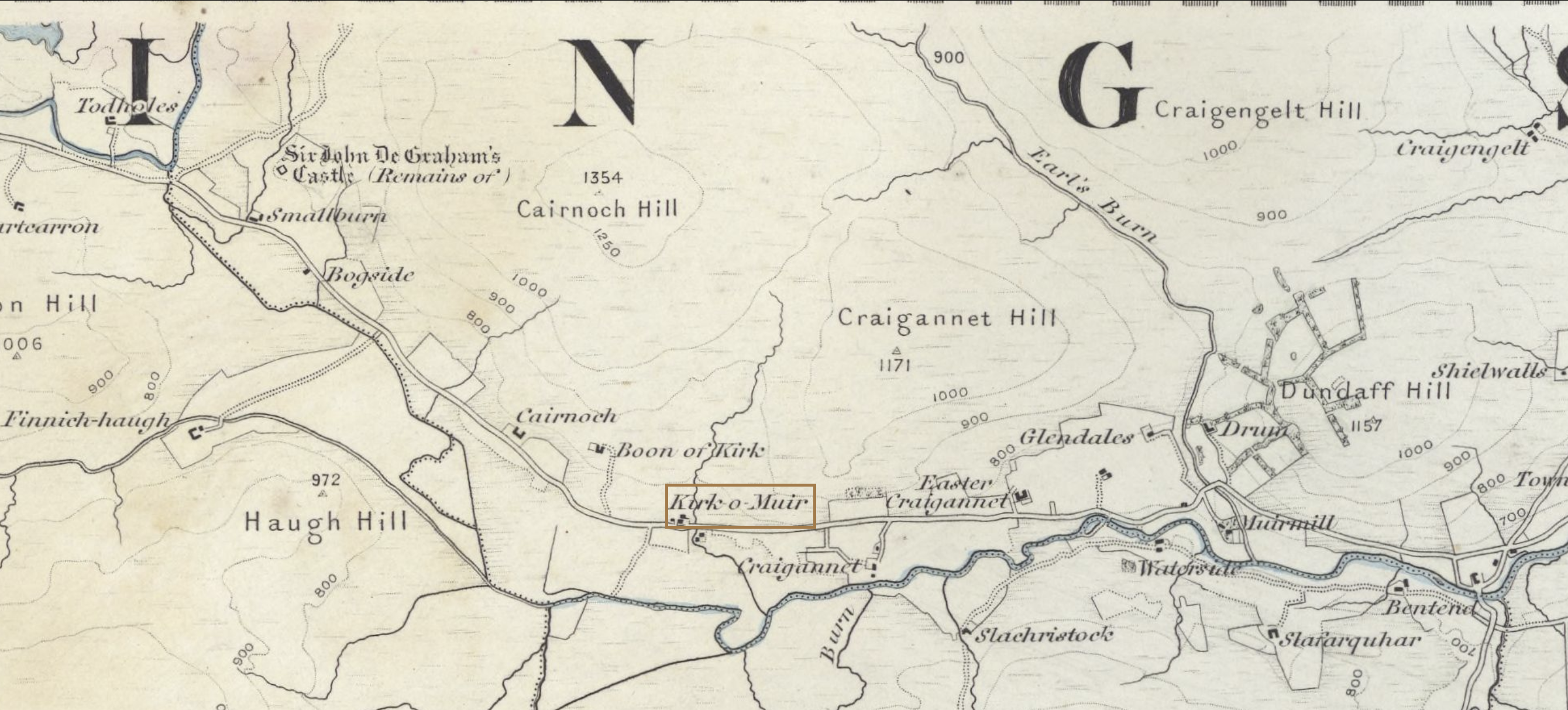
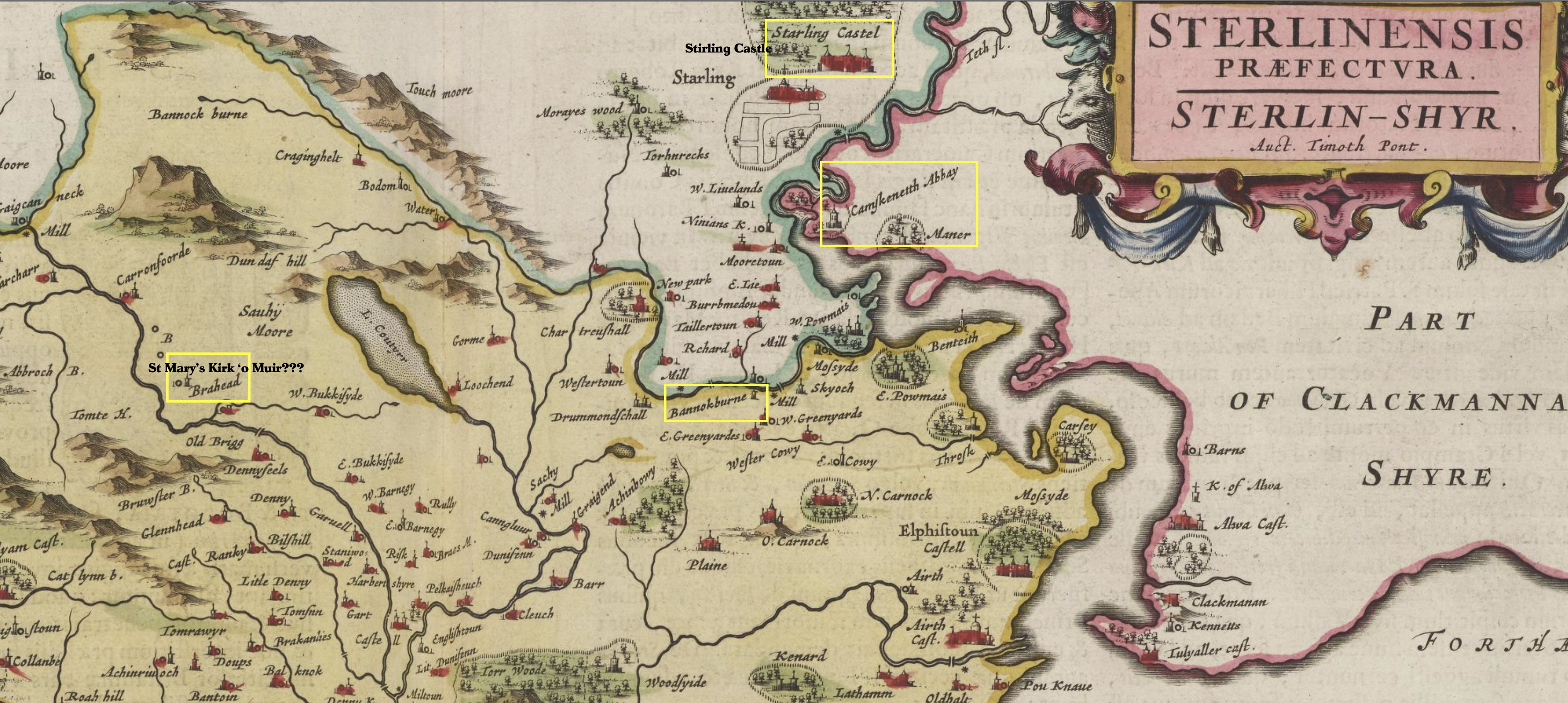
As often happens as you dig you discover more. A much more complete version of David DIckson’s life appears in Select practical writings of David Dickson, vol. 1 and pulled together by the editor. It would have saved me much time in my searching but the longer journey is sometimes the more scenic route. Our introduction reads like a tale from the bible ; “Mr David Dickson, or Dick, (for the family seems to have used either name indifferently.) was the son of Mr John Dick, merchant in Glasgow, a man of religious character, and possessed of considerable wealth. John, and his partner in life, had been several years married without having offspring, a circumstance that grieved them deeply ; and they not only prayed themselves, but stirred up others to pray for them, that they might have a son — vowing, that if their petition was granted, they Would devote him to the service of the Lord. Their prayers were heard, and David was given to them, like a second Samuel, to comfort them in their old age. The precise date of his birth cannot be ascertained, but it is supposed to have been in 1583. In proper time the boy was sent to school ; but after he had learned some Latin, his parents forgot their vow, and sent him to sea in the capacity of a supercargo, intending thus to train him up to merchandise. But several losses they sustained at sea after David had entered upon his charge, and subsequently, a severe sickness with which he was visited, admonished them sharply of their dereliction. They bewailed their forgetfulness, and sent him to the University of Glasgow, where his proficiency soon showed that he had at last got into his proper element. [Select v-vi]
So we learn that John DICK or DICKSON was a merchant of “considerable wealth” in Glasgow. From Fasti ecclesiae we learn he was of Trongate. Trongate is one of the oldest streets in the in Glasgow, Scotland. The name of the street comes from the town’s “tron” or wooden weighing beam, which was once situated on this street. All bulk goods, like wool and grain coming into the city, would be weighed at the tron. Trongate begins at Glasgow Cross, where the steeple of the old Glasgow Tollbooth is situated, being the center of medieval Glasgow. The Tron church was founded as the Collegiate Church of Our Lady and St Anne in 1525. It became a Protestant church after the Reformation. The steeple was added to the church in about 1593, and rebuilt in 1636. No early drawing exist. Here is a view from about 1770. So we must imagine what it may have looked like at David DICKSON’s youth. The surviving records for Glasgow begin in 1609. Whether he was born in Glasgow or on his father’s property in Busby we do not know. He is recorded many times including his death as David DICKSON of BUSBY.
As we read above David was sent to the University of Glasgow. At this time the University was not far from the cathedral. Although this map is 200 years later it does show the locations proximity . In the left hand corner of the first map would be Trongate.
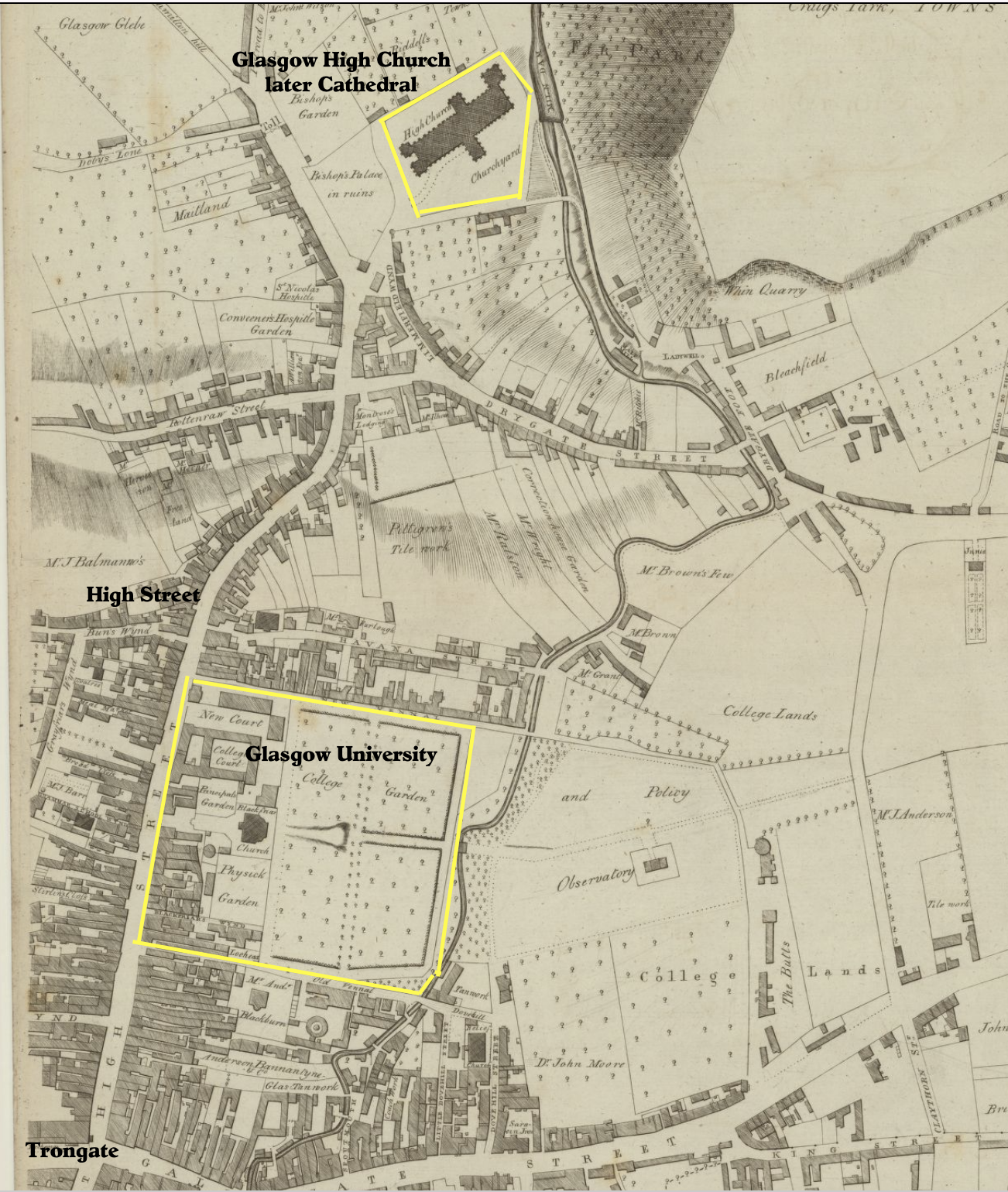
1778 Map of Glasgow (part) by John MacArthur showing Trongate the Church and the Tollbooth would be just to the right. Image on Left shows University and Cathedral.
David may have started Grammar School by the age of 7 to 9, or even earlier. From the account by Robert WODROW he left to be a servant on a merchant ship and then later became severely sick. When he recovered it appears he entered into training for the ministry. This often began at the University as early as 14 to 16 years old and continued through Divinity School for 7 years. “The young pupil, at his admission, was expected to be a thorough proficient in Latin…in addition to the higher Latin classics with which the course commenced, the students were initiated into the Greek grammar, and carried through the ample routine of the Greek poets and historians. These literary acquirements succeeded the study of rhetoric, logic, ethics, physics, geometry, and history ; after which the alumni were introduced to their more important work of studying Theology as a science in all its departments, and the Eastern languages with which it is connected. This course continued for six years.” [Select vi-vii]
“After he had completed a six years’ course, Dickson was found so well qualified for the duties of an instructor, that he was appointed Professor of Philosophy in the University of Glasgow. In this important charge, he was eminently successful in training the youths not only in learning, but sound religious principles. Having continued in the professorship for eight years, he was appointed Minister of Irvine, in the year 1618, when he had reached the mature age of thirty-five.” [Select viii]
BUSBY
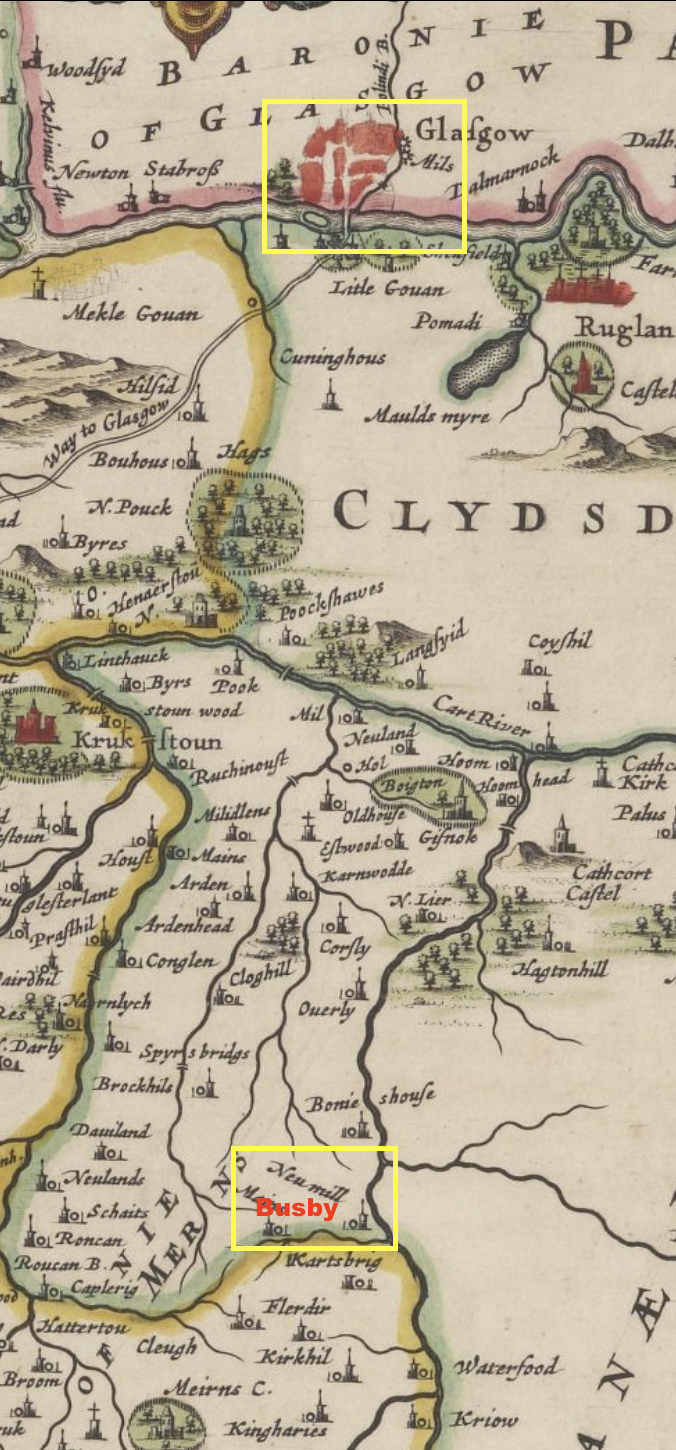
We shall take a short detour to Busby where the family estate was located. Since John and later David are referred to as of Busby we can assume they lived there. Busby did not have a parish church at the time of David’s birth. Busby lays about 6 miles south of Glasgow, in the parish of Kilbride [now East Kilbride]. The White Cart Water runs due south out of Glasgow to Busby. The name Busby was originally Bushby as it was referred to on John Ainslie’s map of 1792. Before this however, the area was actually known as Newmill and can be seen on BLAEU’s atlas of 1654.
David DICKSON married Margaret ROBERTON, daughter of Archibald ROBERTON of Stonehall [Stanehall] at Glasgow, on 23 September 1617 Fasti Ecclesiae Scoticanae; Vol 1; pages 64-65. If the age of his birth is correct this would make him about 34 at the time of his marriage. Margaret is said to have been born about 1598 making her about 19. [Recorded Old Parish Registers Glasgow 644/1 Glasgow pg 29]

At Holyroodhouse on 29 July 1626 a Royal Charter was granted by King Charles I to John DICKSON merchant, burgess of Glasgow and to Master David DICKSON his eldest son minister at the church of Irvine in life rent and after the death of John to John DICKSON eldest lawful son of Master David of the lands of Busbie in the parish of Kilbride, Ayrshire with fisheries, the mill of Busbie [Busby] then in the sheriffdom of Lanark on the resignation of Sir Walter STEWART of Minto, Lady Christina CRAWFORD his spouse and Ludovic their son. Registrum magni sigilli regum Scotorum : The register of the Great seal of Scotland, A.D. 1306-1668. Busby lies due south of Glasgow on the White Cart water. At Busby there there was a meal mill at the waterfall, which can be traced back to 1300. Over the years the river was harnessed to power various types of small mills, for example lint [linen], waulk and grain mills. A waulk or fulling mill ia a mill where fabric is cleaned, felted and thickened. Later there were a couple of Cotton Mills in the area. We do not know the exact nature of John DICKSON’s business, however it might have been any of the above mills. The will of John DICKSOUN 1630 is to be found at Scotland’s People CC9/7/23 Glasgow Commissary Court.
In 1632 the estate of his father John DICKSON of Busbie is settled. November 29, 1632 Brief inquest of Mr David DICKSON, minister of Irvine, as heir of deceased John Dickson of Busbie, his father [GD172/2481] It is five pages and not yet even attempted transcription.
To be continued…
Kelly Wheaton ©2026 All Rights Reserved
Things Treasured, Things Loved
Posted on June 19, 2026 Leave a Comment
“To love abundantly is to live life abundantly , and to love forever is to live forever.”
Henry DRUMMOND
On the way to teach my genealogy class this morning an interview of the poet, Kevin YOUNG, is playing on NPR. The host asks YOUNG: ” Do you feel the dead are around you? Do you feel the strength and the power of ancestors?” Out loud I answer, “Yes!”
I don’t remember how long I have had this small book, but from the moment I laid eyes on it, I loved it. It belonged to my grandfather Milo MOSIER and I very much loved him. We shared a love of many things including poetry and gardens, and especially violets. The book came, or rather was claimed by me, after my grandfather died in 1968. His funeral was on my birthday. Something a teenager does not forget. My father had the book for a time, but then gave it to me.
The binding is falling apart. The soft suede calfskin cover is fraying. The reverse gilding creating the title has lost part of its luster. As we age, things do. It is inscribed, “To Milo From Mother With Fervent Wishes for a Merry Christmas Nov 30, 1918.“
It is titled “The Greatest Thing in the World” by Henry DRUMMOND. It has been a comfort to me to read it, not often, but sprinkled throughout my life. He asks, “What is the Greatest Thing in the World?” And he answers it with a polemic from Paul’s letter to the Corinthians. Specifically, “The greatest of these is Love.”
Not long ago I mentioned it to someone who studies the bible. And then a little while later, I asked myself “who” is Henry Drummond? As a teenager I would have turned to the Encyclopedia Britannica and scanned its pages of small type for a description, but now days the answer is a few clicks away on our cell phones. Henry Drummond, 17 August 1851 – 11 March 1897, was a Scottish evangelist, biologist, writer and lecturer. Scottish I mused. A trip to Scotland is already booked for October. So I read on: Born in Stirling, Scotland died in Turnbridge Wells, England. Buried in Stirling at Valley Cemetery. I look up Valley cemetery which leads to this lovely video.
I had been to Stirling Castle ten years ago but lacked the time to explore the cemetery. As it happens we are staying at the building at the very bottom of the video, below Holy Rude Church. The serendipity! Henry DRUMMOND’s grave is located just north-east of the church and is marked by a distinctive, large red granite Celtic cross. Well that should not be hard to find. l learned that Henry’s uncle, William, has a much more unique monument which every day, I dare say hundreds of people admire. The Star Pyramid and Martyr’s Monument and the adjacent DRUMMOND Pleasure Garden were commissioned and financed by William DRUMMOND in 1859. William was a prosperous Stirling seed merchant and local evangelist In 1814, he and his son opened a shop W. DRUMMOND & Son’s on the corner of Baker Street and Bow Street in Stirling. When I looked up what kind of seed they sold it was flowers and vegetables and grains and seed potatoes. As a gardener I feel I will be among kindred spirits. Now several more things to add to my pilgrimage to Stirling, Scotland.
It just dawned on my yesterday to pay closer attention to the date of the book’s inscription Nov 30 2018. In 1918 my grandfather was in France as an Army medic. Nov 11th the armistice was signed. This book was sent by his mother Lulu to her son, in the hope it arrived to Milo by Christmas 1918. Because I had transcribed his mother Lulu’s diary I could find the relevant entries
- Tue Nov 5 – Still no letter from Milo. I await his address slip anxious as I cannot mail him his Christmas box without it.
- Friday November 8 – Two letters came to brighten up the day. One from Milo and one from Allie. But Milo didn’t send his slip for his Christmas box. I am very sorry I am afraid when it comes it will be too late as they have to be sent by Nov 20...Milo wrote from the front and says he has a fine bunch of souvenirs for me. He writes very entertainingly of army life at the front.
- Nov 30 Sat. – …go to Berkeley red cross for that everlastingly elusive Christmas Carton. Last day. The card I have chosen to send bears this appropriate verse…I arrived at the Red Cross 1:15 and was the last one to send a box over seas from Berkeley. I came home afoot Leo trotting along in and out of doorways up and down steps banks and hillocks, tireless. I was tired enough when I got home.
To my lad in Khaki
Heaven possess you, fortune bless you all along the unseen way,
Forward faring, gladly sharing
In the nations testing days
Courage fill you service thrill you
Victory crown each brave advance
Comrads cheer you God be near you,
Soldier boy “Some where in France.”

- Jan 23 Fri. — …I am in a flutter of anticipation over Milos possible arrival in N. York.
- Sun Feb 9 – …We have had several letters from Milo lately saying among other things that he had received his Christmas box and that he was coming home soon he thought.
- Mar 30 Sun …I had a letter from Milo about two weeks ago he had written it so long ago that it wasn’t very newsy. He didn’t expect to get away from France for a while probably until spring. He was doing nurse duty and said it was a great life if you didn’t weaken.
- May 11 – Mothers day. Just 1 yr since my Milo gave me a fine bunch of carnations in lovely Ca. Valley [Castrol Valley] . I have some of them waxed…Milo should be home soon.
- May 17 –Saw in the paper that Milo’s regiment was on their way home.
- May 18 …He [Milo] is bronzed, bigger than when he left nervous and happy to be home. Likes S. F. better than New York or any other place…Milo is home and I am glad.
The “Greatest Thing in the World” was originally delivered as an address to a large body of Students at Northfield, Massachusettes in the summer of 1897 [Thomas Aquinas University].
Milo, when still just a lad of 19, far from home in France, at the close of the first World War receives “The Greatest Thing in the World” from his mother as a Christmas gift. It travels from Berkeley to France and back to the Presidio in San Francisco with Milo—and kept by him for the rest of his life. Passed on to my Dad and then to me.
Someone in my class asked why Lulu would pick this book. Lulu grew up in the Purple Cane Community of Nebraska which was largely populated with Scots who had immigrated to Nebraska in the 1870’s and 1880’s to be cattle farmers. Lulu’s father, James L. PADEN’s grandfather immigrated from Ireland to Maryland by 1798. But like my grandfather and his mother never lost sight of their Scottish roots. My grandfather was a great admirer of Robbie Burns and my great grandmother notes in her diary that she is reading Sir Walter Scott’s “The Lady of the Lake.” So that through line reaches out to me. Now as I prepare my trip to Scotland, a pilgrimage is planned to the grave of Henry DRUMMOND. Henry never married nor had any children. However, his book binds 4 generations of my family together through his words of love.
To be continued…
“The meaning of things lies not in the things themselves, but in our attitude towards them.” — Antoine de Saint-Exupéry
Kelly Wheaton ©2026 All Rights Reserved
Deciphering our past Part 3 : FGC53429+ DUKES & NOBILITY IN FRANCE
Posted on May 30, 2026 Leave a Comment
Introduction
In this chapter we switch our focus from the parent SNP FGC22501 to a specific sub-clade SNP FGC53429+, but still with our eyes on the Sun Wheel symbol. Our target area for FGC53429+ on the map above is in Gallia Belgica. This map show the early Celtic Tribes of about 200 BCE. The previously mentioned Ad(t)uatuci Tribe in the middle top. I have added the areas of early La Tène Boii concentration about 450 BCE [green outlines]. The FGC53429+ descendants were bishops and hereditary episcopal nobility of Reims, Trier, Verdun, Metz, Laon, Cologne, Utrecht, Lincoln, St-Davids, Durham, Bruges, and Antwerp. Is it possible that they were descendants of the Ad(t)uatuci and later the Suessiones Tribe that each had versions of the Sun Wheel on their coins?
The following is the timeline of FGC22501 to FGC53429. In essence traveling form Bohemia to Belgica about 574 current age.
- R1b>U152>L2>FGC22501 appears to have originated in Bohemia about 2200 BCE [As above]
- R1b>U152>L2>FGC22501>FGC22538 originated about 2153 BCE
- R1b>U152>L2>FGC22501>FGC22538>FGC22516 originated 1591 BCE
- R1b>U152>L2>FGC22501>FGC22538>FGC22516>FGC22518 originated about 1585 BCE
- R1b>U152>L2>FGC22501> as above FGC22518>FGC42117 originated 1469 BCE All the above likely staying in Bohemia
- R1b>U152>L2>FGC22501>as above FGC22518>FGC42117> FGC42109 originated about 998 BCE perhaps beginning to migrate
- R1b>U152>L2>FGC22501>as above FGC22518>FGC42117> FGC42109> FGC53429 originated about 574 CE in Belgica.
Symbols of Power
Symbols reduce the infinite complexity of the world or the universe into manageable, recognizable pieces, allowing for immediate understanding. They are effective in branding and recognizing, power, authority or affiliation. They are evocative and have the capacity to move people, acting as catalysts for passion, belief and sometimes action, as in a holy war. So might an ancient Sun Wheel be both an external and internal symbol used to identify in this case both secular and spiritual power. From ancient Celtic seers to later marquis? Heraldic designs came into general use among European nobility in the 12th century. Systematic, heritable heraldry began at the beginning of the 13th century. But before that we see the Sun wheel still in use in Anglo-Saxon coins 690-715. Although difficult to piece together this early symbol dating back as far as the Royal Game of Ur 2600-2400 BCE we can see the Sun Wheel symbol. The Wheel itself is invented about 3500 BCE. The Domestication of the horse perhaps around 2200 BCE on the Eurasian Steepe. In many ancient traditions the sun god or goddess is responsible for pulling the sun across the sky each day via horse and chariot. Those who can understand and explain the powers of god and the universe are both revered and feared. They co-opt the power of the gods.
Due to the extensive work of Vanessa Van der Beke we have found that the 5 or sometimes 3 annulets [rings] are frequent symbols appearing on the Blason (Coat of Arms) of families and places associated with FGC2253429+. Is this a coincidence? Almost all arms with annulets belong to marquess [episcopal nobility]. (However, not all marquess have arms with rings / annulets). There were many places and families in France and elsewhere having arms with rings. Vanessa was able to connect them to the palatine counts (episcopal counts) of the Carolingians and their successors. A sampling below.
Timeline
- 100-57 BCE Aduatuci coins minted with 5 annulets
- 57 BCE Dispersal of surviving Aduatuci after their conquest by Ceasar
- 140 CE Vicus Beda (Bitburg) founded. Bitburg was stopping place for travelers from Lyon through Metz and Trier to Cologne.
- 400 CE End of Roman rule & takeover by Frankish Tribes
- 690-715 CE Frisian Sceattas Anglo Saxon coins minted with 5 annulets
- 715 CE Frankish Castrum Bedense (Bitburg) became the capital of the Bidgau (Bitburg province)
- 720 CE, the noble Frankish woman Bertrada founded an abbey in Prüm, close to Bitburg and Trier
- 768 CE Charlemagne made Prüm his personal abbey with possessions in Belgium, the Netherlands, France & Germany with 300 monks
- 795 – 855 CE Lotharius I, King of Lorraine was buried in the abbey of Prüm . The abbey of Prûmh had a villa in Erdorf near Bitburg, which belonged to vassals of the counts of Vianden who had arms with annulets. Erdorf’s coat of Arms had 5 annulets
- Count Wigeric(k) From 915 or 916, he was the count palatine of Lotharingia. He was the founder of the House of Ardennes. He died 9 July 953 He married Cunegonde of the Carolingans
- Count Gerald (Gozello) of Metz (911-942/3) married Oda of Saxony (905-965)
- Bruno the Great (925-965) his brother Otto I appointed him Duke of Lorraine.
- Van der Beke arms and the arms used by the military commanders and masters of accounts from the duchy of Bar from the former duchy of Lorraine, Arms 5 silver annulets on a red field [see above]
- c1147 Geoffroy de Vienne et de Louppy with Arms with 5 annulets, gold on red field [see above]
Background on the Noble Titles
Following the collapse of the Holy Roman Empire the Merovingians were the ruling family of the Franks c481-751 who established the largest and most powerful kingdom in Western Europe. They followed the Roman laws and were served by mayors of the palace who liked weak kings so they could increase their own power and territory. Until one of them grabbed the highest power and became king himself and ancestor of Charlemagne creating the dynasty of the Carolingians.
Charlemagne (748-814) was King of the Franks from 768, King of the Lombards from 774, and Emperor of what is now known as the Carolingian Empire from 800-814. When Charlemagne became emperor he had one big concession: the imperial title belonged to the ancient Roman empire, so to continue it, he had to share it with the highest entity in Rome: the pope. The title of emperor belonged worldly 50% to the emperor and ecclesiastically 50% to the pope and the realm was called the Roman-German Empire. During his reign Charlemagne made great efforts on behalf of medieval education. Later the Ottonian emperors (919-1024) of the German or Saxon dynasties expanded them further, mainly through abbey and chapter schools. Children of the nobility, ministerials, and the wealthy attended these schools. Precursors to formalized noble classes were high-status clans, warrior elites, or landholding families before the standardization of hereditary titles. About 1250 in France the proto-nobility emerges before the introduction of marquis sometimes changed to: sire, prince, marquis, margrave, knight, page, esquire, or simply count (earl). In the medieval context, the Latin word ‘marchio’ meant among other things: marquis, margrave, marshal, but equally count palatine, episcopal count, accountant, chancellor, governor, diplomat, bailiff, or counselor.
By virtue of his ecclesiastical position, the Marquis or Margrave was usually educated in both secular and ecclesiastical law. In addition to guarding and defending the imperial or royal domain, the palace, and/or borderland, a Marquis was also frequently employed as a diplomat. A marquisate is the territory, domain, or rank held by a marquis, marquess, or marchioness. It could be an entire county such as Flanders or only a part of it like Vienne (le-château) in the county of Bar.
Furthermore, it could be a secular or ecclesiastical marquisate, in contrast to a secular duchy which contained multiple counties. In a modern context, a marquisate roughly corresponds to a Ministry of Foreign Affairs and a duchy to a Ministry of the Interior, both assisted by the Ministries of Justice and Defense.
A key element of Emperor Otto I’s (912-973) domestic policy was to strengthen ecclesiastical authorities at the expense of the nobility who threatened his power. So he filled the ranks of the episcopate with his own relatives and with loyal chancery clerks. As protector of the Church he invested them with the symbols of their offices, both spiritual and secular , so the clerics were appointed as his vassals through a commendation ceremony. The bishops had the right to appoint a temporary “count for life” (comte viager), theoretically subject to the authority of the bishop. These counts were selected from the noble family of Ardennes. Because of the duality of the imperial title their servants were equal : this meant a bishop and a king were equal, a duke and a count palatine (marquess) were equal. One holding the worldly power and the other the ecclesiastical power. They were always second : to the king of France, England, the dukes of Bar, the counts of Flanders. But as ecclesiastic equals they served as regents when the worldly emperor, king, duke, count was absent we replaced his authority.
The division of power between church and state, pope and emperor had serious consequences because everything needed to be divided. The emperor had kings, the kings appointed dukes (who controlled a whole territory ie.: Lorraine). The pope had bishops, the bishops appointed count palatines (seneshals who controlled border lands called marks, hence the name of margraves – mark counts – later changed into marquess). These margraves served also as episcopal counts protecting the bishoprics, when the bishop obtained worldly power from the emperor he became a countal bishop (Verdun) or a prince bishop like in Cologne, Utrecht, Liège and Durham. Over centuries the pope lost more of his power and the Roman-German empire changed into the German Empire.
If you look closely this coin contains the symbol of the Sun Wheel. It appears on coins from the Macedonian through the Byzantine Dynasties. it is a sign of power.
Case Study : van ver beke
At the time of the Dukes of Lorraine, beginning in 959, Upper and Lower Lorraine, the royal lineage of the House of Ardennes (Verdun) was a marquisate of the Holy Roman Empire vis-à-vis the Kingdom of France. Van der Beke, comes from the royal family of the House of Ardennes (Verdun), they also possessed, on the border between the Kingdom of France and the Holy Roman Empire, the count-bishopric marquisates of:
- Moncel-lez-Lunéville for the Count-Bishopric of Metz.
- Vienne (later Vienne-le-Château) for the Count-Bishopric of Verdun
- Louppy (later Louppy-le-Château)
- Chardogne for the Count-Bishopric of Toul, which they had acquired through investiture.
- County of Voncq (possibly) next to the originally Merovingian palace of Attigny, which briefly served as a Christmas and summer residence under the Carolingians,
Returning to the Blason (Coat of Arms) of the families and places associated with FGC2253429+ we see how the symbol was adopted by families and places alike. It reminds me of a family heirloom whose provenance has been lost to time but whose story can be read in its symbol. Or in this case the YDNA.
Episcopal counts like van der Beke made their titles hereditary and no emperor or king could intervene. The titles were open to either males or females so you could have a marquess and a marchioness. We see this in this text of the prince-bishop and count palatine Anthony van der Beke. The episcopal principality of Metz was a bishopric state of the Holy Roman Empire. This State is distinct from the diocese of Metz, founded in the 4th century, initially subordinate to the ecclesiastical province of Trier, over which the spiritual authority of the bishop is exercised, and which extends over part of the Lorraine area. The episcopal principality is for its part the set of territories (possibly disjointed) over which the bishop exercises the temporal power of a lord, disposing of high, medium or low justice depending on the case. The bishops of Metz, who initially came under the Duchy of Lorraine, obtained imperial immediacy as temporal lords of the episcopal principality in the 11th century, and were part of the college of ecclesiastical princes at the Diet of the Empire. In the 11th century, the influence of the Holy Roman emperors faded; the royal counts become dukes of Lorraine, while the bishops, residing on the spot, concentrated more and more in their hands the temporal power the exercise of which they delegated to their counts palatine; these become “episcopal counts. Verdun was part of the middle kingdom of Lotharingia and in 1374 it became a free imperial city of the Holy Roman Empire. The Bishopric of Verdun formed together with Tull (Toul) and Metz the Three Bishoprics, which were annexed by France in 1552.
The Sun Wheel does not belong to FGC22501 exclusively or its descendants— However following the DNA and this symbol shows a connection that does tell a story. We can never fully know the truth of a thing, but we can follow it deeply and perhaps get a richer view of history for doing so. This story may get further chapters as more discoveries are made. I hope it has whetted your appetite to dig a little deeper into your own stories.
And here’s where it came full circle. In part one I showed the Cross of St Cuthbert showing the familiar symbol . It happened to pop up on my Facebook feed. I sent the photo to Vanessa. She offered an explanation Anthony van der Beke (de Beck) was the bishop and chancellor of the Flemish count and the county of Flanders Seger. Van der Beke traveled with gold, emeralds etc as gifts from the Flemish count. This may be how the Cross of St Cuthbert makes its way to Durham Cathedral in 697 CE. We tend toward thinking people lived in isolation. They did not. Whether we want to draw discrete lines around countries, cultures, art or people—they will ever defy our attempts to hem them in. There is something in that which comforts me and my historical world view. We discover, we fashion we re-fashion. “There’s nothing new under the sun.” Remember that next time you pick up a dice—
PS. A couple of recent finds with a familiar pattern, both shields. The first is the famous Battersea Shield dating from roughly 350-50 BCE. And the newest a miniature shield at Cirencester which was actually the capital of the Dobunni tribe. It should be on display later this year at Corinium Museum in Cirencester.
More Exploration
- First Horse Warriors (exploring the Botai culture of the Eurasian Steppe) and Native Horse PBS documentary NOVA: Season 46, Episode 9 2021
- The Horse the Wheel and Language: How Bronze Age riders from the Eurasian Steppes shaped the Modern World. by David W Anthony 2007
- Who We Are and How We Got Here: ancient DNA and the New Science of the Human Past David Reich. 2018
- Celtic Art: Symbols & Imagery. Miranda Green 1996
Kelly Wheaton ©2026 All Rights Reserved
Deciphering our past Part One: DNA to Decoration—following the trail of one YSNP FGC22501
Posted on May 24, 2026 1 Comment
Introduction
This blog post or what may be a series of blog posts is a collaboration of Vanessa Van der Beke and myself. She has done a lot of the heavy lifting research wise in often esoteric old texts. It has been an unexpected journey that I don’t think we could have ever imagined. You may wish to read some of the earlier posts on this page. To make a long story short my husband did a Full Genome Corporation Y Elite DNA test in 2014. In his sample a series of Y-SNPS (aka mutations) were newly discovered and named. They are FGC22500-FGC22550. The most important to our work was the SNP FGC22501. The R-U152-FGC22501: Celtic U152/L2/FGC22501 and subclades project was approved in October of 2015 and has grown to over 225 members nearly 11 years later.
At the time we had no idea where this SNP would lead us. We were very fortunate that the sequencing of ancient human skeletons led to an early match with one of the so-called Headless Roman Gladiators in the town of York, England. This individual known as 6Drif-22 was dated at about about 100-400 AD and back in 2016 this individual was the only ancient to share the SNP FGC22501 —his closest population affinity was with Belgium. Vanessa calls Belgium home and her family goes Van der Beke, comes from the royal family of the House of Ardennes with Wigeric’s son Gozlin (911–942/43) the dynasty’s ancestor and carrier of the FGC22501 SNP. More on that later.
Following the YDNA via YSNPS
The SNP path of FGC22501 is as follows roughly (TIMELINE within R1b):
- M173 SNP c. 20,000 BCE
- M343 c. 17,000 BCE R1b (very pervasive carried by over 110 Million men)
- U152 c. 2700 BCE
- L2 c. 2500 BCE
- FGC22501 2450 BCE (the most recent discoveries may ous this date earlier)
The next discoveries that pushed us back from 6Drif-22 Roman age skeleton in York, England to an individual of the Únětice Culture from Jinonice , Prague 5, Czech Republic named I7202 dated 2200–1700 BCE. It is important to note that even at this early date Celtic tribes represented many different YDNA lines within the R1b umbrella. The core Western European subclade, splits into the two dominant branches: P312 and U106 . P312 (S116): Extremely is common in France, Iberia (Spain/Portugal), and the British Isles. These are the major subclades, with our own FGC22501 falling under U152>L2 .
- L21 (M529): Common in the British Isles (Ireland, Scotland, Wales, Brittany).
- DF27 (S250): Dominant in Iberia and the Basque region.
- U152 (S28): Prevalent in the Alpine region and Northern Italy, often associated with Italics and Celts.
- U106 (S21): Prevalent in the Netherlands, Northern Germany, and Scandinavia, strongly associated with Germanic tribes
Although a subclade may be prevalent in certain areas other subclades are often well represented too. Humankind has been mixing it up for a very long time. So we have called FGC22501 a Celtic SNP but it has lots of company and going back in time it will be preceded with other cultures, not just Celtic. We got lucky and a few more FGC22501 skeletons were discovered within a 50 mile radius of Prague and representing somewhat more recent individuals from Radosevice cemetary dated c309-190 BCE named 21736 Hrobcice, I15951 Radosevice, and I14984 Radosevice. Then was added I18837 Széles földek, Hungary c320-200 BCE. And more recently we have 4 new individuals I38966, I39176, I39356, I39358 from the Karain Cave in Turkey. To place them in order of age see table below. So with these new samples we are able to reach back between 5000-7000 years just based on a YDNA SNP discovered originally in my husband.
| Name | Location | Age | Period | Notes |
| I38966 | Karain cave, Turkey | Details to be announced | ? | FGC22501 |
| I39176 | Karain cave, Turkey | ? | ? | FGC22501 |
| I39356 | Karain cave, Turkey | ? | ? | FGC22501 |
| I39358 | Karain cave, Turkey | ? | ? | FGC22501 |
| I7202 | Prague 5, Jinonice, Zahradnictví, Czech | 2200–1700 BCE | Bronze Age | Únětice Culture FGC22500 |
| I14984 | Radosevice, Teplice, Czech | 330–280 BCE | Iron Age | La Tene; FGC22538 > FGC22516 |
| I15951 | Radosevice, Teplice, Czech | 290-250 BCE | Iron Age | La Tene; FGC22538 |
| 18837 | Széles földek, Sopron, Hungary | 320-200 BCE | Iron Age | La Tene FGC22538> PAGES00073 |
Symbol of Interest: Sun Wheel or Halo Cross
Dating back over 4,500 years, the Royal Game of Ur was Excavated in the 1920s by Sir Leonard Woolley in the Royal Tombs of Ur (now Iraq). The rules of the game were lost for centuries but were deciphered by British Museum curator Irving Finkel from a cuneiform tablet from 177 BCE. This is the first know instance of a curious symbol that has been interpreted with many meanings. Here is a wikipedia photo From the British museum:
The blocks with five circles or annulets become an important part of our story. In many ancient civilizations, God was represented by the sun in the center. Frequently used representation in Middle Eastern, Celtic, East Roman, West Roman, Merovingian, and Holy Roman empires was a sun cross based on a vertical or diagonal representation of the sun with the spring and autumn equinoxes and the summer and winter solstices or even the cardinal directions.

Wikipedia Ta’oulunga cc
Many ancient peoples observed the power of the sun God in the heavens. This symbol is adopted in many cultures. Later the divine stewards obtained their sun-based sun wheel through investiture via the divine status of the kings. SO this symbol, together with DNA allows us to trace some very early connections. The same 5 circles are seen in a natural phenomenon called a Halo Cross.
Some early examples:
So various cultures adopted this symbol into their decorations. The wheel was very important to ancient civilizations. The clay wheel from Spišský Štvrtok (Slovakia) is an archaeological artifact from the Early Bronze Age (around 1700–1500 BC). These wheels were small not for use but found in burials. This drawing of one from STUDIA HERCYNIA XV PREHISTORY OF EUROPE AS SEEN FROM ITS CENTRE Czech lands from Paleolithic to the end of the La Tène period in European context by By Jan Bouzek pg 41. “The end of Middle Bronze Age brought also changes in religious ideas. At time that roughly corresponds to period of Akhnathon’s religious reformation and his worship of sun god Aton (14 th century B.C.) also in the north of Europe reform brings to the centre of religious interest Sun god and/or Sun hero. “pg 40
Next Chapter we will dive into why this symbol matters to FGC22501.
Kelly Wheaton ©2026 All Rights Reserved
Writing About Yourself: The Blue Flower
Posted on December 19, 2025 1 Comment
I realized I never posted this before. It is a short, but true story about me. It is a relative narrow topic but it reveals volumes (excuse the pun). It avoids the general concerns about self revelation, and yet is still self revelatory. I offer it as an example of how to write about yourself, without it being too scary. It doesn’t matter what my skill is as a writer, or lack thereof is. The purpose is to leave something behind that would allow the reader to get to know you. Not the genealogists: birth, marriage and death image—but something more personal and alive.
If you choose to write your own story, and you aren’t comfortable with writing, try telling it to someone and recording it. Then transcribe and edit as you go along. It may be harder to write about yourself, but it’s worth it to those who come after you.
The Blue Flower
Judy and I shared a passion for books. During our high school years we would make weekly forays to the complex of red brick buildings which provided us with endless titles to feed our growing appetites. Although we lived in El Cerrito we quickly consumed its minimal fare and needed the more substantial offerings that the Richmond Public Library provided.
On our many pilgrimages to this sacred building we explored the worlds of forbidden fruit. Whether pouring over sidereal tables trying to plot our astrological charts or conducting comprehensive studies of the Kinsey reports, Judy and I sought answers. It was during these reconnaissance missions that we happened upon a most delightful way to expand our horizons. We made our way upstairs to the adult fiction stacks. Here one of us would close our eyes and be guided by the other to one of the many aisles, spun around and asked to pick a book without looking. Once selected we were required to read the selection, however dull, and report to the other on its worthiness. This was a magical process which yielded us such authors as Flaubert, Zola and Lawrence and undoubtedly many lesser ones which we quickly forgot.
On one such occasion, I selected a book titled “The Blue Flower.” It was written by Henry Van Dyke and had a most beautifully decorated cover. Inside were interesting colored plates and a series of short stories with intriguing titles like “The Blue Flower” and “The Story of the Other Wise Man.” I enjoyed this book so much that I went back for other titles by the same author, yet “The Blue Flower” remained my favorite. Eventually on a trip with Judy to a used book store in San Francisco I located a copy along with some companion volumes.
Years passed. One day while going through some boxes of memorabilia in my parent’s garage I stumbled upon a stained and yellowed page with the handwritten words “Carrie Ethel Henager From A.W. Dolphin Dec_1910.” Turning over the page I recognized the familiar color plate and the facing title page of “The Blue Flower.” Carrie was my paternal grandmother and she had died some years before from what they then called senility, but we now know as Alzheimer’s disease. I always felt connected to Carrie, but I did not know her when she was well.
The pages I had found were the frontispiece and title pages of the book that had subsequently been lost. Carefully I carried them to my parent’s house and I asked my father to look at them. He asked me where I had found them and casually told me that “The Blue Flower” was his mother’s favorite book! I was so stunned it took me a few moments to recount to him my own relationship with “The Blue Flower.” To this day my grandmother’s pages reside next to their counterparts in my copy of “The Blue Flower.” They stand as a testimonial to the often unrecognized connection we have with our past and to the moment when I came to know my grandmother Carrie through the book that we both loved.
As a post script, my paternal grandmother Carrie’s favorite Flower was Blue Flags or Iris. When my Dad was dying I took him a pot of Iris reticulata ‘Harmony’ in bloom. They were planted in my garden where they continue to flourish.

Please check the Family History Writing Tab at the top of the page for more posts about writing.
Kelly Wheaton ©2025 All Rights Reserved


