Spinning a Scottish Yarn: The Reverend David Dickson Part Two Irvine
In part one we visited David DICKSON’s early life in Glasgow. The next part of the story Begins in Irvine where David DICKSON was a minister for 23 years. Be forewarned it took an unexpected twist. I am grateful to Ian DICKSON (no relation) and Billy KERR for allowing me to quote from their work and research. They have filled in pertinent details of David’s tenure in Irvine, Ayrshire, Scotland.
Mostly when we write about the past there’s a tendency to burnish the rough edges. Going back to 600 BCE we are admonished “De mortuis nil nisi bonum” Of the dead, say nothing but good. The idea being that the deceased are not here to defend themselves. As a family historian we must look at all aspects and come to our own conclusions. We cannot do that if we only report the good, as that falsifies history or only the bad as if taken out of context.
IRVINE
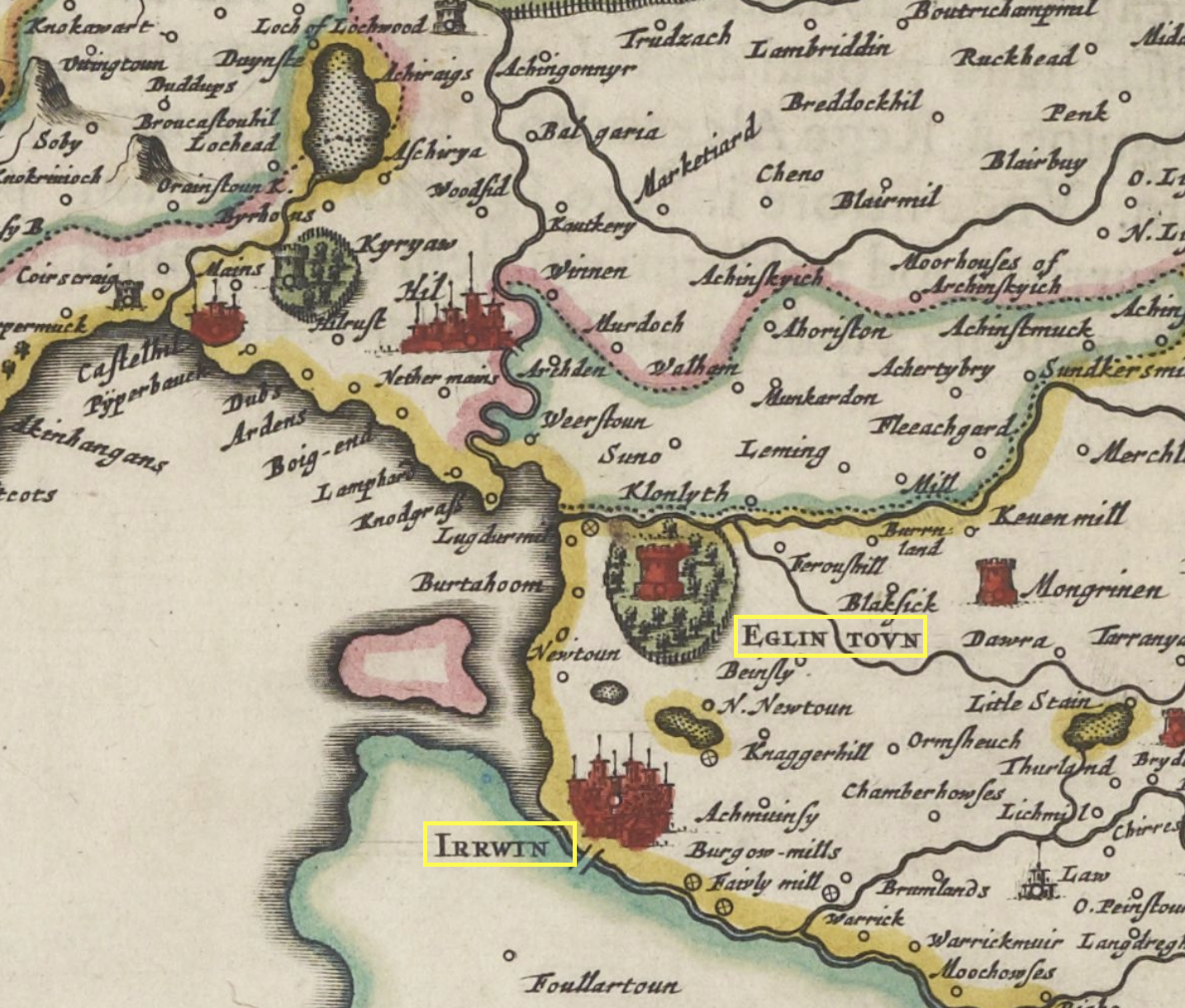
Irvine is one of Scotland’s oldest royal burghs, chartered by King Robert the Bruce in 1308, and formerly the capital of the Cunninghame district. The Map above is a part of Cunninghame. Irvine is described as a busy seaport situated on a rising sandy ridge on the north bank of the River Irvine. Eglintovn on the map is the seat of MONTOGOMERIE’s of Eglinton.
Before I go further I must talk a coincidence. My friend Sissy and I are distant cousins on the Isaac SHELDON line. Well it turns out she is going on a last minute trip to Scotland in July 2026 and we were comparing notes. It turns out her ancestor and mine were both ministers of the Parish Church at Irvine, Ayrshire, Scotland. This is a list of Irvine’s first 15 ministers. Mine was Rev David DICKSON the sixth and hers was Charles BANNATYNE, the fifteenth.
1 1562 – John Lynd
2 1567 – Robert Hamilton
3 1570 – John Young
4 1584 – William Strang
5 1589 – Alexander Scrimgeour
6 1618 – David Dickson
7 1642 – Hew Mackaile
8 1650 – Alexander Nisbet
9 1662 – John Grant
10 1669 – George Hutchison
11 1676 – John Stirling
12 1684 – William Hamilton
13 1688 – Patrick Warner
14 1709 – William McKnight
15 1751 – Charles Bannatyne
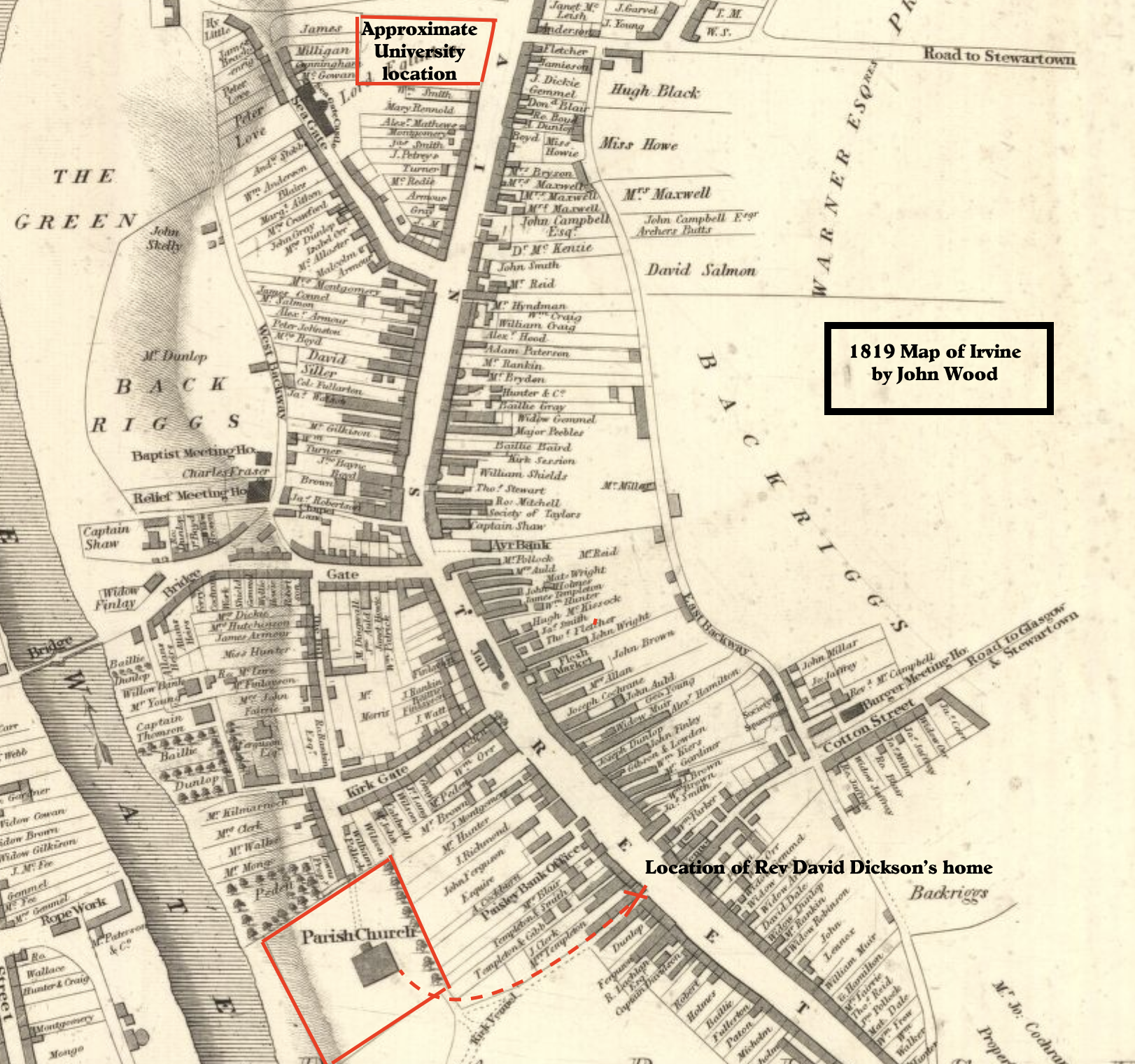
After his marriage 23 Sept, 1617, David DICKSON was ordained a Minister 31st March 1618 and appointed to the Town of Irvine. The Parish Church of St Mary the Virgin often shortened to St Mary’s was demolished in 1772 to make way for what is now called the Irvine Old parish Church. St Mary’s was originally a small chapel that belonged to the monks of nearby Kilwinning Monastery. After the downfall of the Abbey under the dissolution of the monasteries, in 1603 the Patronage of the Church of Irvine, passed to Hugh MONTGOMERIE, 5th Earl of Eglinton. The Lord of the Manor exercised his right until the ministry of Dr. Sommerville whose service began in 1863.
A stone carved with the date 1506 and the initials “MQ” (thought to commemorate a visit by Margaret Tudor, Queen of Scots) survives from the old chapel and it is built into the west wall of the current church. From The Irvine Burns Club quoted with permission: “Early mention of St. Mary’s Church occurs in the agreement between the Burgesses of Irvine and Brice the Earl of Eglintoun in 1205. It was built “small and rude of freestone ashlar” and was cruciform in shape, lit by narrow lancet windows turned with two arches. The oak panelling exhibited in Irvine Burns Club is a relic of this early Church. The carving is a fine example in the style of the Flemish Guild and the inscription, in Greek, reads: “Blessed are they who hear the word of God and keep it. “
“The Rev. David DICKSON lived in a manse located at the corner of the High Street and Kirk Vennel (a Barbershop is now there) in Irvine which had a large Hall that he used for gatherings.” Again from the The Irvine Burns Club with permission Ex-Provost John Paterson, writing c.1892 (handwritten notes, p.62), of David DICKSON’s house: “it was an antique plain two storey house, and projected about ten feet further out into the High St than its successor …The Manse presented a Gable end to the High St with a door & small windows facing down the street. The Garden runs parallel with the Vennel, and a built up door is still to be seen in the Wall, which would open into the passage leading to the small Gate into the Kirkyard, but which is now included in the Burial Ground.” (McJannet, p.146, mentions all the kirkyard-adjoining gardens as having gates, as a practice accepted in Irvine, but dissuaded in some other parishes.)” From Billy KERR’s article on David DICKSON: “Interestingly, the birthplace of Irvine’s ‘great awakening’ occurred just across the road from the Porthead Tavern outside the premises of Lennons the barber at the Kirk Vennel/ High Street corner, which was then David Dickson’s manse. At the right gable of the barber’s shop is an ancient close (still seen today) which led to a footpath that ran parallel along Kirk Vennel to exit at Dickson’s Gate in the kirkyard wall. Under this very lintel ‘The Apostle of the Covenant’ would have stooped on countless occasions on his way to and from the parish church. In recent years Dickson’s Gate was been under threat due to encroaching nearby trees and the old wall being allowed to fall into a state of disrepair, however Kirk yard custodians redeemed the situation when they did an excellent job in restoring this historic symbol of a humble man who God once used so powerfully.“
From “On p. 59, Paterson notes: “From 1630, DICKSON’s Manse at Irvine was said to be a refuge for many of the ousted Ministers both from Scotland & Ireland from which latter country especially they were pursued with relentless cruelty by the Bishops. Situated within the Port of the Burgh where a guard was kept night and day by the Burghers & having the goodwill of the Magistrates of Irvine as well as of the Bailie of CUNNINGHAME, The Earl of Eglinton, David Dickson was placed in a vantage ground to defy the Bishops & even Royalty itself that but few of the Clergy of the time enjoyed. The Guard at the Towns Port had only to give the alarm and a thousand strong arms & willing hearts would have surrounded the old Manse to defend the Minister.” So as a refuge for fellow minsters it appears DICKSON did good.
WITCH TRIALS IN IRVINE 1618
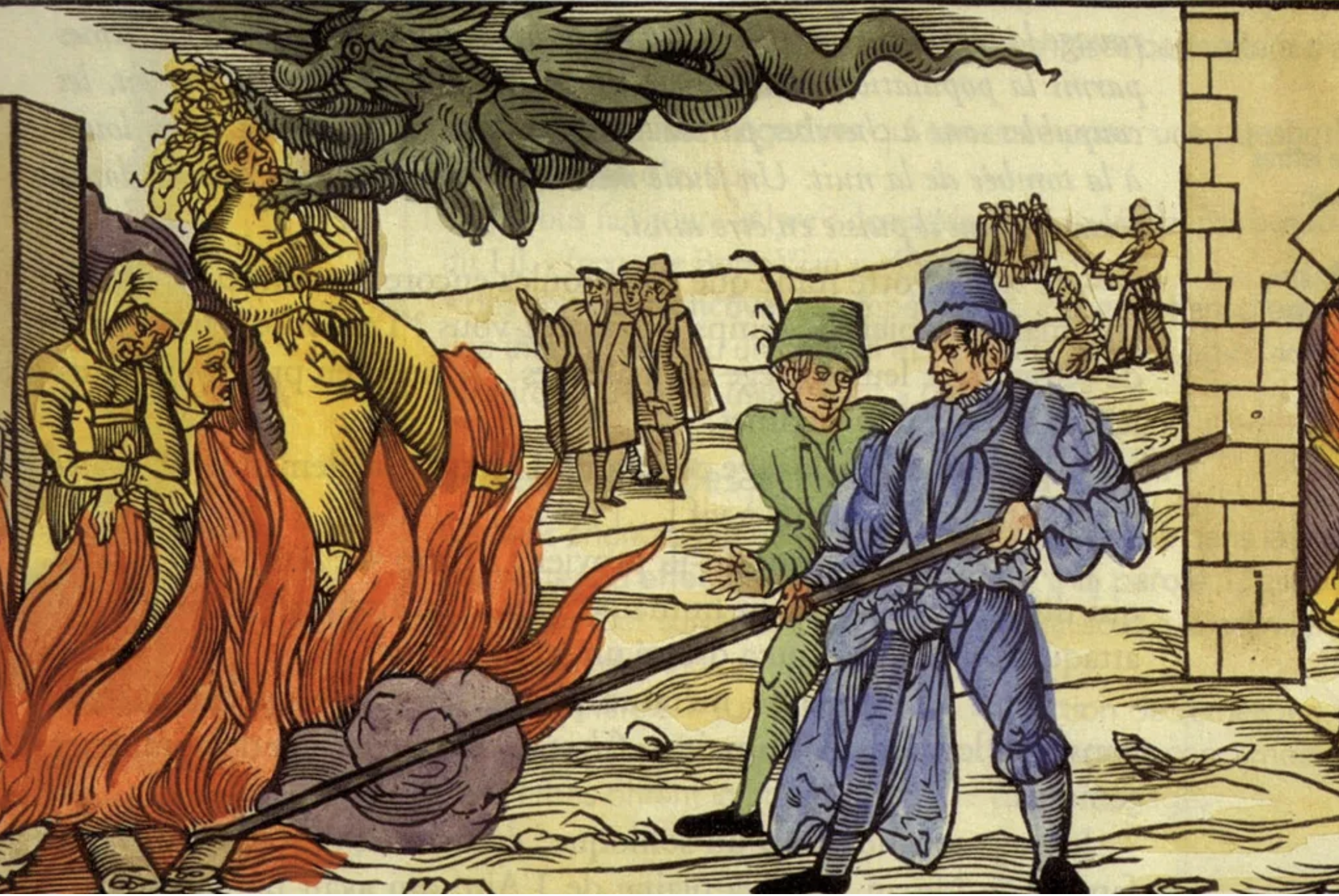
In the same year that David DICKSON is appointed as minister to Irvine a disturbing witch trial was held there. In Sir Walter SCOTT’s book Letters on Demonology and Witchcraft about 1830. In it he recounts the distressing account of Margaret BARCLAY and 3 others accused of witchcraft in 1618 at Irvine. It is ten pages long and he took the material from their original sources [Click on the title to read directly]. I will quote from Billy KERR’s account of “JOHN PEEBLES PROVOST/ MAGISTRATE OF IRVINE” for a succinct account :
WARNING not for the squeamish
In the year 1618 an appalling miscarriage of justice took place in Irvine which Sir Walter Scott described in his Letters on Demonology and Witchcraft as “the most detailed specimen I have met with of a Scottish trial for witchcraft, illustrating in particular, how poor wretches, abandoned, as they conceived, by God and the world, deprived of all human sympathy, and exposed to personal tortures of an acute description, became disposed to throw away their lives that were rendered bitter to them by a voluntary confession of guilt, rather than struggle hopelessly against so many evils.” [Scott pg 264]
“This heart-rending occurrence recorded for posterity as The Trial of Margaret Barclay resulted in the agonized deaths of, Isobel INCH an elderly woman, vagrant John STEWART, beautiful young mother Margaret BARCLAY and Isabel CRAWFORD who was in the full bloom of youth. They were accused of being involved in a satanic plot that was widely believed to have caused the Irvine vessel ‘The Gift of God‘ to be wrecked of the coast of Cornwall, causing most of the local crew, including Provost Andrew TRAN to perish. A Justice Court comprising of magistrates and ministers was commissioned to conduct legal proceedings, one of whom was former Provost John PEEBLES.“
“Isobel INCH was the first of the coven to perish as a result of the brutal treatment meted out to her by her accusers. She endured several days of pitiless interrogation before succumbing and promising to make a formal confession the next day. That same night in desperation she flung herself down from the kirk belfry where she had been imprisoned. Although critically ill from her fall, she was still pressed to admit her part in the demonic scheme. She died from her injuries five days later maintaining her innocence to the last minute of her life.“
“John STEWART, an itinerant juggler, likewise resorted to desperate measures to relieve his sufferings. Incarcerated in the tollbooth, he was so securely fettered that he pleaded with the Rev David Dickson who attended him during the trial, that “I am so strictly guarded that it lies not in my power to get my hand to take off my bonnet, nor to get bread to my mouth.” Later, being left unattended with his shackles loosened, he seized the moment and committed suicide by strangling himself with a piece of hemp used to tie his bonnet.“
“Margaret BARCLAY was a spirited, high tempered, young woman, who steadfastly denied all the “divilish practices” made against her. The most incriminating evidence the Justice Court had against her was that she carried a piece of rowan tree and a colour thread, to make, as she said her cow to give milk when it failed. To overcome her resolve the inquiry proposed a method of ‘gentle torture’ as this would take into account her age and sex. This tender torment consisted of placing Margaret’s legs in the stocks and loading her bare shins with iron bars until she acknowledged her guilt, the weights were removed only when she promised the inquisition that she would tell them what they wanted to hear. On her last day in court she implored ‘All I have confessed was in agony of torture, and before God, all I have spoken is false and untrue.’ After sentence was passed she was immediately taken to a place of execution outside the old burgh boundary known as Springfield, just about where Malcolm Gardens is today. Having made many expressions of religion and repentance, this poor soul met the fate of most convicted witches in Scotland by being strangled at the stake, then having her body burned to ashes.“
“Three innocent lives lost by barely credible allegations, the magistrates sought a fourth. After the Rev David DICKSON failed with earnest prayers to open the ‘obdurate and closed heart”’of Isobel CRAWFORD; she also was introduced to the “gentle torture”. It is recorded that Isobel endured her torment with unbelievable firmness, suffering in silence, with above thirty stone of iron laid on her legs. Only when the bars were moved to other parts of her legs she relented with cries of ‘ak af, tak af, and I sall tell all’ After her confession she then experienced the same cruel end Margaret BARCLAY suffered. However, at her judicial killing, she absolutely rejected the consolations of religion, and raged at the great injustice by constantly interrupting the minister in his prayers and totally refusing to pardon the executioner, as was the custom. Fastened to the stake, this blameless girl died a bewildered raving maniac.
Three mentions of David DICKSON from Sir Walter Scott’s text: “My Lord and Earl of Eglintoune (who dwells within the space of one mile to the said burgh) having come to the said burgh at the earnest request of the said justices, or giving to them of his lordship’s countenance, concurrence and assistance…And upon that same day of the assize, about half an hour before the downsitting of the Justice Court, Mr. David DICKSON, minister at Irvine, and Mr. George DUNBAR, minister of Air, having gone to him [John STEWART] to exhort him to call on his God for mercy for his bygone wicked and evil life, and that God would of his infinite mercy loose him out of the bonds of the devil, whom he had served these many years bygone, he acquiesced in their prayer and godly exhortation…” [Scott 259]
[At the trial of Margaret BARCLAY] “… my Lord of Eglintoune, the said four justices, and the said Mr. David DICKSON, minister of the burgh, Mr. George DUNBAR, minister of Ayr, and Mr. Mitchell WALLACE, minister of Kilmarnock, and Mr. John CUNNINGHAME, minister of Dairy, and Hugh KENNEDY, provost of Ayr…” [Scott 261]
“Isobel CRAWFORD, inculpated by Margaret BARCLAY’s confession. A new commission was granted for her trial, and after the assistant minister of Irvine, Mr. David DICKSON, had made earnest prayers to God for opening her obdurate and closed heart, she was subjected to the torture of iron bars laid upon her bare shins, her feet being in the stocks, as in the case of Margaret BARCLAY. [Scott 263]
RECKONING
I was a few weeks into researching David DICKSON’s life when Billy KERR brought me back to reality, by introducing me to DICKSON’s participation in the famous Witch Trial in Irvine. Billy’s paraphrasing of the historian’s challenge to “never judge a man by your time, but by his” is good advice. On the one hand a well respected, compassionate theologian and minister. On the other DICKSON exemplifies the religious hysteria that led to accusations of witchcraft of approximately 4000 people in Scotland during the period from 1563-1736 and the execution of roughly 2500. This rate was 5 times higher than the rate of Europe overall. Perhaps this can be explained by widespread Celtic beliefs in folk magic, fairies, changelings and the healing arts as practiced by wise women. Both clergy and their parishioners were primed to believe in witches.
It is particularly noteworthy that the online and printed biographies of David DICKSON leave out this part of DICKSON’s life. Is this to paint a more sympathetic character and not to shock our modern sensibilities? I dare say it lays bare the contradiction of religious extremism. Tragic events must be accounted for, and not unlike Aztec or Hawaiian rituals of human sacrifice that we now consider barbaric, they strike to the core of the human need for explanation or even appeasement of their gods. In many cases an unholy union between church and state that essentially keeps people in their place and punishes those least able to defend themselves that dared to stray beyond established norms.
Whether reading about the Salem Witch trials in America or this one in Irvine, Scotland, it seems that accusing someone of witchcraft was often a way to rid yourself of inconvenient , or quarrelsome people, or hated enemies and/or misguided attempts to explain away tragedy or illness. In the case above this was a tragedy, in search of someone to blame. There had already been an ongoing quarrel between the wives of two brothers Archibald DEIN and his brother John DEIN. Archibald was the Burgess of Irvine and his wife was the accused Margaret BARCLAY and his brother John DEIN’ s bark [ship], ironically named, ‘The Gift of God’ was to sail for France, and Andrew TRAIN, or TRAN, provost of the burgh of Irvine, who was an owner of the vessel, went with him to superintend the commercial part of the voyage. John DEIN and Andrew TRAN perished and only two sailors survived. John DEIN’s wife, Janet LYAL, now a widow finds an opportunity for revenge. The whole sordid tale is based on tainted testimony. At the time the accused were not afforded legal representation at their trials—which were a mockery at best. Lest we think we have completely moved on—scapegoating is still in practice today, although no longer under the guise of witchcraft.
To add some more historical context, the Scottish Witchcraft Act of 1563 made the practice of witchcraft, sorcery, and necromancy, as well as consulting with witches, capital offenses punishable by death. In 1590 King James VI [later James I of England] deeply feared witchcraft, and famously blamed witches for the storms that nearly sank his ship while he was returning from Denmark. He authored a treatise titled Daemonologie in 1597. It was not until Great Britain, in the Witchcraft Act of 1735 revoked all previous Witchcraft Acts and ruled that witchcraft was not a crime. And on Woman’s Day 2022 Scotland’s First Minister Nicola Sturgeon addressed an apology “Some will ask why this generation should say sorry for something that happened centuries ago,” “But it might actually be more pertinent to ask why it has taken so long.” Sturgeon called the accusation, conviction, vilification and execution of those under the Witchcraft Act 1563 an “egregious historic injustice“. She extended a “formal, posthumous apology” on behalf of the Scottish government.
The Kirk of Scotland and its evangelical Presbyterian factions were almost entirely responsible for the 17th-century witch trials in Scotland. The times brought overly zealous Protestants keen to enforce their version of morality. Catholics after the Reformation had been marginalized and persecuted, playing virtually no role in witch hunts. The Scottish Reformation led by John Knox established Calvinism as the state religion. The pursuit of witchcraft became highly systematized including Kirk Sessions, local parish disciplinary committees, and were often led by Presbyterian ministers and elders, who investigated immoral or ungodly behavior. They gathered evidence against suspected witches. Presbyterians believed they had a direct covenant with God and viewed witchcraft not just as a crime, but as a threat from the Devil himself, that in turn might bring down the wrath of God in the form of all manner of evil. So it was not a simple matter in the established Ptresbyterian orthodoxy.
To be fair, to begin your ministry, as DICKSON did, and be thrust into a witch trial —made for a trial for DICKSON himself– “these are the times that try men’s souls“. Did these scenes, even if he believed he was correct in trying to save their souls, did they haunt him from time to time? It makes we wonder how this may have affected him going forward. Whether the compassion that he seemed to display was influenced by these events. It appears DICKSON was sincere in his prayers for these unfortunate souls, however misguided we know those prayers to be now.
“If we look back into history for the character of present sects in Christianity, we shall find few that have not in their turns been persecutors, and complainers of persecution. The primitive Christians thought persecution extremely wrong in the Pagans, but practised it on one another. The first Protestants of the Church of England, blamed persecution in the Roman church, but practised it against the Puritans: these found it wrong in the Bishops, but fell into the same practice themselves both here and in New England.”
Benjamin FRANKLIN Letter to the London Packet, 3 June 1772
Or as Jesus said at the Sermon on the Mount. “Judge not, lest ye be judged.” But judge, we do…and too often in the name of a religion or God who would not recognize the mayhem we have created in his/her name.
IRVINE Continued
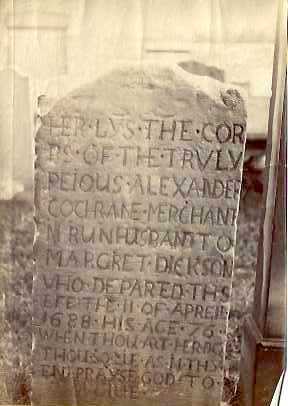
In 1620 DICKSON was named in a leet of seven [list of candidates] to be a minister in Edinburgh, but since he was suspected of nonconformity his nomination was not promoted. The birth of his children is roughly as follows John 1620, Margaret 1622 , James 1624, David 1626, Alexander 1628, Robert 1630 and Andrew 1632, Archibald 1634 [listed as youngest son in deed dated 15 July 1659 Rh/28/137]. All assumed to have been born in Irvine. Billy KERR has supplied me with an old Photo of a grave of Alexander COCHRANE and his wife Margaret DICKSON recorded on this memorial she is said to be the daughter of David Dickson. “Sadly the stone no longer exists, probably dumped into the nearby river by gravediggers, as they were once prone to do.” It reads “her lys the corps of the truly peious Alexander COCHRANE merchant ? husband to Margaret DICKSON who departed thus life the 11 of Apreie 1688 His age 76 When thou art herd thou ? as with ? prayse God to thee?” This would make him born about 1612 and not unlikely somewhat older than his wife—so Margaret, very likely a daughter of David.
January 29, 1622 David DICKSON was summoned to appear before the High Commission, by Janus LAW, Archbishhop of Glasgow. He was summoned because he was outspoken in condemning the Five Articles of Perth. King James in 1618 aimed to align the Church of Scotland with that of England by a set of controversial liturgical rules. DICKSON appeared, and gave a paper declining the jurisdiction of the Court. He was sentenced to deprivation of his ministry at Irvine, and ordained to proceed to Turriff, in Aberdeenshire, within twenty days. He continued preaching almost daily until his time was up and was then was about to commence his journey to the North.
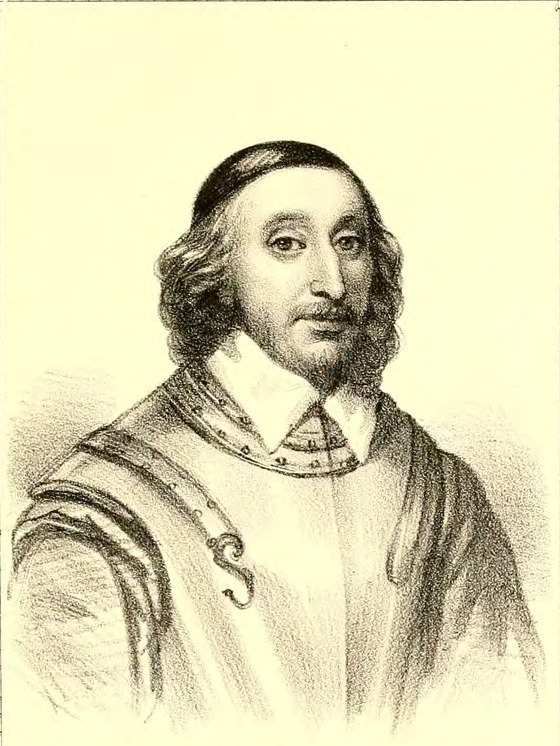
At the request of the Alexander MONTGOMERIE, 6th Earl of Eglintoun, he was permitted to remain in Ayrshire, where for about two months he preached weekly in the hall and courtyard of Eglintoun Castle to large congregations of his parishioners. He was then ordered by the Archbishop of Glasgow to set out for the Turiff which he did. The 25th of April 1622 Instrument recorded narrating that Mr David DICKSON, minister at Irvine, entered himself in free ward in town of Turriff [GD172/2476] it is said DICKSON stated “The will of the Lord be done; though ye cast me off, the Lord will take me up. Send me whither you will. I hope my Master will go with me; and as he has been with me heretofore, he will be with me still, as being his own weak servant.”
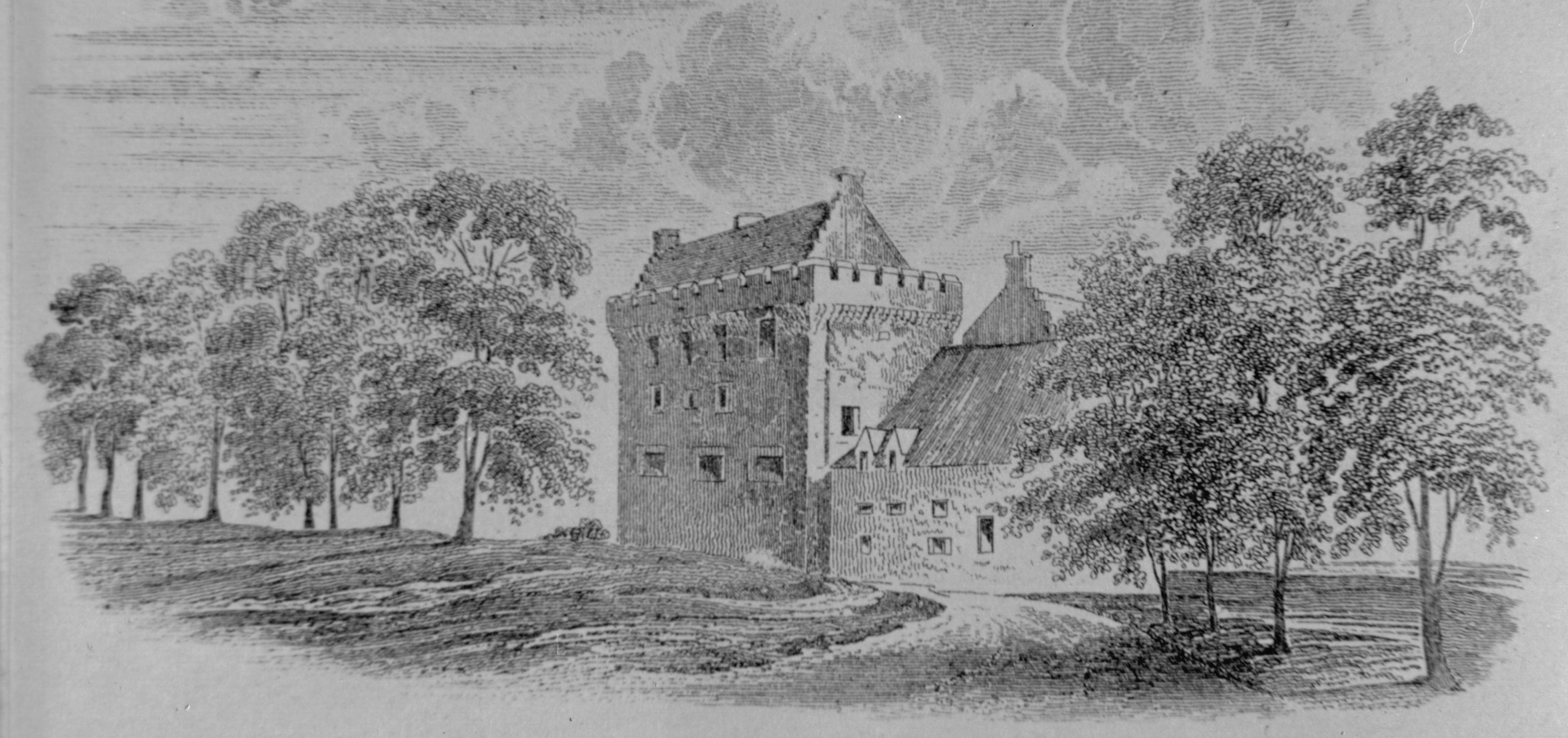
This is the same Lord Eglinton who hosted David DICKSON’s services in 1622 . The Eglinton Estate and Castle were home to the MONTGOMERIEs of Eglinton, who were the Earls there for nearly 800 years and among the most powerful families in Scotland. Alexander MONTGOMERIE, 6th Earl of Eglington (1588 – 1661) would have been a contemporary of David DIXON. Alexander was a staunch Presbyterian, chiefly owing to the influence of David DICKSON during his time as minister of Irvine. Alexander was one of the commissioners at parliament in 1621 who voted against the five articles of Perth as did David DICKSON. After DICKSON was deprived of his ministry at Irvine for publicly protesting against the five articles, the Earl obtained for him freedom to come to Eglinton and visit his family at Irvine. The Records of Scotland record a Letter dated 24th of March 1623 to Mr David DICKSON, minister at Irvine from Alexander, Earl of Eglinton regarding the writer’s efforts to persuade the bishop to allow DICKSON to return to his parish. [GD172/279]. The Earl and others eventually being successful, DICKSON was permitted to return to Irvine in July 1623. On his arrival at Eglinton, the Earl arranged that he should preach in the hall of the castle, and afterwards in the close, when the multitudes who thronged to hear him became too great for the hall.
A most interesting book “The Ladies of the Covenant: Memoirs of Distinguished Scottish Female Characters Embracing the Period of the Covenant and the Persecution” by James ANDERSON 1862 Some mentions of Davis DICKSON:
LADY ANNE CUNNINGHAM, MARCHIONESS OF HAMILTON. “The bishops had procured all the dissatisfied ministers to be discharged the town, so divers of them, upon the last day of the Parliament, went out to Sheens [Kirk o’ Shotts 16 miles east of Glasgow] , near Edinburgh, where in a friend’s house they spent the day in fasting and prayer, expecting the event, of which they were as then uncertain. After the aged ministers had prayed in the morning with great straitening, at length a messenger from the city, with many tears, assured them all was concluded contrary to their request. This brought them all into a fit of heaviness, till a godly lady there present, desired Mr. David DICKSON, being at that time present, might be employed to pray, and though he was at that time but a young man, and not very considerable for his character, yet was he so wonderfully assisted, and enlarged for the space of two hours, that he made bold to prophesy, that from that discouraging day and forward, the work of the gospel should both prosper and flourish in Scotland, notwithstanding all the laws made to the prejudice of it.” Kirkton has not recorded the name of the lady who suggested that Dickson should be employed in prayer ; but Livingstone, who narrates the same incident in his Memorable Characteristics, informs us that Lady Culross told him she was the person by whom the suggestion was made.” [Ladies of the Covenant pg 36 about 1620] Lady Anne CUNNINGHAM’s daughter was married to Hugh MONTGOMERIE 6th Earl of Eglinton.
LILIAS DUNBAR, MRS. CAMPBELL [Lilias Dunbar was the only daughter of Mr.DUNBAR of Boggs, by his wife, Christian CAMPBELL, daughter to Sir John CAMPBELL, fifth knight of Calder]: “During the persecution, the adherents of Presbytery, though most numerous in the south and west of Scotland, were scattered more or less numerously over the northern counties. Even so far north as Morayshire, and in some of the neighbouring shires, not a few of them were to be found. The gospel had been preached in these remote parts, with considerable success, by Mr. Robert BRUCE, Mr. David DICKSON, and other ministers who had been banished thither by James Vl or by the high commission court, for their opposition to the introduction of prelacy, and the fruits of the instructions of these eminent men remained even to the persecuting times.” [Ladies pg 292 before 1625]
As above, DICKSON returned to his parish in Irvine in July 1623. From all accounts he was a very popular and persuasive Minsiter. “At Irvine, Mr. Dickson’s Ministry was singularly countenanced of God. Multitudes were convinced and converted ; and few that lived in his Day were more honored to be Instruments of Conversion than he.” [Wodrow pg xiii] People came from far and wide to ear him preach and many settled in Irvine. “Mr. Dickson had his Week Day Sermons upon the Mondays, the Market-Days then at Irvine. Upon the Sabbath Evenings, many persons under Soul Distress, used to resort to his House after Sermon, when usually he spent an Hour or two in answering their Cases, and directing and comforting those who where cast down, in all which he had an extraordinary Talent ; indeed he had the Tongue of the Learned, and knew how to speak a word in Season to the weary Soul. In a large Hall he had in his House at Irvine, there would have been, as I am informed by old Christians, several Scores of serious Christians waiting for him, when he came from the Church.” [Wodrow pg xiv] ” On 23rd of Nov 1624 the College of Glasgow and David Dickson, presenter of Glasgow and others of the parsonage and vicarage of Kilbride and Torrance were party to an Agreement. [GB248 GUA 20788]
STEWARTON SICKNESS
This is a wonderful telling of the “Stewarton Sickness” from Billy KERR: “This sacred phenomenon received its name from ‘The daft people of Stewarton’ as they were mockingly called who traveled to Irvine to hear the parish minister [DICKSON] preach. The Stewarton minister at the time William CASTLELAW encouraged his congregation to journey to the Townhead to attend the Monday morning market which was always preceded by a talk from the Irvine minister. From those weekday sermons this particular out-letting of the Holy Spirit began, quickly spreading from house to house for miles around and then sweeping further a field across Ayrshire. Within a few weeks thousands of people were flocking from all over Scotland to listen to David Dickson preach. The ‘Stewarton Sickness’ lasted lasted five years (1625-1630) and its impact would be felt for generations to come. It is said that David Dickson’s style of delivering a sermon was not that of the usual revivalist who normally relies on a loud voice and thumping the bible to work up hysteria, but was very cultured in tone and learned in application, appealing to many.“
About the Year 1632, some of Presbyterian Scots Ministers: Mr. Robert Blair, Mr. John Livingstoun, etc. settled amongst the Scots in the North of Ireland. Then in 1637, Robert Blair and John Livingston, were driven by the bishops from their charges in Ireland. They were given shelter by DICKSON. He was again cited before the High Commission Court, however no charges were brought against him. He was active in many serious debates. So we can say by this time David DICKSON was having no problem defying those in authority.
REDEMPTION
Having brought us low with the accounting of David DICKSON in his early years as a minister, perhaps it is well to offer a more sympathetic story recounted by Billy KERR: “an account of David Dickson that reflects the influence he had on people he met, even his enemies such as a highwayman he encountered, the story goes: ‘Traveling on horseback to Edinburgh he was stopped and robbed by a young man who stole a considerable amount of money from the minister. He said to the man “This is a very bad way of making a living you are following. Take my advice, take my money from me, go trade with it and leave this woeful course of yours.” Many years later when the Rev Dickson was Professor at Edinburgh University a hogshead of the finest wine arrived at his residence, not knowing who sent the wine he set it aside. [A hogshead of wine typically holds about 230-300 liters or 300 – 400 bottles of wine.] A few days later a wealthy merchant arrived at the house of the professor and was treated with the greatest respect and given a glass of ale. When the merchant asked if there was any wine in the house it was explained to him that a hogshead of wine arrived a few days ago but no one knew who it was from. The merchant said that he had sent it and asked the professor if he remembered a young man robbing him of his purse, the professor replied that he remembered it vividly; the merchant said that he was that young man and that he had come to repay the money he had stolen plus interest.“
“We pardon to the extant that we love“
Victor Hugo
To be continued.
Kelly Wheaton ©2026 All Rights Reserved.


A fascinating read!