Spinning a Scottish Yarn: The Reverend David Dickson Part One Beginnings in Glasgow and Busby

Storaidhnean farsaig: in Scots Gaelic storaidhnean is a story or tale and farsaig : wide, extensive or broad. Roughly translated an expansive tale. This may turn out to be Storaidhnean farsaig.
INTRODUCTION
As I often do when getting ready for a trip I try my hand at researching my own families that may intersect with the places I am to visit. I have done this many times. A search on my website will find many examples. It starts with someone that catches my eye or strikes my fancy and then take on a life of its own. This is a long and twisted tale—so it will be tackled in parts
My upcoming trip to Scotland in October I will be based in Edinburgh, Stirling and Cromarty (near Inverness). My Scots ancestry is not recent with many of my families coming in the early 1700’s and mostly via Ireland. I have at least 3 STEWART lines, DICKSON, KENNEDY, ROBERTON, HAMILTON, ROBINSON, PADEN, WILLIAMSON, CAMPBELL and many others. My great grandmother was a PADEN and that is a line that I have used DNA when the paper trail dried up. I have written about one of my STEWART lines that goes dry in Ireland before my immigrant Alexander STEWART who likely was born in Antrim, Northern Ireland about 1675, immigrates to America in 1719. He settled in Voluntown, New London, Connecticut and died there 20 July 1742. Finding the proper Alexander STEWART is like a needle in a haystack. Although through DNA we have confirmed the family legend that he was of the Royal STEWART line.
Like so much in genealogy when you can’t find your specific individual follow their religion. The first known Scots Irish immigration from Northern Ireland to Boston, Massachusetts is in August of 1718, followed by thousand of others in the next decade. These were Scots who originally fled religious persecution of Presbyterians during the reign of James VI by the Church of Scotland. They chiefly immigrated to Ulster, Ireland from Scotland starting about 1610. The first Presbyterian minister, Rev George Dunbar served in 1627. The creation of the first presbytery in Ulster in 1642 was by chaplains of a Scottish Covenanter army which had arrived to protect the mostly Protestant British (Scottish and English) settlers in Ulster. It is one of the oldest in Northern Ireland having been established by members of the Scottish Kirk who came during the Plantation of Ulster. The First Presbyterian Church of Ballymena, Kirkinriola, Antrim, Northern Ireland was in 1666.
My Alexander STEWART’s father was a likely descendant of those original Presbyterians and he is listed as Presbyterian in Connecticut. He marries in Ireland Margaret DIXON, she born about 1677 at Ballymena. Her father was Robert DICKSON born at Irvine, Ayrshire, Scotland about 1630, son of the famous Covenanter, the Rev. David DICKSON, and her mother was Priscilla KENNEDY daughter of Hugh (Hew) KENNEDY.
And at this point I am having a bit of deja vu. As in my search for my Alexander PADEN’s origins, one invariable comes into contact with Alexander PEDEN 1626 – 1686, also known as “Prophet PEDEN.” He was one of the leading figures in the Covenanter movement in Scotland as was David DICKSON. PEDAN was born at Auchincloich Farm near Sorn, Ayrshire, about 1626. He was a student at the University of Glasgow from 1643 to 1648. David DICKSON was appointed Professor of Divinity in Glasgow in 1641 and served there about ten years. So don’t you just love those coincedences?
As it turns out the YDNA for the famous Alexander PEDEN line, is not the same as that of my Alexander PADEN. My Alexander is the son of John PADEN b 20 Dec 1767 Coleraine, Londonderry, Northern Ireland who immigrates to Maryland. Since PADEN is a Nickname for Little Patrick and the DNA connections are with MCKEE, MAXWELL, NOBLE, LOWERY and other surnames and mostly in Ireland that remains a brick wall. However the children of a PADEN and a STEWART of mine line marry and I think that connection is a hint.
DAVID DICKSON
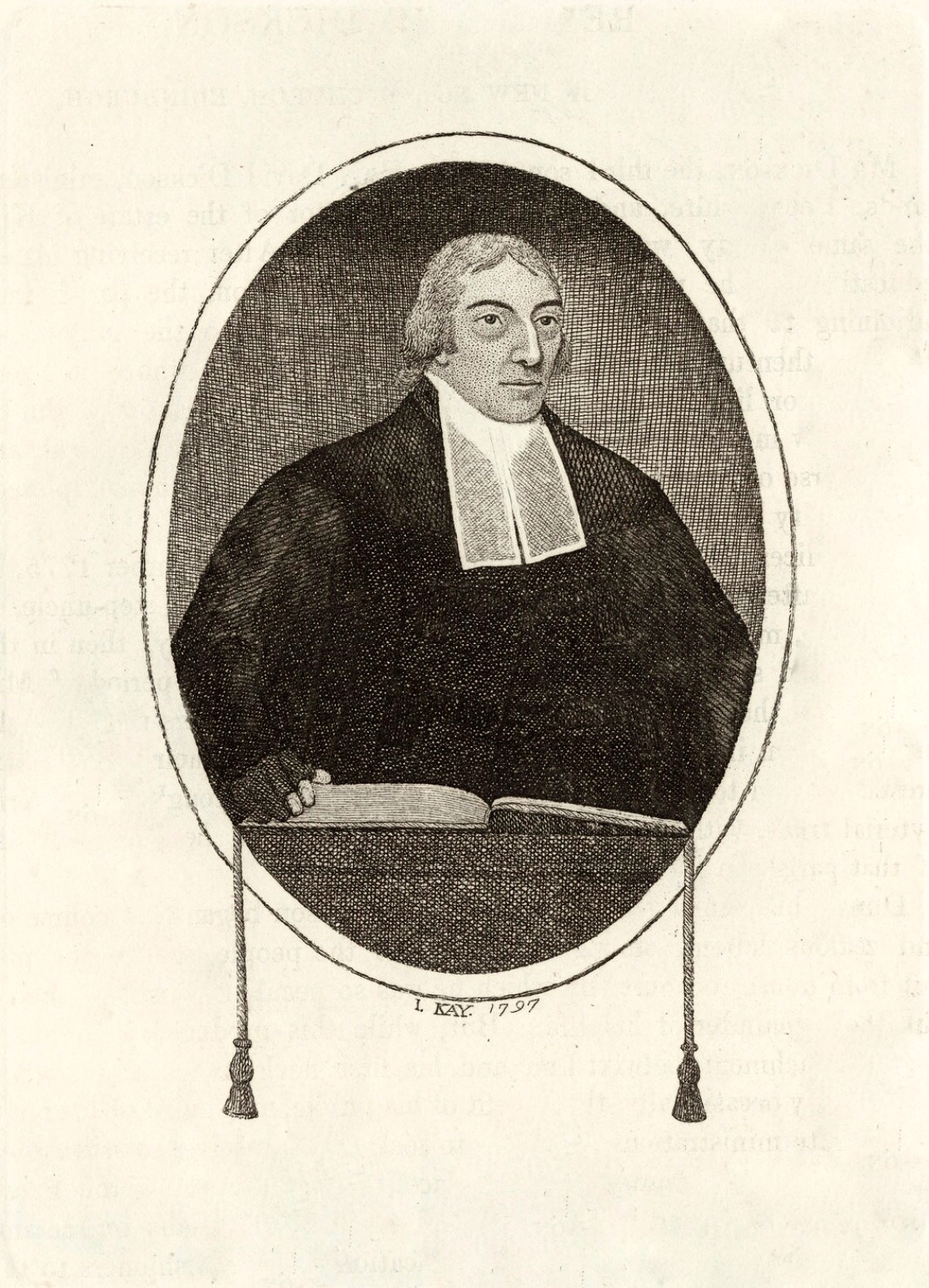
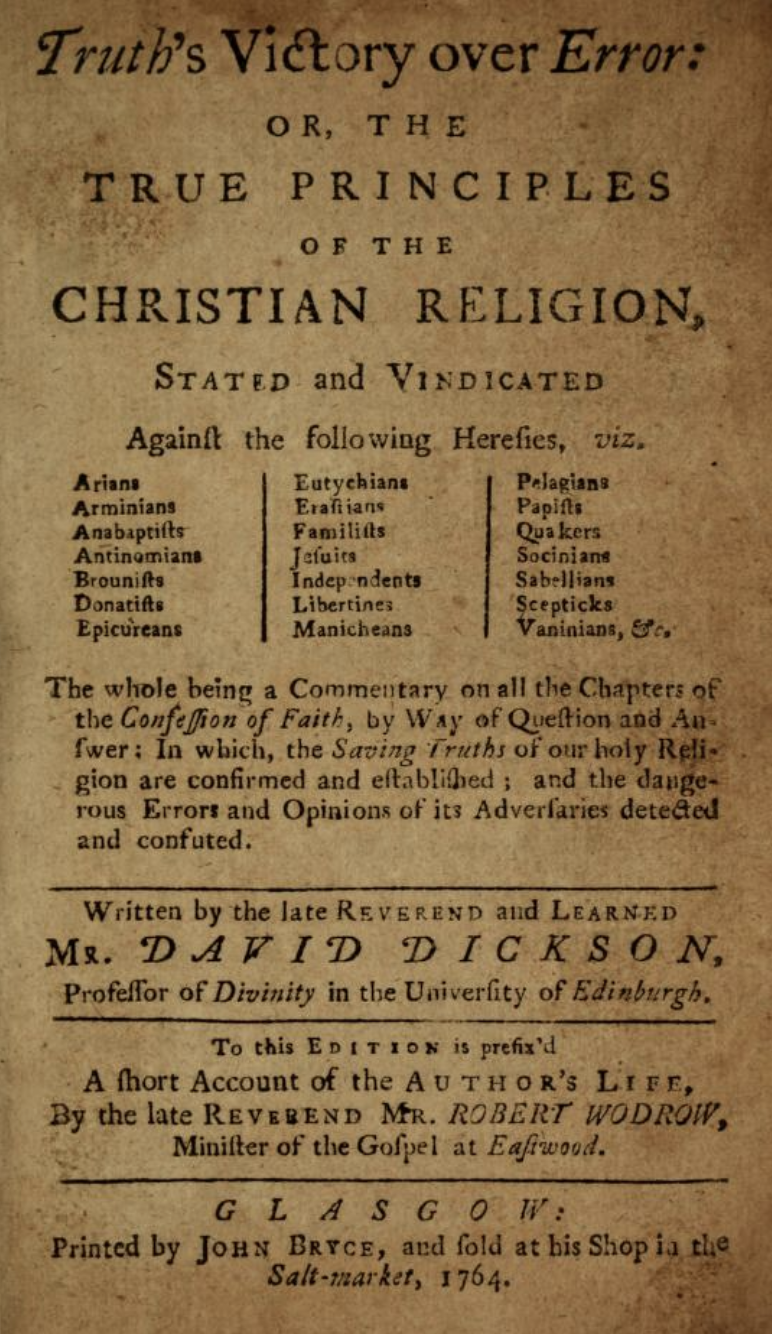
In the absence of many clues I decide to follow the DIXON / DICKSON line as it seemed to provide more material. The Rev David Dickson (c. 1583–1662) is my 9th great grandfather. He was a minster, a professor of theology, a writer and a poet. Reaching back hundreds of years, for many of our ancestors we can barely get a glimpse. We are luck with David DICKSON because we can read his own words and those of his contemporaries. The personal biography contained in his book “Truth’s Victory over Error, or, the true principles of the Christian religion“, originally translated by George SINCLAIR and misattributed to him. Later it was published in David DICKSON’s name with the Rev. Robert WODROW (1679-1734) giving a short account of the Reverend DICKSON’s life. It is that account that I am using in part as the basis to track his life along with as many contemporary resources as I can fit in. My purpose is to get a feel for the man and the places he may have been rather than the typical genealogy of names, dates and places. Nor am I looking to him as theologian or Presbyterian scholar but, rather a curious descendant.

GLASGOW
According to Scott Hew’s Fasti ecclesiae scoticanae; the succession of ministers in the Church of Scotland from the reformation 1915: “DAVID DICKSON of Busby, born Glasgow 1583, son of John DICK/SON, a wealthy merchant of the Trongate, was at first intended for the mercantile profession, but afterwards studied for the Church. After becoming M.A. of Glasgow, he was appointed Regent of Philosophy in the University, and on 31st March 1618 was ordained minister of Irvine...”
This is not quite as colorful or as informative as “the Short Account of his life” from Truth’s Victory cited above.: “Mr. David DICK, or DICKSON, was the only Son of John Dick or DICKSON, Merchant in Glasgow, whose Father was an old Feuar (land owner), and possessor of some Lands in the Barony of Fintry, and Parish of Saint Ninians, called the Kirk of the Muir. His Parents were Religious Persons, of considerable Substance, and many Years married before they had this Child, and he was the only one ever they had, as I am informed. As he was a Samuel asked of the Lord, for he was early devoted to him and-the Ministry; yet afterwards the Vow was forgot, till Providence, by a Rod and fore Sickness on their Son, brought their Sins to Remembrance; and then he was put to resume his Studies which he had left, and at the University of Glasgow he made very great Progress in them.” [Truth’s Victory xi-xii]
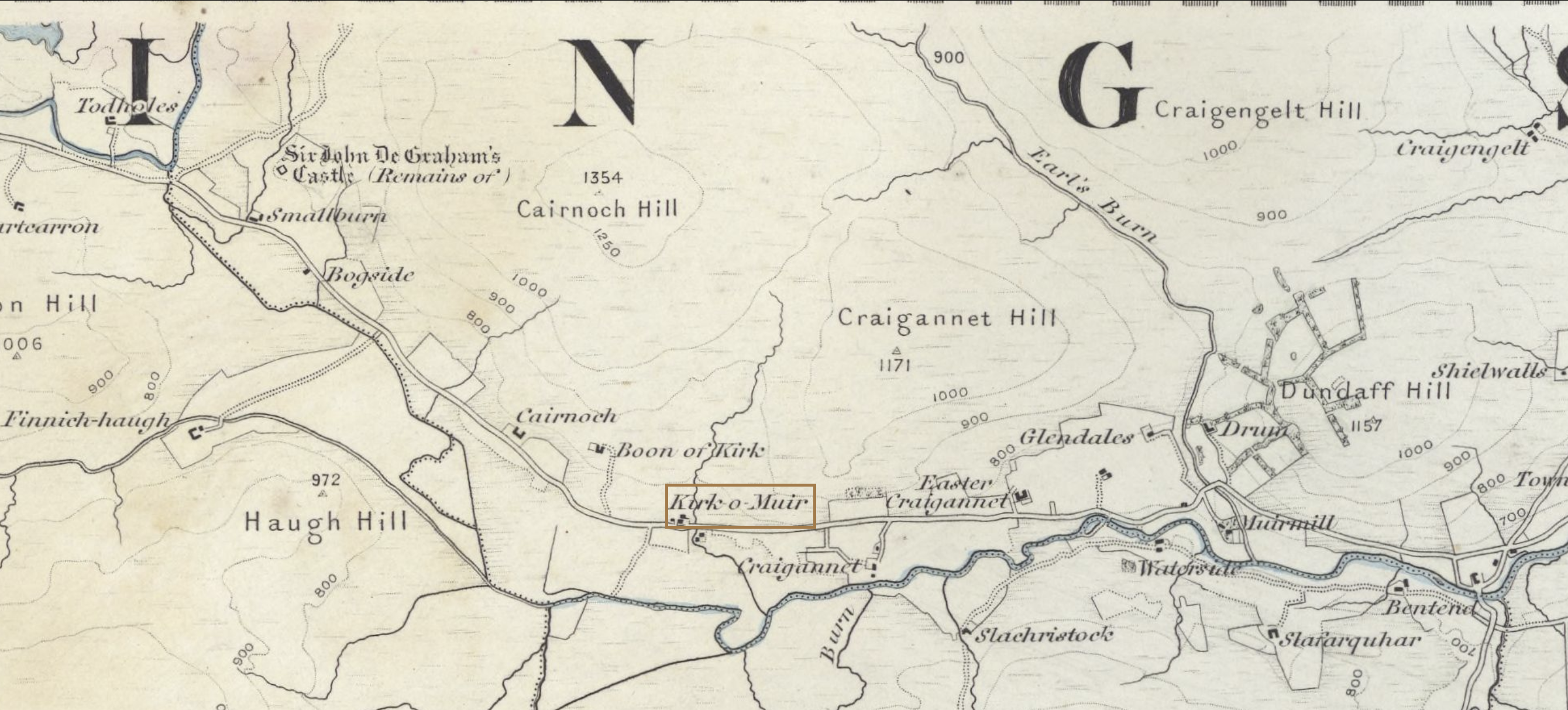
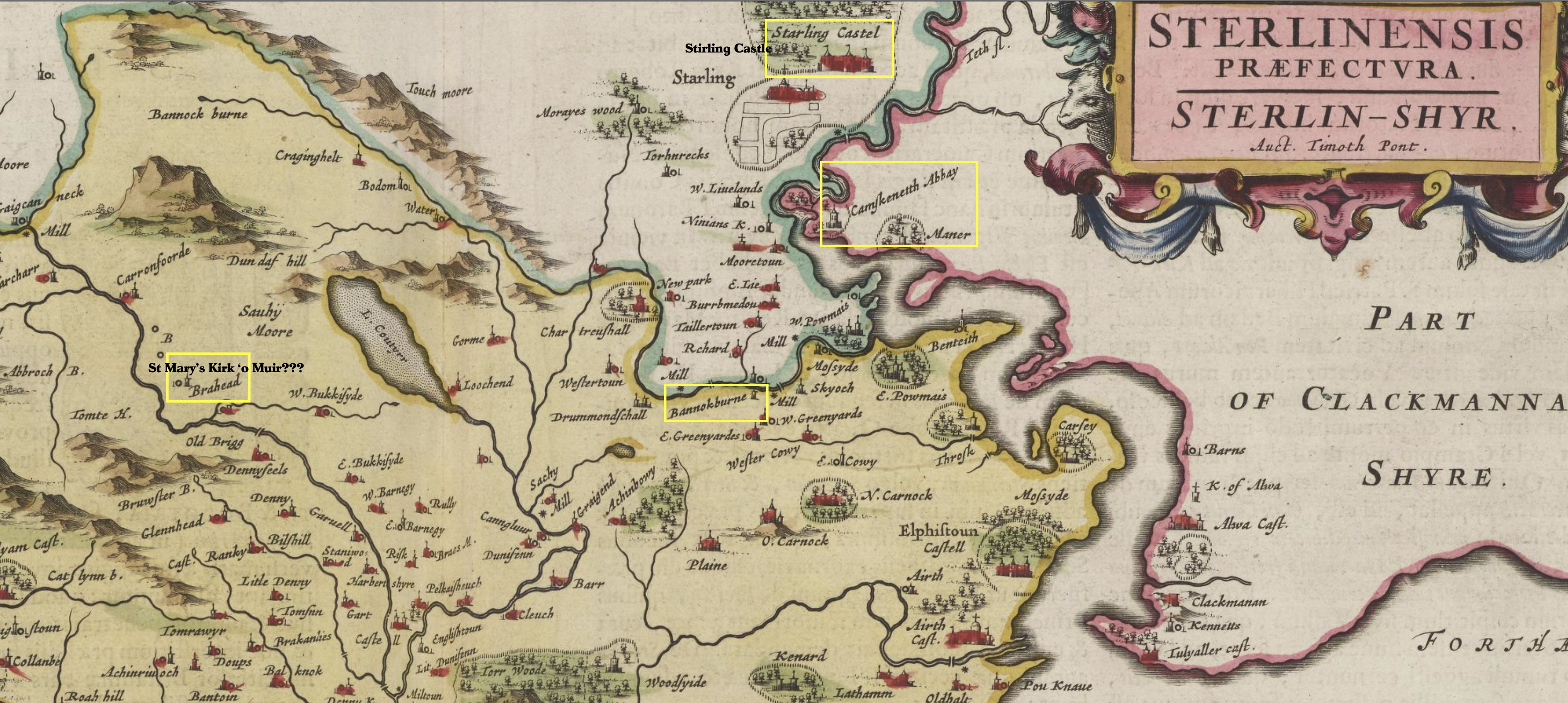
So doing some digging on “Kirk of the Muir,” I find Post Reformation Minister of St Ninians Old Parish Church 1567-1587 was Patrick GILLEPSIE, Minister of St Ninians, Larbert, Donypace, Kippane, Kirk o’ Muir and Gargunnock. So it appears that the parish contained within it these churches. Stirling names website states: “The Kirk on the Muir in the Carron Valley, is one of the most overlooked wee gems in Stirling and is rife with a deep history. The site of a chapel dedicated to St Mary in the 15th century, probably in connection with John de Graham’s Castle and marked on maps in the 17th and 18th centuries it was demolished by the 1850s, when it became just a cemetery and the site of what may be Scotland’s smallest school, measuring 7.5m long and 4m wide!” The small graveyard remains but the Carron River was dammed forming the Carron Valley Reservoir about 1939. Below is the Ordnance Survey map from 1878. Whether his father just owned land there or lived there is not known.
As often happens as you dig you discover more. A much more complete version of David DIckson’s life appears in Select practical writings of David Dickson, vol. 1 and pulled together by the editor. It would have saved me much time in my searching but the longer journey is sometimes the more scenic route. Our introduction reads like a tale from the bible ; “Mr David Dickson, or Dick, (for the family seems to have used either name indifferently.) was the son of Mr John Dick, merchant in Glasgow, a man of religious character, and possessed of considerable wealth. John, and his partner in life, had been several years married without having offspring, a circumstance that grieved them deeply ; and they not only prayed themselves, but stirred up others to pray for them, that they might have a son — vowing, that if their petition was granted, they Would devote him to the service of the Lord. Their prayers were heard, and David was given to them, like a second Samuel, to comfort them in their old age. The precise date of his birth cannot be ascertained, but it is supposed to have been in 1583. In proper time the boy was sent to school ; but after he had learned some Latin, his parents forgot their vow, and sent him to sea in the capacity of a supercargo, intending thus to train him up to merchandise. But several losses they sustained at sea after David had entered upon his charge, and subsequently, a severe sickness with which he was visited, admonished them sharply of their dereliction. They bewailed their forgetfulness, and sent him to the University of Glasgow, where his proficiency soon showed that he had at last got into his proper element. [Select v-vi]
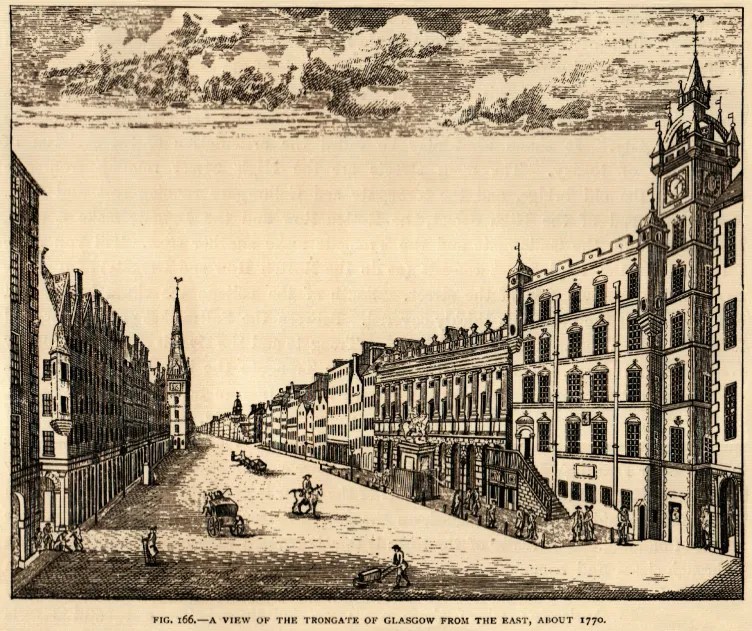
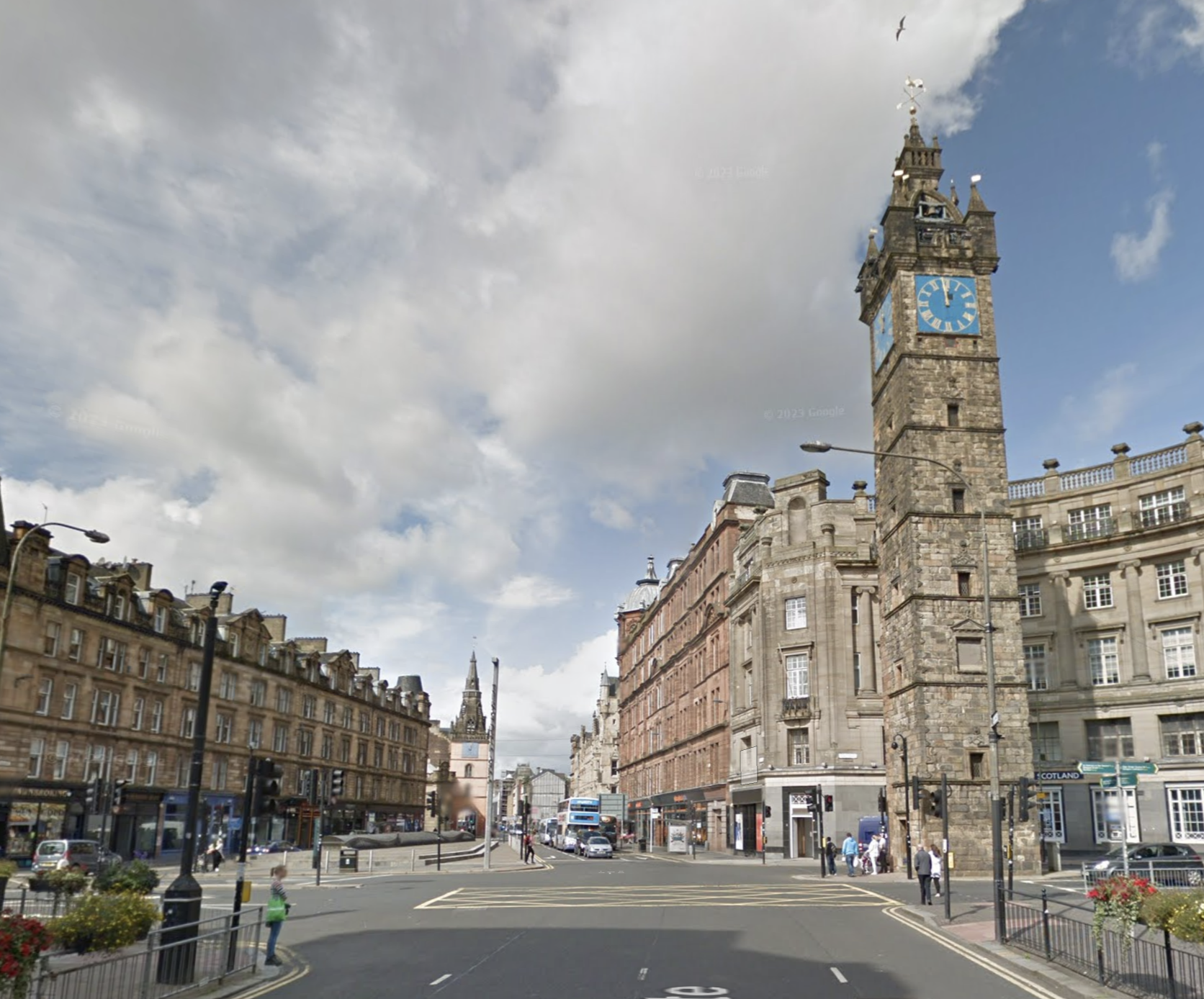
So we learn that John DICK or DICKSON was a merchant of “considerable wealth” in Glasgow. From Fasti ecclesiae we learn he was of Trongate. Trongate is one of the oldest streets in the in Glasgow, Scotland. The name of the street comes from the town’s “tron” or wooden weighing beam, which was once situated on this street. All bulk goods, like wool and grain coming into the city, would be weighed at the tron. Trongate begins at Glasgow Cross, where the steeple of the old Glasgow Tollbooth is situated, being the center of medieval Glasgow. The Tron church was founded as the Collegiate Church of Our Lady and St Anne in 1525. It became a Protestant church after the Reformation. The steeple was added to the church in about 1593, and rebuilt in 1636. No early drawing exist. Here is a view from about 1770. So we must imagine what it may have looked like at David DICKSON’s youth. The surviving records for Glasgow begin in 1609. Whether he was born in Glasgow or on his father’s property in Busby we do not know. He is recorded many times including his death as David DICKSON of BUSBY.
As we read above David was sent to the University of Glasgow. At this time the University was not far from the cathedral. Although this map is 200 years later it does show the locations proximity . In the left hand corner of the first map would be Trongate.
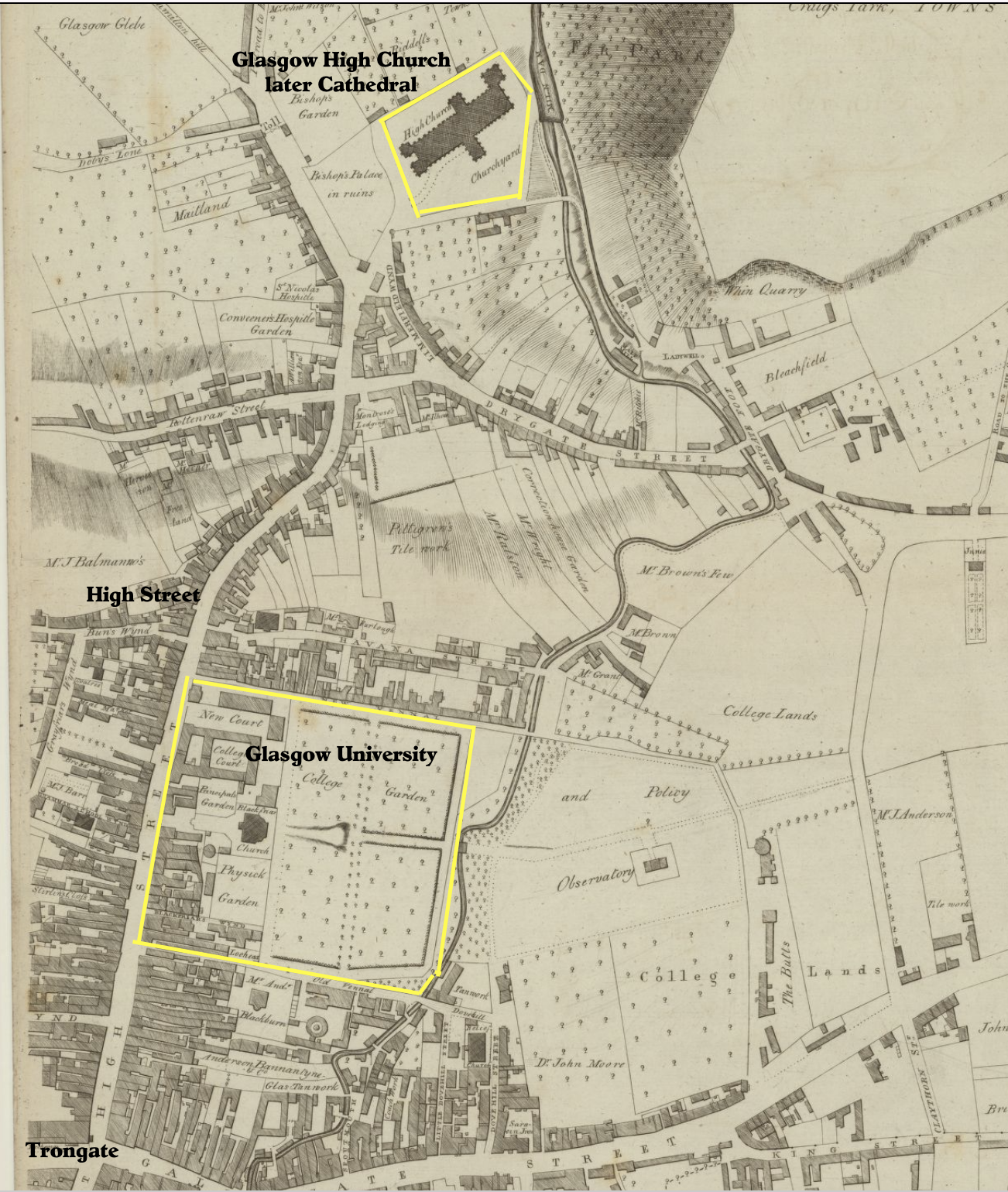
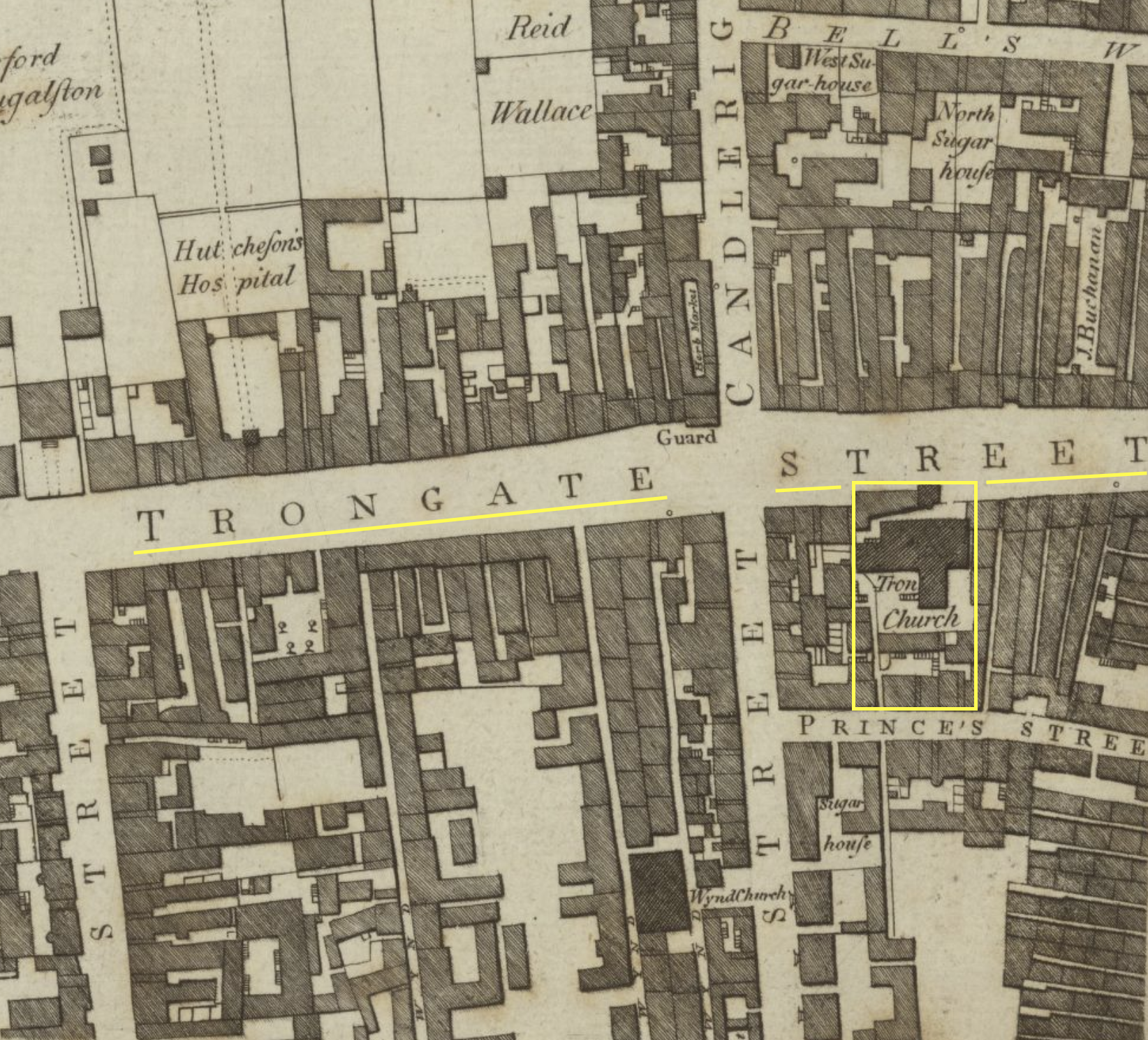
1778 Map of Glasgow (part) by John MacArthur showing Trongate the Church and the Tollbooth would be just to the right. Image on Left shows University and Cathedral.
David may have started Grammar School by the age of 7 to 9, or even earlier. From the account by Robert WODROW he left to be a servant on a merchant ship and then later became severely sick. When he recovered it appears he entered into training for the ministry. This often began at the University as early as 14 to 16 years old and continued through Divinity School for 7 years. “The young pupil, at his admission, was expected to be a thorough proficient in Latin…in addition to the higher Latin classics with which the course commenced, the students were initiated into the Greek grammar, and carried through the ample routine of the Greek poets and historians. These literary acquirements succeeded the study of rhetoric, logic, ethics, physics, geometry, and history ; after which the alumni were introduced to their more important work of studying Theology as a science in all its departments, and the Eastern languages with which it is connected. This course continued for six years.” [Select vi-vii]
“After he had completed a six years’ course, Dickson was found so well qualified for the duties of an instructor, that he was appointed Professor of Philosophy in the University of Glasgow. In this important charge, he was eminently successful in training the youths not only in learning, but sound religious principles. Having continued in the professorship for eight years, he was appointed Minister of Irvine, in the year 1618, when he had reached the mature age of thirty-five.” [Select viii]
BUSBY
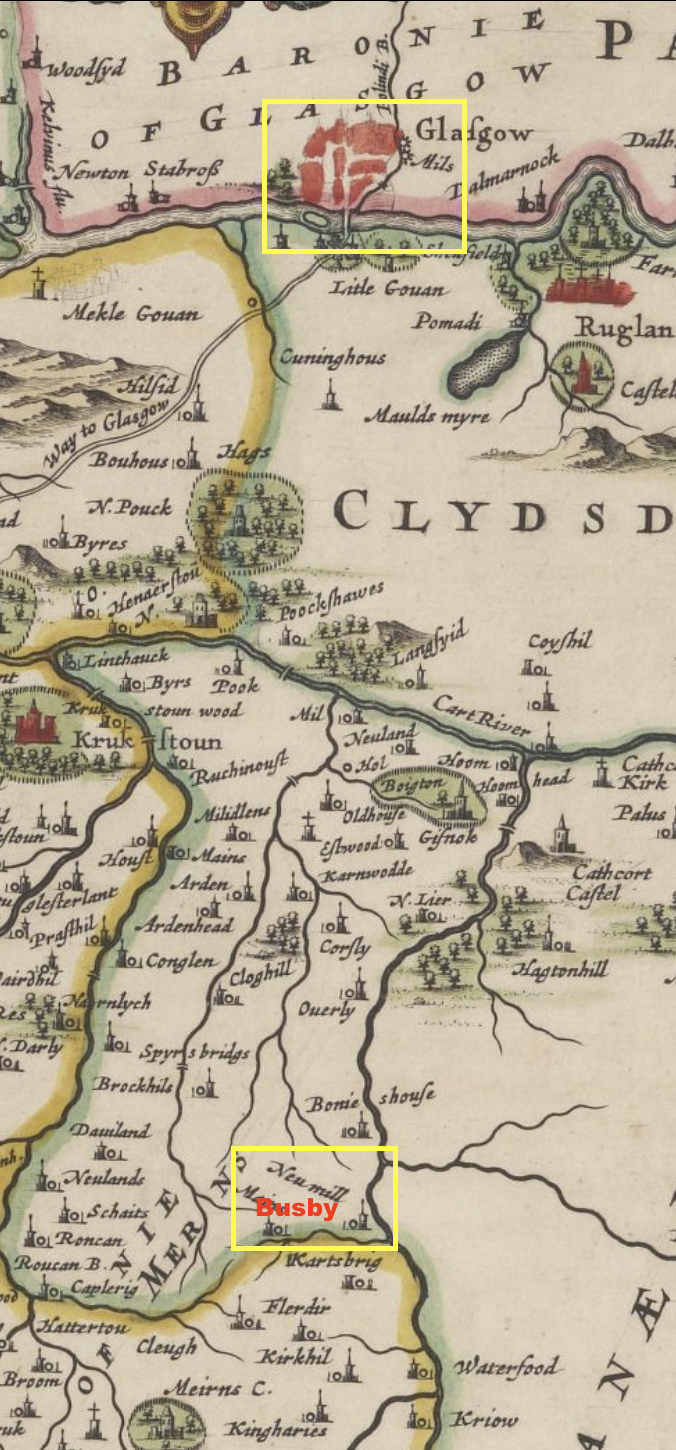
We shall take a short detour to Busby where the family estate was located. Since John and later David are referred to as of Busby we can assume they lived there. Busby did not have a parish church at the time of David’s birth. Busby lays about 6 miles south of Glasgow, in the parish of Kilbride [now East Kilbride]. The White Cart Water runs due south out of Glasgow to Busby. The name Busby was originally Bushby as it was referred to on John Ainslie’s map of 1792. Before this however, the area was actually known as Newmill and can be seen on BLAEU’s atlas of 1654.
David DICKSON married Margaret ROBERTON, daughter of Archibald ROBERTON of Stonehall [Stanehall] at Glasgow, on 23 September 1617 Fasti Ecclesiae Scoticanae; Vol 1; pages 64-65. If the age of his birth is correct this would make him about 34 at the time of his marriage. Margaret is said to have been born about 1598 making her about 19. [Recorded Old Parish Registers Glasgow 644/1 Glasgow pg 29]

At Holyroodhouse on 29 July 1626 a Royal Charter was granted by King Charles I to John DICKSON merchant, burgess of Glasgow and to Master David DICKSON his eldest son minister at the church of Irvine in life rent and after the death of John to John DICKSON eldest lawful son of Master David of the lands of Busbie in the parish of Kilbride, Ayrshire with fisheries, the mill of Busbie [Busby] then in the sheriffdom of Lanark on the resignation of Sir Walter STEWART of Minto, Lady Christina CRAWFORD his spouse and Ludovic their son. Registrum magni sigilli regum Scotorum : The register of the Great seal of Scotland, A.D. 1306-1668. Busby lies due south of Glasgow on the White Cart water. At Busby there there was a meal mill at the waterfall, which can be traced back to 1300. Over the years the river was harnessed to power various types of small mills, for example lint [linen], waulk and grain mills. A waulk or fulling mill ia a mill where fabric is cleaned, felted and thickened. Later there were a couple of Cotton Mills in the area. We do not know the exact nature of John DICKSON’s business, however it might have been any of the above mills. The will of John DICKSOUN 1630 is to be found at Scotland’s People CC9/7/23 Glasgow Commissary Court.
In 1632 the estate of his father John DICKSON of Busbie is settled. November 29, 1632 Brief inquest of Mr David DICKSON, minister of Irvine, as heir of deceased John Dickson of Busbie, his father [GD172/2481] It is five pages and not yet even attempted transcription.
To be continued…
Kelly Wheaton ©2026 All Rights Reserved


Wow! That is a lot of fascinating history. You have done your research and it is so impressive. Thanks for sending it.
My Scottish lins are Bruce and Forbush (Forbes) and I have traced my Forbes line back to Daniel Forbush—8th great grandfather. It is well documented as he fought in the Battle of Dunbar and survived the Dunbar Death March. He was one of the 1400 out of 5100 who survived and one of the 900 who were sent to the colonies. The first record of him in this country was his marriage to Deborah Perriman in 1660 in Concord, MA. I think he worked in the mines for seven years prior to pay back his captures for the journey.
I’ve traced my Bruce line to Thomas Bruce (eighth grandfather) who married Magdalen Evans in St. Martin’s in the Field church in London in 12Dec. 1652. Prior information hasn’t been confirmed and there is no record of how he got to the colonies or exactly when..His third son, Roger, was born in Marlborough, MA in 1670. This son married Elizabeth Forbush thus uniting the two families.
Dianne, Thank you. The next installment brings us into some distasteful territory with Witchcraft. Stay tuned.