Mind The Gap: Making the Connection to the Royal STEWARTs of Scotland
Sometimes you can prove a connection without being able to flesh out the in-between. Thus like the announcements at the train station “Mind the Gap.” Sometimes people grasp at anything to make the connection and falsify the record in doing so. This is part of a cautionary tale to be careful even when evaluating something that appears as fact with nothing to back it up but conjecture.

My STEWART line I have written about before in My Woman Warrior where I relate that my 2nd great-grandmother born Catherine Adeline STEWART claimed she was related to the Royal STEWARTS. I didn’t really give it much credence until a decade ago when YDNA testing proved that it was true. Imagine that! I also noted in the Revolutionary War pension file of her father Daniel Bertine STEWART there are several letters from descendants inquiring about the Royal STEWART connection. It surprises me how persistent these family legends can be and sometimes they turn out to be true.
DNA
The line back to my immigrant to America, Alexander STEWART (1675-1742), is solid. More about that in a moment. What isn’t solid is the name of his parents and the line backward from Alexander. What we do know is, we are patrilineal descendants of Alexander (1675-1742), because a number of male STEWART cousins are positive for the YDNA SNP: S781. That is they are direct descent from Sir John STEWART Bonkyl (c.1265-1298) who carried that SNP. The Royal STEWART FTDNA project states: The two most important branches of the family are the Scottish Royal STEWARTs, represented by descendants of King Robert II of Scotland (grandson of Alexander STEWART via eldest son Sir James STEWART); and the STEWART of Lennox… who descend from Alexander STEWART’s younger son, Sir John STEWART of Bonkyl. Sir John STEWART of Bonkyll was a military commander during the First Scottish War of Independence and during the Battle of Falkirk he commanded the Scottish archers, and was killed, 22nd of July 1298, during that Battle. He is interred in the churchyard of the Falkirk Old Parish Church.
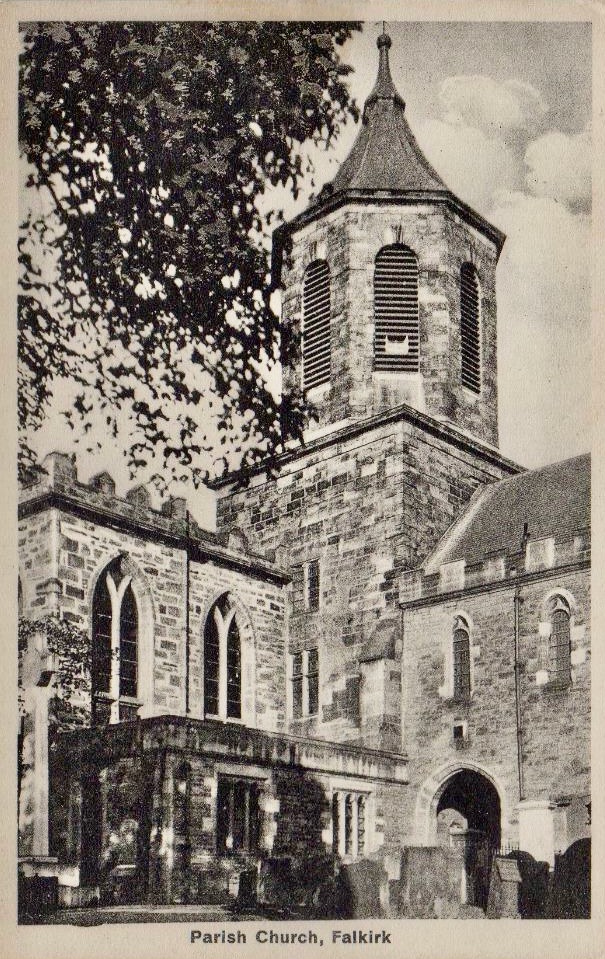
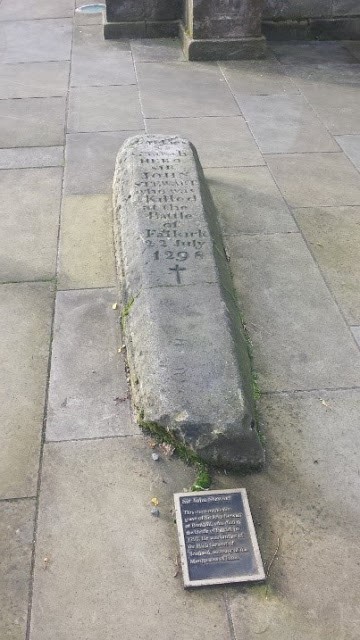
From Sir John Stewart Bonkyl (c.1265-1298) we can trace the ascent (backward in time) as follows:
- Sir John STEWART Bonkyl‘s older brother, James was the 5th High Steward of Scotland.
- Their father Alexander STEWART (1220-1282) was the 4th High Steward of Scotland.
- Their grandfather Walter STEWART (1204-1246) was the 3rd High Steward of Scotland.
- Their great grandfather Alan Fitz Walter (1140-1204) was the 2nd High Steward of Scotland.
- Their great-great grandfather was Walter fitz Alan (1140-1204) the 1st High Steward of Scotland.

Sir John’s STEWART Bonkyl’s nephew was Walter STEWART, 6th High Steward of Scotland (1293–1327) who married Marjorie Bruce, daughter of King Robert I the Bruce.
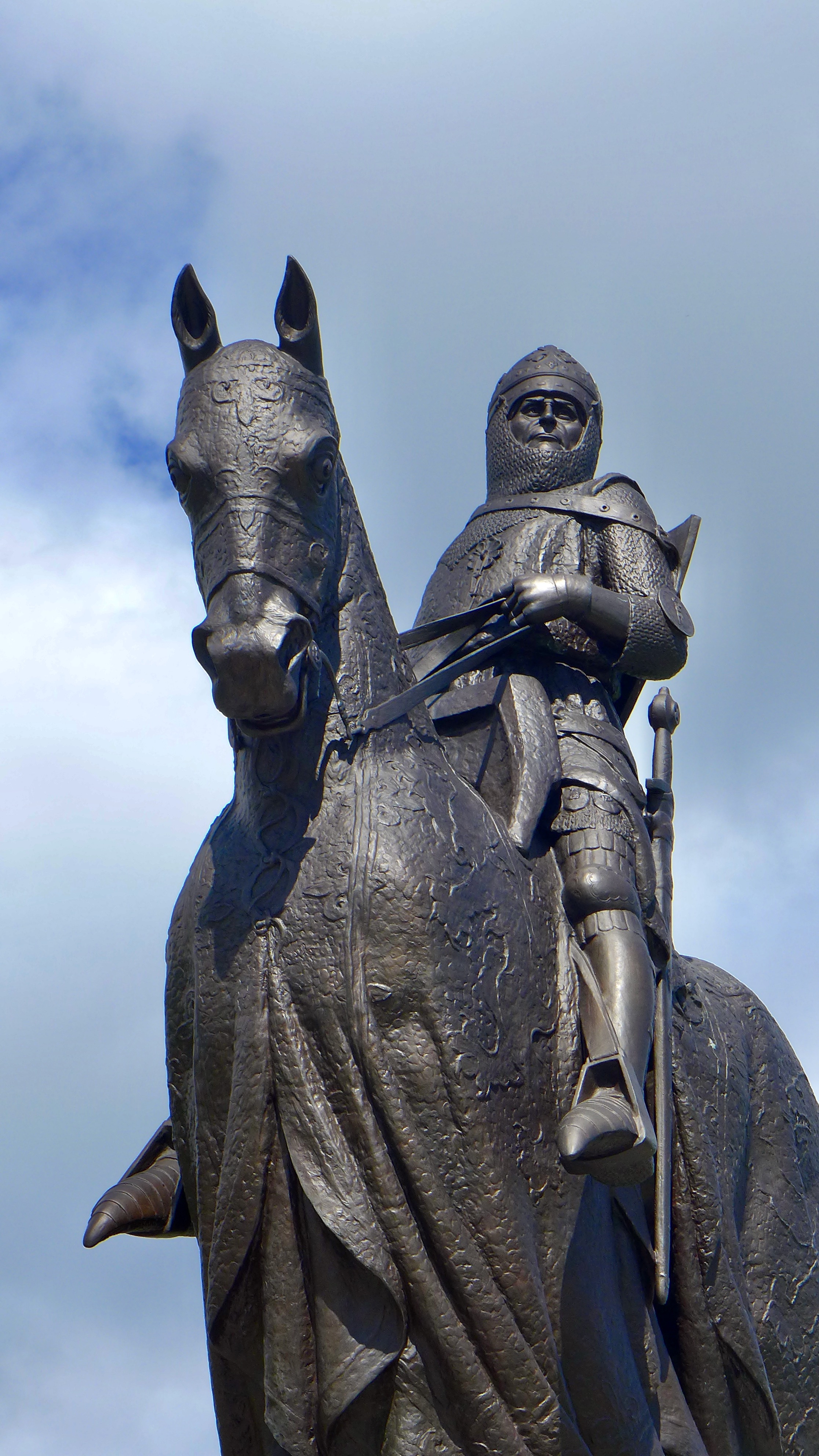
by Pilkington JACKSON at Bannockburn Battlefield
His son was King Robert II of Scotland, the first STEWART monarch. So to simplify Sir John STEWART [Bonkyl]’s grand-nephew was King Robert II of Scotland. So not exactly royalty but from the same STEWART family that became Royals. However, Sir John’s STEWART [Bonkyl]’s 9th great grandson Henry STUART Lord Darnley was the Stuart that married Mary Queen of Scots.

Coming forward is more problematic. Of the sons of Sir John’s Stewart Bonkyl that did not die without issue or daughter out we have:
- Sir Alan STEWART of Dreghorn whose descendants are the STEWARTs of Darnley, Earls of Essex, the Seigneurs d’ABigny and the Royal House of STUART. Also from this branch are the STEWART of Galstoun that appears to have died out. FTT43
- Sir Walter STEWART of Garlies and Dalswinton whose descendants were STEWART of Garlies, later Earls of Galloway and Lords Blantyre YSNP FTT48
- Sir James STEWART Pearston whose descendants were the Lords of Lorne, Earls of Atholl, Earls of Buchan, Earls of Traquair and Clan STEWART of Appin YSNPS A5024 FTT41 (and for the Appin branch FTT42)
- Sir Robert STEWART of Daldowie ancestors of the STEUART and Seton STEUART baronets of Allanton and Coltness STEWARTS.

The above pedigree I have annotated to show the YDNA SNPS that identify Different branches and the green boxes denote possible lineages that could be the connection. There are not easy answers to our STEWART conundrum. There are thousands of descendants but many lines daughter out. Knowing the SNP associated with our branch descending from Sir John of Bonkyll helps in eliminating possibilities. There are also issue not included in the chart specifically around other sons of Sir Alexander STEWART of Darnley and his son Sir John STEWART’s other issue not recorded on this chart. It would appear we descend from either through an un-researched line or through illegitimacy. In the chart above there are several possibilities Alexander STEWART son of Matthew the 2nd Earl of Lennox if he had male heirs. The John STEWART Methven illegitimate son of Ludovic 2nd Duke of Lennox or an unknown descendant or Esme STEWART Third Duke of Lennox. Or one of the unrecorded brothers of the aforementioned STEWARTs. The DNA proves the connection but it is the Gap that needs Minding.
ATTACHING AN ANCESTOR WITHOUT EVIDENCE
But it’s the in between that remains in question. And that’s where people clutch at any connection they can find and they get it wrong, more often than not. There are plenty of trees showing Andrew’s father as Robert STEWART which depends of on one scrap of evidence ” tradition states Alexander’s father was Robert” from an old Stewart Clan Magazine, September 1929, Vol. VIII, No. 3. Even worse is connecting Robert STEWART as a son of Reverend Andrew STEWART, II b. 1620, Gortigal, County Tyrone, Ireland, UK; died January 02, 1671. The problem is it isn’t true. Descendants of Rev. Andrew STEWART are of a different YDNA line. This is what happens when you try to connect people in your tree based on a name, without other supporting evidence. How many Robert STEWARTs do you think there are in this time period in Northern Ireland?
YDNA to the RESCUE
I have tons of these stories including one from The venerable New England Historical Genealogical Register Vol 80 pg 380 1926 in which J. Gardner Bartlett of Boston presumed that the Isaac SHELDON of Windsor, Connecticut was the same as the one born in Bakewell, Derbyshire in 1632. I wrote about that here. Then a short time later I found the Isaac of Bakewell living in Manchester, England. “Transcription: “Isaac Sheldon of Manchester, sadler, sonne of Raphe SHELDON late of SHELDON in the county of Derby, Gen’t, and Mary VENABLES of Selford, daughter of William VENABLES of the same, chapman, were married at Manchester, the seventh day of April, 1656 before Richard HAWORTH, Esq. one of the Justis of Peace in this County of Lancashire.” More on that here in which Dale Sheldon shows that this Isaac married and had a family in Manchester when the other Isaac was in Windsor Connecticut. And on top of that the YDNA of the Derbyshire SHELDONs does not match those of the Windsor, Connecticut SHELDONs. Those pesky devils int he details.
DNA allows up to prove a patrinlineal line without being able to “Fill in the GAP.” My Husband’s precise connection to Robert WHEATON of Rehoboth, Massachusetts has a “Gap.” We are lucky to have DNA to prove in essence that which we have no other evidence for. It simply isn’t always going to be possible to make connections as we would like.
WHAT ARE OUR OPTIONS?
The truth in a legend can open the door to history. I don’t happen to think Royals are any better than anyone else in my tree—the Easter egg– in finding one, is there’s generally much more written about them, than your every day farmer or peasant. The bonus is being able to connect yourself and your ancestors with history. It suits me just fine if the illegitimate son of Ludovic STEWART, 2nd Duke of Lennox, John STEWART of Metheven was my ancestor, even as he was an unsavory character. The illegitimate son of an illegitimate son–reading below sounds right out of a movie script:
In September 1626 the Privy Council found he had been living in adultery in Dumbarton Castle with two servant women, Isobel Beaton and Margaret Kilmaurs, and had kept his wife, Dame Margaret, a prisoner in a ruinous and damp part of the castle for 13 days, chained to the bed, and he beat her. Isobel Beaton and Isobel Scot had previously been admonished by Dumbarton Kirk for scandalous behaviour.
Stewart was found guilty of three adulteries and sentenced to be executed “by the king’s will”, and the court ordered that he should be hanged in December 1627. It is unclear if he was hanged, but he was dead by 1630 when a legal case mentions his decease, and his widow Margaret married Sir John Seton of Gargunnock in 1629.
Register of the Privy Council of Scotland, vol.1 (Edinburgh, 1899), pp. xciv, 358, 378, 380, 416-8.
There are a couple of things that recommend this particular theory. John STEWART of Metheven also spent considerable time in Ireland. John STEWART Methven was said to have been lax in his duties at Dumbarton Castle, Scotland preferring to spend time in Ireland at Mongavlin Castle which he had built in 1611 and he had lands in Raphoe and Portloughe, all in Donegal. These areas were part of the Scottish Plantation of Ulster which had been granted to his father, the Duke of Lennox.
In reality the connection may be someone less noteworthy who just happened to be the 2nd, 3rd or fourth son who ended up in obscurity.
TEASING OUT THE TRUTH
Allegedly Alexander STEWART who immigrates to East Haddon, Connecticut and later settles in Voluntown married in Ireland to Margaret DIXON. Her father Robert DIXON fled Ayrshire, Scotland in 1666 for Antrim in Northern Ireland. Between 1638-1688 Covenanters who did not abide the Church of England faced persecution and sometimes death, so many fled Scotland for Ireland. By 1702 there were nine Presbyteries founded: Belfast, Down, Antrim, Coleriane, Armagh, Tyrone, Monaghan, Derry and Convoy. It is alleged that Robert DIXON married Priscilla, daughter of Hugh KENNEDY about 1670 in Ireland. The children of Robert and Priscilla DIXON were allegedly born in Ballymena, Antrim, Ireland but I can find no evidence of any DIXONs in Ballymena in 1669 but this may have been because they came after the Money Rolls in 1660 & 1663 and settled in Ballymena after 1669. Robert and Priscilla were allegedly married about 1670. In 1660 the closest DIXONS or DICKSONS to Ballymena in is a Widow DIXON in Kilead, Antrim about 16 miles away.
In the 1669 Hearth Money Rolls for Ballymena town and Estate we do find four STEWARTS: Andrew, John, Robert and a widow STEWART. Could this the alleged Robert STEWART, aka Alexander STEWART’s father (1675-1742) ? We just don’t know. There are also three Hugh KENNEDYs in Doonans, Donegal; Priestland, Antrim; and Stranocum, Balymoney, Antrim which is about 19 miles from Ballymena. And there was a John KENNEDY living on the Ballymena Estate in 1669.
Sometimes you can’t fill in the gap—it’s as simple as that. We sometimes must be satisfied with knowing the further back, but missing the in between. The Ulster diaspora to America estimates for the period 1680–1750 are about 70,000 immigrated from Ireland to America. There was a large exodus to America in 1717-1719 when the persecution of the Presbyterians was great and the rents of tenant farmers was high. In 1718 five ships carried families from both Aghadowey and Dunboe in County Londonderry and settled in what is now Maine. Also in August of 1718 Governor Samuel SHUTE agreed to allocate land in the Massachusettes colony for Ulster settlers at the urging of Ulster ministers. Massachusettes provided land grants for Ulster settlers to reinforce the frontier against Native Americans and to enhance Massachusetts‘ claim to the territory that was in dispute with Maine. Many immigrants followed and by 1720 approximately 2,600 Ulster immigrants had arrived in Boston. Among them were Andrew STEWART and his wife Margaret and her alleged brothers Robert, Archibald and John DIXSON. It is said that their son Samuel STEWART was born aboard ship on their voyage to Boston.
Until something new comes along that is where we must leave it. Alexander STEWART of Ireland who immigrated to Connecticut is by DNA confirmed to be a descendant of Sir John Bonkyll STEWART of the Royal line of STEWARTs. For now “Please Mind the GAP”!
Kelly Wheaton ©2024 – All rights Reserved
 Wheaton Wood
Thanks for this post. I have been researching my Stewart line for 30 years. I can’t get further back than 1818 in Kentucky. My goal is somewhat different in that I don’t particularly want to be related to the Royal Stewarts as they do not appear very intelligent or kind. I would be happy to find I’m related to a Stewart or Steward of an estate. Family lore is that we are from N. Ireland (my father directed me to wear orange on St. Patrick’s day instead of green.) I have found no DNA Stewart relatives to further my search on Ancestry, 23andMe, or FTDNA. I just wanted to say I appreciated seeing your search results, and it did give me some ideas for further searching.
Thank you Mary. If you are looking in Northern Ireland—please check out Bill McCaffe’s site https://www.billmacafee.com/ It has lots of great resources. I have a couple of solid brick walls about the same time frame 1790’s in New Jersey! That doesn’t stop me from trying!
HI Kelly,
I have similar ancestry in the area as well, both the maternal and paternal side. I was just at PRONI in Belfast in OCT on a research trip, I must say I was amazed at what they have in the archives. Letters and boxes of estate records etc. Perhaps your answer is there. I found my McMorrough-Kavanagh Line records there , I was surprised to learn he owned land in Armagh. I have never seen anything that was written about it. I pulled a box that had his will, his wife and the son and the land records for selling the property in 1903. It was a treasure trove, however still working on the link the families.
Patricia, I would love to spend some time there. I am 10 hours+ away by plane. It is always possible to find things in person that are not available on line. If not me someone may bridge the gap, someday.
Yes you need at least a week. I am a little closer about 6 hours however Aer Lingus now flys out of Hartford, I took it in October it was lovely. Yes it will happen, I dont have the Stewarts to my knowledge but I do have the Spencers and others.
Fingers crossed.
Stewart is one of those names I see cousin matches have but it isn’t a name in my tree. Sinclair is another as is Erskine. Montgomery is the only Norman name I recognise in my tree yet Y DNA shows my paternal grandfathers R1b Z36 line crossing at the time of the Conquest. Strangely for reasons I don’t understand a generation of his family changed their name to ‘Peters Son’ or rather ‘Perkin’s Son’ which became Parkinson. I have four or five different Parkinson lines in my tree and it is on record that they inherited estates from the Duchy of Lancaster known as ‘Fairsnape’. I would dearly love to know the story behind that one. Parkinson sounds very Anglo Saxon but the male line made that same journey from the Alpine Valley’s into France. Potentially the First Duke of Lancaster was a Z36 but there is huge controversy over that because Richard III was G2a so either the Duke of Lancaster or his descendants were a broken line or Richard III was. De Percy were also Z36. A mystery sometimes, at least you have a surname to go on!!!
Yes, yes yes. So many mysteries so little time. A family member by marriage has the surname REILLEY but it turns out rather than an Irish R-M222 they are a Norman line who had many, many Castles in Galloway. Still waiting for matches in England or Wales on the WHEATON R-FGC22501 line and of course the SHELDON line we believe harks from Warwickshire. And then there’s the PADEN/PEDEN line looking to be from Loch Lomond area and has YDNA matches to MAXWELLS then to Cokeraine area of N.Ireland and finally to Funkstown, Maryland.
Pingback: BAVARIAN Hans MOSER c1623-1696 was from Austria, not Switzerland | Wheaton Wood
Kelly,
Wow! This confirms my long-held belief that have to be somehow connected to Ludovic Stewart of Lennox just based of off my uncanny resemblance to his portrait, and the both of us descending from Dir John Stewart of Bonkyl. I found this publication by using Grok AI and it has opened another pathway to my Stewarts from 1700’s Portsmouth Virginia. Thank you for this work. I wish I could show you my side by side comparison with Ludovic.
Back down the rabbit hole I go….
Kelly,
Alexander Stewart from Connecticut is one of my ancestors as well but I’m glad you were able to confirm by DNA that he is descended from Sir John Bonkyll Stewart. I plan to travel to Scotland within the next two years and wanted to visit some ancestral homes if they remain. This has given me a few ancestral homes to research and visit.
Thank you for sharing what you have found. I’m grateful!
Iam planning a trip in Oct of 2026, but there is not much to go on but who knows I may stumble upon something.