TILDEN’s of Kent, England
In my last blog post Traveling for Genealogy I chronicled my research into the TILDEN family of Benenden, Kent. I decided to do a deeper dive and as usual found some interesting connections. One of the places we are to stay and visit is Leeds Castle. So let’s dive in to a bit of ancient history.
LEEDS CASTLE

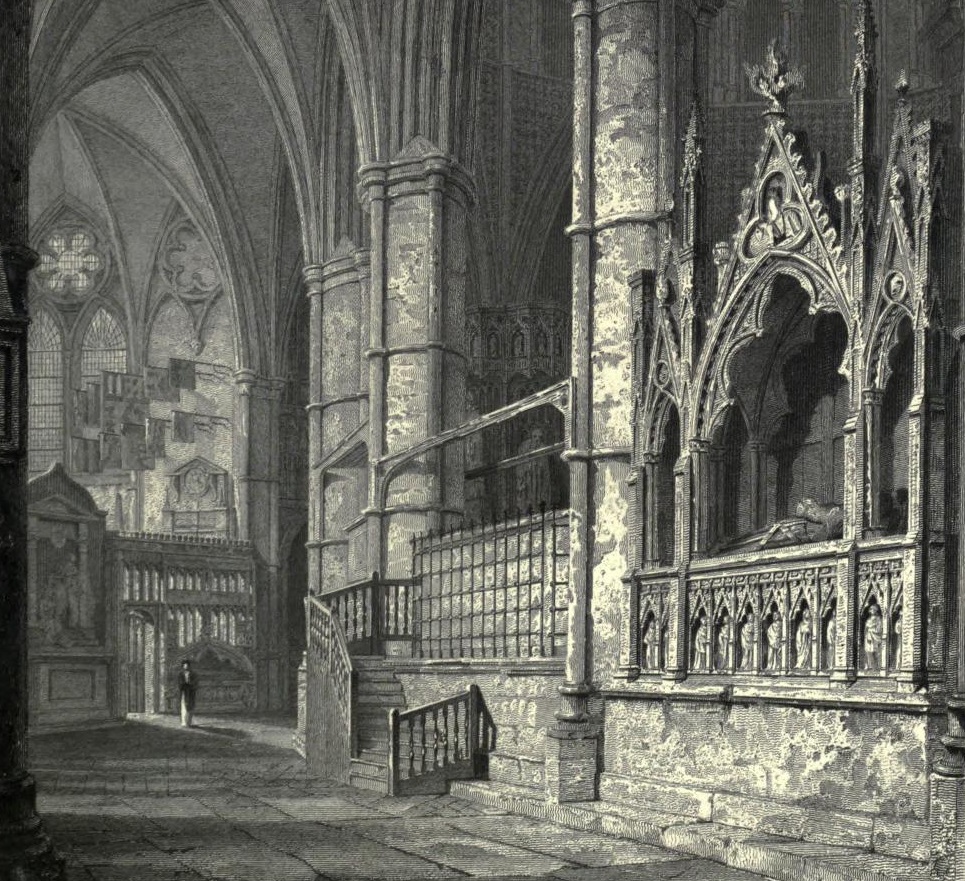
From about the year 857, Leeds Castle, near Broomfield, Maidstone, Kent, was a Saxon castle built of wood on 2 islands, in the middle of the River Len. It was owned by the Saxon chief, Led or Leed, and was known as the Manor of Esledes. After the Norman Conquest of 1066, it was rebuilt in stone in 1119 by Robert de Crevecoeur as a Norman Castle. Robert de Crevecouer was the son of Hamo de Creveqouer. Leeds Castle descended through the de Crevecoeur family until the 1260s. In 1278, the castle was bought by King Edward I’s Queen, Eleanor of Castile [Both interred at Westminster Abbey]. The Norman Leed’s Castle was held by Odo Bishop of Bayeux, who was the half brother of WILLIAM I, aka William the Conqueror. All roads lead to William the Conqueror!

It is the assumption of John Tilden in his 1968 manuscript “The Tilden Family: our English Ancestors 1235-1635” that the TILDENs were originally from East Sutton or Hollingbourne which lay about 4 miles apart, with Leeds Castle in between. The earliest record he found is of a Henr’ de TILDENN who was born about 1235 and died after 1311. Henry appears as a witness in 1293, in a legal controversy between EDWARD I of England, and the Pryor of the Hospital of St. John, of Sutton de la Hone [Sutton-at-Hone], Kent, England [ Placita de Quo Warranto , pages 352-353]. Also Henry TILDEN appears as a witness in a controversy between said EDWARD I and Adam MARTEL, of the Manor of East Sutton, County Kent, [Placita de Quo Warranto , pages 358-359]. At that time he is mentioned as of East Sutton or Holyngbourne, County Kent. East Sutton would make sense. However I have discovered an earlier record, a grant from Nicholas of TILDEN (‘Teldenne’), son of Ordmeus de Hethezeherst to Hamo de Crevecquer, son of Robert de Crevequer . I cannot find Ordmeus as a given name so this may be a mistaken transcription. Perhaps Ordmær, Ordmer? meaning “famous-spear.”
Grant From : Nicholas of Tilden (‘Teldenne’), son of Ordmeus de Hethezeherst To: Hamo de Crevecquer, son of Robert de Crevequer. An annual payment of 18¼d, payable by Vincent de herdesfeld, Michael de hethezeherst and Martin de hethezeherst. Payable as specified for 4 acres of land called ‘hopeland’, lying in ‘hethezeherst’ [possibly in or near Marden], 4 acres of land called ‘hope’, lying in ‘hethezeherst’ and the capital messuage of Martin de hethezeherst. For an annual payament of ½d, payable at the court of Bockingfold (‘Bokingefold’). Dated 42HenIII, no month. Witnesses: Henry of Cheveney [in Marden]; Michael de helherst; John de Sipherst [Sheephurst], brother of Giles; Giles de Sipherst, brother of John; William Salomun; Hugh the clerk; Gilbert de bades’elle; Nicholas de Tetesden, brother of Ralph; Ralph de Tetesden [Teterden?], brother of Nicholas; William the clerk.
Dated 28 Oct 1257 – 27 Oct 1258.
My best guess is Hethezherst is Heather Hurst or Heather Hill, very possibly on the lands that are now adjacent Tilden Lane. At the terminus of Tilden Lane if you were to go straight East, crossing Stilbridge Lane, you would run right into a hummock or hill. Here you will find a present day Hertsfield [as in Vincent de Herdsfeld] and a Hurst Green. So my best guess would put Hethezeherst where Tilden Lane in north Marden.
The original Hamo Crevequer aka de Crevequer was born about in Calvados, Normandy, France and his son Robert Crevequer founded the priory and stronghold of Leeds in Kent. Further grants establish a bit more certainty of the proximity of the people mentioned in the deed above. In this case the court was held at Bockingfold. Bockinfold is south of Marden and about 5.6 miles from the TILDEN estates. The other names are from properties in the parish of Marden, so fairly safe to assume in the vicinity.
SURNAME TILDEN
The surname TILDEN is a habitational name that is literally “from Tila’s pasture.” The name Tila means heritage, fortune, or wealth. Another possibility is from the word “Till” as in “to cultivate.” Kent manor houses had dens or pig pastures often distant from a manor’s arable holdings. Kent Wealden Weal meaning well-being or wealth and pig pastures. Manors may have had several dens which were an important part of the local economy. Each fall, pigs were driven by the swineherds to the manorial dens, where they were fattened foraging on, fungi, nuts, roots beetles, etc, before being butchered in November or December. Many place names arise from these dens, such as Tenterden, Tilden, Beneden etc.
TILDEN PLACES
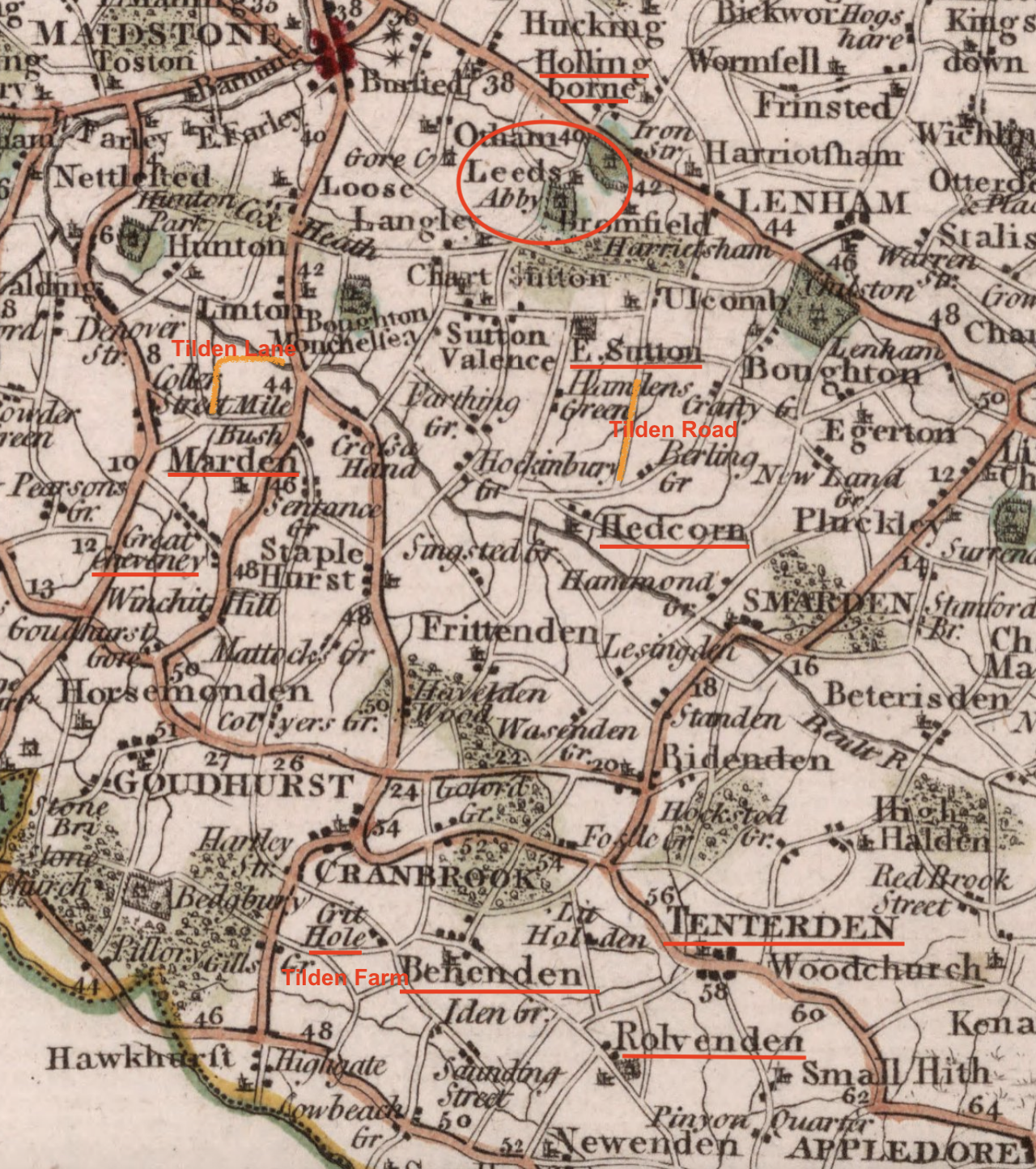
Early places in Kent, England, are: Great and Little TILDEN in Marden, TILDEN in Headcorn and TILEDN Farm in Benenden. I have marked Leeds Castle, Hollingbourne and East Sutton, as well as two Roads named Tilden and the location of TILDEN Farm in Benenden on Water Lane. We will take up the TILDEN Listed buildings in Kent, from the suspected oldest to more recent. It is bit of a tossup which is the oldest. Because the oldest standing might not be the same as the oldest named TILDEN. The map below has Leeds Castle circled, places mentioned in the deed underlined and the location of the 2 TILDEN Road and Lanes in orange, which are about 6 miles apart as the crow flies. It would not be surprising if two of the early TILDENs settled in the area. Below we take up each TILDEN place. Please note that all 3 of these places fell under the ownership of Bishop Odo of Bayeux who also owned Leed’s Castle. From Leed’s castle to TILDEN Farm near Benenden is about 13 miles as the crow flies
MARDEN

Marden does not appear in the Domesday book. The name Maere dene or Maera dene, derives from “forest clearing for horses.” There was a church, probably built of timber, in Marden by 1085, which is mentioned in the Domesday Monachorum of Canturbury. EDWARD I gave the village of Marden to his mother, Queen Eleanor of Provence in the 13th century, and she was granted the right to hold a weekly market and an annual fair. Edward III in 1336 invited continental cloth weavers to England. Below is perhaps our earliest TILDEN place contender. It is the earliest deed for a place TILDEN:
Grant, in free, pure and perpetual alms From: Margery of Pattenden [in Marden], widow of Samson of Pattenden To: ‘Dominus’ Hamo de Crevequer 4 acres of land in Murzie [in Marden] which Godholte?, her mother, gave her, lying with the land of Richard? la farne? to south, the street which leads to Tilden [in Marden] to north, … Hamo’s land to west. For an annual payment of a root of ginger? For this Hamo has also paid 40s as a gersum fine. Dated 41 Henry III, no month. Witnesses: Henry of Cheveney [in Marden]; …de Heherst; John de Sipherst; Giles, brother of John de Sipherst; … Solmon; Hugh the clerk (partially damaged)
28 Oct 1256 – 27 Oct 1257
It is followed by a deed in 31 July 1303 which mentions Henry TILDEN and his three sons: Walter, Henry and John TILDEN. This is probably the same Henry TILDEN in the earlier records cited by John Tilden in his manuscript. It would likely be on the same property as we find the Great TILDEN Farmhouse at a later date.
A LEASE from: William of Borden, prior of Leeds Priory To: Stephen of Reed, of Marden parish 3 pieces of land lying in Marden parish on the denns of ‘Hyedenne’ and Reed, which land Stephen held at farm of William’s predecessors. For the term of Stephen’s life. For an annual payment of 5s, payable as specified. Right of distraint if payment in arrears. Priory’s part of indenture. Witnesses: Henry of Tilden; Walter, son of Henry of Tilden; Henry, son of Henry of Tilden; John, son of Henry of Tilden; Adam de Hertesfeld’; Walter Finch; Richard of Reed [in Marden]; John Kyr Endorsed with description in early 14th cent hands. 31 July 1303 [Document damaged.]
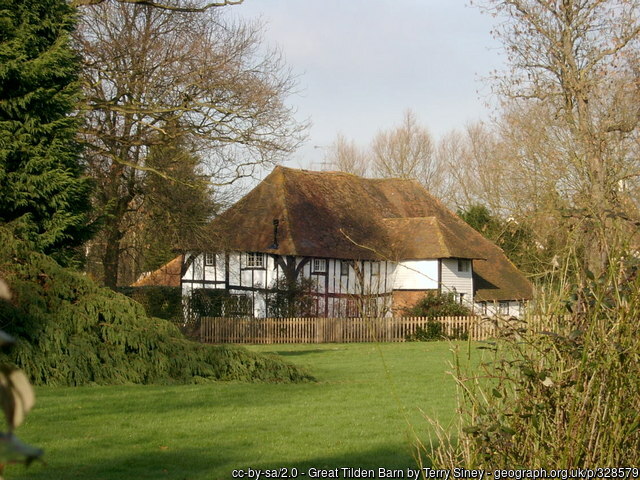
GREAT TILDEN FARMHOUSE TQ 74 NW TILDEN LANE (north side), MARDEN Farmhouse. C15 or early C16, and late C16 or early C17, C18 and mid C19. Left wing red brick in Flemish bond. Ground floor of central section red brick in stretcher bond, first floor pebbledashed, with applied studding. Listing NGR: TQ7486247664
In 1452 there is a lawsuit that refers to a tenement called Tylden, in Marden, Kent . Between 1454 Sept 1-1455 Aug 31 there is a deed with the Grantor: William Brook. Recipient: Thomas Elys, the younger, William Tyldenne, Robert Mayhewe, John Tyldenne and John Lynche.
BENENDEN
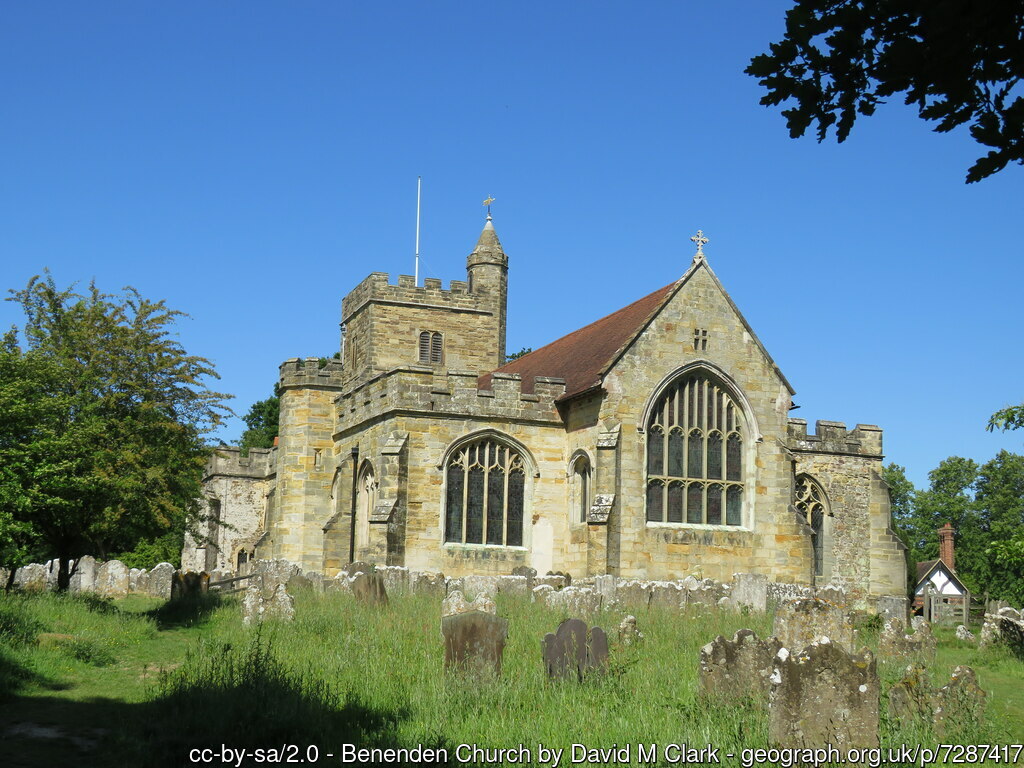
This appears to be the second oldest place named TILDEN. The Domesday Book of Benindene was one of only four places in the Weald of Kent to have a church. 4 villagers. 9 smallholders; 2 ploughlands. 1 lord’s plough teams. 2 men’s plough teams; Woodland 5 swine render. 1 church. Annual value to lord: 2 pounds 10 shillings in 1086; 2 pounds when acquired by the 1086 owner; 2 pounds in 1066. Tenant-in-chief in 1086: Bishop Odo of Bayeux. From the 14th century places such as Benenden became of industrial importance. The Wealden ironmasters continued what the Romans had done; and the other major industry, cloth-making, also helped to make the village prosperous.
“Clothiers were the entrepreneurs at the heart of the cloth trade which became England’s leading industry in the late Middle Ages. No other industry created more employment or generated more wealth. As many as 1 in 7 of the country’s workforce were probably making cloth and 1 in 4 households were involved in spinning.”
Working in the Middle Ages: The Medieval Clothier. John S. Lee
The earliest record of TELDEN [TILDEN] in Beneden is dated 24 Dec 1418 , a Grant by Thomas Goldyng [Golding] of Benenden, Kent, to Thomas Morleyn and Beatrice his wife, of Benenden, of a messuage and 14 pieces of land, meadow and wood, upon the denes of Backtilt and Maplesden in Benenden, Kent, 32 acres. Witnesses: Robert Stace, James Telden, Thomas Wylard, John Bygge, Richard Moore, Stephan Heanden, William Dokelynden, and many others. Grantor: William Brook. Recipient: Thomas Elys, the younger, William Tyldenne, Robert Mayhewe, John Tyldenne and John Lynche. Place or Subject: Maidstone. County: [Kent]. Date: 33 Hen VI 1454 Sept 1-1455 Aug 31. The TILDENs and BYGGE [Bigge] become clothiers in Benenden and surrounds.
TILDEN FARM, WATER LANE, HAWKHURST [BENENDEN] TQ 73 SE (east side) House. C16. timber framed and tile hung, with part exposed small panel frame to right return and English bond brick base with plain tiled roof. Listing NGR: TQ7760431961
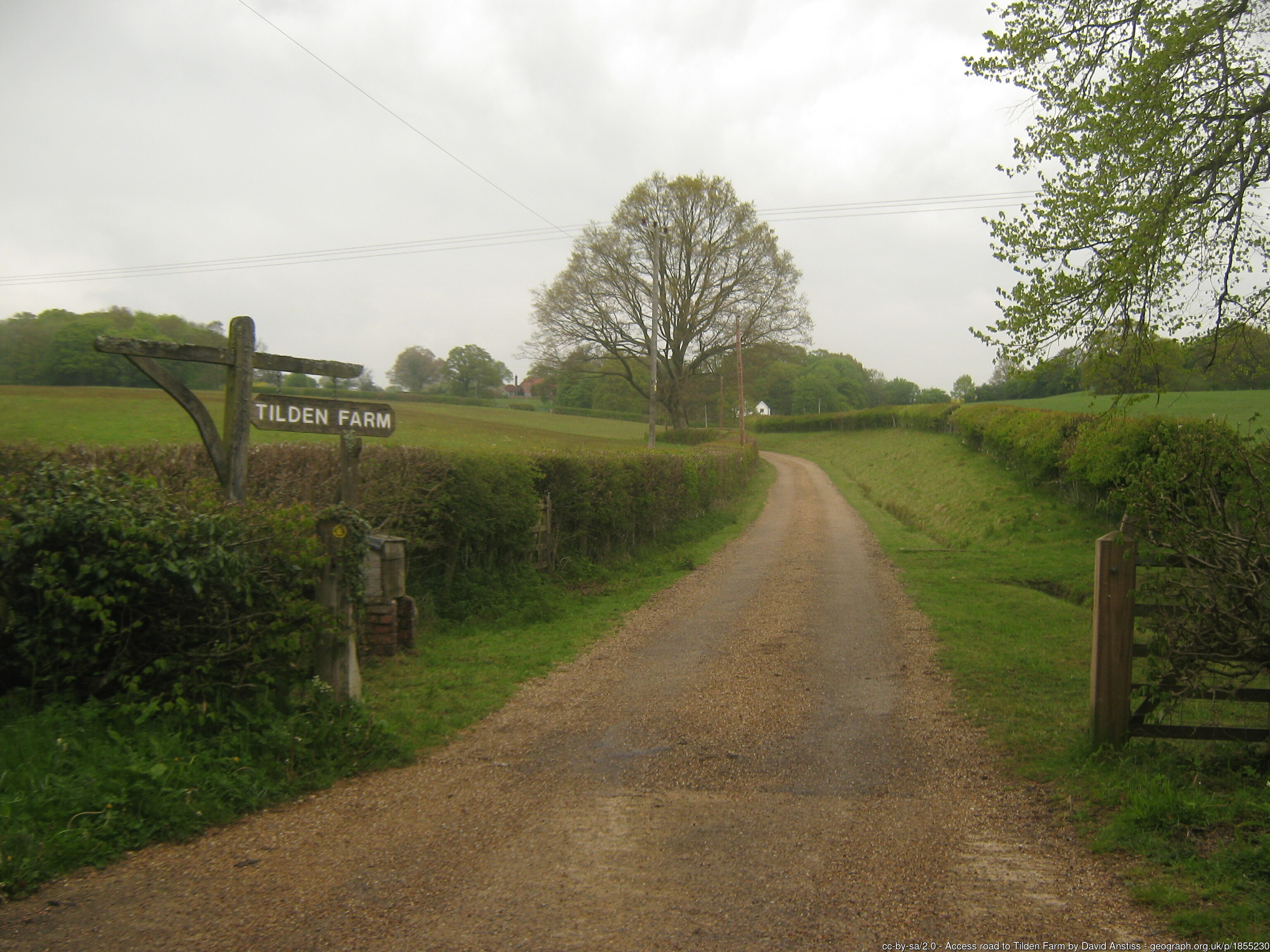
EAST SUTTON / HEADCORN

In the Domesday book the closest listed place to Headcorn is [East] SUTTON which had 15 villagers. 9 smallholders. 10 slaves; 8 ploughlands; 2 lord’s plough teams; 4 men’s plough teams; 8 acres Meadow. 50 acre Woodland swine render. 1 church. Annual value to lord: 12 pounds in 1086; 10 pounds when acquired by the 1086 owner; 10 pounds in 1066. Tenant-in-chief in 1086: Bishop Odo of Bayeux who also held Leed’s Castle. Curiously I can find no record referring to TILDEN people or places near Headcorn in the 12-16 centuries, so it is unclear when the road and buildings adopted their name.

TILDEN, HEADCORN ULCOMBE ROAD TQ 84 NW (East side) Farmhouse. C15 or early C16, with C16 alterations. Timber framed with plaster infilling. Listing NGR: TQ8361145374

LITTLE TILDEN HEADCORN ULCOMBE ROAD TQ 84 NW (East side) Farmhouse. [On the map the Tilden Road from East Sutton to Headcorn] Mid C15 or earlier, with C19 or C20 addition. Timber framed with plaster infilling. Ground floor of right end bay underbuilt in red and grey brick, ground floor of added left bay red brick in stretcher bond. Plain tile roof. Wealden Hall Houses were timber framed farmhouses built by wealthy Yeoman farmers from the late 1300’s to the mid 1500’s Listing NGR: TQ8371645591
SUMMARY
So summing it up we have the surname TILDEN [or its variants] appearing in the mid 13 century [1258-59] near Marden, Kent and by 1452 we have a place referred to in a deed as Tylden, Marden, Kent. In 1418 the surname appears on a deed in Benenden. Best guess is it was adopted from a dene of a Saxon named Til in the area that is now TILDEN Lane in north Marden. From there it spread as a surname to Benenden and other areas of Kent and eventually across the ocean via Nathaniel TILDEN to Scituate, Massachusetts. I cannot fail to mention two other TILDENs. First is TILDEN Park in the San Francisco Bay Area, a very special place of my childhood named in honor of Charles Lee TILDEN. I believe he traces back to Nathaniel TILDEN of Tenterden. And another place we shall visit on our upcoming trip is Chartwell, home of Sir Winston Churchill. It was designed by Philip TILDEN, architect, who I have traced back to a William TYLDEN born about 1585 and died in 1669 Rainham, Kent. And most likely tracing back to the same Marden roots.
Corrections, suggestions and comments are welcome.
Kelly Wheaton ©2025 – All Rights Reserved
 Wheaton Wood
HI Fablous read on the name Tilden, I also have the Tilden name and worked on it some more this weekend. I guess I will need to add Kent back to my list as I it looks like I missed a lot. It wil have to wait until I can do a full day trip.
Pingback: Friday’s Family History Finds | Empty Branches on the Family Tree
Pingback: TRAVELING FOR GENEALOGY: Expectation vs Reality | Wheaton Wood
Pingback: KENT The Garden of England Day One Part One: Chartwell | Wheaton Wood
Pingback: KENT The Garden of England Day Two Part Two & Day Three Part One: Leeds Castle | Wheaton Wood