Organizing Your Genealogy: How I do it Part Two
Posted on July 5, 2024 2 Comments
I wrote in an earlier post on this topic but realized in preparing for a Genealogy class on Organizing I needed to give more specifics. How I do it may not work for you. You must develop I system where you can intuit where you filed something without thinking. Not what someone else decides is the way you SHOULD do it. After 50 years I do have very strong biases. While it sounds great to put birth certificates in a folder and deaths certificates in a folder when you are starting out, ultimately this isn’t very helpful overall. [Unless you have a very specific reason for doing so. [I have a death binder that includes all my ancestors back to second great grandparents for the purposes of analyzing how old they were at death and what they died from. But this is also duplicated elsewhere.] So in General file everything about a Surname in one digital folder, binder or folder. If you need to , you can break this into multiple sub-files or folders or binders but still under the Surname heading. Whatever you do for digital files use a similar organizing structure everywhere. KISS (Keep It Simple Stupid). I keep people with their families until they marry. This means if I am writing a narrative about them I will have to go to their parents family first.
By Surname
Since I am a stickler for advocating your job as a genealogist/family historian, is not to collect branches on your tree, but to tell the stories of your ancestors—my system for organizing is designed to facilitate Story Telling. everything about a person or family is filed together. Since I have the most information on my parents and grandparents they have binders of their own. In the case of my one grandfather I have a whole 3″ binder of just his letters organized with his outgoing letter [carbon] and the response from his brothers and sisters in chronological order. My system is the same whether it is organizing photos digitally or organizing binders, or digital files. So this a screenshot of my digital file structure:
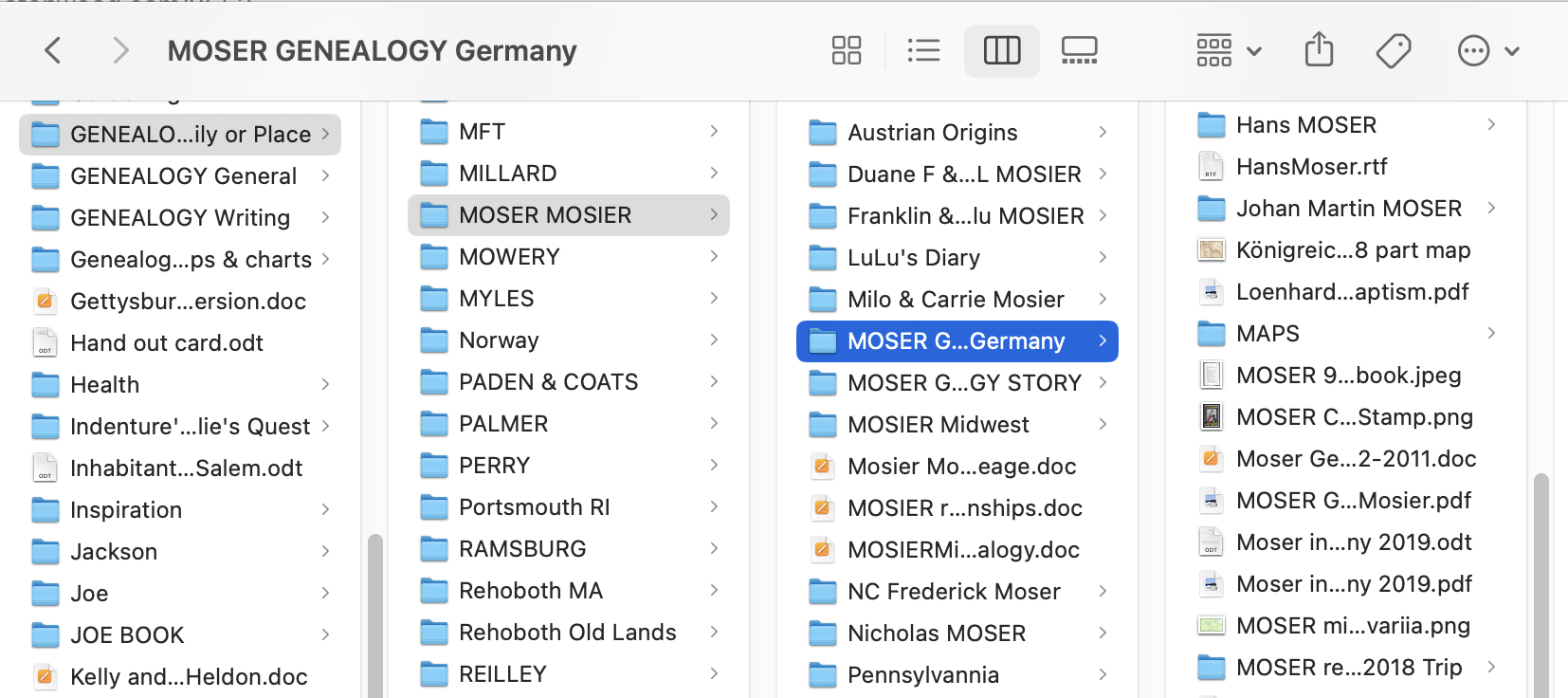
FOR DIGITAL FILES: Genealogy Family or Place > Surname> Family >Individual Family> and so on. Within an individual family there will be documents and photos as well as deeds, printed genealogies etc.
FOR BINDERS or FILE FOLDERS: Genealogy Family or Place > Surname> Family >5 Generation chart > Individual Family> Family Group Sheet (most recent family) >Chronological by family which includes photos, certificates, census etc.[as above]. At the front of the binder goes the 5 generation chart(s) and overall organizational things, like a research log or To DO list.
FOR PHOTOS: Genealogy> Place or SURNAME> Photos. If the Photos are too many organize into sub-file folders.
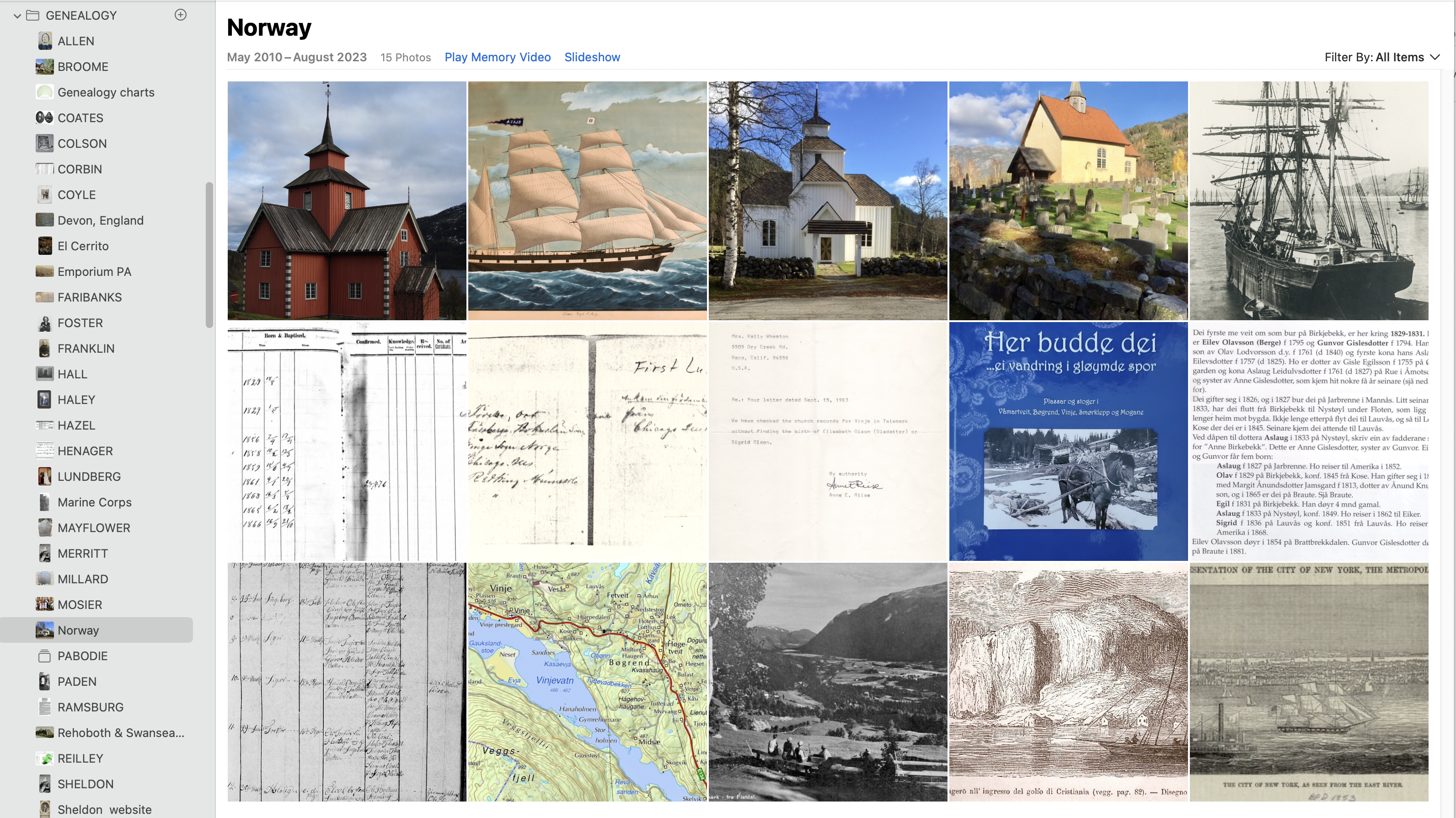
By Location
A big decision point is SURNAMES versus LOCATION. With Scandinavian names there are no SURNAMES when you get back a ways only Patronyms. So Surnames don’t work. That’s when I switch to a binder by LOCATION. Other times are when I have a Research Binder say on Ireland that has lots of information specific to Irish Research. It may contain a summary sheet of all my Irish families and the year of immigration. Another is when you get back far enough a whole Binder is too much for that surname but is perfect for inter-related families from a certain place. It may be a specific Town like Rehoboth, Massachusetts or Stonington, Connecticut. Or it may be a County. For instance there is no sense in duplicating a map in 5 different families when these share a common history.
The Bottom line is the way you organize should facilitate your story telling. I have physical file folders from a long time ago, Binders and Digital files. If I am working on a story I like to have things printed out to facilitate putting them in chronological order and not missing anything. I also like using an Individual Research Sheet [see previous post]. When I am actively working I will have a physical file I put stuff in. Eventually it will get filed elsewhere, but in story writing phase I need it handy. I have used binders with archival sheets forever. I use the heavyweight ones–well worth the extra cost. Especially important with original documents. Always make digital copies of important documents and share them freely. Use a cloud or back-up service to avoid disaster.
By Topic
I like to make charts or finding aids that facilitate my research. Sometimes these are prior to a research trip and I arrange the call numbers of locator identification. Sometimes they are a list of documents in a timeline. It can be a list of DNA Haplogroups of my families or a list of German surnames I am searching. These I make in Open Office [Microsoft Word, Open sourced substitute ] usually with the tables feature. Some examples to give you an idea. You can adapt to meet your own needs.
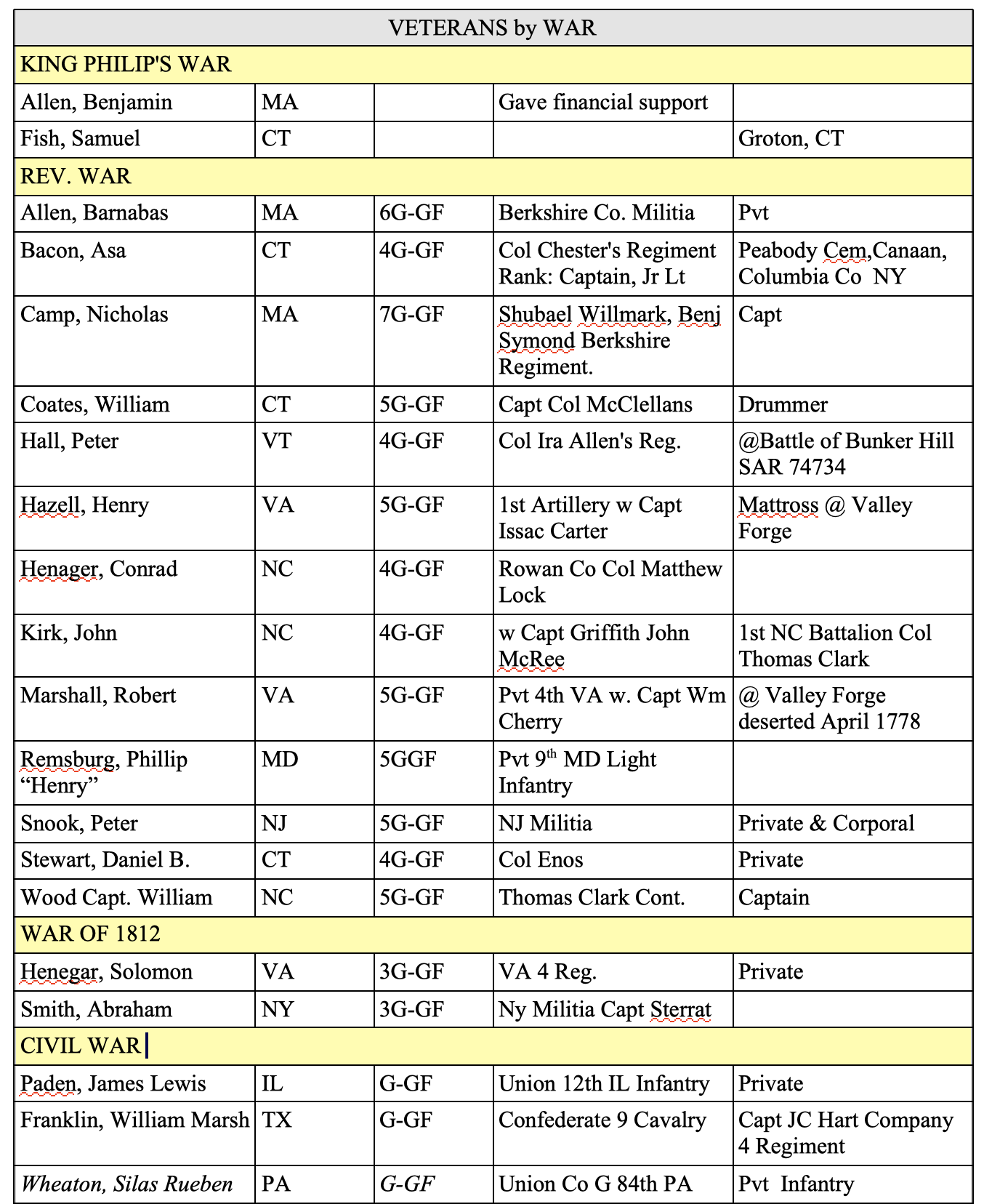

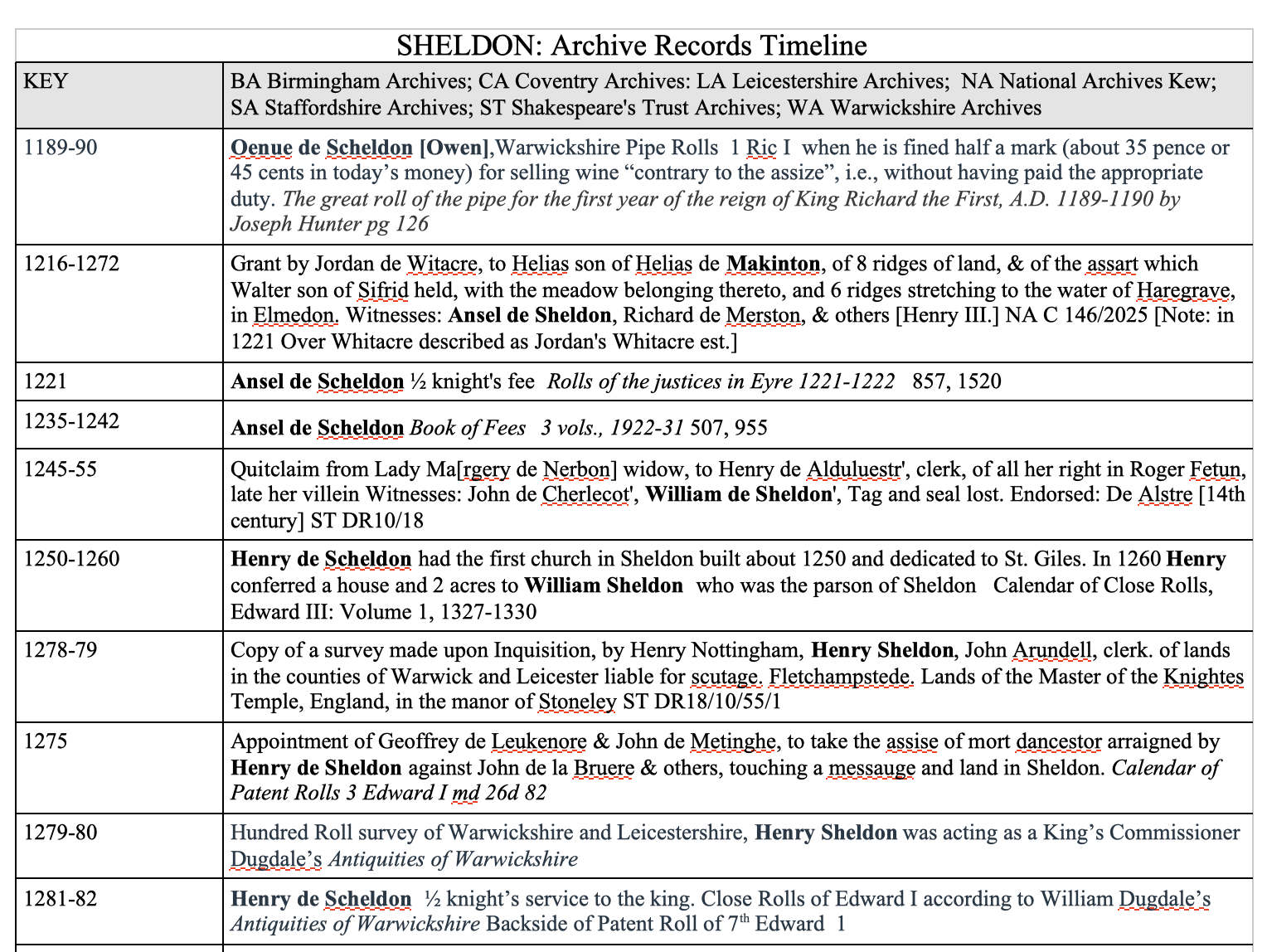
Remember that these are organizational tools for you, so make them the way they make sense to you. Using the Tables feature in any Word Processing program can help. More complex tables can be made with a Spreadsheet program like Excel. When you are building trees you may wish to your the suffix field to your advantage. In my tree I have too many “John SHELDON”s so adding the year of birth or a locale can help. SO rather than searching for John SHELDON in my tree and getting 6 pages of John SHELDONs , I might see a list that said Sir John SHELDON of Broadway or John SHELDON 1645. What ever organizing principles you use—they should make your life easier not more difficult.
NUMBERING & COLOR CODING

I don’t do any numbering in assigning a number to each ancestor. I started Fifty years ago with a couple of variations but frankly no one I know remembers ancestor #1103. I also did a system that used letters and numbers. They did not stand the test of time. I also used to keep a binder full of Five Generation Charts. I only put a 5 generation Chart at the beginning of a relevant surname or location binder. I do use numbers to identify lineages:
Justus Warren SHELDON ( Isaac 1, 2, John 3, 4, Isaac 5, Thomas 6, Isaac 7, Justus 8, 9, Elmer 10, Justus 11 Warren 12) For me this is far more helpful than #13,728. But as I always say do what works for you.
Otherwise I far prefer color coding. My basic color coding is warm colors for mother’s side and cool for fathers. Avery Color dividers come in packs of 15 Now I wish it was 16 [one for each 2nd great Grandparent] but I make do by combing one additional Swedish 2nd great grandparent to the same color. I use variations on these colors in Coding my DNA matches or organizing folders. Again it is a matter of personal preference, do what works for you. In general organize in a way:
- Which makes sense to you
- Makes it easy for you to find things
- Would make reasonable sense to someone inheriting your genealogy collection
- Is not to complicated or hard to remember
- Facilitates writing your ancestor’s [or your own] stories
When I am actively working I am not that organized. I follow innumerable gopher holes in all different directions. Eventually I have lots of maps and articles and resources and that’s when I pull it together in a blog post, story or series of stories. Again it is a personal process sometimes with a lot of trial and error. I tend to shun things that are too hard. This should be fun. Many people are more disciplined, but I have more fun! 😉
Kelly Wheaton ©2024 – All rights Reserved
The Journey of one 4000 Year old Celtic Y-SNP FGC22501: Ten Years of Discovery
Posted on May 22, 2024 Leave a Comment
Background
To recap my first dive into Genetic Genealogy was giving my husband a Family Tree DNA Y37 kit for Valentine’s Day in 2011. It was purely out of frustration, as traditional genealogy had failed to connect him with either Thomas WHEADON (later WHEATON) of Branford, Connecticut or Robert WHEATON of Salem and Rehoboth, Massachusetts. The Y37 proved he was of the Robert WHEATON line.
It wasn’t long before we went from testing YSTRS to YSNPS. He was part of the large R1b Haplogroup which is the largest group in the British Isles today with about 2/3 of the English males tested being R1b; about 3/4 in Wales and 4/5ths of the Irish. In continental Europe the percentages are generally at lower frequencies although it still accounts for a large portion. Furthermore, he was found to be a part of the subclade U152 (also known as S28) which only accounts for around 8% in England and then the subclade L2 is even a much smaller subclade. [See top part of Abbreviated Phylogenetic Tree below].
Full Genomes Corporation: Y Elite
In 2013 Full Genomes Corporation was launched and a group of WHEATONs funded a Y Elite test that would test 14 million base pairs on the Y chromosome with reliable mappings. Through my own error I sent to the kit to the wrong person (same first and last name) and in the end it was my husband whose YDNA was tested as a proxy for all the Robert WHEATON descendants.
So in 2014 the results came back with 51 newly named Y-DNA SNPS from FGC22500-FGC22550 all under L2. [the numbering is sequential and is not indicative of which happened first. For instance FGC22500 happened after FGC22501]. The only match in the beginning was a sample of a man in Los Angeles with mixed European and Hispanic ancestry who was FGC22501+. Matches were few and far between and time frames were unclear in the beginning. It was believed that L2 formed in the Italian Alps as that was where it is most prevalent today. That seems less likely as more ancient remains have been discovered. It may have been closer to Prague where we find the earliest FGC22500+ to date. This man was born about 2200–1700 BCE or 3700-4200 years ago. The following graphic charts our branch [in green] and includes some of the other major branches but not all.
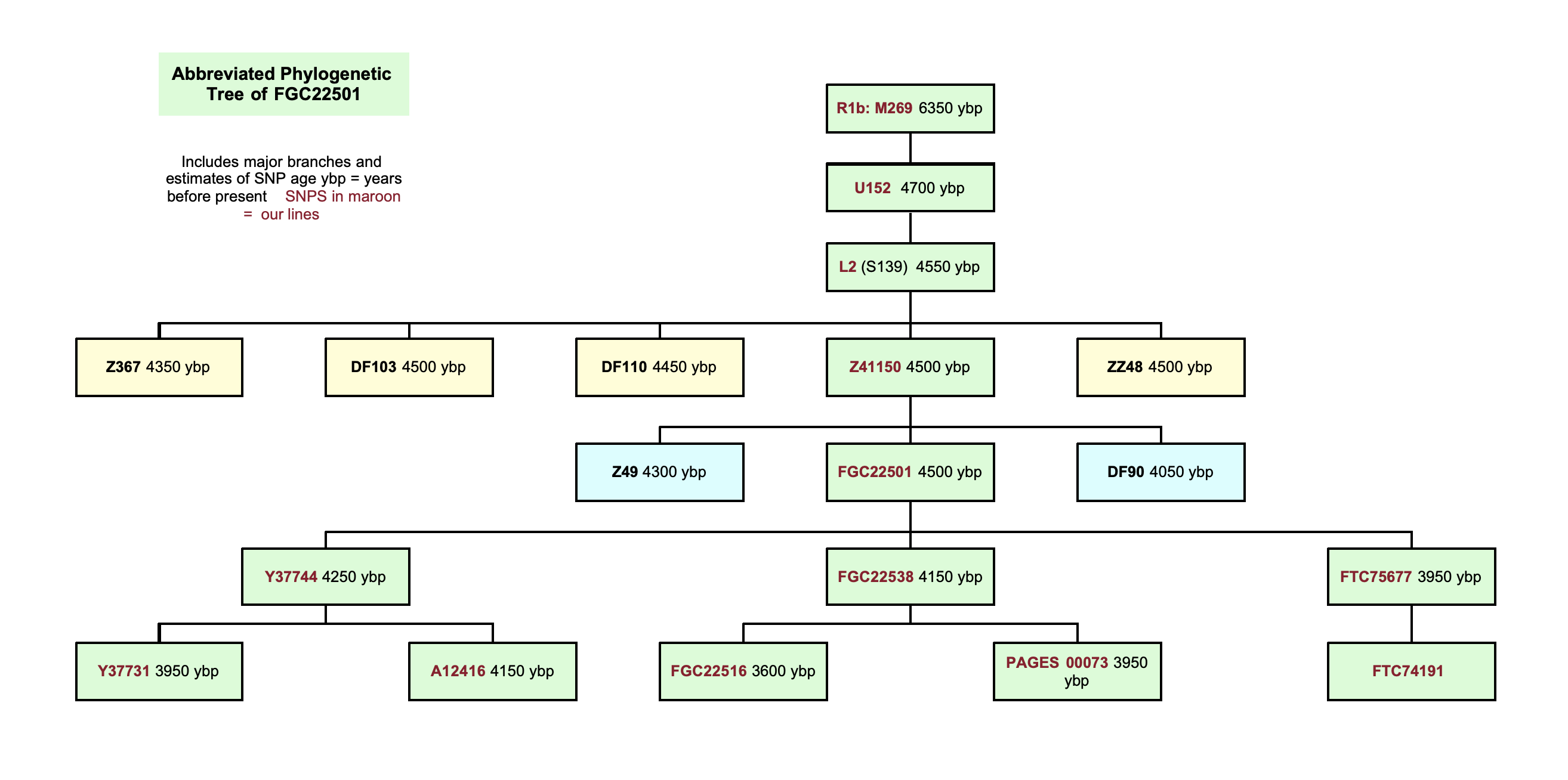
FGC22501 Project at Family Tree DNA
In November of 2016 the Celtic FGC22501and Subclades Project was approved by Bennett Greenspan himself. In the first year we added 10 members. At this date in 2024 we have reached 173 Y Kits and 107 Big Y tests. We have 73 Haplotypes identified. Considering this project has been the work of Vanessa Van de Beke, Jan Suhr and myself I feel as citizen scientists we have accomplished quite a lot. There are many L2 subclades but to my knowledge we are the only L2 subclade project, most are housed in the U152 Umbrella project.

The FGC22501 Diaspora
The parent of FGC22500 is L2. There are over a dozen L2+ skeletons in the Prague area of the Czech Republic. We are lucky that one of those skeletons from Jinonice, Prague 5 is FGC22500+. No one expected the explosion of YSNPS that have been discovered as the testing of the Y chromosome has advanced. Both modern and ancient DNA is rewriting human history. As mentioned above there are 73 haplotypes under FGC22501, as identified by FTDNA. As you can see in the Phylogenetic chart above after the formation of FGC22501 about 4,500 years ago we have 3 main branches : Y3774, FGC22538 and FTC75677 forming about 4,300 to 4,000 years ago. As you can see from this map what we have is an explosion of descendants of FGC22501 spreading across Europe. In the screenshot of the map below the darker colors are the oldest. Stars are subclade FGC22516 and Squares are subclade Y3744.

To see the interactive map click here.
Our Prague Skeleton Digging Deeper
The excavations at the site Jinonice Prague – garden nursery took place in 1984-1986 during the construction of a subway. A total of 29 graves were found, dated to the older phases of the Únětice culture. The skeletal remains of 36 individuals were found, with predominance of adults between 20-40 years of age. The burial ground was not excavated completely. With the exception of two graves, grave goods, mainly pottery, were found in all graves. Grave 94 is the one that tested positive for FGC22500 which is slightly younger than FGC22501. We are getting more and more info on how these people lived. A reconstruction of a rich woman of Únětice culture from Pardubice (68 miles west of Prague), gives us a glimpse into what they looked like. Czech scientists reveal striking look of a Bronze Age woman from Bohemia (click on link to see).

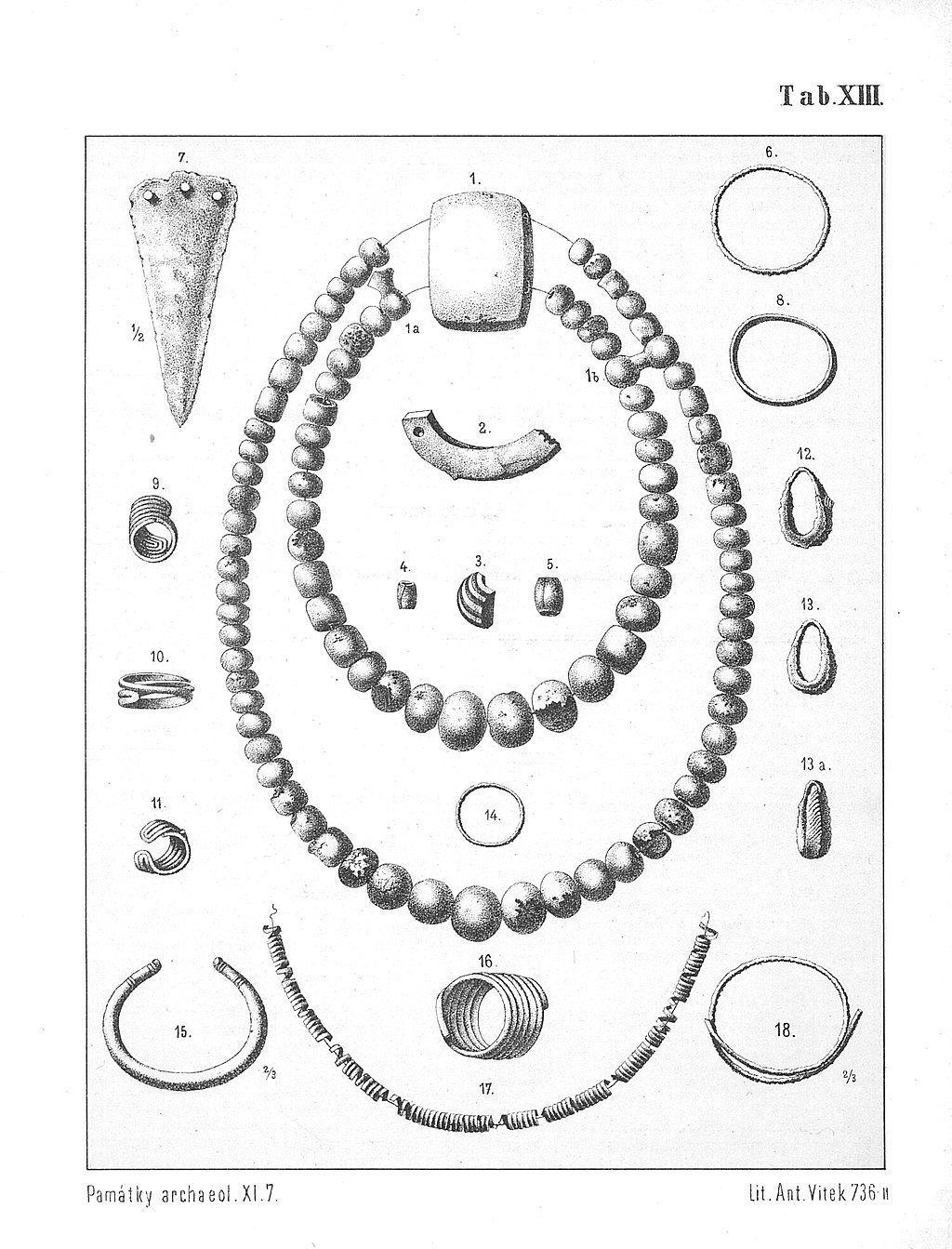
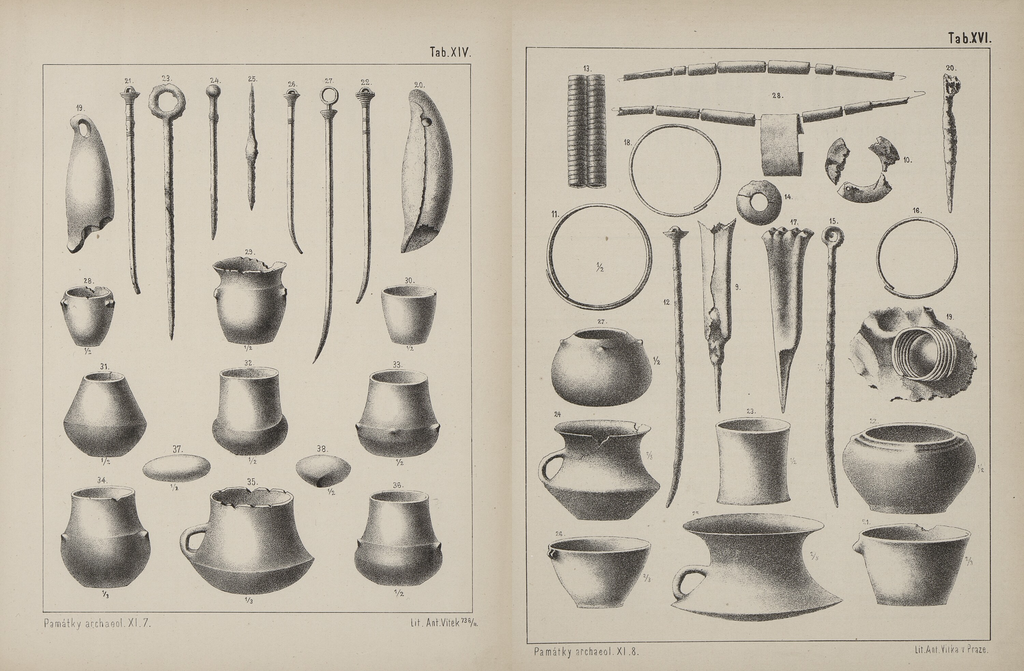
Grave goods: two vessels (bowl, cup), flint arrowhead and bronze hair rings
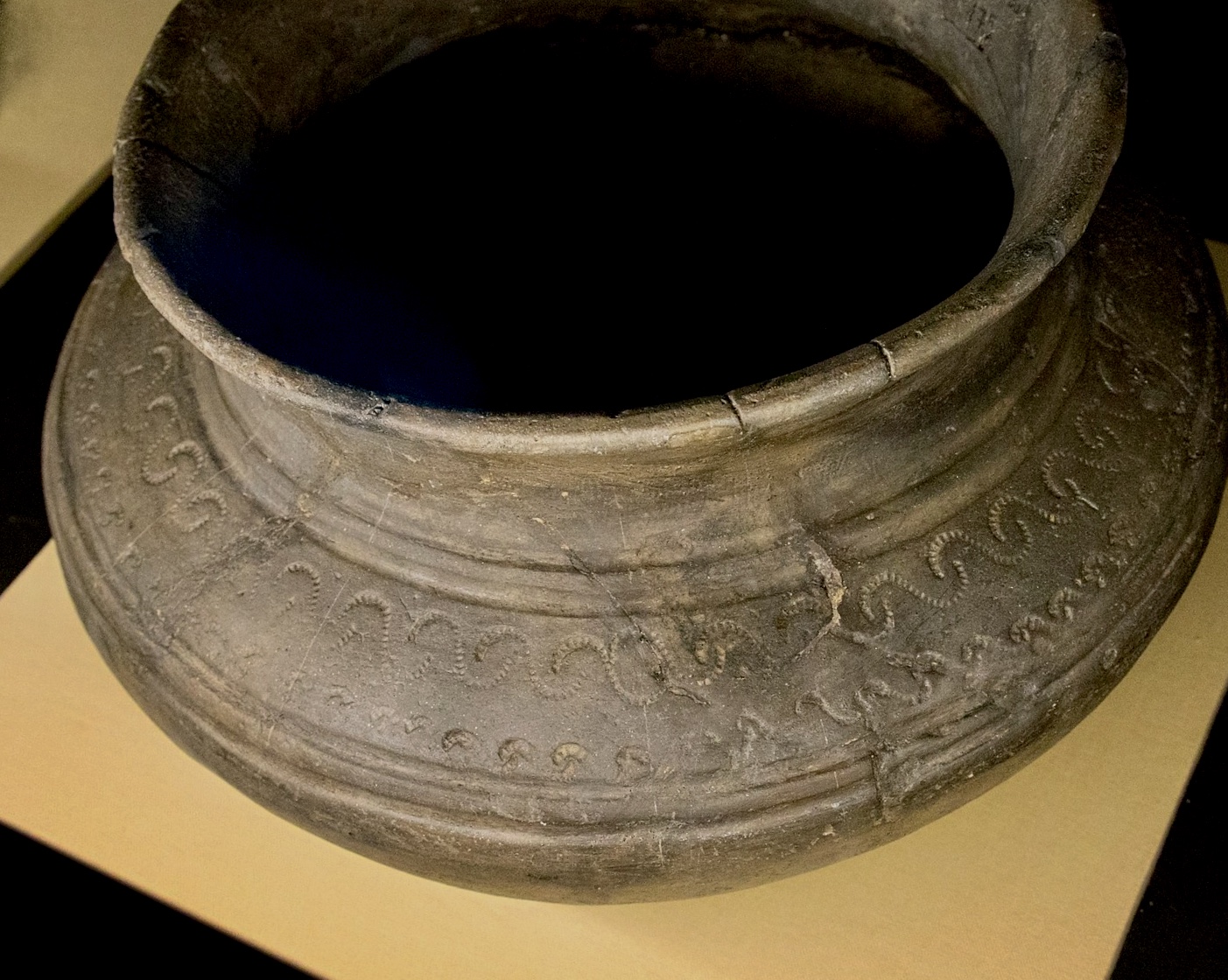
See images below for example of Únětice grave sites from Czech with typical grave goods.
Below is one of the few known sculptures of the La Tène culture from about 40 miles east of Prague and 24.5 from Teplice, Radosevice (the two cemeteries where FGC22501+ burials are known).
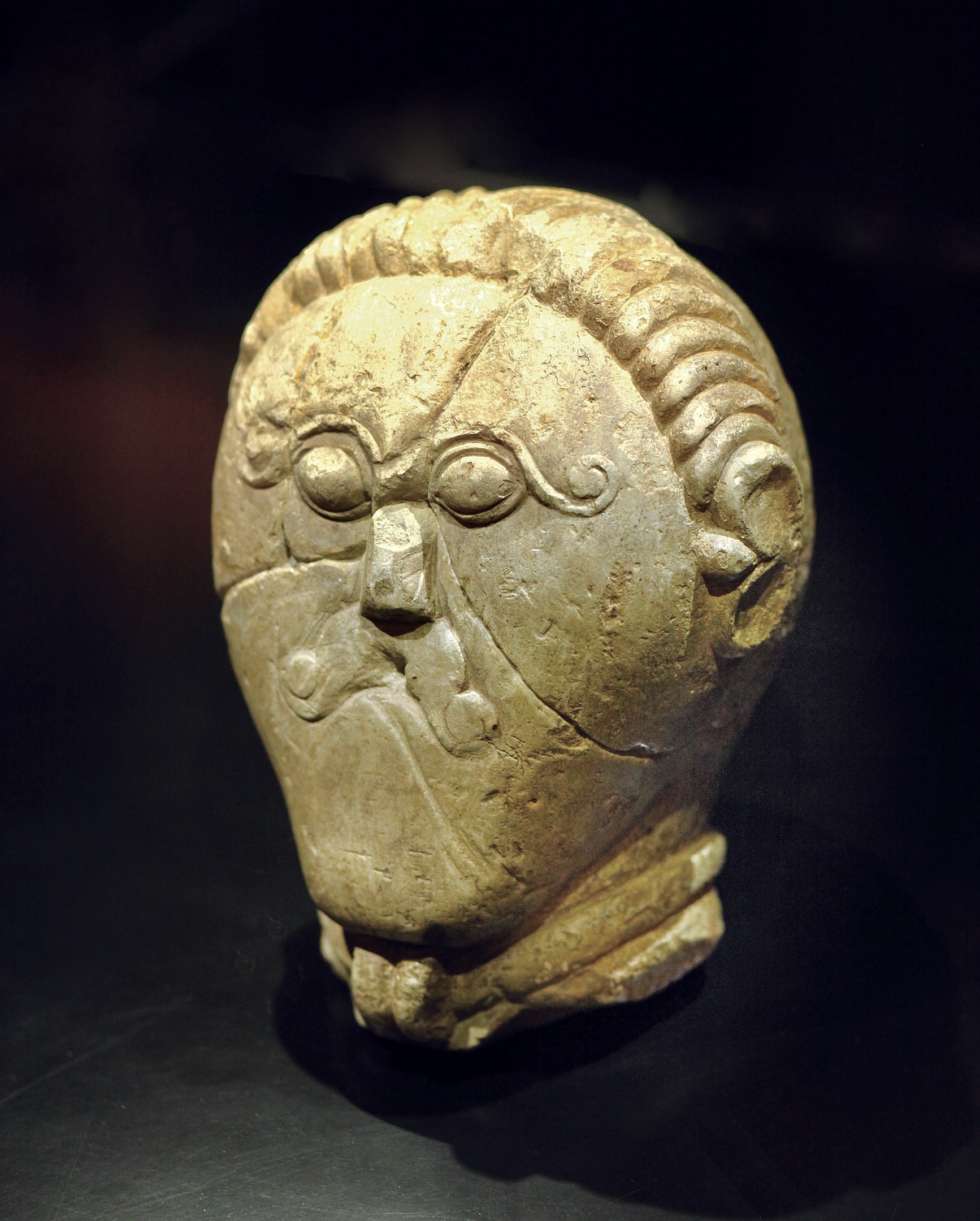
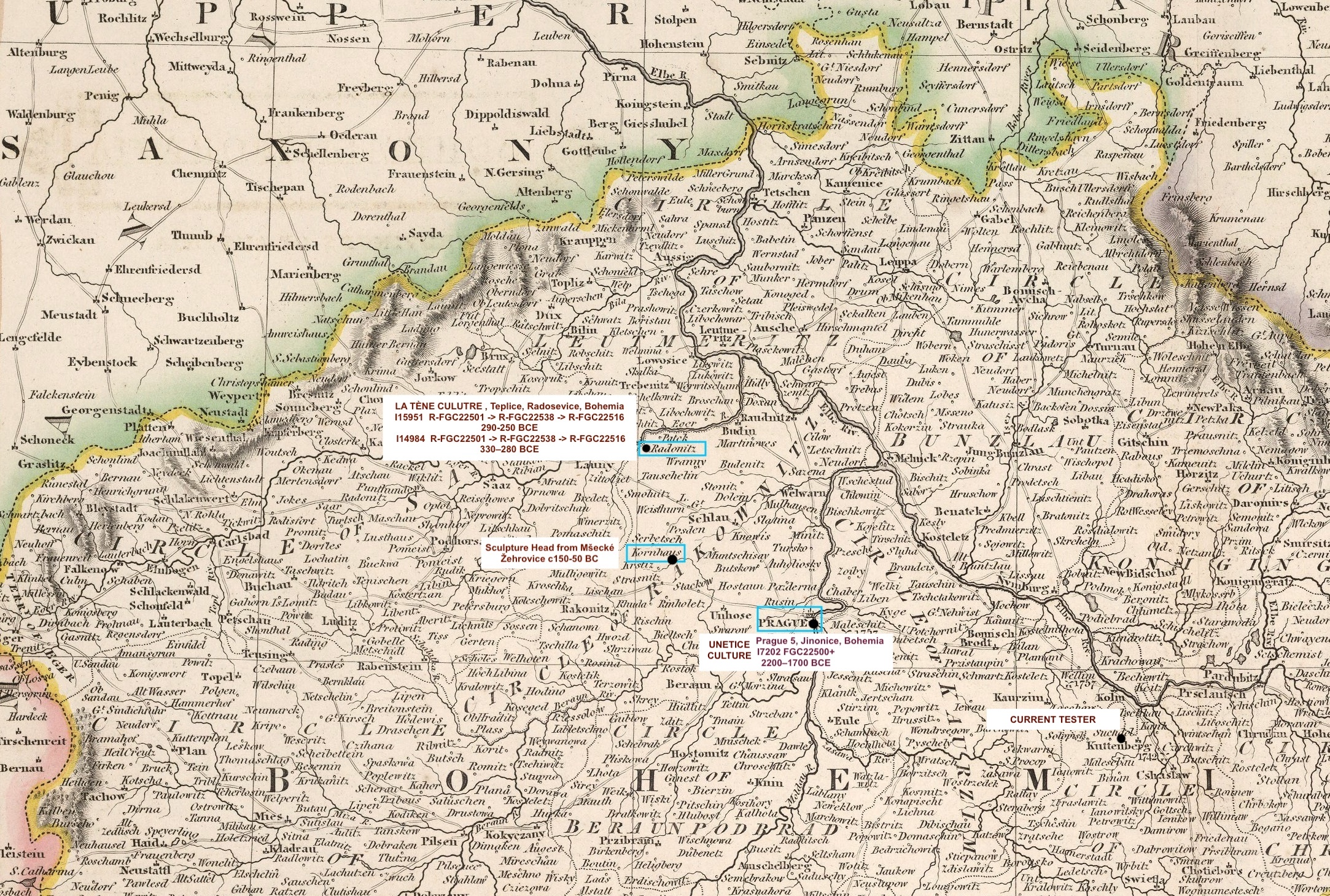
30 miles radius of Prague over about 1500-2000 years
in Radovesice (top of 3) the Bell Beaker graves come from an excavation in the pre-mine of the brown coal mine . They were discovered in two locations, which are approximately 800 meters apart. This yielded our second individuals I14984 FGC22516 c. 330-280 BCE and I15951-FGC22516 c. 270 BCE believed to be father and son.
So in less than ten years we have come quite a long way. Each man who is FGC22501+ can track back to a common ancestor about 4,000 years ago in the Czech republic. In a future blog post we will go into detail into one downstream SNP: FGC4211 who Vanessa has traced to Chancellors and Seneshals of western Europe.
Kelly Wheaton ©2024 – All Rights Reserved
The Trouble with Clowns: Self disclosure in Writing
Posted on May 2, 2024 3 Comments
This piece is very short but it speaks volumes about who I am as a person and some of my early relationships without telling the story of who I am in a typical autobiographical style. All writing is biographical no matter what you write about, because you are always disclosing bits and pieces of yourself. When we lift the veil we may not like what we see, and our readers may recoil. That is the risk we take in writing.
I have an unsettled relationship with clowns. My mother adored clowns and I always felt uneasy around them. That disconnect between my mother and I, in respect to clowns, is emblematic of our relationship. We simply perceived the world from completely different vantage points.
Before I get into the details I have to share my only positive clown memory. It is a story my mother often told about the clown that sat on top of her jewelry box. She was in the hospital after my birth. My father came for a visit and outside the hospital he was was approached by a young boy selling hand made clowns. My father bought one and took it to my mother. So it sat for the remainder of my mother’s life as a sentinel to the only child my parent’s had, that survived. My mother loved clowns—so by extension she must have loved me.
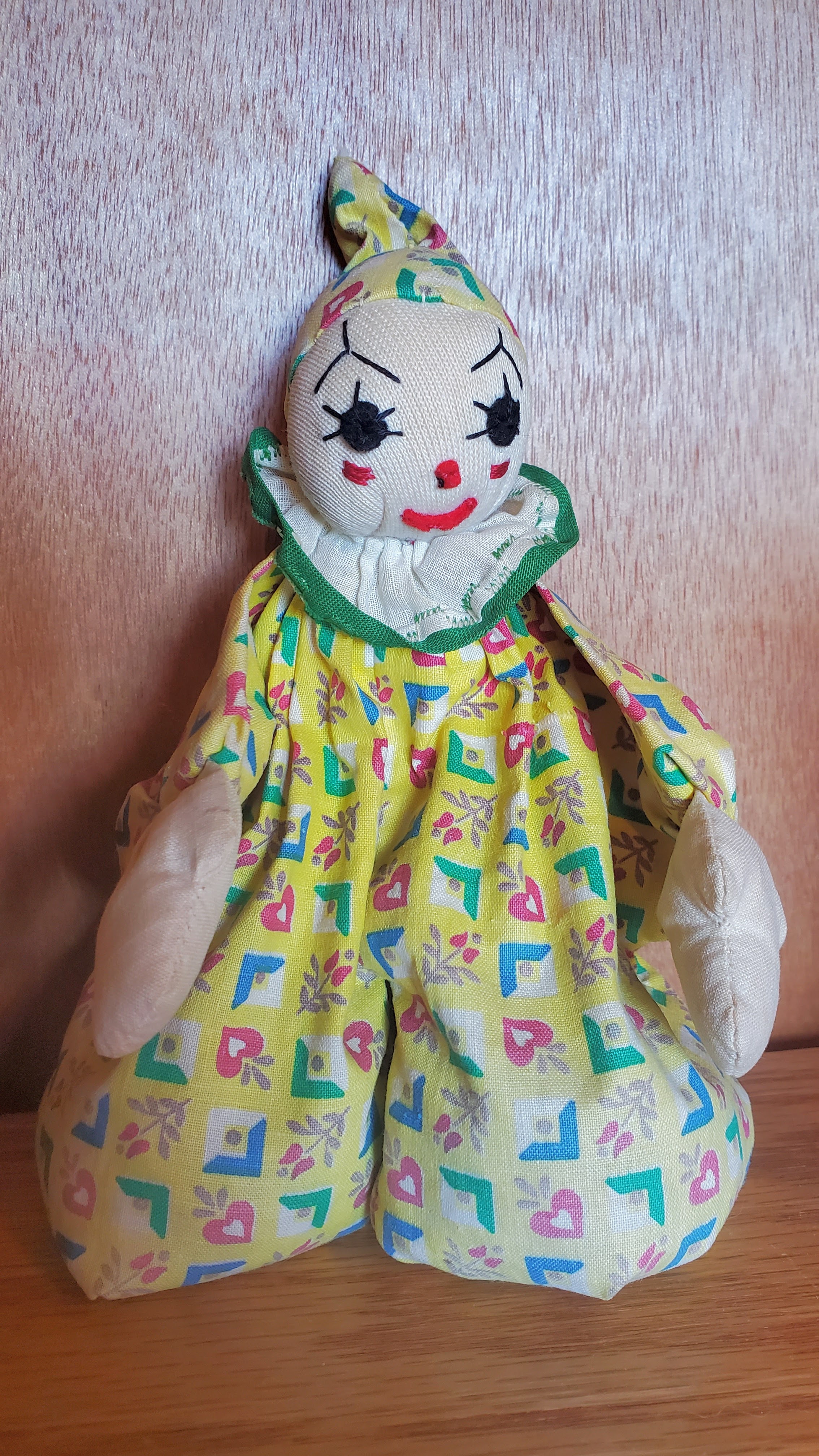
The next clown I remember was a framed colored photo of Emmett Kelly with his classic sad clown face. It was hung in my room and I found in troubling and unsettling. It was there for many years, a testament to my mother’s passion for clowns and the circus. When I was finally old enough to have a say, I asked for its removal, much to my mother’s dismay. We went to the Ringling Brothers Circus and again I found it all rather confusing. It did not have the effect on me, that it had on my mother. It delighted her and yet made me sad.
I remember when I was about 10 my mother for Valentine’s Day got my brother and I stuffed animals that included an autograph pen so you could have your friends sign them. My brother got the muted orange dog and I got the red and yellow and blue clown. I don’t remember if I broke into tears straight away, or later. However, I do remember my Mom insisting that the clown was the better of the two. My mother liked clowns, so I should be delighted she chose the clown for me. I wasn’t and she never got that. And sadly it didn’t matter if I tried to explain it to her—she simply could not put herself in my shoes. And I was the opposite. I was always putting myself in everyone else’s shoes, in my attempt to understand why people did what they did. I was wired to try and understand.
When I had children my mother insisted on taking us all to the circus and although decades had past my feelings remained the same. Rather than amuse me and make me laugh and uplift my spirits, I felt out of sorts. Even sad.
This all came to my attention recently when I was talking to someone about comedy. And how so much comedy and humor is at someone else’s expense. There is a fine line between funny and exploitation. Perhaps, this was because I was teased and humiliated as a kid. It is probably the reason I react so strongly against bullying and why I find some comedy–not at all funny. There’s a difference between laughing with someone and laughing at some one. Laughing at our human condition and the silly things we do and laughing, often cruelly, at someone that we place beneath us.
In retrospect I could not reconcile the sadness on a clowns face with something that was supposed to make me happy. Or even a happy clown, like the Bozo of my youth, I could not reconcile with the sadness that lurked inside. I simply do not inhabit a superficial world, where I can take things at face value. One of the nice things about aging is, I know I have lots of company. My apologies to any clown lovers out there, that I may have offended.
Kelly Wheaton ©2024 – All Rights reserved
The Fear of Writing Family History Stories
Posted on May 1, 2024 2 Comments
In my last genealogy class, a member said, “now I see why you want us to write stories!” I got to thinking about all the things that hold us back. Here’s a non-comprehensive list:
- I am not a writer
- What I write sounds stupid
- No one is interested anyway
- I don’t know how to write a story
- I have nothing to say, that hasn’t been said
- I might embarrass myself or another family member
- I might make a mistake
- I don’t know what to write about
So let’s take that last one first: “I don’t know what to write about.” This one is easy, pick anything. Pick something you know about or if you want more of a challenge pick something you want to know more about. Write what you Know, and Research what you don’t.
“I am not a writer.” Most family historians aren’t either. If you write, you are a writer. If you don’t write your stories and the stories of your ancestors, that you know about, they will be lost.
“What I wrote sounds stupid.” Yep, it does, so what? When you first started doing anything—did you do it perfectly? Of course not. Lighten up, take a few risks and have some fun. Or if you are in a mores serious mood. Out with the skeletons and traumas and family secrets. It doesn’t sound nearly as stupid if its juicy!
“No one is interested anyway.” You are right. No body cares or only a few. But later—when you are gone or a hundred years from now it will matter. Someone will read something you wrote and they will say, now I know what that was like? I never knew.
“I don’t know how to write a story.” Do you know how to tell someone about something that happened to you? Of course you do. So when you start putting words down on the page hear the conversation in your head as if you were telling it to someone. Just jot down or type or use google translate to type out what you would say. Do not worry about spelling or grammar or anything else. Whatever you get down—that is a draft. That is where we start.
“I have nothing to say, that hasn’t been said.” True. But the way you say it, the way you tell the story is from your unique perspective and that is important. You are important. Doesn’t matter whether it has been said a thousand times—you still must say it, in your own voice.
“I might embarrass myself or another family member?” Yep. So what. You have never embarrassed yourself or someone else? Did you survive? Did they? Everything worth doing in life involves risks. Feel the Fear and Do it Anyway. (also the title of a book)
“I might make a mistake.” Uh huh? So what? It’s just a draft. You can throw it out and start all over. You can edit and improve on it. You can ask for feedback. We learn the most from our mistakes. What works or what doesn’t its all a learning process.
“I don’t know what to write about.” Got that covered here is a whole page of ideas and prompts for you. Link to Family History Writing.
So enough with the excuses let’s do it!
Kelly Wheaton ©2024 All Rights Reserves
“The Wild Inside”: Our Grizzly Ancestry
Posted on April 21, 2024 3 Comments
This like many stories is a web of what connects us to a past. A spark alights, a memory leads us to our own wild insides. We think we stand alone, but we are connected even to our extinct past. Man and beast we are the same, yet different. Our most innate drives and passions are passed down through generations in ways that we take for granted. This journey reminded me of where I come from.
My local library, like many libraries, has bookshelves of donated books for sale. Most are a dollar for hardbacks and 50 cents for a paperback. For a few years I volunteered on processing the donations and now I occasionally peruse them. My latest purchase was a suspense novel called “The Wild Inside” a first novel of Christine Carbo, published in 2015. The cover attracted me with a lone grizzly bear in a snowy landscape. The description was a bit off putting, but I bought it anyway. The main character, when he was 14, was camping with his father in Glacier National Park and his father was attacked and killed by a grizzly bear. Years later he is investigating the death of another man by a grizzly bear.

I love the serendipity of finding a book and then finding something meaningful in its pages. This turned out to be that sort of book. My father liked bears. I like bears. My grandfather liked bears. I have never seen a grizzly (Ursus arctos horribilis) in the wild, but I have seen American black bears (Ursus americanus) at Grand Teton National Park and occasionally they are spotted in my area in Northern California.
I have always felt the bitter irony of the California State flag bearing (oh dear, excuse the unintentional pun), the image of a California Grizzly bear, which is also our state animal. The last one was killed in the state in 1922 . Two years later, one was spotted several times in Sequoia National Park, then disappeared. The Grizzly was declared extinct here in 1924, and now a hundred years later, our flag still bears her image. It is estimated that 10,000 grizzlies once lived in California and yet none remain. In perhaps a warning to us all.

When I finished the book it inspired me to re-read my grandfather’s poem “The Last Grizzly.” According to his annotated copy of “Artifacts” (his collection of poems), his poem was first written in the 1920’s. In his 1964 letter to the California State Department of Fish and Game he had a recollection about a grizzly article he thought from the 1930’s but he wrote “it could have been referring back to the 1922 incident.” The reply had nothing further after 1922. The inquiry and reply below.


But I found the mention of the 1924 visits of a Grizzly Bear to Sequoia National Park, in the San Francisco Bulletin, Fri, Dec 26, 1924 Page 6. I suspect this may have been the impetus for his original poem. This article is worth a read, dispelling many grizzly bear myths.

My grandfather and father were both great admirer’s of nature. Both fly fisherman and hunters, when their need to fill their bellies, was great. My father, his brother and my grandparents spent a snowy winter in the Trinity Alps, living in a canvas tent. My father set snare traps to catch hares during those challenging years of the Great Depression. They were both great admirers of the naturalist Ernest Thompson Seton. I am sure they would think me remiss if I did not mention his book published in 1904, “Monarch the Big Bear of Tallac” the story of a Grizzly Bear near Lake Tahoe. What I remember most about Seton, I wrote about in a report in grammar school. On Seton’s 21st birthday his father presented him with an bill for all of the expenses connected with his upbringing, including the fee of the doctor who delivered him. He paid the bill, it is said, and never spoke to his father again. That story, and the brutality of it, is one I never forgot. These stories passed down through families are seldom recorded, but shape us none the less. Seton founded the organization the “Woodcraft Indians” in 1902 and invited the local youth to join. The group was open to girls and boys. An extraordinary man ahead of his time and remembered mostly for having being instrumental in the founding of the Boy Scouts of America and for his being an early writer of wild animal based fiction stories. He was also an artist whose spare use of line, my Dad greatly admired.

“Monarch the Big Bear”
Here I offer my grandfather’s Poem
“The Last Grizzly”
O Grizzly King, accept the bitterness
Implicit in the words I speak to you;
Nor think I seek forgiveness for my kind,
With hope to mitigate their sordid act;
For you, the Patron—bear with me awhile—
The Patron of this sovereign State lie slain;
The State itself your slayer, unrebuked,
Except for these too feeble words of mine.
In what long-hidden wilderness retreat
Did you seclude that massive frame so well,
That howsoever diligent the ones
Who guard us from the power of the beast,
They did not mark your range; nor even see
Your mighty tracks, until this fateful day?
It has been said that you were gone, ere now;
Ere this a mockery, the Golden Bear.
Ah, well, a day; a year; what matter? Just
So you are gone! For you were dangerous,
And fierce. Your goaded charge had raised
The hair on far too many frightened heads.
You were not one to feel the choking noose,
In passive resignation; nor the force
Of rifled death, against whose brutal stroke
The Rhino’s armored hide avails him not.
But when chains, tormented by the goad;
Rope-wracked and torn; awaiting to be dragged
To some corral to fight a hapless bull,—
That also did not seek the senseless fight—
if then the vast frustration grew too great;
And you would ask, and get, God’s leave to die,
and simply cease, the laughing Don would say,
“He dies of rage!”, not caring to recall
His tons of horses pulling, all opposed,
On rawhide lassos looped about your neck—
And more, vaquero-ridden, standing by
To choke you down, if need be, so to void
Their fellows risk, or hold their chains
that simplified their next brutality.
“He dies of rage!” the laughing Don would say,
As if to hide your torture with that lie.
So the crime of fighting for your own,
Te People passed a judgement on your head;
And you have paid. The state claimed your life:
“For seeking food on your own usurped range.”
You took a calf or two, or maybe three,
Against the awful levy on your race,
That filled the bellies of the gold-mad men
Who trespassed on the land God gave to you.
Myself, sometime, have ranged about the wood,
And from a distance watched, to learn your way;
But you were on good behavior then;
Not acting your reputed self. I saw
No arrogance displayed as you did pry
With eager nose, and claws, in rotten logs,
For ants and termites; and I watched you dig
For lily bulbs, and roots, among the stones—
You filled yourself with fungi, succulent;
With bugs and grubs; and berries in their time,
While mulling over heavy memories
Of honey-bees, and hives in hollow trees.
At such a time you were not bad to see,
But much akin to small and curious boys,
Searching in attic, erstwhile unexplored.
Such scenes are gone, with drowsy summer days;
And insect’s drone, in manzanita grove;
And lupine blue; and poppy-gilded slope—
All gone for you—unless perchance, there be
An ursine garden in Elysium,
Where golden asphodels drip honey-dew.
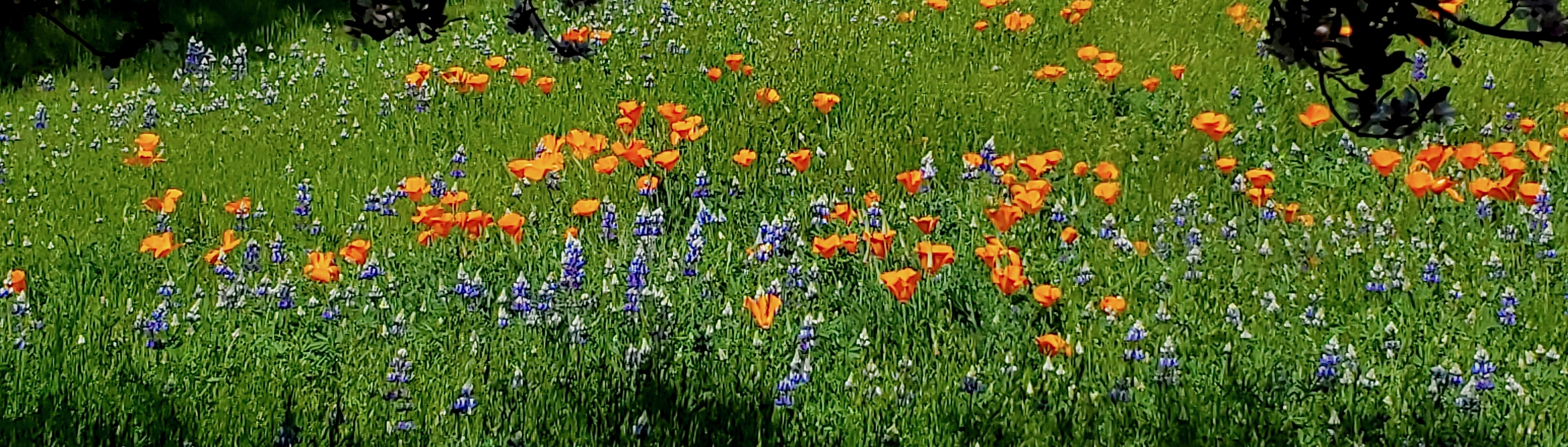
My grandfather mentions in his notes many attributes of the Grizzly, especially from Harold McCracken’s 1955 book: “The Beast that Walks like Man.” I wonder if that was the greatest of man’s fear, that the Grizzly was both intelligent, thoughtful and terrifying when he rose up like man.
I am past the age, when my grandfather died and can not ask him questions, that I would ask him now. My title above is a play on words “Our Grizzly Ancestry” in the double meaning of grizzled as in old, and in grizzly as in brutal. At times I felt reading his poem again, that it was a metaphor for the native peoples who revered the Grizzly and were feared as savages. Grizzlies reduced to caricatures of their complex natures and labels that aim to justify their extermination. It is a not so gentle reminder of the arrogance of man, and his folly in thinking he has dominion over the earth. His brutality to both nature and his fellow man, exceeds any seen in wild beasts.
And finally in reflection, I see in my grandfather, my children and hopefully their progeny, a desire to understand and do homage to the natural world, which we are gifted, but a brief stay.
Kelly Wheaton ©2024 All Rights Reserved
Irish Genealogy Resources
Posted on March 2, 2024 3 Comments
This is a page of resources I have put together for my Genealogy Class. I hope they may be of interest to a broader audience as well. Some of these are pretty obscure so I hope that it expands your list of Irish resources.

HINT: Finding Irish Origins for Immigrants
In general there are two overlooked places to find genealogical information as to place of origin for Irish immigrants. First is tombstones which often list the place of origin. The second is Newspaper obituaries or ads in either local papers or in papers like the Irish American Weekly (1849-1914). While writing this I went to my husband’s HALEY line. I read over Patrick HALEY’s obituary carefully. Within the obit the name was also spelled HEALY but I had overlooked was that he came over with his wife and a David MURRAY who also settled in Emporium, Cameron County, PA. Bingo I found David MURRAY and Patrick on the same Ship’s passenger list. I had been searching for Patrick Haley for decades. It was spelled Patrk HEALY on the manifest. Another example of the friends and family research plan. I also had expected that he went from Ireland to New York and It appears he actually left from Liverpool ENGLAND!

General & Getting Started
Organizations
- Researching your Irish Ancestry Ireland XO
- Irish Genealogy
- Irish Family History Association Roots Ireland
Videos
- Getting started with Research in Ireland Dan Poffenberger at 2024 Roots Tech video
- Coming and Going: Tracing Your Irish Surname History David Ryan 2024 Roots Tech video
- Researching Your Irish Ancestry at Minimal Cost Maurice Gleeson Excellent!
- Finding Irish Relatives Part One Vita Brevis NEHGS
- Finding Irish Relatives Part Two Vita Brevis NEHGS
- Finding Irish Relatives Part Three Vita Brevis NEHGS
- Irish and Scots-Irish Family History Research Workshop video 3 hours
- Free Irish Genealogy Getting started Course
Books
- The Family Tree Irish Genealogy Guide: How to Trace Your Ancestors in Ireland Claire Santry 2017
- Tracing Your Irish Ancestors 5th Edition John Grenham 2019
- Irish Records: Sources for Family and Local History James G. Ryan 1997 Ancestry
- Finding Your Irish Ancestors David S. Oumette 2005 Ancestry
Forum
- My Irish Heritage
- Ireland XO Message Board
Surnames
- Irish Surnames John Grenham’s great site for searching Irish surnames
- Ireland Names and Surnames
- Origenes Maps Surnames, Ulster surnames, Castles, Clans etc
- Irish Surname Maps Barry Griffith
Immigration
- Irish Immigration Database Mellon Migration Centre
- Immigrant Letters from America University of Galway 7,000 complete letters
- National Museum of Liverpool (often a port of embarkation for Irish immigrants)
- Irish Newspaper Archives $$$ Free to members of NEGHS
- How to locate parish of Origin Ireland XO
Census or alternatives
- Census Records from the National Archives 1821-1851 (fragments) ; 1901; 1911
- Ireland Tithe Applotment Books, 1814-1855 @ Family Search need account -free
- Ireland, Tithe Applotment Books, 1805-1837 @ Ancestry.com (need subscription)
- Northern Ireland, Tithe Applotment Books, 1822-1837 @ Family Search
Records Sources
- Ireland’s Virtual Treasury
- Ireland National Archives
- Public Record Office of Northern Ireland
- Family Search Ireland On line wiki
- Irish Manuscript Collection
- 1641 Depositions at Trinity College Dublin Library
- Medieval Gaelic Sources
- The Annals of the Kingdom of Ireland
Catholic Records
- Irish Catholic Parish Registers from St Louis County Library
- Irish Catholic Church Records Roberta Estes
- Finding Your Ancestors in Catholic Parish Registers
Ulster Scots / Scots -Irish in America
- Scots Irish in America Origins & Migrations Rhonda R. McClure via NEGHS video. Highly recommend. Great introduction
- Ulster Settlers
- Ulster Historical Foundation
- 1718 Migration of Ulster Scots to America
- Derry Records
- Plantations in Ulster 1600-41 A collection of Documents
- Ulster Ancestry
- Name search Ulster records search
Land Records, Deeds, aka Memorials
- Introduction to the Memorials and Transcription Books at the Registry of Deeds, Dr Patrick Walsh
- Northern Ireland Registry of Deeds
- Republic of Ireland Registry of Deeds
- Images of the Memorial Book on Family Search
- Registry of Deeds Indexing Project
- Using Irish Landed Estate Papers to find your ancestors Gillian Hunt Roots Tech 2022 Video
- Tracing Your Irish Ancestors Through Land Records: A Guide for Family Historians Chris Paton book
- Understanding Irish Land Divisions Rhonda R. McClure via NEGHS video
Maps

- Ireland’s History in Maps
- Maps based on Griffith’s Evaluation
- 1846 Old Ireland Map
- Origenes Maps Surnames, Ulster surnames, Castles, Clans etc
- Irish Surname Maps
- Ireland Map Collections at UCD and on the Web: Historic Maps from Univ College Dublin
- Irish Townland and Historical Map Viewer
- Clan Names of Ireland Map
- David Rumsey Map Collection
Finding a Barony, town, parish etc.
- Irish Historic Town Atlas from St Louis County Library
- The Irish Townlands
- Alphabetical Index to the Townlands and Towns, Parishes and Baronies of Ireland. Dublin: Alexander Thom
- Irish Townlands Survey
- Topographical Dictionary of Ireland 1837 Goof for looking up place names
Specific Area
ANTRIM
- Bill MacAffre’s site for Antrim and Derry
CORK
- Skibbereen Heritage Centre West Cork
DERRY
- Bill MacAffre’s site for Antrim and Derry
Visiting Ireland

- Planning your Irish Research Trip David Ryan Roots Tech 2022 Video on YouTube
- How to Trace your Irish Ancestry during a visit to Dublin Frommer’s
- Ireland Castles
- Excavations at Elag Castle
- My Ireland Heritage Tours
- Cobh Heritage Centre Cobh, County Cork
- Ireland National Archives
- Public Record Office of Northern Ireland
DNA
- Origins of the Irish and Scots as revealed by their DNA
- The Irish DNA Atlas: providing a map of Irish genetics in and out of Ireland – Dr Edmund Gilbert
- Ancient Ireland’s Y and Mitochondrial DNA – Do You Match??? Roberta Estes
- Emerging Dynasties in a Maritime World by Cathy Swift YouTube from Genetic Genealogy Ireland 2014
- DNA vs The Irish Anals By Brad Larkin YouTube from Genetic Genealogy Ireland 2014
- Using Y-DNA to Research your Surname Maurice Gleeson YouTube 2018
- Dr. Maurice Gleeson Presentations and downloads
- Ireland and the Slave Trade Maurice Gleeson
Irish Genealogy Blogs
Kelly Wheaton ©2024 – All Rights Reserved
OUR LEGACY: Leaving Breadcrumbs
Posted on February 20, 2024 3 Comments
In my genealogy class last week, I was asked, “why do you write“. My first answer was I write for myself. My second answer was I write for posterity. But since then I have been pondering this provocative question. Which really is a broader question? Why do we exist? What are we here for? What will we leave behind? What will our legacy be? Will we soon be forgotten? I am not sure I am prepared to answer those existential questions. However, I am prepared to grapple with these things.

My last blog post was Write What You Know: Research What You Don’t & Beware of Artificial Intelligence Generated Answers and I wrote about how we need to view our ancestors in context. That we cannot view their lives in isolation as if they lived devoid of family, friends, geography, history and what was happening around them. So in part I write to look at my own life in the context of history and the ancestors who laid the groundwork for my existence. I am essentially looking for myself in my own context. But more than that, I also write to understand. I want to understand the past, as it informs the present.
“Those who do not learn history are doomed to repeat it.”
George Santayana
I write to understand what I don’t know. I write because it forces you to do your homework and not just rest on the work of others. In my first genealogy class one of the members said, “my family has all been done, there’s nothing to do.” I am fairly certain they no longer feel that way. It’s not just our ancestors that we seek to understand, but it is ourselves. I write and encourage others to write, because it takes courage and I want others to be inspired to take the risk. Especially these days it isn’t always easy to put yourself out there. Especially when no one seems to be listening. But that should not deter us, do it anyway. The doing of it, is its own reward.
As I research and discover more about my ancestors, it brings broader themes of history into focus and it casts an illuminating light on my own family history. Whether you are adopted, or your family kept lots of secrets or whether books have been written of your family there is always more to discover from your unique perspective. No two human beings see things the same way. Whether siblings or spouses each will have different insights and different recollections of events. We are the result of millions of years of genetic experimentation and expression along with the shaping hands of our moment in time and space.
I write because I am curious; because I am wired to seek understanding. And it isn’t just understanding—I care about the answers. I care about how the choices we make outlive us and ripple and reverberate through time. We walk along the sandy shoreline, leaving footprints in the sand. Those prints are short lived, washed away in an incoming tide. Gandhi said it better than I:
“Whatever you do in life will be insignificant but it is very important that you do it because you can’t know. You can’t ever really know the meaning of your life. And you don’t need to. Every life has a meaning, whether it lasts one hundred years or one hundred seconds. Every life, and every death, changes the world in its own way. You can’t know. So don’t take it for granted. But don’t take it too seriously. Don’t postpone what you want. Don’t leave anything misunderstood. Make sure the people you care about know. Make sure they know how you really feel. Because just like that…It could end.”
Mahatma Gandhi
We are unique and we have something to communicate. It’s not up to us what if anything survives us: history decides. Whether it is me retracing the path of YDNA from Prague 4000 years ago to a WHEATON, born over 400 years ago which traces to my husband. It matters. My great grandmother’s diary matters. Another great grandmother’s colored pencil drawings matter. They are all breadcrumbs leading us to places we never imagined.

They give us glimpses into what mattered to them. Art painted on a cave wall. Grave goods from 4,000 year old burials. Carvings on a prison wall in The Tower of London. There is always an attempt by some of the powerful to eliminate the silenced voices from history. Resist.
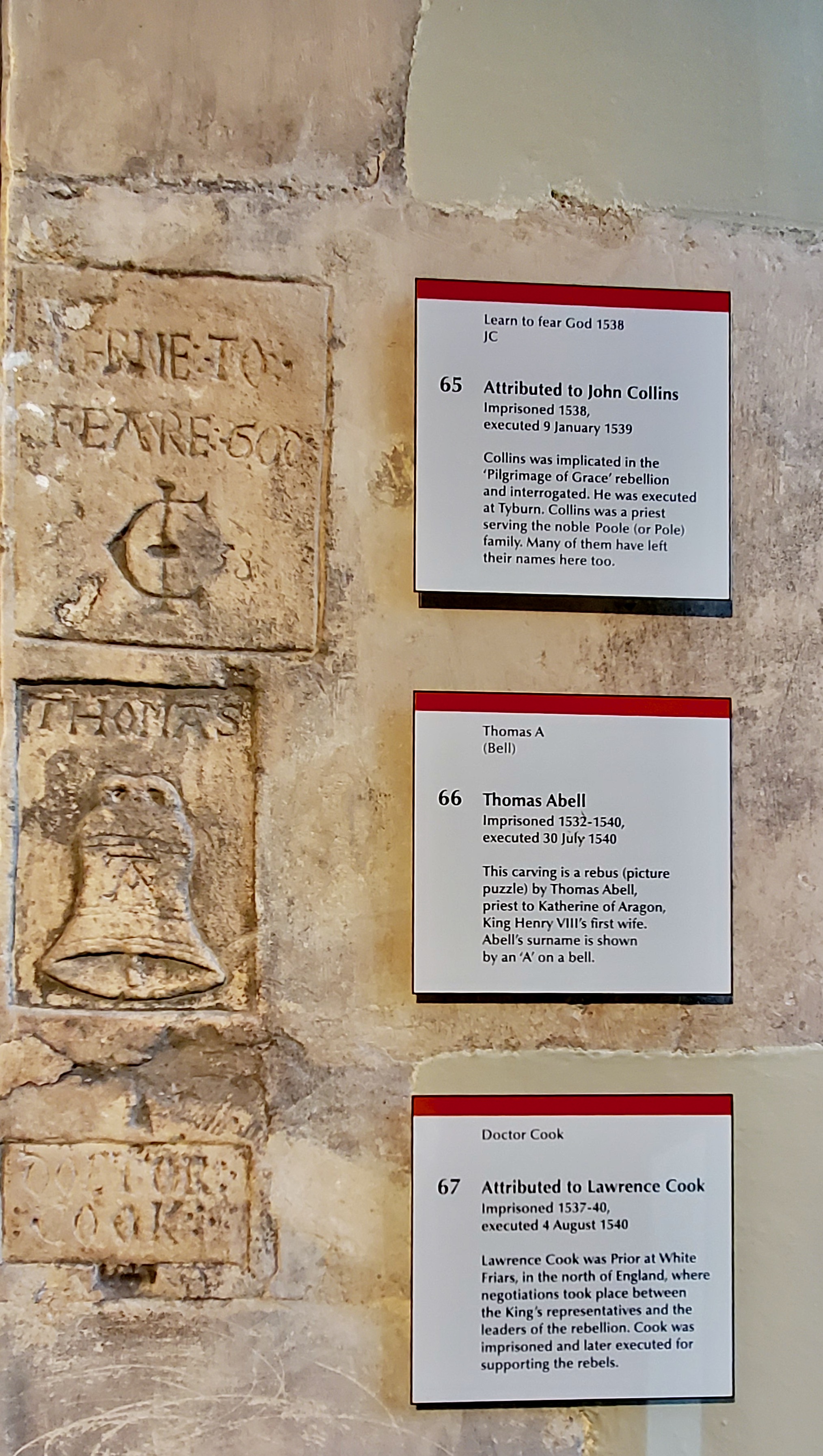
So take the risk, write the letter, the story. Paint the scene, give voice to the voiceless. Leave your breadcrumbs for others to discover.
Kelly Wheaton ©2024 – All Rights Reserved
Maps & Mapping Resources for Genealogists and Family Historians
Posted on February 19, 2024 3 Comments
If you are a regular Wheaton Wood blog post follower you will know I love maps. For my genealogy class I compiled some of my favorite Map resources below. In general I use out of copyright maps and those that are as close to the time frame as when my ancestors lived in a location as I can find. This is an active post, meaning I may add to it from time to time. You may wish to bookmark it for future reference.
HINT: Google a library or an archive for the specific area you are researching—from a town to a country. Search archives or museums in the county, state or country of interest for maps. For instance the Google Search:
“Archive North Carolina maps” yields these top hits:
- North Carolina State Archives Maps
- North Carolina Maps Home at the University of Chapel Hill
HINT TWO: Do not make the mistake of only looking in the place you think a map might be located. For instance below you will find the Perry-Castañeda Library Map Collection located at the University of Texas. It includes this large list of maps pertaining to Mexico.
HINT THREE: Check out Etsy and Ebay for old maps and atlases.
GENERAL & USA
- Google & My Maps (must have a Google account) My maps is a Google product that allows you to drop pins and create migration routes. Measure areas and much more. Here’s a short Youtube video on My Maps to get you started. But you can look for more YouTube videos with greater depth.

- David Rumsey’s Historical Maps Collection – Probably my favorite large map repository. With two features I love. Geo-referencing which allows you to overlay an old map onto a current map. And the new feature “Text on Maps” which allows you to search for a place on a map. Each of those little images sows the term “Alamance” on a map. Hovering over any of the images tells you more about the map. Clicking will take you write to that spot on the map. If you do a surname search this takes you to towns and places with that name but it also includes some individual names on Plat Maps from County Atlases. This will become a more and more powerful tool no doubt. Give it a try it is awesome! It is available by Using the down error in the corner of the search box. Make sure you are in “Text on Maps.”

- Old Maps Online Collection 400,000 maps for library, university, and national institutions. Each map links to the original website that houses it.
- Library Of Congress Map Collection
- Library of Congress Sanborn Collection These are very detailed maps of U.S. cities and towns in the 19th and 20th centuries. Originally created for fire insurance companies to assess liability.
- Norman B. Leventhal Map & Education Center
- Perry-Castañeda Library Map Collection
- Harvard Map Collection
- NY Public Library Digital Collection
TOPOGRAPHICAL
US LAND PATENTS & PLATS
- US Dept of Land Management provides access to Federal land conveyance records for the Public Land States, between 1788 and the present. Amazing!
- US Place names The U.S. Board on Geographic Names (BGN) was created in 1890 to maintain uniform geographic name usage throughout the Federal Government.
SURNAME DISTRIBUTION MAPS
WORLD
Use Family Search for maps. Go to Family Search Catalog. Then search by place and look for Maps in results list.

United Kingdom
- National Library of Scotland for all UK maps
- UK Maps Geograph Photos by location across the UK
- Family Search Historic UK Map Collection
- England in 1086 Domesday Map
Some Others
- Canada Archives Maps
- Germany Geograph Photos across Germany by location
- European Maps
- Norwegian Maps
- Swedish Maps
Kelly Wheaton ©2024 – All Rights Reserved
Write What You Know: Research What You Don’t & Beware of Artificial Intelligence Generated Answers.
Posted on February 15, 2024 5 Comments
If you are a follower you know I encourage you to turn your family trees into stories. But sometimes it is hard to know how to do that. Well you start with what you know about an ancestor or family. That is where tools like Family Group Sheets, Individual Research Checklists and Timelines come in handy. These are ways to organize information that you know and see what is missing. If you use Ancestry or a similar online program you will be familiar with a view that shows a timeline on the left side, like this one in Ancestry’s Facts view:

So you are placing the individual “Frederick” within the context of time and family. If you switch on Ancestry to the Life Story view it starts shifting you into a narrative format as shown below
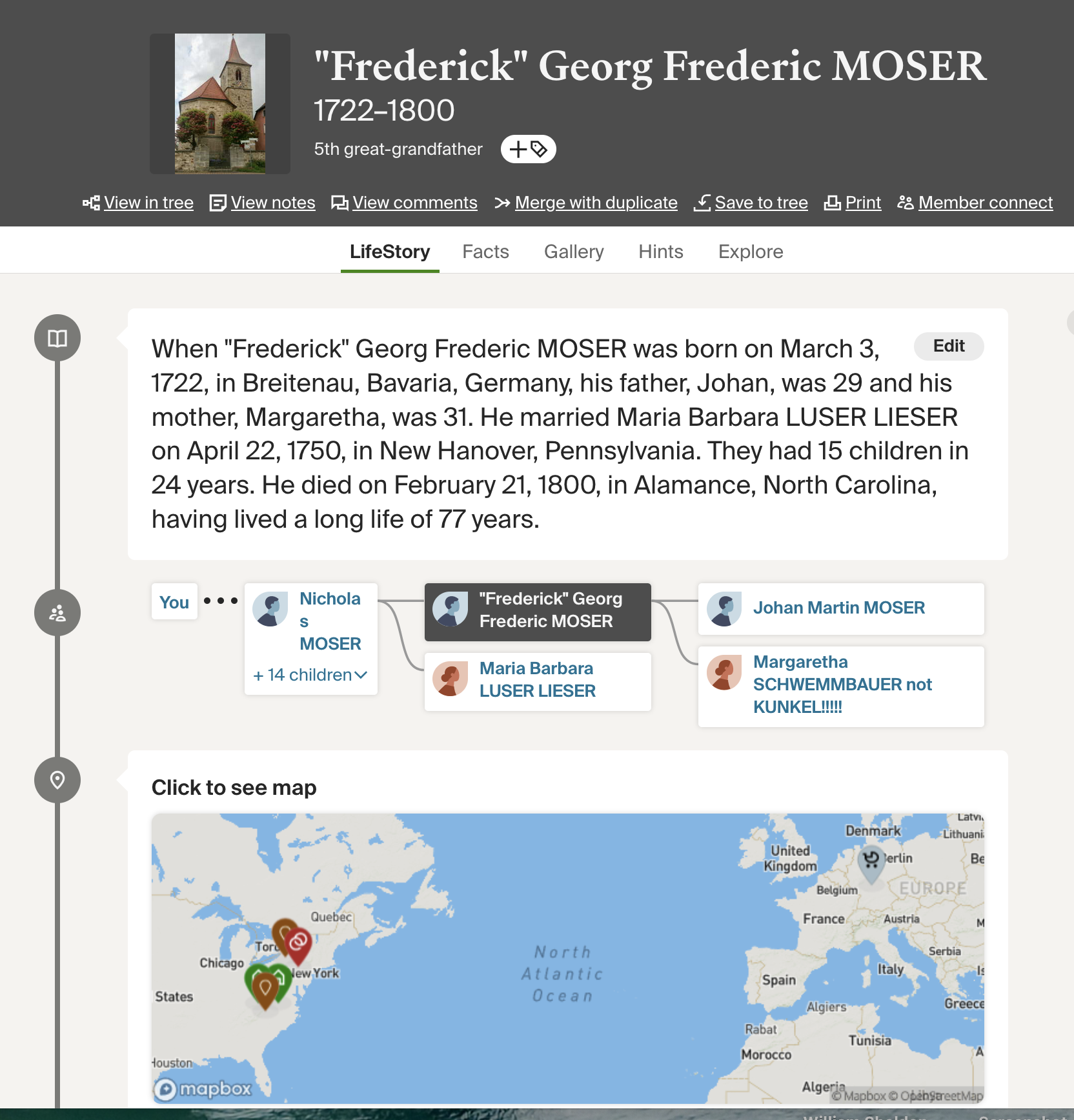
You will notice they insert maps and make observations about the family. There may be short articles on historical events.
CAUTION
But now there is a new twist you can have Ancestry AI suggest a question and give you an answer via Artificial Intelligence. The problem is in the first question I tried the answer was partly, VERY WRONG. This is in BETA but it troubles me. The Question was “What was Breitenau, Bavaria, Germany like when Frederick Georg was born?” Below is the answer as reported by ancestry AI.

Generally speaking this a correct, but one horribly wrong statement made me distrust it wholesale. The wrong statement shifts a fundamental part of understanding Frederick MOSER and his parents. This is the patently false statement “Religion played a significant role in the lives of the people in Breitenau. The village had a Catholic church, which served as the spiritual center of the community. The villagers attended mass regularly and participated in religious ceremonies and processions.” There was no Catholic Church in Breitenau. It is in a predominately Protestant area of Bavaria and the church was Lutheran then, as it is today. This is a very small village and it has ONLY one church. Furthermore both Frederick’s parents were descendants of Austrian exulanten. These were protestants who fled Catholic Austria during the early 17th century, for protestant areas of Germany. Do not rely on Artificial intelligence or those nice little historical details to write your stories for you. The only way to do it properly is to do your own research.
HOW TO RESEARCH an ANCESTOR’S STORY
And what does that mean? It means to familiarize your self with the geography, the maps, and local history of the place your ancestors lived. The WHAT, WHERE and WHY of your ancestors story.
- What was the area known for?
- Were there wars between indigenous people and immigrants?
- Were there divisions between religious or ethnic groups?
- Were there wars or economic divisions that occurred before or during your ancestors lifetime?
- Who lived nearby?
- Why did they move here and not somewhere else?
HISTORIES
Immerse yourself in where they lived. It’s wonderful if you have the opportunity to visit, but in the absence of that search for time appropriate maps. Or at least as close to the time frame in question. If you can drive down the road in Google Street View. Look around. What do you see? Do a search for a county or regional history. My favorite way to do that is to do a search for: “Archive the History of [the name of the county or region].” So a search would yield something like this:
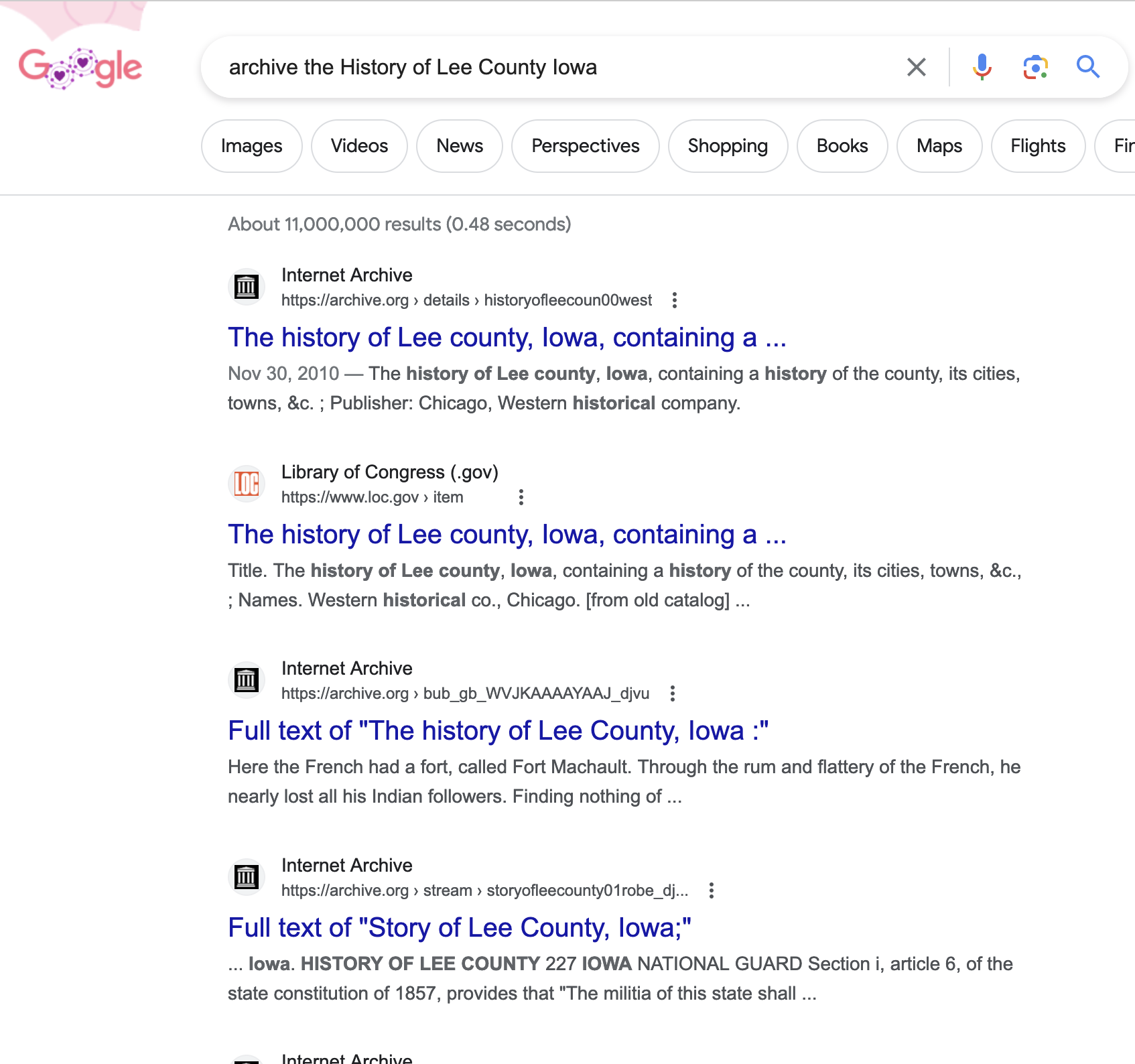
This immediately gets you able to read Histories of Lee County Iowa that are out of copyright. I can search for ancestors but I can also look for details about population, agriculture, churches, military service, history etc. Because this brings up history that is uncopyrighted I can freely quote descriptions of life and the areas my ancestors lived. Sometimes it will even have delightful stories about your ancestors, like the one I wrote about in Ice Cream Melons & Foxes.
MAPS
Second I like to research maps. Perhaps my favorite map resource is David Rumsey Map Collection. There are many great features but two favorites are the Georeferencing or overlaying of current and historical maps. And a NEW feature is: Search by Text-on-Maps! Have a look at what a search for Alamance looks like. Each one of those images will take you to a map with the word Alamance in it.
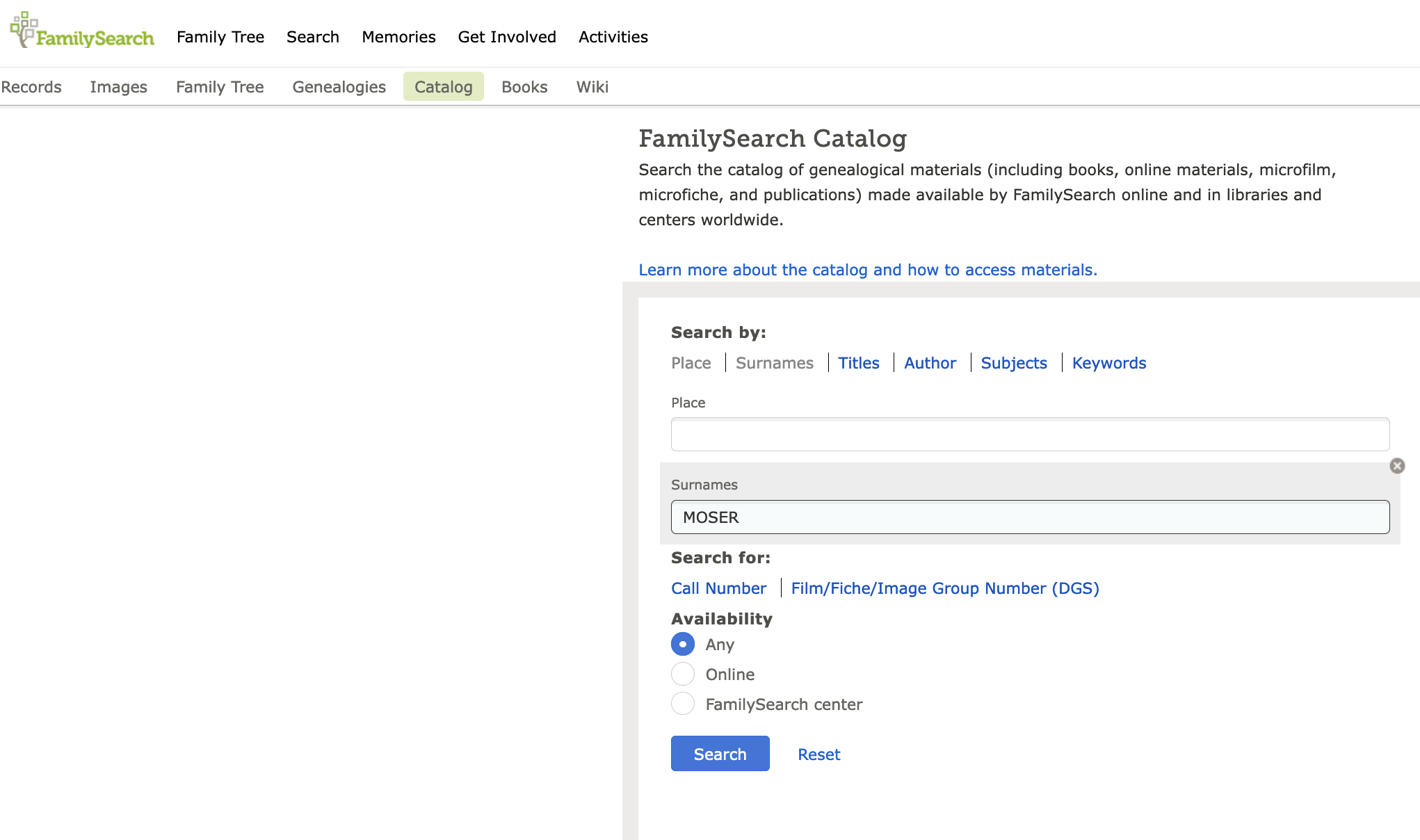
So first we looked at some background history and then maps. What next? The sky can be the limit but here are a few places I tend to check. I especially like Family Search for looking for an existing genealogy that may cover your ancestors. So here I have clicked on Catalog then on Surnames and Entered the surname “MOSER” This will yield hundreds of published and unpublished manuscripts that contain the MOSER family.
GENEALOGIES
Which brings us to your “Friends and Family” searches. Even if you can’t find something about your family you might find something about their neighbors. So go back to your Census records and take a closer look. Was your family living in a Jewish neighborhood? Or were most of the people in the area Irish? Who did your ancestor marry? Who were her/his in-laws? Who did their children marry? The names you come up with can be clues to finding out more about your ancestor. You can go back and search for them as above.
NEWSPAPERS
Now depending on how deep you want to go—you may wish to explore newspapers to see what was going on in your ancestors lifetime. If you are lucky maybe you’ll find a mention or an obituary. But pay attention to other things that were being reported on locally. Was there a series of droughts? A drop in cotton prices or maybe labor riots. All this familiarity withe what was going on during your ancestors lifetime will inform what you write about and how you understand their challenges. I have a civil war ancestor who was legally charged with taking care of his “slow” brother under and agreement with his father.
ARCHIVES
Another great sources of information is Regional or institutional archives. Examples might include:
- Religious denominational archives
- College or University Archives (often repositories of individual papers)
- Historical or genealogical Archives
- State Archives
- Regional Archives
- National Archives
What you might find can range from letters, vital records, deeds, maps, diaries or even court cases. And REMEMBER the diary, letter etc does not have to mention your ancestor to be relevant to your understanding of what your ancestor went through. Sometimes its a simple tidbit or snippet of information that makes the difference.
So assuming you have followed my suggestions above–what’s next? Go back over all the records you have and see what you overlooked— before you knew all the information you have gathered. Was there some information on a death certificate that now makes sense. An obvious one is a death from a work related exposure. Like an accident on the railroad or dying of black lung because your ancestor was a coal miner. Look at birth order, the number of children, deaths in the family, remarriage etc. Did grandparents live in the household? Did relatives settle nearby? Was your ancestor’s immigration preceded by a friend or family member? When you can answer these questions, then you are ready to write your ancestor’s story.
At the end of the day, how you tell the story will make us care about your ancestor or not. Your job is to tell enough of the story with just enough detail to make us care, without boring your audience and bogging the story down with extraneous details that will cause your intended audience to stop reading. You are not writing the history of blankity-blank region. You are writing about how that history influenced your ancestor’s life. That said whatever you do, however well or poorly written something is, it is always better than nothing, IF it is well researched. But if it is AI generated nonsense it is worse than nothing at all—because it is just glorified fiction. You have to do enough of your own research to know what is true and what is not. AI has its uses like in being able to take places in maps and deliver them to your computer screen. But the lack of conscience and integrity that AI has in compiling stories must be met with a very healthy dose of skepticism.
Kelly Wheaton ©2024 – All rights Reserved
MOSER BIBLIOGRAPHY
Posted on February 15, 2024 Leave a Comment
This is a living blog post: new sources will be added. This regards the series of blog posts on German Immigration and the MOSER family. Please feel free to email me with additions or corrections. Hotlinks are included as available.
BOOKS
Barber, Edwin Atlee; Tulip War: Pennsylvania- German Potters 1903
Basset, John Spencer; The Regulators of North Carolina 1894
Berheim, Gotthardt Dellman; History of the German settlements and of the Lutheran church in North and South Carolina, from the earliest period of the colonization of the Dutch, German and Swiss settlers to the close of the first half of the present century 1872
Fausel, Virginia Loy; St. Pauls Lutheran Church History 1982
Hauser, James J; A History of Lehigh County, Pennsylvania 1902
Kars, Marjolrine; Breaking Loose Together: The regulator rebellion in Pre-Revolutionary North Carolina 2002
Kline, Rev J.J.; The Lutheran Church in New Hanover Montgomery County Penna 1910
Krauß, Eberhard; Exulanten aus dem westlichen Waldviertal in Franken (German text)1997
Krauß, Frierich; Exulanten im Evang.-Luth. Dekaat Feuchtwangen (German text) 1999
Kuhr, Georg, Bauer Gerhard; Verzeichnis der Neubekehrten im Waldviertel Codex Vindobonesis 7757 1992
Loy, Harvey; Lay -Loy Families in America undated
Morgan, Jacob L, Brown, Bachman S, Hall, John; History of the Lutheran Church in North Carolina, 1803-1953 1953
Moser, Gary C; Moser of Middle Franken and Pennsylvania, 1653-1732 2006 (some errors in it. Gary updated information with me)
Moser, Leland; Moser: a family history 1994
Offman, D. I; Moser Family Records 1974 available from Alamance County Historical Association
Peters, Geneviere E; Know Your Relatives 1953
Recker, Charles; The People of the Marsh Volume One Johan Martin and Hans Adam Moser 1984
Rusam, Georg; Österreichische Exulanten in Franken und Schwaben (German text) 1989
Schmauk, Theodore Emanuel; A History of the Lutheran Church in Pennsylvania Vol 1 1903
Stoever, John Casper, Rev., Early Lutheran Baptisms and Marriages in Southeastern Pennsylvania 1730-1779, 1896
Stockford, Sally; A History of Alamance 1900
Stoudt, John Baer; The Folklore of the Pennsylvania Germans : a paper read before the Pennsylvania-German Society at the annual meeting, York, Pennsylvania 1916
Strassburger, Ralph B., & Hinke, William John, Pennsylvania German Pioneers: Original Lists of Arrivals in the Port of Philadelphia from 1727 to 1808 1934
Trimble, David B.; MOSER of North Carolina 1996
Whitaker, Walter; Centennial History of Alamance County 1849-1949 1949
Websites, articles, videos
Berks County, Pennsylvania Genealogy Society
Carnes-McNaughton, Dr. Linda F. video “The Loy Family: Pioneer Potters of the Piedmont”
Chilton, Mark Piedmont Wanderings Blog
Chipstone Foundation Loy pottery
Durham- Orange Genealogical Society
Kuhr, Georg Östrreichische Exhulanten: Gründe der Auswanderung. Orte dew Zuwanderung und Bedeutung für Franken nach dem Dreiigjähringen Kreig 1987
Leach, Susan Website with Albright and North Carolina information
Loy History Website
North Carolina Land Grants Query
North Carolina Archives Governor Tyrons Letter et al.
Rumsey, David Map Collection
Winston-Salem, North Carolina Museum of Early Southern Decorative Arts
Trent, Kim Resurrection at Sharps Chapel 2009
Kelly Wheaton © 2024 – All Rights Reserved
 Wheaton Wood
