German Immigrants to North Carolina: Pioneer Georg “Frederick” MOSER (1722-1800) Part Three
Posted on February 7, 2024 3 Comments
AFTER THE REVOLUTION
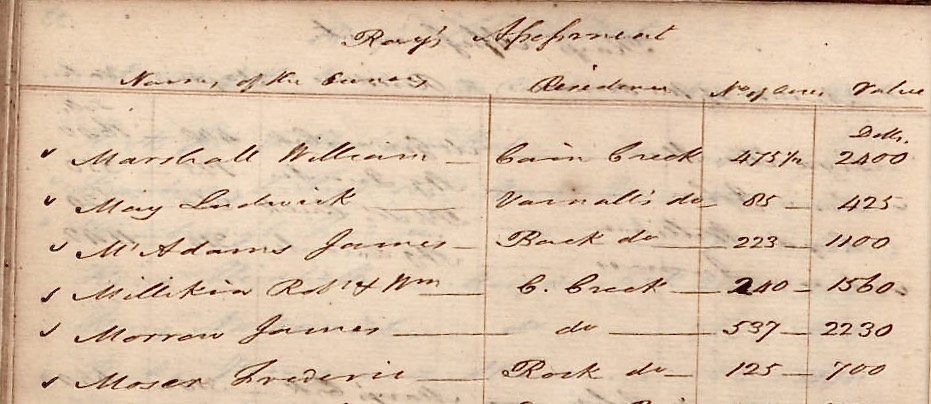
As we ended the last chapter the North Carolina General Assembly at the close of the Revolutionary War had passed Confiscation Acts to confiscate the property of Loyalists. It may be in this way that Frederick MOSER reacquired his lands or gained clear title to them. We have many anomalies in the land records. First is this one where Frederick MOSER grants land back to Henry MCCULOCH “before” he has acquired it.
- Henry MCCULLOCH to Fredrick MOSER, 225 acres, proved by Robert RAINEY. RegLn 2186 Not found 2184 dated 15 Jun 1763
- Fredrick MOSER to Henry Eustice MCCULLOCH, 225 acres near Stinking Quarter Creek. RegLn 2194 proved by Nicholas GIBBS 24 May, 1763
It appears that Henry MCCULOCH grants land to Frederick MOSER after Frederick deeds the same land back to him. If we take the date on MCCLUOCH’s original list we have 225 acres, 24 May 1763 and on the document in my possession, MCCLOUCH makes taxes due as of the 25th. We do not have that the original deed as it was probably in one of the books not recovered from loyalist James MUNRO’s burial of same. Book A is missing. We can hope to piece together his lands from later deeds and documents. Sometimes we must work backwards and forwards simultaneously.
Stinking Quarter Creek takes hits name from a time long ago when many deer died of disease in the winter near the creek. When their carcasses thawed in the Spring the stench was horrible thus “Stinking” . [according to Calvin HINSHAW as told to Lee MOSER recorded on page 210 of Leeland’ MOSER’s MOSER a Family History]
MOSER CONFUSION
- Anthony MOSER, 220 acres, 8 Sep, 1762 (1st cousin to Frederick) This was likely the land his father settled
- Martin LOY, 251 acres, 17 May, 1763; apparently he built a mill on Rock Creek. (Son Nicholas MOSER’s future father in law)
In addition to Frederick MOSER the subject of these blog posts we must reiterate that there was another early MOSER settler. This was Frederick MOSER’s uncle Adam MOSER b 21 Aug 1700 d. abt July 1763 in Orange County. Adam had sons: Anthony MOSER (1735-1827) who bought land in Orange Co 8 Feb 1762 and sold it 26 Jan 1768 and removed to Rowan Co, NC then to Carter Co. TN; Adam MOSER (1743-1826) bought land 25 Apr 1767 on the Rocky River, Chatham Co, NC; Tobias MOSER (1748-1837) in 1818 moved to Indiana, died in Fountain Co, IN and Jacob MOSER (1752-1813) Anderson Co., TN. Since they used the same forenames and end up in some of the same places it is easy to confuse them. It appears however that this MOSER family did not stay long in Orange county.
Orange County Tax Lists
In 1777 the State Legislature of NC passed “An Act for levying a tax by General Assessment and other Purposes,”
which enacted that “a tax of one penny value be levied on each pound value of all the Lands, Lots, Houses, Slaves, Money, Money at Interest, Stock in Trade, Horses and Cattle in this State.” Later these were amended to define as “all Lotts and Lands with their Improvements, Slaves under the age of Sixty Years, Horses, all Cattle from one year old and upward, Money, Money at Interest and Stocks in Trade of every kind wherever the same may be, all Bonds, Notes and other obligations, which bear or include Interest.”
Note: For the purposes of this Chapter generations/ lineages begin with Frederick 1.
1779 Orange County Tax List
Frederick 1 MOSER and his son Jacob 2 listed as MOZAR in 1779 Tax List. Interesting that his value is listed at Ł1898

In 1780 Orange County Tax List there were
- 96 properties under 100 acres 11.6%
- 223 properties 101-200 acres 27%
- 295 properties 201-400 acres 35.7%
- 212 properties over 400 acres 25.7%
- 826 properties over 1000 acres 47%
But a year later the value has gone from Ł1898 to Ł690. Jacob’s seems more reasonable going from Ł462 to Ł510. However, he may have given or sold land in those 10 years.
- Frederick1 MOSER Ł690; inc 240 acres, 4 horses, 10 cows
- Jacob2 MOSER Ł510; inc 200 acres, 3 horses, 4 cows
- Philip2 MOSER Ł558; inc 250 acres, 2 horses, 1 cow
1816 Orange County Tax List
- Frederick2 MOSER Jr. paid taxes on Ł690 in property including 240 acres, 4 horses and 10 cows
- Jacob2 MOSER paid taxes on Ł510 in property including 200 acres , 3 horses and 4 cows
- John2 “Philip” MOSER paid taxes n Ł558, including 250 acres, 2 horses and 1 cow

Orange County Census
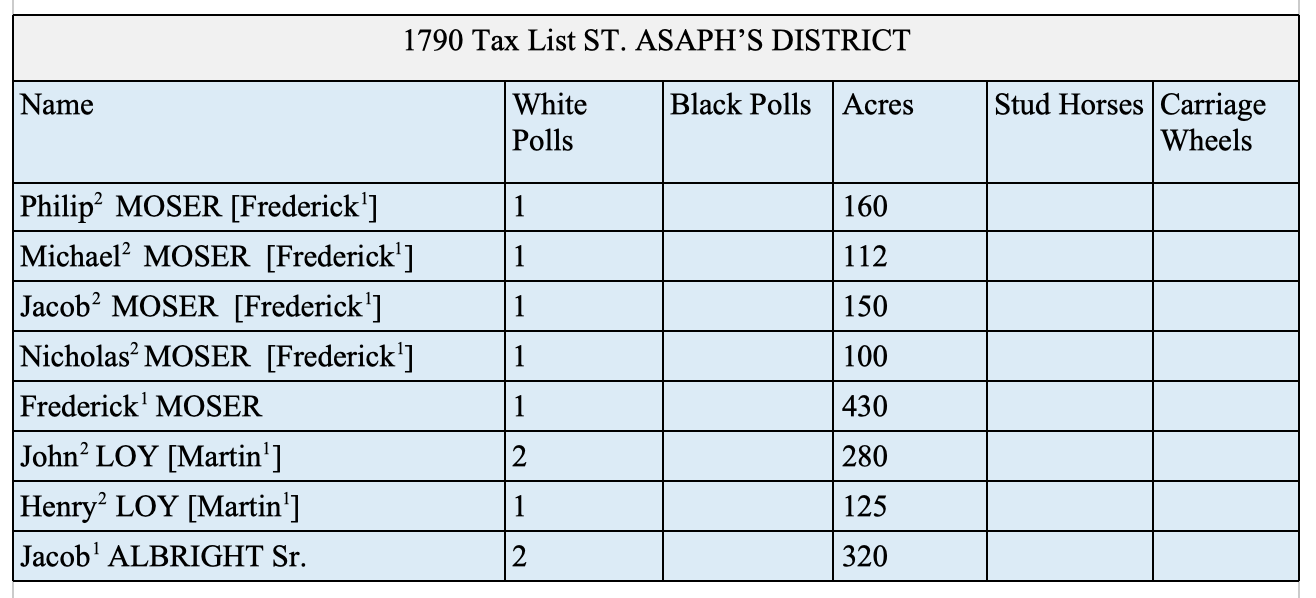
The 1790 Tax list is used as a substitute for the 1790 census. I have included the LOYs and ALBRIGHTs. Jacob ALBRIGHT Sr’s daughter Sophia ALBRIGHT married Henry LOY, son of the immigrant Martin 1 LOY. Both from Berks Co, Pennsylvania. Henry 2 LOY and Sophia (ALBRIGHT) LOY are the parents of Elizabeth 3 LOY who married Frederick’s son, Nicholas 2 MOSER [my 4th great-grandfather].
1800 M260  MOSER         John            M-32 034  581  20110-20010-00
1800 M260  MOSER         Nicholas        M-32 034  522  21010-32010-00
1810 M260 MOSER Fred M-252 041 171 NdRcd
1820 M260  MOSAR         Adam            M-33 082  358  NdRcd
1820 M260  MOSAR         Fred             M-33 082  358  NdRcd
1820 M260  MOSAR         John            M-33 082  358  NdRcd
1820 M260  MOSAR         Mical           M-33 082  358  NdRcd
1830 M260 MOSIER Henry? M-19 123 292 SOUTH DISTRICT
1840 M260  MOSER         Henry           M-704 367  231  SOUTHERN DIVISI
1840 M260  MOSER         Levi           M-704 367  231  SOUTHERN DIVISI
1840 M260  MOSER         Magie           M-704 367  260  SOUTHERN DIVISI
1840 M260  MOSER         Mary            M-704 367  260  SOUTHERN DIVISI
It is clear that Frederick did well for himself owning 430 acres on the 1790 Tax List. Not bad from the 1780 Tax list where he owned 240 acres. Four of his sons owned between 100-160 acres each on the 1790 Tax List . We do not have much information on what life was like then. However it is slightly amusing that the first thing the yound county and states do, is to pass laws regarding taxes.
Where was Frederick’s Property Located?
The simple answer, we don’t know for sure. We know that the original Land grant from MCCULLOCH was for 225 acres near Stinking Quarter Creek. But then we know Frederick relocated to Sandy Creek [waterways are in green on this map] . My best guess is that he owned 225 acres of land in the area of the red dotted circle about 1763. In the 1790 tax list he has 430 acres. So the blue dotted circle encompasses his land on Sandy Creek. I suspect he retained part of the original 225 acres. In 1893 Calvin5 MOSER: of Frederick 1,2,3, Anthony4 lived within the red dotted circle. And T.L.4 MOSER: of Frederick 1,2, Martin3 lived within the blue dotted circle. So for the time being those are my educated guesses.

The following is the Deed from Frederick 1 Sr to Frederick 2 Jr MOSER dated February 21, 1800 from Orange Co. Deed Book 8 pg 343-344 for 220 acres where Frederick 1 Sr now lives. It mentions Malisha FOGELMAN’s corner:


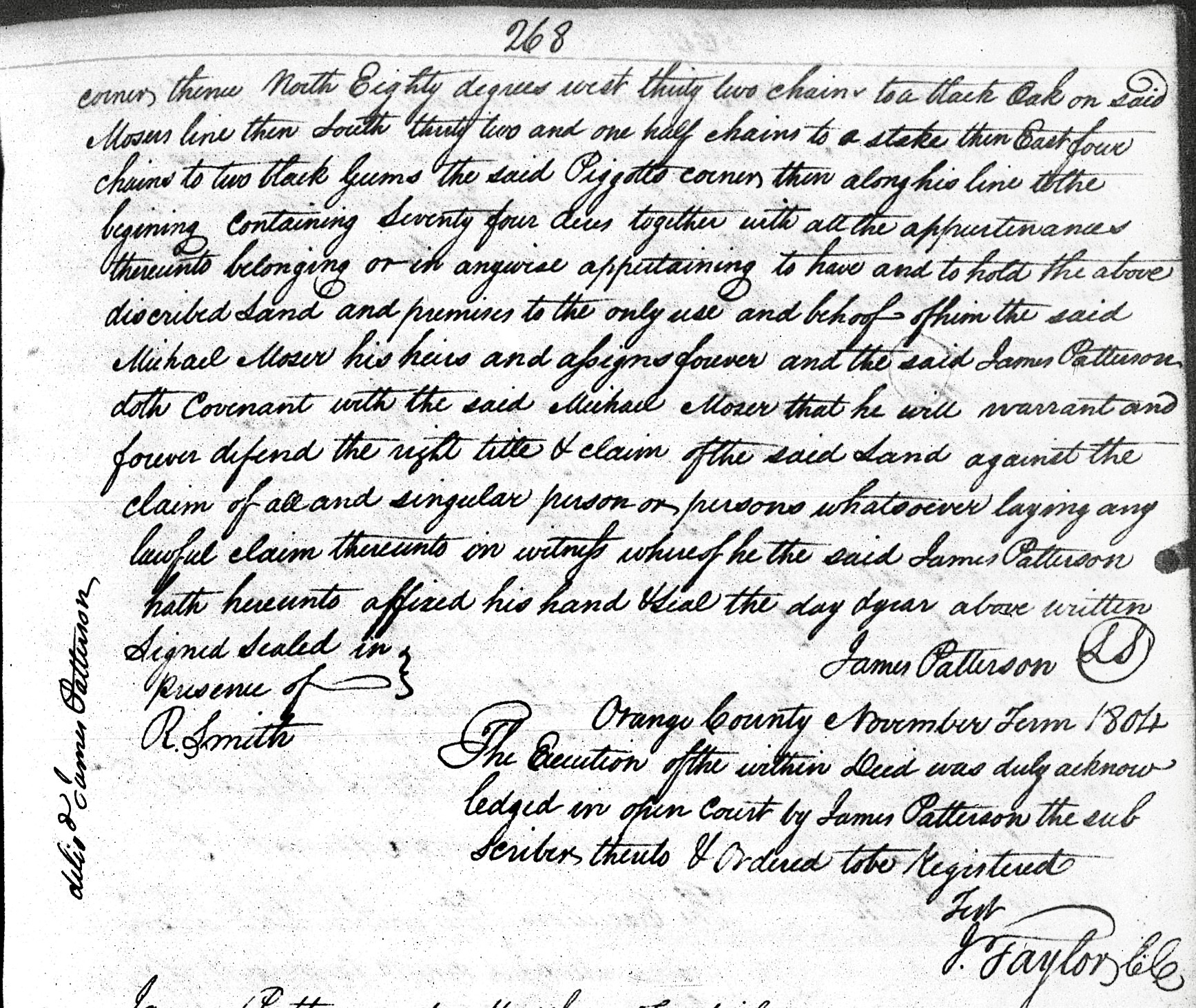
And we get a little more of an idea from this deed of Michael 2 MOSER’s deed of land for 74 acres he bought from James PATTERSON 26 November, 1804, because it mentions this parcel adjoins the lands of Philip 2 MOSER and Frederick 2 MOSER. The land of the latter was that which Frederick Jr received from his father. Also mentions Joshua PIGGOT’s corner

Children of Frederick and Barbary MOSER Born in PA
- Jacob 2 MOSER bc 1751; lived lived in St. Asaph’s District, Orange NC in 1762; 31 December 31, 1779 granted an 136 acres on Stinking Quarter Creek for which he received a grant on November 9, 1784. He sold this land to Henry KIMBROUGH for Ł70, 25 January, 1789. From 1794 to 1801 he paid taxes on 242 acres. He entered 240 acres on the waters of Stinking Quarter Creek on July 18, 1805 and received a grant to it on February 9, 1807; moved to Anderson Co, TN in 1805; may have moved to Clairborne, TN and thence in 1819 to Brown Co., IN
- Catherine “Caty”2 MOSER bc 1753; mc 1773 Powell “Paul” KIMBRO; dc 1807 Orange Co, NC
- Abraham2 MOSER bc 1754; served Rev War from Orange CO, NC; moved to Anderson CO, TN in 1808; d. 22 Oct 1836 Anderson, TN
- Johan “Michael”2 MOSER b 1756; m. 1st Maria Sophia REINHARDT; m. 2nd Mary Magdalene (FOX) MORETZ; d. July 1828 Orange Co., NC; 25 August 1786 Orange Co land grant for 115 acres on Rock Creek (South of Haw River); 26 Nov 1804 granted 2 Dec 1805 30 acres on Stinking Quarter Creek
- Johan “Philip”2 MOSER bc 1758; m. Catherine 1784; 1808-9 he moved to Anderson Co TN then to Floyd Co, IN; d 1840 Jefferson, KY; 4 July 1786 land 112 acres south of Haw River for Ł105, 13 April 1804 150 acres, entered 17 June 1805 Stinking Quarter Creek. To Floyd Co IN
- Georg2 MOSER 1 Jan 1760 died 1760
- twin Maria Barbara “Barbary” MOSER 1 Jan 1760 West Hamburg , Berks Co; m c.1778 Samuel HUFFMAN; she d. c 1799 Burke Co, NC
- Nicholas2 MOSER bpt 8 Aug 1762 Berks Co; m. 9 Mar 1797 Elizabeth LOY; moved 1804 Anderson Co, TN; moved 1808/9 to Madison Co. AL; d. 1821 Madison Co, AL; 9 Mar 1797 land near Stinking Quarter Creek; 4 Jan 1800 sold land 220 acres on Rock Creek
CHILDREN Of Fredrick and Barbary MOSER Born in NC
- “Mary” Ann2 MOSER b 15 Sep 1765; m. c 1784 Frederick Conrad KECK; lived Clairborne Co, TN d. 15 Oct 1851 Union Co. TN [ She is listed as born in PA in some sources-the date would suggest birth in NC ]
- John2 MOSER bc 1766; m. 1792 Sally GARRETT; died 12 Apr 1825 Alamance Co, NC; he bought land 144 acres, 15 Feb 1804 from his brother Frederick Jr. Fredrick Jr inherited the Frederick Sr Lands. John entered 464 acres on the waters of Great Alamance Creek 17 Feb 1815, for which he received a grant 3 Feb 1816.
- Elizabeth2 MOSER bc 1768; m c 1790 Henry SHARP; to Anderson Co, TN in 1802 d 2 Sep 1821 Clairborne Co TN
- Frederick2 MOSER Jr. b 15 April 1771; m. 1795 Mary INGOLD; m. 2nd 1799 Barbara ANTHONY; d 15 Aug 1823 Alamance Co, NC; buried at St Paul’s Lutheran, Alamance.; 2 Feb 1800 his father gave him 225 acres on Stinking Quarter Creek. [144 acres of which he sold to his brother John MOSER for Ł200 27 June 1823]
- Eve2 MOSER 1773; m. Peter SHARP 31 Aug 1795; d. Aug 1829 in Alamance Co, NC
- Magdalena2 MOSER b 1775; m. 1793 Barnabas BUTCHER; lived Anderson Co, TN; d. 1843 Monroe Co, IN
WILL of FREDERICK MOSER SR.
On April 17, 1796, Frederick 1 MOSER made his will, giving his property to his wife Barbary and children. He died 21 Feb 1800 at the age of 78. His will was not proved until May of 1800. Interestingly he left the larger portion of his estate, that is his land and tenements, to his youngest sons John and Fredrick Jr. It may well be that he had already given a significant portion to his eldest sons. Jacob, Michael, Abraham, Philip and Nicholas each received 35 “silver dollars” each (worth about $850 today) and his daughters 12.5 “silver dollars” (about $300 today), staggered over a period of fourteen years, to begin 4 years after Frederick’s death. I suspect this was to keep the estate intact, although I have not seen an estate handled quite this way before.. On February 21, 1800 he gave his son Frederick his 225 acre farm and died shortly thereafter. His estate was probated in May of 1800. Copy below, then transcription. Frederick Signs this Will with his mark. This is consistent with a notation back in Pennsylvania where he signed a petition with his mark.
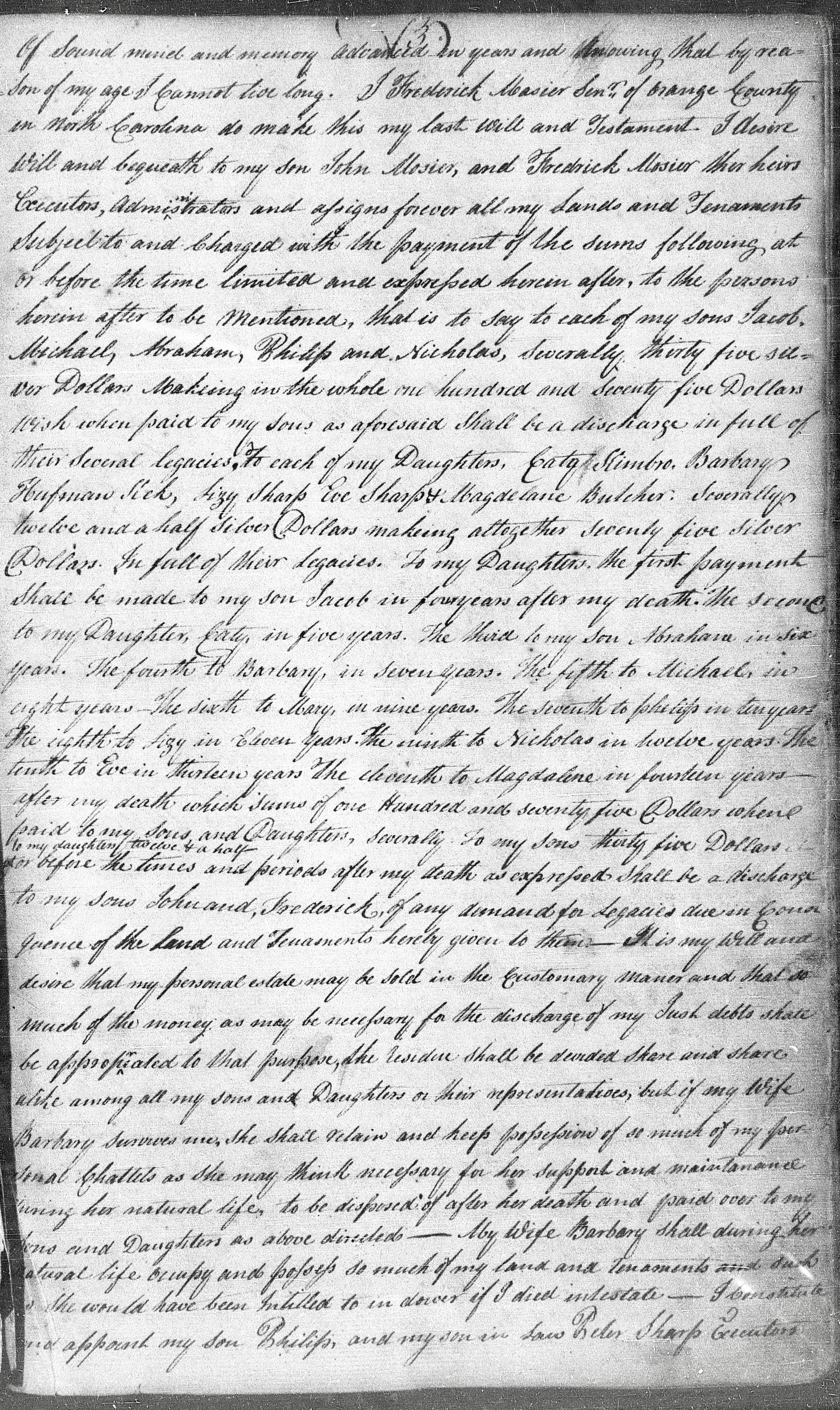

Of sound mind and memory advanced in years and knowing that by reason of my age I cannot live long, I Frederick MOSIER Senr. of Orange County in North Carolina do make this my last will and testament. I desire will and bequeath to my son[sic] John MOSIER, and Frederick MOSIER their heirs, executors, administrators, and assigns forever all my lands and tenements subject to and charged with the payment of the sums following at or before the times limited and expressed herein after, to the persons herein after to be mentioned, that is to say to each of my sons Jacob, Michael, Abraham, Philip and Nicholas, severally, thirty five silver dollars making in the whole one hundred and seventy five dollars which when paid to my sons as aforesaid shall be a discharge in full of their several legacies. To each of my daughters Caty KIMBRO, Barbary HUFMAN KEK[KECK], Lizy SHARP, Eve SHARP & Magdelane BUTCHER, severally, twelve and a half silver dollars, making altogether seventy five silver dollars in full of their legacies to my daughters. The first payment shall be made to my son Jacob in four years after my death. The second to my daughter Caty in five years. The third to my son Abraham in six years. The fourth to Barbary in seven years. The fifth to Michael in eight years. The sixth to Mary in nine years. The seventh to Philip in ten years. The eighth to Lizy in eleven years. The ninth to Nicholas in twelve years. The tenth to Eve in thirteen years. The eleventh to Magdalene in fourteen years after my death, which sum of one hundred and seventy five dollars when paid to my sons and daughters, severally to my sons thirty five dollars, to my daughters twelve and a half at or before the times and periods after my death as expressed shall be a discharge to my sons John and Frederick of any demand for legacies due in consequence of the land and tenements hereby given to them. It is my will and desire that my personal estate may be sold in the customary maner and that so much of the money as may be necessary for the discharge of my just debts shall be appropriated to that purpose, the residue shall be divided share and share alike among all my sons and daughters or their representatives, but if my wife Barbary survives me, she shall retain and keep possession of so much of my personal chattel as she may think necessary for her support and maintenance during her natural life, to be disposed of after her death and paid over to my sons and daughters as above directed. My wife Barbary shall during her natural life occupy and possess so much of my land and tenements and such as she would have been entitled to in dower if I died intestate.
I constitute and appoint my son Philip and my son in law Peter Sharp executors of this my last will and testament. Witness my hand this twenty day of April seventeen hundred ninety six. Frederick MOSIER [mark]
Witnesses Present : Ricd COCHRAN & ??
Orange County, NC Will Book D pg 3-4
We do not know the date of Frederick’s wife Maria “Barbary (LIESER) MOSER’s death. Sometime after 1796 and perhaps before Fredrick’s will was proved. John 2 and Frederick Jr2 received their father’s property at his death. The approximate dates of inheritance of the rest of his children of their “silver dollars.” Daughter Barbary predeceased her father :
Where Fredrick and Barbary MOSER’s Children Moved
In total we know of 14 children of Maria “Barbary” and Frederick MOSER. One died in infancy. 7 surviving sons and 6 daughters. To Tennessee went Jacob, Abraham, Mary, Philip, Lizy, Nicholas and Magdalene MOSER; Philip and Magdalena later went to Floyd Co, IN; and Caty, Michael, Eve, Frederick Jr and John MOSER stayed in Orange Co, (later Alamance Co), and Barbara to Burke Co NC. Even today there are MOSERs in the Alamance. The date following their name: is the year of their inheritance from Frederick’s estate.
- Jacob MOSER: 1804; bc owned land on Stinking Quarter Creek 1779; and sold land in 1789; Moved to Anderson Co, TN on 1805 Tax List
- Caty (MOSER) KIMBRO: 1805 ; Died abt 1807 Alamance NC
- Abraham MOSER: 1806; Rev. War NC Militia Dec 1779; 1782 in Alamance; bought land in Anderson Co TN 1808, on 1805 Tax List d.
- Barbary (MOSER) HUFMAN KECK: 1807; d. Burke Co, NC
- Michael MOSER:1808; bought land in 1786 on Rock Creek; Stayed in Alamance NC; d. July 1828
- Mary(MOSER) KECK: 1809; to Claiborne Co, TN
- Philip MOSER: 1810; Taxed in Orange Co, 1780; bought land in Orange Co 1786; Sold land in Orange Co 1806; 1808-9 moved to Anderson Co TN on 1808 Tax list, to Floyd Co, IN; d 1840
- Lizzy Elizabeth (MOSER) SHARP: 1811; Anderson Co TN Henry SHARP on 1802 & 1805 Tax List
- Nicholas MOSER: 1812; Sold his land in Orange Co 1803; Anderson Co TN on 1805 Tax List
- Eve (MOSER) SHARP 1813; Stayed in Alamance NC
- Magdalene (MOSER) BUTCHER 1814; Anderson Co TN then to Monroe Co, IN
- Frederick Jr MOSER: 1800; 1805 bought Land on Stinking Quarter Creek; Stayed in Alamance NC; d 15 Aug 1839
- John MOSER: 1800; 1814 464 acres Orange Co.; Stayed in Alamance NC; d. 12 Apr 1825 Orange Co
Reflecting back from Frederick MOSER’s birth in the small village of of Breitanu, Bavaria, Germany where his father was a shoemaker to his nearly thirteen weeks, passage across the Atlantic, at the age of six. His settlement at the Faulckner Swamp Church in New Hanover, Berks Co, Pennsylvania. And then his immigration from Pennsylvania down the Great Wagon Road to Orange County North Carolina about 1763 where he lived until his death 37 years later. He survived the Battle of Alamance, the Revolutionary War proper and a period of relative calm in the newly minted country.
With a raft of thirteen children spreading out from what became Alamance County across American “Barbary” and Frederick have many progeny. On AncestryDNA I have 144 matches that share Frederick and Barbary as their ancestors. In 2014 there were 21,900 MOSERs in America and 11,000 MOSIERs. Not all of whom have the same roots, but still a prolific family. At one time descendants claimed they were related and they were.
MOSERS who Stayed in Alamance Co, North Carolina

The following is my best effort at identifying the above.
- Eli5 MOSER Rock Creek; Frederick 1, 2 , Eli 3, John 4; b. 1850 near Graham, d. aft May 1905 Alamance Co, NC
- George4 W MOSER Rock Creek; Frederick 1, John 2,Levi 3; b. 20 Jan 1844 d. 6 July 1903 Alamance Co, NC
- James Adam4 MOSER CURTIS Mill; Frederick 1, 2 , Nimrod 3; b 1852, d 7 Aug 1913 Friendship, Coble Twp. Alamance Co, NC
- J G [John Gaston]4 MOSER LOY’s Shop; Frederick 1,2, William 3, b 1837 d. 1893 Location Shown as Widow MOSER on 1893 Spooner Map
- Thos L [Thaddeous Lucien]4 MOSER Brick Church; Frederick 1,2, Martin3 b 15 Nov 1851, d 19 Aug 1915 Coble Twp, Alamance Co, NC
- William3 MOSER Clover Orchard is this near Snow Camp?; Frederick 1,2; b c 1806 d. 20 Jan 1886 80 years
- William H4 MOSER; Frederick 1, John 2, Levi 3,
MOSERs On the 1893 Spooner Map
Again my effort at identifying those on the map.
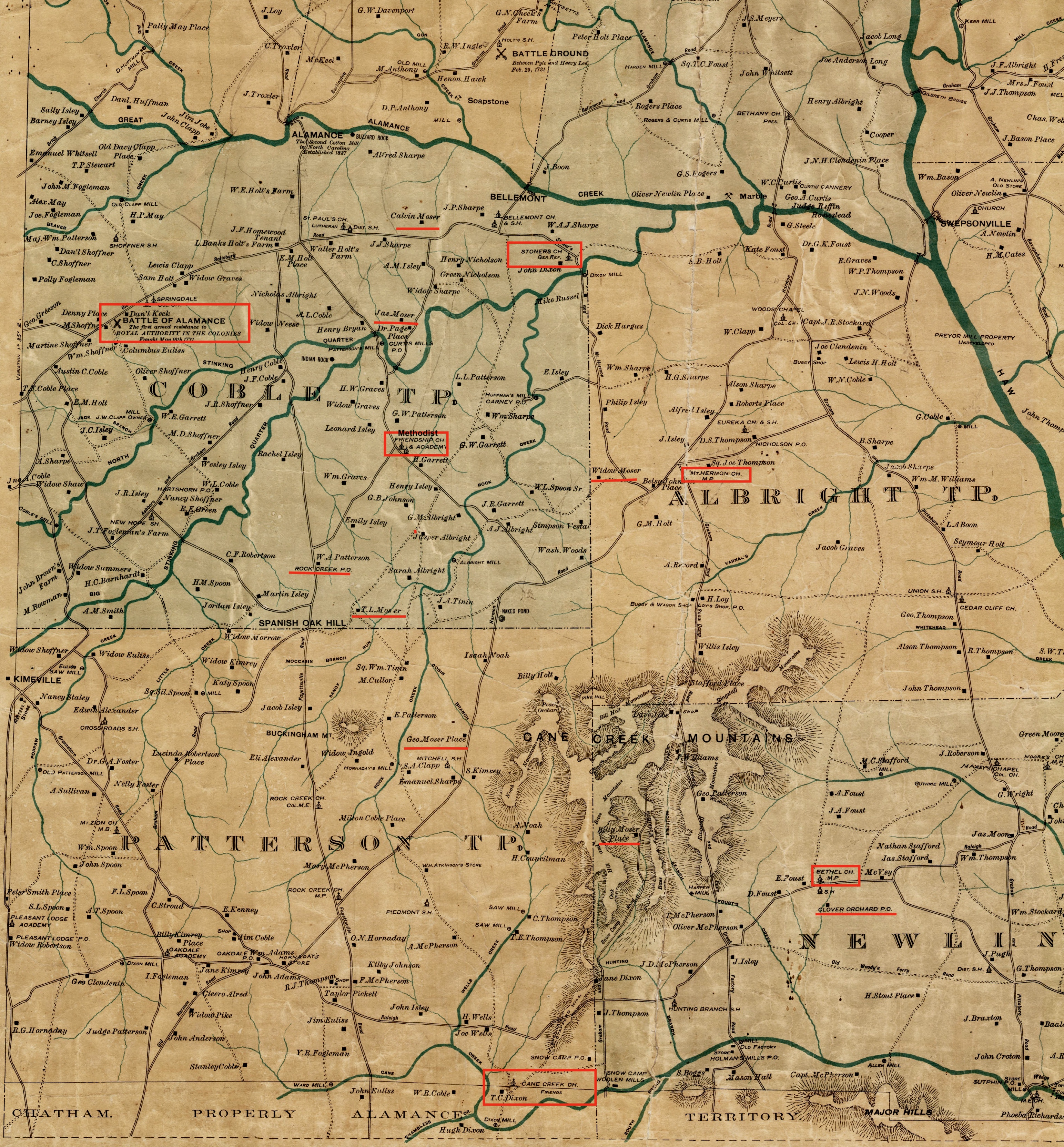
- Calvin F.5 MOSER near St Paul’s Church; Frederick 1,2,3, Anthony4 ; b Mar 1856 d. 3 Jul 1920 Coble Twp, Alamanace Co, NC
- James Adam 4 MOSER CURTIS Mills; as above.
- Billy MOSER Cane Creek Mountains; ?
- Widow MOSER LOY’S Shop on map; wife of J G [John Gaston]4 MOSER above
- Thos L [Thaddeous Lucien]4 MOSER on map near Friendship Academy; as above
- George W.4 MOSER near Rock Creek on map; Frederick 1, John 2, Levi 3 ; b 20 Jan 1844 d. 6 Jul 1903 Alamance Co., NC
This concludes the North Carolina Chapter of the Frederick 1 MOSER family. In the next blog post I will take up the MOSERs who immigrated from Alamance to Anderson CO., TN with an emphasis on Nicholas.
Kelly Wheaton ©2024 – All Rights Reserved
German Immigrants to North Carolina: Pioneer Georg “Frederick” MOSER (1722-1800) Part Two
Posted on January 29, 2024 Leave a Comment
TROUBLE IN ORANGE COUNTY

While we read in the last post that settlers were lured to North Carolina with advertisements of inexpensive land and no taxes, the speculators had other ideas. The settlers came, cleared the land and made improvements: cabins, fences, pastures and fruit orchards. They raised rye, barley, oats, hemp and flax as well as herbs and vegetables. They raised livestock such as hogs, sheep, fowl, cattle and horses. They supplemented their diet with game they could hunt and often sold pelts for extra income.
These were settlers in a 60 mile wide area of land that the King had granted Lord GRANVILLE but then in 1737 Henry Eustace MCCULOCH, through proxies, received a deed for 1.2 million acres. The problem was that some of the lands overlapped and there was no clear title. The lands that Frederick MOSER and his fellow settlers in Orange County fell into MCCLOUGH track 11. It was a twelve and a half mile square rotated to appear as a diamond shape. It encompassed much of what was then Orange County but is now Alamance and Guilford counties. When GRANVILLE died in January of 1763 the matter of clear titles had not been settled and there was nothing to keep the unscrupulous from backdating contracts or worse.
Henry MCCULOCH, when he turned over the unsold lands in the GRANVILLE Tract , listed all that his father had sold. The earliest was dated 20 Sep 1757, to George CLAPP. The last 7 were sold to himself between April and June of 1763. The following are of note:
- 21. Anthony MOSER, 220 acres, 8 Sep, 1762 [first cousin to Frederick]
- 57. Malachy ISLEY, 200 acres, 14 Sep 1762 [brother of Ludowick Isley]
- 58. Ludowick ISLEY, 257 acres, 14 Sep 1762
- 77. Martin LOY, 251 acres 17 May 1763, he built a mill on Rock Creek
- 85. Frederick MOSER, 225 acres, 24 May 1763
- 93. Ludowick ALBRIGHT, 258 acres, 1 June 1763
MCCULOCH made his money by trying to sell the land back to the same farmers who had toiled to improve it. These were families that paid for land patents that did not materialize or were claimed to have been handled improperly. It was the work of the settlers who gave the land its value that now MCCULOCH wanted to sell back to them. The German farmers in the Piedmont settled near streams or rivers where they could successfully farm. As they cleared more land they increased the size of their farms. They lived in one room log cabins perhaps with a loft. Later cabins may have been made of stone or clad with wood siding.
“The trouble began to arise between GRANVILLE’s agents and the early settlers. It was said that the title to their land was not good… [Agents] contrived by villainous means to extort money from those who had already paid for their lands. One of them being a lawyer, pretended to find a fault or defect in the other’s patent, which had been signed simply ‘ GRANVILLE’ by his attorneys, saying that it ought to have been by ”the right honorable earl GRANVILLE, by his attorneys,’ etc. GRANVILLE lived too far away to set the matter right. So patents were to be taken out a second time. They doubled the fee and contrived a device which they fixed to a warrant of survey, without authority, for which they charged six dollars.” STOCKFORD pg 49
MCCULOCH cannily made alliances with government officials and even cut them in on the action. The FROHOCK brothers: John, Thomas and William took up positions as commissioners, clerks and land surveyors. Thomas FROHOCK was the son-in-law of Henry McCULLOCH’s cousin, Alexander MCCULLOCH. One final member of the extortion ring was Edmund FANNING who positioned himself as assemblyman for Orange county as well as public registrar for Hillsborough and a militia officer. So the fix was in.
It wasn’t just the German settlers who had been lured or who were caught up in the scheme. Many Scots, Irish, Swiss were early settlers who now realized they were being taken advantage of. And it wasn’t just land transactions it was also fees for marriage licenses and other legal matters that were set beyond the settlers ability to pay. From Walter WHITAKER’s Centennial History of Alamance County 1849-1949 no copyright.
Henry MCCULOCH required settlers to pay twice the price, interest and an agreement not to fight him in court. Either way MCCULOCH made out like a bandit. He appointed Edmund FANNING and John and Thomas FROHOCK to collect debts, fees and monies or claim the settlers forfeited lands. Money was scarce and many settlers would have had no way to pay in the 1760’s and 1770’s.
“In the year 1766, Governor TRYON, escorted by 100 troops and servants, led a 17-day expedition into western North Carolina to run a boundary between the colony and the Cherokee nation. The trip cost taxpayers 15,000 pounds sterling — $75,000. In November of the same year the General Assembly ratified a proposal to tax the colonists 20,000 pounds to build a new palace for the Governor at New Bern. Such government extended into Orange County also. The county clerk charged 15 pounds — $75 — for a marriage license. Tax collectors frequently took a farmer’s horse from the plow to satisfy exorbitant taxes.” WHITAKER pg 47
The Governor of North Carolina, William TYRON and his council ordered the 17th of April 1765 that MCCULOCH “desist from any Steps in Law to dispossess these People,” meaning the farmers of their property. Matters reached a head on the 7th of May also in 1765 when MCCULOCH and his surveyors including John FROHOCK were badly beaten while attempting to survey lands belonging to a widow of the ALEXANDER clan.
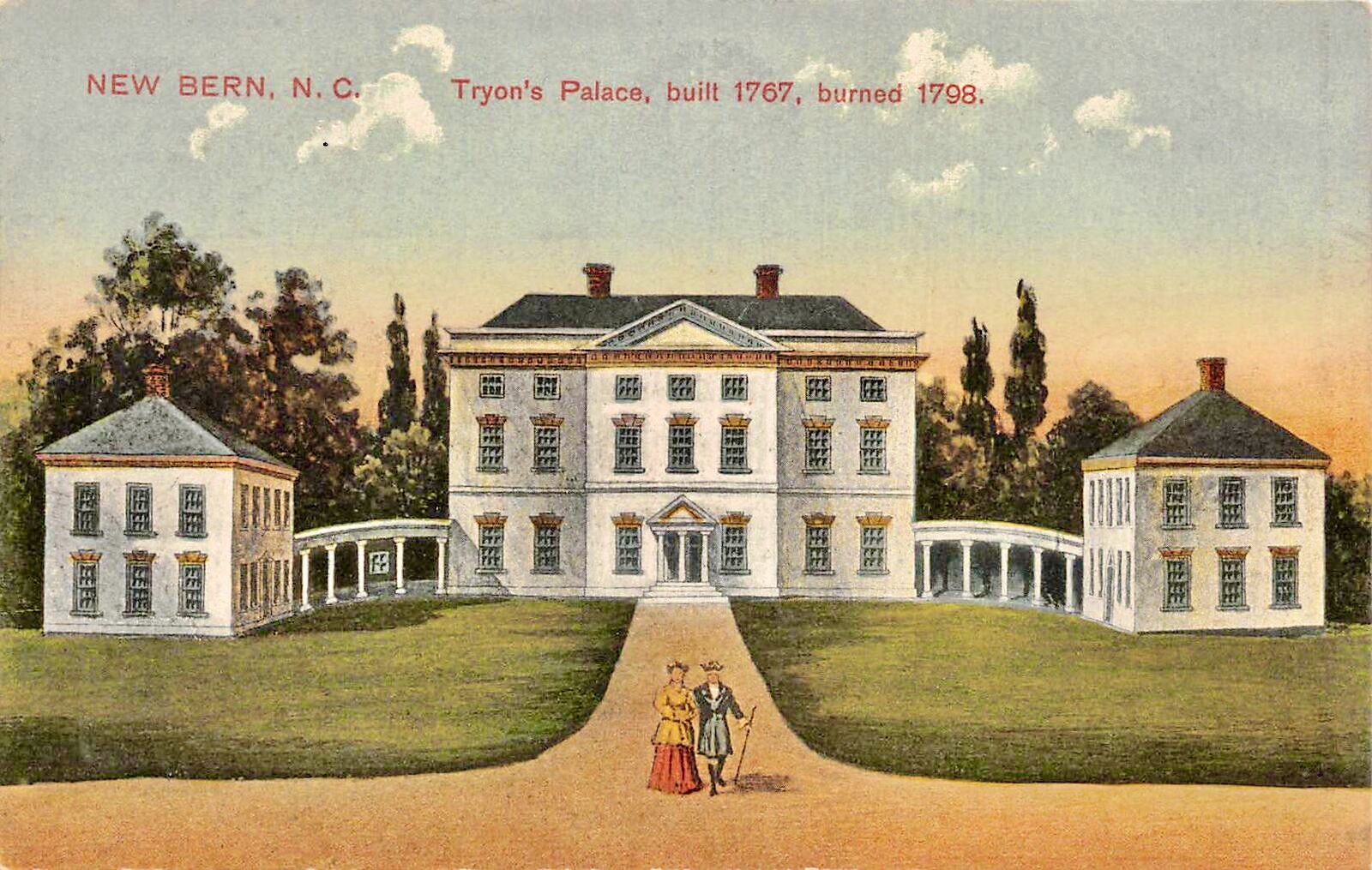
The gentry were getting rich, the taxpayers were getting squeezed by new taxes to pay for Governor TRYON’s Palace built in 1767 and viewed with great distaste by the poor farmers of the area.
“On October 10, 1766, a number of men entered a session of Inferior Court at Hillsborough and requested the clerk to read a petition written by Herman HUSBAND [Prominent Quaker and outspoken representative of the farmers]. The petition called for a meeting of county officials and citizens “judiciously to inquire whether the free men of this county labor under any power of abuse . , . and in particular to examine into the public tax and inform themselves of every particular thereof, by what laws and for what use it is laid…
Husband, however, worded his “advertisement” in vague terms, and the court complied with his proposal and set a meeting for October 10 at MADDOCK’s Mill, two or three miles west of Hillsborough, “a suitable place where there is no liquor.” On the appointed day the hopeful planters left their unharvested crops and rode to the mill. After waiting several hours they sent a millboy into Hillsborough to see why no officials had appeared, and late in the afternoon a lone horseman arrived at the mill. Colonel Edmund FANNING and Thomas LLOYD, the Orange County delegates to the General Assembly, had intended to come, said the rider — but Colonel FANNING noticed the word “judiciously” in HUSBAND’s petition. Since the men gathered at MADDOCK’s Mill had no judicial authority, it seemed obvious that they were insurrectionists, and the delegates refused to meet with them. Unsuccessful and dissatisfied, the farmers broke up their meeting and returned to their homes. Their grievances, however, had become stronger.During the following spring further action developed.” WHITAKER pg 47-48
Adam MOSER, Frederick’s nephew was among the signers of a Regulator petition to Governor TRYON seeking relief from excess fees.
THE REGULATORS
The Regulator movement was born out of necessity. From the book the The Regulators of North Carolina (1765-1771) by John Spencer BASSETT
Another very prominent grievance [of the Regulators] was the dishonesty of the sheriffs, who failed to pay into the hands of the public treasury the money they had collected. The public accounts were most inefficiently kept. There was a prevalent opinion among all classes that there was fraud just here. In 1767 Governor TRYON declared it as his opinion that “the sheriffs have embezzled more than one-half of the public money ordered to be raised and collected by them.” BASSETT Pg 152
Extortionate fees was perhaps the greatest grievance of all. Nearly all the officers were paid in fees. The people of the back counties complained heavily of their officers, and in support of their complaint the Orange County Regulators produced affidavits sufficient to satisfy the most skeptical that they were right. As soon as counties were organized on the frontier sheriffs, clerks, registers, and lawyers swooped down upon the defenseless inhabitants like wolves. BASSETT Pg 153
“On March 22, 1767, several hundred Orange County citizens met at Sandy Creek to discuss the situation. The courthouse ring refused to deal with them; the governor would not answer their petitions; it was time for action. Finally they agreed to organize. Things proceeded slowly but by 1770 things were getting heated “When Judge Richard HENDERSON opened the fall term of court for Orange County on September 24, 1770, the Regulators were present in great force…Hardly was the session underway before a mysterious letter written by James Hunter appeared accusing Husband of promoting the Orange County riots. As a result Husband was dismissed from the Assembly and placed under arrest in the New Bern jail. A grand jury found him not guilty, and again he was released. ” WHITAKER pg 54-56
Note the date above September 24, 1770. Note the name Edmund FANNING. [See his portrait above] So back in February of 2016 I randomly decided to do a search on Ebay for “writ” & “MOSER” and bingo I hit genealogical gold! For sale was a document dated 1770 titled “Orange County NC Writ for Frederick MOSLER Owing Henry MCCULLOCH 46 pounds.” It cost me $11! It was actually for Frederick MOSER written MOSUR.

This original document is signed by Thomas FROHOCK. He was appointed the clerk of Superior court : “Whereas Thomas FROHOCK hath Received an Appointment from the Honourable Martin Howard Esquire Chief Justice of the province aforesaid dated the Fifteenth day of December 1768 thereby constituting and Appointing him the said Thomas FROHOCK Clerk of the Superior Court for the District of Salisbury“
And on the reverse it is signed by E. [Edmund] FANNING. Interestingly the first date Sept 1769 is crossed out and the March date of 1770 is substituted. I looked through the Superior Court records and did not find the corresponding case. I did find Martin HOWARD Esq Chief Justice at Salisbury present on September 6th 1770 but not on September 5th. it is not clear to me that these cases were ever heard in court. The German settlers were at a decided disadvantage as many were not fluent in English. The date of the original land transaction as it appears in MCCULOCH’s records is May 24th 1763 and on the above document from May 25th 1763 so I believe this is his original purchase. Here is the Transcription:
“North Carolina
George the third by the grace of God King Etc.
To the sheriff of Orange County Greeting Whereas In a Judgement in Reasoned Lobby in Our Superior Court of Justice held for the district of Salisbury at the court House in Salisbury by Henry Eustace MCCULLOCH against Frederick MOSIER for the Sum of Forty Six pounds Proviso and Intent from 25 day of May 1763 we find for his Debt also the sum of Four pounds three shillings and four pence for his cost by him about his such Expended .__ .___
You the said Sheriff Z?lumo On the Writ of Feri Facias to you District executed on S..dry. And Motion of the Plantiffe Attorney it was so by our hand ordered that a writ of Vandickson? v Expon? Issue whereby the said goods may be sold to answer the Judgement and Costs aforesaid. We remmand you therefore that Expon? The said goods to Sale according to Law and the money arising therefrom you are to return to Our Supt Superior Court of Justice to be held for the district aforesaid at the Court House Afsd on the Fifth day of March Sep —— Next When and then to Render onto the said Henry Eustace MCCULOOCH his debt and costs aforesaid. Witness Martin Howard Esquire Chief Justice of Our said Province at Salisbury the Fifth day of
SeptemberMarch in this viiiix Year of Our– Reign AD17691770Thomas FROHOCK”
Even more interesting perhaps is the second sheet that shows the charges. They include Entering and Docketing action and order rule and order thereon and serving papers; Entering Each Attorney on the Docket 7d, Entering Plaintiff and defendants Appearance and Testimony Defendant and Default et cetera in the amount of Ł8.16s.9d in interest and fees. In 1770 pounds this would be equivalent to: 2 horses, 3 cows, 39 Sheep, 11 stone of wheat and 183 hours of skilled labor. Or $2,000 in today’s dollars. This is what was meant by Exorbitant fees.

So we have first hand evidence of the actions that lead to the revolt of the farmers and the formation of the Regulators. And we can place Frederick MOSER in the thick of it. In “A sketch of the life and character of the Rev. David Caldwell, D. D by Eli Washington CARUTHERS in 1842 pg 114 he writes “It was said that he [Thomas FROHOCK] charged $15 for a marriage license; and the consequence was that some of the inhabitants on the head waters of the Yadkin took a short cut. They took each other for better or for worse ; and considered themselves as married without any further ceremony.”
“The General Assembly was reaching adjournment in late January, 1771, when word reached Governor TRYON that a large force of Regulators had gathered at Cross Creek (now Fayetteville), intent on burning the governor’s new palace. Once more, however, the Regulators dispersed when they learned of Husband’s freedom. Once more bloodshed was narrowly averted. The fuse was burning shorter now. Thousands had joined the Regulators. Many of them were law-abiding people who abhorred mob violence and who had no part in the disreputable rioting. Yet they and their forefathers had fought oppression for centuries. They had come to a new land with a new dream — the dream that here there was justice for all. For this dream they were willing to fight and to die.” WHITAKER pg 56

THE BATTLE OF ALAMANCE

Things finally came to a head on May 14, 1771, Governor TRYON and his militia were camped on the banks of Great Alamance Creek, with a force of 2,000 troops. They marched about 10 miles, likely crossing the lands of Frederick MOSER until they reached where the Regulators were gathered, about 2.5 miles west of Frederick’s farm. About 6,000 men, mostly farmer, came in hopes of making a statement. Instead Governor TRYON on May 16th came prepared to put down any rebellion. The Regulators were mostly unarmed and unorganized. In the end 9 members of the militia were killed and 61 were wounded. 10-15 members of the Regulators were killed and between 100 and 150 were wounded in what is known as the Battle of Alamance. Governor Tryon took 15 prisoners, 6 of whom were hanged at the Hillsborough Courthouse. Some believe this was the opening battle of the Revolution. Others believe it was simply a peasant’s revolt. It certainly was an important event in what led up to the Revolution. At the time the citizen’s were seeking relief from their government rather than over throwing it. The effect of this insurrection on breeding the impetus to seek revolution cannot be underestimated.
“On May 16, 1771 Governor TRYON met about two thousand Regulators on the plains of Alamance. Then was the first blood shed for freedom on American soil ; that was the first open resistance against the oppression of King George’s rule. The battle of Alamance, N. C, and not the battle of Lexington, Mass., was the beginning of the Revolutionary war. It was a fight against the primal cause of the war for American Independence.” STOCKARD pg 11
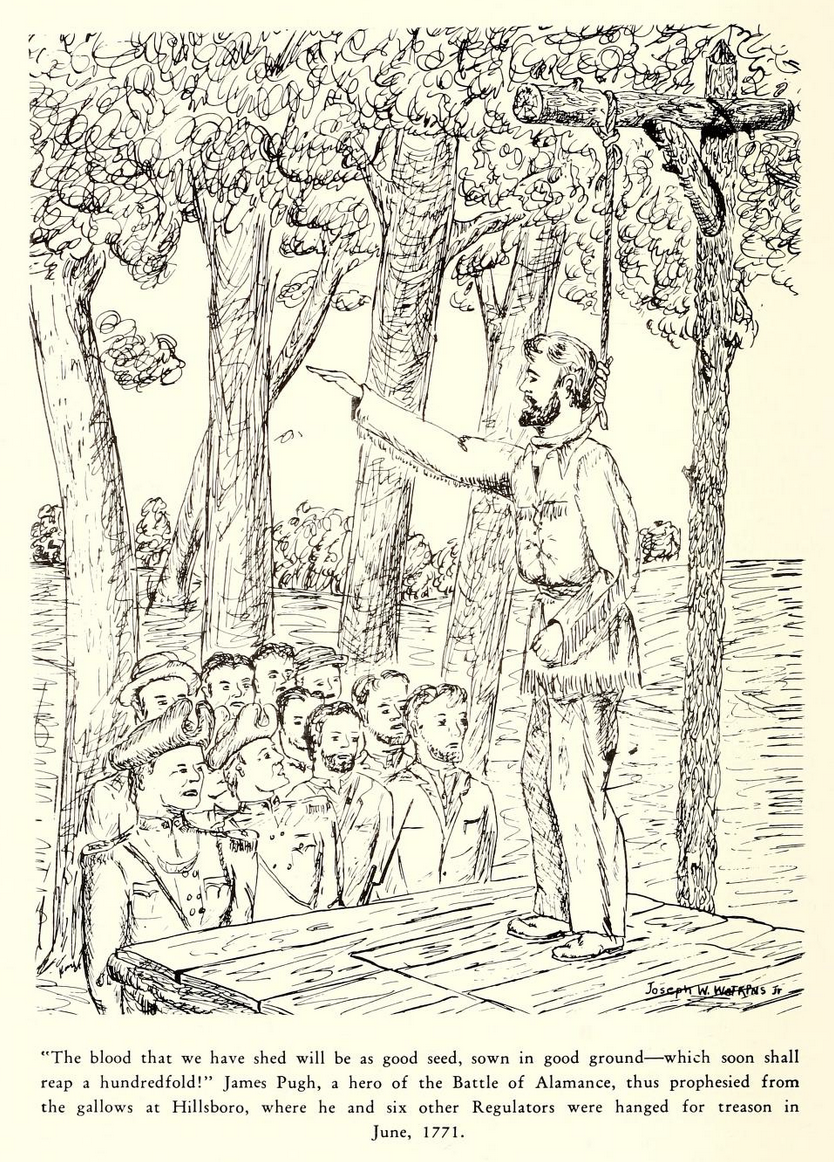
” The blood that we have shed will be as good seed, sown in good ground—which soon shall reap a hundredfold.”
James Pugh, A Regulator at the gallows
A contemporary article in the Pennsylvania looks on the Battle at Alamance with scorn for the Regulators. This is the opening paragraph:

The following document from the North Carolina is a proclamation by Governor TRYON dated the day after the Battle of Alamance, giving amnesty to those Regulators who will take an oath of allegiance.


“Though some took the test oath becoming loyal to King George, some took it and remained neutral; more took it refraining themselves from fighting, but making up for it in helping others, as did old Mr. MOSER, on the Great Alamance, who encouraged his six or seven sons to be ” Whigs of the Revolution.” Some of the Regulators who had sworn to TRYON took Dr. CALDWELL’s advice and considered their oath a broken contract.” STOCKARD pg 75
We get a slightly different version in this account from the Church Records of Reverend D.I. Offman, Lutheran Minister from Part 19 MOSER Family Records 1974:
“Tradition says that when Gov TRYON took the oath of allegiance of those who participated in the battle of Alamance, Mr. MOSER was of that number. His sons were not old enough [Jacob the oldest was about 19] to be in the battle consequently the oath was not administered to them. When [the Rev.] War broke out the boys sided with the patriots, but the old man kept his oath. Someone reported to the authorities that he was aiding and abetting the American cause. Soldiers were sent to arrest him. When he saw them he ran into his house and escaped out the back side into a thicket. The soldiers not knowing this when they could not find him fired the house to be sure of his death. After they left he came from his hiding place and said, that politically he was dead, and he assisted the American cause ever after.” OFFMAN
Like the rest of the colonies the years from 1775 onward through the Revolutionary War were tumultuous. The Orange County Militia was founded the 9th of September 1775 and its last skirmish occurred at Deep River 11th of February 1782. Close by, the Battle of Hillsborough occurred the 12th of September 1781. The patriots under Governor Thomas BURKE lost 15 killed, 20 wounded and 2000 captured by the Loyalists under Colonel David FANNING, who had but 1 soldier injured. So the back-country of Orange County remained an unsafe place. Based on the above two quotes it would appear that while Fredrick tried to thread the needle he like so many others, eventually had to choose a side. How he and his sons helped in the war effort for the patriots remains a mystery. Whether supplying horses, food or a place to hide the two quotes suggest they were involved.
In early 1781, General Charles CORNWALLIS occupied Hillsborough re-imposing loyalist control of Orange County. Before long, CORNWALLIS and his army moved out, and as he left the Loyalists knew that the Revolutionaries would take back control. From “Early Settlers in the North Carolina Piedmont on Land Sold by Henry McCulloh within Granville’s District, 1749-1763” by John Scott DAVENPORT’s (NCGenSoc Journal), #4, 1978
RECORDS BURIED!!! Loyalist James MUNRO, later stated in an affidavit that “when Lord Cornwallis gave sudden and unexpected orders for the movement of the army from Hillsborough,” he decided to seize, “the Records of the County with intention to hold them, in order to strengthen the influence of government until the contest should be decided.” “I had all the records above mentioned privately buried underground in the woods along with my own bonds, books, and most valuable papers, with strict directions not to touch them until I should return; consequently they were suffered to remain in that situation so long, that when they were taken up, many of the books were found quite destroyed, and almost all my own papers rendered entirely useless.” Of the several deed books which Munro buried, only one was salvaged, a book that was at that time known as Orange County Deed Book B and has since been renumbered Orange County Deed Book 1. Though there were thousands of real estate transactions in Orange County between its formation in 1752 and this incident in 1781, only a small fraction remain well documented in Orange County Deed Book 1.” DAVENPORT
After the War the North Carolina General Assembly from 1776 through the 1780s passed the Confiscation Acts to confiscate the property of Loyalists. Part punishment but also to gain control and obtain income for the state. The confiscated real estate netted North Carolina about £600,000. It may be in this way that Frederick MOSER reacquired his lands or gained clear title to them.
In our next post we will examine where exactly Frederick lived and the closing chapters of his life.
Kelly Wheaton ©2024 - All rights Reserved.
German Immigrants to North Carolina: Pioneer Georg “Frederick” MOSER (1722-1800) Part One
Posted on January 25, 2024 Leave a Comment
The Lure of Cheap Land
Notices like the one below appeared in Pennsylvania newspapers. One might ask why did the MOSER’s move from Pennsylvania to North Carolina?

“Lands are so very cheap,” one Carolina resident wrote, “that . . . Six Hundred and Forty Acres . . . will cost three or four pounds Sterling . . . free from all Taxes. [A lie] Centennial History of Alamance County 1849 – 1949 by Walter Whitaker.
Frederick MOSER had paid Ł15 10s for his 100 acre property in Linn Township, Pennsylvania in 1749. In 1750 in the Granville District of North Carolina was offering 100 acres at three to five shillings [20 shillings per British pound]. In 1762 in Linn Township Tax List we find Henry SHARP, Frederick LIESER and Michael ALBRECHT but not Frederick MOSER all would arrive in Orange County, North Carolina about the same time. Perhpas in 1762 Frederick had already traveled to Orange County, [now Alamance] North Carolina and then assuming a starting date in the spring of 1763 the MOSER Family was to tread a well worn trail to North Carolina. The family comprised of parents, Frederick and Barbara MOSER and their 6 children ranging in age from less than a year old Nicholas MOSER to the eldest 12 year old Jacob MOSER.
“Leaving his family behind with friends, the early pioneer set out from Pennsylvania on horseback to seek a new home…With good weather, the Pennsylvanian reached North Carolina in less than one month….He crossed the beautiful Cumberland and Shenandoah Valleys in early spring. After selecting the tract he liked best, the pioneer sent for the land agent who held a patent or title to the property. The tract was surveyed and arrangements were made for a deed to be ready when the new owner returned with his family in autumn. WHITAKER pg 15-16
“By this time word had spread through the countryside, and a group of “neighbors” left their homes miles away and came to help the new settler clear his fields, plant his crops, build his fences and raise his log home. The frontiersman was usually glad that a new family had come to make their home in the wilderness, bringing news of the outside world and offering a helping hand for the tasks which one family could not do alone. When the cabin was completed, the new settler left its care to these “neighbors” and climbed into his saddle for the journey northward.” WHITAKER pg 16
Repeating his immigration with his parents from Bavaria to Pennsylvania, was Frederick lured by cheap lands and maybe a bit of adventure? As chronicled below there was much to put in order before leaving. Did he remember leaving Bavaria? Below is a plate from Eastern Pennsylvania dated 1762. Maybe a treasured dish such as this was among the MOSER’s possession as they traveled from Pennsylvania to North Carolina.

“In Pennsylvania many things had to be done in preparation for the trek to Carolina. The family sold everything they could not carry with them, and purchased three or four strong horses, or perhaps two yoke of oxen, and a heavy but commodious wagon. Into the wagon went every available article for the farm and home, leaving just enough space for the women and small children and the family bedding. Behind the wagon a milch cow or two was tethered to the axle. The elder children would drive a small flock of sheep and a few hogs. All of these things were necessities, for there was no room for the luxuries which the family had possessed. When all preparations were completed, the departing family gathered for a last time in the village meeting house to receive the best wishes and the prayers of those whom they were leaving — some perhaps forever. Finally the journey got underway. Ahead lay 400 miles of little-traveled territory, presenting frequent difficulties and dangers. Slowly the big wagon creaked along the trail, rocking the pioneer mother who sat beside her husband on the broad wagon seat, cradling a baby in her arms and dreaming of her new home. Behind the wagon the children walked, laughing and shouting and telling each other what they would do in Carolina.” WHITAKER pg 16-17

They traveled the Great Wagon Road from Pennsylvania southward through the Shenandoah Valley through Virginia to the Carolinas, along the east side of the Blue Ridge Mountains and south into the Piedmont region, it passed through the present-day North Carolina towns of Winston-Salem, Salisbury, and Charlotte, and sites of earlier Indian settlements on the historic Indian Trading Path.

ARRIVING IN THE PIEDMONT

A rudimentary log cabin such as this may have been the MOSER’s first home in North Carolina. Whether it was built in 1762 before the rest of the family arrived or in 1763 we do not know.

“Three distinct groups led the movement and established colonies in the area which became Alamance County. To the Cane Creek section, near the present village of Snow Camp, came a group of Pennsylvania Quakers; east and north of the Haw River settled Scotch-Irish Presbyterians; and along the western boundary of Alamance Creek a large number of Lutheran and Reformed settlers found new homes. Most of them were agriculturists, and few villages were built. Along the Alamance were the ALBRIGHTs, HOLTs, SCHOFFNERs, MOSERs, ISLEYs, KIMEs, … and other Germanic folk.” WHITAKER Pg14-15
Among the following, mostly German speaking folks, were naturalized in the Superior Court at Salisbury, Rowan Co, NC. Many of them were residents of the western part of Orange County. Perhaps Salisbury was more convenient than Hillsborough, Orange Co. There was probably less of a language barrier. A typed abstract of the minutes in the Rowan Public Library in Salisbury. SUPERIOR COURT MINUTES page 598 – 22 Sept. 1763 – Natives of Germany Naturalized. Among others: Adam MOSER, and Malekiah ISELY. [Frederick MOSER is not listed.]
Meanwhile we learn from Sally STOCKFORD’s The History of Alamance 1900 that all was not well in paradise. The lands that lured them to Orange County were not without issues.
“In 1744 the Earl GRANVILLE granted, bargained and sold, for and in consideration of covenants, provisions and agreements by Benjamin Martin that parcel of land lying in the Parish of St. Mathew of the County of Orange in North Carolina on the west side of Haw River and on both sides of Cane creek, 600 acres of land with the exception of the gold and silver mines found there, at the rate of 3 shillings sterling per hundred acres per year or four shillings Proclamation money at or upon the two most usual feast days — the feast of the Blessed Virgin Mary and St. Michael, the Arch Angel. GRANVILLE, [seal] By Francis CORBIN, Registered by Jas. WATSON, Clerk of Court.” STOCKFORD pg 46
When Henry E. MCCULLOH surrendered to Granville’s estate the unsold lands in McCulloh’s Great Tract #11, he listed out all of the parties to whom his father Henry MCCULLOH had sold land in Tract 11. I have included the ISLEYs and ALBRIGHTs as they were with him in Berks co, Pennsylvania and Malachai ISLEY and Frederick MOSER are credited with starting the St. Paul’s Lutheran Church in Alamance. This list of purchases, [ Great thanks to Mark CHILTON for all his work on the Blog “Wandering Through the Piedmont” in chronological order], includes:
- Anthony MOSER, 220 acres, 8 Sep, 1762 Henry MCCULLOCH , proved by Robert RAINEY. [Son of Frederick’s Uncle Johan Adam MOSER–so his cousin] Anthony’s father Adam MOSER– died after 4 Aug 1763 but before Nov 1763 [Orange County Will Books A/25 Will of Adam MOSER dated 4 Aug 1763]
- Malachy ISLEY, 200 acres, 14 Sep, 1762; ODB4/194 ISLEY to Phillip FOUST to John ALBRIGHT; Daniel MAY’s Corner; Joseph BOGG’s line; GREESON’s Corner.
- Ludowick ISLEY, 257 acres, 14 Sep, 1762
- Henry Eustice McCulloh to Lodewick ALBRIGHT, 325 acres, proved by Robert RAINEY. RegLn 1095
- Henry Eustice MCCULLOCH to Martin LOY, 347 acres, proved by Robert RAINEY .RegLn 1103
- Henry Eustice McCulloh to James ALBRIGHT, 215 acres, proved by Robert Rainey. RegLn 1148
- Malachi ISLEY to Phillip FOUST, 200 acres, proved by John Oliver. Not found, but see ODB 4/194 Philip FOUST & Catherine FOUST to John ALBRIGHT, 3 Mar 1788, 200 acres adj Daniel May, Joseph Boggs, Greeson – Henry MCCULLOCH to Malachi ISLEY 14 Sep ?, Malachi ISLEY & wife Magdalen ISLEY to FOUST 6 Feb 1764 [RegLn 1349]. Proved May 1789 by [blank].
- Martin LOY to Henry Eustice MCCULOCH, 251 acres, proved by Robert RAINEY. RegLn 1264 Not found, but see RegLn 2185 prob about 1763
- Henry McCulloch to Martin LOY(G), 251 acres, proved by Robert Rainey.RegLn 2185
- Martin LOY to Henry Eustice McCulloch, 347 acres, proved by James Boyd. RegLn 1296 – [He died after 15 Jul 1777 but before May 1779 – Orange County Will Books A/207 Will of Martin Loy, dated 15 Jul 1777, proved May 1779, OCPQS 3/128]. Grandfather of Elizabeth (LOY) MOSER
- Henry MCCULLOCH to Fredrick MOSER, 225 acres, proved by Robert RAINEY. RegLn 2186 Not found (2184 dated 15 Jun 1763)
- Fredrick MOSER to Henry Eustice MCCULLOCH, 225 acres. RegLn 2194 proved by Nicholas GIBBS 24 May, 1763
- Ludowick ALBRIGHT, 258 acres, 1 Jun, 1763; b 1731 d 1810 Orange Co. [Son of Johannes ALBRIGHT b 1728, liv Bern Twp, Berks CO, PA]
- Jacob ALBRIGHT, 215 acres, 10 Jun, 1763; ODB4/181&182 to Henry and Daniel ALBRIGHT; Rock Ck near John LOY’s Mill. see patent Bk57/86. Also Orange Deeds B 4/470 LOY’s Millpond; [ Jacob b. 1728 ; b. 1728 d. 1791 Orange Co. Brother to Ludowick ALBRIGHT above]
- Ludwick ISLEY, – GDB 1/237 Henry EUSTACE MCCULLOCH to Ludowick ISLEY, 1 Jan 1773, 250 ac adj corner of Christian FOUNKHAUSER Granvilles line, Cedar Ck.
These families lived within close proximity and often intermarried and at times this continued for generations. We will take up more about the lands in a future blog post.

LIFE IN ORANGE COUNTY

German PA & NC communities
In the History of the German settlements and of the Lutheran church in North and South Carolina, from the earliest period of the colonization of the Dutch, German and Swiss settlers to the close of the first half of the present century by Gotthardt Dellmann BERNHEIM 1872 we get some descriptions of what life was like for the early German settlers.
“The farm-yard of these Germans still abounds with fine and well-fed horses, and the old Pennsylvania four-horse wagon securely housed in the shed between two corn-cribs, with the bow-shaped body suspended above it upon chains, read to be let down in its position on the wagon, whenever it should be needed.” “In the dwelling-house, and behind a cheerful wood-fire, during the winter season, one might still notice a heavy iron plate placed upon the hearth to protect the back of the chimney, ….indicating that they were cast in the city of Reading, Berks County… and perhaps brought along to North Carolina with the emigrants from the Keystone State.” “On the blank pages of the old German Bibles of those first German settlers of North Carolina, we may frequently find the story of their colonization, stating that they were born in Pennsylvania at such a date, and that they emigrated to North Carolina and settled in such a county of that Province.” BERNHEIM pg 150
“These German settlers were all industrious, economical, and thrifty farmers, not afraid nor ashamed of hard labor, and were soon blessed with an abundance of everything, which the fertile soil and temperate climate of that portion of North Carolina could furnish them. As they were all agriculturists, they generally avoided settling themselves in towns; uninformed in the ways of the world, ignorant of the English language, and unacquainted with the shrewdness necessary for merchandising, yet well informed in their own language, and well read in their Bibles and other devotional German books, they remained at their own country homes, and enriched themselves with the productions of the soil BERNHEIM pg 153-154
The following images are from Museum of Early Southern Decorative Arts Winston-Salem, North Carolina used with permission. These are Contemporary with the time frame the MOSERs and related families lived in Orange county. Frederick MOSER’s son, Nicholas marries Elizabeth LOY, daughter of George LOY. George LOY, son of Martin LOY and Catherine Elizabeth FAUST; he was born in 1739; he died after 18 Oct 1799 but before Nov 1799 – [Orange County Will Books C/157 Will of George Loy, dated 18 Oct 1799, proved Nov 1799, OCPQS 5/634]. He was father of Elizabeth (LOY) MOSER . George LOY’s brother, John LOY b. 1747, was the father of Henry LOY b.1777 who was likely founder of LOY potters. Henry LOY was Elizabeth LOY’s first cousin. Henry LOY married Sophia ALBRIGHT. Her father was Jacob ALBRIGHT. Jacob ALBRIGHT’s name in the 1800 tax list for the St. Asaph’s district, Orange County NC. has the word Potter next to it. “An Inventory and an Account of Sales of the Estate of Jacob Albright Decd,” dated March 24, 1825 listed two potter’s wheels, a glaze mill, a clay mill, a grindstone, a pipe mold, and a stove mold. Thank to Dr. Linda F. Carnes-McNaughton for her help in sorting out the LOY potters. Please see her video “The Loy Family: Pioneer Potters of the Piedmont” I think it is important to imagine that though these may have been farmers their homes and lives were not devoid of adornment. Please compare the plate at the top of the blog post to these.

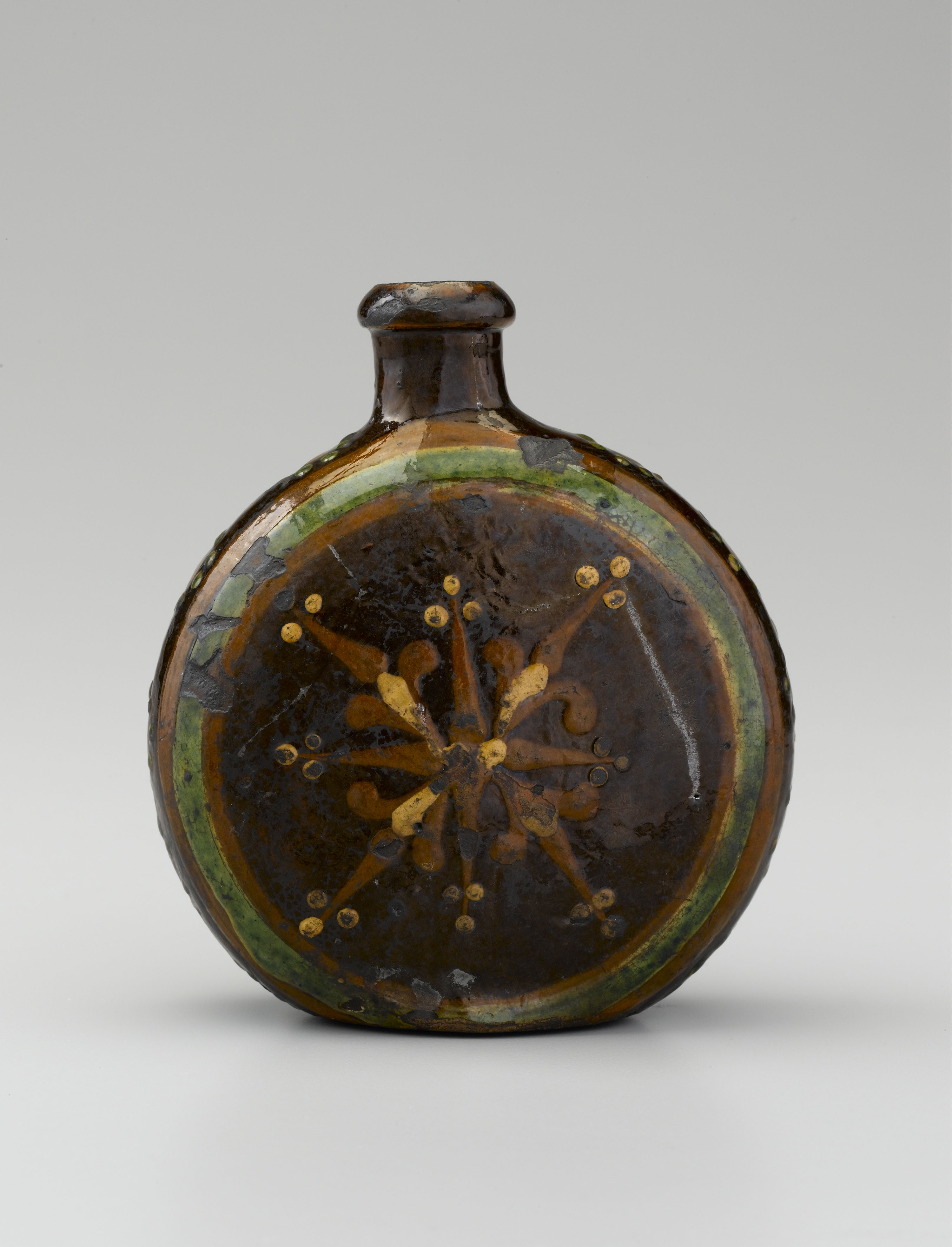
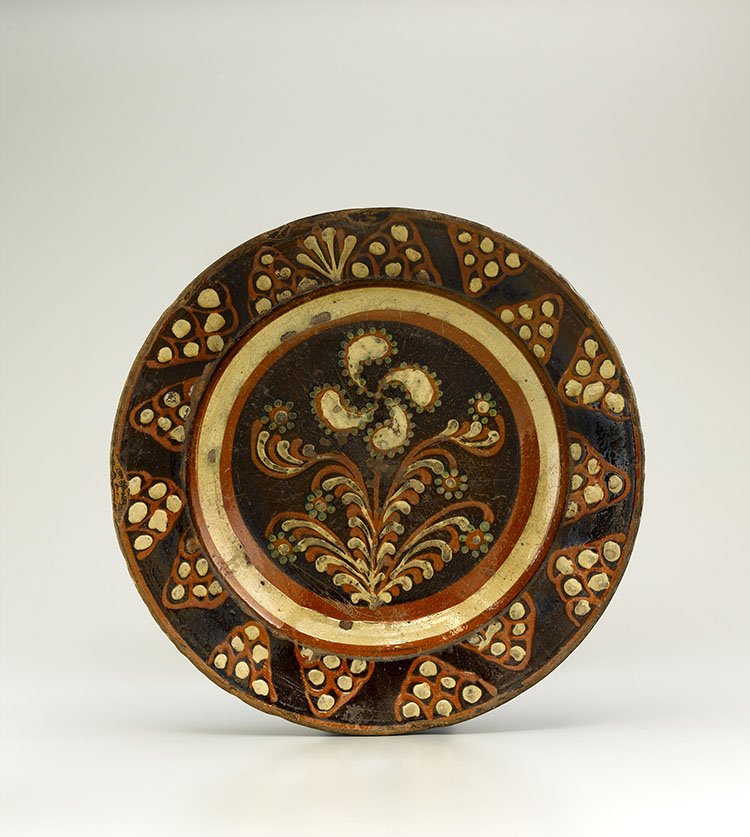
“In North Carolina... all the German settlers, with the exception of those who were located at Newberne [New Bern], came mostly from Pennsylvania during a period of twenty-five or thirty years before the Revolutionary War… consequently, one will find Pennsylvania ideas, habits, manners and customs prevailing…179-180

ST. PAUL’S LUTHERAN CHURCH, ALAMANCE

Original Lands of Frederick MOSER
As we have already seen the church was very important to German immigrants to America. It was the glue that held communities together. From Virginia LOY FAUSEL St. Pauls Lutheran Church History we learn that Frederick MOSER was a founder of St Paul’s Lutheran Church near Alamance. In the above map there is a Calvin MOSER perhaps on lands originally owned by Frederick.
“In the 3rd year of King George III, a land grant was made Frederick MOSER. His son Frederick’s grave is located at St. Paul’s Church. The first Frederick MOSER and Malachi ISLEY were founders and members of St. Paul’s in 1763. Frederick MOSER [later] settled on land now owned by Mrs S.L. Murray about 8 1/2 miles south of Graham on Sandy Run.” St Pauls Lutheran Church History by Virgina Loy Fausel 1982 writes
The following descriptions are from the History of the Lutheran Church in North Carolina, 1803-1953 by Jacob L MORGAN, Bachman S BROWN and John HALL 1953:
Malachi ISLEY and Frederick MOSER are credited as being founders and members of Saint Paul’s Lutheran Church in 1763. Malachi eventually settled on land just north of the future Friendship United Methodist Church. Magdalene, wife of Malachi, born July 22, 1729 in Germany, died December 24, 1790. Malachi, born in 1725 in Germany, died May 3, 1808. Both are buried in Saint Paul’s Lutheran Church Cemetery. In 1839, a new St. Paul’s Church, was dedicated on the third Sunday in September, 1839 BERHEIM pg 527
“St. Paul’s Church is located in Alamance County on the old Trading Path, about two and one-half miles east of the Alamance Battle Grounds. It is not definitely known when this church was organized… History spoke of itinerant ministers preaching here as early as 1759 – 1764…The first two buildings were log structures; however, we do not know much about either of them. The third and present building is a frame church, about 30 x 40, which was erected about 1893. Sunday School rooms were added in 1941 while Rev. D. I. Offman was pastor. pg 328

“The presence of Lutherans among these German settlers has never been questioned, and the concensus is that they were in the majority. They brought with them the heritage of their Lutheran faith; and Bibles, catechisms, hymn books, and other books of devotion were among their prized possessions. They had been trained to appreciate the necessity of the means of Grace, and they recognized the importance of providing for their orderly administration. With such a background, they were not likely to be indifferent to religious needs and responsibilities. It is true that they were not able to bring pastors with them. They came in small groups and even had pastors been available, they were in no position to assure them adequate support. There was no resident pastor in North Carolina until 1773, but there is indisputable evidence that Lutheran congregations had been organized long before that date. Dr. W. T. WHITSETT observes that, “Contrary to the rule with certain other denominations, the Lutherans did not think it necessary to wait for regular ministers in order to begin their church work; they set up their church services upon their arrival, and with their duly elected deacons and elders conducted regular religious worship.” MORGAN Pg 19
“During this formative period, the need for regular pastors was desperately felt. Consecrated laymen could effect organizations and do much to hold the people together, but they were not authorized to administer the sacraments and to cultivate the spiritual development of an increasing number of needy souls. For these services they were dependent upon the ministrations of traveling pastors who, on rare occasions, visited the territory.” MORGAN pg 20
CHILDREN Of Fredrick and Barbara MOSER BORN IN ORANGE COUNTY, NORTH CAROLINA
- Mary MOSER bc 1764; m. Frederick Conrad KECK; lived Clairborne Co, TN
- John MOSER bc 1766; m. 1792 Sally GARRETT; died 12 Apr 1825 Alamance Co, NC
- Frederick MOSER Jr. b 15 April 1771; m. 1795 Mary INGOLD; m.2nd 1799 Barbara ANTHONY; died 15 Aug 1823 Alamance Co
- Magdalena MOSER b 1773; m. 1793 Barnabas BUTCHER; lived Anderson Co, TN; d. 1838 Monroe Co, IN
- Eve MOSER 1775; m. Peter SHARP 31 Aug 1795; d. Aug 1822
In our next chapter we will take up the problems with land speculation, over taxation, the Regulator movement and more.
Kelly Wheaton ©2024 – All Rights Reserved
German Immigrants to Pennsylvania: Pioneer Georg “Frederick” MOSER (1722-1800)
Posted on January 23, 2024 Leave a Comment
The earlier parts of this story can be found here. This is a common German immigrant story so perhaps you will find some connections to your own story.
BRIETENAU, BAVARIA

Our Frederick MOSER had a very interesting life. He was baptized Georg Frederic MOSER in the small village of Breitenau, Bavaria, Germany the 3rd of March 1722. Although others have placed a Johan or Johann in front of his name, nothing in the records I have examined indicates he ever was Johan. He went by Frederick or Frederich here in America. His parents were Johan Martin and Margaretha (SCHWEMBAUER) MOSER. Both were descendants of Lutheran, Austrian “exulanten” [exiles] who left “Catholic” Austria and settled in a Lutheran part of Mittlefranken aka Franconia, Germany. MOSERs lived originally in Wißenkirchberg.
When Fredrick was six years old his parents heeded the call to emigrate to America. He and his 4 siblings 8, 4, 2 an 1 years old and his uncle Johan Adam MOSER , who was then 27, traveled together. They likely went west to meet up with a contingent of the Lutheran, Reverend Caspar STÖEVER, then went west to the Rhine River finally arriving in Rotterdam. From there they boarded the ship the ‘James Goodwill’. The voyage took 89 days to reach Philadelphia. From there they traveled to New Hanover, Pennsylvania where they settled. [Links in highlighted text to that part of the story].
BERKS COUNTY, PENNSYLVANIA

After arriving in the bustling harbor and town of Philadelphia the MOSERs along with the STOEVERs would have headed northwest to New Hanover and Faulckner’s Swamp church.

A History of the Lutheran Church in Pennsylvania
Life in those pioneer days centered around farming, the family and church. For a glimpse of growing up in Pennsylvania German family I am indebted to John Baer Stoudt’s The Folklore of the Pennsylvania Germans : a paper read before the Pennsylvania-German Society at the annual meeting, York, Pennsylvania 1916:
“The early German settlers in Pennsylvania were a God fearing and devotional people…Here, indeed, was earnest Christian devotion, here was the family altar, here was the Bible and the hymn-book, the constant source of instruction and blessing and here, also, there was the careful and religious training of the children…No meal was taken without some one offering an audible prayer, and a verse or even a whole hymn was frequently sung.” STOUDT pg 8
“Strange as it may appear, it was the father and the grandfather, rather than the mother or the grandmother, who usually taught the child the nursery rhymes. Coming in from the work at the barn, the father would draw a chair close up to the kitchen stove or fireplace, for the folklore was taught in winter, — in summer every one was engaged from early morn to late in the evening, — and take the child in his lap and to amuse it or perhaps to amuse himself, taught and rehearsed the nursery rhymes. This is perhaps accounted for by the fact that the mother and the grandmother, whose work was never done, were too busy, their time being all taken up by knitting mittens and stockings, spinning or sewing or perhaps preparing the meal, the father and the child waiting for the latter.” STOUDT pg 25
8From A History of the Lutheran Church in Pennsylvania (1638-1820) by Theodore Emanuel SCHMAUK we learn that in 1741 a new log church at Swamp was begun, but was not yet finished in 1742, when MÜLLENBURG arrived. We know his first sermon was 2 Corinthians 5:19-20 “that God was reconciling the world to himself in Christ, not counting people’s sins against them. And he has committed to us the message of reconciliation. We are therefore Christ’s ambassadors, as though God were making his appeal through us. We implore you on Christ’s behalf: Be reconciled to God.“
“MUHLENBERG’s insistence on educating the young people of the Swamp, as the most important practical task of the congregation, had borne fruit. A schoolhouse and schoolmasters were kept busy. But when, in 1754, the London Society inaugurated the project of the German Charity Schools, with the cooperation of MUHLENBERG and of Michael SCHLATTER, on August 1st the Lutheran Church Council at the Swamp sent a petition to the Pennsylvania trustees of the London Society, urging the opening of a school in that vicinity, and offered the use of their new schoolhouse, conveniently situated in the middle of the township. The request of the Lutheran congregation was also supported by a petition from the ministers, elders and chief men of the Reformed Church at the Swamp, dated October 28, 1754.” SCHMAUK pg 164

We don’t have a record of Frederick’s confirmation which would have likely occurred about 1738. His sister Maria Barbara MOSER “—daughter of widow MOSER” was among Henry Melchior MÜLLENBURG’s first catechetical class in 1743. Frerick’s brothers Philip MOSER and his brother Burkhard MOSER were both confirmed on 8 Apr 1744 by Rev. Henry Melchior MUHLENBERG at New Hanover (Falckners Swamp) Lutheran Church. The sponsors were Johans Adam MOSER & his wife Eva (Their uncle and aunt).
Frederick MOSER’s father Johan “Martin” died about March 1743 without a will at age 50. The Administration of his estate is dated in the body 6 April 1744. As his eldest son, Frederick MOSER received Ł6:11:10.5. Double what the rest of his heirs received.
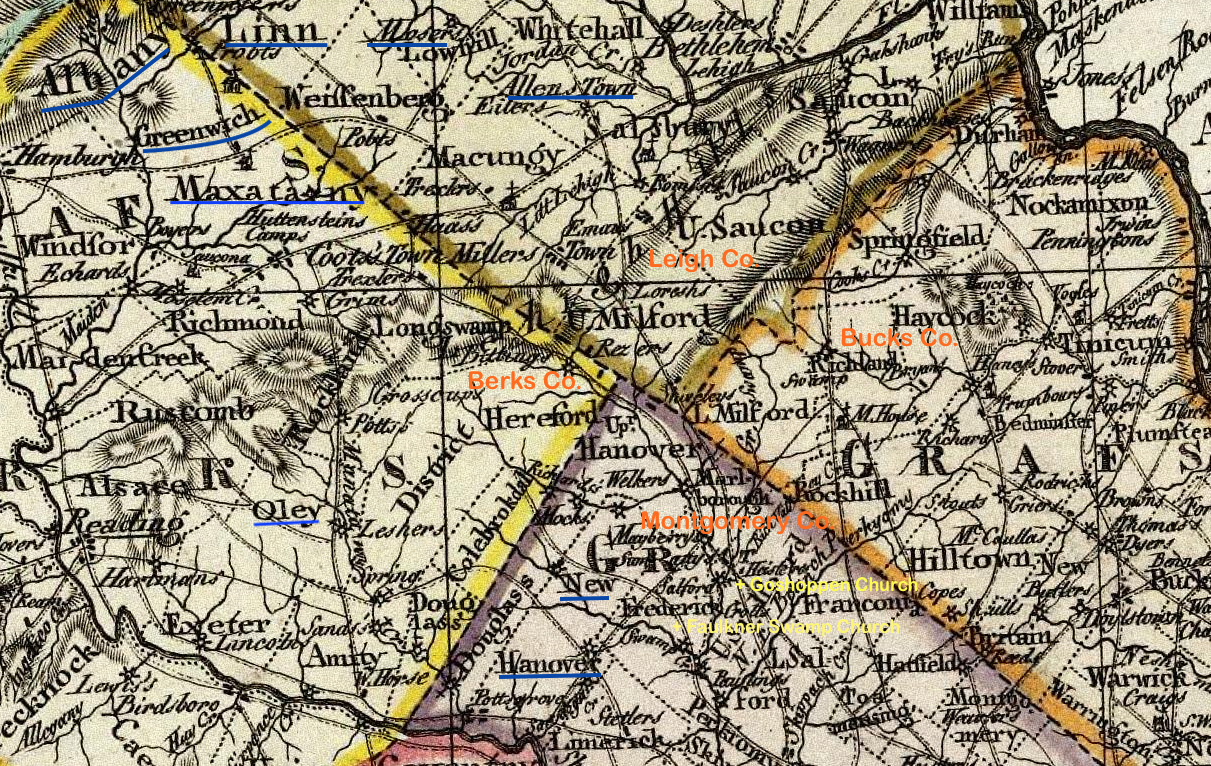
At 27, Frederick MOSER was granted a warrant for 100 acres of land in Bucks [later Northampton, now Lehigh] County which was surveyed on March 30, 1749 located “beyond Allemangel about a mile from the Blue Mountains adjoining Henry BOYER and Conrad SWITZER.” In A History of he Leigh County, Pennsylvania by James J Hauser he writes “But the settlers got the land cheap. More than three- fourths of the inhabitants of the county are German…” The Blue Mountains are the southernmost ridge of the Appalachian mountains that runs for 150 miles through Pennsylvania.
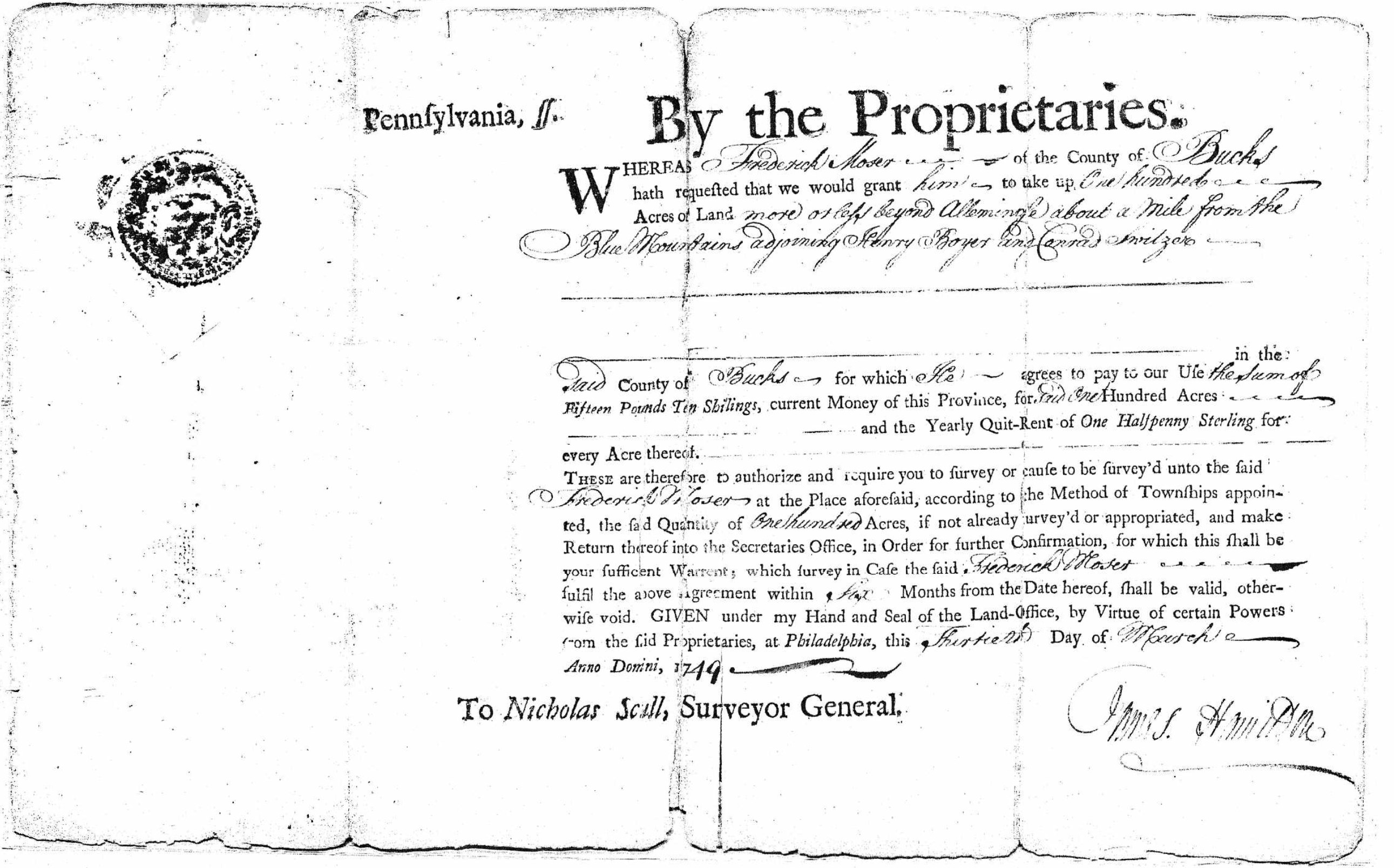
1 March 1749

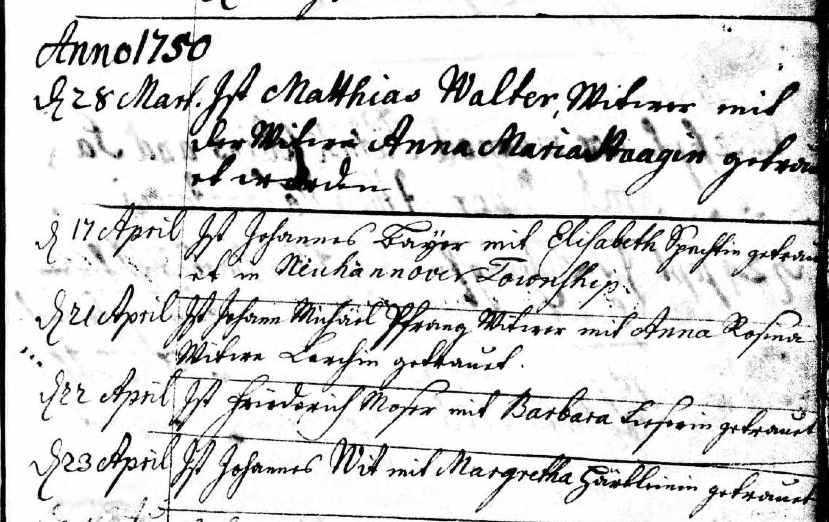
After acquiring property, Frederich MOSER marries Maria Barbara LOESER [also spelled LIESER or LISER] as recorded at the New Hanover Lutheran Church 22nd of April 1750. This is the same church sometimes known as Faulkner’s Swamp Church where he and his parents originally settled. The original church and later schoolhouse were but simple log structures. Likely the home he grew up in as well. His mother, widow Margaretha MOSER, gave 3 shillings toward the bell at The Falckner Swamp Church in 1748. We know that Margaretha MOSER was alive 8 Apr 1750 when her two sons were confirmed at New Hanover. So we hope she was present at the marriage of her son Fredrich.
Fredrich MOSER and brother, Philip MOSER’s names appear among the signers of a petition for a new township submitted 3 Oct 1752 to the Justices of Court of Common Pleas for Northampton County at Easton. Petitioners were identified as inhabitants of an area lying under (south of) the Blue Mountains between the lately laid out township of Heidelberg and the county line, the area that became Lynn Township and later Lehigh Co. The signers included Fredrick MOSER who made his mark and Philip MOSER who signed. It seems odd that Frederick signed with a mark as he was a tax collector a few years later—perhaps his brother signed for him? The Johannes LÖYE is son of Martin LOY [Brother to George LOY whose daughter later marries Frederick MOSER’s son, Nicholas MOSER].

Frederick MOSER’s brother Burkhardt MOSER moved in 1754 to Linn Township. In 1759, Frederick was the tax collector for Greenwich Township, Berks County. [need citation]. He is supposed to be on the 1759 Tax list for Linn Township [need citation]. These townships all originally a part of Berks County and in close proximity. I was able to find him in 1761 in Linn Township, Northampton, PA:


Please note that Frederick is listed on the same page as his younger brother Philip MOSER and his brother-in-law, Jacob LIESER, [brother to his wife Maria Barbara (LIESER) MOSER]. Also listed, as a single man, is Frederick LIESER another brother-in-law.
Frederick’s brother Philip MOSER is on the list of men naturalized 21 Sept 1761, when Lehigh was still part of Philadelphia County. We don’t know where Frederick MOSER was naturalized. Philip was a deacon for the Lutheran congregation on 5 January 1761 of the Ebenezer Union Church also called die Orgel Kirche or “Organ Church,” in New Tripoli, Lynn Township Church) in PA. It was so called being the only church in that region which had an organ. The limits of the congregation extended to the Blue Mountains on the north. The settlement was made by a portion of the Allemangel colony; Among the first settlers, were Burkhardt and Michael MOSER, uncles of Frederick MOSER. Simon MOSER, bought Dec. 22, 1748 203 acres in Mosserville followed by Michael MOSER, June 8, 1754, 54 acres. They are among members of Faulkner Swamp and Goshenhoppen churches who moved, between 1735 and 1745, up to Lynn township, and settled in “Allemangel.”

(See above for Linn Township)
Frederick MOSER is a Tax Collector in 1759 in Greenwich Township, Berks County and on the Tax list for Linn Township in Northampton County in 1761. On the 8th of August 1762 Nickolaus (Nicholas] MOSER, my 4th great-grandfather, was baptized at the Ebenezer Union Church also called die Orgel Kirche or “Organ Church,” in New Tripoli, Lynn Township Church) in PA as recorded in the Personal Register of the Rev. Daniel SCHUMACHER. The first church was built out of logs and was dedicated on November 6, 1756. It is quite possible that he was born in Greenwich Township but brought to St Paul’s for baptism.
Children of Frederick and Barbara MOSER born in PA
- Jacob bc 1751
- Johan Michael 1754
- Abraham 1759
- Johan Philip 1758
- Georg 1 Jan 1760 died 1760
- twin Maria Barbara 1 Jan 1760
- Nicholas bpt 8 Aug 1762
Sometime between 1762 and 1763 the MOSER family relocates to North Carolina. We will take that up in the next blog post.
Kelly Wheaton ©2024 All Rights Reserved
THE MOSERS IN BAVARIA: Wißenkirchberg, Hetzweiler, Kloster Sulz, Altengrueth
Posted on January 18, 2024 4 Comments
If you haven’t read the previous blog post BAVARIAN Hans MOSER c1623-1696 was from Austria, not Switzerland you should read it first. When last we met Hans MOSER he was part of a mass migration of “exulanten” or exiles having been expelled from Catholic Austria and resettling in a Lutheran part of Mittlfranken or Middle Franconia in Bavaria, Germany [Please note in Germany it is often written Bayern].
BACKGROUND

It is about 12 miles from Ansbach to Weißenkirchberg
This map was drawn just a few years before Hans and Maria MOSER arrived in Franconia. It shows the area of Weißkirchberg still as forest. Towards the end of the Thirty Years War Brunst and Weißenkirchberg had 22 households. In 1642 the Properties in the Principality of Ansbach are:
- Kloster Sulz: 2 properties
- Brunst (taxes to the parish of Weißenkirchberg): 9 properties one a tavern; plus taxes to church 3 properties
- Weißenkirchberg: 3 properties one with an inn and tavern; the office of Schillingsfürst 2 farms, 2 properties one with a blacksmith shop

Hans and Maria MOSER were part of a large exodus coming out of the Waldviertal. Based on their ages at their deaths Hans is estimated to have been born about 1623 and Maria about 1630 so their marriage may have occurred between 1650 and 1653. It is not recorded in Weißenkirchberg so it is assumed they were married in Austria of elsewhere on their trek to Weißenkirchberg. It is likely that they knew where they were headed and perhaps even had friends or family already established in the area. The landscape would not seem altogether different from where they had come from. Rolling hills, verdant valleys and pockets of heavy forest. Since all the early Protestant church records in Austria were destroyed during the persecution we will likely not be able to reach further back unless it is through DNA. [Haplogroup I: M221> Z189> L801> Z165> CTS6433> S2364> S2361> Z171>CTS8584>Z185>BY165960>BY181213]

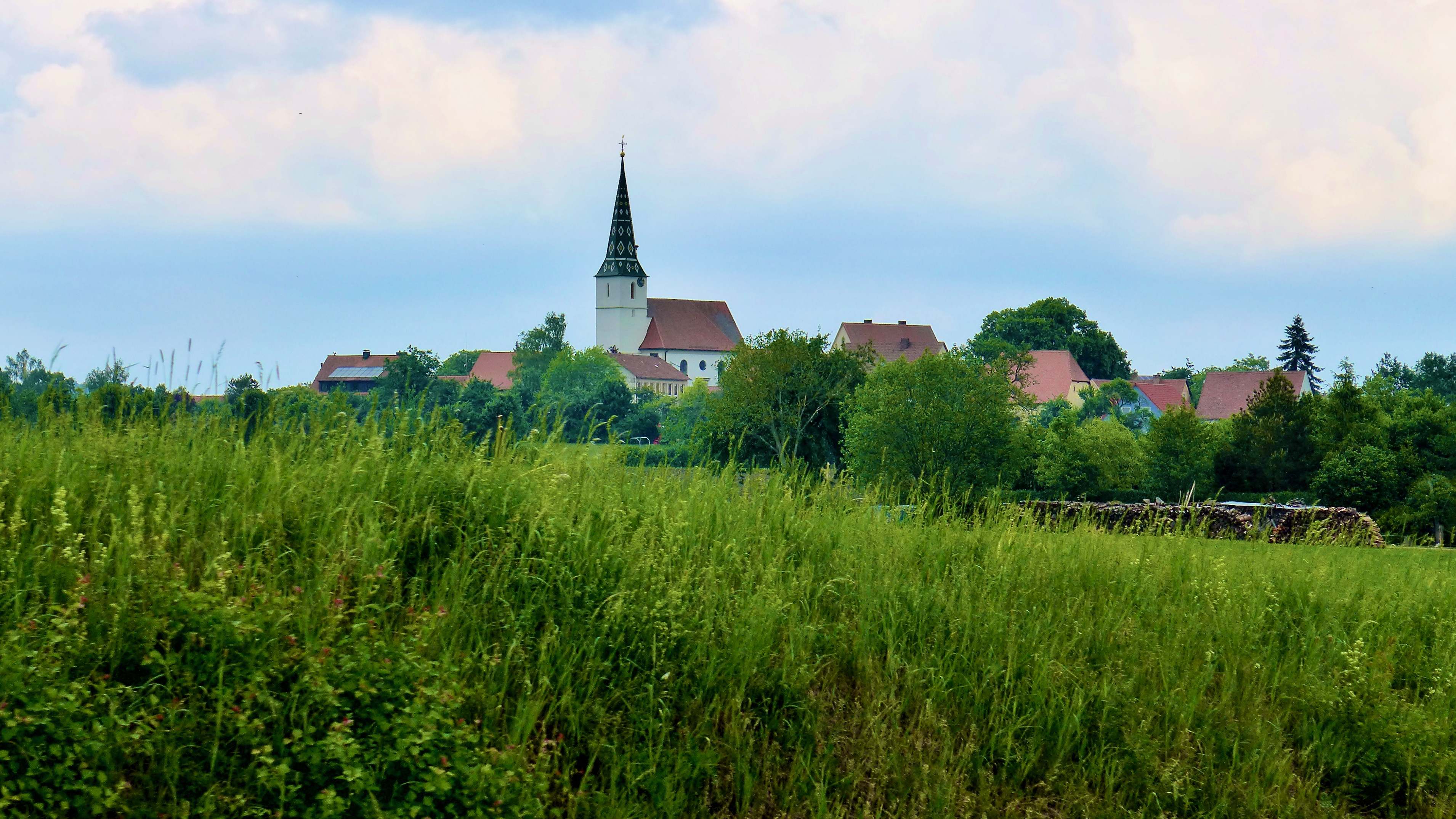
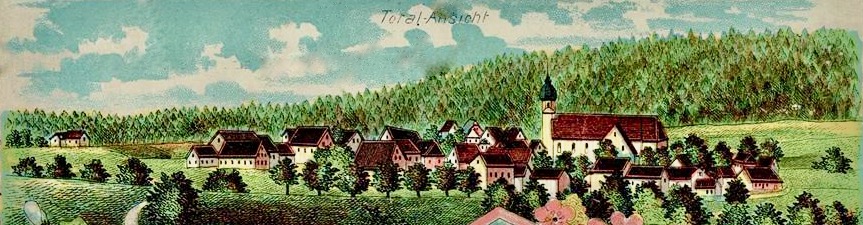
St. Wenzeslaus church in Weißenkirchberg is first mentioned in the historical record in 1333 but was heavily damaged during the Thirty Years War. One would guess the new arrivals would lend a hand in rebuilding it. The tower still holds two old bells; the smaller one from 1521 and the other from 1575. The photo below is immediately adjacent the church and might give a better idea of what things looked like back when the MOSER’s arrived: stone walls tile roofs and simple wood framed windows.

This is a view of the church today with the beautiful tiled steeple.

The day I visited the MOSER villages we drove through the forest that lies between Kloster Sulz and the hamlets of Weißenkirchberg, Brunst and Heitzweiler. As one exits the forest the church tower of St. Wenzeslaus is visible rising above the farmland as seen in Photo above. The smaller bell is rung each day at 3 PM as a reminder of a nun from the nearby Kloster Sulz monastery. It is said she was lost in the forest and found her way out by following the chiming of the bell at St. Wenzeslaus church. Unfortunately we arrived at 3:08 PM just missing the ringing of the bell.

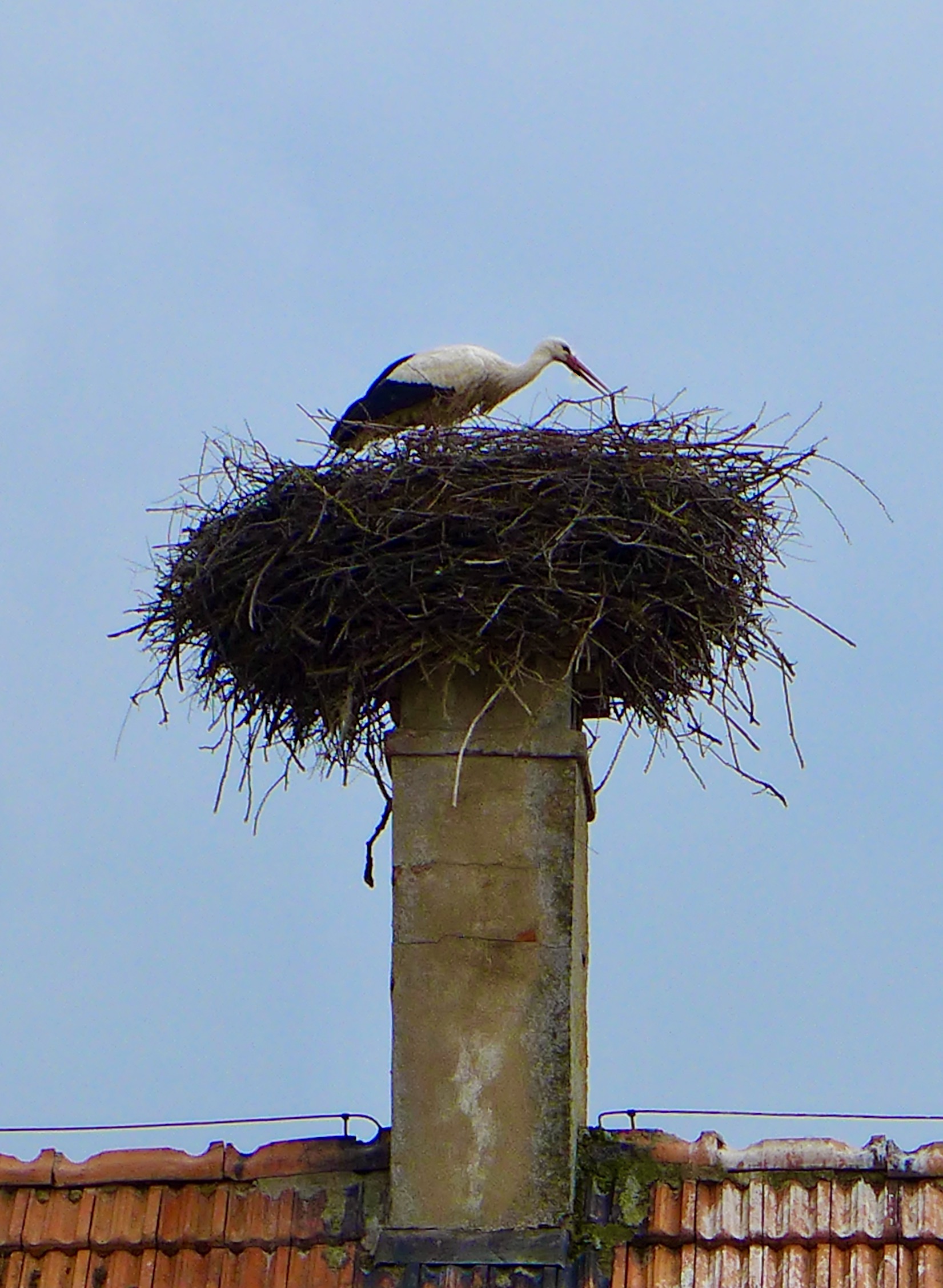
In Weißenkirchberg adjacent the church of St. Wenzeslaus, on the chimney of a nearby house a mother stork was being kept very busy feeding her young . In Germany the stork is a sign of fidelity, longevity, prosperity, protection, luck, and motherhood. And then the rumbling began as waves of thunder roared across the valley—it was so loud it felt as if our arrival was being announced.
HANS & MARIA MOSER IN BAVARIA
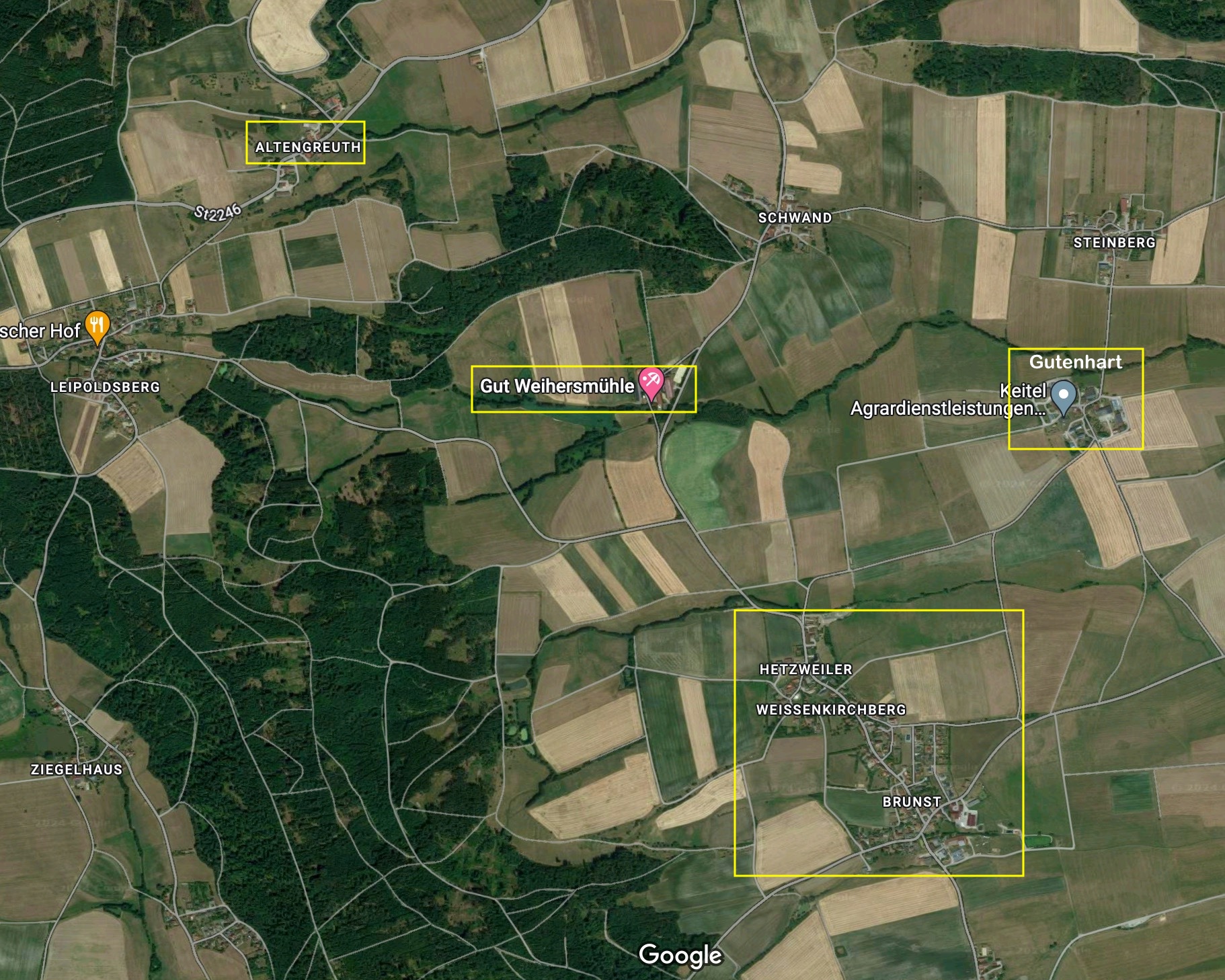
The first record we have of Hans MOSER is a Tax record. This establishes that Hans was settled at Hetzweiler in 1653. You can see that Hetzweiler and Weißenkirchberg today are just a cluster of houses with the church in Weißenkirchberg. Accounts of the jurisdiction of Colmberg and Leuterhausen STA Nüremberg, RA Colmberg 316, Item 117 sheet 94:
Hanss MOSER, Hetzweiler, 1653 Hans MOSER peasant farmer from Unterösterrich for the acquisition of Leonhardt FINISTERER’s peasant property at Hetzweiler, owes the purchase price of 20 Guilders, that he has promised to settle in annual installments of 4 Guilders, payable at Candelmas. [Important Feast day known as the beginning of the “farmer’s year” in Germany and often when accounts were settled.]
Then we have the tax exemption for the jurisdiction of Colmberg and Leuterhausen STA Nüremberg Hetzweiler 316 Item 27 Sheet 140 1653:
For the first year Hans MOSER is exempted from the annual Candelmas-tax for the acquisition of Leonhardt FINISTERER’s little property at Hetzweiler. He is exempted from 2.37 Guilders. He is exempt for three years which ends in 1656 so to begin tax in 1657
Then we have the Tax Roll of Hetzweiler 1646-1654: Account of the district of Brunst at Colmberg and Leuterhausen STA Nüremberg, RA Colmberg 225/5 1, Item 27:
“Leonhardt FINSTERER at Guth Farm (1646) : Now Hanns MOSER Lower Austria (1654)”
As I explored in the last post the Guth farm may have been in the area of Gutenhart and/or Gut Weihrsmüle. One of the fields visible on the above map was undoubtedly farmed by Hans MOSER 370 years ago. Then what little we know is recorded at Wenzeslaus church. First is the baptism of Hans Adam MOSER the 14th of September. He was born at Hetzweiler. The list of Hans and Maria MOSER’s children:
- i. HANS ADAM MOSER Born 14 Sep 1653 in Hetzweiler, Mittelfranken, Bavaria, Germany. He married Maria Stroebel. He is my 7th great grandfather. More about him later.
- ii. HANS PHILIP MOSER Born 30 April 1656 in Hetzweiler, Bavaria, Germany. m. ROSINA MITTLEMEYER . He was a farmer and married Rosina MITTLEMAYER, 4 June 1689 in Eckartsweiler He died 21 May 1727, Eckartsweiler, Bavaria. His death record says he died of a stroke. With this interesting side note. “For many years he was suffering from melancholy, and pretending being a prophet claiming that with his death the entire world will come to an end. After his death he was buried to earth, however, the world is still extant to date.“
- iii.JOHANN MICHAEL MOSER Born 19 Aug 1658 in Hetzweiler, Bavaria, Germany; married EVA MITTLEMEYER 13 May 1683 in Weissenkirchberg, Bavaria, Germany. He died 5 Feb 1716/17 Brunst, Bavaria, Germany.
Of note is the godparent of both, Hans Philip and Johan Michael MOSER was Hans HEFFNER [HAFFNER]. Like Hans MOSER, in 1654, Hans HEFFNER [HÄFFNER] occupied a farm previously belonging to Hans FINSTERER . Hanns HEFFNER was also an Exulanten of Lower Austria and like Hans MOSER we do not know where he was from precisely. We do know HEFFNER‘s widow married 2nd Thomas SOLZENDALLER from Griesbach, Lower Austria. Again all likely from the area around Rappottenstein. Two of the MOSER brothers married sisters both daughters of Hans MITTLEMEYER. The younger son, Johann Michael MOSER married at 25 years of age and had ten children. His older brother, Hans Philip MOSER married at 33 and had six children.
Sometime between 1659 and 1686 Hans and Maria MOSER moved to Altengrueth. Altengrueth is a hamlet about 1.5 miles northwest of Hetzweiler. [See the above aerial map] Today there are 6 farms in Altengrueth. We know of four families that lived at Altengrueth from the later part of the 1600’s MOSER, SINDEL, ORTNER and DANZER. The DANZERs and ORTNERs came from Griesbach and the SINDELs from Rappottenstein and GroßGerungs. The distance from Griesbach to GroßGerungs is 4 miles, and to Rappottenstein 7 miles. We also know there was a Hans MOSER at GroßGerungs and 3 at Rappotenstein. A very strong possibility is that one of them was our Hans MOSER.
Maria and Hans would have been alive to see their son Johan Adam married at St Wenzeslaus church the 26th of January 1675. The first four of Adam’s children were born at Altengrueth, probably on the same farm where Hans and Maria lived and likely Maria would have attended their births. In 1683 Hans Michael [3rd son] was married. In 1686
“On 30th of July, between 6 and 7 o’clock in the morning, there died Maria, wife of Hans Moser, subject to Rothenburg in Altengreuth, after a long illness of tumor in the 56th year of her life. She was buried to earth with sermon on the 31st.”
Hans lived another ten years. His 3 sons had 16 children among them by the time of his death. In 1696:
“On the 26th of September, between 4 and 5 o’clock. In the morning, Hans Moser, widower in Altengreuth, died of feverish sickness, and was buried with a sermon on the 27th of the same month. Age: 73 years”
Hans and Maria’s son, Philip MOSER, removed to Eckartsweiler when he married Rosina MITTLEMEYER who was from Eckartsweiler which is less than a mile south of Weißenkirchberg. Their first three children were born in Altengrueth and then Eckartsweiler. Hans and Maria’s son, Michael MOSER, lived in Brunst and the first six of his children were born in Altengrueth. Hans and Maria’s son, Johan Adams first child was born in Hetzweiler but the following six were born in Altengrueth. So it appears the family was tight knit and most of the early grandchildren were born on their grandparents farm in Altengrueth. It makes me think that grandma Maria was a good midwife!
Eldest son, Johan Adam MOSER marries Maria STRÖBEL, daughter of Han STRÖBEL 26 Jan 1675 in Brunst. She was born at Kloster Sulz in 1652. We know that the Johan Adam MOSER family moved to Grossulrichausen between March of 1690 and January of 1693 when Johan Martin MOSER was baptized at St Martins church in Wörnitz.
If you have an opportunity to visit St Wenszlaus church in Weißenkirchberg have a sit, perhpas upon a stone that a MOSER previously sat upon.
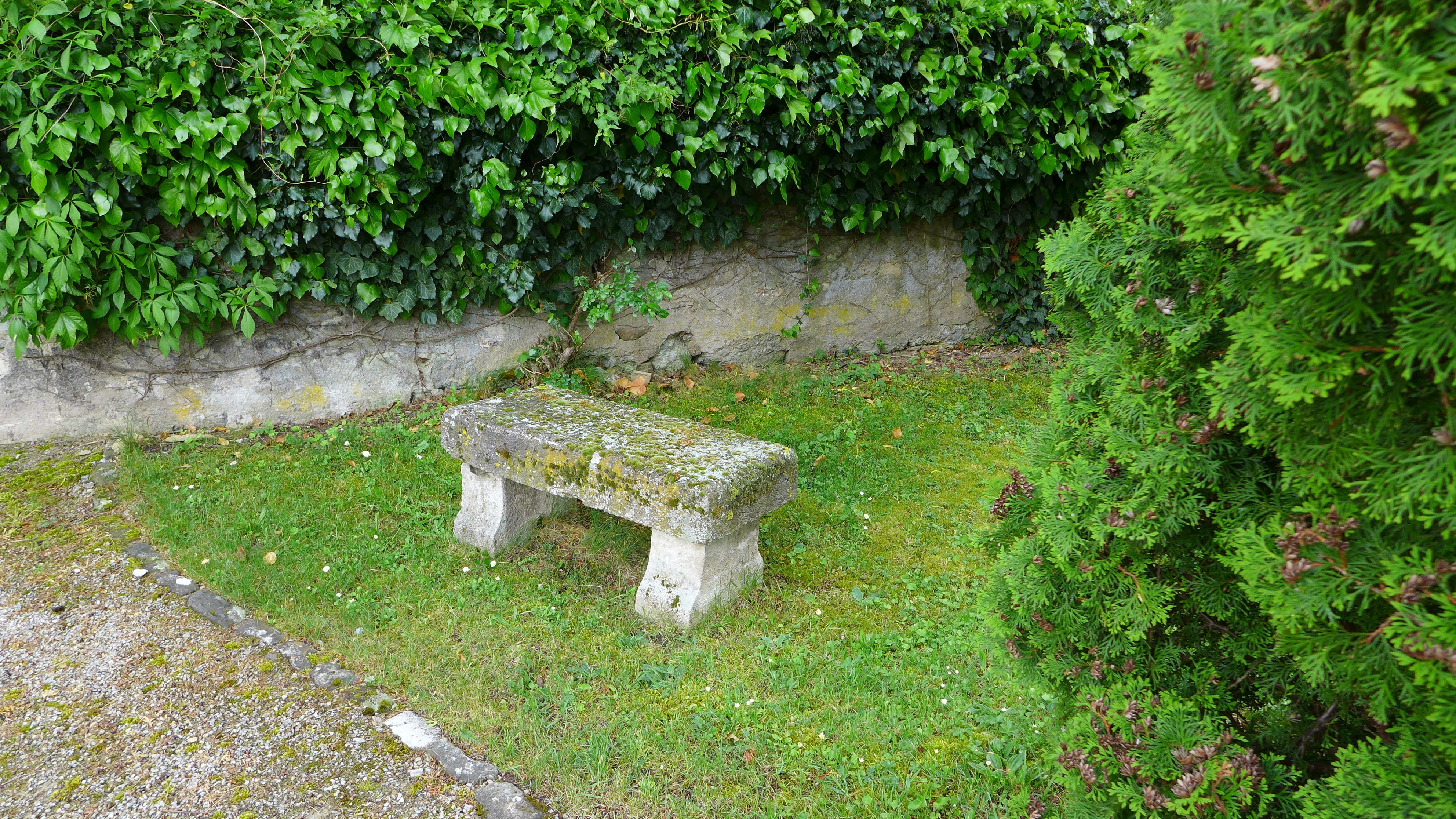
I have not researched much on the MOSERs who may have stayed in the Weißenkirchberg. Of the grandsons of Hans and Maria MOSER, it appears that only their son Hans Philip MOSER (1656-1727) had a son that stayed in the area. That would be Johan Michael MOSER born 10th April 1695. He was a tailor in Eckartsweiler and he had sons Johan Michael 1726 and Johann Sebastian 1730. And there appears to be great -grandsons born in the latter half of the 17th century. The last entry for a MOSER in Weißenkirchberg is the marriage of John Leonhard son of Johan Sebastian in 1800. So that ends our tale of MOSERS in Weißenkirchberg. My part of the story is continued in the previously posted stories of Johan Martin MOSER of Großulrichausen, Wörnitz and Breitenau Bavaria and New Hanover, Pennsylvania:
- Three Brothers Story Retold: Johan Martin MOSER
- German Immigration Part One: Johan Martin MOSER
- German Immigration Part Two: Johan Martin MOSER
- German Immigration Part Three : Johan Martin MOSER
- German Immigration Part Four : Johan Martin MOSER
Future posts may involve some unconnected MOSERs in the Weißenkirchberg area. And the continuation of my particular branch with Frederick MOSER of Breitenau, New Hanover and Orange County [now Alamance] North Carolina. I hope you find these stories inspirational in searching your own.
Kelly Wheaton ©2024 – All Rights Reserved
BAVARIAN Hans MOSER c1623-1696 was from Austria, not Switzerland
Posted on January 15, 2024 13 Comments
Please excuse my rant. You can’t do proper genealogy without historical context. You shouldn’t go connecting people to your tree willy-nilly without evidence. A few years back my friend Paul Chiddwicks had a blog post Are you a Genealogist or Family Historian? As I go about teaching genealogy and writing about family history I would say I am both. However, major problems arise should you not brush up on geography and history. We all make mistakes but sadly—one mistake long ago proliferates like a cancer.

Remember my Blog post Mind the Gap? This is another cautionary tale. Boat loads of trees have a Hans MOSER bc 1621-3 as the son of Andreas Johann Wilhelm MOSER born on 12 October 1603, in Rothenbach, Bern, Switzerland nor is it Hanß Reichardt Moser born the son of Johann Wilhelm MOSER 6 Apr 1621 Schwäbisch Hall, Baden-Württemberg. There is not a shred of proof of either of these and the historical record says Hans was from Lower Austria. More on that shortly. So lets face some facts, shall we? Let’s start with the SURNAME
SURNAME MOSER

Whether German, Austrian or Swiss it is generally agreed that the surname MOSER comes from “Moos” meaning a marsh, moor, or bog and “er” the person coming from such a place. So in this case MOSERs are “the people of the marsh” as was coined by Charles Recker over fifty years ago. A moor or marsh is generally peaty and dominated by grasses and sedges, often near the bench or lowland of a river. Although it may have a negative connotation today, these were rich, fertile farmlands. As a habitational name it may have been adopted by widely scattered individuals.
As a coincidental side note, when Johan ‘Martin’ MOSER settles in Pennsylvania it is at New Hanover near the Swamp River, Montgomery County and he is a member of the Lutheran “Swamp Church.”
As a habitational name there is no relationship to be inferred by sharing the surname MOSER. Widely scattered unrelated people may have taken up the name at different times. The largest concentration (rounded) of MOSERs today and the rank of surname within the country:
- America 40,000; 1,071th most popular surname
- Germany 36,000; 194th
- Austria 26,000; 9th
- Switzerland 19,000; 17th
Today Hans is the 8th most popular forename in Germany and 75th in Lower Austria. Hans is a derivation of Johan or Johannes which both remain popular. So the idea that you can simply take a name like Hans MOSER and connect it to a random individual born around 1623 is absurd. But this looks to be what has happened. Even without other evidence to the contrary it just doesn’t make sense. First the forenames Andreas, Wilhelm or Reichardt are not found in our Bavarian MOSER families.
To write the proper story of your ancestors one must know the context in which they lived. Between 1618 and 1648 the Thirty Years’ War was one of the longest and most destructive wars in European history. An estimated 4.5 to 8 million soldiers and civilians died directly from the war, or from disease and famine. Switzerland enjoyed relative stability because they remained neutral during the war, whereas Germany was decimated. So the idea that a Swiss MOSER suddenly decides to travel 310 miles to a decimated area of Germany doesn’t make much sense.
HANS MOSER’S ARRIVAL IN GERMANY
The following is the single most important bit of evidence as to the time of Hans MOSER’s arrival in Bavaria and his place of origin as given to me by Gary MOSIER from the Accounts of the jurisdiction of Colmberg and Leuterhausen STA Nüremberg, RA Colmberg 316, Item 117 sheet 94:
Hanss MOSER, Hetzweiler, 1653 Hans MOSER peasant farmer from Unterösterrich for the acquisition of Leonhardt FINISTERER’s peasant property at Hetzweiler, owes the purchase price of 20 Guilders, that he has promised to settle in annual installments of 4 Guilders, payable at Candelmas. [Important Feast day known as the beginning of the “farmer’s year” in Germany and often when accounts were settled.]
The year of immigration is likely 1652. Hetzweiler is contiguous with Wießenkirchberg and Brunst. On the map below Altengrueth is spelled Altengruet. Leonhardt FINISTERER’s farm was called the GUTH Farm. There was a Martin GUTH from GroßGerungs, Austria who lived in Ansbach-Eyb, Bavaria about 13 miles east of Hetzweiler. And there were FINISTERERs in Wießenkirchberg as early as 1557. In 1631 FINISTERERS lived at Hetzweiler and were associated with Weihrsmühle. A Johann Leohard FINISTERER died at Gutenhard in 1652 and an educated guess is that Hans MOSER took over the small farm in the area of Weihrsmuhle or Gutenhart before later settling less than a mile away at Altengruth. Today there is a Gut Weihrsmuhle and perhaps that was originally the “GUTH” estate or farm or at Gutenhart.
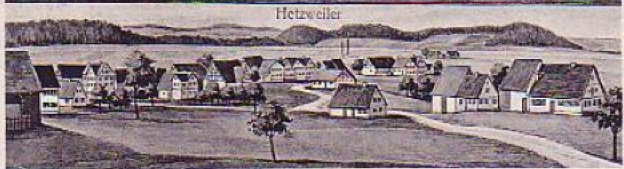
Tax Roll of Hetzweiler 1646-1654: Account of the district of Brunst at Colmberg and Leuterhausen STA Nüremberg, RA Colmberg 225/5 1, Item 27 [First person listed is taxable owner in 1646 second is taxable owner in 1654]:
- Hanns HOFFMAN
- Hans KRAUS at Guth Farm Now (1654) Valentine RUCKER. Valenetine’s first child was born in 1652 at Brunst; subsequent children at Hetzweiler. He died 1676 at the age of 50 (b.c 1626)
- Georg SHARVOGEL at Hof Farm: Now (1654) Matthias HOCHLEITHER. First child and subsequent born 1654 Hetzweiler
- Leonard LÖDTER at Hof Farm: Now (1654) Matthias and Hanns STEINER ?
- Leonhardt KRAUS at Hof Farm: Now (1654) Paul DAUBER (DAUBINGER) first children born Hetzweiler 1659; he died 1688 age 74 (bc1618) He md 2nd Maria KAPFER of GroßGerungs Lower Austria
- Wolff HAUFF at Guth Farm: Now (1654) Wolff (Wolfgang) GÄRTTNER (GÄRTNER) First child born Hetzweiler 1654; Brunst 1659. He died Eckartsweiler 1668 at age 74 (bc 1594) He married Margaret WACKER 1655 Wife of Martin LÖSCHEL his father from Griesbach Lower Austria
- HANS FINSTERER [FINNISTERERs in Weiẞenkirchberg as early as 1557] at Halboff Farm now (1654) Hanns HAFFNER (HÄFFNER) Lower Austria his widow md 2nd Thomas SOLZENDALLER from Griesbach
- Hanns FUNCKH (FUCHS?) at Guth Farm: Now (1654) Hans KÖRBAN (KÖRBER) [family in Hetzweiler since 1565]
- Leonhardt FINSTERER at Guth Farm: Now (1654) Hanns MOSER Lower Austria
Now let’s take a look at why Hans MOSER and perhaps the DAUBINGER, GÄRTNER and KÖRBER families immigrated from Niederösterreich, aka Lower Austria to the Weiẞenkirchberg area.
Niederösterreich: Lower Austria
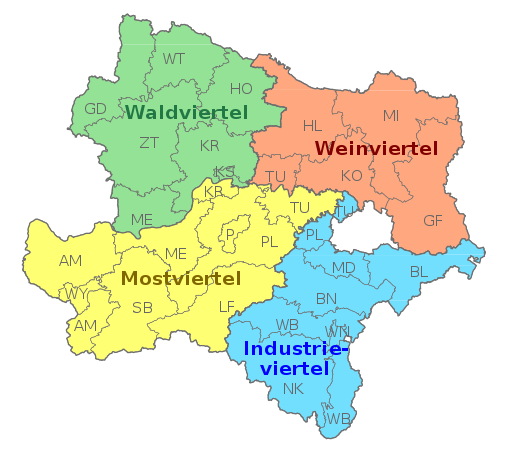
Niederösterreich aka Lower Austria is the northwestern-most of the nine states of Austria. It is further divided into four quarters known as Viertel. The most likely origin of our Hans is in Waldviertel, or translated the Forest Quarter. The Waldviertel is bounded on the south by the Danube River and on the north it borders the Bohemian part of Czech Republic. The Austrians and Bavarians share a common ancestry. They have a common political affiliation with the old Duchy of Bavaria, shared traditions, Bavarian dialect, art, folk style and clothing. Historically the Bavarians are said to be descendants of the ancient Marcomanni, a Germanic tribe.
When Martin Luther in 1517, then a Catholic monk, listed 95 criticisms of the Catholic Church, Protestantism began to spread throughout Austria. Excesses within the church were part of the problem.
“A report by the papal legate Commendone on a visit to the Wilhering monastery in 1569 sheds light on the state of the Catholic Church in Austria: The Eucharist was not kept, the last rites were not recognized, there were no silent masses, Lutheran books like the Bible translation was found, the abbot Matthäus Schweitzer, who was only twenty-seven years old, interpreted the holy scriptures according to his own opinion like the Lutherans, the convent leaned strongly towards Lutheranism in matters of faith, although remnants of Catholic life were still present, etc.” Osterreichische Exulanten in Franken und Schwaben, Georg Russam 1989 p 36
By the turn of the century the majority of the population of Austria was Protestant. For example: Arbesbach in 1530 was less than 10% Catholic. Rappotenstein in 1643 was less than 5%. In 1596 when Ferdinand II came to power [the representative of the Habsburgs and the Holy Roman Empire] things changed drastically for the Protestants. In the year 1600 Lutherans were forbidden to baptize. By 1620 Lutheran nobles were charged with rebellion and their estates were confiscated. By 1628 the Proestestants were forced to convert or emigrate. Most peasants had no options, so they no longer practiced their faith openly. The Emperor set up a commission who scoured the country looking for Protestants. They confiscated and burned their Lutheran bibles, books and records. They took their children for conversion to Catholicism and generally spreading terror among the people. Many still refused to become Catholic. They were to become the Exulanten or Exiles.
EXULANTEN: The Exiles
During the Thirty Years War [1618 to 1648], starvation warfare and disease decimated Europe. The War was primarily a religious conflict between Roman Catholics and Protestants that eventually included most of Europe taking up sides. As with most religious conflicts there were political agendas and territorial disputes. Adding to the losses were typhus and plague along with famine. Areas of Germany and Bohemia suffered the highest losses. The population of Germany had been reduced by 40 percent or more in the rural areas, and 33 percent in the cities. The Protestant who were forced out of Catholic Austria had one silver lining to all the dark clouds. They had a place that needed them. They came to Franconia to farm the fields as this was a Protestant area of Germany which had been deeply depopulated.
“The monastery office of St. Gumbertus (Ansbach) [Ansbach is the district where Wießenkirchberg is located] reported in November 1634: Of the 421 estates and farms belonging to the monastery in the wide area around Ansbach, only 123 are left; Of the remaining 298, the residents died or ran away.” Georg Russam 1989 p114
In 1652 the last remaining Lutheran refugees from all over Austria gathered in the counties which were situated in the state of Lower Austria. Each was interrogated individually between 1652-1654 by the Imperial Commission for the Re-Reformation. In the final report of that commission, the “Verzeichnis der Neubekehrten im Waldviertel Codex Vindobonesis 7757” each of those interrogated is mentioned by name. Arranged and published by Georg Kuhr and Gerhard Bauer 1992.
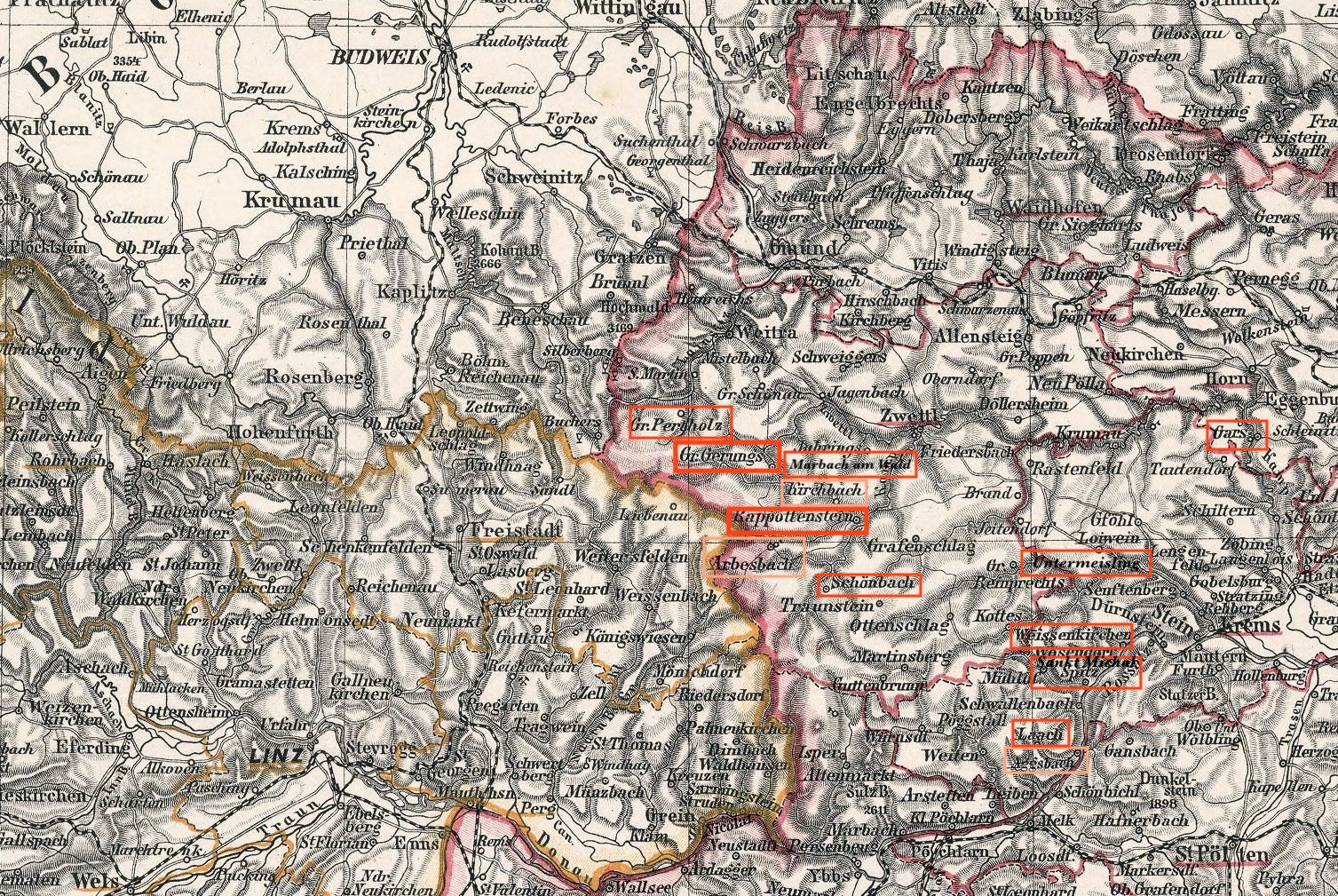
There were 22,000 Lutheran’s interrogated in 1652-1654. Of those in ”Lower Austria” there was a total of 72 MOSERs, mainlyin two areas. The first around the villages near Rappottenstein [Castle pictured at beginning of blog post] and the other alone the Danube near Spitz. 28 lived near Rappottenstein. It is likely that is where we find our Hans MOSER. Although to be fair it is only 25 miles from Rappotenstein to Sankt Michael near Spitz. Of those MOSERS there are 12 Johann [ Hanns ] MOSERs as follows [ Number Parish in Austria (distance from) total MOSERS from parish]:
- 3 in Rappottenstein (+1 Phillip, 1 Georg, 1 Abraham MOSER) 5 total
- 1 in Großgerungs (8 miles from Rappottenstein)
- 1 in Schönbach (6 miles from Rappottenstein)
- 1 in Sankt Michael (+1 Simon MOSER; 1 mile from Spitz)
- 2 in Weißenkirchen (+2 Georg, 1 Maria; 3 miles from Spitz)
- 2 in Maria Laach (+1 Barhtholomaus; 1 Georg, 1 Barabara, 1 Rebecca, 1 Rosina MOSER; 7 miles from Spitz) 7 total
- 1 in Untermelisling (+1 Sebald, 1 Töchter; 12 Miles from Spitz) 3 total
- 1 in Gars am Kamp (+1 Barbara; 31 miles from Spitz) 2 total
Additionally Hans had 3 sons that may be common forenames in his family: Hans Adam, Johan Philip and Hans Michael. In the lists those forenames appear with MOSER as follows:
- Philip MOSER 1 Rappottenstein
- Michael MOSER 1 Kirchbach (2 miles from Rappottenstein)
- Michael MOSER 2 in Marbach am Wald (3 miles from Rappottenstein)
- Michael MOSER 1 Arbesbach (7 Miles from Rappottenstein)
- Adam MOSER 1 Großpertholz (15 miles from Rappottenstein)
- Philip MOSER 1 Aggsbach (6 miles from Spitz)
Speaking of forenames these percentages of forenames come from Eberhard Krauß Exulanten aus dem westlichen Waldviertal in Franken 1997 pg 68 and that from “The Directory of New Converts in the Waldviertal.” Note the forename Adam or Philip does not make the list of the top 12. And of course Hans and Maria are the most common forenames . Rank Male and Female.
- 1. Hans 16.8% Maria 17%
- 2. Georg 10.2%. Barbara 9.7%
- 3. Matthias 7.8% Catharina 9.0%
- 4. Michael 5.4% Anna 8.2%
- 5. Thomas 4.9% Elisabeth 6.0%
- 6. Paul 4.5% Susanna 5.9%
- 7. Andres 3.8% Eva 4.9%
- 8. Martin 3.7%. Margaretha 4.7%
- 9. Simon 3,7% Magdalena 4.1%
- 10. Wolff 3.4% Rosina 4.1%
- 11. Jacob 3.05% Ursula 4.1%
- 12. Stephan 2.7% Regina 3.1%
Since we do not know for sure which Johannes MOSER is ours we look to friends and family. Of the above Villages in Austria only the following have other immigrants to the area of Weißenkirchberg, Bavaria Germany. Town from: SURNAMES
- Großgerungs : BINDER, BÜCHLER, EBERTS, EINFAULT, FESEL, HÖBEL, RECHBERGER, ROGNER, ROSENECKER, SCHMITZ, SINDEL,STEINLEIDNER, WITTEBSCHLAGER, WIZELBAUER, ZANZINGER, ZIMMERER
- Rappottenstein: EINFAULT, FISCHER, HEIDECKER, MAURER, SINDEL, STEINLEIDNER
- Arbesbach: AUER, FRAGNER, HABERECKER, HÖLLRIEGEL, KERSCHBAUM
- Großperholz: AUER, HITZGER
- Marbach am Wald: MAURER
- Griesbach * not above (Between Arbesbach & Großgerungs): DANZER, ORNTNER (who settle in Altengrueth)
Information on families from the books:
- Frederich Krauß Exulanten im Evang-Luth Dekant Feuctwangen 1999 and
- Eberhard Krauß Exulanten aus dem westlichen Waldviertal in Franken 1997

Hans MOSER “most likely” came from the area of Rappottenstein or Großgerungs if we play by the numbers. Rappottenstein is the village near the Rappottenstein Castle which was built in the late 12th century by Rapoto von KUENERING. It was one of many castles he built to protect his familiy’s lands. The castle was adjacent an ancient trade route. Großgerungs is a much larger and had a larger number of immigrants to Weißenkirchberg. However the towns are only 8 miles apart. So it would not be surprising if all the MOSERS in this area were related. You will note that in the list above that the same surnames appear in more than one village. It is not surprising that soem MOSERS stayed and converted to Catholicism. In Georg KUHRr’s article Östrreichische Exhulanten: Gründe der Auswanderung. Orte dew Zuwanderung und Bedeutung für Franken nach dem Dreiigjähringen Kreig 1987 he writes “especially in the western part [of Waldviertal] near Arbesbach , Rappottenstein and to the north Groß-Gerungs and Langschlag [about 4 miles west of Großpertholz] … over 90% of the residents remained with their Protestant faith. The Evangelicals had the support from Protestant rulers such as Wilhelm V. LANDAU of Rappottenstein, Achatius HACKLEBERGER V. Höhenberg at Arbesbach or den HERREN v RÄWEN in Marbach am Wald.”

The Adam MOSER in Großpertholz is intriguing since it is the name of Hans’ oldest son, Adam, and Adam names his oldest son. It is the only Adam among the 72 MOSERs listed as exiles. I hope those reading this find the evidence compelling that Hans MOSER was not from Switzerland. Of the 22,000 exiles at least 3,500 went from the Waldviertal to Franken [the specific part of Bavaria].
So our Hans MOSER was about thirty when and his wife Maria traveled out of Austria in 1653 and were welcomed into the community of Protestants celebrating at St. Wenzeslaus at Weißenkirchberg, in Bavaria, Germany. In 1627 alone Weißenkirchberg lost 257 people to the plague. At the end of the thirty years war only 22 households remained. Most of Mittelfranken was Protestant with small enclaves of Catholicism Kloster Sulz. Lutheran clergy and landowners welcomed the newcomers from Austria, as farmers were needed to grow food and tend the land and more parishioners were good for the local churches. A couple of relevant quotes from the article by Georg KUHR. As we learn some of these families already had a relationship with Weißenkirchberg.
“Interesting observations about the parish of Weißenkirchberg in Leuerhausen where Waldviertel farmers, after the sale of their cattle, brought out of Lower Austria, in Ansbach, attended service and the Lord’s Supper at Weßenkirchberg the Evang. The Rogner, Binder, Löschel, Zansinger, Nefischer, Einault farmers were attracted between 1637-1640. From 1642-1650 friends from the old homeland came in groups of 8-12 people at a time. We find about 150 people from Aresbach, Griersbach, Rappottenstein, who came after the counter-reformation.”
“In 1643 large numbers of cattle herders from Aresbeck, Rappottenstein, Wiesenfeld, Griesbach, Rohrof, Lembach and other areas of the Waldviertel sold their cattle in the area just outside Lower Austria and used the opportunity to commune in Weißenkirchberg [Franconia] according to the Lutheran manner. The same occurred again the next year and along with the cattle herders, others joined them including a sixty year old widow from Arlesbach that had not been able to commune as a Lutheran for several years. Some of them decided not to return home and resettled there.”
Immigration from the Austria to Franconia began about 1598 and lasted until about 1668. The highest numbers came in 1632 or later. They walked on foot traveling the well worn oxen path from Arbesbach in the Waldviertal, south to Grein on the Danube River then following the Danube north into Germany and on to Franconia. After the Thirty Years War cattle farmers from the Waldviertal found a welcome market for their cattle in Franconia, with good prices. As people began to emigrate they followed the path of those before them. By 1652 large numbers were immigrating. Through this period the records of the Weißenkirchberg church shows that about 41% of the marriages were of exulanten. These Lutheran areas of Germany became sanctuaries for the Austrian immigrants. As mentioned previously they shared the same language and customs as there new homeland. The exiles are credited with rebuilding areas ravaged by the war and revitalizing the Lutheran church in Franconia.
In the next Blog post we will explore the MOSERs life in Weißenkirchberg.
Kelly Wheaton @ 2024 – All Rights Reserved
German Migration to America: Johan Martin MOSER 1693-c.1743 Part Four
Posted on January 13, 2024 5 Comments
There are No coincidences!!! At least in this case, it is all connected. Back in Chapter One, remember that it was Daniel Falckner who wrote Accurate Tidings from Pennsylvania published in 1703. It was part travel information and part advertisement for Germans to immigrate to Pennsylvania. It may also be one of the “missives” referred to in the Diary of a Voyage: Rotterdam to Pennsylvania 1728 when the author writes: “O these liars!”
In 1704 Daniel FALCKNER became a legal agent of the Frankfort Company, along with Benjamin FURLEY who was William PENN’s land agent. This same Daniel FALCKNER is the founder of the first German Lutheran Church in America.

TIMELINE
- Between 1671 and 1677 William PENN visited Germany on behalf of the Quaker faith
- 1677 Benjamin FURLY, a Quaker Merchant, settles in Rotterdam. A friend of the famous Quaker George FOX and later agent to William PENN
- In 1681 King Charles II of England granted William PENN a large tract of land in America to offset debts owed Penn’s father, Admiral William PENN (that becomes Pennsylvania)
- Adam MOSER marries at Wörnitz, Bavaria
- 1693 Johan ‘Martin’ MOSER, son of Adam & is baptized at Wörnitz, Bavaria
- 1700 Daniel FALCKNER founds the first Lutheran Church in America 35 miles west of Philadelphia
- 1700 Adam MOSER, son of Adam and half brother to Martin is baptized at Wörnitz, Bavaria
- 1703 Daniel FALCKNER publishes his “Accurate Tidings from Pennsylvania” in German and is an agent for William PENN to recruit Germans to immigrate to Pennsylvania
- 1717 Martin MOSER marries Margaretha SCHWEMBAUER in Breitenau, Bavaria
- 1728 the Martin MOSER family and half brother Adam sail from Rotterdam to Philadelphia on the ‘James Goodwill’ with Reverend Caspar STÖEVER and his son.
- 1728 the Reverend Caspar STÖEVER and his followers from Germany settle at Daniel FALKNERs SWAMP, New Hanover, Pennsylvania
- 1734 Johan ‘Michael’ MOSER son of Martin and Margaretha is baptized by Reverend Caspar STÖEVER at
- 1743 Martin MOSER dies at New Hanover
- 1743 Martin MOSER’s daughter, Maria Barbara, receives her confirmation at the FALCKNER’s Swamp Church by Reverend Henry Melchior Muhlenberg
THE SWAMP LUTHERAN CHURCH

The New Hanover Lutheran Church, the original Falkner Swamp Church is located in New Hanover near Gilbertsville, Montgomery County, Pennsylvania [originally Berks County] about 35 miles northwest of Philadelphia. The historical marker at the corner of Swamp Pike and Lutheran Road [pictured above] marks the location of the original church. You can see the newer 1787 church in the background on right. It was referred to as “der Schwamm” [the swamp] The marker reads:
“The first German Lutheran Church in America was organized here by Daniel Falkner about 1700. From 1742-1761 Henry Melchior Muhlenberg served as pastor The present building 1/4 mile NE was erected in 1767”
Pennsylvania Historical and Museum Commission
We can see from the plaque below that Daniel FALCKNER and both John Casper STOEVER Senior and Junior served here.

The following are selected excerpts from “A History of the Lutheran Church in Pennsylvania (1638-1820) From the Original Sources” by Theodore Emanuel Schmauk. These quotes document the relationship between William PENN, Daniel FALCKNER and Johan Caspar STÖEVER Senior and Junior. The MOSERs accompanied the two STÖEVERs on the ‘James Goodwill.’ They also tell the story of the new land and church that the MOSERs joined. Daniel FALKNER preached at Falkner’s Swamp from about 1704 until 1714. Johan Caspar STÖEVERs, father and son, came here with the MOSER family in 1728. Both were preaching sermons aboard the ‘James Goodwill’, although Junior was not ordained. He is refused ordination by Daniel FALKNER. He is ordained 2 years after his arrival. This solidifies that the MOSERs traveled with the STÖVERs from Germany to Philadelphia and then to Falckner’s Swamp. Moreover in researching all the families aboard the ‘James Goodwill’ the MOSERS are the only ones known to settle at New Hanover, which had already been settled in 1700. All the others settled in communities in about a 30 mile radius. A bit more on the early church.
“When finally he [Daniel Falkner] returned to Pennsylvania, he was accompanied by several theological students, among whom was his brother, Justus Falckner, who subsequently had the honor of being the first clergyman to be regularly ordained in the Western world…On the return trip to Pennsylvania in 1700 Daniel Falckner is supposed to have brought over with him the Germans who located in the Swamp and constituted the first
permanent Lutheran congregation in the Province. These Germans must have left England on May 25, 1700, and
arrived in Philadelphia during the first days of August. Daniel and Justus Falckner were the legal representatives of Benjamin Furly, the agent of William Penn in Amsterdam, for the sale of Penn’s land. Daniel Falckner was the legal representative of the Frankfort I, and Company, to whom Penn had sold the Manatawny district of 22,000 acres, in which New Hanover lay… This congregation of New Hanover, or Falckner’s Swamp—the name the whole region has continued to bear after its founder—is the oldest Lutheran one in Pennsylvania of which we have any definite record, and is still in active existence.” p121-134
“The Gemeindschaftliches Schreiben of 1754 mentions Falckner, with Henkel and Stoever, as pastors who had been active in Pennsylvania in the period under their discussion. This tradition must have referred to Daniel Falckner and to his work at Falckner’s Swamp. That Falckner was conscientious in his appreciation of the office of the holy ministry is seen from the fact that years afterward, in spite of the pressing need of ministers for the Lutherans, he refused ordination to at least two young men who presented themselves to him as candidates.” …One of these was John Casper Stoever [Junior], to whom he refused… after hearing the young man’s sermon, for reasons unknown to us.” p132
“The Lutheran Church at Falckner Swamp is a large, hill-sheltered and well-watered lowland, fertile as any English meadow, and constituting an extensive section of Montgomery County, that bears the name of Daniel Falckner as a perpetual memorial to the Lutheran minister who two centuries ago opened this tract for settlement and civilization, and who at that time founded on this spot the oldest still existing German Lutheran church in the land. Set five miles inland from the Schuylkill, thirty-six and twenty-one miles respectively between Philadelphia and Reading, and bounded on the north by a range of hills which in the early days the Indians made their main
thoroughfare, Falckner Swamp rests in the heart of a rich country like, secluded paradise. On the north of the
great hollow meadow rise the South Mountains. To the east we see the ridge on the bank of the Sciota Creek. On the south run the Stone Hills and on the west Fox Hills….Mr. J. F. Sachse, says One of the first things he [Daniel Falckner] did in the new settlement was to organize a congregation, build a church, and hold services according to the Lutheran ritual. This humble structure, a mere rude log-cabin, without any attempt at ornamentation or architectural beauty…When the Rev. John Caspar Stoever arrived in Pennsylvania in 1728, he undoubtedly preached to the Lutheran congregation in the Swamp…The first catechetical class recorded in the church book is that of 1743. The names of those confirmed at this time include Maria Barbara Moser —daughter of widow Moser [This would be Martin Moser’s daughter and the widow Margaretha] …In this year the congregation had 250 communicants. Some of these came from a great distance…The earliest baptisms recorded by the new pastor Muhlenberg are of the year 1744.” p135-165
“In 1731 Rev. Stoever began regular services and the congregation in the Oley Hills was organized. In 1732 the Old Goshenhoppen and the New Goshenhoppen churches in the Perkiomen district and the Conewago church in McAllistertown in Hanover, York County, across the Susquehanna were established. In 1731 five baptisms of Stoever are credited to Oley ; in 1732, 1 to Oley and 3 to Colebrookdale ; in 1733, 5 to Oley Hills and 3 to Colebrookdale. The difference in dates would indicate that he had made four or five trips each year for the purpose of holding services. p242
Caspar STÖEVER arrived in 1728. “We know that in the year 1729 he officiated at some marriages and baptisms at Philadelphia and at Lancaster. He was not ordained. There was no one at hand who was capable of examining or
ordaining, or even of administering the Holy Sacraments in Pennsylvania. Baptisms were administered in case of
necessity by laymen. Under such circumstances Stoever, meeting the desire of the people, began the pastoral office in what are now Montgomery, Lancaster and Berks counties. p248

The “Records of Rev. John Casper Stoever [Jr] : baptismal and marriage, 1730-1779” Schantz, Franklin Jakob Fogel 1896 contain only one baptism record for the three children of Martin and Margaretha MOSER born in America. That record is for Johan Michael MOSER son of Johan Martin MOSER born 30 May 1734 and baptized 6 June 1734 at New Goshenhoppen [about 5 miles NE of Falckner Swamp]. The sponsor is John MOSER & wife Eva [This is Johan Georg Phillip MOSER, Martin’s brother, as he is the only one we know with a wife Eva].
The other two children are Johan Phillip MOSER bc 1730 and Johan Burkhardt MOSER bc 1736. It is likely that there baptisms were solemnized by another minister or lay person. Rev. STÖEVER’s records inducate he traveled to the dozen or so churches in the area regularly. As we see above Johan Michael was baptized not at New Hanover but nearby New Goshenhoppen.
CHILDREN OF MARTIN & MARGARETHA MOSER
Born in Breitenau
- Maria Magdalena MOSER bpt 15 Mar 1718. Died 28 Aug 1718
- Unnamed Child stillborn/died 5 Jun 1719
- Maria Margaretha MOSER bpt 7 Jun 1720; married 1st 1741 in Salford, Montgomery, Pennsylvania to Jacob STEINBRUCH. Married 2nd 1756 Sebastian WERNER. Had 2 children
- Georg Fredrich ‘Frederick’ MOSER bpt 3 Mar 1722. Married at New Hanover 22 Apr 1750 Barbara LOESER (LUSER) Moved to Orange Co, North Carolina. Had 12 children.
- Maria Barbara MOSER bpt. 12 Dec 1723. Confirmation 1743 New Hanover, PA; Married 18 Nov 1760 in Goshenhoppen Church, Montgomery County, PA to Daniel GERHART
- Anna Margaretha MOSER and an unnamed twin who dies, born 1 Mar 1726, bpt 27 Mar 1726. Dies before fathers Will proved.
- Johan Leonhardt MOSER bpt 29 May 1727; married 5 Feb 1754 in Jordon Lutheran Church, Whitehall, Northampton, PA to Maria Margaretha LICHTENWALLER. Died 1807. Had 6 children
Born in Pennsylvania
- Johann Philip MOSER, born about 1730 in Pennsylvania. Married Maria Barbara KRANGELICH. Settled in Mosserville, Lynn Twp, Northampton (now Leigh Co). He died 1817. Had 9 children.
- Johann Michael MOSER, born 30 May 1734, Baptized 6 June 1734 at New Goshenhoppen, Montgomery Co. Confirmed at New Hanover 8 Apr 1750, age 16. Rev STÖVER called him Michael of ‘Atolhoe’, a church near Rehrersburg, Tulpehocken Twp, Berks Co; he moved to Nothkill, Berks Co Had at least 4 children
- Johann Burkhard MOSER, born about 1736 in Pennsylvania. Confirmation 8 Apr 1750, age 14 years, New Hanover. Married Maria Agatha LICHTENWALLNER. Settled in Mosserville. Died 1807 in Lynn, Northampton Co. Had 4 children.
The date of the confirmation of Maria Barbara MOSER is important as this helps to establish the date of Martin’s death as it states the parent as ‘Widow MOSER’. Gary MOSIER suggests that the confirmation happened 21 April 1743 and thus Martin’s death occurred before that date, perhaps in March. Martin likely died unexpectedly as there was no will. He would have been 50 at the time of his death. The Administration of his estate is dated in the body 6 April 1744. There is no property listed just a category improvements, which is odd. There are a horse and mare, 2 cows and calves, 3 sheep, hogs, Saddle & briddle, along with his clothes, Iron stove, Kitchen Goods, Hough & harrow, Axes, hoes etc. Disbursements went to his wife Margaretha Ł 11:10:10, children: Maria Margaretha [STANBROOK] , Maria Barbara, Philip Michael and Burhardt MOSER each received Ł3: 5: 11.5 and oldest son Frederick Ł6:11:10.5.
“Know all men by these presents that Margretha MOSSER, Benedict STROM, and Herman FISHER of Goshehopen in ye County of Philadelphia are held and firmly bound unto Peter EVANS, Register General for the Probate of Wills granting letters of administration & in the sum of three hundreth Pounds lawfull money of Pennsilva & dated the sixth day of October 1744. The condition of this obligation is such that if ye above bounden Margretta MOSSER, widow of Martin MOSSER her late husband, deceased, do make or cause to be made an inventory of all singular goods & which were of ye said deceased at ye time of his death & and further do make or cause to be made a true & just acct & calculation: or reckoning of the said Administration at or before the seventh day of October 1744.” (Margaretha MOSSER and Benedict STROM made their marks).
Widow Margaretha MOSER gave 3 shillings toward the bell at The Falckner Swamp Church in 1748. We know that Margaretha MOSER was alive 8 Apr 1750 when her two sons were confirmed at New Hanover. At that time she would have been 60 years old.
THE SURPRISE
While searching the records of ” Records of Rev. John Casper Stoever [Jr] : baptismal and marriage, 1730-1779 I was shocked to find not just the record of Johan Martin MOSER’s son Johan Michael but something I never in my wildest imagine would have guessed. My paternal grandparents Milo MOSER and Carrie HENAGER’s direct paternal ancestors, their 4th great grandparents are Johan Martin MOSER and Johan Michael HENNINGER, respectively. Each had children baptized by the Rev. Caspar STOEVER Jr.: the MOSERs in New Goshenhoppen, Montgomery County and twenty miles north the HENNINGERs in Maxatawny, Berks County. So during the years 1731-1750 my grandparents families lived a mere twenty miles apart, and my grandparents had no idea. And until yesterday either did I!
In the future I plan blog posts on Johan Martin MOSER’s ancestors in Germany and Austria and on his son Frederick MOSER who went from Pennsylvania to Orange county [later Alamanace] North Carolina.
Kelly Wheaton ©2024 – All Rights Reserved
German Migration to America: Johan Martin MOSER 1693-c.1743 Part Three
Posted on January 11, 2024 2 Comments
Please read the following Preamble and Part One and Part Two before reading this one.
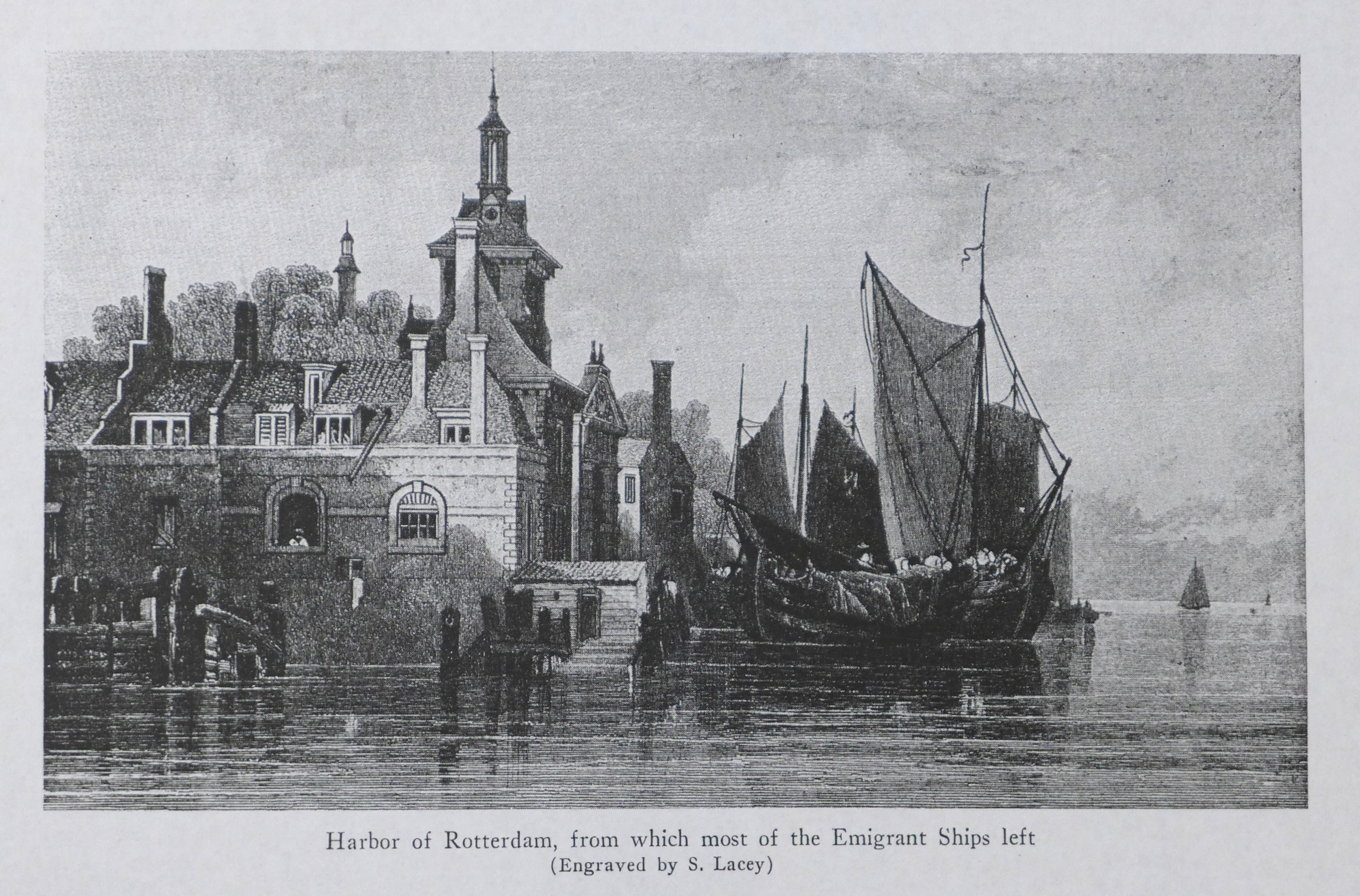
If you have been following this saga we left the Martin and Magaretha MOSER family in Rotterdam about to board a ship to America. The year is 1728. Martin is 35 and Margaretha 37. I failed to mention that Martin’s half brother, son of his father’s second wife, Elisabetha WOLLINGER, accompanied Martin on their voyage. Johan Adam MOSER was 27 at the time of the sailing and as far as we know single. He would have provided an extra set of hands on the long journey.
THE SAILING
Sailing from Holland to Philadelphia could take eight to ten weeks. There are three ships that leave Rotterdam for America in 1728; The ‘Mortonhouse’ which took 70 days (10 weeks), the ‘Albany’ that took 75 days (10 weeks 5 days) and the ‘James Goodwill’ which took 89 days (12 weeks, 5 days). Ordinarily we would know very little about what took place on the such a voyage, but we are exceedingly lucky that a diary kept by one of the passengers was found in St Paul’s library in Westphalia and later at the University of Munster. In 1729 a pamphlet was put together from several missives/diaries wherein it describes the journey from Rotterdam to Philadelphia. The author is unknown but the compiler notes that he is a man of education, devout and concerned. I cannot know for sure, but wonder if the Reverend Caspar Stöver may have been the author. The translation was published by Julius F Sachse in Lancaster, PA in 1909 titled Diary of a Voyage: Rotterdam to Pennsylvania 1728. I highly recommend reading it.
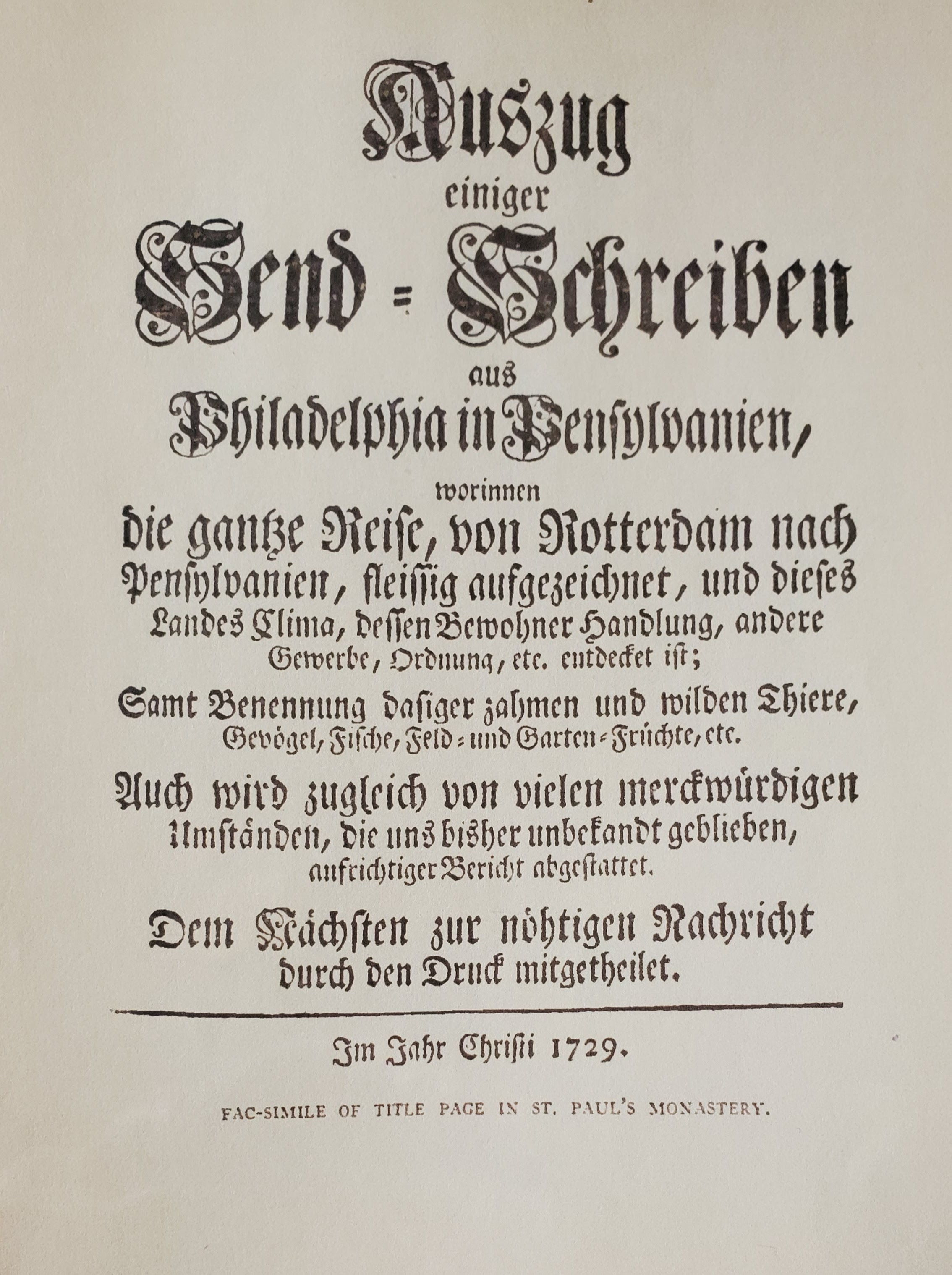
Because of the length of the voyage as described in the pamphlet and the dates of departure and of arrival I believe this chronicles the voyage of the ‘James Goodwill’. Even if I am not correct it gives the reader an excellent view of what was involved in crossing the Atlantic in 1728. It took the ‘James Goodwill” two weeks or two weeks and five days longer to arrive than the two other vessels arriving from Rotterdam this year. Please note the pilot had a habit of running aground —on account of never being sober! A few quotes:
“Our voyage to Pennsylvania was appointed for the ninth of June. But our departure was delayed until the fifteenth, when we set sail from Rotterdam, having however an unfavorable wind. After sailing about an hour and a half we had the misfortune to break our Iron Rudder-gaff, through the carelessness of the Pilot, who ran the ship aground, under full sail, whereby our second helmsman, who was at the tiller was badly hurt at his foot. So we had to cast our anchor and send the broken Gaff back to Rotterdam for repairs. on the afternoon of the sixteenth we again set our sails but on account of the contrary wind….we had again to drop anchor…On the afternoon of the seventeenth, we again weighed our anchor, but after sailing about half an hour, we once more were fast upon the sand, by the carelessness if our almost never sober pilot. ” p 8
“On the 21st we started early and sailed well during the day. At night we anchored. Early on the morning of the 24th we sighted the Dover cliffs, and about 9 o’clock in the morning passed Dover.” p 9
However, ever at the mercy of the weather it took another 6 days to arrive at Plymouth Harbor.

“After an inspection of our vessel, which resulted favorably we sailed out of Plymouth Harbor on July 8, but on account of contrary winds were obliged to come to anchor on a very dangerous spot, with perilous cliffs upon both sides. Here we remained until the 11th, if where in the meantime a storm would have arisen, we would have been in the greatest peril. The merciful God, however prevented it, and we sailed off this dangerous hole on the 11th with a very favorable breeze. The same day we passed the end of England, and entered upon the great ocean, having favorable wind until the 17th when we sighted two English ships coming from Livorno and Gibraltar, who brought is news that the Saraeen pirates has broken their treaty with England, and had equipped several vessels and sent them out to sea, with orders to capture all Christian ships with which they should meet.” p9
The account chronicles the good and bad days at sea. By August 31st they were 78 miles from New York and by September 3rd had sighted the coast of America and made there way to Delaware Bay where more treacherous sand bars awaited them.
“During the storm a heavy rain fell, so I remained in my bed, particularly on account of the horrid motion of the ship. One could neither walk nor stand, but would stagger like a drunkard.” p12
By this time they were near Philadelphia but unable to get ashore. The captain sent 3 sailors and the chief mate to secure a pilot but they did not return. The next days were full of contrary winds and on the 6th and 7th a terrible storm. Finally without a pilot or sailors:
“On the 11th our captain resolved to go ashore personally in the large boat to inquire about our absent crew. This was done, and upon his return with a load of cedar wood and apples, brought the truth about the missing sailors, who had been some days in the town, and gotten drunk.” p15
Perhaps some additional excerpts from the diary are to be noted. It really gives insight into conditions aboard ship.
“Concerning the other inconveniences of this journey, they consisted chiefly from the fact that the ship was packed too full, as a result there was but little room. In the cabin, which was medium size there were lodged eight persons, with much baggage and we had to content ourselves with close quarters. The ship’s food consisted of horrible salted corned meat and pork, peas, barley, groats and codfish. The drink was stinking water, in which all food was cooked….My greatest annoyance during the whole voyage were the lice, from which none aboard were free, not even the captain” p 17
It seems the voyage was a particularly bad one. Perhaps Martin and family spent some of their time during the nearly 13 weeks on board reading the bible [and praying for deliverance]. Here’s a Martin Luther bible title page printed in Nuremberg in 1717 which would have been the closest printing house to them. Perhaps they received one as a wedding gift when they were married in 1717.
1717 Nuremburg
I like to think that the children played with other children on board. There were 37 families, 42 above the age of 16 which left a total of 48 children. According to the Diary of a Voyage none who embarked died. There were 4 children born at sea and two were a set of twins who died and were buried at sea. p. 25 Margaretha was busy watching after the two toddlers and probably washing and sewing. Martin I like to think was at his craft. Maybe earning a bit of money making shoes for those aboard ship. I do not know what his brother Adam’s occupation was.
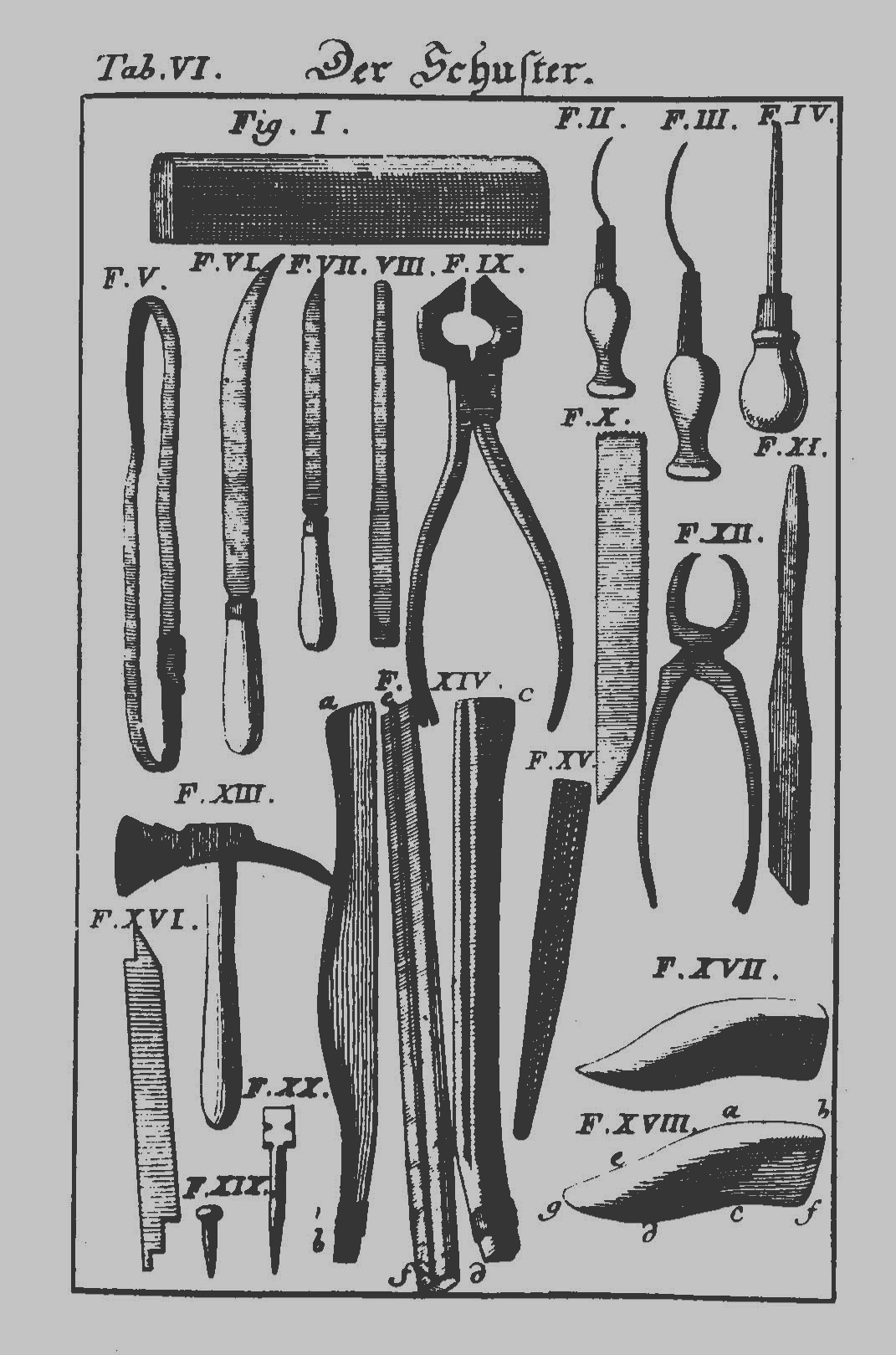
The Lutheran Revered Caspar STÖVER and his apprentice minister son would have done their best to tend to their flock. It has been stated that his son often preached on Sunday’s aboard ship. Back to the author who probably expressed the feelings of all:
“Now I am here, and rejoice over my deliverance from the dangerous element of water, and am upon dry land. But this I must and will frankly acknowledge, that if I was still in B—-[Berlin?] or any other place in Europe, I would never undertake this journey, even if there should be there a veritable, or in fact a terrestrial Paradise, as a certain person wrote in his lying and deceitful letters from here to various places in Germany.” p.17
THE ARRIVAL
The author writes that even if you could not afford passage their were people to pay your fare:
“Such persons, especially unmarried ones, can undertake the journey without money. The ship captians take them along, and when they land here, there are enough people found, who are willing to pay for the passage (ordinarilly six pistoles) of such persons and who then according to the laws of this country must serve their masters for four years. The master of such servants is bound at the end of the term to give the servant a suit of
Sunday and ordinary clothes, together with a new axe and hoe.” p19
Apparently some of the passengers of the “James Goodwill” owed Captain CROCKATT money as this advertisement suggests :
“Those Palatines who have hitherto neglected to pay for their passage in the Ship James Goodwill, are to take Notice; that if they do not pay me onboard said Ship, or to Charles Read of Philadelphia, the sum from them respectively due, the 20th day of this instant November, they will be proceeded against to Law, by David Crokatt.”
“The American Weekly Mercury” Philadelphia 7 November, 1728
From the Arrival List 8A: the Mens Names above 16 years old aboard the James Goodwill, M David CROKATT, Commander, from Rotterdam to Philadelphia in Pennsylvania, arrived the 11 September 1728. Thirty seven families produces Forty Two persons above 16 Years. [This could be the same as the David CROKATT, great-grandfather of Davy Crockett.]
From the Minutes of the Provincial Council, printed in Colonial Records Vol. III p. 331.
Dav’d Crokatt.
“At a Council held in the Courthouse of Philadelphia,
Septem’ber 11th, 1728. . . . A List was presented of the Names
of Forty two Palatines, who with their Families, making in all
about Ninety persons, were imported here in the Ship James
Goodwill, David Crockat, Master from Rotterdam, but last
from Deal, as by Clearance from the officers of the Customs
there, bearing Date the Fifteenth day of June, 1728.”
PHILADELPHIA
Below is a painting from 1718 and an etching that illustrates the development 38 years later. The MOSERs arrived early on. The population of Philadelphia in 1730 was about 11,500. At the beginning of the 18th century must homes were built of logs or wood frame but by the end of the century they were being replaced by stone and brick.

Courtesy Library Company of Philadelphia

courtesy Philadelphia Museum of Art
The pamphlet has quite a bit to say about the author’s view of Philadelphia.
The city of Philadelphia, upon the whole, is right decently laid out, and already pretty well built up, and much business is done there. Wine is very dear, tea also —Five Rix dollars for a pound of a very bad sort—tea (Bohia), coffee beans… Sugar such as is bought in Berlin for six Groschen, costs here twelve Groschen. —Summa—Everything here is dreadful dear. Meat is still the best bargain here, with price about the same as in Berlin. Bread, rent and wood are dreadful dear. As to drink, water is the cheapest thing here and extraordinary good. The strong beer that is brewed in Philadelphia is very good, but not for me. The cider or applewine is rarely found good. Molasses beer, which is chiefly drank in the country, is an exceedingly pleasant and thirst quenching beverage, which tastes better to me than the pure water. This beer is composed of water, syrup and hops, together with some wheat bran. In this country far more wheat is grown than rye, and wheat-bread is eaten in almost all places.” p22-23
The author complains about the weather, mice, the price of goods and the poor quality of most of the dwellings. He talks about game, trees and lumber at some length. But this kernel sums it up nicely:
O these liars! who in their glowing well-written and printed missives send us such glowing accounts about the climate of this country and other things all described so beautiful and paradisical, which deceived so many hundred people—even me I would not like to share their just reward.” p23-24
A German printer in Philadelphia, Christopher SAUR, published the first German bible in America. Soon a third of the population in Pennsylvania was Swiss or German. In 1732, Benjamin FRANKLIN published Die Philadelphische Zeitung—the first foreign-language newspaper in America. German emphasis on education and literacy provided a market for newspapers, books and almanacs that kept the German community together and well informed.
In the next chapter we will find out where Johan Martin MOSER and family settled in Pennsylvania and how it all ties together with William PENN, Daniel FALCKNER and Reverend Caspar STÖEVER.
Kelly Wheaton ©2024 – All Rights Reserved
German Migration to America: Johan Martin MOSER 1693-c.1743 Part Two
Posted on January 8, 2024 4 Comments
If you haven’t read Part one you can read it here. In this chapter we will explore the beginnings of Martin MOSER’S family life and what led him and tens of thousands of others to leave Germany behind.
In the year 1677 William Penn toured Germany where he spread the message that religious freedom could be found in the American colonies. A couple decades later Daniel Falckner wrote “Curious News from Pennsylvania” [Curieuse Nachricht von Pennsylvania] in 1702. Germany’s Johannes Gutenberg invented movable type in 1440. With a long history of printed materials from flyers to books to bibles people were educated and generally well informed.
Martin MOSER’s two older sisters Anna Marie and Eva both married in 1705. Anna Marie married Micheal FRIEDRICH, a shoemaker, and Eva married Lorenz ZWIRNER, the journeyman weaver. As previously mentioned Martin’s mother Maria STRÖBEL MOSER died in 1695 when Martin was two years old and he was raised by his step-mother Elisabeth WOLLINGER. Sadly, in January of 1714 she died. Left at home was Martin’s older brother, also a journeyman weaver, and the four surviving children, ages 7 to 18, of his father Adam and Elisabetha. I suspect it was around this time that Martin struck out on his own. His brother remained on the farm at Grossulrichshausen. In November of 1714 his father Adam marries for the third time to Apollonia GERINGER.
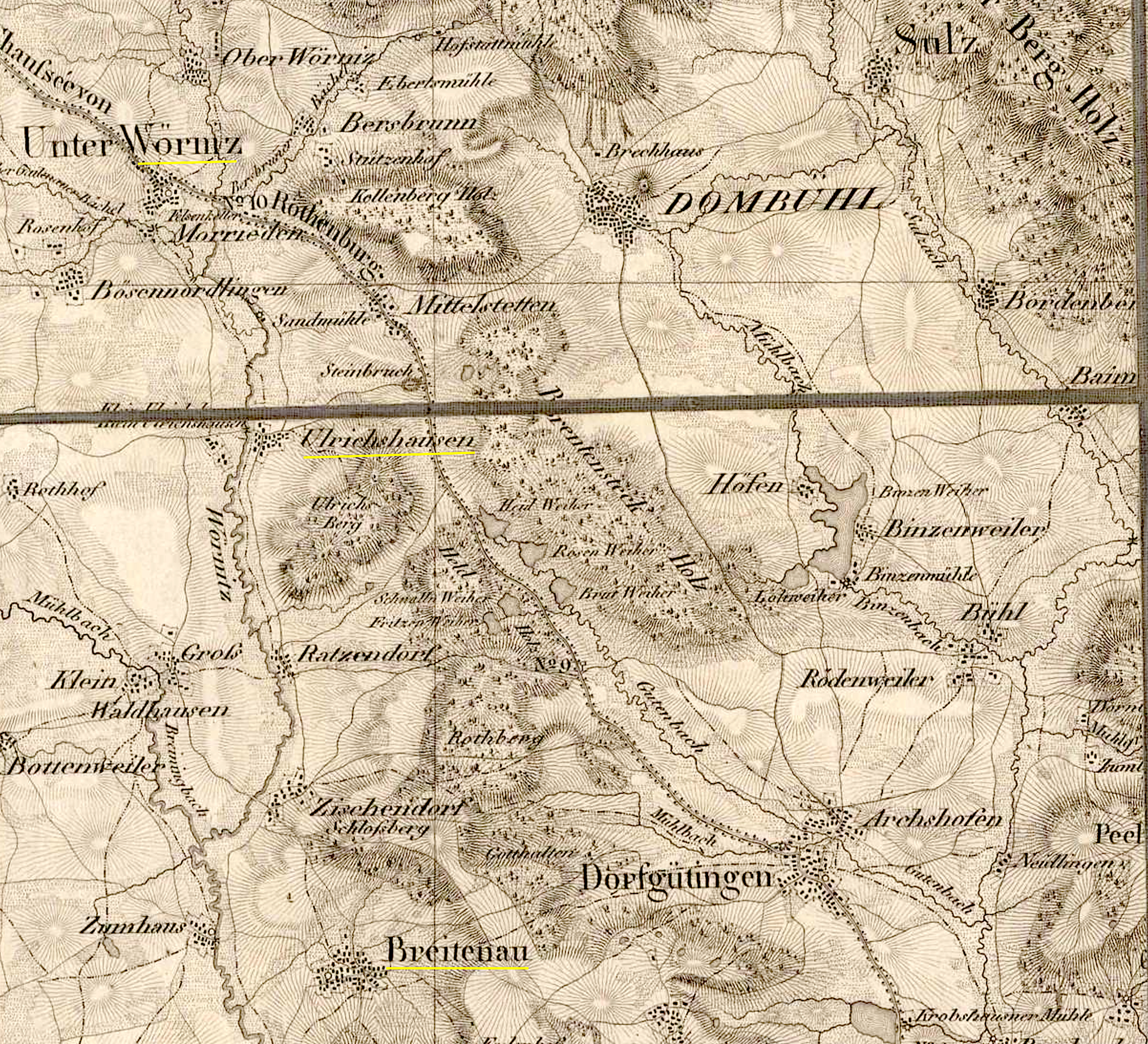
BREITENAU

Sometime between 1713-1717 Johan Martin MOSER moves to the village of Breitenau. Breitenau lies in the Ansbach district of Feuchtwangen about 4.5 miles south of Wörnitz, where Martin was baptized, and even closer to Grossulrichshausen, where he was born. The village is located in a valley to the east of the Wörnitz river. Breitenau sits between two wooded hills. Schloßberg to the north and Mühlberg to the south, each approximately 1700 feet high. The area is surrounded by grassland, arable land and scattered trees. In 1732 there were 32 properties that belonged to the Lord. These included the church, the parsonage, schoolhouse, village hall, a farm with a Inn, a farm with brewing rights, a blacksmith, a baking house and two half farms. It appears that Breitenau at this time was slightly larger than Wörntiz. A good guess is that Breitenau was in need of a shoemaker. A description of Breitenau from 1761:
“Braitenau. A mediocre village located in the district of the Feuchtwang, close to the Wörnis [Wörnitz River] and the Rotenburgische Landwehr, in which there is a parish, church and school incorporated into the Feuchtwang deanery, and a good number of residents. This place formerly belonged to the aristocratic and later imperial family of von Geyer, after its extinction in 1708, it fell to King Frederick I in Prussia, was then handed over by King Frederick William’s Majesty in 1729 to the High Princely House of Brandenburg Onolzbach… even up until the year 1728, the place had no grave field of its own for burying the dead…”
Historische und Topographische Nachricht von dem Fürstenthum Brandenburg-Onolzbach
by Gottfried Stieber 1761
Well perhaps Breitenau was mediocre then but to my eyes it was lovely as the last place my MOSERs lived before their immigration to America. This is a photo of the Schoolhouse adjacent the church.

We know for certain that Martin MOSER was living in Breitenau by 1717 as it is listed as his place of residence when he marries Margaretha SCHWENBAUER, the daughter of Wolf and Eva SCHWENBAUER, the 29th of June 1717 at the age of 24. Margaretha was born 13 Sept 1690 in Breitenau, so she was 26. Her father died when she was five, the 24th November 1695 at Gehrenberg [the next village east of Breitenau]. A transcription of the marriage entry has this wonderful description:
“The hardworking bachelor Martin Moser, his trade is shoemaker, son of the Honorable Adam Moser peasant and farmer in Grossulrichshausen and Margaretha, legitimate daughter of the Honorable Wolf Schwenbauer, in Breitenau, the Latin having [been] proclaimed three times.”
St Stephan Churchbooks

at Wörnitz

(Mirror of Human Activities.)

The Lutheran church of St. Stephens in the Breitenau, Feuchtwangen district dates from the 14th century. The chancel and tower of the church were rebuilt at the end of the 15th century. The nave was extended at the beginning of the 18th century. The cemetery, is right next to the church and is surrounded by a wall [left in this photo above and just visible behind the wall] . The church is located on the site of the former Breitenau Castle. In the distance of this photo you can see the wooded Schloßberg. The inside and outside of this church is quite lovely. Note the painting of Martin Luther above the raised pulpit.
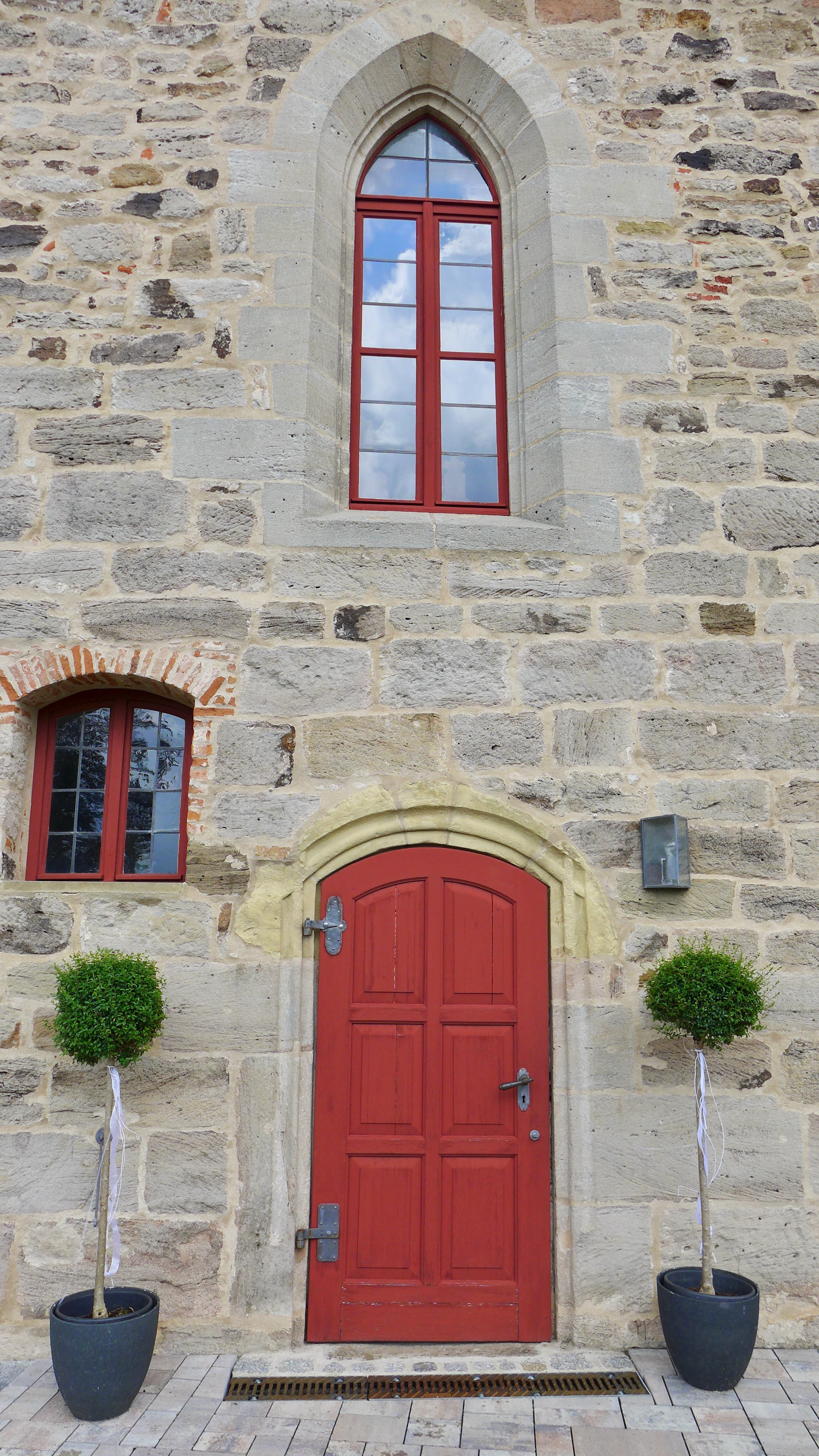
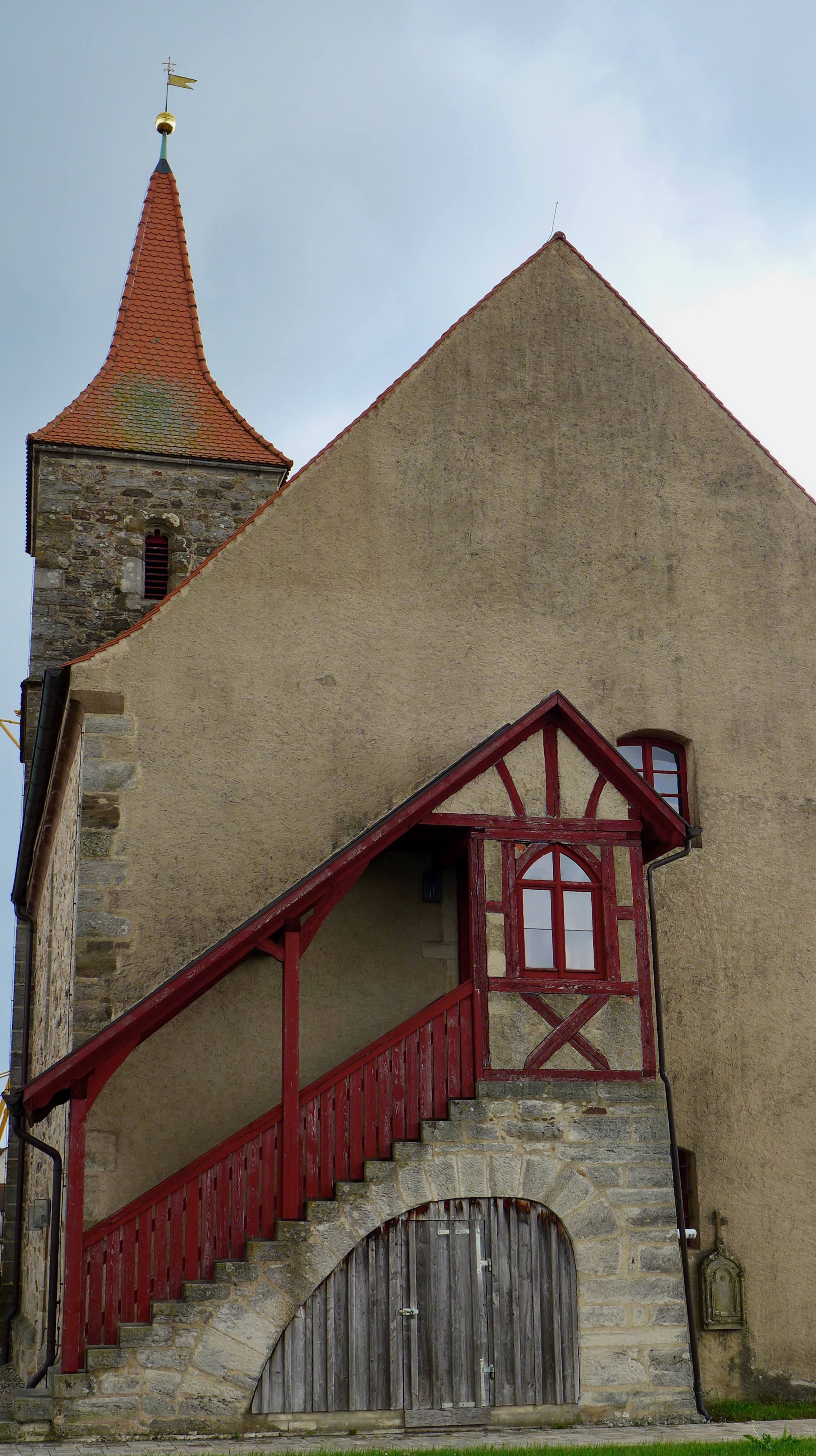

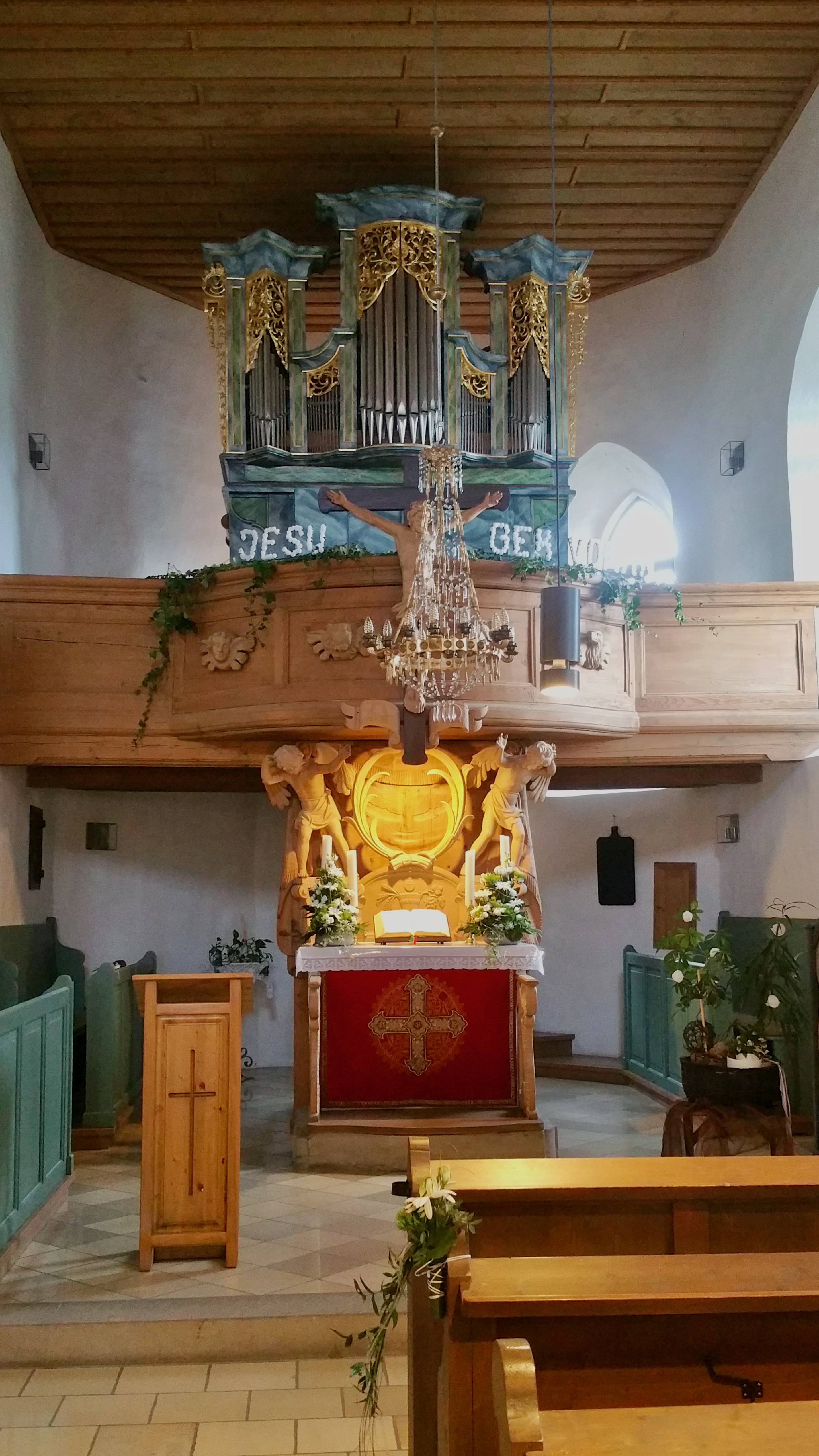
I imagine Martin and Margaretha worshiping here and bringing their children to be baptized [See Baptismal font below]. Their first child was Maria Magdalena MOSER who was born 15th of March 1717 but died 28th of August 1718. She was followed by an unnamed child in 1719. So Martin and Margaretha had much tragedy in startinga family. Finally Maria Margaretha was born on the 7th of June of 1720. But sadness again visits the family when a few weeks later Margaretha’s mother Eva dies and is buried at Breitenau the 9th of September 1719. Just a month later Martin’s father, Adam MOSER, dies the 8th of August dies at the age of 66 years and 10 months at Grossulrichshausen. A lot of loss in the first two years of marriage. I wonder if this was a turning point—with no living parents of either Martin or Margaretha did they begin to dream of a different life on a distant shore. How long would it take to plan and save for their passage?
The next birth to Martin and Margaretha was my 5th great grandfather, Georg FRIEDICH “Frederick” MOSER, baptized the 3rd of March 1722. Three more children follow: Maria Barbara born 12 Dec 1723. Anna Margaretha MOSER and a twin are born on March 1st 1726 . The twin dies and only Anna Margaretha is baptized on March 27th and a year later Johann Leonhard MOSER born 29 May 1727 all at Breitenau. So by 1727 there are 5 living children and Martin and Margaretha as they celebrate their 10th wedding anniversary. Interesting that Johan Leonhard MOSER is also the name of Martin’s brother who was born 12 January 1710 at Grossulrichshausen. So named after his uncle these shared names were to create confusion in America as to who belonged to whom.
On the day we visited the church was beautifully decorated for Confirmation.
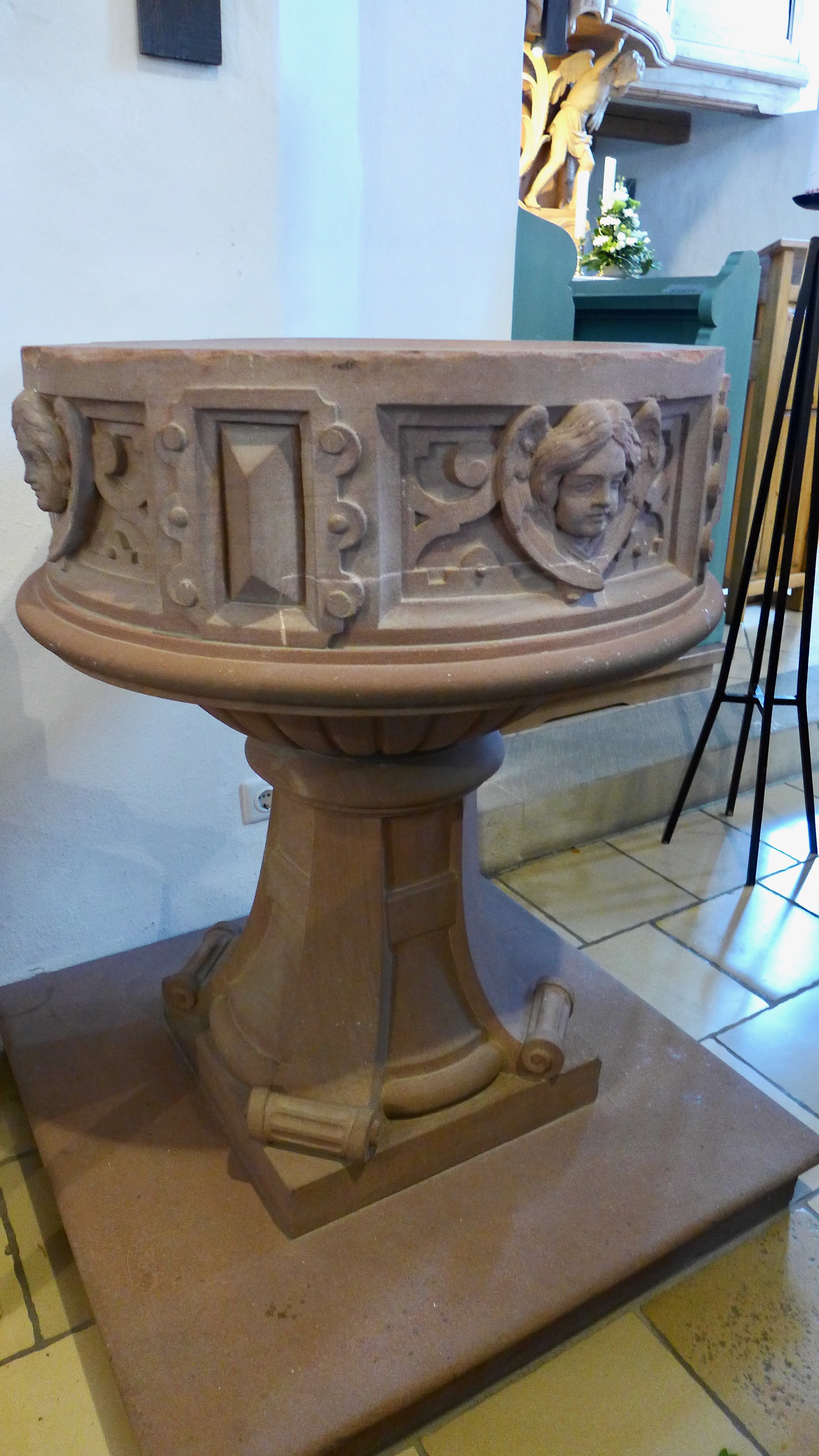
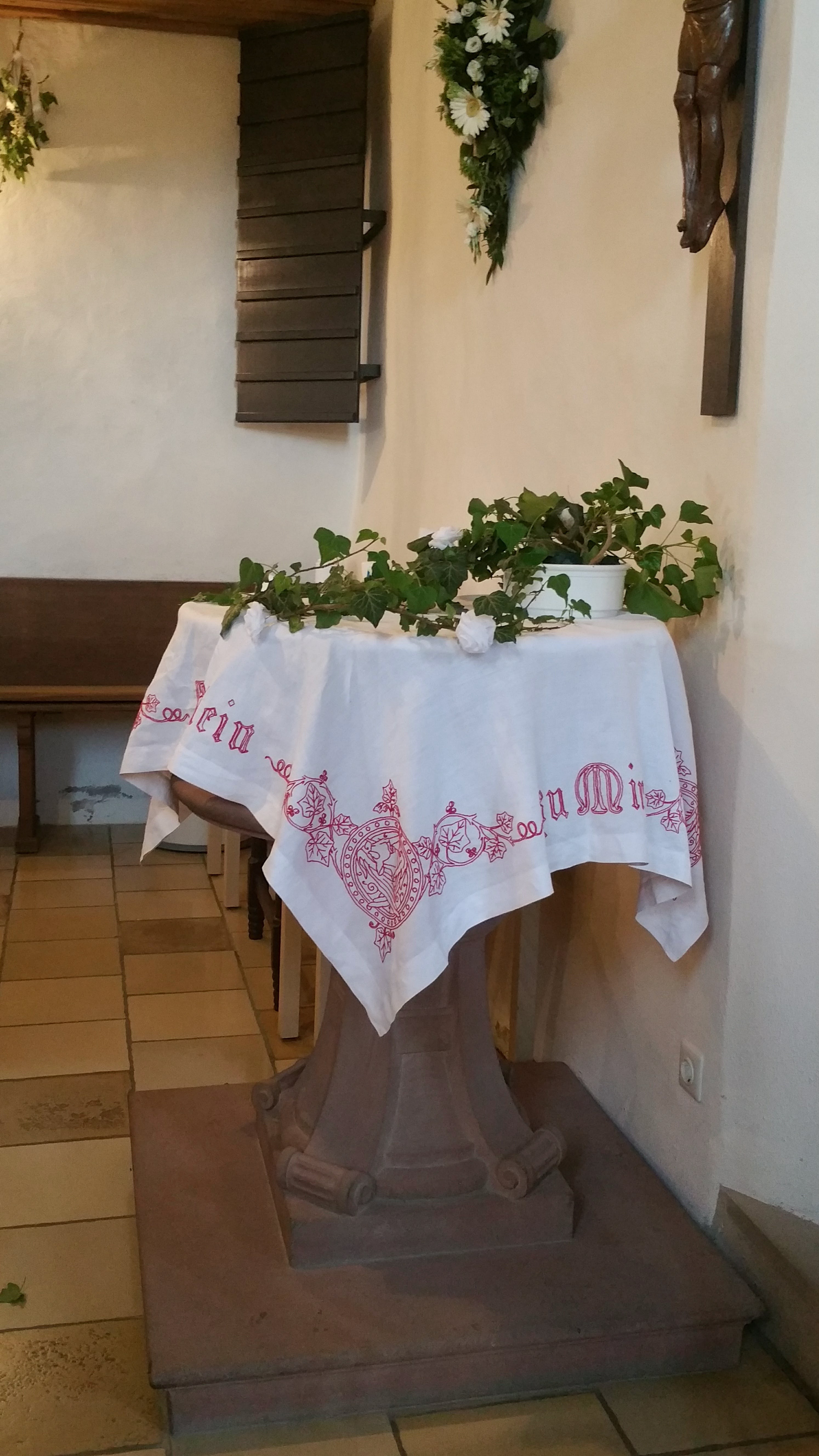

I was struck by this old pews at St Stephens, especially thinking the MOSER family may have sat right here where I was sitting. The seats were not very deep and quite hard. No falling asleep allowed during the service.

IMMIGRATION TO AMERICA
It is important to remember that in Germany land was owned by nobles and only leased by the peasantry. Both inexpensive land and religious freedom lured many German immigrants to America’s shores. As I mentioned in the first Part we have the Accurate Tidings from Pennsylvania book published by Daniel Falckner in 1703. We can only guess at what made the Martin MOSER family risk the arduous journey to America. Likely it was like most changes people make a combination of desire for something more and opportunity. While researching I happened upon a bit of serendipity. In 1724 a Johan Martin WEIGEL traveled from Hoffenheim near Sinsheim to Wörnitz for a carpentry apprenticeship. That seemed odd to me that someone would travel 75 miles for an apprenticeship. Three years later in 1727 five ships left Rotterdam for Philadelphia with approximately 1200 German immigrants. One ship was the ‘James Goodwill’ with about 200 passengers.
The following year the same ‘James Goodwill’ sailed again from Rotterdam to Philadelphia. What is curious is that at least a dozen of the families on board the 1728 sailing came from the area around Sinsheim, Germany. The same area as Johan Martin WEIGEL was from, 75 miles west of Breitenau. No other families that appear on the ship’s passenger list are associated with Breitenau or any surrounding village. The only reference that connects is that of Johan Martin WEIGEL. It makes one wonder…if it was just a series of word of mouth that brought the MOSER family to be on that second sailing.
We can only imagine what that trip was like. Leaving the small village of Breitenau of maybe a couple hundred people. My best guess is that the MOSER family traveled westward from Breitenau to Sinsheim perhaps by ox and cart or wagon. A 95 mile trek. Perhaps from there, led by Johan Caspar STÖVER a Lutheran minister, they traveled with a group of families who would sail together and settle in Pennsylvania. From there they may have continued to head due west for the Rhine River at Speyer. The Rhine was called ‘The River of Destiny’ as so many started their journey abroad here. Once on the Rhine they would have traveled by boat to Rotterdam. The MOSER family consisted of Martin and Margaretha, little Maria Margaretha age 7, Frederich age 6, Maria Barbara age 5, Anna Margaretha age 2 and Johan Leonhard 1. Perhaps they carried several trunks; one with Martin’s shoemaking tools and maybe some leather goods to keep him busy on the trip. Another with household supplies and books and another with clothing. I imagine their family bible and perhaps a copy of Accurate Tidings from Pennsylvania. What treasures would they take and what had they sold and left behind?
The Rhine River is dotted with dozens of castles. Martin and Margaretha and their children must have been gobsmacked by the views, city-scapes and castles. Imagine this view at Mainz when you have come from a small village. This anonymous etching is from 1633, so imagine it nearly 100 years later in 1728. Under good conditions, the approximately 350 miles trip down the Rhine would have taken four or five days however, there were as as thrity toll stations that belonged to the lords of each of the castles.
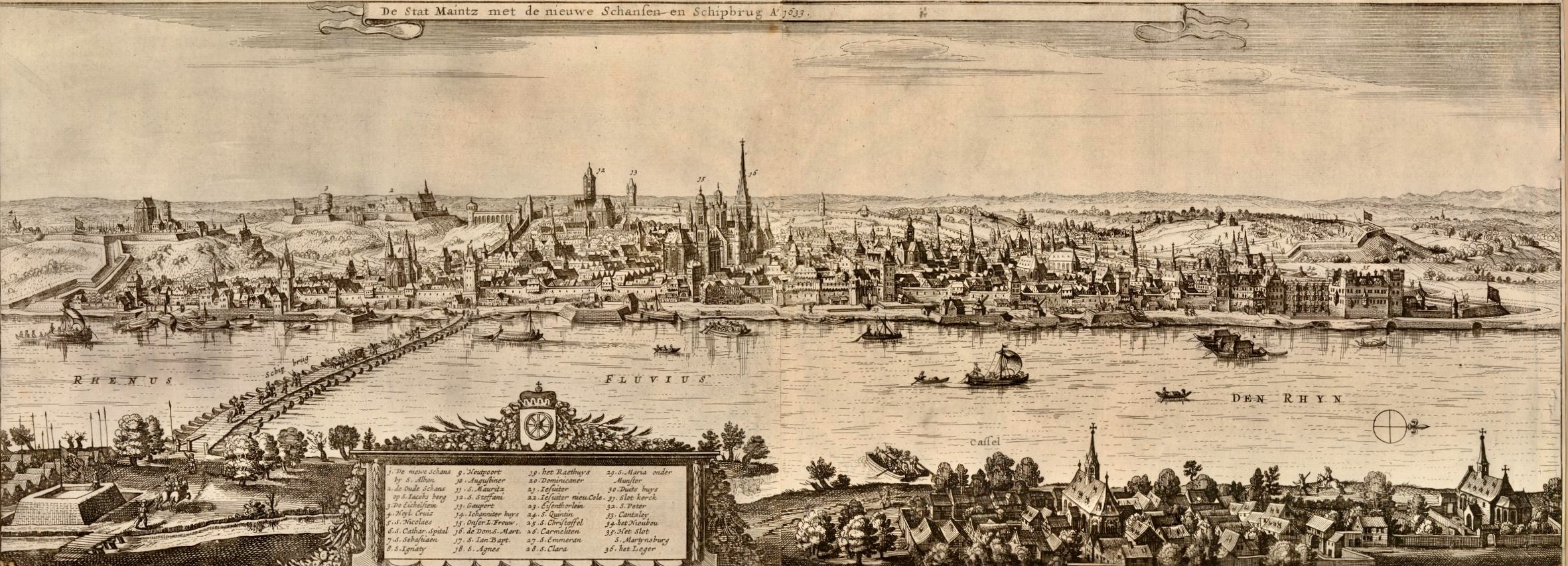
Just a little bit north a more contemporary view form 1700 [they traveled in 1728]. The scene would probably be quite similar. They likely would have traveled in a smaller boat, like one of these pictured, hired to take them to Rotterdam.

© The Trustees of the British Museum

Once they reached Rotterdam would they have found lodging while securing their passage? Perhaps the experience Reverend Stöver guided them safely through the chaos. They made there way aboard the ‘James Goodwill’ and received customs clearance at Rotterdam the 15th of June 1728. There were about 90 passengers. Johan Caspar STÖVER and his son of the same name top the list of passengers as does Martin MOSER on the 1728 sailing of the ‘James Goodwill’. In the next chapter we will explore the Atlantic crossing and arrival in Philadelphia.

Showing [Rev.] Johan Caspar Stöver Senior & Jr [left] Martin MOSER’s signature [right]
Kelly Wheaton ©2024 All Rights Reserved
German Migration to America: Johan Martin MOSER 1693-c.1743 Part One
Posted on January 6, 2024 3 Comments
This is the story of one of my many German ancestors. If he isn’t one of your ancestors this may not be of interest to you on it’s face. But if you have German ancestors who immigrated in the first half of the 18th century, there may be some things that you will want to add to your own story. Like many of the migrants from Europe to America they were heavily influenced by the stories of those who had made the trek and lived to write about it.
Although I had put together a genealogy in 2015 when you shift from writing a genealogy to writing a story—many new things come to light. Please take note that a Genealogy is not the same as a biography or family history. The latter gives more historical context and deeper research brings to life a much richer story. First off, we must note that there was no country of Germany during this period it was composed of duchies, independent states, or kingdoms. It was generally believed that God pre-ordained your station in life, so there was no possibility of upward mobility. The nobles protected, the clergy prayed, and the peasants worked. The reforms that Martin Luther brought led to the deep divisions between Catholics and Protestants. Do not underestimate the power of religion in a peasant’s daily life and as a means of upward mobility and its influence on immigration.
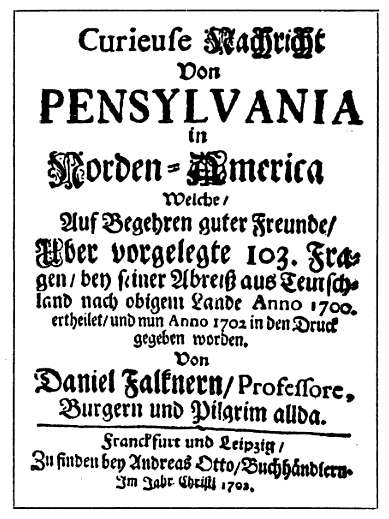
by Daniel Falckner 1703
When Johan Martin MOSER was just a year old he was living on a farm in Grossulrichshausen, Bavaria, Germany, Daniel FALCKNER, a professor and son of a Lutheran minister [also named Daniel FALCKNER] arrived in Philadelphia the 23rd of June 1694. He returned to Europe in 1698 where his book Accurate Tidings from Pennsylvania was published. He wrote for potential immigrants about what they might find in America via a series of 103 Questions.
The questions are incredibly insightful and here are a few:
- 1 How to contrive a voyage to America.
- 7 What is to be observed concerning ship and seasickness.
- 9 What is to be observed upon arrival in Virginia or Pennsylvania.
- 14 Regarding the fertility of the country.
- 17 Of the savages, their nations, numbers and languages.
- 32 How is it supposed that the savages came to America and in particular the different nations.
- 53 Whether all kinds of artisans cannot find subsistence there, and which in particular.
- 63 What kind of animals are there, both domestic and wild?
- 68 How to develop the country and bring about its proper uses and advantages.
- 86 To whom must one first report upon his arrival to America?
- 102 What manner of names do the savages have?
The answers to each question very between a paragraph and a page or so. They are full of piety and amusing reflections in the context of the time. Here is the first sentence in answer to Question 7: “Sea-sickness mostly affects people of bilious disposition and such as are inclined to vertigo and fear.” Question 63 begins: “With some exceptions, just the same as with us here. Among the exceptions is the jackass, which would be very useful there.” These books gave very practical advice and information and were to have a profound impact on the immigration of Germans and particularly Lutherans to Pennsylvania. I highly recommend perusing it.
GROSSULRICHSHAUSEN

Meanwhile in the hamlet of Grossulrichshausen, then in Mittlefranken [Middle Franconia] now Bavaria, Johan Martin MOSER was the seventh child, and 4th son, born to Adam MOSER and his wife Maria STRÖBEL. At the time of his birth Martin’s eldest brother, Adam, had already died. After Adam all the sons were named first Johan and a middle name which was generally the name by which they were known, so for sake of clarity I will refer to Johan Martin as Martin. His father, Adam MOSER, was a peasant farmer and shoemaker by trade. The family had recently moved from Altengrueth to Grossulrichshausen and the closest parish was Wörnitz, hardly a mile away. [Gross = large; Ulrich is likely the name of the farm or family and Hausen the Residence or House] This is a lovely rural setting with just a small cluster of farm buildings and houses. The field in the photo above was full of beautiful wildflowers when we visited.
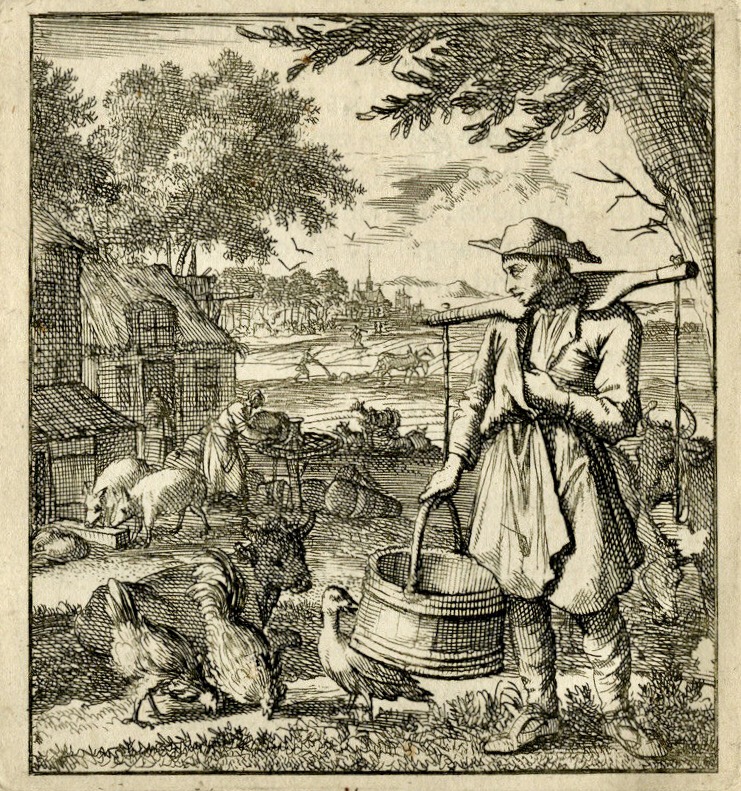
When Martin was just two years old his mother died, the 15th of January 1695, leaving his father with six children. By May his father had remarried to Elisabetha WOLLINGER. To this marriage another five children were born between 1696 and 1707. Tragedy struck again in January of 1714 when his step-mother Elisabetha died. By this time Martin had just turned 21 and may not have been living on the farm. Later that year his father married for the third time to Apollonia GELLINGER the 6th of November 1714. At the time of this marriage Adam had ten children but some had already married. Apollonia was to give Adam 3 more children but only one survived more than a month. In total Adam sired 16 children by 3 wives over a period of 45 years!
WÖRNITZ
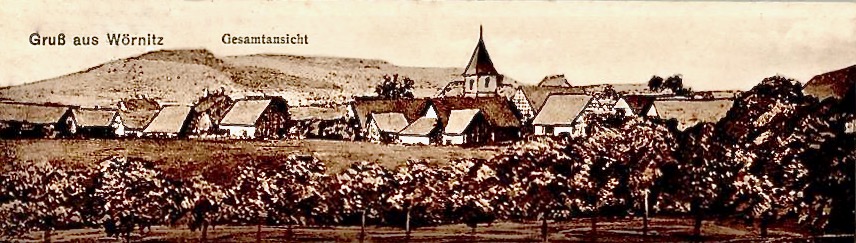
The Village of Wörnitz lies next to the river of the same name. The River Wörnitz begins at Schillingsfurst, 6 miles north of Wörnitz and then heads south 55 miles to Donauwörth where it meets the Danube River. There was a St. Martin’s chapel in Wörnitz as early as 741 and a chapel in 1392 which was later made into a fortified church. The oldest parts of the existing church are the choir room and bell tower which dates to 1519. From 1520 services held here were in the protestant rite [Lutheran]. During the Thirty Years War (1618-1648) the whole of the town burned except for the church, the rectory and the schoolhouse. Note at this early date that there was a schoolhouse! Martin Luther had been a proponent of early education. So David Falckner’s book may have been available at the schoolhouse where Martin was an educated.


Besides life on the farm much of Martin’s early life would have been centered around the church. It was here that he, Johan Martin MOSER, was baptized the 10th of January, 1693, perhaps named for the patron of the church St Martin or Martin Luther for whom Lutherans are named. Martin Luther was never canonized as his calls for reform got him excommunicated from the Catholic Church. Whereas, St. Martin of Tours died the 8th of November in 397 and his feast is celebrated as St. Martin’s day in Germany. It marks the end of the harvest season and the start of winter and the “reveling season.” St. Martin of Tours is known for his mercy, kindness and helping those most in need. Martin was the first of Adam’s children to be baptized here at St. Martins.


The Church was updated in 1709 when Martin was sixteen. The interior of the church was lengthened, widened and the height was raised perhaps to accommodate a growing population. The stones for the renovation came from a high defensive wall that was said to cast too much shadow on the church. New Baroque windows were installed on the north side, where the south gothic windows remained [as pictured above]. I can imagine the young Martin gazing at the sky and watching the Linden leaves dancing in the breeze.
WÖRNITZ LINDEN TREE
“[The] Linden will connect you to your roots, ancestry, your place of being.”
Andre Cullen
I simply must take a moment to tell you more about the center of life in Wörnitz. It is so important to the village that it appears on their Coat of Arms. To the west of St Martins church is a large Linden tree [Tilia cordata] and its history is worth repeating. The original Linden tree was planted the 10th of March 1653 in part to commemorate the end of the thirty years war. Six months later Adam MOSER was born and baptized in Weißenkirchberg about 6 miles to the east of Wörnitz. When Adam settled in Grossulrichshausen probably about 1692 the linden tree was nearly 40 years old. The original tree lived to be 308 years old!
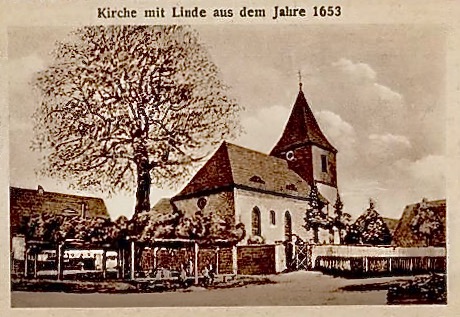
On the first of June 1961 lightening struck the tree. An offshoot of the tree was planted the 30th of April 1962. When I stood there in May of 2018 this replacement tree was 46 years old. [click on photos for more detail]


Today this tree is huge and spreading. As you can see there is seating around the perimeter of the canopy. In Celtic and Germanic culture the motherly goddess, Freyja, is associated with love, fidelity, friendship, peace, justice, altruism, fertility and prosperity and the Linden tree. It was also believed to ward of evil spirits including lightening strikes. Perhaps we can say the tree sacrificed itself for that of the church. Later the Linden tree was associated with Mary the mother of Jesus. Linden Trees are found in central locations in many German Villages. Townspeople would assemble beneath the Linden tree to celebrate, dance or hold important meetings. Under the Linden tree it was believed that one could only speak the truth. This is where lovers pledged their love, disagreements were settled and important occasions marked. In some places there were dance floors erected under the Linden Tree. Can’t you just imagine Martin chasing his siblings around the tree? His older sisters Anna Maria and Eva both married here in 1705, was young Martin a witness to their courtship under the tree? You can imagine the villagers congregating after Baptisms. Marriage and funerals as well as after weekly worship.

The sweet smell of Linden blossoms perfumed the air on the day I was there and they are a rich source of nectar for bees. Linden honey is said to be good for fevers and colds and for lowering blood pressure. Did Martin or his father keep bees on the farm? Or did they buy honey from a apiary in the village?

c. 1730 titled “As long as it lasts”
SHOEMAKER
We can only construe a life from the scant circumstances in the historical record. What we do know is that Martin MOSER grew up on the farm of his birth in Grossulrichshausen and that he was baptized at St Martin’s Wörnitz. During his time in Grossulrichshausen He must have apprenticed with his father who was a shoemaker as when he marries he is listed as a shoemaker. This early print of a shoemaker would not have changed much in 150 years. It was a valuable trade that did not require many tools. The shoemaker was an integral part of the community for whether you were a farmer, clergy or a nobleman everyone needed shoes.
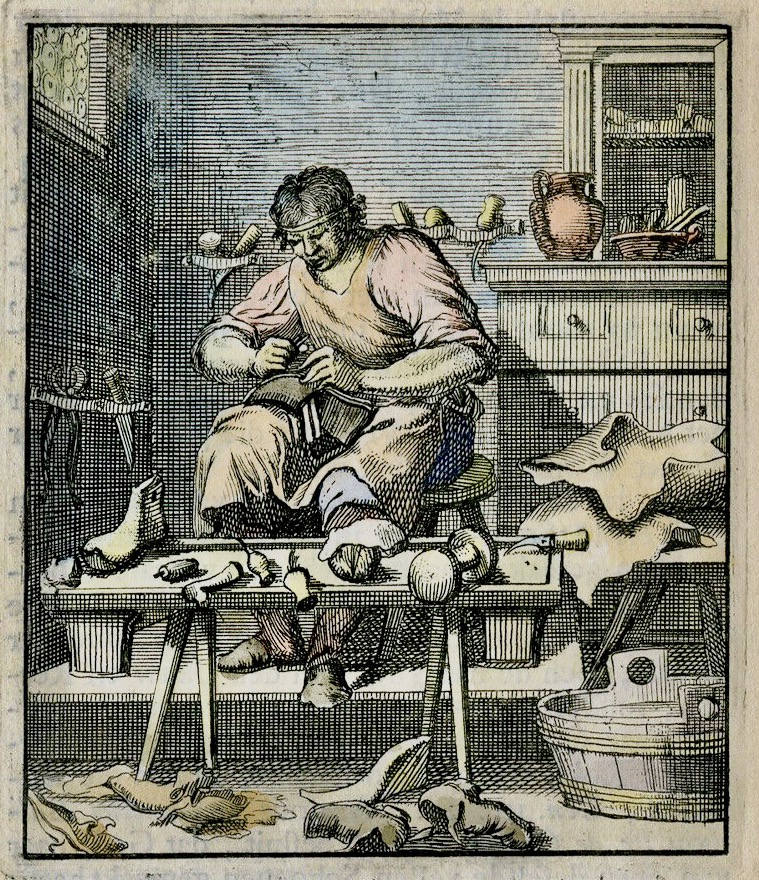
We can infer that the village of Wörnitz needed but one shoemaker and sometime between 1713-1716 Martin relocates to Breitenau about 4.5 miles south of Wörnitz and even less from Grossulrichshausen [shown on the map above]. We will take up our next chapter in Breitenau and why Martin would trade a seemingly idyllic life in Germany for the wilds of America.
I hope this gives you a some ideas to search for the context of your German immigrant’s life.
Special thanks to the the Gerling family and my friend Denise for making the trip I took possible.
Kelly Wheaton ©2024 – All Rights Reserved
 Wheaton Wood