The Three Brothers Story, Retold: Johan Martin MOSER
Posted on January 5, 2024 8 Comments
The “Three Brothers Story” is so prevalent in Family History Circles that it is often recounted smugly by experienced genealogists as a sign of family mythology. Some of you know my contrarian nature causes me to poke holes in establishment edicts. Nowhere is that more fun than with my own “Three Brothers Story.” More on that shortly.
In the Beginning
Johan Martin MOSER (1693-c1643) is my immigrant ancestor from Germany or was it France? I first learned about him in the 1970’s with the help of Charles Recker’s newsletter about MOSIER- MOSER families called “The People of the Marsh.” From there I got in touch with Lee MOSIER, who at the time of our first correspondence lived in Las Vegas but later returned to his home town of Carmen, Oklahoma. At the time of this correspondence there were dozens of MOSERs who believed their MOSER ancestors were related but the family legends lacked proof. Below is an excerpt from an article in “People of the Marsh” that suggests that there were 5 MOSER brothers that immigrated from Pennsylvania to North Carolina.

As it turns out these were not all brothers but rather brothers and cousins. But this was back in 1974 and over the course of many decades, with the help of many descendants more and more pieces of the puzzle were collected and organized.
Thirty Years Later
I continued to follow research into the origins of MOSERs in Germany. In my family it was alleged that John Martin MOSER came from Alsace Lorraine, but there was no proof. In 2006 Gary MOSIER published a study “Moser of Middle Franken and Pennsylvannia, 1653-1732” based on paid German research by professional genealogists there. Some of the information in his original study was superseded by newer information. This is where the nut finally began to crack. I contacted Gary MOSIER and he wrote in answer to my question in 2006:
“There is no proof for the parentage of Johan Martin and Johan Adam [MOSER], only guesses. The ties of these guys to the ‘Adventure’ [Ship] is all circumstantial.”
Gary MOSIER 2006
Johan Martin and Johan Adam MOSER traveled to America on the ship ‘James Goodwill’ and landed at Philadelphia the 15th of June 1728. We did not know there relationship at the time of their arrival. Then on the 23rd of September 1732 several more MOSERs arrived on the ship ‘The Adventure’. It was suspected that they were all related, but how? Interestingly, Gary’s ancestor was a Johan Leonard [Leonhardt] MOSER and he was suspected to be a son of one of the brothers– but he could find no proof. Over the course of the next ten years the puzzle began to resolve and the “Three Brothers Story” exploded.
Forty Years Later: The Explosion
Gary’s persistent research eventual answers not only his question of who Johan Leonard MOSER’s parents were but also all the other MOSER’s that arrived on the ‘John Goodwill’ and the ‘Adventure’. Some of this fell into place via research by German genealogists but the key to his question he found himself when he located the baptism of Johann Leonhard MOSER 12 January 1710 in Wörnitz, Bavaria, Germany which had been overlooked by the researchers. This is also where we find the baptism of my Johan Martin MOSER 10 Jan 1693, my 6th great-grandfather. The father of Johan Martin MOSER and Johann Leonhard MOSER is Adam MOSER born 14 September 1653 in Hetzweiler and baptised at St. Wenzeslaus, Weissenkirchberg, Bavaria Germany. However they had different mothers. In fact the reason that things got so convoluted is Adam MOSER was married 3 times and sired 16 children over a period of 45 years!
| Children of Adam MOSER (1653-1720) | |||
| Mother | Date and Place of birth & baptism | Name | Notes |
| 1st Maria STROBEL m. 26 Jan 1675 | 13 Dec 1675 Hetzweiler, bpt Weissenkirchberg | 1. Hans Adam | Died 29 Oct 1693 buried Wörnitz |
| 20 Apr 1678 Altengrueth; bpt Weissenkirchberg | 2. Anna Maria | m Michel Friedrich 6 Oct 1705 Wörnitz | |
| 20 Oct 1680 Altengrueth; bpt Wörnitz | 3. Eva | m Lorenz Zwirner; Immigrated in 1732 ‘Adventure’ | |
| 24 Apr 1683 Altengrueth, bpt Weissenkirchberg | 4. Johan Georg Phillip | Immigrated in 1732 ‘Adventure’ | |
| 25 Oct 1686 Altengrueth, bpt Weissenkirchberg | 5. Maria Barbara | Died 21 Dec 1694 Wörnitz | |
| 4 Mar 1689 Altengrueth, bpt Weissenkirchberg | 6. Johan Michael | Immigrated in 1732 ‘Adventure’ | |
| Maria STROBEL. She dies 15 Jan 1695 | 10 Jan 1693 Grossulrichausen; bpt Wörnitz | 7. Johan Martin | Immigrated on ‘James Goodwill’ 1728 |
| 2nd Elisabetha WOLLINGER m. 2 May 1695 | 23 Sep 1696 Grossulrichausen; bpt Wörnitz | 8. Magdalena | |
| 29 Sep 1698 Grossulrichausen; bpt Wörnitz | 9. Tobias | Immigrated in 1832 ‘Adventure’ | |
| 21 Aug 1800 Grossulrichausen; bpt Wörnitz | 10. Johan Adam | Immigrated on ‘James Goodwill’ 1728 | |
| 28 Apr 1704 Grossulrichausen; bpt Wörnitz | 11. Johan Jacob | Died 24 Jul 1704 buried Wörnitz | |
| 2 Jan 1707 Grossulrichausen; bpt Wörnitz | 12. Christina | ||
| Elisabeth WOLLINGER died 28 Jan 1714 | 12 Jan 1710 Grossulrichausen; bpt Wörnitz | 13. Johan Leonard | Immigrated in 1832 ‘Adventure’ |
| 3rd Apollonia GELLINGER m. 6 Nov 1714 | 22 Dec 1715 Grossulrichausen; bpt Wörnitz | 14. Johannes | Died 4 Jan 1716 |
| 3 Mar 1717 Grossulrichausen; bpt Wörnitz | 15. Anna Margaretha | ||
| 28 Dec 1719 Grossulrichausen; bpt Wörnitz | 16. Maria Barbara | Died 11 Jan 1720 | |
Of Adam MOSER’s 16 children, 5 died young or before marrying. Of the eleven remaining 6 sons and at least 1 daughter immigrated to America. Thus the “Three Brothers Story” is actually 2 brothers immigrating on the ‘James Goodwill’ in 1728 and 4 brothers and a sister immigrating on the ‘Adventure’ in 1832. So not 3 Brothers but actually SIX BROTHERS AND A SISTER! So, yes Virginia there is a Santa Claus!
As is the case in many stories, there are parts that are true and parts that aren’t. DNA has helped to confirm that all these MOSERS are indeed related and the male MOSERs share the same YDNA line. I hope to give more thorough treatment of the Bavarian MOSERS in future posts. Although both Lee and Gary MOSIER and Charles RECKER have all died I am grateful to them for their friendship and help. Never forget that Genealogy is a group endeavor without their help the thousands of MOSER descendants in America would know very little. Genealogy and Family history is a communal effort.
Note: The information on the internet connecting this MOSER family to a line going much further back in Switzerland is incorrect. It is a case of wishful thinking. Be forewarned.
Kelly Wheaton ©2024 – All Rights Reserved
STARTING FROM SCRATCH: You
Posted on January 3, 2024 2 Comments
It is a New Year and I have promised my Genealogy class some beginner’s lessons. This one is an adaptation of one I did many years ago. It is a lesson in context and social history and it is about searching things you think you know but maybe don’t. Once you do this exercise for yourself you can use it for others of your ancestors. It’s not hard and it is a bit like a scavenger hunt. Do not underestimate the power of CONTEXT!

ASSIGNMENT
- Grab a piece of paper
- At the top pf the page write your birth name and date of birth
- If you know the exact time—write that too. If you don’t can you find your birth certificate? If not the time, do you know the time of day?
- What day of the week were you born?
- Where were you born? At home? A hospital? Which one?
- Was anyone present besides you and your Mom?
- What was the weather? What time of year?
- What was happening locally or in the world?
- Did anything special happen on this day the year you were born or previous years?
- Do you have any family stories, told about your birth?
- Do you have any photos?
Use the resources below to find whatever is of interest to you on the day you were born.
ON THIS DAY IN HISTORY: Resources
NEWSPAPER RESOURCES: Free
Chronicling America https://chroniclingamerica.loc.gov/
Purdue Library Digital US Newspapers https://guides.lib.purdue.edu/digitalUSnewspapers
California Newspapers https://www.library.ca.gov/california-history/newspapers/
Carnegie Mellon Newspaper Guides https://guides.library.cmu.edu/newspapers/newspaperguides
Or search by state or country: __________ Free Newspapers
List of online Newspaper archives https://en.wikipedia.org/wiki/Wikipedia:List_of_online_newspaper_archives (both free and $$$)
NEWSPAPER RESOURCES: $$$$
Newspapers.com https://www.newspapers.com/
Genealogy Bank https://www.genealogybank.com/static/lp/explore-newspapers/
Newspaper Archive https://newspaperarchive.com/
PUTTING IT TOGETHER
Now once you have spent a couple of hours (yes I said a couple) researching what “Happened on the day you were born” you can clean it up into a proper list and/or you can take what you found and put it into a narrative or story of some sort. Or maybe you want to make it into a ballad or a limerick. You might add photos if they exist or any news articles you found interesting. This might involve some background on your parents. Your birth order etc. Who was in the household you arrived into? Were you the last of 14 children? Or the first of one. This is about you so you are in the driver’s seat. Once you are gone who will be able to tell this story? Why not tell it yourself.
NEXT STEPS
You might enjoy a side track into the book “Family Constellation: Its Effects on Personality and Social Behavior” by Walter Tolman. It has interesting insight into birth order and family dynamics. Or another of my favorites, Bringing Your Family to Life: through Social History by Katherine Scott Sturdevant.
Or you might think of doing this assignment for a child, grandchild or other loved one, as a gift to make for their birthday or next Christmas. If you enjoyed doing this it might be the first chapter in your autobiography. It can be used to give a snapshot of how you fit into other events that happened during your life. Your autobiography can be just a series of snippets. It does not have to be a 5 pound tome. What you do with it is up to your own sense of creativity. The important part is to have fun!
Kelly Wheaton ©2024 – All Rights Reserved
Patterns & Intersections in Genealogy
Posted on December 24, 2023 5 Comments
We all have patterns and intersections in our ancestry—but we don’t always know about them. Sometimes we just stumble upon them. One of the greatest joys of genealogy is finding those connections. Below you will read a collection of such things in my research. I encourage you to be on the look-out for your own. And to anyone reading this on Christmas Eve, Christmas or Boxing Day—may I wish you the good tidings of the season!
I have written two other blog posts about intersections: Genealogy Intersections: Revisiting the 1719 Deed of Little Packington in Warwickshire and The Intersection of Gardening and Genealogy. You can check them out for my ideas. My first memorable intersection was finding out that my husband’s WHEATON line, is also my own. The immigrant Robert WHEATON had a daughter Hannah, who is my 9th great grandmother! Making my husband and I, 8th cousins 3 times removed. I can prove my line—however his is still only proven via DNA. Cousinship in families that have been in this country for a long time or lived in the same area is not that unusual but fun nonetheless.

COINCIDENCE
Then when I was working on my paternal grandparents lines MOSIER and HENAGER I realized they each had an ancestor that came over from Germany to Philadelphia arriving the 21st of September 1731 on the same ship “Britannia”. So Milo Dean MOSIER and Carrie HENAGER, my grandparents, married and never knew they had this connection.


Hans Michel HENNINGER his signature
And then there was my piece, A Tale of Two Soldiers, about my two paternal 2nd great grandfathers who both served in the Civil War, one for the Union from Illinois and the other for the Confederates from Texas. And how they served on the same Battlefield. So this makes at least two connections between my paternal Grandparents.

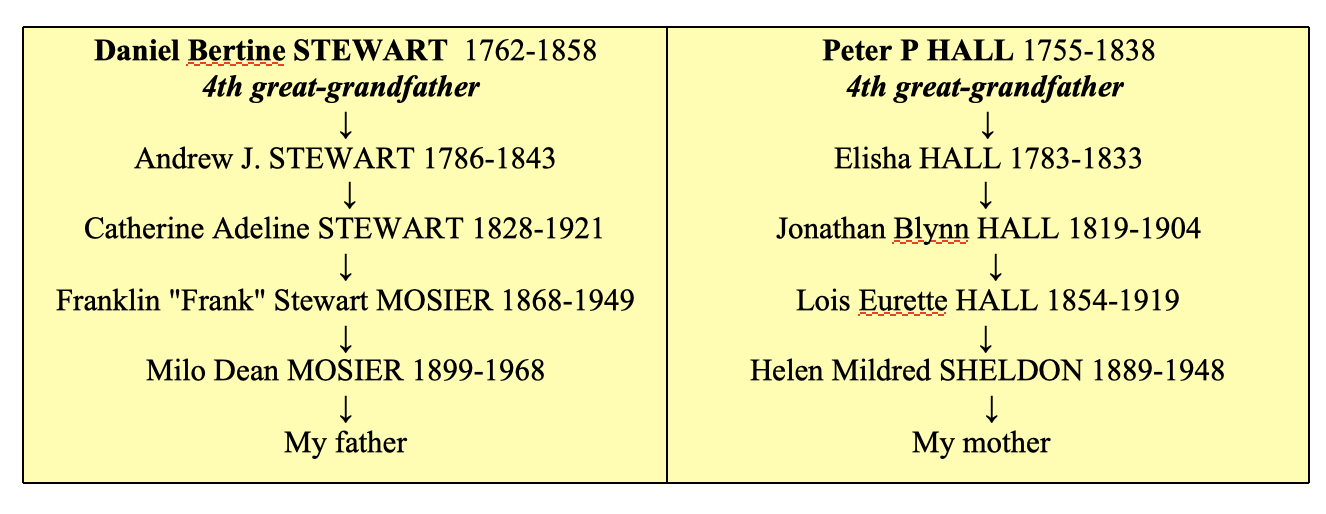
Then recently while working on my maternal 2nd great grandfather, Revolutionary War solider, Peter P HALL I found he served under Lieutenant Colonel Roger ENOS and under Col. Return MEIGS of the 22nd Regiment of the Continental Army. In the records I spotted another familiar name that of my paternal 2nd great grandfather Daniel Bertine STEWART, also serving under Lieutenant Colonel Roger ENOS and under Col. Return MEIGS of the 22nd Regiment of the Continental Army.
PATTERNS
AGE at MARRIAGE: There are lots of patterns that we seldom focus on. One is the tendency to marry older or younger. In my husband’s WHEATON line the men have a tendency to marry younger women. In years going backward 8 years younger wife, 5 years younger with first wife and 24 as a widower, 23 years younger, 13 years younger and 6 years younger. In my mother’s Swedish line the women are older +3, + 8, +2 and another Swedish line the women are +2, +5. Once we get further back in Sweden it seems to even out.
MARRIAGE & ORIGIN: This one seemed strange to me my paternal grandparents were of mixed ancestry but both had German surnames and similar backgrounds. But what caught my eye was that for three generations in the middle all the MOSIER/MOSER men married women of Scottish ancestry.
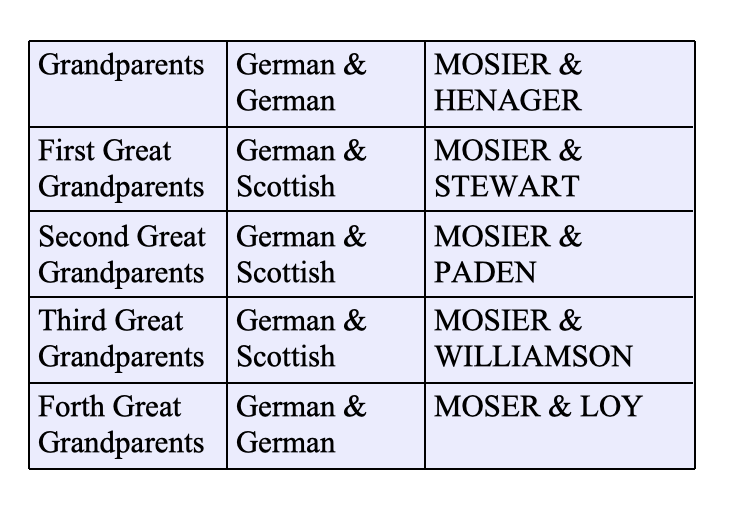
However when I visited Scotland and a couple of years later it made sense to me, although it is hard to articulate. Both countries pride themselves on their open, hearty hospitality especially if you express that you have ancestry there. The mid day meal with lots of meats bread and cheese was very similar. In Scotland we met quite a number of Germans on holiday and it seems a favored location to visit. There is something of the same artistic, storytelling, Celtic tradition that seems familiar. There is a stress on hearth and home, honor and courage. Traditions that seem deeply embedded in these ancestors. Maybe it is just happenstance—but I couldn’t help noticing it.
Some other things to get you thinking about possible patterns or intersections:
- Longevity
- Cause of Death
- Migration patterns
- Intermarriage
- Birth Order
- Age at Birth of First child
- Age at Birth of Last child
- Number of Marriage
- Occupations
- Religious Affiliation (or lack thereof)
- Twins or multiple births
INTERMARRIAGE & PEDIGREE COLLAPSE
My most recent evidence of cousins marrying cousins is my paternal 2nd great grandfather who married his second cousin. Both descended from Matthew SPARKS and Eleanor BROOKS. But once we get back to New England it becomes a terrible tangle. My most prolific ancestors to populate my tree are my 9th great grandparents immigrant Walter PALMER and wife Rebecca SHORT who met and married in Charlestown, Massachusetts owned property in Rehoboth and settled in Stonington, Connecticut. They had nine children together and of them Hannah, Nehemiah and Gershom PALMER are my ancestors. And one possible cousin to Walter is also and ancestor. Then in Rehoboth, Henry & Mary BUTTERWORTH appear 3 times and Sampson MASON & his wife Mary BUTTERWORTH twice and John MILLARD & wife Elizabeth BAUGH twice and William SABIN and his wife twice.
My son in law is related to me 4 ways. Three on his father’s side and one on his mother’s, all at the 8th cousin once removed. I worked for a man who wanted me to work on a particular connection in his family tree. He turned out to be my fifth cousin on my maiden name line. The connection are all around us—with people we have known for decades and others we just met.
WHY IT MATTERS
The key is to use the information to enhance your understanding and make your stories more interesting. The more you look at patterns the more things make sense. For instance back in my post Deep Diving: Water Wheels and Paper Making in 19th Century Sweden I was able to figure out why my family traveled far and wide across Sweden (Master Paper makers were in high demand.) Sometimes it is impossible to get anything close to a full picture of the past. But the more I have concentrated on one person at a time and attempted to recreating their stories the more I believe a lot more is possible than we can ever imagine.
In a world of chaos we are always looking for things that bring us together.

“It really boils down to this: that all life is interrelated. We are all caught in an inescapable network of mutuality, tied into a single garment of destiny. Whatever affects one destiny, affects all indirectly.”
Martin Luther King Jr.
Kelly Wheaton ©2023 – All Rights Reserved
When Records Are Wrong: Why Original Research is Necessary
Posted on December 11, 2023 4 Comments
In my recent piece about Resurrecting the Dead Part Two. I relearned an important lesson. It doesn’t matter what the books, genealogies or sources say—they can and often are wrong. My research into Peter HALL showed:
- All the trees at Ancestry & elsewhere had his full name wrong
- No one had his correct death date
- The book version of Connecticut Soldiers in the Revolution had transcription errors
- One transcriber translated the abbreviation for ditto as deceased
NAME
With a very common name like Peter HALL middle initials matter. In everyone’s tree, including my own of 50 years, Peter was listed as Peter H Hall. Somewhere along the line the “H” slipped in and has long persisted. The problem is the record historical records starting with the 1800 census along with numerous land transcriptions and his probate notice have him as Peter “P” HALL. Likely the “H” was simply a one time transcription error that spread like a virus.

DEATH
This one had me stumped. Again every tree had Peter died 25th of October 1835. We tend to give more credence to dates with specific days and months. Again this at some time or other was a transcription error. Old “5”s and “8”s can look similar. His date of death mattered to me because he didn’t get his pension until 1834 and I hated to think he had been denied and received it for only a year. The truth is he died in 1838 not 1835. Just to muddy the water a couple of DAR applications had his death date as 1839! The day and month of his death had been correct all along.

MILITARY SERVICE
Compilation of service records in printed sources can really throw you for a loop. Wrong muster in and out dates. Misinterpretation of notes and bad transcription can have your ancestor dying in the Revolutionary War when he did not.

WHY IT MATTERS
First off when we try to rebuild an ancestors story we will end up writing fairy tales if our facts are faulty. Bad facts lead to fiction. “My Revolutionary War soldier died in the War.” When the truth is he didn’t. If we are doing searches with the wrong names or dates we may overlook evidence and sources. We may make assumptions which will thwart our attempts. Doing a newspaper search for a death or probate notice in the wrong year means you won’t find them.
In the case of Peter P HALL he has a cemetery [really a family plot] named after him and it even shows up in a Google Map search. However the marker for Peter is not evident. One marker is for his wife, Mandana HALL and there is an adjacent stone simply marked H.H. The area has become wooded and is on private property and is difficult to find. My distant cousin was told the graves are somewhere else and the markers were moved. Since they appear to be on land that Peter owned, I suspect this removal has more to do with trying to explain the lack of respect shown those interred there. An old survey from 1977 has 3 graves evident—now there are only 2.
SOME ADVICE
Yesterday I found the record for Peter in the Orwell Baptist Church records. The whole file is only 11 pages. The pages are out of sequence and many are missing. I decided to look at each one carefully. Although only one citation for Peter HALL occurs in the Ancestry search—his name actually appeared on 5 pages. But there was more to discover. His daughter appeared as well. And then I came across two names that jumped off the page. Peter’ HALL’s son, Elisha HALL, is my ancestor. He marries a Sally Ann Thompson whose parent’s are speculative at best. But there on the page of the Baptist Church of Orwell was a David and Sally Thompson! May be a coincidence but it is certainly a clue!
Another thing that I was reminded of– is to set your search parameters wide when looking at Newspapers or resources. Sometimes the birth or death date is wrong and sometimes a person is mentioned in a article about their son or daughter when they die. You must try every conceivable search term. My husband’s great great grandmother is listed in her obituary as “Granny WHEATON.” You just never know.
In the last Genealogy Class I taught someone asked when you can accept what you have as proven. Someone said 3 proofs. I said NEVER. They thought I was kidding. You gather as many bits of evidence as you can and you build a case. But you must ALWAYS stay open to the possibility that better evidence may come along. It does not matter if 15,000 people have John JONES as the father of Lucas JONES. It may be that John adopted Lucas and he is not the biological father. You do the best you can and then you CORRECT, CORRECT, CORRECT, whenever you find new, more robust information. As I hope this shows: trees, books, DAR applications, tombstones, death records etc can and are– often wrong. Transcriptions misinterpret the evidence. The good news is that there is always more to be discovered. And original deep research is not only rewarding, but it is still possible with more and more original records being digitized.
Don’t get discouraged. Keep digging and you will be rewarded.
Kelly Wheaton © 2023 – All Rights Reserved
Resurrecting the Dead Part One: Start with a Timeline
Posted on November 29, 2023 7 Comments
If you have read any of my earlier blog posts, like Trees into Stories, you may know I favor ancestor stories over adding more to the tree. So in that spirit I want to talk about playing God as a family historian. We literally get to recreate the life of an ancestor who for all intents, is lost. Yes, they may appear on hundreds, if not thousands of trees—but few give much detail into their lives. In my post My Woman Warrior I chose to resurrect my second great grandmother. For this post I am reaching further back to my fourth great grandfather Peter P HALL. Note most trees have him as Peter HALL of Peter H Hall but in thoroughly examining the records I find that he is Peter P. HALL. He was the Revolutionary War soldier and I wrote about him in Revolutionary War Details in Ancestor’s Pension Files. I decided to see what else I could discover about Peter’s life and it turns out I like to start by building a timeline. Then adding entries bit buy bit.
The easiest way to begin is to print out a Timeline from Ancestry, Family Search, My Heritage or Family Tree Maker (or similar program) and then use that to create table. This is your basic chronology of the life of your ancestor. You want to look carefully at the deaths of parents, children and siblings. In the case of Peter HALL his older brother Joel Hall died in battle after June 1776 somewhere near New York city. Three other brothers and his father also served in the Revolution but none for as many enlistments as Peter. You also may want to look into the family members of your subject’s spouse.
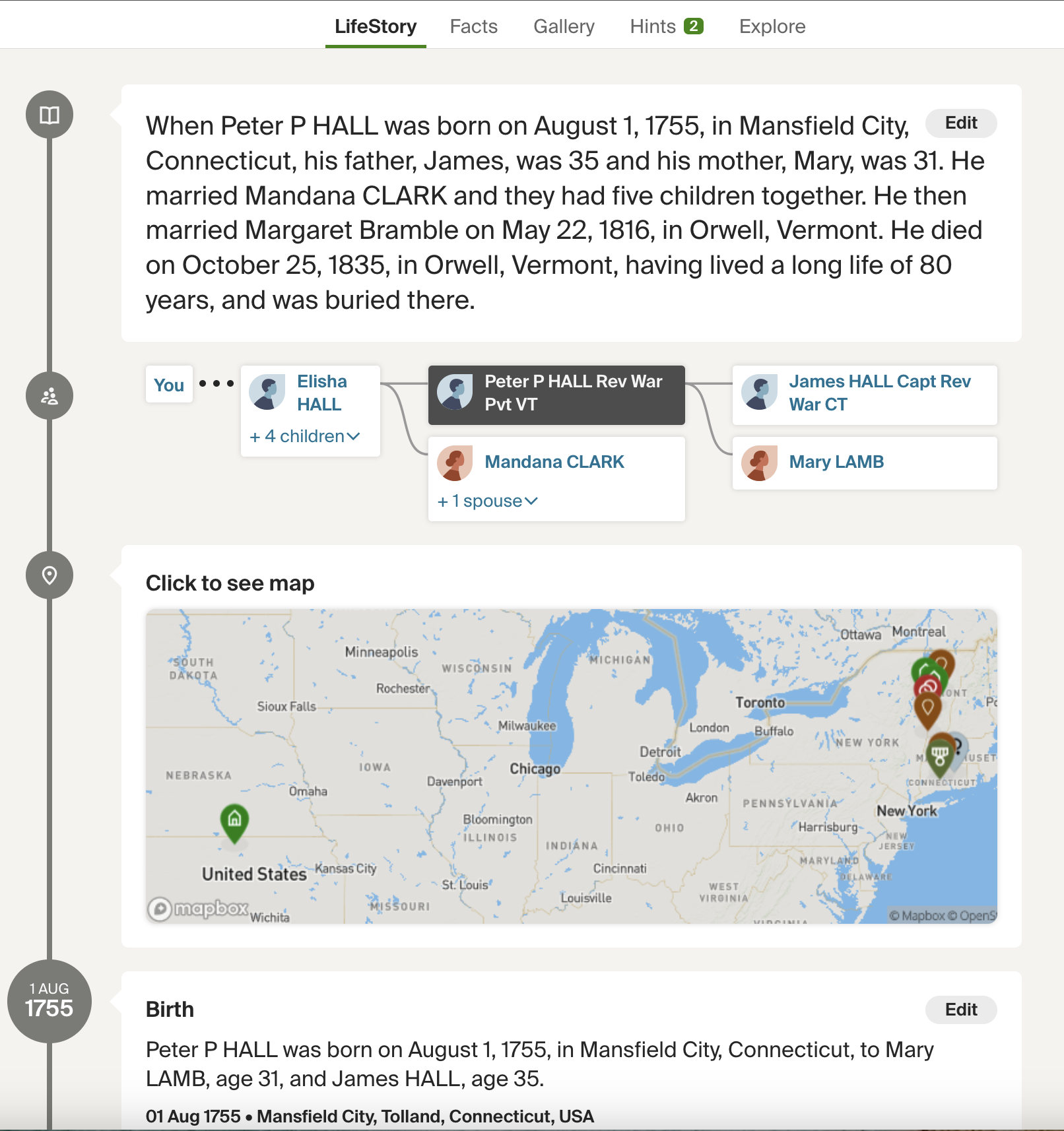
A gem of a Revolutionary War Roll tells that Peter HALL served under Colonel Ira ALLEN; Capt John STARK’s Company 1 April 1780 for 7 days at Skeensborough and Ticoderoga and who does he serve with? His future wife Mandana’s brother Elisha CLARK Jr. This matters because the following year Peter and Mandana marry 4 Oct 1781 at Pawlet, Vermont and the same day he is listed in Captain Zadock EVEREST’s company under Colonel Ira ALLEN. That same company in 1 May 1782 of the 30 men, three are Mandana CLARK’s brothers: Lemuel, Elihu and Smith CLARK as well as her nephew Ozias CLARK (son of previously mentioned brother Elisha CLARK). So paying attention to family members matters.
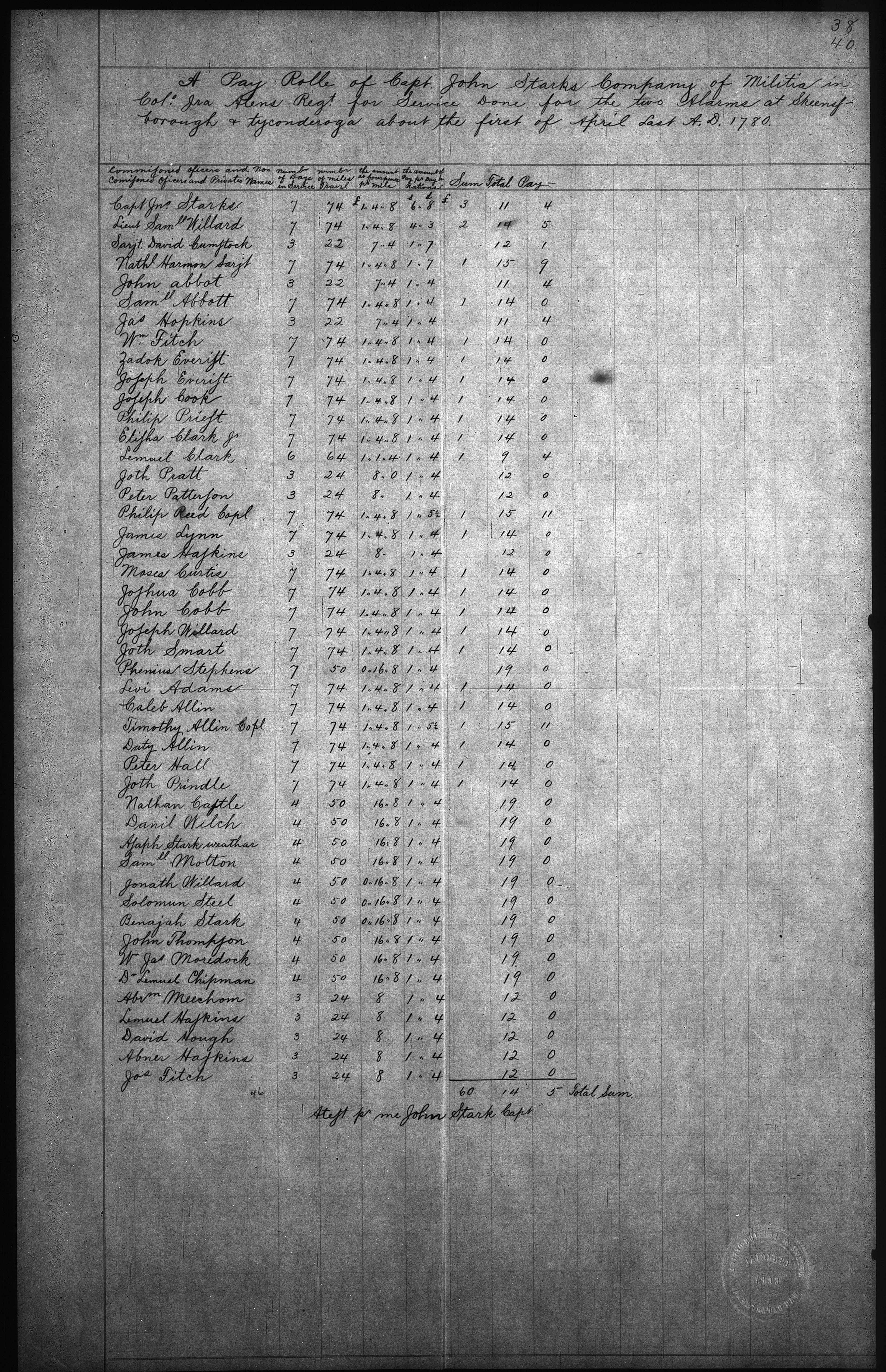
So you assemble the facts that you have in chronological order and then go looking for more. Among the records in this time frame:
- Church Records
- Vital Records (recorded by town in new England)
- Military Records
- Military unit histories
- Newspaper articles
- State Archives
- Land Records (recorded by town in new England)
- Maps
- Etchings or drawings of places
- National Archives
- Town or County Histories
Once you have collected as much as you can find, place these into your table or spreadsheet. But you aren’t done yet. Then you need to add contextual information.
- Historic facts for the time frame and places your ancestor lived
- Old Newspapers are great for giving you a feel for what was happening
- If your ancestor served in a war look for articles about commanding officers
You should end up with something like this (partial):
| Peter P Hall Timeline | |||
| Date | Age | Event | Location |
| 1754-1763 | French American War | ||
| 1 Aug 1755 | Peter Hall‘s birth | Mansfield, Tolland, CT | |
| 3 Aug 1755 | Peter Hall‘s baptism First Congregational Church | Mansfield, Tolland, CT | |
| 10 Feb 1763 | 8 | Treaty of Paris ends the French-American War | Paris, France |
| 5 Mar 1771 | 15 | Boston Massacre. 9 British Troops shot | Boston, MA |
| 19 Apr 1775 | 19 | Battle of Lexington & Concord | Lexington & Concord, MA |
| 5 May 1775 | 19 | Peter Hall Enlists as Private to serve 7 mos in Col. Joseph Spencers 2nd Regiment; 6th Company Major Return Jonathan Meigs, Capt. Noadiah Hooker who marched to Roxbury, MA | Middletown, CT |
| 10 May 1775 | 19 | 2nd Continental Congress meets. Establishes the Continental Army: Ethan Allen & Benedict Arnold capture Fort Ticonderoga | Philadelphia, PA Fort Ticonderoga, New York |
| 17 Jun 1775 | 19 | Peter Hall was present at Battle of Bunker Hill was not called to action. | Boston, MA |
| 25 Jun 1775 | 19 | Col. Spencer was promoted to Brigadier General; command fell to newly commissioned Colonel Samuel Wyllys. | |
| 2 July 1775 | 19 | Gen George Washington arrives | Cambridge, MA |
| 5 Sep 1775 | 20 | 1st Continental Congress meets | Philadelphia, PA |
| 18 Dec 1775 | 20 | Peter Hall is discharged from Colonel Samuel Wyllys | Roxbury, MA |
| 17 Mar 1776 | 20 | Evacuation of British Forces from Boston | Boston, MA |
| Mar 1776 | 20 | Peter Hall reenlists Colonel Samuel Wyllys’ previously General Spencer’s. 7 mos. | |
Once you have this assembled a timeline and the accompanying documents that helped to you to build it. It’s time to move to the next step which is bringing your ancestor to life.
I was summoned by my Country, whose voice I can never hear but with veneration and love.
George Washington
Kelly Wheaton ©2023 – All Rights Reserved
Resurrecting the Dead Part Two: Bringing them to Life “Peter P HALL”
Posted on November 28, 2023 8 Comments
With our time line in place and our research into Peter HALL’s Pension we can begin to sketch out as much as we can of Peter Hall’s life. We don’t have to start at the Beginning I jumped into a more familiar part of history and will back fill as I go. This has been a remarkable journey for me. Hopefully you will find some inspiration for your own.
Brewing Unrest: 5 Mar 1771 The Boston Massacre
When Peter HALL was 16 years old the Bloody Massacre of 6 American’s by the British Army at Boston underscored the growing tension between the crown and the colonies. This undoubtedly made an impression on young Peter along with his older brothers James, Joel and Abel. This is an engraving by Paul Revere of the “Boston Massacre 5th of March, 1771″

by a party of the 29th Regt.
In part it reads:
Unhappy Boston see thy sons deplore
Thy hallowed walk besmear’d with guiltles Gore
While faithless P-ll and his Savage Bands
With murd’rous Rancour stretch their bloody Hands
Like fierce Barbarians grinning o’er their Prey
Approve the Carnage and enjoy the Day
Paul Revere
Declaration of Freedom: Town of Mansfield, Connecticut 10 Oct 1774
In 1774 Peter HALL was still living in the town of Mansfield in which he was born. A most interesting document is found in the Town Records of Mansfield dated 10 Oct 1774. This document was forged as the First Continental Congress is meeting in Philadelphia between September 5 and October 26, 1774, which the townspeople of Mansfield were no doubt aware. In part it reads:
So far as our Influence can extend to them, will be faithful Subjects of that Illustrious Race of Kings, So long as the Crown maintains Inviolate the Stipulate rights of the People, which God grant maybe forever. 2 That we will defend with our Lives and Fortunes, our natural and Constitutional Rights & in Obedience to the Second great Command of the Moral Law & Laws of Nature we will assist our neighbors as Occasion Requires. “God & Nature Bid the Same.”

Book 1 pg 257 10 Oct 1774
Battle of Lexington: 19 April 1775
Beginning the 2nd of March 1775, Ninety-Three men from the town of Mansfield are called to the Lexington Alarm . The total population of the town of Mansfield in 1774 is 2,446; so a good portion of the able bodied men of the town respond. The Battle of Lexington and Concord happens on April 19, 1775, the first of the American Revolutionary War. Word quickly passes throughout the land. This from the Hartford Courant, dated May 3rd at Worcester:


[Enlarge for detail]

Nineteen year old Peter HALL is among those that immediately enlist after the Battle of Lexington. He mustered in at Mansfield, Connecticut, the 5th of May 1775, to serve 7 months in Colonel Joseph SPENCER’s 2nd Regiment (at SPENCER’s promotion it became Colonel WYLLYS’). The 6th Company was under Major Return Jonathan MEIGS and his unit under Captain Noadiah HOOKER. You can see that on Saturday they joined the march to Cambridge, as reported in the Pennsylvania Gazette. So his pension file is consistent with the contemporary record.

Peter Hall’s Background in Mansfield, Connecticut

80 years after his birth
Peter P HALL was born 1 August 1755 at Mansfield, Connecticut. He was the seventh child of James HALL and Mary (LAMB) HALL, and their fourth son. In 1756 the population of Mansfield was 1,614. By the time of the Revolution he has 7 more younger siblings, the youngest, a sister, Jemina, just 3 years old, and the population of Mansfield is closing in on 2500.

Boston & Cambridge
As we return to our story 19 year old Peter HALL is on his was to join the Continental Army at Cambridge. What a sight that must have been! An estimated 14,000 troops assembled near Cambridge, Massachusetts. On July 2nd General George WASHINGTON arrived in Cambridge to take command of the newly-formed Continental Army. Writing his brother, WASHINGTON called the army that he found “a numerous army of Provincials under very little command, discipline, or order.”


Currier & Ives 1876
Courtesy of The Metropolitan Museum of Art NY
According to his pension affidavit Peter HALL “enlisted at Mansfield Connecticut–served three campaigns the first at Boston & Roxbury.” Again from his pension file “[Peter] marched to Cambridge & Roxbury & was stationed at Roxbury until his time was out, where he was discharged. His regiment was paraded at Roxbury during the Battle of Bunker Hill, but was not called into action and he tells of assisting in taking & destroying a Lighthouse in Boston Bay.” Three days after the Battle of Bunker Hill, a small detachment of American troops burned the wooden parts of the lighthouse. So Peter’s testimony is consistent with the facts even 55 years later with his memory failing . Belong is an etching of the Lighthouse known as Boston Light. Sadly his Captain Noadiah HOOKER died at Roxbury. This is the first inkling we have that Peter serves on reconnaissance missions.

(Boston Public Library)
Peter HALL musters out the 18th of December of 1775. He writes “he remained in service a fortnight at Roxbury after his time was out in 1775 until the new recruits came in.” Which again gives us a measure of this young soldier. I assume he traveled back home to Mansfield the beginning of 1776. On March 17th 1776 Colonel George Washington defeats the British in the Siege of Boston, then he moves to strategically relocate his army to defend the port city of New York. He called upon and urged the soldiers already in the field for 1775 to re-enlist for another year.
New York
The Connecticut regiments of 1775 were reordered. General SPENCER’s continued under Colonel WYLLYS . Meanwhile Peter HALL “Soon after his time was out in the winter of 1776 he re-enlisted for three months & served in Captain CURTIS Company. The muster rolls show he re-enlisted in March of 1776 under Col Samuel WYLLYS now called the 22nd Continental Regiment. He marched under Washington to New York and remained in that vicinity from April to the close of the year. The 22nd Regiment assisted in fortifying the city of New York; they were ordered to the Brooklyn front on Aug. 24; engaged in Battle of Long Island Aug. 27; were in retreat from New York, Sept. 1; and with the army at White Plains. In his pension record “[Peter HALL] was for a time at New York–tells of rowing all night—to bring out [the] army from Long Island— This would have been the Sept 1st retreat from New York. As shown below rowing from Brooklyn to Manhattan.

More to be found of this harrowing retreat from Long Island in the Memoir of Benjamin Talmadge (1856):
“Gen. Washington was so fully aware of the perilous situation of this division of his army, that he immediately convened a council of war, at which the propriety of retiring to New York was decided on. After sustaining incessant fatigue and constant watchfulness for two days and nights, attended by heavy rain, exposed every moment to an attack from a vastly superior force in front, and to be cut off from the possibility of retreat to New York by the fleet, which might enter the East River, on the night of the 29th of August, Gen. Washington commenced recrossing his troops from Brooklyn to New York. To move so large a body of troops, with all their necessary appendages, across a river full a mile wide, with a rapid current, in face of a victorious, well disciplined army, nearly three times as numerous as his own, and a fleet capable of stopping the navigation, so that not one boat could have passed over, seemed to present most formidable obstacles. But, in face of these difficulties, the Commander-in- Chief so arranged his business, that on the evening of the 29th, by 10 o’clock, the troops began to retire from the lines in such a manner that no chasm was made in the lines, but as one regiment left their station on guard, the remaining troops moved to the right and left and filled up the vacancies, while Gen. Washington took his station at the ferry, and superintended the embarkation of the troops. It was one of the most anxious, busy nights that I ever recollect, and being the third in which hardly any of us had closed our eyes to sleep, we were all greatly fatigued. As the dawn of the next day approached, those of us who remained in the trenches became very anxious.”
pg 10-11
Northward in retreat by Sep 6th General WASHINGTON is near Fort Washington. Across the river is Fort Lee in Hackensack Township, NJ. Peter HALL writes he was “At Hackensack, NJ —“

Peter HALL writes “of a retreat to the White Plains, of his discharge a short time before his enlistment expired in consequence of fever ague [Malaria].” “Retreated to Whiteplains where he was discharged by Col MEIGS –[he] was not called into action at Whiteplains.” So it seems to me Peter has twice been involved in a mission involving rowing and critical support but not on the front lines.
Westchester & Long Island
On 1st January 1776 the 2nd Connecticut Regiment of SPENCER’s Brigade, part of the Main Continental Army was re-designated The 22nd Continental Regiment. On 12 August 1776 SPENCER’s Brigade was re-designated as PARSON’s Brigade. On 12 November 1776 the brigade was reassigned to the Highland’s Department, basically frontier lands north of White Plains. The regiment was reassigned to MERCER’s Brigade of the Main Continental Army on the same date. November 24th, 1776 Peter HALL enlists under Colonel Return MEIGS 6th Regiment; Capt Elisha ELY, Lt Peter CURTIS 3rd battalion for 3 months. The 3rd Battalion remained in part, in Westchester [Co], NY.

Muster shows Peter Hall mustered out in January of 1777 under Col MEIGS, and on the 4th March 1777, was appointed Corporal under Col. Roger ENOS, Capt Peter CURTIS’ 3rd battalion. In 1777 we find this document from Colonel Roger ENOS of the 4th Connecticut Regiment of the Continental Army know under General George WASHINGTON in New York appoints Peter HALL First Corporal.

May 12th 1777, MEIGS was promoted to colonel and given the 6th regiment of light infantry, designed for fast movement. Now at the command of his own regiment, Colonel MEIGS organized one of the most daring and successful raids of the war. What became known as the Sag Harbor or MEIG’s Raid was made in response to a successful British raid on Danbury, Connecticut. There were no American casualties in MEIGS’ raid, but six Loyalists were killed and at least 90 captured. Colonel MEIGS quick and decisive mission against the British garrison on Long Island and Tory stronghold, earned him accolades throughout the colonies. Whether Peter Hall was on this mission is not known. One such article appeared in the Virginia Gazette:

From his affidavit “In the winter of 1777 [Peter] again enlisted in Col Roger ENOS 3rd Regiment, Capt Peter Curtis’s Company again for three months and marched to Whiteplains & Horse Neck and served guarding the line and in the winter of 1778. [See map above for location of Horse neck and Sag Harbor.]
And although this is not for Peter here is an enlistment record under Col. Roger ENOS:

The 19th of July of 1778 Peter HALL re-enlists in the 1st Regiment under Capt Elisha ELY. He is on the muster roll for July & Aug & Sept 2nd under Capt Elisha ELY. He was listed as sick at Danbury, Connecticut on the 12th of September 1778. So I wonder as a part of the Light Infantry he was assigned to Capt Peter CURTIS he subsequently commanded ENOS’ Regiment of Connecticut Troops, a militia unit that served in the Hudson Valley during 1778. Again confirming what Peter has recounted in his application for pension.
The Cordwainer & Shoes

October 26, 1775 of Black Buckled shoes
We can assume Peter Hall was back home, at Hartford, Connecticut in October in 1776 [Having relocated from Mansfield]. This would have been a month after he was listed as sick at Danbury. This is remarkably evidenced by this advertisement:

We know from records kept by Benjamin Tallmadge in 1777 that Peter Hall was a shoemaker [cordwainer]. Is this advertisement evidence of his entrepreneurship looking to train and secure two journeyman shoemakers who would likely be supplying the Continental Army with as many shoes as they could produce? The Army’s need for shoes far exceeded the supply. Soldiers generally wore black leather buckled or laced shoes that were affixed with canvas or leather gaiters covering the ankles to keep out dirt and water. There was no distinction between left and right shoes at this time. Cleats known as “ice creepers” were attached to shoes with a leather strap for travel through snow and ice. Only mounted soldiers wore boots, if they could get them.
November 6th 1776 Peter is listed as a Quartermaster enrolled in Colonel Elisha SHELDON’s Light Horse militia known as the Continental 2nd Regiment of Dragoons [More on this unit below] . Meanwhile also in November the Connecticut Assembly voted to raise four State battalions to join the Continental army near New York to serve until March, ’77 and the United States Congress asked the four New England governments to supply the Continental army with 10,000 pairs of shoes and stockings. Not a bad opportunity for a soldier with many Army connections.
One readily available supply of leather that Congress attempted to organize, was the hides of slaughtered army beef. During the winter of 1777-1778 the effort to systematize the collection of hides and leather was temporarily shelved and the army had to fend for itself. Each brigade appointed an officer to exchange government hides for shoes. This was a temporary measure and by March it was abandoned. So there would have been ample opportunity for Peter HALL to engage in a bit of a side hustle. In addition to his skill in making shoes he would have been useful in making/securing leather cartridge boxes, belts and other much needed equipment. As a Quartermaster Peter would have been charged with finding requisite supplies—and what better than having your own journeyman making shoes or boots.
Elisha Sheldon’s Light Horse Militia

By January 1777 Sheldon had formed the authorized six troops, all commanded by captains:
Colonel Elisha SHELDON and his captains recruited Continental troops from across Connecticut. Colonel SHELDON’s Light Horse militia was known as the Continental 2nd Regiment of Dragoons or sometimes “Sheldon’s Horse” for short. The entire regiment was gathered at Wethersfield, Connecticut for organization and initial preparations for the 1777 campaign. [At this time Peter HALL is not a part of the Light Dragoons] According to Benjamin TALLMADGE’s Memoirs, his troops were all mounted on dapple gray horses with black straps and black bearskin holster-covers, of which he was quite proud. TALLMADGE took command of the 1st Troop but wasn’t there for long, as he was promoted to Major on April 7, 1777 where he was a senior staff officer under Colonel SHELDON. The second troop had darker horses and were called the Blacks; but the colors of the 3rd through 6th troops is not known. Each troop had a captain, a lieutenant, a commissioned officer [cornet], a quartermaster, 2 sergeants, 2 corporals, a farrier, a trumpeter and 34 privates. They wore, when in uniform, dark blue woolen coats with cream or buff faced collars, light breeches, knee high black leather boots with silver spurs. They had metal helmets with white horsehair plumes. They carried a cavalry saber, a pistol and a musket. Like most Continental units, the organization of dragoons was in constant flux with discharges, enlistments, deaths and promotions.
- 1st Troop: Capt. Benjamin TALLMADGE
- 2nd Troop: Capt. Jean Louis de VERNEJOUX
- 3rd Troop: Capt. Josiah STODDARD
- 5th Troop: Captain William BARNETT
- 4th Troop: Capt. Epaphras BULL
- 6th Troop: Captain Nathaniel CRAFTS

In September, 1777 2,500 American troops assemble at Pawlet, Vermont, referred to as the Pawlet Expedition. The location of Pawlet surrounded by mountains and with a narrow pass made it an ideal location to base operations and easy to protect. The Vermont road along the western side could not accommodate wagons north of Pawlet so food and ammunition could only be carried by horse. Substantial numbers of the Connecticut Horse arrived at Pawlet on August 28 and September 1st . I believe that this is what precipitated Peter HALL’s enlistment in the Dragoons. An interesting description from the Maryland Gazette:

After the Battle of Monmouth [June 28, 1778], General WASHINGTON moved his main army to White Plains. They remained at White Plains until late in the fall when the troops went into winter quarters at different points. It would be the largest American force of regular troops brought together in a single encampment during the entire Revolutionary War. By August of 1778, MEIGS’ regiment had reported to White Plains. How Peter appears under both Capt Elisha ELY and under Capt BULL is a bit of a mystery. Perhaps he was released from one regiment and assigned to another. The Records show MEIGS was assigned to a committee of officers along with Colonels WYLLYS, BRADLEY, and SWIFT, to settle a dispute over officers’ ranks, filing their report on August 29th. This was known as the Arrangement of November 15, 1778. I have a feeling that Peter HALL’s assignments fell within the arrangement.
The 2nd Light Dragoons were not a typical regiment, they were often assigned to different roles and seldom served as a whole. So Peter Hall could have been assigned to do work under either Capt BULL or Capt MEIGS and may well have acted as a courier and scout moving between commanders. The Dragoons were messengers, scouts, spies and in some cases acted as the personal bodyguards to General WASHINGTON himself. From his pension file affidavits Peter HALL states he “ knew Gen Washington, Putnam, Lee, Sullivan, Gates, Schulyer & many others.” As a Quartermaster and as a part of the 2nd Light Dragoons—that isn’t a stretch.
On the 6th Nov 1777 Peter enlists in the 2nd regiment of Elisha Sheldon’s Light Dragoons. Although the printed “Records of Service of Connecticut Men in the War of the Revolution” pg 442 lists Peter Hall as a quartermaster in the First regiment, in other records he is under the fourth [like the one above]. Or the list [below]. He is under Captain Epaphras BULL who made up the 4th. Epaphras BULL was from Hartford as was Peter [after his first enlistment]. We learn in the above record from Benjamin TALLMADGE that Peter HALL was a shoemaker, 5’7″ tall with a dark complexion, dark hair and dark eyes.

“After my command in the lines before Philadelphia closed, which was in January, 1778, the light horse having been ordered to Trenton, I repaired to that place with my detachment, and from thence the 2nd Regiment Light Dragoons removed to Chatham, New Jersey, for Winter quarters. Here we were permitted to rest from the fatigues of a severe and bloody campaign. But our brethren at Valley Forge passed a Winter of extreme suffering, being in want of provisions and clothing to an alarming degree.”
Benjamin TALLMADGE Memoir pg 27
In August and September, 1778, Captain BULL was assigned to surveillance of ship movements in Long Island Sound. In the summer of ’78 the Regiment was on the Hudson, and in the fall formed part of Gen. Chas. Scott’s Light Corps on the lines in Westchester. This is consistent with Peter Hall being at Horseneck, NY. At the same time letters show that Benjamin TALMADGE is at Bedford, New York and Ridgefield, Connecticut while Colonel WASHINGTON is at Windsor and later Fishkill.
To George Washington from Captain Epaphras BULL, 26 August 1778
Maroneck [Mamaroneck, N.Y.] 26th Augt 1778
May it Please your Excellency—there has passed by this Place to the Wtward, to day 3 Sloops & one Schooner Loaded with Hay—& one Row Gally, 2 Brigs & one Sloop from the Eastward come to anchor this afternoon Just Et of Hempstead Harbour, and as far Etward as I can see, appears to be 8 or 10 Sail Vessels, believe shall be able to give an Acct of them Tomorrow. I have the Honour to present your Excellency with 20 or 30 wt Blackfish they are now in a ⟨Car⟩, shoud be glad to know when ’twil best suit to send them up, I am your Excellencys Most Obt Hble sert
Epaps Bull
Letter from Epaphras BULL to George WASHINGTON
“My station during the campaign of 1778, was in the county of Westchester, and occasionally along the shores of the Sound. No important blow was given the enemy during this campaign, by the American. army, although the light troops in advance (as was always the case with our regiment) were frequently in conflict with similar corps of the enemy. When the campaign closed, our regiment went to Durham, in Connecticut, for Winter quarters. A part of the time, however, I was from choice stationed at Greenfield, from whence I could easily cross to Long Island.“
Benjamin TALLAMDGE Memoir pg 30
Peter HALL’s discharge date from Sheldon’s horse may be 27 November 1778 but that date is somewhat uncertain. [See above.] Where he was for the next period is also uncertain but what follows is my best reconstruction.
Pawlet, Vermont
Zadock EVEREST came to Addison County, Vermont in the summer of 1765. He built a log house and there and kept the first public house in the county. After the breaking out of the war he removed his family to Whitehall, and he himself sought refuge in Pawlet. In 1779 Peter HALL was engaged in building a picket fort for two months, [Fort Warren], at Castleton, Vermont. This is the only record I have found for him in 1779. However, I suspect he was living at Pawlet, Vermont at this time. In Hiel Holliseter’s “Pawlet from One Hundred Years” 1867 we find that Mandana’s brother’s Lemuel CLARK was a Selectmen in Pawlet in 1777 and Capt. Zadock EVEREST in 1781 [under whom Peter served]. In 1780 Mandana’s brothers Lemuel and Elisha CLARK held Pawlet town offices. In April 1780 Peter HALL served 7 days at Skeensborough [Later known as Whitehall] and Ticoderoga in Colonel Ira ALLEN’s, General John STARK’s militia and traveled 74 miles. Pawlet is about 35 miles south of Ticonderoga. The British abandon Fort Ticonderoga in 1781.

Who does Peter serve with under General John STARK ; Captain Zadock EVEREST’s Company? His future wife, Mandana’s brother, Elisha CLARK Jr. This amusing article [below] appeared about Major General John STARK in 1778. John STARK had a colorful life, when he was 24 he was abducted by the Abenaki tribe, and made to run the gauntlet of warriors armed with sticks. It is said, STARK grabbed the stick from the first warrior’s hands and proceeded to attack him, taking the rest of the warriors by surprise. The chief was so impressed that STARK was adopted into the tribe, where he spent the winter. [He may have been the source for the story line in the Outlander TV series where Ian Murray Jr runs the gauntlet by the Mohawk, before being adopted into the tribe. S4 Ep 13]

Major General John STARK served in the French American Wars and for the patriots in the Revolutionary War.

During the Revolutionary War, women and children traveled with both the British and Revolutionary armies. Whether part of a soldier’s family or not, they often did the housekeeping duties including laundry and food preparation. Women did much of the nursing and treatment to prevent illnesses. I suspect that Mandana CLARK fulfilled such a roll for her brothers living in Pawlet. We know by 1783 that Elisha Clark is an inn holder there. I think it might be safe to say that Mandana was likely associated with said inn. And this may well have been where they met. I also think the fact that 3 brothers and one nephew of Mandana who served with Peter through their shared service in the same regiment may have been another factor.

In January of 1781 Mandana’s brother Lemuel CLARK is the moderator of the Pawlet Town meeting. Later this year on Oct 4th Peter is listed on a muster roll for Captain Zadock EVEREST’s company under Colonel Ira ALLEN and serves 16 days and travels 8 miles on the Northern Frontier. Capt. Zaddock EVEREST is listed as a selectman in Pawlet that same year. And on the same day as the muster, 4 Oct 1781, Peter HALL and Mandana marry at Pawlet, Vermont.

Also in 1781 we find a letter from Colonel Roger ENOS to John STARK dated 26 Oct 1781 where Col. ENOS is at Saratoga and John STARK is at Castleton. Again In keeping with Peter HALL’s affidavit. May 1st of 1782 of the 30 men in Captain Zadock EVEREST’s company, three are Mandana CLARK’s brothers: Lemuel, Elihu and Smith Clark as well as her nephew Ozias CLARK (son of previously mentioned brother Elisha CLARK) along with their now brother-in-law Peter HALL. Two events happen in 1783, the first settlement of Orwell, Addison, Vermont is made and Peter and Mandana’s first child, Elisha HALL is born the 8th of June. So in summary it appears those who acted earlier as scouts and had experience with the terrain of Pawlet and later Orwell, not surprisingly ended up settling there.
Orwell, Vermont

“Some of the land of this township is broken and hilly; the remaining part is very level, handsome land, and produces abundant crops of all kinds of grain. The principal streams are East Creek, which rises in Benson and falls into Lake Champlain, on the north side of Mount Independence . . . The width of the lake between Mt. Independence and Ticonderoga is about eighty rods . . . In common with most of the towns on Lake Champlain, the scenery in Orwell and its vicinity is truly delightful.” Gazetteer of Vermont, Hayward, 1849
From the 1963 History of the Town of Orwell by Doris S Bishop we learn: “Of the three or four thousand troops…who garrisoned at Mt. Independence, no doubt many were attracted by the rich rolling country to the east.” And: “Between seventy and eighty humble log cabins had been erected before the actual organizing of the town, which occurred December 12, 1787” Among the 71 men who took the Freeman’s Oath and the Oath of Allegiance were Peter HALL and Mandana’s brothers Elisha and Smith CLARK. pg 13
In 1784 this advertisement as well as the one above; a meeting of proprietors for Orwell is to be held at the Inn/ dwelling of Elisha CLARK jun. in Pawlet. Orwell lies about 36 Miles north in the areas that Peter HALL and his brothers-in-law have previously scouted [see above map].

It appears the family relocates to Orwell in 1786, likely one of the families with modest cabins mentioned above. On the 8th March of 1787 Peter and Mandana’s daughter Cynthia HALL is born in Orwell. Over the next few years Mandana and Peter have children: Elisha, Elijah, Cynthia, Daniel Webster, James Mortimer Fayette and Albert Erastus Bolivar HALL.

Property in Orwell
Ozias CLARK is an original proprietor receiving lands of John TEMPLE the 13rd of February 1785 in Orwell. None of the original landowners of Orwell lived there and only 3 ever visited, then only once or twice a year to collect rents. This is the time of much land speculation. Later this same year on the 17th of June Peter and Mandana’s second son Elijah is born at Pawlet. The 26th of October Ozias CLARK (Mandana’s nephew) deeds land to Peter HALL in Orwell [Proprietor’s Records for Orwell pg 27]. Over the next 40 years there are at least 20 land transactions involving Peter HALL as Grantee or Grantor. Placing where these lands are is difficult. One reference says his farm was East of the SANFORD’s Farm and we have his wife’s grave marker at the Peter Hall Cemetery. So somewhere in this vicinity is where I expect was Peter HALL’s farm


The following is the recording of a bid on the land previously John TEMPLE’s for 11 pounds, 7 Shillings and 1-6 pence at auction. I believe the other 50 acres he already secured from Ozias CLARK making in total 100 acres.

It is not clear that this is the land I have shown on the map above or his original parcels as he may have sold these lands for those he later settled on.
LATER LIFE
The first occurrence of his name as Peter “P” HALL is on the 1800 Census and then a deed dated 26 May 1801. We do not know what the “P” stands for but it was used in deeds consistently from then on. One person listed him as Peter H HALL and that has spread everywhere. It is incorrect as the census and many land records consistently use Peter “P” HALL. It seems possible at one point a P was mistaken for an H. There were two other Peter HALLs in Vermont on the 1800 census. I suspect this is may be the reason for his adopting the initial “P”. The other two Peter HALL’s in 1800 Vermont: were in Westminster, Windham and Greensboro, Orleans.
The record gets pretty sparse outside of census and land records at this point. I found this record that shows that Peter P HALL was an Orwell Commissioner in 1810. He would have been 55 at this time.
26 Dec 1810
The household was 6 members in 1790 Census; 8 in 1800; 7 in 1810; 6 in 1820; and 3 in 1830. Peter’s wife, Mandana, dies the 5thof October 1829 at the age of 74. Of the 3 in listed in the 1830 census: 1 is Peter P HALL age 70-79; 1 Male 20-29 which could be his youngest son, Albert Erastus Bolivar HALL; and 1 female age 50-59 which could possibly be his daughter Cynthia or could be someone looking after him [More research needed]. to put things in context this part of an Orwell Chronology.

So from 1786 until he died 52 years later Peter P HALL would have seen a lot of changes in Orwell. Where once there were woods, there was farm land. Where once wheat was grown, it gave way to sheep and cattle. He was there for the first town meetings as well as the formation of local churches. I don’t know whether he continued as a shoemaker—but suppose he did. in 1816 he would have witnessed the Eagle Hotel being built in 1816. It was a luxurious hotel for many years but fell into disrepair and was demolished in 1971.

The Pensioners for Addison County, Vermont Under The Act of June 7, 1832 does not list Peter HALL. He swore his original application under this act on 3 August 1832. His original application is turned down and it in part seems because he did not have anyone to testify to his service. The Act of 1832 provided every surviving officer and soldier who served at least 2 years in the continental army and other units with a pension of full pay for life. The 14th of March 1833 the sworn testimony of Bela Rogers with whom he served in 1775 under Capt. Noadiah Hooker’s Company. And then in 15 January 1834 the remarkable letter from Orwell‘s residents including the Town Constable, Selectmen, Town Clerk and Town Treasurer seems to have changed the ruling. Over a period of 7 years Peter P HALL served his country first with the Connecticut Army then with the Continentals, then Sheldon’s 2nd Dragoons and finally in Vermont under Colonel Ira Allen. It is rather sad that his original application was denied and that it was not until April 11, 1834 that he received the pension he deserved. It appears he received back pay to 1832 so I like to think he died with some amount of dignity and comfort the 25th of October 1838, at the age of 83. [Note all trees including my own had Peter’s date of death as 25th of October 1835. This clipping and his pension record show that the correct date is 1838]

Brandon, Rutland, Vermont

and he is listed as Corporal
That made it possible to find this notice of probate:

Generally speaking we don’t have a description of what someone looks like or what kind of person someone was who lived 265 years ago. But we know Peter P HALL was 5’7′ with dark eyes and dark hair and dark complexion. we know he was an able bodied soldier that survived a bout of malaria as well as a second hospitalization which may have been a relapse. But moreover his townspeople wrote about his character:
“we are confident we speak the feelings of all acquainted with him—we might add that Mr Hall is & has been from an early day a regular member of the Christian Church & an exemplary Christian. —The state of Mr Hall’s income is such that a pension would be a timely aid to his infirmity & would be well used by him—should your honor grant our request by placing Mr Hall on the Pension List we confidently believe you will not have conferred it on a more deserving man.”
The exact location of Peter’s burial is unknown. A cousin tells me it was elsewhere in Orwell—however the small burial plot where Mandana’s grave is as marked on the map above—is completely grown over. There were only 2 stones there more recently. The location is consistent with where he lived—so I suspect his stone if there is one is buried beneath the debris. Locally you’d hope some one would at least get a proper Rev War marker for him. The small grave next to Mandana’s is marked HH. So perhaps a child who died young.
“The remains of this cemetery are in a hedge row in the Ochs Orchard . . . A 1977 survey for VOCA noted only 3 stones. VOCA’s 1990 update places the cemetery 2/10 mile east of the intersection with Church Street. Only one stone remained.” [Source: Jenks, Margaret R.: Orwell Cemetery Inscriptions, Addison County, Vermont, privately published Granville, NY, 2007, p.40]


CLOSING
And finally through a new death date I was able to extend my deed search and came up with a Deed for the sale of 1/2 a pew in the Orwell Center Meeting House from Peter HALL to Dan GOODELL. Further we learn that this was. “The said pew 10 is situated on the ground floor in the square body of pews of said house East and adjoining the Broad Aisle in the house. It being the Pew that was originally Bidd off in the original sale of the pews in said house by myself and Gershom HALE and stands in the records…” Furthermore he apparently aquired the half belonging to Gershom HALE and that was the half he was conferring to Dan GOODELL for the sum of Ten dollars! This I believe was the Baptist Meeting House which probably also functioned as a Town Hall. First Baptist Church of Orwell, was first organized in December 21, 1787. Their church building, located in the eastern part of the town was built in 1810.

And finally with the Baptist clue we find in the Southern Baptist Convention records for Orwell, Vermont. Peter hall appears in the many lists of members and then in 1838 he is listed along with his date of death.
The pages in this record are out of order and sequence and it appears many pages are missing. But I did do a through search for his wife Mandana and for her brothers surnamed CLARK. None appears in the record. However in 1830 Peter and Mandana’s daughter Cynthia BRUNDAGE is listed under her married name. The other church in town early on was Congregational and I suspect this is where Mandana attended along with her brothers. So another possible avenue for future exploration… In looking through the records there appears to be half or more of the parishioners not attending with spouses. So perhaps religious independence was more prevalent than we might imagine back then.
Before I began this quest to resurrect Peter he was just another of my sixteen, fourth great grandfathers. I not only feel that I have a better sense of who he was as a person, but a better sense of his part in the greater formation of my beloved country. It saddens me to be living in times that so many fought for our freedom, for our Democracy and for our Republic and yet we are threatened by ill-informed, historically illiterate people that lust after power and autocrats. May we somehow rise to this moment in history and recapture the spirits of the ordinary people who came before us. May we honor the lives of our forebears by bringing their ordinary and sometimes extraordinary, lives back to life.
As far as process goes the amount of material available on the Revolutionary War is enormous including actual letters in the National Archives and Institutional archives like Yale that should not be overlooked. Letters and dairies exist broadly to give you context. Good luck in your own resurrections. They certainly enrich our understanding of our ancestors and what they did to make our lives possible. Thank you Grandpa Peter!
Kelly Wheaton ©2023 – All Rights Reserved.
A Tornado in November: Remembering
Posted on November 18, 2023 2 Comments

Dorothy repeats after the good witch, Glinda, “There’s no place like home”. Dorothy then clicks her heels three times. The makeshift sheet otherwise known as the stage curtain drops and we scurry about. The curtain rises, “Where am I?” asks, a bewildered Dorothy and in a blink of an eye we are bowing to raucous applause as the final curtain drops on Miss Buckley’s 4th grade production of the “Wizard of Oz”. Miss Buckley whistles and trumpets “Bravo” in her Boston laced accent.
As the audience of the visiting class departs, we are in high spirits. The room is buzzing with a mixture of pride, excitement and anticipation. This is the day before Thanksgiving and our last performance. Only, the young Miss Buckley, a brand new teacher would attempt a production of the Wizard of Oz with fourth graders. We are her pride and joy and we adore her. Miss Buckley’s enthusiasm is contagious, even though we’ve only been together since August, we have bonded tightly.
After removing our costumes and taking down the elaborate decorations we are all anticipating the party Miss Buckley has promised us.
Untypically, she leaves the class unsupervised as she retrieves ice cream from the faculty room freezer. It’s just down the hall , “Be back in a jiffy,” she says. The minutes pass and our excitement turns to concern. A class of fourth graders are not used to being left alone, there’s always an adult in charge. We discuss sending someone to find her. As we are deciding who will go to the office, the door opens with Miss Buckley and no ice cream.
Miss Buckley is blowing her nose and dabbing tears from her cheeks. We gather round as she tells us, “President Kennedy has been shot.” We know how much she admires him as they both come from Boston and to our ears they both pronounce idea “eye dear,” which we find amusing, so much so that we often correct her. She tells us what she knows about the shooting and tries to reassure us.
We retreat into silence, trying to make sense of what she has just said. This isn’t just any president; John Fitzgerald Kennedy, is my president. When I was six I worked on his campaign stuffing and stamping envelopes. I delivered pamphlets door to door placing them carefully under the door mat or rolled to fit between the door knob and frame. I learned it was illegal to put them in a mailbox. I watched excerpts from the Democratic Convention held in Los Angeles on our Black and White television. And on election night I was allowed to stay up until close to midnight when it looked like Kennedy might win.
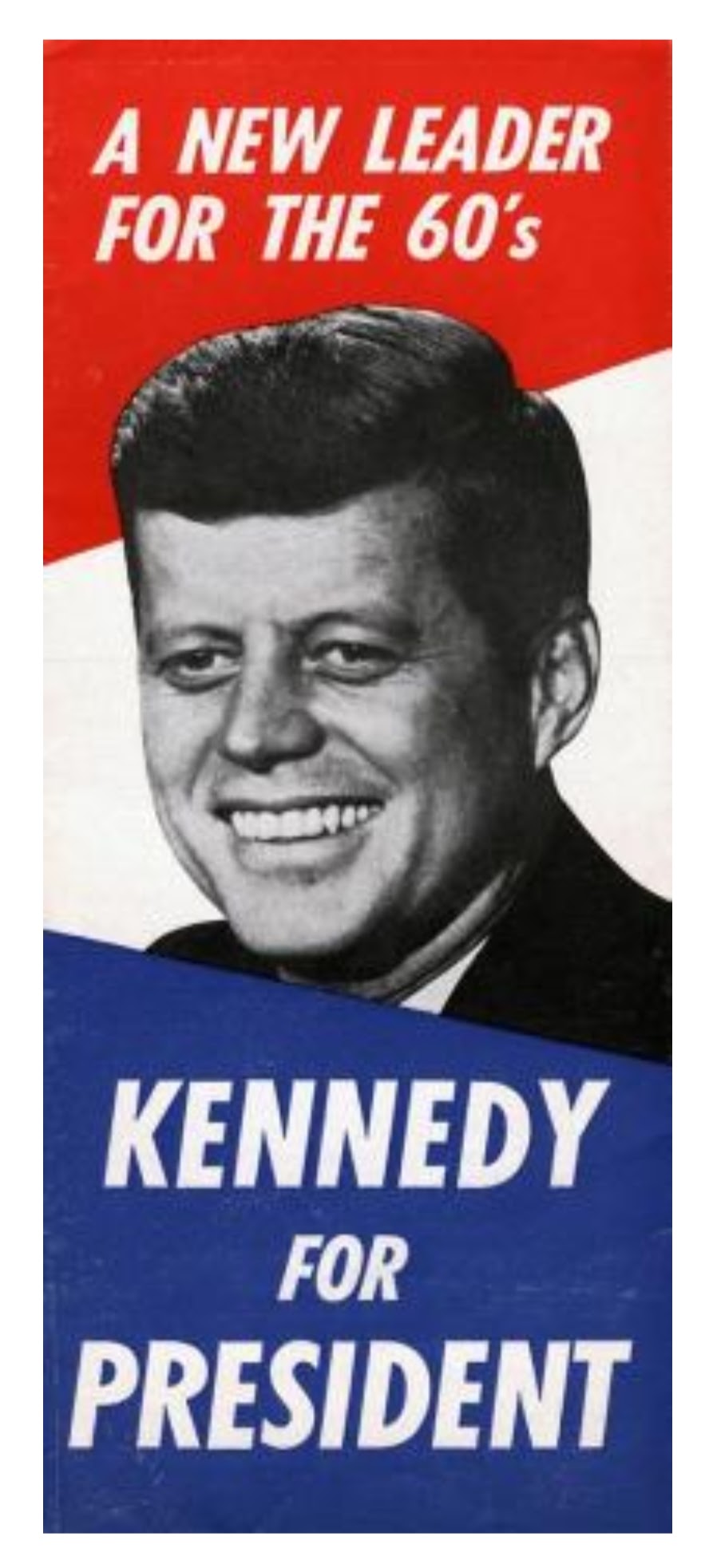
Back in the classroom we hear the voice of Principal Brown, over the loudspeaker. We already know what he is going to say, “President Kennedy has been shot.” He follows with, “the bell will ring shortly and you are all to go home to your families.” And just like that the sunny, autumn day before Thanksgiving in 1963 turned our world upside down. We packed up and said goodbye in robotic fashion. All of us, just as bewildered as Dorothy awakening from the tornado in the Wizard of Oz. I lived across the street from Castro Elementary School, but I still had to travel a distance across the playground, down a set of stairs, across another playground and through the park, to get to our house on the corner. I cannot remember any of the journey. All I wanted was to be home.
As I come through the front door, my mother seems surprised to see me. The television is on. She switches the stations to find more news. Some stations have regular programming. There is confusion about the president’s condition. “Grave” I think someone said. The tones are somber and then the words, “President Kennedy is dead.”
John F. Kennedy was the 35th President of the United States from 1961 to 1963, and the youngest man elected to the office of President. He died on November 22, 1963, the youngest President to die. Years later I would read Franz Werfel’s book ‘The Song of Bernadette’. In it he wrote “ Youth ceases at the moment when death becomes a reality to us.” Something of my youth was definitely shed that day. Like Dorothy we were uprooted and thrown into a totally new and unpredictable world and then when we returned to school on Tuesday, it was supposed to be back to normal. But the truth is, it never was the same.
Please see my Writing Challenge: Where were you when Kennedy was shot? if you are interested in doing your own writing for the 60th anniversary of JFK’s death this coming Wednesday.
Kelly Wheaton ©2023 – All Rights Reserved
Revolutionary War Details in Ancestor’s Pension Files: Peter P Hall
Posted on November 11, 2023 4 Comments
In honor of Veteran’s Day I decided to look a little closer into the pension files of some ancestors. While reading through the Pension Application files I found this lovely letter. A bit heart breaking but, worth sharing. The point is we all need to take the time to read deeply and reflect on the sacrifices made by our ancestors. Especially our veterans.
Affidavits for Revolutionary War Pension
Transcription follows:
Orwell, Rutland Co, Vermont To the Hon Secretary of War for the United States of America,
Sir the undersigned the constituted authority of the Town of Orwell– having learned that the application of Mr Peter Hall (through his agent B. Temple Esq of Rutland) for a pension for Revolutionary Services—has not been granted to this time, they have to offer a few remarks for your consideration & information— Mr Hall was one of the first settlers of this town a farmer, his character for honesty, truth & patriotism stands as fair as any man of our acquaintance for that moral honesty he has become proverbial among us— We have ever believed he was justly entitled to a pension and we heard his tales of Revolutionary Services when his mind was good, it is now gone, which places him under embarrassment about procuring testimony–his statement here every one believes –& all regret the state of his mind is such that he can do nothing to assist himself— He enlisted at Mansfield Connecticut under Capt Peter Curtis–served three campaigns the first at Boston, Roxbury and he tells of assisting in taking & destroying a Lighthouse in Boston Bay. At Hackensack, NJ —He was for a time at NewYork–tells of rowing all night—to bring out [the] army from Long Island—of a retreat to the White Plains, of his discharge a short time before his enlistment expired in consequence of fever ague [Malaria]. –is Positive he was discharged by Col. Meigs–this is the most we can learn from him. —& In saying we believe– is we are confident we speak the feelings of all acquainted with him—we might add that Mr Hall is & has been from an early day a regular member of the Christian Church & an exemplary Christian. —The state of Mr Hall’s income is such that a pension would be a timely aid to his infirmity & would be well used by him—should your honor grant our request by placing Mr Hall on the Pension List we confidently believe you will nut have conferred it on a more deserving man—we remain with the highest respect your humble servants. Orwell 15 January 1834 Signed Mr B. Temple of Rutland, agent for Mr Hall; Roswell Bottems Jr Town Clerk; Bishop Bottom and Ruluff White, Selectmen; Chauncey H Conkey 1st Constable; Asa Fletcher Town Treasurer
What an impressive testimony to my 4th great grandfather Peter Hall that his fellow townspeople would have written such a description of his character.
Following this are many additional affidavits and the most interesting is from fellow soldier, Bela Rogers:
I Bela Rogers of Castleton in the county of Rutland and State of Vermont and the age of eighty six and a Soldier in the Revolution do testify and say that I was acquainted with Peter Hall who is now ? while in the army of the Revolutionary war. I knew him at Farmington in Connecticut. He belonged to Capt. Noadiah Hooker’s Company. The year 1775 the regiment I between was commanded by a Mr Spencer [Later General Spencer of Spencer’s brigade]. He the said Peter Hall enlisted and I enlisted in the month of May in the year 1775 and was discharged the same year in the month of Decem. The said Peter Hall belonged to the same company that I did and we both were discharged at Roxbury and further this respondent saith not. Given under my hand at ? this 14th day March 1833 Bela Rogers.
Transcription of Peter Hall’s original application which was at first rejected:
3rd of August 1832 Rutland Vermont
In 1775 He [Peter Hall] lived in Mansfield, Connecticut & immediately after the Battle of Lexington [April 19, 1775] he enlisted for seven months in Col. Meigs Regt, Capt Ely: Company Lt. Curtis — he does not remember the names of the other officers –marched to Cambridge & Roxbury & was stationed at Roxbury until his time was out, when he was discharged. His regiment was paraded at Roxbury during the Battle of Bunker Hill, but was not called into action. Soon after his time was out in the winter of 1776 he enlisted for three months & served in Captain Curtis Company I (being the LT Curtis above mentioned promoted) and marched for Whiteplains and after his time was out he again enlisted for seven months in the same company & Regt & marched to New York where he was when the enemy took the place in Sept 1776 — retreated to Whiteplains where he was discharged by Col Meigs –was not called into action at Whiteplains. In the winter of 1777 he again enlisted in Capt Curtis’s Company again for three months and marched to Whiteplains & Horse Neck and served guarding the line and in the winter of 1778 he again enlisted and, served three months in Capt Curtis Company again in guarding the line about Horse Neck and Whiteplains making in whole twenty three months of service. In addition to this he remained in service a fortnight at Roxbury after his time was out in 1775 until the new recruits came in. His memory is very much gone & he couldn’t remember the names of other officers under whom he served nor the precise time when he entered & left service –nor other regiments with whom he served. He knew Gen Washington, Putnam, Lee, Sullivan, Gates, Schulyer & many others whose names he forgets. He never recvd . a written discharge except from Col. Meigs above mentioned & this he has lost — He has no documentary evidence, &knows no person whose testimony he can procure who can testify as to his services, He was born in Mansfield 1 August 1755 his age is recorded in his Bible, & in the town clerk’s office in Mansfield. Soon after the close of the revolutionary war he moved to Orwell, Vermont where he has ever since lived. –He is known to Rev. W Kellogg, & to Apollos Austin Esq. whose affidavits he has present & to most of the inhabitants of Orwell. He forgot to mention that the last year of the war he lived in Pawlet, Vermont & volunteered service about two months at Castleton & assisted in building a Picket Fort there –but he has forgotten the names of the officers under whom he served. R.C. Royce Registrar signed Peter Hall.
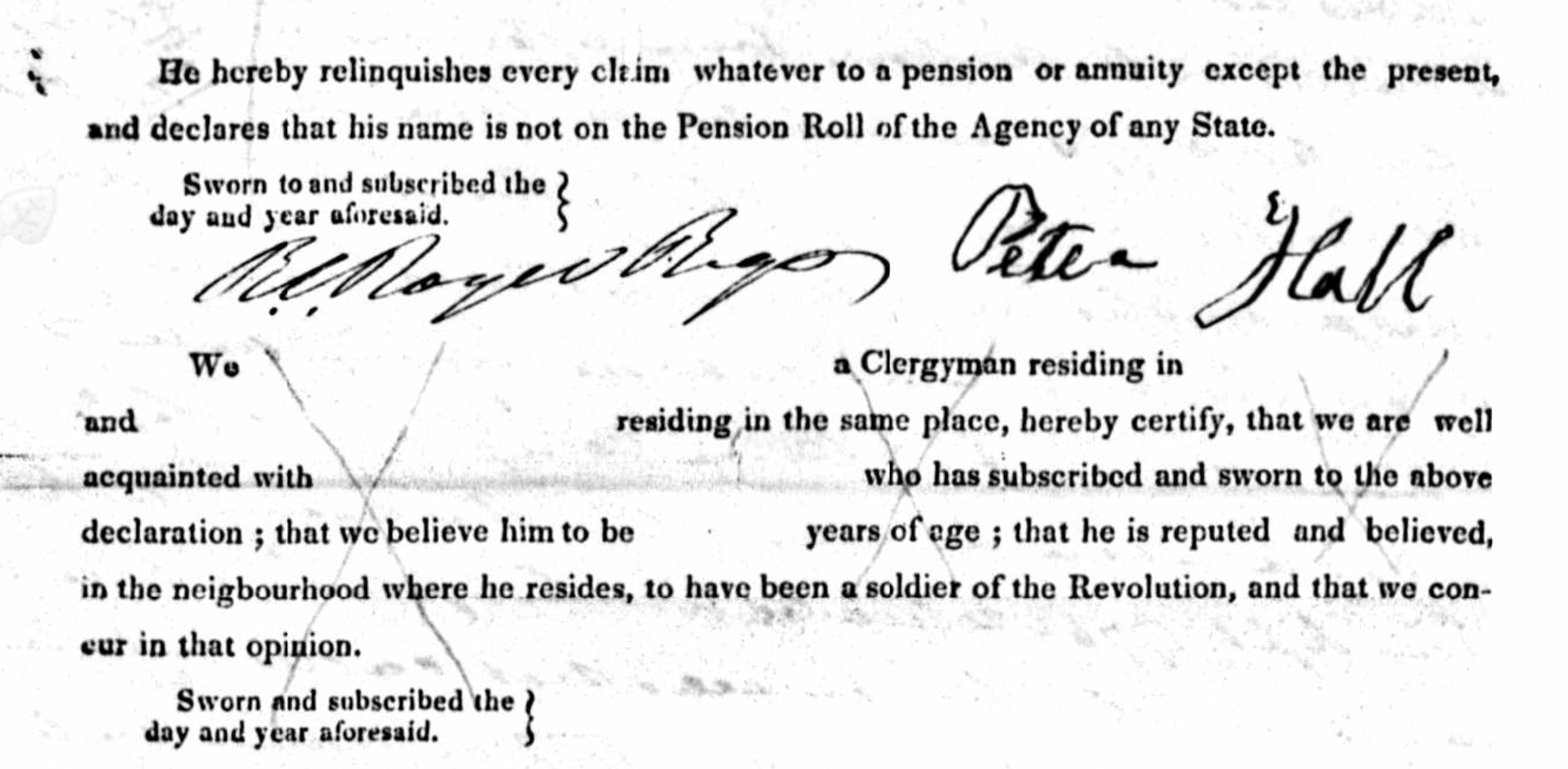
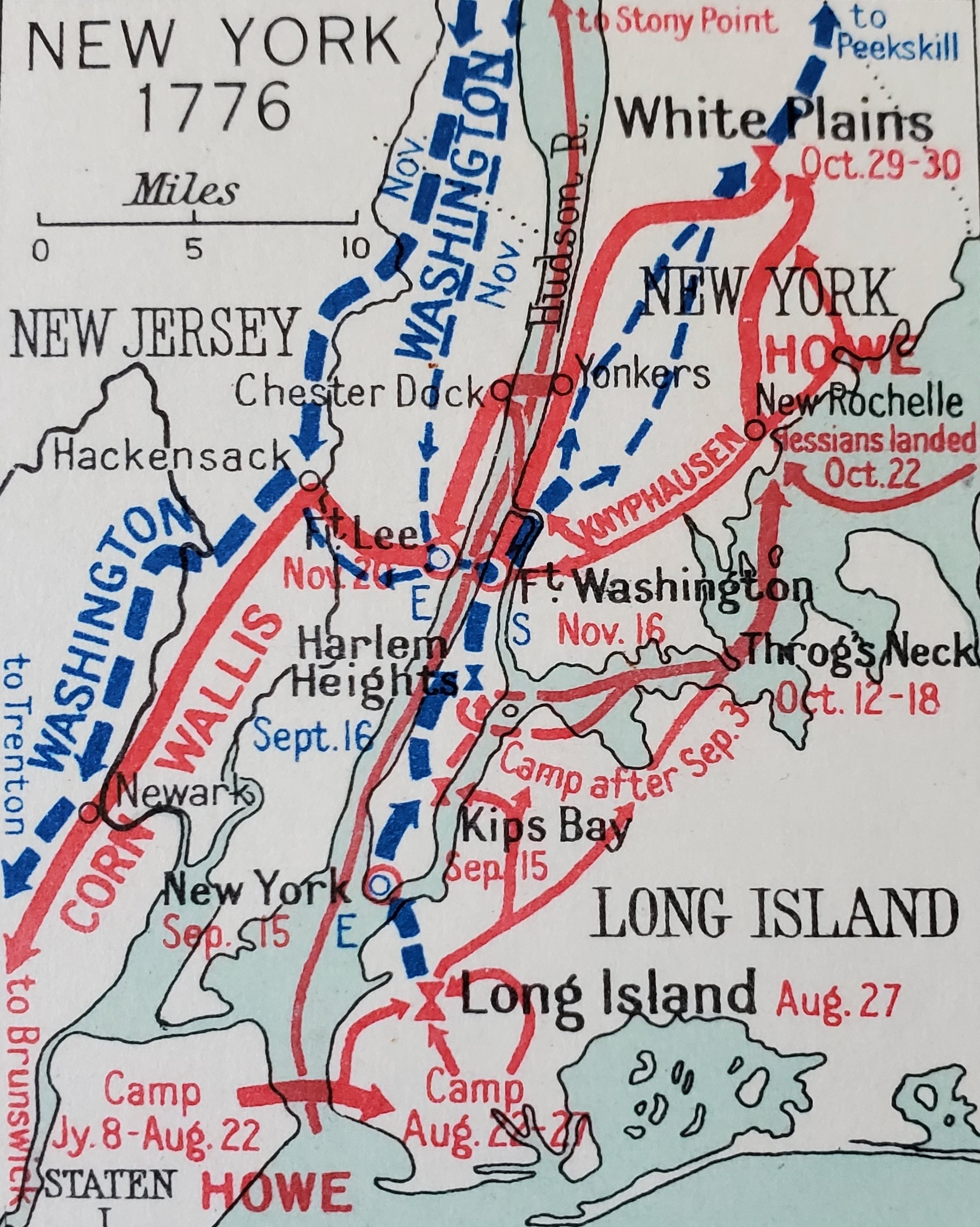
From historical records we learn that a few months after hostilities at Lexington and Concord erupted, Col. Return Jonathan Meigs, aged 35 a militia captain, enlisted on July 1, 1775 as a major in the 2nd Connecticut Continental Regiment. The regiment was formed on May 1, 1775, commanded by Colonel Joseph Spencer [ Later known as Spencer’s Brigade]. So this is probably when Peter Hall enlisted. Spencer was promoted to Brigadier General on June 25th and the command fell to newly commissioned Colonel Samuel Wyllys. The Muster Roll for Peter Hall is under the 2nd Regiment Col. Wyllys. Further on August 9, 1776, now, General Spencer was promoted to Major-General of the Continental Army, and given command of a division composed of Parsons’ and Wadsworth’s Connecticut Brigades. In January 1776, due to a pressing request from General Washington, the Connecticut Council of Safety voted four regiments of 728 men to be raised to serve at camp near Boston until 1st of April. 1st raised under Colonel James Wadsworth, was present at Long Island at time of the battle August 27th, half of his division being engaged; present at White Plains October 25th, and on December 14th was ordered eastward, and took command in Rhode Island, which was surrounded by Admiral Sir Peter Parker’s forces. General Spencer remained in command through 1777. Colonel Noadiah Hooker was of Farmington, Connecticut. He marched to Roxbury as a captain in early stages of the American Revolution and was promoted to colonel in 1776. It appears that Peter was a lucky man in not facing many battles but he repeatedly enlisted to serve his country and was a witness to history.
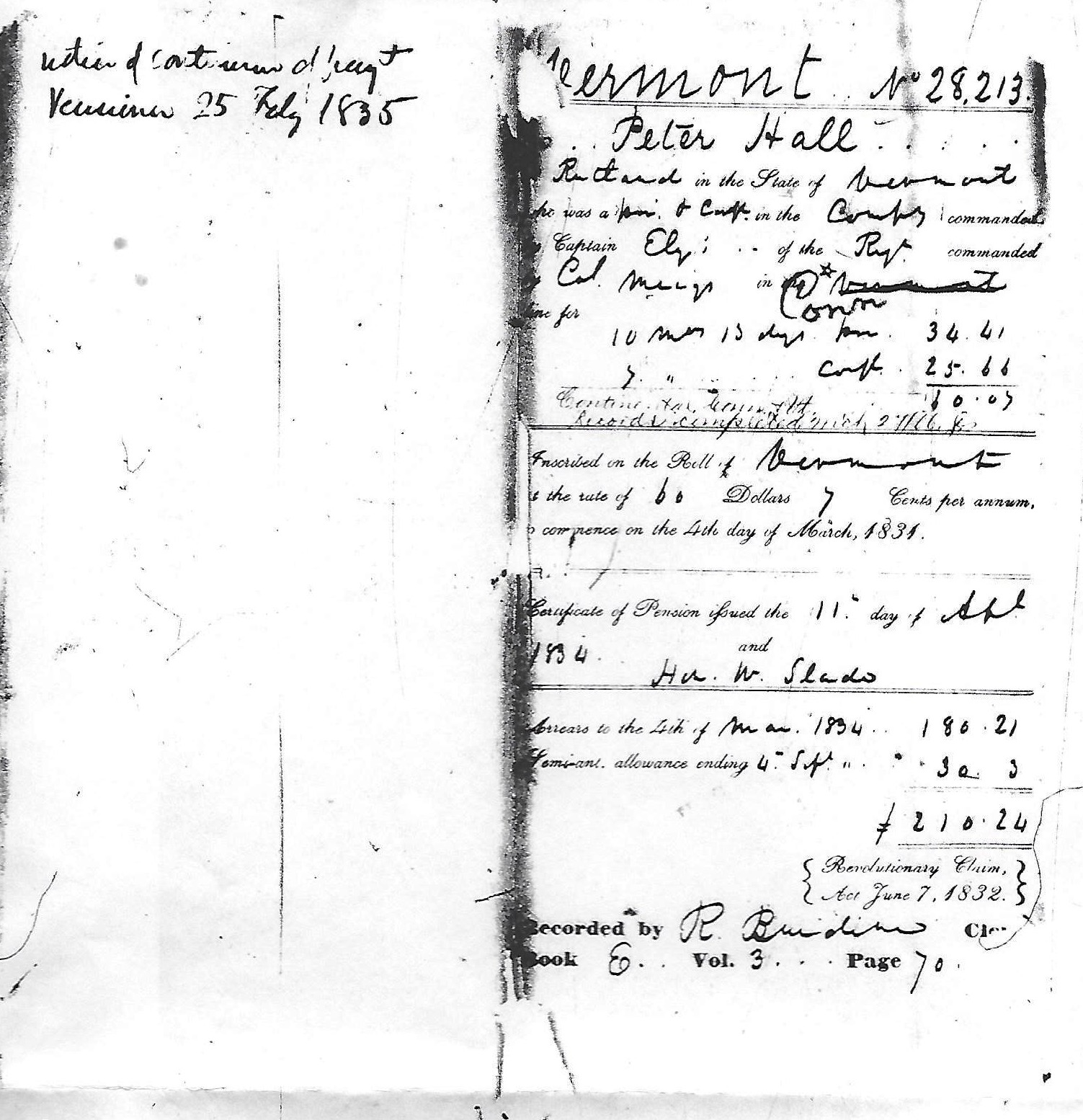
The testimony of Peter Hall, though not remembering all the details is consistent with the facts. His pension file includes this summary in response to an inquiry.
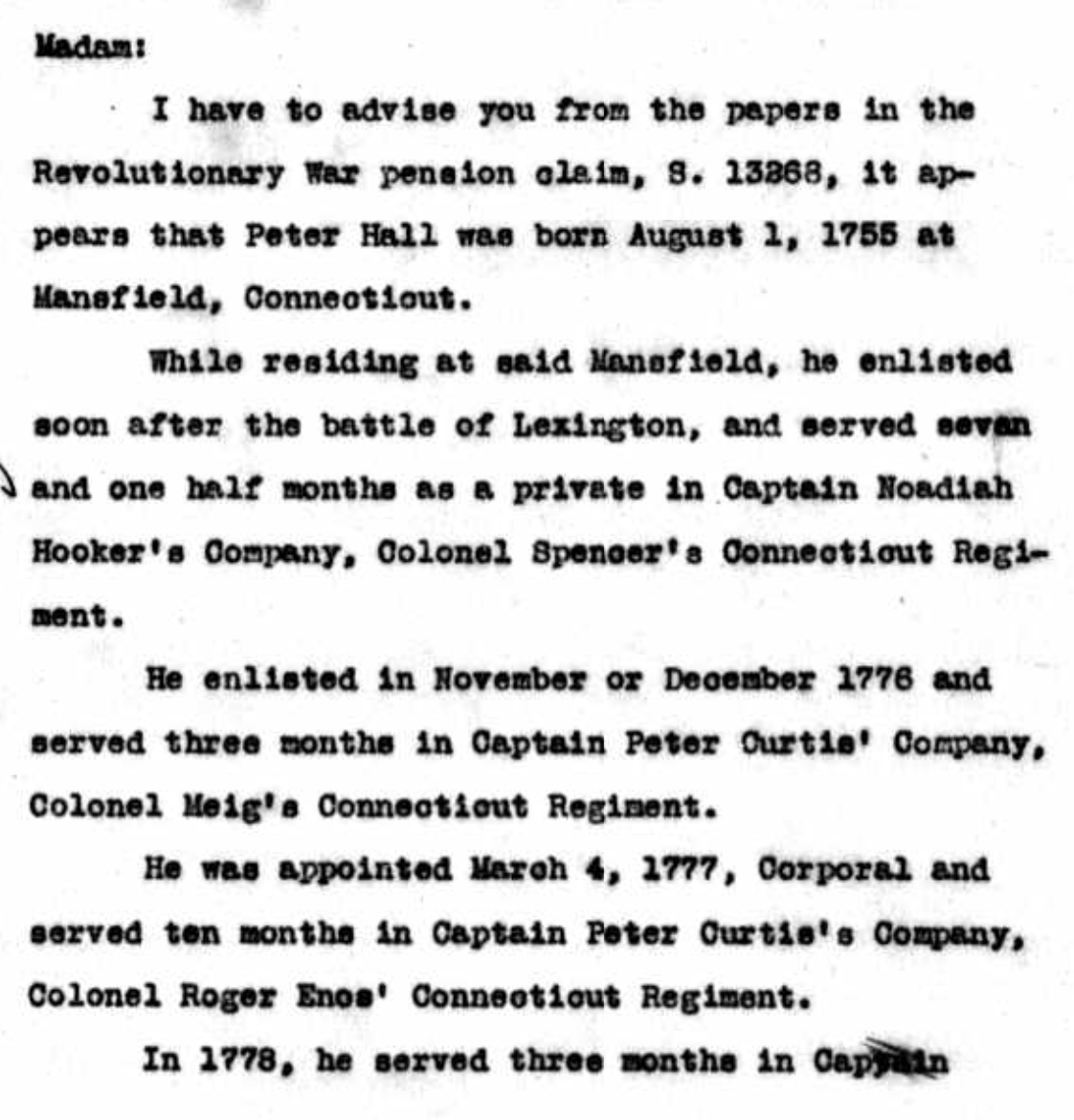
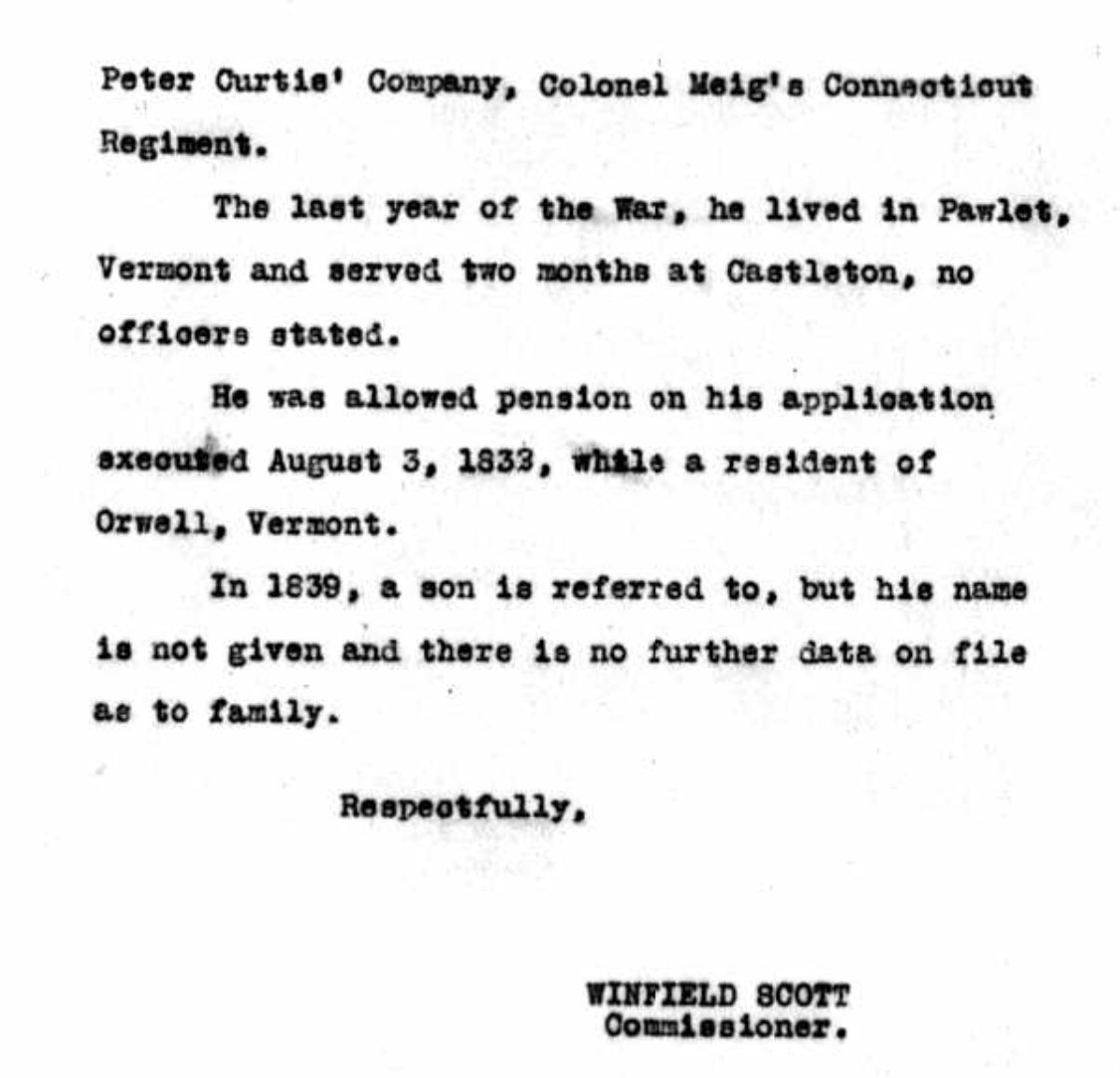
So we have confirmation that he served about 2 years and 1.5 months over the course of the Revolutionary War and was granted a pension after August 3, 1832. He died the 25th of October at the age of 80. I encourage all of you to honor a veteran this day, by digging a little deeper.
ADDITIONS
In the DAR applications this gem which gives he was a shoemaker dark eyes, dark hair, and dark complexion and 5’7″. Also more details including under War service.
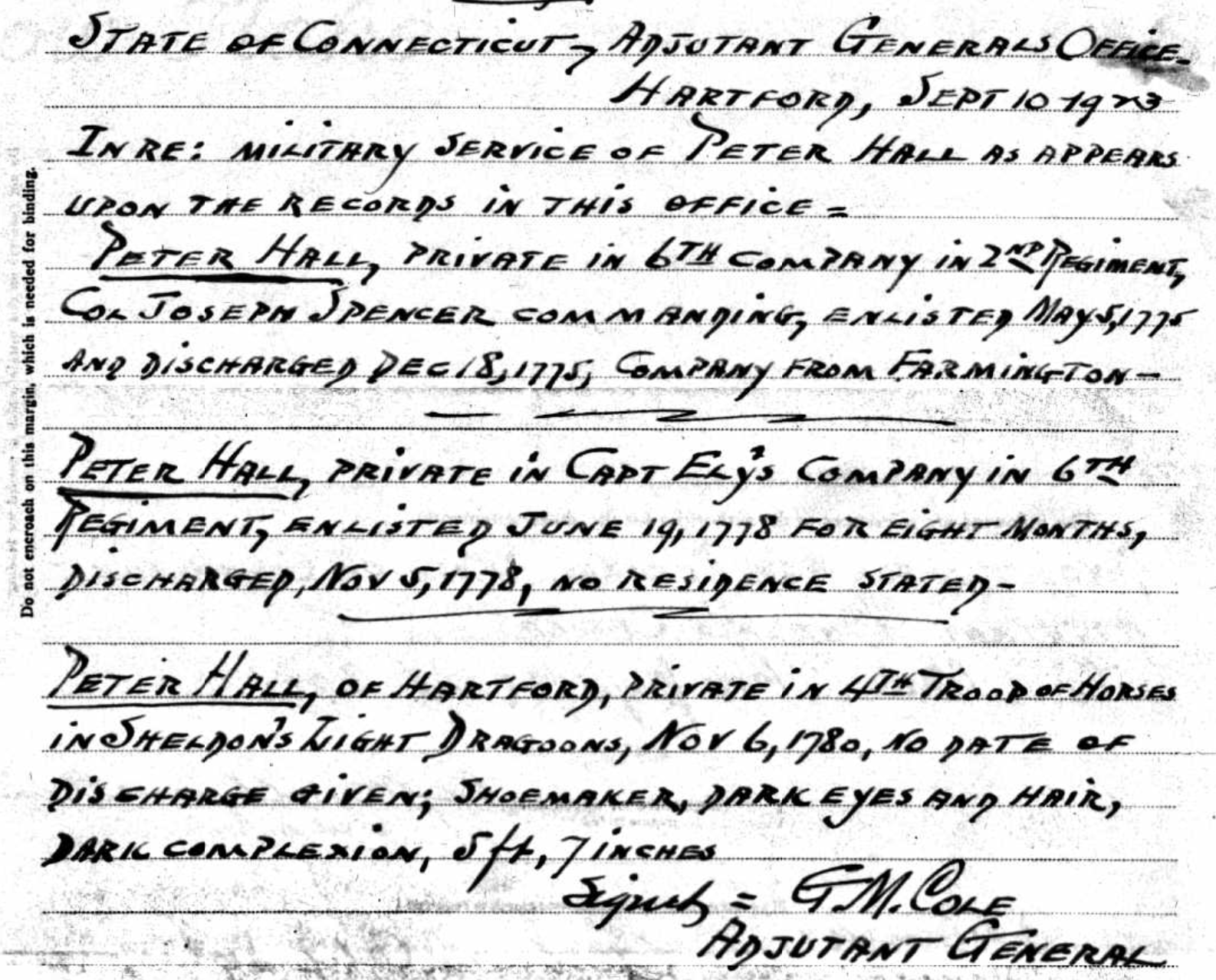
Governor Trumbull included the 5th Connecticut Light Horse Militia commanded by Major Elisha Sheldon as part of the state militia contingent sent to General Washington in New York after the Battle of White Plains. They Raided Fort St. George and Corum (Long Island, NY) 11/23/1780 during Peter Hall’s tenure.
Kelly Wheaton ©2023 – All Rights Reserved
Writing Challenge: Where were you when Kennedy was shot?
Posted on November 7, 2023 1 Comment
One of my Genealogy class students, Frank, suggested that we write a piece on what we remember of where we were and what we were doing when President Kennedy was shot. November 22, 2023 will be the sixtieth anniversary of this national tragedy. As luck would have it they were both Wednesdays before Thanksgiving. It seem like a good way for us to tell part of our own story.
If you happen to be reading this and were not alive then I suggest you interview someone in your family.
I will post what I wrote in a later blog post but I thought reflecting on my process might be helpful to budding family history writers.
After our class decided to take up Frank’s challenge. I let the idea roll around in my head for a couple of days.
A couple of decades ago I had written a piece on one of my teachers and it included a bit on what had happened that day. But the focus of that writing, was on the teacher. I read it, but put it aside. In my mind I kept drawing in things to be included in the story, but then kept realizing that they were unnecessary tangents. I did not want to write a long story or a detailed story. I wanted it to be sparse—and not flowery—a true indication of the day.
As is often the case when I write I fall asleep at night thinking about how to frame or create the story. And usually I am rewarded waking up with an idea. I woke with the start of an idea but it was not yet formulated. As I wrote— it made itself known. I wrote in first person present and I dropped right into what was happening with no preamble. Without thinking about it in advance it perfectly mapped out what happened for me as that day unfolded.
There is a tendency with new writers (and some seasoned ones) to explain. Nothing on that day came with a explanation—and I wanted the reader to feel that. I did not want to add lots of adjectives or sensory clues. I just knew that up front. I think I felt a bit like a news writer. These were not things I was fully conscious of when I started—but as I said earlier they made themselves known.
I read my writing out loud to see if there were an awkward places. I rearranged a couple of clauses to make it read better. I added a quote and a small bit of detail but the rest was simply as it flowed. I could write a longer story from it—but I don’t want to. At least not now. Sixty years is a long time. I wrote what I remembered without filler or embellishment.
If you decide to take up this challenge your story is unique. How you tell it is both a reflection of you as a person, and your experience as a writer. There is no wrong or right way to do it. All I can suggest is that you be authentic. Do not try to sound like anyone but yourself. One member of my class does not like to write, except lists. If that is you write a list. Anything you write will give your descendants a better idea of who you were and what you experienced. That is the point. They won’t give a damn about your grammar or your skill. They will just be grateful that you wrote something down.
Please feel free to add snippets of your story in the comment or a link to your story.
Kelly Wheaton ©2023 – All Rights Reserved
Writing Challenge: Playing with Sentences
Posted on October 26, 2023 1 Comment
I tried this out on my Genealogy Class and the results were terrific. So I offer it up for your consideration. This is a true beginners exercise, but even seasoned writer’s can have fun with it.
Ground Rules
- Limit yourself to one or two sentences to start
- You can write about anything you want. Maybe pick an ancestor and describe something about them ie Grandma Jones always wore a red gingham apron.
- Limit yourself to 5 minutes to write your initial sentence or two
Okay once you have your one or two sentences you are going to revise them as many ways as you can in 5 minutes. Try:
- Rearranging the words
- Adding sentences
- Putting in more or less descriptors
- Write whatever comes to mind
- Have fun
My Example
- She walked into the room and the fragrance of orange blossoms was overpowering.
- The fragrance of orange blossoms nearly knocked her over as she entered the conservatory.
- A familiar scent, tickled her memory; instantly transporting her back to her grand mum’s orangery.
- What was that smell? She inhaled it like someone thirsty for something they did not know they needed. Her shoulders relaxed as she pondered forgotten memories.
The whole idea of this exercise is to get your creative juices flowing. There is not RIGHT way to WRITE anything. There are many, many choices we have in selecting words, their order, their context. Playfulness often unlocks depth and interest in our writing. Especially with Family History Writing. Ask yourself, “Who is my audience?” If its your descendants ask yourself, “Will they read this, will it interest them?” If your answer is NO. Then its time to move past your first draft of a sentence to something a bit more interesting.
Kelly Wheaton ©2023 – All Rights Reserved
 Wheaton Wood