Old Rehoboth, Massachusetts & the Ring of Green: Mapping the Past on Greenwood Ave, East Providence, Rhode Island
Posted on October 16, 2023 12 Comments
Background
Two years ago in the lead up to visiting Rehoboth and Swansea, Massachusetts I contacted the East Providence Historical Society and I asked for help in locating the original home lot of Robert WHEATON on the Ring of Green. Sandra Turgeon and I exchanged emails and arranged to meet at the East Providence Historical Society at Hunt’s Mills.

Adjacent the Hunt House as it stands today is where Stephen Payne built a sawmill, grist mill and tannery back in 1643 on the Ten Mile River. If you follow the River westward it forms the southern boundary of the approximately 300 acre of the Ring of Green. Whether this or any other of the numerous Mills along Ten Mile River may have been where Robert WHEATON’s Tannery was located we will never know.
We did have a fruitful meeting and later I spent an afternoon talking photos along Greenwood Ave and the ends of Pearl and Chauncey avenues trying to make sense of the original home lots as shown in the Volumes by John G Erhardt. Below you see his drawing of the Ring of Green. Which for those not in the know, is now in East Providence [Rumford], Rhode Island, for the original Rehoboth was not where it is today.
The Ring of Green

The homelots of the original proprietors of Rehoboth were laid out around a common or green. This area would be where livestock was allowed to graze and a meeting house/church would be built. Five gates were scattered about the green where you could enter or exit. The green was fenced and surrounded by house / farm lots of six, eight or twelve acres depending on the wealth of the proprietor. Rehoboth was the name chosen by Samuel Newman. To the native Narragansett and Wapanog, it was known as Seaconk or Seekonk. I will not wasde into the controversy over what Seekonk means as Richard LeBaron Bowen gives up the first 24 pages to an exploration in his Early Rehoboth Vol. 2.
In the map above the lots on the south of the Ring from Isaac Martin to Obadiah Holmes lay along what is now Greenwood Ave. The bottom parts of those lots are now part of the Agawam Hunt Golf Course. Sorting out what the lots were then and where they are today has been a major challenge. I have come up with many iterations of that map with lots superimposed onto a aerial view of Google maps of the present day. But it was never quite matching up. I worked on it many times since my visit and then set it aside.
At the very beginning we knew the locations of Samuel NEWMAN’s lot but not all the area it encompassed. We know that the Phanuel BISHOP House at #150 Greenwood Ave was located on NEWMAN’s property. And we knew that the Caleb ABELL house is located at #66 Greenwood Ave and that another ABELL house is located at #30 Greenwood. But where exactly lay the lots of Robert WHEATON and his neighbor Robert FULLER were guestimates.
The Two Roberts: WHEATON & FULLER
The Puzzle
Then Sandra contacted me and we started working afresh. Although its still a work in progress its getting closer and closer. So if there were rudimentary surveying and property disputes back then—it wasn’t going to be easy to reconstruct the past. What is evident is that the separate, discrete lots of the original 1645 Ring of Green were consolidated over time and then more recently separated back again into smaller lots. The exact location of property lines is going at be suspect at best. But I am going to put forward what we have so far and amend it, as necessary.
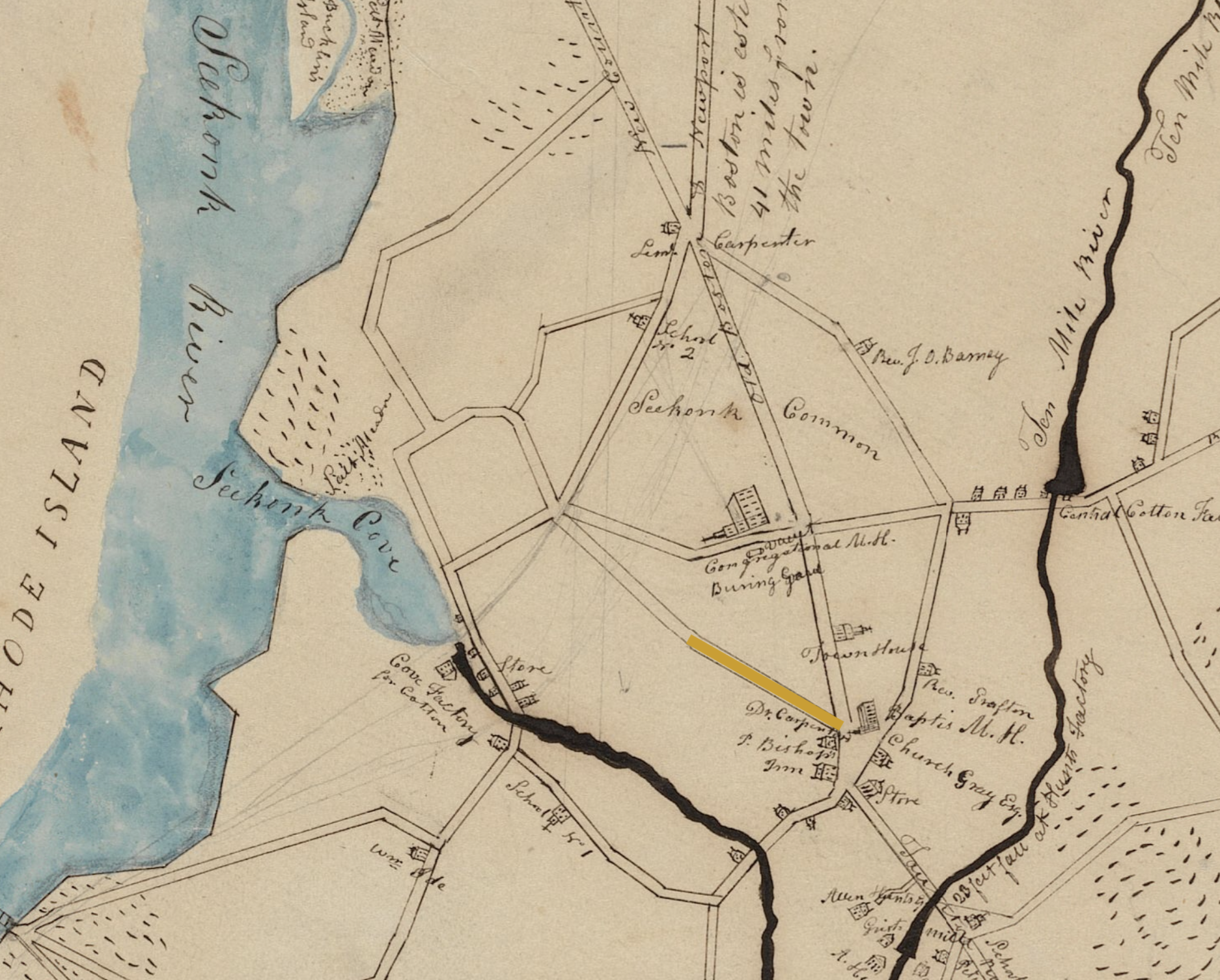
I have highlighted Greenwood Ave. Courtesy of Norman B. Leventhal Map & Education Center, Boston
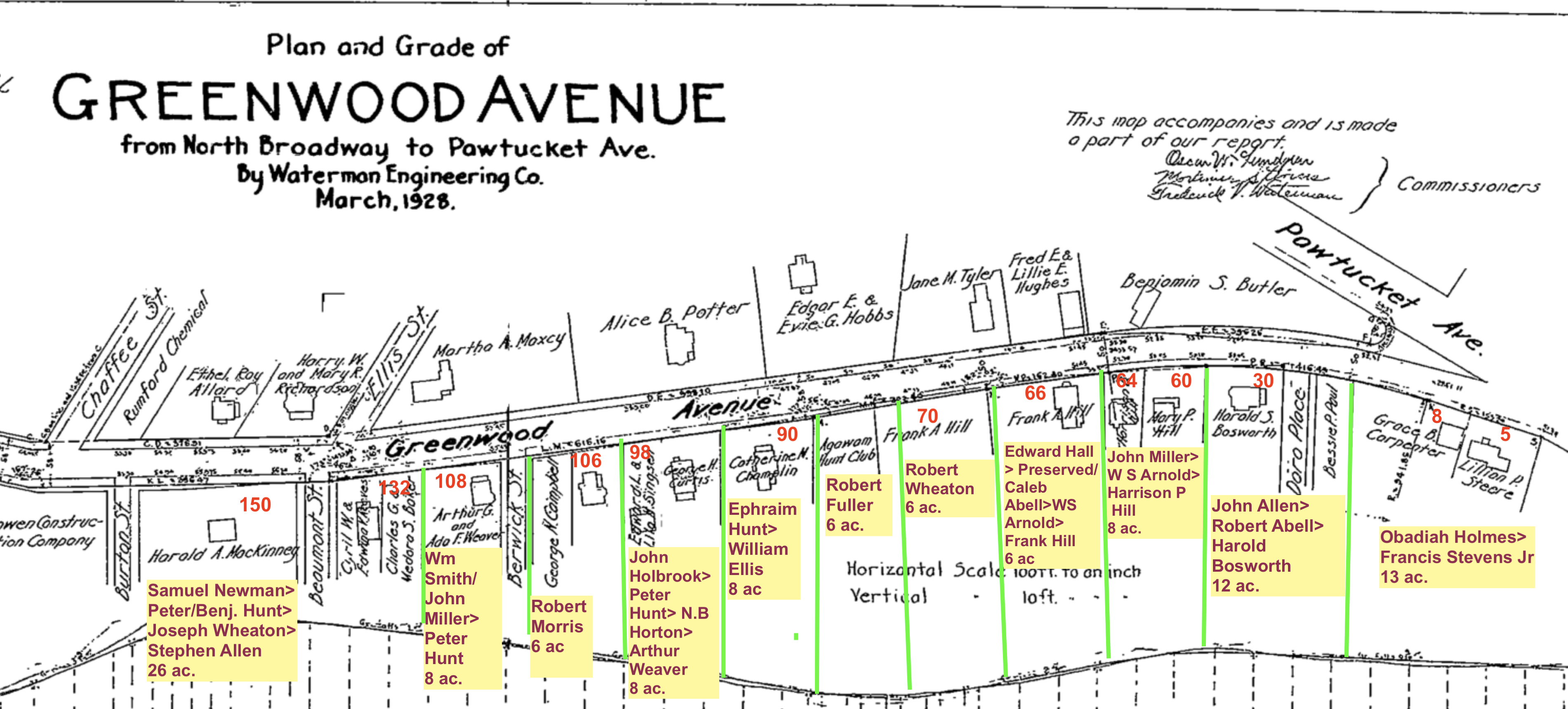
So I decided to take another approach that led to this chart. As I said this is a work in progress. But I am confident it is close.

Plotting them onto a 1928 Map of Greenwood Avenue it looks like this.
Holmes, Abell & Allen Houses
I did not take photos of every lot but starting with #8 Here goes. This is the lot of Obadiah HOLMES. It is said that this house, built about 1760’s on the foundation of a house that burned during King Phillips War.

Next up is #30 originally John ALLEN and later Capt. Robert ABELL. Later known as the Harold BOSWORTH Hose built about 1910’s.
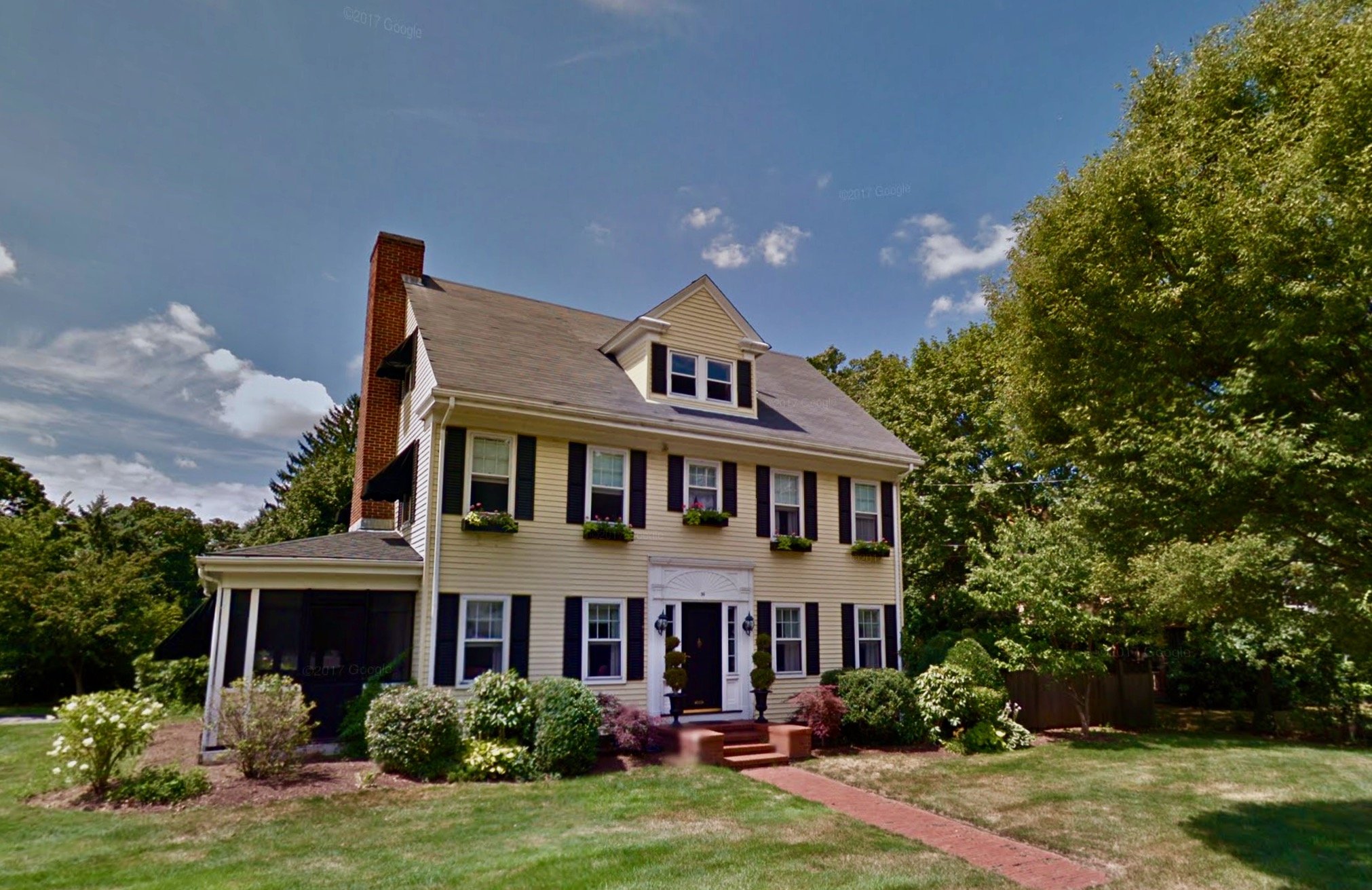
The following property was also owned at one time by the ABELL family. The original foundation goes back to the 17th century. The first house built in 1643 burned in 1676. The current house dates about 1750. The original lot belonged to Edward HALL then Caleb ABELL.
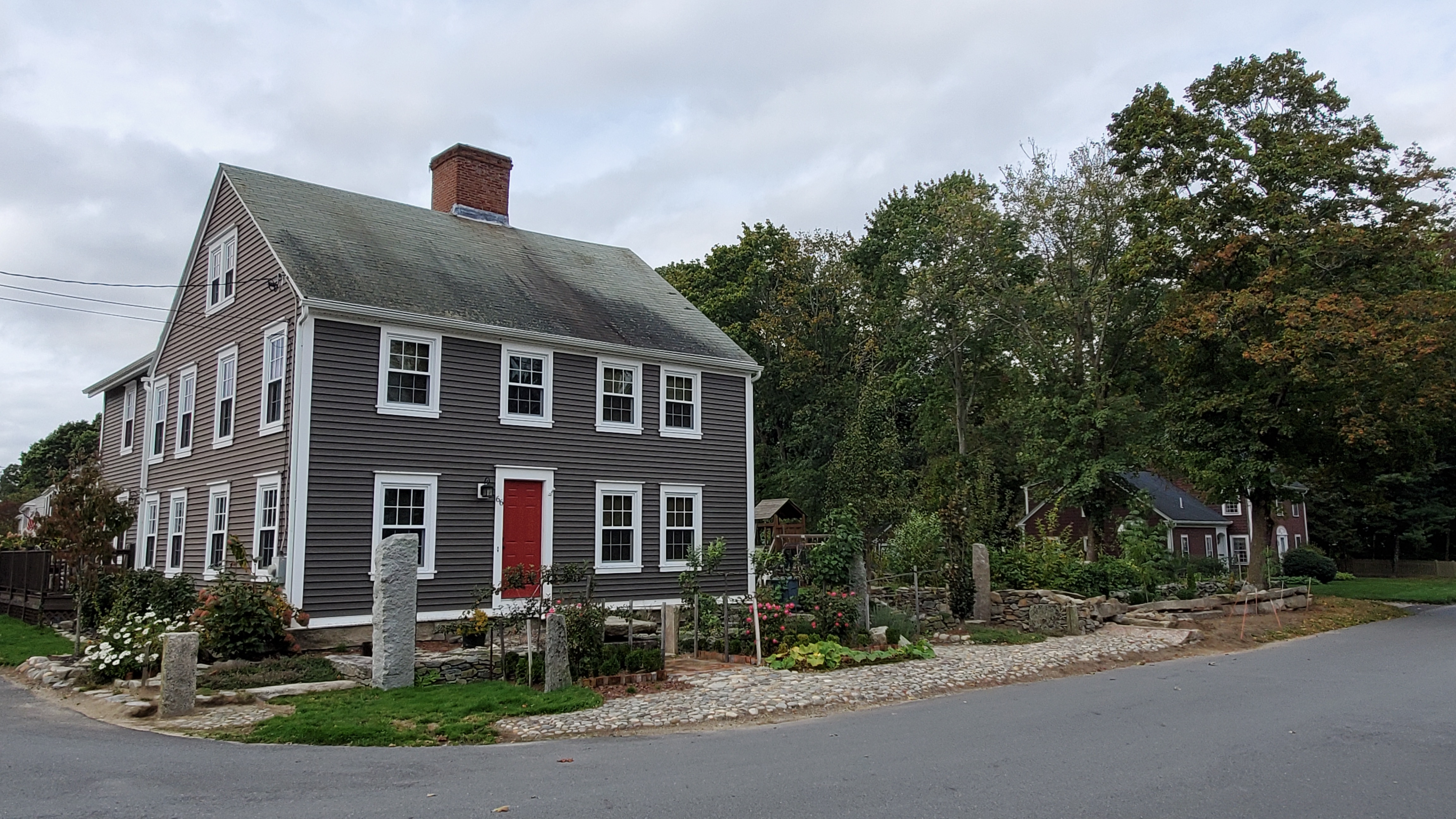
Robert Wheaton’s and Robert Fuller’s Lots
Both Robert WHEATON bc 1606 and Robert FULLER bc 1615 settled originally at Salem, Massachusetts. Robert WHEATON was a tanner and Robert FULLER a bricklayer or mason. Robert WHEATON appears on the records in Salem in 1636 and Robert FULLER in November of 1639. The Roberts each married sisters Alice and Sarah BOWEN, daughters of Richard BOWEN. It is most likely that Richard BOWEN was instrumental in the Roberts moving to Rehoboth as he was with the Rev. Newman at Weymouth, Massachusetts before relocating to Rehoboth. The border between Robert WHEATON’s property and Robert Fuller’s was in dispute for thirty years. Robert FULLER turned over his home lot to his son Benjamin in 1679, only after the property dispute was settled:
As a side note Sarah (BOWEN) FULLER wife of Robert FULLER died 14 October 1676, prehaps killed by Indians. That same year all but two houses on the Ring of the Green were burnt to the ground and Robert and Sarah’s sons Samuel and John FULLER were killed in August. It is presumed that their sister Abigail was also a victim of King Phillip’s War. It is perhaps for this reason Robert FULLER removes to Salem in 1676 where he lives with his new wife Margaret the widow of Christopher WALLER. In their 80’s Margaret and Robert FULLER return to Rehoboth. She dies in 1699 and he in 1706. By comparison Robert WHEATON’s family survive King Philips War intact. Robert died in 1696 in his 90th year, his wife Alice sometime between the time of the writing of his will in 1686 and the settlement of his estate in 1696. It is suggested that they are buried near their son, the Rev Ephraim WHEATON at Old Burial Hill but no markers exist. However there are some field stones in the general vicinity.
” An agreement made the 28th [torn] of 1679 Betwixt Robat Wheaton and Robert ffuller both of Rehoboth in order to make the ending of a contriversie that hath ben longe between them Respecting the Bounds of thire home lott, the said Robat Wheaton ingageing in the persone of Mr James Browne and other neighbors; that betwixt this day and winter sets in he would puk his fence and set it in the bounds where the thre stakes stands, and they both agreeingthat they both agreeing that those stakes shall be the bound between them: witness my hand the day and yeare above written, The Marke of Robert Wheaton. “ William Carpenter, Town Clerk Rehoboth Town Meetings Book II
So the answer to my quest is probably the same hunch I had when wandering up and down Greenwood Ave. It would be closest to the lot of #70 today. Of course the house there is much more recent.

To the right (west) is a wooded stream bisected lot that would have been Robert FULLER’s his house being located across Greenwood Ave on the North side where it is less steep. I suspect Hayward Place and this wooded area would be a part of his original lot.


View from the Backside to the South
All of these lots along Greenwood had their southern boundary at Ten Mile River. Their lots would have encompassed what is now the Agawam Country Club & Golf Course. So I also went to the south side and took photographs shooting northward.

I think it interesting to compare this view with one 100 years earlier.

Continuing Along Greenwood Ave
This House at #90 Greenwood Ave is known as the 1871 William W. ELLIS house. The house was altered in the 20th century. This is likely on what was the Ephraim HUNT lot back in 1645. The woods to the left side of photo would be that of Robert FULLER lot.

This house at #98 built in the 1860’s would be the approximate location of the John HOULBROKE lot.

That is Followed by the Nathaniel BISHOP House at #106 Greenwood Ave. This house built in the 1860’s by Nathaniel BISHOP on the approximate Robert MORRIS lot.

These two house at #108 and #132 were originally the William SMITH lot and Town Land lots. #132 was later consolidated into the holdings of Samuel NEWMAN. #108 is known as the Arthur WEAVER house built in the early 1900’s.
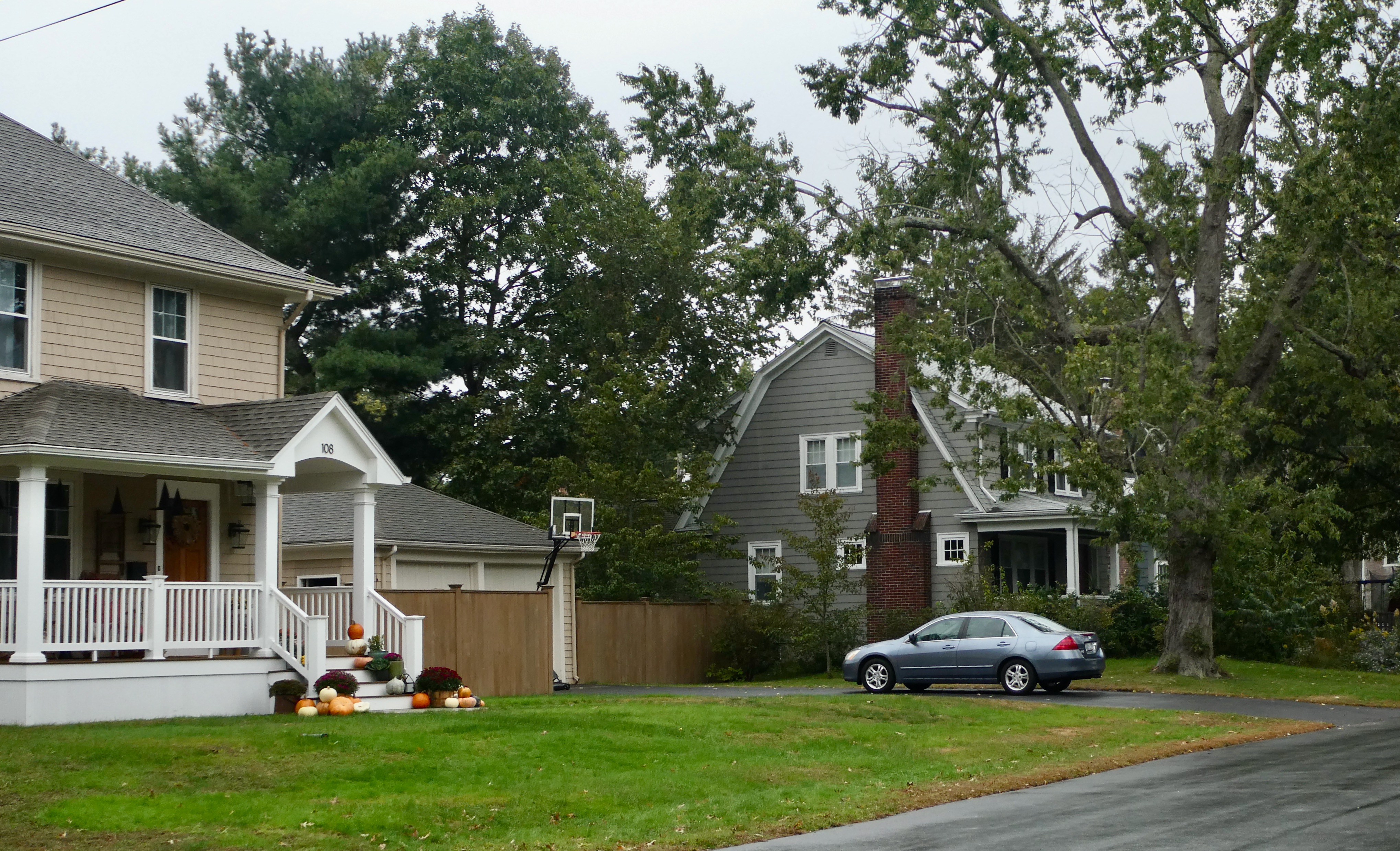
And finally we arrive at the Property originally belonging to Samuel NEWMAN known now as the Phanuel BISHOP house. It was built in the 1770’s .

Located on property previously owned by the Rev. Samuel NEWMAN
Further research may yield adjustments but I decided to publish this in the event someone has information that will further clarify what we think we know. Additions and corrections are always welcome. Thank you’s to Sandra Turgeon and Lende Mcmullen.
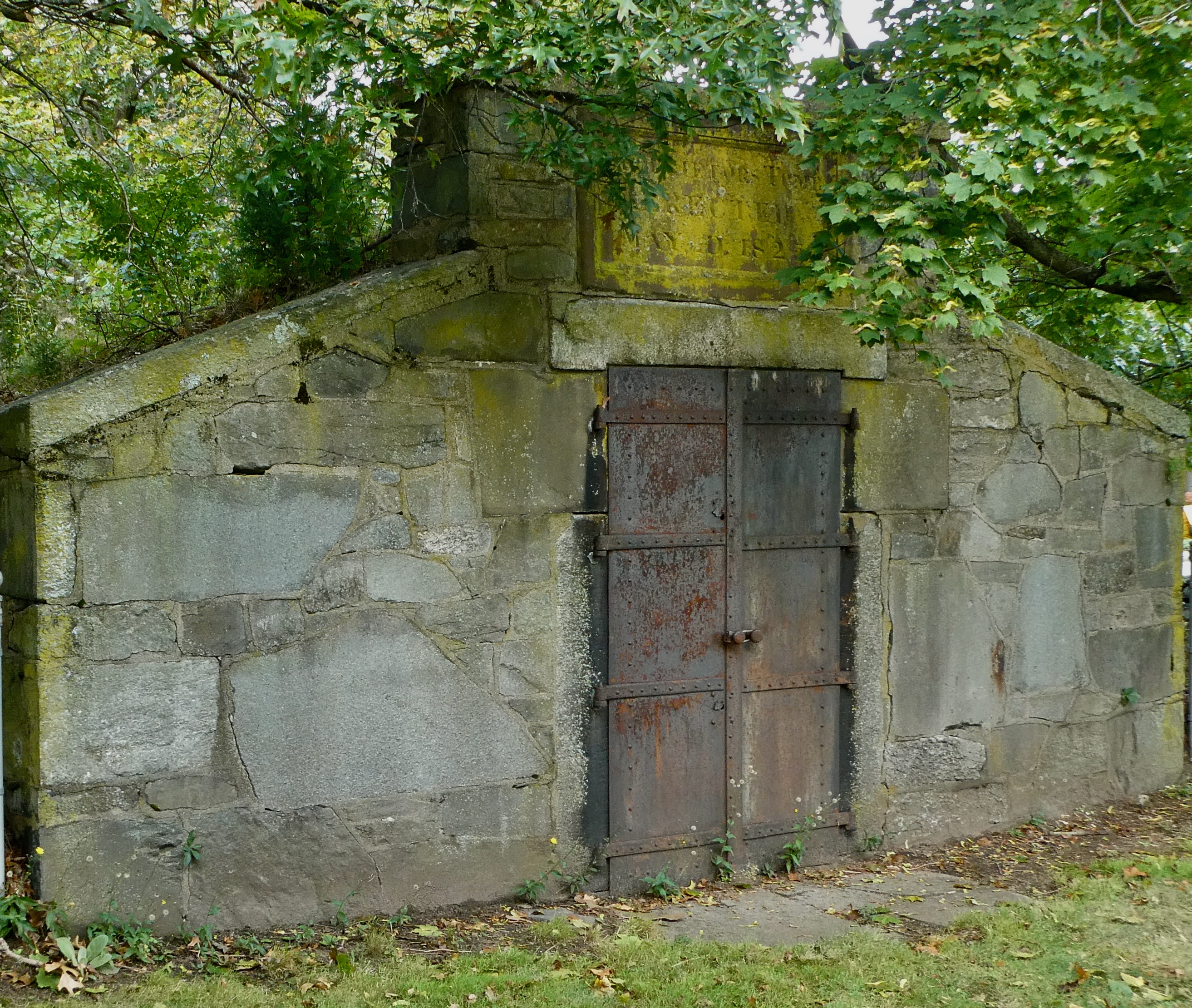
Note: Please if you visit this neighborhood be respectful of the people who live here. And don’t forget to pay your respects at Newman Cemetery which is what remains of the green, of the “Ring of Green.”

Kelly Wheaton ©2023 All Rights Reserved
Special Ancestors: Asa Ami Paden
Posted on October 7, 2023 4 Comments

I happened to think of Asa today when teaching a genealogy class. I was talking about being the custodian of historic documents and it made me think of my cousin, Nancy Black Young [my 2nd cousin twice removed], who had sent me a few years ago, documents regarding my 2nd great uncle, Asa PADEN. But that wasn’t the first time I had heard about Asa. Back in the 1970’s when I began corresponding with my cousin, Elsie PADEN [my 1st cousin twice removed] she wrote to me about Asa and later she included him in her “Personal Glimpses of the Paden Family : from 1790 to 1977 October 1972.”
So off I go to my binder of Elsie’s letters and her first mention of Asa in our correspondence. In a letter to me dated Jan 30, 1975, speaking about James Lewis PADEN, her grandfather, she writes:
“The reason for Asa Paden’s name on the 1880 census was because he was under his father’s care even at 33 years of age because of his mental ‘Condition.’ The census reports stating that Asa was ‘insane’ falls short of the truth. Asa was not ‘insane’. He was not even Feeble-minded as we know it today. He was ‘odd’ perhaps, and no doubt his IQ was below 75. I remember him as quite an old man when I was six or seven. He lived with his brother, James Lewis and his wife Millie Coats Paden on the Nebraska homestead, having gone to live with them after his father, Alexander’s death. It was always my understanding that Asa, too served in the Civil War the latter part of the conflict. That of course is possible as he would have been around 17 years of age, and because the Union Army was so desperately in need of men…” [I have not found an official record of his service. As my cousin Malia suggests perhaps he just tagged along].

It was later torn down
My grandfather Milo MOSIER was born here in 1899
What intrigued me in Elsie Paden’s letter was the following description: “I distinctly remember Asa’s room in Grandma’s farm house. It was small, on the southwest corner of the second story, having two windows, one on the west and one on the south. Asa Collected bottles of every color, shape and size. He had them tastefully arranged on the window sills, and on other furniture in his bedroom. The sun reflected through the colored bottles made lovely rainbows on the walls. He could name the places he found the bottles and loved telling about them. He kept them washed and shiny. So you see why I feel quite sure ‘insane’ is a cruel word to describe him. I presume people in that era could not understand how one could be sane and collect bottles! He was such a gentle, kind person and did whatever he was told to do with no complaint. He had plenty of opportunity to find bottles as the homestead was on the Mormon trail from Council Bluffs, Iowa to Salt Lake City.” This description of Asa written and read by me over 48 years ago stuck. I can see a rainbow reflected on a wall and think of my Great Uncle Asa, who I never met. Such is the power of word pictures to build a connection with our past.
Asa was born in 1847 in Sandusky, County Ohio, the eleventh of thirteen children. He is listed on the 1850 census with his family. Then in 1860, twelve year old Asa is listed at the Ohio Institution for Idiots, also known later as the Ohio Institution for the Feeble minded. Its mission “to furnish special means of improvement to that portion of our youth who are so deficient in mind, or have such marked peculiarities and eccentricities of intellect as to deprive them of the benefits of other educational institutions and ordinary methods of instruction.” This institution was founded in 1857 and my guess is the “experts” convinced his parent parents Alexander PADEN and Anna Maria REMSBURG that they could take better care of educating Asa. Perhaps he was there just for a short stint for “improvement.” In 1860 the Institute was located in a rented house on Friend Street (now East Main St). There were a total of 32 “insane” resident, ages ranging from 8-16; 2 Physicians, 1 Physician Assistant, 3 teachers, 3 laborers and 8 domestics.
However, by the 1870 census, Asa is back living with his parents in Limerick, Ohio, and we are left to wonder. Did he help out in the Civil War? When was he released? What happened to him when he was there? In 1880, as Elsie mentioned, Asa is living with his father, Alexander, and Asa is listed as insane. They are both living in the household of Asa’s brother, John PADEN. For occupation it says Asa “does errands.” That made me smile. Based on Elsie’s remarks above, he probably was very good at doing errands and lending a hand where needed. Below is a photo of Asa, something of the gentleness Elsie spoke of seems to shine through.

Asa, never married, never had children. There are few left to remember him, but I wanted to give him his due. When I wrote to my 3rd cousin, Malia Hammerstrom, I found out she had written about Asa a few years ago. I am grateful to her for letting me share her photo of his gravestone and for her additions to Asa’s Story. Thanks are also due to my cousin, Nancy. I have the document between Asa’s father and his brother, James L, arranging for his guardianship and care. It reads in part “Whereas as the party of the second part agrees to keep his brother Asa A Paden of unsound mind, during his life time to furnish him with board and clothing and all the necessities of life For the payment of same the said Alexander Paden party of the first part has this day deeded to James L. Paden….80 acres and valued at Two Thousand Dollars which is a part of Asa A Paden’s dower at the death of Alexander Paden. In case James L. Paden should die before his brother Asa A Paden the said Asa shall receive his support from the estate of said James L. Paden.

I can not find Asa in 1900 but I do find him in 1910 after his brother James L PADEN has died and he is living with his sister-in-law, Millie and family on the Paden farm pictured above. Asa is listed as being able to read and write but “none” is listed for his occupation. I muse, they should have listed him as a “bottle collector. As Elsie and Malia noted the Mormon Trail, as it came through Nebraska, it took various routes. In 1851 flooding and heavy rainfall forced the Mormons to take a more northern route. The Paden homestead was located in Colfax County in the southern and eastern part, right where the 1851 trail comes through. This makes Asa’s searching for cast off items along the trail make sense.
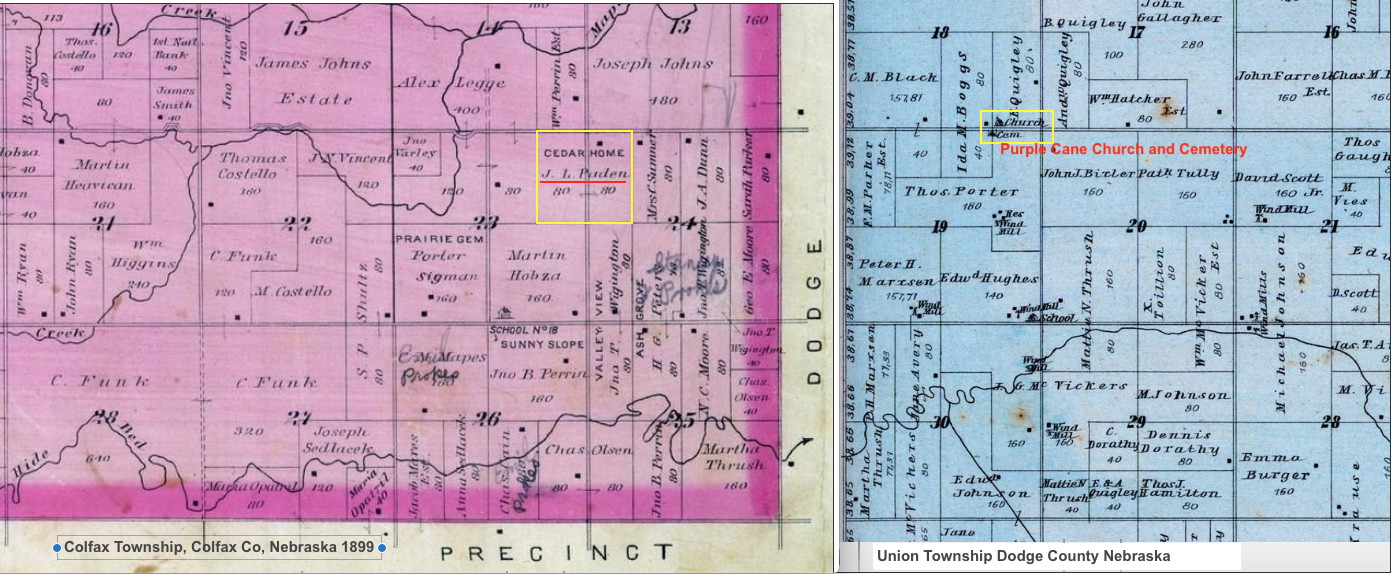
Asa would have been searching a few decades after those heading west had passed through. Not only could Asa understand the value of discarded things—it seems he knew how to make them beautiful. Asa died in 1915 and is buried at the Purple Cane Cemetery near Rogers, Nebraska. Nancy Black Young and Malia Hammerstorm were doing family history searches and found Asa’s plot and realized no marker had been placed there. Cousins Nancy, Sherry Campbell, Pam Maldonado, and Malia purchased Uncle Asa a stone that was placed on his grave in the spring of 2018, so he should not be forgotten. Thank you for remembering Asa. A family that cares for all of its members and especially the special ones, is a family I am proud to share.

Asa’s story has always stuck with me. Perhaps it will inspire you to honor “special” ancestors that may be lurking in your tree.
Kelly Wheaton ©2023 – All Rights Reserved
Family Heirlooms: Egyptian Cosmetic Spoon
Posted on August 27, 2023 5 Comments
This is an example of starting to write about a particular object and ending up with much more than you bargained for. All the memories of a beloved place come streaming back. So no matter the writing—let it take you where it wants to go.
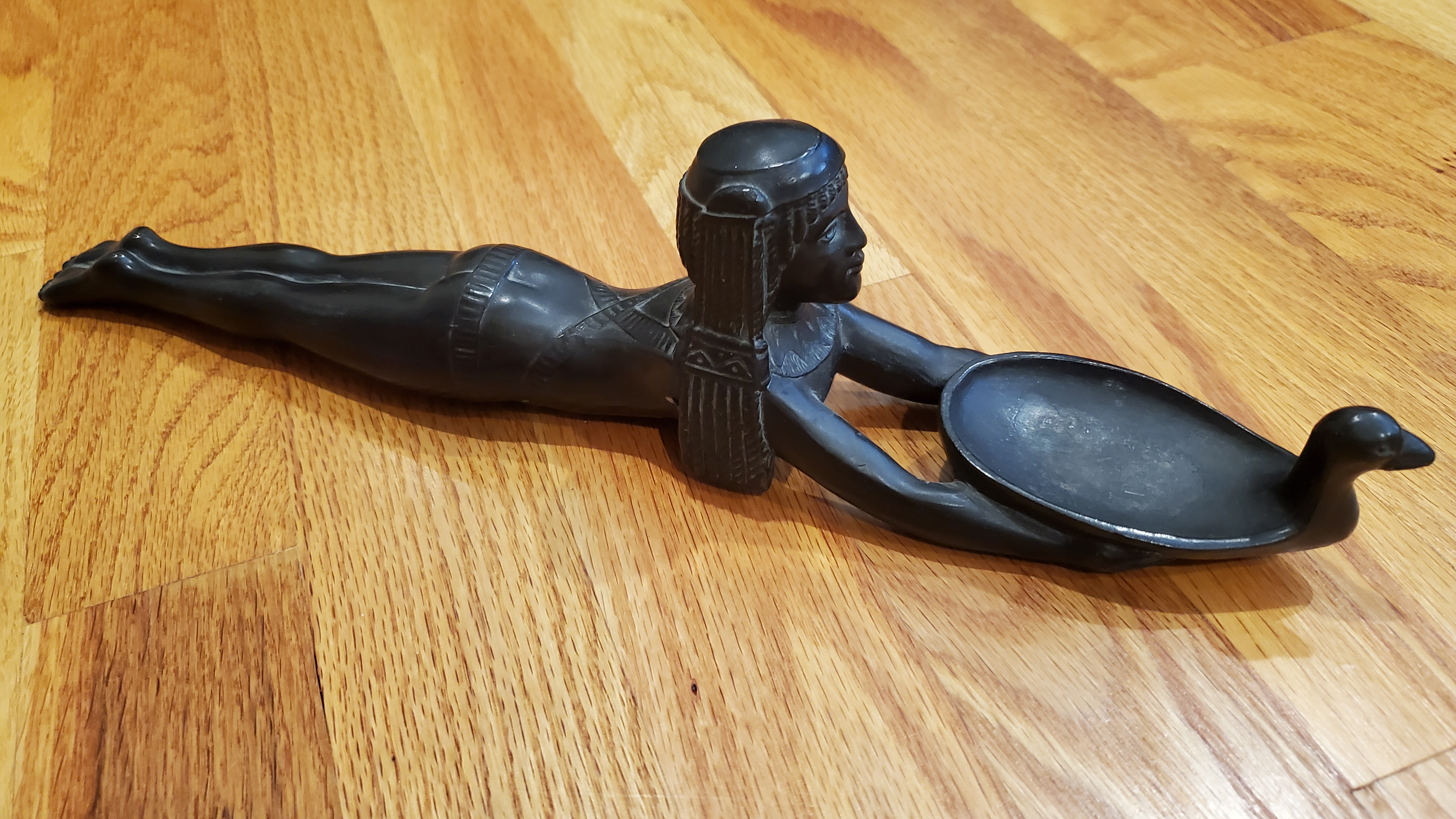
This figure sat on the coffee table of my grandparents house and I never knew the provenance of it. I never was quite sure whether it was American Indian or Egyptian in style. My grandparents did not have much in the way of toys at their house, so I sometimes played with the black princess. The toy box, stored in their pantry, which we used to drag out into the kitchen, held old wood spools and wood rings that looked like donuts. The box had a pierced metal, vented top and sides and a lovely latching mechanism on top. Reminded me a bit of an old icebox. Thinking about that box I wonder whether it previously held pigeons as mentioned in my great grandmother Lulu’s diary. When we write we are bound to remember. We are encouraged to wonder. There was also a small assortment of red plastic Hills Brothers coffee scoops in the toy box. And even though washed, they still smelled like coffee. So the wood pigeon carrier perhaps, repurposed as toy box. It had a mix of wood odors and coffee. It’s not just the fragrance of things past, it is the tactical remembering you feel in your fingertips or notes echoing in your ears.

The black princess was not really a toy. She was heavy, weighing in at two pounds—so not exactly a barbie doll! She was proportioned more like a girl than a mature woman –so that gave her a leg up on Barbie in my book. She was utilitarian as she would gladly hold nuts, collected flowers or petals from the garden or my favorite specially selected pea pebbles from my grandparent’s pea gravel paths and driveway. The black princess didn’t talk much and she was like Barbie, completely inflexible, but she was more amenable to my story telling. She made me wonder about her. And she looked like a swimmer and so we had that in common.
When my grandparents died in 1968 I never knew where the black princess ended up. I would sometimes think of her and always wonder where she was. Then one day I was talking to my cousin and it turns out she had the black princess and as she had no specific memories of it—so she lovingly sent it to me. It’s one of those objects that can instantaneously transport me back to the 1960’s in my grandparents living room on Cedar Street. Compared to my parent’s living room it seemed large. It was filled with the most glorious light filtering in from opposite sides of the room. There were two sofas: one a dark gray horse hair and another that was in a cream and gold brocade. The cream and gold brocade being the newer more modern one that had a good view of the console television. The black princess sat on the coffee table of the horse hair sofa and she had a good view of the brick fireplace and the windows with their lace curtains. I preferred her kingdom to the modern one that the family generally occupied. There was one table between the two kingdoms and that held my grandfather’s well loved upright Royal typewriter. I can smell the typewriter ribbon just thinking about it.

Once I possessed the black princess, I set out to find out more about her and each time came up empty. Then in one of those inspirational moments I took a photo and posted it on Mastodon [Free social media platform]. And sure enough Mastodon did not let me down. Thanks to @ThreeDollarBill and @CyperBunk. I learned my black princess was indeed Egyptian. And she is a “cosmetic spoon.” Who knew?

Wikipedia has a photo of a Cosmetic spoon from the Louvre: “Cosmetic Spoon: Young Girl Swimming is a late Eighteenth Dynasty ancient Egyptian carving by an unknown artist. Completed sometime between 1400 BC–1300 BC, it currently resides in the Louvre, Paris. These spoons are also referred to as “toilet spoons”. It is believed that cosmetic spoons were used to throw myrrh onto fires as offerings to gods or to the dead.” The spoons are associated with the Egyption Goddess, Nwt [Nut], Goddess of the night sky. As such she ruled over the stars and the universe. She was said to draw the dead into the night sky where she would enfold and protect them. She was also the protector of Ra, the sun god. The spoon may have been a vessel for cosmetic paints or aromatic oils however, egyptologists still argue over her purpose. In my version of the mythology she is mother gathering the souls of the dead to swim them to the heavens.
My cosmetic spoon obviously, is a replica. No matter its value is not to be measured in dollars. ASOR: The American Society of Overseas Research has a picture of an identical piece on their webpage here from the author’s collection. Save that his is Bronze: “Victorian swimming girl spoon ca. 1890.” It looks to me as that they were cast from the same mold. Whether this was from the 1915 Panama–Pacific International Exposition as I suspect or something earlier, I do not know. If it is, who bought it? My grandmother Carrie, was still in Washington State so my guess is either my great-grandmother Lulu or her son, my grandfather, Milo. I guess it may have been Lulu and this was something he kept of hers as a keepsake. Or perhaps Lulu’s mother, Millie, had bought it when she was visiting. She writes about her visit to the Panama–Pacific International Exposition here.

My black princess is my feminist icon of connection between the living and the dead. The Zulu and Ndebele people of southern Africa believed the stars are the eyes of dead ancestors, keeping watch on the living from above. That pleases me. By the way the duck is a symbol of renewal and fertility…the law of conservation says all matter is conserved. The same amount of matter exists before and after the change [death] —nothing is created or destroyed.
Update: In an email exchange with Peter Lacovara the author mentioned in the ASOR article the spoons estimated date of production was 1870’s-1880’s. When the Suez Canal was opened in 1869 there was a resurgence of Egyptian style known as the Egyptian Revival Style that persisted into the 1920’s. That makes it even harder to pinpoint who owned it. If only I could power-up the time machine…
Please see my post on writing about heirlooms.
Kelly Wheaton © 2023 – All Rights Reserved
Fact or Fiction? A Revolutionary War soldier talked to a boy, who became a Civil War soldier
Posted on August 25, 2023 5 Comments
"There will be stories, and only some of them will be true." DUANE F. MOSIER
These words my Dad spoke after his diagnosis with lung cancer. They were words of wisdom he passed on to me and his grandchildren. In my The Challenge: Tokyo Rose I proved that a story he told about testifying at the Tokyo Rose Trial was true. Here is another story my Dad said when he was a young boy living in Weaverville, Trinity County, California there was and old “codger” as he called him who was hard of hearing. The old man told him that when he was a kid, like my Dad, he didn’t pay old folks stories much mind either. The old fella said he had talked to a man who served in the Revolutionary War. When my Dad told this story at work with a bunch of scientists, they said he was full of crap. That’s impossible. So I decided to see if Dad was right, or “full of crap.” He only knew the last name of the old man was “JONES.” He wasn’t hard to find on the 1830 census. He is listed as a gold miner, age 89. When my Dad arrived in Weaverville in 1833, my Dad would have been 7 or 8 and the old guy about 92. So that part of the story fits.
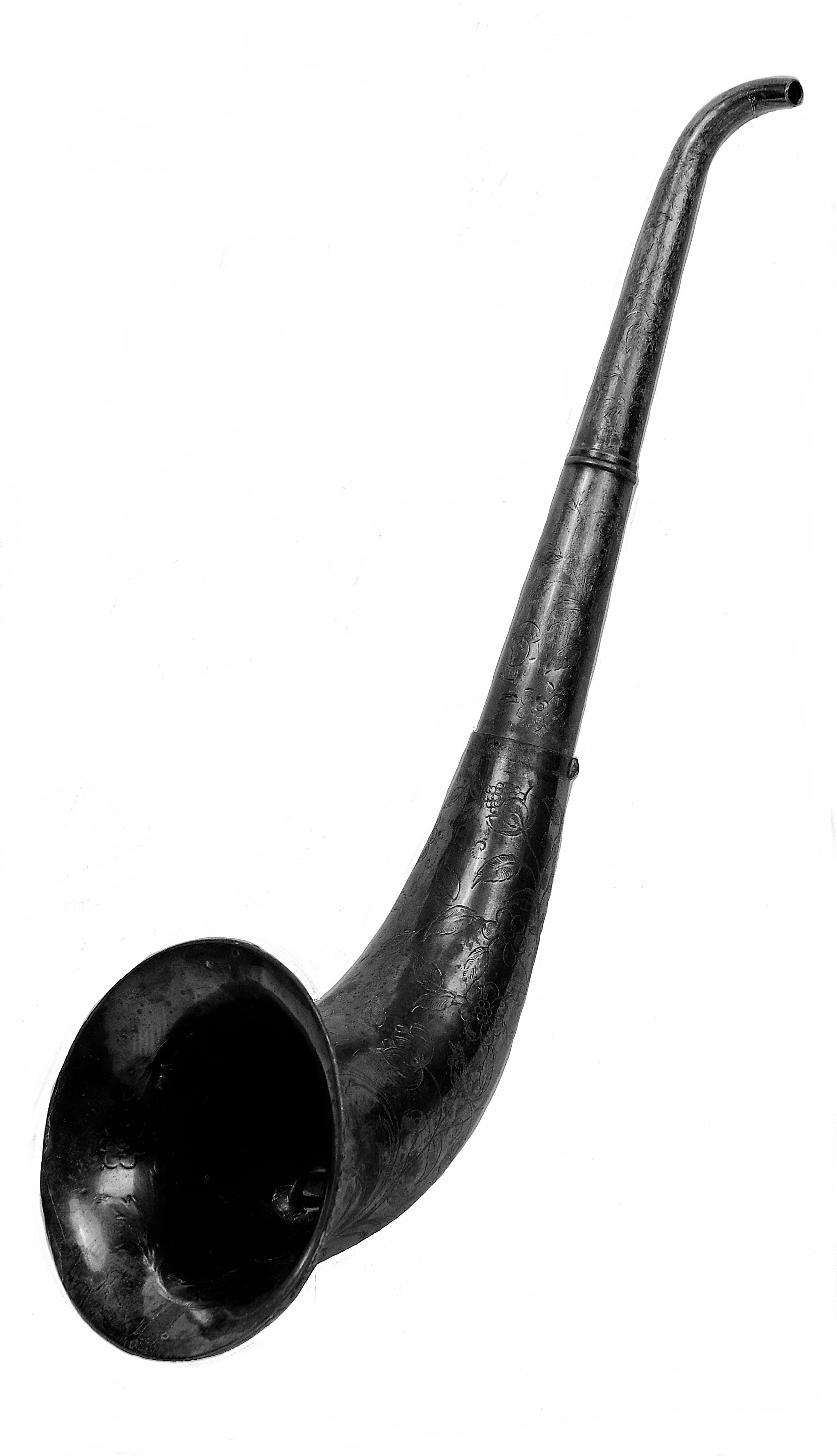
The codger was Monroe JONES and according to his obituary in the Sacramento Bee, 4th of February 1939 he was the last of the Trinity County Civil War Veterans. My Dad’s childhood friend Ruth Goodyear Dowdakin describes him as having one of those very long ear trumpets so he could hear. They may seem crude but they are said to have been remarkably effective. So we learn here that Monroe was just 3 months shy of his 99th birthday when he died and that he left a daughter and eight grandchildren and two great grandchildren! It makes me wonder how many of them had ever listened to his stories.

4 February 1939
The 1930 census told me that Monroe was born in Illinois. And sure enough I found Monroe JONES living with his parents in the 1850 Henry County, Illinois census as 6 year old, listed as Charles, with parents Milo and Mary JONES. In 1860 he is listed as, Monroe, 16, with parents Milo and Mary JONES. But in the same census for Henry County in 1850 where the JONES family is on page 23, I then found a Geo Spear, Pauper, age 96 born in Pennsylvania on page 40. He is living with a James Bacchus. He is the only 90+ year old male in the county.
So I went looking for a George SPEAR and found one on the 1800 Federal census in Amwell, Washington County, Pennsylvania age 26-44 so birth about 1756-1774. Furthermore I find in Pennsylvania Archives, Fifth Series, Volume III : Harrisburg Publishing Company, State Printer, 1906 pg 134: George Spear, Rev War Corporal 9 Sep 1778 with Continental Line Captain Jacob Bower’s Company Of Sixth Pennsylvania Regiment Commanded By Lieutenant Colonel Josiah Harmar, Esq. There are George SPEAR land transactions in Illinois as early as 1826.
The point is, that even the most outlandish stories can be true. A Revolutionary War Corporal born about 1754 when he was about 96 spoke with a young lad Monroe JONES about 6-8 years old. Then Monroe grew up to serve in the Civil War and he talked to my Dad about 1933-39 when my Dad was 8-13. So I am going to believe that my Dad talked to a Civil War Veteran who talked to a Revolutionary War Veteran.
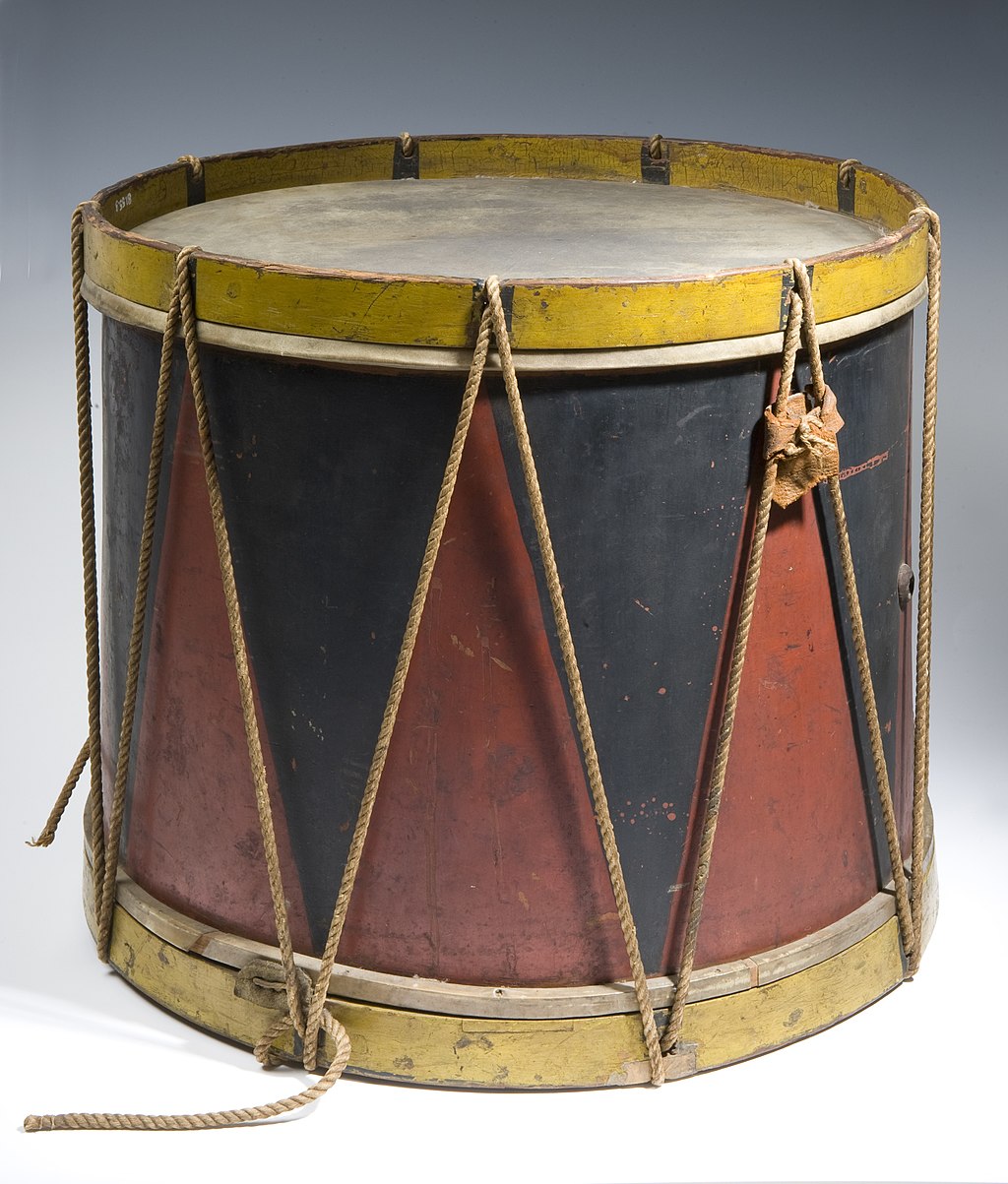
And any way you cut it that’s one helluva story! Thanks Dad. Sadly I am unable to locate a grave for George Spear and as a Pauper he may have been buried in an unmarked grave—perhaps never claiming the pension to which he was entitled. May this stand as a memorial to your service. How many patriots lie in unmarked graves?
Kelly Wheaton © 2023 – All RIghts Reserved
Mind The Gap: Making the Connection to the Royal STEWARTs of Scotland
Posted on August 17, 2023 15 Comments
Sometimes you can prove a connection without being able to flesh out the in-between. Thus like the announcements at the train station “Mind the Gap.” Sometimes people grasp at anything to make the connection and falsify the record in doing so. This is part of a cautionary tale to be careful even when evaluating something that appears as fact with nothing to back it up but conjecture.

My STEWART line I have written about before in My Woman Warrior where I relate that my 2nd great-grandmother born Catherine Adeline STEWART claimed she was related to the Royal STEWARTS. I didn’t really give it much credence until a decade ago when YDNA testing proved that it was true. Imagine that! I also noted in the Revolutionary War pension file of her father Daniel Bertine STEWART there are several letters from descendants inquiring about the Royal STEWART connection. It surprises me how persistent these family legends can be and sometimes they turn out to be true.
DNA
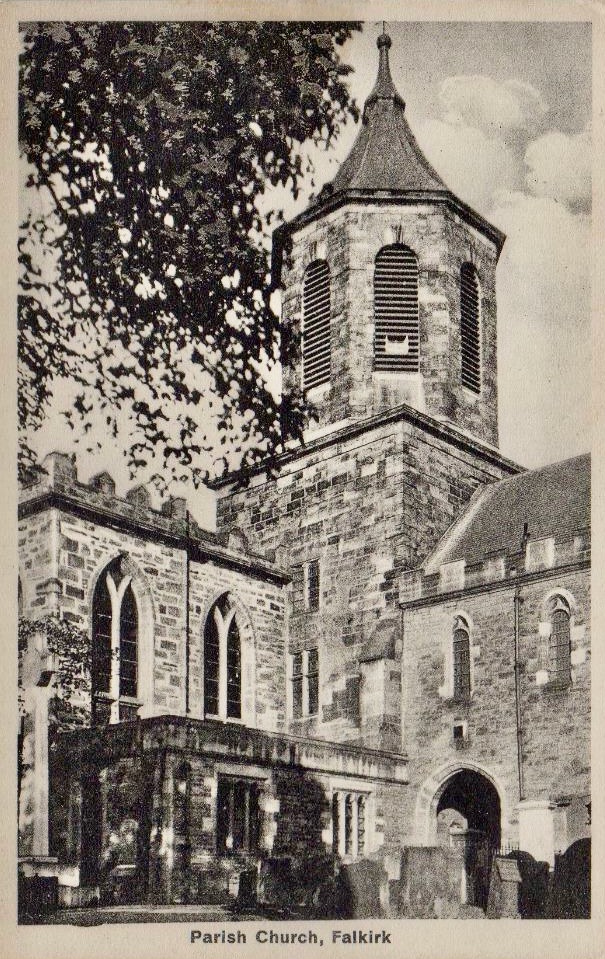
The line back to my immigrant to America, Alexander STEWART (1675-1742), is solid. More about that in a moment. What isn’t solid is the name of his parents and the line backward from Alexander. What we do know is, we are patrilineal descendants of Alexander (1675-1742), because a number of male STEWART cousins are positive for the YDNA SNP: S781. That is they are direct descent from Sir John STEWART Bonkyl (c.1265-1298) who carried that SNP. The Royal STEWART FTDNA project states: The two most important branches of the family are the Scottish Royal STEWARTs, represented by descendants of King Robert II of Scotland (grandson of Alexander STEWART via eldest son Sir James STEWART); and the STEWART of Lennox… who descend from Alexander STEWART’s younger son, Sir John STEWART of Bonkyl. Sir John STEWART of Bonkyll was a military commander during the First Scottish War of Independence and during the Battle of Falkirk he commanded the Scottish archers, and was killed, 22nd of July 1298, during that Battle. He is interred in the churchyard of the Falkirk Old Parish Church.
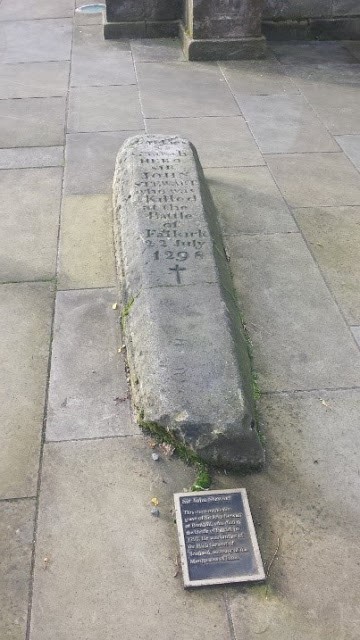
From Sir John Stewart Bonkyl (c.1265-1298) we can trace the ascent (backward in time) as follows:
- Sir John STEWART Bonkyl‘s older brother, James was the 5th High Steward of Scotland.
- Their father Alexander STEWART (1220-1282) was the 4th High Steward of Scotland.
- Their grandfather Walter STEWART (1204-1246) was the 3rd High Steward of Scotland.
- Their great grandfather Alan Fitz Walter (1140-1204) was the 2nd High Steward of Scotland.
- Their great-great grandfather was Walter fitz Alan (1140-1204) the 1st High Steward of Scotland.

Sir John’s STEWART Bonkyl’s nephew was Walter STEWART, 6th High Steward of Scotland (1293–1327) who married Marjorie Bruce, daughter of King Robert I the Bruce.
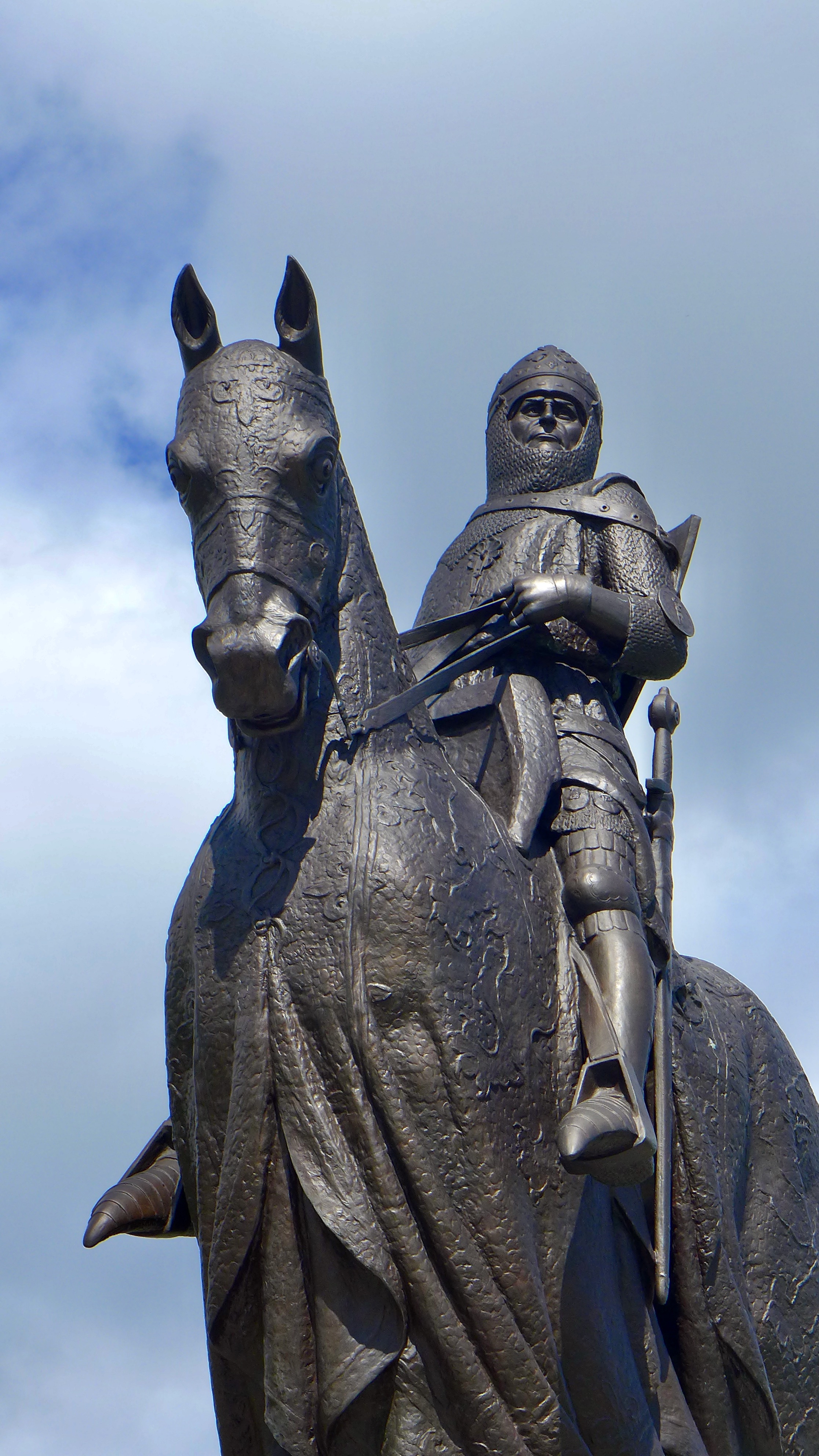
by Pilkington JACKSON at Bannockburn Battlefield
His son was King Robert II of Scotland, the first STEWART monarch. So to simplify Sir John STEWART [Bonkyl]’s grand-nephew was King Robert II of Scotland. So not exactly royalty but from the same STEWART family that became Royals. However, Sir John’s STEWART [Bonkyl]’s 9th great grandson Henry STUART Lord Darnley was the Stuart that married Mary Queen of Scots.

Coming forward is more problematic. Of the sons of Sir John’s Stewart Bonkyl that did not die without issue or daughter out we have:
- Sir Alan STEWART of Dreghorn whose descendants are the STEWARTs of Darnley, Earls of Essex, the Seigneurs d’ABigny and the Royal House of STUART. Also from this branch are the STEWART of Galstoun that appears to have died out. FTT43
- Sir Walter STEWART of Garlies and Dalswinton whose descendants were STEWART of Garlies, later Earls of Galloway and Lords Blantyre YSNP FTT48
- Sir James STEWART Pearston whose descendants were the Lords of Lorne, Earls of Atholl, Earls of Buchan, Earls of Traquair and Clan STEWART of Appin YSNPS A5024 FTT41 (and for the Appin branch FTT42)
- Sir Robert STEWART of Daldowie ancestors of the STEUART and Seton STEUART baronets of Allanton and Coltness STEWARTS.

The above pedigree I have annotated to show the YDNA SNPS that identify Different branches and the green boxes denote possible lineages that could be the connection. There are not easy answers to our STEWART conundrum. There are thousands of descendants but many lines daughter out. Knowing the SNP associated with our branch descending from Sir John of Bonkyll helps in eliminating possibilities. There are also issue not included in the chart specifically around other sons of Sir Alexander STEWART of Darnley and his son Sir John STEWART’s other issue not recorded on this chart. It would appear we descend from either through an un-researched line or through illegitimacy. In the chart above there are several possibilities Alexander STEWART son of Matthew the 2nd Earl of Lennox if he had male heirs. The John STEWART Methven illegitimate son of Ludovic 2nd Duke of Lennox or an unknown descendant or Esme STEWART Third Duke of Lennox. Or one of the unrecorded brothers of the aforementioned STEWARTs. The DNA proves the connection but it is the Gap that needs Minding.
ATTACHING AN ANCESTOR WITHOUT EVIDENCE
But it’s the in between that remains in question. And that’s where people clutch at any connection they can find and they get it wrong, more often than not. There are plenty of trees showing Andrew’s father as Robert STEWART which depends of on one scrap of evidence ” tradition states Alexander’s father was Robert” from an old Stewart Clan Magazine, September 1929, Vol. VIII, No. 3. Even worse is connecting Robert STEWART as a son of Reverend Andrew STEWART, II b. 1620, Gortigal, County Tyrone, Ireland, UK; died January 02, 1671. The problem is it isn’t true. Descendants of Rev. Andrew STEWART are of a different YDNA line. This is what happens when you try to connect people in your tree based on a name, without other supporting evidence. How many Robert STEWARTs do you think there are in this time period in Northern Ireland?
YDNA to the RESCUE
I have tons of these stories including one from The venerable New England Historical Genealogical Register Vol 80 pg 380 1926 in which J. Gardner Bartlett of Boston presumed that the Isaac SHELDON of Windsor, Connecticut was the same as the one born in Bakewell, Derbyshire in 1632. I wrote about that here. Then a short time later I found the Isaac of Bakewell living in Manchester, England. “Transcription: “Isaac Sheldon of Manchester, sadler, sonne of Raphe SHELDON late of SHELDON in the county of Derby, Gen’t, and Mary VENABLES of Selford, daughter of William VENABLES of the same, chapman, were married at Manchester, the seventh day of April, 1656 before Richard HAWORTH, Esq. one of the Justis of Peace in this County of Lancashire.” More on that here in which Dale Sheldon shows that this Isaac married and had a family in Manchester when the other Isaac was in Windsor Connecticut. And on top of that the YDNA of the Derbyshire SHELDONs does not match those of the Windsor, Connecticut SHELDONs. Those pesky devils int he details.
DNA allows up to prove a patrinlineal line without being able to “Fill in the GAP.” My Husband’s precise connection to Robert WHEATON of Rehoboth, Massachusetts has a “Gap.” We are lucky to have DNA to prove in essence that which we have no other evidence for. It simply isn’t always going to be possible to make connections as we would like.
WHAT ARE OUR OPTIONS?
The truth in a legend can open the door to history. I don’t happen to think Royals are any better than anyone else in my tree—the Easter egg– in finding one, is there’s generally much more written about them, than your every day farmer or peasant. The bonus is being able to connect yourself and your ancestors with history. It suits me just fine if the illegitimate son of Ludovic STEWART, 2nd Duke of Lennox, John STEWART of Metheven was my ancestor, even as he was an unsavory character. The illegitimate son of an illegitimate son–reading below sounds right out of a movie script:
In September 1626 the Privy Council found he had been living in adultery in Dumbarton Castle with two servant women, Isobel Beaton and Margaret Kilmaurs, and had kept his wife, Dame Margaret, a prisoner in a ruinous and damp part of the castle for 13 days, chained to the bed, and he beat her. Isobel Beaton and Isobel Scot had previously been admonished by Dumbarton Kirk for scandalous behaviour.
Stewart was found guilty of three adulteries and sentenced to be executed “by the king’s will”, and the court ordered that he should be hanged in December 1627. It is unclear if he was hanged, but he was dead by 1630 when a legal case mentions his decease, and his widow Margaret married Sir John Seton of Gargunnock in 1629.
Register of the Privy Council of Scotland, vol.1 (Edinburgh, 1899), pp. xciv, 358, 378, 380, 416-8.
There are a couple of things that recommend this particular theory. John STEWART of Metheven also spent considerable time in Ireland. John STEWART Methven was said to have been lax in his duties at Dumbarton Castle, Scotland preferring to spend time in Ireland at Mongavlin Castle which he had built in 1611 and he had lands in Raphoe and Portloughe, all in Donegal. These areas were part of the Scottish Plantation of Ulster which had been granted to his father, the Duke of Lennox.
In reality the connection may be someone less noteworthy who just happened to be the 2nd, 3rd or fourth son who ended up in obscurity.
TEASING OUT THE TRUTH
Allegedly Alexander STEWART who immigrates to East Haddon, Connecticut and later settles in Voluntown married in Ireland to Margaret DIXON. Her father Robert DIXON fled Ayrshire, Scotland in 1666 for Antrim in Northern Ireland. Between 1638-1688 Covenanters who did not abide the Church of England faced persecution and sometimes death, so many fled Scotland for Ireland. By 1702 there were nine Presbyteries founded: Belfast, Down, Antrim, Coleriane, Armagh, Tyrone, Monaghan, Derry and Convoy. It is alleged that Robert DIXON married Priscilla, daughter of Hugh KENNEDY about 1670 in Ireland. The children of Robert and Priscilla DIXON were allegedly born in Ballymena, Antrim, Ireland but I can find no evidence of any DIXONs in Ballymena in 1669 but this may have been because they came after the Money Rolls in 1660 & 1663 and settled in Ballymena after 1669. Robert and Priscilla were allegedly married about 1670. In 1660 the closest DIXONS or DICKSONS to Ballymena in is a Widow DIXON in Kilead, Antrim about 16 miles away.
In the 1669 Hearth Money Rolls for Ballymena town and Estate we do find four STEWARTS: Andrew, John, Robert and a widow STEWART. Could this the alleged Robert STEWART, aka Alexander STEWART’s father (1675-1742) ? We just don’t know. There are also three Hugh KENNEDYs in Doonans, Donegal; Priestland, Antrim; and Stranocum, Balymoney, Antrim which is about 19 miles from Ballymena. And there was a John KENNEDY living on the Ballymena Estate in 1669.
Sometimes you can’t fill in the gap—it’s as simple as that. We sometimes must be satisfied with knowing the further back, but missing the in between. The Ulster diaspora to America estimates for the period 1680–1750 are about 70,000 immigrated from Ireland to America. There was a large exodus to America in 1717-1719 when the persecution of the Presbyterians was great and the rents of tenant farmers was high. In 1718 five ships carried families from both Aghadowey and Dunboe in County Londonderry and settled in what is now Maine. Also in August of 1718 Governor Samuel SHUTE agreed to allocate land in the Massachusettes colony for Ulster settlers at the urging of Ulster ministers. Massachusettes provided land grants for Ulster settlers to reinforce the frontier against Native Americans and to enhance Massachusetts‘ claim to the territory that was in dispute with Maine. Many immigrants followed and by 1720 approximately 2,600 Ulster immigrants had arrived in Boston. Among them were Andrew STEWART and his wife Margaret and her alleged brothers Robert, Archibald and John DIXSON. It is said that their son Samuel STEWART was born aboard ship on their voyage to Boston.
Until something new comes along that is where we must leave it. Alexander STEWART of Ireland who immigrated to Connecticut is by DNA confirmed to be a descendant of Sir John Bonkyll STEWART of the Royal line of STEWARTs. For now “Please Mind the GAP”!
Kelly Wheaton ©2024 – All rights Reserved
We Can’t Write What We Don’t Know: A Journey from the Fjords of Norway to the Shores of New York Mid 19th Century
Posted on August 8, 2023 2 Comments
If you decide you want to write about an ancestor be prepared to go down many gopher holes you never dreamed of visiting. Almost every time I decide to dig deeper into an ancestor’s story I end up researching things I never knew anything about. My last blog post Deep Diving: Water Wheels and Papermaking in 19th Century Sweden is a perfect example. Please note that the chronology below is based on what was discovered and how that informed my research. So it jumps backward and forward as is typical of the research process.
INTRODUCTION

When I set out to trace the journey of Asloûg Eilefsdotter from Vinje, Telemark, Norway to America I had no idea what to expect. As we learned in Locating Immigration Records Asloûg traveled with a group of twenty-two from her parish and there were four families. As yet I cannot confirm any close familial relationships with anyone that she traveled with, but many may have been distantly related and certainly would have worshipped together. A drawing of Vinje Church as it would have appeared when Asloûg left. What would leaving the land of your birth and that of your ancestors for a far away shore evoke? I imagine Asloûg departed with both trepidation and excitement. I know I would have…

DREAMS of EMIGRATION
It has taken me awhile to ascertain the most likely scenario for the families taking leave for America. Most historians suggest that they were leaving for opportunity whether it be a wider choice for a spouse and/or the hope of a more prosperous life. I like to think the seeds of Asloûg’s escape may have been planted when she was fourteen. In the Fall of 1843, Knud Svalestson, a native of Vinje, returned from Muskego, Wisconsin to Vinje. I can imagine villagers sitting in rapt attention listening to his stories of America. In addition we have the book mentioned in the Locating Immigration Records post published in 1838 giving any future emigre background on what to expect in America. [These are often to be found in other languages, not just Norwegian] Here is the introduction from the True Account of a Norwegian in America:
“Good Countrymen,
Fine and Craftsman!
I have now been eight months in America, and during this time have had occasion to experience much, about which I tried in vain to obtain information before I left Norway. I felt at this point how uncomfortable it is for those who would like to go to America, that they must miss a reliable and fairly detailed account of the country; I also experienced how great people’s ignorance is, and what false and unreasonable rumors were believed to be the full truth. — in the present little writing it has therefore been my endeavor to answer every question, which I even vomited, to clarify every point about which I felt that people were in ignorance, and to refute the false rumors that have come to my ears, partly before my departure from Norway, partly after my arrival here. – – I would like , dear Reader! that you must not find any Post, about which you wanted Information, overlooked or incompletely processed!
Illinois, the 13th of February 1838.
Ole Rynning“
I loved that he noted “Two things are a plague on the ocean [crossing], namely sickness and boredom.”
Perhaps most influential were letters from those in America sent home to Vinje telling tales of their adopted land. It seems most of her fellow passengers were headed to Wisconsin or Iowa. Why she was headed for Chicago I do not know. However, I suspect that she had secured a job there. In looking through the 1850 census of Chicago for those born in Norway the vast majority were young women employed in the households of English speaking families as servants. As I view Asloûg as a practical women– this makes sense to me—that she would have a job awaiting her. Although the photo below is from some years later it provides food my imagination of a family group in Telemark.
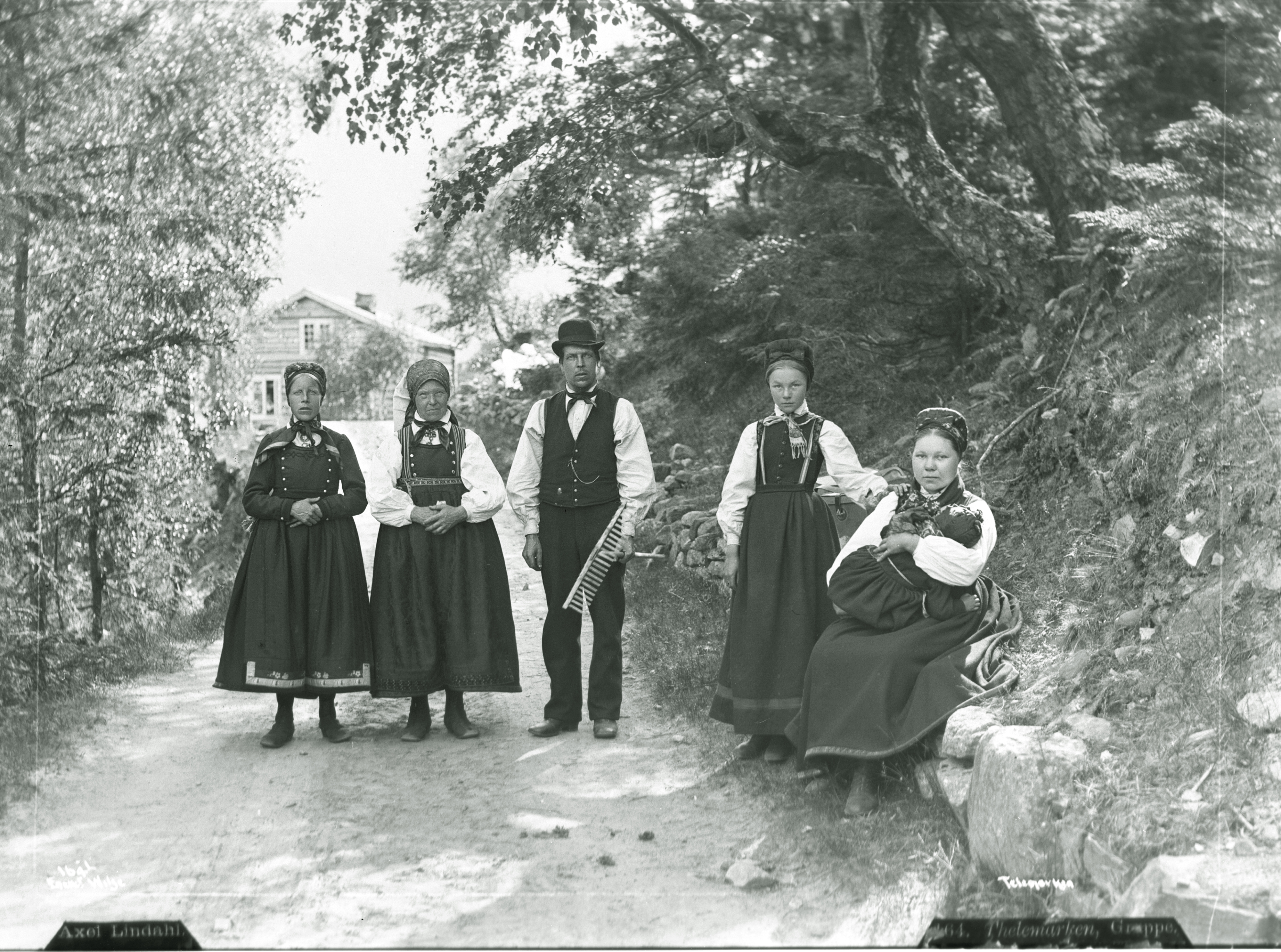
In 1853 Printed at Thorv. A. Hansen’s printing house this poem written by a Norwegian who stayed behind while his countrymen left for the promise of America, a few excerpts:
“A Farewell Ode to Emigrants on Their Journey to America“
1.
You are going away to maybe never again
See Norway, your homeland behold.
O that all that you here bitterly must manage without,
you in that distant safe harbor will get tenfold back.
In America’s valleys abounding with flowers,
where the earth does not mock the sweat of its grower,
on your journey there we pray that God
will look down upon your wandering with blessings!
 5.
When you in a better home country stand,
don’t forget your friends in the cold North,
that will never on your coast land;
but trudge heavily on Norway’s barren soil.
Send them a letter, a penny with a picture of freedom
so they with affection can stare at it,
on the ideal they can imagine,
in helmet and armor joyfully standing strong.
 10.
Thanks for your good company here! Do know from me
my wishes and warm prayers to God
hopefully not in vain I am raising
for your wellbeing: O for the young strong sprouts
of Norwegian stock in America to progress
to the delight and luck of father and mother
and all good! Salvation you will enjoy
when you one day leave this earth!
It seems to me even those left behind were invested in a good outcome for the emigrants.
VINJE TO SKIEN
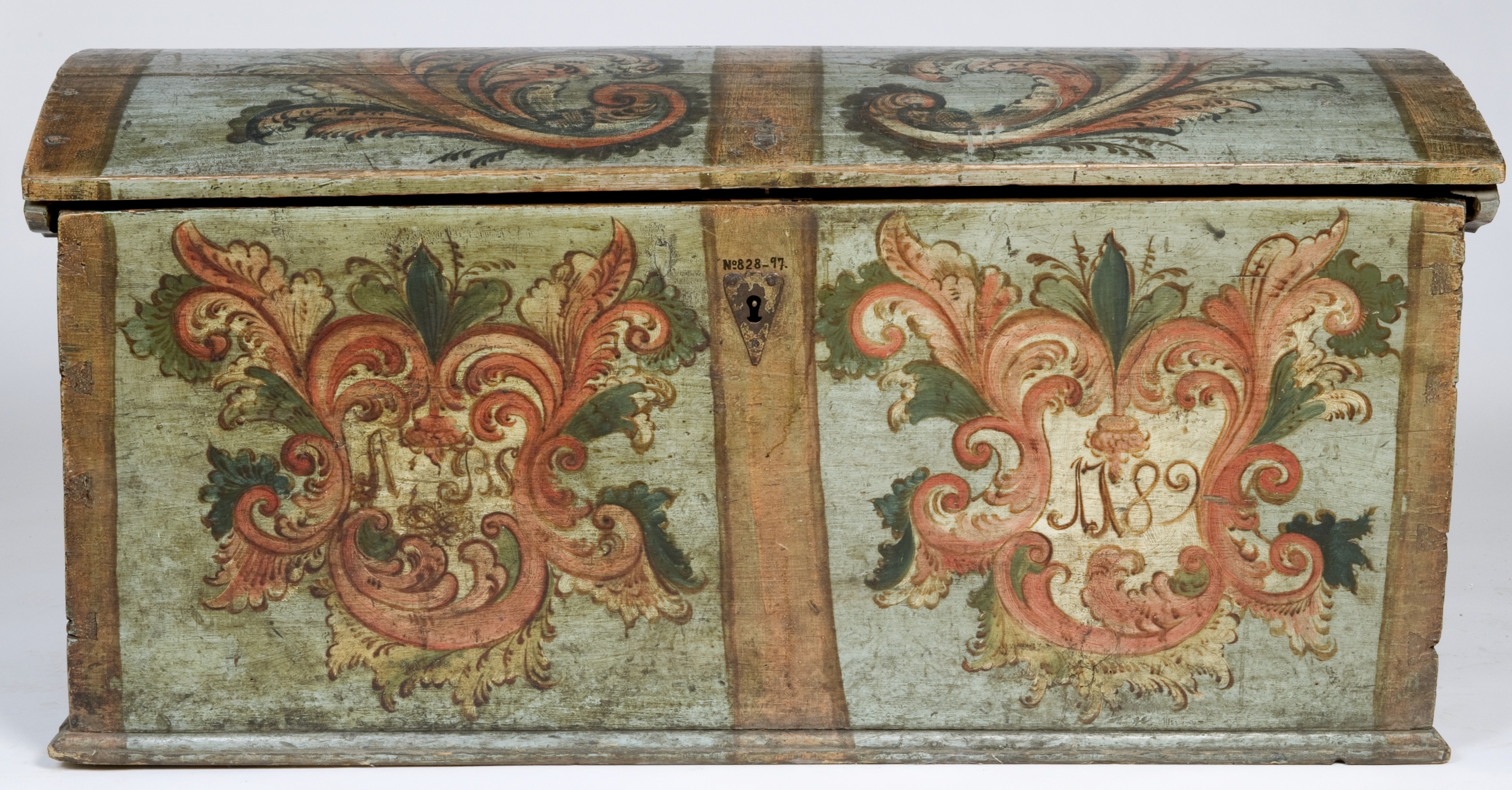
courtesy Norsk Folkmuseum
Imagine getting into a row boat such as this one below and waving goodbye to your parents and siblings–especially to your youngest sister, Sigrid, who was 16 and likely not wanting to be left behind. All of your belongings are packed in a trunk. Many of these trunks were actually dowry chests that were made for young women to store their belongings in preparation for marriage. At the time of Asloûg’s emigration she was 25 years old, a bit past prime time for marriage. The trunk would carry her dreams for the future and memories of her past. There would be objects of Norwegian identity whether traditional clothing, a bible or book from home. Additional clothes—bedding, a cooking pot, utensils, items for your daily toilet: soap, comb, brush and hair ribbons, sewing items, perhaps knitting or embroidery items to keep one busy on the two month journey to America.
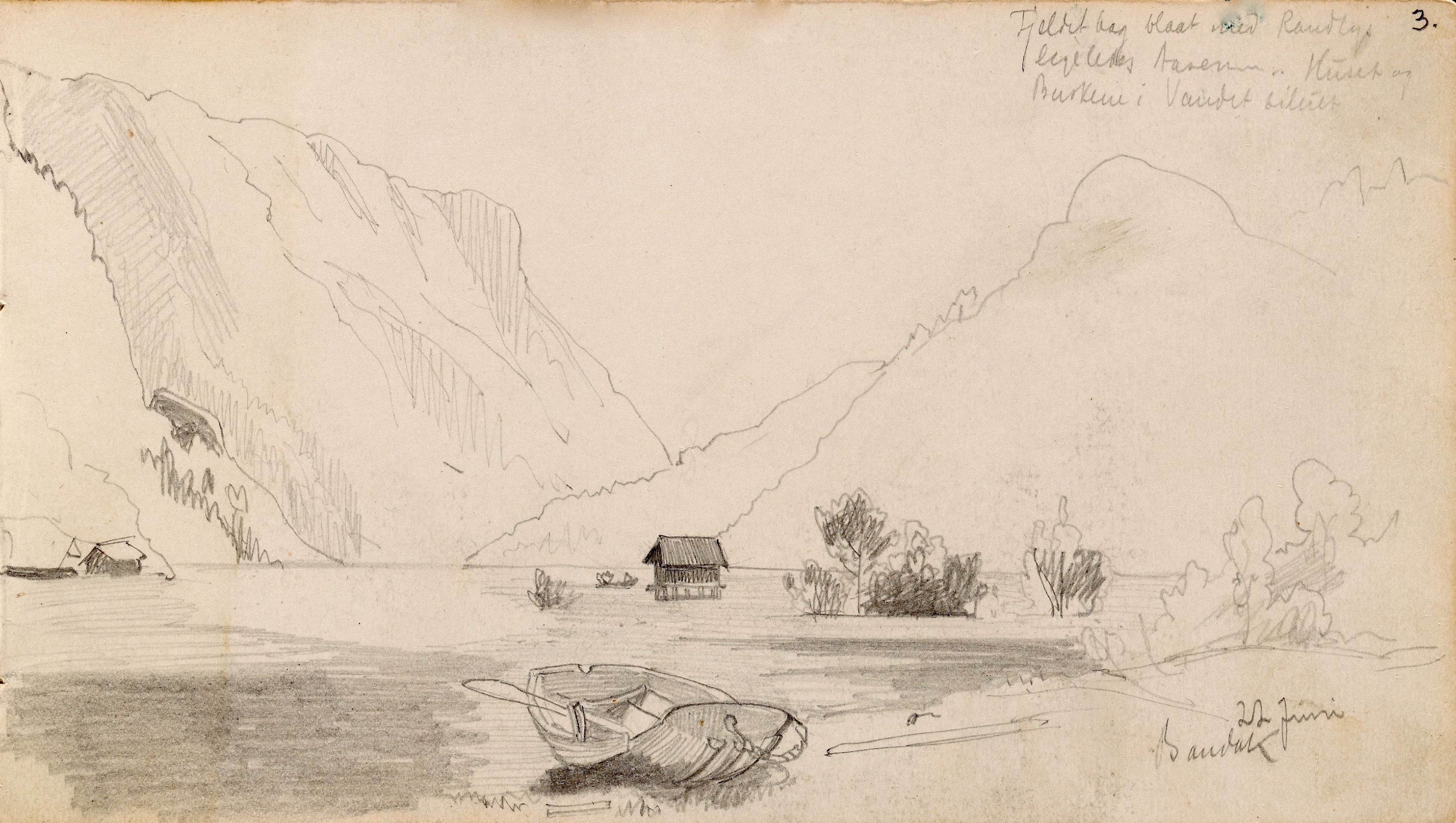
by Elief Peterssen 1873
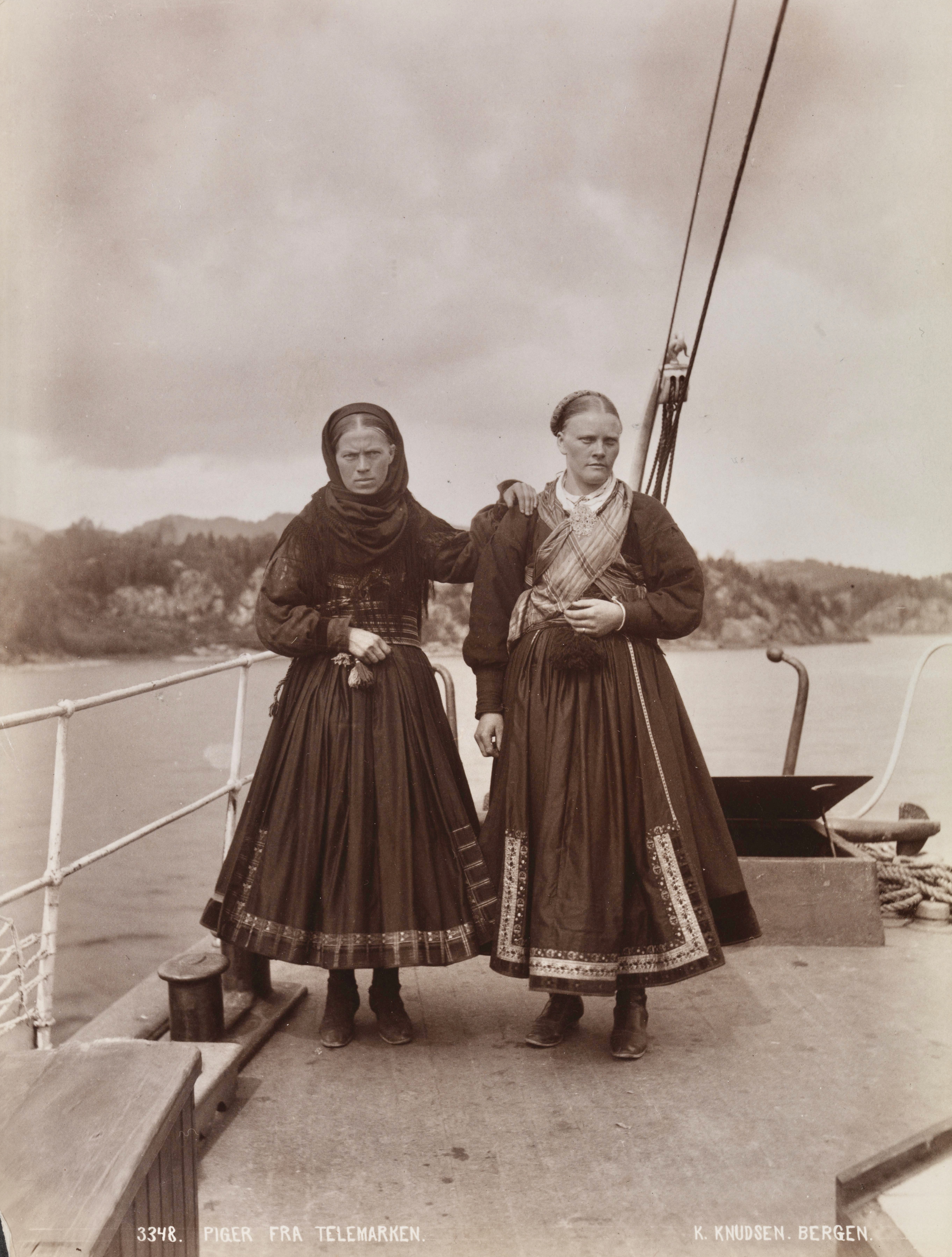
I love this photo of two girls from Telemarken from 1864. It is 12 years after Asloûg immigrated but it shows the traditional costumes and they are aboard a ship perhaps like one Asloûg may have taken across the fjords. The journey from Vinje to Kragerø was not an easy one, but easier by boat than by foot. More on that in a bit.
RESEARCHING IN NORWEGIAN LANGUAGE NEWSPAPERS PUBLISHED IN NORWAY
Just because you do not speak or read Norwegian or another language does not mean you should not look through their archives. The Norwegian Newspapers are available here for free. As I discussed in my Blog post on Google Translate you can have anything translated for you. Since I knew the ship that Asloûg traveled on was the ‘Colon,’ it is simple to search. This yielded a number of advertisements. This one from February suggests that there was a organized effort to secure enough passengers by March for the ‘Colon.’ So between the time they may have heard and their commitment to go was not a particularly long one. I did read of agents traveling into the interior of Norway looking for passengers.

The Correspondent Skein, Norway
11 Feb 1852
This later ad reads: “The brig ‘Alerth’, led by Capt Disen, and the ship ‘Colon,’ led by Capt Hassel, whose vessels, which the past 3 years have been sailing to America, will leave this spring with passengers for New York, if a sufficient number sign up for it before the month of March.”
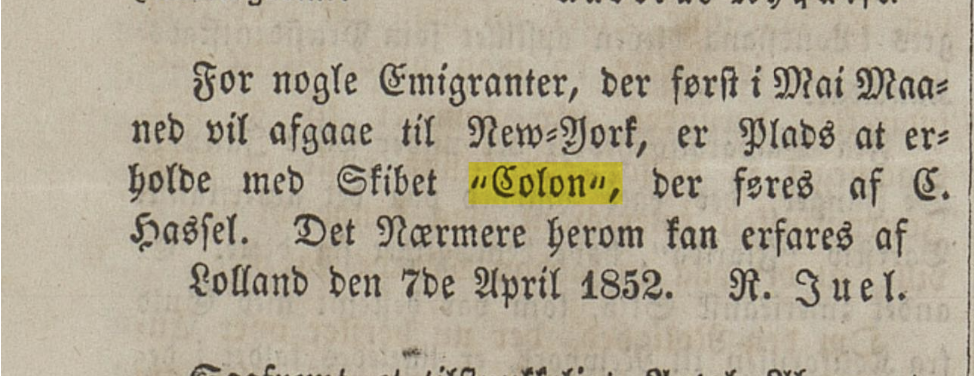
This was followed in April with this ad that suggests there was still room on board. “For some emigrants, who will leave for New York first in the month of May, there is room to be had with the ship ‘Colon’, which is led by C. Hassel. More details about this were learned from Lolland on 7th April 1852. R. Juel.”
But I hit the jackpot with this one. This is a rough transcription of an article that appeared in Morgenbladet newspaper Oslo, Norway Thursday June 3 1852:

“Kragero, the 28th of May. Yesterday morning the ship “Colon”, Mastered by Capt. Chr. Hassel, here from the city [of Kragerø] to New York with 146 emigrants. Most notably coming from Bratsberg upper Telemark . The majority were healthy and wealthy people in their prime, reportedly quite prosperous. Most of them left, full of courage, some were afraid of ‘abandoning [Norway] and jumping overseas’; but this individual was confident, because ‘Colon’ is a new well regarded Ship, just like Capt. Hassel is known as a capable shipmaster and also a conscientious man, who on arrival in New York does not fail to assist them with advice and guidance. The interior on board was very appropriate and won the passengers’ complete satisfaction. It is not a happy sign to see the dearest of the people seeking escape in a distant country, which, according to their statements, year by year here becomes more difficult to bear, even among those whose claims are the most wretched and who are used to the lands windswept and harsh nature. But we hope that a bright future is reserved for Telemark; that much improved communication will awaken the farmers inertia and sluggishness, for the spirit of business and enterprise, which in the past had been well respected, and which first brought about real development. A call for new branches of business and the opening of a large district resources, which until now had only been stopped at the ground of the people’s slumbering industrial enterprises.”
Now how often do you get a first hand account of a ship’s sailing? I know that of the 146 passengers only 19 were well off enough to travel first class in their own cabins. The rest traveled in steerage which literally means between decks. Overall they must have presented themselves well. There are very few illustrations from this time period to give one an idea of what steerage was like. Since this was a ship that was only two years old and “won the passengers’ complete satisfaction” perhaps it was a bit better than is illustrated here. Although we do not have the exact dimensions, the dept of the ship was typically 28-29 feet so with the cargo hold full of luggage and exports. the between the decks area needed to house 127 passengers. Since passengers had to eat, sleep and spend much of their time here it is no wonder so many ships ended up with illness. Luckily there was no cholera aboard and only one infant died.

SKEIN
The article mentions Bratsberg as where they came from so back to the Norwegian Archives and I found the map below for Bratsberg, which it turns out is the area that encompases the parishes from which the emigrants came. The original advertisement was in the Skein paper and it got me thinking how did they get to Kragerø and it appears they went via Skien. Here is a map with my suggested route. They would have traveled mainly by row boat or sailing ship using the waterways and fjords as highways and avoiding the need for much wagon or foot travel. Each passenger would have had a trunk packed with clothing, personal items and cookery for preparing food aboard ship. We can estimate the time of travel based on the leaving of the Laurentz Agundsson family who are recorded on the leaving registers on 21 April and their known arrival in Skein. More on that in a minute.

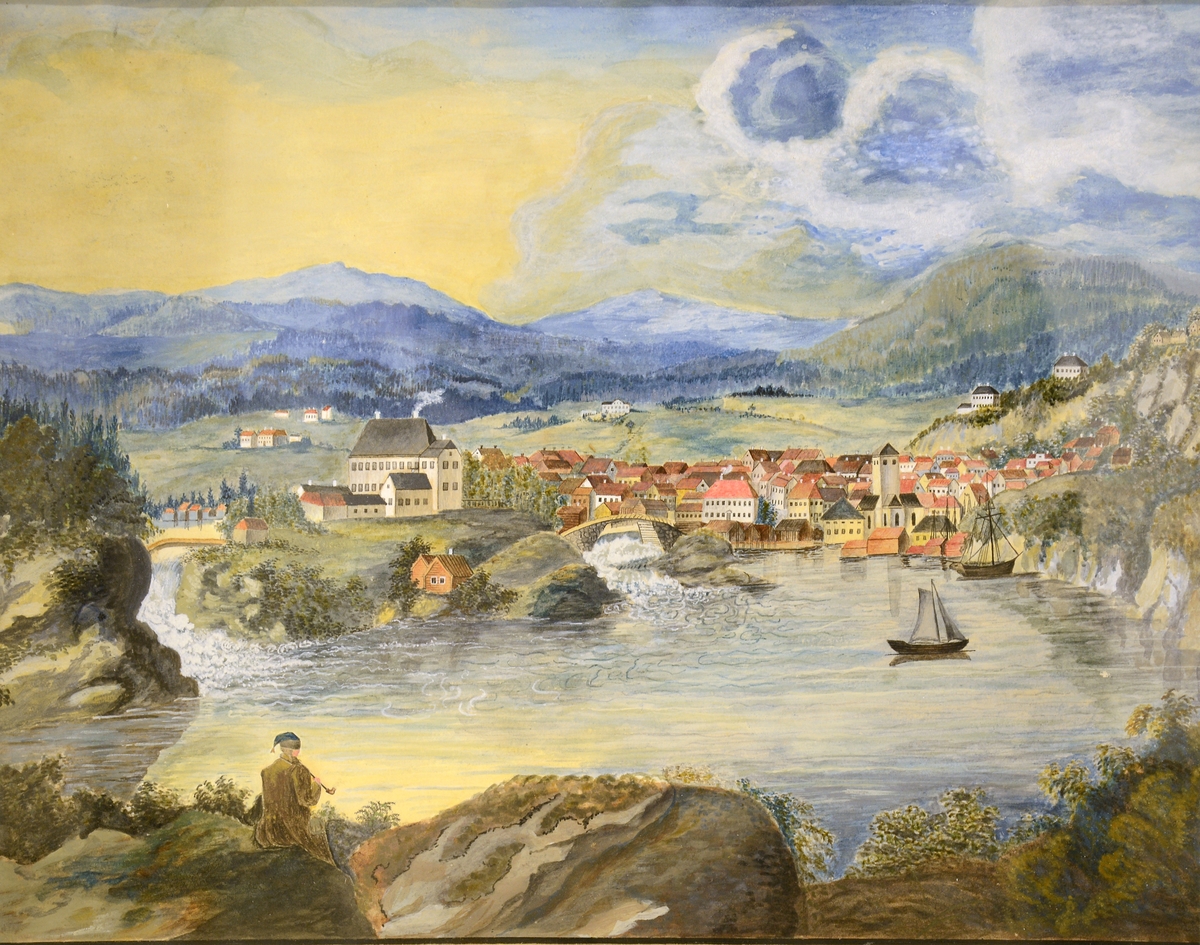
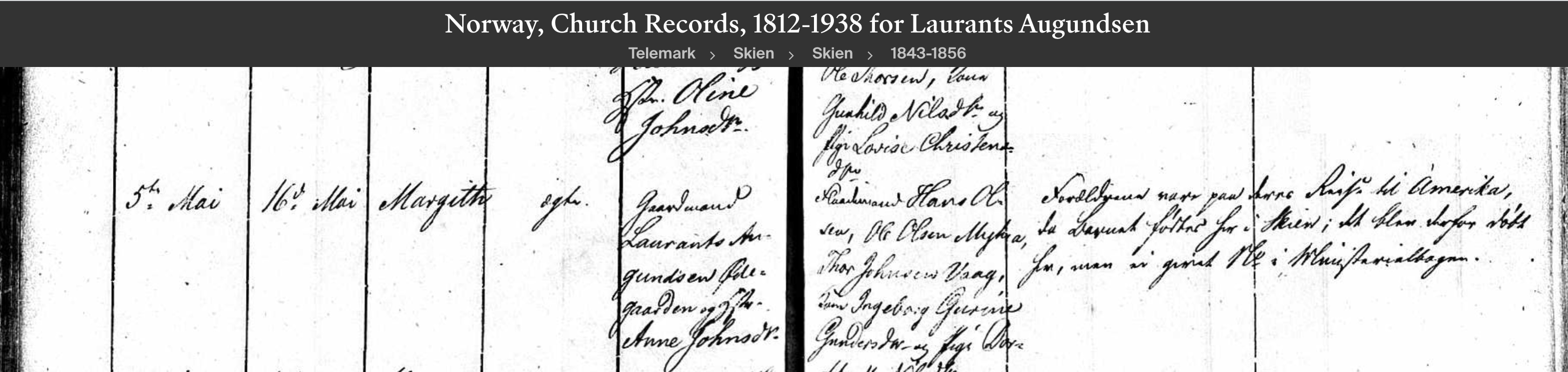
Finding the article in the Skien paper was a clue so I decided to see if I could find anything in the Clerical Household Records or comings and goings, but that came up empty. But I hit a bit of a jackpot with the birth/death records for Skien. So this family from Vinje left according to Vinje Church records on the 11st of April. They arrived by the 5th of May when their daughter, Margith, was born. Sadly she died on the 16th of May , just ten days before they would board the Ship ‘Colon’ for America. The notation on the right reads “The parents were on their journey to America, when the child was born here in Skien. It was then baptized here, but not given a number in the church record [Ministerialbogen– The persons did not belong to the parish, and that is why the child was not given a number.]”. Since those that were staying in Skien on their way to America were also not a part of the parish they are not recorded either.
Skien was a primary port in the area and a more direct route from upper Telemark. Kragerø would have involved more land travel and portage. Kragerø was also a less populated area so the party from upper Telemark may have traveled to Skien thinking they would find more lodging there. This painting from 1822 is quite idyllic. But belies the sad death recorded above.
Skien’s claim to fame is as the birthplace of the playwright Henrik Ibsen, born March 20, 1828, Skien and died May 23, 1906, Kristiania [now Oslo]). Skien was known for its seafaring, timber and exports. Its was one of Norway’s three largest cities between the 16th and 19th centuries. In 1846 the population was recorded as 3,677.
KRAGERØ to NEW YORK
Kragerø in the 19th century was one of Norway’s largest port cities and definitely a hub of ship building and seafaring. It later became known as a vacation spot and was a favorite of the Norwegian Edvard Munch whose painting the “Scream” is universally known.

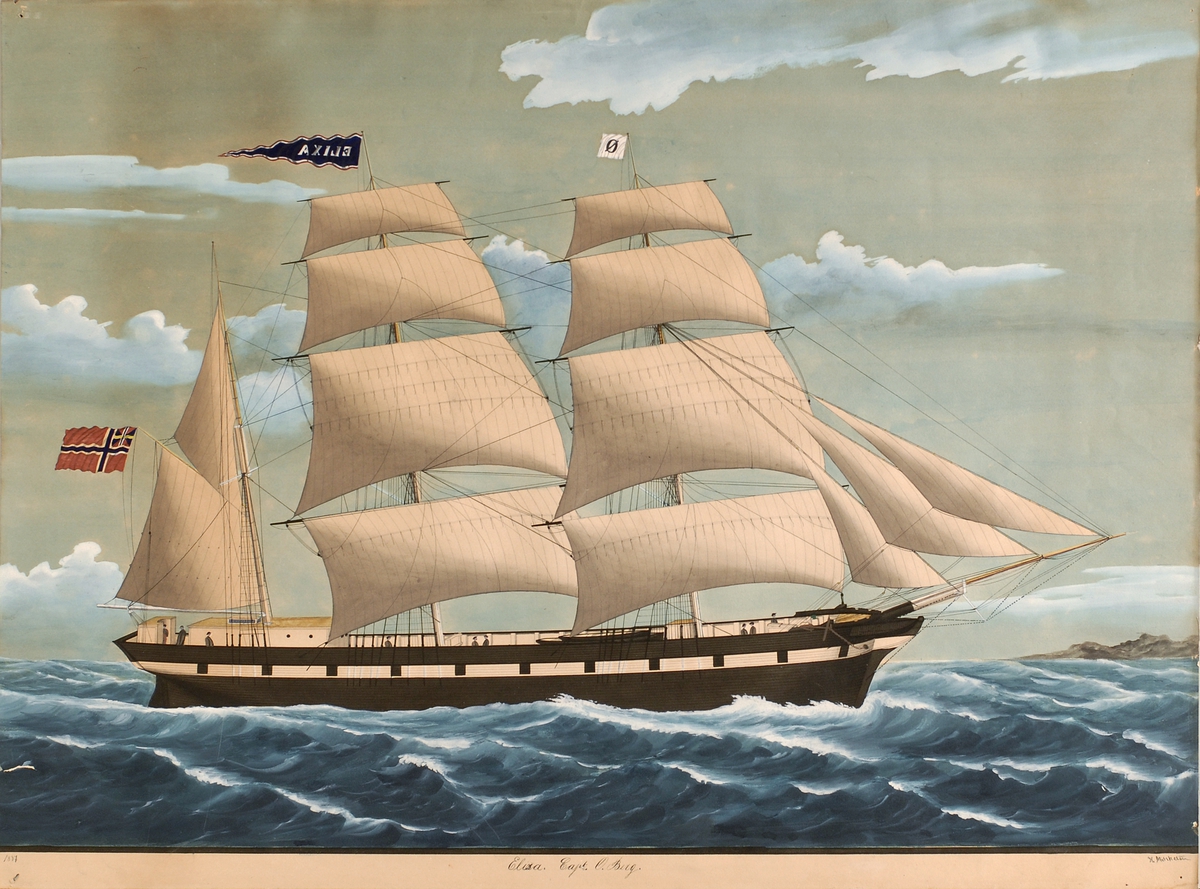
The Ship Colon’s Captain was a Kragerø native born 24 July 1834 and the son of a ship’s Captain Ludvig Andreas Hassel. His ship the ‘Colon’ was built in Kragerø and launched in April of 1850. Its maiden voyage was to New York with 152 passengers. From there the ship traveled to Havana, Brazil, Amsterdam, Odessa and Constantinople. So by the time Asloûg boarded the Kragerø in 1852 the ‘Colon’ and her Captain had proved their seaworthiness. Although no pictures of the ‘Colon’ are known the Bark ‘Eliza’ built a couple years later would have been similar. I note that the paintings present a rather romanticized version. Compare with the photo below it of an Emigrant Ship from Bergen from 1860. I think it gives a more realitic view

I cannot exit our discussion of the ship ‘Colon’ without mentioning its sailing back to Larvik [about 33 miles to the northeast by sea] from Kragerø. The ship traveled back via Canada and Hull, England with only a crew of six, as seven of the crew jumped ship in New York! Of those that remained all but the chief and under steerman, were young men and boys. After that there are no more records of the ‘Colon’ [whether she was sold and renamed we do not know.]
A TWO MONTH CROSSING
It is very hard to imagine spending two months at sea on a ship traveling steerage. The Diary of Elisabeth Koren 1853-1855 translated by David T Nelson gives us some insight. Although the author was of a wealthier class and traveled first class, and a year after Asloûg’s journey it does give us a good feel for things. Two differences were in Asloûg’s favor; the time of year she left and the weather. The Colon left 28th of May 1862 whereas Elisabeth Koren began traveling 26th September. So Asloûg traveled at a better time of year. In 1852 the first hurricane hit the Atlantic was 19th of August a month after Asloûghad safely arrived. There were two hurricanes during Elisabeth Koren’s passage. When seas are relatively calm steerage passengers could spend much of their time above deck in the fresh air. This would have been better for all aspects of their health. From Elisabeth’s descriptions of the steerage passengers we do learn that they spread out their rugs on deck and made their toilet. the men played chess and smoked their pipes and she mentions the nasty smell of tobacco. I would gather the women would knit or sew or perhaps read if they weren’t looking after children.
Weather records that I have located for 1852 [in Newspapers in Europe and the US] show the weather was dry and balmy in May-July [after a very wet winter and early spring]. It heated up towards the end of July and into the fall, Europe entered a drought. So as long as winds for sailing were favorable, it looks as though Asloûg’s crossing would have been a favorable one of calm seas and decent temperatures.
ARRIVAL in NEW YORK

After two months at sea imagine spying land and entering the port of New York. I can imagine her awe at the scene above. However it was also sweltering as Asloûg arrived in the midst of a heat wave. I imagine her steaming in the heavy wool clothing of Telemark.

All passenger ships entering into New York Harbor in 1852 were stopped to await a health inspector who went by boat to each arriving ship. Those with infectious disease, including ships’ crew that were ill, were removed from the ships and taken to the Staten Island facility for quarantine. [It was not until August of 1855 that Castle Garden Hospital and Immigration Center was operational.] Those who were well were transported ashore via boat. Then commenced the issue of getting lodging and arranging train passage [ if not already arranged. ] If Asloûg had. a job awaiting her in Chicago, perhaps she had help making he arrangements.
This article appears in Norwegian newspaper, Christiana Osten, 5 March 1851 “License Passage Bureau of Immigration” which lends a note of caution to passengers arriving in New York from Norway or Sweden:
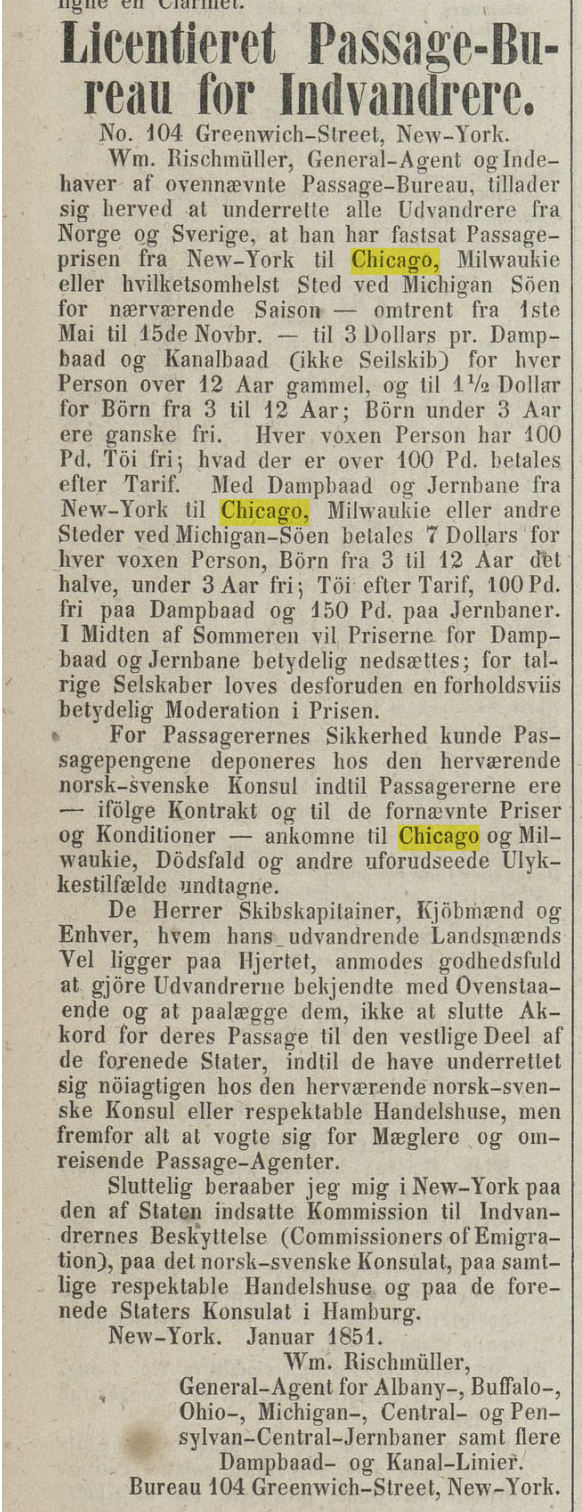
“No. 104 Greenwich-Street, New-York. Wm. Rischmüller, General-Agent and Indehaver of the above-mentioned Passage-Bureau, hereby takes the liberty of informing all Emigrants from Norway and Sweden, that he has fixed the Passage price from New-York to Chicago, Milwaukie or any Place on the Lake of Michigan for the present Season approximately from 1 May to 15 November.to 3 Dollars per Steam boat and canal band (not sailing ship) for each person over 12 years old… By steam train and railway from New-York to Chicago, Milwaukee or other places on Lake Michigan, 7 dollars is paid for a live adult person… In the middle of the summer, the prices for steamboats and trains will be significantly reduced; for numerous Companies, a proportionately significant Moderation in the Price is also promised. For Passengers’ Safety, the Passage money can be deposited with the present Norwegian-Swedish Consul until the Passengers are in accordance with the Contract and at the aforementioned Prices and Conditions arrived at Chicago and Milwaukee, Death and other unforeseen accidents excepted.
The Gentlemen Ship Captains, Merchants and Anyone, who has the welfare of his emigrant countrymen at heart, is graciously requested to acquaint the emigrants with the above and to oblige them, not to enter into an agreement for their passage to the western part of the United States, until they have notified, consulted with the present Norwegian-Swedish Consul or respectable Trading Houses, but above all to beware of Brokers and traveling Passage Agents. Finally, I appeal in New York to the Commissioners of Emigration appointed by the state, to the Norwegian-Swedish Consulate, to all respectable trading houses, and to the United States Consulate in Hamburg.“
The new country was fraught with hazards. It was not easy for non-English speakers to locate the right train and schedule. I do not know whether Asloûg traveled alone or with a group to Chicago. When she was finally boarded a train headed in the right direction there she would be among a mix of passengers of different classes and nationalities. Among them traveled newsboys selling apples, cookies, newspapers, books and magazines. What a culture shock to go from a small village in a Norwegian fjord across an ocean and now chugging on a steam train across the prairies and woodlands of New York! If only we could hear her stories.


The next part of the story was covered in How they Met.
RESOURCES
1850 Federal Census for Chicago
Newberry Library Digital Collections Chicago
The Diary of Elisabeth Koren 1853-1855 translated and Edited by David T. Nelson c1955
Kelly Wheaton ©2023 – All RIghts Reserved
Deep Diving: Water Wheels and Paper Making in 19th Century Sweden
Posted on July 29, 2023 3 Comments
Researching is really about deep diving. It is the only way to flesh out an ancestor’s life. For me it almost always starts with a question. In this case why was my 2nd great grandfather Carl Gustaf Vantsrum [originally Wenernström] born in Fässberg, Jönköping Sweden, which was 100 miles west of where his family had lived for at least three generations. The following is my deep dive into the answer and even involves a bit of serendipity. I hope the process is valuable to you in your own research. Some research notes at the bottom. The process is not a straight line it involved hopping back and forward through time and trying to connect it all together. And then there is the issue of context. I hope this inspires you to dive a bit deeper into the lives of your ancestors. Names, dates and places are not enough.
Serendipity
During the hot of the past weeks, I spent much time at my computer while escaping the heat outside. I decided to try to further track down 2nd great-grandfather, Carl Gustaf Vanstrum‘s family in Sweden. I had the rough outlines, where he was born, where his parents were born, but I was missing when and where his parents, Gustaf Wernström and Maria Catharina Hakberg died and why they moved around so much. My aunt and I had lost track of them in Annerstad 40 years ago.
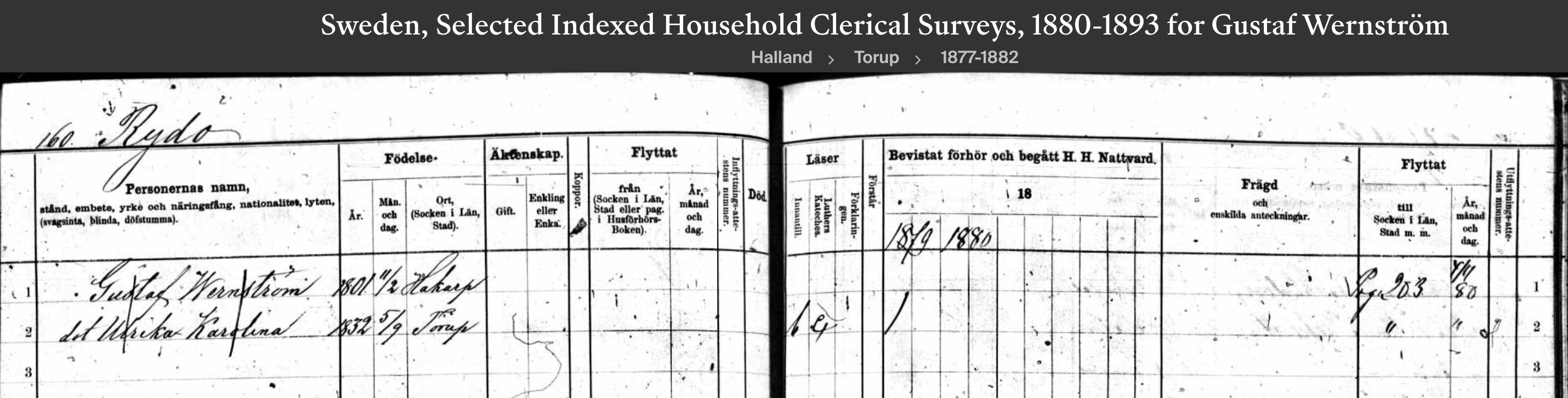
While many of the Swedish Clerical Surveys have been indexed the difficulty with deciphering means that even anything resembling the name you are looking for, is often indexed incorrectly. So going back to the days of hours on a microfilm reader I spent hours looking at hundreds of pages of Household Examination Rolls and Flyttinger (Moving Out) registers, etc., page by page. I finally found where Gustaf Wernström and Maria Catharina Hakberg settled. It was in the parish of Torup, Halland lan and they lived there from their arrival in 1846 until his death on the 5th of August 1884. She died there December 5th 1872. Just east of Torup is one of two hamlets where they lived one was named Rydö and the other Våcknared. And while looking at it on Mapcarta [better for seeing the names of Scandinavian farms and hamlets than Google] I found a museum there called Rydö Bruksmuseum and a Facebook group so I posted on there group page and a few hours later I had a most wonderful response from Lennardt Hildingsson, including a photo of the house Gustaf Wernström built! “Gustav Wernström was a craftsman, a paper maker, at the Veka [Weka] hand paper mill in Rydö.” Now I had a bigger clue. He was a foreman for handmade paper mill! So I went back to Fässberg and Hakarp seeking answers.
Fässberg and Mölndal
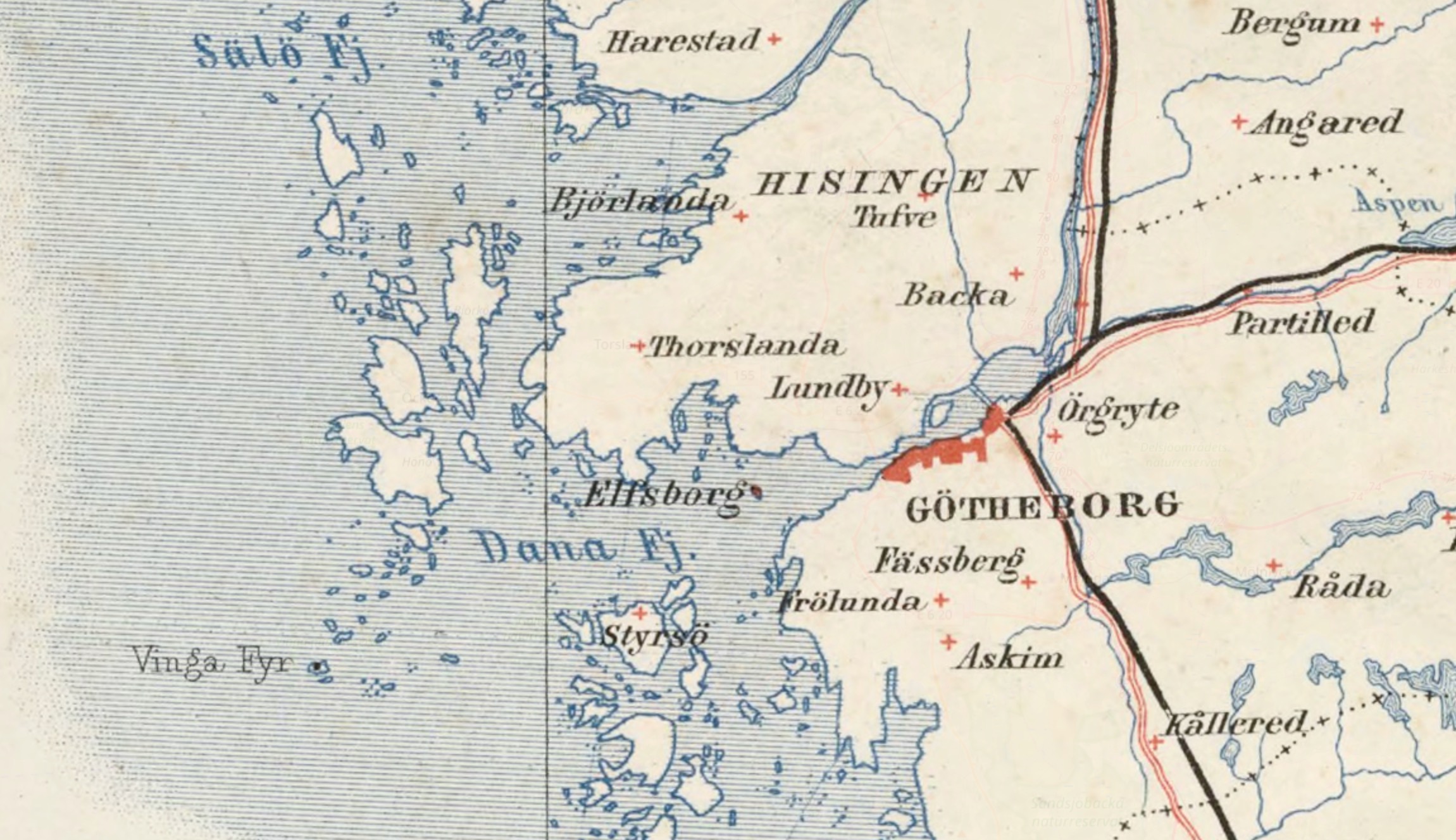
This map shows the proximity of Göteborg to Fässberg where Carl Gustaf Vanstrum [Wernström] was born in 1829. This area is south of the port city of Göteborg from where we expect Carl left on his way to America in 1853.
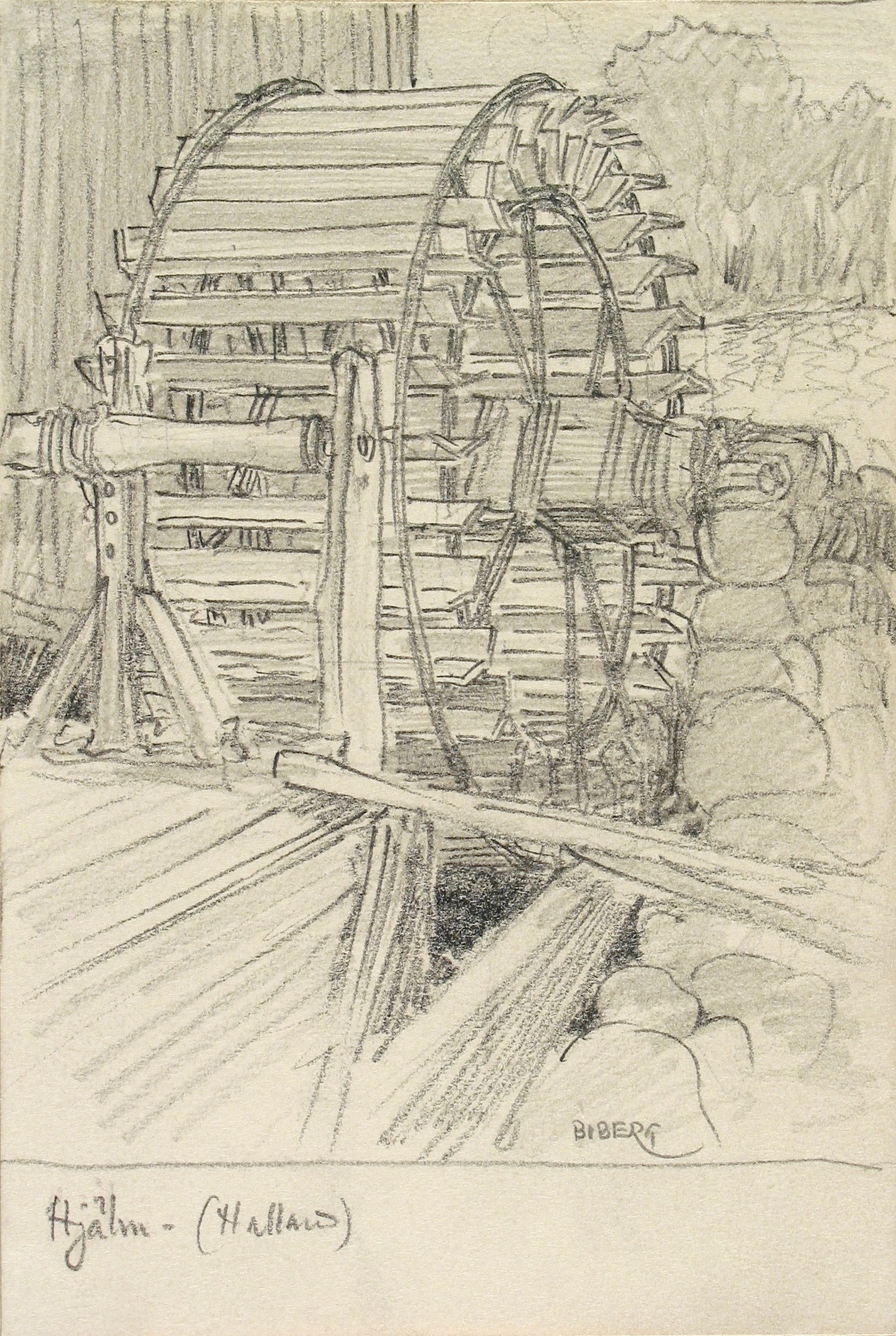
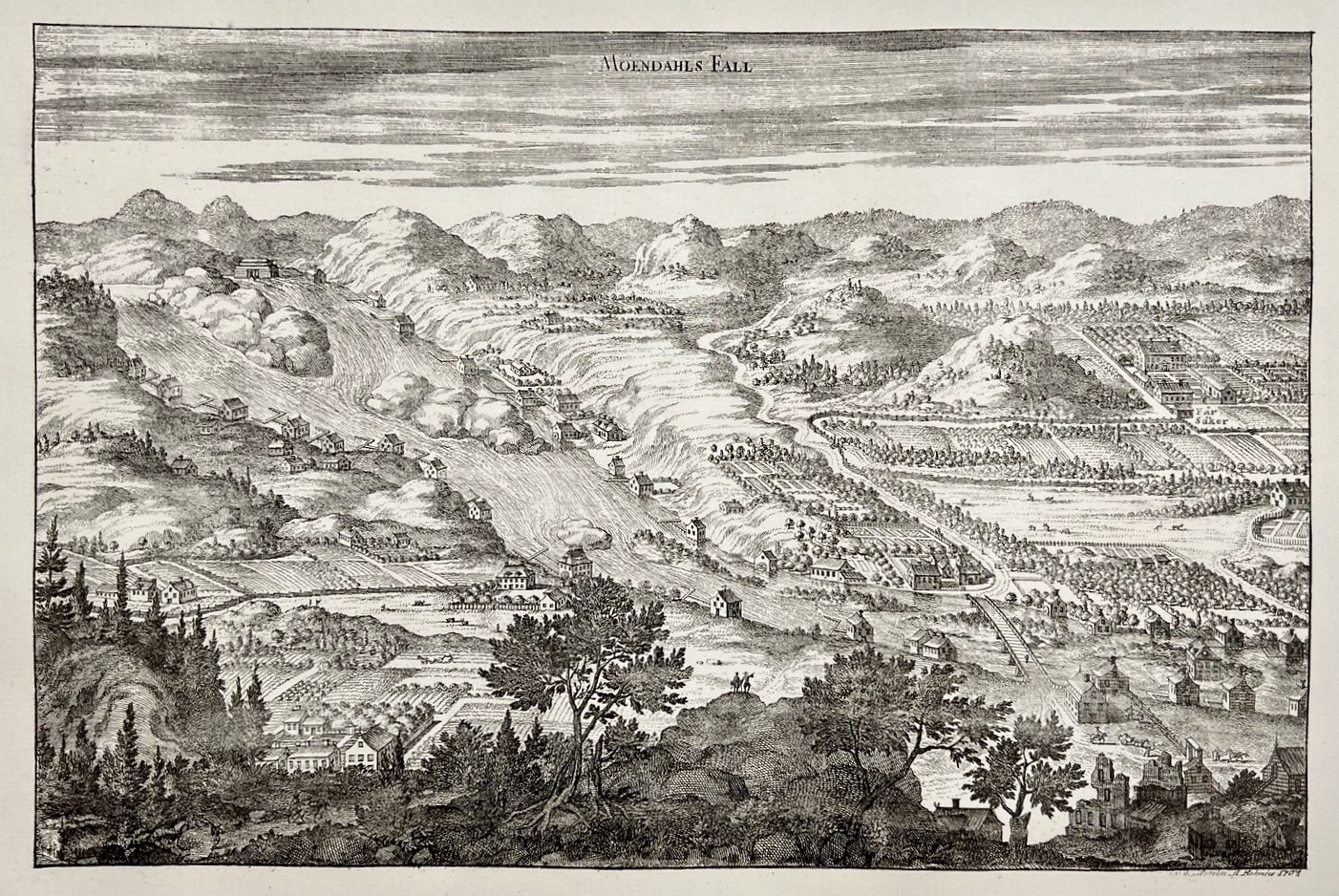
However this map does not show the ruggedness of the area. Just to keep us on our toes originally the parish of Fässberg encompassed Mölndal and now Mölndal encompasses Fässberg. Mölndal literally means Mill Valley. Many mills were built along the rapids of the Mölndal River. The rapids that would provide the energy to power the water wheels. In about a half mile the rapids drops 150 foot over. This etching by Johan van den Aveelen from about 1703 would give us an idea of the rural nature of the area in an earlier time.
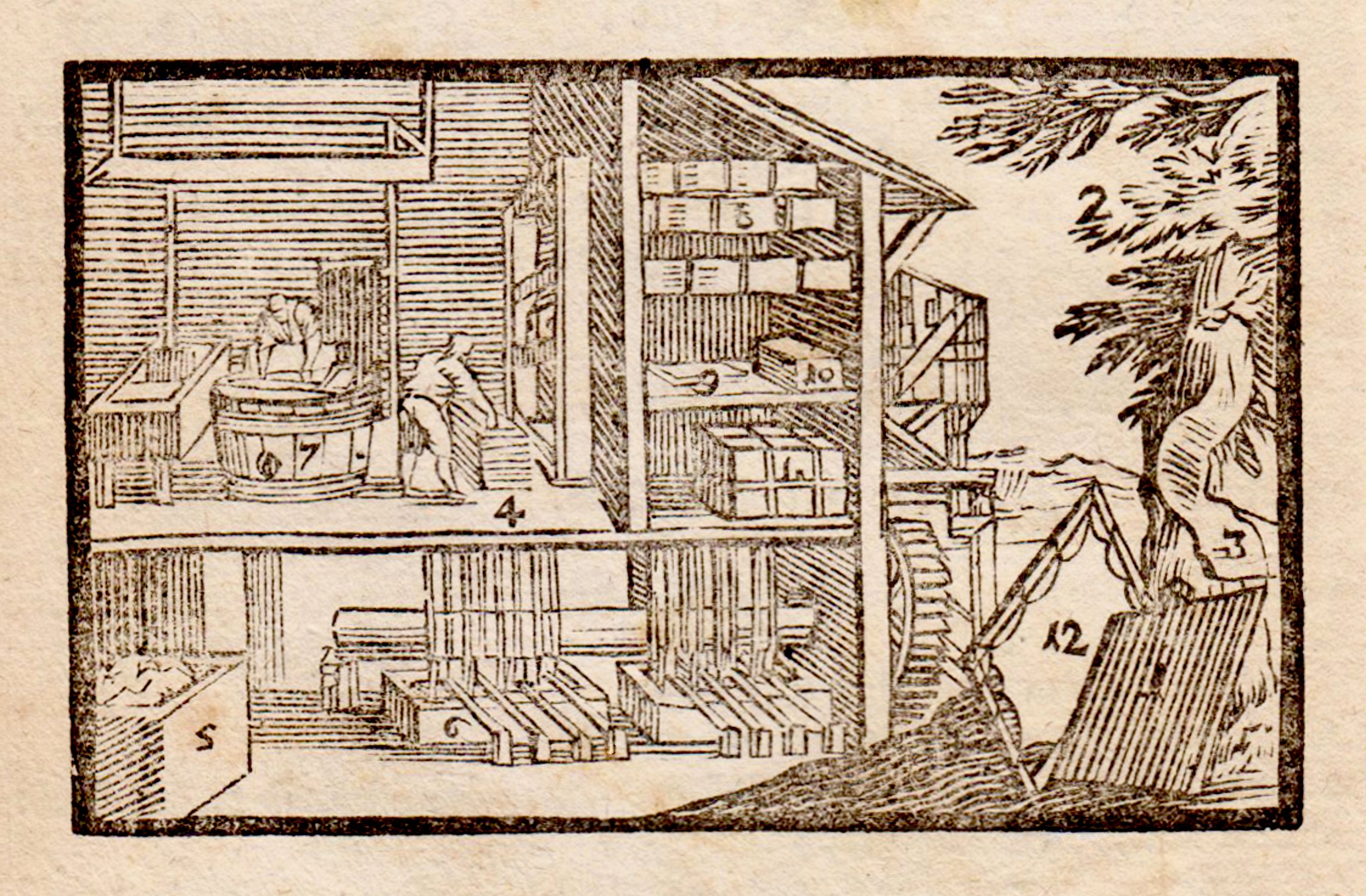
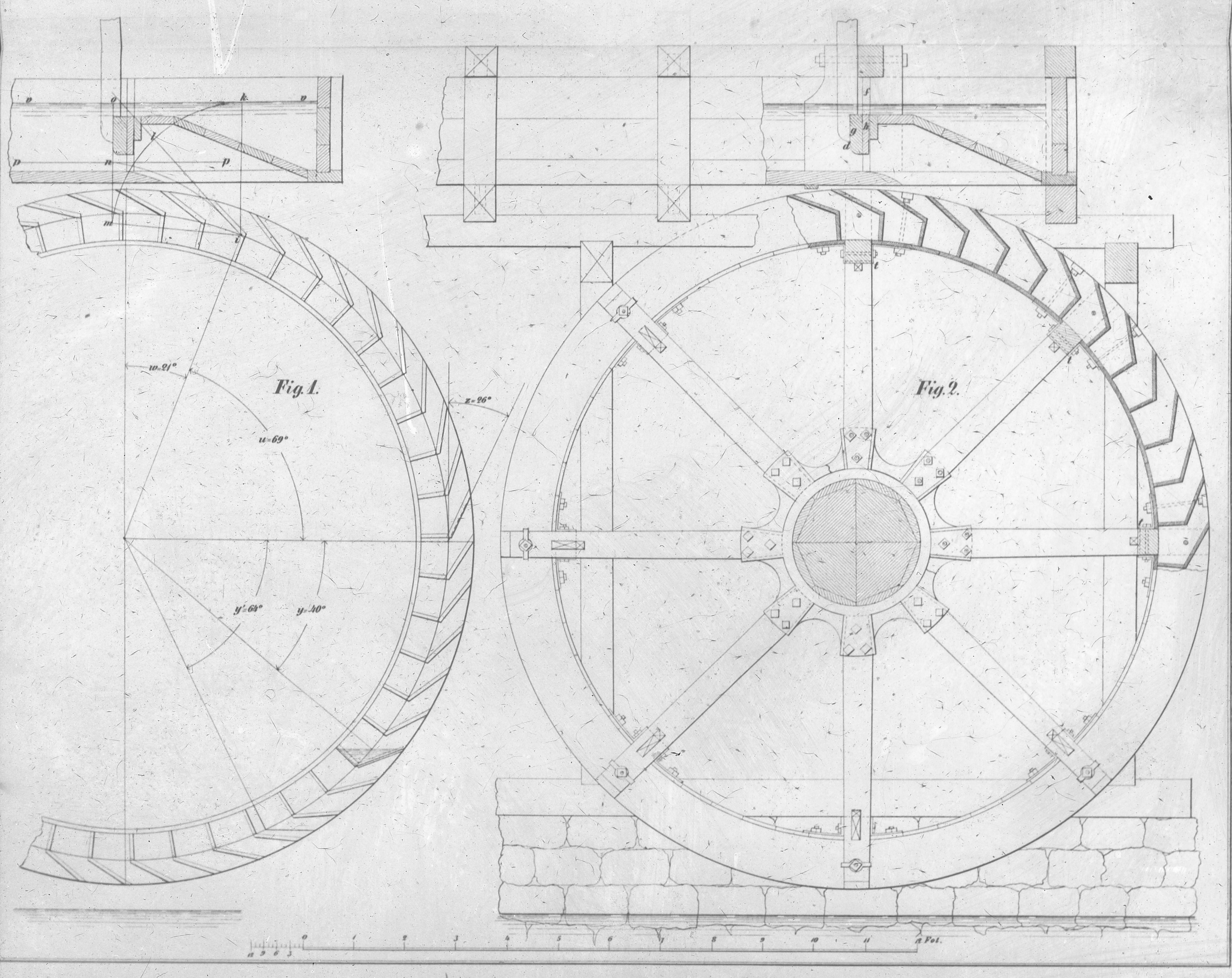
And as luck would have it in 1827, a hand paper mill was built along the Mölndal River called Götafors Pappersbruk. And as it would happen this is where Gustaf was employed when he moved there in 1829! It was powered by a water wheel, and the buildings were constructed of timber. It may have looked a bit like this.
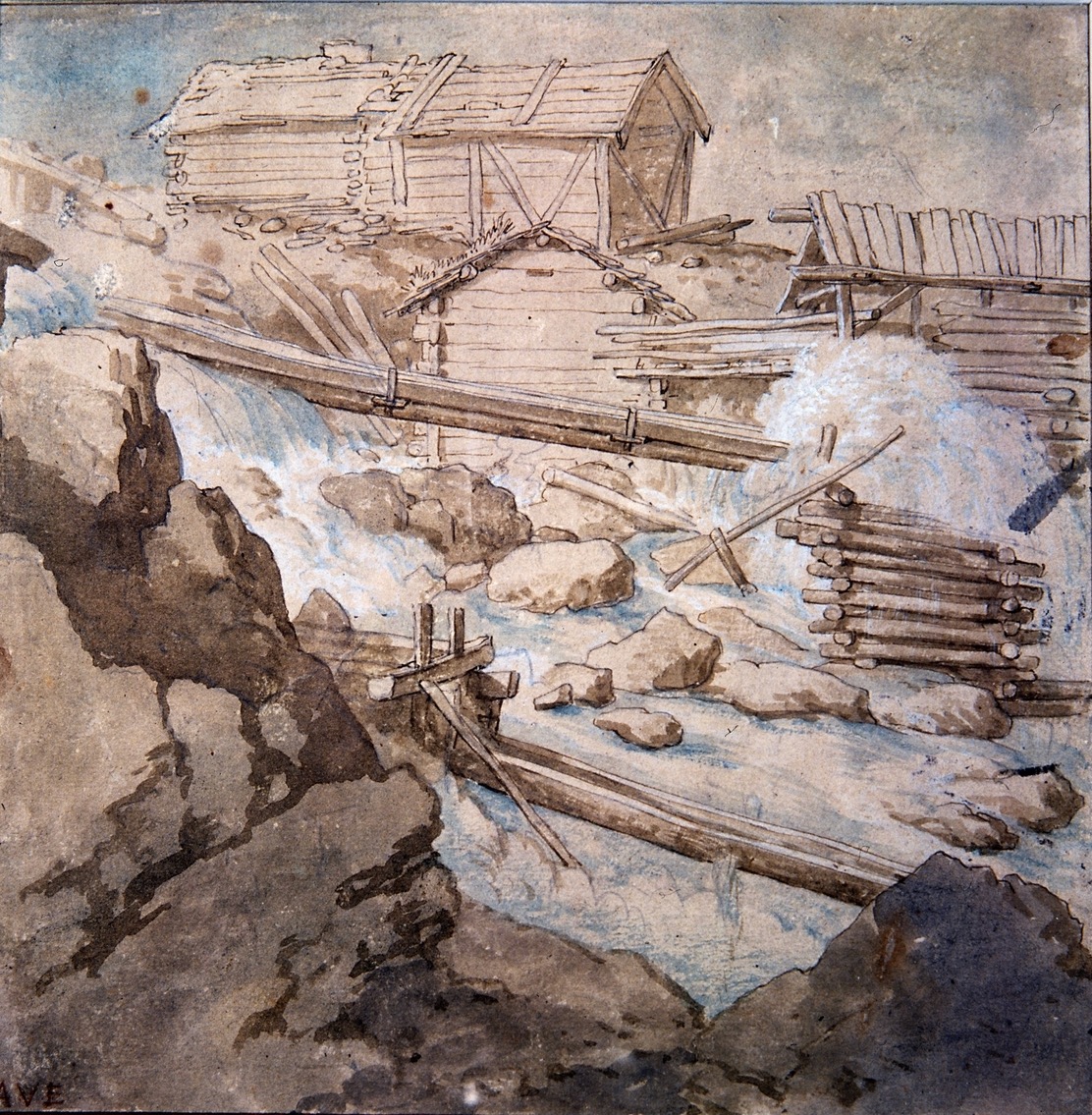
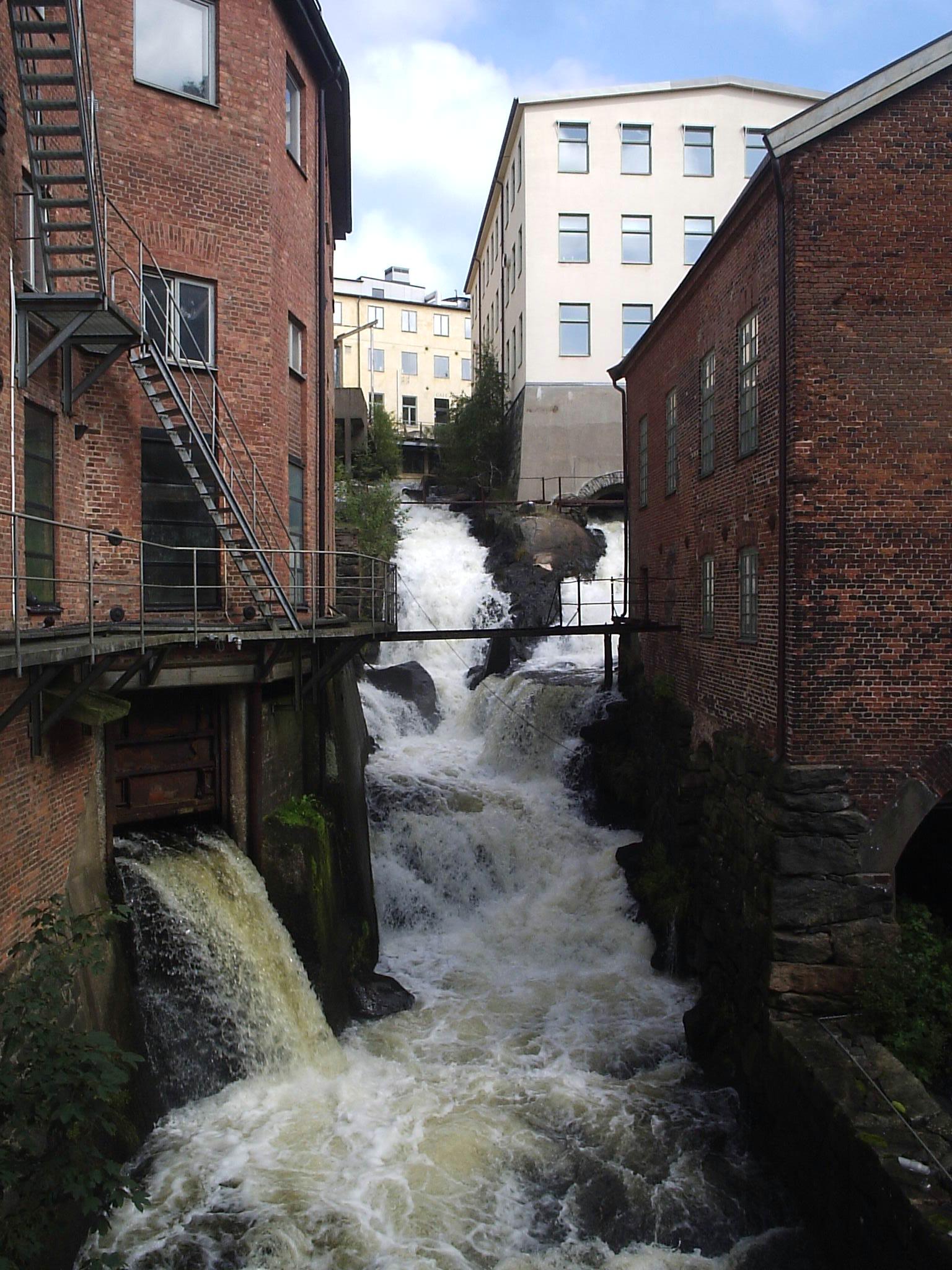
There were as many as 30 mills in 1818 along the Mölndal River and they were used for many purposes. The Götafors Pappersbruk would have been just downstream of this photo taken in 2007. The falling water would power the water wheel that would grind the rags used to make paper. All of these mills in Mölndal were originally built of wood and later replaced by brick.
Hakarp and Stensholm
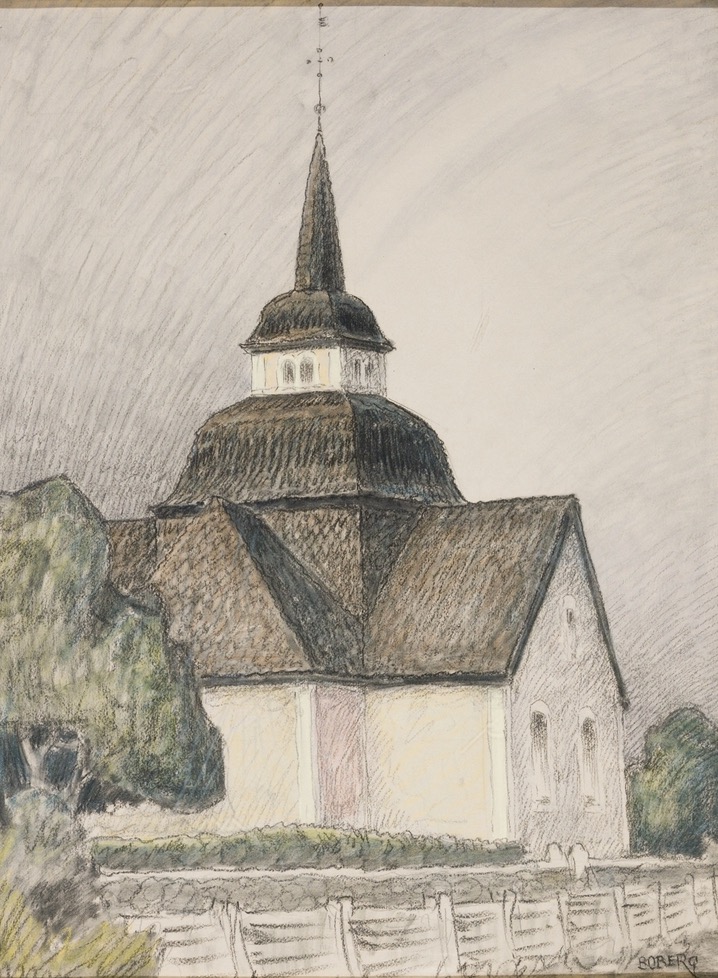
Carl’s parents were both born in Harkarp, Jönköping not far from Husqvarna. Gustaf Wernström and Maria Catharina Hakberg married at Hakarp the 27th of December 1821. The church where they were both baptised and married is pictured below. This is their marriage record.

married Dec 27 1821
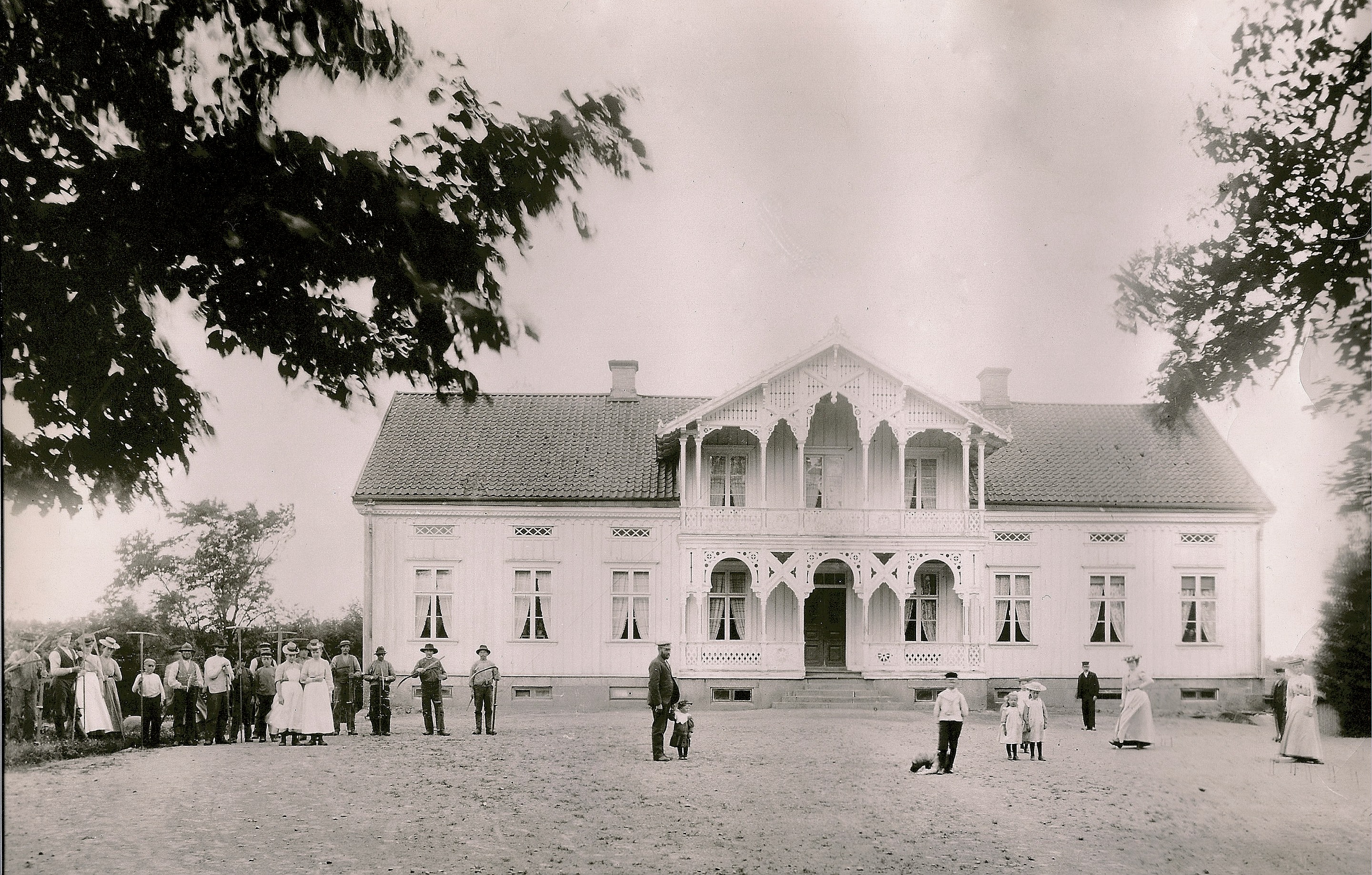
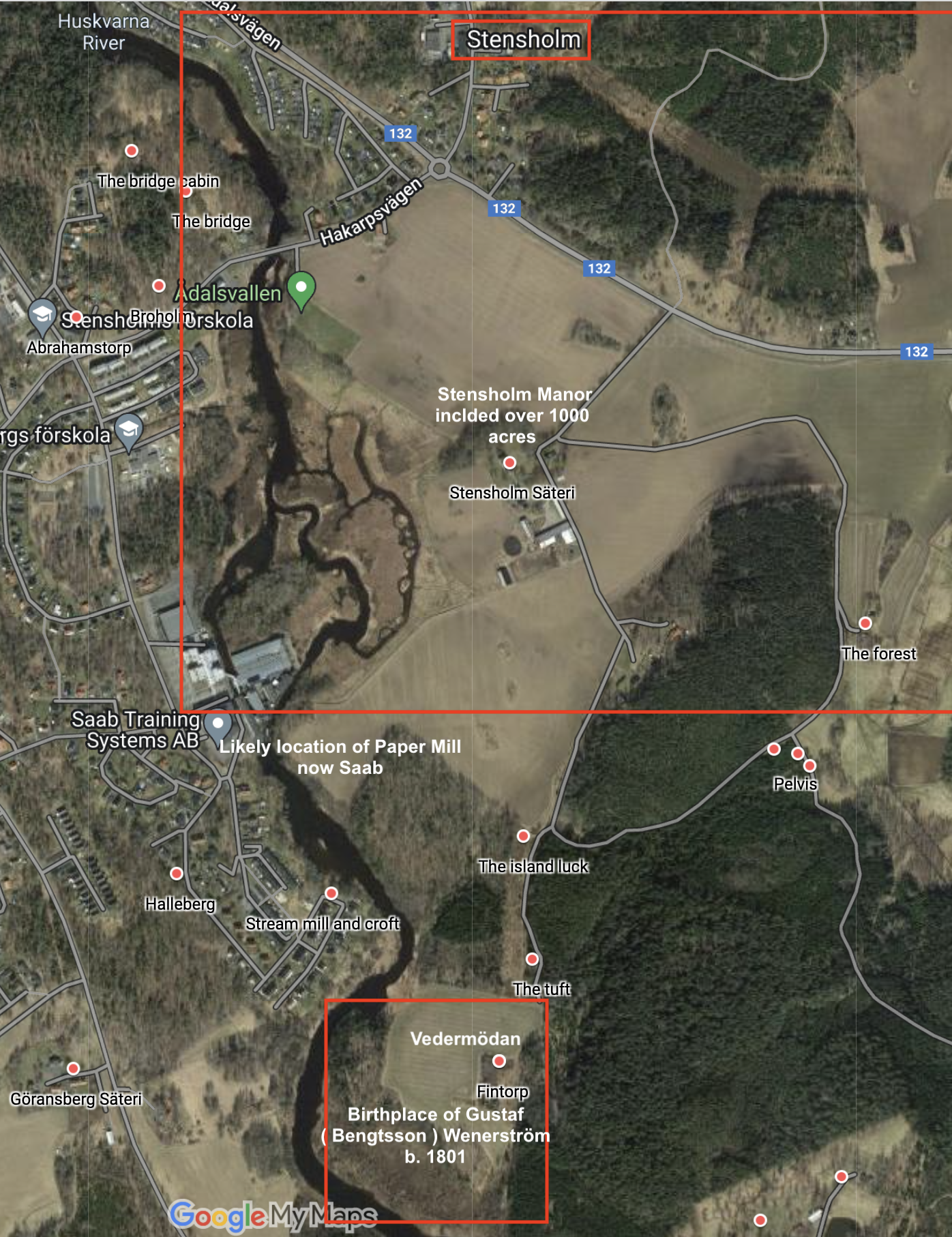
Gustaf Wernström ‘s father, grandfather and great-grandfather all lived at Vedermödan a croft under Stensholm, in the parish of Hakarp. The name Vedermödan translates “Tribulation” and it may have been a tongue and cheek description of the more difficult growing conditions of the two crofts: Vedermödan and Fintorp, although separate crofts they shared a farm house [they were later united under the farm name Fintorp]. Vedermödan was adjacent Stensholm Manor which included over 1000 acres. Here is a picture of the manor in 1905. The manor was built on the estate of a previous castle located on an island in the Huskvarna River. In 1821 Stensholm’s manor held 18 small crofts, Ebbes and Strömma mills and a paper mill. Perhaps Vedermödan was one of it’s crofts. According to Papermaking: History and Technique of an Ancient Craft by Dard Hunter 1947: In 1800 Sweden had 24 Paper Mills. By the 1830’s there were 92.
Below is the first use I have found of his Gustaf’s last name Wernström which may have been a name assigned during his mandatory military service. The name literally means Protector [of] River = Wern + Ström. What is interesting is the name was first entered as Gustaf Bengtsson and then above it is written Wernström. This is also the first time that he and his wife Maria Catharina appear together in the Household Examination Rolls. It has the date of their marriage listed as 1821 and their first son Per [Peter] August is listed. [I helpful hint is to look for the birthdate of Gustaf 1801 or in this case “01.” It is sometimes easier than looking for the name when scrolling through hundreds of pages.] It took me several times to find this listing in Hakarp: Stensholm: Paper Mill [Pappers Bruck]. There are 9 journeyman, 2 supervisors and 3 rag collectors. Paper was made from cloth rags until about 1870 when wood pulp was employed. So there were “lumpsamlare” or rag collectors who were employed to go around and collect rags from villagers. Today we still make handmade papers and watercolor papers from 100% rag. This could be cotton or linen.

I believe the Paper mill was adjacent Stensholm’s Estate perhaps where the Saab plant is now or at the location marked ‘stream mill and croft’ [Although the later does not appear to currently have the proper elevation drop] . Gustaf Wernström is listed in Household Clerical Survey 1804-1815 under his parents and grandparents at Vedermödan, Hakarp. The map below shows Stensholm which is a hamlet in the parish of Hakarp, Vedermödan which shared a house with Fintorp and Stensholm Manor which was originally a stone structure now an island within the Husqvarna RIver, perhaps as seen below.
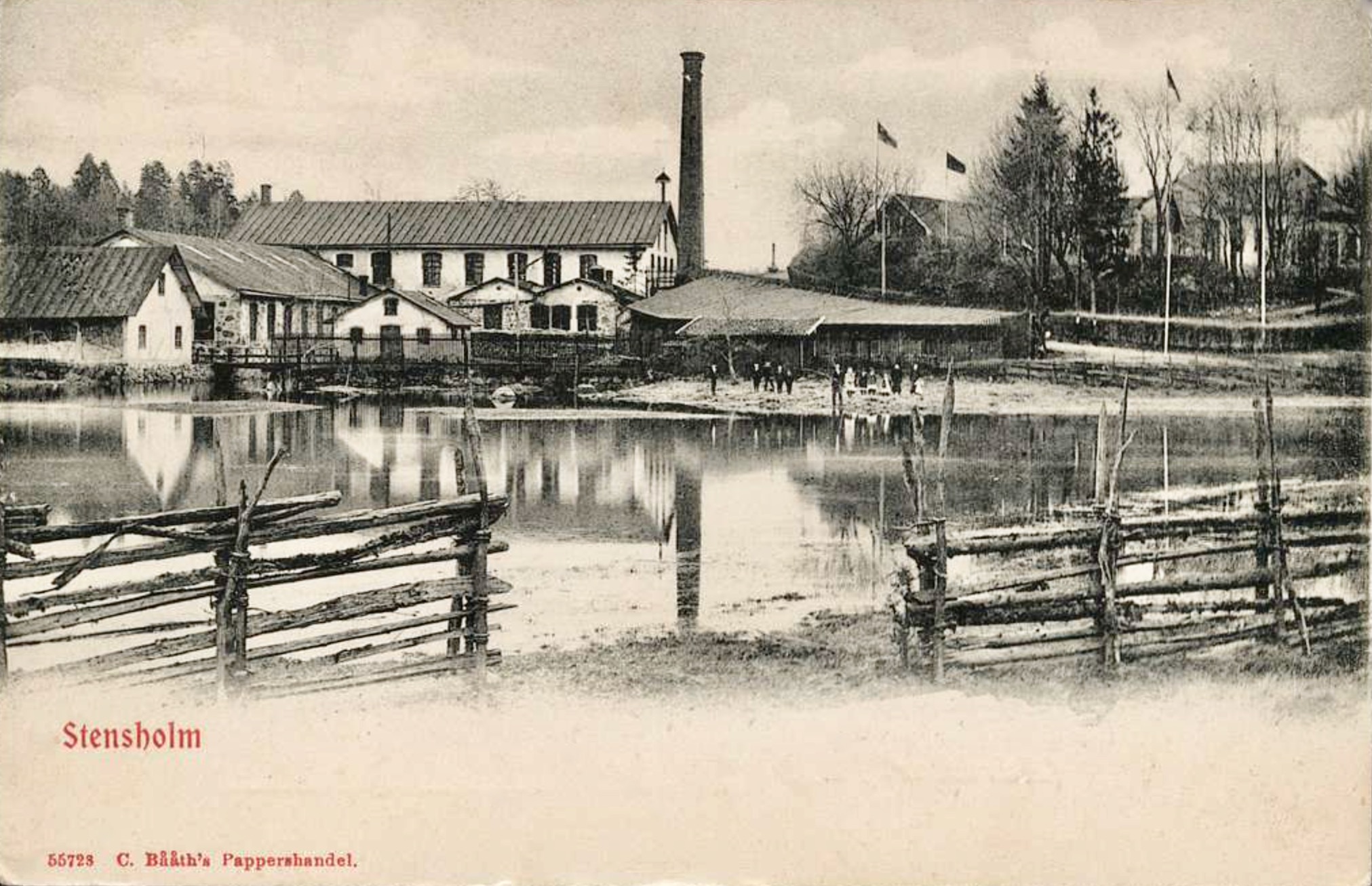
This is what the Stensholm looked like in the year 1900, 99 years after Gustaf’s birth in 1801.
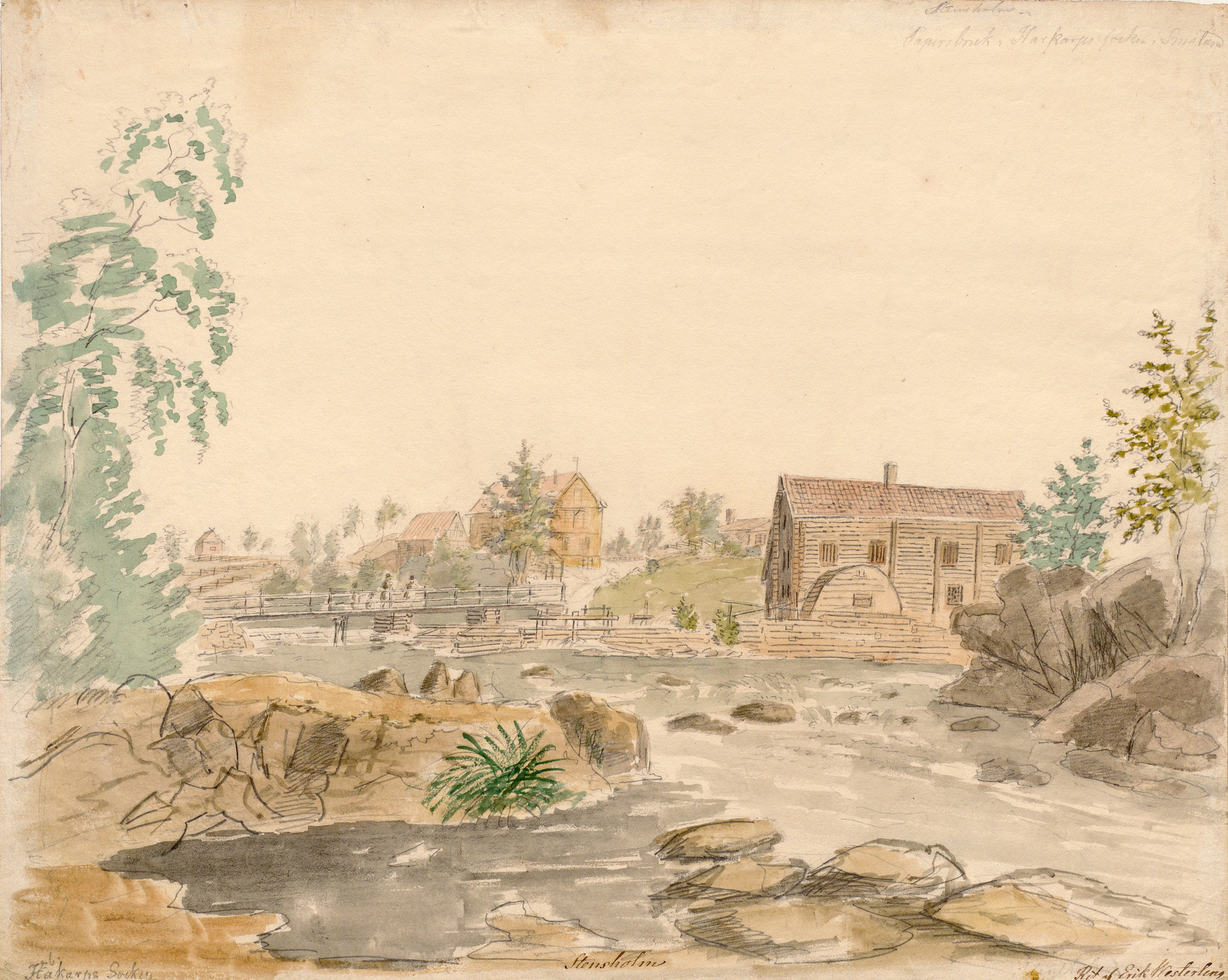
What is truly remarkable is this sketch and watercolor painting by Erik Westerling of Stensholm from about 1840-1850’s showing the Paper Mill. The rapids turned the water wheel which powered the press for the making of paper.
Gustaf’s older brother, Johannes, is set to take over the farm so Gustaf is seeking his fortune elsewhere. His first child arrives October 21st of 1822, Peter August, followed by Carl Frederick 12th of August 1825 but sadly Carl dies the 14th of December of the same year. The family appears on the Flyttninger [Moving out] records in 1826 headed for Fänneslunda, Ålvsborg.
Following the Paper Mills
As it turns out Gustaf Wernström located in Härna which is about 4 miles southeast of Fänneslunda but nearly 50 miles from Stensholm. And no surprise there was a Paper Mill in Härna. Following the path of Gustaf Wernström and Maria Catharina Hakberg was exhausting, but at every stop there is a Paper Mill. And every entry has Gustaf listed as a Journeyman Papersmaker.
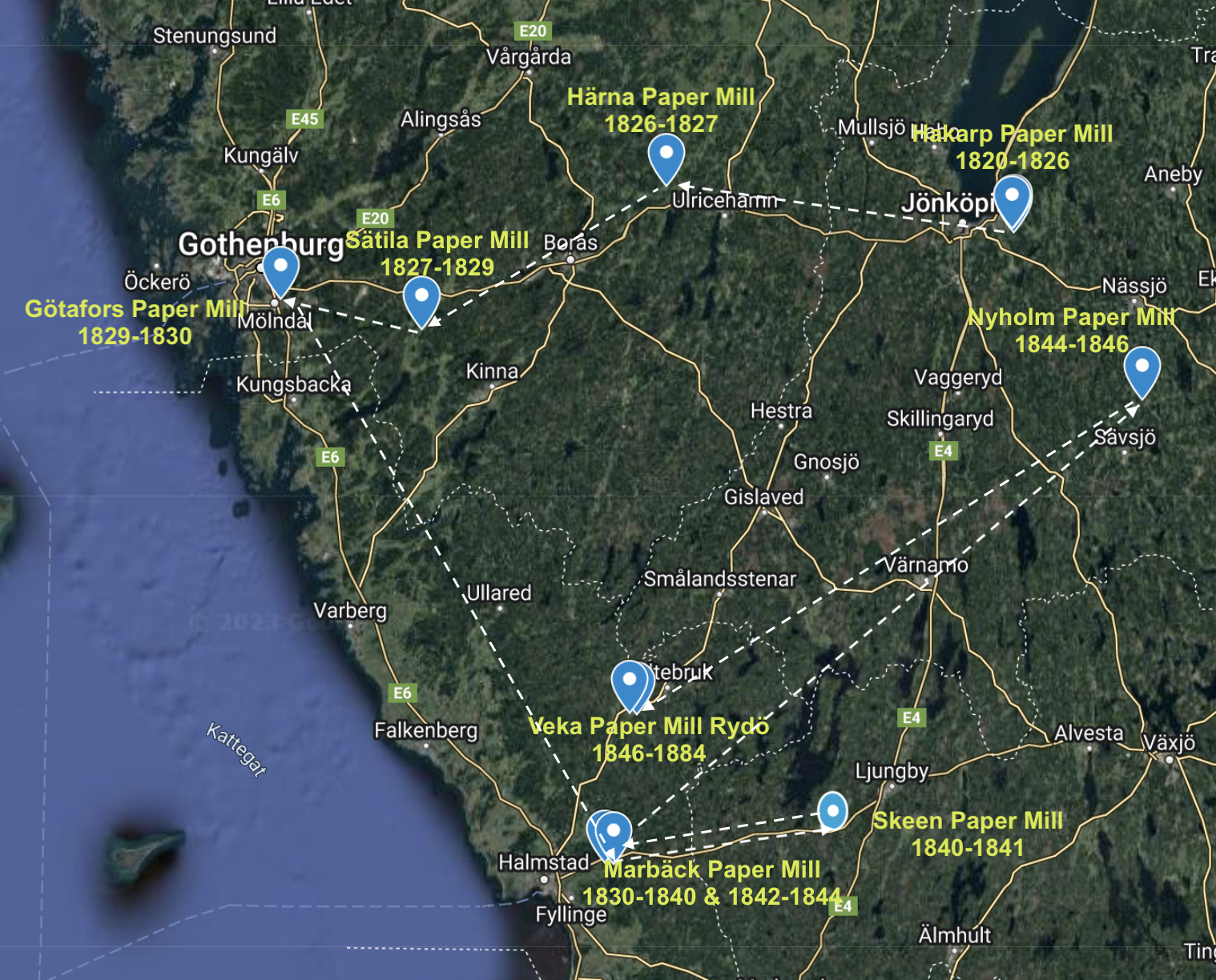
So the mystery of why Gustaf moved 100 miles from Hakarp to Fässberg was solved! With stops in Härna and Sätilla along the way. Then on to Fässberg where his son Carl Gustaf was baptized, but they did not stay long.

Here I have plotted out in My Google Maps all of the places and Mills that Gustaf worked and lived. After Leaving Götafors Papermill he spent most of the next fourteen years at Marbäck Paper Mill.
| Date | Parish | Farm or Hamlet | County | Details |
| 1801 | Hakarp | Vermödan under Stensholm | Jönköping | b. Gustaf Bengtsson |
| 1801-19 | Hakarp | Vermödan under Stensholm | Jönköping | Gustaf on Household rolls |
| 1820 | Hakarp | Hakarp Paper mill Stensholm | Jönköping | Gustaf Wenerström a journeyman at paper mill |
| 1821-1826 | Hakarp | Hakarp Paper mill Stensholm | Jönköping | Gustaf Wenerström m. Maria Catharina Hakberg |
| 1826-27 | Härna | Härna Paper mill | Alvsborg | Gustaf a journeyman at paper mill |
| 1827-1829 | Sätila | Sätila Paper mill | Alvsborg | Gustaf a journeyman at paper mill |
| 1829- Aug 1830 | Fässberg | Götafors Paper mill | Göteborg och Bohus | Gustaf a journeyman at paper mill |
| Aug 1830 | Snöstorp | Marbäck Paper mill | Halland | Gustaf a journeyman at paper mill |
| 1836 | Snöstorp | Skerkerd | Halland | Gustaf a journeyman at paper mill |
| 1836-1840 | Snöstorp | Marbäck Papermill | Halland | Gustaf a journeyman at paper mill |
| 29 Dec 1840 | Annerstad | Hallarp Munkaz: Petersburg | Kronberg | Gustaf a journeyman at paper mill |
| 1842-1844 | Snöstorp | Marbäck Paper mill | Halland | Gustaf a journeyman at paper mill |
| 1844-1846 | Norra Sandsjo | Nyholm Paper mill | Jönköping | Gustaf a journeyman at paper mill |
| Sep 1846-Aug 1884 | Torup | Veka Paper mill, Rydö | Halland | Gustaf a journeyman and foreman at paper mill |
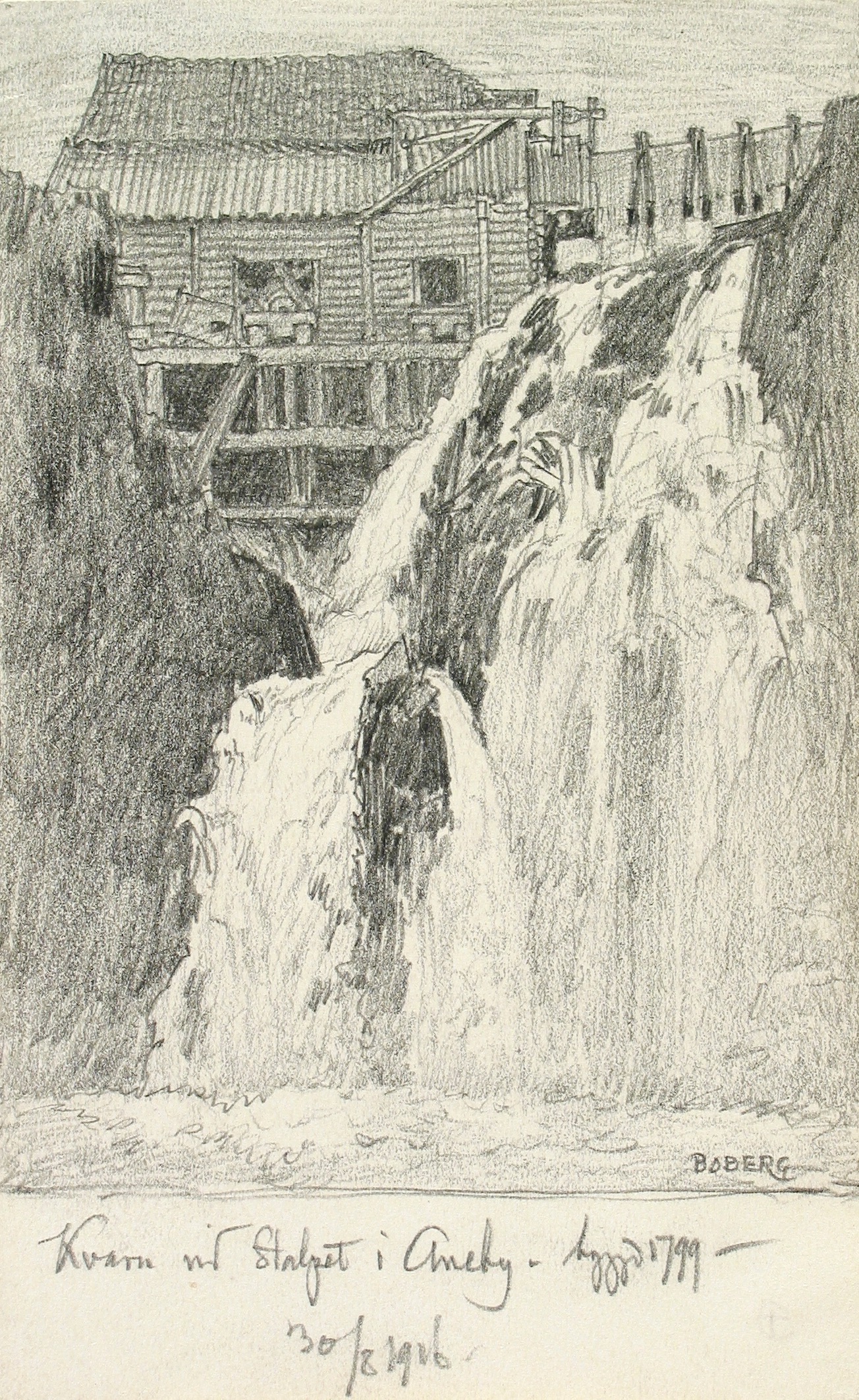
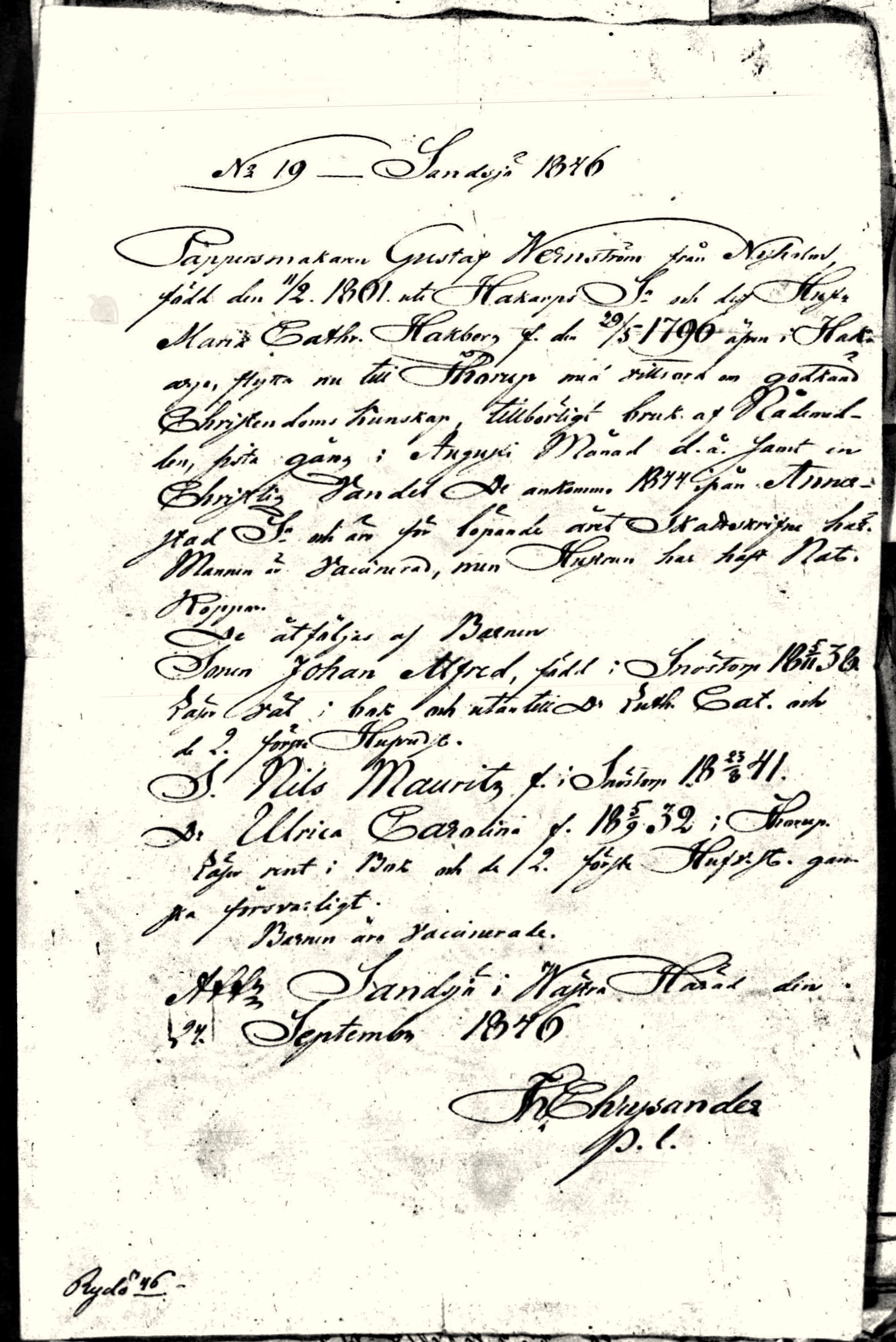
The above drawing created in 1916 gives us a good idea of what it may have looked like some 80 years earlier. In the 1693 census under “Marbäck in Snöstorps parish” there was listed a Paper Master, Carl. A paper mill may have been manufacturing paper here since the 16th century. In 1755, 15,000 sheets of writing paper and 20,000 sheets of printing paper were produced at Marbäck. Gustaf appears to have had short stints at the Skeen Paper and Veka Paper Mills during the years 1830-1846. This remarkable document was found in Torup parish. Rather than an entry in the Inflyttinger [entry registers] this is the actual letter from Sansjö parish [Nyholm Paper Mill] where it lists Gustaf Wernström and Maria Catharina Hakberg and children their birthdates where they were born and that they were leaving from Nyholm, Norra Sandsjö and it is dated 22 September 1846:
Rydöbruk: Veka Paper Mill
In his life Gustaf worked at 8 different Paper Mills in Sweden. In the fall of 1846 he arrived at the Veka [Weka] Mill in the parish of Torup, the community of Rydöbruk where he finally put down roots. From the 1989 “Rydöbruk Bevarandaplan” [Rydöbruk conservation plan] we learn:
“a hand paper mill was built at Veka, a hundred or so meters upstream on the other side of the county border and the south-east side of Nissan. The factory building itself was built on one floor with two smaller extensions, one containing the water wheel, the other containing rag chambers and washrooms. The factory building was divided into two halls, and contained a Dutch press, a molder, a paper press, a boiler wall, a linen and sorting shed and a smoothing machine. Rag storage, two drying sheds and a residential building with associated outbuildings had also been built within the factory area…For papermaking, you needed clean and never-ending water, and you got that from the ‘Kungskällen’ which was located on the north-west side of Nissan…Weka hand paper mill was the largest of Halland county’s three paper mills (the others were Marbäck and Stjärnarp) .“
The Veka Paper Mill was established in 1828 and operated until the 1870’s. A good portion of the factory burned in 1865. So it is likely that Gustaf worked there until it closed. In the 1867-76 Household Examination rolls he is listed as a Foreman. Gustaf would have seen many improvements over the course of his life as a papermaker.
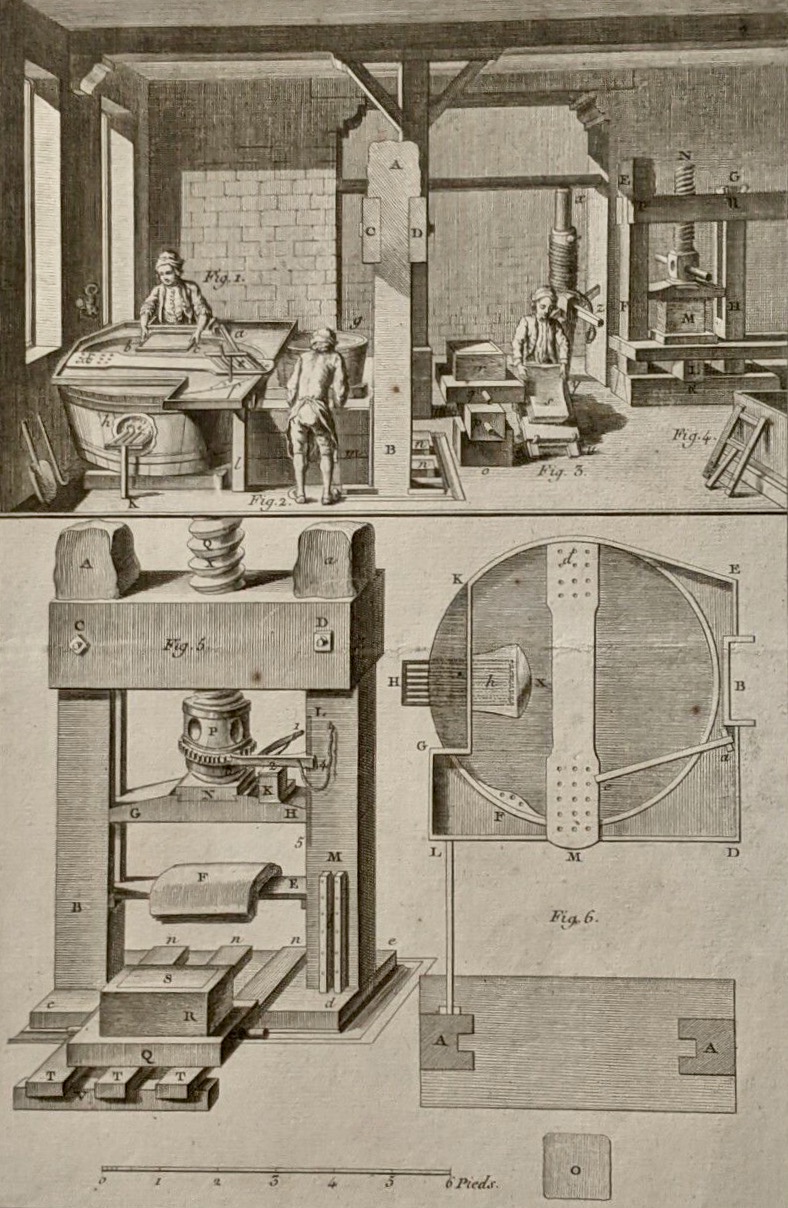
In 1798 a papermaking machine by JNL Robert appeared followed by others. This is a 1/5 scale replica model of his machine.
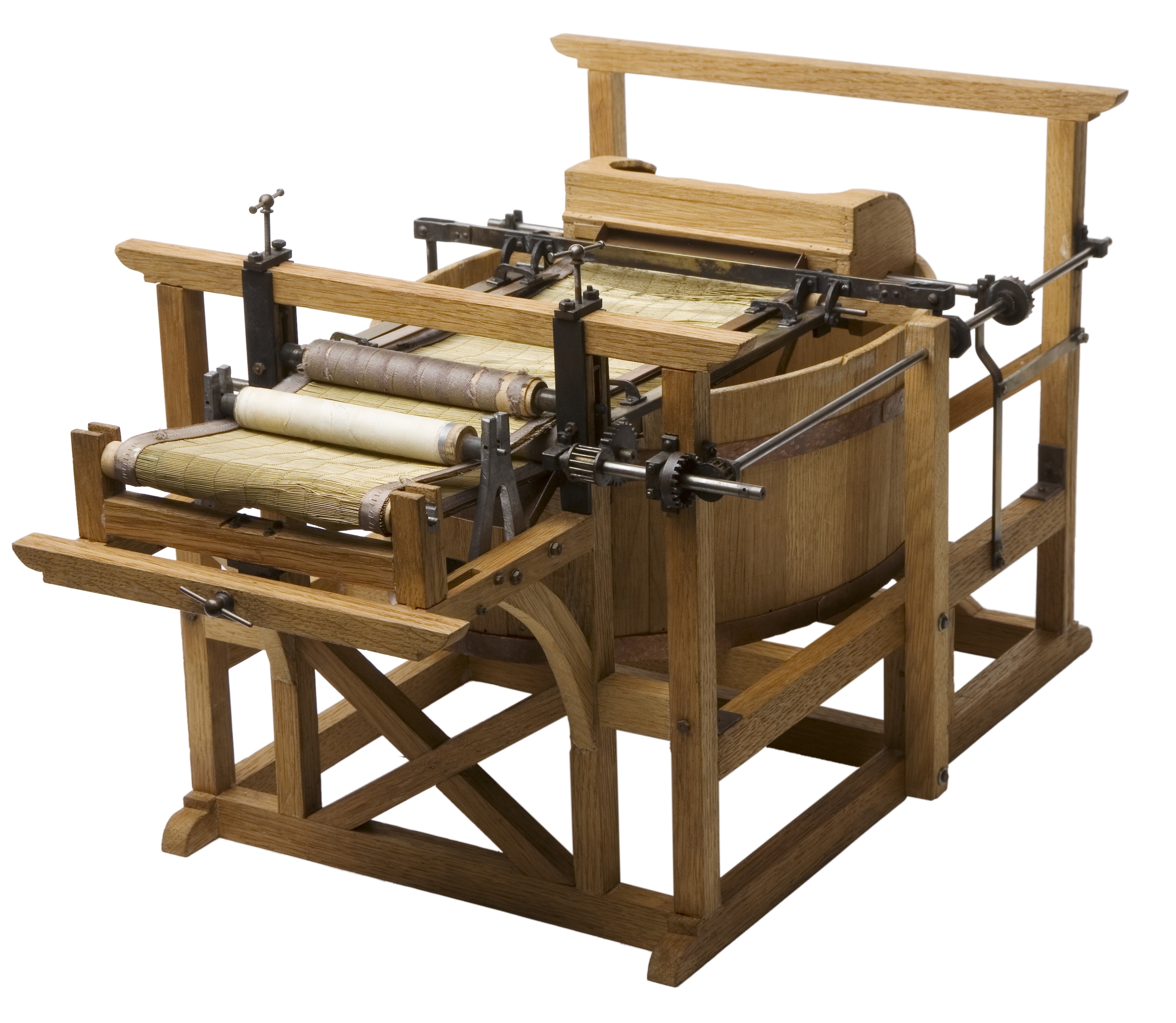
In 1844 Friedrich Gottlob Keller of Germany patented a process for turning wood pulp into paper. A very good article on papermaking is found here “Background: European Papermaking Techniques 1300-1800” by Timothy Barrett. This resource is shared under the Creative Commons [CC]. A few interesting quotes that brings home the skill required in handmade papermaking:
“Therefore, a fine-quality white paper with good look-through was most readily and economically made by first selecting well-worn white rags of a similar strength.”
“The task of the layer demands skill and experience [to] avoid tearing the sheets as they are lifted from the felts. It is suitable only for people who have practiced it from an early age and not for uneducated, inexperienced country-folk.“
“Considerable skill and experience were required to evaluate the strength of the rag and the degree of retting required to produce fibers that would respond readily to stamping yet yield an optimum-quality sheet, with minimal loss of fiber. In the more substantial and well-established mills, fermenting was the job of a specialist, who passed his craft on to his sons or other young artisans.”
In our case, two of Gustaf’s sons became papermakers during their time in Sweden. Johan Alfred who moved to America in 1855 [two years after Carl Gustaf] became a Captain in the Civil War and later a Postmaster and Registrar of Deeds. His brother Nils Mauritz who moved to America in 1865 became a grocer and merchant. My ancestor Carl Gustaf was a carpenter and merchant.
As mentioned earlier Gustaf’s wife, Maria Catharina Hakberg died December 5th 1872 in Rydö. Daughter Ulika Karolina lived with the her father in the house he built, at nearby Våcknared in 1880, until his death August 5th 1884.
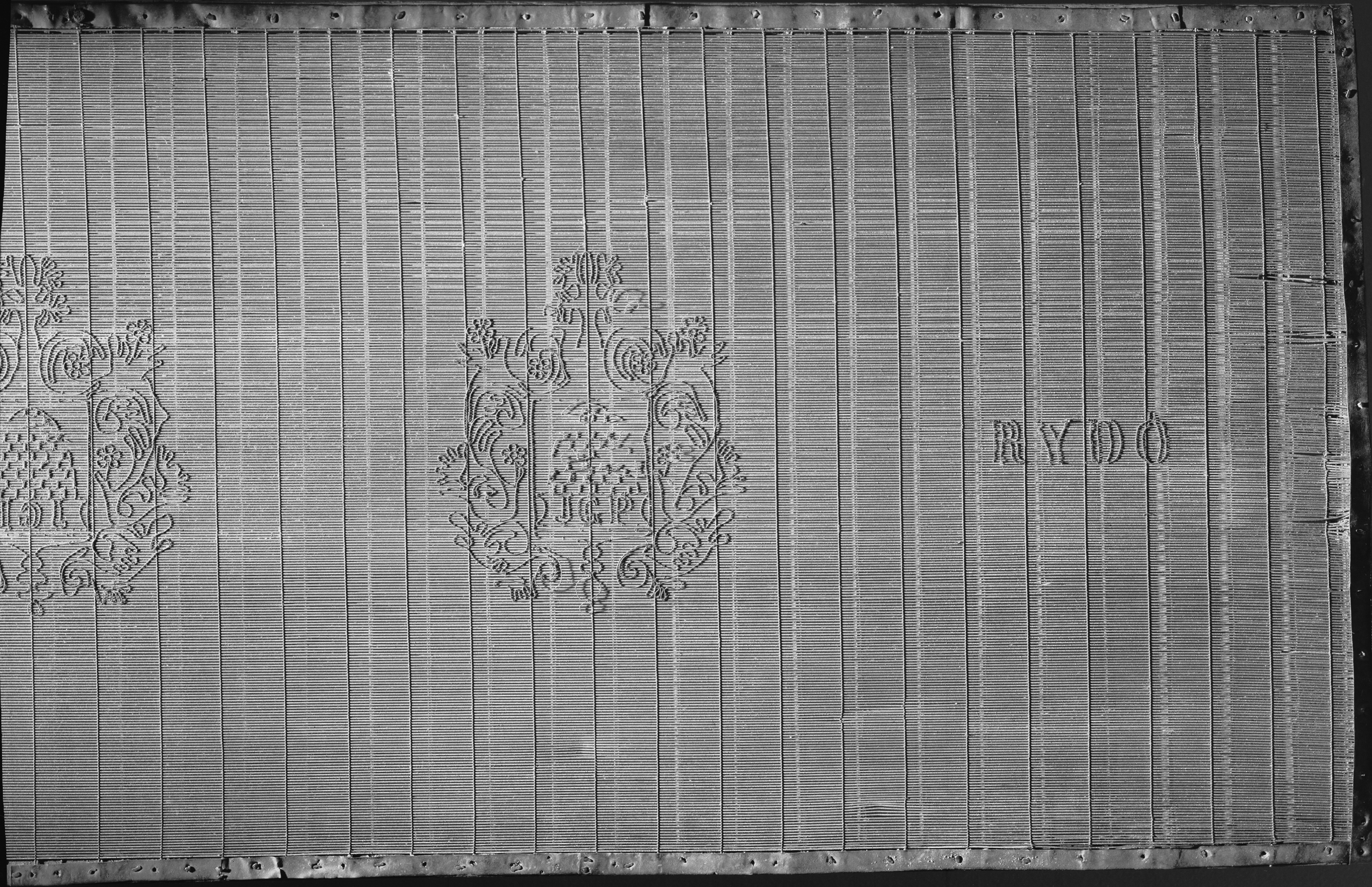
And finally we close this journey with a look at the mold for the Rydö paper watermark. It’s nice to think Gustaf may have handled this very mold.
I hope this provides inspiration for your own deep dive you just never know where it will lead!
Resources
- Old Maps online
- Nordisk DIgital Museum. Wonderful source of images
- Facebook for Local museums and Local History Societies
- Google for maps and searches
- Ebay for old post cards and drawings
- Local Swedish Homestown Histories
- FamilySearch for the names of Farms within a Scandinavian Parish
Please not links are included whenever possible.
Kelly Wheaton ©2023 – All Rights Reserved
FILLING IN THE BLANKS: Researching the Story of How They Met
Posted on July 25, 2023 1 Comment

Public Domain Library of Congress
See How my Forty Year old Brick Wall was Broken and Locating Immigration Records for the earlier part of this story. It is amazing how much you can find to fill in pieces of the story. For this part I searched for early maps of Chicago at the Library of Congress. Searched for histories of the Immanuel Lutheran church in Chicago. Also searched Newspapers at Newspaper, etchings and contacted the Archives of the Evangelical Lutheran Church in America.
CONNECTING THE DOTS
In August of 1852 Elizabeth Olson [previously Aslaûg Eilefsdotter] arrived in Chicago after a journey of 9-10 days from New York. She likely joined a small Norwegian congregation which later becomes the Immanuel Lutheran Church. The print above is from a few years after her arrival. It gives us the lay of the land and a window into the world to which she arrived. We are looking west along the Chicago RIver Area. To the north (right) is the area then called “The Sands,” where many Scandinavian immigrants lived. Literally a little shanty town of Norwegian immigrants in the sand. About 9 blocks west and 9 blocks north is where the Immanuel Church was located [top right half way back from Lake to canal]. You can see the railroads on the right where she would have arrived. In 1850 the population of Chicago was 28,269 of which 562 were Norwegian. Two years later, in 1852, the population had grown by more than 10,000 to 38,734. I do not know but suspect that Elizabeth worked as a servant or laundress after her arrival. Perhaps working for a Norwegian family. Did she already have a job awaiting her? Did she have friends or family already in Chicago? We probably will never know.
1852 CHICAGO
These were not easy times for immigrants. I was lucky to have located the record of the marriage of Elizabeth in 1855 at the Immanuel Lutheran Church, so this was my starting place. Digging deep into the foundations of the Immanuel Lutheran Church of Chicago I find valuable stories and context. What follows below in italics is adapted and condensed from The Story of The Immanuel Lutheran Church By C. O. Bengston 1928
The small congregation of German Lutherans organized a Lutheran Church in Chicago in 1848. They collected funds from St Louis to build a church on the corner of Superior St between Wells and LaSalle streets. The church was only partially built when a imposter parson took off with the money. Some of the Norwegian members had been distrustful of Gustaf Smith from the beginning and they sent for Norwegian, Paul Andersen, a then seminary student at Beloit College. The same year he was ordained by the Evangelical Lutheran Frankean Synod.
In 1852 a small company of immigrants came to Chicago from Västergötland, Sweden. They continued on by boat intending to settle in Sheboygan, Wisconsin. No one came to greet them and after two days they returned to Chicago. Here they managed to find quarters with some Norwegian families, members of the Lutheran Church. Many of them soon fell ill with the cholera, and one expressing an eager desire to see a Norwegian, Lutheran pastor, Rev. Paul Andersen was sent for. Though it was late in the night, he came with spiritual comfort for the sick and the dying. As time went on he continued his ministrations, giving them all good counsel and assistance, in both spiritual and temporal things. As a result, the members of the little band became much attached to him most of them, joining his church. Rev. Andersen was already fully occupied in meeting the spiritual needs of the Norwegians. He felt that to them belonged the first claim on his time and strength. His influence on the Swedish people was, naturally, rather limited.
In October of 1852 Rev. Tuve N. Hasselquist comes from Sweden and agrees to help with the search for a Swedish clergymen.
1853 CHICAGO
True to his word Rev. Tuve N. Hasselquist returns in January of 1853. In a letter back to Sweden dated January 17th he wrote that he essentially preached to the Norwegians in the forenoon and the Swedes in the afternoon. At the time the number of parishoners was 80. Rev. Erland Carlsson from the Växjö diocese of Sweden, was selected to fill the void. He set sail for America in the company of 176 Swedish immigrants, on June 3, 1853. The total on board was 554 from many places including Sweden, Norway, Ireland, and England. Twenty-six died aboard ship. Were they perhaps bringing cholera with them? They reached New York on Saturday, August 13th. On Monday, August 22nd, Rev. Carlsson arrived in Chicago. From the time of organization until Rev. Carlsson arrived, the congregation held its services in the Norwegian Church, each Sunday. Rev. Carlsson preached his first sermon on August 28th, the Fourteenth Sunday after Trinity. Before long the congregation purchased the unfinished structure on Superior Street.
During the first years Rev. Carlsson and the people endured many hardships. It is only to be expected that they looked upon themselves as strangers in a strange land. This sentiment served to draw them closer together, and where there was also spiritual fellowship, based on the mutual experience of grace, the attachment became dear, and tender. As Rev. Carlsson took hold, vigorously, on the multifarious duties crowding upon him, he was confident that God would supply him with both strength and wisdom for his labors. On the first page of the church records he has written these words: “Relying upon divine assistance I a determined to declare the truth openly and faithfully, whatever difficulties may be thrown in my way.” Is there, perhaps, an element of prophecy in the circumstance that he wrote these words in the English language?
By the time Rev. Carlsson took charge, the majority of the original eighty communicant members had drifted away. Thirty-six remained: eight married couples, and twenty single persons. All of them were in strained financial circumstances. They lived in shanties, or other crowded and inadequate rented quarters. As they could not house the pastor, he secured two rooms with a Norwegian family. For lodging, board, and laundry he paid ten dollars a month. For the year 1854 men worked for fifty cents a day, and women took in washing for ten to twenty-five cents a day, while flour cost seven dollars a barrel and rent, for five or six rooms, was twenty dollars a month.

Charles Gustavus Vanstrum [Carl Gustavus Wernstöm], my second great grandfather is recorded in censuses and newspaper articles as having immigrated in 1853. Just yesterday I found him in the Flyttningar [Moving list] for Bexeda aka Bäckseda, Jonkoping Sweden and sure enough it says he arrived in Bäckseda in 1852 and left in 1853 for America and he is listed as a Carpenter. [More on how I found this below under process.]

A ship’s passenger list has not been located for him or Carl Ericson listed right after him. [They may have entered through Quebec where no such records exist for this year]. It looks like these two young carpenters went first from Snöstorp to Bäckseda before immigrating to America. We can surmise that they joined this mixed community of Norwegians and Swedes North of the Chicago River upon their arrival in 1853. They were likely employed as a carpenters and perhaps even in the finishing of Immanuel Lutheran Church. My Carl was said to have been an excellent cabinet maker so he may have built the pews or altar. We do not know. He was listed on the 1860 census as a carpenter and that he could read and write. Unlike some of the immigrants he was a skilled craftsman. Perhaps Charles was among the many passengers arriving in July as noted in the Chicago Tribune.

1854 CHICAGO
The year 1854 has been called the “terrible cholera year.” It has been estimated that about two thirds of the immigrants who arrived that year perished in the plague. “Many literally walked about and died. A servant girl would look out through the window and see a hearse driving by, not knowing that the coffin contained the remains of her father or other. Members of families were buried before the husband or father returned from work in the evening. The sufferings of those who remained or survived can only be imagined. Innumerable families were scattered. Immigrants were told to go elsewhere to avoid getting ill.
Rev. Carlsson was tireless in his efforts to alleviate the misery both within and without the membership of the church. He allowed himself scarcely any rest, but spent the time from early morning until late evening among the sick and dying. About one tenth of the membership of Immanuel Church died . The mortality rate of the children was even greater. Immigration essentially ceased in 1854.
In Chicago in 1854 1,424, died of cholera both young and old, often within hours of their first symptoms. Another 210 died that year from “diarrhea” and 242 more from “dysentery,” which may actually have been cholera.
HOW DID THEY MEET

I have often wondered how my second great grandparents met and courted for she was Norwegian and he was Swedish. The previous information on the Immanuel Lutheran church certain gave ample opportunity for the two to interact. Whether they met at worship or perhaps when they were both aiding those suffering from cholera or perhaps he contracted cholera and she nursed him back to health or vica versa. Or maybe he was working on the church building and she was keeping the workers supplied with food and drink. We have only our imaginations to fill in the blanks. Although they spoke different languages and came from different countries they shared the immigrant experience, the Lutheran faith and they endured the hardship of the cholera epidemic.
They were brought together into a small enclave with German roots, and Norwegian and Swedish parishioners. The Norwegian, Rev Paul Anderson, is credited with holding services in English. Did this allow both Swedish and Norwegian parishioners to communicate with each other while learning the language of their adopted country? This listing from the day of their marriage shows the Rev Paul Anderson as the pastor so it is certainly he who married them. Rev Anderson was born the 24th of August 1821 at Nordland, Vang, Valdres, Norway about 108 miles as the crow flies from Vinje, Telemark, where Elizabeth was born. Both are small villages on the shores of a fjord. So they would have had much in common.
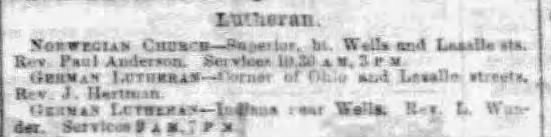
Lutheran: Norwegian Church Superior bt. Wells and Lasalle Sts. Rev Paul Anderson Service at 10:30 & 3
Although Elizabeth was a full two years older than Charles there must have been something that sparked their interest in each other. They married Saturday, May 19, 1855 listed as Carl Gust. Wernström and Elisabeth Olsson both of Chicago.

To this union was born the following year a son April 7, 1856 Carl Wilhelm Wernström. He was baptised on April 17th.

And here we have the family In the Immanuel Lutheran Church for Chicago and it lists the arrival of Carl G Wernström from Brexeda, Jönköping [Sweden] in 1853. And leaving for Red Wing [Minnesota] in 1856

Note Snickaren means Carpenter—so Carpenter Carl G Wernström born Fossberga [Fässeberg] came to US in 1853, left for Red Wing in 1856. Next will trace their movement from Chicago to Red Wing Minnesota.
Addendum: I checked all the records for the first ten years of Immanuel Lutheran Church in Chicago. The majority of parishioners are Swedish. I could locate only 3 additional records of a Norwegian marrying a Swede:
- 1856 Mar 21 Lena Knudsdotter of Stavanger Norway to Johan Jacob Nettherstrom of Malmo Sweden
- 1856 Dec 3 Niels Olsen Strand of Eidsvald, Norway to Anne Borthune ? Hansdotter of Lyngdal, Sweden
- 1861 Jan 28 Knud Knutsson of Holden Prison?, Norway and Stina Nilsdotter of Värö socken, Halland, Sweden
So altogether of the four mixed marriages there were two each of Norwegian men and Norwegian women marrying Swedish spouses. Carl Gustaf and Elizabeth being the first in 1855.
PROCESS
The way I came by this last piece was not through any search engine for Carl Wernström [or variants]. All such searches now and over the years have been relatively fruitless. So I think it may be helpful to others to find out how I got here. Instead of searching for Carl I decided to search Ancestry for the minister of the church and chose Erland Carlsson being an unusual first name is easier to find. The tenth resource was the Membership Record for Immanuel Lutheran Church from the Lutheran Archives. It took only a few pages to find. the above entry.
Then I looked for any other entries for Bexada and I found a Carl Johan Erickson also from Bexada also coming in the same year and also a carpenter! It took me awhile to figure out Bexada is now Bäckseda. Then I searched for Carl Johan Erickson in Bäckseda and found not only Carl Erickson but my Carl G. Vernström. Both the same age both came to Bäckseda from Snöstorp where I knew my Carl had lived. Matching birth dates sealed the deal.
RESEARCH SUGGESTIONS
- Early maps from Library of Congress or other Archives
- Histories of the Church denomination of your ancestor
- Newspapers including foreign language newspapers
- Etchings, drawings or photos from Google search, archives or ebay
- Archives of religious or secular organizations to which your ancestors may have belonged
- Look for others from the same place when you have difficulty finding your ancestor
Kelly Wheaton ©2023 – All Rights Reserved
TACKLING TRANSLATION: Helpful Hints
Posted on July 21, 2023 1 Comment
If you don’t have any non-English speaking ancestors you can skip this Blog post. However if you are like me you you will encounter French, German, Swedish, Norwegian and Dutch records in researching your ancestors. In Junior High and High School I took Spanish—and the truth be told I was never very good at it even after over 5 years of instruction. To date, I have no known Spanish speaking ancestors in my tree, although there may be a Portuguese one or two back in the 1500’s.
Needless to say there are many people that are very good a foreign languages—I am NOT one of them! Over the years I have gotten by with genealogy Cheat sheets like the ones you can find on the FamilySearch Wikis, foreign language dictionaries, and more recently Google Translate. I few years back when I had arranged a guided tour in Scotland and the tour was to be given in Spanish, I downloaded the Google Translate app to my phone. I didn’t end up having to use it as our guide spoke perfect English and we were the only ones on the tour. But it did come in handy a few years later in Germany when my host spoke only a little English and his wife none. Google did an admirable job of translating the spoken language in German into English and vica versa.

But the real power of Google Translate for genealogy remained hidden to me until I was sitting at a restaurant in the French Alps and finding the menu bewildering my grandson showed me the REAL power of Google Translate in all its glory. Open the Google Translate app; Point the phone at the menu, and voliá French becomes English. How great is that? Well I ordered this! And it was to die for: Avocados, fresh butter lettuce, walnuts, hard boiled eggs, julienned carrots, cherry tomatoes, peppers and the freshest mouth watering goat cheese. Success!

GOOGLE TRANSLATE for GENEALOGISTS
So it took me awhile to turn this new found tool, onto foreign language texts or documents. You have two options in Google Translate: Conversation, for spoken language and Camera for writing or texts. Choose camera and with Google Lens aim at the text you want to translate. Obviously it does better with printed text but can sometimes manage handwriting. The second option is to send the translated text in the original language and the translation in English to your phone where you can copy it and send to yourself by email of text. Now mind you it isn’t perfect but it’s darn good. So on the left we have a photo of the original text. On the left is the translation as it appears on the Phone screen and you can see at the bottom “Send to Translate Home” where it will send to your phone the text in both German and English. This works on any two languages you choose.


GOOGLE LENS
Google Lens sure beats typing all this out by hand! It works hand in hand with Google Translate or you can download the Google Lens app and translate any writing into text. Try it out—you can thank me a thousand times later.
Sadly it does not work so well with old Gothic Script in Latin and other fancy scripts—but it sometimes helps—maybe someday it can tackle the really tough stuff.
Kelly Wheaton ©2023 – All Rights Reserved
Locating Immigration Records: As luck would have it from Norway to Chicago in 1852
Posted on July 20, 2023 2 Comments

Retracing the steps of our ancestors is a time consuming research challenge, but it is almost always worth the effort. Like most of my blog posts, although this is about a specific ancestor, the process is what is important. If you happen to have Norwegian ancestry a search of Norway Heritage is in order to see if you can locate your ancestor. It helps to know the year of immigration especially because of spelling and transcription issues. The year of immigration can sometimes be found on the 1900 or more recent census. The above book “True Account of America, like many others written in German, Swedish, Danish etc were travel and immigration guides for those thinking of transplanting to America. This along with the letters sent back home from those that had successfully made the crossing across the Atlantic were passed around and the subject of much conversation. At what age the seed was planted in Elizabeth we do not know. At 24 Elizabeth probably would have been working as a servant or laborer and perhaps saving for the dream of immigrating to “Amerika.” In 1840, Ole Knudsen Trovatten from Lårdal, Telemark [25 miles from Vinje] wrote “America Letters”, which created quite a stir. He came to Muskego, Wisconsin in 1840 and was widely spoken of in Upper Telemark.
In my earlier piece How My Forty Year Brick Wall was Broken I go into detail about finding my 2nd great grandmother Elizabeth Olson who we find out was born Asloûg Eilfsdotter in 1827 in Vinje, Telemark, Norway. In this post I am trying to retrace her steps and how she may have come to leave Vinje for Chicago Illinois. First we find her as the last entry #22 on pg 403 of Udflynttede [Leavings] 1852 Vinje. Dated April 14th she is listed as 25 years and headed “til Amerika.” Many Scandinavian countries recorded all the entrances and exits to and from their parishes.

Comparing the years before and after for the Udflynttede for Vinje leaving for Amerika in:
- 1846 has 4 individuals
- 1847: 2 individuals
- 1848: 2 families and 2 individuals
- 1849: 1 family
- 1850: 3 families and 3 individuals
- 1851: 7 individuals
- 1852: 4 families and 4 individuals for a total of 22 people
The numbers drop of again in 1853 and 1854. So 1852 was the height of the early immigration out of Vinje for Amerika. I always wondered about whether she came alone to America. It is of some comfort that she was not alone on at least the first parts of her journey.
What is helpful about the Udflynttede is that the families are listed as family units, whereas on the Ship’s passenger list they are listed haphazardly. The earliest entry for Amerika leavings in 1852 is April 6th and the latest is April 21st. Whether these were the dates they checked out with the parish priest or the date they left is not known. The distance from Vinje to Kragerø is about 100 miles on foot and wagon. Whether this was their mode of transportation the timing would be about right if they left by the end of April and left Kragerø the end of May.

The passengers that are identified by origin came from the parishes of Vinje, as the northernmost, Seljord, Kviteseid, Mø, Fryresdal, and closest to Kragerø, Sannidal. The 150 ton sailing Ship “Colon” with C. Hassel master departed Kragerø on May 27th See #82 Aslau Eleefesdtr—note the name difference. The “Colon” carried 161 Passengers: 19 are in cabins and 143 in steerage. One infant dies during the voyage and one is born . There are 15 infants, 36 children and the rest adults, the oldest is a 59 year old man. From Vinje we find the families & individuals [those with an * are also on the Udflynttede] All those from Vinje traveled in steerage:
- Ole Olsen Fandestøel (36) and his wife Ingeborg* Bjørgesdatter Flatdal (35);
- Ole* Amundsen Rue (32) and his wife Asbjørn* Johnsdotter (25) and daughter Sigri* (8 mos)
- Sigvald* Olsen Midgaard (36) and his wife Asne* Egilsdatter (26) and daughter Anne (6 mos)
- Laurentz* Augensen Ødegaarden (47) and his wife Anne* Johnsdotter (43) and children Anne* (18), August *(16), Sigri* (14), John* (14), Teliev *(12), Knud* (10)
- Aslau* Ellefsdotter (24)
- Halvor Olsen Berge (44)
- Kari Knudsdatter (24) from ??
- Margit Halvorsdotter (40) from ??


And a more recent photo taken in 1900. If you look closely some of the buildings look similar.

The journey took 60 days. For steerage passengers the same space, below deck, was used for sleeping eating and socializing. Passengers supplied their own bedding. Food was available for purchase but the passengers had to cook it themselves. Steerage passengers were allotted time on the upper deck to get some “fresh air.” In 1852 no known ships were lost on their way from Europe to America, suggesting good travel conditions. The “Colon” arrived in New York July 26th 1852.

The passage from Kragerø to New York would have cost 20 Spd [Speciedaler] or about $20 US. In addition food on board ship may have cost as much as $15. Add to that expenses waiting to embark and upon arrival in New York after 2 months on board. The “Colon” arrived in New York July 26th 1852. Then there was the problem of passage to Chicago.

27 Jul 1852, Tue page 4

Public domain Library of Congress
It is hard to imagine leaving your small village traveling days to reach the southern coast of Norway and then embarking on a sailing ship in Kragerø and landing here! Once arrived there was the problem of passage to Chicago. The most likely route would be by a series of trains to Chicago. And it was a good thing that Elizabeth landed in New York and not like many Norwegians who landed in Quebec. For had she, she might have taken a steamer down the St Lawrence Seaway and across the Great Lakes. This article from The National Intelligencer dated August 21, 1752 recounts the collision, in dense fog, of the steamer ‘Atlantic’ with the propeller Ogdensburg on Lake Erie. The ‘Atlantic’ sank within a half hour and 300 of the 600 passengers drowned. Onboard were 138 Norwegians, of which 68 drowned. That is why I said “as luck would have it.” Twenty-six days and a slightly different route, Elizabeth may have perished and I might not be here.

As it is I believe Asloûg probably went by train. The first line connecting Chicago to New York, via Buffalo, was opened on 22 February 1852. However this did not mean you could board a train in New York and go straight through to Chicago. Many train changes and a ferry crossing of the Hudson River at the start and 9-10 days of travel. After 2 months on a ship in steerage, maybe it was a pleasant change.


IMMIGRATION RESEARCH SUGGESTIONS
- Use census to determine year of immigration
- See if the county from which they left has emigrations or leaving records
- Check for online directories of passenger lists like Norway Heritage
- Ellis Island Foundation has passenger lists from 1820-1957
- Check Ship’s Passenger lists. Many Europeans traveled to Germany or England before going to America; Some traveled into Quebec or American ports other than New York–look broadly
- Use maps specific to the country of origin. Google maps does not show as much detail as country specific maps
- Use newspapers to search for arrivals. Note the one I found has misspelled the port of embarkation AND the name of the Ship and the captain’s name which was Hassel
- Look for travel guides of the vintage and written in their native language
- Do searches to locate etchings, drawings photos etc of places especially The Library of Congress
- Try a search of Ebay for ships or places
- Try everything!
Kelly Wheaton ©2023 – All Rights Reserved

