ANCESTRY DNA’s Beta Chromosome Painting
Posted on August 4, 2022 Leave a Comment
This one sneaked up on me—I didn’t know it was there! It’s a new feature at ANCESTRY DNA currently in BETA. If you have tested there you should check it out. My favorite part was probably the questionnaire where it asked whether I would want to see the segments of my matches? HELL, YES! We dedicated genetic genealogists have been begging for this for many years. So PLEASE do me a favor and tell them you want this feature.

A CLOSER LOOK
If you followed my earlier posts on Ethnicity/Ancestral breakdowns at Ancestry you have heard my complaints about the assignments. The assignments have not changed but the painting of the assignments onto your chromosomes is new. So first off the Finnish on Ch 19 is actually Norwegian at least back to the earlier 1600’s. I know this from Chromosome painting at DNA Painter which shows that all of the segments on my mother’s side of chromosome 19 are Norwegian matches. And since I have this family well documented back to the 1500-early 1600’s I am confident this isn’t Finnish, at least not in the last 500 years. The next thing I looked at was the Germanic Europe segment on Chromosome 8. This one is a bit more intriguing. So at Ancestry it shows one half of chromosome 8 as Germanic Europe. The other half as Scotland with a bit of English Unassigned on the right most tip.

There’s many things I want to draw your attention to and scrutinize. First the 2 gray segments on Chromosome 8 & 10 are actually assigned at 23andMe. These are my African segments and neither of these chromosome paintings show them correctly! They are actually on my PATERNAL side.

The PATERNAL side of Chromosome 8 includes mostly matches on my German lines of HENAGER and REMSBURG (RAMSBURG, RIEMSBERGER) and on my English SPARKS/BARNES lines. The segment shown as Ghanaian at 23andMe and Unassigned at Ancestry is from matches on the SPARKS/BARNES line which is from my father’s side so the painting is showing part from my Mom and part from my Dad on the same side of the Chromosome. Known of my MATERNAL matches on the Scandinavian (23andMe) or Scottish (Ancestry) has any African DNA. Furthermore the part of my tree in question had ancestors who were enslavers so my guess is somewhere a child was born between the Master or male relative of a plantation who later passed as white. (Another mystery yet to be resolved). One of the people in the tree below is likely responsible for my African segments.

The second African segment on Chromosome 10, I have no segment matches for. However the segments on either side of the African segment are both related to matches on the SPARKS/BARNES lines.
FOR A DEEPER COMPARISON
Let’s take a look a closer look at Chromosome 1 from Ancestry. Basically it shows MATERNAL side on top with mostly Swedish/Danish and a bit of Norwegian on Right Tail. On my father’s side it shows England and Northwestern Europe.

Let’s compare with the 23andme version:

In this matchup Ancestry wins. My maternal side shows matches just as shown with the bulk Swedish and some Norwegian on the right end. On Paternal side it is similar to the bottom half of what 23andME shows. SHould read Scottish/English/German/English which the broad Ancestry tag encompasses.
So what does this all mean? It means that all of these tools must be taken with a teaspoon of salt and yet there is important data to be mined here. To date none of these tools gets things precisely right—but as you can see they are useful. Particularly in trying to sort out where segments come from. Here is the major CAVEAT: Anything Northwest European can be mistaken ie Scottish might be Swedish, Swedish might be British and Finnish may be Swedish. If you are lucky enough to have some more DNA outside the NW European Bucket the accuracy of these predictions can go up.
If you are not already doing so keeping track of matches on DNAPainter is what allows me to know where individual segments come from. I highly recommend this tool.
Check it out and feel free to share your Opinions here or on The All Genetic Genealogy Facebook page.
Kelly Wheaton © 2022 All Rights Reserved.
Serendipity Strikes Again!
Posted on August 2, 2022 1 Comment
Most every Sunday, SheldonGenealogy.org sponsors a free Zoom chat, where anyone with SHELDON ancestry around the globe can join in to exchange information or get help on their SHELDON genealogy. Well this weekend we were joined by Steven SHELDEN who told a story about his grandfather and great uncle being surrendered to a VFW home in Eaton Rapids, Michigan, after their mother died and their father was unable to care for them. Steven belongs to the Godfrey line of SHELDONs which traces back to Derbyshire, England and I to the unrelated John SHELDON of Kingstown, Rhode Island, speculatively from Warwickshire. I have never been to Eaton Rapids, but knew the place immediately. The VFW home is located on a farm previously known as the Grand River Stock Farm. I found this plaque (sold) on Ebay—another touch of serendipity.
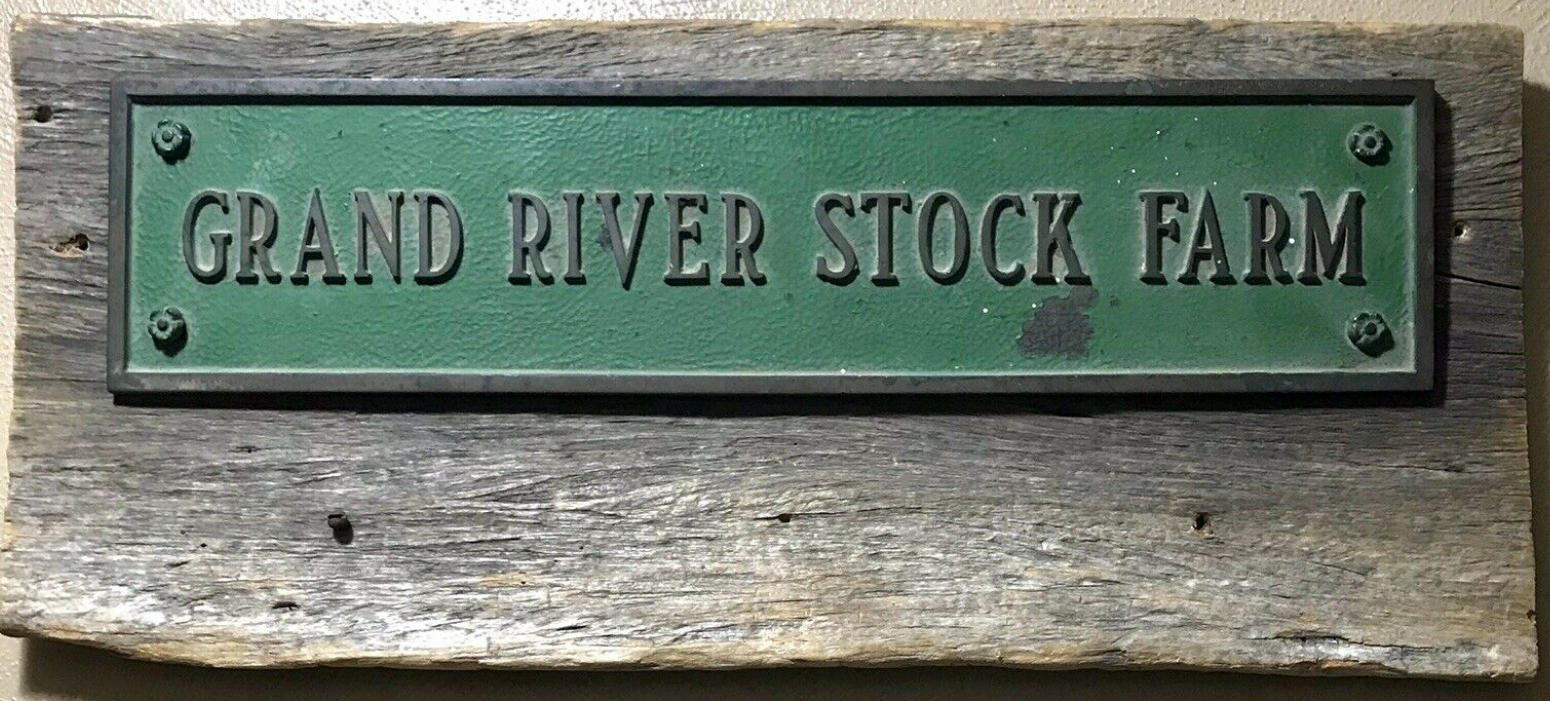
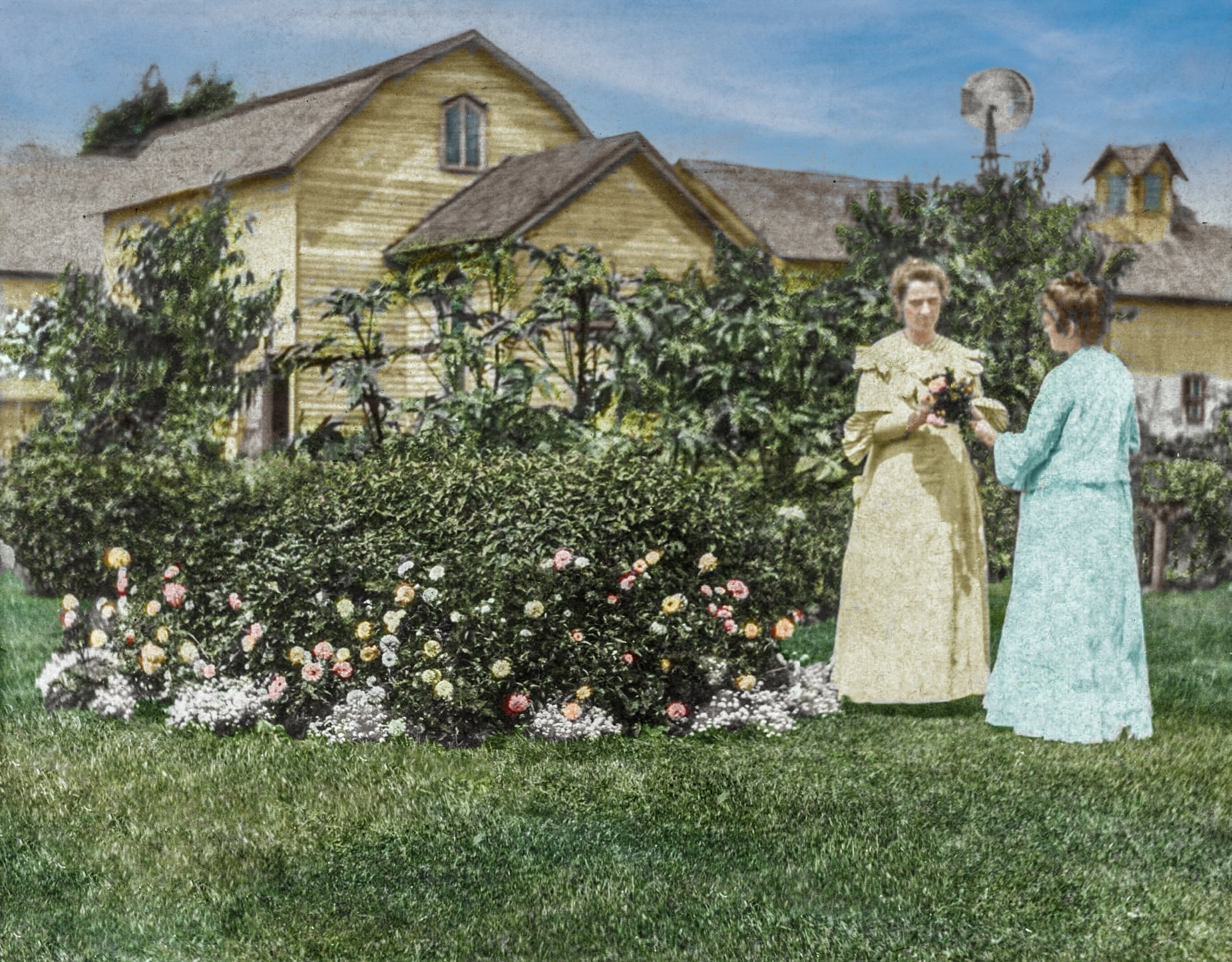
The 472 acres was originally acquired from the government by Matthew La “Rue” Perrine in 1838. At Perrine’s death in 1894 it was purchased by my great grandfather, Justus Warren SHELDON. Where according to the book The Only Eaton Rapids on Earth by W Scott Munn c 1952 Uncopyrighted: ” J Warren Sheldon, [who] erected a commodious farm house, a mammoth barn and outbuildings and it became known as the Grand River Stock Farm.” (p352). It was later purchased by Corey J Spencer who was instrumental in making the VFW Home a reality.
The farm which was originally timbered was the source of the oak that was used to build Justus Warren Sheldon’s Home in Eaton Rapids. More on that in a later post. Here is a colorized photo of my great aunt and great grandmother on the farm.
There are 2.43 BILLION acres of land in the US. What are the odds that two people would have knowledge of a 472 acre plot of land with connections to two different SHELDON families? Things like this happen everyday in the genealogy world. I guess that’s what I love about genealogy.
And a further bit of serendipity was shared by Steve SHELDEN. He had posted in a local Facebook Group in England where the Derbyshire SHELDONs hark from and lo and behold there are still SHELDONs living there! The first ones were in the 13th century!
Kelly Wheaton © 2022 All Rights Reserved. Also published on SheldonGenealogy.org
Writing Challenge: What Did You Want to be When You Grew Up?
Posted on July 31, 2022 1 Comment
This is a common question we ask young people all the time. It is a question fraught with pitfalls. As a high school counselor, I devised a strategy for my students. I told them “Just figure out a school and some major or aspiration you ‘might’ want to accomplish.” Adults want nothing more than to tell you what you “should” do. Deny them this opportunity by answering them with a thoughtful, plausible path forward. Feedback suggested this strategy was very effective. We used to say people might go through as many as 8 major job changes in their lifetime. What used to be a decision that might last a lifetime is seldom so today. Many of the jobs that will exist for students in the future, don’t even exist today. The idea that we need to have a clear path from point A to point B is silly. We are always self correcting with life’s experiences informing where we end up.
“You don’t need to figure you what you will do for a lifetime, just figure out what you will do next”
Ron Logsdon III
So what did I want to be when I grew up? I did not have a clue. I liked doing miniature sculptures and jewelry making. Since, I liked working with small things my parents planted the idea that I should become a dentist. This failed to take note of the fact that I HATED going to the dentist. I can think of not a single thing associated with people’s teeth and gums that appeals to me. And then there was that time that I lost consciousness when the dentist convinced me it was a little cavity and didn’t need novocaine and I woke up with a mask on my face and people standing all around me… I hate the smell of grinding enamel, the unnatural angle that one lays while having your teeth worked on, the intimacy of having someone trompsing in my mouth. Nope never going to be a dentist.
Next, I was to be a protozoologist. Again I did not have much input into my new career path, parents idea, again. I did like biology, but that is not where I was headed. In high school I took the bull by the horns and bombed my PSAT test and after that refused to consider taking the SATs. The truth is I chose a traditional career path during a very untraditional time. I was a housewife and then a mom. I took a career class at the local community college and the counselor said, “not surprising you don’t know where you are headed as you have clearly outlined being a mom is your most important role.” Good validation there. I really appreciated that.
It wasn’t until my children were in High School that I started college in earnest and eventually got my BA and then a Masters. It was a visit by two Counselor’s from the University Career Center that started me on my path to an advanced degree in Counseling with a Education emphasis. My mentor and dear friend Ron Logsdon III was my inspiration. In reflecting why I ended up there—I think it had a lot to do with having a difficult childhood and yet the schools I attended and the counselors I had never really noticed. I thought perhaps I could be the person for someone else, that I needed back then. And although my career was not a super long one I have had enough students come back and tell me what a difference I made for them— It seems I made the right choice.
“The purpose of life is not to be happy. It is to be useful, to be honorable, to be compassionate, to have it make some difference that you have lived and lived well.”
Ralph Waldo Emerson
Write about your own career path or one of your ancestors
What to include
- Any childhood ideas of what you wanted to be?
- Any career paths you took and where they led?
- Any brick walls or detours you took along the way?
- Funny stories about what led you where you ended up?
- Who inspired you?
- Anyone else in the family that did something similar?
- Did you end up in the career you set out to be in?
Kelly Wheaton © 2022 All Rights Reserved.
The Circle Game: Loss and Healing
Posted on July 26, 2022 18 Comments
Dear Readers you may be wondering where I have been. I have been wondering that too. If one has lived a half century or more one has endured loss. Sometimes the losses are monumental like death or war, and sometimes so subtle we may hardly notice them. Then one day you wake-up to the passage of time and realize all the things that have slipped away… Everyone who has lived through the last two and a half years of the Covid-19 pandemic has lived through unspeakable loss and yet we hardly let it register in our consciousness. There have been 6.4 million deaths from Covid-19 world-wide; well over 1 million in the US. Many fundamentals of the way we live have shifted, and yet we barely take note. We may telecommute, shop more online and attend more meetings remotely. and only in reflecting back three years ago to the summer of 2019 do we realize how different life was then—to what it is today. Within that backdrop, I have lost my 98 year old neighbor, friend, and mother/grandmother figure. I have become estranged from a child and I have lost a previously dear friend.
I have dealt with personal demons involving a prescription drug taken occasionally to help me sleep that turned into a nightmare. It took months for my to realize what was happening. It was only by keeping careful notes did I realize the drug was causing anxiety, sleeplessness, and other issues— which was why I was taking it in the first place! The reason it was hard to figure out was that it has such a long half life it’s a few days after taking a dose that the rebound or withdrawal happens– so no easy cause and effect. We all make missteps. No one gets by unscathed.
I find comfort in my ancestors like my 2nd great grandmother Catherine Adeline STEWART MOSIER who endured more loss than seems possible in one lifetime. And of course I have (with my cousin’s help) transcribed and illustrated my great grandmother, Mary “Lulu” PADEN MOSIER ANDERSON’s diary which covers the years 1913-1922 that are to be found as chapters of the Soprano’s Aria. After a recent trip to the library I happened upon the new novel by Isabel Allende, “Violeta.” And finally I have just finished the novel, “Lemons in the Garden of Love” by Ames Sheldon, who as it turns out, is my 5th cousin once removed on my SHELDON line. And what all these stories have in common are strong women, who have faced loss and yet they had meaningful lives. As Friedrich Nietzsche said: “What doesn’t kill me –makes me stronger.” We age, discovering new pains and new strengths, and things about ourselves that were previously unrealized.
In an age of the constant drone of helplessness and the futility of hope– it’s nice to be reminded that our kin have trod these paths before us. One of my favorite quotes:
We are all just trying to make the best of a crazy situation.
Ram Dass in “How Can I Help”
I think that sums up life rather nicely, don’t you? Over time the world keeps speeding up. Getting crazier and crazier and we humans feel we can’t cope. Climate change, Covid-19, deep political divisions tearing families apart, gun violence in the US; and an increase in fascism around the globe with a concordant contraction of personal freedom. And here in America, especially for women, a turning back of the clock that our mothers, grandmothers and great grandmothers worked so hard to achieve. Equality and body autonomy just ripped away, couched as a religious right to life, is really the destruction of freedom for all those born female. As a woman, the world looks more and more like the dystopian world of Margaret Atwood’s “The Handmaid’s Tale.”
While we have never had more women on the US Supreme Court; we also have never had a Supreme COurt justice who was also a member of a religious pseudo-christian cult like the “People of Praise”. Founded in 1971 the People of Praise teach “that men have authority over their wives.” I cringe as I write the words. It is groups like the People of Praise that inspired Atwood’s “The Handmaid’s Tale” first published in 1985. Ames Sheldon credits a dream about her grandmother’s aunt in the early 60’s as the genesis of her novel “Lemon’s in the Garden of Love” which tells the fictionalized story of Blanche Ames and her work in the early 20th century for Women’s Rights especially in regard to women’s reproductive rights. The regressive movement towards earlier times, when females could not vote, had no access to birth control and males held all institutional power is not something I can sit by and idly mourn, as just another loss. A recent Emerson University poll found among women “a 10-point swing for those saying they were much more interested in voting in the midterms because of the Supreme Court’s decision compared to September. Among women aged 18 to 29, the swing increased to 20 points.” There is palpable anger and determination.
In Amanda Ripley’s recent opinion piece in the Washington Post titled “I Stopped Reading the News” (published July 8 2022) she identifies 3 things the News lacks: Hope, Agency and Dignity. It’s well worth a read. All of us, are in need of more hope, agency and dignity. Reading my great Grandmother’s diary I see how what began as the American Women’s League, an organization where women sold magazine subscriptions, led to a national network of women joined together to fight for the causes that mattered to them. Foremost was the right to vote, followed by the right to birth control. I came of age in a time when “the pill” was widely available to young women and that was followed in 1973 by the Supreme Court decision in Roe vs Wade that until recently made it possible for women to have autonomy over how and when they chose to have children. This allowed many women to escape poverty and abusive relationships. As you can read in my great grandmother’s diary, how she became a “divorced and emancipated women” at a time when a huge social stigma was attached to women choosing this path in life.
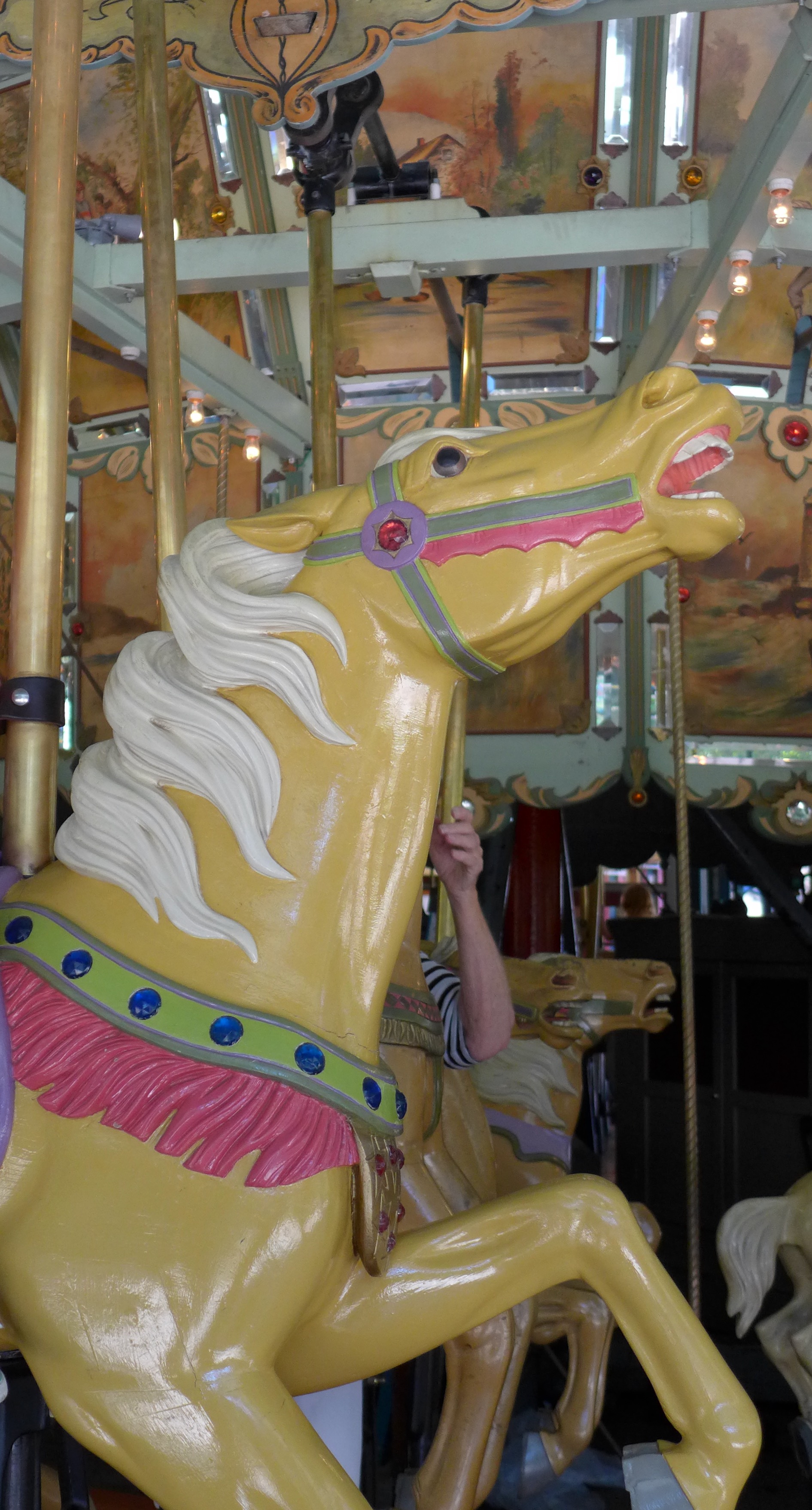
As a teenager Joni Mitchell was my favorite artist. I listened to her songs hours on end. Someone recently posted a video from the Newport Folk Festival of Joni singing the Circle Game. The chorus is worth sharing.
And the seasons, they go round and round
And the painted ponies go up and down
We’re captive on the carousel of time
We can’t return, we can only look
Behind, from where we came
And go round and round and round, in the circle game
Joni Mitchell
Putting difficult experiences in writing; that is hope and agency. In writing, we give ourselves and our readers their dignity. There is so little in life that is not bettered by the collective experience– the knowing that others feel the same way, that our paths are not new. That is the reason to explore the lives of our ancestors and actively work in the present– to prepare for the future. Women’s greatest successes have been accomplished via their natural talent for networking, collaborating and shared sacrifice. We can meet each loss with the mourning that is its due—but then we must pick up our hope AND our agency and get to work.
A recent example is a teen named Olivia Julianna, 19, who heard Florida Congressman Matt Gaetz’s speech arguing “women who are worried about dwindling abortion access are too unattractive to become pregnant.” She used it as an opportunity to raise $1.9 million and counting for the Gen-Z for Choice Abortion Fund. ( This fund splits all donations evenly among 50 local abortion funds across the United States.) The organization is a “youth-led nonprofit working to educate our generation and create tangible change on issues that disproportionately affect young people.” That is Agency! That is Hope! Give women their Dignity! Things may look bad—but we CAN make it better.
Kelly Wheaton © 2022 All Rights Reserved.
A Love Letter to Young Genealogists
Posted on June 11, 2022 9 Comments
Dear Young Genealogist,
Once upon a time I was you. I always had an interest in the past and unlike many of my peers I enjoyed hanging out with old people (gray haired retirees). I liked their stories and their points of view. I tried to imagine living through life without cars and planes and coming from places far away beyond American shores. Other than looking at old photographs and family heirlooms my earliest recollection of a true genealogy pursuit was in 6th grade when we were asked to create a family tree and then later to do a report on a country from which our ancestors came. Mine was on Sweden, but at the time I had no idea exactly where in Sweden my ancestors were from. But I also remember feeling uncomfortable for my younger brother who was adopted and did not know his true family tree. Always be sensitive to those with less information than you. We all start in different places on our journeys.
My real pursuit of genealogy happened when I was 17 and read a Family Circle magazine article. And that was over 50 years ago. I have written about that previously here.

Recently a very dear friend and I exchanged letters beginning over 50 years ago. Reading this one I wrote back in 1984 is very interesting regarding genealogy.
“I’ve been working on the genealogy a bit lately. Well last week I got 4 letters from my relatives giving me lots of information. One from Ken, my grandmother Carrie’s brother. He traced the HENAGERs back to the 1600’s in Germany. He hasn’t given me all the details as he isn’t sure which if two brothers is his grandfather. He also gave me a lots of dates and things working back to a Josiah FRANKLIN, which might be the son of Josiah FRANKLIN, Benjamin FRANKLIN’s father.” [Although this turned out not to be true.]
“Also got a letter from my great aunt and uncle (my grandfather Milo’s brother). Anyway they sent a lot of things…a copy of a letter which traces the ALLEN’s to my great-great grandmother Lucinda Mary ALLEN who is quite closely related to Ethan ALLEN.” [Also turned out not to be true].
“Also my great great grandmother Catherine (STEWART) MOSIER. She told her children that she was descended from Mary Queen of Scots. When Catherine was living in Lincoln, Nebraska she received $3,000 from a lawyer who had been searching for her. He also gave her a book on the history of the STEWART family. Eilene said her grandmother always had that book with her but unfortunately it has been lost. Anyway, I never thought that delving into my family’s past would bring up such possibilities, even if they aren’t true, which quite possibly they aren’t, it sure is fun working on the whole thing. I guess you can tell I’m excited about it.” While its not shown that we are descended from Mary Queen of Scots YDNA has proven that we are descended from the Royal STEWARTs through Sir John STEWART Bonkyll. So of these early claims half turned out to be partly true.
So that is a cautionary tale for young genealogists. Some things, especially back then, turned out to be nothing more than wishful thinking. But whether fact or fiction or something in between when you start a genealogical journey expect to be surprised, confounded and amused. If you aren’t having fun, then please reevaluate your action plan. If you are running into stuffy old gatekeepers and curmudgeons, keep reaching out until you find the relatives and genealogists willing to help and maybe even mentor you. They are a godsend. Please remember to say thank you. It goes a long way and is sometimes forgotten in the age of instant gratification.
Your relatives and progeny will appreciate your journey as you discover your family’s past. Don’t forget you are part of a very old story. And I am sure young genealogists have lots to teach us oldsters, as well. We bridge the age gap and make the world a better place. And if you indulge me just a bit more—please focus on the stories. They are the most important things you may hear—you may not know it at the time—but trust me every one you record will be a gift to future generations.
Love to you all—and may you be blessed with many stories…Special hello to Daniel Loftus and Gen_Z Genealogy.
Kelly Wheaton © 2022 All Rights Reserved.
Mundane to Profane: Writing our Own Stories
Posted on May 30, 2022 3 Comments
“Sadness is but a wall between two gardens.”
Kahlil Gibran
I have suffered in my life, but I have always diminished that suffering by comparing it with that of others; finding it not so bad as theirs and not worthy of memorializing. The truth is when we tell our stories it can make our friends and family uncomfortable. It can make us uncomfortable. That’s why we tend to shy away from immortalizing those stories. Yesterday, while talking to genealogy friends we were talking about all of the stories that are lost because no one records them. From the mundane to the profane, history forgets. And these days we have such short memories. Whether blessing or curse my memories and the stories I tell about them have become a curse. Perhaps not rising to the level of Post Traumatic Stress Disorder, but certainly on the spectrum of trauma that sets you up for lifelong triggers and maladaptive responses. But all stories can be re-written.
The latest shooting of children by a gunman in Uvalde, Texas makes me think of all the children and families which will relive that day every time something triggers that memory. Every person alive will respond in different ways to National tragedies like the shooting of President Kennedy, the Challenger disaster, 911 or the latest mass shooting. Each of these traumas affects us depending on our temperament, our proximity and our ability to compartmentalize tragedies that are beyond our control. Today is Memorial Day. The day to remember those that died in the service of their country. It has morphed into a remembering of all of our dead. Perhaps that makes it more palatable, not to remember specifically those slaughtered in war, but to remember all that we have lost.
I wrote about my name and the process I had gone through to reframe the discomfort it caused. Writing can be a process of healing. We take something tragic and try to find a way to bring something good to come out of it. With all that is threatening us in the world from the War in Ukraine to global warming, it becomes increasingly more difficult to find peace and happiness. We focus on the positive, on what we can control and the goodness we can find, whether a flower pushing itself up through cracked pavement or the delight of watching young squirrels chase each other round a tree trunk. Life goes on in spite of unspeakable tragedy. Writing is a way of recording the past but it can also be an instrument of healing.
“We read to know we are not alone”– William Nicholson wrote in his play Shadowlands. We write to connect our past with our present, and perhaps to touch someone in the future. It is our act of hope that something we record will resonate with someone who needs to read it. I told this story to a couple of friends just yesterday. It records a painful incident from twenty years ago that was echoed in something that happened a few days ago. It is a small thing but emblematic of how sometimes it’s family that strikes the cruelest of blows.
I was reminded of a time after my Dad died and my mother had returned from a trip to Costa Rica. My brother was at her house and I had brought her flowers. My Mom says to me, ” Kelly, put them in that vase right there.” Then she adds, “Isn’t that a beautiful vase is that your brother gave me.” I say, “Mom, I gave you that vase for Mother’s Day. I bought it at Macy’s when I was shopping for a wedding gift” She argues with me and I take and turn the crystal vase upside down and it still has a Macy’s sticker on it. Silence. My brother does not say, “Mom I didn’t get that for you.” My Mom does not say, “I am sorry I forgot.” Then Mom says, “Kelly get me the paper bag on the dining table, which I dutifully retrieve. Then she directs me to give it to my brother which I do. Inside are gifts for my brother from Costa Rica. There is nothing for me, and that is her point.
So why share something so personal and painful? Why hang out our dirty laundry for the world to see? For me it is many things. It is an act of courage and defiance. While I have relieved that painful memory recently when something similar caused it to resurface I can choose whether to tell the story as the victim or as a badge of courage. Nietzsche wrote “Out of life’s school of war—what doesn’t kill me, makes me stronger.” We hear the shortened version often.
“What doesn’t kill you makes me stronger.”
Nietzsche
None of us gets through life unscathed. Luck, circumstance, genetics, trauma— the cauldron of life is not the same for each of us. Sometimes life is unspeakably cruel in ways that are difficult to give voice to. From seemingly random tragedies, like gun violence, to the ravages of cancer or chronic illness. We cannot make sense of it. But I do know, at pivotal moments we have an opportunity to record the comedies, histories and the tragedies of our lives and those that came before us. They will not always be pretty and they may sometimes be painful, but they are the authentic stuff of life. The more we uncover the family stories of our ancestors–the more we realize we are not alone. Families are messy. They are full of joy and sorrow. And for many they do not appear in equal measure and yet we endure, we survive and occasionally we triumph. I think of the movie: ” As Good As it Gets” and I have to smile. Sometimes just being able to tell a painful story or step on a crack makes us the hero of our own story. For me there is a release in setting the story free. I don’t have to remember it and I can change it as I see fit. I invite you dear reader to do the same. Whether you share your stories or not, write it down. Give it a voice.
Kelly Wheaton ©2022 All Rights Reserved
Can Ancestry’s Ethnicity Breakdown get any Worse?
Posted on May 20, 2022 3 Comments
Sadly the answer is yes, for me. You may wish to look at this blog post first, that I did back in April 2022. First off let’s look at April’s version versus the new one.

Compare that with the newest one two month later
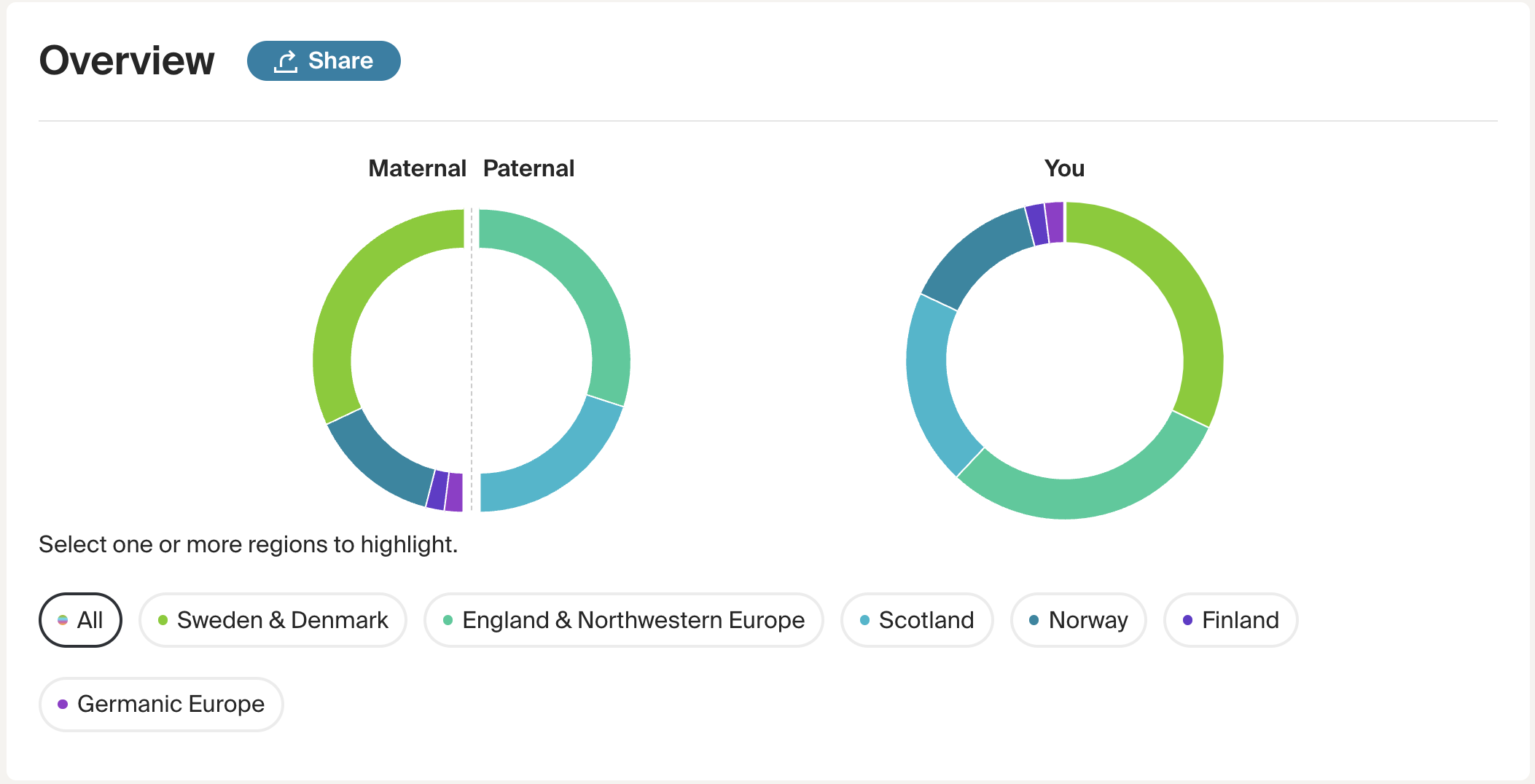
First off they have changed the colors so that may make it tough to follow. I have ascribed the maternal side as the green (Sweden Denmark) Teal (Norway). Now the purples are showing as German and Finnish. Okay on paper this is my paper ancestry:
55% British, Scottish, Irish
18% German, French, Swiss
19% Swedish
6% Norwegian
2% Other
I, as I have often explained have one 100% Scandinavian grandparent who is 3/4 Swedish and 1/4 Norwegian. And yet my Ancestry DNA “estimate” shows my total Scandinavian as 48% of my DNA. Which means I only got 2% of my DNA from my maternal grandmother which I know via matches and segment painting is false. So I am here to remind you again to take these estimates with a pound of salt.
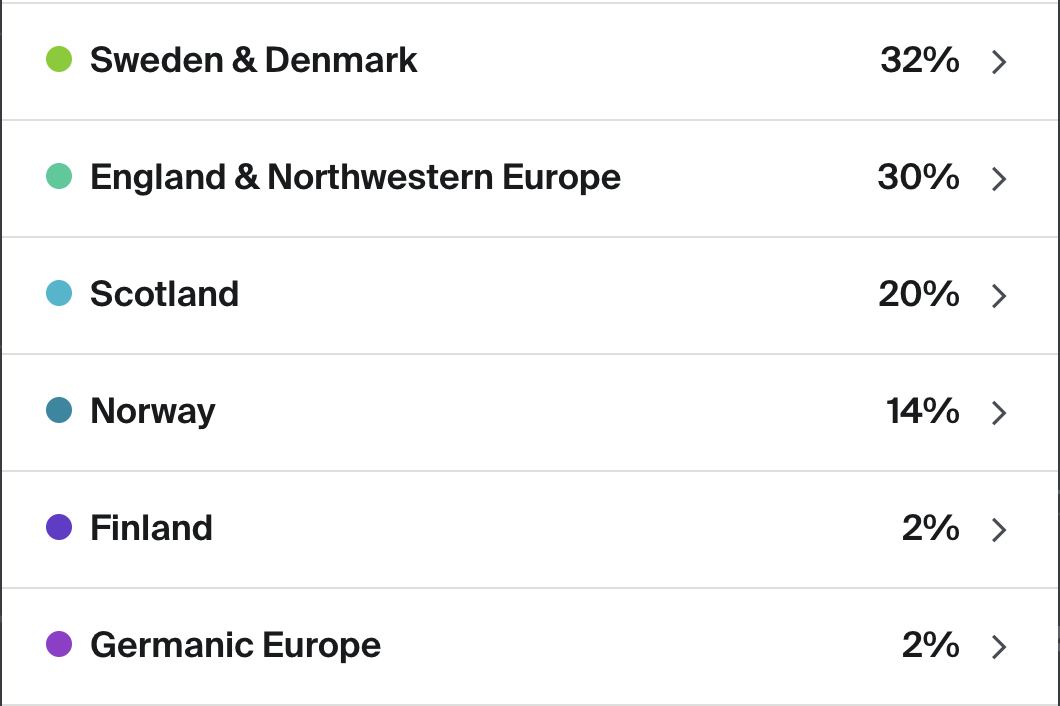
Furthermore, My Maternal side is not where my German comes in, that’s heavily from my father’s side and I have the matches to prove it. In actuality the first iteration is closer to the truth than the second. And neither of them give me any confidence at all in these new “estimates” which are at best parlor game material. My guess is they are highly influence by most recent ancestry from an area. My Scandinavian ancestors immigrated to the US in 1850-1870’s. My English as far back as 1620. Most of my German ancestry is from the early 1700’s. It just isn’t possible for these wide swings in ancestry to be real. There is something seriously wrong with the algorithms. If we have had some swings and misses Ancestry struck out here. Below is my breakdown from 23andme which is much closer to reality.
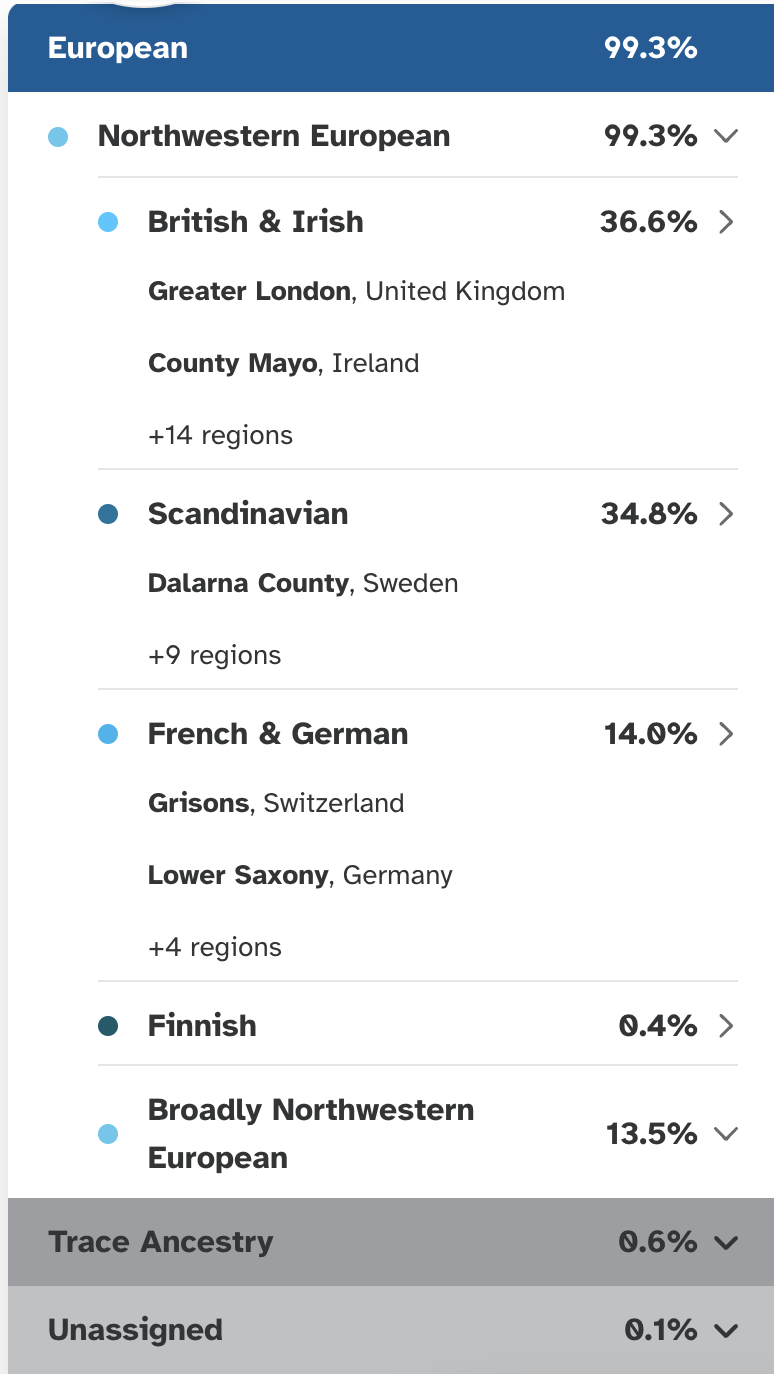
Remember you mileage may vary. Often these estimates get better over time but for me Ancestry just gets worse and worse. I really couldn’t believe how bad this was….
Kelly Wheaton ©2022 All Rights Reserved.
Heirlooms: The Family Bible & a Lundberg Coincidence
Posted on May 17, 2022 3 Comments

Early on in my genealogy career I sought after the family bibles of various members of my family and my husband’s as well. I was able to photograph a couple and there were a few more whose existence was talked about, but they had mysteriously disappeared. The ones I did photograph– were over 50 years ago– before I had much idea what I was doing. I am glad to have what I have although where those bibles ended up, I am not sure.

I only have one Bible that previously belonged to a family member [photo above] and it was pictured in my last blog post. That’s what got me thinking about bibles and the treasure that they are. The one I have belonged to my grandfather Roy Sidney Lundberg and as it turns out it was given to him by his paternal grandparents Johan Solomon Lundberg and his wife Anna Olofsdotter who immigrated to America in April of 1880 with their five children. This family is my most recent immigrant family.
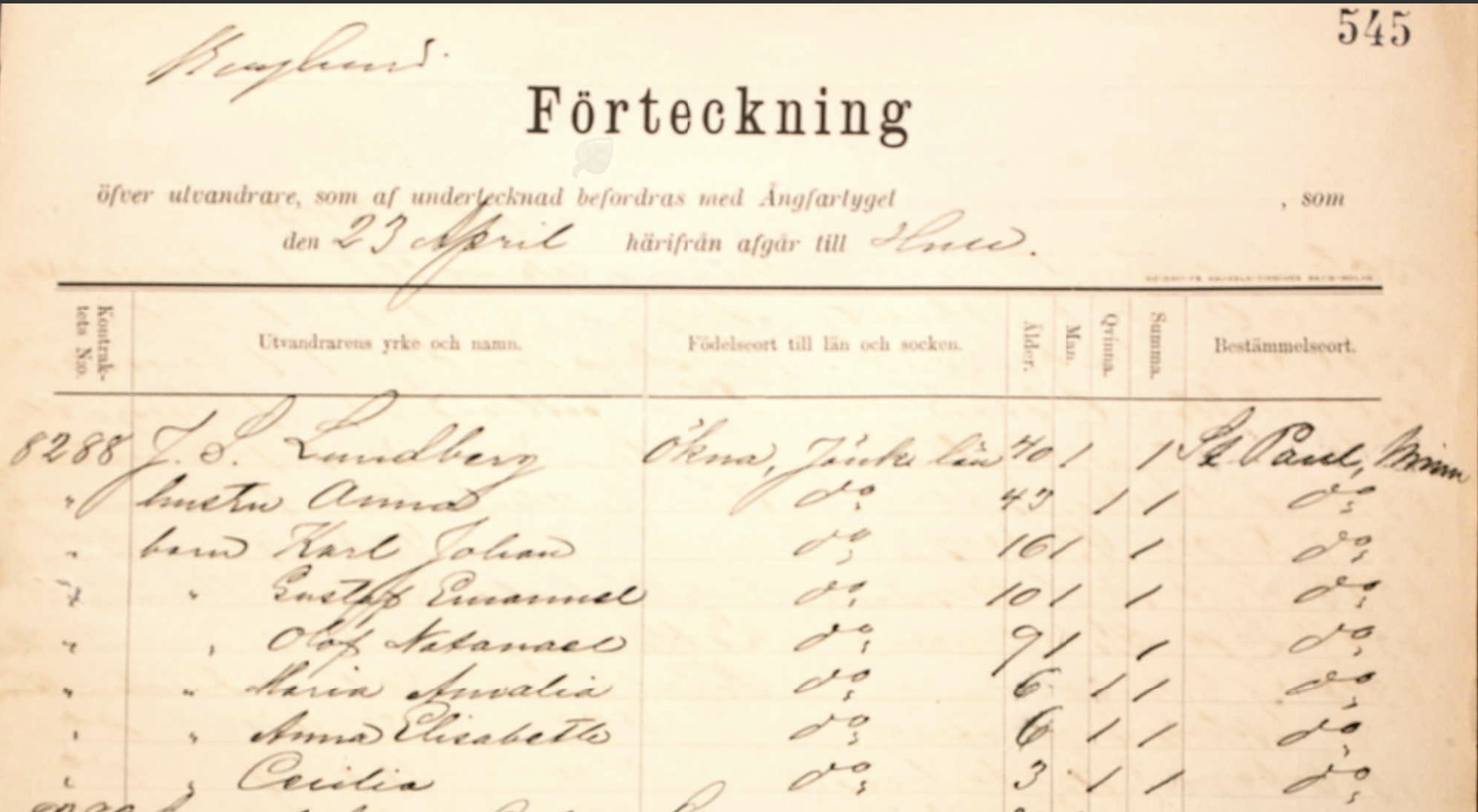
The following is a photo of the inscription of Roy’s confirmation Bible. The date of publishing is 1903 in Orebo, Sweden and as you can see given in 1905.
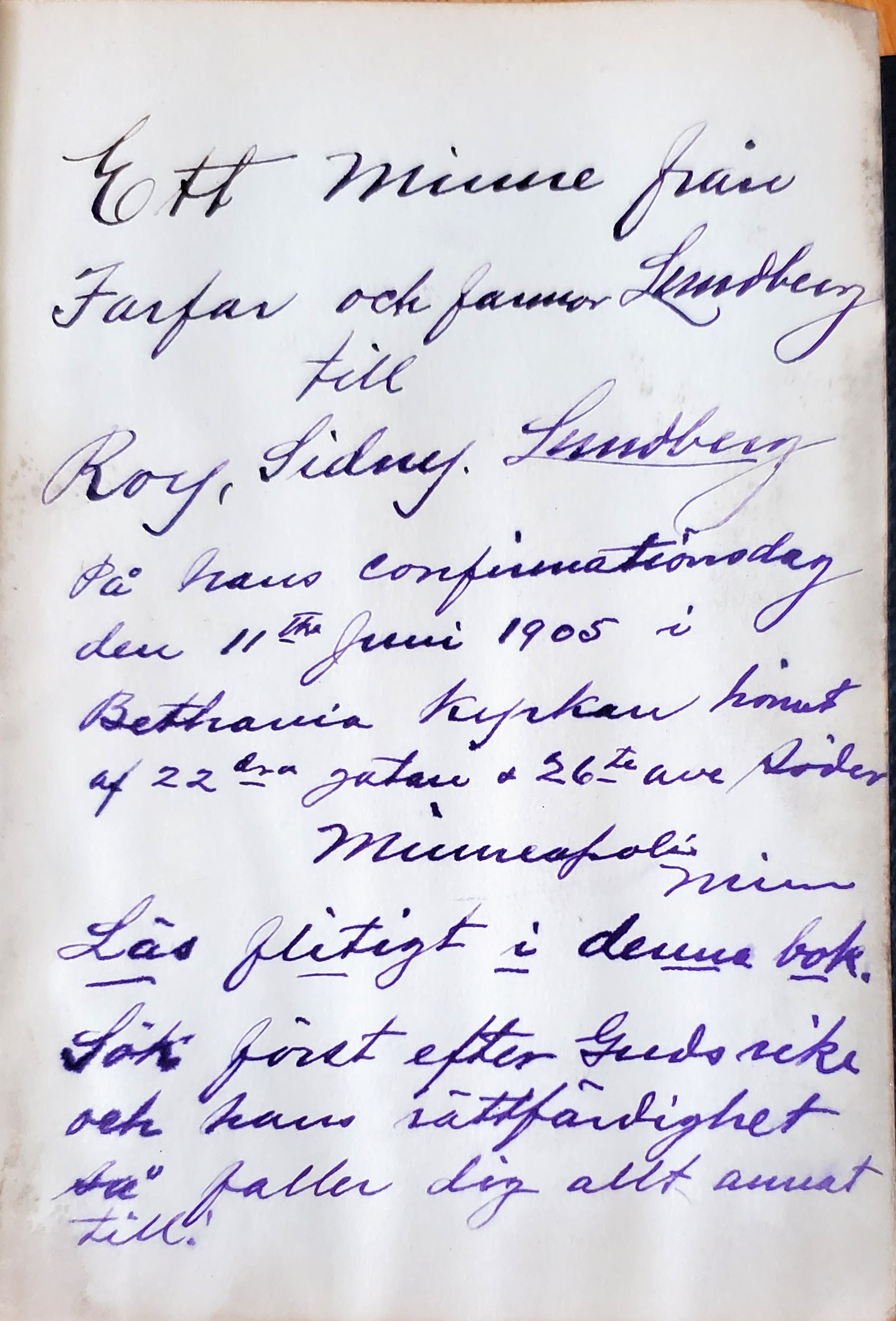
Transcription: Ett minure från farfar och farmor till Roys Sidney Lundberg På hans confirmation day 11 Juni 1905 i Bethania Kyrken af 22nd gatan & 36th ave söder Minneapolis Minn. Lâs flitigt i desna bok. Sôk först efter Guds rike och hans rättfärdighet så faller diy allt annat till.
Translation: “A token from [paternal] grandfather and grandmother Lundburg to Roy Sidney Lundberg on his confirmation day 11 June 1905 in Bethania Church corner of 22nd street & 36th ave south Minneapolis Minn. Read this book frequently. Seek first the kingdom of God and his righteousness. Everything else will fall into place when the timing is right.”
Well just after I started this blog post i got an invitation from a distant cousin in Sweden Casja Lundburg to a new group for our Lundberg family on Facebook. Whereupon another cousin posted this lovely painting that was likely done in remembrance of Johan Soloman Lundberg’s Parents Johan Petter Lundberg and Catharina Jacobsdotter’s marriage. They the great-grandparents of Roy Sidney Lundberg and parents of his grandparents who gave him the bible!
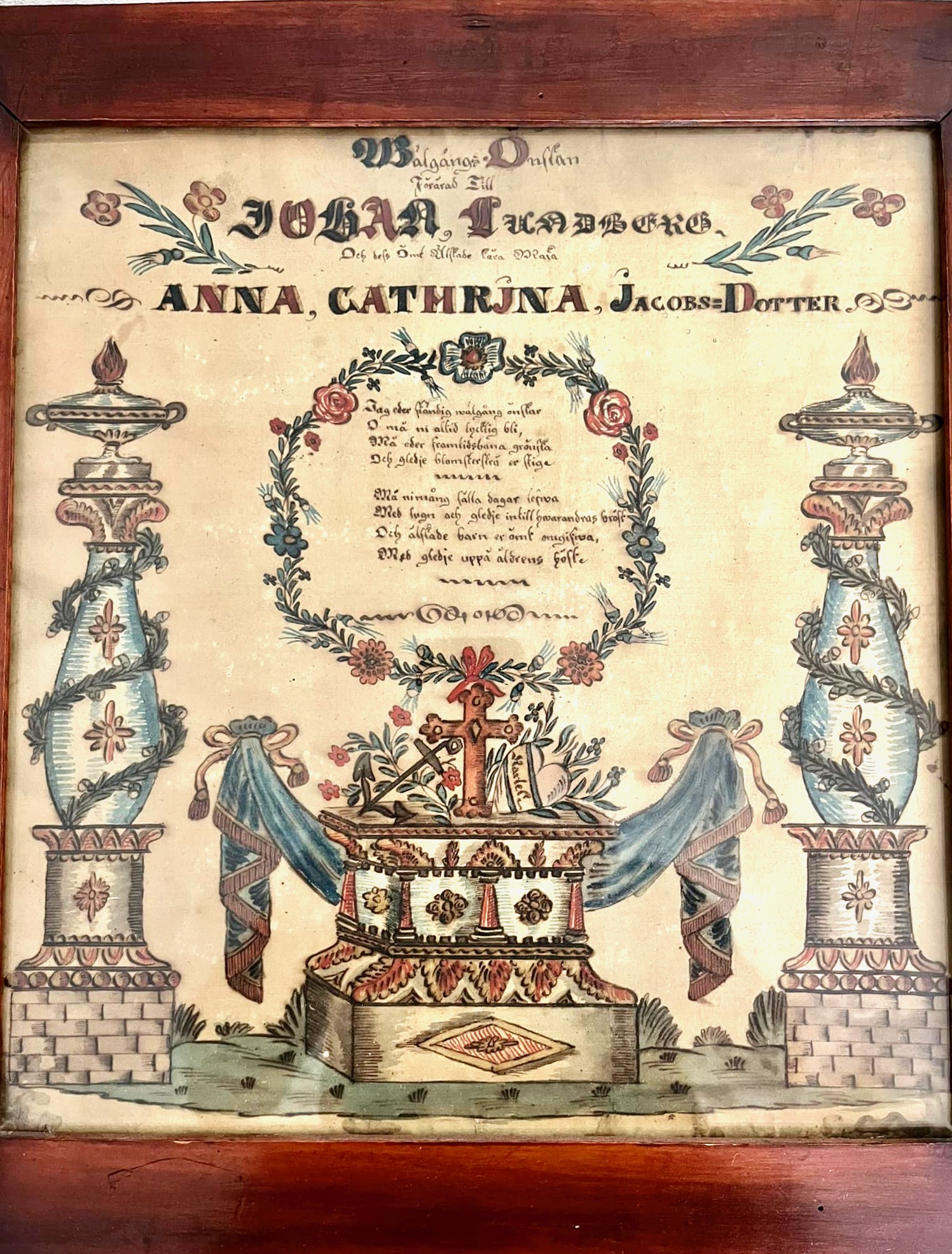
A heartfelt thank you to Erik Feldt who not only gave permission to use the photo but also provided the following transcription and translation:
The text in archaic Swedish:
Jag eder ständig wälgång önskar
O må ni allltid lycklig bli
Må eder framtidsbana grönska
Och gledje blomsterstrå er stiga
Må ni många sälla dagar levfa
Med lugn och gledje intill varandras bröst
Och älskade barn er ömt omgifva
Med gledje uppå åldrens höst
In English it should be something like this:
I wish you constant prosperity
And may you always be happy
May your future path flourish
And joy like flowers rise
May you live many cheerful days
With calm and joy next to each other’s chest
And surrounded by beloved children
With happiness in the autumn of your age.
Rebuilding a Family History
It drives home the point that we all have bits and pieces of the family puzzle that get passed down through various branches of a family. Sometimes when we are lucky those pieces are shared and we all become the richer for that sharing. In that regard my earlier piece on the Misattributed Heirloom is another part of the story.
Kelly Wheaton © 2022 All Rights Reserved
Looking at Ancestry’s New Ethnicity Estimates
Posted on April 15, 2022 4 Comments
Ancestry has a new feature which I would love, if it got it right for me or my husband. I applaud the attempt, but it just isn’t ready for prime time with the results for us. I share this detailed discussion to caution others in accepting it as a fact. It may get some people right, but I would proceed with caution. My husband has 4 grandparents as follows. One 100% Swedish, married to mixed English/Welsh/Dutch; 1 100% Irish (could have Scots back further) married to 1 100% German. So on paper it should be 25% Swedish, 25% English-Dutch-Welsh; 25% Irish and 25% German. Because we can inherit from our grandparents unevenly each range might be 15-35% This is what his chart looks like:
The line should be closer to where the purple line is. All the Swedish is definitely from his father’s side and the German, Scottish, Irish Welsh from his mother’s side. I won’t quibble over the percentages other than to say that in their ranges they seem to overly favor Swedish results . On paper he should have about 25% Swedish—this could range up to the 38% but most likely is in the 20-30% range.
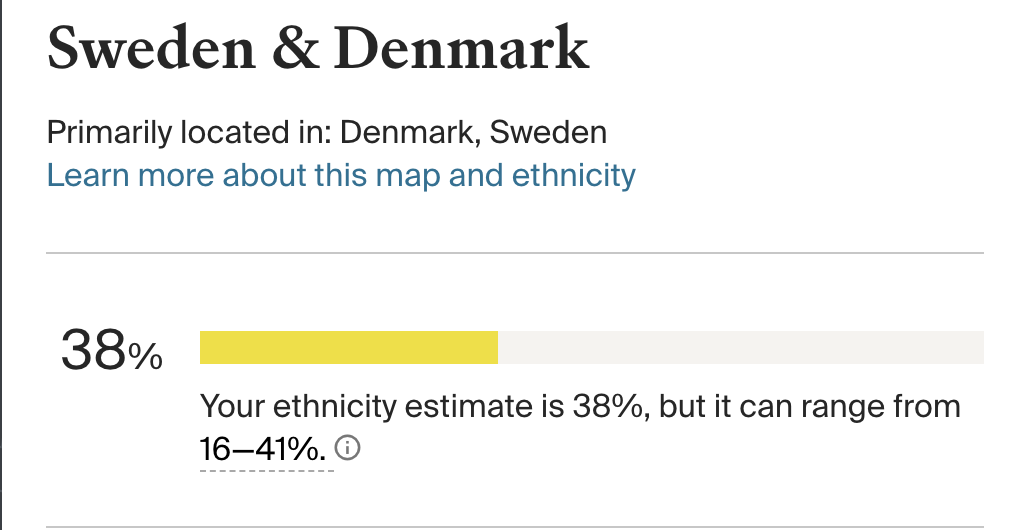
In my particular estimate The range for Swedish is 3-32% but it opts for the high end—an obvious error.
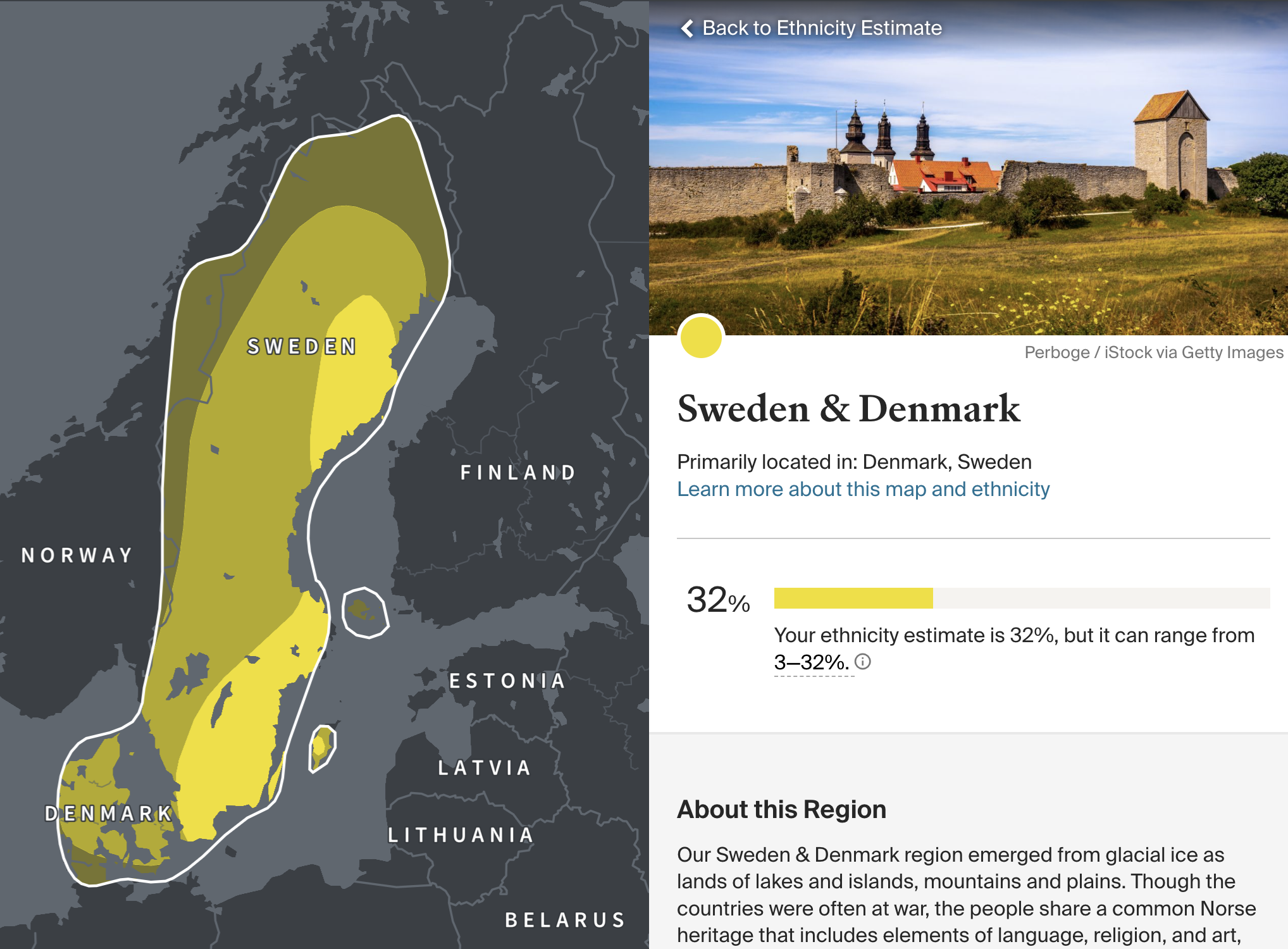
My Swedish on paper should be about 18.75% and my Norwegian about 6.25%. Ancestry reports I have 32% Swedish and 14% (Range 0-23%) Norwegian and 2% Finnish (0-2% range) (total of 57%). So even being super generous my Swedish should be in the 30% range tops and my Norwegian 15% tops. There is no Finnish as far back as the early 1600’s. If I did get the top amounts as suggested by Ancestry it would be more than 50% from my maternal grandfather and nothing from my maternal grandmother. That is NOT POSSIBLE. Based on what I have been able to paint with DNA Painter I can account for 6.2% DEFINITELY coming from my maternal grandmother. This would leave 43.8% from my maternal grandfather. My guess is it’s not more than 40% and maybe far less. 23andme reports 34.8% Scandinavian which I think much more likely. I have fewer matches on my maternal grandmother’s side due to very small family sizes 2-4 surviving children in the last 4-5 generations. My maternal grandfather has much larger families and many matches.
Since my Swedish and Norwegian as well as my husband is more recent I think the Ancestry algorithm has a bias towards larger (more recent segments) that tends to skew the more recent immigrants percentages upwards and dimisses the older (smaller) colonial segments.
Here is my overall breakdown
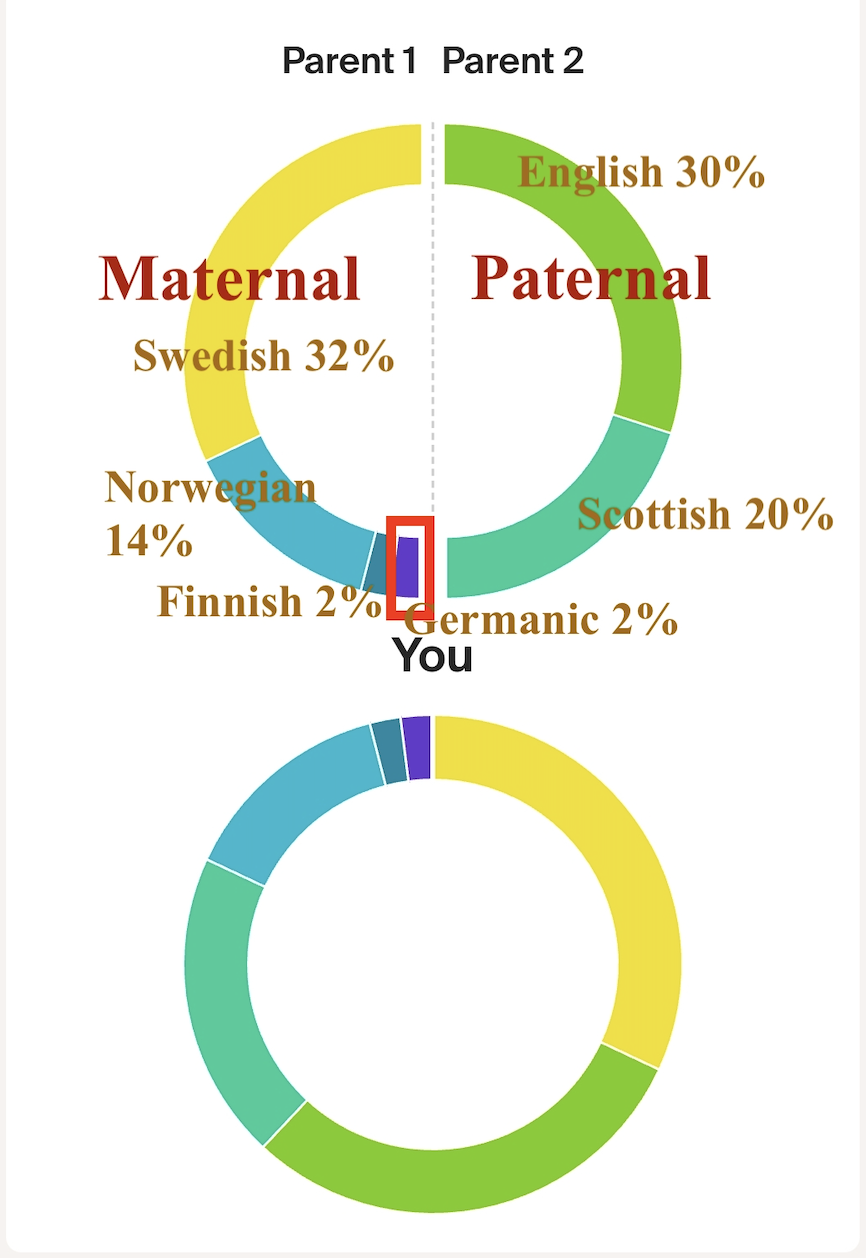
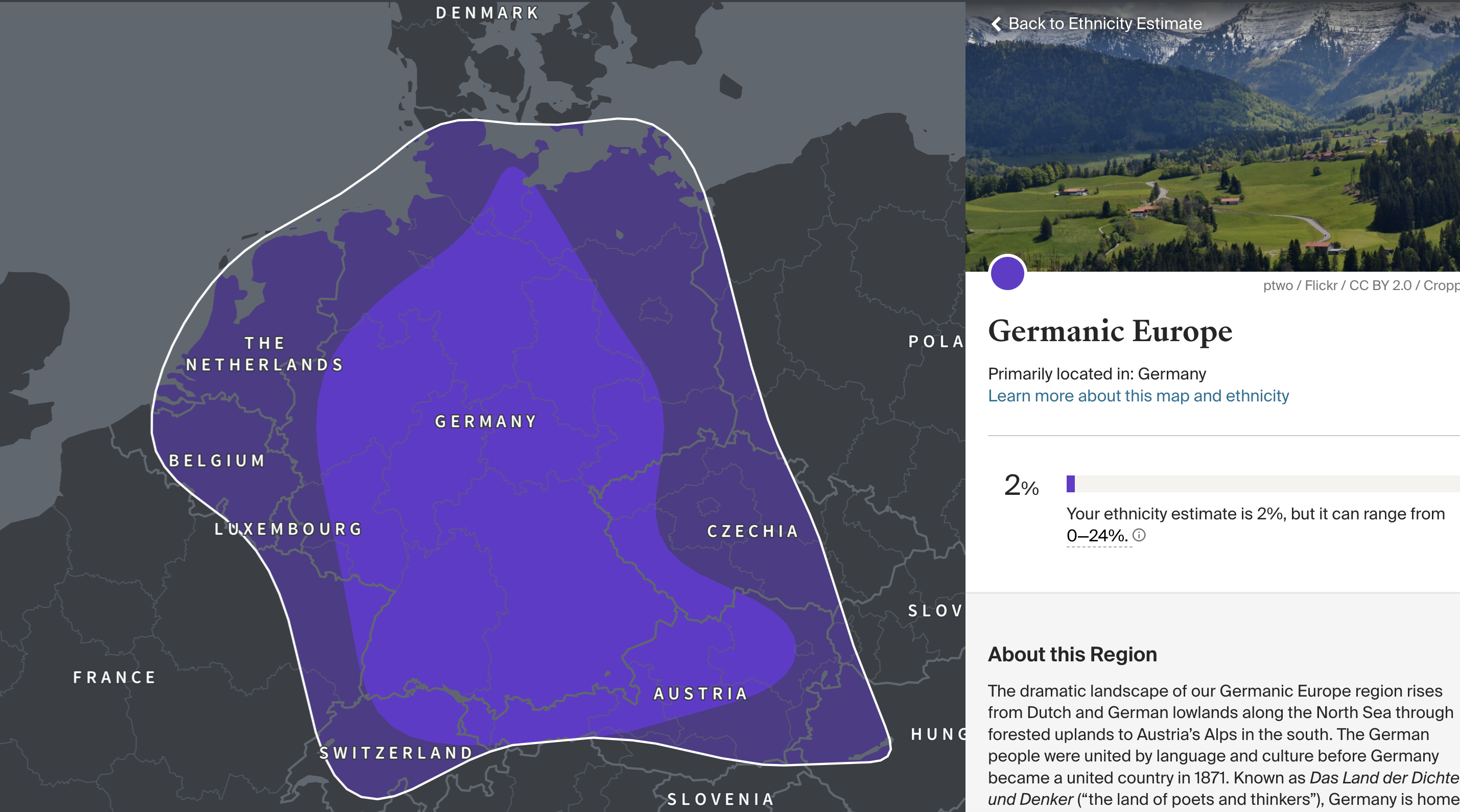
Here the Germanic should be on my paternal side and the range is shown as 0-24%. On paper it should be about 18%, and based on my DNA Painter findings it is at least 18% of my genome (not 2% as Ancestry reports). Although it suggests it could be up to 24%!
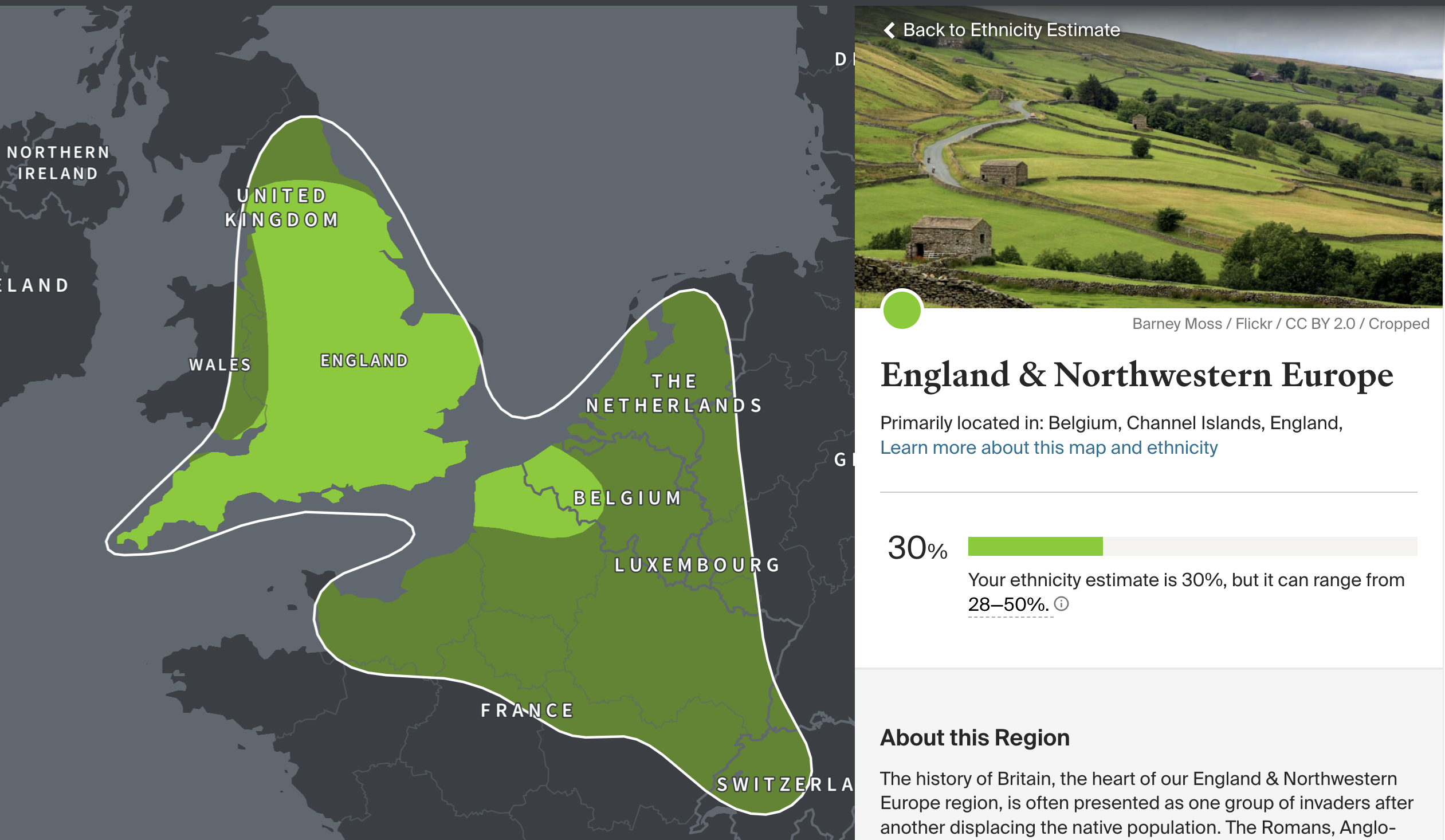
Finally let’s take a look at my English which on paper is about 55% of my Ancestry. Ancestry reports a range of 28-50% and places me at the low end. I think some of the Scandinavian over reporting should be English. To be fair Yorkshire and Norwegian share a lot of DNA.
The point of all this is to again treat it with a great deal of skepticism. I also think it most likely that the more recently you have admixture from Europe the more likely it will appear in higher percentages in your breakdown. use EXTREME Caution in taking these too seriously.
Kelly Wheaton © 2022 All Rights Reserved
Let’s Talk About Death
Posted on April 11, 2022 1 Comment

Family Historians and genealogists should be ever mindful of what happens to all their hard work and accumulated books and files when they depart this life, for good. Some recent deaths and illnesses of family and friends reminded me the best time to prepare is long before we think we need to.
BOOKS
A few years back I looked at my massive book collection and decided if I read a book every few days I did not have time to read everything I had. So I decided to edit my collection and reduced it by nearly a half. Suddenly I had a place to put things! And it was easier to organize and find things. But recently I was looking at my books and wanted an easy way for my family to evaluate the book collection at my demise or incapacitation. So I ordered some removable colored stickers and have placed a sticker inside each book. Family can grab what interests them. Then to help in dispersal:
- Pink = donate, sell or otherwise dispose
- Orange = donate to local Genealogy Society Library
- Yellow = family significant books or needs further evaluation
- Green = first editions, rare books and of monetary value

In the process of going through each book I ended up with 2 grocery sacks of books that have been donated to the library. The process has taken a few days but I am quite satisfied with the ease and simplicity of the process. For very valuable books I have slipped a printout of current sales price or note inside. What could be a huge future burden, eliminated!
It’s been a couple of weeks and I went looking for a book of Haiku found it and sat down to read it. It’s worth maybe $15-40 on Ebay. However when reading through it I realized I did not much like most of the translations and in reading the essay in the back I discovered I liked the literal translations much better than the westernized version. So I thought to myself why keep a book that does not please me. Let it be found by someone else who might treasure it — so off it went to the library to be donated. Better to have fewer books that delight , than those that annoy or weigh you down. And don’t forget this comes from a lifelong book-lover.
GENEALOGY
Every genealogist should face the fact that unless someone in the family has shown “true” interest in your collection, it may end up in the rubbish if you do not make other arrangements in advance. There are many options but whatever you choose to do put it in writing. What organization or individual gets what. Here are some possibilities:
- Donate to a local genealogical or historical society
- Donate to a surname specific organization
- Donate to a geographic specific genealogical or historical association
- Donate to a major genealogical repository
- Digitize and dump any non-original documents, photos etc. now
- Donate digital copies to appropriate organizations
- Convert genealogies into stories and consider making them into books
- Locate relatives that would be delighted to receive part of your collection
Whatever you decide, please check in advance to see if the individual or organization is interested in your entire or parts of your collection. Many books that use to have more value but have since been digitized have less value to collectors than the used to. Use a broad based search engine like Bookfinder.com to get an idea of your book’s value.
HEIRLOOMS
At this juncture in time most kids don’t want our stuff and if they are interested in heirlooms it’s likely to be a short list. Here’s a novel idea, ask them what they want. Have them wander around your abode and have them make a list of what they want. If you do not have children or grandchildren ask and friends or cousins with whom you choose to share. Once you have those lists you can set out your decisions based on their desires. There’s no sense giving Bobby the painting you love, but he didn’t ask for, when Mary did. Make informed choices For small objects you can use the same color coding I used above but with a person’s name on a yellow sticker. Pink is no particular value—can be donated. Orange could have where to donate and green suggests the check out the value. If you are super organized you could take photos of objects along with notes on its provenance, value, appraisal etc. Yes this is a lot of work but it does not need to be done all at once. I am in my 6th decade—if I give myself a couple of years I should be able to get this done. During the process I can weed out things no one wants and donate them myself or sell them. Possibilities include Craig’s List, Ebay, consignment or garage sale.
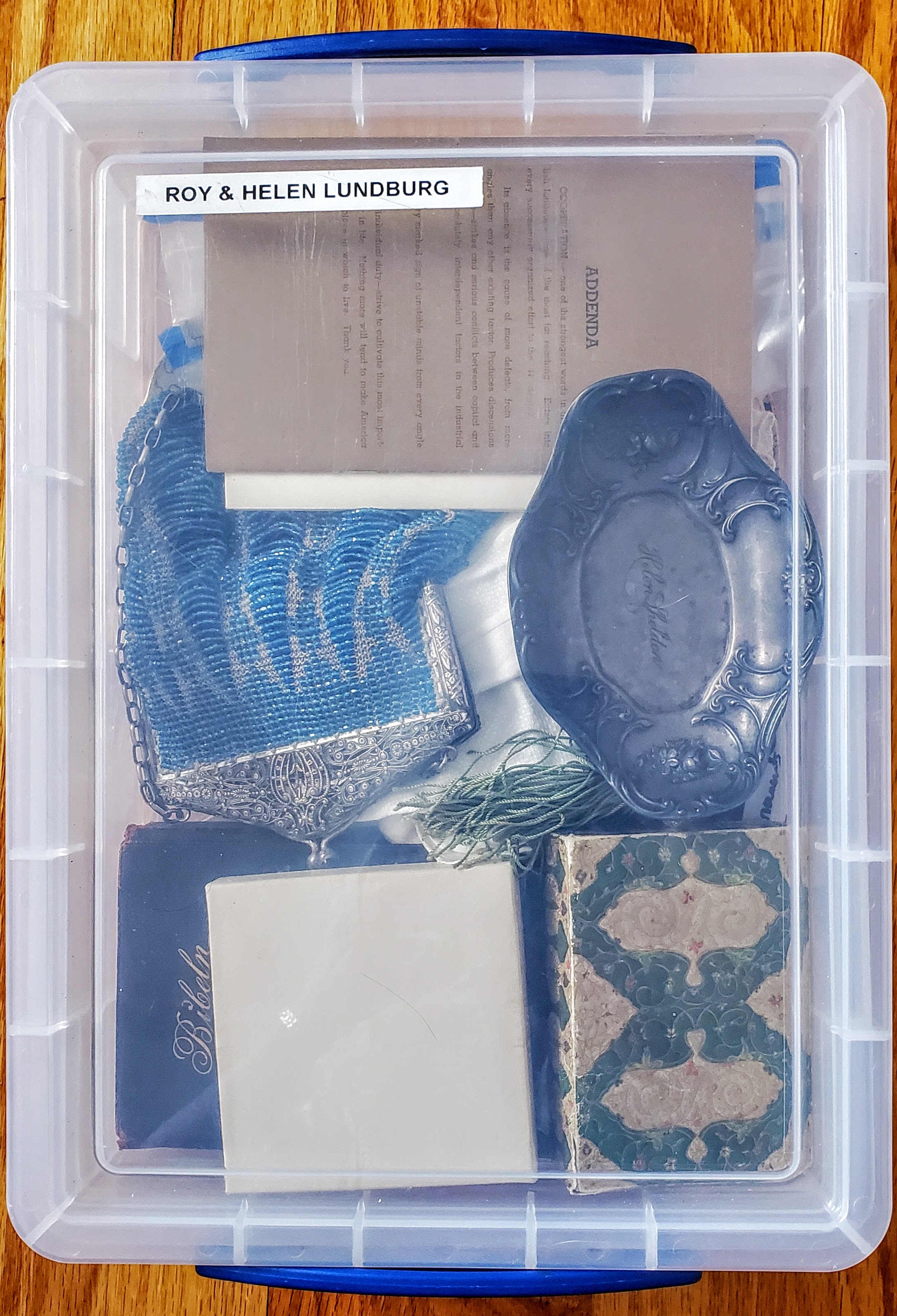
Below is a 4 liter “Really Useful Box” which is 14 5/8″ x 10 1/4″ x 3 3/8″ and I find particularly helpful. This one contains keepsakes from my grandparents. Others I have designated for children or grandchildren. This one contains a Swedish Bible given to Roy by his grandmother and grandfather upon his confirmation in 1905. A beaded evening purse of Helen’s, an engraved calling card tray, jewelry etc. I like that you can see what is inside and that they stack nicely and are easily loaded into the car (as we did more than once during the fires). Use whatever system works for you.
As I work through the process myself I may have additions to this blog post or another follow-up piece. I started writing this piece and before I published mine my friend Paul Chiddick’s posted this excellent one. Please feel free to share your ideas in the comments.
Paul recommends Planning a Future for Your Family’s Past by Marian Burk Wood. And there are lots of books out there like Get it Together designed to help you plan your estate.
Kelly Wheaton ©2022 All Rights Reserved.
 Wheaton Wood