Organizing Your Genealogy: How I do it
Posted on August 3, 2021 6 Comments
Just this morning I read a Genealogy Tweet that got me thinking about how I organize my Genealogy. The author mentioned putting all their Birth, Deaths and Marriages into a binder in archival sleeves. Yay for archival sleeves, I have been using them for at least 20 years. However, reading that the BMD’s were all in one binder—made me cringe. Been there done that. It really doesn’t matter how you start out organizing your genealogy, I can almost guarantee that you will change it. It’s one thing when everything will fit in one binder….. quite another when you have over 50 binders of genealogy information. I also have a file drawer and a myriad of computer files. This is what works for me and maybe there is something here that you can use for yourself.
If you have are all digital files what I am going to say still holds. Before I go much further I suggest reading my previous blog post on Reformed Genealogists to get the why of this. So the idea is to facilitate not only finding things but writing the stories of our ancestors. If your photos are in boxes in the closet or albums in the dining room and Trees and Family Group Sheets are in one set of binders and then documents, Births Deaths and Marriages are in a file drawer it’s very difficult to get a sense of what you have and what you are missing. It’s also very hard to see patterns this way. What you have is lots of pieces of information but lots of pieces of information do not add up to a story. And the story is all that REALLY matters. Genealogy is not the point. It’s lots of fun but the goal is to resurrect, in a meaningful way, something of the lives of our ancestors.
EXPERIMENT: So here is what I am suggesting, take just one family (Father-Mother and their offspring) collect all the bits you have. This may take you awhile and that’s okay. The idea is to get everything together and unite it in chronological order. (you could do the same in a digital file) Let’s say I am tackling a set of great grandparents Everything I have on them goes in the binder (the size of the binder is determined by how much you have) original certificates, photos etc. in archival sleeves. The rest whatever suits. In some of my binders almost everything is in archival sleeves (I love the heavyweight ones). I usually put a Family Tree chart at the beginning to facilitate where they are in context. Then a Family Group Sheet and sometimes an Individual Research Checklist for each (in this case great grandparent.) Their Birth certificates next and any early life information including photos and school records if you have them. Then their Marriage certificate, census records, Deeds, newspaper articles etc in chronological order, interspersed with photos if you have them. Oh and don’t forget maps! Once all this is assembled you can fill out an Individual Research Checklist to see what you may be missing.
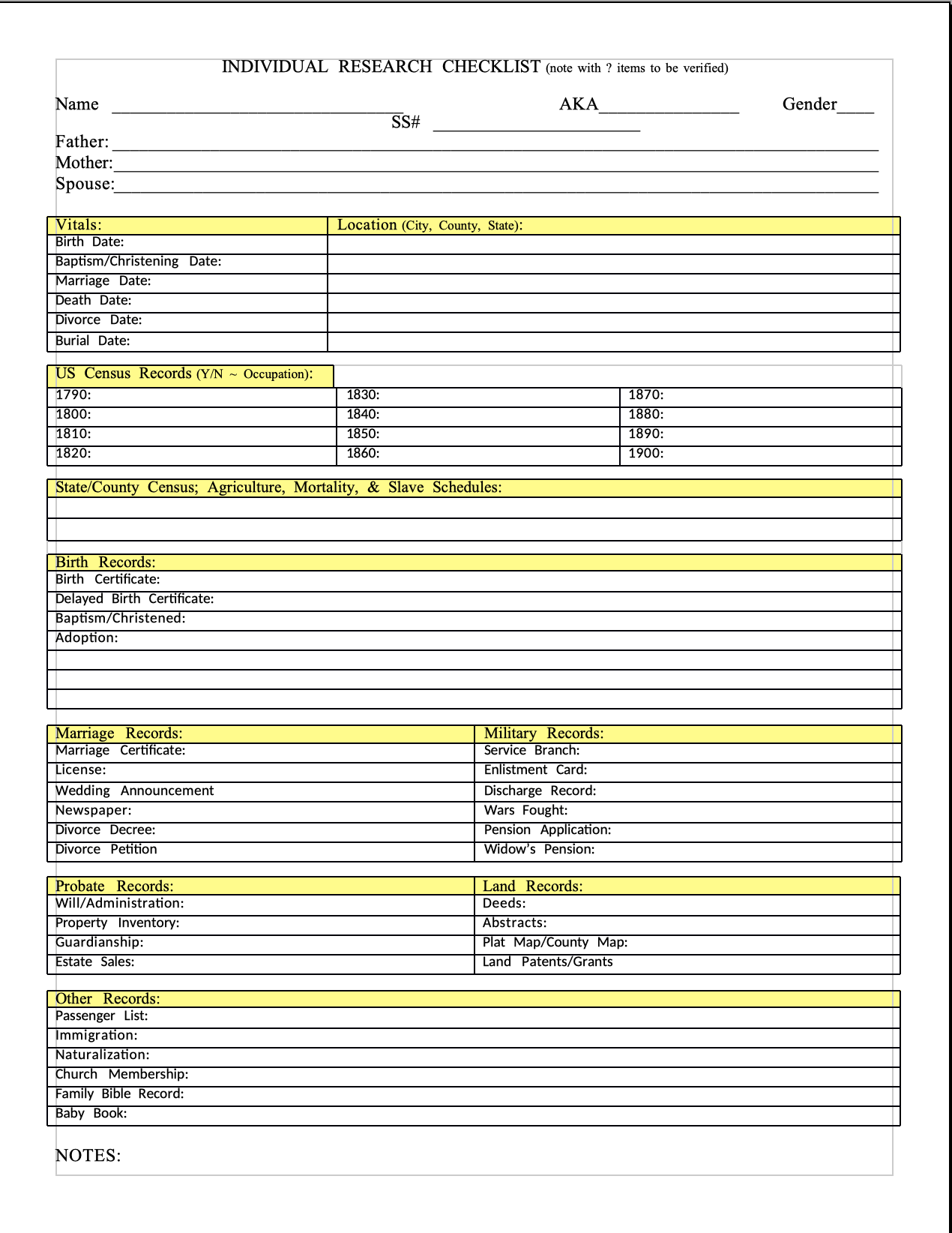
Now everything you have about this Family is in one place and it starts to tell its own story even before you do. Pay attention to things like how old were their parents when they were born. Where were they in the birth order. How many times did the family move. How old were they when they wed? Do you know how they met? DId they live in the same town? Had either been previously married? How many children did they have together? What were their occupations on the census? Did you check the Agricultural or Mortality Census? What can you tell from photographs you may have of them? Are their places listed on the photos? Have you done a through search for newspaper articles? Basically how can you bring them back to life? Do you have letters, recipes, receipts? Those maps can come in handy too. And you may want to include one of their migrations if they moved around quite a bit.
For some families you may have only a few pages and for others you may need multiple binders. For all but my closest families (which generally get their own binder) I place them in a SURNAME BINDER, so the FRANKLIN Binder has the first FRANKLINs to appear in my tree: my 2nd great Grandparents William Marsh FRANKLIN & Eliza Jane KIRK; then going back in time they will be followed by William’s parents Josiah FRANKLIN & Harriet PARK and so forth. Then there are the stragglers which for a long time I filed in one binder that grew into five binders–all alphabetically, but I found that to be quite inconvenient. So now I file those in GEOGRAPHIC BINDERS, of which I only have a half dozen. These are families, often way back in New England, that will never warrant their own binder. So I have Binders for places where I have many Ancestors for example Rehoboth, Massachusetts, Stonington, Connecticut or Frederick County, Maryland. The beauty of these geographic Binders is I can put the Pedigree Charts in the Front followed by maps and other contextual information and then the families by surname. I do this alphabetically but you can do whatever suits you. (GEOGRAPHIC BINDERS also very handy when you are planning a visit to a locale where many of your families lived. )

Whether you like Binders or not the basic organizational framework can work for for traditional files or electronic ones. What I like about Binders is that you can easily move things around when you get new information adding and subtracting as you go. The come in many sizes from 1/2″ to 4″ (although I usually stick to 1-3″). You can find beautiful heirloom Binders to use if you wish. (Someday maybe I will transform mine…) Binders help protect what you have, accommodate archival sleeves and are easy to flip through and transport. You can also remove pages from Binders for traveling. (Don’t take originals make copies!)
The idea is to put all bits of a family together and to make it easy to find any individual bit—but mostly to facilitate the telling of stories. Even if you never get ’round to telling that particular story whoever inherits your stuff will have a good starting off point. I can guarantee they are going to find the family more interesting when viewed in context and not a bunch of disparate parts. Now, don’t think I have accomplished this completely or that I am organized perfectly. I am not! There are still some photos waiting to be united with their families and there are binders to be put in chronological order (all the parts are there, just need to be sorted). It’s always a work in progress. I have been using this system for about ten years now and I like it very much. There are very few times I can’t find what I am looking for in very short order. Sometimes I get lazy and don’t file things chronologically in the binder. Sometimes I just tuck something in the pocket. Lately I have begun revisiting binders, reorganizing them and purging them of information now proven to be incorrect, redundant or unnecessary. I have letters going back to my beginning days with the Genealogical Helper in the 1970s. I save important bits and place them in the appropriate binder. The rest gets purged so my progeny don’t need to figure out whether it is relevant or not. It’s not a perfect system but it works remarkably well for me and it only took me about 40 years to get here!
Remember genealogists may appreciate all those names dates and places, but our families seldom will. They may take a cursory glance at this or that but if you don’t point out the interesting bits in your telling of their stories—they may be lost forever. A by-product of this kind of organization is it tends to focus you on the stories you want to tell and THAT is the point!
Copyright Kelly Wheaton 2021 All RIghts Reserved
Genealogy Challenge: Ancestor Scavenger Hunt
Posted on August 1, 2021 Leave a Comment
If you have been following me for any amount of time you will note my posts tend to be “all over the map.” Here’s one that I dreamed up and haven’t even done myself so this post will be my own process. This is not a contest and one should not overthink this.
Items You will need:
- A timer
- Something to take notes with
- An ancestor you have not previously researched other than names, dates and places—please consider a female ancestor if you are an experienced genealogist (they tend to be more challenging). Do not spend more than ten minutes figuring out an ancestor, just pick one that calls out to you.
- Your bag of genealogy tricks
- A block of uninterrupted time preferably 1-4 hours (I originally thought 30 minutes but I knew most of us couldn’t stick to that)
FIRST: So first thing I did was to go to my tree on Ancestry that happened to be open to the ancestors of my 2nd great grandmother Catherine Adeline STEWART. And the first name that caught my eye was her grandmother Olive SCOVILLE. She is interesting since for many years it was believed that she was not her grandmother but rather her step-grandmother. So this is a line I have not worked on other than the rough outline. I want to call your attention to your own process. Jotting down the process is sometimes as important as what you find.
SECOND: Without going any further jot down a list of first places you intend to search. Here’s mine Ancestry, Family Search, Wiki Tree, American Ancestors, Chronicling America. So even with the writing of this I am twenty minutes since I started and I haven’t begun searching yet.
THIRD: Collect everything you have on this person. Here’s what I have in my tree which is a lot more than I expected. As I often do I collect things and forget about them.

FOURTH:
Let’s analyze just what I can see right in front of me. First I see some questions forming. Obviously one BIG one is why she marries Andrew STEWART in 1781, has a son (my 3rd great grandfather Andrew J STEWART ) in 1786 and then remarries ??? TAYLOR when ??? and has three more children with Mr TAYLOR. Meanwhile her first husband my 4th great grandfather Andrew STEWART is still alive. It appears I am missing some census records so I will focus on them and see what I can dig up on Ancestry, Family Search, My Heritage, American Ancestors etc. So excuse me a bit while I travel down the rabbit holes…
PROBLEM ONE: A note on Ancestry : “Olive Scoville or Scovell was the daughter of Benjamin and Abigail Chapman. Olive married Daniel Bertine Stewart in East Haddam, Middlesex, Connecticut in May of 1781. They were the parents of one daughter Phebe born in 1783 and Andrew Jackson, born on November 18, 1786. After Daniel Bertine deserted his family in 1788 or 1790. Olive married a Mr. Taylor, in Litchfield, Connecticut in the year of 1795. They were the parents of one son Philo J. Taylor.”
Well first off Olive’s parents according to the baptism are Stephen SCOVILLE and Elizabeth EGGLESTON and her death record where she is listed as “Miss” Olive Taylor she is 87 years old making her birth in 1752 which could fit the Olive of Stephen and Elizabeth but not as the daughter of Benjamin SCOVILLE and Abigail (CHAPMAN) SCOVILLE who are listed on seven Ancestry Trees with no sources but the same date of birth! So I will stick with Olive’s parents as Stephen SCOVILLE and Elizabeth EGGLESTON.
PROBLEM TWO: The evidence does show that Daniel Bertine STEWART abandoned Olive in Connecticut. In fact there’s a Ohio Supreme Court case brought by the heirs of Daniel’s “alleged” daughter Phebe. In the excerpt below the testator is Daniel Stewart. The first wife would be our Olive SCOVILLE.
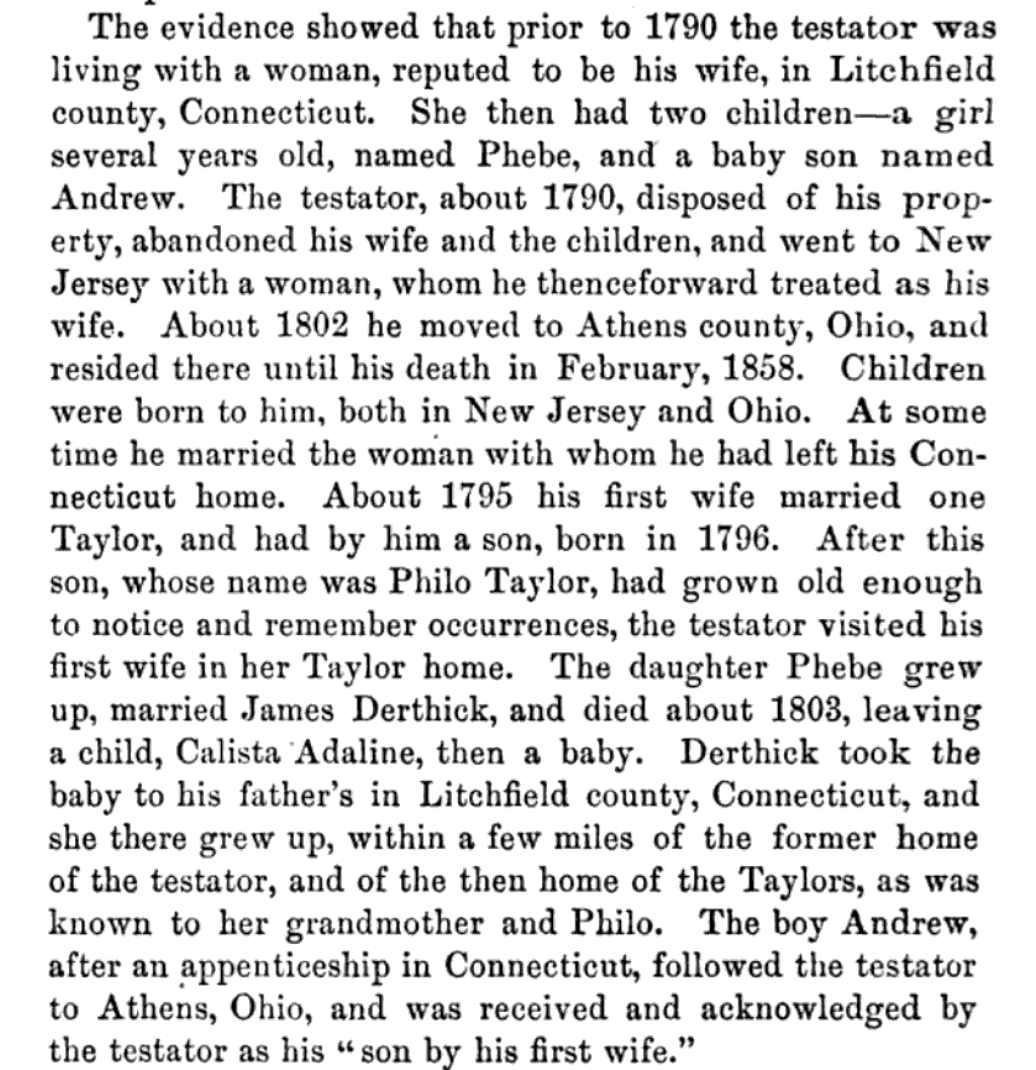
First off we do have the marriage of Olive and Daniel as recorded in East Haddam, Middlesex, Connecticut in May of 1781 from Bailey, Frederic W. Early Connecticut Marriages as Found on Ancient Church Records Prior to 1800. Baltimore, MD: Genealogical Publishing Co., 1997. So we know they were married! Olive was just shy of her sixteenth birthday when she married Daniel and he was but 18. I can find no registration of the birth of Andrew or Phebe. The court did not find that Phebe was the legitimate daughter of Daniel but she might well have been. And we do find Olive on the 1790 census with 1 male under 16 (Andrew b. 1786) and 2 free white females (Olive b 1765 and likely Phebe bc 178?).
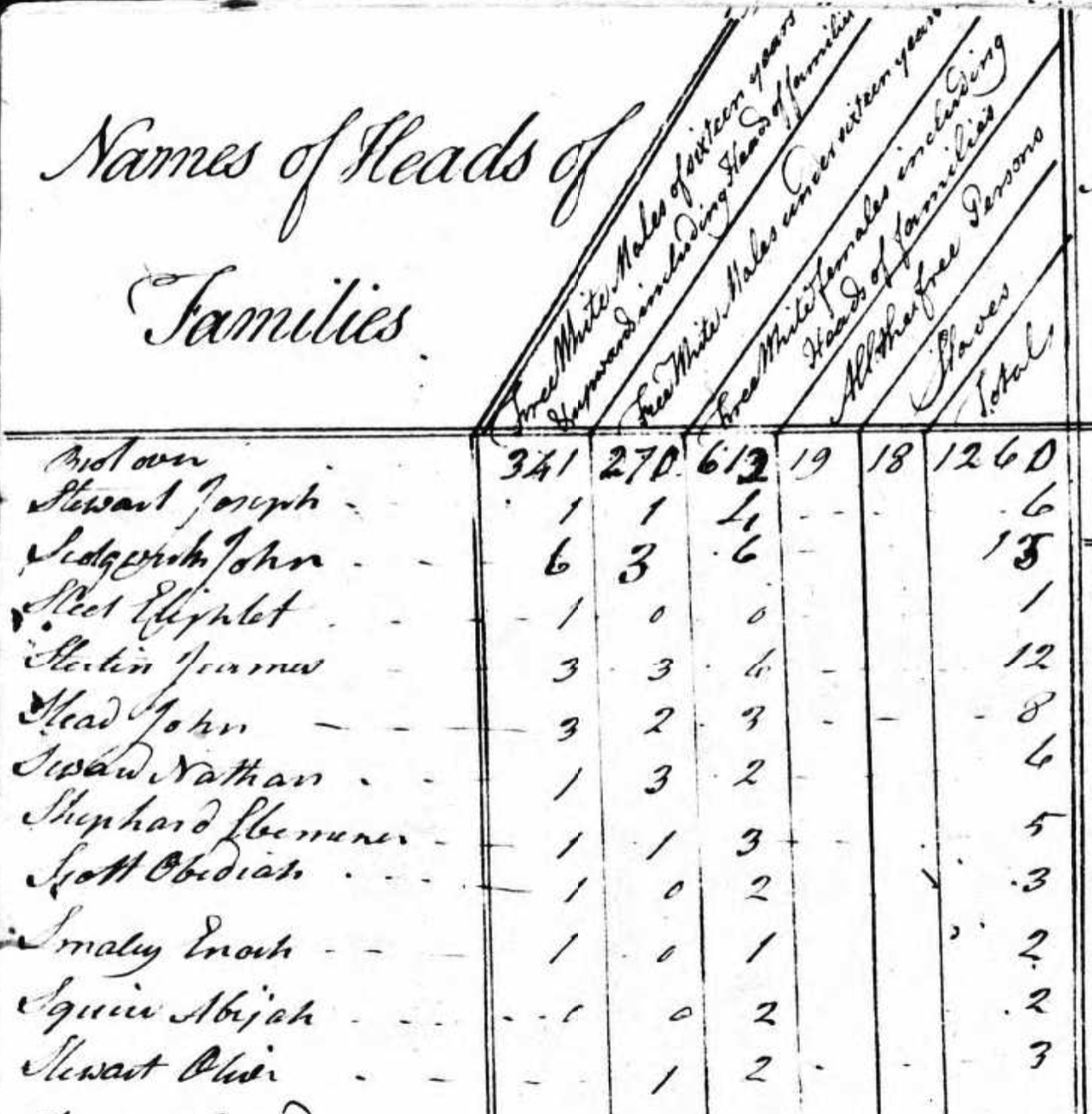
As above it looks as if Daniel is missing and likely has taken up with Ruth Fulford. By the time they arrive in Ohio and she assumed the role of wife, meanwhile our dear Olive having been abandoned at or about the tender age of 22-23. In the court testimony a Mercy G Alcott states ” I heard mother say he [Daniel STEWART) was married in Connecticut; I do not recollect who he married; he left his wife [Olive] in Connecticut with two children and in low circumstances and his wife in the family way.” According to court testimony she appears to take up with a Mr. Taylor for whom no marriage record can I find. Not even a first name. And it gets even curiouser. Olive is alleged to have had 3 children with Mr Taylor ( Lucy 1790, Sallie 1791 and Philo 1796). And yet she is listed as Olive Stewart on both the 1790 and 1800 census and does not appear to have these children. Olive appears on the 1800 Census again as Olive Stewart in Cornwall, Litchfield where her Scoville family resides but with one son under 10 (is this Andrew who would be 14 or someone else?) and herself. Furthermore by 1810 the Philo Taylor mentioned in testimony as being the son of Olive is marrying in the same Athens Co, Ohio as Daniel STEWART resides. In 1820 Philo Taylor is one of 85 families living in Rome, Athens County Ohio along with Daniel STEWART. Seems a bit of a coincidence? The testimony just starts falling apart and I suspect this may have been a scam to get part of Daniel’s estate and had nothing to do with Olive. or her alleged daughter Phebe.
PROBLEM THREE:
Is the “Miss” Olive Taylor who died on 29 February 1852 at Litchfield, Connecticut, USA my Olive (SCOVILLE) STEWART? I don’t know yet. The dates are could be right, but I wonder. In the testimony above it states that Olive’s son Andrew “after an apprenticeship in Connecticut, followed the testator [his father Daniel] to Athens, Ohio, and was received and acknowledged by the testator as his ‘son by his first wife.'” We find Andrew in an Athens County Tax list in 1810 when he would have been about 24 years old. I can not find Olive in 1810 or 1820 unless she is remarried. There are two Taylors in Litchfield in the 1800 census a Levi and a Jonathan. Perhaps she marries one of them should they become a widow? By 1810 she would be 44 so I would not expect children after that. So what if the scenario painted in the court case is false. What if there were no Taylor children and the Philo Taylor was just a grifter and opportunist staking a claim based on Phebe who had likely died young (not on the 1800 census). It seems odd to me that a child of Olive allegedly born within a couple of years of Andrew albeit by a different father would end up in the same place but never be acknowledged by Andrew as a half brother and furthermore not appear with their mother on the 1800 census when according to testimony they would be only four years old. It just doesn’t add up.
Here is another possible scenario. Olive marries at age 15 has (likely) two children a girl (maybe Phebe) and a boy Andrew. Her husband Daniel STEWART a very young Revolutionary War veteran has another family by 1790 when he begins fathering children with Ruth Ann Fulford to whom he may never have married (no marriage record found). By 1801 he has purchased 3000 acres in the Ohio Country and moves this family West. He goes on to have a total of 14 children with Ruth. He becomes one of the richest men in Athens County. He helped to found more than fifty churches and the town that grew up on his land bears his name. He died at the age of ninety-six in the home he had built there.
Meanwhile Olive (SCOVILLE) STEWART appears to have lived at least until 1800 and beyond that it is hard to tell. By 1810 she has either died or remarried. There is no evidence for the alleged marriage of Olive with a Mr TAYLOR around 1790 and it does not make sense that she is listed on the 1790 and 1800 census by her married name STEWART and not TAYLOR and has none of the children alleged to be with Mr TAYLOR.
Olive’s life seems rather sad from the briefest of outlines I was able to uncover. It is clear from the testimony of her son Andrew that she was his mother. If she died between 1800-1810 it makes even more sense that he would go west to join his father. This is all I can discern in the 4 hours allotted. Wikitree, Family Search and American Ancestors were all included. I did not have time to research on Chronicling America. I did look for a probate record for Olive’s father but that did not yield anything.
Lots of threads to follow but I am not very hopeful of finding a lot more. This was a lot more problematic than I expected—but so it goes. Please feel free to post your own experience should you try this Genealogy Challenge in the comments. Have fun!
Copyright Kelly Wheaton 2021 All RIghts Reserved.
DNA Ancestral Origins: a Deeper Dive
Posted on July 27, 2021 5 Comments
We often compare the results of different atDNA (autosomal DNA) tests with regards to Ancestral Origins. Usually I share breakdowns via the five companies I have tested with. I wanted for the purposes of this post to limit my comparison to one particular geographical area. This came to mind when recently reviewing an update of my Ancestral Origins for my Living DNA results. Overall I find Living DNA to be among the least accurate and the most confounding. However when I honed in on my “Germanic” Origins, I found Living DNA to be quite accurate in terms of geographic specificity and its alignment with the origins of my Germanic families, which includes German, Dutch, Swiss and Austrian. I do not mean that as a blanket endorsement of Living DNA but it may point out that different companies may more accurately or inaccurately portray one’s Ancestral Origins in very specific areas. This is both an issue of geography and of percentages attributed to various regions. So first my results from Living DNA:
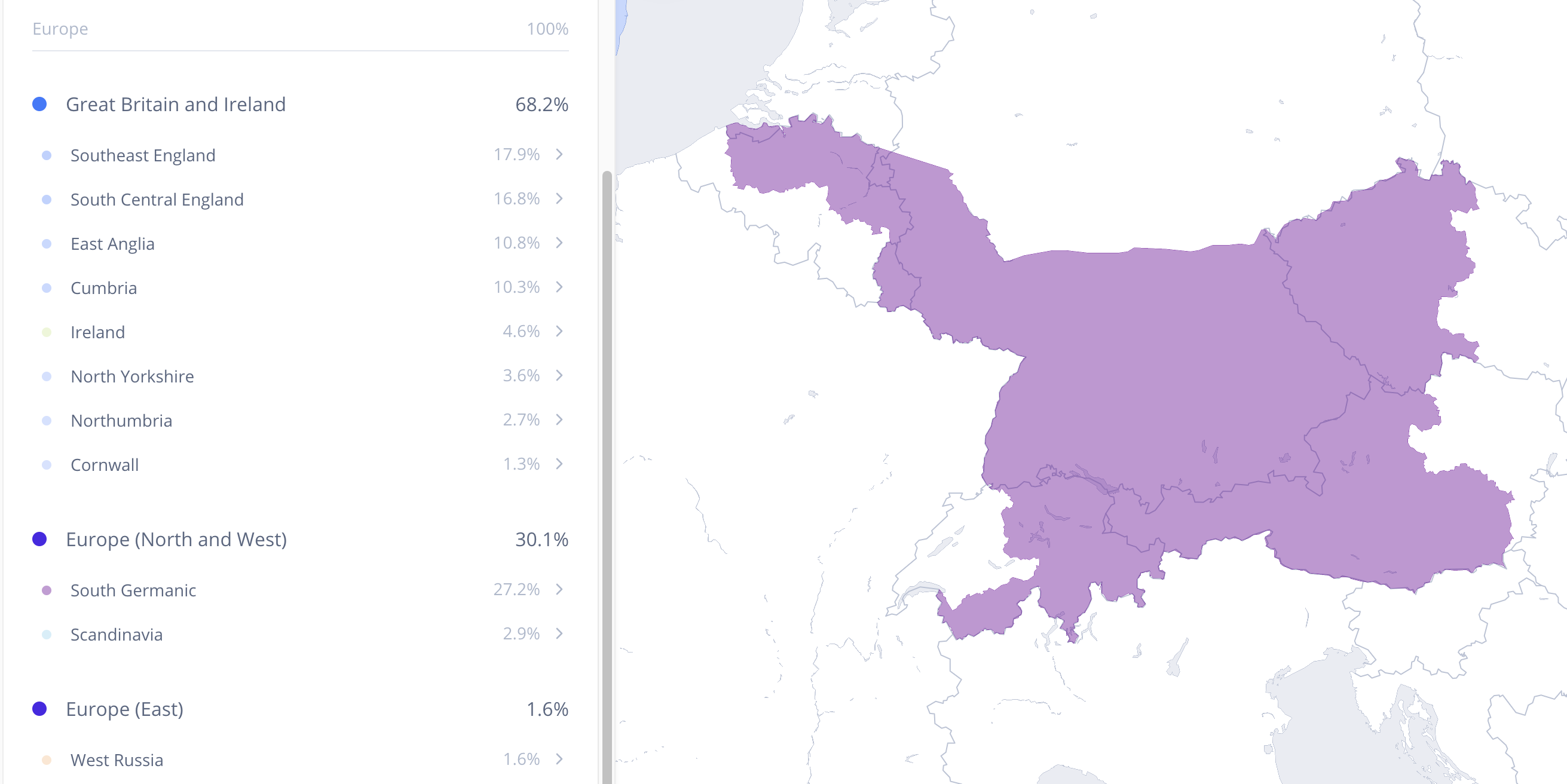
Now Please compare that with this screenshot of my Germanic families plotted on the map. Not Bad in my estimation. However I clearly do not have 27.2% Southern Germanic and 2.9% Scandinavian. I have one 100% Scandinavian grandparent!

I think 23andme is a close with a more realistic percentage at 14%.
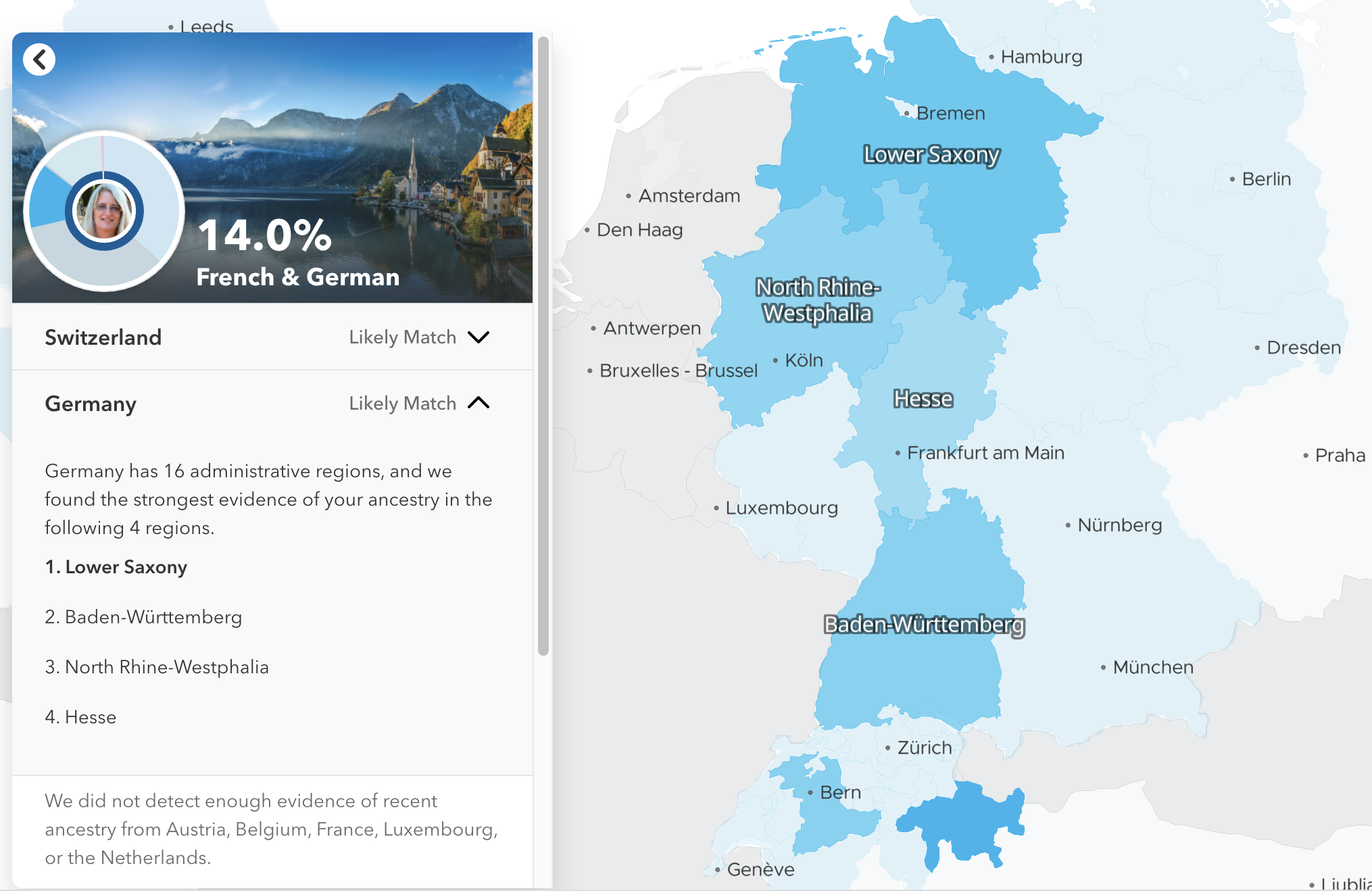
My Heritage, Family Tree DNA and Ancestry offer little specificity (for me, your results may differ).
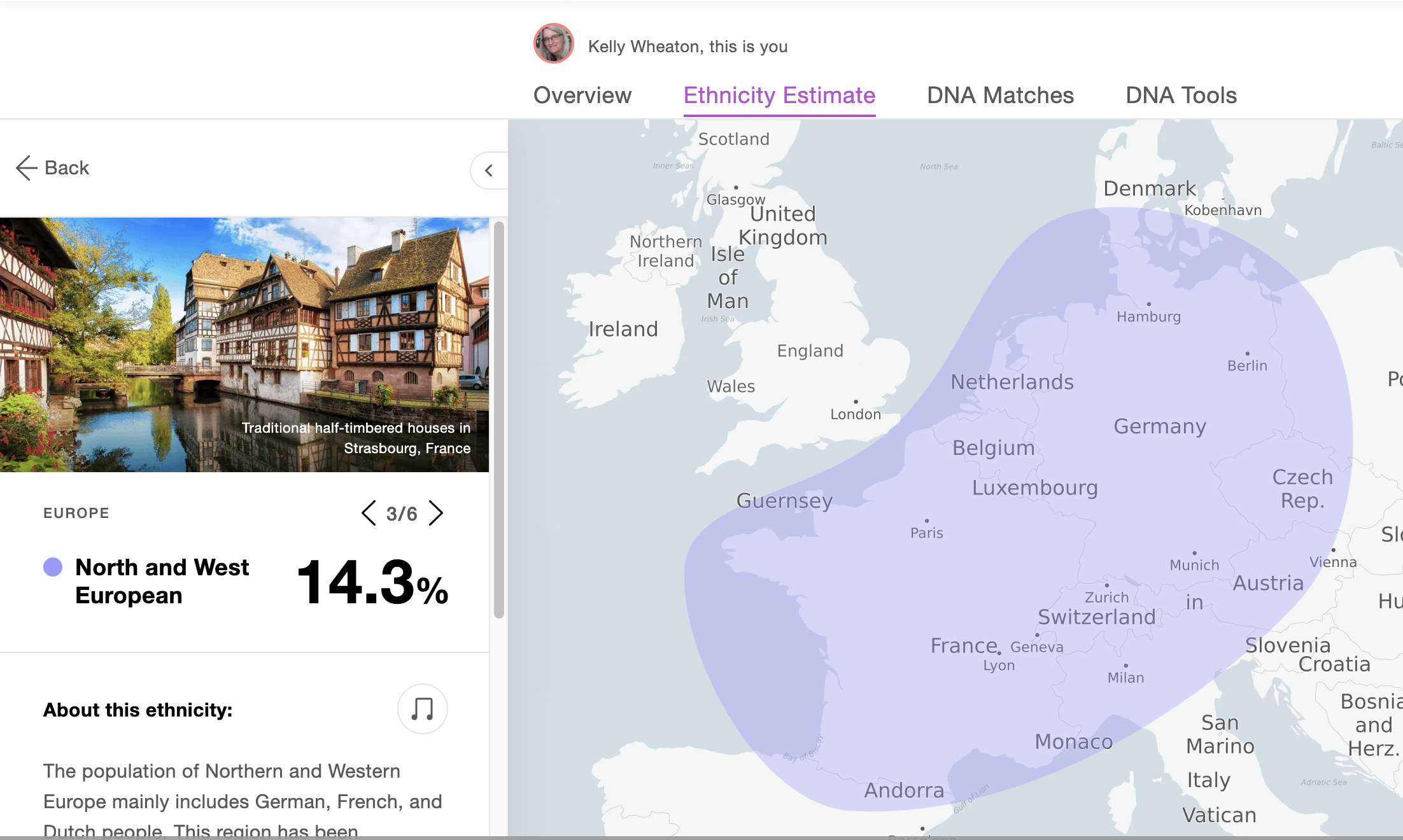
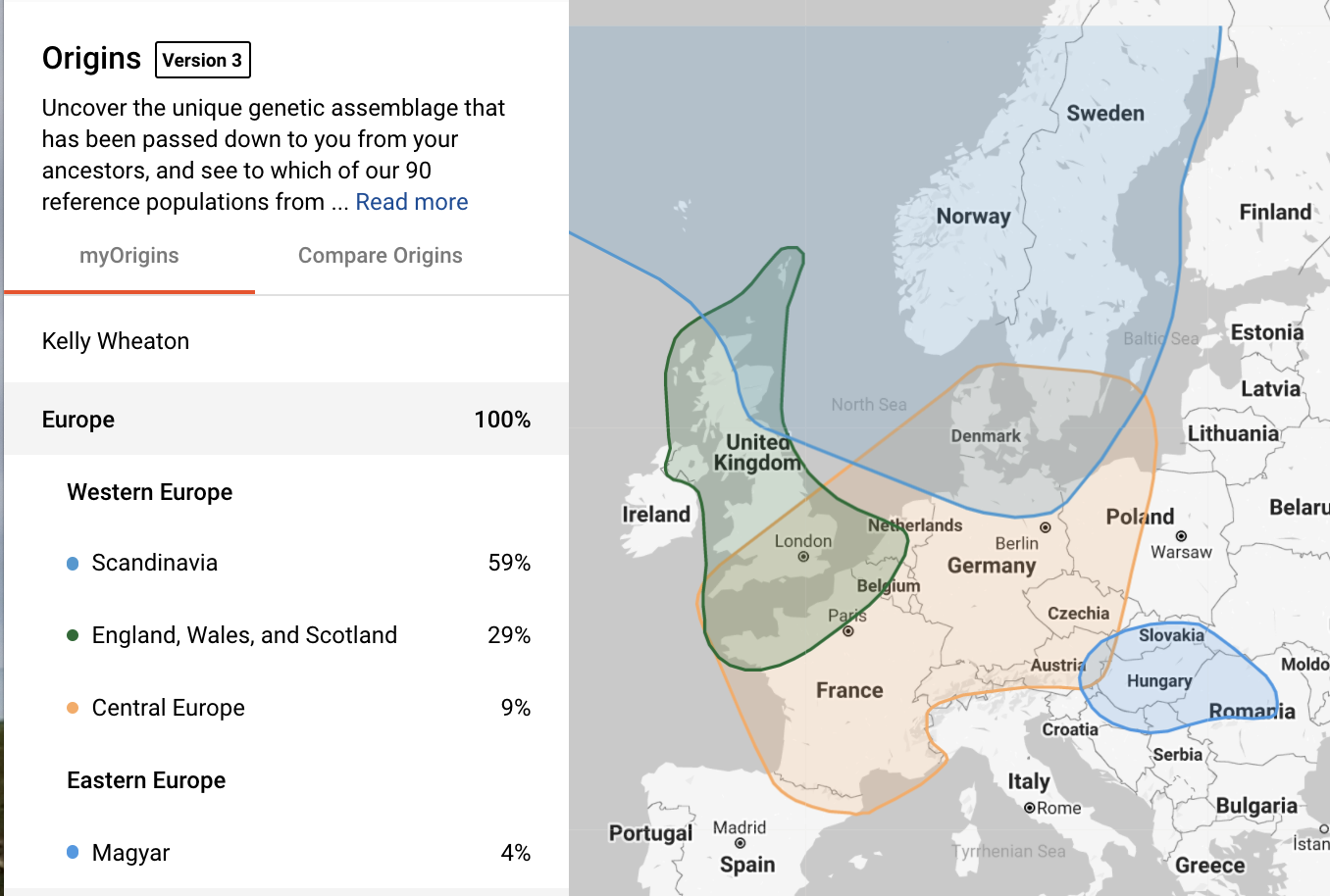
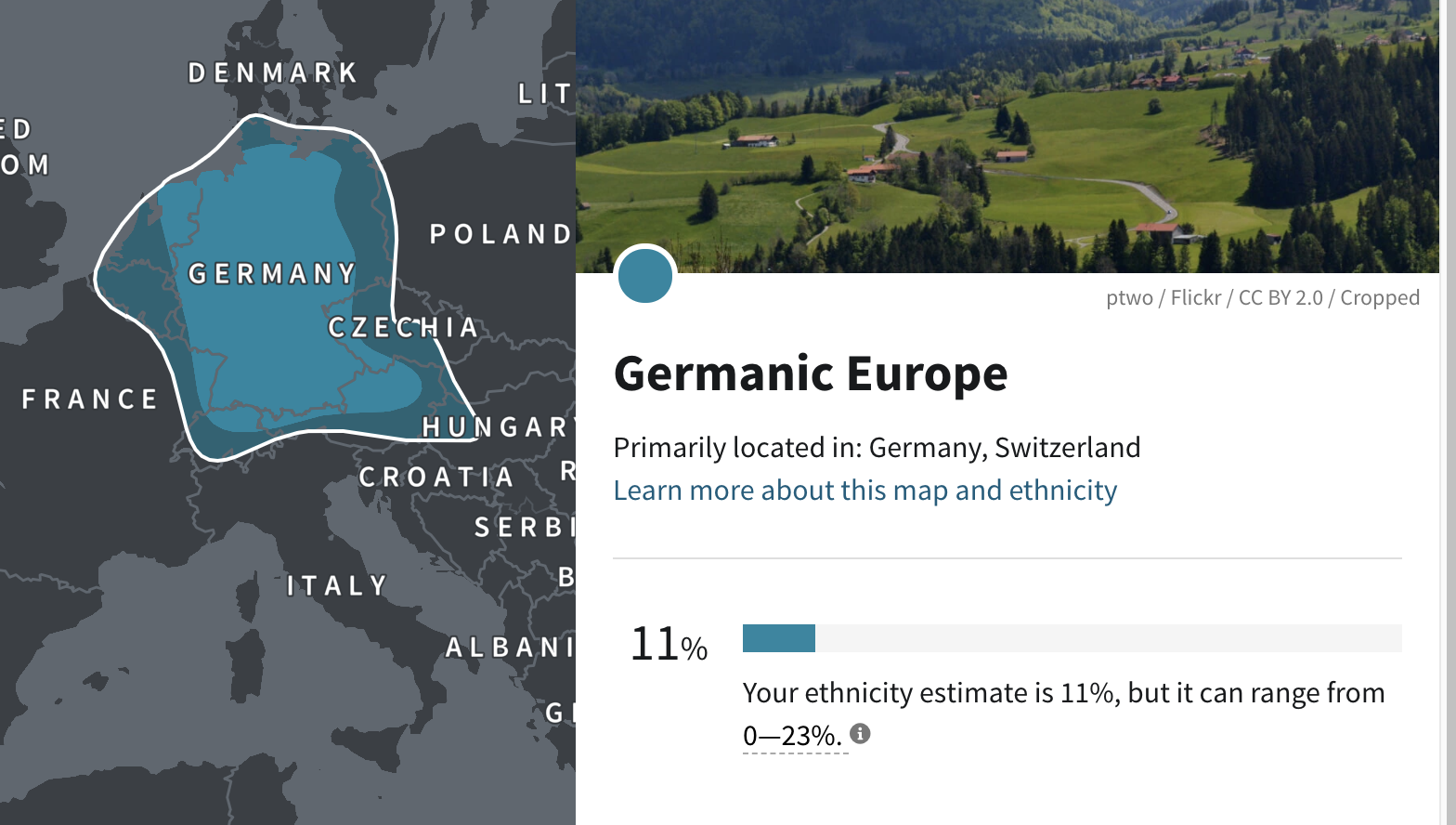
For Germanic Europe I have a percentage range from 9% at Family Tree DNA to 27.2% at Living DNA. In between lays 23andMe 14%, MyHeritage 14.3% and Ancestry 11%. Overall that averages 15.1% Germanic. On paper my estimate is 18%, but our DNA does not always reflect our paper tree as we retain DNA unevenly from various parts of our tree. So overall in terms of specificity of location and percentage my nod goes to 23andMe. However the geography with Living DNA was spot on. Granted your mileage may vary greatly. The point is to dig a bit deeper. My husband is lucky to get some great specificity with Ancestry in his Irish origins. Depending on how recently your ancestors came from somewhere else the more likely that you will get enhanced geographic specificity from some vendors. Namely 23andMe, Ancestry and surprisingly LivingDNA.
Kelly Wheaton Copyright 2021 All Rights Reserved
Evidence Can’t Be Trusted Either: The Case of Changing Attributes
Posted on July 26, 2021 2 Comments
I suppose I delight– just a bit– in saying that, as a sometimes contrarian genealogist or family historian, I do enjoy pointing out the flaws in Professionals commendable but often flawed insistence on “facts” and their proper citation. Yesterday I gave myself a task—I decided to see how many of my recent ancestors that I could come up with written evidence for their physical attributes. Photographs maybe—but mostly I was looking for documentation. The best descriptions came from driver’s licenses, military drafts or military enlistment papers. I had a two expired driver’s licenses for my mother, none for my father, but I did have his service records. I had draft cards for my two grandfathers and enlistment papers for one grandfather and on to Civil War ancestors etc. Note: if you haven’t done this its a good exercise.
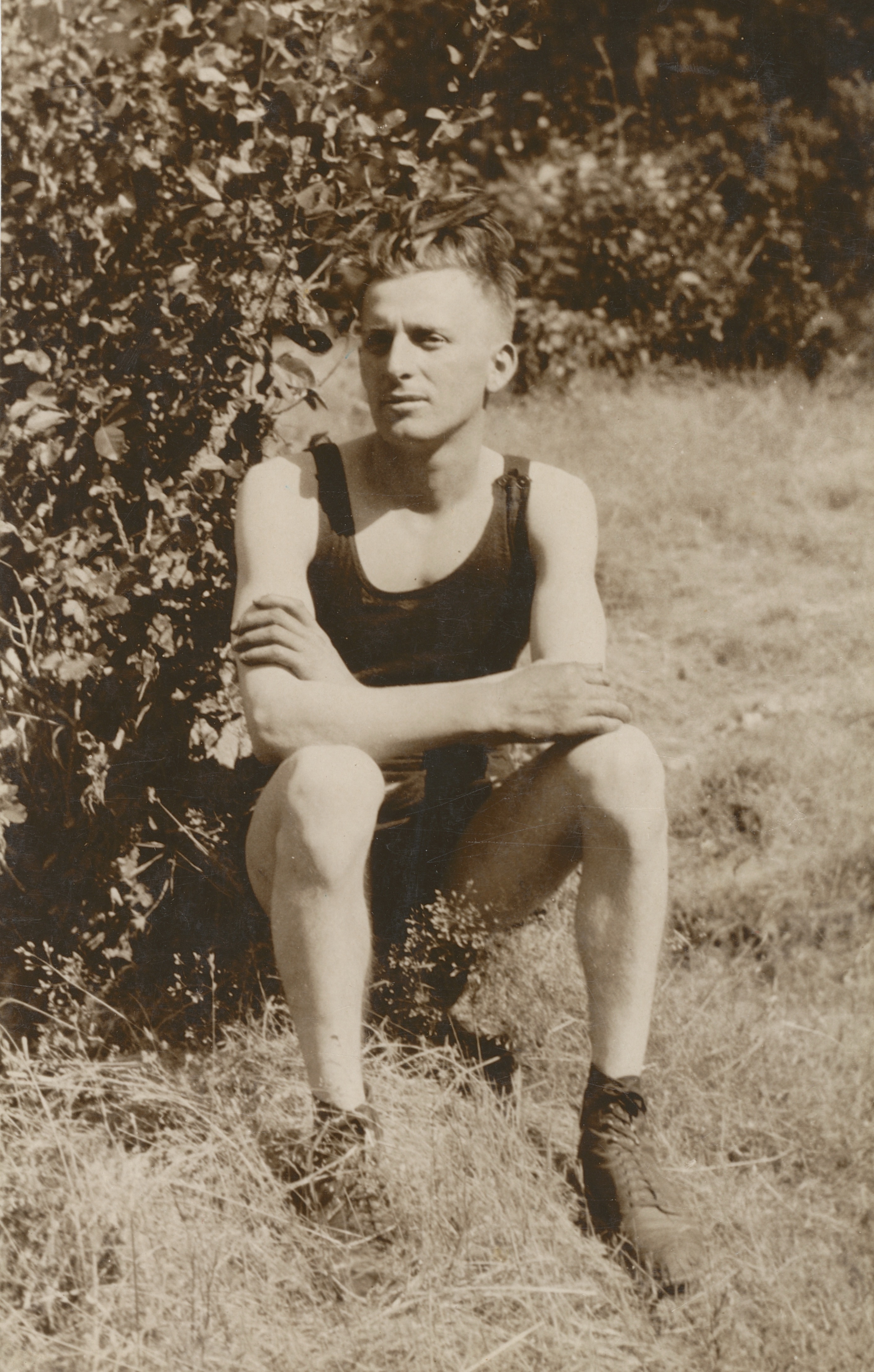
Okay well enough—except for my grandfather Milo. The inconsistencies are enough to make your head spin. Let’s start with the earliest record which isn’t as early as it should be but his Army enlistment record from WWI is non existent. Here is his discharge dated 21st May 1919 which was entered upon his re-enlistment in WWII dated 16 Oct. 1942. He enlisted 14 January 1918.
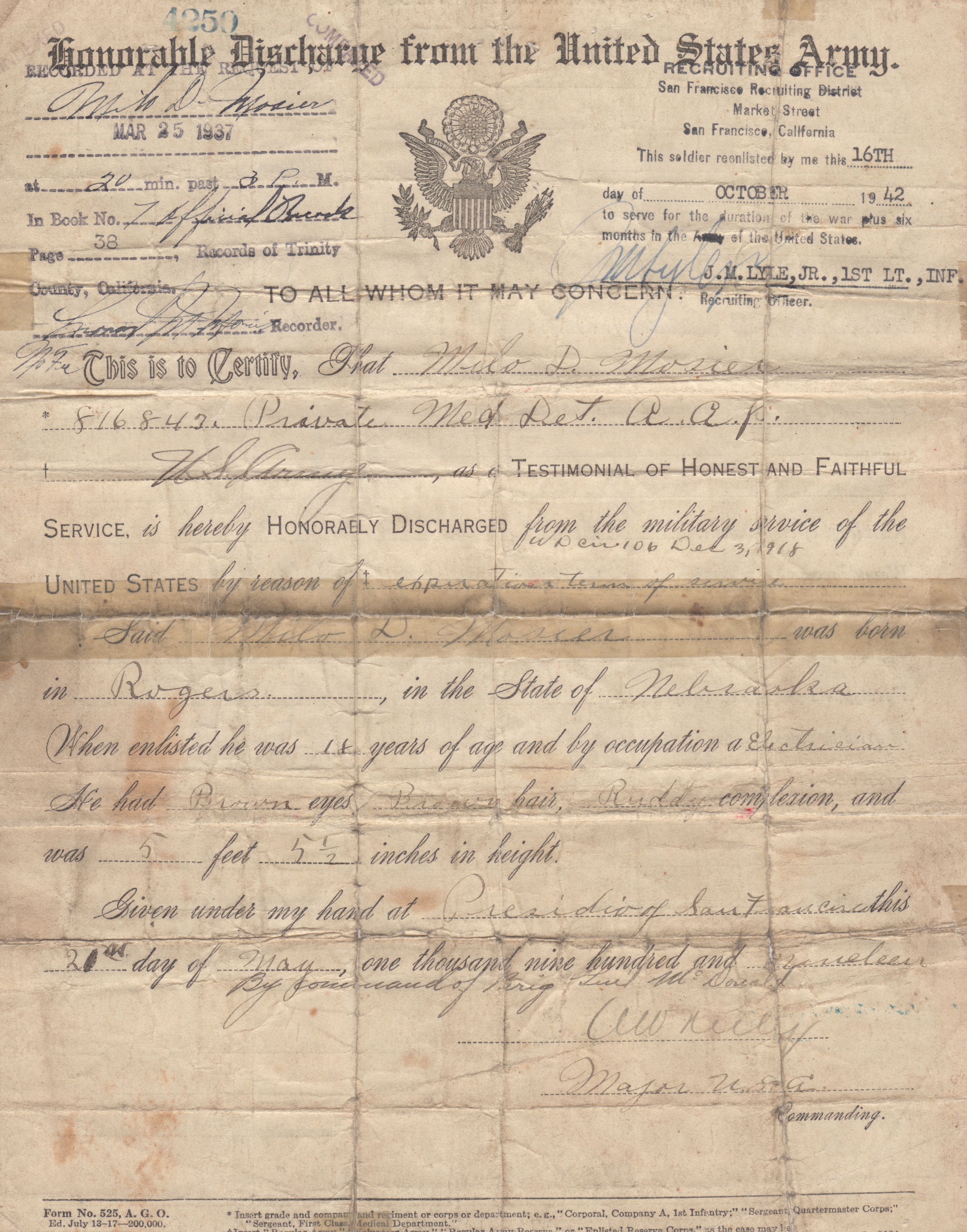
At the time of his original enlistment at 18 years old he was 5 feet 5 1/2 inches tall, brown eyes, brown hair and Ruddy Complexion. The next record we have is his Draft card from 14 February 1942.

So in 24 years Milo has gained 1 1/4 inches. Not impossible since he was only 18 at enlistment however his eyes have gone from brown to gray and his complexion from Ruddy to Light, but his hair is still brown. I am positive this is Milo’s card as he did have a Right index finger amputation! But we aren’t done yet! My grandfather served in the Army for about 5 months from October 1842 to March 1943. At the time of his discharge he was listed as an Airplane Mechanic with excellent character. Not sure of the true reason for his discharge but he then joined the Navy 12 June 1943 as an electrician. When he was discharged we get another description of Milo.
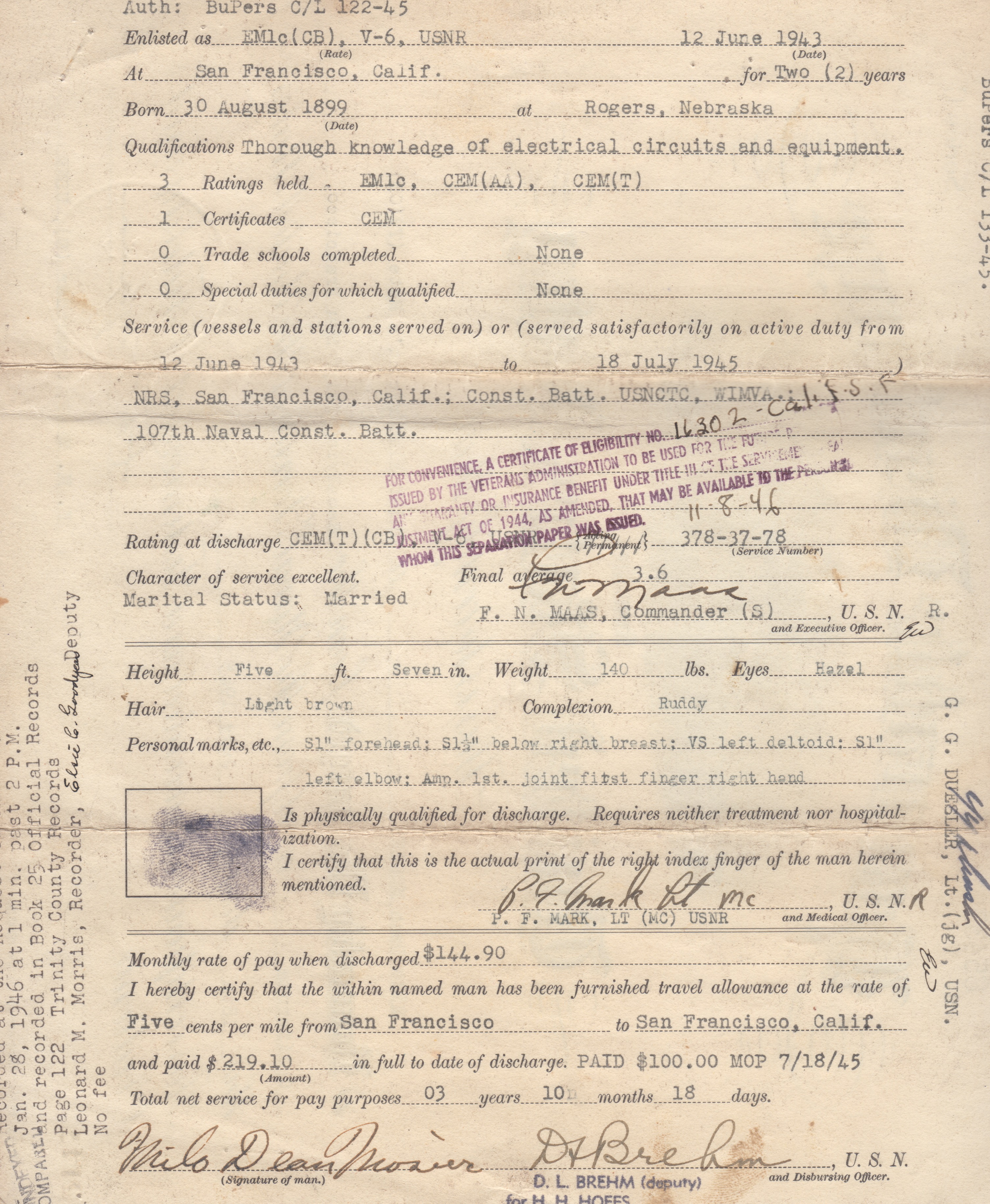
Okay let’s have a look: Milo’s height is now 5′ 7″ (looks like they gave him the 1/4″), he has dropped 8 pounds, but his eyes which were last Gray are now Hazel. His hair that was brown is light brown and his complexion is back to Ruddy! So what can we make of all this. Well since I knew my grandfather well I think I can speak with better authority than any of these documents. My grandfather was probably closer to 5′ 6 when I knew him. He had graying hair that was brown with sandy highlights. His complexion was medium with ruddy or red undertones (probably vestiges of his Scottish ancestors also described this way). His eyes were a blue-gray with some brown flecks. Not a single description is inaccurate per se but rather an interpretation. And so much of what is recorded and viewed as evidence is simply an interpretation. A case in point is my own marriage is officially recorded as the day after the day I was actually married. The minster simply made a mistake. yesterday while perusing a list of German Exulanten I found an error where my ancestress was listed as married to the same man as her sister (not the case) and my ancestor she did indeed marry was left out—and so an error can be passed on from a mistake in typesetting or transcription. Our jobs as historians and genealogists is to try to take all evidence and endeavour to make sense of it. We are constantly revising, revisiting and gathering more information. Take away: the more carefully we scrutinize what information we have the closer we may get at a realistic version of history.
Copyright Kelly Wheaton 2021 All Rights Reserved
The Places You Go, the People You Meet
Posted on July 20, 2021 Leave a Comment
This post is prompted by the death of a fellow genealogist who died in June of 2020, of a non-Covid 19 related illness. I just recently found out that he had died. My last email to him was in August of 2020 to which I had no reply. I was not surprised at no response, as he had told me earlier he had a detached retina and other health issues… I sent a Christmas greeting with no response. Death brings up so many issues as a genealogist. The loss of a friend and fellow researcher. The not knowing what happened—the thousands of us that will die and none of our hundreds of email “friends” will ever know what happened to us. Perhaps we all need to write a reminder to our executor asking them to email all of our contacts and let them know of our passing. What will happen to our websites and blog posts? So many questions…
But my real reason was to share a bit about Gary Mosier and how someone like Gary can have such a huge impact on our genealogies and our lives. Stay with me here as this has relevance to us all. Gary impacted me in two ways that stand out. First he was the person who finally cracked the MOSER nut wide open, although it took him several years and boat loads of money he spent on hiring German genealogists they did find the MOSER origins in Germany. In so doing, he PROVED that the five brothers family legend was TRUE!!! In fact it wasn’t three brothers or five brothers it was actually 6 brothers and at least one sister who immigrated to America in the early 1700’s. The part of the legend that was wrong is that they were not from Alsace Lorraine but were from the small villages near Ansbach, Bavaria (namely Weißenkirchberg, Wörnitz, Ulrichausen, Breitnau, and Kloster Sulz). Subsequent YDNA testing has also confirmed that the brothers were related. At the time of my first contacts with Gary back in 2013 there had been no proof. He was always in search of Johann Leonhard MOSER’s (his ancestor) origins and baptism. The failure to find him was what spurred him forward. (Familiar story that the frustrated genealogist does so much work for others…) I think this excerpt from Gary’s email is worth mentioning.
“I went to back to the original source records from Wornitz, just in case Leonard had been missed. I have had these records searched three times, by two different German researchers, but with no result. I suspected I was looking for a son of Adam Moser and Elisabetha Wollinger, since all of Johann Michael’s children and Johann Martin’s children were accounted for, and I wasn’t researching Georg Phillip for the purpose of this exercise. I thought the year of birth might fall in the period 1706-1712. It required about ninety hours spread over a month to finally locate the record, and I had to finally had to block match cap A’s an cap M’s to do the job. The film is somewhat indistinct, but I could pick out “Leonhard”, “Adam Moser”, “Wollinger”, and “Martin Claus” (who was also Johann Adam Moser’s godfather). I was pretty sure I had the fellow. Professor Esther Bauer, translator of all things Teutonic, did the conversion to English, which is attached as a PDF file. That lady is a wonder, and is highly recommended. I also have to relate that while I was waiting for the translation to come back, I checked back in on Hans Ebert’s web page. He has now transcribed the churchbooks of Wornitz, and Leonard’s birth record is included. If I had only waited.”
The point is, that like all good genealogists, we keep looking for the answers that we know are there somewhere! As it turns out the progenitor (who never immigrated) was married 3 times and fathered 16 children! Five died young. ALL of the surviving sons immigrated to America; 2 on the ‘James Goodwill’ in 1728 and the rest on the ‘Adventure’ in 1732. Each of those 6 sons had large families who spread across America. Back in the 1970’s other researchers had tried to make the connections—we MOSERs are all indebted to Gary for solving this mystery.
Not only is this my maiden name line but the one that my grandfather and father would surely have loved knowing about. In May of 2018 with guidance from Gary I was lucky enough to visit the churches in the area and see for myself the origins of the Bavarian MOSERs.
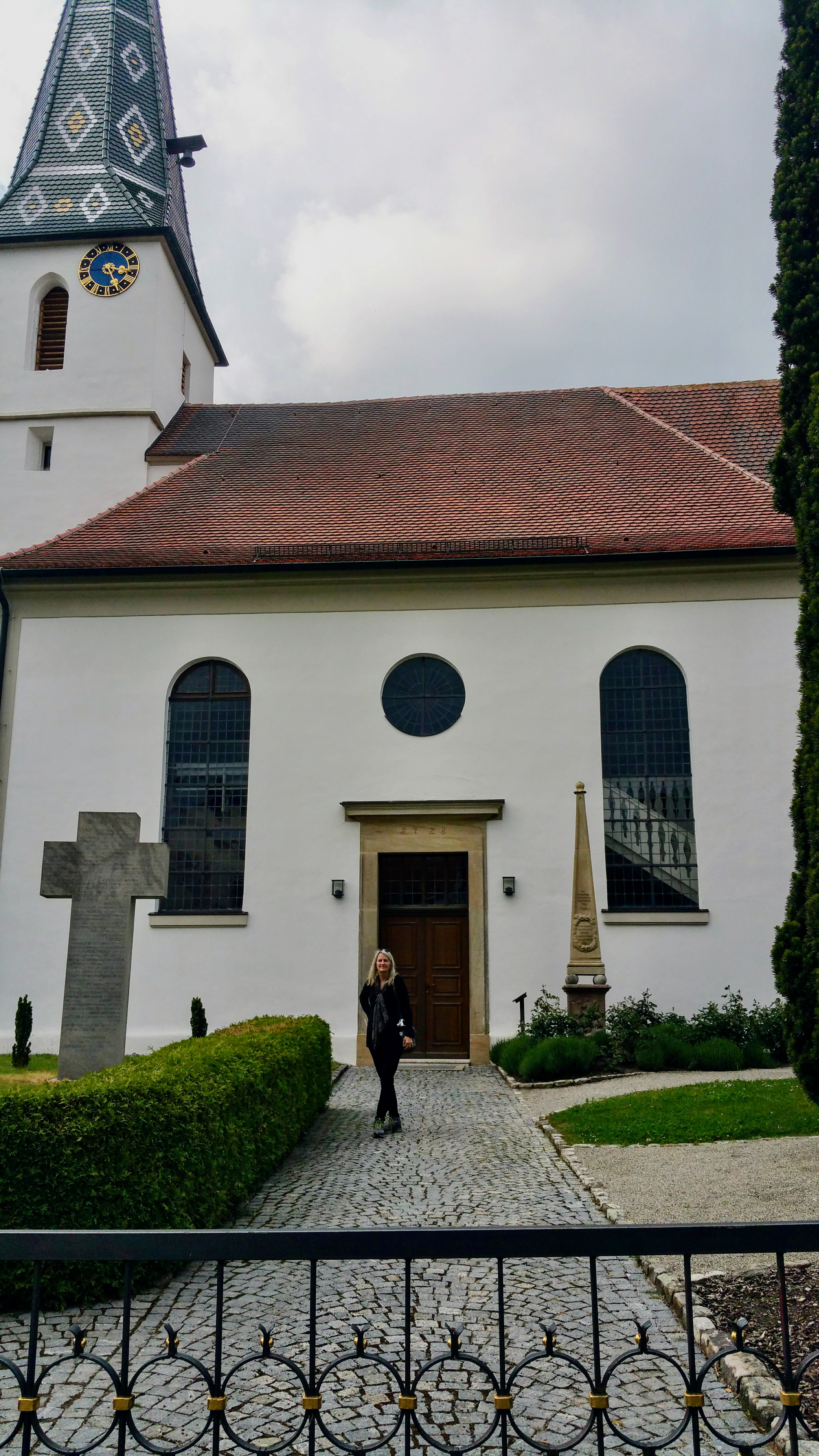
Which brings me to the Second debt I owe Gary. And this is the unexpected debt of sharing that happens to genealogists all the time. You mention a trip you are going on and then your fellow genealogist says, “if you are going to be in Warwick (pronounced War-ick in England) you must visit the Collegiate Church of St Mary and visit the Beauchamp Chapel (pronounced Bee-chum). It is spectacular!”

So I dutifully added this to my list. Well in getting ready for the trip I started researching the other side of the pond, as my focus has usually been to find out where a family came from but I had not tried my hand much at connecting deep in England. Well lo and behold this turned out to be much richer than I thought. As it turns out the Beauchamp Chapel is the finally resting place of Queen Elizabeth I’s favorite Lord Dudley and Richard Beauchamp 13th Earl of Warwick the father in law of the famous “Kingmaker.” But as it turns out, Richard Beauchamp is also my 17th great grandfather! And I would not have known this had it not been for Gary, insisting I visit the Beauchamp Chapel. Richard’s tomb is one of the most beautiful anywhere. The chapel has a Doom painting and one could spend hours there. Gary was absolutely right.

The above photo I sent to Gary in October of 2019. It is really an extraordinary place with tons of history—and do not miss nearby Warwick Castle the home of the Beauchamp family for centuries. So my dear friend Gary if there’s a heaven for genealogists you my friend surely deserve a place of honor. Say hello to our mutual grandparents for me…

I never met Gary in the flesh but he like so many others has taken me unexpected places and led to many people I never expected to meet. Thank you Gary! And Thank you to all the other unsung heroes of genealogical research.
Copyright 2021 Kelly Wheaton. All RIghts Reserved.
A Trip Down Memory Lane: One way to access the stories of our past
Posted on July 18, 2021 Leave a Comment
Sometimes its a random thing that brings out old memories. Never underestimate what you can learn from a simply property search. A childhood best friend made a post about the price of the home she grew up in. I decided to follow suit and look up the house I grew up in. The house that my parents bought back in the 1950’s for $13,950 is now estimated to be worth about $1,119,000. I am lucky that I have the original purchase contract so I know the exact price they paid. It was dated a few months before the deed which is recorded the day after I was born! My Mom used to say they moved in the day before I was born and I suspect this was right. I imagine they were anxiously awaiting my arrival and the finishing of their new home, all happening in rapid succession.
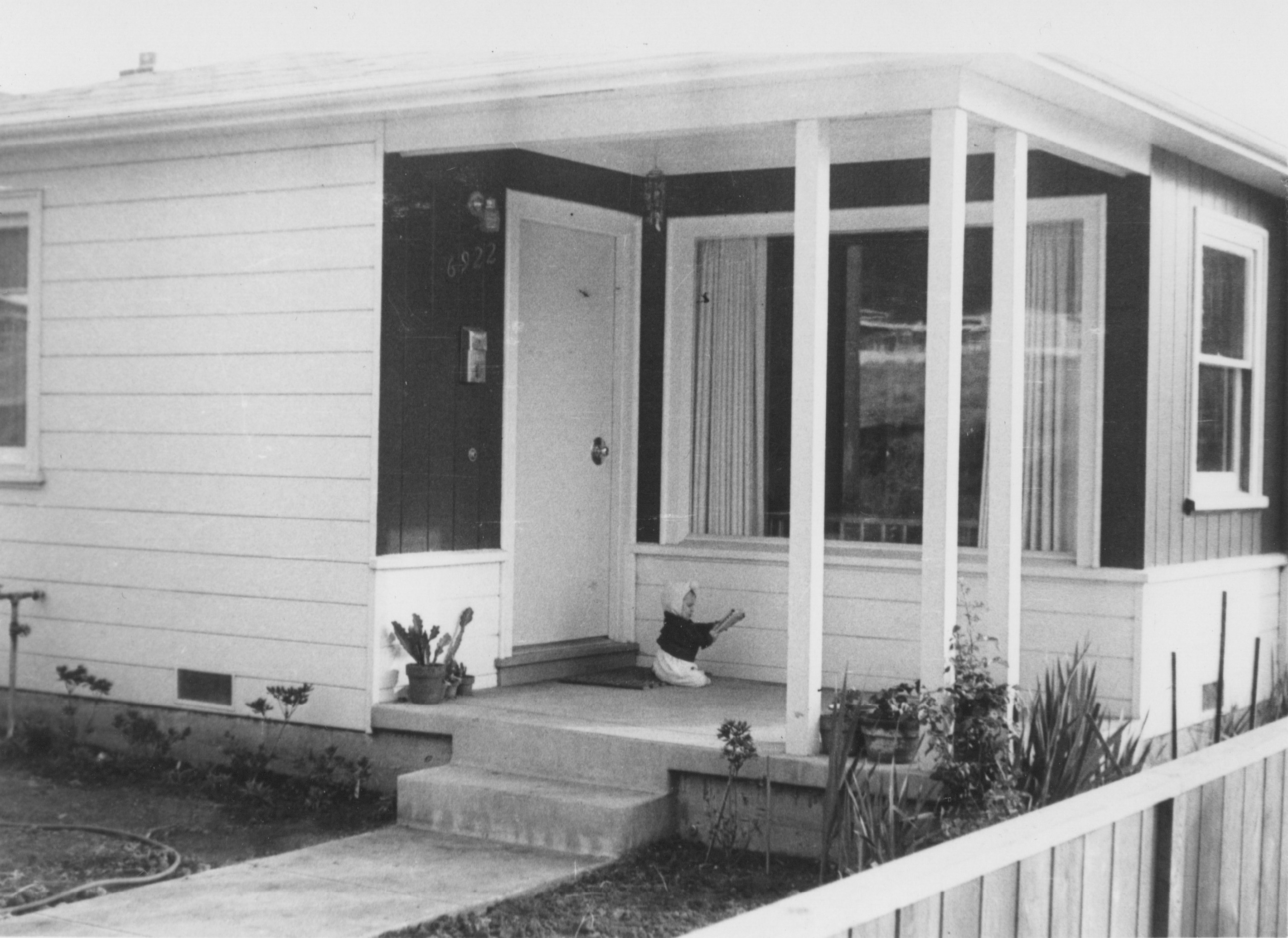
The house was brand new and had never been occupied. It was post World War II and houses in the San Francisco Bay Area were sprouting up everywhere, the onslaught of suburbia. It was and remains a 3 bedroom, 1 bath cracker box weighing in at 1,157 square feet. Small by today’s standards but then it was considered a modest middle class dwelling. It was built of redwood siding and my parents built a redwood fence all around it. It also had clear redwood panelling on one wall of the living room which is now painted over. My parents later added brick planter boxes across the front and sides and filled them mainly with Rhododendrons, azaleas and cymbidium orchids. It sat on the corner, which they liked as it meant more privacy, they said. There was a garage behind the house so essentially one neighbor instead of three. The one neighbor’s house was a mere six feet away and I could look from my bedroom into there’s with ease. I always felt quite exposed there on the corner for all the world to see rather than being tucked in further down the block, a contrast explained by the fact my parents were both extroverts and I although outgoing, a definite introvert.
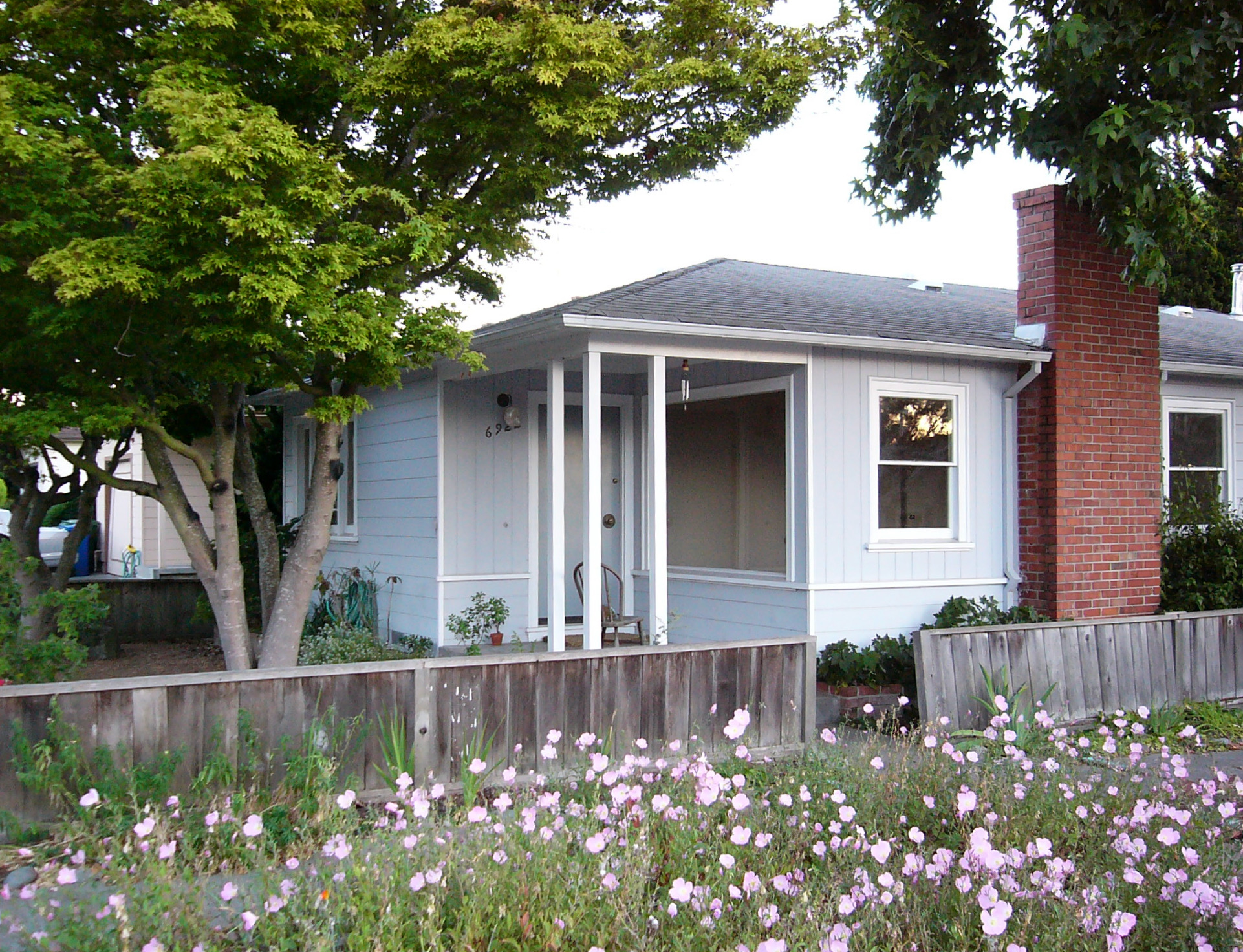
In the above photo I am holding the newspaper and the top edge of the play pen is visible inside the living room window. Although you can’t tell from this photo the door was yellow and the dark siding was a deep pine green. the trim and the rest was white. There were brass numbers and a brass mailbox. The mailman used to come up the steps not quite visible on left side and exit those to the front. In fact many people took the “shortcut” across our porch. Below is what the house looked like in 2003. The color scheme had changed and the fence was beginning to fall apart. Today the door is a nice turquoise blue and the fence has been replaced.
By looking at one of the many Real Estate websites you may be lucky enough to have a photos taken inside. This is what really brought back a flood of memories, even if many things have changed. This photo is what the dining room looks today.
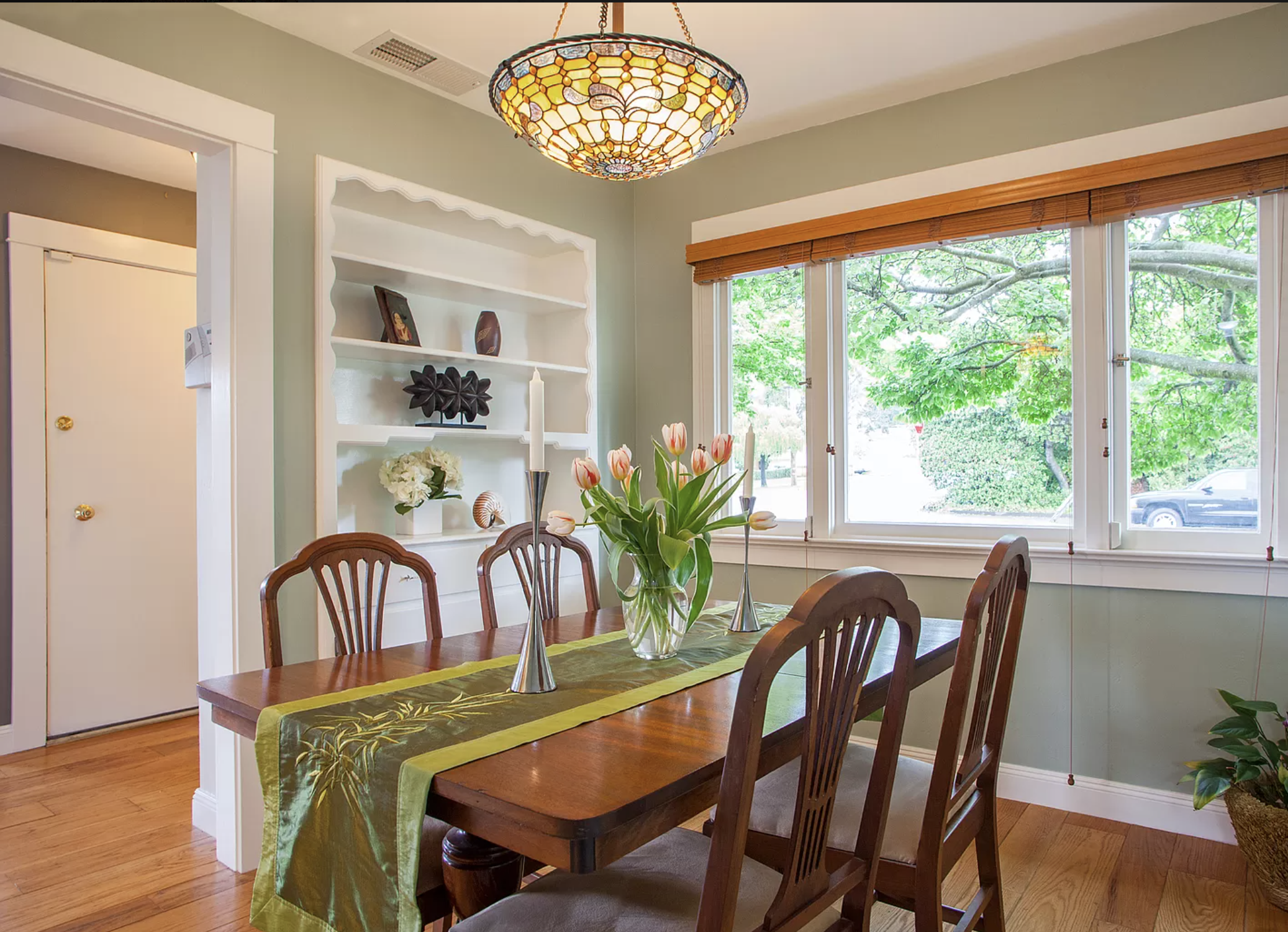
What I instantly note is the scalloped edge on the built in buffet. The front window has been replaced but aside from the new light fixture essentially the same. You can see the Front door in the background. This room seemed so much bigger back then—but wait I have an old polaroid of the room.
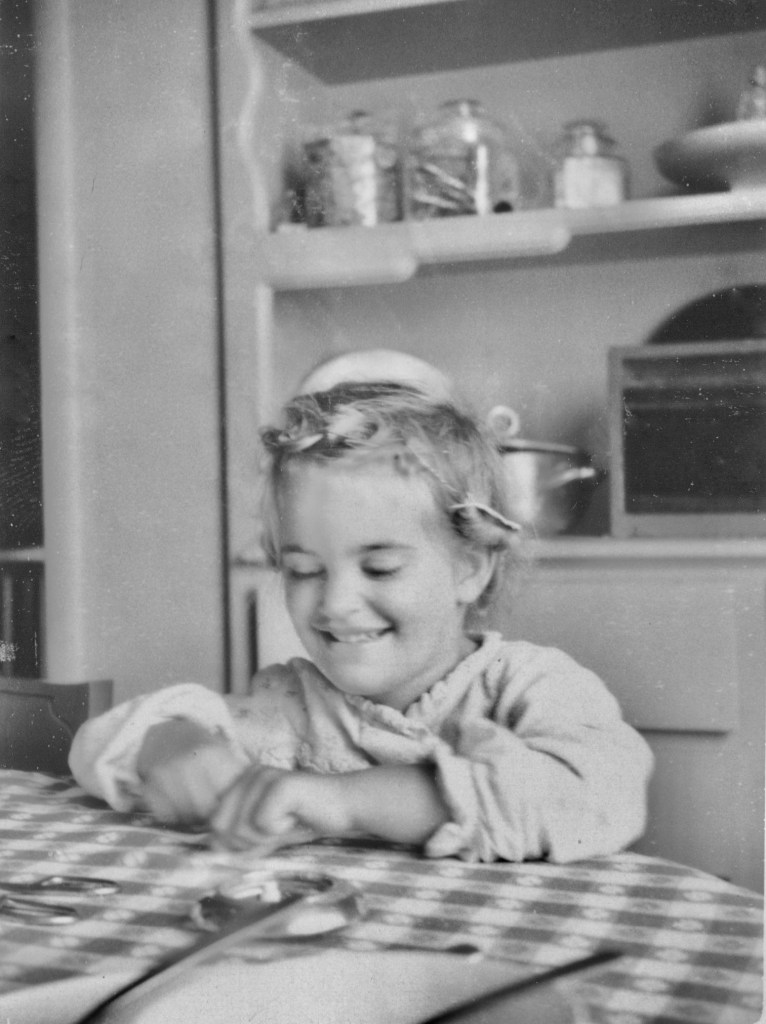
You can see the scalloped built in is the same. This is me age 3, in my bathrobe, hair in curlers setting the table perhaps for a dinner party my parents are having later that evening. In the background I spy an aquarium which may have held reptiles or fish, as I collected both. The tablecloth is red and white checks. In those days the walls were a rosy beige and the one large wall had dark green wallpaper with magnolia flowers with a hint of the same rosy beige. What really spoke to me was the scallops. After over 60 years the scallops remain! And that’s not all, they remain in the kitchen as well. I do not have a photo of what the kitchen looked like back then but let me describe it for you. Knotty pine cabinets with copper handles just like this:
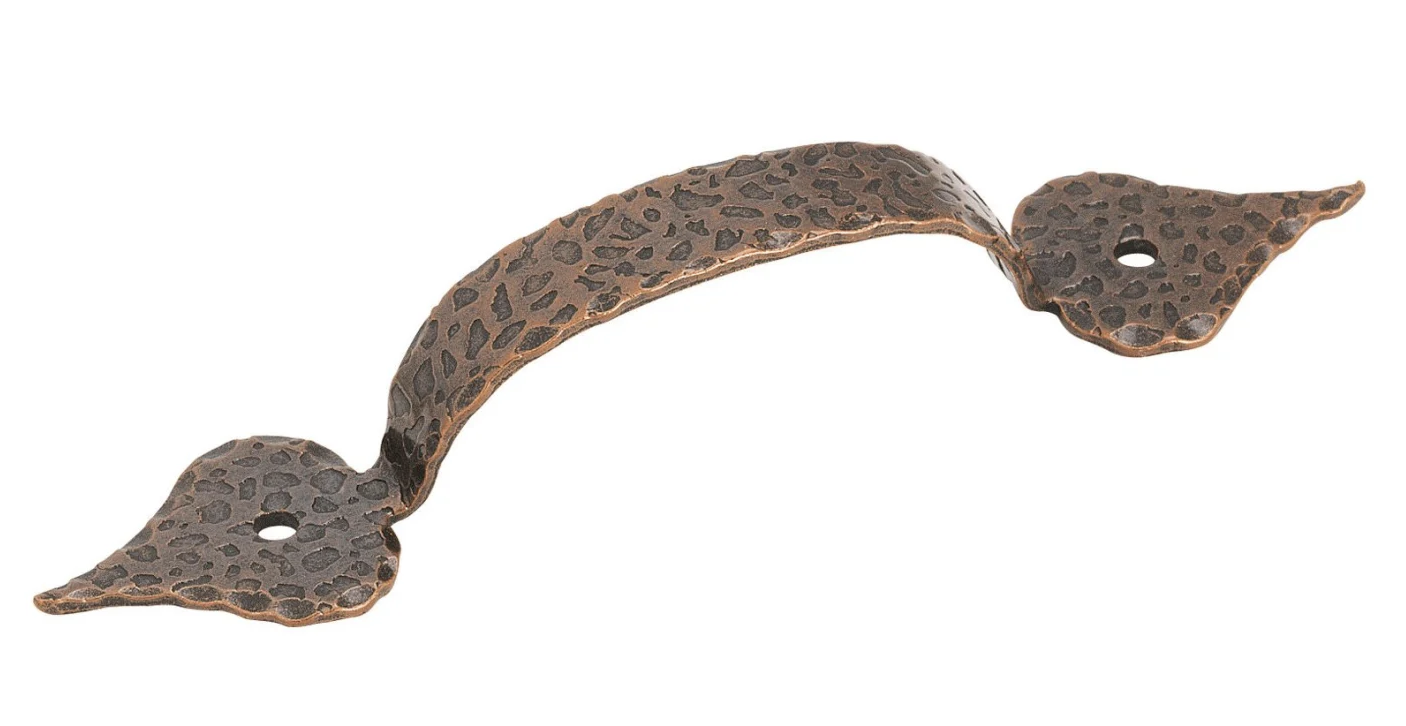
The flooring was a red brick pattern and the tile was yellow with contrasting black edge tiles. The knotty paine has been replaced and new hardware. Here’s what it looks like today. The tile has been replaced but the configuration is identical. Those round end shelves were filled with knick-knacks and do-dads. The telephone, a black desk model sat right about where the basket is and there was nowhere to have a “private conversation” in those days. Not to mention we had a part line shared with a half dozen other neighbors. But aside from the cosmetic changes looking at this photo brings it back like it was just yesterday.

I could go on and on describing each room and writing up memories but the point of this post is for you to look up your house or that of your grandparents, aunts, or uncles— and see what it brings up for you. It does not have to look the same to joggle our memories. If you are lucky enough to have parents or grandparents alive maybe you could share a search with them and see what it yields…we are never to old to revisit our first home. Capturing those memories and stories may surprise you!
Copyright Kelly Wheaton All RIghts Reserved 2021
Enslaved People in our Family Records: What We Can Do
Posted on July 6, 2021 1 Comment
This is a difficult topic and one I tend to delve into in search of my African ancestors and then pull up empty and run in another direction. But, I keep coming back again and again. For most of my life I had no idea I had any African kin. Here’s how the story goes…back in 2011 I gave my husband a YDNA kit for Valentine’s Day. After 40 years of trying to connect him with either Robert WHEATON or Thomas WHEADON I gave into DNA to solve the mystery. Then I took the dive and tested myself at 23andme.
Shortly after that, and before my results came back, I was browsing books at my library’s sales shelf. I found this title “Pearl’s Secret: A Black Man’s Search for his White Family” by Neil Henry which I purchased and read. Well wouldn’t you know it but a month later my atDNA results came back with .6% African in two substantial segments. To make a long story short I have been searching for the source ever since but have not been very successful. I did have an aunt confirm rumors of African ancestry with my grandmother. And I have narrowed down the part of the tree I suspect it is coming from. I suspect my 3rd great-grandmother Sallie WOOD had a more colorful background than her paper tree suggests. So as I often do, I had another look at DNA matches in this part of the tree, always looking for majority African Americans who might be the key. To date those matching me on the African segments are all majority white. So as it usually does this path doesn’t get me very far.
So this time I decided to revisit Sallie WOOD’s ancestors. Her grandparents are William WOOD, Martha KENDRICK, Bartlett C SMITHSON, and Martha WILLIAMS all born between 1734-1748 in Virginia and North Carolina. Both her grandfathers died in 1804. William WOOD is listed on the 1800 Randolph County, North Carolina with 1 enslaved person and Bartlett C SMITHSON in Pendelton District of South Carolina with 4 enslaved people. Call it white guilt or call it a human revulsion to what travesties man inflicts upon his fellow man—each time I come across these records I recoil. Especially knowing that one of their ancestors is (likely) my African ancestress. With more and more records especially probate records coming online more is coming to light. And the revulsion turns to responsibility. The key to may African Americans lies buried in the records of our white ancestors. So even if I personally am uncomfortable I believe what I unearth may be the key to others journeys.
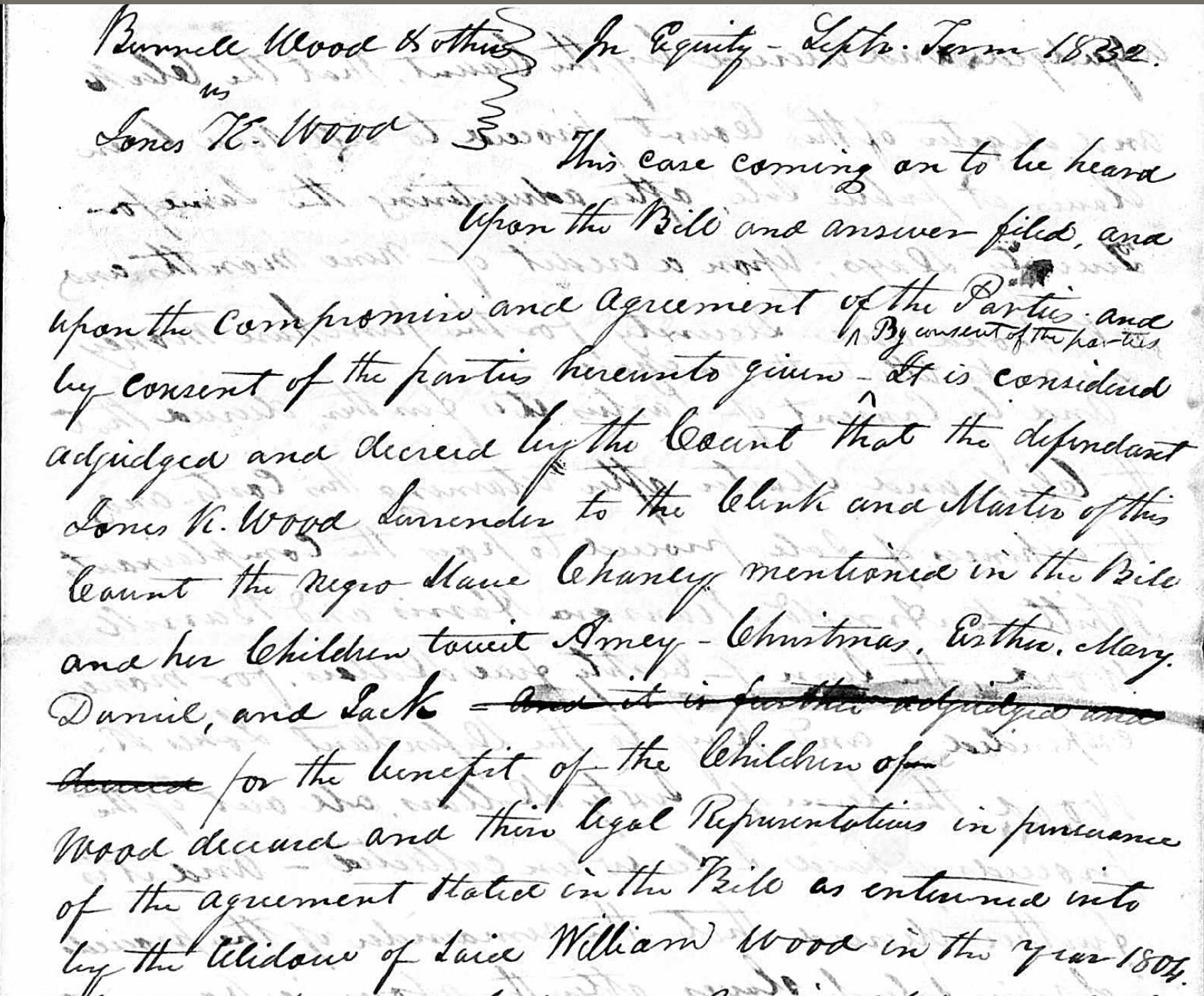
So yesterday, on the 4th of July (love the synchronicity here) I turned up a probate record for William WOOD who died in 1804 which really gave me pause. It was not just one enslaved person that is mentioned in Probate file as the negro slave Chaney. It is the later documents in 1832-1834 involving Chaney’s children: Amey, Christmas, Esther, Mary, Daniel and Jack and their improper distribution. So now I have not one individual for whom I feel responsible for resurrecting but rather a whole family. Sadly this settlement that happened 28 years after William’s death meant the dissolution of this family group.
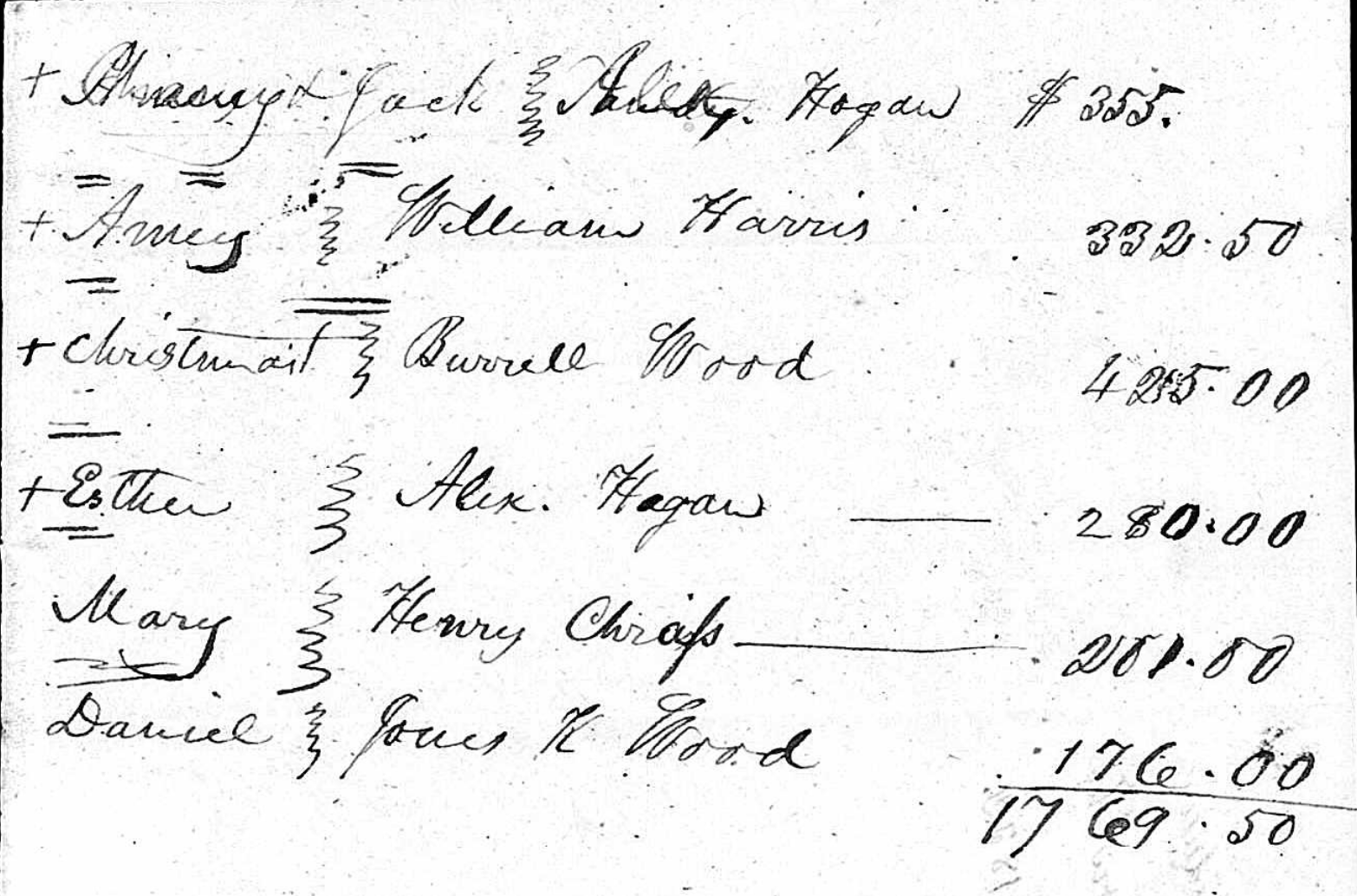
Which is evidenced in the later document that lists the settlement and where Chaney and her children went. Chaney & Jack who may be her youngest, and Esther went to Alexander HOGAN. Amey to William HARRIS, Christmas to Burrell WOOD (son of William WOOD), Mary to Henry CROSS and Daniel to Jone K WOOD (son of William WOOD).
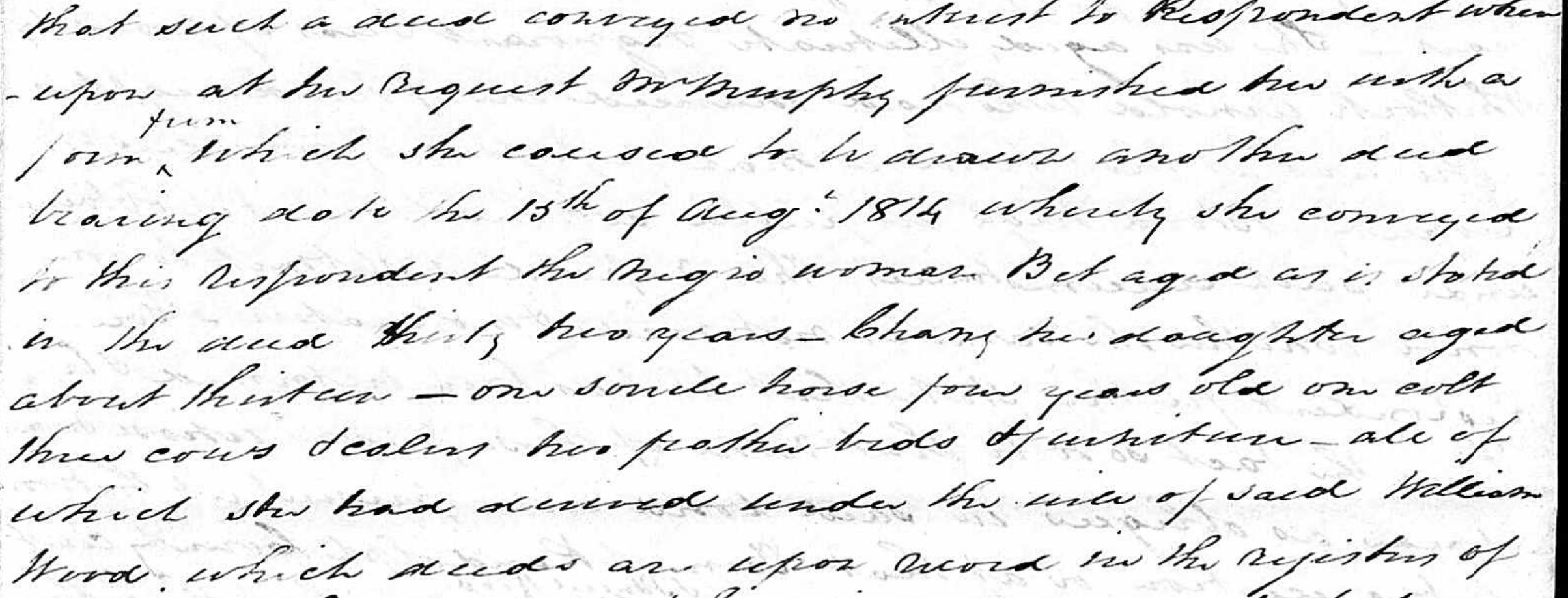
Further documentation shows how William’s widow, Martha, was taken advantage of by Whitlock ARNOLD who had married one of their daughters. And not only do we learn about Chaney, we learn of her mother Bet. Bet is born about 1882 and her daughter Chaney about 1801.
I still need to comb through these records for more clues but already I have a family and I went searching for them. There are are 3 generations of a family that are kin to someone. I have found a possibility for Amey in 1870 and sent a message to a family member, to date I have not heard back.
I went is search of a repository for this new found information and reached out to a friend who has been successful in searching his enslaved ancestry and reuniting with his white Plantation owner descendants. He sent me to “Beyond Kin.” Beyond Kin has a protocol to enter the “found” into trees on Ancestry so others may benefit. I suspect the story will not end here and that now I know how to honor the people I have “found” I will be able to reconcile with this unhappy part of my ancestral past. I do not have confirmed parents for William WOOD but I do for Martha KENDRICK. In the testimony of her son this statement ” That the provisions made for his mother, the wife of the testator (William WOOD), were reasonable—married early in life [they] had begun poor—together they had worked for what they had accumulated and it was the fruits of their joint labor.” For all I know William may have been of mixed ancestry and Bet was kin to him…the search continues….
Copyright 2021 Kelly Wheaton All Rights Reserved.
The Case of the Missing Birth Certificate
Posted on June 23, 2021 2 Comments
Records are funny things. There are many caveats we must keep in mind when requesting and searching for birth certificates. My grandmother Carrie requested her birth certificate some time after she married my grandfather. Well that did not go well. She ended up having to provide sworn affidavits by people who were knowledgeable about her birth. Among my grandparents papers I found a copy of just such an affidavit.

It was sometime later I requested her birth certificate and it was NOT FOUND. I later discovered why it had not been found originally. I suspect it is not entered in the INDEX. Now that the records are online a search for any variation of the father’s name in the index yields “NO RESULTS FOUND.”
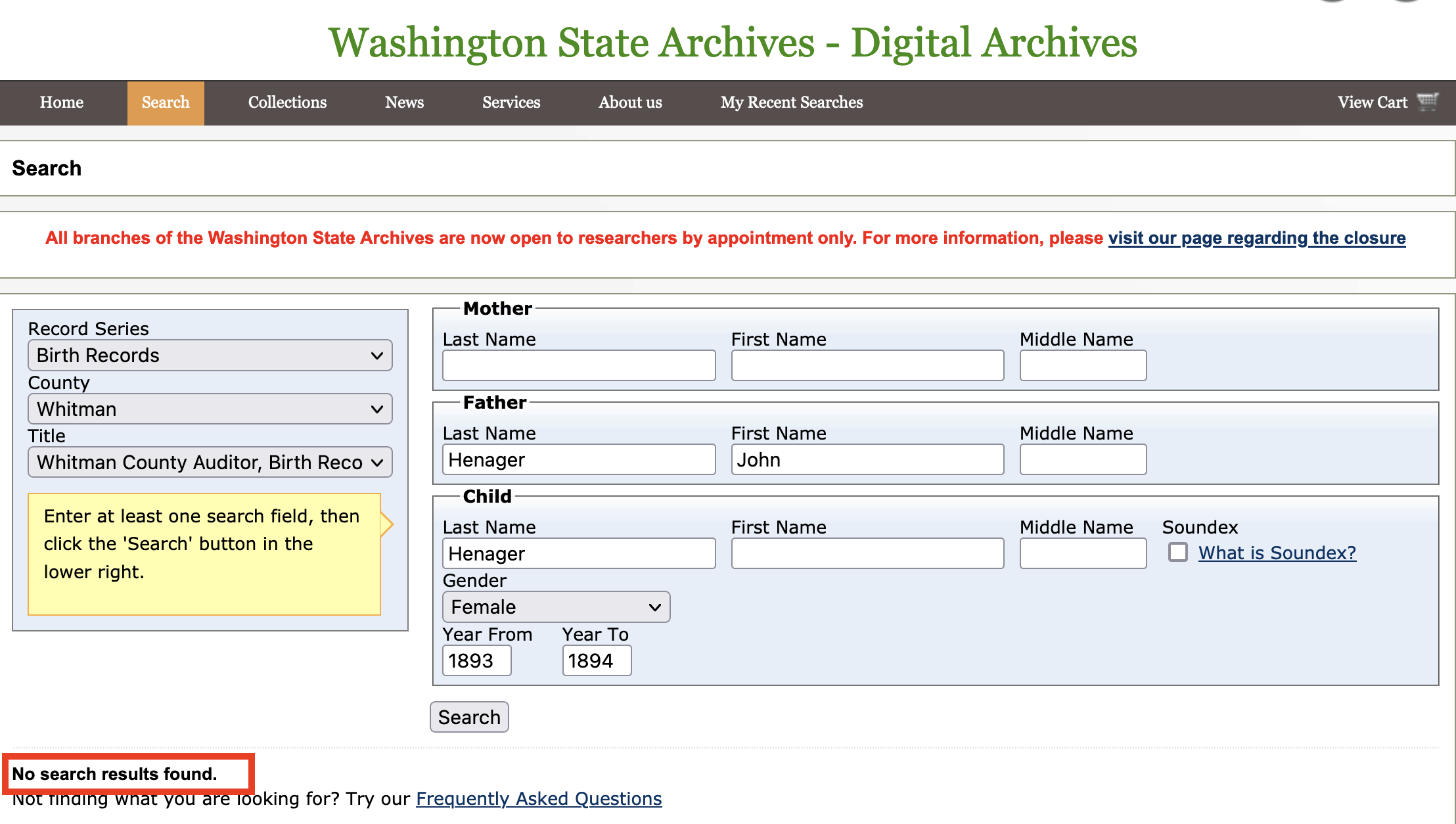
However even though it comes up with no results if you search manually by year you can find this:

An odd result. Who is J Iney? We are looking for a Carrie Henager born in 27 September 1893 daughter of John L. Henager and Lucy Jane Franklin. This child has no name.
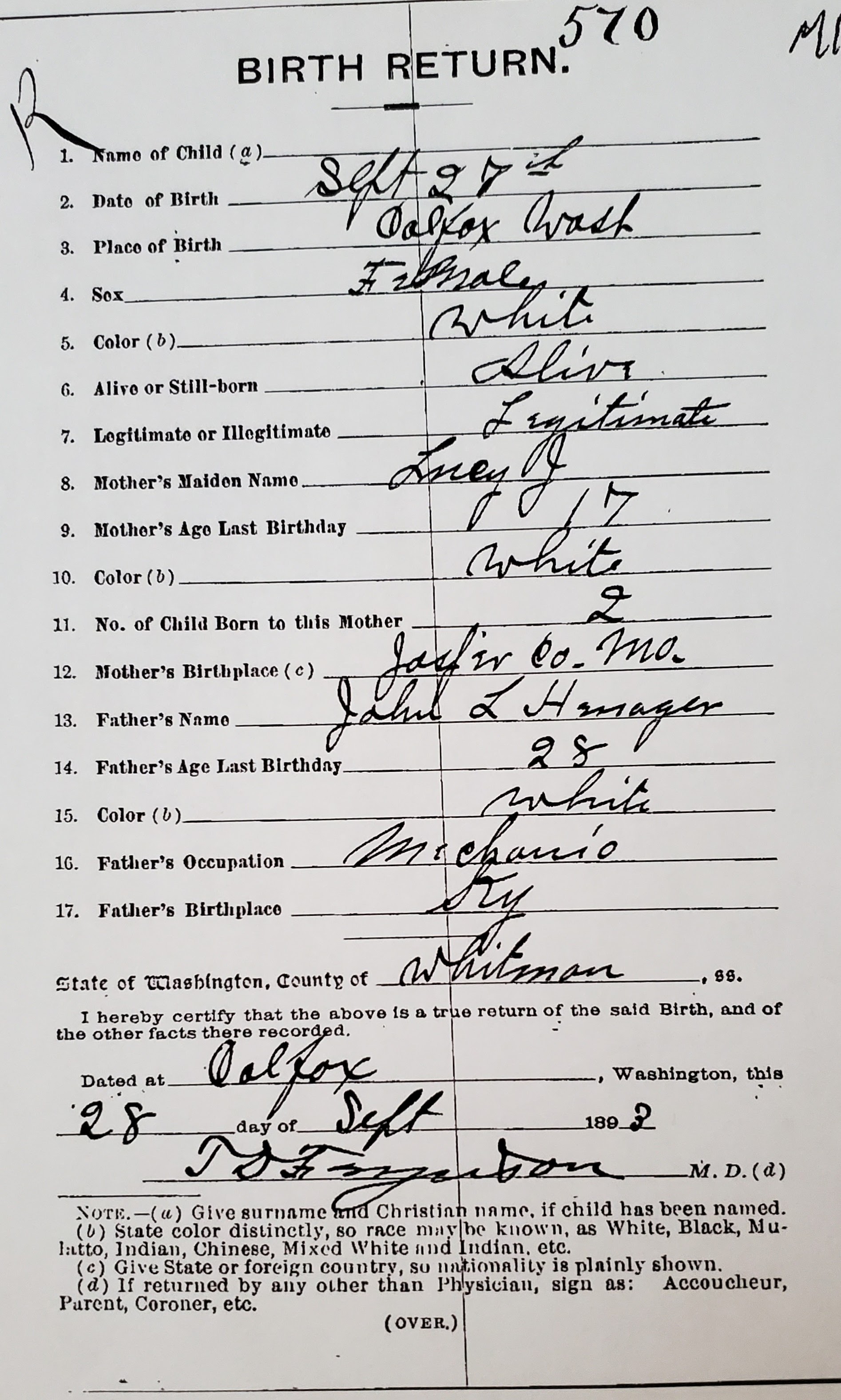
So although she does not have a name on this birth certificate and although spelled properly the record does not show up in the index. Father’s name is correct as John L. Henager and mother’s name is right but incomplete and transcribed incorrectly. The index lists her as “J Iney” but this reads Lucy J which is correct but does not give her full maiden name. Her full maiden name is Lucy Jane Franklin.
What is the moral of this story? Records are funny things.
- If you know a thing should exist try, try again.
- Do not rely on indexes alone.
- Always try to review the original record.
Kelly Wheaton Copyright 2021. All Rights Reserved
Confessions of a Rabbit Hole Genealogist: In Defense of Inspired Genealogy
Posted on June 19, 2021 3 Comments
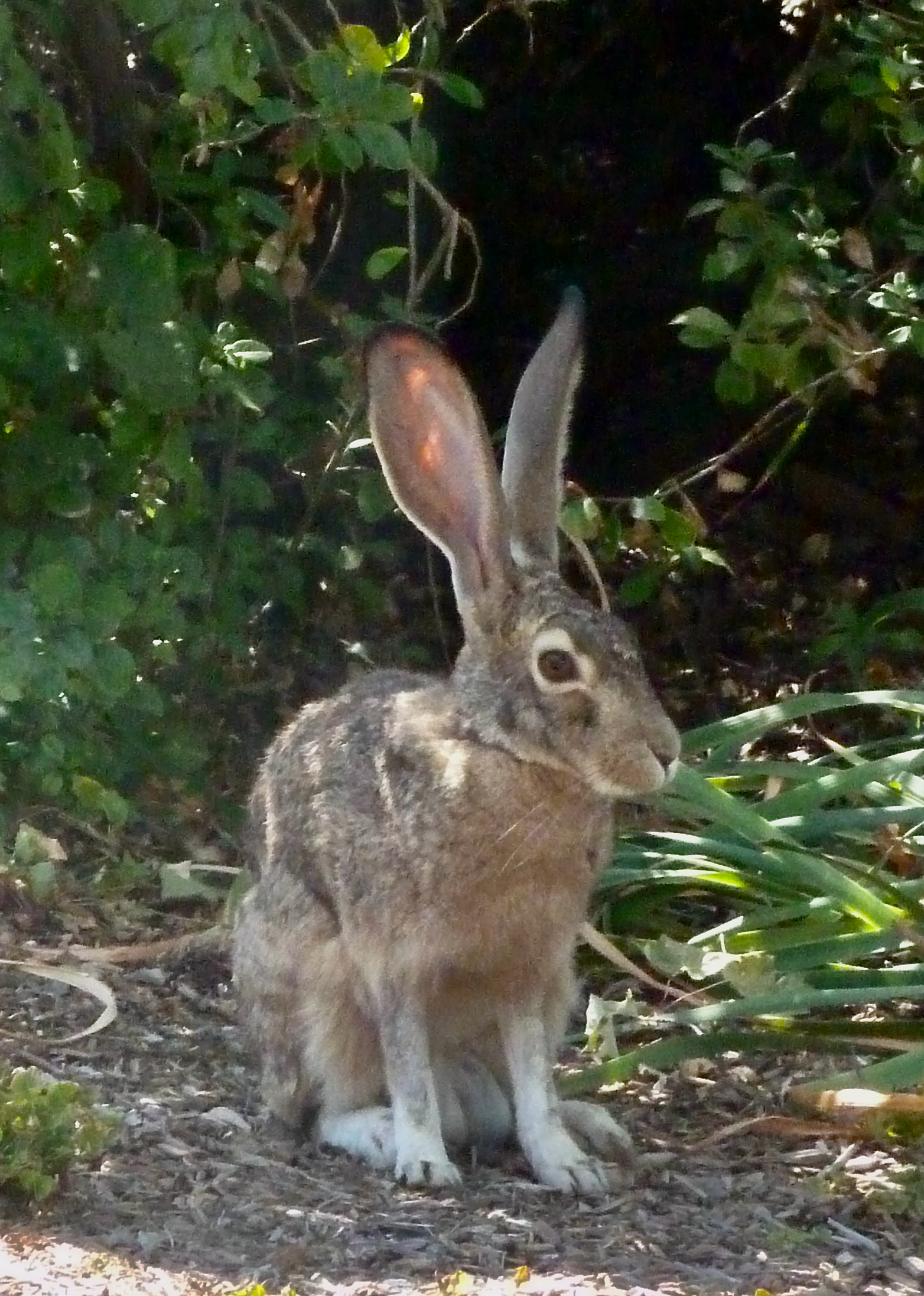
This post has been brewing for at least a decade. It won’t be long that I will be celebrating a half century of pursuing genealogy. I have learned much over these many decades but still I feel guilt every time I read an article about how to do genealogy “properly.” What finally brought this to the fore was a post in January of 2019 by Paul Chiddick, “Top Ten Sin’s of a Genealogist“. I am certainly guilty of Sin 2: “Not noting every search” and Sin 5: “Adopting the scattergun approach”. More on these later.
So here is my confession, I don’t think I ever shall do genealogy “properly.” I do not disparage all of you who do manage it quite well. Those who follow the rules and proper protocols and carefully document based on the Genealogy Standards of the Board for Certification of Genealogists. (And yes I do have a copy and do endeavor to cite properly), but let’s face it, some of us are just not cut out for always following the rules. It’s not that we don’t know how to color within the lines, or stay on task…we do. But we just can’t be depended upon to always do so. We start off on one path and before you know it we are following rabbits down holes hither and dither. Even our most carefully constructed research questions might take a U-turn and we end up somewhere completely unexpected.
Ah, but before I lose you dear reader I want you to know I am not disorganized. Far from it. When I go to the The Family History Library in Salt Lake City or any Archive for that fact I peruse the catalogs before going and have very organized checklists of all the resources I want to consult. Generally when I am limited for time I grab all the books off the shelf I can mange in a certain section, take them to a table where I bookmark pages for photocopying or scanning and then proceed to scan or in some cases photograph. I do not stop long to evaluate what I am copying if I will be there for more than a day—that’s what night’s are for! I always start with the title page and copyright pages. For printed pages I do very well with keeping them together and filing them (eventually) but digital files are another matter. Sometimes it can be months or years before a file gets named and put in its proper place. I should be better but I am not. And I have come to the sad truth that I am not likely to change for the better.
There are plenty of books and blog posts to keep you on the straight and narrow. They will urge you to stay on task, and they may be right to do so. What I want to explore with you is that inspirational and unconventional approaches to genealogy may be just as fruitful and may be more in tune with your natural style. I just finished a Zoom genealogy research session and when faced with a given question the four of us went out searching in different directions and what happened is those different directions and ways of doing things offered new perspectives and new bits of information. Had we all done the same thing the results might have been less rewarding. When we drive home the exact same way we miss things that we might have seen had we taken a different route or saw the world anew from a different perspective.
I am not a cook but I do like to bake. If you are given a recipe you can follow it precisely or you can be innovative and try different ingredients or experiments. They may improve the final product or they may not, but the experience definitely informs your future baking. It is as much art as science. The same can be said for genealogy.
This came up in our Zoom today. The forgetting of a resource we had visited before. Remember Sin 2 above: Not noting each search. I still have a dozen pages or more of my first few years of noting my searches on Research registers. It’s a great idea in concept—but practically speaking—it would take me more time going through all my previous searches and determining whether I had looked there before than doing the search again. And here is the benefit of doing the search a second or third time—we do so with more experienced eyes. Not to mention the originals may be enhanced or give a better reproduction. Maybe when I searched the 1800 census back in 1975 at the National Archives branch in San Bruno I got excited after scrolling through pages and pages of microfilm when I finally found who I was looking for. Maybe I didn’t look at the rest of the town for others that might be related to my family—but maybe in 1995 I would check the indexes for other related families. And perhaps if I searched on Ancestry, Family Search or My Heritage today I might spend some time just perusing the pages looking for anything that “caught my eye”. I have found that going on instinct and revisiting past searches almost always yields more bountiful information and understanding. When we start out in genealogy we don’t know what we are looking for and often collect too much or too little. When we go through our binders or folders, or online files with fresh eyes we see things we missed years ago. Or sometimes we re-remember them. We chide ourselves for ending up here again. Oh I already copied that. I already decided that was not my family, etc. But then there are the aha moments. “Well, will you look at that, she was married to John Smith before she married his brother Abel.” Or, “Oh dear how could I have missed that she died before that child was born, she can’t be his mother.” What is obvious to you today may not have been obvious to you then. So who cares how many times we retrace our steps, if every now and then we find something new?
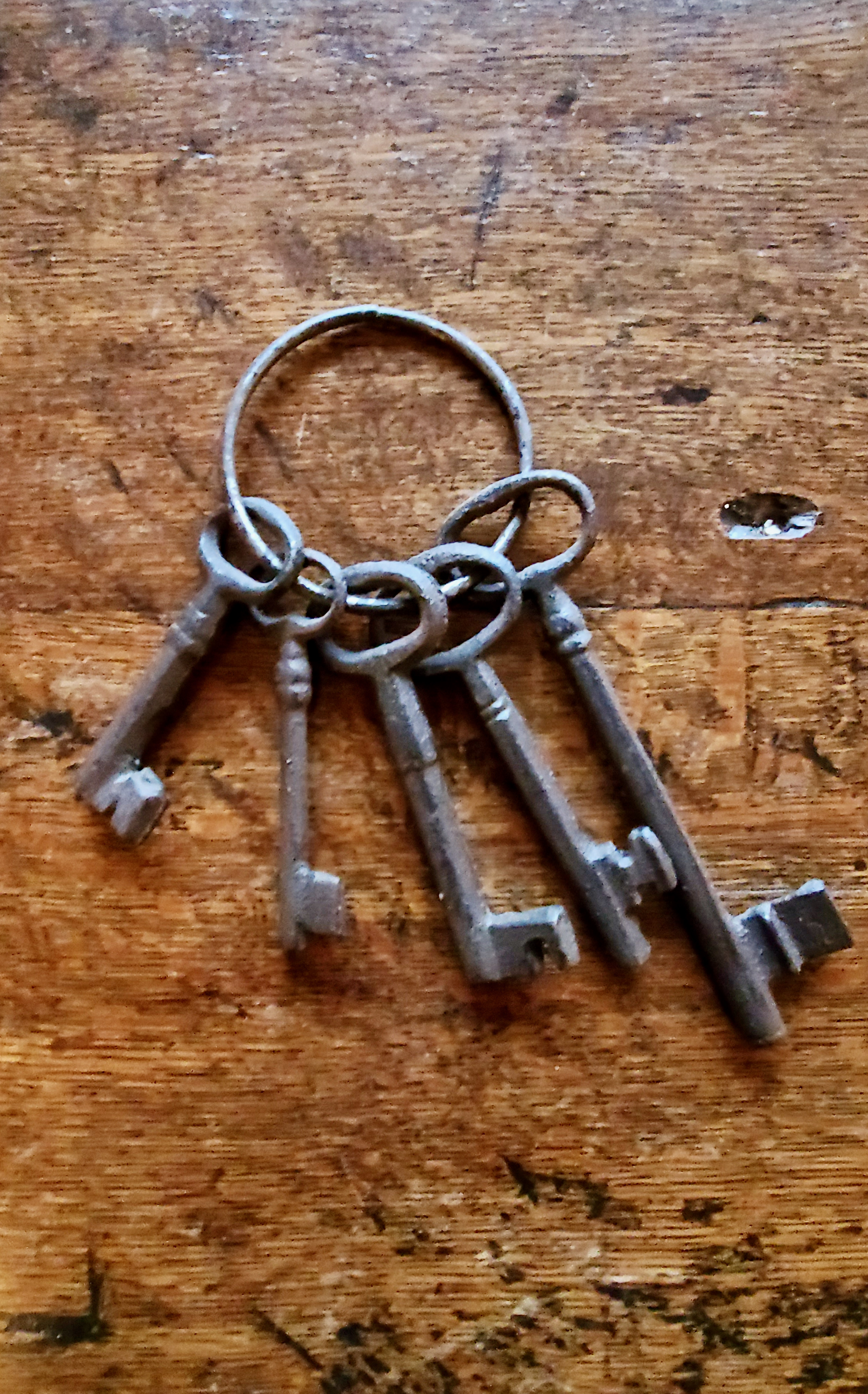
So what is inspired genealogy? It’s going to be different for each of us. It is the instinct or imperative to follow our nose, to explore a subject more fully, to chase the elusive clue. Sometimes we end up far afield from where we started. Some find this approach terribly distracting and annoying. I love this sort of research. Rather than think of it as lost time I always feel it inspires me. Many is the time I have been looking for one family and just by happenstance ran into an unexpected record of another relative from a completely different part of my tree. I liken it to when you are expecting or a family member is, and suddenly you see expectant mothers and babies everywhere. Some one hands you a ring of keys. Two of the keys you know where they fit but the other 3 you have no clue. So do you throw out the keys? Not me. Fifty years and I periodically look to see what chest, door, cupboard or record they may unlock. I depend on some inspiration or intuition to remind me to check the key at the proper time. This is my own version of the scattergun approach. The throw the spaghetti on the wall and see what sticks. Cast a very wide net. And I never stop trying—especially with those brick walls. I know you have tried the key before but when you go to try it again you might see something you missed the ten previous times.
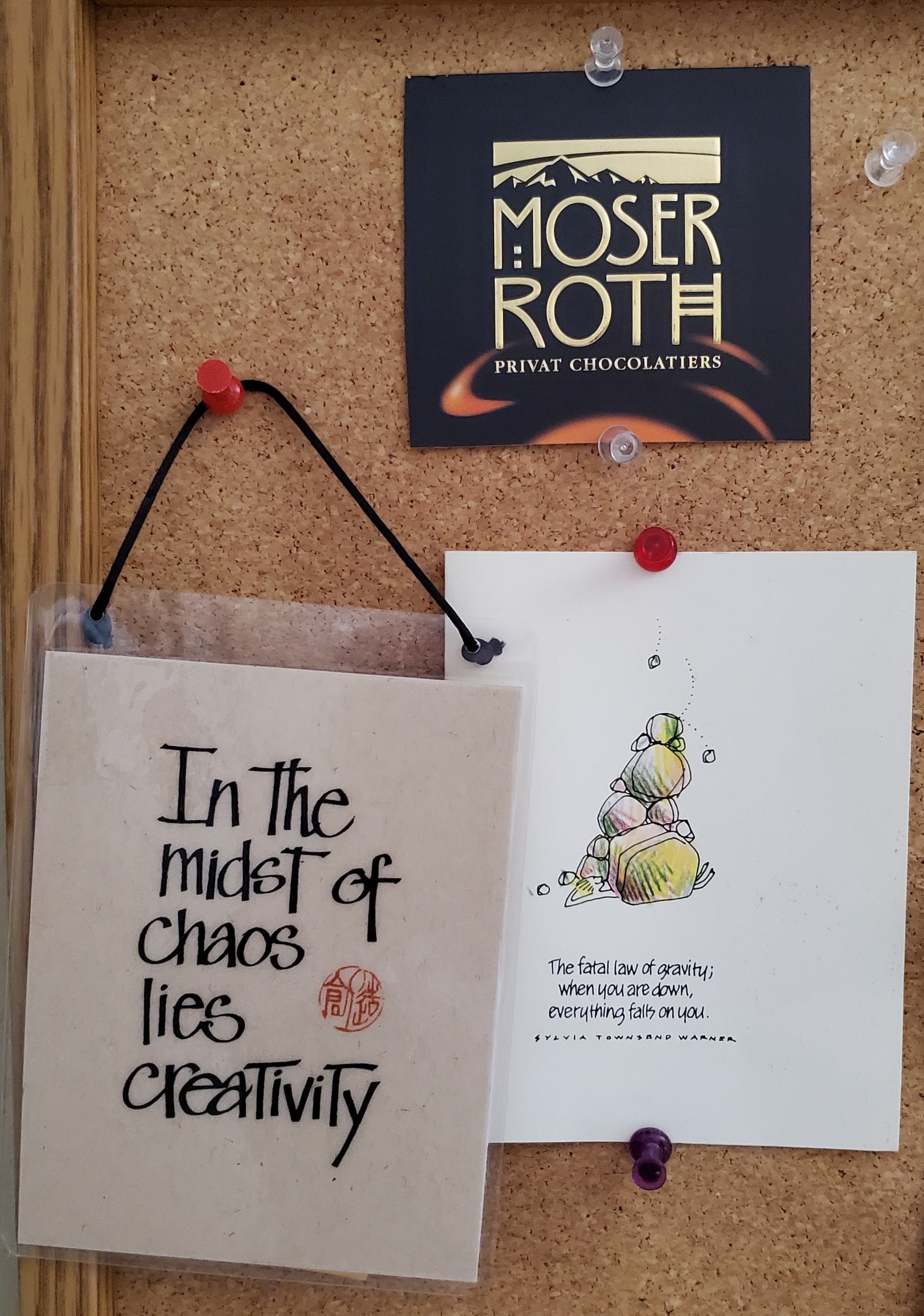
My deepest dives in a subject, are the inspired ones. They are the questions I ask to explain the why of the story. Why did the shoemaker and his brothers and sister from a small village in Germany immigrate to Philadelphia? Why did my great grandmother marry at 14? What were the circumstances of my two 2nd great grandfather’s Civil War service. Asking those questions means lots of contextual research. It can lead you to forums, ebay searches, books and documents you never would have consulted otherwise. Yes, this leads down rabbit holes. The truth is you aren’t going to find the richest records and the best maps and the most interesting stories without the willingness to go down dead end streets and ’round corners where you lose your way. I am writing to say this is okay. If you are like me, and enjoy a good hunt down the rabbit hole, celebrate your perseverance and inspiration. It’s okay to do genealogy any way that works for you. I am at times sloppy and inconsistent. I have decided nearly fifty years in—this is how I work best. Below is a photo of a corner of my bulletin board which illustrates my recipe for genealogy: 1 part chocolate, 1 part chaos, 1 part reality. Find out what feeds you and do it. Don’t spend another minute playing could’ve, would’ve, should’ve. If you manage to resurrect one lost story, solve one inexplicable riddle, or straighten out out one tangled part of your tree, then celebrate the journey that led you there! If you took the long road whose to say who had the better journey?
Book Recommendation: Bringing Your Family History to Life through social history by Katherine Scott Sturdenvant. Copyright 2000.
Kelly Wheaton Copyright 2021. All Rights Reserved
REFORMED GENEALOGISTS: Turning Trees into Stories
Posted on June 18, 2021 11 Comments
This sprang out of a 2015 Facebook post. Then I created a webpage in 2020 but for those who haven’t seen it, here goes.
A REFORMED GENEALOGIST is one who has moved from filling in their Family Tree—-to making the tree bloom through the telling of its family stories.
- A Reformed genealogist pledges to make unearthing the past and resurrecting ancestors their primary goal.
- A Reformed genealogist shares with others freely, without excuse. This is the best insurance their legacy survives. Ancestors are shared: so too shall be their stories.
- A Reformed genealogist knows nothing is ever perfect, complete or without need for improvement, we are undeterred by such odds.
- A Reformed genealogist pledges to write at least one story each year.
- A Reformed genealogist travels in person or through cyberspace in search of whispers of the past.
- A Reformed genealogist finds joy in reconnecting our life histories to that of our ancestors.
- This page began as a post on the Organized Genealogist FACEBOOK page in September of 2015. Within minutes there were more likes and comments than I have ever had to a post, anywhere. That suggested I had hit a nerve. Here is the post.
“This is for NEW GENEALOGISTS or those looking to revamp their systems. First I apologize for sounding like a broken record. I have nearly 45 years of experience so I have seen/done it all. Most of the systems for organizing are just fine when you start out or even ten years in but somewhere along the line the color coded, numeric, alpha numeric, file folders, binders etc is going to break down.
You may be able to remember 200 ancestors and where they fit into your tree but you aren’t going to remember 10,000. Computerized programs are nice for that. When most of us start doing genealogy we may not have a well thought out GOAL and so the plan to achieve it leads to a breakdown in organizing. As we get older our goals change. We no longer are worried about filling in every blank and shift as I have to telling stories. Perhaps individual 9457 means something to you or FT436. Great. But ask yourself what is this going to mean to your children, grandchildren etc. If they are going to look at all your hard work and either not be able to make sense of it or worse yet not care….then what you have done is fascinating and it may be beautifully arranged but if it isn’t retained or read— well it was just a nice past time.
What is most compelling about genealogy is the STORIES. Not names and dates but a ticket stub from the World’s fair where grandma met grandpa. Its letters, diaries, photos, its knowing that great grandma married at 14 and searching to find out why. If you start NOW to organize with the idea of telling these stories I guarantee, not only will you be happier, more organized and your research more focused—but so will those that come after you.
You can use any system you want but please think about the stories. Perhaps you have a binder or binders that are organized by surnames, or Irish immigrants or Revolutionary war Veterans. Just make sure to put all the information on any individual or family together. That means everything, not photos here, census there, birth certificates in that folder.
Think of it this way…..do you want to be scattered across files, boxes, cabinets? A bunch of vertebrae in that box and hip bones on the other shelf? If a forensic scientist was trying to reconstruct your skeleton would they not lay out all your bones, put them into order and then if they were trying to reconstruct your life and what you looked like they would slowly add meat to the bones.
Your job: should you choose to accept it, is to resurrect the people that made your life possible. Choose the ones that call to you and start assembling them now. You will be happier and all those that come after you as well. Trust me on this. Organize to tell stories, do not tell stories of how wonderfully you organize!”
“As a reformed genealogist I have come to realize that names and dates or even photos without context are nothing. It’s who the people are and the stories that need to be recorded that we need to focus on. We may have boxes of photos, but unidentified and devoid of context, they will be lost to our descendants as unknowable.”Random Researching for Reformed Genealogists: Ways to enhance and research your stories
- Look to free websites like Chronicaling America for newspapers on the date your ancestor was born, married etc.
- Look to state archives for photos, maps diaries that may be relevant to your ancestors lives.
- Postcards are often a great way to find illustrations of a village, town etc where your ancestors lived.
- If your ancestor was a member of the armed services, a fraternal association, alumni of a school, member of the clergy: do a web search and see what you turn up.
- Check Wikipedia: information, maps and photos you may use in your stories under of the Creative Commons Licensing Agreement.
- Do a Google search. Maybe your ancestor worked at a garage in a small town. Give a search a try– you might get lucky.
- Look on Ebay, yes Ebay.
- Do a search of your local library’s card catalog for places your ancestors lived. Do not reject fiction as a source material. Historical novels are particularly rich in getting you into the feel of the time. Movies are good too. If you don’t like reading, try books on tape.
- A picture is worth a thousand words. Break up your story telling with photos, maps, deeds, ephemera.
- Less is more. Good story tellers know that editing is key. Make the words count, don’t count the words. A tight 3 page story is better than a 30 page essay that no one will read.
- Many historical books that are out of copyright are available on-line. These are sometimes obscure manuscripts that you would never have found in a million years.
- Children’s books are wonderful sources of information. They often use out of copyright illustrations, wood block cuts and photos in the public domain. Once you find such illustrations you can often do a web search and download them for your own purposes.
Kelly Wheaton Copyright 2020. All Rights Reserved
 Wheaton Wood