The Pen is Still Mightier than the Sword: A Soprano’s Aria Chapter 8
Posted on September 15, 2021 Leave a Comment
Jan 1, 1914 New Year day dawned bright and sunny after so many days of rain. Albert went over to the Fair grounds and saw Beachy do his loop stunts in the air over the bay. Uncle came up to supper. Albert and Uncle are thick as molasses in January in Duluth, not S.F. They have gone down town. 10 O’clock nervous, cant sleep. Wish I could. Good night.

Jan 2 Wrote to Jessie Kendrick . Made F.S. a pair of working mits. Sleepless night of nervous misery.
Nov Jan 3 Got sack of Sperry flour. Baking late. Watching Mrs Ross’s bread. Got long looked for letter from Mother. Will ans. today.

Jan 4 Sunday Walked over to the fair grounds and saw Lincoln Beachey make his record breaking fly and loopping the loop 7 times in the air over San Francisco Bay. Returned through Presidio. Long and tiresome walk but very pleasant though.
Jan 5 Absolutely played out from long hike yesterday. Stiff and sore in hip joints. Franks sore finger developed into a painful felon. Raved from 6 until 10 o’clock p.m. when Dr Salmon came and lanced it. Great relief. Went to Dr. again Tuesday and Wed Jan 6 an 7. Bad finger out of work. Bad outlook. Crocheting grape motifs. Baking bread. Wrote to Leo.
Jan 8 Usual Routine
“ 9 Wrote to Mother. Frank worked.
“ 10 Washed and baked bread. Went to market. Retired, tired. Read ed.
Jan 11 Sunday Sunny, cold. Uncle came to dinner. Albert worked at the Portola Theater.
Jan 12 Mon Rainy. Frank started to work. Not certain of success.
Tuesday 13 More rain. F.S. couldn’t work. Spent day chrocheting. Baked bread.
Wed 14 Finished “Blue and Grey” doiley 2 round. Usual routine.
Thu 15 Wish it was friday. Long dreary week. Spent the time pleasantly making doileys. Todays was gray linen with great french knots.
Fri 16 Received a letter from Dewey. Would love to see them all. Made fancy work apron and Baked bread.
Sat 17 Did a wash and dried it in the house. “Lulus Home System” 1 gal tub. 1 glass borax. 1 dishpan. 1 pail forms my entire outfit. Pouring rain. Left-elbow lame.
Sun 18 Quiet uneventful day. F.S. worked at the shop. Uncle came down for a few hours in evening. He had been out to supper with Albert who is ushering at the Portola sat and sun while attending Polytechnic High School.
Mon 19 Baking day. Flour didn’t arrive until 12 p.m. with 2 cakes compressed. Had beautiful rolls for supper and bread out at 9. Sperry flour very good. At 5 O’clock p.m. Milo and Donald met with a serious accident while burrowing in the base of a sand bank. It settled down upon them leaving their legs exposed from their knees. Their violent attracted the attention of some laboring men a block away who hastened with their shovels to dig them out. They were unconscious but soon came to. A very close call and a warning.
Tuesday Dec Jan 20 Got up late. Violent disturbances in the domestic circle which caused old almost forgotten pain in left breast in area of heart to reappear. I never feel this pain excepting after one of these insane outbursts of my partner in joys and sorrows chiefly the latter. Cold and cloudy, the day opens with a dreary aspect. I want to ans the letter I got from the girls at home yesterday.
Wed 21 Wrote and mailed letter to the children. Ordinary duties performed.
Thu 22 Our eldest boy Albert is 24 years old today. Lolita gave him a part of a fine Waterman fountain pen which he will replace with new parts and Agness D. gave him a fine silk handkerchief.

Fri 23 Quite a little earthquake shook us up while at dinner. Some quaking people also. No damage.
Sat 24 Frank came home with $15.00 the most he has made in one week since we came here in Oct. I and Lolita washed clothes.
Sun 25 Brought in wash out of a drenching rain all streaked with dirt. They smell sweet at least. Baked some sour bread. Albert is at the Portola. F.S. gone for a walk.
Jan 26 Mon Wrote to Newman sending lodge dues. Milo took it to the P.O. and bought his first Post Office Money Order and mailed it.
Jan 27 Baked seven loaves of bread and washed clothes
Jan 28 Wed Franks hand worse. Went to Dr. Salmon and had it lanced again. Cut Ediths jacket.
From Jan 28 until present day Feb 11. Things have mooved along pleasantly. The weather has been exceptionally fine, sunny and bracing. I have not been out-dooring during this time except over on Haight st marketing. On Feb 3 Eilenes birthday we sent her a post card shower, some letters and a stick pin. Have received letters from children Mother Mosier and Uncle Lum. Have finished Mrs Ross’s sewing receiving $3.50 for same. Also received Newman’s receipt for lodge dues. Ordinary grind of the household mill today. Baked 6 loaves white + 5 loaves raisin bread yesterday.
Thursday Feb 12 Spent day doing housework and in afternoon went upstairs to hem towels in Mrs. Ross’s apartments.
Fri 13 Was quite lucky for me. I did a big wash and got it dried fine.
Sat 14 Valentines day. Didnt get any. Or send any. Ironed cleaned house. Did some shopping in evening. Got a “Priscilla” [New Testament study?] and my shoes at the repair shop. Milo went to Mt. Tamalpais with Don + Billy. Had a splendid time.

Sun 15 Fine weather continues. F.S. did some pipe work for a man. Rec’d magnificent sum of $1.00. Uncle came up in evening for a short stay.
Monday F. 16 Received letters from the children in Minneapolis. Wrote to Uncle Lum. Cloudy and a trifle lonesome. This fountain pen is “der limit.” Been studying the new Priscilla. [The pen used is quite broad tipped. Up until Nov 3, 1913, this journal was almost entirely in pencil and is almost entirely in pen from this point forward. The Feb 12 entry marks a significant positive change in quality of penmanship which may be what is being referred to here.]
Tuesday Feb 17 Did some shopping on Haight. Talked with girl at store about Irish lace collar. Hope I can sell her one. Spring in the air, smells like rain. Wrote to children. Gas escaping at 2 a.m.
Wed 18 Rainy in morning. Sunny at 10. Housework and crocheting. Baked 6 loaves of bread and tin of biscuits yesterday. This writing is done with pen mentioned above after I sharpened it on a file. All children in school. F.S. at work at Dolans at same old wages, just enough to keep us guessing. Spent entire aft. and eve crocheting.
Kelly Wheaton Copyright 2021. All Rights Received.
Good bye Old Year, More Joy to the New: A Soprano’s Aria Part 7
Posted on September 14, 2021 Leave a Comment
1913 Nov 3 Monday Went down town and did a little marketing. Bought a salt and pepper box.
Nov 4. Tuesday Worked on rug all day. Rained some.
Nov 5 Wednesday A blue day. Wrote to Emma and worked on my rug. Some sun and rain.
6, 7, 8 Unusually dull and monotonous.
Nov 9 Anniversary. Passed uncommented upon and without event. From this on until my Birthday nothing unusual occurred to warrant especial mention but the fact of my continued ill health which I apparently brought with me from Minnesota.
Nov 16 Got a beautiful birthday card from Leo and the others which bore news of Emma’s fathers violent death by shooting.
The remainder of Nov was spent nursing a very bad case of Bronchitis complicated with liver and kidney trouble. Utterly miserable with a terrible cough and intermittent fevers and chills. I took but little notice of passing events, kept indoors and did what house work I had to, kept the children in school and Doctor’d myself to save money.
Nov 27 Cooked the turkey. Had Uncle to dinner. Felt little like eating.
28, 29, 30 Dec 1 Slowly convalescent.
Dec 15 Went down town and signed bill of sale of furniture and sent it to Leo
Dec 16 Went down town and walked all over hunting Minneapolis flour. Found it at last at the Emporium.

Dec 17, 18 Worked on susette bows for Jessie and Eilenes Christmas in the evening of the 18 on thu. Uncle came down and we all went to the exhibition of the Polytechnic High School. Very interesting indeed. Had a fine walk to and from and enjoyed the change.
Friday 19 Spent the day chrocheting. Some rain. Beautiful december weather.
Sat Dec. 20 Feeling better. Washed clothes and dried in side, raining
Sun 21 Finished Irish Jabots for Jessie and Eilenes Christmas
Mon 22 Bread out of oven at 8 a.m. Got letters from Eilene Dewey and Mother Mosier. Went down and mailed Christmas parcel to children in Minneapolis. Bought Milo a scroll saw. Made F.S. a pair of Khaki mitts by hand. Got supper made and apple turnover for Lol’s lunch and cut a pattern for Milos pants. Wrote a letter to Mother Mosier. Some day, believe me.
Dec 23 Worked on Milos pants. Milo made a Christmas wreath.
Dec 24 Paid Examiner bill which depleted my Ch. money just 75¢. Finished Milos pants entirely by hand. Made them out of an old coat. Uncle came up in the evening.
Christmas Dec 25 1913 At Mrs. Ross house at 1712½ Fell st. San Francisco. Without the larger part of my family was a little strained at first but wore off when we got their blessed night letter wishing us good cheer. Our little mutual gifts were duly appreciated and admired. Uncle Wm Pettie came to dinner which he praised. [William & Elizabeth Ross lived at 1712 Fell St. & a Charles Ross at 1712 Fell who worked for Shreve & Company, Jewelers]
26 Nearly sick from overwork on Christmas. Resting up.
27 Sat Work occupied the day. Sent Mrs Newman her Forrester dues. Did some marketing and went to bed.
Sun 28 Lolita went up to the stadium to see the big out door Christmas tree. Uncle came in afternoon to dinner and then we all went down to Lottas Fountain at Market and 3rd to hear some outdoor singing and speaking.


Mon Dull day. Started crocheting a new pattern for a coat set
Tues. 30 Did a big wash 6 sheets 2 bedspreads 2 tablecloths etc. Dried them all in house on account of rain.
Wed 31 Last day of old never to be forgotten 1913. Some joy, more of grief marked the passing of the days in Columbia Heights. Hope has found a new house in my heart since coming to this blessed clime. May the reign of lawlessness which terrorizes our fair city soon give place to peaceful security. Third day of heavy rain, rivers full, tides high. City full of unemployed mostly transient men. Baked bread, ironed some. Crocheted Lolitas new doll a hood. Just a wearyin for my absent ones. Wish they may come early in 1914. Good bye old year, more Joy to the New.
Kelly Wheaton Copyright 2021. All Rights Reserved.
Gentle Genealogy: More Discoveries, more Delight, less Drudgery
Posted on September 14, 2021 Leave a Comment
Sounds great, right? Well I found this out as a side effect of becoming a Reformed Genealogist. All one needs is to shift your focus from collecting and researching: to resurrecting and writing. It’s called a Paradigm Shift. I am telling you it will be the best thing that ever happened to you, as a genealogist. A side benefit your family will stop rolling their eyes everytime you start talking Genealogy. Please don’t cringe at the word WRITING. I didn’t know how to write when I started, either. Stop concentrating on the writing. Just listen to your ancestors and agree to tell their stories.

Gentle Genealogy isn’t about rules and have to’s. It’s about enjoying the journey and the people you meet on your trip. In your life, when you meet someone new, do you ask: Can you tell me the date and place of your birth and the names of your parents? And may I please see your birth certificate? Well of course you don’t. If you are simply collecting ancestors to fill out your tree that’s pretty much what you are doing. If you are a “proper” genealogist you will get down every document, record all sources and have a huge collection that no one will ever look at, save you. Jolly good!
Delightful is meeting someone and learning something interesting about them. It’s finding commonalities or finding they have a story to tell. You will learn a lot from their stories, as you begin to care about them as real people. You will want to figure out all the supporting bits that help you tell their story. You may be doing more research and documentation than ever before, but instead of it being DRUDGERY, it can be DELIGHTFUL. The focus is on placing your ancestor within the context of their own lives. You need to see where they lived, how they lived. What was happening of historical significance. You need to understand that he lost two brother’s in the Civil War. Did he have survivor’s guilt? She married at 14 was she pregnant? Context matters. Now most genealogy teachers will emphasize this. However, with a Paradigm Shift you don’t need to be scolded or shamed into doing it. You can’t write their story without context. You will need to do research, because you will need it to complete your mission. Otherwise, your ancestor will remain dead and buried “six feet under.” Sadly this is the fate of most of our ancestors that fill our family trees. Show me one good story—it’s worth more than a tree full of unripe fruit.
WRITING CHALLENGE
- Pick an ancestor who you would like to resurrect
- Is there anything interesting you already know about them?
- Is there anything interesting about their name? Are they named for someone? Are they a junior? Imagine you are asking them. They can’t speak, but they tap their finger there.
- Locate where they lived. Did they live in a posh or a poor place. A log cabin or a Victorian mansion, a castle or as a servant in a Manor house.
- What story would they tell you about themselves? What would they want you to know? What are you going to ask them?
Do you see how this shifts away from collecting bits and allows you to engage in an ancestor treasure hunt for their stories. You are not forcing yourself to write about someone you know nothing about. Or that you or your audience doesn’t care about. You are a detective following clues, filling in the blanks and bringing your ancestor to life.
As for the writing part. First, give yourself permission to muck it up from the get go. Did you do a perfect job the first time you rode a bike? Of course not! The idea is to get to know this ancestor and then in a conversational tone, tell them what you found out. You might literally imagine telling your ancestor (who can’t speak) what you have found out about them. Sounds a bit weird, but try it. Or if that’s too much of stretch imagine your telling your grandmother about what you have found. When you read it out loud to her, you’ll see what’s missing. Will you need maps or pictures to help explain? Can you hear her, yes Kelly that’s right Great grandpa was in the Revolutionary War from Connecticut… As I have mentioned before if writing is just too hard—tell the story and then transcribe it. Do what works for you. It can be short (under 500 words) or quite long. I suggest if this is your first go, pick something doable in less than a week. Don’t bite off the life and times of my grandmother Ida May. Rather let it be “Ida May’s Award Winning Quilt.” Or “How John Stevens Escaped the Grim Reaper, Again.”
The idea is to build on success. If you aren’t having fun, you might need to remind yourself of your focus. It isn’t about you and how well you write—it’s about your ancestor and how to make others care about them, how to make them real. You want your reader—to laugh, to cry, to worry or to want to know more. You don’t want your reader to yawn and stop reading.
RESOURCES TO HELP YOU
- Google Maps
- Rumsey Historical Maps
- Ebay for Postcards of places or things Before 1923 they are in public domain & can be used freely
- Newspaper articles for Free at Chronicling America or The Big Project worldwide, elsewhere by subscription,
- City Registers many available Free online, others by subscription
- Sanborn Fire Maps US, British Library Fire Maps, both Free
- Archives—various archives and repositories with Free online records
- FamilySearch.org Free genealogical records
EXAMPLES
Location, Location, Location: San Francisco: A Soprano’s Aria Chapter 6 An example of Place research using GOOGLE MAPS, Sanborn Fire Maps & Historical maps to illustrate a place someone lived
Pacific Ocean, Golden Gate Park, Paradise? A Soprano’s Aria Chapter 5. Using postcards & historical maps
The Challenge: Tokyo Rose In this piece I put myself in the story defending my father in a historical context. I used the National Archives for this
Cher Ami: A Pigeon & a Poet This is a very short piece that includes a poem my grandfather wrote, a photograph from the National Archives and a photograph I had of him.
A Tale of Two Soldiers A long piece that took a couple of months to put together using lots of resources
Kelly Wheaton Copyright 2021. All Rights Reserved.
Family History Writing: Sequencing Challenge
Posted on September 13, 2021 2 Comments
I have an issue with sequencing. Many years ago this was diagnosed during a learning styles assessment. Do you remember in grammar school where you read a story and then had to put a series of items in the order in which they happened? Well I could never do it. Only if there was a cause and effect could I get close ie.: Mary was carrying the eggs– the eggs splattered on the ground. This was a distinct disadvantage in school and also in “telling” stories and jokes out loud. However it has been helpful in several ways.
- I don’t get hung up when movies or books jump around in a non-linear fashion
- I have to stay organized in my genealogy, often making spreadsheets to keep track of what happened & when
- I approach writing from an arguably more creative way
When we read most stories about an ancestor they most often follow a very linear approach. So and so was born on X date to these parents. They married, they had these kids and then they died. Occasionally an online tree will have them dying before they were married. Or the parents being born after their children, but usually it follows a fairly predictable pattern.
For this challenge take either a story you have already written or one you were thinking about writing and I want you to purposely place the details out of sequence. Why I am asking you to do this?
- It will make you think about what you want to highlight in the person’s life
- It may lead to things you hadn’t thought about (the BIG WHYs: why did she do that, why did he move, take that job, etc)
- It forces you to be more creative—thus less predictable
- It makes your writing more interesting to read
A made up example:
June hated getting up on stage. The first time she did it she nearly fainted. It was at PS 97 in Brooklyn and she was the Tin Man in her school’s production of the Wizard of Oz. Her mother used to say she was a born actress…
June was born 17 June 1944 to Mary and Joseph Callender. She was the eldest of 4 children….
The point is to breath life into your stories. Give it a try and see where it leads.
Kelly Wheaton Copyright 2021. All Rights reserved.
Location, Location, Location: San Francisco A Soprano’s Aria Chapter 6
Posted on September 13, 2021 1 Comment
BACKGROUND
The location of the Mosier residence in 1913 deserves some attention. The flat that Allie secured for them at 1712 1/2 Fell street was quite a wonderful location. Frank may not have had a job for the first few weeks but they had a centrally located flat across from the panhandle. The “Panhandle” is an extension of Golden Gate Park that goes in a Easterly direction at a much reduced width from the park proper, making the park look like a giant rectangular frying pan. To this day its beautiful victorian buildings are revered as part of San Francisco’s “Painted Ladies“. The term refers to the beautiful painted buildings as well as San Francisco’s history as a Gold Rush town replete with Houses of ill repute. Some of the most heavily photographed are those that surround Alamo Square Park which is the green square on the map below to the NE of the panhandle.

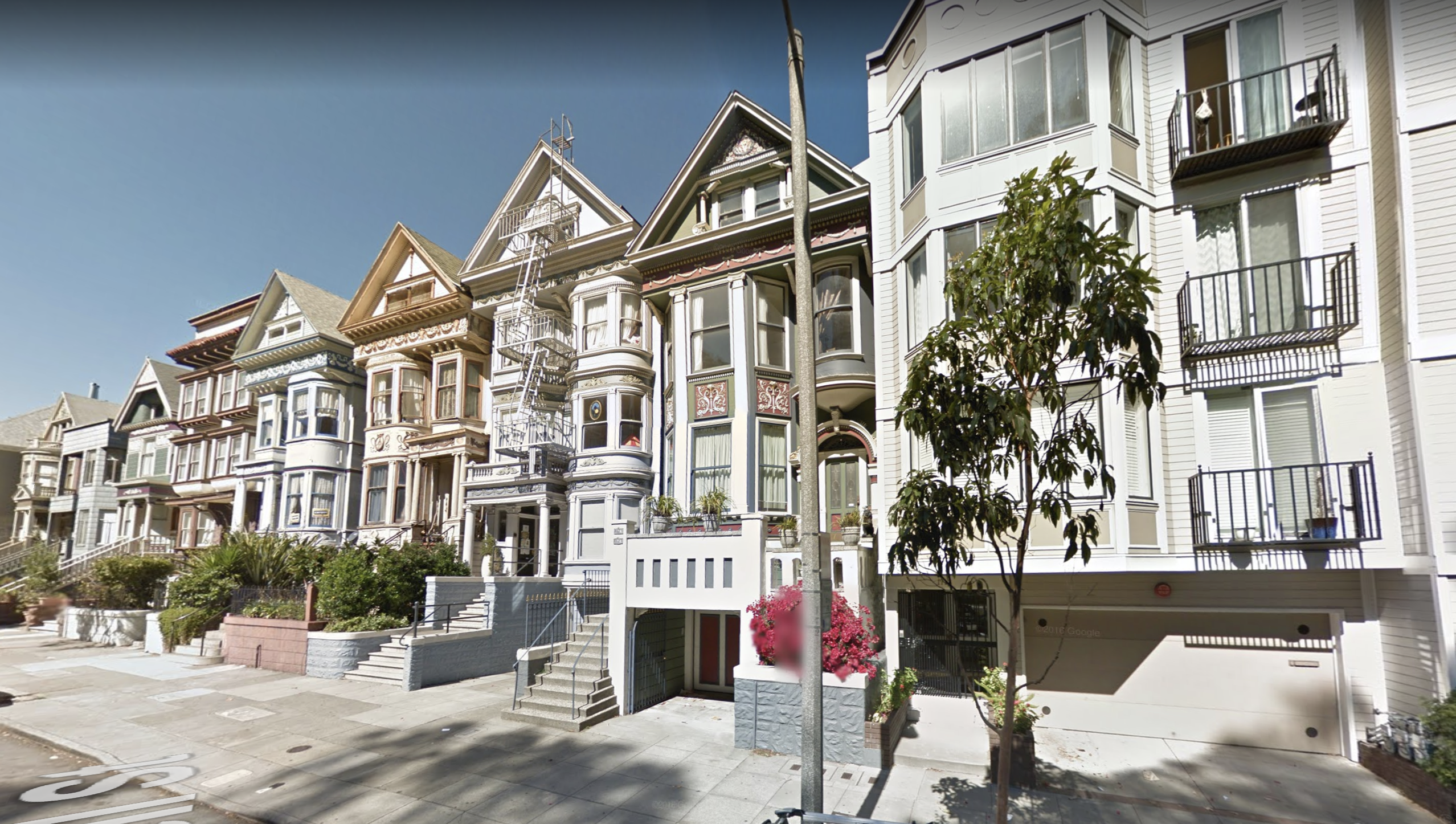
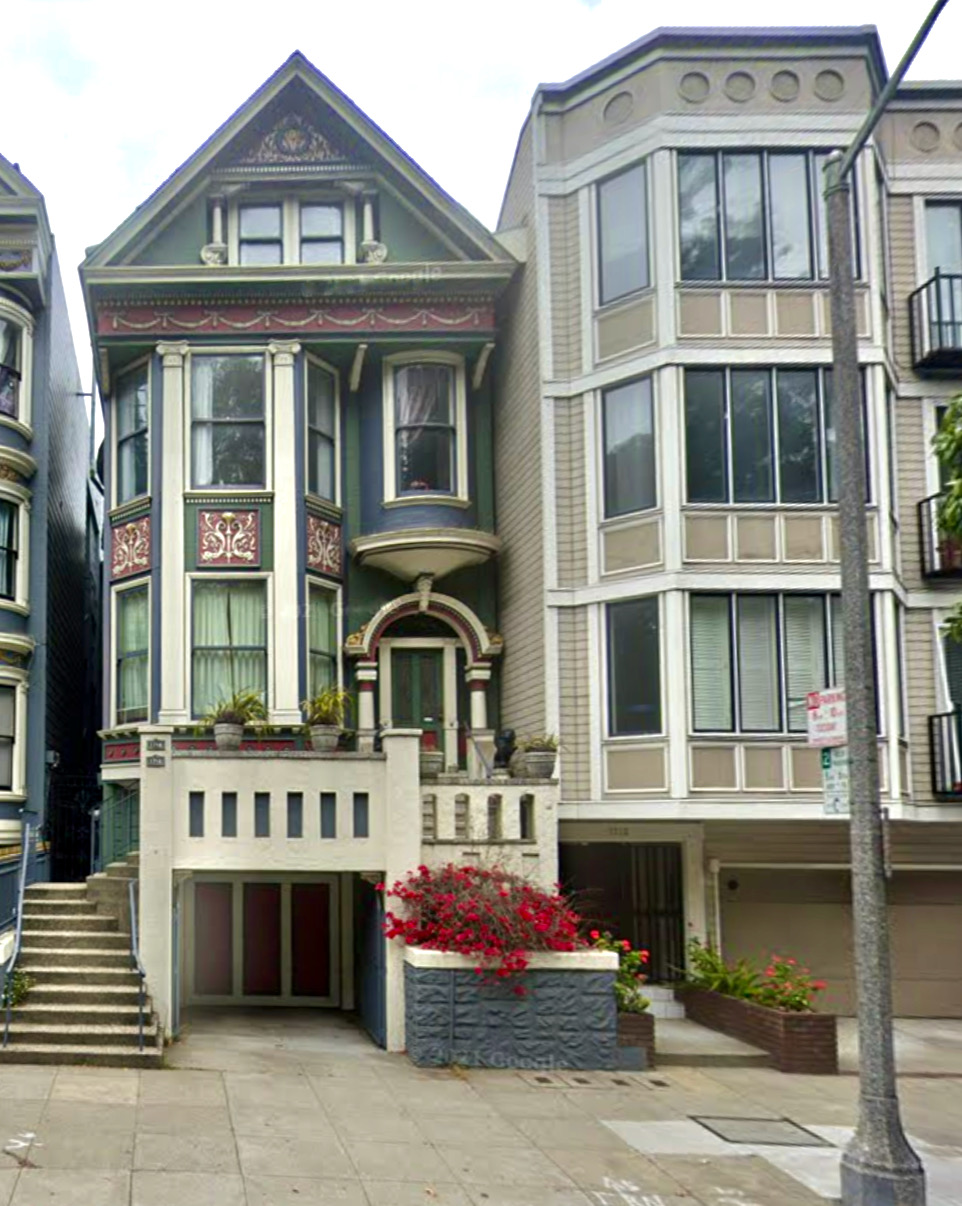
Although 1712 Fell has been modernized the adjacent Buildings give a hint of what it may have looked like back in 1913.
Taking a closer look at the Sanborn Fire Maps we can see changes. The lot sizes were 25 X 100 feet but in 1900 the lot was empty to the East of 1712 and there was a vacant one house to the west.
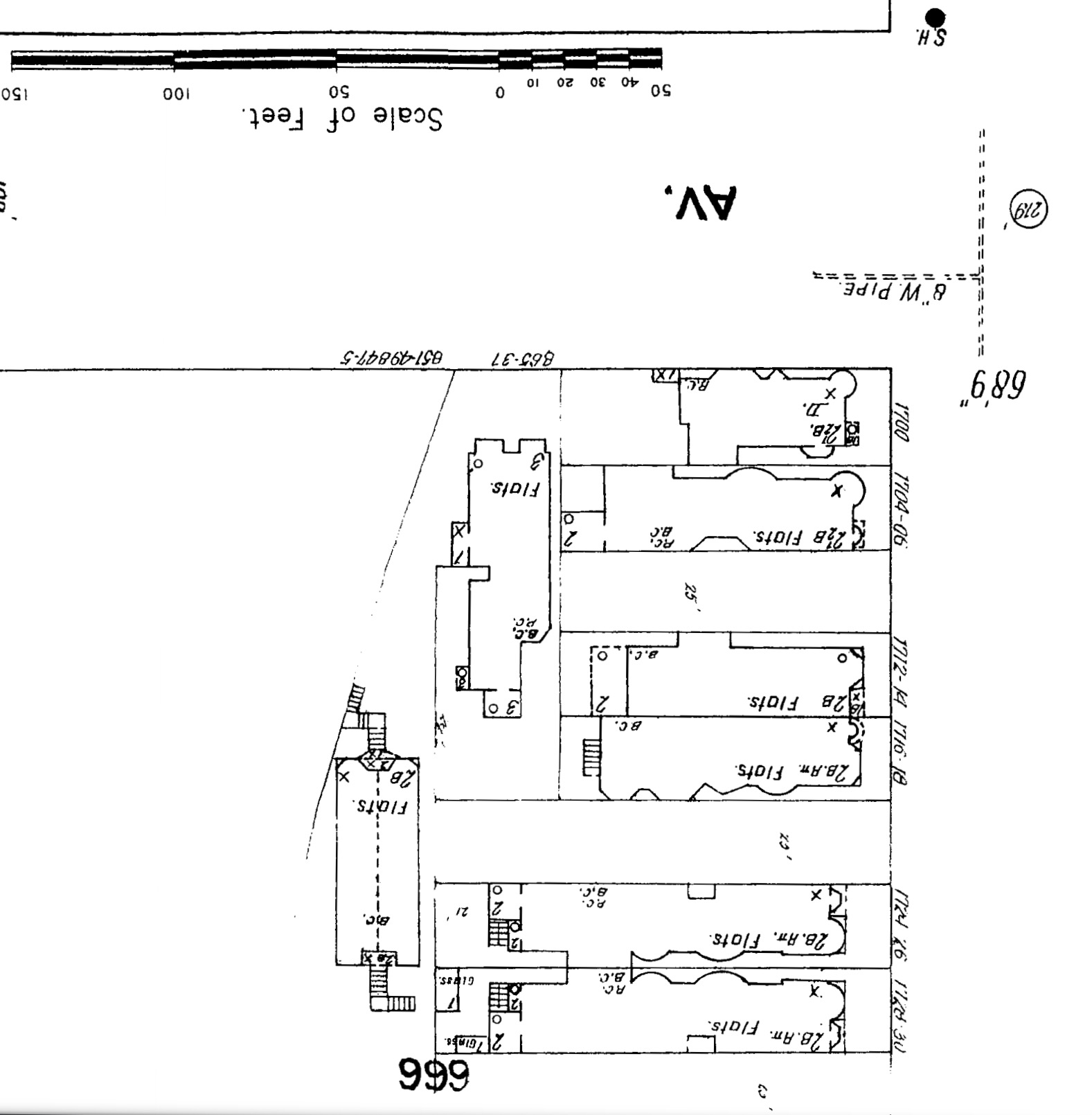
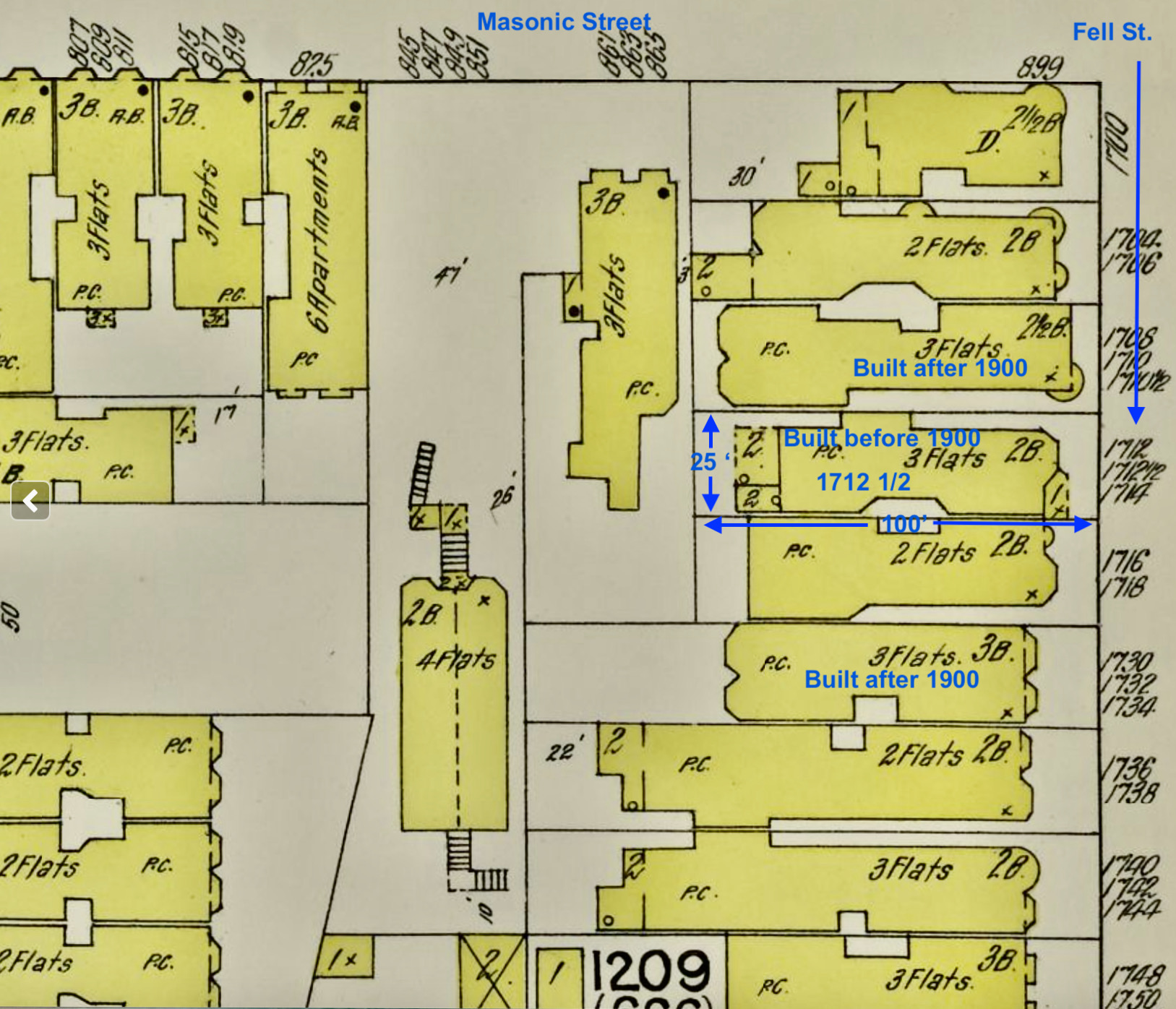
show the buildings survived the 1906 earthquake and several were added.
1712 Fell street has been remodeled and made a part of a larger building but what it would have looked like can be seen by its twin which was 1714 Fell street. AS seen below in a 2018 Google Street Photo. Remolded 1712 on right and original twin house on left (1714).
Here’s a current satellite photo:
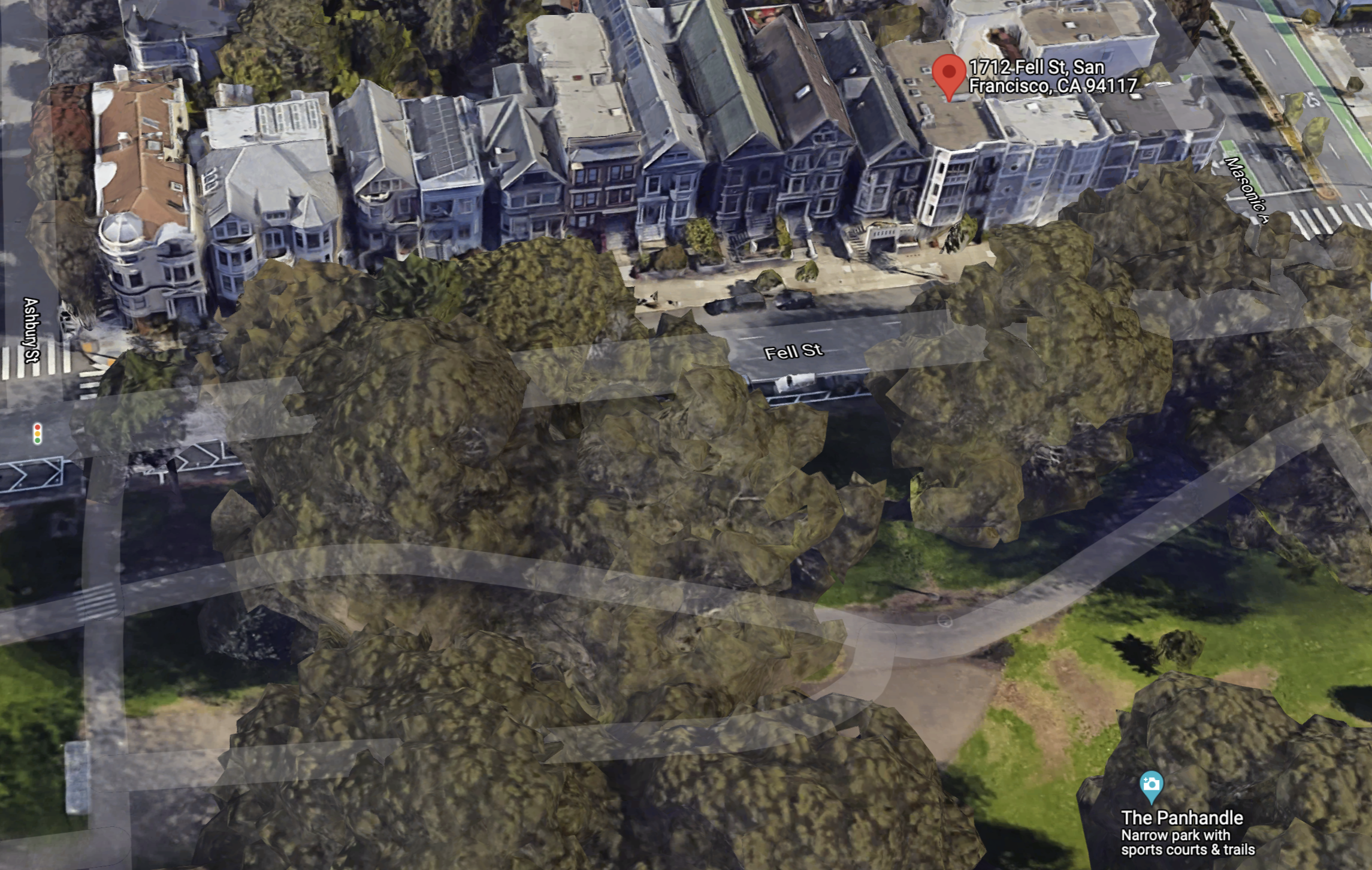
Across the street was a park and a few blocks west lay the whole of Golden Gate Park. And beyond that Ocean Beach and the Pacific Ocean. A short streetcar ride would take you to downtown Market street and the Theatre district. So they really were very fortunate to land in a beautiful city with wonderful amenities. Balm for the soul.
Kelly Wheaton Copyright 2021. All Rights Reserved.
Pacific Ocean, Golden Gate Park, Paradise? A Soprano’s Aria Chapter 5
Posted on September 13, 2021 1 Comment
1913 Thu Oct 9 I hardly know just how to describe the events of this day for I saw two beautiful sights new to me and long looked forward to, the Golden Gate Park and the Pacific Ocean. I suppose if I had not been so tired I should have been greater thrilled. But there they were both grand especially the old ocean. Frank, Albert, Lolita, and Milo with myself walked the whole length of the park which is over 4 mi, beside we made a detour to see the different attractions which added to the distance. We had stopped to admire some beautiful swans when I looked across the boulevard to see Albert gazing away to the west. I crossed over and he says can you see it? I looked and looked away into the glimmering sky and then I saw the waves appear like shimmering silk in the distance. After a quite long walk we came to the sandy beach and walked down to the edge of the water. The tide was coming in and many an incoming wave lapped over our feet before we could get out of the way. It was wonderful. We waited till the sun went down and turned homeward reluctantly.

Fri Oct 10 Spent the day cleaning house.
Sat 11 Did some washing and cleaning. Do not feel very well. Children went out marketing. Mrs Ross came down to give us the key to turn on the water with which to water the flowers. There is a little plot about 6 ft sq containing a row of calla lilies, a riot of wandering jew a lemon verbena a Scotch Heather some mums and secret ferns and geraniums. All doing fine in Oct.
Sun 12 Spent the day at home. Mr. Wm. Pellec came to see us and take dinner. He is a very fine old man – the one Albert calls Uncle and that he has missed for so long.
Mon 13 Nothing much doing. Milo and Lolita started to school in San Francisco. We all went upstairs in evening and had some music. Enjoyed a splendid time with Mr. and Mrs Ross and daughter Edith and Son Charley. Fine People.
Tue 14 Beautiful sunny day. No Winter rains yet. Spent the day at home alone mending + sewing. F.S. and Al have been unsuccessful hunting work.
Wed 15 Fair sunny weather with no rain. Visited the Golden Gate Park Museum with Mrs Ross and saw the exhibit of colonial household articles. Very interesting.
Thu 16 Explored Buena Vista park with Frank, hard climb. In afternoon took walk with Mrs Ross around the new Polyte [Polytechnic] High School. Saw a bunch of beautiful Cosmos in full bloom. Mine were killed by frost in Minn in Sep 22.
Fri 17 Did a big wash. Sick headache. Frank got work at last on a wrecking yard through the influence of a S.F. Ex Solicitor who took his order for the paper for 1 week. Good work. Albert is at an entertainment.
Sat 18 I sewed and mended all day. Frank commenced work. Albert went to Santa Cruze for 1 week.
Sun 19 Went to park to hear band play. Very fine. Ideal weather. [The Golden Gate Park Band was founded in September of 1882. Free Sunday Music concerts were originally in a wooden structure replaced in 1900. Although damaged in the 1906 earthquake, it was repaired and stands today.]

Monday 20 Regular routine. Went downtown alone first time, marketing.
Tue. 21 Washed clothes
Wed. 22 Ironed and mended. First day of Portola Festival. Vacation for the childrens school. Soldiers and Sailors Parade. [The San Francisco Portola Festival was held October 19 – 23, 1909. It honored Don Gaspar de Portola, the discoverer of San Francisco Bay. It was also a celebration of a city which, just three years earlier, lay in ruins. The festival ran each subsequent year until 1913.]
Thu 23 Dull day. Weather same. Everything ditto.
Fri 24 Lolita I and Milo went to the Portola parade. Walked down stood 3 hrs watching splendid parade. Walked back and got supper.
Sat. 25 Albert came home from Santa Cruz. Uncle made us a visit reminiscing over night. All went down to see Gorgeous parade of ships on Market Ave entitled the Evolution of the Dreadnought.
Sun. 26 Lolita and I went over to G.G.P. [Golden gate Park] and listened to some good music. It was a cool bracing day.
Mon. 27 Nothing unusual.
Tue. 28 Went downtown with Albert. Come home to supper. He took evening boat to Stockton. Paid a little bill on Haight St.
Wed. Oct. 29 Did a big washing.
Thu 30 Went down town and bought an alarm clock at the Emporium. My 1st visit to the big store.

Fri 31 Ironed and returned 6 sheets to Mrs. Ross. First rain of the season.
Sat Nov 1 Rained hard all day. Went to the Cort theater to see Bird of Paradise [More on the Cort Theater]
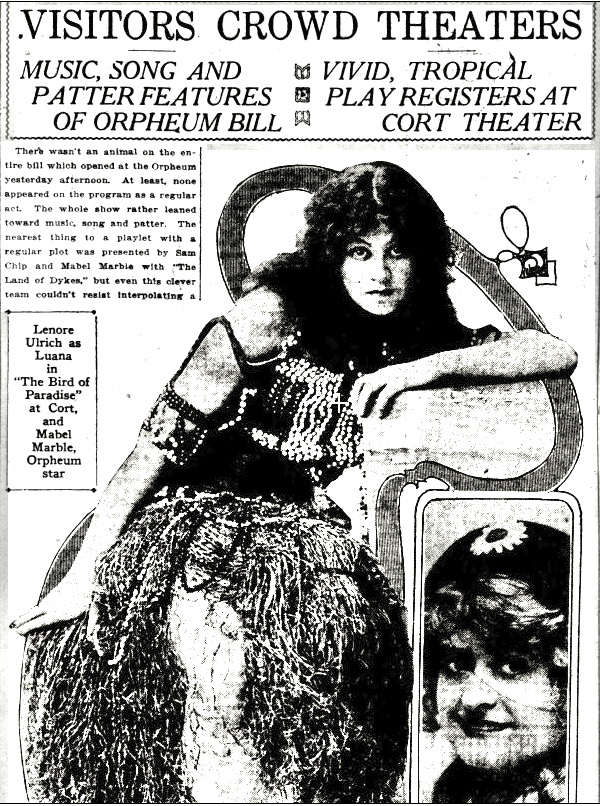
San Francisco Call 27 October 1913
Sun. Nov 2 Quiet Sunday. Pleasant after the rain. After lunch F.S. Lolita and myself went out for a walk in a new direction and happened into the Laurel Hill Cemetery. Entered the west gate and wandered clear through to the eastern entrance. Here they lie at rest the lowest of the low and loftiest of the high. The pitiful wooden markers crumbling away into dust and the splendid mausoleums some of the cracked and broken by the terrible earthquake. The foreign born of many lands hither same at last, their earth warn feet content to pause awhile they will wander no more. Thus do al once the splendid and the most forlorn city of the silent land I have ever seen. It is a strange assemblage of wealth and poverty, good taste and bad, great painstaking care and loving, and flagrant lock of any at all. Dead and decaying herbage close by the lively green on the surface, but below, they’re much the same, returning again to the dust. All of one accord to be silent and still. Closely assembled but without jostling oddly placed but none striving for a higher place. Sweet peace and content, who would not long to rest even as they. [ More on Laurel Hill Cemetery]

Kelly Wheaton Copyright 2021. All RIghts Reserved.
Who was on the Train? A Soprano’s Aria: Chapter 4
Posted on September 12, 2021 Leave a Comment
BACKGROUND

On the 2,000 mile train trip from Minneapolis to San Francisco we have our heroine Mary “Lulu” (PADEN) MOSIER 45, her husband “Frank” Franklin Stewart MOSIER 45, also known as F.S. in Lulu’s Diary. Then we have their children: Eilene 18, Dewey 16, Milo 13 and Lolita 12. Left back in Minneapolis is Leo 22 and Jessie 20. Out in San Francisco awaiting their arrival is eldest son 23 year old Albert Edgar MOSIER, also known as Allie.
The 4 day rail journey ended in Oakland, California necessitating a ferry trip across the bay. [No Bay Bridge back then.]
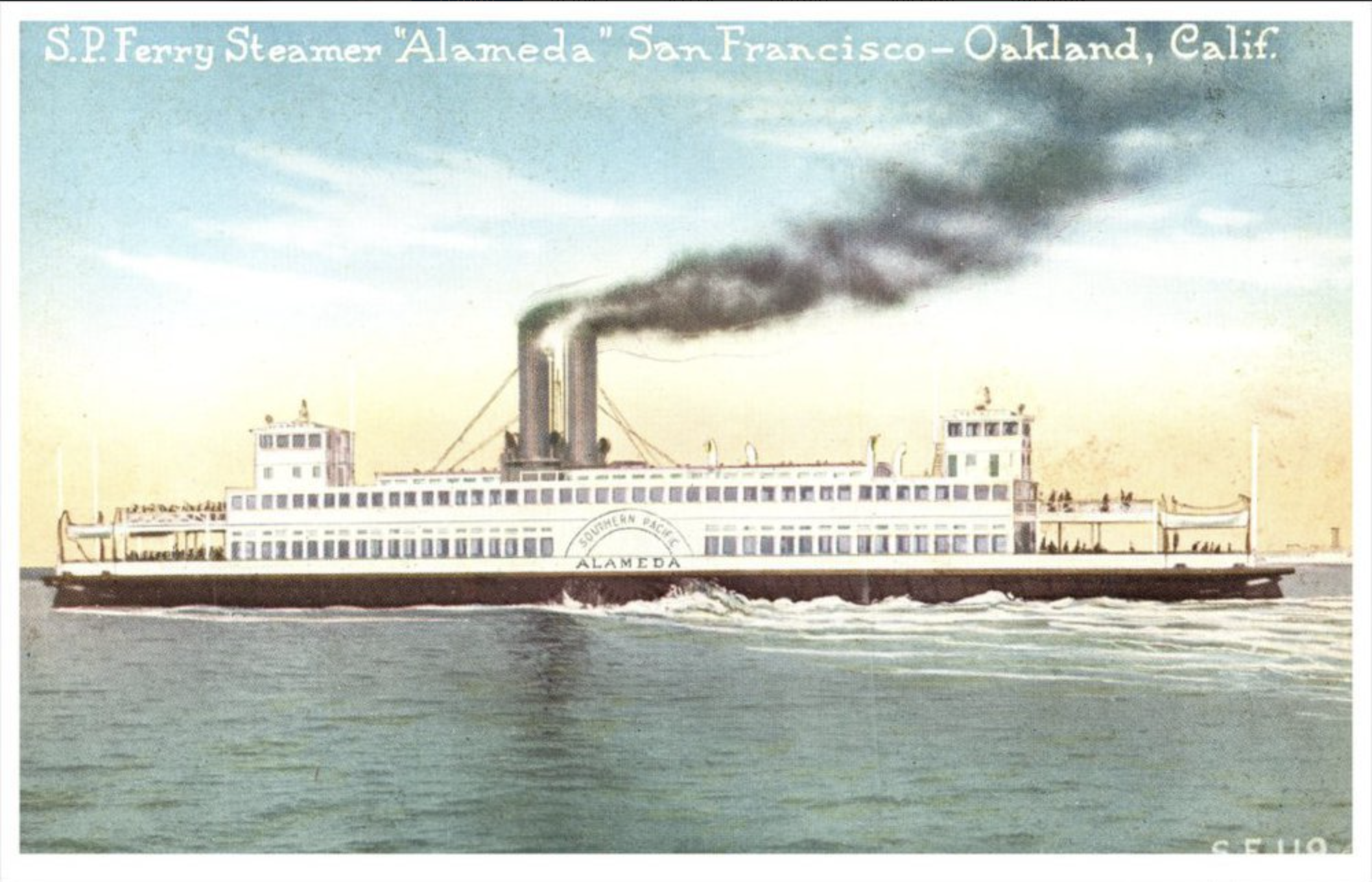
So after a very long trip the MOSIER family arrives in San Francisco spends the night at the Winchester Hotel and will soon be on there way to there new home in San Francisco on Fell St across from the Panhandle. To orient you this annotated Chevalier 1911 Map of San Francisco.
To give you an idea of scale it is about 3.4 miles from the Ferry Building to 1712 Fell Street. And 4 miles on foot from 1712 Fell street to the Pacific Ocean.
Kelly Wheaton Copyright 2021. All RIghts Reserved.
On the Rails: Minneapolis to San Francisco: A Soprano’s Aria Chapter 3
Posted on September 12, 2021 Leave a Comment
1913 Wed Oct 1 Wed Mrs Haley and Nellie came up in the evening. We had a pleasant time.
Oct 2 Thurs Mooved into the New Flat at 1109 E. 17 st. A beautiful sunny day Frank Hoffman [Eilene’s husband] moved us in his auto-truck. Dewey went down to Haleys and got some pickles and preserves Mrs. Haley so kindly gave us. It was so difficult to sort our stuff, that and it took us so long to move, we didn’t get started on our long journey to San Francisco. Well good Bye to our old home at 1027 st. N.E.

Oct 3 Friday Helped unpack in new flat. Made Lolitas new gingham dress. Jessie and Dewey rented an old oil stove and we cooked a square meal and did some ironing. Went down town and bought a new suit case and some stockings. Jessie and Dewey put us up a fine lunch and after supper we all went down to the Union Depot at Minneapolis to catch the 8 oclock train. Missed our train and took the one at 11:15. Emma Hollis and children were at the depot with a fine lunch for us. Leo and Eilene arrived on the run after we had boarded our train. Tearful and heart wrenching goodby and we were off.
Soon after starting and we soon found out is was the Union Depot in St. Paul. It burned up completely We were held up there about 45 min.

Oct 4 Sat Woke up in car speeding southward through Iowa. Along in the A.M it began to rain and the car leaked all over. We happened to have a dry place and were very glad when we arrived at Omaha.
Boarded a train at 4:30 for Frisco. Couldn’t get a berth there but was very fortunate to get one at [Schuyler] Neb in time to turn in. Slept rather cold but better than the night before when we occupied seats.
Oct 5 Sun Woke up in morning in Berth 13 after good nights rest. Breakfasted and wrote some postcards and mailed them at Cheyenne. The road west is a steady climb to Buford [7851] feet above sea level. Then Sherman where they get the gravel for the road bed. The road gets more hilly and rocky as we proceed the scattered pine trees unusually small. We passed the “lonsome pine” top of trunk bare but still boasting green branches bravely. The rocks are mostly red granite not a bit like the gray limestone of Minnesota.
Then we came to Laramine. The mountains in the distance look quite like the pictures of them one sees everywhere. Frank just came in from the smoker to say I must put down “Mosiers Here” so he gets into the record but dont know how long he’ll stay. The most notable thing we were able to see from the car windows was a girl clad in bright scarlet that waved as we passed. We are now speeding westward over the Wyoming prairies with nothing much to see but a lonely ranch here and there mostly the latter.
It is now 3 o’clock. At 10 min to 4 we ran into a light snow which turned into a blizzard in 10 min more. Through the flying flakes we could discern a large board sign painted with white letters W A T C H T H E C R O P S G R O W. Ground is already white. 1 hr later we left the storm behind and sailed into the sunshine but it soon clouded over again, although at sunset the sun went down behind the hills in the most approved fashion. I thought many times Leo and I sang the song, “Now the sun is in the west” and of course the foolish ineffectual tears would flow. My boys and my girls God help me but its hard to say good bye. Its Sun eve and I suppose you are all at church and I know praying for me as I shall do for you. We have had our supper and are waiting for the porter to make up the births for another rock a by night on the old U.P. [Union Pacific] good night.
Oct. 6 Mon Bitter cold and snow greeted us upon awakening this morning a few mi out of Ogden, Utah and a heavy pelting of hard snow was our farewell from that little town under the big bluff. We soon left the snow behind and came upon the wide far reaching flat that was once part of Salt Lake. Next appeared the lake itself along the low northern banks of which we hurled awhile and then the train took us right out on to it! I thought our steamboat ride in Minnetonka the 4th which seemed rather tame in comparison. High mountainous bluffs surround its irregular shore and every few minutes one is surprised with a startling feature. At first the iridescent mud colored expanse flat as a pancake. Then just lake. Then the island of red rock then more lake. On our right where the water lapped the shore it appeared of a bright red color surrounded by a few inches of white salt. A little further on the water appeared of a beautiful sea green and “Every little water had its night cap on.”
So very, very early in the morning. A pretty sight with the purple mountains to the N.E. and a mud peat in the distant North. Not long after we ran into the Great American Desert which is a great stretch of sand bordered by mountains. Later we passed the line into Nevada. It seems to be quite the same in general appearance.
At 3:15 we stopped at a little town named Carlin in Nev. for 15 min. We ran out – mailed a letter to J&D and bought 10¢ worth of sugar 25¢ peaches & 5¢ celery. In Cheyenne on Sunday we bought a Sunday paper 5¢ a bottle of wild cherry phosphate 50¢ a fruit 15¢ buns 10¢ bread 15 and a pie 10¢
Later in the day we passed through Battle Mountain Nev. Here we saw quite a number of Mexicans and their little village of huts. We passed through Reno and the snow sheds after dark.
Tue. Oct 7 Getting into Gods Country again. Human looking habitations. Christian looking fields and meadows trees and shrubs. Stopped in Sacramento 15 min.
Ran up town and bought “for 10¢” some delicious grapes. Passed through Stockton where Allie lived so long and on through agriculture lands to Oakland. Here we left the train that had carried us so far in safety and took the boat for the Ferry Building across the bay.

We soon landed but no Allie could we see so the lady we became acquainted with on the way Miss Eunice Summer showed us to a Hotel, the Winchester, where we passed a very pleasant and restful night.

Wed Oct 8 Cool with slight sprinkle of rain. Felt weak and languid. Went out and breakfasted in a funny little basement restaurant where we ate on a bare table out of crockery ½ in thick, a substantial breakfast of pork sausages fried, hot coffee, bread & butter and cereal all for 15¢. Later when we returned to the Hotel I ran into Allie in the corridor. May be I wasn’t glad to see him. He had engaged rooms at 1712½ Fell Street for us and we went right up after he had seen the gas people. At – present- I am waiting for them to return from hunting commissary and work. Soon I’ll be settled down to housekeeping in earnest.
Kelly Wheaton Copyright 2021. All RIghts Reserved.
Listen to Your Ancestors: What Story do they want you to Write?
Posted on September 11, 2021 5 Comments
When I was thinking about my great grandmother’s diary, A Soprano’s Aria: Lulu’s Diary, I really struggled with the title. And if you read my piece Writing Stories: Writing Begins With a Title you will know that the title sets the stage for the story you will tell. It really got me to reflect on what story Lulu would want me to write. I could have chosen a title “The Diary of an Abused Woman” or “Abused,” but that would have emphasized her victim hood. I am sure she would not have wanted that. I thought about what she cared about most and what got her through the rough times? Family, faith, friends, literature? And then I heard her voice in the pages. She was a soprano who loved music and the title materialized. She may have thought it too lofty, but it speaks of her specifically and metaphorically.
I never met Lulu in life. It is a bittersweet journey having to learn who she is, through her writing. And although she suffered greatly, she was a strong woman who eventually grasps her power, and finds her voice. It is Lulu’s story, but it is also the story of countless woman at the turn of the 20th century, even as it is today. She lived through the suffrage movement and gained the right to vote. She lived through massive changes in how women were treated and how they saw themselves.
Although Lulu may have wanted this painful part of her past destroyed when she died, I know she would appreciate the inspiration it can be for others. She would likely cringe at the parts about the abuse she endured, but she would want us to know about her joys and the history she was a part of.
When we write stories about our ancestors we can keep some points in mind.
- Listen, honor their voices
- Think about your subjects as REAL, breathing people that are responsible for your being alive
- Dig deeper into the circumstances, find out the why, not just the hows and whens
- If they are a close ancestor we may have things in common, how can that inform what we know about them?
- Whenever we write, we become a part of the story, how can we keep “their” story the primary focus? We may be the narrator, how can we stay out of their way
- Illuminate, but do not exploit
- We all need heroes, and we need to show ordinary people can be our heroes too
So if you are writing a story be mindful of whose story it is. I cannot emphasize that enough. Listen to Your Ancestors! What Story do they want you to Write?
Kelly Wheaton Copyright 2021 All Rights Reserved.
American Women’s League & Good Bye Minneapolis! A Soprano’s Aria: Chapter 2
Posted on September 10, 2021 Leave a Comment
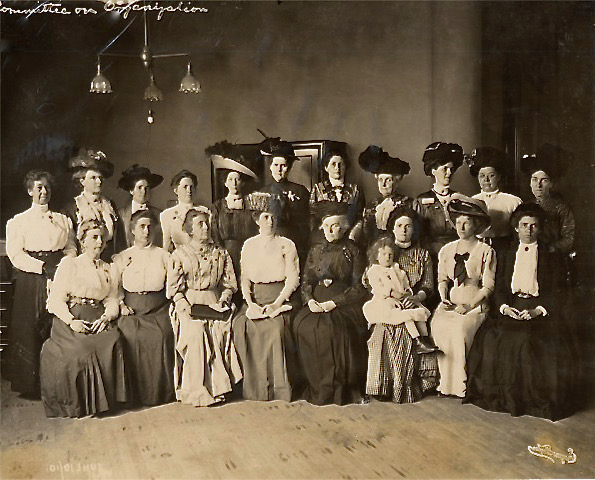
“Edward Gardner Lewis established the American Woman’s League as a subscription gathering organization. Lewis’ plan was for women to qualify for memberships by selling $52 in magazine subscriptions. The fees that would otherwise have been paid to individuals would be paid to the American Woman’s League. The League would use these funds to provide benefits that the women wanted…education, a foundation for social organizations within their communities and security for their old age…among other things.” Arguably these women’s organizations were foundational in the women’s suffrage movement. Lulu’s early involvement cannot be overlooked in her future development.
INSIDE the Front Cover of the Diary
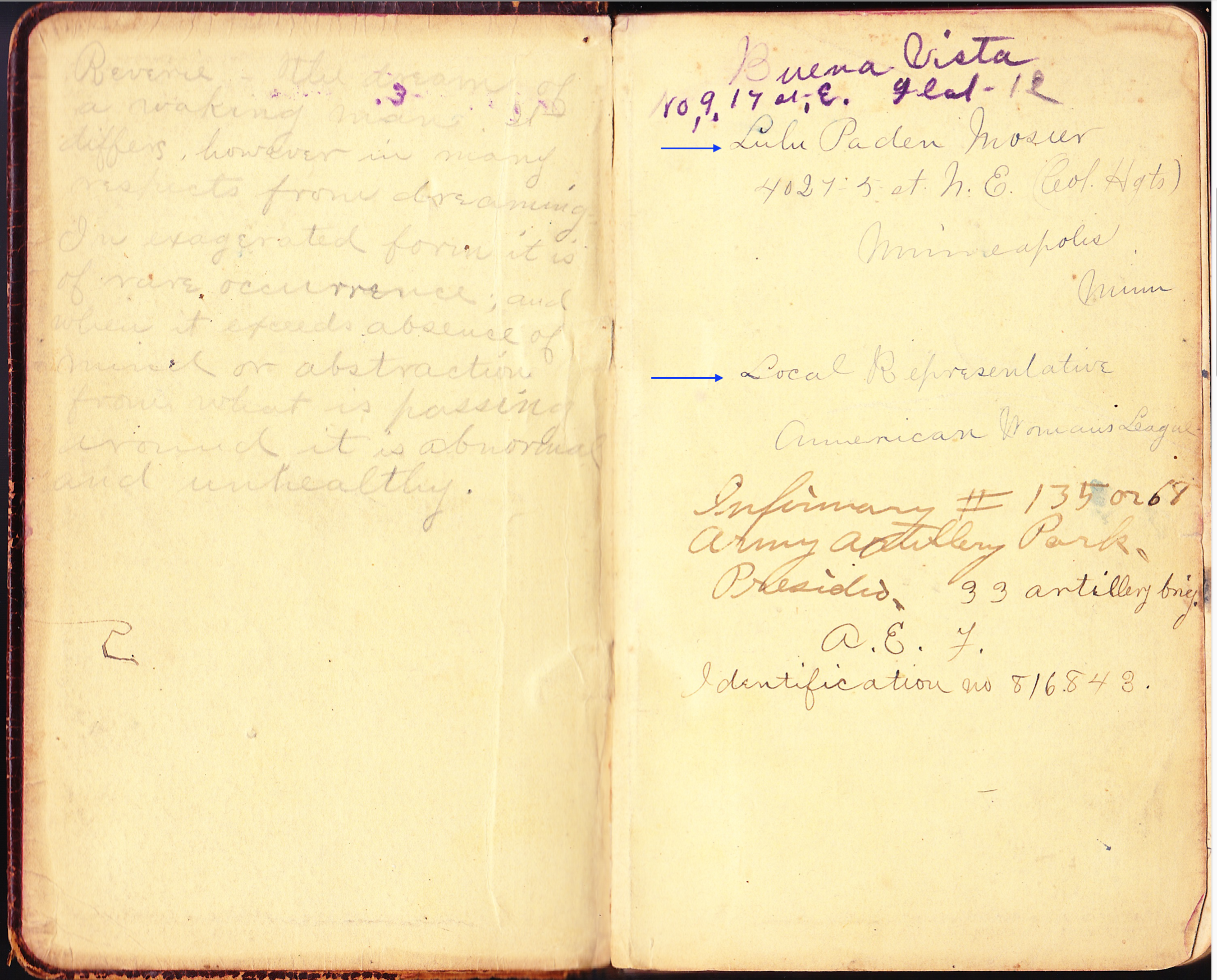
Diary Quote reads: “Revenue – The dream of a waking man. It differs, however, in many respects from dreaming. In exaggerated form it is of rare occurrence and when it exceeds absence of need or abstraction from what is passing around it is abnormal and unhealthy.“
1913 Sep 2 Friday Morning dawned bright and fair in Col. Hgts. [Columbia Heights] Cool enough for winter coats. Our cosmos won’t bloom but the sweet alyssum and nasturtiums and dahlias are doing splendid. In the afternoon Mrs Schreveder and I saw baby Ruth Went to the Bijou to see the “Battle of Gettesburg.” It was a moving picture in 5 reels. Romance and patriotism, love and devotion, fidelity to duty, heroic bravery and a cruel wars inexorable toll of human lives were enacted before us with wonderful cleanness and realism. Lincoln’s speech at the dedication of the monument was beautifully shown, his sad countenance moving with feeling the placid shawl over his shoulders and the crowd standing about in the old fashioned garb made it seem very real, and left a lasting impression of the unspeakable horrors of war.
Sep 25 Thu “Cut out my house gown and worked on it some. Went down town with Frank Mo.[Mosier] and Leo to see about the house. Decided to accept the $1100.00 offered by the Co for a quit claim deed for the house we have lived in these unhappy years. Glad to be rid of it but sorry to leave the older children.
Went to the Bijou theater on Washington Ave to see the moovies. Mrs Vincent gave me the ticket and so it cost me nothing. It was the Bishops Daughter in 4 reels. Saw Mrs Cornelius on the Street Car coming home. Effie is in high school also.
Fri Sep 26 Baked 14 loaves of Rye bread and sewed some on my house gown. The weather turned out warm and sunny. Grateful change. Mrs Taylor stopped in a few min yesterday and said Harrises were going to move out of the heights also. Well they may all go before I should worry. I wonder if San Fran will be much of an improvement on old Minneapolis Minnesota.
The time is nearing for us to go if we start Oct 1. I have so much sewing to do that it staggers one. Jessie went to see the dentist about her teeth and came home feeling better. Maybe now she can be of some assistance to me in getting ready to go. It is now midnight and I must retire to get what sleep and rest I may for another days labor.“
BACKGROUND
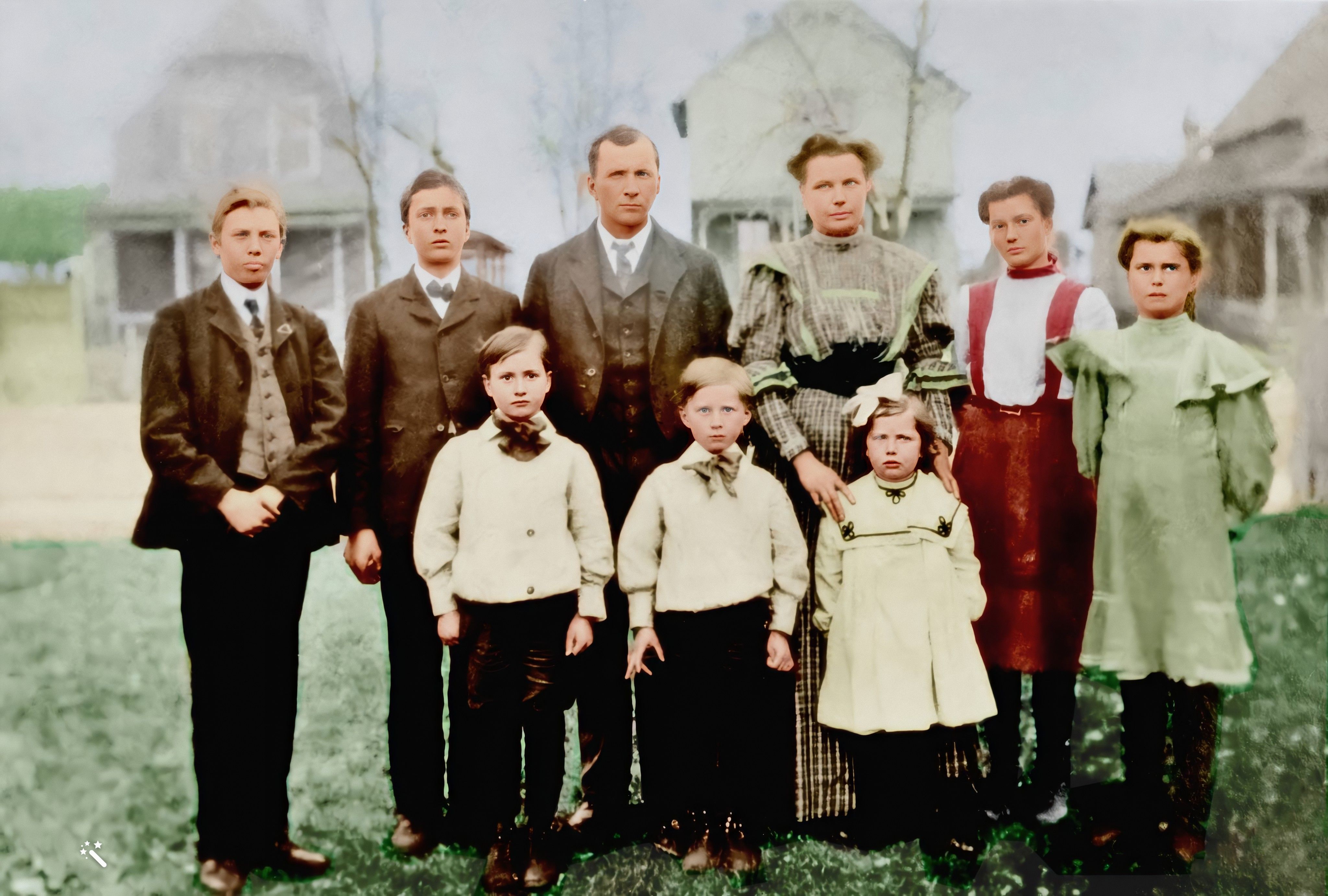
Between 1890 the year after Lulu and Frank marry and 1903 together they have 8 children in 13 years: Albert “Allie” Edgar 1890, Leo Dewey 1892, Jessie Ellen 1893, Audry “Eileen” 1895, Orland “Dewey“, 1897, Milo Dean 1899, Lolita Genevive 1901 and finally Millie Catherine in 1903.The the first 6 born in Nebraska, the 7th in Colorado and the last Millie in Madison, South Dakota. Sadly, Millie, named after her grandmothers: Millie Almena COATES PADEN and Catherine STEWART MOSIER. Sadly she died at 4 days old. By 1908 the family has moved to Columbia Heights, Minneapolis, where Frank is listed in 1908 as a laborer, a clerk for T M Robert S Supply in 1909 and a Tireman for Hennepin Brewing Company in 1912. It appears Frank changed jobs quite frequently a trend that he is destined to continue.
Kelly Wheaton Copyright 2021 All Rights Reserved.

