Deciphering our past Part Two: Sun Wheels to Druids
I began this post over two years ago with these lines: “With little to go on but a few samples of ancient DNA to guide us, I am going to offer a plausible story to tell one branch of the FGC22501 progeny story. I intuit to bridge the gap between the ancient FGC22501+ skeletons in Bohemia (now the Czech Republic) and the work of Vanessa van der Beke and her work on FGC53429+, a branch of the FGC22501+ family. They became chancellors and seneschals of western Europe. We will work forwards and backwards and hope to meet somewhere in the middle. Whilst I was working on this blog post we had a new member join the FGC22501 project who is from the Kutna Hora area about 35 miles Southeast of Prague. Not very far to move in 4,000 years!” However, I never posted it as it seemed incomplete. With time leaps of faith come closer to fruition.
ORIGINS BEFORE FGC22501
Where did FGC22501 come from? If you really want to know, Follow the Rivers! The Volga River to the Danube to the Vltava River in the Czech Republic. Tibor Fehér in his article Celtic and Italic from the West – The Genetic Evidence 2021, lays out what we know to date from DNA evidence from ancient human remains. [ CC BY 4.0 ] FGC22501 He has an ancestry thus:
- R1b>P297>M269 originates from the Pontic-Caspian Steppes which are in today’s Ukraine and Southern Russia; P297 Found in Samara culture on the Volga River about 5500 BCE
- R1b-M269>L52>P311>P312 dwelt in Eastern Poland in the late Corded Ware on the present Ukrainian Border, migrating there 2900-2500 BCE
- R1b>P312>U152+ Bell Beaker earliest sample to date is RISE563 2571-2341 BCE from Osternhofen-Altenmarkt Germany
- R1b>U152>L2 branch spreads from the Bell Beakers into the northern Alps, Bohemia and Poland extending down to Budapest along the Danube between 2500-2000 BCE
- R1b>U152>L2 then spread around 2500-2000 BCE to present day Netherlands, Northwest Germany, Southern France, Iberia and British Isles
- R1b>U152>L2>FGC22501 appears to have originated in Bohemia about 2484 BCE. Our skeleton match is 2200 BCE
BOHEMIAN CELTS:
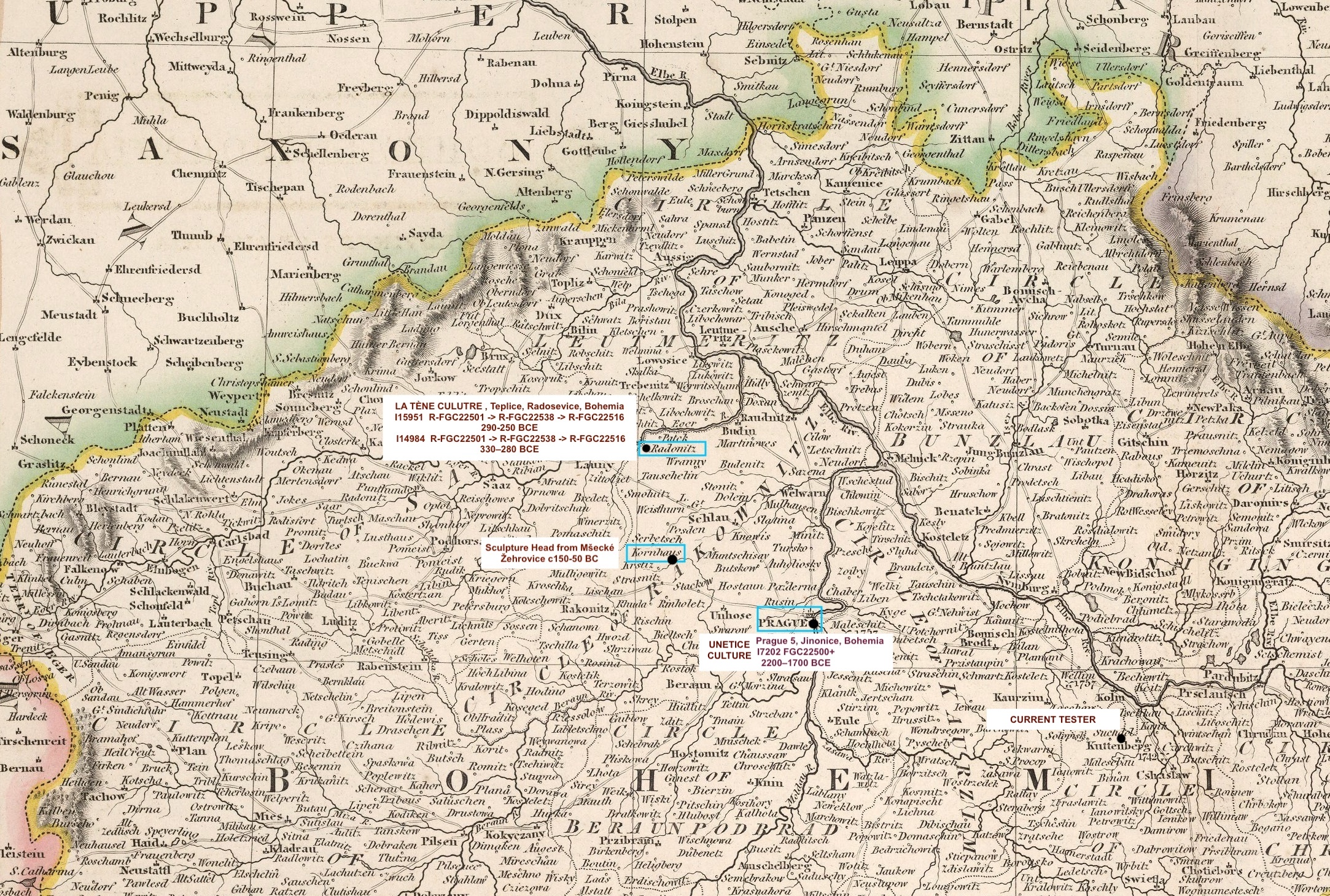
The inhabitants of Bohemia, which literally means the land of the Boii, were a Celtic speaking people and where we find the most distant known individual who were FGC22501+ about 4,000 years ago (or more). We do not know if this is where the first FGC22501 mutation occurred or if it happened in an individual from somewhere else. The Celts were the most widespread people in Europe and the wealthiest, before the Roman conquest. The meaning of Boii, from the Indo-European language, meaning ‘cow’ or ‘warrior.’ The Boii could be translated ‘the herding people’ or ‘the warrior people’. Most of what we know about these early tribes comes from observation by the Greeks and Romans beginning about 500 BCE. The Celtic people were very mobile and though not speaking the exact same language, their languages had the same Indio-European root. They knew themselves as “the People” and then by their tribal affiliation. The ‘Keltoi’ are first mentioned by the Greeks Hecateaus and Herodotus in the late sixth and fifth centuries BCE, in reference to their [the Greek’s] barbarian neighbors. They were admired by the Greeks for their fierceness and bravery in battle. Eventually there were hundreds of Celtic tribes, spread across Europe. They were people of oral tradition, story telling, legend and art. They left little evidence of a written language [Until the Ogam script in 400 CE] so we must rely on what was written about them by others combined with archeological finds and more recently with DNA of skeletal remains.
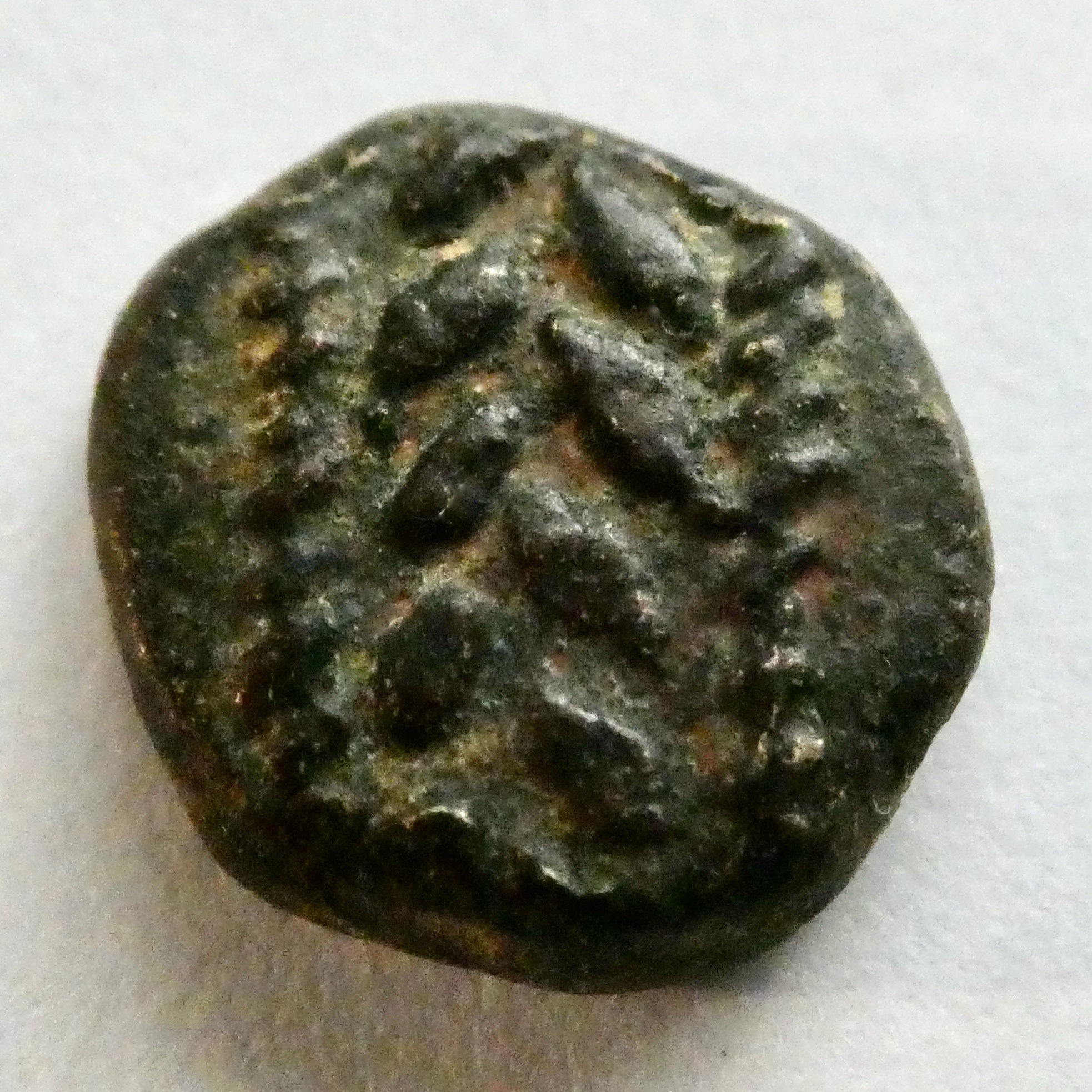
Laurel Wreath pattern, reflecting the God Apollo
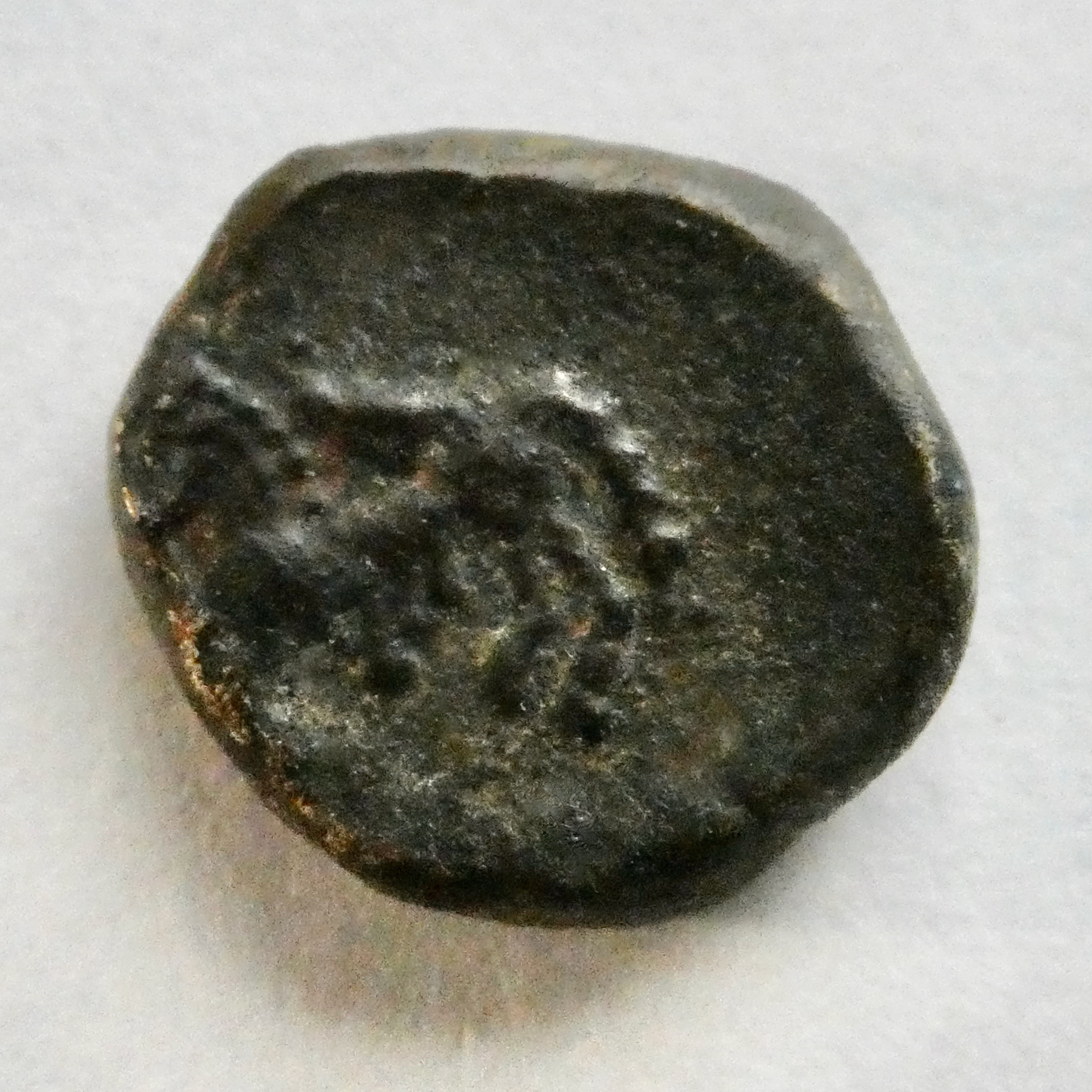
Celtic Eastern European Boii Obol, simmering type from about 100 BCE- 100 C
We know that the Boii tribe lived during a period called Unetice Culture from about 2200-1500 BCE, during the time of our earliest three FGC22501 skeletons in Bohemia. This was followed by Urnfield Culture 1200-800 BCE, Hallstatt 800-450 BCE and finally La Tène Culture from 450 BCE to 1 BC. These cultures are determined by archeologists in studying their pottery, grave styles and grave goods. They do not refer specifically to the tribes but to the periods of time in which certain cultural elements were present. From the DNA we know that an individual man who was FGC22501+ died and was buried in Bohemia about 2200 BCE. We now have a tester with ancestry from the present day Czech Republic so we can expect some stayed put, and others migrated broadly across Europe. Other skeletons carry very different Y-DNA lines so even early on their was diversity.
As mentioned above “Follow the Rivers.” Most likely those that migrated to our target area in Eastern Gaul, known as Gallia Belgica, came via the Main River (see below) our skeletons were found near the Eger River (Ohre in Czech Republic ) which has it’s source in the Fichtel mountains at the German/Czech border. Others may have traveled west via the Vltava River which stretches south from Prague to meet the Danube river. Our branch may have follwed the Eger to the Main to the Rhine to the Moselle and Meuse Rivers.
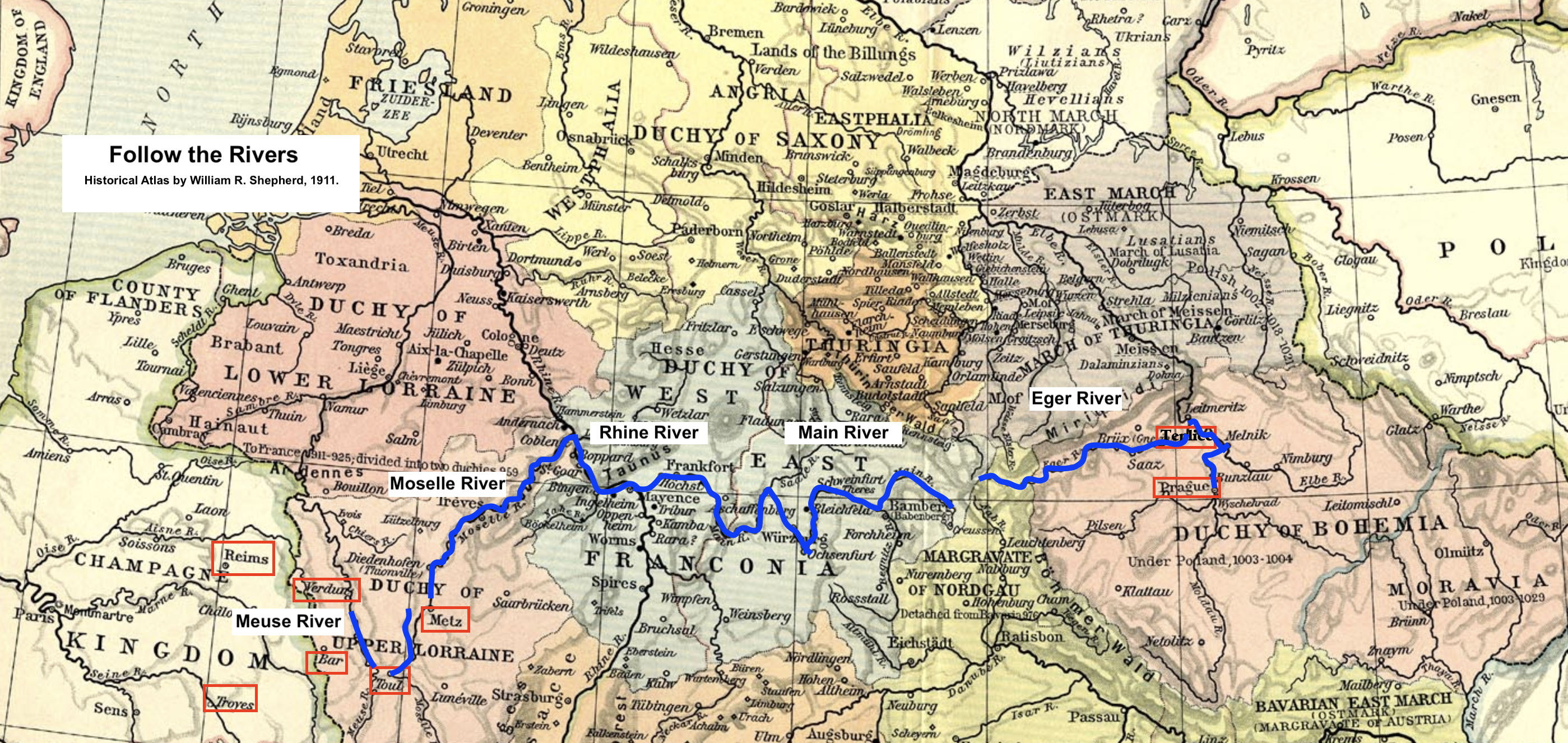
About the 1st century CE the Celtic place Beda (Bitburg) was at the end of the trade route from southern Europe down the Rhine river and then to the cities of Lyon, Metz and Trier. About 400 BCE, Trevorum [now Trier] was a Celtic city that eventually would be conquered by the Romans. The (Gallic) Celts were mixing with the Romans in Trier and elsewhere and later became known as Gallo-Romans, losing their language through assimilation. Then later the Anglo-Saxons added another layer to the mix. Today the Celtic language and much of its cultural traditions, remain alive in Ireland, Scotland, Wales and Brittany.
THE COIN BRIDGE
We can use Celtic coin art as a gateway into what they valued and perhaps more about their beliefs. Celtic speaking cultures passed down their traditions, history and wisdom via song, ballad or story-telling— all oral arts. As Simon Lilly notes in his small volume Ancient Celtic Coin Art (2008) : “Iron Age coins are the least studied artifacts of Celtic art, yet are paradoxically one of the best sources for learning about pre-Christian Iron age beliefs.” Celtic coins were minted from the late 4th century BCE to the mid 1st century CE. They were initially copies of Greek designs, especially Philip II of Macedon and his son, Alexander the Great. The obverse usually featured a head and the reverse often a horse or boar. Over time their imagery became more and more abstract and more and more a reflection of Celtic beliefs. Celtic symbols of the axe, torque (neck ornament), triskele, hands and wheels with eight spokes are common. Their art were influenced through trade. Celts were often mercenaries to the Greeks and later some tribes provided mercenaries for the Romans. Sometimes Greek motifs and even letters were used, especially in southern France on Celtic tribal coins. The first Celtic minted coins probably came from Bratislava oppidum [hillfort] in current Slovakia.
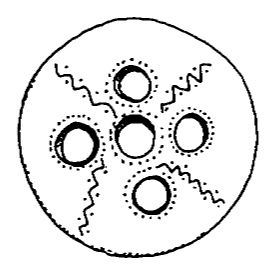
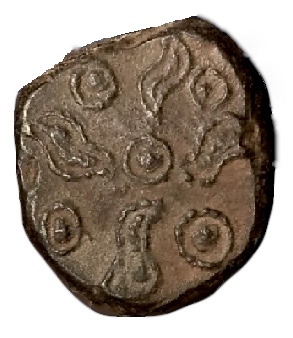
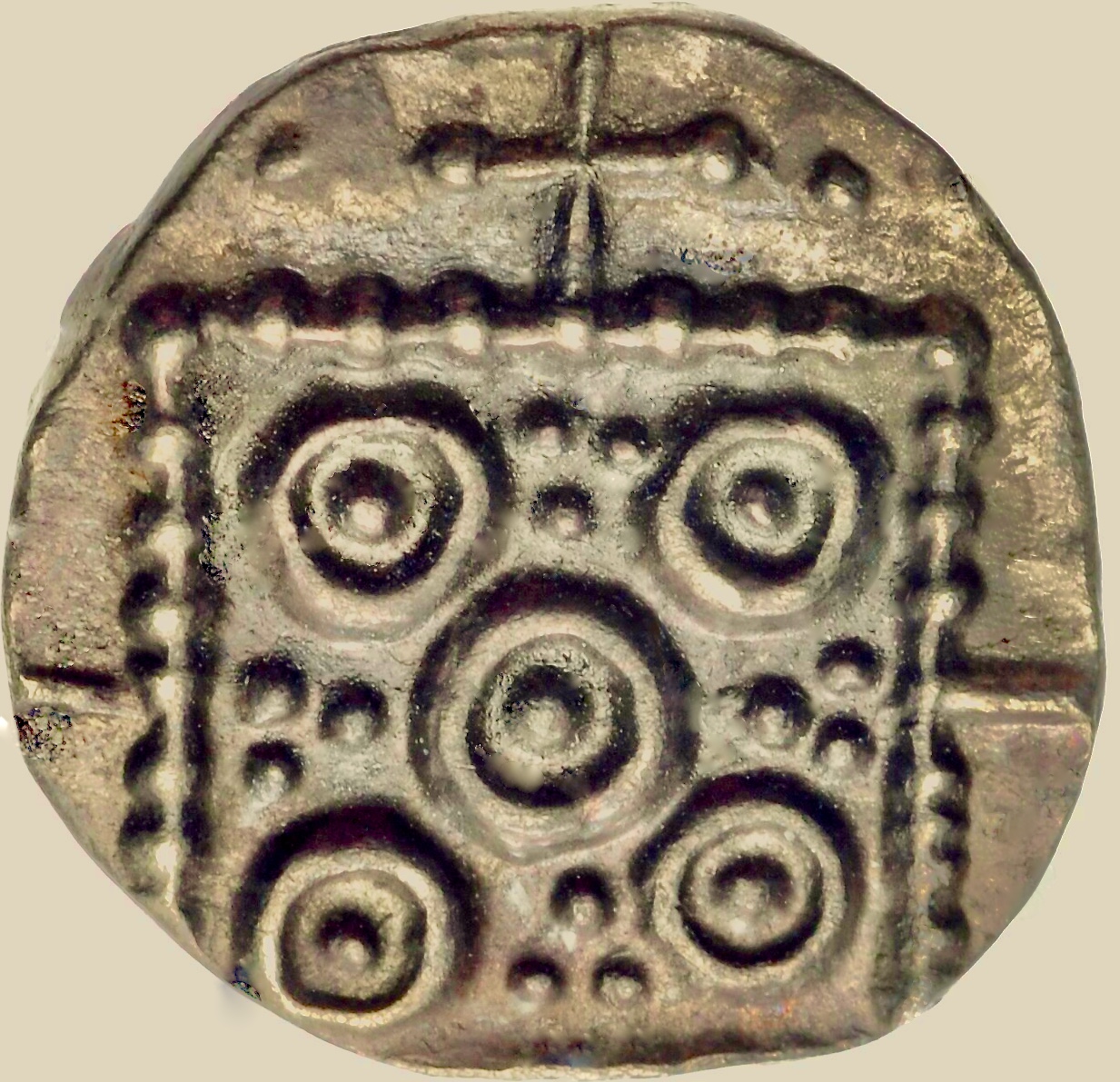
D.W. Harding wrote in his book the Archeology of Celtic Art (2007): “One medium in which motifs and designs must have been intended to convey a ‘meaning’ is coinage.” pg 297 I would add that coins were a tribe’s means of identity. What they wanted to project into the world, and how they saw themselves. Again quoting Harding: “The depiction of individuals bearing swords or spears, or wearing torcs, together with cauldrons, wheels or sun-disc, and possibly even altars, underlines the aristocratic, heroic or ritual milieu that the coins invoke.” In studying Celtic coins I was impressed with how similar the symbols are with some we still use and recognize today. The Images below represent the Sun Wheel in various forms, with 5 annulets [rings] in a square pattern with a central annulet.
In the image below, the first image is from Spišský Štvrtok, Slovakia from 2000-600 BCE. The second is from the Celtic, Aduatuci tribe, in Northeastern Gaul [See map above] about 100 BCE-52CE . The third is from the Netherlands in the Anglo Saxon period about 690-715 CE. So we have spanned about 2,000 years with the same core image of 5 annulets.
The Celts understood the universe as something quite changeable, not at all fixed. The Celts appear to have understood reality across a broad spectrum and incorporated observation and science broadly speaking. Although we can ascertain the meaning of many symbols, it is likely they had many meanings and layers. One common theme in some of their art is a tendency towards abstraction, whimsy with hidden faces, animals and shape shifting as a coin is turned in different directions.
The annulets themselves are symbols for the sun and for gold. The four arms [leaf shapes or squiggles] represent motion as the sun traveling in a circular motion across the sky. The quartering as previously mentioned the denote the 4 equinoxes, seasons or cardinal directions. The wheel symbol is also believed to represent God’s chariot, as he pulls the sun across the sky. Lastly, the Anglo Saxon sceatta [Series E, variety L] has Five annulets with pellets inside, in each quadrant is a triangle of pellets. When anything appears in 3’s it is clear indication of the divine or other worldly experience. The square suggests an enclosure. This is emblematic of the Viereckschanzen the sacred square or rectilinear Druidic structures found across Celtic Europe. Sacred sites, churches, Viereckschanzen are all places of protection and sanctuary. The Druid or Priest, as spiritual leader, oracle and protector of the tribe would preside over events at the Viereckschanzen. It may have a temple or place of training as well as a place of collective worship or pilgrimage, during special events such as the solstices. Like the ancient stone circles, the Viereckschanzen, may have been oriented to track the solstices.
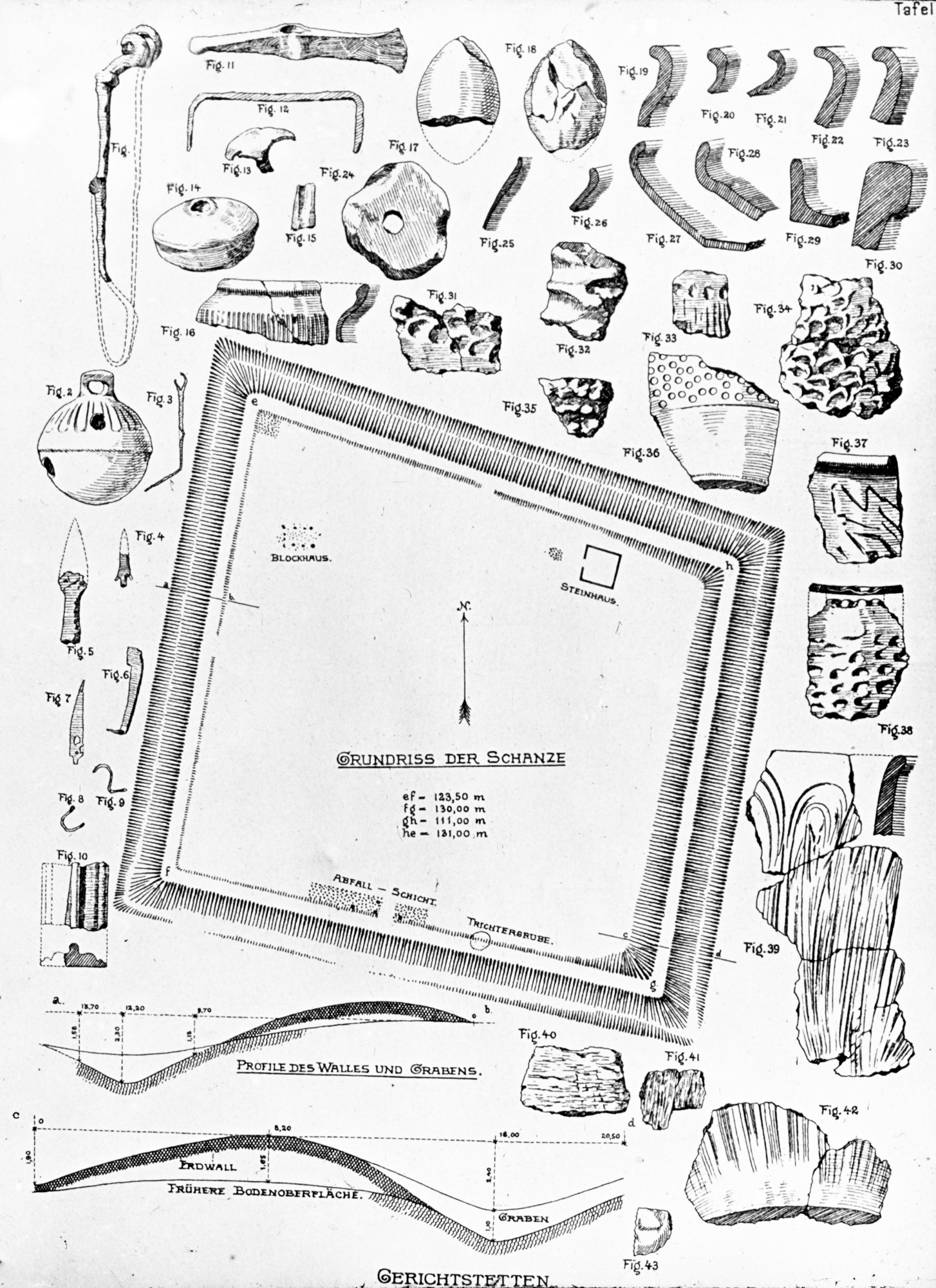
Celtic Oppida [hill forts] were tribal centers, where elected officials, presided over public affairs and where coins were minted. The political system of farms surrounded by clients and servants resembles the later medieval lords and serfs. Druids were the religious leaders in Celtic culture. They also acted as legal authorities, adjudicators, story tellers, medicine men/women as well as political advisors. It is said that the Druids were literate, but left no writing. It is believed their secret knowledge, was by custom, not to be written down as that would cause it to lose its power. Their mythology and wisdom was contained in the sacred verses taught by the Druids. This explains both the value of the Druid to the tribe and their power. Druids were influential, but they are barely visible in what they left behind, except for their rectangular sanctuaries called “Viereckschanzen”. These were usually located away from the Oppida, on sacred sites—perhaps acting as a temple or church. The Viereckschanzen were built primarily of wood and surrounded by a ditched enclosure, perhaps acting as a moat. The Viereckschanzen were constructed during the last phase of the La Tène period about 150-1 BCE and show mathematical knowledge in their construction and application of Pythagorean triangles, parallelograms, rectangles, lozenges, and squares. Example below of a Viereckschanzen in Gerichtstetten, Germany with archeological artifacts.
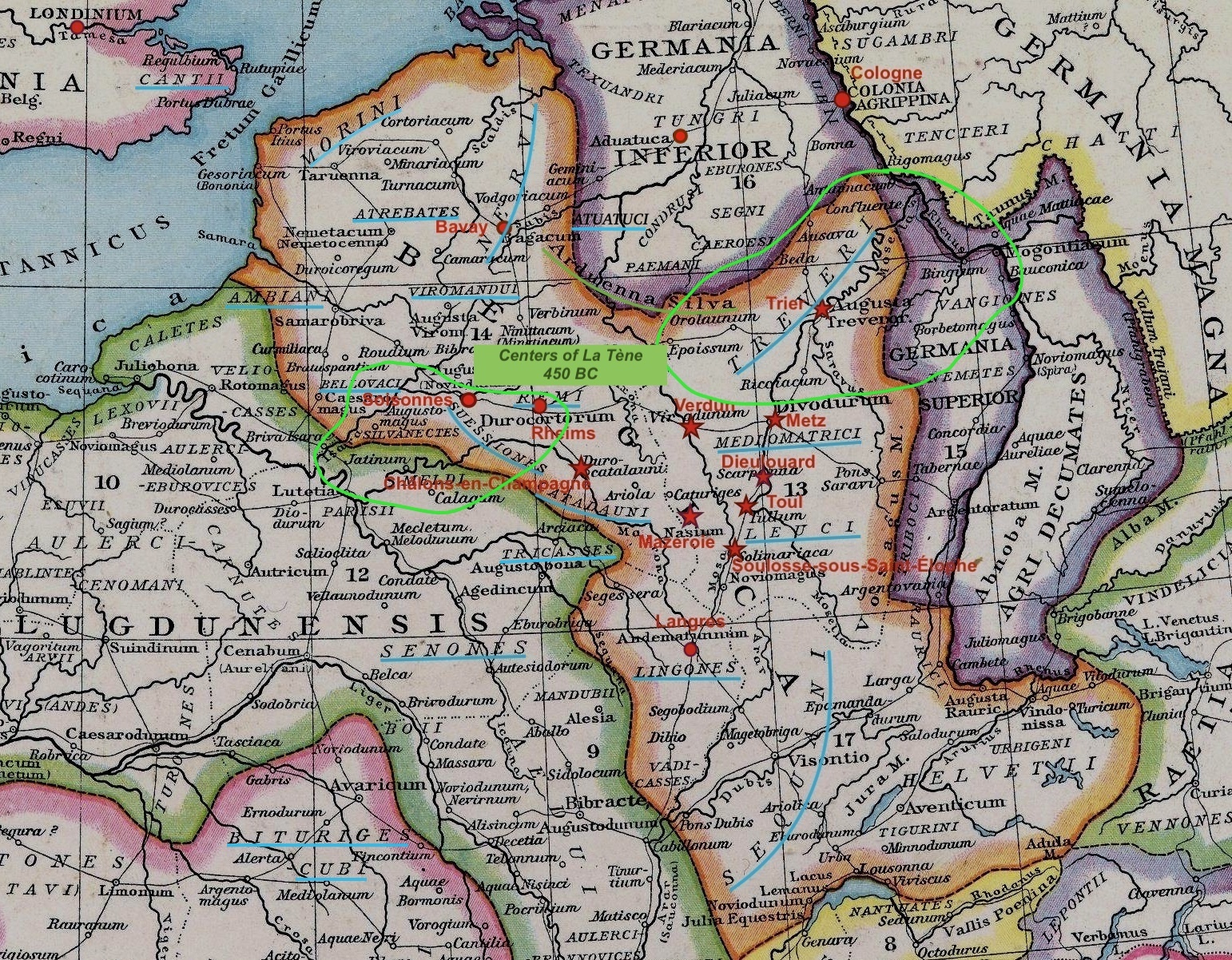
I am proposing that the Aduatuci tribe had imagery on their coin for a specific reason. The Ad(t)uatuci (tribe) and Aduatuca (place) are of Gaulish origin, but their actual identification as to meaning, is subject to debate. According to Gaulish language expert, Xavier Delamarre, the suffix ad- (‘towards’) attached to the root uātu- (‘Vātis, soothsayer, seer, prophet and philosophers) and the suffix -cā (feminine of -āco-, denoting the provenance or localization). An original Gaulish form *ad-uātu-cā as the ‘place of the soothsayer, or where one goes to prophesize. Thus the Atuatuci could mean the Prophet People or likely the tribe of Druids. The square of 4 annulets made of 3 triangles in the shape of the Viereckschanzen or “sacred enclosure” would be an incredibly powerful symbol and is consistent with the tribe’s identification as soothsayers.
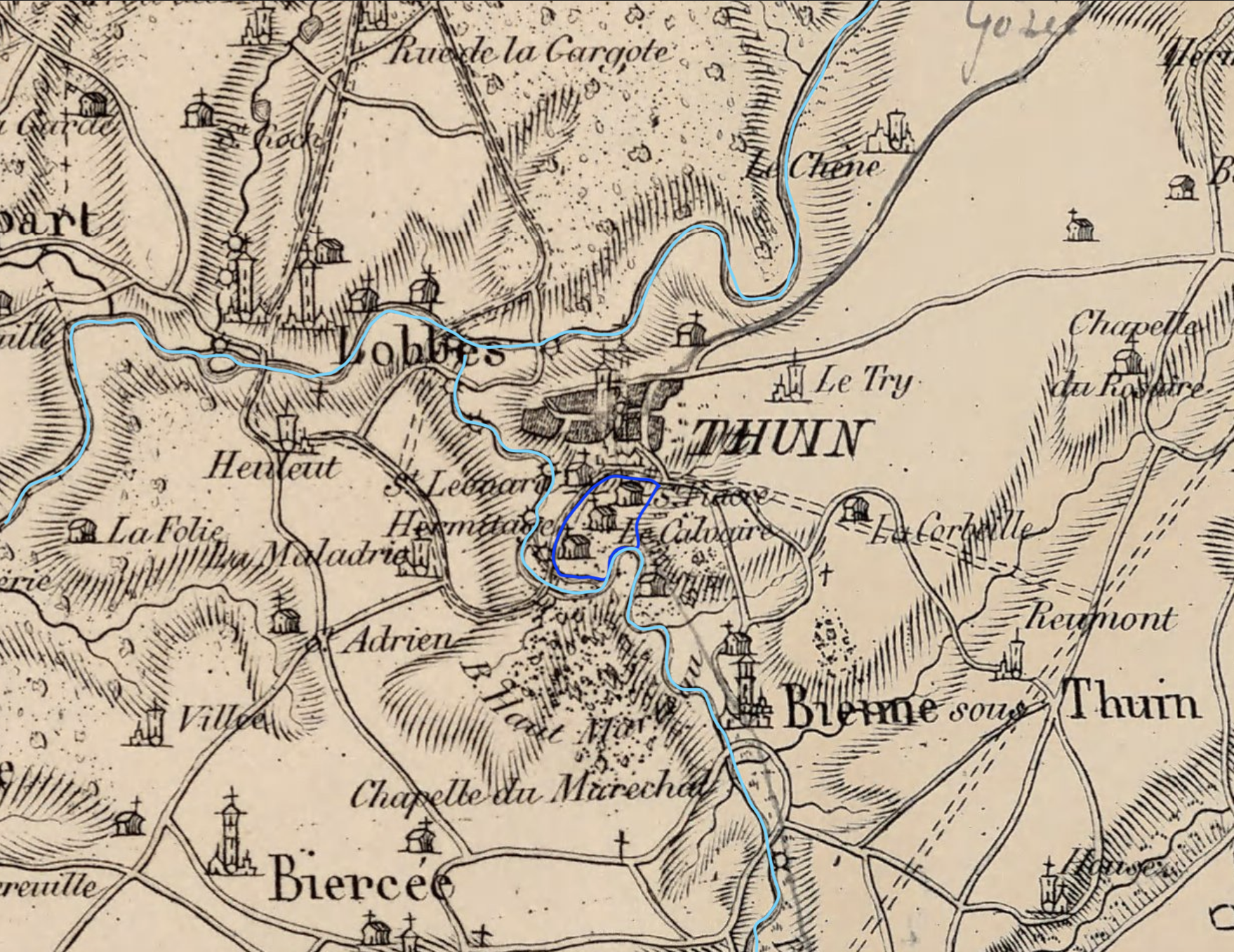
Part of the Aduatuci tribe, were associated with the current site Tongeren, 65 miles to the east. However, a more recent discovery has located an Oppidia in Thuin which is closer to the target area on the border between France and Belgium. This is an elevated, wooded area south of Thuin as outlined in blue. Nearly 200 years ago this was the site of many chapels although only one remains. The Thuin area was used as a burial place in the 2nd and 3rd century, Gallo-Roman times. “One of the more spectacular discoveries of Roman provincial archaeology of the last few years is the plausible identification of a Late Iron Age fortification at Thuin (Belgium) as the oppidum of the Aduatuci, conquered by Caesar in 57 B.C” Fernandez-Gotz & Roymans pg 77 [see below for link] “Although it is clear that both the Eburones and the Aduatuci did not survive the conquest period as tribal groups, there are differing opinions among historians about the interpretation of Caesar’s narrative; some scholars take his account on the destruction of the above tribes very literally, while others (e.g. Heinrichs 2008) see it as a rhetorical act of political propaganda.” I would add that the Roman description of human sacrifices by the Celts may have been another bit of propaganda and has been questioned by researchers. Creating savages out of the “other” the “Keltoni” makes it easier to accept Roman genocide.
My theory is some of the Aduatuci survived, and they carried forward their sun wheel, tribal symbol. The most likely place they might escape to is the closest forest of Avesnois [about 6 miles] and perhaps moving southward to the Forest of Ardennes [about 35 miles] A similar pattern is seen on some coins of the Suessions tribe but the annulets are replaced with pellets.
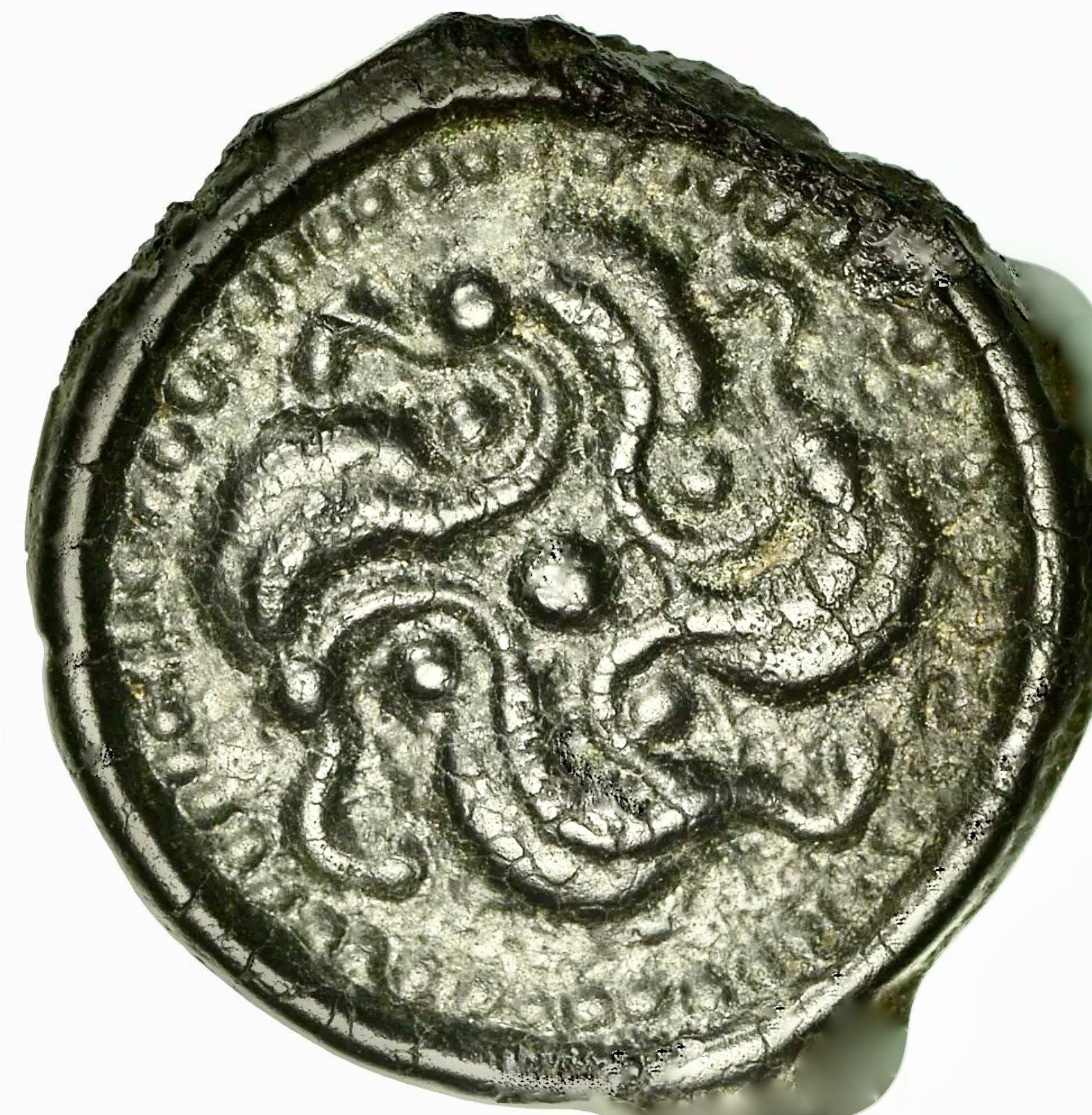
This may suggest that they had a close relationship. Perhaps some Aduatuci being absorbed into the Suessions tribe near Soissons, France about 90 miles west. Or the Aducati may have ventured south along the Meuse River to the Verdun area. This pattern may have been a sign of identification passed through many generations. A Secret symbol or remnant of the Druidic past. It was later adopted and used in Anglo Saxon coinage with the addition of crosses connecting them with Christ. Often pagan customs and iconography became subsumed in later cultural adaptation, so this is not unusual. So what I am suggested is that members of this Druidic tribe, become Episcopal nobility 700 years later. If the Druids passed down their secrets through families it does not seem at all strange that the scientific, political and religious knowledge would give them certain advantages in rising to positions of power. This of course is just a theory but it seems as plausible as any we can ascertain, with the evidence we have. Next up is how this sun wheel symbol bestows its power.
BIBLIOGRAPHY
Coupland, Simon (2014) The Use of Coin in the Carolingian Empire in the Ninth Century from From Rory Naismith, Martin Allen and Elina Screen (eds), Early Medieval Monetary History: Studies in Memory of Mark Blackburn
Bouzek, Jan (2010) “STUDIA HERCYNIA XV PREHISTORY OF EUROPE AS SEEN FROM ITS CENTRE Czech lands from Paleolithic to the end of the La Tène period in European context” Prague
Fehér, Tibor. (2021). Celtic and Italic from the West – the Genetic Evidence. Academia Letters, Article 1782. https://doi.org/10.20935/AL1782.
Green, Miranda (1996) Celtic Art: Symbols & Imagery London
Fernandez-Gotz, Manuel & Roymans, Nico (2015) Caesar in Gaul: New Perspectives on the Archaeology of Mass Violence Theoretical Roman Archaeology Journal Mar 2015
Harding, D. W. (2007) Archeology of Celtic Art
Lily, Simon (2008) Ancient Celtic Coin Art
Kelly Wheaton ©2026 All Rights Reserved


Kelly These have been so helpful I guiding me to understand my data. Also I never noticed that you were a wood. Where are your woods from. Mine are from North Yorkshire.
Sandra–I have a couple of WOOD Lines.
John WOOD who arrived at Plymouth Colony in 1635 his son Thomas settled in Swansea, MA
William WOOD Rev War Capt Birth 03 Apr 1737 Poquoson, York, Virginia, USA or Maryland and Death 26 Apr 1804 Randolph, North Carolina, USA father unknown.
Edward WOOD Birth 29 Oct 1598 Nuneaton, Warwickshire, England and Death 27 Nov 1642 Charlestown, Suffolk, Massachusetts, USA Goes back to a Lewis WOOD b 1540
Susan WOOD Birth 09 Aug 1578 Halifax, Yorkshire, England Death 1664
May be others.