The Days Are Passing Swiftly by and I Am One Day Nearer Home: A Soprano’s Aria Chapter 32
Posted on March 5, 2022 1 Comment
June 13 – I have been here [at Mrs. Fryer’s] a mo[nth] and Joe gives me 45 dollars for my month’s work which I have earned every cent. A week later The Elijah comes off
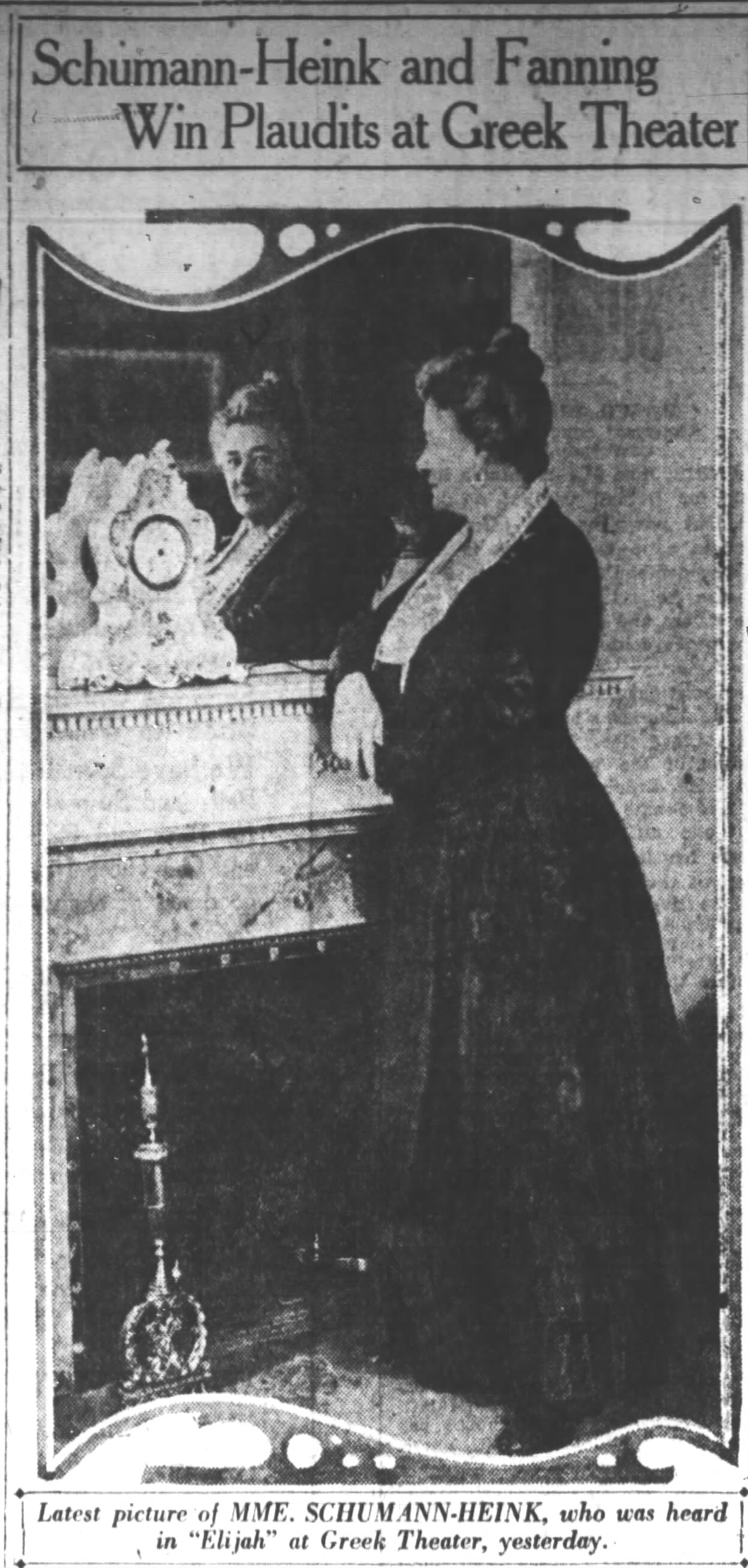
June 21 – I do a tremendous forenoons work, eat lunch that Mrs Fryer Irene cooked, and dress up in my white suit for to go out and help sing Elijah at the Greek theater. I arrive in pleanty time Madame Schumann-Heink sings several solos in her wonderful style which holds the vast audience grilling there in that pitiless sun, breathles. Then our Choruses goes off without scarce a hitch and then home alone lonesome but still glad to be back in our little Berkeley Bungalo again to rest up and recuperate.
June 22 –Joe and Eilene drive out with my suitcases and pay me my last weeks wages and that chapter in my life ends which never will be quite the same as before I went but, if joy or sorrow most is mine I know not, they are so closely comingled.
June 23 – Enjoying a good rest at Jessies. Finished Josephines plaid waist and left it with Mrs. Bursick at Capwells store on 25. The rest of the month was spent quietly at Jessies in Berkeley.

July 1 to 3 — Preparing to go Camping.
“ 4 – Jessie & Syl started on the 3 and went over to Ferry to meet Ester and Herbert to go to Lagunitas I started on morning of July 4 to meet the boys and Lolita at the Ferry. I had my new Gray Blanket and a box of cooked food and camping necessities. They were there with the car and we waited our turn to be taken on the Ferry to Sausalito. The boat was crowded with 100 cars and there was barely room to pass between them. We had a most enjoyable trip.

The scenery from Sausalito to Tomales is very beautiful and diversified comprising dry and marsh land mountains and open sea. We had a puncture and blow-out the latter necesitating the purchase of a new tire at San Anselmo. The foggy drive did not tempt us to tarry at Tomales so we came back to a friendly field near to Calonia and made camp. We parked the car in a stubble field near Paper Mill creek and after building a bridge across the lively little stream by throwing in rocks topped by a rotten log, we crossed dry sleeved? with our camping outfits to the opposite bank which was covered with trees with a nice level gravelly place near the water to build our cozy fires on.
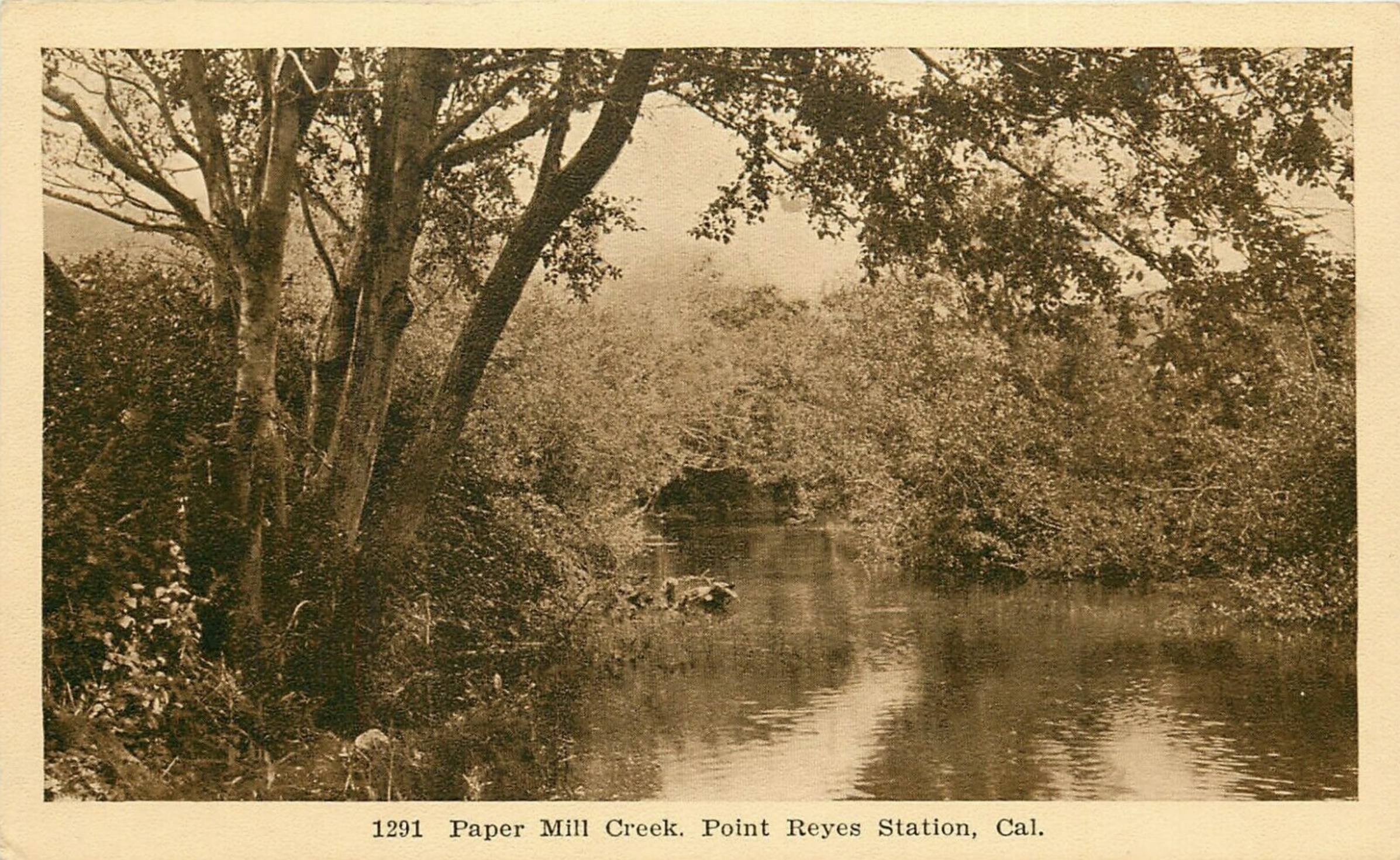
The day had passed and night had fallen on the rim of the world when at last we made our first meal, and our camp beds under the sheltering bay trees. Lolita, Little Leo Hoffman and I slept together. Dutch and Milo found a soft bed of leaves further up stream and Albert & Dewey slept near the machine. In the night I felt cold and got up and made a big fire of the abundance of brush wood all about and Allie came over to enjoy it. Later I layed down and slept til morning.
July 6 – We passed Jessies and Syls camping place which was already deserted. We had a most enjoyable auto ride skirting the hills homeward bound. A long wait in line at Sausalito and then packed in the ferry boat to cross the S. F. Bay at the Ferry building. I said good Bys and go home to Jessies again where they have already arrived. We swap “yarns” and retire for a good rest in a real bed. Glad to be home again
July 7 — a very hot day. I take a slight cold
July 8 & 9 – washing and ironing
“ 10 – Dewey went to San anselmo to redeem my watch which we left at the garage when we bought the tire on our camping trip. I got a letter from Jennie Palmer saying she would come to see us. We start planning
“ 11 – Decide to get a bedroom set and clean house
“ 12 – Went to several places and at last found what we were after in Oakland. A beautiful Russian walnut dresser and bed for $135 and mattress and spring for $20 to be delivered Tuesday 15. Upon arriving home we found Lolita had come and gone.
July 13 Sun. – I went over to see the children and Dewey came over here I waited there for him and he waited here for me. We each stayed all night at the others place.
Mo. July 14 — In the morning I got up saying he wins and hurried over, finding him still in bed. Had a pleasant chat with him. He had got my watch for me. I was glad to have it back. The bedroom set came. It is very beautiful to look at and restful to sleep on. I wrote to Jennie and she did not come. Jessie and J. Ralsomme? the kitchen and clean the whole house.
“ 16 – Mrs Miller came over as we were finishing. She wants her dress
“ 17 & 18 – Finishing Mrs Millers dress.
“ 19 – Lolita and Leona Pfeiffer came and broke the news to me that she was to be married Mon. I am astonished incredulous dismayed disappointed dissatisfied desolated grieved. I expostulate exhort argue complain. I wonder and regret and repeal and learn nothing. Lolita departs in tears promising to come on the morrow and tell me all about it. They come
July 20 Sunday – I give Charley a collar bag I have made for him and Lolita a collar that was Lois’s and a pretty hanky I bought for her. I clean her cape and hang it up to air over night. Charley very meekly and sweetly asks me if I care and I tell him I was sorry I didn’t know of it in time to make her trousseau. He said she had enough and was glad that I didnt object to him personally.
Monday July 21 –Lolita Mosier and Charlie Camerons Wedding day – Lolita comes over with Toots and gets ready for the ceremony. J, T. L. and I start on time and arrive at the courthouse in S. F. at 2 oclock. The rest consisting of Dewey Allie Milo and Eilene also Charley and his mother have just arrived. After introductions all around we go to the county clerks office and procure the license. Then up we all go to Judge Trouts office and listen to the service that unites my little “bito dale” to Mrs. Camerons pride and hope both 18 yrs. old in the holy bonds of matrimony and hear him say with this ring I thee wed. Hear their clear proud responses to love and cherish each other and hear the Judge pronounce them man and wife and hear her addressed as Mrs. Cameron. Dewey took Mrs. Cameron the mother Leona, and the bride and groom out to Ingelside to get their suitcases while Jessie & I went to the jewelers to get Lolitas watch. I also bought her a pretty pin. We met them at the Ferry (the worlds meeting place) and gave them to her and said good bye taking the boat for home while they went on the Sausalito ferry to take the train for Sonoma Grove where they will spend their honey moon.
Tue July 22 – aftermath. Jennie didn’t come rather sorry and lonesome
Wed. 23 – Making a shirt case for Deweys birthday.
Thu “ 24 – Deweys 22 birthday I went over and gave it to him and had dinner there. Eilene was cleaning house. We plan a shower on Lolita and Charley when they return. Lolita wrote of a happy honey moon. Jessie writes and receives a letter from Agnes. I meet Joe at the Ferry and tell him the news. He says let them be happy while they are young, they’ll be old soon enough. Said Irene was doing fine but nervous. Explained his booth in Ferry building for advertising by slides and mooving pictures and we crossed the bay together the first time.
Fri 25 – Jessie is ironing and making Lolitas middie out of a serge dress Mrs Fryer gave her a long time ago. She is talking of going down town to do some shopping later in the day I accompanied her to Oakland and as she took her treatment at the Dr’s shopped around and wound up by leaving my magazine and patterns at Osgoods drug store and when I went back for them they had been picked up by a woman who saw a chance to get something for nothing. It will profit her nothing. I was very disgusted with myself and wonder why I am getting so rattle brained.
Sat. July 26 – I worked on a quilt for Lolita some of the blocks of which I pieced in Minneapolis so long ago. Sat. with its usual house cleaning. In the evening we went to see the Little Shepherd of the hills in the mooving pictures at the Oakland Orpheum. It was very good and touching. Jessie cried but I guess most of my tears have been shed, Or maybe they drip inside. When Lolita and Charley came home from their honey moon they found the house empty but by accident the song book was turned to Home Again and and standing on the music rack of the piano. They both thought it very strange, and spoke of it when we returned from the show. Lolita cried because she thought I didn’t love her any more but I guess she knows better now! I was glad to have them “Home Again”.
27 Sun – J & S. L. & C and I went to the little corner Presbyterian church and listened to a good sermon by a visiting minister. Then they all went away but me returning later in the evening.
Mon. July 28 – I accompany Lolita to the city to look for appartments. She finds one after a weary search and engages it. Then we went to Eilene’s to get some lunch and Lolita returns to Jessies to get Charlie to help her carry their suit cases to their new home. C went to work in earnest today. He said he made $10.00 today some wages but then the cost of living is very high. Their appartment is 37.50 for 3 rooms (bath and kitchen 2 wall beds 2 closets. It is much the lightest cleanest and best furnished we found for the money.
Tue July – Well my last little girl is off to her new home. May she find a refuge from the world and haven of happiness. Im glad she has a home of her own. It puts her on an equal footing with the other two girls.
July 30 – Jessie and I go to Sabins Jewelry store on Filmore in the city to look at some silverware. I decide on 3 articles of 6 each –knives forks and teaspoons $6.00 best grade community silver.
“ 31 – Last day of memorable old July. Working on a quilt for bride.
Aug 1 – Still at Quilt & Eilenes dress
“ 2 – Finish making over “ Golden poplin dress 3rd time. Looks fine pack suit case with changes wedding cake and go to Eilenes Find her busy hanging pictures and nearly ready for party. I clean kitchen and laundry and dishes etc. Then we all dress and the party is on. Last to arrive is the Bride and Groom . They put new life into the party. The time was spent singing and dancing and then Lolita was led in blindfolded to a seat on the davenport which was piled with bundles. When the blindfold was removed she looked at the presents rather sheepishly and then began unwrapping and holding them up for admiration thanking each giver sweetly. The presents were all appropriate useful and in good taste comprising china silverware glassware table linen and crackers and bowl vase picture and electric Iron. She and Charlie are both very proud of their presents. Jessie Sylvester & I accompanied them home and remained over night. N & J went early to church next morn.
Sun Aug 3 – Later in the day L. & C went to the civic Auditorium to hear Lemare play. I stayed in and read “20 Years After” by Dumas.
Aug 4 – I went down to see about a position as solicitor for a real estate co. They took my name and address. Then I went back to the St. Regas appts. And read while waiting for Milo to bring my shoes which I left at Eilenes the night of the party. Soon he and Dutch came and I went to Oakland to get another pattern like I lost and met Josephine at Kahns soon Mrs Fryer came and we talked of her health which is still poorly. She talked of mooving. I offered to help, if she’d call up.
Aug 5 – I went down to Hinks store for some lead weights to put in the coat I’m fixing for Lolita. I went into a book store and got a box of writing paper to send to Betty my dear whose birthday is on…
Aug 6 – Betty Richardson is 9 years old today and I hope she gets the present I sent and likes it well. I did not mention that Mrs Miller came over yesterday and I fixed the dress I made some time ago. She paid me 6.00 for it. I finished Lolitas coat and cut and basted my new silk waist washed up the dishes and am now going to bed at 10:15 oclock. I wrote a long letter to Leo today in ans to one I got recently. It closely covered 3 sheets of note paper.
Thu Aug 7 – Did a big wash and sewed some in afternoon.
Fri 8 – Still sewing on my champain crepe de chine
Sat 9 – Cleaned 2 suits for myself and long check coat J and I did a big ironing and washed up the odds and ends of the week. I made a red striped clothes pin sack for L.
Sun 10 – I rather looked for a phone message from Mrs Fryer but none came. There 3rd month at the Vill at Lovely Broadmoor is up today Jessie and Syl went down to Melrose to see Rosie who came back with them. After she went away J. S and I called on the Smiths across the corner. We had a pleasant time playing records on the victrola and came home to find Eilene and Mrs Shiman here. We had a lively time chatting for an hour and when they left I accompanied them to the Vine St Station. I am now about to retire it is nearly midnight beautiful and cool and moonlit. They say its very hot in the east
Mon Aug 11 – Finished reading 20 Yrs After by Alexander Dumas. A very exciting story full of warlike characters who play their part to the last page where all ends happily. I sewed a little and washed dishes. Am not very well. Jessie went to the Dr for a treatment.

Tue Aug 12 – Spent the day sewing on my pongee dress and Little Leo’s coat. Milo came and got Lolita’s coat that I fixed for her and some other things. I was glad to see him. Mr. Jeune called in the evening to talk with Syl and Jessie about church and mission work.
Wed Aug 13 – Just 3 mo since I went to Beautiful Broadmoor and it seems so long ago. All time is not measured by length of days. O heart of mine what happiness it would be to dwell amid those sylvan scenes surrounded by those we love, forever; Today I busied myself finishing Leo Hoffmans coat. This evening I practiced some on the piano and took a short walk, getting a pink & white geranium on my way.
Thu Aug 14 – Jessie washed cloths I cleaned up the house and stamped my waist for embroidering. I got a good long letter from my sister Goldie. She asks for advise I hope I can give it to her right. It is a hard task. Mrs Miller came in time for dinner and then we all went down to Rays to get some rabbits. Ray and Rose have exchanged their place in Melrose for a small ranch in Castro valley and will moove to Napa while R. works in the ship yards at Mare Island. Mother Miller lent me an old book that was her mothers, to read. Wormwood by Marie Corelli, about the effect of Absynthe on the minds and morals of Paris. An awful tale. I turned off the light at 3 oclock.
Fri Aug 15 –I got up late had a light breakfast and finished my story in bed. And now in the light of truth that has dawned on the world since right triumphed over wrong and France did so nobly and bravely fight and conquer (with our aid and Englands’) over old foe, Germany. We can see that Wormwood was wrong. Absynth did not ruin France and cause her downfall. They must have seen its danger and averted it, and I am glad my faith in the ultimate triumph of good over evil of right over wrong of love over hate is justified. It is noon my work calls and bids me back to sanity and peace in its accomplishment. Spent rest of the day in sewing and housework.
Sat Aug 16 – “The days are passing swiftly by and I am “one day nearer home.” Help me O Lord to live each day as if it were to be my last. Help me to keep a sweet faith and childlike trust. Help me to enjoy the life Thou hast given and to give of that joy to others. Help me to make friends and to keep them to help and comfort them in their hours of affliction and to rejoice with them in their hours of gladness. Drive out of my heart envy and suspicion malice and hate that there may be more room for love for Thee and thy creations Help me in my weakness Keep me in health and let me live long in thy service. Give out of thy abundance O father my hearts desires in Jesus name Amen.
Today I finished my silk waist and went down to Oak. Got some buttons for Leos coat a pair of gloves and a magazine. Saw Mrs Fryer but didn’t speak to her. I think she is still at 13 Broadmoor
Sun Aug 17 – Jessie & Syl went to Alameda to visit Dorens I stayed home alone all day. Dewey came over at 7.30. I cooked dinner and as we were eating J. & S. came back. They are talking shop (machinist) now. I am tired and will soon retire. Dewey is working at Mare Island now. I gave him Leo’s coat to take home. I hope it fits him all right.
Mon Aug 18 – Jessie went to S. F. and got a bundle of rompers from the Factory to make up. Saw the whole family upon her return. Baby was very proud of his coat. They are all well. I am blue and lonesome to the nth degree. I worked on my pongee dress today.
Tue 19 – Jessie worked awhile on her rompers and then went to city. I did up work and sewed on pongee. J came home and got dinner. Syl is figuring on a goat pen and rabbit hutches. It is 10 oclock and bed time. Every thing is tranquil.
Wed 20 – Sewing and housework all day
Thu 21 – Jessie and Syl burned the grass in back yard some fire. I came in with a headache. Very blue and despondent.
Fri Aug 22 – J cleaning house and washing I worked on rompers all day. Milo came to dinner. ???? all night. Vestina came to call a few minutes. Tired am I.
Sat Aug 23 – Sewed on rompers awhile and cleaned up sewing room Jessie worked hard at cleaning house and baking Dewey came in evening. I went over to Lolitas after a light dinner with Dewey J & S having dined earlier. I left before their guests arrived. Met Milo, Dutch David and John Armstrong arriving at C & L Cameron’s.
Sun 24 – Next morning I arose and cleaned up after last nights festivities rested and read the papers came home to Jessies at 7 oclock found them enjoying the Sunday paper on my new Circassian bed. Dewey had gone before I arrived. Went to bed and slept fine.
Mon Aug 25 – This is Leo Mosiers birthday. I wrote him a long letter. J and S went to O Tech H. to enroll couldn’t get in. Went to Berk. Tech High with same results. Will try again. Emense enrollment all schools this term 10% gain over last.
Tue Aug 26 – Jessie and I finished the 3 ½ doz. rompers and took them back to the factory. She received 1.25 per doz plus car fare 22 cents. We decided there was nothing in it for us and did not take any more. We called on Eilene and then came back to Berkeley in time for dinner. Lolita came over but left early.
Wed 27 – I finished embroidering corset cover. We all called on Vestina and Mrs. Smith. Syl favored us with selections on the phonograph. It is quite warm today. The West is in the midst of a R. R. strike. To bad Allie was going to send for A.
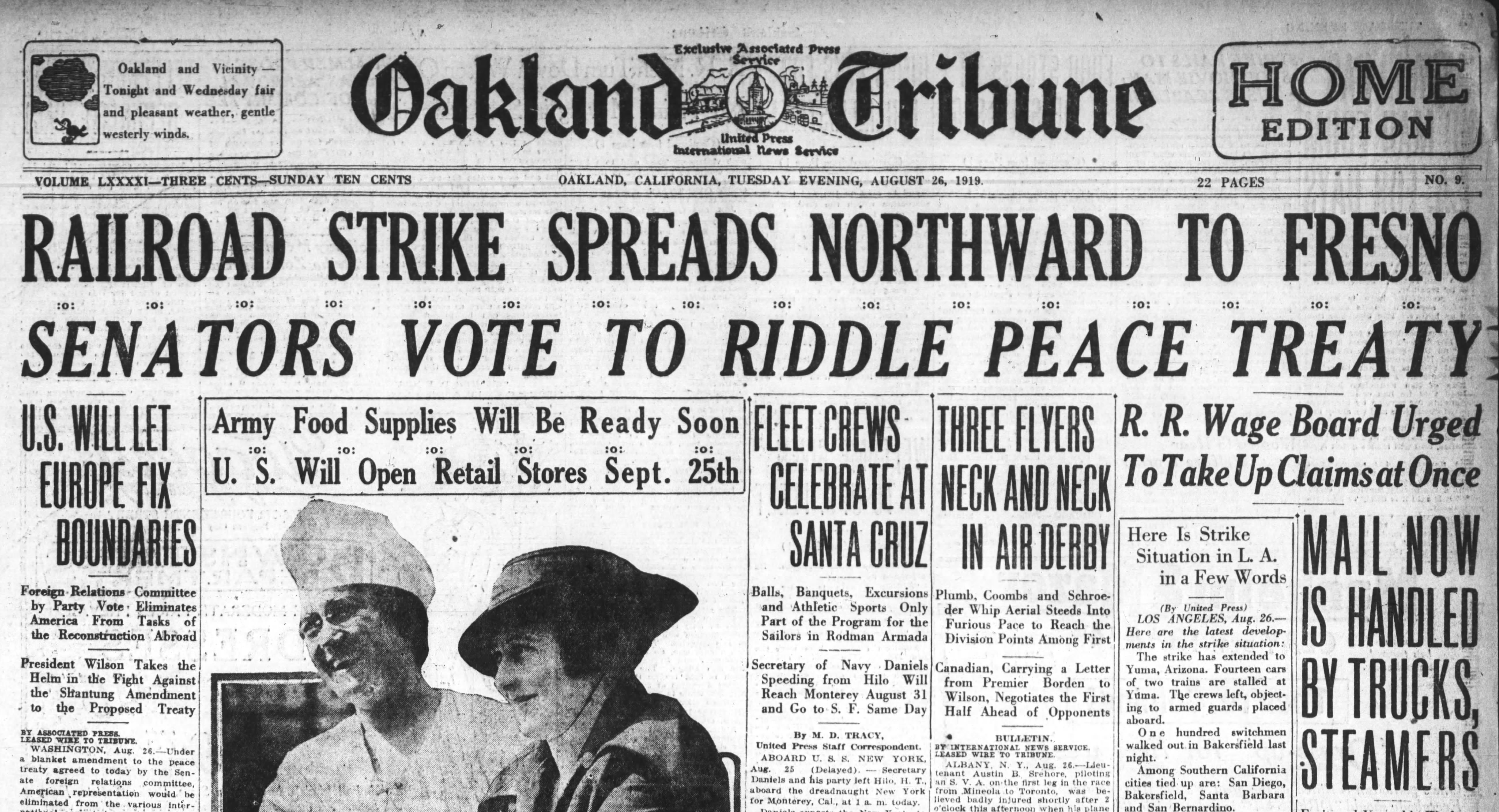
Thu Aug 28 – Spent the day mending In evening attended a rehersal of the Berkeley Community Chorus to practice for entertainment of Sailor boys of Fleet Sept 3 [Fleet Week].
Fri Aug 28 – Went down to Oak High School to see about vocational training to teach dressmaking in the Public school.
Kelly Wheaton © 2022 All Rights Reserved
One Fine Autumn Afternoon at the City Hotel
Posted on March 4, 2022 4 Comments
This is a work of historical fiction grounded in the facts as catalogued in My Woman Warrior . This is just one incident in my 2nd great grandmother’s life. It is my first attempt at historical fiction, so be kind. At the end I will briefly talk about my process.

Mrs. Catherine Adeline Mosier ran a tight ship. Lunch for full board guests of the CIty Hotel in Dodge was promptly served at half past one, as it always was on weekdays. This being a Tuesday, it would be promptly at half past. She knew her honeymooning couple would be starving as they had not been down for breakfast, nor requested a tray. She simultaneously grinned and said a “tusk, tusk” to herself when thinking on it. Her daughter Emma was married in this very hotel six years ago and her daughter Anna five years, next month. My how time flies she thought. Wonderful smells coming from the kitchen quickly ended her reverie. She went to check on the fresh apple cake she was serving for desert, with warm cream of course. It was her first cake of the season from her Cox’s Orange Pippin trees from out on her husband’s farm. The orchard was planted nine years ago, in 1886, when they bought the farm outside of Dodge. The apples were producing nicely and this years crop was the best yet.
Today’s lunch fare featured Catherine’s own pea soup and squash biscuits, as well as some fine sausage, homemade breads, jams and preserves. Mr. Arnold, one of her regular travelling salesmen, was always good at entertaining the other guests and today was no exception. However, our newlyweds seemed more interested in each other than Mr. Arnold’s exciting tales of adventure. There were two couples who would be headed out tomorrow. Mr. Arnold had his wares set up in Catherine’s sample room. They included books, stationary, fine fabrics, linens, notions, jewelry, watches, perfumes and even some crystal. These always attracted some of the local merchants, farmer’s wives, as well as those staying at the hotel. It was a lucrative arrangement for both Mr. Arnold and Catherine. He got a discount on lodging and she got a discount on all her purchases plus a small percentage of his sales.
This September afternoon was particularly warm, with temperatures expected to reach the upper 80’s. The only thing that kept them from sweltering was the rather robust breeze that was turning downright gusty. Catherine watched as the lace curtains began dancing rather vigorously in the wind and decided to close the sash windows to the south and west as it seemed a storm might be brewing. As she reached up to close the window she caught the acrid smell of fire. Followed moments later by the rigorous clanging of the fire bell. “What can it be now?”, she thought. Walking out onto the front porch and looking down the street she could see the billows of dark smoke and flames being whipped about by the wind. People came running and shouting, “get out, get out now!” In the moments that she had stood there it seems the fire consumed the block between them.
As she entered the dining room the guests were already headed outside to see what the commotion was about. Catherine quickly exited out back, rushed across the small yard, unlatched the gate, and urged her chickens to flee for their lives. Meanwhile, Mr. Arnold had wasted no time in gathering up as much as he could and was dragging two large trunks onto the porch and down the front steps. Most of the other guests grabbed their bags as best they could and quickly moved down the street to be further away from the encroaching flames. Catherine slipped the crystal and silver salt and pepper shakers from the side board into her deep pockets. They had been a wedding gift from her grandfather Daniel Stewart. She clutched the guest registers in her arms and glanced around her hotel knowing it might be the last time she did. Some made efforts to pull as much out of the buildings as they could. Mr. Arnold was back and helped her move a few things outside; a side table, a mantle clock and several ornate lamps. Catherine found it hard to choose what to save. She took one last look, sighed heavily and joined her guests down the street. She looked at the watch pinned to her breast it read 2:17 and wondered to herself, why she was checking it.
Even though the fire was still half a block away the smoke was causing her eyes to water heavily. It looked as if she was crying and many people were, but Catherine stood stoically as she watched the flames licking their lips at the back of the hotel where the sample rooms were being consumed by a fire breathing monster. She comforted herself having seen her hens headed to a nearby cornfield. All you could do was watch mesmerized by the flames. Even the hook and ladder truck and fireman stood silently watching the beast devour everything in its path. There was no water and the wind was a gale making short work of it for the monster.

It seems it was over almost as quickly as it began. All that was left of Dodge was smouldering, steaming, rubble. Aside from 3 brick buildings that were saved and a wagon here and there with a tumble of furniture and wares there was nothing left where the town of Dodge once stood. Some 50 business and 16 homes were gone! Just like that! Only one person had been injured in the fire, she was grateful for that. Joe Wiesner had a badly blistered arm from trying to pull goods from his store as it was being engulfed in flames. “Silly man,” she thought. Catherine mused this must be what it looks like after a tornado, although she had never seen one. She was circumspect; yes she could rebuild but she had no insurance. It was exorbitantly expensive so few had insurance and even those that did were underinsured. She hadn’t noticed how exhausted she was. She enjoyed running the hotel, she liked the changing kaleidoscope of visitors, but at 66 she was getting tired. It had been a good eight years at the hotel, perhaps she needed a rest. The Lord giveth and the Lord taketh away. She knew this all too well.
Husband John showed up in his wagon having seen the smoke from the farm. He was devastated. All he could think about was the money and how the sample rooms he had helped to build were in ashes. He was talking about rebuilding the hotel in brick. Meanwhile Catherine was thinking of where she might live—surely not with John—full time? She liked the Hotel precisely because it gave her just the right excuse to be away. There were rumors that the Railroad had started the fire and another that it started in the hay barn at the livery. Catherine didn’t much care. Friends and family were gathering and neighbors from nearby towns of Snyder, Clarkson and Howells as well as larger North Bend were bringing food and household goods. Catherine was lucky she had her home and farm to return to. She had lost her livelihood, but not her life. She turned back once to look at where her lovely hotel had stood then climbed up into the wagon and fixed her eyes on the sun, slipping below the horizon.
It started with the word “acrid” which I couldn’t get out of my head as I stared with the horror at the War being waged on Ukraine and feeling helpless. Ideas occasionally surfaced and a story started to take shape. Then I woke up early one morning and managed to fall back to sleep. In that dream state more images materialized. Once I had the basic outline in my head I revisited articles about travelling salesmen, sample houses, newspaper accounts of the Dodge fire, old cook books and menus etc to make sure what I was writing was historically accurate. I tried to give Catherine a voice that was consistent with her life. All the events are fictionalized. I hope they do her justice. A note on the flower picture—I just thought it needed a flower photo. I did not know its meaning at the time but the photo is of Hypericum [St. John’s Wort] which literally means above a picture and comes from the tradition of hanging plants over images, pictures, or windows. Furthermore common folklore suggests it wards off evil influences and protects against harmful, unseen forces.
Kelly Wheaton © 2022 All Rights reserved.
My Woman Warrior: Pioneer Mother Catherine Adeline Stewart Murphy Mosier
Posted on February 28, 2022 11 Comments

The impetus for this blog post was my writing challenge to resurrect one of your women warriors. A woman in your tree whose story lies hidden in the names, dates and places. I have spent the last few weeks on Catherine. I offer this as an example of what is possible to resurrect a woman in your tree. This is a recounting of all that I have been able to stitch together, that may be revised later. If you have any doubt what battles our womenfolk endured, give it a read. All heroines deserve to be remembered.
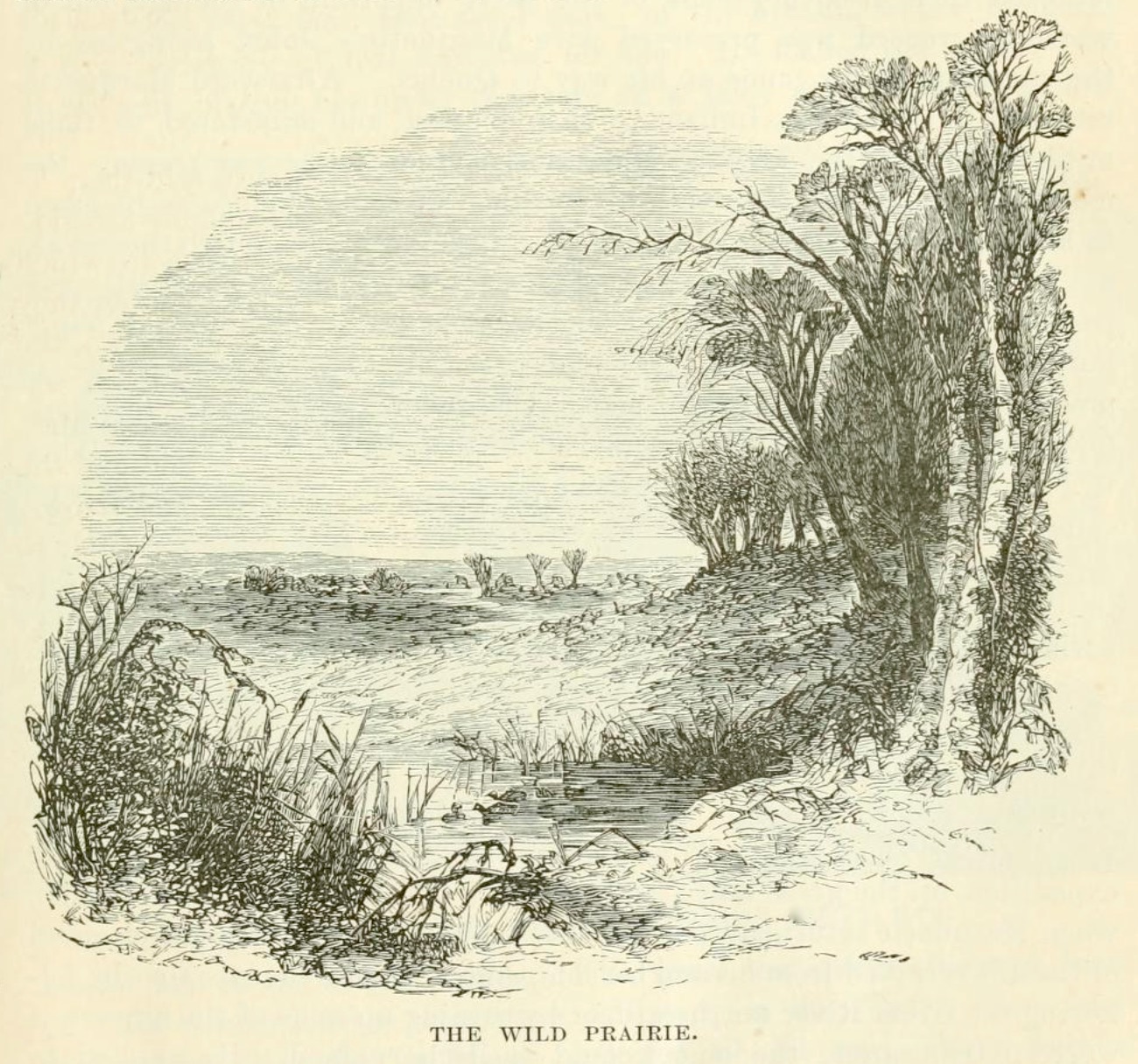
To the Pioneers–Who blazed the way, braved the elements, forded streams, repaired cabins on the storm swept prairies; the spacious landscape their only scene by day; the tinkling cow bell in the distant corral and howling wolves the only sounds at night; But who, with brave hearts and willing hands, defied the wilderness and in after years transformed it into fruitful fields and caused it to blossom like the rose…
Dedication from A History of Montgomery County, Iowa by William Wallace Merritt 1906
In my tree Catherine has always been an intriguing ancestor. She is my 2nd great grandmother, part enigma and part icon. [She is mother to Frank, the husband to Lulu of a Soprano’s Aria. We all have people in our trees that call to us and Catherine calls to me. For many years I have sought a photo of her, but to date none has been forthcoming. There were two things about Catherine, told to me by my great aunt, her granddaughter Jessie MOSIER MILLER, that surprised me. First, that she owned a Hotel in Nebraska. And second, a family legend— that she was descended from the Royal STEWARTs and had received an inheritance of $3,000 and a book of family history of the STEWARTs from a Scottish lawyer. This was a woman with a story!

So how much of a life can we give back to Catherine? When Catherine Adeline STEWART was born in Columbus Ohio, 20th of November 1828, she was the second child of Andrew J STEWART, age 42, and Sarah “Sally” RUTAN STEWART, age 25. They married just 3 years earlier in Urbana, Champaign Co, Ohio, on the 21st of April 1825. An intriguing age difference, yet neither had been married before. Andrew J STEWART was born in Connecticut, the son of a Revolutionary War veteran and Sarah RUTAN was born in Maryland. Both of their families were early pioneers of Ohio. At the time of Catherine’s birth the total population of Columbus, Ohio was less than 2,400 souls. It was at the time on the edge of a forested wilderness.
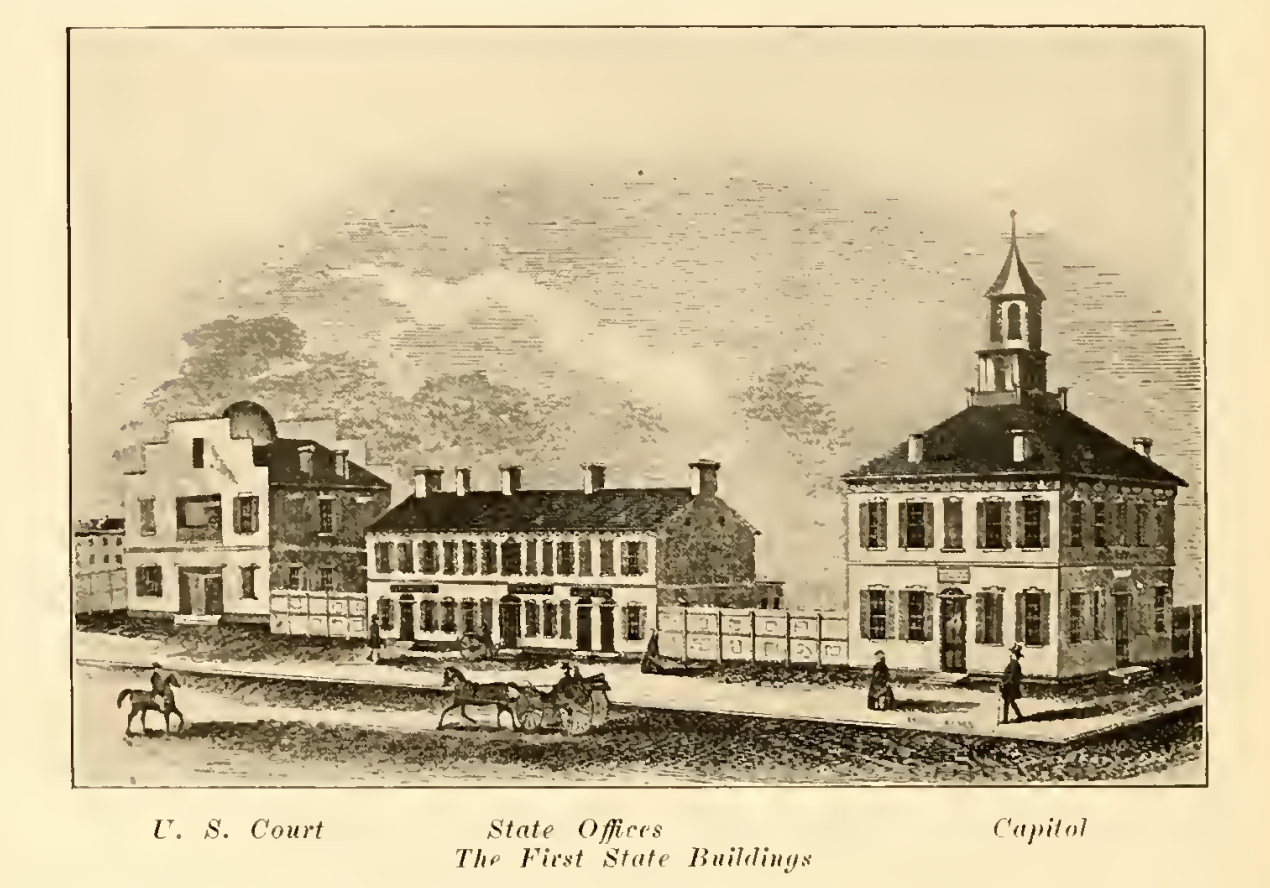
Catherine’s parents were blessed, first with her older sister Eliza in 1826, then Catherine in 1828. Then another daughter Delilah follows in 1832. Then in 1835, the long awaited son George. He is followed in 1837 with another daughter Ann. Somewhere along the line brother George dies. Then the 2nd of February, 1843 in Van Buren, Iowa, Catherine’s father Andrew J STEWART dies. Her mother Sarah is left with four girls and she is 5 months pregnant. Catherine is but 14 years old, likely helping out with her younger siblings. That same year her older sister, Eliza (17) marries, on the 17th of June and three days later their brother, Andrew Jackson STEWART is born. Likely, Catherine is there to help and support her mother, now being the oldest child in the household. I cannot imagine what it would be like to lose a brother and a father to death, and a sister to marriage and welcome a new brother in the space of a few months. Was her mother despondent? Stressed? With her older sister gone did Catherine willingly take on the role of mother’s helper? We cannot know the answers but we can guess at the turmoil.
Three years later in Van Buren County, Iowa Catherine’s widowed mother Sarah, marries Ezekiel BENJAMIN, a blacksmith the 20th of June 1846. Hopefully bringing some stability and support to her family. To this union one child is born, a daughter, Elizabeth Hester BENJAMIN about 1847. At the age of twenty Catherine leaves her parent’s household and marries at Keokuk in Lee County Iowa John W MURPHY, a boatman from Ireland on the 29th of May 1849. How did they meet? Was she attracted by his accent, his warmth? Was she hoping for a life of romance and adventure? She is but twenty with a whole life ahead of her. I wonder about her dreams and aspirations.
By 1850 Catherine is listed on the census in Dist 29 of Lee County, Iowa with her husband John and a son John A listed as 9 months old. By my calculations Catherine may have become pregnant just after she wed. In any event John Jr arrives about February. By October tragedy strikes again when Catherine’s step father Ezekiel dies after an illness of 6 days. According to the 1850 Mortality Schedule of unknown cause, however there was a Cholera epidemic sweeping through Keokuk at the time. So at the young age of 22 Catherine has lost a father, a step-father and a brother. Her mother is now twice a widow at 47.
In the 1850 census Catherine is living next door to her mother Sarah and her five siblings. Undoubtedly, a source of financial and moral support for her mother. We do not know what happened next but Catherine’s life and her mother’s seem to be following parallel paths riddled with tragedy. Catherine’s husband, John W Murphy dies. As a boatman he may have died of illness or an accident. He may be the John Murphy who died 23th May 1854 that is buried at the Third Street Cemetery in Dubuque, Dubuque County, Iowa. What we do know is she is a widow by 1854 when she marries 29 October, a widower, John Wesley W. Mosier in Lee County Iowa. In any event, her new husband John was previously married to a Pamela Overton 16th of May 1850 at Keokuk. Pamela died about 1853, and her mother died in 1851. [I am beginning to think this area was particularly hard hit by illness.] Perhaps wisely, the family moves 90 miles north to Iowa City, Iowa where their first daughter is born the 17th March 1855. Catherine’s grandfather Daniel Bertine STEWART dies the 20th Feb 1858 in Rome, Athens, Ohio. Since her father had already died, her grandfather makes his children his heirs. How much she received I am still researching. By 1860 the family has moved 240 miles west and is settled in Council Bluffs, Pottawattamie Iowa where John is listed as a Farm Laborer and Catherine a housewife. Did they move following farm employment opportunities? Was it for land? There is no Real Estate listed but their personal estate is valued at $100. There are 4 children in the family; the oldest John A Murphy 10, Catharine’s son from her first marriage, Sarah 4, Charles W 2 and Albert 6 months.
Meanwhile by 1860 her mother Sarah, now 59 and 4 children have moved to Scioto, Montgomery County, Iowa. The value of her Real estate is $500, and personal Estate $300. Where did her money come from? There is no occupation listed for Sarah but her daughters Sarah 25, and Audria 22 are domestics and her son, Andrew J is listed as a Farm Laborer. Her youngest Elizabeth BENJAMIN is now 13. How she came to move there is not known, but I suspect she followed her sister there. April 13, 1861 a Mortgage is entered between John W Mosier and William Plummer and wife in Section 22 of Washington township for 40 acres with an assign by Hiram Whitney. I do not know who William Plummer’s wife is in 1861 but he marries Catherine’s sister Sarah Ann STEWART 23 Oct 1862 in Montgomery county. This Mortgage recorded 12 Dec 1863. I suspect this maybe the property occupied by Catherine’s mother in 1860 and it may be where John and Catherine first live in Montgomery County.
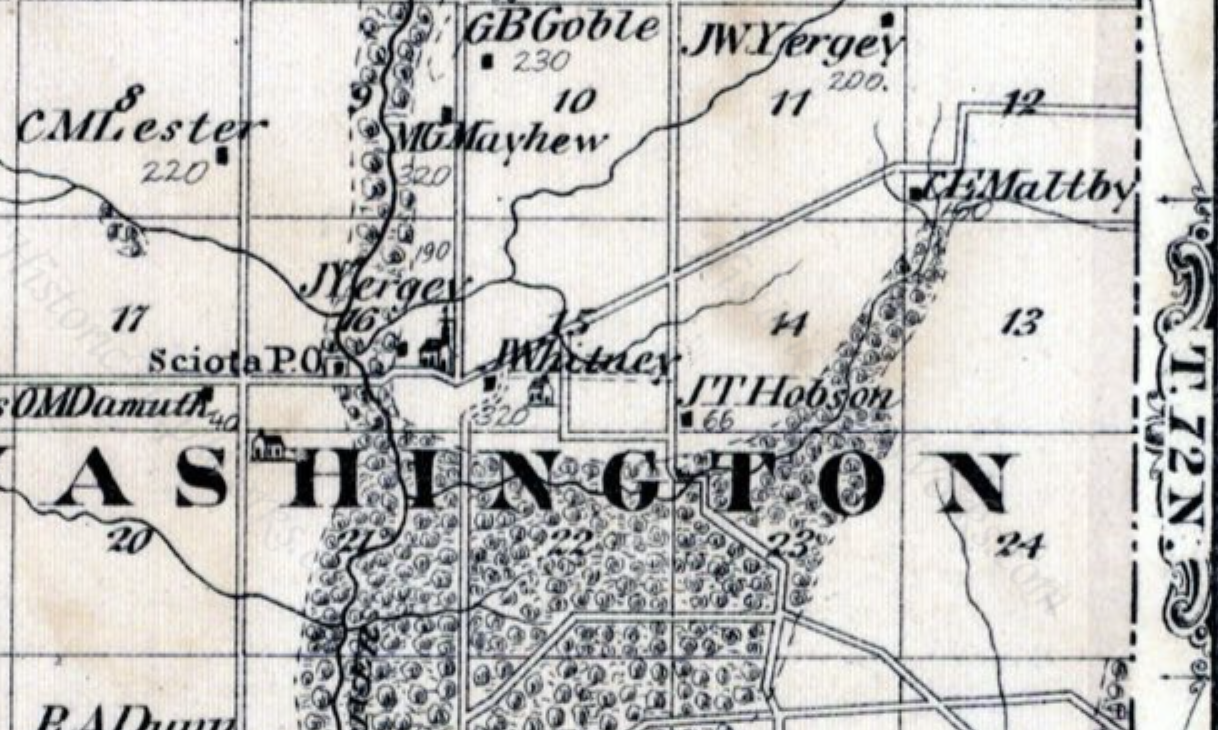
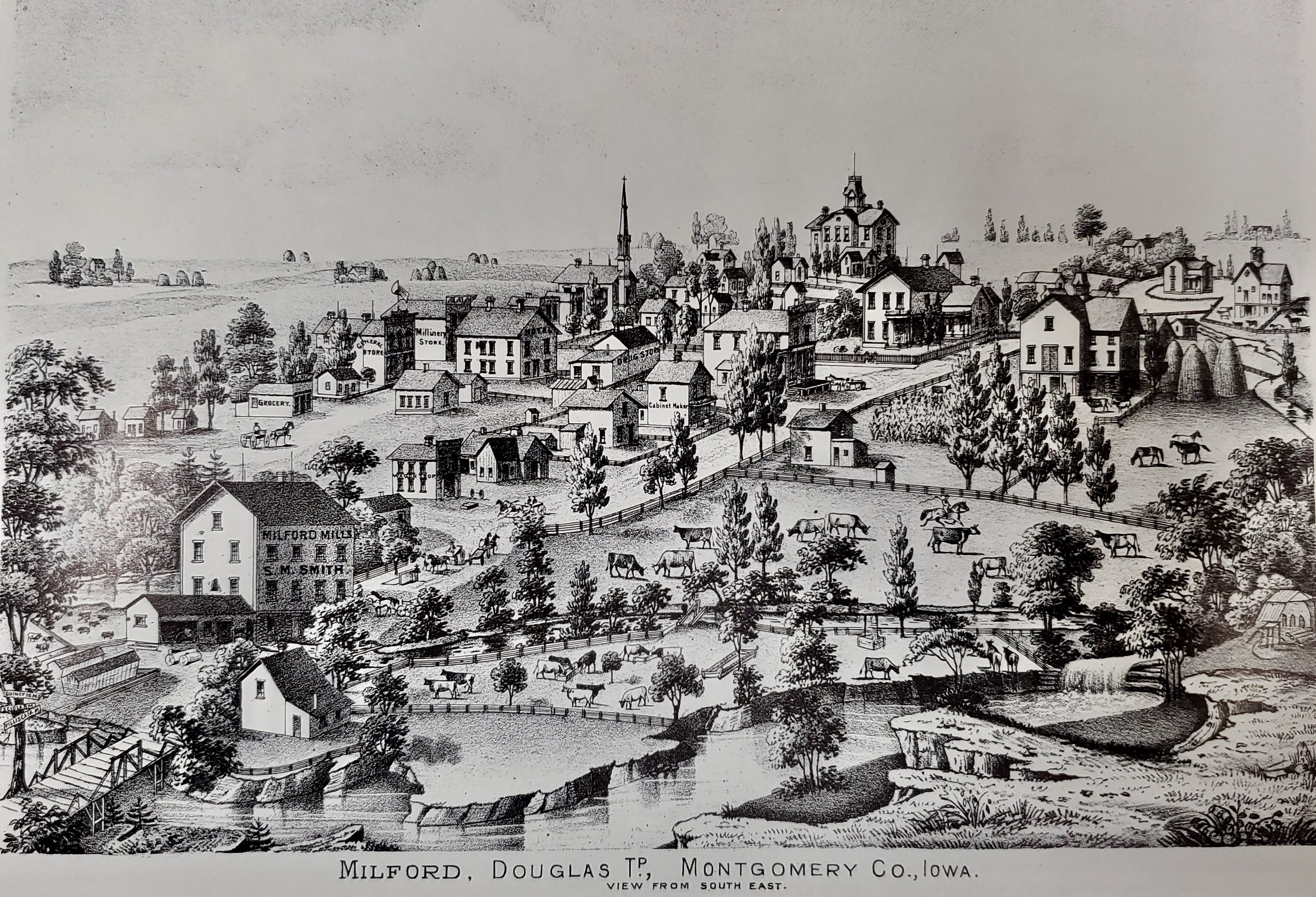
In 1862 a daughter Anna is born, followed by twin daughters Luella and Louisa born in 1866. Two years later Franklin Stewart MOSIER [my great grandfather] is born near Milford. Catherine now 42, and John have a total of 9 children, one from Catherine’s first marriage and a set of twins! [Catherine’s mother was a twin as well.] Can you imagine this family arriving in covered wagons and living in same while they construct a log cabin. Maybe they stayed with Catherine’s mother Sarah while building their cabin. The first house in Milford was built in 1857 and the first schoolhouse in 1876. Although Milford is the town nearest to them its Post Office is named Grant. Ten years later in 1870, we find Catherine and John MOSIER in Douglas Township, Montgomery County, Iowa near Milford about 7 and a half miles north of her mother Sarah BENJAMIN. I am going to quote liberally from the History of Montgomery County, Iowa by William Wallace Merritt to give you a flavor of what life was like back then:
“The first habitations were the covered wagons or the ‘Prairie schooners,’ where the immigrant resided until a cabin could be built—parlor, kitchen, bedroom combined. Outside of the wagon cover was the great ‘withdrawing room.’ The furniture was a camp kettle and a few tin dishes on the inside; and the implements of husbandry on the outside were a breaking plow, axe, ox-yoke and chains.”
History of Montgomery County, Iowa by William Wallace Merritt 1906 pg 39

A further description from the history:
“The first permanent habitation of the early settler was built of round logs, the space between the logs being filled with split sticks of wood called “chinks,” then daubed over, both inside and out, with clay mortar. The floor was commonly made of puncheons or split logs with the smoothest side turned upward. The roof was made by gradually drawing in the top to the ridge pole and on cross pieces laying the clap-boards which, being three or four feet in length, instead of being nailed were held in place by “weight” poles lad on them reaching the length of the cabin. The fireplace, about six feet in length, occupied one end of the single apartment and was situated in a projection…”
History of Montgomery County, Iowa by William Wallace Merritt 1906 pg 41
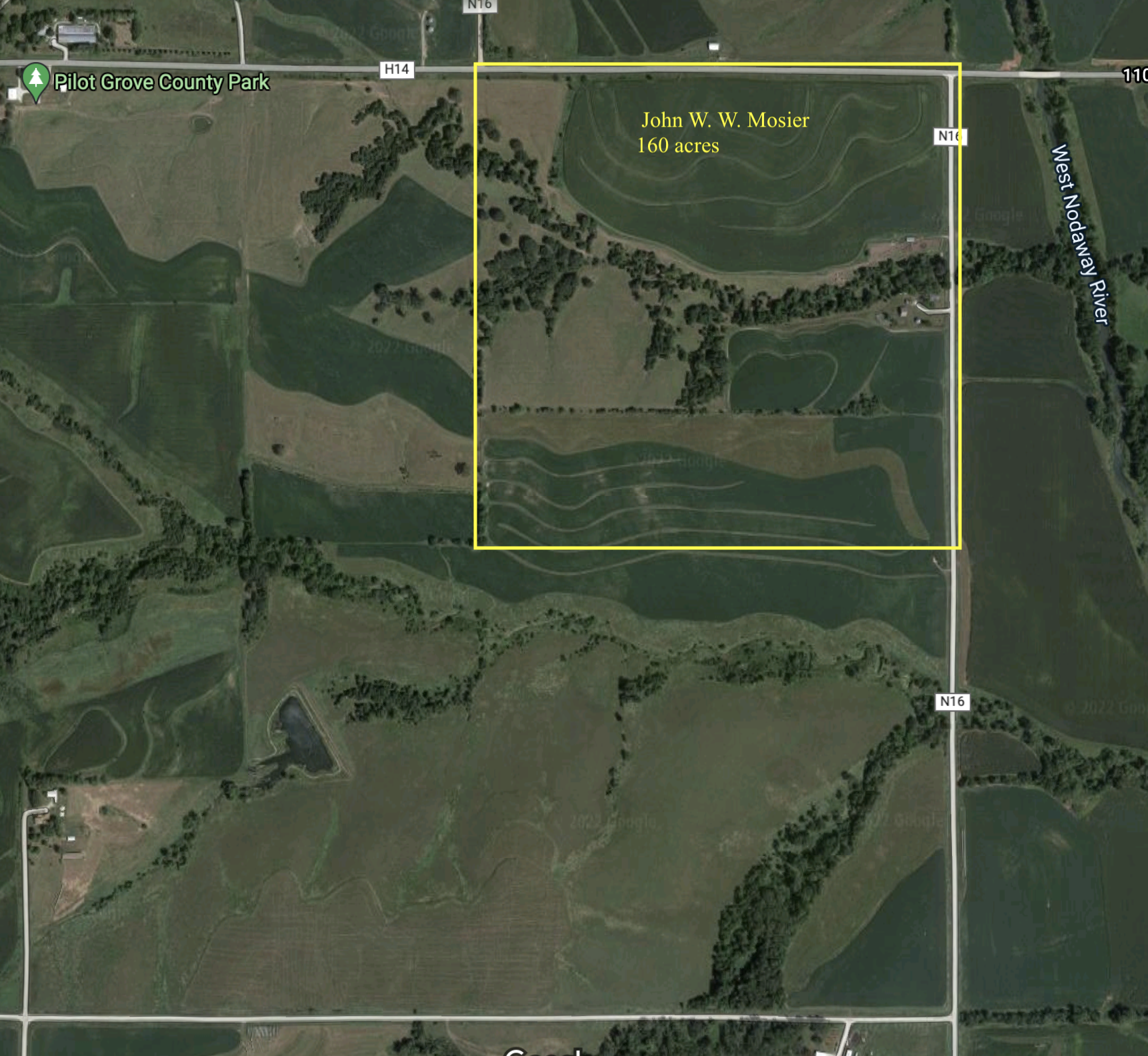
By 1870 Catherine’s sister Audria has married Hortense Elson and has moved to North Bend, Nebraska. Her mother Sarah has left Sciota, and is living in North Bend as well. Sarah was likely following her sister, Delilah Rutan STEWART who married James H. Graham and together they were among the first settlers of North Bend arriving in 1857. [The Andreas History of the state of Nebraska by William G Cutler 1882 North Bend] Meanwhile the 1870 census records John W.W. Mosier as a farmer and the value of his Real Estate is $3,200 and personal estate as $1,225 so the family has done well! It makes me wonder if the family legend of an inheritance is true? In 1871 John and Catherine have a son Willie J who dies quite young. Then in 1872 at the age of 44, Catherine gives birth to a son Walter. In late 1874 Catherine at age 46 gives birth to a daughter Fannie. Sadly, Fannie dies in January of 1875. John W.W. MOSIER owns 160 acres in Sections 7 of Douglas Township.
The view below and the map below it are from the Atlas of Iowa 1875.
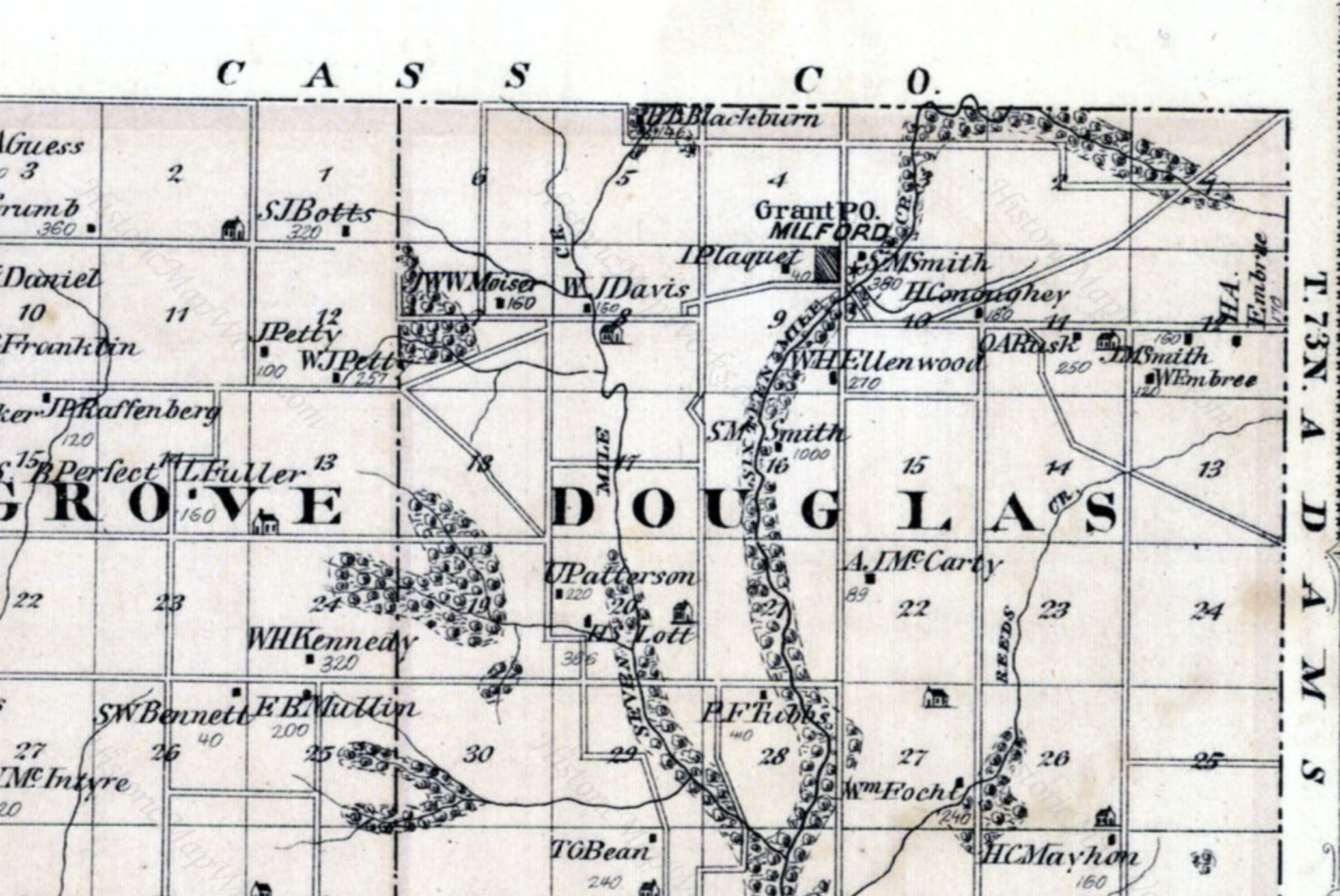
This is the parcel shown on the above map as it appears today.
“The cabin usually consisted of one room which answered all purposes. Upon entering one would see suspended rings of dried pumpkin and a string of red peppers, while aver present rifle and powder horn were in a convenient place ready for use. Sometimes a loom might be seen; the wife, or mother, busily weaving cloth to be made into garments for family use.”
History of Montgomery County, Iowa by William Wallace Merritt 1906 pg42
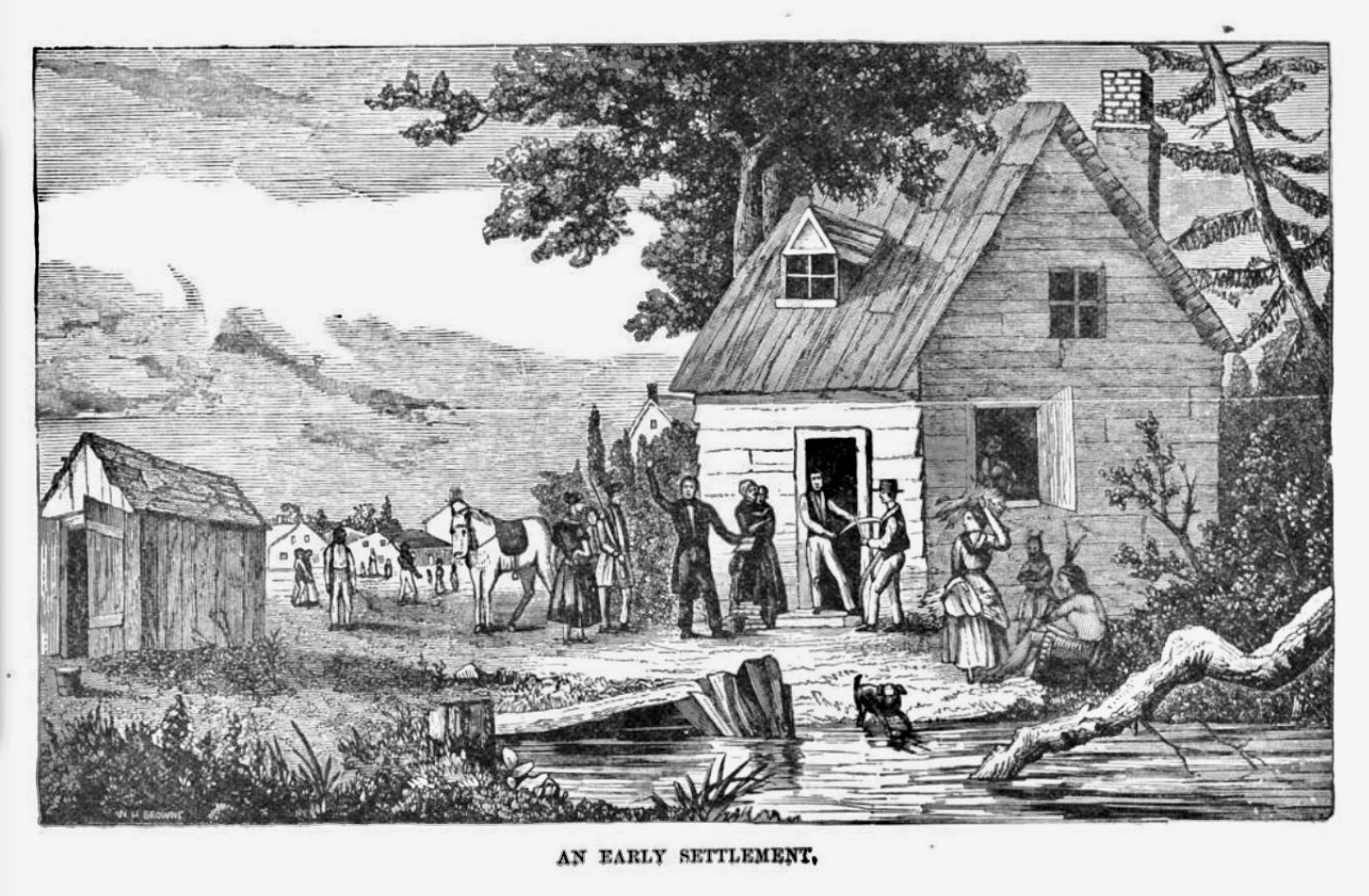
“In well-to-do families the ‘loft’ was in evidence, and if not used for the storage of ‘traps,’ took the place of the modern spare room. This apartment was approached by a ladder secured to the wall… When prosperity overtook them a double log-cabin was erected or, as was more usually the case, another cabin Built beside the old one with a space or hall between them and the entrance to the new structure being from the hall.
The articles in the kitchen corresponded with the room and were few and Simple, a ‘dutch oven,’ a skillet or long handled frying pan, an iron pot or kettle were usual utensils. “
History of Montgomery County, Iowa by William Wallace Merritt 1906 pg 42
Just months after the death of Fannie, John and Catherine’s eldest daughter Sarah, marries John Parks Norcross the 4th of March 1875 in Montgomery Co, Iowa. Catherine’s first grandchild, Walter Hamlin Norcross is born the third of January 1877. Sadly Walter dies seven months later, the 17th of August of the same year. A month later Sarah dies at the tender age of 22, on September 25, 1877, due to complications of childbirth. Sarah and her son, Walter, are both buried at Grant Cemetery near Milford (Grant P.O.), Montgomery County, Iowa. If you draw a line 1.6 miles due west from this cemetery you will run into Catherine and John’s farmstead. Also buried here are Catherine and John’s children Willie and Fannie.
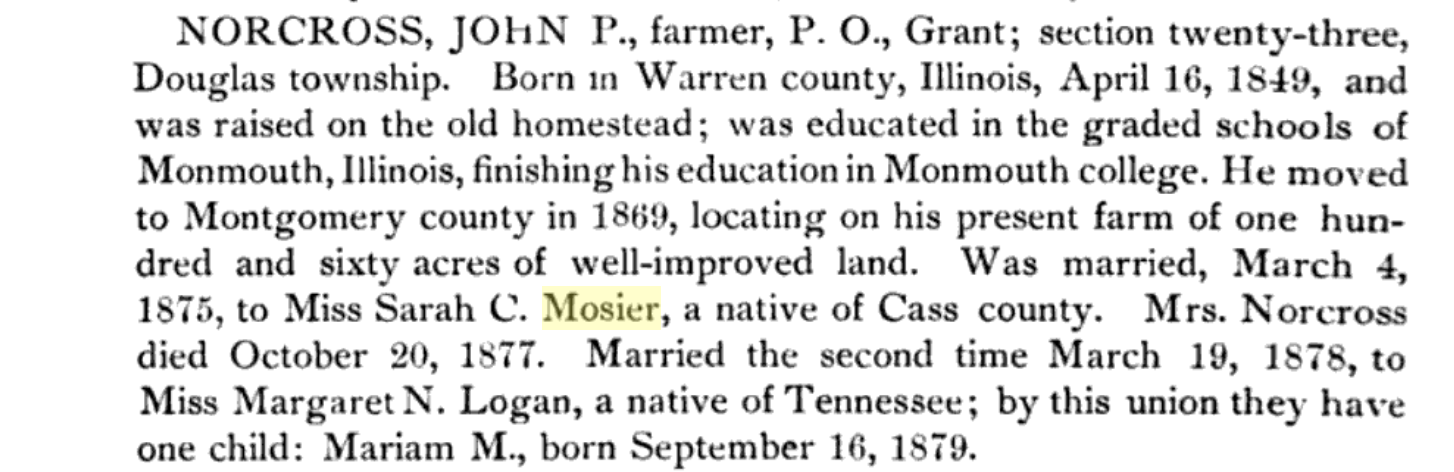
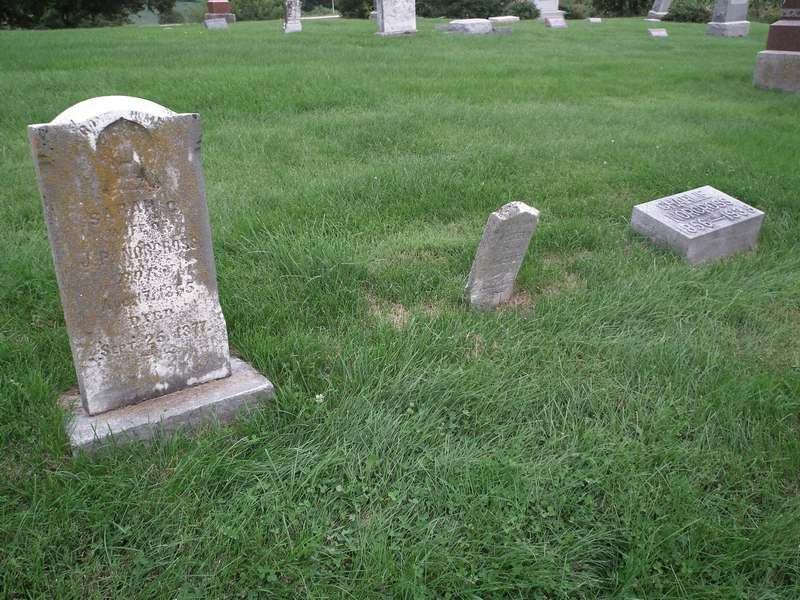
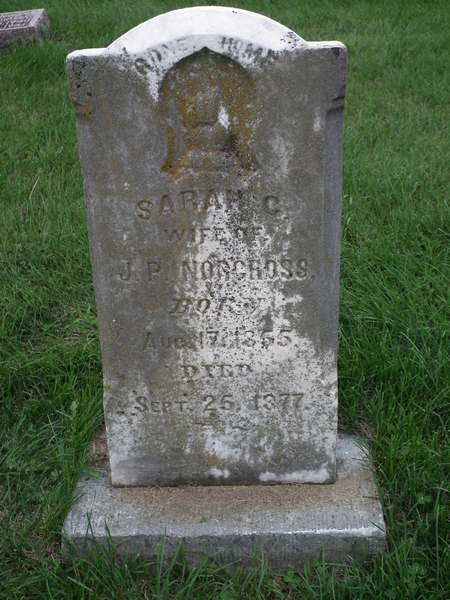
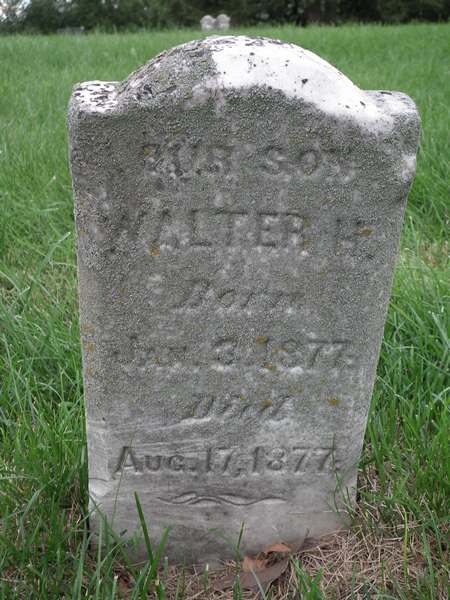

So Catherine in just a few years has lost two children herself, saw her eldest daughter married, her first grandchild, Walter, born and then they Sarah and Walter die! I wonder how you get through such losses. And yet with 8 children and a husband to take care of life goes on. On February 17th 1878 her son Charles W MOSIER marries Mary Belle FIGGENS at Montgomery County, Iowa. A year later on the 19th of February they give Catherine a new grand-daughter Clementine. In 1880 the family is still in Montgomery County, Iowa now listed in Sherman Township which is West of Douglas.
By 1885 Montgomery County Iowa is left behind and they move 110 miles northwest to North Bend, in Dodge County, Nebraska, following her mother Sarah, who had moved there fifteen years prior. My great aunt Jessie believed that John and Catherine lived with her sister Sarah, and her husband Tance Plummer, in North Bend and she spoke of a photo she had of their house which is where she believes she was born. She mentions a blacksmith shop run by John and the Cathey Hotel run by Catherine, and a farm and house outside town where they lived before the children began to marry.
In May of 1885 the Fremont, Elkhorn and Missouri Railroad was building a branch to run Northwest from Fremont, Nebraska through what became Dodge, about 25 miles north of North Bend. The Village of Dodge was laid out and platted in August of 1885. Less than a year later the estimated population of Dodge was 554. The Fremont Weekly Herald 29 July 1886 lists the school teachers in North Bend among them are Louisa, Ella and Emma MOSIER. In the same paper we find John and Catherine’s grandson Guy son of Charles Wesley and Mary Belle MOISER has died.

John and Catherine, following the opportunity move to Dodge. I found this wonderful newspaper clipping that proves Catherine did indeed own a hotel! Catherine’s middle initial is A for Adeline. Her son Albert is but sixteen, so I believe this is Catherine [needs more research but Dodge County Deeds have not been microfilmed].
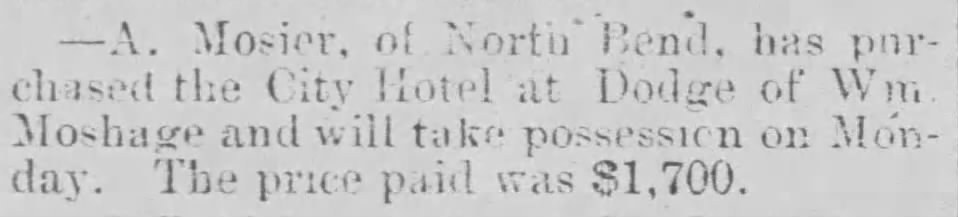
In addition the 1890-91 Nebraska State Gazetteer is this description of Dodge Omaha: J. M. Wolfe & Co., Publishers :
“DODGE – Is a village of 450 inhabitants in the northwestern part of Dodge county, on the Scribner and Oakdale branch of the F E & M V Ry, 36 miles from Fremont, the county seat. It is located in a very rich farming and stock country, being mostly settled by Germans and Bohemians. This is a lively trading point and is making rapid strides in improvements, several new stores and residences having been erected in the past year. A splendid brick school has been built at a cost of $13,000. There are three grain elevators here having a combined capacity of 58,000 bushels and shipping on an average 90 car loads per day during the season. A splendid full roller system flouring mill located here assists in the consumption of the surrounding products. The Dodge Advertiser is the local journal and is edited by Mr G W Rosa, one of the early settlers of Dodge. The financial interests of the community are well taken care of by the Farmers State Bank, which has a paid in capital of $15,000 and authorized to $60,000. There are two hotels, as also two splendid church edifices, namely, the Catholic and the Congregational.”
Among the Dodge Businesses listed we find Mosier J W Mrs, prop[ietor] City Hotel. And among the farmers Mosier J W, Dodge. Am interesting reimbursements from the County to J.W. Mosier for board and taking care of Ed Steven wick with the measles $12.40 that appeared in the Fremont Weekly Herald 3 November 1887. My guess is that John applied for the reimbursement but the “taking care of” was provided by Catherine at the City Hotel. On the 23 Jan 1889 The City Hotel and Catherine hosts the marriage of her daughter Emma Medora Mosier to Edward Beesom Kelly. A few months later note the second item. “The interior of the City Hotel has been re-painted and re-papered.
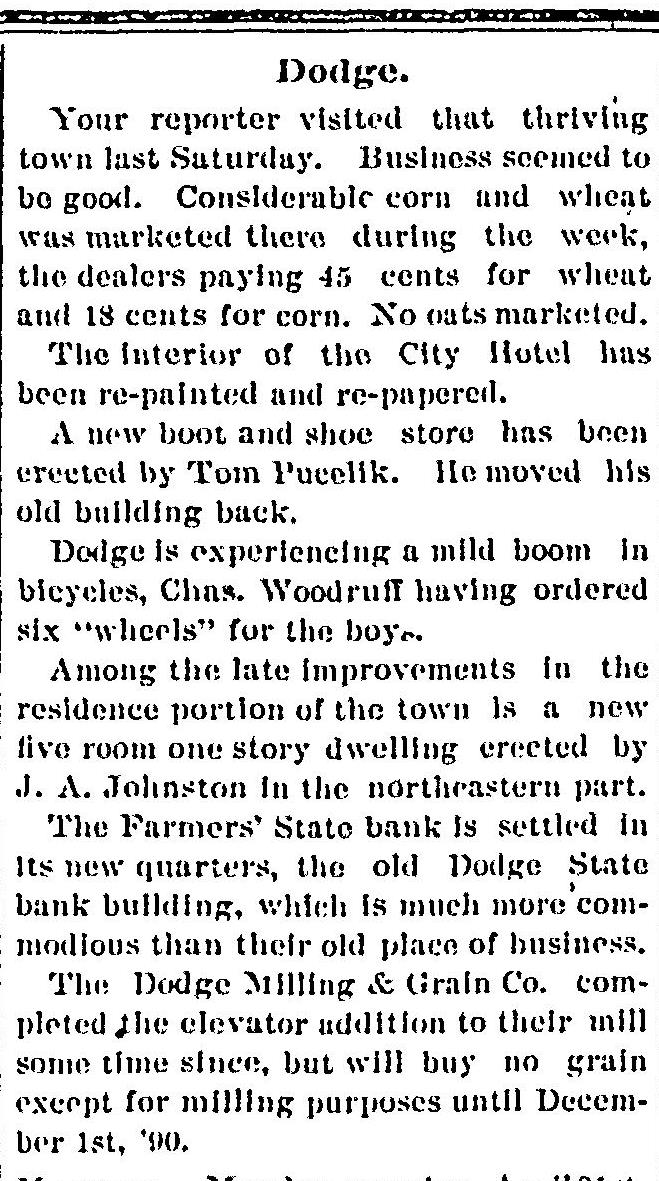
Catherine must have been kind to the reporter as she makes it into the paper quite a bit. The 17th of April she appears in the North Bend Argus : Mrs J.W.. Mosier, of Dodge was in the city [North Bend]. Business must have been good and I am certain this life appealed to her. Catherine always strikes me as an independent woman. I have a letter from one of my great aunt’s to another and she mentions two hotels. And my great aunt Jessie told me about the Cathey Hotel in North Bend, although I can find no mention of it in North Bend or Dodge. There was the North Bend Hotel built in 1870 and a City Hotel in North Bend built in 1876. It is possible she owned or operated a hotel in North Bend before moving to Dodge. Catherine’s son Frank [Franklin Stewart MOSIER] marries my great grandmother Mary “Lulu” Paden at Fremont, Dodge County Nebraska, and this is most notable for the fact it wasn’t held at the hotel and that neither party had family present. Next Spring more news of the City Hotel.
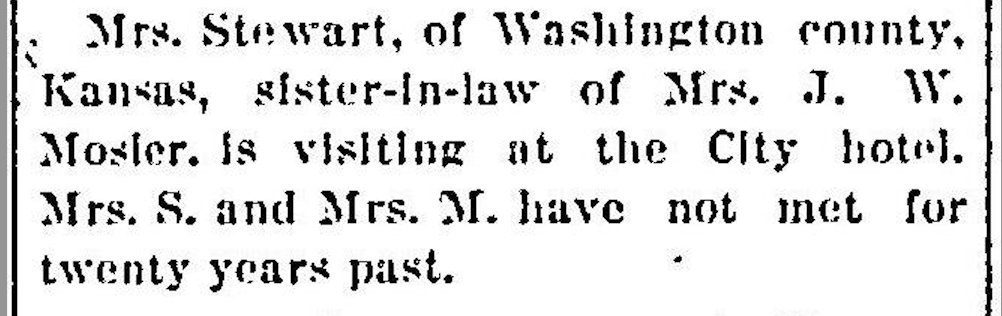
In the North Bend Argus for May 22 1890 Dodge: “We would advise the farmers to plant no corn until Mr Mosier discards his fur cap which will be May 25th.” This lovely bit of news from June about Catherine’s sister-in-law she has not seen in twenty years is Frances Merla STEWART wife of Catherine’s younger brother Andrew Jackson STEWART. The railroad makes such visits more likely.
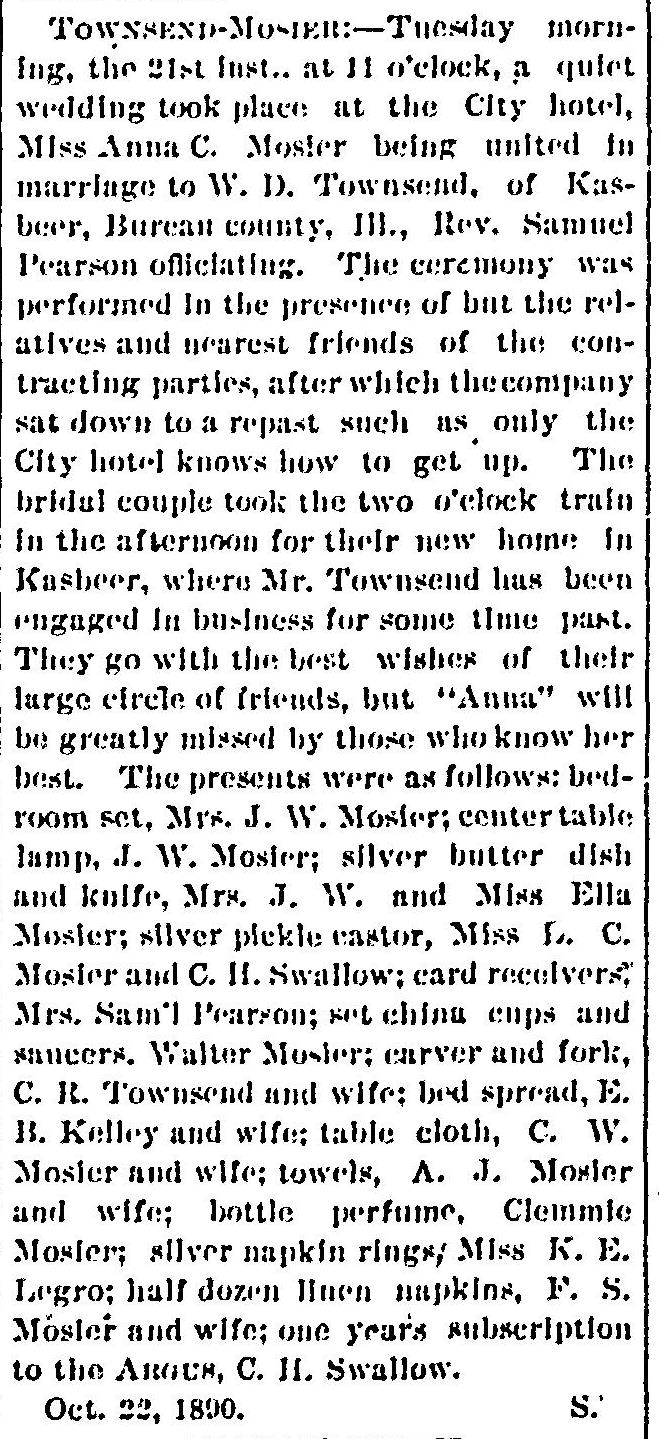
In the North Bend Argus 3 July 1890 “Mr Mosier, our mail carrier, completed his four years’ contract yesterday for carrying Uncle Sam’s package from North Bend to Dodge.” Interestingly my aunt wrote ” Grandpa used to help the farmers and was also a RFD mail man.” Furthermore she wrote, ” Grandpa ran the stable [livery] and I am sure Grandma ran the hotel. Their three girls, were school teachers and they built a big house for their mother and themselves in North Bend” [ I suspect this was closer to Dodge]. The North Bend Argus reports 17 July 1890 “A gloom of sadness overhangs our town caused by the supposed kidnapping of little Walter Mosier, who it is thought has dropped into unworthy hands.” There is no more mention of wee Walter—yet another loss. This is followed by the birth of another grandson Albert Edgar MOSIER born to Mary Lulu and Frank MOSIER. He is their first grandson to survive. Another marriage ceremony at the City Hotel lightens the heart on the 21st of October, Anna C Mosier marries WIlliam Townsend. Lovely details about the gifts. Note that gifts are given separately by Mrs J. W. Mosier [Bedroom Set] and J. W. Mosier [Center table lamp]. The other gifts are from her siblings. I suspect that Catherine may have been living at the hotel and John W. at their farm, that at this time they had separate lives.
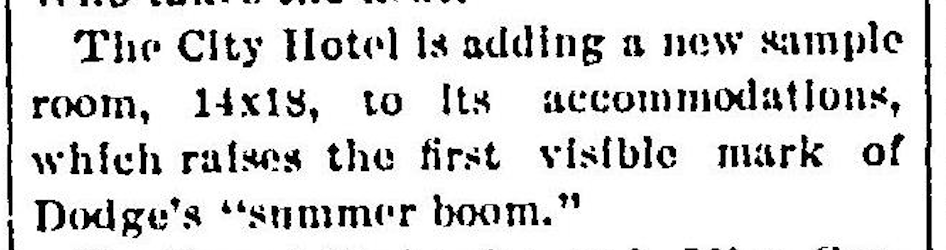
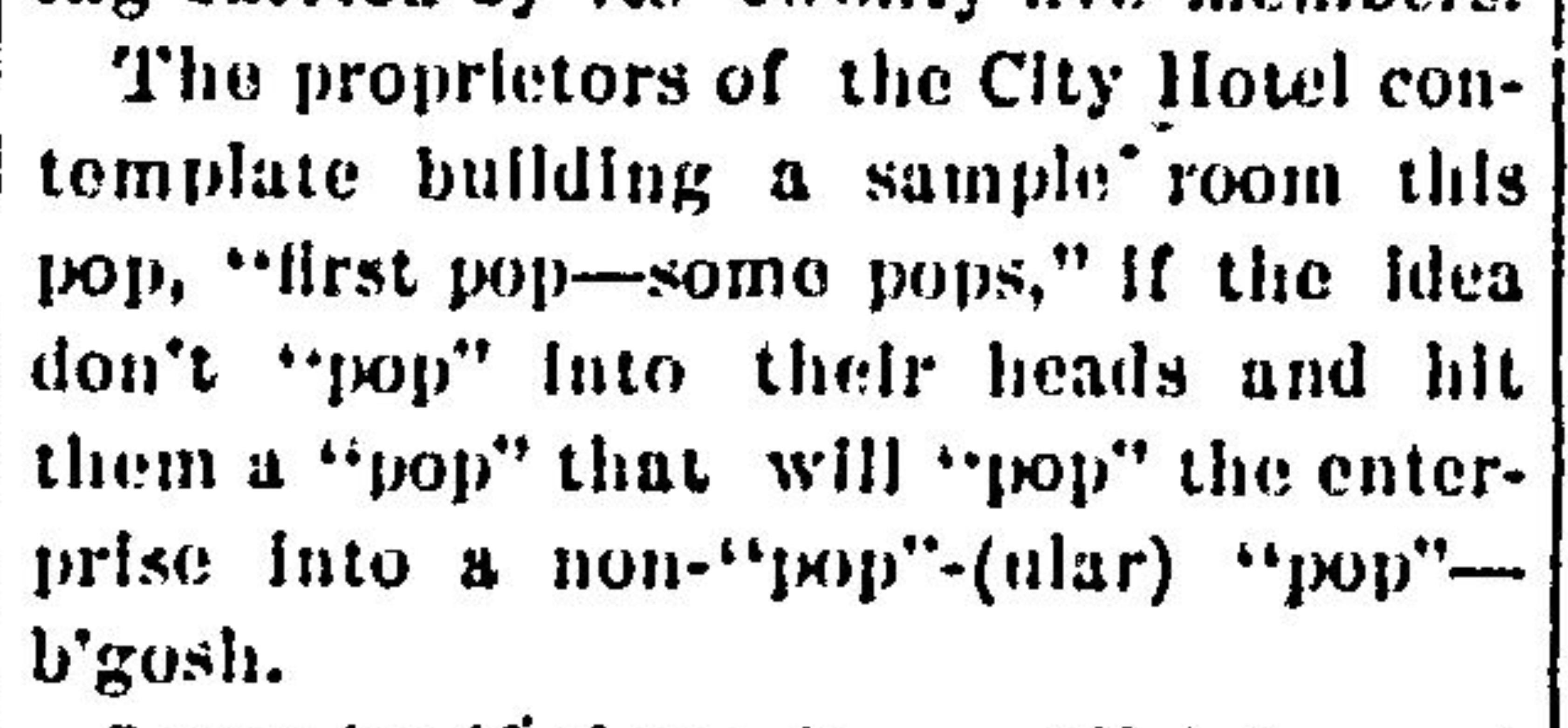
The City Hotel continues to be mentioned in local news for Dodge. A sample room is a hotel room in which salespeople display merchandise for the inspection of buyers for retail stores. Probably quite a lucrative arrangement.
Catherine’s mother Sarah RUTAN STEWART BENJAMIN 88, dies the 8th of June 1891 near, North Bend, Dodge, Nebraska, USA. Unfortunately the North Bend Argus issues are missing from the same time frame as I expect we may have learned a bit more.
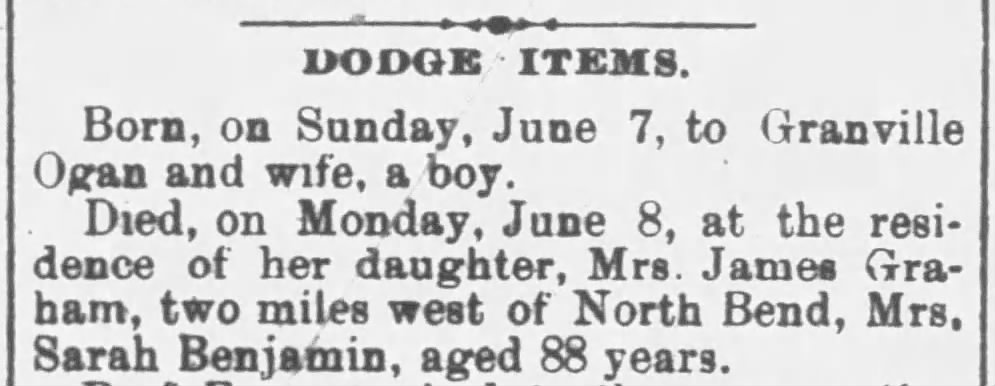
Frank and “Lulu” MOSIER give Catherine and John another grandson the 25th of August 1891. Sarah BENJAMIN’s children gather to remember their mother in September.
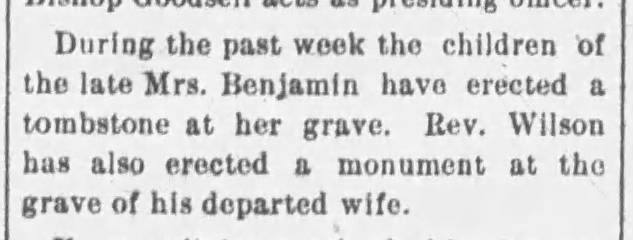
In the Fremont Daily Herald for 21st of November 1891 “Mrs J.W. Mosier left Tuesday for a visit with her daughter, Mrs Anna Townsend ar Casbeer, Ill.” [Kasbeer] Catherine’s daughter gives birth to a child who dies in 1891 so I wonder if this is the purpose of Catherine’s visit. Later in the month the 27th of November daughter Emma, gives birth to a daughter Katherine “Kitty” Kelley in Monroe, Nebraska. In 1892 there seems to be a shift away from local news tidbits in the paper, so there is an absence of information. However, in January of 1893 daughter Anna gives birth to a son Walter Roy Townsend. Son Frank’s wife Lulu brings a grand-daughter Jessie Ella the 30th of March 1893 and finally daughter Emma has added another grandchild on May 6th Dessa Louisa Kelley. So now Catherine has 5 living grandchildren! In 1894 Catherine gains to more grandchildren, Ira E Mosier, born the 7th of June to her son Charles W. MOSIER and Charles William BARRETT born the 27th of June to her daughter Louisa. On the third of February 1895 Audrey Eileen is born to Lulu and Frank MOSIER making a total of eight living grandchildren! For a change things seem to be going well. And then:
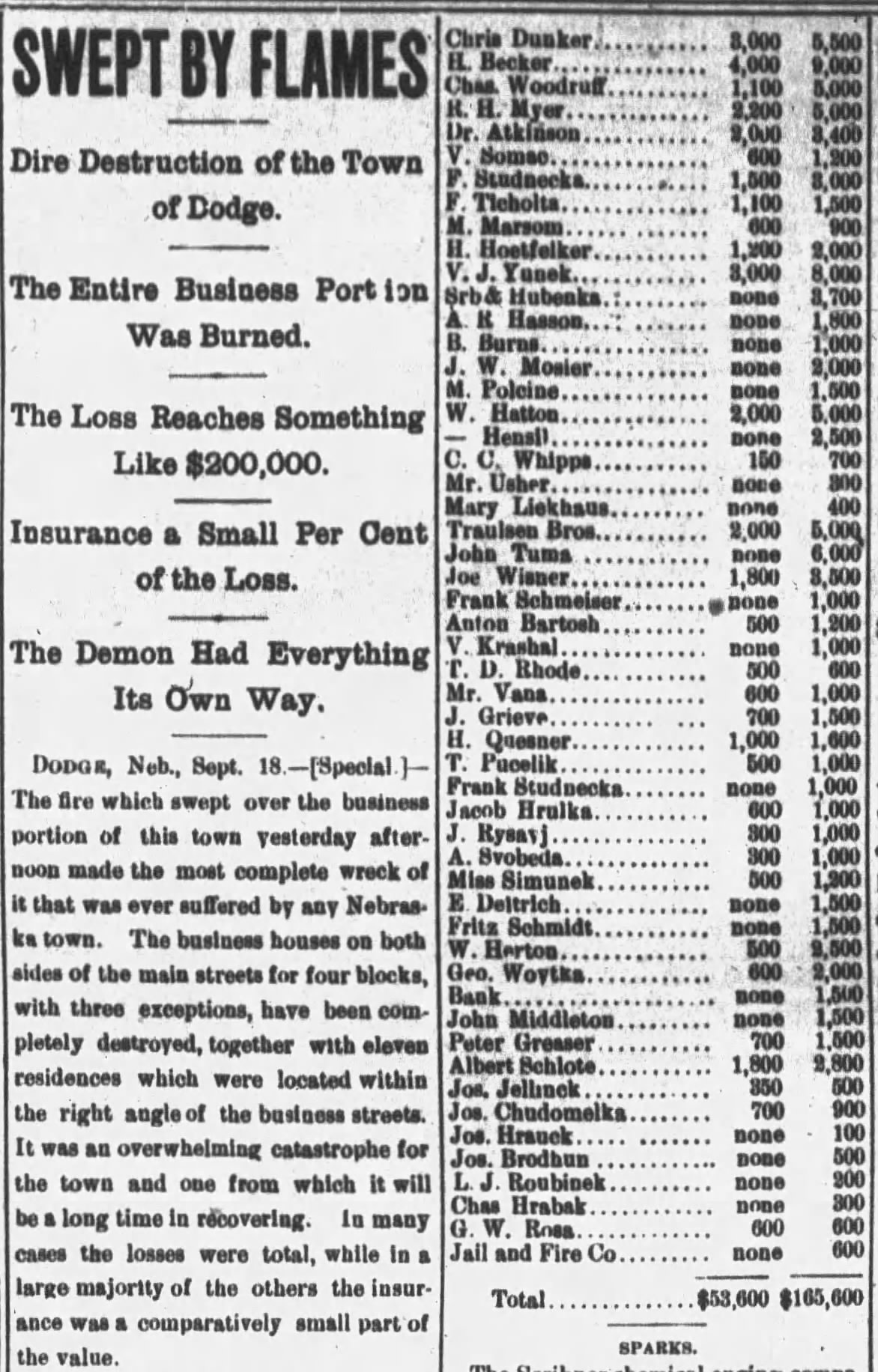
The business portion of the city [Dodge] is wiped out completely, four blocks square, an area of sixteen blocks, was completely destroyed with the exception of three buildings.”
Fremont Tribune 18 Sep 1895
The fire which swept over the business portion of this town yesterday afternoon made the most complete wreck of it that was ever suffered by any nebraska town.
18 September 1895 Fremont Tribune
Dodge was treated to a deluge of fire and nearly every house in the city was destroyed. The damage is over $100,000. The fire started at 1:50 p.m. in a small shed containing hay connected with the livery barn of William Neuveman, The wind was blowing a gale from the southwest, causing the fire to spread with inconceivable rapidity, and in thirty minutes the entire business portion of the town was destroyed.”
Ponca Grit 26 Sept 1895
The loss of the City Hotel to J.W. Mosier is listed as $2,000 with no insurance. Over the next year a total of 67 lawsuits are filed against the railroad for allegedly starting the fire but testimony shows that it was caused by a discarded cigar. The suits are dismissed. Although this snippet suggests that the Hotel will be rebuilt there is no evidence this happened.
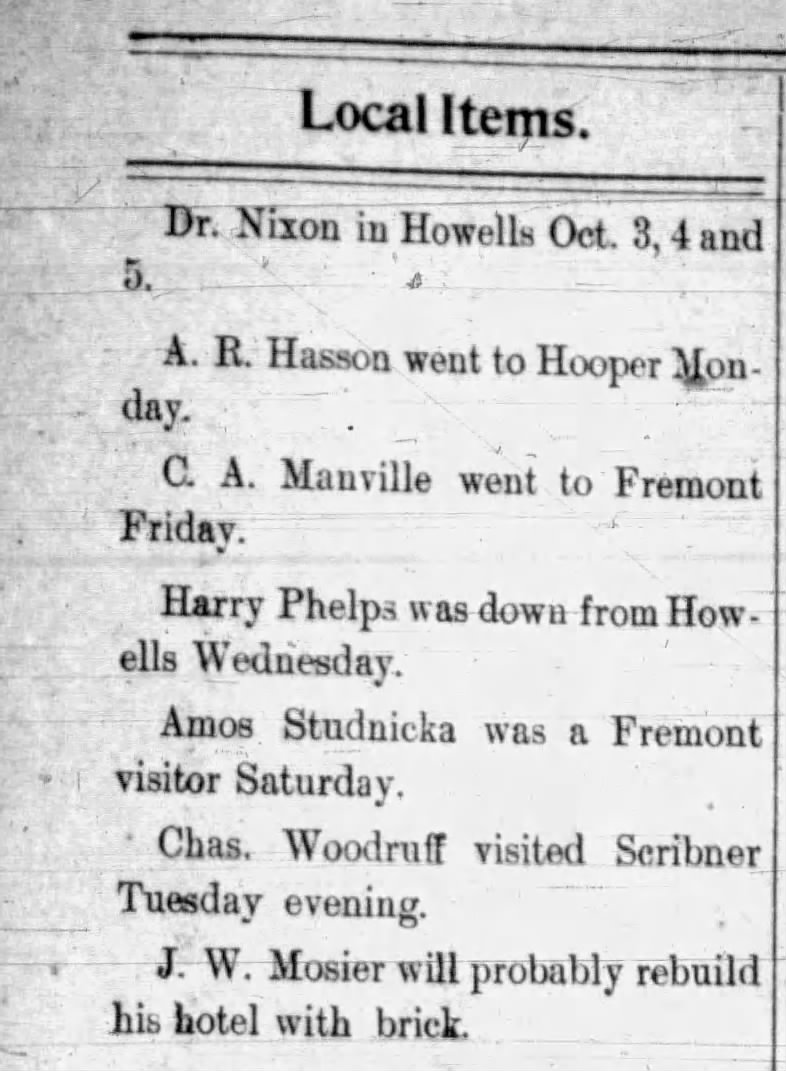
In 1896 Catherine is approaching her 68th birthday it appears she has moved to Morse Bluff which is across the river from North Bend and she is ill.

I wonder whether she ever saw him again once he left in 1872. Catherine’s youngest son Walter married Altene Shelton 14 March 1899 at the Shelton farm in Colman, South Dakota. This brief item below in 1899. John W breaks a collar bone in a fall!
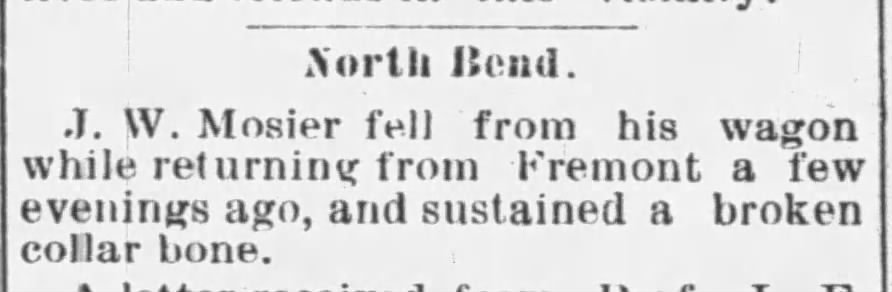
So we can assume that John, if not Catherine are living in North Bend at this time. It may be that Catherine has already moved to South Dakota. On the 1900 census [22 June] we find Catherine living with her son Walter and his wife Altene MOSIER at Lake View, Lake County South Dakota. Catherine is listed as married but no John W.W. and I have not been able to locate him. Then August 7, 1904 disaster strikes again when Catherine and John’s son Albert D MOSIER dies in a freak accident when the Missouri Pacific Flyer train from Denver Colorado was crossing the Dry Creek Arroyo bridge near Eden Station 8 miles north of Pueblo Colorado. A flash flood wave passed over the trestle shearing off the front half of the train and dragging the people in those train cars to their deaths.
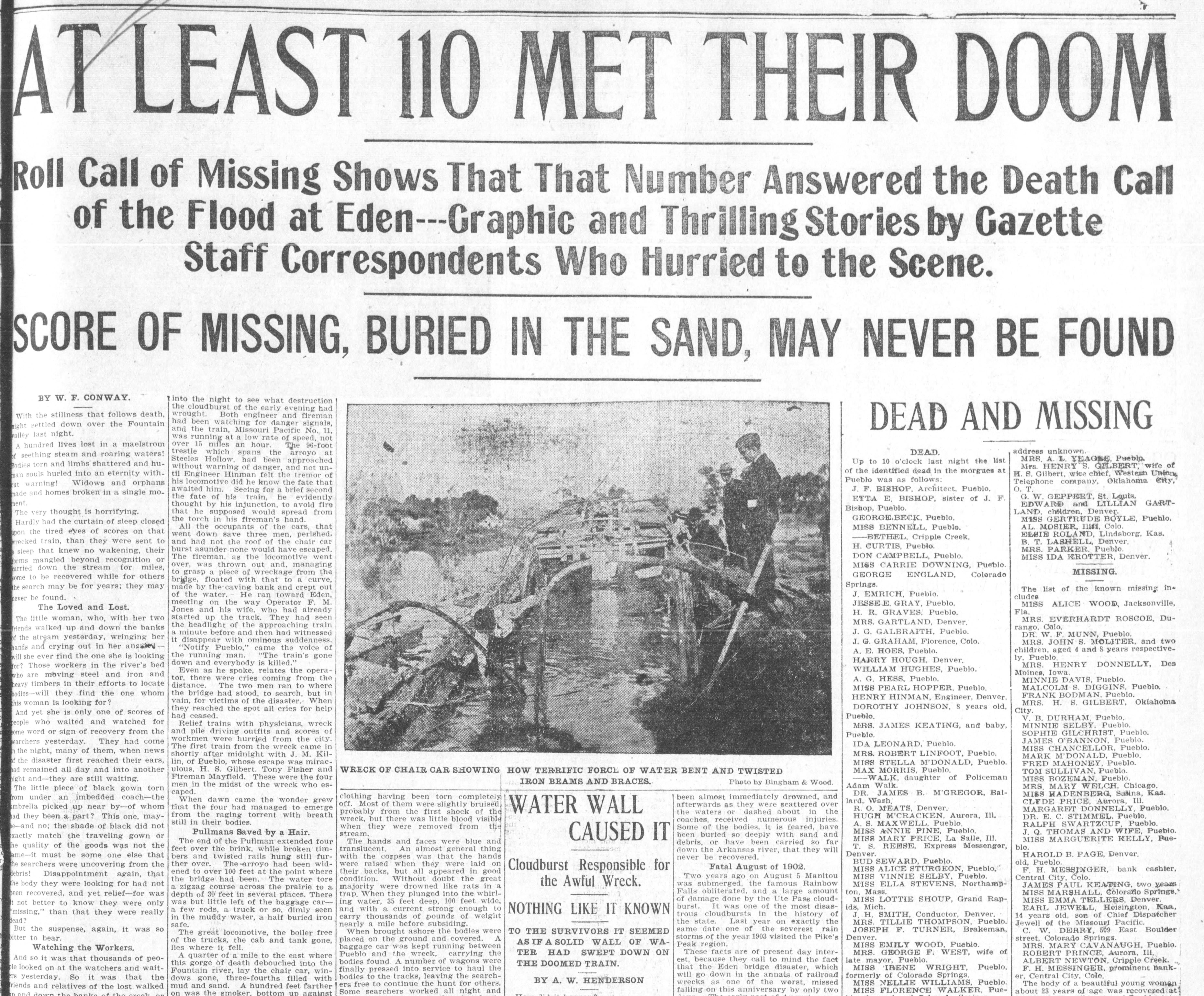
Catherine’s oldest child John Murphy who has lived in California for 34 years dies the 16 Dec 1906 of heart disease at the age of 56. He is the 4th of her children to die prematurely. I can’t help but wonder if Catherine ever saw him again once he left for California in 1872. Also in 1906 Catherine’s son-in-law Walter became a manager of the Rosebud Indian agency of the White River District which is located 13 miles south of Reliance South Dakota. In 1911 when land first opened up to homesteaders he bought land and John W Mosier took a quarter section just north of his at the same time.
On the 1910 Census Catherine is listed in her own household, in a home she owns in Hudges Precinct, Perkins County, South Dakota. She is listed as married 54 years and as having 12 children but only 8 living. Two died very young Fannie and Willie and then her grown sons Albert in the flash flood on the train and John MURPHY of early heart disease. Right next door is her daughter Louisa Ella “Louella” and her husband Marion BARRETT. Louella and Marion had no children. Meanwhile John W. MOSIER is living in Lyman County, South Dakota listed as “widowed” and 84, although Catherine is very much alive. He owns his own farm and is a farmer on an Indian Government Farm with his son Walter F MOSIER next door. So it appears that Catherine and John have been living apart for some time. And it seems Catherine is an independent woman with her own means. Catherine is no longer living near her son Walter but John W is. Catherine makes a brief appearance in Lulu’s dairy Friday Feb 27, 1914 “Got letter from Grandmother Mosier.” At the time Lulu is living in San Francisco with Catherine’s son Frank. On the 20th of February 1915 Catherine’s husband John Wesley W. MOISER dies in Reliance, South Dakota. He is 88 and his death certificates states he died of “Old Age”
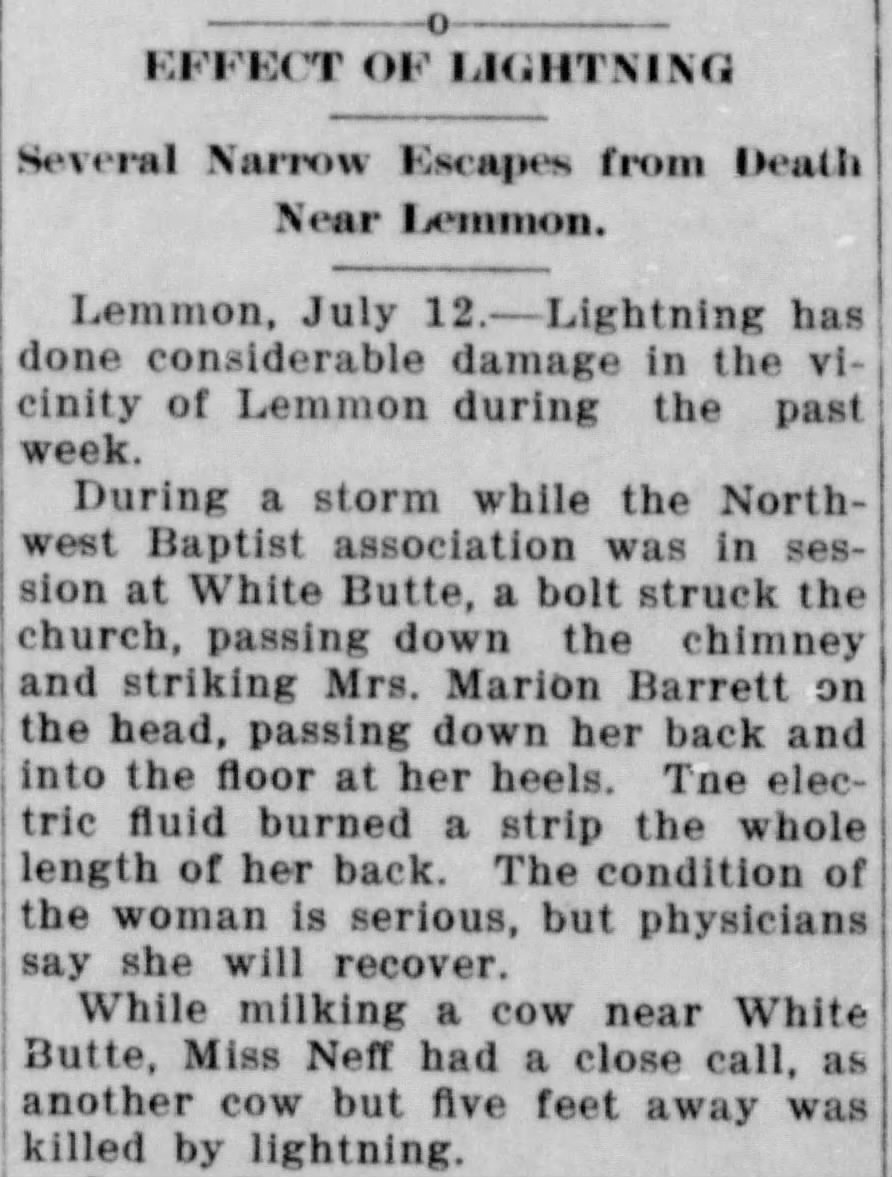
In this sad clipping later that year, we learn Catherine’s daughter Luella is hit by lightning. No doubt mother Catherine was there to nurse her daughter Louella back to health.
This directly from my correspondence with my great aunt Jessie,
” When Grandma was not well and papa went to see her. And she rallied until papa arrived and she recognized him. While he was there she grew weaker and passed away. The card was written April 4, 1921. And he said, she died the night before so that would be the 3rd of April.”
Jessie MOSIER MILLER correspondence to the author
What this tells me is in spite of any other faults Frank may have had, he loved his mother. Catherine was 92 when she died having saw a very long and challenging life. I have not been able to locate a death notice or a death certificate for Catherine.
Yet we still have a couple of big questions to answer. Was Catherine a descendant of the Royal STEWARTs? Well we have YDNA thank for the answer to that question. The first of the line of Scottish Royal STEWARTs was Walter Fitz Alan (1110-1177) was appointed High Steward of Scotland under King David I. His descendants became Hereditary High Stewards of Scotland, and the 4th High Steward, Alexander Stewart (1214-1283) was the first to use STEWART as his surname. King Robert II of Scotland (grandson of Alexander Stewart) via Alexander Stewart’s younger son, Sir John Stewart of Bonkyl all carry the YDNA marker: S781. Descendants of Alexander Stewart (1675-1742), Ballymena, Antrim to Voluntown, Connecticut which include Catherine’s father and grandfather also carry the marker S781, so we know that part is true as confirmed by YDNA tests of their patrilineal male descendants. The part about the Scottish lawyer is, as yet unproven. However, we do see a quite substantial change in the families net worth between 1860 when they had no property and $100 in personal property and 1870 when their real estate was valued at $3,200 and personal estate at $1,225. What we do have of the historical record suggests that Catherine had her own estate which she used to purchase the City Hotel in Dodge and her home in South Dakota. I for one am inclined to think there is some truth in the family legend. We know the money did not come from her immediate family since her father died in 1843 and her grandfather in 1858. This is a mystery yet to be resolved.
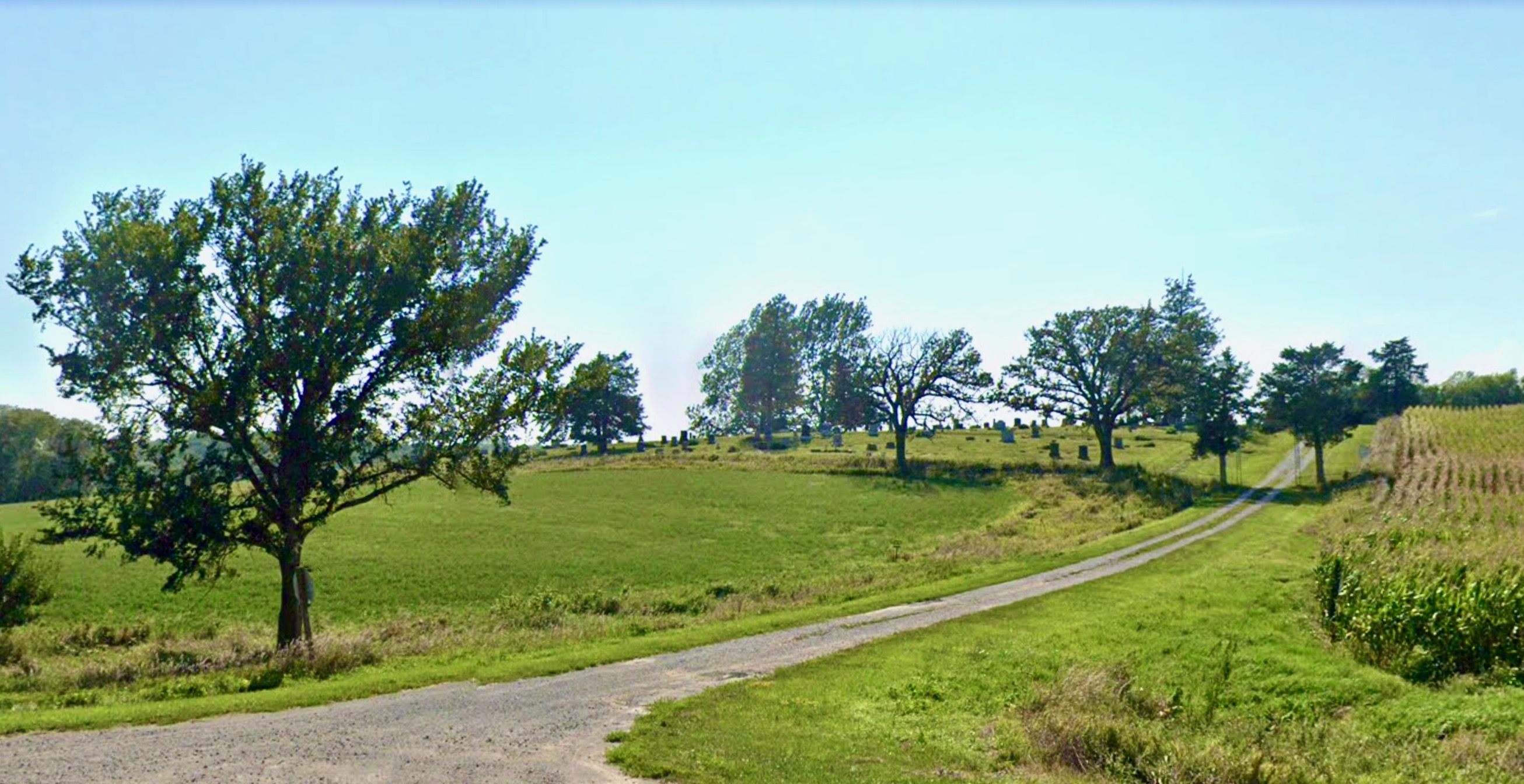
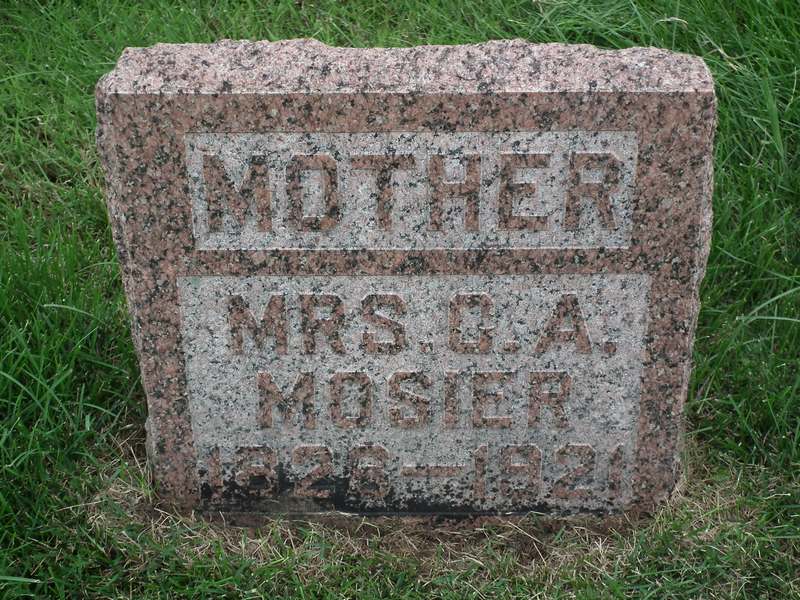
But before we lay Catherine to rest I want to add another detail from my great Aunt Jessie which always gave me pause. It was that she was buried with her son who had died, near Red Oak, Iowa. This turned out to be only part of the story. Catherine died in Lemmon South Dakota which is just miles from the border with North Dakota. It was her wish that she be buried with her children near Milford which lies 500 miles away. And that wish was granted. This is a photo from Google Maps of Grant Cemetery near Milford, Iowa. When I found this I found it oddly comforting.
And below is her gravestone adjacent her two children Willie and Fannie and not far from her daughter Sarah and grandson Walter. We may think that the way Catherine survived was to harden her heart against the many losses she suffered but her desire to be buried with these children lost in 1871, 1875 and 1877 is testament to something different. Catherine is my woman warrior because she had so very many losses in her life but she soldiered on, and yet she never forgot those she left behind.
“The reality is that you will grieve forever. You will not ‘get over’ the loss of a loved one; you’ll learn to live with it. You will heal and you will rebuild yourself around the loss you have suffered. You will be whole again but you will never be the same. Nor should you be the same nor would you want to.”
Elisabeth Kubler-Ross
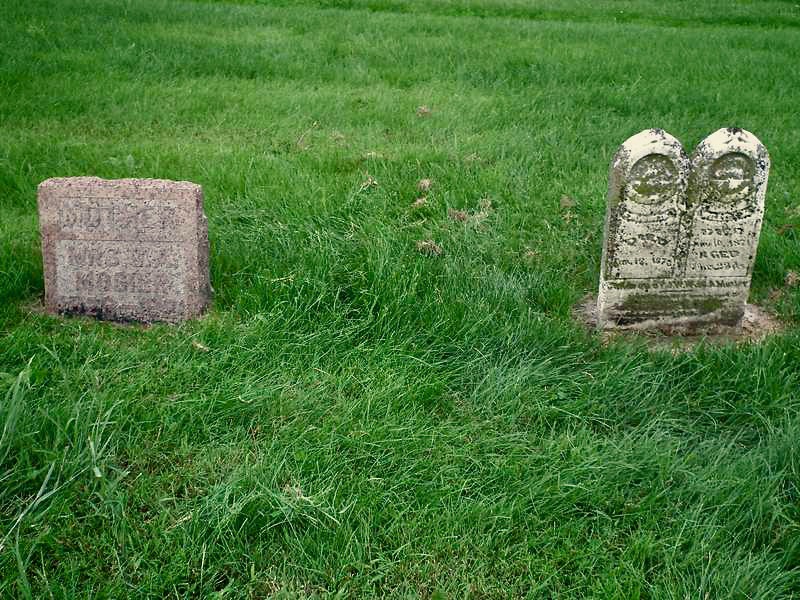
A descendant contacted me after reading this post and told me that Catherine had died of breast cancer at the age of 92. When you are feeling low, compare your life to hers….
For now I will close with a poem from someone with a local connection, Robert Louis Stevenson (1850-1894). Robert and his bride Fanny honeymooned here in the Napa Valley in May of 1880. It seems only appropriate that a fellow Scot is quoted here.
Requiem
Under the wide and starry sky,
Dig the grave and let me lie.
Glad did I live and gladly die,
And I laid me down with a willThis be the verse you grave for me:
Robert Louis Stevenson
Here he lies where he longed to be;
Home is the sailor, home from sea,
And the hunter home from the hill.
Kelly Wheaton © 2022 All Rights Reserved.
Write It Down
Posted on February 28, 2022 6 Comments
Aside from DNA, which I view as our personal encyclopedia of our ancestry, anything that is going to survive more than a generation or two is WRITTEN. Whether on a gravestone, an engraving, a letter, a newspaper clipping, photos or a book. What survives is written or inscribed. An unidentified photo of an ancestor is not the same as the one with writing on the back. [Or if digitized has the name in the title]. One thing this last year of writing Blog posts has taught me is that old letters, diaries, stories, identified photos, newspaper articles—those are all that is left of our lives after a generation or too. While we may not have much hope of resurrecting a 16th century farmer’s wife in a narrative, we can do quite a bit with a second great grandmother as I showed in My Woman Warrior.
A question gets asked routinely what would you do differently is you were just starting out in genealogy? Two things emerge—talk to the oldest members in your family and record or take notes of your conversations. Even if you record conversations let me suggest you transcribe those notes immediately. We always think we will remember but we don’t. Details get jumbled, memories falter. WRITE IT DOWN. Note taking is great—but I find the visual images of articles, book pages, etc are far more valuable than handwritten notes. Take a photo or clipping. If you are copying pages from a book, the very first thing to do is Photograph the title page and copyright page. Highlight if you choose to bring things to your attention. If it is digital add the person mentioned and source and date in the title. If it is a photo that someone else has taken such as Find-A-Grave seek permission and give attribution. Do it now. WRITE IT DOWN.
The lost art of letter writing is perhaps the single greatest loss to genealogists in my lifetime. Yes, we have email and texts but they are much easier to be discarded, to not stand the test of time. If they have any personal details of your family or ancestors, print them out. Date and label. File where they will be noticed. I know you digital folks will be shaking your head but here’s the thing a picture is worth a thousand words. Even if it is a picture of words—we humans are very visual for a reason— When you have amassed 40 binders of information or an equivalent amount of computer files you are going to need to get my attention. Seeing is believing, it is where stories come to life. When we fit the pieces together into an image, a picture, a story. We don’t put jigsaw puzzles together blindfolded. We need to see what we’ve got—we need to WRITE IT DOWN, to see the story emerge.
I sometimes take over a whole table, floor or bed with pieces of paper and I put them in chronological order—putting a person’s life together. It does not mean we need to tell the story chronologically, we don’t! But we need to know the order of how things happened. It was not until I was rebuilding Catherine’s life in My Woman Warrior that the pattern of loss, upon loss emerged. I said to a friend, “You cannot make this shite up, no one would believe me.” Catherine endured so many deaths I lost count—well that in itself is not unusual—but then on top of that a kidnapped grandson, a flash flood that killed her son and lightning seriously injures her daughter. And a fire that wipes out her hotel and all but three buildings in her small town. Without those details her life would still be hidden…What if we had her diary—wow the stories she could have told. If only she WROTE THEM DOWN, and someone kept them.
If you haven’t already figured it out this isn’t just about writing our ancestors stories about writing our own. No matter how elegant or lame, whether it is a full blown story or a list of thoughts, you cannot imagine what it may mean to some descendant of yours some day in a future you cannot even imagine. My great grandmother’s diary is full of mundanities and yet her spirit shines through. She records lots of historical details from the 1919 Flu Epidemic to the US entry in WWI, women’s right to vote and on an on. While we look at what is happening in our lives as not newsworthy—someday it will be history. WRITE IT DOWN.
So here’s a writing challenge—take anything in your life that has meaning to you and write about it. You do not need to show it to anyone. Just put pencil to paper and WRITE IT DOWN. You can:
- Write just your thoughts in a long brain dump
- You can make a list
- Start a diary
- Write a poem or haiku
- Paint a word picture by describing something in great detail
- Re-create a dialog that happened or interview your younger self
- Stop worrying, just write
Whatever you write—whatever evidence you leave behind—I can assure you someone will be thanking you.
“We write to taste life twice, in the moment and in retrospect.”
― Anais Nin
Kelly Wheaton © 2022 All Rights Reserved.
Women’s Origin Stories
Posted on February 16, 2022 5 Comments
I woke up thinking more about the question I asked earlier—Who Gets to Write History? More specifically who gets to write a woman’s history? Why do we yearn for women to be the heroines of their own stories, the guardians of their own destinies and not just an add-on in the lives of men? Who are our women warriors? Where are our Origin Stories? While it is true that we all begin life in a woman’s womb, we seem to forget the most powerful of origin stories begin, in our mother’s sea of life.
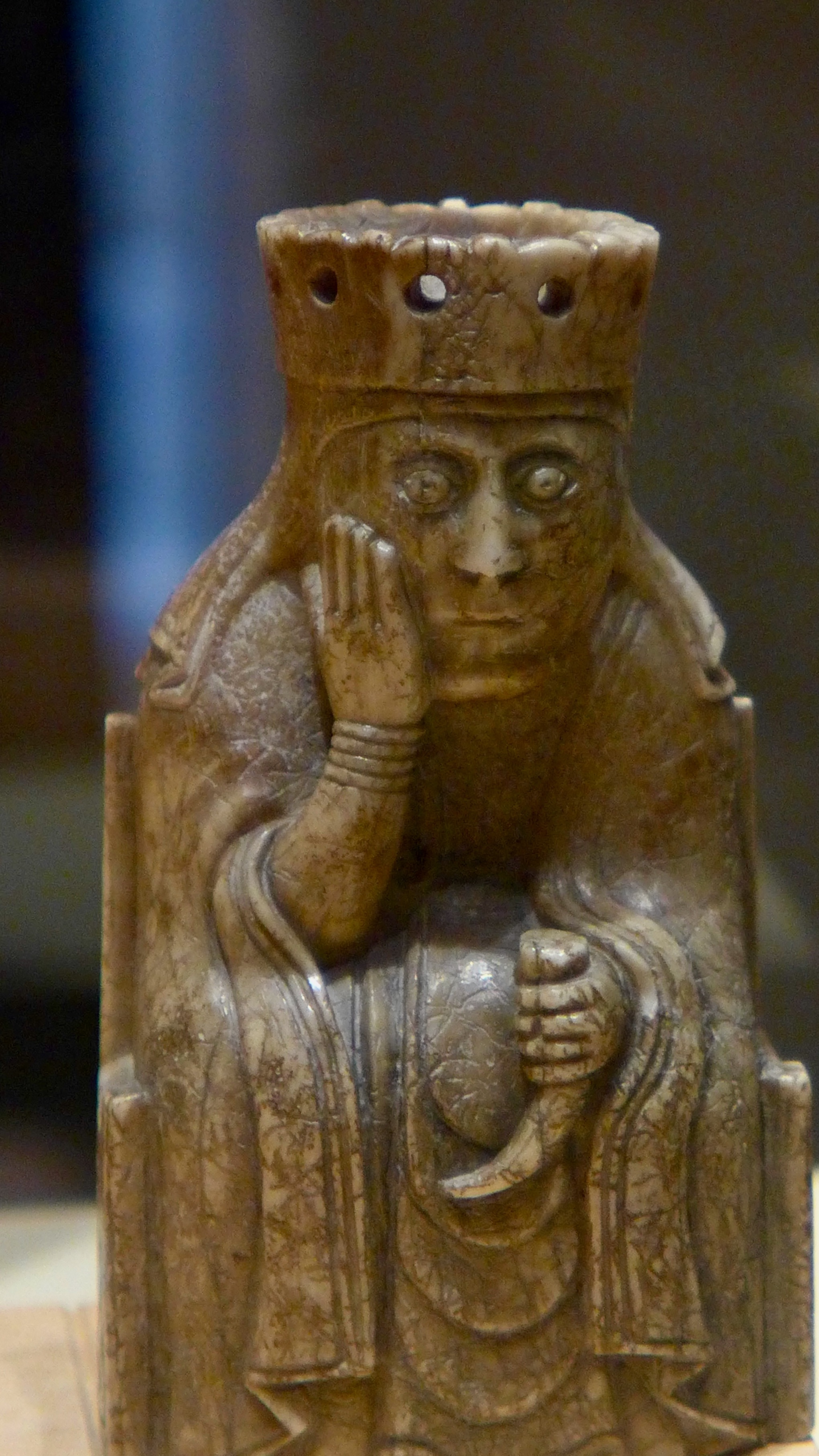
The chess piece above is from the Lewis Chessman. The Queen’s head, resting upon her hand, speaks to me of mix of concentration, patience, boredom, amusement, and wisdom. She holds in her hand the horn of abundance. In a game of chess, surrounded by men, the women are few, but alas the most powerful pieces on the board, they bide their time…
As a teenager, within my cultural tradition there were not many female origin stories. Studying Ancient History and Greek Mythology in Junior High was a joy for me to connect heroines with power and intelligence. The older the culture, the closer we get to a time when feminine power was revered and celebrated. I am drawn to these traditions— Native American, African, Celtic and Viking Stories where women’s power is venerated or even celebrated. Strong women with self governance and power, isn’t that what we all want? But what are we to do when for the past 1,000 years or more men have written the histories, the genealogies and the stories? Pick up any 19th century History of any county in the United States—how many biographical sketches of women do you find?
What does this mean as a family historian and genealogist? What happens when half the stories are missing? Where do we women belong, in our own histories? How many women in my family have asked these questions? This is not ancient history. Women gained the right to vote a mere 101 years ago in the United States on August 18, 1920, when the 19th Amendment to the Constitution was finally ratified, declaring for the first time that women, like men, deserve all the rights and responsibilities of US citizenship. How many of us celebrate this day? My great- grandmother, Lulu, did. We know because she wrote about it in her diary.
In Outlander when Claire meets with Adawehi, the medicine woman, Giuhua translates for her, “My husband’s grandmother says you have medicine now, but you will have more, when your hair is white like hers, that is when you will find your full power.” Many ancient cultures have the leitmotif of wise old women or crone goddess. Whether the Indian, Kali, goddess of death and destruction; the West African, Asae Yaa, woman of the earth; the Celtic, Cerridwen, keeper of the cauldron; or the Native American, Grandmother Spider Woman, the old wise woman, who gave us the sun and fire; they are all emblematic of the power of the female and her creative life force and yet they have little place in written history. Which brings me around to another point I make often—evidence is not enough. Facts are not enough. They are dead without the stories to bring them to life. Perhaps it is a deep seated need to reunite with the earth, to acknowledge the dual forces of nature both female and male, creative and destructive, that draws me to the ancient wisdom traditions. Their truth speaks to me, as it must to everyone who seeks. I have no desire to subjugate men, or diminish their stories in order to give voices back to my female ancestors. I just want to hear what is missing.
So how come in the western tradition we are denied these female role models and origin stories? We have but a handful of outspoken women in early New England and they were often mistreated for stepping out of their lane [speaking outside of the Puritan orthodoxy] such as Mary Dyer or Anne Hutchinson. But they are hardly the stuff young girls today aspire to. In 2016 I had the good fortune to visit the Celts art and Identity Exhibit at the National Museum of Scotland and there to see the Gundestrup Cauldron discovered in a Danish bog dated between 150 BC-50 BC. It is much more massive in person than you might imagine at 37 inches in diameter. It is decorated inside and out, but I wanted to focus on the panel with the goddess/woman below who has two bird above her head, a smaller woman plaiting her hair, another woman to her right and another bird in hand [variously described as doves or cuckoos]. She is thought to represent the goddess of fertility Venus.

In Norway the cauldron also called the “seething cauldron”, because from its fire and ice coalesces new life. Mircea Eliade writes “ According to celtic people the cauldron is comparable to the horn, or vessel, of abundance.” There are 2 dogs in this panel and celts believed dogs to be healers of the body and soul. Some argue the dogs represent the constellations canis major and minor and the fallen man the constellation Orion. Whatever the meaning the artisans intended I am glad to see women depicted in a powerful way.
So here is the challenge fellow genealogists, how are we to tell the stories of all the unsung heroines in our trees. How are we to pay homage and justice to the women that made our lives possible? The older I get, the whiter my hair, the more urgent the need to find answers in their lives. I challenge you to take a female ancestor and build her a life, out of whatever scraps you have. Listen to the whispers as she calls to you.
Kelly Wheaton © 2022 All Rights Reserved.
Life in this Eden takes on a Very Serious Aspect: A Soprano’s Aria Chapter 31
Posted on February 14, 2022 Leave a Comment
April 1 – Eilene came over to Berkeley and I cut her black silk dress.
“ 2 – Wed Morning Choral practice. Called on Mrs Fryer at St Marks Eilene went home.
“ 3 – Washed and cleaned house. Spent afternoon sewing on Eilenes dress.
“ 4 Fri – Eilene came again to work on sewing. We shortened her gray cape and worked on black silk. Jessie is busy shopping and working.
“ 5 Sat – Getting on fine with sewing Eilene and Leo went home.
“ 6 – A cheery peaceful Sun. Jessie and I went to Greek theater to hear a concert given by the Pasmores of S. F. I enjoyed it very much.

“ 7 – Blue Monday beautiful day Jessie and I first got our big wash out when Irene Fryer came with children for a fitting. I am doing a lot of sewing for them.
“ 8 – I went to Ingleside in S. F. to help E. train for her class of girl scouts in their Easter song. Made some progress helped her get the boys Allie and Dewey dinner. Came back to Berkeley late.
“ 9 – Went to Choral. Had a fine sing. Eilene came to finish dress. Jessie busy with house work.
“ 10 – Josephines 10th birthday. I sent card.
“ 11 – Fryers all come out and I do some fitting J & I go to town with them in their fine new auto. I exchange my ? glasses for a pair of Ulter which are ground from a solid piece of glass and are much better and cleaner.
Apr 12 – Busy Sat. nothing important got a letter from Wed Morn Choral saying my voice tho good needed more training when I could again make application. I read between the lines that I have no social standing. I will not apply for reinstatement but continue work with the Berkeley Oratorio Society, which is nearer home and under the same leader Mr Paul Steindorf.
“ 13 Sun. – Lolita and Charley come over J & Syl go to church in city. Hunt house in Oakland lunch downtown meet Joe R and Irene F. ask them out to dinner.
“ 14 – Again washday. Busy as ever J & I plan my white Poiret twirl
“ 15 – Tue even rehersal of Stabat Mater at Unity Hall. sewing fast
“ 16 – Sewing all day
“ 17 Thu – aft rehersal with orchestra rainy. Gloomy.
“ 18 – Good Friday Finished dress in forenoon. Wore it to Greek theater in afternoon when I sang in the big chorus that rendered the Stabat Mater. The Quartet was wonderful to listen to, everything went off fine. Big crowd perfect weather. J & Vestina were there but I didn’t see them.

“ 19 – Big parade welcoming soldiers return to S. F. I didn’t go. (Sat)
“ 20 Easter Sun. – J & S went to Sunrise meeting I staid home and finished making over blue silk for Lolita and trimmed her hat over to match. She wore it in evening when Charlie came and looked very sweet and fine she kissed me for ? ? but I was very tired I’m glad to see her so pleased and happy.
April 21 Mon. – I started to make my blue voile and got quite a start
“ 22 Tue – made the skirt and was about to add finishing baubles when Irene F. brought the kiddies out for a fitting. I laid my work aside and spent a hard aft fitting and cutting cutting & fitting. After they left I ate dinner and went to rehersal at Unity hall heard Garrison. [Mabel Garrison Soprano see above]
“ 23 – working like a beaver on kiddies dresses. They are pretty ginghams. Postpone dinner party
“ 24 – House work in forenoon sew in aft
“ 25 –Big parade in Oakland for soldiers return. I didn’t go down.
“ 26—J & Syl went to city and then on hike. Mother Miller came over and I worked a little on her dress she is making over.
“ 27 – I was alone all day resting up when Eilene came and surprised me by bringing Frank Hoffman along. He came and surprised her the night before on the 26. I was so glad to see him home again. I got up a nice dinner and then J & S came. They were very glad and surprised also to see him sitting there so fine and splendid at the dinner table. It was a happy reunion. Leo was 3 years old.
“ 28 – Worked all day on Betties print Gingham. Very pretty. Wrote to Milo and Goldie in ans to letters recd recently.
“ 29 Tue – I went to Unity Hall to the 1st rehers of Elijah. It is extremely difficult. Joined the Oratorio society and paid my dues 50 cents. I walked home with Mrs Manning???
“ 30 – Last day of April. Sewing all day
May 1 – Rather a chilly and cloudy day for gayities planned for today J & I dinner at home at work
May 2 – Jessie & I decided to go to the city today so we accordingly got busy put the house in order got dressed and started. Fine beautiful day. Cashed Milo’s check from War Dept probably last one on our transfer pocketed my $15.00 and went to the Fabiola Hospital to see Rose.

She is looking fine. I didn’t see the baby. Left address with lady in same ward. J & I went on down town. I took Mrs Fryer her pink silky kimono. She is in bed not very well but not sick. Paul was in room 622. Nearly sick with stomach trouble fine boy, had a good chat with him. Met Joe a moment and then said good bye to them all and went to hunt Jessie. I also went to have my glasses readjusted which was done cheerfully. I later found J and we went on over to the city. No one was home but Eil Frank, Leo and Dewey. Eilene had gone to drill her girl scouts. We cleaned up the house got dinner and J went home to Syl while I stayed did up the dinner dishes and still Eilene did not come so Lolita accompanied me home. J & S were still up when we arrived at 11 oclock. I didn’t sleep well the ants crawled up into the bed. First time in my life to have ants get in the bed. They are a pest east of the bay. Heard a piece of good news they were saying the Army artillery Park had sailed for home and had actually arrived in New York and would be demobilized in Camp Dodge Iowa. How I wonder if he will come home or not. Irene Fryer was 41 on the 27 of April.
May 3 – Lolita went to work early. I sew and rest up. Day windy and somehow indescribably lovely. Jessie and Syl plan to go to the city this evening.
“ 4 Sun. — J. S. & I went to see Rose and her new baby at their new home in Melrose. The day was raw and windy. Came home hungry and got dinner. Was sick all night vomiting and diarrhea.
“ 5 Mon — Home at work all day. Mrs Fryer didn’t come as per appointment.
“ 6 Tue – Busy sewing and preparing for company for dinner. Mrs Brown Syls aunt Mary and his father. I went to rehersal before they came. I came back before they left. Dewey was here and had gone again. He had got a telegram from Milo who was in New York and wanted 10 dollars. Im so glad he’s back in the States.
“ 7 – Went to S. F. orphanage to see about a position
“ 8 Thurs. – Dewey came over with the 10 he borrowed to send Milo. he stayed to dinner I was happy to have him.
“ 9 – At home in Berkeley. Beautiful weather
“ 10. Sat – Finished my blue voile with white organdie ruffles. Quite pretty Vestina called last night J. S. and I walked away down to the piano repair shop to see piano they have bought. It is an old rosewood square which has a lovely tone Can have it in 10 days.
May 11 – Mothers day. Just 1 yr since my Milo gave me a fine bunch of carnations in lovely Ca. [Castrol Valley] Valley. I have some of them waxed still It was a sunny breezy day warm and pleasant with the odors of many flowers. A contented happy day peaceful and serene. I wore my new blue and made boquets for the house. Lilys and calendula. We just read and rested. Nobody came and we went nowhere. Milo should be home soon.
May 13 –I was sewing industriously when some one rang the bell and when I answered I was surprised to find Joe standing there. He had come to get me to help Mrs Fryer who had moved out to a beautiful park like place in Broadmoor, San Leandro, and who had taken seriously ill. I packed two suitcases and went along had a delightful ride and was met by Paul Fryer, who was home convalesing. Mrs Fryer was glad to see me and I took hold and got dinner. House is big roomy beautiful and very inconvenient a kitchen. Got along fine however.
May 14 – Many steps up and down and weary planning of meals getting accustomed to new work.
“ 15 – Mrs. Fryer went to see Dr Kleeman and he advised an operation. Went to the Hospital. So here am I as cook and housekeeper over a big establishment. Two girls in Catholic school in Oakland. Arise at six a.m. thru at 8 very tired and happy.
“ 16 – Busy with housework of all kinds in daytime. Josephine and Betty are sweet and entertaining little girls. Joe appreciates every thing I do and likes my cooking. Paul takes me about in Joes little car occasionally. Life is very pleasant and too good to last. We gather great boxes of flowers and send them to the hospital. Mrs Fryer is cheerful and ready for the operation.
May 17 – Life here has settled into a routine already. I am doing the work methodically and in order every day. Saw in the paper that Milos regiment was on their way home Sat. Joe said I could get off to go and meet him Sunday morning.
May 18 – Got thru with mornings work early and Paul & I took train for S. F. Met J. and S. at Imole? and all went over. We went out to Presidio and found them in line then. Followed them, the soldiers, all around the Presidio for an hour and a half when he was released for the day. He [Milo] is bronzed, bigger than when he left nervous and happy to be home. Likes S. F. better than New York or any other place. We went to the Old Oregon Bldg for a red cross lunch and then parted he going over to Oak St place and J. S. and I to Berkeley. I was tired upon arriving and soon left for San Leandro. Found Joe and kiddies had had their dinners and I soon found something to eat. Seemed good to be back again in fairy land amongst birds and bees and flowering trees and orange blossom scented breeze. Green velvet lawn, verbena borders, doorways and windows shaded with a riot of Jasmine, wisteria, ivy, geranium and honeysuckle. Cherries and apricots, pears and sweet peas, behind Canna and Shasta daisy to one side, and roses roses to the other fine? birds, surely this must be their old home place and this occasion their usual reunion they sing so long and joyously and Milo is home and I am glad.
Followed days of hard work and anxiety about Irene who underwent a serious operation and came out of it splendidly. Dr said she was very bad off. Joe is distracted. Life in this Eden takes on a very serious aspect.
May 20 – I go out to Berkeley to reherse Elijah, Left hand bag
“ 21 – Call up Jessie who promises to go to church and get it.
“ 23 – Get my handbag. Paul drove me out and back by the Skyline Blvd which is a wonderful drive along the side of the high hills along which lie Berkeley, Piedmont and Oakland. Every Thur. Louise comes to help clean house and we sweep & dust and clean up everything on Sats I go all over it again On Sundays we have a big dinner which takes me nearly all day I get me a new belt some stockings and underwear. I finish my striped skirt and do some work on the kiddies dresses which were not finished. Busy is the word. Mrs Fryer called up for me to make her kimono which I did and on Sunday 25 we all drove out to the Lake Merritt Hospital to see her. She was sitting up and looking sweet in the new yellow blue laced kimono I had made. Had several sets of company when Irene came home. Real work commenced. Breakfasts in bed and many trips up and down orders to give and take, this is the life tired in body and soul. O but if I had a home like this of mine own and some one to help with all the hard work It would be paradise.
The family is very good to me and take me along when they can. We gather around the piano at night and play and sing. It is a joy such as I have seldom known sitting by the fire place of blazing logs exchanging confidences news and opinions. Paul is gaining fast and leaves Tues for to join wife and baby in Los Angeles. Hate to see him go. School is out at last and kiddies romp all day long in their overalls. I cook and they eat ummmm and O daddy isn’t she a dear? yes! But I know this cant last long. Cherry pies and Gooseberry pie and raspberry and loganberry and blackberry and black loganberry such a list pies and the best gingerbread I ever ate in my life and Lamm curry and rice and stuffed breast of veal and noodles and dumplings and johnny cake. Did kings fare better when the fare was good? I doubt it.
Kelly Wheaton © 2022 All Rights Reserved
Heirlooms Gone, but not Forgotten
Posted on February 13, 2022 8 Comments
We keep some things so close, that even though we do not own them, they are never far away. The things that are indelible. The things that in a millisecond transport you back to the beginnings of our time, upon this earth. Their texture, fragrance, as close to you now as they were then, a lifetime ago.

Such was my father’s black and ivory wool sports coat. It had a very long life, that coat. I suppose he bought it as a young man in Redding, California when he worked as a salesman for JC Penny selling men’s suits. It sometimes seemed a bit incongruous for my father the electrical engineer to have sold men’s suits, but it really wasn’t. His mother, Carrie and his paternal grandmother “Lulu” were both accomplished seamstresses and tailors.
The thing about something familiar, is you know it so well, you never even look at it. It’s just there, as it always was, until it isn’t. Our parents are that way, we just expect them always to be there, then one day they aren’t. It’s then the questions come. Thousands of them, you never got ’round to asking.
“When you come back, bring questions.”
These were my Dad’s last words to me. When I came back, he was no longer answering. It didn’t matter. We had our time and I have my questions. And you must be wondering what the hell that has to do with my dad’s coat. As I write this I am not exactly sure…but I am pretty sure the answers will come to me…
Sometimes the answers take a long time to find us. A few years ago, I was reading the itinerary for a 4 day tour of Scotland and looking up the various places we might visit and I thought my heart stopped. It took me a moment to catch my breath…there it was, something so familiar, but unknown. Shouldn’t I have known? What stopped me was the trademark label for Harris Tweed, produced and woven on the Isle of Harris in the Outer Hebrides of Scotland. That label adorned the inside of my Dad’s sports coat. And perhaps that cinched the deal, that was the tour I needed to take.
But it wasn’t until I was there at Tarbet on the Isle of harris, running my fingers over the bolts of Harris Tweed and inhaling the fragrance of the wool that the answers came flooding in. The answers were to questions I had not thought to ask. They were answers that perhaps my Dad had not known either. The answers, like the tweeds, so beguiling, their colors so simple yet incredibly complex, echoing the landscape. Inexplicable, haunting, timeless.

My father had Scottish ancestry, but I have no knowledge that any of them came from the Hebrides. Maybe they did, maybe they didn’t, yet of all the places I have been, these isles of Lewis and Harris, call to me. Whether it is of a familiar fabric woven there, or of ancient ancestors answering questions I did not know I had, I just know it in some way it is my story. Perhaps when I am gone and my progeny want answers they will find them in Tarbet, Callanish, Gerannan, Bostadha, Carloway, and Luskentyre. Or perhaps in the warp and weft of Harris Tweed. Or in the patterns of the Navajo rugs that my father collected and that I have passed on to them. It doesn’t matter. There are answers waiting when you are ready. They are woven into our lives in ways that will surprise you, so profoundly, that we know the answers in our bones when we arrive at them.


Natural colors, the dyes derived from mother earth. Standing in a weaver’s black house at Gearrannan you know something…but you don’t quite know what it is you know. That yearning, that connection…My father liked to weave a tale, but he also must have loved the feel of the wool in his fingers as he was a needlepointer. I don’t believe that was by accident.
Nor do I think my reaction to hearing my first wauking song was by chance. My great grandmother Mary “Lulu” Paden was much closer to the traditions. I selected the title for her diary: A Soprano’s Aria, knowing she loved music. Even by family members who did not like her much, they describe her voice as angelic. Her father “Louie” was the music teacher, in the cornfields of Purple Cane, Nebraska. He played the fiddle, as I suppose his father, and his father before him. Sitting in a restaurant in Fort William with my friend Denise, Scotland and I am hearing Gaelic music so moving I ask the artist and scribble down the name. Capercallie. I find later that Karen Matheson’s voice described as angelic. I can listen to her forever. Each of her albums has at least one or two wauking songs.
As a family historian you pull at threads and you try to weave an origin story back to life. You start out with one object and realize it was much more than you thought.

Isle of Lewis
The impetus for this story came from my 2nd cousin once removed, Glenn Paden. And thank you to our guide on this journey, Donald Nicholson, to my dear friend Denise who was with me and to my Dad whose story this surely is.
Kelly Wheaton © 2022 All Rights reserved.
Photos & Postcards : Now & Then
Posted on February 11, 2022 3 Comments
The idea for doing a blog post on this has been rolling around in my mind for a long while. It comes out of two intersecting interests. The first is visiting places, many with ancestral ties, and second is collecting old postcards of places I have visited. I really did not have the idea to put them together until fairly recently and not with an eye to actually replicating the same vista as on a postcard—but I might try harder on that, in the future. I love using postcards to illustrate genealogy posts and stories as they are fairly easy to locate and many are in the public domain. This article has an extensive list of what is and is not in the public domain. Basically if was published before 1923 (even if copyrighted) and between 1923 and 1978 – without a public copyright notice, they are in the public domain. Please click on photo, especially the vertical ones to see complete images.
STRATFORD on AVON
That said here are a few to get you started thinking about using postcards. This first pairing is of a photo I took in Stratford on Avon at the walkway “Church Avenue” up to Holy Trinity church. I bought the postcard (published 1901-1907) a few years after I took the photo. It seems to me that the original trees have been replanted.


The iconic Anne Hathway’s cottage in Stratford I have loved since I was a child. I have had the good fortune to have visited there twice. This lovely old postcard captures it in an earlier time probably 120 years ago. Note that the thatching has increased in thickness over the years.


REHOBOTH now RUMFORD, Rhode Island
The next pairing is not so precise as I don’t know exactly where on “Ten Mile River” the original was taken. Mine was on the southside in what is now Rumford, Rhode Island but was originally Rehoboth, Massachusetts. This would have been the southern-most boundary for the parcels on the original “Ring of Green” I purchased the postcard again, after I had taken the photo.


MONTACUTE, Somerset England
This next one is of a holiday rental called the “Tudor Rose” in Montacute, Somerset, England we stayed at for a week in 2019. This is a Grade II listed, 15th century cottage that sits right across the street from the National Trust Property “Montacute House”. Before it was a holiday house it was a tea room. Note on additional window was added in the last 100 years.

And since I mentioned Montacute House this pairing of the grand entrance.

SOUTH HARTING, Hampshire, England
This next pairing goes back to when my son lived in South Harting, Hampshire.

EDINBURGH CASTLE, Edinburgh, Scotland
My earliest views of Edinburgh were from postcards my parents sent back in the early 1970’s. However I did not travel there until 2016. We stayed on Johnston Terrace with lovely view of Edinburgh Castle.


DUNSTER YARN MARKET, Dunster, Somerset
This postcard is one of my favorites, for many reasons including the my tour guide Jean and Den. My photo pales in comparison….

SHELDONIAN THEATRE Oxford, England


STONEHENGE
And last but not least is the iconic Stonehenge. It appears that some of the lintels have been reset in the original positions.

I probably have enough of these to do a part two If I ever get ’round to it. Until then, if you aren’t using postcards in your genealogy—you may want to think about it.
© 2022 Kelly Wheaton All Rights Reserved.
Who Gets to Write History? Who Are We Keeping Out?
Posted on February 9, 2022 9 Comments
A bit of a kerfuffle over who gets to write history and ask why, along with a series of emails with an Oxford educated historian and a local political scandal has me thinking about the parameters genealogists are “supposed” to operate within when writing our family histories. People act as if “facts” are truth. Sadly they are not. While I will agree that we should provide evidence to support our claims people need to get off their high horses. Let’s start using the word evidence. What evidence can we provide to answer our why questions—all the while knowing evidence is just data, that needs to be scrutinized and analyzed until more data comes along to prove or disprove it. Do we ever make mistakes? If we are good at our work I would say we should make mistakes every day. No risk, no reward. Do you dare to ask questions, write the story and find out you are wrong? I hope so. What do you really care about?

Elitism happens in all fields of study, and it has been a source of irritation and consternation that I express frequently. This is particularly true in Genealogy. I know many of you are proud members of lineage societies and perhaps they have their place—but I am not. It’s not that I am not qualified—I am for many but I find the them versus us attitudes distasteful. And for many the cost is exorbitant. The organizations that require you to “prove” before you can be “let in.” I can tell you that the people they wouldn’t let in, the people they wouldn’t help, even after they have the evidence, they are often hurt and bruised by the process. Many of these organizations whether they be event based [War], descendants [Surname] or DNA based have a distasteful habit of abandoning those that don’t meet their particular entrance standards. In my DNA surname projects, all are welcome. If they share a name that is good enough for me. Why should women be excluded? Why should I abandon someone because through no fault of their own their great-great-grandfather was not the father they thought him to be. I must confess, the same exclusive types often are the same as the “fact” police. They are more insufferable to me, than the 75 year old women giving birth in someone’s tree. I suppose it comes from my comfort level with the self righteous versus sloppy, silly tree-building zealots. Sadly, I prefer the latter as, I have at times in my 50 years of genealogy, been one of them.
To the victor belong the spoils.
William L. Marcy
Let’s talk about historical facts and evidence. You of course know that facts are often wrong? And sometimes evidence too.
- How many death certificates with incorrect or no parents names?
- How many false census records? Incorrect spellings, ages etc.
- How many mislabeled dates? On gravestones, in histories, on official records? My own marriage certificate is off by a day!
- How many fathers on birth certificates were the father of record, but not the real father?
- Who gets to write history? Up until fairly recently rich, white, men. The guys who win write the history. Do you think they have an agenda? Do you think they always tell the truth.?
- DNA is rewriting many a family tree as well as the broad strokes of history.
I am not arguing that we should not seek to confirm what we “think” is the truth of our ancestors stories. In fact that is precisely what we SHOULD be doing. However, facts are funny things. Evidence can lie. It is sometimes wrong. It can be squishy. Evidence is sometimes our friend and often our enemy. It leads us on wild goose chases and down deep gopher holes. Those that worship at the altar of facts will be sadly disappointed. People are left off lists or put on lists where they don’t belong. There can be passengers on a ship, first settlers of a town, or followers of a certain clergy person or sect. How many times in history does the wrong person get the credit or the blame? What I am trying to get across is the same as my blog post Everything is a Working Theory.
Do not be so wedded to facts, or the lack thereof— that you cannot build a life for your ancestors. I just wrote about 12th-14th century Sheldons in Warwickshire, England so surely you can manage a 3rd great grandmother. We can learn a lot by studying context and social history, all the while paying attention to who is writing it. What was happening to our ancestors where they lived? What was their social status? Were they free, enslaved or were they the enslavers? Were there wars going on? Who held the power? If they were women could they vote? Own property? Was their marriage for love or for money? We don’t need many facts to build a life for our ancestors. We can look at histories for those they lived near, even if they themselves did not make it into print.
History is constantly being revisited, revised and rewritten. Sometimes the best new histories come from outside the predominant culture or viewpoint. Hurrah! I embrace the young genealogists and historians just starting out with their fresh ideas and perspectives. Those with the audacity to challenge conventional wisdom and not be deterred by a lack of evidence. I love evidence, but I inherently distrust it. It started very early for me when as a teenage genealogist one of my ancestors was listed on censuses as variously born in Alabama, in North Carolina and At Sea. Just because it’s written anywhere does not make a thing “true” and just because it isn’t does not make it untrue. Everything is a working theory, anyone who tells you otherwise is lying to you. We do the best we can. We accumulate as much evidence as we can and we can still get it wrong. Please I ask the elders within the genealogical and historical communities to ratchet down the rhetoric that smacks of know-it-all-ism and snobbery. You can educate people kindly. You can help people that are not your tribe. You can be decent. The genealogy world needs to take these words to heart if they want to leave a legacy to the new generation of genealogists. And let me give a shout out to Daniel Loftus at The Hidden Branch an organization dedicated to the young genealogist. Let them rewrite history and not been intimidated by the ever prevalent elitism in the genealogy community.
Kelly Wheaton ©2022 all Rights Reserved
Adventure in Ancient DNA Part 2: Bridging the Gap
Posted on January 30, 2022 2 Comments
This post is based on the exquisite research of Vanessa Verbeeck of Belgium, who is the primary author. Because we are working in the past with sometimes scant historical records the work is speculative in nature but grounded in facts.
BACKGROUND
Long before the Romans occupied central Europe the area was held by ancient Celtic Tribes. As we explored in the last post we have discovered our FGC22501 SNP in a 4,000 year old skeleton in Prague. And later not far from there we find 2 skeletons dated about 290-250 BC both from Radovesice, Czech Republic which are FGC22501 as well. This would have been the stronghold of the Boii Tribe which later spread south and west. This map (used with permission) I have annotated to show some of the Boii pockets and the Celtic Tribes that occupied the area where we find our later FGC22501 ancestors.

Below is a coin called a rainbow cup. These were Celtic gold and silver coins found in areas dominated by the La Tène culture (c. 5th century BCE – 1st century BCE in central Europe). They are bowl shaped and marked with symbols and patterns. Please note the ring patterns on the bowl side of this coin.

Follow the rings:
Our Celtic Boii warriors moved due west from the their stronghold in the current Czech Republic to the areas occupied by the Leuci, Mediomatrici and the Ligones with him they either mixed or were their ancestors. [See first map] The Celts held and traded slaves as a commodity and this practice continued until the African slave trade in 1500s became established. The combined county/diocese of Verdun was a slave hub in the Middle Ages. After the Vikings, slaves from England and northern Europe were traded in Verdun. During the 9th & 10th centuries Viking and Russian merchants traded East Slavic slaves to Denmark where they were sold to Jewish and Arab slave traders who took them to Verdun and Léon. So we must not forget how much mixing was going on in this area for centuries. And this may account for the spread of FGC22501 across Europe. The following map shows the territory as occupied by celtic Tribes as it came under later rulers. It seems that a long progression of FGC22501 men held positions as successive constables, seneschals, marshalls, and/or governors in this region.

We start with Matilda of Saxony, countess of Flanders From Wikipedia: She was the daughter of Hermann Billung. She first married Baldwin III, count of Flanders, with whom she had one son:
- Arnulf II, Count of Flanders
After Baldwin’s death, Matilda married Godfrey I, Count of Verdun, with whom she had several children:
- Frederick (d. 1022), count of Verdun
- Godfrey (d. 1023), duke of Lower Lorraine (1012–1023)
- Adalberon (d. 988), bishop of Verdun (984–988)
- Herman of Ename (d. 1024), count of Brabant (retired as a monk in the abbey of Verdun abt. 1022)
- Gothelo (d. 1044), margrave of Antwerp, duke of Lower (1023–1044) and later also Upper (1033–1044) Lorraine
- Ermengarde (d. 1042), married Otto of Hammerstein, count in the Wettergau
- Ermentrude, married Arnold de Rumigny (d. 1010), lord of Florennes
- Adela, married Count Godizo of Aspelt. Their daughter Irmgard married Berthold von Walbeck
Matilda died on 25 May 1008 and was buried in Ghent. Mathilde, daughter of the Saxon duke, in her second marriage became “mistress of Verdun” and she was granting arms with 5 rings we have a symbol of celtic origin about 200 years before the lion flags popped up after the crusades. This suggests the region had already been using rings in their arms/shields/flags long before. After the collapse of ancient Lorrain and the division of it between France and Germany, there remained three independent states : Champagne (French speaking), Bar (Patois (flat regional mixed with Celtic/Germanic remnants) speaking, Lorrain (Patois and German speaking) [Shown in the three larger arms on Map].
Champagne went to the French king around 1245, Bar was split by the river Meuse belonging West to the French king and East to the German emperor as overlords and Lorraine belonging to the German emperor as overlord. So the territory did not match the language same as in Belgium where Flanders belonging to the French influence spoke Flemish (Germanic language) and Wallonia belonging to the German influence speaking Walloon (Latin language). The blue line to the left with 5 smaller arms : these were the successive constables, seneschals, marshalls, and/or governors between 1200-1300 for the counts of Champagne. There were so many killed at an early age either in local wars either and during the crusades. A branch of the Dampierre with the two lions became counts of Flanders and the descendants of Vienne-le-Chateau (de Louppy) with the 5 rings became the counselors, masters of accounts and chancellors of Flanders and Bar known as van der Beke/van der Niepen. This is where it gets interesting as we can trace back multiple members of the FGC22501 project to van der Beke/van der Niepen. They had been peers already in the county of Champagne and remained attached for centuries after. When members of Bar and Flanders married and lived in the Nieppe castle : Dampierre (Flanders), Bar and de Louppy (van der Beke/van der Niepen) consolidated.

Bar existed longer as an independent state, we can see the arms from the successive constables, seneschals, marshalls, governors between 1250-1450. The blue M-line with 5 annulets/rings. The arms of : Moncelle-les-Lunéville, Ornes, Chardogne, Louppy-le-Château, Azannes et Soumazanes (Thyl) were all used by van der Beke. Verdun seems to have been the hub from which the 5 rings were radiating: the diocese of Verdun and the county of Verdun. Likely the diocese was a black cross on silver and the ancient county blue with 6 silver rings. At one time they were consolidated under supervision of the bishop. Hence the county must have been divided in 4 pairies (peerages) under the bishop of Verdun (red area on the map). From two I could find historical records : ornes (silver, 5 annulets gules) and Haudainville (lazul, 5 annulets silver). Ornes and the others belong to the list of 30 villages ‘died for France’ in 1916 after complete destruction. Many of them were never rebuild and only kept an administrative name and postal code in remembrance. We do find 5 rings also in the Bitburg/Vianden area, it is not clear if this belonged to a larger Celtic or split Celtic region with the Verdun region.
In the absence of other evidence we tend to believe the rings along with more ancient DNA discoveries are key to tracing our Celtic origins.
Kelly Wheaton © 2022 in collaboration with Vanessa Verbeeck. All Right Reserved.

