Another Map: Wheaton Weedon Distribution
Posted on August 14, 2015 Leave a Comment
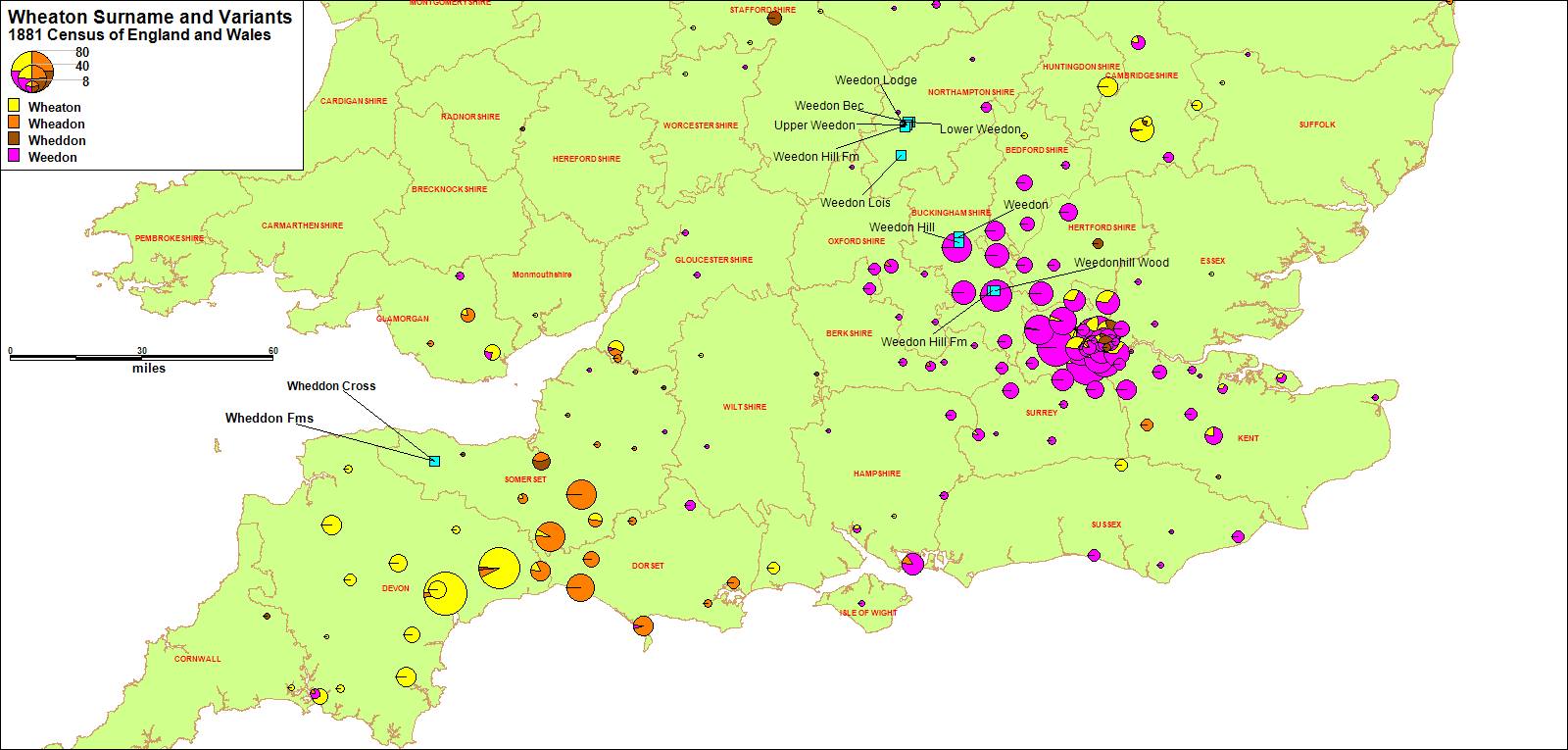
This map by Howard Mathieson includes a little wider swath and Weedon variations.
WHEATON distribution in Southwest England and Wales
Posted on August 12, 2015 Leave a Comment
WHEATON SURNAME VARIANT MAP
This map was recently generated for me and it shows WHEATON, WHEADON and WHEDDON derivations in England in 1881 census.
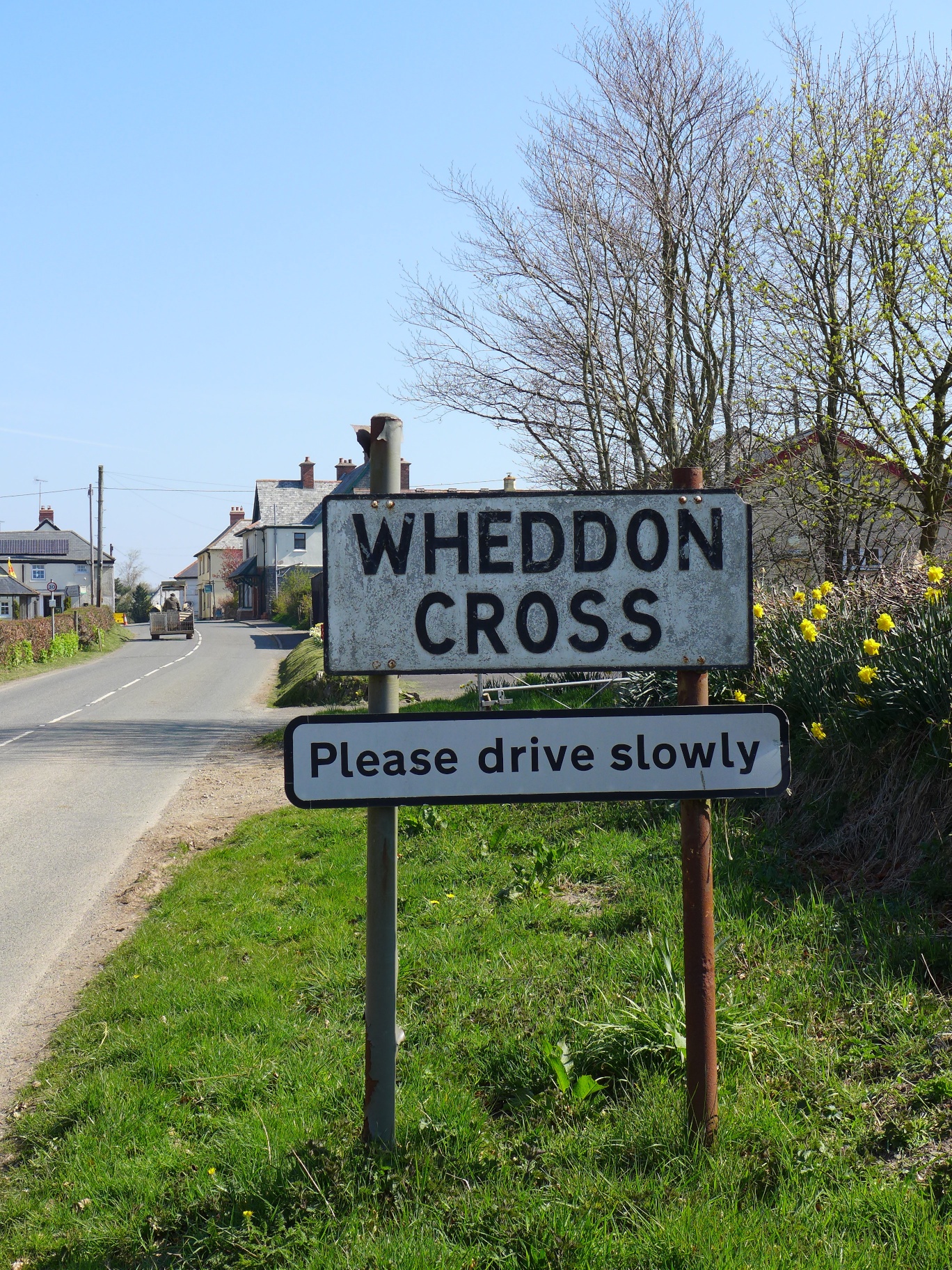
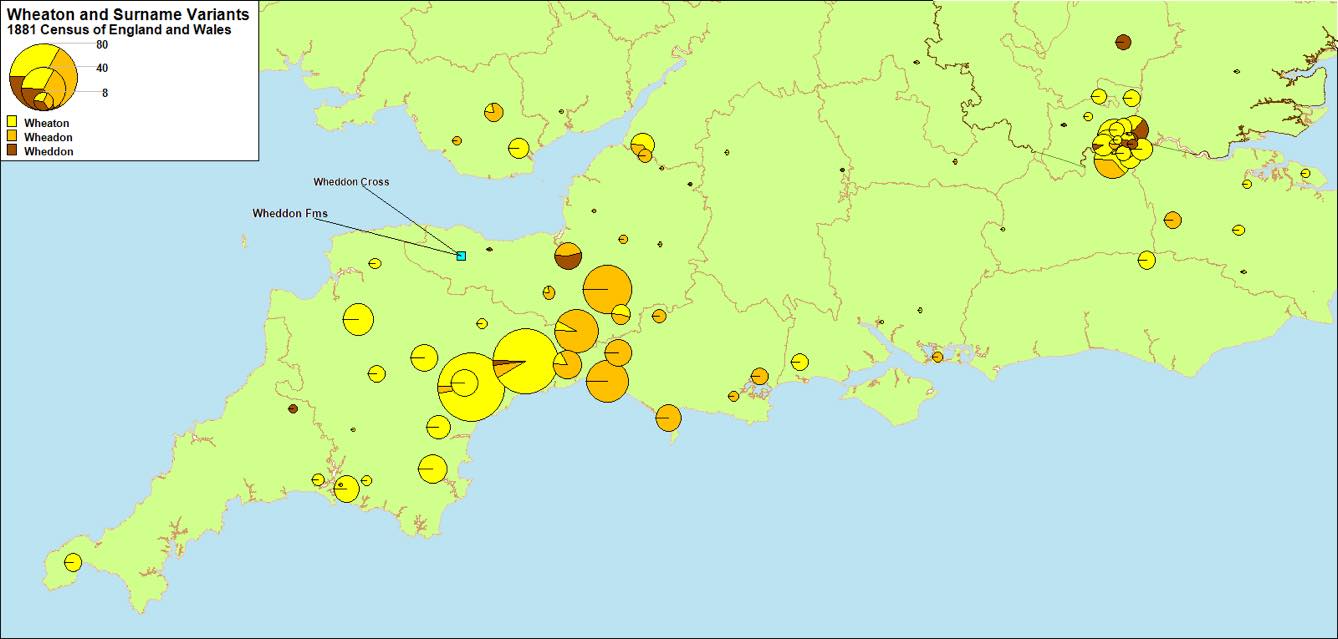 You can see thatWHEATON is more highly represented overall thanWHEADON and there is some overlap. WhereasWHEDDON appears in locations widely spread with theclear cut highest portion near Bridgewater, Somerset. Across the channel in Wales we findWHEATON in Cardiff,WHEATON andWHEADON in Pontypridd andWHEADON inPorthcawl. The small Turquoise point is the village ofWHEDDON CROSS that we Den, Jean and I visited in April.
WHEATON GROUP B News
We are awaiting analysis of our new TRIPP match.
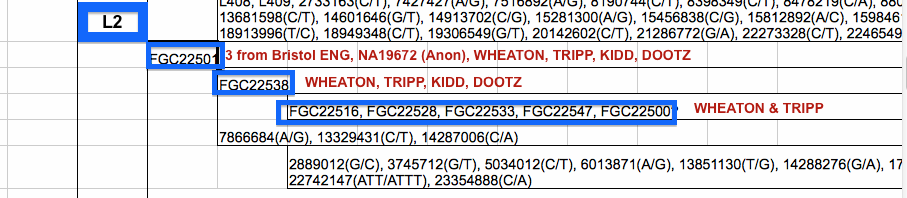
Here is our placement on our section of the L2 tree. Add how we match other surname samples.
SNIPPTY DO DA! WHEATON GROUP B
Posted on July 27, 2015 2 Comments
Hi all,
Yes things have been quiet here for quite some time. Although eventually I will be posting more about my trip.
A few days ago I was alerted by Rich Roca (of R-U152) of a new match that is in our FGC22501 cluster, below L2. Our WHEATON Group B has a genetic distance GD of 0 to -7, this new TRIPP match is our closest match to date -16 . Let me recoup in the order of when we got the matches.
DOOTZ -26 41/67 markers c1100 moved from Flanders–Saxony to Romania; our connection could easily be c2500-3500 YBP
KIDD -20 47/67 markers unknown location in the British Isles Probably; c 2000-2500 YBP
TRIPP -16 51/67 markers John Tripp (1610-1678) of Horkstow, Lincolnshire; 1500-2000 YBP
This diagram shows our very own SNP progression. Each box shows all those sharing the SNPs. As we move downward, the pool shrinks and the time frame gets closer to the present.
SPECULATION
So at first this had me scratching my head— TRIPP has some of its highest concentrations in Somerset Co, England but this branch is from Lincolnshire and appears in the records as early as 1500’s—we do not know if there is any relation between the TRIPPS in Somerset & Lincolnshire.
There is some Lincolnshire connections to Flanders. First are Flemish soldiers that were stationed near Hadrian’s Wall in the years 90-120 and up until the 4th century. There are also Roman soldiers that may have passed through this area of the Rhine and there is STILL the possibility of earlier Celtic immigration into Britain. L2 is though to have originated about 4900 years ago in the Alpine regions of Northern Italy where it is found in its highest concentrations today (10-12%) L2 was found to be about 5% of those in the 1000 Genomes Brabant (Belgium) Project. And falls to about 2% in Britain. The following map shows the Possible path from the east to the Bell Beaker cultures which may have been where L2 developed. Then for our branch moving up from northern Italy into the Rhine region and finally North Belgium and across to Britain. Still not clear of that would have been in the Celtic era Belgae, Roman or Flemish immigration. It does appear that the closest matches are in the are from Cologne into the north Netherlands
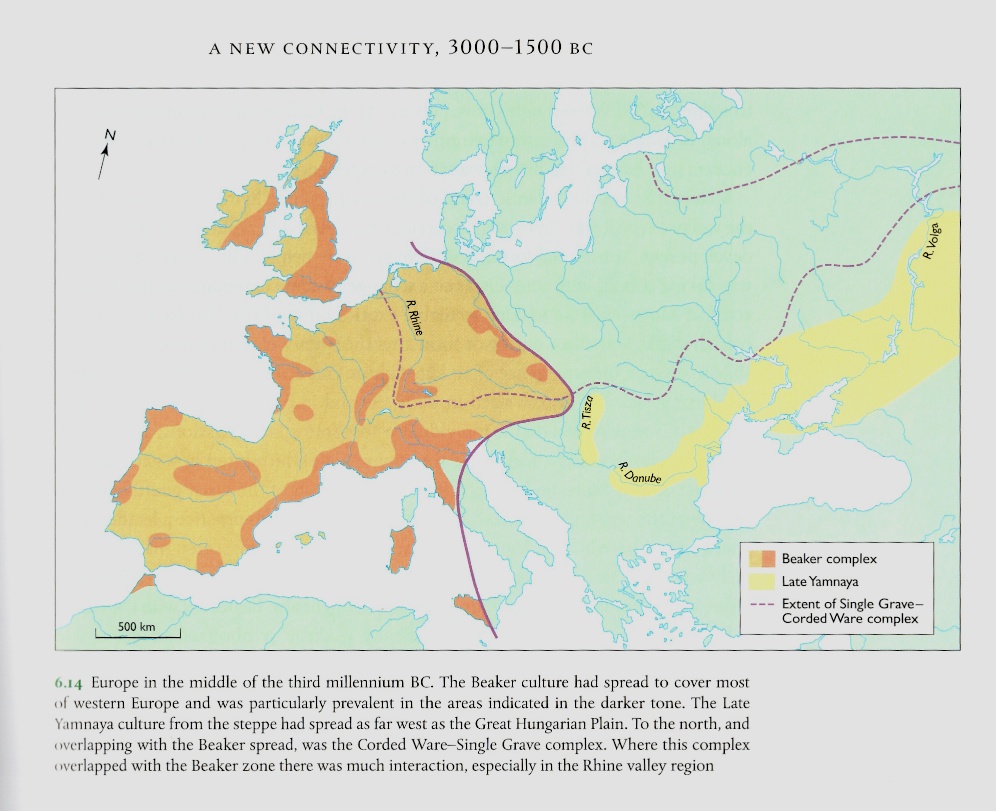
I am still hoping that a few of you decide to do the YSEQ panel available for available for $231 here http://www.yseq.net/product_info.php?products_id=10796 This would be most valuable for those not descended from Robert WHEATON.
I have requested primers for FGC22501 and FGC22538 in hopes that at $17.50 each some other surnames may decide to test. Especially interested in some in the Netherlands project.
Do not hesitate to contact me with questions.
Closing in on Robert WHEATON’s homeland
Posted on April 12, 2015 1 Comment
GROUP B: the origins of Robert WHEATON
For me searching for Robert’s origins have been a nearly life long quest. Aside from my speculation we have DNA matches with the HANCOCKS from South Molton, DEVON and the HOWELLS from Newport Wales. One of our two New SNPS: FGC22538 is shared by:
DOOTZ 1200 Transylvania Saxons
KIDD 1600’s unknown UK (Although I did find a Devon Kydde in 1334)
And now we have three more anonymous matches to FGC22538 but they are quite helpful. They are part of a medical research study but the geographic area is known. This area is roughly from Bridgewater up through Bristol to about Sharpness in a 10-15 miles swath.

This area is just north along the Bristol channel from our area of interest so I consider this confirmation of the right area. There are no early Wheatons in this area so my guess is that they would share common ancestry from severall hundreds to several thousands of years ago.
And in other exciting news the FGC22503 Panel is available for any Group B participant at YSEQ ($231 for the panel or individual SNPS $17.50) We have results for 18 of the 22 SNPS being tested and of the 18 thus far 16 are shared by both Michael and Jerry. So they would be at the level of Robert 1 or earlier. Those where they differ may be defining for the branches via Robert’s sons. Once the last 4 are in I would recommend anyone that does not have a paper tree back to Robert consider testing these 2 (or more) SNPS. Those like MALLENBY, HANCOCK, RAINES and HOWELLS—the panel and what is shared and not shared will again define the tree pre Robert 1 WHEATON. Thank you to Jerry for making this discovery possible.
Additional Information shoukd you choose to order. The panel is called FGC22503 the individual SNPS that are differenr (Michael positive and Jerry negative) are FGC22526 & FGC22529. Imwould remiss if I did not mention that there are nearly 60 other SNPS tested as a byproduct of where on the Y we are tested and these (as they should be are all negative.) Positives are a one time occurance. So any man who has it he is descended from a common ancestor in which that mutation once occurred. Our progression looks like this R: U152: L2: FGC22501: FGC22538: FGC22503-FGC22518 etc then we have a split into two branches: Those that are positive for FGC22526 & FGC22529 and those that aren’t. Remember these labels are assigned by the testing labs. The actual position of a SNP is an actual address on th Y chromosome ie FGC22526 = 15172319 where the ancestral value is A and the derived (or mutated value) is T.
Heading to Devon
Posted on April 4, 2015 Leave a Comment
Its been while since I posted here but most of you know I am headed to England on April 15th.
I will be visiting locations in Devon and Somerset identified with various branches of Devon WHEATONS and wanted to give you a tentative list of locations we may visit and their connection to the various WHEATON Groups. I will be meeting up with Den and Jean WHEATON of Group E and David of Group A (My husband and I are of Group B). So a bit of a WHEATON gathering!
Halberton: 1332 William Whetene
Tiverton: 1376 Alexander Leygh aka Alexander Wheton, very early Baptist church founded here 1607
Loxbeare: 1541 Peter Wheton
Witheridge: Wheddon Farm (staying here)
Woolfardisworthy: 1332 William Whetena, 1569 Thomas Wheaton Muster Roll
Meshaw: 1332 Roger de Weydon
Sidmouth, Branscombe, Sidbury: Wheaton Group A
Axminster: Wheadon Group C (Thomas Wheadon progenitor)
Ottery St Mary: Robert Wheaton marries Margaret Bastine here in 1604 Group?
Wheddon Cross
Wyddon, Somerset: Wyddons in the 1500’s
Wooten Courtenay: Wheddon early 1600’s
Dunster: Wydon & Widnone 1500’s
St Deucmans: 1620 Will of John Wheddon, Blacksmith
Stogursey: Robert WHEADDON m. 1599 St. Andrews to Joan HUISH; Hugh Wheadon will 1650
There are many, many locations to the West and South that I will not have the time to visit this trip. I am concentrating on the locations in the North most likely being the homeland of Robert Wheaton (Group B) and hitting known locales for Group A & C.
I may post photos from my trip here as I go or I may wait til I get back.
Cheers!
Colorful Chart of L2 downstream SNPS
Posted on December 14, 2014 Leave a Comment

One of our L2 friends took Rich Rocca’s chart and made it into this spiffy Graphic. The WHEATON group B and allied lines are the FGC 22501 and FGC 22538 the third column from the right. As we do further testing we should be able to make further progress. This looked to me like Christmas presents!
Also Here is the larger U152 chart with L2 on Left and we are third from the bottom.

I Have Updated Our Group Results
Posted on November 10, 2014 Leave a Comment
From the Last post I have been inspired to update our colors for groupings I have updated our FTDNA results page here.
https://www.familytreedna.com/public/Wheaton/default.aspx?section=ycolorized
Please note a very interesting result for our member James Lewis Wheaton whose ancestor is from Gornalwood, Sedgly, Staffordshire, England b. 1770 He appears to be a distant match with Group B and shares a couple of off-modal markers with Paul Ritchie Wheaton. Once we get the new SNPS available this would be a good place to test to make sure they do connect.
And I have updated the WHEATON Interactive map here to reflect those same colors here.
https://www.google.com/maps/d/edit?mid=zh5CkrS3uzMQ.kyaeE0_ERf6A
This map is scaleable you can zoom in and out and click on any point for more information. This is a screenshot showing possible groupings in Devon. [This map is not scaleable here] Some points refer to DNA results and others are chosen to reflect connections with the historical record. They are subject to change.
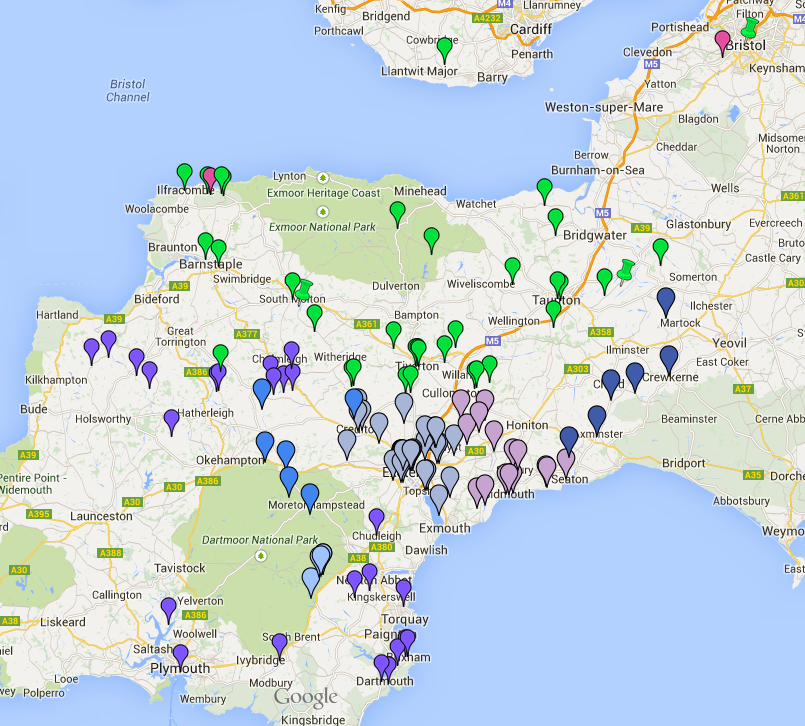
This map is also visible on this webpage
https://sites.google.com/site/wheatonsurname/wheaton-specific-resources/devon-wheatons
Groups are as follows:
Group A Group A Wheaton os Sidmouth is shown on the interactive map in Light Purple. Group D is dark purple
Group B is L2 Wheaton of N. Devon and related families are shown in green
Group C is U106 The sub groups are shown C Wheadon Dark Blue, C2 Wheadon (not shown), C3 Wheaton Exter in Blue gray, C4 Whiddon light blue Medium Blue is Sir Whidden line.
Group D is L21 and shown in dark purple on the map.
Group E is I-P37.2 Wheaton & Wetton and shown in Peacock
Group F is I-P37.2 Wheaton Peacock (not shown)
Bowen is in Magenta—related to Group B
POST NEOLITHIC ORIGINS of WHEATON GROUPS
Posted on November 9, 2014 Leave a Comment
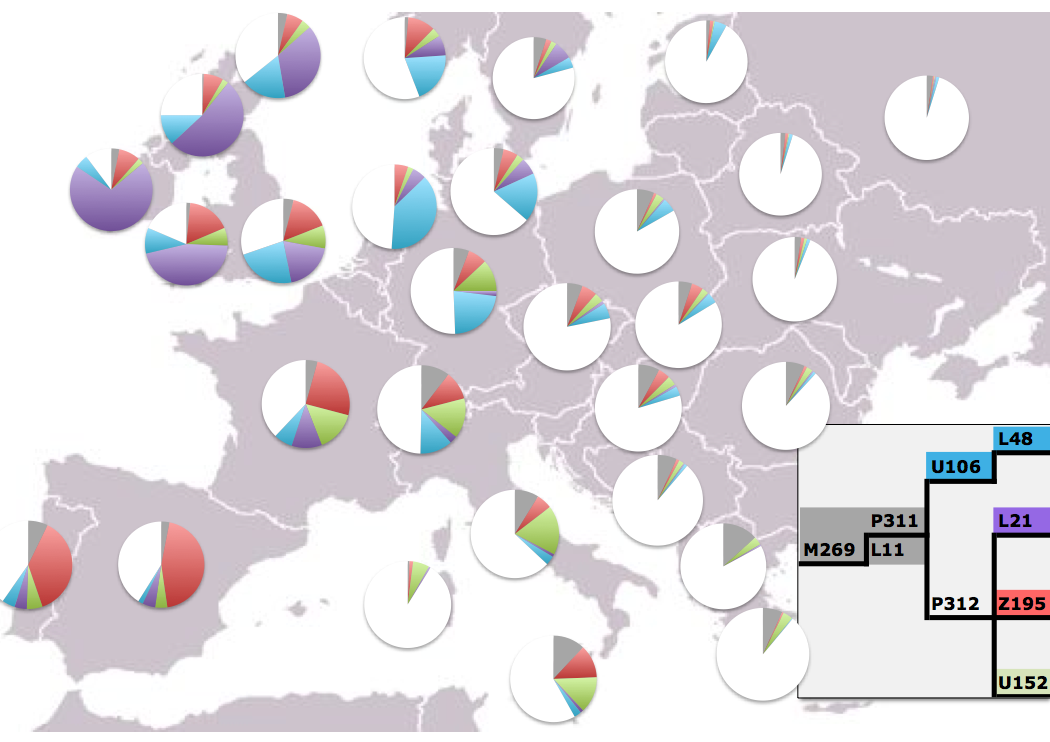
In case you haven’t noticed I love maps and I love tracing the paths of our ancestors. During the recent Family Tree DNA conference Michael Hammer’s presentation was on the Post Neolithic Expansion of Haplogroup R-M269 in Europe. I have adapted one of his slides to show how WHEATON groups A, B, C and D are related. Hapolgroup I Group E & F would have taken a path perhaps more towards Asia and then to Norway (Vikings) and then into England.

So what we have here is the Common R Haplogroup ancestor M269 Moving north into Eastern Europe (P312) and from there Groups A, B, & D (U152) move into Central Europe whereas Group C (U1060 Moves right into the heart of Saxon territory. Group A & D migrate from central Europe to England. Group B (L2) likely move into the Alpine region of Europe before moving northward again where we pick up our match from Northern Germany or Belgium before migrating to England.
Group “A” WHEATON of Sidmouth, DEVON, ENGLAND: Haplogroup R1b1a M269 Likely R-L21
Group “B” WHEATON of SW ENGLAND and So. WALES: R1b-U152>L2>FGC22501 > FGC22538
Group “C” WHEADON & WHIDDON of DEVON, ENGLAND: R1b U106 R-L48>Z346>DF101>DF102>FGC12993 (C2, C3, C4 similar)
Group “D1” WHEATON of Winkleigh, DEVON Haplogroup R-L21 M269 WAMH Likely R-L21
Group “D2” WHEATON of N Jersey Haplogroup R-L21 WAMH Perhpas of Welsh origin
Group “D3” WHEATON R-L21 WAMH Likely R-L21 & R-L144
Group “E” WHEATON Wetton of STAFFORDSHIRE, HUNTINGDON & CAMBRIDGE, ENGLAND: Haplogroup I-P37.2
Group “F” WEEDON of Lancashire England Haplogroup IP37.2> CTS1977
From the same presentation a distribution graph of Haplogroup frequencies in Europe
To give you an idea of how far we have come this is the Phylogenetic tree for R-M269 in 2010:
 Now this is in 2013, three years later. Each line represents a SNP. So essentially about 14 newer SNPS in 2010 and Hundred’s in 2013

 And I would venture to guess that as we exit 2014 we have ten times the above tree. And so this is how SNPs (mutations) are allowing us to further map the Y-Tree including our WHEATON parts of it.
What Next Generation Sequencing (NGS) does and how it works to help us
Posted on November 6, 2014 Leave a Comment
Next Generation Sequencing is only about a year old and is being used for complete sequencing (full genomes) and for sequencing just the Y chromosome. The Y chromosome contains YSTRS, YSNPS, and mtDNA. Whether you test a Big Y at FTDNA or a Y PRIME or ELITE at Full Genomes Corporation this new sequencing process is looking for newly discoverable SNPS. Most of the Y chromosome never undergoes recombination and so is passed from father to son to son and so forth intact. That’s how we can trace back any man from now to the proverbial Adam.
YSTRs are the markers that men have tested in our DNA project. They tend to Mutate in the realm of every 100-500 years and have helped us identify who is related in, what we call, a genealogical time frame (since the advent of surnames). They are counts of long stretches of strings of values “AAAGGGGTTTGAG” where we count how many times that sequence is repeated. The number of repeats is recorded for that STR for example:
DYS19 = 16 [repeats]
YSNPs are markers where the ancestral value has mutated to a new value. This is generally a one time event. At a given position on the Y chromosome a SNP mutates. Here is one of our newly discovered shared SNPs:
at Position 18099238 the ancestral value is “A” but ours is “G” (SNP is named FGC22538)
That change is a mutation that gets recorded once in one man one time and then every man that is descended from him carries that mutation. by going from the most recent SNP backwards we can essentially reconstruct the whole Y tree.
Let’s review

Now Group C continues

So find Z1 and continue here

So you can see that in the above example only KINCAID and FRANK share with our Group C WHEATON at the FGC12993 SNP. And beyond that KINCAID shares its own SNP Z1370.2. This essentially the way in which SNPs can be family defining.
Then Group B continues

Since this chart was drawn there are lots more sub-clades under L2 and our newly discovered one looks like this 
Note the HUGE difference in the number of sub-clades under Group C WHEATON with 13 sub-clades between its ancestor U106 (S21) versus Group B WHEATON with 2 below L2. U106 is a more prolific group in the UK and also has many more testers. L2 is widely scattered in the UK and does not have as many testers.
Here’s a slightly different example that is not of our group but shows where we can go. [This happens to be R-L21- DF 63.] The long line of SNPS at the top are shared by all those below. All of the men sharing these SNPS are FRANKLINS except one who has an NPE and is also by blood a Franklin. Okay then you can see that some below the top block are shared by some FRANKLINS and not others. These SNPS can be used to identify who is more closely related to whom and when the lineage is known to identify different lines below the common ancestor. In this case the common ancestor was born about 1780.

So this means that if we had more WHEATON group C testers we would find similar clustering. And since we have a pool of about 18 potential test takers for WHEATON group B we might eventually be able to give Glen and Adam and others who don’t know how they connect a definitive path to ROBERT WHEATON and we can tell whether MALLENBY, RAINES, HOWELL and HANCOCK are related downstream of ROBERT or before Robert as in before 1600. And if people test specific SNPS once we have identified potential ones that might be shared we can tell how WHEATON, MALLENBY, RAINES, HOWELL and HANCOCK are related.
So what we in Group B have now is a long list of new SNPS that must be confirmed by others within our group. Some of them are likely to be private like the one we discovered in Jerry’s Walk through the Y and others like the example above are going to be shared by many. I have requested information on a panel at YSEQ. And a couple of you are considering other options. If we get one or more results from NGS we should know which direction to head.
If this is still not clear please ask questions. More info to come.
More on Ancient Population studies connected to WHEATONS All groups
Posted on November 6, 2014 Leave a Comment
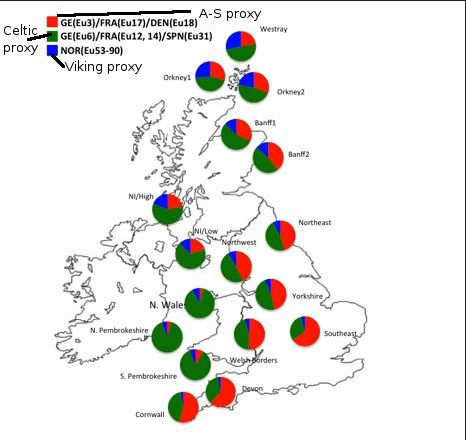
I wanted to share with you this map based on the project “Peoples of the British Isles” (POBI). This is based on genetic (atDNA) testing of people who had 4 grandparents born in the UK within several miles of each other. This map shows the composite origins of their DNA by region. They are approx. Proxies:
Red=Anglo Saxon
Blue =Viking
Green=Celtic
We might expect a similar breakdown with Y-DNA. We See this somewhat in our Wheaton groups.
Group A (not sure if it is Celtic or Anglos Saxon)
Group B Celtic
Group Cs Anglo Saxon
Group Ds Celtic
Group E Viking
 Wheaton Wood